7 Mar 2017

Unionism loses its grip on Northern Ireland in March 2 election

Steve James

The main beneficiary from the March 2 elections to the Northern Ireland assembly was the Irish bourgeois nationalist party, Sinn Fein. For the first time since Ireland was partitioned in 1921, in the aftermath of the Irish War of Independence, pro-British Ulster unionist parties have lost their combined absolute political majority in the regional government.
Although the Democratic Unionist Party (DUP) led by Arlene Foster remains the largest party, with 28 seats, in the assembly based in Belfast’s Stormont House, the party now only has one more seat than Sinn Fein.
Sinn Fein’s total vote was only 1,186 short of the 225,413 won by the DUP out of a total number of votes cast of 812,783, on a relatively high turnout of nearly 65 percent—up by 10 percent on last year. The DUP’s first preference votes were down 1.11 percent on last year’s Assembly vote, with Sinn Fein’s up 3.89 percent.
This means that together with the 10 seats won by the Ulster Unionist Party, one Traditional Unionist Voice seat and one independent unionist, the combined forces of pro-British unionism can only muster 40 seats in a reduced 90-seat assembly.
At the last elections, held less than a year ago, the combined unionist seats amounted to 55 of 108 then available.
On the nationalist side, Sinn Fein’s 27 seats, added to the Social Democratic and Labour Party’s 12, gives the Irish nationalists 39 seats. But these, combined with 8 seats won by the “cross community” advocates of economic liberalism, the Alliance Party, 2 for the Greens and 1 for the pseudo-left People Before Profit Alliance, mean that non-unionist forces amount to 50 seats.
Negotiations for a new power-sharing government will therefore take place with Sinn Fein much strengthened. But the party has previously insisted that it would not re-enter government with the DUP led by First Minister Arlene Foster, pending the outcome of a public inquiry into the Renewable Heat Initiative (RHI) scandal, so-called cash for ash, and with outstanding Irish language and deeply contested “Troubles” legacy issues unresolved.
If a new arrangement between the two parties cannot be found, under the terms of the 1998 Good Friday Agreement, another round of elections must be held or the Northern Ireland Secretary James Brokenshire can re-impose direct rule from London.
Brokenshire’s predecessor, Theresa Villiers, has suggested that Westminster could legislate to give the Northern Ireland parties more time to come to terms. The Conservative government in London is seeking to avoid adding to its intractable problems in the aftermath of last year’s referendum vote to leave the European Union (EU), by including direct rule of Northern Ireland among them.
The March 2 poll was triggered by the resignation of the deputy first minister, Sinn Fein’s gravely ill Martin McGuinness. McGuinness’s resignation and Sinn Fein’s refusal to immediately nominate a successor meant that, under the complicated constitutional rules surrounding Northern Ireland’s administration, new elections were obligatory.
In response, Foster promised a “brutal” election. Throughout her campaign, she warned hysterically of the dangers of a victory for Sinn Fein and its longtime leader and unionist bogeyman, Gerry Adams. She repeatedly presented McGuinness’s eventual replacement, Michelle O’Neil, as “installed by Gerry Adams and...instructed by Gerry Adams.”
As a consequence, the outcome, although marking a shift towards Sinn Fein, is also deeply polarised. Despite being in government for 10 years, it is notable that the DUP vote did not collapse, but rather its rival (and self-proclaimed “moderate”), UUP, lost 5 of its 15 seats and will see a leadership contest next month after the resignation of Mike Nesbitt.
Foster’s aggressive rhetoric also tended to encourage nationalist voters to turn out for Sinn Fein; otherwise the party might have been expected to suffer from popular anger at the corruption and swindling that has characterised the assembly’s operations during Sinn Fein’s years in power with the DUP.
Overhanging the election was the steadily deepening crisis surrounding Britain’s departure from the EU. Northern Ireland voted to remain in the EU by 55 to 45 percent, reflecting the fact that significant farming, infrastructural and cross-border subsidies have found their way from the EU’s coffers to Northern Ireland agricultural and business interests.
Brexit, besides disrupting the flow of subsidies, will transform the border between Northern Ireland and the Irish Republic into an external boundary of the EU.
Imposed by the British Army and maintained by anti-Catholic pogroms in 1921, the border barricaded the wealthy Northern industrial heartlands of the Ulster Protestant capitalist class from the impoverished and turbulent Catholic south. During the twentieth century and particularly during the “Troubles”—the dirty war between the British Army and Irish republicans between 1969 and 1998—the border was heavily militarised.
The Good Friday Agreement mostly brought an end to armed conflict in the north by laying the basis for republicans to join the Stormont Assembly, under complex and sectarian power-sharing arrangements. These, reflecting the long-standing loss of influence by Ulster capitalists bound up with the destruction of heavy industry, amounted to a joint unionist and republican effort, overseen by the British and Irish governments, to attract global mobile investment—while relying on sectarian divisions to police the working class.
Today, the border is almost invisible, and is crossed daily by commuters, travelers and considerable amounts of commerce and trade. British, Irish and Northern Irish politicians of all stripes have insisted that border controls will be kept to a minimum under Brexit, but no one has yet explained what this means or how it can be achieved. Proposals from both the Irish government and Northern politicians, including Sinn Fein, that some form of special status could be created to allow Northern Ireland to retain EU membership or single-market access have been proposed, but have been rejected by both the DUP and London.
The issue is becoming one of a lengthening list of disputes between powerful rival pro- and anti-Brexit factions of the ruling class, and between the pro-Brexit British government and the EU over the terms of Brexit.
The hard-right DUP is firmly in the Brexit camp and functioned as a conduit for funding from dubious sources for the “Leave” campaign across the UK. According to the pro-EU OpenDemocracy web site, the DUP accepted cash from the hitherto unknown Constitutional Research Council, fronted by a Scottish-based former Conservative party candidate, Richard Cook. Cook reportedly has links to former Saudi intelligence figures and royals seeking to benefit from a Brexit-induced fall in the value of sterling.
Sinn Fein, by contrast, sees the threat of Brexit as an argument for a “border poll” referendum on Irish unification, a provision for which is in the Good Friday Agreement, and a position that is gaining a hearing from the Irish government and the EU. Commenting on the election outcome, Irish Taoiseach Enda Kenny, fresh from talks with Michel Barnier, the EU’s chief Brexit negotiator, and EU President Donald Tusk, stated, “If the people by consent were to form a united Ireland, that could be a seamless transfer as happened in the case of East Germany and West Germany when the Berlin Wall came down.”
Kenny’s remarks were endorsed by EU Parliament President Antonio Tajani, who said, “Ireland must ensure that its economic links to the UK are protected,” and secondly, “...it must ensure that the terms of the Good Friday Agreement which has given peace in Northern Ireland are included in any future agreement between the UK and the EU.”

Massive increase in attacks on refugees in Germany

Franci Vier

There were 3,533 attacks on refugee shelters and individual refugees in 2016 in Germany, indicating a massive increase in right-wing violence directed against a vulnerable group of people who have experienced war, persecution and poverty.
The growth of such deliberate violence can only be understood against the background of the refugee baiting conducted by the establishment parties, the media and sections of the academic milieu. In 2015, when many refugees from Syria and other war zones came to Germany, there was an outpouring of solidarity in the population. But since then, the most right-wing sections of society have been mobilized against them with various threatening scenarios.
Of the 3,533 registered attacks, those on refugee shelters (inhabited and uninhabited) account for 988. These included attacks (66 arson attacks and four involving explosives), propaganda offences (211 cases), property damage (371 cases) and other assaults. While compared to the previous year—the highpoint of the refugee influx, when 1,031 attacks on refugee homes took place—this number has decreased, violence in every other category is on a sharp rise.
There were 2,545 registered cases of violence involving direct attacks on refugees outside their accommodations (due to lack of data there are no comparative figures for 2015). In total, 560 people were injured, including 43 children. Added to this are 217 attacks on aid organizations and their volunteers.
The figures are derived from a response by the Interior Ministry to a parliamentary question quoted by the Funke Media Group at the beginning of the week. Since no official statistics have been released, the figures are only preliminary and may rise.
Violence against refugees had risen to around 200 offences from 2014 to 2015. In May 2016, the Federal Criminal Police then reported an increase of 44 percent over the same period the previous year. Thus it could already be foreseen that politically motivated crime and violence by right-wing groups and individual perpetrators against refugees would take on a massive scale. The number of attacks rose yet again, while the number of refugee shelters and refugees has decreased. The figures for 2016 mean that 10 attacks took place every day last year.
In autumn 2016, Der Tagesspiegel reported an increase in the brutality of the violence by far-right groups and neo-Nazis. The number of attempted homicides has risen from one (2014), to four (2015), and 11 in 2016.
Attacks occurred throughout the country, and the number of successful prosecutions is generally low. The media only report particularly brutal cases, such as those in Clausnitz and Bautzen.
In Bautzen at the end September 2016, after an aggressive provocation, around 80 right-wing extremists chased 20 young asylum seekers through the city because they had refused to leave a public square. One refugee was injured with a knife. The far-right hooligans threw stones at an ambulance, which could only continue to take the youth to hospital under police protection. In another incident in the same city, an asylum seeker’s residence was set on fire, while right-wing onlookers stood by and applauded.
In Clausnitz in the state of Saxony in February 2016, an angry group of right-wing demonstrators surrounded an incoming bus of refugees and abused the terrified occupants with xenophobic slogans. The police responded by violently forcing the refugees from the bus into their hostel.
Most assaults are only reported in the regional press or not at all. For example, the Berlin police only issued a press release about 15 of the 57 attacks on refugees in 2015. In 2016, there were just seven press releases on some 60 attacks on refugee homes. The situation is similar in Bavaria. Police issued press releases on just two of the 30 attacks on refugee accommodation or individual refugees in Munich.
Assaults by refugees, however, whether fictitious (as the recently alleged “sex mob” in Frankfurt) or grossly exaggerated (as in New Year's Eve 2015 in Cologne), are exploited politically and by the media to stamp refugees in general as being potential perpetrators of violence. There is a systematic effort to stigmatize refugees as sex offenders, social parasites or potential terrorists.
The statistical data of the Federal Police tells an entirely different story, however. As of June 2016, crimes “against sexual self-determination” as well as the general crime rate have not grown proportionately.
In November 2016, criminal psychologist Ulrich Wagner told broadcaster SWR, “The fact is that in 2015, more than a million people came to Germany, and this did not lead to a corresponding increase in crime.” He pointed out that the “sense of security” in the general population is influenced greatly by the detailed media coverage.
The massive violence against refugees takes place against a background of a political turn to the right internationally. In the US, Donald Trump and his fascistic adviser Stephen Bannon have made nationalist and racist action against migrants the official state doctrine.
In Europe as well, nationalist and xenophobic views have gained ground in the political establishment with the rise of the National Front in France, UKIP in Britain, and the far-right Alternative for Germany. Official social discourse has moved clearly to the right.
Germany’s Left Party also bangs the drum for a strong state and the arming of the police. Its parliamentary leader Sahra Wagenknecht, the supposedly “left” figurehead of the party, stirs up particularly offensive sentiments against refugees. At times, she calls for upper ceilings on the number of refugees; at others, she criticizes Merkel’s “chaotic policy” of “uncontrolled border openings” or demands that refugees who abuse German “hospitality” be deported.
Jörg Baberowski, professor of Eastern European history at Humboldt University in Berlin, has denounced refugees in numerous interviews and newspaper columns as a burden on the welfare state and as potential perpetrators of violence.
Against the backdrop of this intellectual incitement, right-wing forces feel encouraged to move from public expressions of anti-refugee hatred to carrying out actual deeds. While refugees are criticised for their supposed readiness to commit violence, in actual fact there is a massive rise in right-wing violence against the refugees themselves.

German authorities ban appearances by Turkish politicians

Justus Leicht & Peter Schwarz 

The authorities in several German cities have prevented appearances by Turkish government officials who wanted to advocate a yes vote in the constitutional referendum of April 16. About 1.4 million Turkish citizens live in Germany who are entitled to vote in the referendum.
The bans were justified on technical grounds. For example, the city of Gaggenau refused to allow an event with the Turkish justice minister, Bekir Bozdag, arguing that parking and access roads would not cope with the expected visitor numbers.
The city of Cologne refused to allow an appearance by the Turkish Economics Minister Nihat Zeybekci at the Porz town hall on the grounds that there was no hiring agreement for this event, because a publicised “theatre event” had been recast as an “information session.” And the city of Hamburg banned a planned appearance of the Turkish Foreign Minister Mevlut Cavusoglu on Tuesday on the pretext that fire protection measures were insufficient.
In reality, the bans are for political reasons. They are taking place against the backdrop of a hysterical campaign to ban all Turkish politicians who support the new constitution, sought by President Recep Tayyip Erdoğan to strengthen his rule.
Bavarian state premier and leader of the Christian Social Union (CSU), Horst Seehofer, told the Süddeutsche Zeitung that Turkish politicians were abusing their “right to hospitality” when they “promote anti-democratic measures in their country.” CSU domestic affairs expert Hans-Peter Uhl told the Bild newspaper such meetings should, if necessary, be disbanded by the security authorities.
In the newspapers of the Redaktionsnetzwerks Deutschland, Free Democratic Party (FDP), leader Christian Lindner railed against “systematic Turkish state propaganda on German soil.” He called on the federal government to call a halt to it.
Even federal Justice Minister Heiko Maas (Social Democratic Party, SPD) spoke out against Erdoğan himself being allowed to promote the constitutional amendment in Germany. With reference to the German-Turkish journalist Deniz Yücel currently sitting in Turkish custody, Maas told an SPD event in the Saarland, “I think with what is happening there, we are at a point when the time to keep quiet has to be over.”
The most aggressive calls for a general ban on appearances by politicians from the Turkish ruling AKP have come from representatives of the Left Party. In Berlin, Left Party leader Bernd Riexinger demanded, “that the next promotional show for Erdoğan not take place.”
“The Turkish despot is leading the government around by the nose,” he said, with barely concealed chauvinism.
In the Rheinische Post, Left Party parliamentary leader Sahra Wagenknecht accused the government of “cronyism with the Turkish autocrats.”
The demand for a ban on appearances by Turkish politicians is undemocratic and reactionary.
Proponents of such a ban say it is justified because Erdoğan is suppressing his political opponents and that the proposed constitutional amendment has authoritarian characteristics. Therefore, as Heribert Prantl wrote in the Süddeutsche Zeitung, “freedom of speech for Erdoğan (and his governmental campaigners) in Germany” means “aiding the elimination of fundamental rights and liberties ...”
This argument is essentially false. Such prohibitions do not defend democracy and freedom of expression in Turkey, but suppress it in Germany. Leading politicians and journalists presume to prescribe to Turkish citizens living in Germany what they may think about, whom they may listen to and who not. In place of political debate comes bans and censorship. In this way, a precedent is created for the suppression of all dissent. The state will determine what may and may not be said in public.
If the AKP (which after all, won 60 percent of the vote among Turkish citizens living in Germany in the last election) may not express its views in Germany, what about members of socialist parties, which the ruling elites accuse of being “anti-constitutional”? Or what about Muslims, whose faith some right-wing politicians claim is incompatible with the constitution?
That the discussion is going in such a direction is shown by another argument that the proponents of the ban cite against the appearance of Turkish politicians: fundamental rights only apply to Germans.
In its weekend edition, the Süddeutsche Zeitung wrote, citing the Freiburg law professor Ralf Poscher, arguments for a general ban on assembly were “legally feasible” because Article 8 of the constitution (“All Germans have the right to assemble peacefully and unarmed without prior notification or permission”) was a “German fundamental right.”
On Monday, Heribert Prantl repeated this shameful argument. Pointing to earlier appearances by Erdoğan in Germany, he warned that Turkish government politicians should not be “given the impression that their campaign speech rights in Germany are a kind of customary right.”
The government had permitted such appearances in the past, “even if the right of assembly is really only a German fundamental right.” This was “an act of diplomacy … because one and a half million Turkish voters live in Germany and because German-Turkish friendship should be strengthened in this way.” But now the question arises, whether the German state was “not only entitled, but even obliged” to “stand firm against this promotion?”
In this way, the basic democratic right to freedom of assembly for hundreds of thousands of Turks living in Germany is made dependant on arbitrary state decisions. No events with elected Turkish politicians—even completely peaceful ones—are to be permitted if their politics do not suit the German state. And this in a country that only 80 years ago denied millions of people all rights under the Nuremberg Race Laws because of their Jewish religion.
When it comes to their own interests, the German political elite use very different standards. Completely forgotten is the campaigning by Chancellor Helmut Kohl (Christian Democratic Union, CDU) in spring 1990 in East Germany, then still a sovereign state, where he promised “blossoming landscapes” if they supported reunification. And in 2014 on the Maidan, German Foreign Minister Guido Westerwelle expressed his solidarity in person with the right-wing forces that organised the overthrow of the elected Ukrainian government. In both cases, representatives of the German government were not discussing domestic German politics among expatriate Germans but were directly intervening into the affairs of other countries.
If it serves their interests, the German government has no problem dealing with autocrats and despots. For example, just last week, Chancellor Merkel visited the Egyptian ruler al-Sisi, who acts far more harshly against his political opponents than Erdoğan, and assured him of Germany’s interest in the stability of Egypt.
Merkel has agreed a dirty refugee deal with Erdoğan himself, which prevents refugees from the war zones in Syria, Iraq and Afghanistan from making the onward journey to Europe. Merkel wants to continue this deal, and for this reason, she, like foreign minister Sigmar Gabriel, has been cautious in speaking about the bans on Turkish politicians.
However, there are fierce conflicts among German politicians about how to deal with Turkey. From the start, Merkel’s refugee deal met with criticism in her own camp because a section believed German imperialism was binding its hands in the Middle East if it tied itself too tightly to Turkey. Above all, the CSU and the Left Party have for some time been demanding that Germany should act with more self-interest towards Turkey. And the defence ministry has invested much effort in the arming and training of the Kurdish peshmerga.
In the meantime, German-Turkish relations have reached a low point. Last week, the Turkish foreign ministry in Ankara summoned the German Ambassador Martin Erdmann and conveyed to him its “unease” about the actions of the German authorities. On Sunday, Erdoğan accused Germany of “Nazi practices,” which met with an indignant backlash in Berlin.
The defence of democratic rights and the struggle against Erdoğan’s authoritarian measures cannot be left to the German government and the bourgeois state. They require the mobilisation of the Turkish and international working class.

In northern France, Calais mayor bans distribution of meals to migrants

Antoine Lerougetel 

In an inhuman action, Calais mayor Natacha Bouchart of the right-wing Les Républicains (LR) signed an order on Thursday, March 2, prohibiting the distribution of meals to migrants.
After the brutal dismantling by police of the “La Jungle” camp, at the orders of President François Hollande’s Socialist Party (PS) government last October, and the dispersion across France of some 6,000 refugees wanting to go to Britain, at least 700 still live near Calais, in deplorable conditions. Several new migrants arrive daily in Calais, mostly from the Middle East, Africa and the Indian subcontinent.
85,000 people sought asylum in France in 2016, mostly from Sudan, Afghanistan, Haiti, and Albania. Almost two-thirds of their applications were rejected. The actual number of undocumented migrants is certainly higher.
During the visit to Calais by PS Interior Minister Bruno Le Roux on Wednesday, Bouchart said she wanted to prevent the formation of “magnets for migrants” and also to keep new “gathering points” from reappearing in Calais. Le Roux agreed, saying he also would “firmly oppose any gathering point”. Just for form, he added that “we will not prevent the distribution of meals”, which did not prevent Bouchart from signing her barbaric order the next day.
Bouchart said she was “personally opposed, even if it is humanly difficult to say,” to any humanitarian provision in Calais, whether it be meals or showers set up by Catholic Relief.
The legal argument of the municipal order is based on the prohibition of gatherings within a defined perimeter of the city. It “prohibits the abusive, prolonged and repeated occupation of the industrial zone of the Dunes” and asserts that the distribution of meals for migrants is “likely to disturb public order, safety and security.”
Sarah Arrom, who works for the charity Utopia56, reported that police used tear gas on Thursday to prevent volunteers from providing breakfast to 30 teenagers: “Tear gas has never been used before when we tried to distribute meals.”
Some leaders of the charities said they would not comply with Bouchart’s reactionary order. “We have been distributing food both day and night for two months, and we will continue to do so for a simple reason: people are hungry,” said Gaël Monzy of Utopia56.
Renke Meuwese of Refugee Community Kitchen and Help Refugees, told the media that kitchens were cooking about 400 meals a day, compared with about 50 during the previous month.
A Catholic Relief official, Vincent de Coninck, said he was “amazed that a politician could forbid children to wash and eat.”
However, aid volunteers in Calais are powerless to stop escalating attacks on the democratic rights and humanitarian conditions of the refugees. Closely connected to the petty-bourgeois social milieu of the parties and trade unions which operate on the periphery of the PS, they cannot and do not try to mobilise the working class to defend the rights of immigrants.
Faced with increasing attacks on immigrants by the PS and LR, the charities argue above all that their actions facilitate the police and health authorities’ defence of public order.
They stressed that food distributions make it possible to “avoid deaths on the streets,” to ensure “the safety of the people of Calais by avoiding theft and possible attacks” and to “identify medical problems, in particular the possible spread of infectious diseases.” They also point out that “the charities do this work because the state and public authorities do not carry out their own obligations, both legal and humanitarian.”
Only a broad and politically independent mobilisation of workers across Europe can stop the escalation of attacks on refugees and immigrants.
On November 23, Pierre-Alain Mannoni, a teacher-researcher at Nice Sophia Antipolis University, was tried for taking three wounded Eritrean girls to the doctor in his car. On January 4, at the Nice court the public prosecutor called for an eight months’ suspended prison sentence for the farmer Cédric Herrou, 37, for helping migrants near the Franco-Italian border.
These actions by the authorities are part of a wider strategy by all EU governments to discourage people in the Middle East and Africa from fleeing the imperialist wars that have devastated their countries for more than 15 years. Extreme right-wing attitudes, which would have been identified with the positions of the National Front, have become commonplace in mainstream French and European bourgeois politics.
Political parties and the media have long been campaigning against migrants in order to poison the political atmosphere and divide workers along ethnic and religious lines.
The Stalinist CGT (General Confederation of Labour) union confederation participated in the far-right demonstration on September 5 of last year calling for the dismantling of the “Jungle”. It thus contributed to the anti-immigrant hysteria whipped up by the candidates in the April-May 2017 French presidential elections.
Indeed, the CGT and its political allies, the New Anti-capitalist Party (NPA) and the Left Front alliance of the French Communist Party and Jean-Luc Mélenchon’s Left Party, defend the proxy wars in Syria and Libya with the help of Islamist forces as well as the anti-immigrant policies of the Socialist Party, which they supported during the 2012 presidential elections.

Warning of neo-fascist victory in France, Hollande promotes EU militarism

Alex Lantier

Before yesterday’s summit of German, Italian, Spanish, and French officials in Versailles, François Hollande gave an extensive interview to Le Monde and other papers of the Europa consortium—Süddeutsche ZeitungLa Stampa, the GuardianLa Vanguardia, and Gazeta Wyborcza. The French president outlined the deeply pessimistic perspectives predominating in the layers of the European bourgeoisie closest to Berlin and the European Union (EU).
Hollande unambiguously indicated that the EU is on the brink of collapse, in particular because a National Front (FN) victory in the April-May French presidential elections would install in Paris a neo-fascist government that could blow up the EU. However, having pointed to the bankruptcy of the French and European capitalist regimes, the only perspective he could offer was to develop the EU as a massive military and police-state machine.
Asked about an FN electoral victory, Hollande said: “The threat exists. The far right has never been as high in the polls for more than 30 years.” He added, “if somehow the National Front candidate were to win, she would immediately launch a process of exit from the eurozone, and even from the European Union. This is the objective of all the populists, wherever they are: to leave Europe, to close themselves to the world, and to imagine a world surrounded by barriers of all kinds and borders defended by watchtowers.”
Hollande posed as a defender of the EU and democracy against the danger of the far right. “My last duty is to do everything to keep France from being convinced by such arguments, or to take such drastic action,” Hollande declared, adding: “But France will not give way. First of all, because it is France and it is conscious of the fact that the votes on April 23 and on May 7 will determine not only the fate of our country, but the very future of European construction, as well.”
These democratic pretensions are rank hypocrisy. The possibility of an FN victory and the disintegration of the EU is now very real, and this is above all an indictment of the reactionary policies of austerity and war pursued by the EU across Europe and, in particular, by Hollande’s own Socialist Party (PS) government in France.
The EU’s relentless austerity offensive after the 2008 Wall Street crash bled the working class white, most obviously in Greece, and Hollande imposed over €100 billion in austerity measures against the working class in France. The European ruling elite’s response to growing social anger was to boost police powers and stimulate ever more anti-Muslim and anti-immigrant sentiment to divide the working class along racial lines.
The PS imposed and continuously extended a state of emergency in response to terror attacks carried out in France and Belgium. It initially concealed and then dismissed the significance of the fact that these attacks were carried out by Islamist terror networks that France and other NATO powers relied upon to wage their proxy war in Syria. Instead, it passed a reactionary mass electronic surveillance law and joined a media firestorm warning of religious war and demanding stepped up policing, aimed above all against Muslims.
This policy not only created the judicial and surveillance infrastructure of an authoritarian state in France, but paved a way for the neo-fascist FN to fully integrate itself into the bourgeois political mainstream and aspire to take over state power, exploiting anger with the PS on a populist basis.
The claim that the French people would reject an FN government due to its attachment to the EU is a political fraud. Not only is the EU broadly unpopular in France—in one poll last year, only 23 percent of the population thought EU membership helped France—but the EU’s own positions on war and the persecution of immigrants and refugees are increasingly indistinguishable from those of the FN.
Indeed, the political agenda Hollande then laid out for a post-Brexit EU to a large extent consisted of carrying out on a European scale the policies that the FN proposes for France: to build up the EU as a major military power and police-state apparatus, based on appeals to so-called European “community of spirit.”
“What Europeans demand, is that the EU be able to protect them more,” he declared, “that European sovereignty protect their borders, ward away the terrorist threat, and finally preserve a way of life, a culture, and a community of spirit. … Today, Europe can find a second wind by concentrating on defence. On the one hand this would ensure its own security, but on the other it allows it to act in the world, to seek solutions to conflicts that threaten it.”
The danger of the coming to power of the FN, like Brexit or the election of Trump, reflects a deep breakdown of the relations and structures of international capitalism as they developed after World War II and after the Stalinist bureaucracy dissolved the USSR in 1991. After the election of Trump, Hollande made clear, the purpose of the EU military machine would be to rival, and perhaps eventually threaten, the United States, as well as to pursue a harsh line against Britain after Brexit.
Hollande again stressed his wariness of Trump: “We now know the basic lines of his policy: isolationism, protectionism, anti-immigrant policies and budgetary irresponsibility. So one has to worry in the face of this uncertainty, and the euphoria of the financial markets strikes me as quite premature. As for his misunderstanding of what the EU is, it forces us to demonstrate to him its political cohesion, its economic weight, and its strategic autonomy.”
Asked what he would say if Britain wanted to keep the advantages of EU membership after Brexit, Hollande bluntly replied, “That it is impossible and that it will thus have to become an outsider to the EU. Here is the problem of the United Kingdom: it thought that by leaving Europe, it could develop a strategic partnership with the United States. But it turns out that America is closing itself to the world. The United Kingdom made the wrong choice at the wrong time. Sorry.”
The EU’s advocates are abandoning any idea—in line with claims at the EU’s founding in 1992 that it would prevent the re-emergence of a third world war between the European powers—that the EU would equally respect the rights of all its member states. As shown by the four-power format of the Versailles summit, which decided not to issue any formal statement to minimize opposition from other EU states, Berlin and Paris aim to deal with rising tensions in Europe by sidelining smaller countries and moving to a so-called “multi-speed” Europe.
“Let’s be frank: some member states will never join the euro zone. Face up to it. And let us not wait for them to deepen the economic and monetary union,” Hollande declared. “Because if you want to do everything with all 27 member states, the danger is that you will do nothing at all.”
Finally, on Russia, while he adopted a hostile line, Hollande indicated differences with sections of the US foreign policy establishment that pursued an aggressive line against Moscow under Obama, to the point of risking a military clash with Russia in Syria or Ukraine.
Russia, Hollande said, “is affirming itself as a power. It tests our resistance and measures power relations at every point. At the same time, Russia uses all possible means to influence public opinion … with strategies for influence, networks, and very conservative views on lifestyle issues. It also has pretensions that it will defend Christianity from Islam. Let us not exaggerate anything, but let us be vigilant.”
He added, “People often ask me, ‘Why don’t you speak more often with President Putin?’ But I never ceased speaking to him! Or with the [German] chancellor either, by the way. And that is good.”
Amid this escalating collapse and drive to war of the world capitalist system, both the defenders of the EU and the reactionary Trump administration and its allies within Europe, like the FN, face the international working class as enemies. The only way forward is to mobilise and unify workers around the world in struggle against austerity, war, and police-state measures.

General Motors announces 1,100 job cuts at Lansing, Michigan plant

Shannon Jones & Jerry White

Just three days after phasing out the second shift at its Detroit assembly plant and eliminating 1,300 jobs, General Motors announced Monday it will lay off another 1,100 workers at its Lansing Delta Township plant when it ends third shift production on May 12.
The layoffs at the vast complex just outside of the Michigan state capital bring the total number of job cuts announced by GM since December to 4,600. On January 20, 850 workers lost their jobs at the neighboring Lansing Grand River plant, and another 1,100 were laid off at the Lordstown Assembly plant, near Youngstown, Ohio.
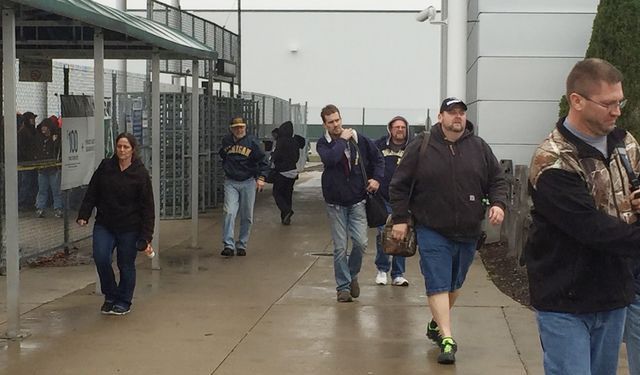
Shift change at GM's Delta Township Assembly Plant
The ongoing job cuts expose the fraudulent character of President Donald Trump’s posturing about protecting American workers. Trump has said nothing about the GM job cuts while appointing GM’s CEO Mary Barra to his corporate advisory board.
Workers at the Delta Township plant, which employs 3,200 hourly and 250 salaried workers, were given a 60-day notice of the layoffs Monday morning. The plant produces the highly profitable Chevrolet Traverse, Buick Enclave and GMC Acadia sports utility vehicle models. The new generation Acadia, however, is being moved to GM’s Spring Hill Assembly Plant in Tennessee.
The plant will shut down from May to June to prepare for the launches of the new Traverse and Enclave. It will resume as a two-shift operation on June 12, according to the Detroit News.
“We have known this was coming for a while, so it is not a shock,” a worker at the Lansing Delta Township plant told the World Socialist Web SiteAutoworker Newsletter. “We had three cars in the plant and now we are down to two. There is not enough demand for those to run three shifts. We hope we will get another product, but it might not be this year but further down the road.”
He said that even if GM decided to move a new vehicle into the plant, it would take time to get the bugs out and ramp up production. “Most of the workers that are being affected are temporary workers. Some workers were given the opportunity to move to Tennessee,” where the production is being shifted. “However, those workers are already gone.” He noted that most of the workers facing layoffs were temporary workers, not eligible for transfer or for supplemental unemployment benefits (SUB).
GM is carrying out a global restructuring of its operations even as it is engaged in funneling approximately $12 billion to its richest investors in the form of stock buybacks and dividend payouts. In a Monday morning meeting with investors Barra said GM’s sale of its European Opel-Vauxhall division to French automaker Peugeot-Citroen—which could lead to the shutdown of several plants and wiping out of at least 6,000 jobs—would free up $2 billion to accelerate its stock repurchase plan to drive up the company’s share value.
The ending of GM’s 80-year presence in Europe is part of the automaker’s efforts to be a smaller, more profitable company with fewer employees, fewer pension and health care obligations. Barra told investors that GM continuously looks at every country and product line to ensure they provide a “great return.” Barra promised investors returns of 20 percent or more.
GM made a record $12 billion in North American profits last year. Analysts have largely attributed the profits to the concessions contained in the 2015 UAW-GM contract, which expanded the number of disposable temporary workers allowing the company to quickly cut back production and their workforce in response to slowing demand without having to pay early retirement or supplemental unemployment benefits. Known as “perma-temps,” these lower-paid workers are repeatedly hired and fired before they reach one year and qualify to become full-time employees.
A call from the World Socialist Web Site seeking a statement on the layoffs from UAW Local 602 was not returned. In comments to the Lansing State Journal, however, local president Bill Reed did not even pretend to oppose the layoffs, which will have a devastating effect on workers and their families. Instead, he repeated the company line, saying the layoffs were due to “a major vehicle change” and would probably be short-lived. “I know (GM) wants to utilize the plant at full capacity,” he said.
A worker who recently retired from the Delta Township plant told the WSWS, “They keep workers in the dark like mushrooms. What they are doing is laying off workers before they get a year in the plant so they don’t have to pay benefits. It is tragic, but that is how they repay people. Another thing I heard they are doing is laying off permanent people in violation of seniority because it is cheaper to work temps.”
“The union doesn’t represent the people,” he continued. “They are policemen for the companies. It is nothing but a pressure cooker in there. Management makes up new rules every day just so they can maximize profits. It is like a dictatorship now. You make a mistake and you get three days off without pay. I was not able to get a grievance written in the last 15 years. It is like an old boys’ network. If there are any rumors on the floor, they will haul you into labor relations.”
A worker at the GM Detroit-Hamtramck plant with five years said that he had just learned of the layoffs in Lansing today, which followed the layoff of 1,300 workers Friday at his plant. “We had heard that there were going to be layoffs, but there was nothing down on paper. From my understanding the temporary workers will be in a pool and may be called back in the future, but I don’t know how they decide who comes back, if it is random or not.”
He said there were still some temporary workers in his plant who were being used to train permanent workers. However, the temporary workers would face layoff as soon as the training period was over.
As far as the future of his plant he said, “There is talk of more weeks of shutdown. You never know. There is no telling what is going to be happening.”
Margaret, a retired GM worker living in Ohio said she had been following the layoffs closely. “According to the UAW contract the temporary workers are supposed to be made full time after one year, so they are laying them off so they can’t get to full time.”
She said she had worked for seven years at the Lordstown Assembly Plant outside of Warren, Ohio. “At Lordstown they had temps working for years. They would lay them off after 90 days and then hire them back so they didn’t have to pay full wages. They are doing the same thing at Delta and Detroit-Hamtramck.”
Asked what she thought about the media blackout of the layoffs in Detroit she said, “I can tell you why there is no media coverage, GM wants to hide its dirty work.”
Margaret spoke about the collaboration of the UAW with management in the destruction of tens of thousands of auto jobs. “Since I started work GM has closed three-quarters of its plants and I have worked at seven different plants starting in Saginaw, Michigan. I finally took my pension and got out. The UAW doesn’t care about the workers.
“GM doesn’t want to give workers anything. They made billions of dollars in profits last year.”
She said she opposed the attempt by the Trump administration with the collaboration of the UAW to scapegoat immigrant workers for the destruction of jobs. “These workers come here to get a job and a better life for their families and now they are being punished. The corporations are our enemies, not immigrant workers. It doesn’t matter if a worker is immigrant or not, there is too much mistreatment of poor people. They are being tossed on the scrap heap. They value money more than humans.”

Trump issues new version of Muslim travel ban

Patrick Martin

US President Donald Trump issued a revised executive order banning travel from six majority-Muslim countries and halting all refugee entry into the United States for the next 120 days. The order revokes and replaces Executive Order 13769, signed by Trump January 27, which was struck down as unconstitutional by several federal courts.
The revised order targets six of the countries named in the previous order—Iran, Libya, Somalia, Sudan, Syria and Yemen—but exempts the seventh country, Iraq. This was after objections from the Pentagon, which feared widespread popular anger in the country where 6,000 US troops are deployed alongside tens of thousands of Iraqi army and militia forces in the ongoing conflict with Islamic State guerrillas.
The order omits several of the most flagrantly illegal and unconstitutional provisions of the earlier order, including a specific preference for “minority religious groups,” which in the context of Muslim-majority countries meant overt discrimination against Muslims.
Unlike the first order, the travel ban is prospective only: it freezes new applications for visas for the next 90 days, but has no effect on current visas, or on US legal residents (green card holders) coming back from visits to one of the six targeted countries. There will be no mass cancellation of visas, as was the case under the initial draft of the order.
That said, the reactionary and anti-democratic character of the order remains, with the main immediate effect felt by refugees, who will make up the vast majority of those denied entry to the United States, rather than travelers.
Trump cuts the number of refugees to be admitted from 117,000 for the current fiscal year to only 50,000. Given that there is a 120-day freeze on all refugee admissions, which begins when the new order takes effect March 16 and lasts until July 14, it is highly unlikely that even 50,000 refugees will be able to enter the US during the remainder of the period ending September 30.
The impact on travelers could be much larger going forward, since the executive order commissions the secretary of homeland security, in consultation with the secretary of state and the attorney general, to make recommendation on extending the travel ban, and to draw up additional lists of countries whose citizens should be excluded, based on an assessment of whether these countries have provided information on their own citizens demanded by the US government. In other words, the “temporary” ban on the six countries could well become open-ended, and Washington will bully foreign governments into collaborating with its “anti-terrorism” policies, on penalty of being added to the travel ban.
The language of the new executive order bristles with Trump’s hatred for the judicial review process that resulted in the effective overturning of the earlier order, and his contempt for the issues of democratic rights and constitutional norms that were raised in the numerous legal challenges. It reiterates the claim of near-absolute presidential power to bar the entry of broad classes of foreigners at the discretion of the White House.
Immigrants’ rights groups and the American Civil Liberties Union denounced the new travel ban as just as anti-democratic and unconstitutional as the first order, even though scaled back to apply to somewhat fewer people. Lawsuits will be filed even before the new order takes effect on March 16.
The supposed “anti-terrorist” rationale for the travel ban is belied even by the agencies responsible for enforcing it. The Department of Homeland Security itself admitted, in a report made public last month, that country of origin was not a meaningful variable in assessing the likelihood of any individual mounting a terrorist attack.
According to an analysis by Charles Kurzman of the University of North Carolina, cited in Monday’s New York Times, of the 36 Muslim extremists who have engaged in terrorist attacks inside the United States since 2001, 18 were born in the US and 14 migrated here as children, and so would have passed any vetting procedure. None came from the six countries targeted by the travel ban.
The Times concluded: “Muslim extremists have accounted for 16 out of 240,000 murders in the United States since the terrorist attacks of Sept. 11, 2001.” The newspaper could have added—but chose not to—that during that period far more Americans have been killed by former soldiers traumatized and brutalized by the wars conducted by US imperialism in the Middle East than by any terrorists, Muslim or otherwise.
These facts did not stop Trump from claiming, in his address to Congress last Tuesday, “The vast majority of individuals convicted of terrorism and terrorism-related offenses since 9/11 came here from outside of our country.” That lie was followed by a brazen appeal to fear: “We cannot allow a beachhead of terrorism to form inside America.” This was in reference to refugees from Syria, mainly women and children, victims of a brutal civil war instigated by the United States and the oil-based monarchies of the Persian Gulf.
Congressional Democrats for the most part postured as critics of the revised travel ban, but they have focused all their attention on denouncing Trump as insufficiently aggressive towards Russia, effectively downplaying any objections to his attacks on democratic rights.
The issuance of the new order came in the midst of a mounting political crisis of the Trump administration over charges and counter-charges relating to alleged Russian interference in the 2016 presidential election and alleged contacts between Trump aides and Russian intelligence agencies. No actual evidence of such interference or such contacts has ever been made public—only an endless series of anonymous leaks from officials in the military-intelligence apparatus opposed to Trump’s apparently softer foreign policy towards Russia.
On Saturday, Trump retaliated with a series of tweets claiming President Obama had ordered wiretapping of his Trump Tower offices during the election campaign, claiming that this represented a scandal as serious as Nixon and Watergate. Like his critics in the anti-Russian campaign, Trump did not offer a shred of evidence to back up his extraordinary claims.
Reaction to these charges in the media and official political circles was overwhelmingly hostile, with congressional Republicans distancing themselves from the White House, agreeing only that the question of wiretapping should be looked into by the intelligence committees that are investigating the charges of Russian interference.
White House officials avoided all interaction with the media during the issuance of the executive order establishing the revised travel ban, apparently to avoid further questions on the wiretapping issue. Trump signed the order behind closed doors, rather than welcoming television cameras to the Oval Office as he did when he signed the first order.
The formal issuance of the order came at a joint White House appearance of Secretary of State Rex Tillerson, Secretary of Homeland Security John Kelly and Attorney General Jeff Sessions, at which each official read a short statement. All three then left without taking any questions. A scheduled televised press briefing by Press Secretary Sean Spicer was held off camera and behind closed doors.

India becomes “frontline” state in US war plans against China

Deepal Jayasekera & Keith Jones

India is to become a major service and repair hub for the US Seventh Fleet—the armada that is at the center of US war preparations against China.
Last month the Pentagon awarded a contract, said to be worth up to $1.5 billion over the next five years, to a shipyard in Gujarat to maintain the Seventh Fleet’s warships and patrol and service vessels.
This is a strategic move aimed at giving flesh and blood to last August’s agreement opening India’s military bases and ports to routine use by the US military for the resupply and repair of its warplanes and warships.
The transformation of India into a hub for the Seventh Fleet marks a new stage in India’s integration into US imperialism’s military-strategic offensive against China.
The Seventh Fleet is at the very center of US plans to wage war on China. It has responsibility for the western Pacific and the eastern stretches of the Indian Ocean up to the India-Pakistan border. US strategy calls for the Seventh Fleet to impose an economic blockade on China by seizing control of the Straits of Malacca and other Indian Ocean/South China Sea chokepoints and to spearhead a massive bombardment of Chinese military installations, cities and infrastructure in what the Pentagon calls its “Air-Sea Battle” plan.
Since the beginning of the 21st century, Washington has worked assiduously to harness New Delhi to its predatory agenda and to build up India as a counterweight to China. The Pentagon and US military-intelligence think tanks have long coveted India as a geopolitical prize because of its size, its large nuclear-armed military and its strategic location. India, or so the strategists of US imperialism calculate, can serve as China’s “soft southern underbelly.” It also provides the best vantage point from which to dominate the Indian Ocean, China’s and the world’s most important commercial waterway.
Under Narendra Modi and his Hindu supremacist BJP government, New Delhi has dramatically expanded its already extensive military-strategic cooperation with Washington. In addition to the basing agreement, India has expanded bilateral and trilateral military-strategic ties with America’s principal Asian-Pacific allies, Japan and Australia. In January, the head of the US Pacific Command, Admiral Harry Harris, revealed that the Pentagon and Indian military are sharing intelligence on Chinese submarine and ship movements in the Indian Ocean.
The grave threat the Indo-US alliance represents to the people of Asia and the world is underscored by the advent of the Trump administration. It has denounced China as a “currency manipulator,” dismissed the Obama administration’s anti-China “Pivot to Asia” as weak and ineffective, and threatened to deny Beijing access to Chinese-controlled islets in the South China Sea—an act that would be tantamount to a declaration of war.
Trump has criticized Obama’s foreign policy on many fronts. But when it comes to India, Defense Secretary James “Mad Dog” Mattis has vowed that the Trump administration is determined to “build upon” the recent “tremendous progress” in Indo-US “defense cooperation.”
The Indian government, opposition and corporate media are all complicit in keeping India’s workers and toilers in the dark as to the extent to which India is being transformed into a frontline state in Washington’s drive to thwart China’s rise and assert US hegemony over Eurasia. This drive, if not stopped through the revolutionary mobilization of the international working class, leads inexorably to war between the world’s nuclear-armed great powers.
India’s emergence as a hub for the US Seventh Fleet is so striking a change, however, that even Indian media reports could not avoid mentioning that during the Cold War, the Seventh Fleet was used by Washington to bully and threaten New Delhi on several occasions. The Times of India wrote, “The US Seventh Fleet, which was sent to the Bay of Bengal in December 1971 by then-American President Richard Nixon … to pressure India during the Bangladesh liberation war, will now ironically be maintained by an Indian company.”
Because of New Delhi’s strategic and commercial ties with Moscow, Washington treated India as an adversary for most of the Cold War.
Newly independent India had been eager to establish warm relations with Washington. But New Delhi balked at US imperialism’s attempts to bully it into subordinating its foreign policy to Washington’s strategic offensive against the Soviet Union.
Washington responded by recruiting Pakistan, the rival state created through the communal partition of the subcontinent that had accompanied independence, to serve as a linchpin of its Cold War alliance system. With the US arming Pakistan, India turned to the Soviet Union for arms purchases and strategic support. It also became one of the founders and the principal leaders of the Non-Aligned Movement.
Soviet support also helped New Delhi counter the economic pressure the US exerted on India because of its use of import substitution and state ownership to strengthen the Indian bourgeoisie’s position vis a vis international capital. Jawaharlal Nehru and his Congress Party government were also mindful of the assistance the Soviet Stalinist regime’s support could play in integrating the Stalinist Communist Party of India (CPI) into bourgeois politics so as to use it to contain working class opposition.
India’s non-alignment policy had nothing to do with genuine opposition to imperialism. It was a stratagem of the Indian bourgeoisie to strengthen its class rule. When the rug was pulled out from under its state-led capitalist development strategy by globalization and the Stalinist bureaucracy’s dissolution of the Soviet Union in 1991, it quickly junked its anti-imperialist rhetoric and began to fashion a more direct and slavish relationship with Washington.
This shift was spearheaded by Nehru’s Congress Party heirs. It was a Congress-led government that forged the “global Indo-US strategic partnership” that served as the antechamber for India’s transformation under Modi into a veritable frontline state in Washington’s anti-China offensive.
Yet the CPI, its Stalinist sister party, the Communist Party of India (Marxist), and their Left Front continue to promote “non-alignment” as “anti-imperialism” and claim that the Indian bourgeoisie can play a progressive role in world politics.
The Stalinists maintain that the imperialist world order can be pacified and the interests of the Indian bourgeoisie best advanced if New Delhi curtails its strategic ties with Washington and opposes US “unilateralism” by advocating “multi-polarity”—i.e., a greater role in regulating world affairs for the other imperialist ruling elites, the Indian bourgeoisie and the oligarchs who now rule Russia and China.
That the Stalinists openly support the great power ambitions of the Indian bourgeoisie is underscored by their support for the expansion of India’s military and nuclear arsenal.
And for all their claims to oppose Modi’s embrace of Washington, they have failed to alert the working class to how the Indian bourgeoisie’s alliance with US imperialism is emboldening New Delhi in its drive to impose itself as South Asia’s regional hegemon.
The Stalinists applauded when India carried out illegal, cross-border military raids inside Pakistan last September, plunging South Asia’s nuclear-armed rivals into their most serious war crisis since at least 2003.
Pakistan’s reactionary elite has responded to India’s increasingly menacing posture by threatening to use tactical nuclear weapons in the event of a larger Indian attack and by deepening its longstanding strategic partnership with Beijing.
US imperialism’s reckless drive to harness India to its offensive against China has transformed South Asia into a geopolitical powder keg. The Indo-Pakistani and Sino-Indian conflicts have become enmeshed with the US-China confrontation, adding to each a massive new explosive charge, with potentially calamitous implications for the people of the region and the world.
South Asia is thus a pivotal front in the development of a working class-led global movement against imperialist war and the capitalist system out of which it arises. Such a movement, uniting workers and toilers in India, Pakistan and across the subcontinent with the Chinese, American and international working class, will emerge only through a merciless exposure of the criminal role being played by the Stalinist CPM and CPI.

Australian government beset by turmoil

Mike Head 

Paralysis wracked the Liberal-National Coalition government last week over the cutting of wage rates for thousands of low-paid workers, underscoring a profound crisis confronting the entire Australian political establishment. Growing social discontent, combined with the immense uncertainty generated by the Trump presidency, has fuelled deep divisions in ruling circles that are increasingly calling into question the future of Prime Minister Malcolm Turnbull.
For four days last week, Turnbull refused to defend the previous week’s ruling by the Fair Work Commission industrial tribunal to slash by up to 50 percent the extra amount paid for Sunday and public holiday work—penalty rates that many low-paid retail, hospitality, fast food and pharmaceutical workers depend upon to eke out an existence.
Clearly concerned at the outrage among broad layers of working people over the across-the-board cut in workers’ wages, Turnbull sought to distance the government from the decision, claiming it was a ruling by an independent industrial “umpire.” He did not indicate support for the pay cut—a measure long sought by business—until Friday, after being condemned for not “selling” it by the Murdoch media and Tony Abbott, the man he ousted as prime minister 18 months ago. Turnbull sought to justify the attack on workers’ conditions by claiming it would increase employment by small businesses.
Today, however, the government politically backpedalled again. Treasurer Scott Morrison signalled that in its annual budget in May the government would abandon more than $13 billion in cuts to welfare, family tax benefits, pensions and other social spending that have remained blocked in the Senate since the 2014 budget. Only three weeks ago, Turnbull and Morrison unveiled an “omnibus” bill, containing all the stalled cuts, to try to demonstrate to the financial elite that they could impose the measures that Abbott had failed to deliver.
Last Friday, Turnbull desperately attempted to divert discussion by aligning himself with Trump’s vast expansion of US military spending and rhetoric against Islamic terrorism. Turnbull used the arrival in Australia of the first two $100 million F-35 Joint Strike Fighters being purchased from Lockheed Martin to boast that his government was undertaking “massive” military spending—the “biggest, ever in peace time” and that he had discussed these plans with Trump, who was “very, very impressed.”
Turnbull repeatedly declared that Australia was “killing terrorists” in the Middle East, thanks to his government’s legislation enabling the armed forces to kill “terrorists” well away from any battlefield. This legislation, in fact, cleared the way for civilians to be targeted as part of the latest escalation of the “war on terror,” which is a pretext for US-led operations to secure US control over Syria and the rest of the region, after the catastrophes created by the earlier invasions of Afghanistan and Iraq.
Turnbull’s claim he had been praised by Trump, who had cut short his first phone call with the former, highlights the underlying impasse confronting Australian imperialism. It remains heavily dependent, as it has been since World War II, on the US, militarily and strategically. Yet Trump’s unilateral “America First” drive to assert US global hegemony has thrown a giant question mark over all the calculations that the Australian capitalist class made when it lined up behind the Obama administration’s “pivot to Asia” to confront China.
Not only has Trump pulled the plug on the Trans-Pacific Partnership, the economic thrust of the “pivot,” through which the Australian ruling elite hoped to gain more lucrative access to Asian markets. His threats of trade war and military conflict with China imperil Australia’s largest export market and magnify the danger of a catastrophic nuclear war, with Australia functioning as a key US base.
When Turnbull ousted Abbott in September 2015, he claimed he would provide the “economic leadership” to “transition” Australia away from the collapsing mining boom, largely based on exports to China, by developing “agile” and “innovative” new policies. This claim lies in tatters, with large parts of the country mired in recession, corporate investment plummeting, full-time jobs being decimated and real wages falling.
The resulting discontent has only intensified since last July, when the government barely retained power after it called a double dissolution election of both houses of parliament, in a failed bid to break through the blockage of its legislation in the Senate. Since then, the government has worked closely with an array of right-wing populists in the Senate, particularly Pauline Hanson’s anti-immigrant One Nation, whose senators have voted with the government on nearly 90 percent of its legislation.
Increasingly, Hanson is being promoted in the corporate media, together with Senator Cory Bernardi, a right-wing defector from the government, and lower house MP George Christensen, who has repeatedly threatened to defect. While reflecting the rifts wracking the government, they are being used to channel the mounting disaffection in reactionary nationalist and xenophobic directions, trying to emulate Trump by posturing as anti-establishment figures.
Yesterday, Hanson was afforded a 20-minute interview on Australian Broadcasting Corporation television’s flagship “Insiders” program to peddle her anti-Islam chauvinism, accusing Muslims of trying to impose sharia law on Australia. At the same time, Hanson revealed something of her utter hostility to the working class. She stridently backed the penalty rates cut and emphasised her desire to “stabilise” the government of Turnbull, with whom she had “a good rapport.”
Amid this turmoil, the Labor Party, backed by the trade unions, is seeking to return to office by cynically exploiting hostility toward the penalty rates cut. Union officials met on the weekend to draw up a “WorkChoices” style advertising campaign, hoping to reprise the 2006–07 campaign that diverted opposition to the Howard Coalition government’s workplace laws behind the re-election of a pro-business Labor government under Kevin Rudd and Julia Gillard, which passed similar anti-democratic legislation.
Labor leader Bill Shorten’s feigned outrage at the wage-cutting is doubly hypocritical. As a key minister in the last Labor government, he initiated the Fair Work Commission's review of penalty rates, and, as a longtime union leader, played a central role in scrapping penalty rates for many retail, fast food and service workers via union-imposed enterprise agreements with major companies.
With the Liberal Party government in Western Australia likely to be defeated in next Saturday’s state election, the Turnbull government’s instability could come to a head this month. An editorial in Saturday’s Australian warned that because of his “apparent paralysis” Turnbull was on borrowed time.
“For almost a decade now our nation has been stuck in a period of developmental diapause, where alternating periods of partisan upheaval and political ineffectiveness have stymied both fiscal repair and economic reform,” the editorial declared. “The markets, the public and Mr Turnbull’s own culpable colleagues are running out of patience.”
This message points to the protracted crisis of capitalist rule. This is firstly bound up with the inability of successive Coalition and Labor governments to push through all the austerity and wage-cutting measures demanded by the wealthy elite and the global financial markets. Since Howard’s Coalition government suffered a near-record electoral rout in 2007, every government has unravelled in less than three years.
Washington has also demonstrated its willingness to bring down any government that fails to unconditionally line up behind the US confrontation with China. In mid-2010, Rudd was ousted by US-backed Labor Party figures after he proposed that the US make some accommodation to China’s rapid economic growth.