18 Mar 2017

Dutch Prime Minister Rutte wins out against far-right challenger

Peter Schwarz

The far-right Party for Freedom (PVV) of Geert Wilders did not make the breakthrough that was long predicted in yesterday’s Dutch election. With 13.1 percent of the vote, it came in second behind the right-wing Liberals (VVD) of Prime Minister Mark Rutte, who won the election with 21.3 percent of the vote.
However, Wilders’ poorer than expected result by no means signals an end of the sharp shift to the right in European politics. Rutte’s VVD and the Christian Democrats (CDA), which came in third with 12.4 percent, have largely taken over the xenophobic, anti-Islamic rhetoric of Wilders, who set the tone for the entire election. Their only difference with Wilders is over the European Union. While Wilders is calling for a referendum on exiting the EU, Rutte’s VVD and most of the other bourgeois parties are strongly defending it.
Wilders will continue to play a major political role. While he did not meet the expectations raised by the polls, he improved his vote by 3 percent since the 2012 election. “PVV-voters, thank you! We have won seats! The first win is in. And Rutte is far from rid of me!!” read his first response to the result on Twitter.
Notwithstanding Rutte’s victory, the vote of the ruling coalition collapsed, almost halving the number of its seats in parliament from 79 to 42. This is far from the 76 seats needed to form a majority in the 150-seat parliament.
While Rutte’s right Liberals lost eight of their previous 41 seats, the biggest loser in the election was their coalition partner, the Labour Party (PvdA). Labour was punished for its support for austerity and its massive attacks on social welfare. Its vote collapsed from 25 percent to less than 6 percent. With only nine seats left, it is now in seventh place—behind the Greens and the ex-Maoist Socialist Party.
The vote of the Socialist Party, which supported the anti-immigrant drive of the main bourgeois parties, went slightly down from 9.6 to 9.1 percent. In contrast, the Green-Left vote quadrupled from 2.3 to 9 percent. Among voters under 34, it received more than a third of the vote, and in Amsterdam it was the strongest party, with almost a fifth of the vote.
The entire election campaign was highly polarized. This led to a large turnout of 82 percent, the highest for 31 years and 6 percent more than in the last election.
The Green Left, as well as other smaller parties and the left Liberals (D66), who increased their vote from 8 to 12.1 percent, clearly benefitted from the opposition to Wilders’ fascistic campaign, particularly among younger people. But both, the Greens and D66, seek to channel the opposition to Wilders behind staunch support for the EU and are quite prepared to back a right-wing government led by Rutte. Basing themselves on sections of the middle class, they play a similar role to those in the United States who try to divert the opposition against Trump into the dead end of the pro-Wall-Street and pro-war Democratic Party.
Governments all over Europe welcomed the Dutch election result with relief. German Foreign Minister Sigmar Gabriel said it was a “success for Europe.” He said he was now optimistic about the coming election in France. The head of Chancellor Angela Merkel’s office, Peter Altmaier, wrote on Twitter: “The Netherlands, oh the Netherlands you are a champion!... Congratulations on this great result.”
Paolo Gentiloni, the Italian prime minister, said the “anti-EU right has lost the elections,” and urged supporters to work to “revitalise the Union.”
French President François Hollande pontificated, “The values of openness, respect for others and a faith in Europe's future are the only true response to the nationalist impulses and isolationism that are shaking the world.”
However, Wilders is a symptom, not the cause, of the turn to the right in European politics. This turn is the response of the bourgeois parties to a profound crisis of capitalist society in the Netherlands and across the continent.
Neither the EU nor any of the European governments are opposed to Wilders’ xenophobic and anti-Islamic line. The maltreatment and rejection of refuges has become the official policy of the EU.
At the beginning of the month, Rutte published an open a letter to immigrants, telling them, “If you don’t like it here, you can leave.” And three days ago, he staged a calculated provocation against the Turkish government, banning its ministers from entering the Netherlands in an attempt to stir up nationalist hysteria and win the backing of a section of Wilders’ potential support.
The only concern of Merkel, Hollande, Gentiloni et al. is the defense of the EU as a basis for escalating militarism, including colonial-style interventions and hostile action against Russia, and for the development of repressive police state measures internally as well as even more sweeping austerity attacks on the working class.
The idea that, after Wilders was boosted by Brexit and the election of Donald Trump, his election setback will undermine the prospects of Marine le Pen of the National Front in the French presidential election does not stand up to scrutiny.
Le Pen’s party has much stronger organizational and historical roots than the PVV, which is very much a one-man band. The FN has been better able to capitalize on the betrayals of France’s Socialist Party government, the crisis of François Fillon and the Gaullist right, and the neo-liberal economic agenda of the candidate presently favoured to win, the independent Emmanuel Macron, to combine hostility to the EU with a claim to represent the interests of “working people” against the establishment.
For the Netherlands, the election opens what is likely to be a period of massive political instability and fierce political and class struggles. The small country of 17 million inhabitants is riven by deep social and cultural divisions. As a former colonial power, it has a huge immigrant community that has been hit very hard by growing social inequality. Liberal cities like Amsterdam stand in contrast to the religious “bible belt,” one of the most conservative areas in Europe.
In the post-war period, these contradictions were bridged by an elaborate culture of political consensus, which found its highest expression in the collaboration since the 1980s of the neoliberal right, the Labour Party and the trade unions in dismantling the previous social gains of the working class. This has led to sharp social polarization and the virtual collapse of the bourgeois “left.”
The political situation in the Netherlands is reminiscent of the conditions that existed in Weimar Germany between 1919 and 1933, where a parliament paralyzed by intense conflicts presided over conditions that gave rise to the coming to power of Hitler.
With hardly more than a fifth of the seats in a parliament of 14 or 15 parties, and the country deeply divided, Rutte needs at least three, if not four, coalition partners to form a viable government. It is expected that it will take weeks, if not months, of intense horse-trading and backroom deals to establish a new coalition.
Everything depends now on an independent intervention by the working class. This demands the establishment of a Dutch section of the International Committee of the Fourth International, opposed both to nationalism and the European Union and capable of working with co-thinkers across Europe and internationally to unite workers of all countries on the basis of a socialist program for the overthrow of capitalism.

Pentagon prepares to send a thousand more troops into Syria

Bill Van Auken

The Pentagon is preparing to submit a request that would send 1,000 more US soldiers and Marines into Syria, doubling the number of ground troops now deployed in the war-torn country.
The proposed escalation, following close upon the sixth anniversary of the US-orchestrated war for regime change that has killed close to half a million Syrians and turned millions more into refugees, signals a turn toward a qualitative escalation of the US intervention in that country and in the broader Middle East.
The request for the troop buildup comes in the wake of the a report submitted by the Pentagon at the end of last month outlining proposals requested by the Trump administration for an escalation of the US intervention being waged in Iraq and Syria in the name of combating the Islamic State of Iraq and Syria (ISIS).
Gen. Joseph Votel, the head of the US Central Command (CENTCOM), which oversees US military operations in the region, “is set to forward his recommendations to [Defense Secretary James] Mattis by the end of this month, and the Pentagon secretary is likely to sign off on them,” the Washington Post reported Thursday, citing an unnamed Department of Defense official.
The troops would likely come from the 24th Marine Expeditionary Unit and the US Army’s 82nd Airborne Division. The Marines would be drawn from a force of 2,200 which is aboard ships now headed toward the Syrian coast, while the Army paratroopers would come from a force of some 1,000 troops that have been pre-positioned in Kuwait. The initial escalation of troop levels could be quickly increased further from these additional forces being deployed to the region.
Such an increase would formally abrogate caps imposed on US deployments in Iraq and Syria by the Obama administration, 5,000 in the first country and 500 in the second. These limits have already been breached with “temporary” deployments continuously rotating more US troops in and out of the region. Meanwhile, earlier this month the Pentagon dispatched 250 US Army Rangers and 200 Marines into Syria.
The proposed changes in US deployments would not only increase the number of troops on the ground, but also “increase the potential for direct US combat involvement in a conflict that has been characterized by confusion and competing priorities among disparate forces,” according to the Post.
This “confusion” and multi-sided character of the ongoing fighting in Syria is the direct product of Washington’s abortive attempt to topple the government of President Bashar al-Assad through arming, funding and support for Islamist, Al Qaeda-linked militias in collaboration with Turkey, Saudi Arabia and other Sunni gulf oil sheikdoms.
The further buildup of US forces, carried out against the opposition of the Syrian government and in violation of international law, is ostensibly aimed at combating ISIS, itself the product of the protracted US intervention in the region.
In combating ISIS, the US has relied on a militia force dominated by the YPG, a Syrian Kurdish militia. At the same time, Washington’s NATO ally in the region, Turkey, has intervened in Syria in the name of combating ISIS, but directing much of its military power at preventing the YPG from consolidating a Kurdish autonomous zone on Turkey’s southern border.
The US Ranger unit, equipped with heavily armored Stryker combat vehicles, was deployed to the northern Syrian city of Manbij as part of what the Pentagon described as a “reassurance and deterrence” mission, i.e., an attempt to prevent Turkish and Kurdish forces from engaging in all out clashes.
Meanwhile, however, there is also the possibility of a far more dangerous military clash erupting in Syria between the US and Russia.
Russian forces, supporting the Assad government, are also operating inside Manbij. At a press briefing Wednesday, a spokesman for US operations in the region spoke from Baghdad to Pentagon reporters, acknowledging that US and Russian troops were close enough to “observe each other’s movements.”
“They can see each other,” said Col. John Dorrian. “They are not talking to each other, and they are not hanging out together.”
All of these disparate and mutually hostile forces are massing in the area for an attack on Raqqa, a city of 300,000 controlled by ISIS. The US is backing the Kurdish-dominated militia, which has said it will resist any Turkish role in retaking the city. Turkey, meanwhile, is supporting Turkish Islamist forces that are opposed both to the Kurds and to the Syrian government, whose own forces are moving against Raqqa with the backing of Russia.
As the Pentagon prepares its escalation in Syria, an influential Washington think tank has called for an even greater expansion of US operations aimed at furthering US strategic interests throughout the oil-rich region.
The Institute for the Study of War, which is funded by major military contractors, including Raytheon, GeneralDynamics and DynCorp, issued a report entitled “America’s Way Ahead in Syria.” Its principal authors are Kimberly and Frederick Kagan, a husband-and-wife team of neo-conservative advocates of global US military escalation who acted as advisors to US commanders in Iraq and Afghanistan.
The report criticizes the current plans for escalation as an attempt to “supersize the Obama administration’s strategy by lifting constraints on US forces and adding a few additional resources.”
Instead, they advocate, “President Trump and his team must change the strategy fundamentally. They should orient their new plan on American interests rather starting from what the US had been doing.”
The strategy advocated by the Kagans points toward a US confrontation with both Iran and Russia for hegemony over the Middle East.
“The Russo-Iranian military buildup and attempt to dominate the regional system and resources constrain and weaken the United States,” the report states. “Russia and Iran are building a regional order based on their shared near-term interests, which will not diverge any time soon. This developing system denies America the freedom to protect its own interests. The Russo-Iranian coalition will make it more difficult for the US to respond to terror threats against it, defend key allies such as Israel, and ensure unfettered access to trade routes the US economy depends on.”
The report states that “the US must maintain and likely increase its military presence in Iraq even after Mosul’s recapture.” It calls for the building up of forces in Iraq to confront and defeat Iranian influence.
“We must show once again that we are wiling to fight and die with Sunni Arabs against their enemies and ours--Al Qaeda, ISIS, and Iran,” it insists.
In Syria, the report adds, the US should “seize and secure a base in southern Syria ... and create a de facto safe zone” where US forces can “recruit, train, equip, and partner with” local Sunni militias.
It also states that Washington must prepare for direct military confrontation with Russia over control of Syria. “The US must be prepared to conduct a full suppression of enemy air defense if necessary and to use alternative sources of leverage over Putin to deter him from attacking US forces. The US must position a joint package of strike and air defense assets in theater before beginning this course of action to strengthen this deterrence. The package must be obviously able to attain air supremacy throughout the theater and maritime supremacy in the Mediterranean if required.”
Behind the initial plans for escalating US troop deployments in Iraq and Syria, what is being discussed in the White House, Pentagon and CIA, as well as the think tanks connected to the US military and intelligence apparatus, are proposals that pave the way to a third world war.

Trump budget to fund wider wars by slashing domestic spending

Patrick Martin

The budget outline issued by the Trump administration Thursday morning is a blueprint for social counterrevolution. It proposes a massive increase in spending on military operations and domestic repression, while slashing domestic social programs by as much as 30 percent and eliminating dozens of agencies and programs outright.
The document deals only with discretionary spending, funds that must be appropriated each year by Congress, accounting for about one-quarter of the $4 trillion that the US government will spend in the fiscal year that begins October 1.
The budget leaves open the fate of the remaining $3 trillion in federal spending, which includes payments under entitlement programs like Social Security, Medicare and Medicaid, and food stamps, as well as other legally required payments, such as interest on the national debt.
The increase in military spending is far larger than that proposed in an initial White House statement last month, which showed the Pentagon budget rising to $603 billion in Fiscal Year 2018. After criticism by congressional hawks like Senator John McCain, and pushback from the military brass, the Pentagon’s budget will rise to $639 billion.
Instead of the 50-50 split between domestic and military spending in the discretionary portion of the budget, as prevailed under the Obama administration, the military share will rise to nearly two-thirds of the total, particularly if funding for the Veteran’s Administration, the Department of Homeland Security, and the nuclear weapons portion of the Department of Energy budget are included.
There is also a proposed $2.6 billion in funding for building a wall along the southwest US border—only a fraction of the estimated $25 billion cost of this mad and inhuman project.
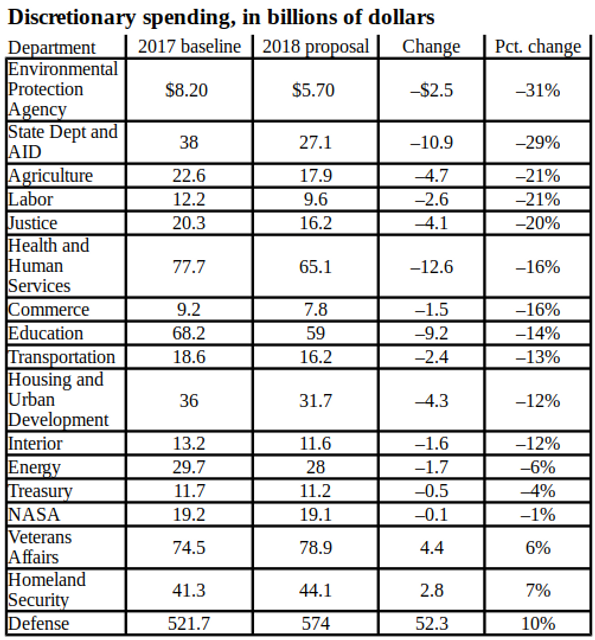
US discretionary spending in billions of dollars
The Trump budget proposes the outright elimination of 19 government agencies, most of them long targeted for destruction by ultra-right ideologues and Christian fundamentalists. These include the National Endowment for the Arts; the National Endowment for the Humanities; the Legal Services Corporation, which provides legal services for the poor; the Corporation for Public Broadcasting; AmeriCorps; and the Chemical Safety Board, which investigates industrial disasters in chemical production and transport, including oil-well blowouts like the 2010 disaster in the Gulf of Mexico. Destroying all these agencies saves only $3 billion, less than the cost of US military aid to Israel alone.
This is a budget that promotes death and destroys life. It pours billions into the Pentagon killing machine, at the cost of programs that provide food, shelter, heating, health care and other vital services for the population of the United States.
The biggest single cut is a $5.8 billion reduction in the budget for the National Institutes of Health, which funds a vast array of biomedical research by tens of thousands of health scientists. The biggest percentage cut, 31 percent, is in the Environmental Protection Agency, where 3,200 jobs and 50 programs would be eliminated, including all pollution cleanup operations in the Great Lakes, Chesapeake Bay, Puget Sound and San Francisco Bay. Half of the EPA’s budget for research and development is eliminated.
Budget Director Mick Mulvaney declared arrogantly, “You can’t drain the swamp and leave all the people in it. So, I guess the first place that comes to mind will be the Environmental Protection Agency.” He continued, “The president wants a smaller EPA. He thinks they overreach, and the budget reflects that.”
The biggest impact of the budget cuts will be on the urban and rural poor. Trump proposes to abolish the Low-Income Home Energy Assistance Program, which provides $3 billion a year to heat homes in the winter; the Community Development Block Grant program, which spends $3 billion on community development, affordable housing and aid to the homeless; the Appalachian Regional Commission, which promotes economic development and community infrastructure in that region; and the Delta Regional Authority, which does the same in the majority-black delta region of the state of Mississippi.
While Trump ran up huge margins in the popular vote in many impoverished rural counties, his budget wipes out much of the federal spending in those areas. He would eliminate long-distance Amtrak train service and the Essential Air Service, which subsidizes flights to small rural airports, and cut $500 million in Department of Agriculture funding for conservation, waste-disposal and water infrastructure in rural America.
Other significant cuts include $2.5 billion slashed from the Department of Labor for job training programs for seniors and disadvantaged youth, while funding would be increased for the Reemployment and Eligibility Assessment program, which reviews state unemployment claims and verifies eligibility, harassing jobless workers and actually making a profit for the department.
Some $10.1 billion is cut from the State Department and the US Agency for International Development, mainly by eliminating all spending on global climate change initiatives, sharply cutting back support for refugees and other foreign aid, and capping US contributions to the United Nations. The Emergency Refugee and Migration Assistance Account would be eliminated entirely.
The budget also proposes significant privatization, transferring “the air traffic control function” of the Federal Aviation Administration to an unspecified nongovernmental organization that would be effectively controlled by the airlines.
The Department of Education would suffer more than $9 billion in cuts, including “cancellation” of $3.9 billion in Pell Grant reserves, eliminating $2.4 billion in grants to states for teacher training and $1.2 billion for after-school programs. The Federal Supplemental Educational Opportunity Grant would be eliminated.
The department will get the only significant increase in social spending under the Trump budget, but this has an utterly reactionary purpose: $1.4 billion in new spending for charter schools, a private school choice program, and grants to school districts to promote the adoption of voucher programs which families could use to pay for education at private, religious, charter and even on-line schools.
One particularly noxious feature of the budget is its systematic assault on science, what the Washington Post called “a seismic disruption in government-funded medical and scientific research.” Besides the $6 billion cut from the NIH, the National Science Foundation is listed under “other agencies” which will have an across-the-board 9.8 percent cut. In agency after agency, funds for research are targeted for higher-percentage cuts, particularly if the research is linked in any way with environmental science or the study of climate change.
NASA has only one significant cut: the termination of several satellites to be placed in Earth orbit to study the planet we live on, because they might discover inconvenient facts about global warming and other climate changes. The budget document does not disguise the purpose of this shift, declaring that the administration wants the agency to focus on “deep space exploration rather than Earth-centric research.”
Both the discretionary budget unveiled yesterday and the overall budget including entitlements will not be enacted in the form proposed by the White House. This is an initial step in a sordid process of backroom dealing in which both congressional Republicans and Democrats will have their say, particularly in the Senate, where at least eight Democrats must vote with the Republicans to reach the 60 votes required for passage.
While Democratic Party reaction to most of the proposed cuts was hostile, this posturing, like the White House document, represents an opening bid. There is substantial Democratic support for many of the cuts proposed, particularly in environmental regulations, as well as for the promotion of charter and private schools.
More significantly, under Obama the Democrats offered to make significant cuts in Social Security through such measures as recalculating the cost-of-living provisions, and enacted major cuts in Medicare reimbursement through Obamacare. Such measures are sure to be raised when the budget talks turn to the entitlement programs.

Manohar Parrikar as Defence Minister: A Positive Record

Gurmeet Kanwal


During his two and a half years as India’s Defence Minister, Manohar Parrikar came across as a sincere and perceptive leader and an accomplished manager. He gave a free hand to the army to act pro-actively on the LoC. He got the prime minister to approve surgical strikes across the LoC in September 2016 – operations that changed the paradigm of India’s response to Pakistani provocations.
Parrikar worked closely with the leadership of the armed forces and the bureaucracy to put the stalled process of military modernisation back on the rails. And, he put his management skills and experience to good use to review policies and procedures for the efficient functioning of the Ministry of Defence (MoD) and the armed forces.
Under Parrikar’s leadership, the NDA government began the long process of addressing the “critical hollowness” plaguing defence preparedness – a term used by General VK Singh as the army chief, in a letter he had written to the prime minister. Besides major operational voids in the war establishment of the three services, there were large-scale deficiencies in the holding of important items of equipment, ammunition and spares that had an adverse impact on combat readiness.
According to a CAG report, the army’s depots have stocks of some key varieties of ammunition – for example for some tanks and artillery guns – for barely ten days of conflict. It has been estimated that it would cost over INR 20,000 crore to replenish stocks and increase holdings to the required levels.
Under Parrikar’s guidance, the MoD invoked the government’s emergency financial powers to sign contracts with Russian manufacturers to procure ammunition and spares worth INR 5,800 crore for the army and INR 9,200 crore for the air force. Similar deals are being negotiated with French and Israeli companies. However, the serviceability state of warfighting equipment still needs substantial improvement.
Modernisation of the armed forces had been stagnating during UPA rule due to inadequacy of funds, rigid procurement procedures, frequent changes in the qualitative requirements, the black-listing of several defence manufacturers and bureaucratic red tape. Parrikar took it as a personal challenge to give a fillip to modernisation.
He appointed a committee to review the Defence Procurement Procedure (DPP) and lost no time in studying and approving its recommendations. Several pragmatic amendments were approved by the Defence Minister and DPP 2016 was issued in April 2016, including an emphasis on ‘make in India’, raising of FDI in defence to 49 per cent, tweaking of the policy on offsets and permitting defence exports.
Consequently, weapons and equipment purchases worth over INR 1,50,000 crore have been accorded AON (acceptance of necessity) approval by the Defence Acquisition Council (DAC). Contracts have been signed for acquisitions worth approximately INR 90,000 crore without a scam. However, it will take three to five years before deliveries begin.
On the negative side, on Parrikar’s watch, the defence budget for FY 2017-18 has dipped to 1.62 per cent of the country’s GDP – the lowest level since the disastrous 1962 border war with China. It is grossly inadequate to build the defence capabilities required to meet future threats and challenges and discharge its growing responsibilities as a regional power. A portion of the budgetary allocations on the capital account for the modernisation of the armed forces still continues to be surrendered unspent.
Not much has been done to streamline the nearly defunct long-term defence planning process. The 12th Defence Plan that will end on 31 March 2017 was not accorded formal approval by the Cabinet Committee on Security (CCS). The CCS has also not formally approved the tri-service long-term integrated perspective plan (LTIPP 2007-22).
The defence minister was widely expected to initiate long-pending structural reforms to improve national security decision-making and synergise combat capabilities. These reforms were thought to include the appointment of a chief of defence staff (CDS) and new tri-service special forces, aerospace and cyber commands. In May 2015 he had told this writer that he would be putting up his recommendations to the CCS after the monsoon session of Parliament. However, for reasons that are difficult to understand, he was unable to do so.
On other fronts, the recommendations of the Seventh Pay Commission have still not been implemented for the armed forces. The agitation for One Rank One Pension (OROP) launched by veterans was allowed to linger on for an embarrassingly long period of time, with many anomalies remaining unresolved. Also, there has been no progress on the establishment of the national defence university and the construction of a national war memorial-cum-military museum.
Overall, the achievements of Manohar Parrikar as India’s Defence Minister far outweigh the disappointments. He deserves compliments for his untiring efforts to enhance India’s combat capabilities.

Goa: Staging Post of the Resourceful

Bibhu Prasad Routray


Otto Von Bismarck wrote, "Politics is the art of the possible, the attainable, the art of the next best." The quotation assumes relevance in Goa's context where the declining popularity and poor show of the Bharatiya Janata Party (BJP) in the Legislative Assembly (LA) polls were converted into a smart victory after the party managed to secure support of nine of the 10 candidates belonging either to smaller parties or independents. The Congress party, the single largest party in the LA, came woefully close to forming the government. But its inability to garner additional support forced it to stay out of power. 
 
In the elections to the 40-member Assembly, the Congress won 17 seats, followed by the BJP at 13 seats. The BJP's vote share, however, while being larger than the Congress, witnessed a dip compared to the 2012 election results. The party polled 32.5 per cent of the total votes compared to the Congress' 28.4 per cent votes. During the post-poll bargaining, the BJP managed to woo the Maharashtrawadi Gomantak Party (with 11.3 per cent of the votes) and the newly formed Goa Forward Party (with a mere 3.5 per cent of the votes) to its fold, both with three elected members each. Additionally, the Nationalist Congress Party and two independent candidates pledged their support to the BJP. Consequently, the BJP's new strength increased to 22, sufficient to allow it to form the government.  
 
While post-poll understanding between political parties and concepts such as extension of outside support are new neither in the Indian context, nor in Goa (which is known for its unstable political history), the swift marriage for benefit between bitter rivals raised several questions regarding the role of principles in politics and on long-term ability of the new government to deliver on promises made during the campaigning period.
 
The MGP's Ramkrishna (Sudin) Dhavalikar and the GFP’s Vijai Sardesai have in the past been bitter critics of the BJP. The MGP fought the election on an anti-BJP platform, along with the Goa Suraksha Manch floated by former Rashtriya Sawamsevak Sangh (RSS) leader Subhash Velinger and the Shiv Sena. While neither the GSM nor the Shiv Sena won any seat in the elections, Velinger's professed objective of "teaching the BJP a lesson" and the GSM's alliance with the MGP made the latter's marriage with the BJP appear as a humongous contradiction. Similarly, among his supporters, Vijai Sardesai had positioned himself as a kingmaker of a non-BJP government. GFP President Prabhakar Timble resigned in protest after Sardesai's dramatic u-turn, and said, "We had our whole campaign against BJP but our 3 legislators have decided to extend the support to BJP.  Now I don't want to be the face of the party." 
 
Both the MGP and the GFP extended support to the BJP on the condition that former Chief Minister of Goa, Manohar Parrikar, who was serving as India's defence minister, would return to the state to take charge as chief minister. The BJP complied. Following the orders of the Supreme Court after a plea by the Congress party that was not offered a chance to form the government by the Goa governor, a vote of confidence was conducted on 16 March. 22 MLAs voted in favour in support of the BJP. Afterwards, a beaming Parrikar, in a press conference, vowed to carry forward the development agenda of the coalition government for the next five years. 
 
The BJP's victory in Uttar Pradesh and Uttarakhand has been ascribed by the party to its development and economic growth agenda. Manohar Parrikar, after the Goa election results were declared, had said that the fractured mandate in the state would hinder development and set Goa back by 10 years. 
 
However, lethargic implementation of developmental and infrastructural projects has been the hallmark of the BJP government's five-year tenure in Goa. While factors like anti-incumbency, a mini rebellion by a RSS faction against the BJP, and Manohar Parrikar's induction as the defence minister could have affected the BJP's electoral prospects, the ruling party's failure to address burning issues such as rising unemployment (currently pegged at 10 per cent), lack of quality roads, electricity outages, an absolute lack of garbage collection and disposal mechanisms, rising incidents of crime, drug peddling and prostitution, and slow progress in building bridges across Mandovi and Zuari rivers made it look like a non-performing party. Parrikar running the state's affairs from Delhi with a remote control did not help the prospects of chief minister Lakshmikant Parsekar, who lost in the polls by a sizeable margin of 7000 votes. The BJP had done well to subsidise petrol and electricity prices in Goa, making it the lowest in the entire country, but failed to implement even the relatively routine administrative decisions such as providing license to the beach shacks and beach cleaning contracts. Unsurprisingly, six of the eight BJP ministers lost their polls.
 
Political polarisation among the Hindus who comprise 66 per cent of Goa's population and the Catholic community that comprises 25 per cent of the state's population has grown as a result of BJP's pro-Hindu outlook in states where it is the ruling party. Even though the party has played safe on sensitive issues such as consumption of beef and has seven Catholics among its 13 elected members, the BJP's political performance in Christian-dominated constituencies of South Goa district has remained poor. In South Goa, three prominent sitting Catholic MLAs lost the elections.
 
The biggest surprise of the elections was the inability of the Aam Admi Party (AAP) to win a single seat. The AAP had mounted a massive campaign in the state and was banking on the pre-poll surveys that indicated a rising popular support for the party. In the end, the voters appeared to have detached themselves from an 'outside' party with questionable achievements in the national capital Delhi where it is in power. However, the AAP's 6.3 percent vote share could have eaten into the support base of the non-BJP parties such as the Congress.  
 
The BJP's new found allies and the lifeline of the new government, the MGP and the GFP, are political entities with thin support base within the state. But their rational choice of aligning with the BJP would ensure that they enjoy immense political leverage for next five years. Such opportunistic fence jumping in the Indian context usually translates into a variety of benefits for the candidates, while doing nothing to strengthen democratic principles. 

16 Mar 2017

75 UNESCO/China Co-Sponsored Fellowship for Students from Developing Countries (Undergraduate/Postgraduate) 2017/2018

Application Deadline: 20th April 2017
Offered annually? Yes
To be taken at (country): People’s Republic of China
Eligible Field of Study: Any applicant can choose one academic program and three institutions as their preferences from the Chinese HEIs designated by MOE. Fellowships are for advanced studies at Undergraduate and postgraduate levels.
About Scholarship: The Government of the People’s Republic of China has placed at the disposal of UNESCO for the academic year 2016-2017, under the co-sponsorship of UNESCO, seventy-five (75) fellowships for advanced studies at undergraduate and postgraduate levels. These fellowships are for the benefit of developing Member States in Africa, Asia–Pacific, Latin America, Europe and North America and Arab region.
The fellowships, tenable at a selected number of Chinese universities, are for a duration of one year. These fellowships, are in most cases to be conducted in English. In exceptional cases, candidates may be required to study Chinese language before taking up research/study in their fields of interest.
Type: Undergraduate and Postgraduate fellowship
Selection Criteria and Eligibility
  • Hold at least the equivalent of the Master’s Degree/above or the Bachelor’s Degree;
  • English proficiency is required;
  • Be not more than 45 years of age; and
  • Be in good health, both physically and mentally.
Number of Scholarships: 75 fellowships are offered
Value of Scholarship: The Program provides a full scholarship which covers tuition waiver, accommodation, stipend, and comprehensive medical insurance.
Duration of Scholarship: 1 year
Eligible Countries
Africa: 46 Member States: Angola, Benin, Botswana, Burkina Faso, Burundi, Cameroon, Cape Verde, Central African Republic, Chad, Comoros, Congo, Cote D’ivoire, Democratic Republic Of The Congo, Djibouti, Equatorial Guinea, Eritrea, Ethiopia, Gabon, Gambia, Ghana, Guinea, Guinea-Bissau, Kenya, Lesotho, Liberia, Madagascar, Malawi, Mali, Mauritius, Mozambique, Namibia, Niger, Nigeria, Rwanda, Sao Tome And Principe, Senegal, Seychelles, Sierra Leone, Somalia, South Africa, Swaziland, Togo, Uganda, United Republic Of Tanzania, Zambia, Zimbabwe
Asia And The Pacific: 28 Member States: Bangladesh, Bhutan, Cambodia, Cook Islands, Democratic People’ S Republic Of Korea, Fiji, India, Indonesia, Iran (Islamic Republic Of), Kazakhstan, Kiribati, Kyrgyzstan, Lao People’s Democratic Republic, Malaysia, Marshall Islands, Mongolia, Nepal, Pakistan, Papua New Guinea, Philippines, Republic Of Korea, Samoa, Sri Lanka, Tajikistan, Thailand, Turkmenistan, Uzbekistan, Vanuatu, Viet Nam
Arab States: 2 Member States: Yemen, Palestine

How to Apply: All applications should be endorsed by the relevant Government body (the National Commission or Permanent Delegation) and must be made in English with the following attachments:
(i.) Application form for UNESCO/China (The Great Wall) Fellowship in triplicate;
(ii.) 3 photographs;
(iii.) Notarized photocopies of diplomas and certificates, and school-certified transcripts of complete academic records (translated in English when applicable), in triplicate;
(iv.) Copy of the university’s invitation letter, for those students who have been admitted in advance by a Chinese university, in triplicate;
(v.) Two letters of recommendation (in English) by professors or associate professors familiar with the work of the candidate, in triplicate;
(vi.) A study or research proposal containing no less than 400 words (in English) of the post-graduate study to be undertaken during the candidate’s stay in China, in triplicate;
(vii.) Foreigner Physical Examination form to be completed and communicated to UNESCO by 15 March 2013 (copy attached), in triplicate; and
(viii.) English language proficiency certificate, in triplicate.
Sponsors: China Scholarship Council (CSC) and United Nations Educational, Scientific and Cultural Organization

University of Sussex Chancellor’s International Scholarship 2017 – UK

Application Deadline: 1st May 2017 
Offered annually? Yes
Eligible Countries: International (Non-UK/EU)
To be taken at (country): University of Sussex, UK
Eligible Fields of Study: MA, MSc, LLM, MRes, Postgraduate Diploma, and Graduate Diploma at the university with a few exceptions
About Award: 25 scholarships are available in the majority of Sussex Schools, and are awarded on the basis of academic performance and potential. The scholarships are offered for one year.
Offered Since: not specified
Type: Postgraduate taught
Eligibility: To be considered for the Chancellor’s International Scholarship you must meet all of the following criteria:
  • Have applied for and been offered a place to study on a full time Postgraduate Taught degree at the University of Sussex (e.g., MA, MSc, LLM, MRes, Postgraduate Diploma, and Graduate Diploma) excluding a few degrees listed on the website (link below)
  • Be assessed as liable to pay fees at the “overseas” (namely the non-EU) rate.
  • Have sufficient funds to meet your tuition fees and living expenses, after taking account of the possible award of a Chancellor’s International Scholarship.
  • Intend to remain on the programme for which the scholarship is offered.
Students who hold other University of Sussex scholarships will not be eligible for the Chancellors International Scholarship.
Selection Criteria
  • Academic Performance
  • Drive, ambitions and academic potential
  • Work Experience, subject related skills and extra-curricular activity
  • Potential for positive impact on country of origin
  • Academic Match
These factors will be assessed by a selection panel at Sussex using the information provided on the Scholarship Application Form. The selectors will pay special attention to information provided in the personal statement section of the form. The scholarships are not awarded on the basis of financial need.
Number of Scholarships: 25
Value of Scholarship: 50% off international student tuition fee
Duration of Scholarship: One year
How to Apply: To apply for this scholarship you must first have submitted your application to study through the University of Sussex online postgraduate application system.
When you have applied for your course, apply for the schoalrship using the application form.
Confirmation of submission will be sent automatically following your submission. If you do not receive this, please ensure that you check your junk/deletion folder for this notification as it may be sent directly to these folders depending on your email security settings.
Visit Scholarship Webpage for details
Scholarship Provider: University of Sussex, UK
Important Notes: Students accepting a Chancellor’s International Scholarship may be required to undertake occasional promotional or support duties for the University of Sussex at times agreed between the student and the University.
By 31 May: Notification to first choice and short-listed candidates
After 3 July: Notification to successful short-listed candidates if first choice candidates do not take up the scholarship.

University of Brighton International Scholarships for Undergraduate Students 2017/2018

Application Deadline:  31st July 2017.
Offered annually? Yes
Eligible Countries: International
To be taken at (country): UK
Type: Undergraduate
Eligibility: 
  • To be eligible to apply for a scholarship you must be a new, full-time, international fee-status student holding an offer for an undergraduate taught degree.
  • You must have applied for the course of your choice at the University of Brighton or Brighton and Sussex Medical School, and have been offered a place on that course for 2016 entry.
  • Students studying foundation degrees or undergraduate degrees at University of Brighton partner colleges are not eligible for these scholarships.
  • These scholarships are not open to students that are fully sponsored.
  • Existing international students are not eligible unless starting a new undergraduate programme.
Selection Criteria: 
  • The criteria for awarding University of Brighton international scholarships are primarily merit-based. Merit does not necessarily have to mean academic merit but could also be interpreted to include outstanding performance in a variety of spheres.
  • The strongest candidates will be those demonstrating a mixture of academic merit (including English language ability) and other merit or outstanding achievement in a particular field of activity.
  • You will also need to show that you have sufficient funds to pay the remainder of the fees
Number of Awardees: 10
Value of Scholarship: The scholarship is worth a £3,000 reduction in the cost of your tuition fees for each year of your course.
Duration of Scholarship: 4 years
How to Apply: For the 2017 academic year, please email  internationalscholarships@brighton.ac.uk with your University of Brighton student number or UCAS number in the subject line, and we will send you a scholarship application pack.
The application form can then be returned electronically to the same email address or sent by post to the address indicated on the scholarship application form. Please note application forms will not be sent to students who do not have an offer of a full-time place with us.
Award Provider: University of Brighton
Important Notes: 
  • You are advised to apply as early as possible after you have received our offer, as the number of scholarships is limited.
  • Please note that any accompanying documentation will not be returned and that the university’s Scholarship Award Committee’s decision is final.

Humber College Scholarships for International Students 2017/2018 – Canada

Application Deadlines: Please see table below
Eligible Countries: International 
To be Taken at (Country): Humber College in Toronto, Canada
Type: Undergraduate
About the Award: All new international students, studying in an academic program are eligible to apply for the following scholarships:
Full Tuition Renewable Scholarships
Humber offers two full tuition renewable scholarships. Both of these scholarships are available for NEW international students beginning classes in September of each year. Applications will be considered based on academics, community involvement, referee/reference letters and statement of interest. Renewal of the scholarship will be based on the student’s ability to maintain a 70% GPA in each year of his/her program at Humber. Application will be included with your acceptance package.
International Entrance Scholarships
Twelve (12) one-time entrance scholarships valued at $1,000 each will also be presented to international students. The scholarships are divided throughout the three semesters each year; eight (8) available for September, three (3) available for January, and one (1) available for May. Applications will be considered based on academics, community involvement, referee/reference letters and statement of interest. Application will be included with your acceptance package.
Bachelor’s Degree Scholarships for EAP Graduates
Graduates of Humber’s English for Academic Purposes (EAP) program with a GPA of 80% or higher in Level 8, who are applying for a Humber Degree, will be eligible to receive a one-time non-renewable scholarship of $1,500.
Student must maintain a minimum average of 75% in order to be eligible for renewal of these scholarships.
Eligibility: These awards are based on the following criteria:
  • GPA
  • significant improvement in all areas of English language development and
  • characteristics of respect, support, and cross-cultural communication within the Humber community.
These awards are only available to EAP graduates who have begun a diploma, degree, or postgraduate certificate program at Humber College. EAP graduates do not need to apply for these awards. Faculty nominate recipients each Fall semester, and the recipients are notified in November.
AMOUNTRENEWABLE*SEPTEMBER 2016JANUARY 2017MAY 2017SEPTEMBER 2017
Full Tuition2 available1 availableNA2 available
$5,0002 available1 availableNA2 available
$1,000one-time10 available8 available2 available10 available
Application DeadlinevariousMay 20, 2016Sep 30, 2016Feb 3, 2017May 19, 2017
Important Notice: The scholarships are divided throughout The University’s three semesters each year. Applications will be considered based on academics, community involvement, referee/reference letters and statement of interest.

Holland Scholarships for International Students 2017/2018 – Bachelors & Masters

Application Deadline: 1st February 2017 or 1st May 2017.
Offered annually? Yes
Eligible Countries: international students from outside the European Economic Area (EEA)
To be taken at (country): Netherlands research universities and universities of applied sciences
Eligible Field of Study: courses offered at the Universities
About Scholarship: The Holland Scholarship is financed by the Dutch Ministry of Education, Culture and Science as well as several Dutch research universities and universities of applied sciences. This scholarship is meant for international students from outside the European Economic Area (EEA) who want to do their bachelor’s or master’s in the Netherlands.
Type: full-time Bachelors or Masters programme
Eligibility Criteria
  • Your nationality is non-EEA.
  • You are applying for a full-time bachelor’s or master’s programme at one of the participating Dutch higher education institutions.
  • You meet the specific requirements of the institution of your choice.
  • You do not have a degree from an education facility in the Netherlands.
Number of Scholarships: not specified
Value of Scholarship: The scholarship amounts to €5,000.
Duration of Scholarship: You will receive this in the first year of your studies.
How to Apply: The deadline for application is either 1 February 2017 or 1 May 2017. Please check your specific deadline on the website of the institution you want to apply to.
Further information about the application procedure, the participating institutions and the specific deadlines is available on the website of the institution of your choice.
Check further instructions below.
  1. Choose a course and/or institution with the Studyfinder tool.
  2. Check whether the Dutch higher education institution is participating.
    a. Participating research universities
    b. Participating universities of applied sciences
  3. Check the selected fields of studies on the website of the Dutch higher education institution.
  4. Check whether you meet the application criteria above.
  5. You can start applying from 1st November 2016 onwards.
  6. The deadline for application is either 1st February 2017 or 1 May 2017. Please check the website of the Dutch higher education of your choice to see what deadline you need to follow.
  7. You need to apply for the Holland Scholarship directly at the institution of your choice and meet their selection criteria.
  8. If you have any questions about the procedure, please contact the institution you are applying to directly.
  9. After the application deadline, the institution you applied to will contact you to let you know if you have been awarded a scholarship.
Scholarship Provider: Dutch Ministry of Education, Culture and Science as well as several Dutch research universities and universities of applied sciences.
Important Notes: You can find the specific closing dates and the fields of study for this academic year on the website of the institution you want to apply to.