25 Mar 2017

Fujitsu UK workers strike to protest job losses, attacks on pay and pensions

Robert Stevens 

Information technology workers employed at Fujitsu UK are striking today for 24 hours, in opposition to plans by the firm to carry out up to 1,800 redundancies.
The Unite union called the strike, with a further 24-hour stoppage set for March 27.
The job losses in the UK and Ireland—to be staggered over the next 12 to 18 months—are part of 3,300 redundancies planned throughout Europe in a restructuring operation. In 2013, Fujitsu already announced 5,000 job losses globally, with 3,000 of these in Japan. Last September, the firm said 400 jobs would go at its Finland operations. Then in November Fujitsu wrote to 2,500 of its UK staff telling them their jobs were at risk.
The Japanese-based transnational provides a range of services—from operating IT systems and supplying servers for public sector and private corporations, to providing air conditioning units. It employs 14,000 workers in Britain, with the redundancies representing around 15 percent of the workforce. Fujitsu has sites throughout the UK, including in London, Birmingham, Manchester, Wakefield, Edinburgh and Belfast. The UK redundancies would allow the firm “to streamline operations in order to remain competitive in the market,” said Fujitsu.
The development of cloud-based data storage facilities has hit the major IT conglomerates, with many clients shifting their data storage from big mainframe systems supplied by firms such as Fujitsu to remote servers. The Financial Times noted, “Fujitsu is facing competition from nimble start-ups and Amazon Web Services, which host data in giant centres far from company premises, as well as suffering a shift from desktop to mobile devices. A Fujitsu company spokesman said that prices for services were dropping and barriers to entry lowering.”
Fujitsu—the world’s fifth-largest IT services provider with more than 150,000 employees across five continents supporting customers in 100 countries—is constantly rationalising its global operations. It is considering the sale of its PC and laptop arm to China’s Lenovo—the world’s biggest PC manufacturer.
Amid this devastating offensive on jobs, the main concern of the union bureaucracy is Fujitsu’s removal of its UK employee consultation committee, Fujitsu Voice, in favour of a centralised European works council. Fujitsu Voice had been chaired by a representative of Unite. With the termination of Fujitsu Voice, the company has also ended its associated redundancy agreement.
At present Fujitsu only allows trade union representation at its Manchester site, which employs over 600 people. Over the last several months, Unite’s Manchester members have been involved in a dispute over possible job losses, pay issues, a retrospective cut in pensions of up to 15 percent for staff who are over 60 years old, and the attempted removal from her job of a Unite rep. After 12 days of strikes, the dispute ended in February after Unite cancelled any further industrial action in January to push the deal via the government conciliatory service, Acas.
Unite did not oppose job losses in the Manchester dispute, only compulsory redundancies. It urged voluntary redundancies and more favourable redundancy terms, with the result that job losses will go ahead.
The chair of the combined Fujitsu UK and Unite committee is Ian Allinson, a former member of the pseudo-left Socialist Workers Party. Allinson is standing as the “grassroots socialist” candidate in the upcoming election for Unite general secretary against incumbent Len McCluskey and right-winger Gerard Coyne.
A January 12 Register article reported that at “Fujitsu’s Manchester branch, where Unite is recognised, the union made an agreement which gives staff a slight buffer, meaning layoffs will be delayed, Allinson told us.” It added, “Allinson said the union does not expect to halt the jobs cuts but to slow the process and negotiate better pay settlements. Fujitsu has yet to offer staff voluntary redundancy.”
Under the January 19 Fujitsu/Unite agreement ending the Manchester dispute, staff received a pay increase of just 1.42 percent—in reality a pay cut, with inflation already at 1.8 percent in January and reaching 2.3 percent this week. The published deal does not reference the issue of the pensions dispute.
Following a consultative ballot that reflected increasing anger at Fujitsu’s attacks, Unite called the national strike, which began March 17. Unite declared the dispute to be over “Job security—including the Agenda 2020 current and future job cuts,” union recognition and for Fujitsu to become “an accredited Living Wage employer, tackling pay inequality, and the retrospective cuts to the pensions of over-60s.”
The truth is that no genuine fight is being carried out by Unite. All that is being demanded is “adequate consultation periods, higher redundancy pay, the right to replace compulsory redundancies with volunteers, and honouring agreements including using the Fujitsu Voice redundancy framework nationally and Annex 1 for Manchester.”
Annex 1 in fact “provides definitions, a framework and processes to help manage changes in patterns of employment effectively.”
Unite makes no appeal for unity with workers threatened with the sack throughout Fujitsu’s global operations.
Rather, in its Q&A on the dispute, Unite boasts, “Fujitsu makes more profit in the UK than it does in either EMEIA [in Europe, the Middle East and Africa] or globally.”
Unite regional officer Sharon Hutchinson emphasised that Fujitsu’s “UK subsidiary” made “£85.6m profit last year” and that the 1,800 job losses are “not good news for the UK economy as the company says that it intends to offshore many of these jobs, with increased automation also responsible for job losses.”
In reality, whatever profit Fujitsu extracts from its UK workforce—with the assistance of Unite—can never be enough. Last November, Michael Keegan, Fujitsu’s UK and Ireland chair, told the Register, “The truth is that the IT market is massively being transformed. We are moving to new skills and new business while old business is in decline.” He added, “What we know about Fujitsu is our return to shareholders is approximately half of the rate of our competitors so we are not as profitable as other companies we benchmark ourselves against and we need to transform ourselves.”
Workers cannot oppose the attacks being made on their jobs, terms and conditions on the basis of Unite’s nationalist, pro-capitalist strategy. In a globalised economy, Fujitsu—as with all transnationals—is able to shift production to any part of the world in order to constantly shore up profitability.
Fujitsu employees in the UK can only win if they link their fight with that of their co-workers throughout the company’s massive global operations.
In 2005 Fujitsu Services, which serves markets in Europe, Middle East and Africa, shifted its entire IT Helpdesk from the UK to South Africa, making a 20 percent reduction on its UK operational costs and achieving “significant staff reductions.” Fujitsu said the IT Helpdesk supported “the hardware and software used by thousands of customer staff in over 50 countries.”
Guy Storer, Fujitsu’s then offshore operations manager , stated, “[W]e can help our customers to realise the same benefits. We can cost-effectively replicate the service in any country that they choose, whatever the size or complexity of their operations.”

German justice minister proposes internet censorship legislation

Justus Leicht

Under the pretext of combatting “fake news” and “hate speech” on the internet, Justice Minister Heiko Maas (Social Democratic Party, SPD) is planning a massive attack on free speech.
On March 14, Maas presented a draft of a so-called network enforcement law (NetzDG), which imposes extensive surveillance and censorship responsibilities on commercial social networking sites such as Facebook and Twitter. If the draft becomes law, such sites will be required to react immediately to complaints and block “obviously illegal content” within 24 hours. Other illegal content must be erased within seven days.
The corporations will have to decide on their own what is “illegal” and, to this end, they will have to set up a contact office in Germany. The law would turn them into “investigators, judges and executioners over free speech,” as the platform Netzpolitik.org writes.
If they do not live up to their duty to delete content, they are threatened with draconian fines of up to €50 million. These fines are left to the discretion of the Federal Office of Justice and can be imposed even in the case of a single offense, regardless of whether it is intentional or the result of negligence.
The law would apply to social networks that have at least 2 million users registered in Germany. However, the definition of a social network is so broadly formulated that, in addition to Facebook, Twitter and YouTube, other services such as Whatsapp and Skype, and even larger email providers and file hosting sites, could fall under its purview.
The providers would be required not only to delete content, but also all copies of it, and would have to prevent it from being uploaded once again. At the same time, the content would have to be saved, possibly indefinitely, “for evidentiary purposes.”
The provider would be required to inform the user about the deletion and would be required to justify the decision, but a “multiple choice justification form” would suffice. If the user does not agree with the deletion, he would have to spend months, or even years, on costly legal proceedings. During this time, the deletion would remain in force.
The draft legislation includes more than a dozen clauses whose violation would lead to deletion. In addition to “open calls to commit crimes” and related offenses, it lists libel, defamation, slander, disparagement of the German president, and insults to religious communities.
As the Berlin law professor Niko Härting remarked, the law is about “unlawful” and not “punishable” content. He insists that this is an important difference. Härting fears that the law will lead to a situation in which the “scope of criminal prohibitions” will be “expanded considerably,” and that the new law will make it much easier to forbid certain statements.
Whether a statement is insulting, disparaging or defamatory has often been the object of a lengthy process of legal dispute. Not infrequently, charges and court actions have been employed in an effort to criminalize and silence personal and political opponents. The Federal Constitutional Court in Karlsruhe has repeatedly, though not always consistently, come to decisions that emphasized the value of free speech.
A well-known example is a decision of the Federal Constitutional Court in 1995. It decided that the statement by the German-Jewish journalist, satirist and writer that “soldiers are murderers” does not constitute libel, and it authored a decision to this effect. The legal dispute over the poem by the satirist Jan Böhmermann about Turkish President Erdogan is ongoing.
The extremely short inspection period combined with the threat of draconian fines makes it likely that corporations like Facebook or Google will react to reports of supposedly criminal content by erring on the side of caution and deleting it. Every sharp, critical, polemic, ironic or satirical post on a social network would “vanish” in no time.
The internet and the social networks on which people publicly voice and exchange views independently of the official political institutions, parties and media, have long been a thorn in the side of the ruling elite, which views the right to freedom of speech as a threat.
The draft legislation addresses this quite openly. “Hate criminality”—according to this law almost everything—“that cannot be combatted and pursued effectively, threatens peaceful coexistence in a free, open and democratic society,” it says. Then the American election is openly invoked as an example: “After the experience in the US election, the combatting of punishable false reports (‘fake news’) has also won high priority in Germany.”
To this end, corporations valued in the billions will be tasked with suppressing disagreeable statements and opinions. A lengthy court process, in which a decision in favour of free speech might be reached once again, will be replaced with a short process: a report, followed by deletion and justification by multiple choice.
Several critical journalists have also noted that the real concern of the Justice Minister is the suppression of free speech and criticism. Harald Martenstein wrote an article for Tagesspiegel, “Where the government decides what is ‘truth’ and what is ‘fake’, we are in despotism. But precisely now, while we are still excited about Erdogan, Erdogan methods are being prepared here in this country. Justice Minister Heiko Maas has presented draft legislation that reads as though it came from the novel 1984. ”
On the other hand, representatives of the two ruling parties, the SPD and the Christian Democratic Union (CDU), welcomed the planned legislation. Moreover, in the view of the Green Party, which is an opposition party to the government, the law does not go far enough.
Green Party parliamentary representative, Renate Künast, who is the president of the Parliamentary Committee for Law and Consumer Protection, told the German radio station Deutschlandfunk that it is a problem that the draft legislation “only covers punishable content”! She also wants to suppress free speech that is explicitly not punishable.
Künast left no room for doubt that for her the point of the law is to silence oppositional voices in the population: “With 30 million Facebook users in Germany, all of this vulgar behaviour, even when it is not punishable, has an impact on real and virtual life. It has an influence. Even mayors are resigning because they are being molested.”
In addition, she advocated viewing social media providers like newspapers and radio stations, which are made directly responsible for the content they bring to the public. This would lead in effect to a comprehensive review of all content and self-censorship in advance of publication rather than afterwards.
The legislation proposed by Justice Minister Maas and the criticism of it by former Green Party Minister of the Environment Künast are indicative of the attitude to basic democratic rights of a future red-red-green federal coalition government. Such a government would not have the slightest interest in defending democratic principles.

Westminster attacker was known to British intelligence

Julie Hyland

Much remains unclear about the terror attack on Westminster Bridge and the Houses of Parliament in London that left five people dead and at least 40 others injured, some critically.
Unusually, it took more than 24 hours for the alleged perpetrator to be named. Khalid Masood, 52, a British citizen born in Kent and thought to have been living in the West Midlands, was killed in the incident.
Just before 3pm on Wednesday, he had driven a rented SUV at speed across Westminster Bridge, knocking pedestrians over, and causing one to jump into the River Thames, before the car struck a perimeter wall at the Houses of Parliament. He then jumped from his vehicle and attempted to force his way through an unlocked gate, fatally stabbing PC Keith Palmer with an 8-inch blade before he was shot by an armed police officer. He died later in hospital.
Parliament was placed on lockdown for several hours, and Prime Minister Theresa May was rushed to safety as armed police searched the building.
In her lunchtime statement before a reconvened Commons on Thursday, May only confirmed that the assailant was a British-born male who had acted alone. He was known to the domestic intelligence agency MI5, although only as a “peripheral figure,” and he was not “part of the current intelligence picture.”
Some 3,000 Britons are thought to be on MI5’s anti-terror surveillance list, but it appears Masood was not among them. May said that his identity was known to the police and security services and that, when “operational considerations allow,” he would be identified. He had once been investigated by MI5 in relation to “concerns about violent extremism.”
According to the Guardian, the original text issued by Number 10 said only that he had been investigated over such concerns, but not by whom. May did not state what these concerns were based on, or whether the subject had ever been arrested. According to subsequent reports, Masood had previous convictions for assault, criminal damage and possession of offensive weapons, but none for terror-related offences.
The patchiness of the prime minister’s statement was underscored by her assertion that the “working assumption” was that the attacker was “inspired by Islamist ideology,” but police “have no reason to believe there are imminent further attacks on the public.”
Despite this, police raided at least six properties in Birmingham, London and elsewhere, making eight arrests.
May also stated that in the absence of “specific intelligence” that a further attack is imminent, the UK’s security level would not be raised and would remain at “severe.” Police patrols would be increased across the country as a “precautionary measure,” including armed police in major cities.
May struck a Churchillian pose, warning that in the face of the terrorists’ efforts to “silence our democracy,” the “oldest of parliaments” would not be cowed and that British “democracy and the values it entails will always prevail.”
There is something profoundly distasteful about the use of such a horror for political grandstanding. The reality is that the MPs gathered in Westminster were probably the safest people in the country at that moment. The Houses of Parliament is the most heavily fortified building in London, complete with concrete bollards, barriers and heavily armed police officers.
Masood only managed to attack PC Palmer because a side gate had been left unlocked. If not, he would have turned his knife, not just his car, on people outside parliament.
Wednesday’s tragedy follows a pattern seen in Germany, France, Belgium and elsewhere.
A lone operative, known to the security services, launches an attack using a lorry, car, knife or some other unsophisticated weaponry to deadly effect. Once again, it is those going quietly about their daily lives who are the victims.
In Wednesday’s incident, these included Aysha Frade, a college worker, and American tourist Kurt Cochran, celebrating his 25th wedding anniversary with his wife, who was injured in the attack. The fifth deceased individual was identified Thursday evening as a 75-year-old man.
In addition to the 12 Britons admitted to hospital, the injured include three French children, two Romanians, two Greeks, one Italian, one Pole, one German, one Irish, four South Koreans, one Chinese, one Italian and one American.
May’s statement, like the wall-to-wall media coverage, is aimed not at uncovering the truth of this incident, its origins and implications, but at concealing, confusing and ultimately silencing any discussion.
Jonathan Freedland in the Guardian wrote, “The bastion of politics now has a human face, as vulnerable as the rest of us to an act of murderous violence.”
Westminster, like “Washington, DC” or “Brussels”, had been shorthand for a “loathed political establishment or distant, overmighty government,” he wrote. Wednesday changed this. MPs “locked in” the Commons chamber trying desperately to contact loved ones, or the images of Conservative MP Tobias Ellwood giving CPR to PC Palmer; all contributed to parliament being “seen not as the widely despised bastion of the political class, but a real place inhabited by office workers, tourists, security guards and groups of visiting schoolchildren.”
Scottish National Party leader Nicola Sturgeon summed up the purpose of such wishful prattle, insisting that acts of terror were the responsibility only of the individuals who carried them out. Labour leader Jeremy Corbyn outdid the Archbishop of Canterbury in pious and saccharine platitudes as to how people must stand together in times of “darkness and adversity”, in order to “defeat the poison and division of hatred.”
The refusal to consider any political or social impulses for terror attacks goes hand-in-glove with the efforts to rehabilitate the discredited and loathed ruling elite, and to excuse the role its wars have played in fostering Islamist terrorism.
Just as the incident unfolded, foreign ministers from 68 countries were gathering in the US to step up their military intervention in Iraq, Syria and Libya. The day before, it was reported that a US-led airstrike had struck a school building in Raqqa, the ISIS capital of Syria, killing more than 33 people. Days earlier, a US strike on a mosque complex in the northwest of the country killed at least 52 people.
While there are no public reports of British involvement in these attacks, in December 2015 parliament voted to authorise UK military airstrikes in Syria.
Then there is the alliance between the US and the UK alongside Saudi Arabia and others, in financing, arming and training Islamic extremists in Syria, Libya and Iraq as its suits their interests. Not only does this increase the danger of terrorism, such reckless actions threaten a global conflagration. But any discussion on these questions is being ruled out of order.
Instead, the UK government follows Trump’s White House in imposing ever more worthless “security” restrictions, such as insisting laptops and tablets carried on certain airlines from specified airports be placed in the hold, rather than in the cabin. This is accompanied by shrill demands for greater police powers.
Rupert Murdoch’s Sun newspaper demanded a massive increase in armed police, while the Daily Mail argued that such attacks make it seem “increasingly perverse to deny the authorities power to eavesdrop on our electronic communications for the purpose of protecting the public.”
As for Freedland and Corbyn’s calls for unity and solidarity, in reality the attack is being used to create an atmosphere redolent of the vicious anti-Muslim campaigns underway in the US, France, Germany, the Netherlands and elsewhere.
Writing in the Daily Mail, Katie Hopkins said London is a “city of ghettoes behind a thin veneer of civility kept polished by a Muslim mayor [Labour’s Sadiq Khan].” She described a “war” taking place in the country, between “those who think it is more important to tip-toe around the cultures of those who choose to join us, rather than defend our own culture.”

Rising death rate for middle-aged US workers driven by “deaths of despair”

Niles Niemuth 

The latest research on rising mortality rates by Princeton University economists Anne Case and Angus Deaton, presented this week at the Brookings Institution, shines new light on the depth of the social crisis which has devastated the American working class since the year 2000.
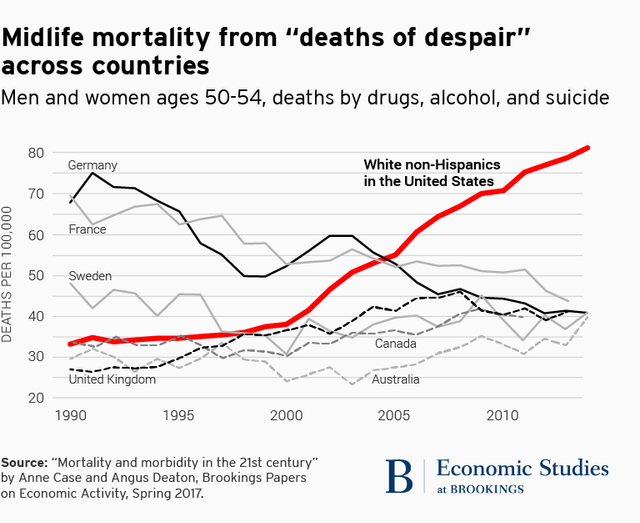
Building off their initial 2015 study which documented a sharp rise in the mortality rate for white, middle-aged working-class Americans, Case and Deaton conclude that the rising death rate is being driven by what they define as “deaths of despair,” those due to drug overdoses, complications from alcohol and suicide. The mortality rate for these causes grew by half a percent annually between 1999 and 2013.
During the course of the 20th century, the annual mortality rate for all middle-aged whites fell from 1,400 per 100,000 to 400 per 100,000. The US experienced a 100-year period of almost uninterrupted improvements in death rates and life expectancy. In this context Case and Deaton identify the recent rise in middle-aged mortality as “extraordinary and unanticipated.”
Midlife deaths of despair across countries
The epidemic of deaths from drugs, alcohol and suicide was initially seen in the American Southwest in the year 2000 but soon spread to the Appalachian region and Florida and is now nationwide, affecting rural and urban areas alike.
While every region of the US has seen an increase in the rate of “deaths of despair” among middle-aged whites over the last 15 years, the hardest-hit states are in the South (Alabama, Kentucky, Tennessee and Mississippi). Large urban and suburban areas have been the least affected, rural areas the most.
The mortality rate for working-class whites was also pushed up by a slowing and then stagnation of the decline in deaths from heart disease for white Americans between 2009 and 2015. On top of this the decline in mortality from lung cancer, caused by smoking and occupational hazards, slowed for white men 45-54 between 2000 and 2014, while mortality actually increased for white women 45-49 between 2000 and 2010.
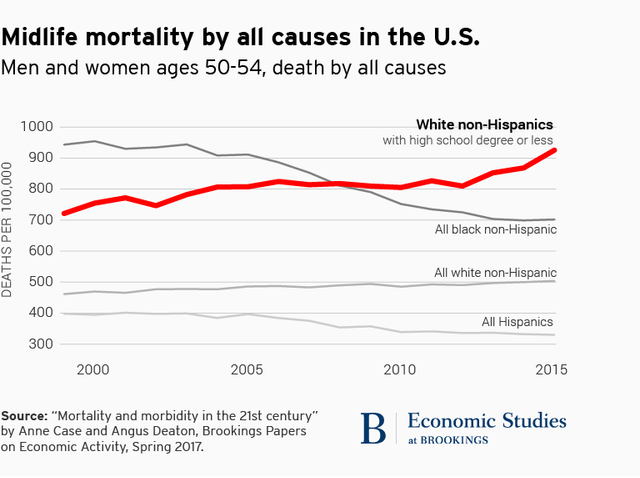
Case and Deaton found that midlife mortality for middle-aged, working-class, white Americans surpassed the midlife mortality for all African Americans for the first time in 2008, and by 2015 mortality for working-class whites was 30 percent higher than for blacks. More significantly, their data shows that the gap in mortality between whites and blacks in the working class has all but disappeared. This is the outcome of a general decline in mortality for blacks and a rapid increase for whites over the last decade-and-a-half, though in recent years the mortality rate for working-class blacks has begun rising along with that of whites.
Case and Deaton’s report is supported by the most recent Centers for Disease Control (CDC) data concerning suicides and overdoses.
The CDC found that after declining between 1986 and 1999 the US suicide rate rose gradually between 2000 and 2015, with the rate growing most rapidly in smaller cities and rural areas after the 2007-2008 economic collapse. Whites and Native Americans had the highest suicide rates, with both groups seeing noticeable increases. All told there were 600,000 suicides in the US between 1999 and 2015—the equivalent of the loss of a major city, more than the total estimated deaths in the Syrian civil war.
Another recent CDC report found that overdoses from all drugs has more than doubled since 1999, with middle-aged Americans having the highest rate of overdoses. The overdose rate for whites has more than tripled since 1999 and is now more than double the rate for blacks and Hispanics combined. Nearly 13,000 people died from heroin overdoses alone in 2015, more than four times the number of deaths recorded in 2010.
Midlife mortality by all causes in the US
The data collected and analyzed by Case and Deaton reflects a deeply sick society, the outcome of a social counterrevolution which has accelerated since the 2008 crash.
Their research makes clear that the American working class, regardless of race, is being made to pay the price for the failure of capitalism, exposing the lie repeated by pseudo-left groups and the practitioners of identity politics about the “privileged white working class.”
In the period reviewed by Case and Deaton, the Democratic Party completed its repudiation of a political program which in any way addressed the needs or interests of the working class, in favor of middle-class identity politics. This found its culmination in the election of Barack Obama, the first black president, who funneled trillions of dollars into Wall Street and expanded the wars in the Middle East. In the last year of his presidency, which had seen such catastrophes as the lead poisoning of Flint and the BP oil spill, and seven years of wage stagnation, Obama asserted that things were “pretty darn great” in America.
The immiseration of the American working class has also been made possible by betrayals of the trade unions which over the last four decades have collaborated with and integrated themselves ever more closely with the corporations in order to shutter factories, eliminate jobs and enforce wage and benefit cuts.
The period in which the American working class has been subjected to unrelenting attacks has seen the growth of historically unprecedented levels of social inequality. The resources of society and the wealth created by the working class have been plundered and funneled into the hands of an ever wealthier financial aristocracy. This process will only accelerate under Trump.
While it is claimed there is “no money” to pay for decent wages or social services in the US, the country claims eight of the world’s 10 wealthiest billionaires and spends more than the next seven countries combined on its military. The health care overhaul and budget cuts being proposed by the Trump administration are guaranteed to accelerate the social counterrevolution.
In this regard it is striking to note the overlap between the areas of the country particularly devastated by “deaths of despair” in the period examined by Case and Deaton and those with a large vote for Donald Trump in the 2016 election. The anti-working class policies pursued in the Obama years paved the way for Trump.
The residents of these areas, either rural or devastated by years of factory closures, voted for Trump not out of racial animus—an assertion often made by the mainstream media and pseudo-left—but as a cry of desperation, incipient anger and complete disgust with the political establishment.
These people have been at the frontlines of the onslaught against the working class, facilitated by Democrats and Republicans alike. As far as Trump identified himself as an outsider, opposed to the political establishment which facilitated the plunder of the working class, he drew significant support. These same working people are quickly being disabused of any illusions they may have held in the billionaire businessman.
The fundamental question raised by Case and Deaton’s research is the struggle of the working class against the capitalist system and for socialism. Social inequality has never been higher and the rich have never been richer. The working class is the only force which can reverse this counterrevolution. Workers must turn to socialism and fight to build a mass independent movement which will fight for political power and take control of the wealth plundered from them, putting it to use for the common good.

Japanese imperialism rearms

Peter Symonds

Japan’s ruling Liberal Democratic Party (LDP) is exploiting the extremely tense situation on the Korean Peninsula to push for its military to be able to carry out “pre-emptive” strikes on an enemy such as North Korea. The acquisition of offensive weapons, such as cruise missiles, for the first time since the end of World War II would be another major step by Prime Minister Shinzo Abe’s government to rearm Japan, heightening the danger of war.
Commenting on North Korean missile tests, Defence Minister Tomomi Inada suggested on March 9 that Japan could acquire the capacity for “pre-emptive” attacks. “I do not rule out any method and we consider various options, consistent of course with international law and the constitution of our country,” she said.
Hiroshi Imazu, chairman of the LDP’s policy council on security, was more forthright: “It is time we acquired the capacity. I don’t know whether that would be with ballistic missiles, cruise missiles or even the F-35 [fighter], but without a deterrence North Korea will see us as weak.” The policy council plans to submit a proposal in the current parliamentary session with a view to its inclusion in the next five-year defence plan.
Inada’s caveat notwithstanding, the purchase of weapons of aggression would openly breach Article 9 of the Japanese post-war constitution, which renounces “war … and the threat or use of force as a means of settling international disputes” and declares that “land, sea and air forces, as well as other war potential, will never be maintained.” Such a move would also dispense with the longstanding legal fig leaf that Japan’s existing military forces are purely for self-defence.
To date, Japanese governments have baulked at the acquisition of obviously offensive weapons, such as ballistic missiles, aircraft carriers and long-range bombers, not least because of widespread anti-war opposition among Japanese workers and youth. On Wednesday, however, Japan commissioned the Kaga, its second helicopter carrier. The ships are the largest put into operation by the Japanese military since World War II and could be modified to carry fighter aircraft.
The Abe government, the most right-wing in post-war history, has greatly accelerated the drive to remilitarise Japan and remove legal and constitutional restraints on its armed forces. Since coming to office in 2012, Abe has used the slogan of “pro-active pacifism” to justify increased military budgets, the establishment of a US-style National Security Council to centralise war planning in the prime minister’s office and a shift in the strategic focus of the military from the north to the southern island chain, adjacent to the Chinese mainland.
Abe underscored his confrontational stance toward Beijing at the 2014 World Economic Forum in Davos where he drew a false comparison between China today and German imperialism in 1914 so as to brand China as “aggressive” and “expansionist.” He deliberately heightened the dangerous standoff with China over the disputed Senkaku/Diaoyu islets in the East China Sea by insisting his government would not enter negotiations over their status with Beijing.
In 2015, the Abe government provoked huge protests against legislation that, under the deceptive banner of “collective self-defence,” allows the Japanese military to participate in US-led wars of aggression.
Abe has campaigned on the program of making Japan “a normal nation” with a strong military—in other words, for Japanese imperialism to prosecute its strategic and economic interests through all, including military, means. The LDP is pushing for a complete revision of the constitution, including the modification or removal of Article 9. The document has long been regarded in right-wing militarist circles as an “occupiers’ constitution” drawn up by the United States to render Japan impotent.
Abe and his cabinet have very strong links to ultra-right groupings such as Nippon Kaigi, which campaigns for a new constitution, promotes militarism and patriotism, and seeks to whitewash the crimes of Japanese militarism in the 1930s and 1940s. Nippon Kaigi’s parliamentary grouping includes 280 of the 717 parliamentarians in the lower and upper houses. Significantly, Abe is a special adviser to the organisation and 16 of his 20-member cabinet are members. He is now embroiled in scandal over claims that his wife, allegedly acting on his behalf, gave a cash donation to the ultra-nationalist operator of a private kindergarten in Osaka that indoctrinates pre-school children in Japanese patriotism.
The drive to remilitarise is being fuelled by the worsening crisis of Japanese and world capitalism, and the deep concern in Japanese ruling circles about the country’s historic decline, underlined by its relegation to the third largest world economy, behind China. As well as boosting the military, Abe has sought to extend Japanese influence, including military ties, especially in Asia, through the most active diplomatic drive of any post-war prime minister.
The Abe government has prosecuted remilitarisation under the umbrella of the US-Japan military alliance and with the active support of Washington. In part, this is to avoid stirring up memories of Japan’s wartime atrocities in Asia and generating opposition in the region to Japanese imperialism. Abe has also sought to continue to work closely with the Trump administration. He was one of the first world leaders to visit Trump after the US election, and again after Trump took office.
Trump’s installation, however, has profoundly destabilised world politics, including in Asia. His repudiation of the Trans-Pacific Partnership (TPP) was a blow to the Abe government, which had invested considerable political capital in overcoming opposition within the LDP, in order to ensure its ratification. Abe regarded the economic pact as critical to countering Chinese economic clout, ensuring a dominant position in Asia for Japan, in league with the US, and overcoming the protracted stagnation of the Japanese economy.
Moreover, Trump’s “America First” demagogy and threats of trade war have not just been directed against China. He has a long history of denouncing Japan for its trade surplus with the United States and “unfair” trade practices. During the US presidential election campaign, Trump also called into question the US-Japan Security Treaty, threatening to walk away if Japan did not pay more toward the cost of US military bases in the country. He even suggested that Japan should protect itself by building its own nuclear weapons.
As in Europe, all the geo-political fault lines that led to two disastrous world wars in the 20th century are emerging again. The Abe government’s determination to rearm Japan as rapidly as possible is not about countering the “threat” posed by North Korea, but defending the interests of Japanese imperialism by every means, compounding the danger of war. As in the 1940s, intense rivalry for markets, raw materials and cheap labour could fuel trade conflicts between US and Japan and a competition to dominate Asia, ending in a catastrophic war that would inevitably engulf the region and the world.

23 Mar 2017

Africa Prize for Engineering Innovation in Sub-Saharan Africa 2017/2018

Application Deadline: 24th July 2017
Offered annually? Yes
Eligible Countries: Countries within Sub-Saharan Africa. For the purposes of the competition, sub-Saharan countries include:
Angola, Benin, Botswana, Burkina Faso, Burundi, Cameroon, Cape Verde, Central African Republic, Chad, Comoros, Republic of the Congo, Democratic Republic of the Congo, Côte d’Ivoire, Djibouti, Equatorial Guinea, Eritrea, Ethiopia, Gabon, The Gambia, Ghana, Guinea, Guinea-Bissau, Kenya, Liberia, Lesotho, Madagascar, Malawi, Mali, Mauritania, Mauritius, Mozambique, Namibia, Niger, Nigeria, Rwanda, Sao Tome and Principe, Senegal, Seychelles, Sierra Leone, Somalia, South Africa, South Sudan, Sudan, Swaziland, Tanzania, Togo, Uganda, Zambia and Zimbabwe.
To be taken at (country): Sub-Saharan Africa
Eligible Field of Study: Any engineering field
About the Prize: The Africa Prize for Engineering Innovation aims to stimulate and reward engineering entrepreneurship in sub-Saharan Africa. The Africa Prize will encourage ambitious and talented sub-Saharan African engineers from all disciplines to apply their skills to develop scalable solutions to local challenges, highlighting the importance of engineering as an enabler of improved quality of life and economic development.
Africa Prize for Engineering Innovation
Crucial commercialisation support is awarded to a shortlist of innovative applicants through a six-month period of training and mentoring. Following this period of mentorship, finalists will be invited to present at an event held in Africa and a winner will be selected to receive £25,000 along with runners-up, who will each be awarded £10,000.
EligibilityTo be eligible,
  • Applicants must be individuals or groups of no more than three people.
  • Individual applicants must be citizens of a country within sub-Saharan Africa and currently reside there. For teams of two or three, the lead applicant must be a citizen of a country within sub-Saharan Africa and currently reside there.
  • Applicants must have an engineering innovation and provide a letter of support from a university of research institution.
  • Industrial researchers and establishments are not eligible.
  • The applicant’s innovation can be any new product, technology or service, based on research in engineering defined in its broadest sense to encompass a wide range of fields, including: agricultural technology, biotechnology, chemical engineering, civil engineering, computer science, design engineering, electrical and electronic engineering, ICT, materials science, mechanical engineering, and medical engineering. If you are in any doubt that your area of expertise would be considered engineering then please contact the Academy to discuss your application.
  • Applicants should have achieved the development of, and be in the early stages of commercialising, an engineering innovation that:
  1. will bring social and/or environmental benefits to country/countries in sub-Saharan Africa;
  2. has strong potential to be replicated and scaled up;
  3. is accompanied by an ambitious but realistic business plan which has strong commercial viability.
Number of Awardees: not specified
Value of Prize: Finalists will be invited to present at an event held in Africa and a winner will be selected to receive £25,000 along with runners-up, who will each be awarded £10,000
Duration of Program: Crucial commercialisation support is awarded to a shortlist of innovative applicants, through a six month period of training and mentoring.
How to Apply: All applications must be submitted via the online grants system, applicants should ensure they read the guidance notes before submitting their application.
Award Provider: Royal Academy of Engineering

UNESCO Photography Contest on the Safety of Journalists and the Issue of Impunity 2017

Application Deadline: 5PM (GMT) on 15th April 2017.
About the Award: As the United Nations agency with a specific mandate to promote “the free flow of ideas by word and image”, UNESCO aims to promote freedom of expression and its corollary of press freedom, to reinforce journalists’ safety and tackling impunity, in the framework of the United Nations Plan of Action on The Safety of Journalists and the Issue of Impunity. The safety of journalists and combatting impunity are central elements to support freedom of expression and press freedom. On average, every four days a journalist is killed for bringing information to the public. Over the last 10 years, 827 journalists have been killed according to UNESCO statistics.
Type: Contest
Eligibility: UNESCO is looking for images that illustrate journalists working in different situations, for example, international and/or local journalists covering demonstrations, trials, major public events, investigations on corruption, citizen journalists, journalists  embedded with police or the military, journalists reporting from a conflict zone, journalists in protected vehicles or in front of media houses with protection or any other case in which journalists, including women reporters, are at work in sensitive situations.
Selection Criteria: The photographs will be chosen for their artistic, creative and original content. UNESCO will establish a contract with the photographers, purchasing the selected photographs, whereby non-exclusive rights for the selected photographs will be granted to UNESCO.
Number of Awardees: Not  specified
Value of Award: The selected photographs will help to raise awareness on the working conditions of journalists and to illustrate activities and programs contributing to the safety of journalists and the fight against impunity.
Duration of Contest:  Not given
How to Apply: Requirements for proposals:
  • Maximum of 12 photographs;
  • Color, minimum resolution: 350 dpi, minimum size: A4;
  • Photo caption in English or French for each photograph with information (place, time, subject);
  • Price per single photograph.
Proposed photographs can be send to Michelle Salomons: m.salomons@unesco.org.
Award Provider: UNESCO

CFA Institute Access Scholarship 2017 for Students Worldwide

Application Deadline: 15th September 2017
Offered annually? Yes
Eligible Countries: All
About the Award: The CFA Institute Access Scholarship Program (“Program”) is designed to make CFA Institute programs more available to individuals who may not be able to afford the full program fees. (“Access Scholarships”). In order to protect the integrity of the Program, the following Official Rules (“Rules”) shall bind all participants in the Program.
Scholarship Candidates may be either new or existing candidates in the CFA Program. There is no minimum or maximum income or asset level for Scholarship Candidates. Candidates are ineligible if their current employer provides any financial assistance for participation in the CFA Program. Candidates can only receive one Access Scholarship per calendar year. Further, a Candidate may only receive one scholarship per exam, so if a candidate applies for both an Access and an Awareness Scholarship, and receives an award, the remaining application will be void.
Selection Criteria: Applications will be reviewed by CFA Institute and/or a local CFA Institute Member Society in the Scholarship Candidate’s geographic area. While financial need will be strongly considered, awards may be made based on a combination of factors, including financial need; the academic, professional or other accomplishments of the candidate; obstacles overcome by the candidate; contributions to the local community; the candidate’s interest in pursuing the CFA charter; and other personal characteristics that indicate the individual is a strong candidate to receive an Access Scholarship and become a CFA charter holder.
Number of Awardees: Not specified
Value of Scholarship: The scholarship covers the one-time CFA Program enrollment fee (if applicable) and reduces the exam registration fee (includes access to the curriculum eBook) to US$250.
Award Provider: CFA Institute

Underwater Nation: As the Rich Thrive, the Rest of Us Sink

CHUCK COLLINS

Are you or a loved one having trouble staying afloat? You’re truly not alone.
While the media reports low unemployment and a rising stock market, the reality is that almost 20 percent of the country lives in “Underwater Nation,” with zero or even negative net worth. And more still have almost no cash reverses to get them through hard times.
This is a source of enormous stress for many low and middle-income families.
Savings and wealth are vital life preservers for people faced with job loss, illness, divorce, or even car trouble. Yet an estimated 15 to 20 percent of families have no savings at all, or owe more than they own.
They’re disproportionately rural, female, renters, and people without a college degree. But the underwater ranks also include a large number of people who appear to be in the stable middle class. Health challenges are a major cause of savings depletion for these people, both in medical bills and lost wages.
Plenty more Americans could be vulnerable.
A financial planner will advise you to put aside three months of living expenses in financial reserves, just in case. So if your living expenses are $2,000 a month, you should try to have $6,000 in “liquidity” — money you can easily get to in an emergency.
But 44 percent of households don’t have enough funds to tide themselves over for three months, even if they lived at the poverty level, according to the Assets and Opportunity Scorecard.
Even having a positive net worth doesn’t mean you can always tap these funds, especially if wealth takes the form of home equity or owning a car.
Bankrate survey found that 63 percent of U.S. households lack the cash or savings to meet a $1,000 emergency expense. They’d have to borrow from a friend or family, or put costs on a credit card.
Seven percent of U.S. homeowners are underwater homeowners, with mortgage debt higher than the value of their homes. And more and more people have taken on credit card debt to pay the bills. Meanwhile, student debt is rising rapidly and is projected to become one of the biggest factors in negative wealth.
Conservative scolds will blame individuals for “living beyond their means” and being financially irresponsible. And individual behavior is important. But the financial stresses facing millions of families are more likely the result of four decades of stagnant incomes.
Half the workers in this country haven’t shared in the economic gains that have mostly gone to the rich. Their real wages have stayed flat while health care, housing, and other expenses continue to rise.
So not everyone is on the edge at this time of dizzying inequality, after all. The 400 wealthiest billionaires in the U.S. have as much wealth together as the bottom 62 percent of the population.
This is only possible because of the expanding ranks of drowning Americans.
Some politicians will scapegoat immigrants or other vulnerable people for this suffering. When this happens, hold on tight to your purse or wallet. They’re trying to distract you from the rich and powerful elites who are rigging the rules to get more wealth and power.
They want to deflect your attention away from the reality that your economic pain is the result of deliberate government rules that give more tax cuts to the super-rich and global corporations, keep wages down, push up tuition costs, and let corporations nickel and dime you for all you’re worth.
Congress and the Trump administration are proposing to cut health care, pass more tax cuts for the rich, and give global corporations even more power over you. They promise benefits will “trickle down.”
Unless we speak up, the only trickle will be the expansion of Underwater Nation.

Report documents extent of US-Australia economic ties

Nick Beams 

Uncertainty over the policies and actions of the Trump administration has intensified a longstanding debate in Australian foreign policy circles over how Canberra should balance its relationships with the United States, its main military ally, and China, its largest trading partner. Various strategic analysts, former politicians, ex-diplomats and media commentators are seeking to influence, in one direction or another, the axis of a new “Foreign Policy White Paper,” which is due to be released later this year.
Earlier this month, Australian Foreign Minister Julie Bishop delivered a major speech in Singapore, in which she urged the US to remain “strategically engaged” in Asia and “play an even greater role as the indispensable strategic power” in the region. Bishop implicitly appealed to the Trump administration to ensure that its “America First” threats of trade war, and escalation of tensions with China over issues such as North Korea, Taiwan and the South China Sea, do not impact adversely on its key allies, above all, Australia.
The speech was immediately criticised by foreign policy and defence analyst Hugh White, who has insisted that Australia recognises the US is in irreversible decline and orientates, instead, toward China as the region’s emerging economic and strategic power.
White took issue with Bishop’s assertion that the post-World War II “rules-based order” had to be defended, noting that in practice it meant upholding geo-strategic relations where “the rules are set and enforced by the United States.”
“That is the kind of order we had in Asia for many decades, and it worked very well for us and the rest of the region,” he wrote in a comment published in the Australian Financial Review last week. “But assuming it can keep working in future is just nostalgia, not policy making.”
White declared that the so-called “Bishop doctrine” of US pre-eminence “seems to be stuck in denial” about “the most important change in Asia’s strategic situation in decades—the radical shift in the distribution of wealth and power away from America towards China.” As long as Australia failed to recognise the scale and consequences of this shift, he continued, “we will be powerless to manage its consequences.”
The debate over foreign policy has been no less forcibly joined by defenders of a continued orientation toward Washington and the centrality of the US alliance. In particular, this layer has opposed reducing the dilemma of Australian capitalism to a strategic relationship with the US as opposed to vital economic relations with China. They argue that when investment and finance are taken into consideration, Australia’s economic ties with the US are irreplaceable. Any shift away from its alignment with US could, therefore, have potentially dire economic consequences.
This issue was first raised by Julie Bishop in January 2014, following discussions with US vice-president Joseph Biden, when she declared that the US was not only Australia’s key strategic ally, but its most important economic partner as well.
The economic relationship between the US and Australia was the subject of a paper published earlier this month by Ian Satchwell, senior fellow at the Perth-based USAsia Centre, entitled Trumping Trade: Understanding the Australia-United States Economic Relationship. The paper has been heavily promoted by Kim Beazley, former ambassador to the US, former Labor Party leader and defence minister in the 1980s—when he was nicknamed “Bomber Beazley” because of his enthusiasm for the military and the US alliance.
In a foreword to Satchwell’s paper, Beazley wrote that it broke “new ground” in understanding Australia’s “global personality” and was a “must read” for those who “want a full picture of our relationship with our American ally.” He drew attention to investment figures compiled by Satchwell, noting that, by 2015, two-way direct and indirect investment between the US and Australia stood at $1.45 trillion. In the same year, just the increase in American investment in Australia was greater than the cumulative stock of Chinese investment.
In the course of his paper, Satchwell does not fully engage in the foreign policy debate, but there is no doubt about his aim in highlighting the economic ties between the US and Australia. As he notes in one of the “key points” extracted from the paper: “There are strategic implications that arise from Australia’s failure to understand fully the breadth and depth of this two-way and increasingly integrated economic relationship, and its interplays with other relationships.”
In his introduction, Satchwell criticises the fact that discussions have focused on the notion of a “binary choice” between Australia’s trade with China and its strategic ties with the US. He asserts that economic relationships with the US, both in trade and investment, have been “under-appreciated.” While China has become Australia’s most important trading partner, the US is Australia’s most important investment partner, as well as its second largest two-way trade partner.
Satchwell’s research goes beyond simple export and import trade data, focussing on the extent of financial ties. He notes, for example, that Australian companies orientated to the American market have shifted entire operations to the US. Sales by Australian firms based in the US now exceed, almost four-fold, Australian exports to the US. In 2013, majority- and minority-owned Australian companies held assets in the US totalling $322 billion, and generated sales of $65.3 billion.
Significantly, the main business activity of US-based Australian firms, some 43 percent of all operations, was manufacturing.
Satchwell cites remarks by the Australian trade minister, Steve Ciobo, in January, in which he points out that the stock of US direct investment in Australia is more than double US investment in China. And Australia has seven-and-a-half times more direct investment in the US than it does in China. The two-way investment relationship between Australia and the US, he comments, is “Australia’s largest by far,” with the United Kingdom coming in second.
In 2015, the total stock of Australian investment in the US was $594.4 billion, which amounted to 69 percent of the level of US investment in Australia, and made up 29 percent of all Australian investment abroad. US investment in Australia stood at some $860.3 billion—28 percent of total foreign investment in the country. Chinese investment, while rising rapidly, stood at just $74.9 billion.
Satchwell notes that the US is a leading destination for Australian investment in finance and insurance. According to a study conducted by the Australian Bureau of Statistics, the US ranked first for the number of Australian affiliates abroad in this sector and third in the total number of sales. A study by the Department of Foreign Affairs and Trade showed that between 2002–03 and 2009–10, the number of Australian finance and insurance businesses in the Americas grew by 555 percent, despite the effect of the global financial crisis.
The US is also a major investor in financial and insurance services in Australia, with stocks of direct investment reaching $US19.7 billion in 2015.
In the area of services, the US is Australia’s top two-way partner by a large margin. The US comprises 15.8 percent of all service exports and imports, compared to China at 9.1 percent. While China is the largest market for the export of services, with the US running second, the US is the largest exporter of services to Australia, showing its importance, according to Satchwell, as the provider of “key enablers of growth and diversification” in the Australian economy.
One significant feature of the trade pattern is that a high proportion of Australian companies that export to the US are involved in high-tech areas, particular aerospace. Of the goods exported to the US, the largest category is elaborately transformed manufactures (ETMs), led by aircraft, spacecraft and parts.
In 2015, ETMs comprised some 35 percent of all Australian exports to the US, while making up only 11.9 percent of the country’s overall exports. What proportion of these exports is related to defence equipment is not known, but it may well be significant.
Insofar as he directly touches on the foreign policy issues that emerge from his economic analysis, Satchwell points to Australia’s vulnerability in the new situation that has arisen with the Trump presidency. He notes that while Australia is a significant trade and investment partner, its importance to the US is much less than the importance of the US to Australia, with the exception of mining.
The Australia-US relationship, Satchwell writes, is “integrated and complex.” The position of the US as Australia’s most important investment partner, major technology partner and key strategic ally means that an ongoing relationship “remains crucial to Australia’s interests.” The balancing of trade and strategic interests, with the Trump administration threatening trade war against perceived rivals and the disruption of global markets, will be “complicated and replete with risk.”
As Beazley’s positions reveal, Satchwell’s analysis will be utilised by all those who favour “doubling down” on the strategic relationship with the US, including even closer military ties, as the best means for defending Australian capitalism’s economic interests.