29 Mar 2017

Protests underway in UK against school education funding cuts

John Vassilopoulos 

Massive cuts to the school funding budget in England by the Conservative government is provoking a growing movement of protests in opposition.
Over the next four years £3 billion in funding will be cut from school budgets under a supposedly “fair funding” formula. This amounts to an 8 percent cut in real terms. More than 90 percent of schools across England will be affected, with cuts in London amounting to £600 million. Pupils in other major cities, including Leeds, Liverpool, Manchester and Nottingham, will receive less funding per head under the new system.
The government is rationalising the cuts on the basis that schools in relatively better funded areas such as London will see their funding cut supposedly in order to be redistributed to under-resourced schools around the country.
On March 18, around 400 parents and children protested in the market town of Sandbach in Cheshire, which has a population of just 17,000. The funding cuts will reduce annual spending per pupil in Cheshire East to just under £4,200. The previous month a protest was held in nearby Nantwich.
Last Saturday parents protested in Chester city centre in the North West of England.
A number of protests have been held in London, including one attended by around 100 parents and teachers at Stoke Newington School in the borough of Hackney.
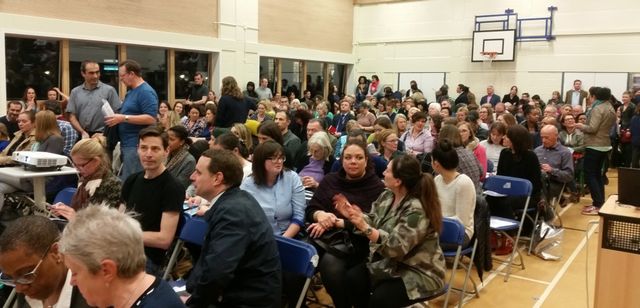
The audience at the Lambeth meeting
In the inner London borough of Lambeth, £25 million is to be slashed from school funding by 2020. For some schools this means up to 25 percent in cuts to their budget.
The impact of such draconian cuts will be devastating. With over 100 people per hectare, Lambeth’s population density is more than twice the London average, making it one of the most densely populated areas in the country. With a ranking in the bottom 10 percent on the index of multiple deprivation, Lambeth is one of the most deprived boroughs in England and the eighth most deprived local authority in London. Lambeth’s children tend to have complex educational needs. Many of them are refugees, while an above average proportion speak English as a second language.
The Fair Funding For All Schools Lambeth campaign, a campaign group set up with the declared aim of opposing the cuts, held a meeting in Lambeth this month. The meeting at Sunny Hill Primary School in Lambeth was attended by over 250 parents, with the assembly hall filled to capacity.
While the high attendance of the meeting testifies to the broad hostility among parents and education workers to the government’s plans and their willingness to fight them, the campaign offered no viable strategy.
The national Fair Funding For All Schools campaign bases its strategy on a call for the government to “Increase investment in all schools by protecting per-pupil funding in real terms for the life of this Parliament.” This request is made to a government that is cutting billions in funding and is committed to the privatisation of education at all levels. The campaign declares that, “through a national petition and setting up local parent groups—we will bring pressure to bear in Westminster through an effective political lobbying and media strategy.”
Leaflets on the chairs set out a limited five-point action plan for parents to follow, which included responding to the government’s consultation online, signing a petition and writing letters to local MPs. A generic postcard addressed to Education Secretary Justine Greening was handed out for people to fill out and send.
The only purpose of such a campaign is to ensure that broadening opposition to the cuts does not spiral out of control and remains within the straitjacket of Labour and the trade unions, which in turn allows the government to implement the cuts unchallenged. It is also designed to conceal Labour’s direct complicity in implementing the government’s austerity agenda.
The speakers at the event were the leader of Lambeth’s Labour-led Council, Lib Peck, Labour MP Helen Hayes and National Union of Teacher (NUT) Vice President Kiri Tunks.
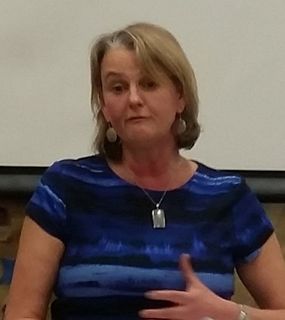
Lib Peck speaking at the Lambeth meeting
In her speech, Peck said, “Schools have already seen cuts in their budgets since 2010 and that’s already beginning to have an impact,” but failed to mention her own administration’s direct role in implementing the government’s cuts.
At the start of 2016, Lambeth council launched a web site “Tough Choices,” on which it stated that its funding had been cut by central government by 56 percent. The web site declares, “That means tough choices about what we can afford.” At the time Lambeth Chief Executive Sean Harriss told the Guardian, “It was a decision made by central government, but we’re prepared to own the decisions we have to make with the hand we’ve been dealt.”
Labour councils’ adherence to the government’s austerity has been promoted by Labour leader Jeremy Corbyn. In September 2015, Corbyn and Shadow Chancellor John McDonnell sent a letter to all Labour councils demanding they abide by the law and impose the cuts demanded by the Conservative government, under pain of disciplinary measures if they refused.
Peck mentioned her own opposition to the “forced-academisation” carried out by the present government, while praising the Building Schools For the Future (BSF) programme implemented under the Labour governments of Tony Blair and Gordon Brown. Both policies, which extended the reach of the private sector within education, were in fact introduced under Labour.
Academies were introduced by Blair’s government in 2000. They are schools directly funded by central government, but are outside local authority control and have the power to supplement their revenue from personal and corporate sponsors.
The BSF was a scheme under the Private Finance Initiative, which handed out lucrative contracts for building schools to consortia of financiers, construction and IT companies.
The role of the trade union bureaucracy is no less criminal in enabling the government to implement its agenda. Having confined teachers’ opposition to the government’s attacks on education to a series of token strikes, the NUT sows illusions that the Tories can be pressured to back down on implementing the cuts.
In her speech, NUT Vice President Kiri Tunks stated, “There are indications that the government has started to backtrack a bit on the national funding formula and this is not the time to take the foot off the pedal.” Tunks concluded, “I think we can win on this, I think we can win better funding and once we’ve got this movement going, and it is a movement, I think we can build a really fantastic vision for education.”
As with NUT General Secretary Kevin Courtney, Kiri Tunks is a supporter of the Socialist Teachers Alliance, a current within the NUT backed by the pseudo-left Socialist Workers Party (SWP). Both Courtney and Tunks were officially backed by the SWP as they ran for election.
After the meeting, a WSWS reporter spoke to Natalia, a mother of two children from France. “It’s so sad! Why don’t they protect education?” she asked. “Education is everything in life. If you destroy kids at a young age then how can you be surprised that the country is such a mess? They can’t even provide the minimum that our children deserve. That’s a disgrace. I feel so sad for my son and my daughter who is only one year old. What is the point of giving life to children [under these circumstances]?”
After the reporter pointed out that education cuts have been implemented both by Labour and Conservatives over many years, Natalia responded, “They should be ashamed! They should never touch the money put in place for kids. Never.”

Shift to right following election in Bulgaria

Markus Salzmann

Citizens for European Development of Bulgaria (Gerb), the right-wing conservative party led by Bojko Borissov, won the early parliamentary election held in Bulgaria on Sunday. The previous head of government will now strive for an alliance with other right-wing and far right forces.
The third parliamentary election in the last four years was called when Borissov resigned as head of government in the middle of last year after Rumen Radew, the candidate of the Socialist Party (BSP), won the country’s presidential election.
According to the electoral commission, 32.6 of Bulgarians voted for Gerb. The BSP, which had been head-to-head with Gerb in the polls, landed well behind with 27.1 percent.
The outcome of the election on Sunday will further exacerbate the political crisis in Bulgaria. It is very unlikely that Gerb can form a stable government with the other right wing parties. Neither is the BSP expected to be able to form a functioning coalition given the massive clash of conflicts which characterise Bulgarian politics.
A major issue is the country's relationship towards the EU and Russia. The election last year of Radew as president was regarded as a step towards Russia. Radew and the BSP chairman Kornelia Ninova demand an end to the EU sanctions against Russia plus closer cooperation with Moscow. Borissov on the other hand is an adamant supporter of the EU.
The likelihood of Borissov becoming premier a third time - he was already prime minister from 2009 to 2013, as well as from 2014 to 2016 - can only be explained by the complete discrediting of the BSP. The successor party to Bulgaria’s Stalinist ruling party had carried out a policy of mass privatization and ruined the country's economy after the collapse of Stalinist rule. Under Borissov the country then joined the EU. As a result, the Balkan state is listed as the poorest country in the EU.
Bulgaria’s per capita economic output is currently less than half the EU average. Although last year's economic growth was over three per cent, the IMF is forecasting a fall to a maximum of 2.5 percent in coming years. Wages, which in Bulgaria average about 300 euros a month, are much lower than even in neighbouring, poverty stricken Romania.
The catastrophic conditions in the country are driving young, better-educated people abroad. Between 1990 and 2012, the population decreased by around twelve percent.
A “grand coalition” between Gerb and BSP has been ruled out by both sides. The vote for the pro-western Reformers Bloc, the last government partner of Gerb, fell from nine to three percent and it failed to enter parliament. For this reason, Borissov is now seeking an alliance with ultra-right parties. The third ranking party in the new parliament is the alliance of United Patriots (VP), consisting of three extreme right parties.
Last week this grouping blocked the Bulgarian-Turkish border to prevent Turks with dual citizenship, and therefore have the right to vote in Bulgaria, from entering the country. The police did not intervene.
The IMRO (Bulgarian National Movement), the largest organization within the United Patriots nationalist electoral alliance, is the successor of an organization which has used terrorist means for decades for the purpose of establishing a “great Bulgaria” through the annexation of Macedonia. The "National Front for the Rescue of Bulgaria," which emerged from the Ataka party in 2011, also part of United Patriots, openly propounds fascist and racist positions.
Krassimir Karakachanov, the chairman of IMRO, calls for the use of firearms against refugees at the country’s borders and openly advocates violence against the Roma living in the country. He regards Bulgaria as a front-line state against Islamism. It should be noted that Borissov, who recently declared the Balkans was on the brink of war, is now considering forming a government with an openly fascist party.
Gerb and the BSP also conducted campaigns against Turks during the election campaign.
Following internal conflicts, the party of the Turkish minority, the DSP, which participated in several governments, broke apart last year. Democrats for Responsibility (DOST), which emerged from the breakup, supports the authoritarian course of Turkish President Erdogan.
Gerb and the BSP reject any coalition with the rest of the DSP, which won nine percent of the vote and therefore has seats in the new parliament.
Another potential alliance partner for Gerb is the new party Volya, headed by Weselin Mareschki, who describes himself as an anti-establishment candidate in the manner of Donald Trump. It received just over four percent of the vote.
Like his American role model, Mareschki owns a business empire, mainly in the fields of medicine and energy. He declared his readiness to form a coalition with Gerb or the Socialists, as long as they fulfilled his demands for massive tax cuts and the complete privatization of the Bulgarian economy.

Thousands protest throughout Russia

Vladimir Volkov

Thousands of people participated in anticorruption protests in Russian cities on Sunday, March 26, leading to the arrest of over 1,000 people in Moscow and St. Petersburg and hundreds in other parts of the country.
Demonstrators’ slogans included “Russia without Putin,” “Impeachment” and “Shame.” According to reports, significant layers of youth took part in the protests. In interviews, many protesters pointed to social grievances. Unia.net quoted one protester as saying: “I am fed up with all of it. We have already gone through our entire life, and what about the youth? With such salaries, with mortgages. And they [the officials] steal and steal. When will they get rich enough?”
The Russian economy has been hard hit by the Western sanctions that were imposed by the US and the EU as an act of economic warfare following the pro-Western coup in February 2014 in Kiev. There are some 25 million people officially living in poverty, but the actual numbers are much higher. Real incomes have fallen by at least 15 percent over the past two years, while food prices have gone up by 36 percent on average, and utility fees by 28 percent, according to the Washington Post .
While many demonstrators expressed opposition to the widespread social inequality that prevails throughout Russia, the far-right and pro-Western program of oppositionist politician Alexei Navalny has nothing to do with the genuine interests of broad layers of the population. Its realization would inevitably lead to a sharp decline in the living standards of the masses and an even greater suppression of their democratic rights. Precisely this occurred in Ukraine after the pro-Western coup in Kiev in February 2014.
Navalny has sought to tap into the massive social discontent among workers, youth and intellectuals with his documentary, which shows the fabulous wealth Russian Prime Minister Dmitri Medvedev has amassed, while the overwhelming majority lives in abject poverty. The YouTube video of the film has attracted over 14 million viewers within the past few weeks.
Navalny, however, is a tool in the hands of a section of the Russian oligarchs, who are dissatisfied with the uncontrolled power of Putin’s circle, and expresses the interests of better-off layers of the upper middle class. They do not want prosperity, freedom and democracy for all of society, but only a more significant and—in their opinion—“just” part in the profits of the extremely narrow ruling elite and, accordingly, a greater participation in political power. In this they see a means not only to preserve, but also to strengthen the foundations of the post-Soviet capitalist order that has thoroughly discredited itself.
At the same time, Navalny’s program corresponds to the interests of influential sections of international, and especially American, imperialism. The ruling elites of the leading Western countries seek to implement a regime-change operation in Russia in order to establish their immediate domination over the natural and human resources of the country, to carve it up into a series of powerless and dependent formations and, eventually, to transform the biggest of the former Soviet republics into a semi-colony.
This deep contradiction between the program of the pro-Western opposition, on the one hand, and the motives of the protest moods in society, on the other, explains the character of the political campaign of Navalny and the means being employed by his team to try to gain mass support.
Navalny has employed extremely vague formulations—in this case, the condemnation of corruption—which leaves the main, core part of their program—the free market—intact and obscured. They try to make use of the fact that the regime fears any public expression of criticism, arguing that this forces them to refrain from elaborating more concrete slogans. But in reality, their silence is beneficial for themselves, inasmuch as they understand that an open discussion of their goals will push significant layers of society away from them.
The corruption revelations of Navalny’s Foundation for the Struggle against Corruption (FBK) concern only government officials, never big business. Meanwhile these two are inseparably linked in the same, indissoluble mafia-like system of post-Soviet capitalism. The state bureaucracy, of course, “robs” businesses, but in the final analysis it is in itself a product of the latter, and did not emerge out of nowhere.
Endemic corruption arises out the character of Russian capitalism, which is incapable not only of developing the country, but even of simply keeping intact the remnants (dating from the Soviet past) of basic industrial infrastructure and social conquests.
Navalny’s political evolution reflects a turn to the right that is characteristic of the ruling elites of the West and Russia over the past 15 to 20 years.
He began his political activities in the early 2000s in the ranks of the liberal-democratic party Yabloko (Apple). In the period of the “color revolutions” in the post-Soviet space, in which ultranationalists of all hues functioned as the hit squad for pro-Western forces, he turned to far-right Russian nationalists and fascists. He repeatedly took part in their marches, screaming slogans like “Russia for Russians” and “Stop Feeding the Caucasus.” For this he was expelled from Yabloko.
In 2010, he attended a special six-month course at Yale University in the US as part of a program which is aimed at preparing “new world leaders and expanding international understanding”—in other words, a program of the CIA and US State Department designed to train future American stooges in various countries of the world.
After his return to Russia, he began his unusually quick and successful career as a blogger, exposing corruption at the highest echelons of power. Already his first loud publication about corruption in the state company “Transneft” in late 2010 revealed his connections to influential circles in the Kremlin without which he would have not been able to get access to the documents in question.
Within a year, in December 2011, when mass protests erupted over alleged rigging of the parliamentary elections, Navalny was parachuted into the ranks of the self-proclaimed leadership of these protests along with activists of the liberal opposition, where he tried to take control.
On May 6, 2012, one day before the presidential inauguration of Putin, Navalny tried to provoke a “Maidan” in the center of Moscow, which became the occasion for the arrest of a number of activists. They were sentenced in the so-called “Bolotnoe case.” Navalny himself was soon put on trial on a series of charges, including the embezzlement of funds, and was sentenced to a probational prison term.
This did not prevent him from taking part in the Moscow mayoral elections in the summer of 2013, where he received over 27 percent of vote, which provided a boost to his pretensions to be the main political representative of the “urban creative class.”
The pro-Western coup in Kiev in February 2014 and the Russian annexation of Crimea in March that same year sharply changed the political moods in the country. The pro-Western liberal opposition found itself in a state of growing isolation, which manifested itself during the last parliamentary elections in October 2016, in which these forces suffered a devastating defeat and lost their representation in the State Duma (Russian parliament.)
After he declared the beginning of his presidential pre-electoral campaign late last year, Navalny, although his official registration was rejected, sought to draw attention to himself against the background of growing protest moods in the country.
One of the elements of his campaign was the establishment of “headquarters” in many regions of the country, and also the emergence of a documentary film about his investigation into the corrupt machinations of Prime Minister Dmitri Medvedev. The commentaries to his film note that it made use of footage of residences that are guarded by the secret services, using unmanned drones. This would have hardly been possible without the support from high-ranking circles of the Kremlin administration.
The corruption prevailing in every sector of Russian economic life is a direct result of the dissolution of the USSR and the restoration of capitalism by the Stalinist bureaucracy, which recklessly plundered the wealth created by the Soviet working class over decades. The working class in Russia can only fight for better living standards and against the danger of war with US imperialism, or the installment of a pro-Western puppet regime, by drawing the necessary lessons from the betrayals of Stalinism and the collapse of the USSR and by turning to a socialist and internationalist program.

US accused of war crimes in air strikes on Iraqi city of Mosul

Bill Van Auken

Amnesty International issued a report Tuesday charging the US-led coalition besieging Mosul, Iraq’s second-largest city, with war crimes involving the “disproportionate and indiscriminate” bombing of residential areas that has slaughtered hundreds of civilian men, women and children.
The report by the human rights group, which chronicles bloody incidents that took place in eastern Mosul during the end of 2016 and the beginning of this year, has been released amid mounting evidence that the Pentagon carried out one of its worst atrocities in decades in the March 17 bombing of the Jadida neighborhood in the densely populated western sector of the city.
While earlier reports spoke of some 160 dead being pulled from the rubble left by the US airstrikes in Mosul’s Jadida district, on Monday the Iraqi Civil Defense Department released a report saying that 531 bodies have been recovered thus far.
“We probably had a role in those casualties,” Lt. Gen. Stephen Townsend, the top US commander in Iraq and Syria, acknowledged to Pentagon reporters Tuesday. At the same time, however, Townsend suggested that the “the enemy had a hand in this,” alleging that there was no reason for civilians to have congregated inside buildings targeted by US warplanes other than their being exploited as “human shields.”
This attempted alibi is contradicted by multiple reports from survivors of the bombing raid, who said that entire families, terrorized by US bombs as well as mortar attacks by Iraqi government forces, had huddled in basements of homes in the neighborhood. Indeed, before launching the offensive last fall, the US-backed Iraqi military dropped leaflets on Mosul, a city of 1.8 million people, urging residents to “shelter in place” rather than flee to safety.
The US and Iraqi commanders on the ground apparently called in the air strikes to kill small numbers of ISIS (Islamic State of Iraq and Syria) snipers located on rooftops, in the process reducing entire city blocks to rubble.
General Townsend dismissed Washington’s responsibility for the carnage. “If the US did this,” said Townsend, it was an “unintentional accident of war.” Chillingly, he added that civilian casualties in western Mosul are “fairly predictable,” given its crowded residential neighborhoods and the intense street fighting. In other words, many more atrocities like that of March 17 are still to come.
Iraqi vice president Osama al-Nujaifi, who is from Mosul and the most senior Sunni official in the country, described the US bombing as a “humanitarian catastrophe” that had resulted in the “martyrdom of hundreds of civilians.” He called for an emergency session of the Iraqi parliament along with an official investigation of the incident. He charged that the mass civilian casualties were the result of changed rules of engagement on the part of the US-led “coalition” that have minimized any attempt to protect the lives of unarmed men, women and children trapped in Mosul.
This same charge was leveled by Iraqi officers cited by the New York Times Tuesday. According to the Times, the officers report that “the American-led coalition has been quicker to strike urban targets from the air with less time to weigh the risks for civilians. They say the change reflects a renewed push by the American military under the Trump administration to speed up the battle for Mosul.”
In a report from the scene of the devastation, the Times described “a panorama of destruction in the neighborhood of Jadida so vast one resident compared the destruction to that of Hiroshima, Japan, where the United States dropped an atomic bomb in World War II. There was a charred arm, wrapped in a piece of red fabric, poking from the rubble; rescue workers in red jump suits who wore face masks to avoid the stench, some with rifles slung over their shoulders, searched the wreckage for bodies.”
The newspaper reported that “One of the survivors, Omar Adnan, stood near his destroyed home on Sunday and held up a white sheet of paper with 27 names of his extended family members, either dead or missing, written in blue ink.”
The Amnesty International report released Tuesday indicates that the atrocity in Jadida is only the bloodiest in a series of attacks carried out by US forces resulting in mass civilian casualties.
“Evidence gathered on the ground in East Mosul points to an alarming pattern of US-led coalition airstrikes which have destroyed whole houses with entire families inside,” reports Amnesty’s senior crisis response adviser Donatella Rovera following field investigations in the war-ravaged city.
“The high civilian toll suggests that coalition forces leading the offensive in Mosul have failed to take adequate precautions to prevent civilian deaths, in flagrant violation of international humanitarian law.”
The Amnesty report quoted Wa’ad Ahmad al-Tai, a resident of the al-Zahra neighborhood of East Mosul, who said he and his family were among those who had followed the advice of the US-backed Iraqi government to stay in their homes rather than flee the siege.
He recounted how his extended family had sought shelter in the two-story home of his brother: “We were all huddled in one room at the back of the house, 18 of us, three families. But when the house next door was bombed, it collapsed on us, precisely over the room we were sheltering in. My son Yusef, nine, and my daughter Shahad, three, were killed, together with my brother Mahmoud, his wife Manaya and their nine-year-old son Aws, and my niece Hanan. She was cradling her five-month-old daughter, who survived, thank God.”
Hind Amir Ahmad, a 23-year-old woman who lost 11 relatives, recounted a similar attack in eastern Mosul that took place on December 13, 2016: “We were sleeping when the house literally collapsed on us. It was a miracle none of us was killed. We ran to my uncle’s house nearby. At about 2 p.m. that house too was bombed and collapsed on us … almost everyone in the house was killed—11 people. My cousin, two aunts and I were the only ones who survived. Everyone else died. It took us six days to find only pieces of their bodies, which we buried in a mass grave in a field nearby. ... I don’t know why we were bombed. All I know is that I have lost everyone who was dearest to me.”
The Amnesty report also debunked the Pentagon’s attempt to justify the killing of Iraqi civilians with claims that ISIS is using the population as “human shields.” Even if the Islamist fighters showed indifference to human life, this did not justify the indiscriminate air strikes launched by US warplanes, the human rights group said. It also pointed out that the US-backed Iraqi military is setting up its own firing positions in and around civilian homes, exposing them to return fire from ISIS forces.
As of March 21, the monitoring group Airwars had recorded over 1,000 “civilian casualty events” resulting from airstrikes by the US and its allies in both Iraq and Syria. The number of incidents has risen sharply in the course of the first three months of this year with the siege of Mosul and the preparations for a similar bloodbath in the ISIS-held Syrian city of Raqqa.
The group pointed out that the US air strikes have far eclipsed those being conducted by Russia, which intervened in Syria in support of the government of President Bashar al-Assad.
Yet the same US and Western media, which waged an intense propaganda campaign over civilian casualties caused by Russian air strikes against Al Qaeda positions in the Syrian city of Aleppo, has proven itself largely indifferent to the killing of Iraqi men, women and children in Mosul.
Nor for that matter have the changed “rules of engagement” enacted by the Pentagon under the Trump administration elicited any protest from its ostensible political opponents in the Democratic Party. This is because, as the Amnesty report documents, the carnage in Mosul was already well under way before Barack Obama left the White House.
The US escalation in Iraq and Syria enjoys bipartisan support. Launched under the pretense of a campaign against ISIS, which is itself the direct product of the US invasion and destruction of Iraq, followed by the proxy wars for regime change in Libya and Syria, the aim of the ever growing American intervention is to assert US imperialist hegemony over the entire oil-rich Middle East.
The US pursuit of this geostrategic aim has already cost millions of lives over the past quarter century. Its aggressive renewal has been launched in preparation for far more dangerous confrontations with Washington’s chief global rivals, China and Russia.

Washington protests proposal for nuclear disarmament

Andre Damon

On Monday, the United States, together with Britain and France, walked out of a session of the United Nations General Assembly set to discuss a global ban on nuclear weapons.
After leaving the session, the United States and its imperialist allies lined up in front of reporters to give a statement protesting the UN proposal, beginning with an incoherent diatribe by Nikki Haley, the US ambassador to the UN and right-wing ideologue who formerly served as governor of South Carolina.
Haley declared, “As a mom, as a daughter, there is nothing I want more for my family than a world that has no nuclear weapons.” However, she cautioned, “Our jobs is [sic] to protect the people in our country.”
She plaintively denounced the fact that “suddenly the General Assembly wants to have a hearing to ban nuclear weapons,” saying, “we have to be realistic. Is there anyone that believes that North Korea would agree to a ban on nuclear weapons…
“In this day and time, we can’t honestly say that we can protect our people by allowing the bad actors to have them and those of us that are good, trying to keep peace and safety, not to have them.”
The hypocrisy of these statements is breathtaking. It should first be noted that the supposed keeper of “peace and safety” is the only country to use a nuclear weapon in war, incinerating two Japanese cities at the end of the Second World War as part of its effort to establish unrivaled military domination in the postwar era.
More recently, the American ruling class and its allies have used the pretext of “weapons of mass destruction” to launch one war and regime-change operation after another, killing more than a million people in the process. Most notably, in the run-up to the 2003 invasion of Iraq, the US falsely alleged that the government of Iraqi president Saddam Hussein had failed to comply with UN resolutions on disarmament.
On March 17, 2003, just three days prior to the beginning of “shock and awe,” George W. Bush declared, “We have passed more than a dozen resolutions in the United Nations Security Council… The Iraqi regime has used diplomacy as a ploy to gain time and advantage. It has uniformly defied Security Council resolutions demanding full disarmament.”
The Bush administration’s claims about weapons of mass destruction were a pack of lies. The war that Bush launched on the grounds of advocating “disarmament” led to a brutal occupation that plunged the country into a bloodbath that continues to this day, engulfing much of the Middle East in sectarian warfare.
Today, the United States is using similar pretexts to escalate confrontations with Iran and North Korea.
Earlier this month, US Secretary of State Rex Tillerson made clear that Washington is prepared to go to war again with North Korea unless it ceases to develop nuclear weapons, saying all options were “on the table.”
Tillerson’s declaration has been accompanied by a nonstop media offensive demanding an even more aggressive response by the Trump administration to the developments in North Korea.
To cite just one example, the Wall Street Journal published an op-ed column by Bret Stephens Tuesday calling for the United States to “make regime change an explicit aim of US policy,” demanding that the US press ahead with a policy of escalation in the Asia/Pacific region that could result in an all-out nuclear war with not only North Korea, but with China.
Even as the US policy establishment clamors for military escalation, behind the scenes major think tanks are warning of just how close the United States stands to full-scale war with one or more nuclear-armed powers.
Among the most chilling of these warnings was an article published in this week’s Foreign Affairs by Philip Gordon, entitled “A Vision of Trump at War.” The article paints three scenarios, all narrated in real time, hypothesizing how the United States might find itself in a full-scale war with China, North Korea or Iran within the next two years.
Here is just one example of the China scenario: “[A]n incident in the South China Sea led to the escalation so many had feared. The details remain murky, but it was triggered when a US surveillance ship operating in disputed waters in heavy fog accidentally rammed a Chinese trawler that was harassing it. In the confusion that ensued, a People’s Liberation Army Navy frigate fired on the unarmed US ship, a US destroyer sank the Chinese frigate, and a Chinese torpedo struck and badly damaged the destroyer, killing three Americans.” The ensuing conflict could “quickly lead to hundreds of thousands of casualties, draw in neighboring states, and destroy trillions of dollars’ worth of economic output.”
The article is couched in the form of a warning that US President Donald Trump’s brash and aggressive diplomatic style risks a miscalculation that could lead to an unintentional war; in that sense it paints Trump as an exception. In reality, however, Trump merely represents, in the most advanced form, the war fever gripping all of the capitalist countries, and both parties in the United States. Trump’s predecessor, Barack Obama, initiated a $1 trillion nuclear modernization program while sharply escalating conflicts with both Russia and China. Meanwhile Trump’s Democratic opponents in Congress have centered their criticism of the Trump administration on the effort to force it to take a harder line against Russia.
The war fever is likewise raging throughout Europe and Asia. NATO members, including Britain, France and Germany, have each sent tanks, heavy weapons and troops to Russia’s western borders after having substantially increased their military spending last year. Citing a potential conflict with Russia, Sweden has introduced conscription, and Emmanuel Macron, the frontrunner in the French presidential election, has vowed to do the same, with other countries likely to follow suit. Meanwhile, the German press has called for Germany to develop nuclear weapons, a proposition previously considered unthinkable in light of the crimes perpetrated by the German military in the Second World War.
All over the world, the imperialist powers, drenched in self-righteous hypocrisy, are arming themselves to the teeth in preparation for a third world war. The conception that the capitalist powers, each mired in its own domestic political, economic and social crisis, will willingly renounce war as an instrument of policy, or even the use of nuclear weapons, is a utopian pipe dream.
As Leon Trotsky wrote in the Transitional Program of 1938, “Disarmament… the entire question revolves around who will disarm whom. The only disarmament which can avert or end war is the disarmament of the bourgeoisie by the workers. But to disarm the bourgeoisie, the workers must arm themselves.”
Trotsky meant that the workers must arm themselves first and foremost politically, with an international party capable of seizing political power from the financial elite that benefits from war, and reorganizing the world’s feuding nation-states in an international socialist federation, based on reorganization of economic life in the interests of social need, not private profit.

The CPEC: Corridor to Chinese Coffers

Vijay Shankar


Misshapen Marshall Analogy 
Deceptive arguments are current that the China Pakistan Economic Corridor (CPEC) finds historic equivalence in the ‘Marshall Plan’. The Plan was an American Congressional Act legislated on 3 April 1948, in the immediate depredations of post-World War II Europe. It sought “to promote world peace (?)… national interests, and foreign policy of the United States through economic, financial, and other measures necessary for…free institutions to survive consistent with the promotion of the strength and stability of the US.” The key phrases were “strength, stability and national interests of the US.” Underlying it was the clash of two opposing ideologies, Communism and post-colonial Western Capitalism.
By 1947, fear of the spread of Communism among the collapsed economies of Europe spurred the US Congress to approve funding of $13 billion ($189.35 billion in 2016) over a period of four years for the rebuilding of Western Europe. This life-saving transfusion generated a resurgence of industrialisation and opened extensive markets that in turn stimulated the American economy. The strategic economic recovery programme quite deliberately precluded any involvement of either the East European economies or the Soviet Union. It resulted in a re-structured economic order that promoted West European integration; it also created a vast system of commerce that complimented the US' domestic economy. The assertion that the Plan represented American altruism has long been debunked, because the investment in Europe not only kept the US from regressing into depression, but also set the stage in 1949 for the creation of the mother-of-all military alliances, the North Atlantic Treaty Organisation (NATO).The gargantuan nature of NATO may be gauged by the fact that its combined military spending even today accounts for over 70 per cent of the global aggregate.

China: No Altruist 
In this context, the CPEC is not a bulwark against an ideology; neither does it presage the threat of global armed confrontation between competing blocs, nor does China have the economic muscle to promise rapid materialisation of a dominant economic confederacy. So then what is it all about?

Pakistan - given the hapless internal security situation that prevails, crumbling infrastructure, and its venal politics - hardly provides the inducement for long term massive investment. The World Bank’s current economic outlook concludes that Pakistan “…faces significant economic, governance and security challenges to achieve durable development outcomes. The persistence of conflict and security challenges throughout the country…impedes development.…political indicators suggest that deep improvements are needed to unleash Pakistan's growth potential.” While a short term forecast has registered 4.2 per cent growth in the region, given the scale, magnitude and expanseof the project, the financial hazard of plunging into a debt trap is real. Meanwhile, falling victim to fugacious investors riding sub-sets of the project already appear to be an actuality. And the Chinese in their financial dealings have not shown themselves to be altruists. Several contemporary China driven international projects illustrate their covetousness.

Woes of the non-performing Hambantota port project in Sri Lanka, built with a Chinese loan have not come to an end. Even after 80 per cent stake being appropriated by China and a lease charter leading to erosion of ownership of the port and loss of ‘sovereignty’ over 15,000 acres of land, neither dividends nor revenues are apparent. It would be interesting to establish how ‘win-win’ the Lankans feel about the venture.

Mozambique was promised over $5 billion from China in 2016. Loans were funnelled to big construction projects. However, local economists point out “projects financed by China do not contribute towards growth. Highways, power projects and railway tracks are built by mandated Chinese firms who bring own workers and materials down to nails and hammers; credits thus flow directly back to China.” This model, which neither invites local participation nor generates wealth within, has left the country crippled by a debt payment crisis compounded by economic slowdown, renewed violent conflict and drop in commodity prices.

Lease-for-Debt 
And what of debt repayment? In both cases, there appears to be a lease-for-debt deal afoot. The story of China railroading Kenya into arrears and the floundering fate of Tanzania’s $10bn Bagamoyo Port follows the same pattern. 

In form, the $50 billion CPEC is not just a transportation network. Comprising a portfolio of projects, the physical “corridor” consists of highways, railways, and pipeline systems running along energy nodes driving special economic zones (SEZ) intended to attract investors and entrepreneurs. The North East-South West orientation from Gwadar to Kashgar spans near 3000 kilometres. Three transportation arteries are planned for the project: a western route through Balochistan and Khyber Pakhtunkhwa; an eastern route through Sindh and Punjab; and a central route crisscrossing the other two. A northern transit connects to Kashgar, via the Karakoram. Implementation is in four parts, which includes: the development of Gwadar Port; investment in road infrastructure; rail and air hook-ups to service the corridor; and the creation of energy nodes and SEZs. $35 billion is allocated for energy projects and $15 billion for the other three elements. The entire portfolio is to be completed by 2030. Here again, Chinese companies enjoy priority of mandate in all projects. Infrastructure and energy sectors, the backbone, are government-led initiatives. They are characterised with numerous procrastinations: persistent terrorist attacks in Baluchistan, Sindh and Punjab inspire little confidence in investors while partisan federal control is making for discord among provinces. Opposition parties suggest, with some veracity, that the government neglects the Western and Central Routes to the benefit of the Punjab province. 

A Conclusion: China’s Grand Design
For China, the project grants a much hankered 40 years operation rights to Gwadar port, assuring a long-term strategic base in the Arabian Sea that reduces Chinese dependence on the Malacca Straits while addressing the imperative to stimulate pace of development in their restive western region (largely subsidised by the project). Availability of ‘exclusive’ zones for Chinese companies along the corridor may even suggest arrogation of prime economic spaces in what can only be termed as “neoteric mercantilism.” Financially, as suggested by columnist Khurram Husain, the $50 billion investment (75 per cent loan and 25 per cent equity) demands debt servicing to the tune of $3.5 to 4 billion annually which in turn urges an improbable 7 per cent year on year growth. Already China, exercised by Pakistan’s inability to attract investments, has fashioned a consortium of Chinese companies that has bought out 40 per cent ownership of Pakistan's only stock exchange. This is possibly the first big price Pakistan is paying. 

Considering all this, the question then becomes: is it to China’s coffers that economic benefits from the CPEC are destined and is this another lease-for-debt deal? Time will very soon tell.

India-Bangladesh: What to Expect During Prime Minister Hasina's Visit?

Amit Ranjan


After a long delay of seven years and some postponements, the Prime Minister of Bangladesh, Sheikh Hasina, will finally pay an official visit to India. This visit - scheduled for 7-10 April 2017 - will have a long-term impact on South Asian regional political architecture, the India-Bangladesh relationship, and on the domestic politics of Bangladesh. According to reports, Hasina will stay at Rashtrapati Bhavan during her visit, which may be because of her interpersonal relationship with the Indian President Pranab Mukherjee. However, this does not rule out the symbolic significance India is according to the prime minister of Bangladesh. 
 
Strategically, the Bay of Bengal is India's backyard where, riding on Bangladesh's back, China seems to be setting up its foothold. This is apparent in the growing Bangladesh-China defence relationship, especially between their naval forces. Since 2010, Beijing has supplied Dhaka with five maritime patrol vessels, two corvettes, and anti-ship missiles. Recently, two Ming-class submarines joined the Bangladeshi naval fleet in November 2016. The procurement cost for the submarines was USD 203 million, which is a large sum for a low-income country like Bangladesh. They are Type 035G diesel-electric submarines armed with torpedoes and mines. During Chinese President Xi Jinping's visit to Dhaka in October 2016, Bangladesh and China entered into a ‘Strategic Partnership of Cooperation’.
 
To maintain its strategic interests in the Bay of Bengal, India proposed defence cooperation with Bangladesh. The momentum for it was built up during the then Indian Defence Minister, Manohar Parrikar's, visit to Dhaka from 30 November to 1 December 2016. At that time, Parrikar presented an idea of having a comprehensive defence agreement between India and Bangladesh. He also offered India’s expertise to train Bangladesh's Coast Guard for enhanced capacity building to guard its southern coastlines along the Bay of Bengal. India further convinced Bangladesh to sign a defence deal during Indian Foreign Secretary S. Jaishankar's visit to Dhaka on 23 February 2017. As a result of these two visits, India and Bangladesh are set to sign two agreements and seven Memoranda of Understanding (MoUs) related to defence issues during Hasina's upcoming visit. According to The Daily Star, “they include a “Defence Cooperation Agreement,” a technical agreement between the Bangladesh Navy and the Indian Navy, and seven MoUs on issues ranging from enhancing cooperation in the field of “National Security and Strategic Studies” to research.” The article also maintained that India is interested in having a “comprehensive deal with Bangladesh on defence, while the latter prefers a MoU to an agreement.” Although declared as a ‘normal’ visit, India's Chief of Army Staff General Bipin Rawat is expected to visit Dhaka on 30 and 31 March, 2017, in order to do some homework on India-Bangladesh defence cooperation. 
 
Some opposition groups in Bangladesh have objected to signing an India-Bangladesh deal because they feel India can strengthen its hold over their country via the deal. Senior Joint Secretary General of the Bangladesh Nationalist Party Ruhul Kabir Rizvi was quoted by The Financial Express as saying “signing any defence deal or memorandum of understanding with India will be a dangerous venture for Bangladesh...We think Bangladesh’s defence system will turn into India’s extended one if Bangladesh procures military hardware from that country.”
 
The second issue which will set the pace of the India-Bangladesh relationship is that of the Teesta river water sharing treaty. It is considered that by implementing the Teesta river water sharing agreement, India will attain more strategic space in and around Bangladesh’s coastlines in the Bay of Bengal. For Hasina, the deal is important and will have an impact on her electoral prospects in Bangladesh's upcoming 2018 parliamentary elections. 
 
Understanding both equations - India’s strategic need, and the relevance of Hasina as the prime minister of Bangladesh - since 2011, the government of India has agreed to release about 50 per cent of the river's water to Bangladesh; but West Bengal’s Chief Minister Mamata Banerjee is against it. In addition to political differences with the central government, Banerjee's reluctance also stems from the water situation in five districts of the North Bengal - Coochbehar, Jalpaiguri, South and North Dinajpur, and Darjeeling - that fall in the Teesta River's catchment areas. The West Bengal state government believes that transfer of such a quantity of water - approximately 33,000 cubic feet per second to Bangladesh - would affect the irrigation system in the abovementioned districts in the state. On the prospect of any sort of breakthrough on Teesta during the Hasina’s visit, the Indian High Commissioner to Bangladesh, Harsh Vardhan Shringla, was quoted in the Indian media as saying “Everything is work in progress. We’ll have to see what is possible and what is not possible.”
 
More than anything, Hasina’s visit will test the flexibility of political leadership of both countries to accommodate the interests of the ‘other', which is proportionately related to securing their respective interests.

28 Mar 2017

Mediterranean Youth Mathematical Championship (MYMC) 2017 for High School Students

Application Deadline: Ongoing
Offered annually? Yes
Eligible Countries: Gibraltar, Spain, Egypt, Libya, Malta, Tunisia, Algeria, Morocco, France, Monaco, Italy, Slovenia, Croatia, Bosnia and Herzegovina, Montenegro, Albania, Greece, Turkey, Cyprus, Syria, Lebanon, Israel, Palestine.
To be taken at (country): Roma Tre University, Rome, Italy
About the Award: The aim of the MYMC is to bring together Mediterranean youth of different backgrounds through their shared passion for mathematics. It is our hope that long-lasting connections will be built, and in turn, greater understanding among different cultures will be advanced.
Type: Contest
Eligibility: 
  • This competition is for high school students in schools in the countries above, to encourage interest in mathematics
  • Each participating country is represented by a team of four students and by one chaperon.
  • The four students are two boys and two girls, currently in their final three years of high school, at least fifteen years old and at most nineteen years old.
  • In all rounds, the problems are either multiple-choice or with numerical answers. The problems are written in English.
  • In all rounds, the four students of a team work together towards the solution of the problems they are given.
  • The only instruments permitted are writing and drawing instruments, such as rulers and compasses. In particular, books, papers, tables, calculators, protractors, computers and communication devices are not allowed into the examination room.
Value of Contest: In the awards ceremony of July 21, 2017:
  • the team in first place will receive the gold medal
  • the team in second place will receive the silver medal
  • all other teams will receive a bronze medal.
Duration of Scholarship: July 19-22, 2017
How to Apply: It is important to go through the Contest Webpage for more details before applying.
Award Providers: The MYMC is organized by: Istituto Nazionale di Alta Matematica (INDAM), the Abdus Salam International Centre for Theoretical Physics (ICTP), Università degli Studi Internazionali di Roma (UNINT), Sapienza Università di Roma, Università degli Studi di Roma Tor Vergata, Università degli Studi Roma Tre, il Ministero degli Affari Esteri e della Cooperazione Internazionale (MAECI) and il Ministero dell’Istruzione dell’Università e della Ricerca (MIUR). The venue of the MYMC alternates between Rome and Trieste, Italy.

Italian Government Scholarships for Foreign Students 2017/2018 (for Bachelors, Masters & PhD)

Application Deadline: 10th May 2017
Offered annually? Yes
Eligible Countries: developing countries
To be taken at (country): Scholarships can be awarded only for study/ research projects at institutions within the Italian public education and research system.
Eligible Fields of Study:
  • Second-level University courses (five-year degree/Master of Science) (Laurea specialistica/Laurea Magistrale 2° ciclo)
  • Master’s Degree courses (First and Second Level)
  • Ph.D Courses
  • Specialisation Schools
  • Research under academic supervision
  • Courses of Higher Education in Arts, Music and Dance (AFAM); Scuola Internazionale di Liuteria di Cremona; Scuola di Alta Formazione e Studio (SAF) of the Istituto Superiore per la Conservazione ed il Restauro (ISCR); Scuola Nazionale di Cinema
  • Courses of Italian language and culture
  • Training/refresher courses for Teachers of Italian language
About Scholarship: The Italian Government awards scholarships for studying in Italy both to foreign citizens and Italian citizens resident abroad (IRE). The aim of these scholarships is fostering international cultural cooperation, spreading the Italian language, culture and science knowledge and promoting the economic and technological sectors of Italy all around the world.
Type: Bachelors, Masters and PhD degrees
Eligibility
  • Educational qualification required by the chosen institution (See Section III of the call for applications)
  • Knowledge of Italian Language:  candidates must possess a certificate of intermediate level in Italian (e.g. CILS B2, CELI 3, PLIDA B2 or INT.IT Roma Tre) or equivalent linguistic proficiency issued by a local organization or language school (e.g. Italian Cultural Institute, Dante Alighieri Society branch etc.). Applicants for enrolment in Advanced Courses on Italian language and culture must have at least an A2 level proficiency in Italian.
  • Italian language knowledge is not required for applicants who enroll for university courses held entirely in English.
  • Age limits:  candidates who are younger than 18 y. o. (born not after 15 April 1998) or older than 35 y. o. (born not before 15 April 1981) on the day of the deadline for the submission of the applications, are not eligible. Candidates for Courses for teachers of Italian as second language (see above, section III, letter I) are eligible until they are 45 y. o. (born not before 15 April 1971) on the day of the deadline for the submission of the applications.
  • Restrictions: Students enrolled in a year exceeding the legal duration of the course of study (the so-called “fuori corso”) are not eligible for scholarships.
Number of Scholarships: not specified
Value of Scholarship: Normally, the scholarship holders are exempt from the payment of the university tuition fees, in accordance with existing regulations. However the Universities, as part of their autonomy, may not allow such exemption. Candidates are therefore recommended to contact the chosen Institution in order to be informed on eventual taxes or tuition fees.
For the sole period of the scholarships granted by the Italian Government, the scholarship-holders are covered by an insurance policy against illness and/or accident. Air tickets are not granted, except for Chilean citizens.
Duration of Scholarship: The scholarship duration can be three, six, or nine months.
Candidates may apply for a renewal to continue or complete a multi-year course. A renewal can be granted only if the applicant has passed the exams required in the previous year. No scholarship renewals are offered for students exceeding the legal duration of the course of study.
How to Apply: Apply on-line
Before applying, please read carefully the Call for Applications 
Scholarship Provider: Italian Government
Important Notes: Applicants may obtain country-specific information from the Italian diplomatic mission or Italian Cultural Institute in their country of origin, either in person or from the institutional websites.

Coventry University Enterprise Scholarships for Postgraduate International Students 2017/2018 – UK

Application Deadline: 30th June 2017.
Offered annually? Yes
Eligible Countries: International
To be taken at (country): Coventry University UK
Eligible Field of Study: courses offered at the university
About the Award: Chosen by the Director of Enterprise and Innovation at Coventry University, Paul Fairburn, the successful recipients of the Enterprise Award will be awarded to two aspirational international students who can demonstrate entrepreneurial flair during their undergraduate study or in their own time.
4 awards totaling a maximum of £5,000 per student are available in this category. Payments will be £4,000 towards tuition fees, with a further £1,000 being awarded to students who go on to achieve a distinction.
Eligibility: Before applying for this scholarship, candidate must have completed an application for a May 2017 or September 2017 course. The scholarship application form will require you to provide your Application ID.
In order to be eligible for this scholarship, applicants must:
  • Be an international fee paying student
  • Be a self-funded student
  • Have been offered a place to study at one of Coventry University’s full-time postgraduate courses
  • Hold at least a 2:1 or equivalent.
  • Complete a scholarship application form including a statement of support which should not exceed 500 words prior to the 25th July 2016 deadline:
    • Your statement of support should state succinctly the entrepreneurial flair that you have demonstrated prior to study in addition to how you will apply the knowledge gained from your chosen degree programme to a future entrepreneurial venture.
Selection Criteria
  • Scholarships will be awarded to the 2 most ambitious students who are able to demonstrate true entrepreneurial flair prior to coming to Coventry University as well as their enterprise aspirations for the future.
  • Members of the International Office will consider each application on its merits to create a shortlist. Shortlisted applicants will be interviewed by Director of Enterprise and Innovation, Paul Fairburn.
  • Only applications made through the application process detailed above will be considered.
Number of Scholarships: 4
Value of Scholarship: 4 awards totaling a maximum of £5,000 per student are available in this category. Payments will be £4,000 towards tuition fees, with a further £1,000 being awarded to students who go on to achieve a distinction.
Duration of Scholarship: one-off award
How to Apply: Students wishing to apply for a scholarship should complete a scholarship application form.
Only applications received by the deadline will be considered. If you are successful you will be notified in due course by the International Office. If shortlisted, be available for a telephone or Skype interview, as successful students will be determined via an interview process.
The successful recipients of the awards should be prepared to represent Coventry University as a student ambassador alongside their studies. They will be required to work with the International Office to provide information which can be included for promotional purposes, including, but not limited to, the regular contribution of material for a blog.
Award Provider: Coventry University UK