11 Apr 2017

Super-rich in America live 15 years longer than the poorest 1 percent

Kate Randall

Rising income inequality in the United States means that wealthy Americans can now expect to live up to 15 years longer than their poorest counterparts, the Lancet finds in a new series, “America, all things not being equal.” The research follows a report from the Centers for Disease Control and Prevention (CDC) in December showing that overall life expectancy in the US fell between 2014 and 2015 for the first time since 1993.
In the first part of the Lancet series, “Inequality and the health-care system in the USA,” the British medical journal’s researchers found that these income-based disparities in US life expectancy are worsened by the for-profit US health care system itself, which relies on private insurers, pharmaceutical companies and health care chains. It is also the most expensive health system in the world.
The life expectancy gap between rich and poor has been widening since the 1970s. Since this time, the share of total income going to the top 1 percent has more than doubled, while the vast majority of workers have seen their incomes stagnate or decline in real terms.
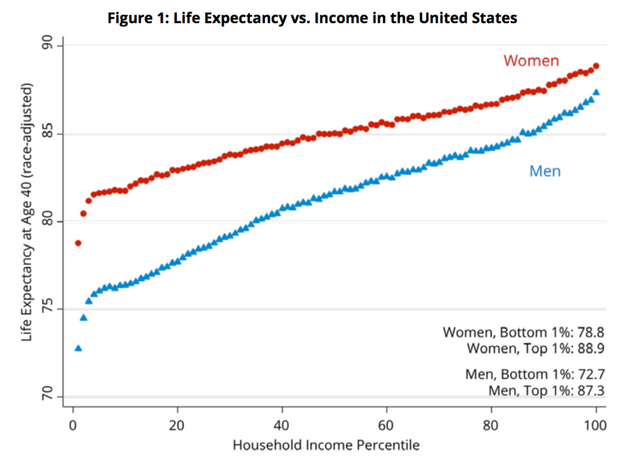
Today women in the top 1 percent of income can expect to live 10.1 years longer than the bottom 1 percent of women earners; men in the top 1 percent can expect to live 14.6 years longer than the bottom 1 percent.
This dramatic contrast in life expectancy between the rich and poor is directly correlated to the growth of obscene wealth at the top among a tiny elite and entrenched poverty among growing numbers of people at the bottom. Since 1986, the top 0.1 percent—those with assets exceeding $20 million—has accumulated nearly half of all new wealth.
By comparison, more than 1.6 million US households, including 3.5 million children, struggle to survive on less than $2 per person per day, the World Health Organization’s definition of extreme poverty.
Health care costs
It is a cruel irony that the US health care system is one of the main drivers of poor health and low life expectancy, particularly burdening low-income households with rising costs. Many patients are unable to pay for the medical care they need, with some forgoing care altogether.
In 2014, after full implementation of the Affordable Care Act (ACA), 19 percent of non-elderly adults who received prescriptions could not afford to fill them. The Lancet research shows that health care costs—including insurance premiums, taxes and out-of-pocket payments—are forcing millions of Americans to cut back on food, heat, housing and other basic necessities.
Millions of middle class families have been driven to bankruptcy by illness and medical bills. Medical bills comprise more than half of all unpaid personal debts sent to collection agencies. Meanwhile, the super-rich are turning to “concierge practices” where they pay out of pocket to gain access to a wide-range of high-priced medical specialists.
Disparities in access to health care can be largely attributed to insurance status. Despite an increase in those insured under the ACA, largely due to the expansion of Medicaid (the insurance program jointly administered by the federal government and the states), 27 million Americans remain uninsured. These include people in those states that opted out of the Medicaid expansion, as well as an estimated 5-6 million undocumented immigrants who are excluded from coverage under what is popularly known as Obamacare.
The uninsured are far more likely to go without needed doctor visits, tests, treatments and medications due to cost. This is especially true for those with chronic conditions. The Lancet gives the example of uninsured individuals with diabetes, who spend on average $1,446 out of pocket on medical expenses each year.
Among patients who develop an acute myocardial infarction (heart attack), those who are uninsured are 38 percent more likely than the insured with low out-of-pocket costs to delay emergency care. Poor Americans under the age of 50 are also far less likely to receive recommended flu and pneumonia vaccinations and cancer screening tests than their wealthy counterparts.
In the private insurance market, which includes Obamacare plans, patient cost-sharing—including co-pays and deductibles—has increased substantially since the 2000s. ACA plans have some of the highest deductibles, averaging $3,064 for “silver” plans in 2016. More than 80 percent of employer-based plans now include an annual deductible, averaging $1,478 in 2016, 2.5 times more than the 2006 average.
When cost-sharing forces patients to forgo care, in some cases doctors and hospitals fill their empty appointment slots and beds with patients who are less “price sensitive,” i.e., able to pay more out of pocket.
Underinsurance” and access to care
The researchers refer to the growing phenomenon of “underinsurance,” writing: “Rising deductibles and other forms of cost sharing by patients have eroded the traditional definition of insurance: protection from the financial harms of illness.” In other words, while many people technically have insurance coverage, they often cannot afford to use it due to skyrocketing premiums and high out-of-pocket costs.
Geography is often an indicator of access to care, with those living in rural areas finding it difficult to obtain primary and specialty care. Many rural and Southern states also have a shortage of family planning resources. Women in Lubbock, Texas, for example, now live more than 250 miles away from the nearest abortion clinic, a result of reactionary anti-abortion restrictions imposed by the state.
Women overall are at a disadvantage in obtaining and paying for medical care compared to men, due to greater health care needs, including reproductive care. Although fewer women are uninsured, those who are insured have higher out-of-pocket costs, with these costs averaging $233 higher than men’s in 2013. While their costs are higher, women’s median incomes are 39 percent lower than men’s.
A Princeton University study presented last month showed a sharp rise in the mortality rate for white, middle-aged working class Americans driven by “deaths of despair,” those due to drug overdoses, complications from alcohol abuse and suicide. The Lancet research shows, however, that despite this crisis access to care for mental illness and substance abuse is woefully inadequate and underfunded.
Psychiatric providers, for substance abuse in particular, are in short supply on a national scale, especially in poor and rural areas. America’s bloated prison system, incarcerating more than 2.4 million in its prisons and jails nationwide, remains the largest “inpatient mental health” facilities in the US. “Treatments” afforded mentally ill patients often include segregation and solitary confinement.
Paradoxically, the US medical system, as the employer of nearly 17 million Americans, exacerbates health care inequality. While physicians and many nurses are generally well paid, many other health care workers are not. The health care system employs more than 20 percent of all black female workers, and more than a quarter of these women subsist on family incomes below 150 percent of the federal poverty line; 12.9 percent of them are uninsured.
While decreasing the official uninsured rate, mainly through the expansion of Medicaid, Obamacare has in fact exacerbated the US health care crisis. In 2017, millions of working and middle class Americans face higher premiums and out-of-pocket costs, less access to vital medical treatments and care, and resulting poorer health outcomes and lowered life expectancy.
This is by design. Based as it is on the profit system, the ACA was deliberately crafted to boost the profits of the private insurers while cutting costs for the government and large corporations. Employers, both public and private, have taken their cue from Obamacare, reducing coverage, raising premiums and costs, and eliminating coverage outright in some cases.
Any “replace and repeal” of Obamacare by Trump and the Republicans would only accelerate this process, in particular through gutting Medicaid through block-granting or other means, tossing tens of millions more into the ranks of the uninsured, and rationing medical services while further driving up costs.

China offers plan to ease trade tensions with US

Nick Beams

China has bowed to pressure from the US to reduce its American trade surplus, putting forward a 100-day plan for negotiations and trade deals.
The plan was agreed upon at the meeting last week between US President Donald Trump and Chinese President Xi Jinping at Trump’s residence in Mar-a-Lago, Florida.
Held in the midst of the US missile attack on Syria—the strike was launched while Trump and Xi were at dinner on Thursday—the meeting on trade was the occasion for US Commerce Secretary Wilbur Ross to advance a series of trade issues he wanted discussed. The Chinese response was the proposal for a 100-day plan for negotiations.
The Trump administration has threatened to impose tariffs on Chinese imports and even brand China a currency manipulator—measures that would set off a trade war between the two countries. Both Ross and Peter Navarro, the head of Trump’s National Trade Council, have made statements to the effect that they regard Chinese economic growth and its trade surplus with the US as among the main factors responsible for low American growth.
Before the meeting, Trump had tweeted that the discussion with his Chinese counterpart could prove to be “very difficult.”
The Chinese proposal is aimed not at reducing the country’s exports to the US, but offering concessions to expand markets for US goods in China. The goal is to reduce China’s $347 billion trade surplus with the US.
Details of the plan have yet to be worked out, but are expected to involve concessions on agriculture, starting with the lifting of a ban on American beef that has been in place since 2003 because of a disease scare in US herds. There may also be commitments by China to purchase more American grain products.
The other key area is finance, with the US seeking opportunities in China’s rapidly expanding financial markets. At present, foreign investors are not allowed to hold a majority stake in securities and insurance companies in China. Negotiations to allow majority foreign holdings had been under discussion during the Obama administration, but were put on hold when Trump won the presidency. They could now go ahead under the 100-day plan.
Speaking after the meeting, Ross said Chinese officials had agreed to what he called a more “balanced” trade relationship. “They expressed an interest in reducing their net trade balance because of the impact it’s having on money supply and inflation. That’s the first time I’ve heard them say that in a bilateral position,” he said.
Up to now, the Chinese position has been that while China enjoys a large trade surplus with the US, its overall trade surplus is not large, and the surplus with the US is a product of the international division of labour. China has also claimed that the trade surplus would be lower if the US lifted restrictions on the sale of certain high-tech products.
Ross said that trade discussions, especially between China and the US, normally involved years. Given the range of issues involved, the 100-day plan might be ambitious, “but it’s a very big sea change in the pace of discussions.”
News of the agreement was greeted with expressions of relief that an all-out trade war had been averted—at least for the present.
“The atmosphere at the talks was good,” Chu Shulong, professor of international relations at Tsinghua University in Beijing told the Financial Times. “Trade is the most worrying issue for the US and China. But it looks like a trade war can be averted for at least the next 100 days while the two sides negotiate.”
According to Andrew Nathan, a China specialist at Colombia University, US negotiators would be pushing on a door “that is relatively easy to open when they place a priority on improving the trade balance not by limiting Chinese exports to the US, but by increasing US exports to China.”
The latter route is more attractive to US business because any barriers against Chinese exports to the US would significantly disrupt the global supply chains of major US firms such as Apple, Microsoft, Walmart and others that depend on Chinese manufacturing. Such measures would not bring manufacturing back to the US, as claimed by Trump, but see the transfer of production to other cheap labour countries.
The US Treasury is expected to bring down its biennial currency report this week, in which it could label China a currency manipulator. This is considered very unlikely in light of the agreement last week. Moreover, China in the past few years has taken significant steps to maintain the value of the yuan.
Writing in the Financial Times yesterday, former US Treasury Secretary Lawrence Summers noted: “In terms of the volumes of reserves expended and the extent of capital controls imposed, few countries in recent years have done as much to try to prop up their currency as has China.”
While Ross adopted a seemingly conciliatory tone immediately after the meeting, a harder line could be seen in his comments over the weekend.
“Words are easy, discussions are easy, endless meetings are easy” he told Fox News on Sunday. “What’s hard is tangible results, and if we don’t get some tangible results within the first 100 days, I think we’ll have to re-examine whether it’s worthwhile continuing them.”
Trump struck a conciliatory tone, saying it had been an “honour” to host President Xi and his wife and that goodwill and friendship had been established. He added, however, that “only time will tell on trade.”

China fears US military attack on North Korea

Peter Symonds

Amid mounting tensions on the Korean Peninsula, the Chinese state-owned Global Times has warned of the rising danger of US attacks on North Korea in the wake of the Trump administration’s cruise missile strikes on Syria. An editorial entitled “After Syria strikes, will North Korea be next?” appeared in the wake of the Pentagon’s redirection of the aircraft carrier strike group led by the USS Carl Vinson to waters off the Korean Peninsula.
“Emboldened by its success in Syria,” the newspaper stated, “Washington will probably become more impatient with Pyongyang’s provocations. Destroying North Korea’s nuclear facilities with air raids is not considered an absurd idea by the Trump team any more, but is a serious option that is frequently talked about.”
The Trump administration has finalised a full review of US strategy toward North Korea. According to an NBC report last Friday, the options now under active consideration include returning US nuclear weapons to the Korean Peninsula, “decapitation raids” to kill North Korean leaders and covert military action to sabotage North Korean nuclear and military installations.
Trump’s national security adviser H.R. McMaster told Fox News on Sunday the US president had asked to be given “a full range of options” to remove the threat posed by North Korea. McMaster declared it “prudent” to redirect the Carl Vinson amid speculation that North Korea could stage a missile or nuclear test to coincide with this week’s birthday of the country’s late founding leader, Kim Il-sung.
The Global Times editorial, reflecting fears in the Chinese leadership, warned that any US strike on North Korea was “unlikely to be limited to nuclear facilities and related military infrastructure” and could provoke devastating retaliation on US ally, South Korea. “Thus, a military strike on the North will very likely evolve into large-scale bloody war on the Peninsula.”
According to an unconfirmed report by the South Korean Chosun news agency, the Chinese military has moved 150,000 troops to the border with North Korea to prepare for “unforeseen circumstances.” The units reportedly include medical and support units to train for an influx of North Korean refugees. The report was denied by the Chinese Foreign Affairs Ministry, and the US Defence Department told the Daily Caller there was “no evidence” of significant troop movements along the Chinese-North Korean border.
Nevertheless, the Chinese government is nervous about the prospect of US military action against North Korea triggering an all-out war in its backyard. In talks between Chinese President Xi Jinping and President Donald Trump last weekend, North Korea was high on the agenda. Trump effectively delivered an ultimatum to Xi to force Pyongyang to accept US demands or face the prospect of US strikes on North Korea. The fact that Trump authorised the US strikes on Syria in the midst of his meetings with Xi underscored the threat.
Beijing is caught in a dilemma. On the one hand, it has opposed North Korean missile and nuclear tests, which provide the US with a pretext for its military build-up in North East Asia. On the other, it does not want a collapse of the Pyongyang regime that could lead to a pro-US ally on its doorstep. China continues to call for negotiations, which the Trump administration has rejected unless its demands are met.
In comments to the Global Times, Lu Chao, from the Liaoning Academy of Social Sciences, said: “The US needs to take many things into consideration if it plans to launch a military attack on North Korea, especially whether its allies Japan and South Korea will fully cooperate and how Russia and China will respond. Otherwise, it will lead to unbearable consequences.”
The prospect of a US military attack on North Korea is also prompting concern in capitals around the world. Speaking on Radio 4’s “Today” program, the ex-chief of British intelligence M-I6 branch John Sawyers warned: “If you are looking for a world crisis which could bring about the dangers of a clash between great powers, then North Korea is a bigger concern than Syria.
“The move by the Americans to strengthen their forces in the Korean Peninsula, the demonstration to President Xi in Florida that the US was willing to use force against another state,” he said. “I think this is all part of a calculation that North Korea has to be treated very seriously, a very high priority and ultimately needs a joint US-Chinese approach to deal with this unless we are to avoid a further conflict on the peninsula.”
Sawyers added: “I think what the Chinese are beginning to understand is that if this can’t be solved peaceably through negotiations, through pressure, then there is a serious risk that the US will have only one option left, which is the military option.”
Beijing’s ability to apply pressure to Pyongyang, short of imposing crippling sanctions such as the cut off of oil supplies, is limited. China has already agreed to UN resolutions that impose heavy economic sanctions on North Korea and announced in February that it was suspending coal imports from its neighbour. China is by far North Korea’s largest trading partner and Chinese sanctions on North Korea have already provoked a sharp deterioration of relations between the two countries.
Whether the Trump administration will wait for China to bully North Korea into submission is unknown. The White House has already held discussions with its closest allies—Japan, South Korea and Australia—about the situation on the Korean Peninsula. The presence of the USS Carl Vinson and its strike group in adjacent waters is just the most obvious indication that the US military is being primed for an attack.
The Daily Telegraph in Sydney reported today that “Australia and its allies have been put on standby for the possibility of the United States shooting down test rockets launched by North Korea.” Citing intelligence sources, it suggested that such a test might occur on April 15, Kim Il-sung’s birthday, or sooner.
The Australian newspaper said the US “is understood to have notified Australia that it is fully prepared to shoot down these rockets. The Australian-United States joint facility at Pine Gap monitors North Korean missile launches, and is on standby.” The Pine Gap spy base in central Australia provides intelligence and targeting information to the US war machine for a broad sweep of the globe from the Middle East to North East Asia.

German trade unions at GM Opel hold secret talks with French auto boss

Marianne Arens

The sale of GM-Opel-Vauxhall to Peugeot Citroen PSA threatens at least 6,000 jobs and possibly several company facilities, according to industry experts. PSA chief executive Carlos Tavares wants to save €1.7 billion per year. A high-level meeting in Berlin last Wednesday confirmed that Tavares can rely on the cooperation of the IG Metall union and the Opel works council.
The content of the April 5 discussions at the economics ministry in Berlin remain top secret. In a conspiratorial manner, the so-called “workers’ representatives” met behind closed doors with the PSA boss and leading politicians to agree on measures to make Opel-Vauxhall competitive in the future. German Economics Minister Brigitte Zypries of the Social Democratic Party (SPD) and Matthias Machnig (SPD), her official responsible for Opel, had extended the invitation to the talks.
Alongside Tavares others taking part included IG Metall leader Jörg Hofmann, deputy Opel works council leader Lothar Sorger and the state premiers (or their deputies) of all the federal states containing Opel plants. Besides Malu Dreyer (SPD, Rhineland Palatinate) and the Hesse state Economics Minister Tarek Al-Wazir (Green Party), the Thuringia state premier Bodo Ramelow (Left Party) was also present.
After the meeting, the PSA boss said he was satisfied with the extremely close cooperation between the German trade unions and the auto bosses. In a statement on the website of the Economics Ministry, Tavares stated he was determined to “continue the valuable collaboration with employee representatives;” this cooperation was “a key factor for the success of the company.”
Neither the Opel works council chief, Wolfgang Schäfer Klug, nor the IG Metall chairman Jörg Hofmann revealed any details of the talks, which took the form of a conspiracy against the workers. In the run-up to the meeting, Schäfer-Klug had demanded that the works council representatives should be closely involved in the transition process.
Following the talks, all participants confirmed they had been held “in a very constructive atmosphere.” Rhineland Palatinate state premier Dreyer told the press,” We have agreed we will not give away too much to the outside world.”
At a factory staff meeting on Thursday, the works council provided more soporifics and repeated the stereotypical claim that the new owner, PSA, will abide by all existing labour contracts and not destroy jobs—at least until the end of next year. Nothing substantial was said to contradict the objections of a shop steward who had previously worked in Bochum, who said that the same phrases had been repeated before the closure of the Opel plant there.
Without providing any further details, the management said that Adam Opel AG was to be transformed into a limited company by the summer. Part of the development area was to remain with General Motors; however, it was not known whether this involved the research department in Turin, Italy, or whether it also affects Powertrain in Rüsselsheim in Germany. Powertrain is also developing transmissions and engines for GM models. Works council chief Schäfer-Klug has consistently refused to make any statements about the meeting in Berlin.
In early March, the PSA Group had agreed with General Motors to buy Opel-Vauxhall for €2.2 billion. The European company operates nine plants in Germany, Britain, Poland, Spain, Austria and Hungary, with around 35,000 employees. However, only representatives of the German sites were invited to the Berlin summit meeting, and the representatives from IG Metall and the works council evidently had no objections—for years they have pursued nationalist pro-German policies.
The acquisition by PSA takes place under conditions of a massive restructuring of global auto production. In Germany, one in seven jobs depends on the auto industry. Opel still maintains production facilities in the cities of Eisenach, Kaiserslautern and Rüsselsheim, where its research centre is based with more than 7,000 employees.
When the deal was concluded at the beginning of March, the PSA board had agreed to comply with all location guarantees until 2020 and make no compulsory redundancies until the end of 2018—albeit only in a verbal agreement. Business daily Handelsblatt described this as a “French pledge of allegiance for Opel with an uncertain shelf life.”
Auto industry expert Ferdinand Dudenhöffer has made it clear that Tavares’ verbal commitments were merely palliatives to keep the workforce quiet. Commenting on the Berlin meeting, Dudenhöffer told broadcaster n-tv, “All that is known so far is, yes, Tavares is a tough re-structurer, i.e. [he] cuts costs ... these prior commitments—one year or a bit more—are not worth the paper they are written on.”
Competition had forced the company to restructure rapidly, and “rapid restructuring means lower costs,” said Dudenhöffer. Opel now faced “hard cost reduction programmes.”
The Opel works council chairman Wolfgang Schäfer-Klug is already preparing for sharp attacks on the workers. On March 30, he gave a long interview to business weekly Wirtschaftswoche. In this he reaffirmed that he assumed that savings of €1.7 billion per year could be achieved. At the same time, he also threatened that the acquisition by PSA—which he supports—would jeopardize jobs.
This was based on changes throughout the entire auto industry, and especially the development of electric cars, Schäfer-Klug said. If these trends “prevail on the basis of the current regulatory requirements, it will cost the automotive industry a significant number of jobs.” He cynically stated, “We are still living under capitalism and money still has to be earned with autos in order to save jobs.”
Schäfer-Klug’s predecessor, the former “Mister Opel” Klaus Franz, also published his assessment of the deal in a business newspaper. In a long article, headlined “Opel’s shaky future under Peugeot rule,” in Manager Magazine, sounding like a business consultant, he recommended that PSA/Opel be transformed into a “European Company (SE) with a participation agreement on the German model.” He advised how PSA best achieve its market objectives, saying, “Until the final conclusion of the deal at the end of 2017, there must be a plan to return Opel to profitability from 2020, and which provides a 6 percent profit by 2026.”
There was currently “no alternative” to the merger with PSA, Franz said, since “Opel lacks the size, market share and profitability in order to exist alone.” Franz went on to state that both the engine plant in Kaiserslautern and the Spanish Opel factory in Zaragoza had poor future prospects. A hard Brexit could lead to shifting the supply industry to the UK: “This can lead to problems in the Kaiserslautern components plant.”
Moreover, if the synergies, “piece by piece in design, purchasing, administration and production carried out with each new model,” were followed through, this would lead to “enormous pressure on the Spanish plant in Zaragoza, starting from the Eastern European PSA level,” Franz said.
Undoubtedly, “as part of the turnaround ... employee contributions would be called for,” the former works council leader said. He proposed “safeguarding” the financial sacrifice demanded of the workers “in the form of an employee share ownership” scheme.
This proposal is not new. Already in 2009, when a takeover of Opel by Canadian-Austrian auto supplier Magna was planned, Klaus Franz had proposed such a “ workers equity investment scheme ”: A private corporation was to be supplied with capital from drastic cuts in workers’ pay and conditions, with the works council and some IG Metall officials exercising control—a vicious trap for the workers, who received no guarantees that they would able to dispose of their deposits.
At that time, Opel remained with General Motors, and Klaus Franz was recognized for his crisis management with the international award of “Communicator of the Year.” During this period of “crisis management,” the Opel general works supported the elimination of 15,000 jobs, the closure of the Opel plant in Bochum, along with 3,300 jobs, with the remaining staff subject to a merciless cuts programme.
Before this, the IG Metall and the Opel works council had already agreed to the closure of the factory in Antwerp, Holland, and the Saab factory in Trollhattan, Sweden. Since then, the Opel plant in St. Petersburg, Russia and the Holden production facility in Australia have been closed.
As reported by Manager Magazine on March 24, in the event of a successful sale to PSA, the Opel board can expect bonuses running to millions. General Motors has held out the prospect of €20-30 million for managers if the sale is actually completed. These premiums are regardless of whether the managers leave Opel or not. Current Opel CEO Karl-Thomas Neumann has already sold some of his GM shares in March, pocketing more than $4 million.
Whether the works council leadership also enjoys such premiums is not yet known. What is certain is that it stands completely on the side of the executive—whether under the Opel, General Motors or PSA badge. “We still live in capitalism,” as Schäfer-Klug pontificated in the media. In the current crisis of capitalism, the works council is willing to sacrifice the jobs and living standards of tens of thousands of workers throughout Europe in order to satiate the demands of shareholders.

Number of Americans defaulting on student loans reaches 4.2 million

Philip Andrea & Genevieve Leigh 

A new analysis released this week by the Consumer Federation of America found that the number of Americans in default on their student loans jumped by nearly a fifth in 2016. Rising 17 percent from 3.6 million in 2015, there are now at least 4.2 million Federal Direct Loan borrowers in default. A borrower is put in default when no payment is made in more than 270 days.
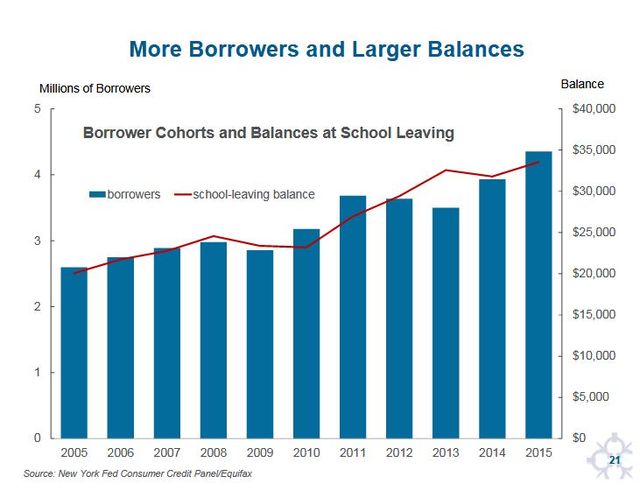
In addition to more borrowers defaulting on their loans, both the number of borrowers and the average amount borrowed continues to increase rapidly. The new analysis shows that the total amount of student debt owed adds up to a staggering $1.3 trillion, triple what it was a decade ago.
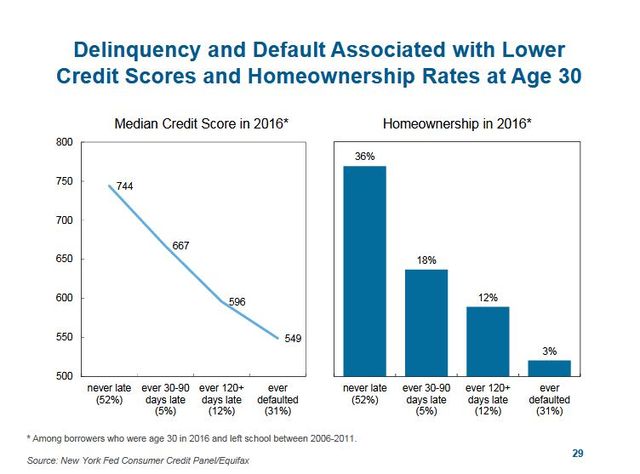
The report also emphasized the relationship between student debt and homeownership. Not surprisingly, it was found that people with student debt have a significantly lower chance of owning a home when compared to graduates without debt, namely those aged 30 to 36.
Attaining a college degree has been shown to increase the probability of owning a home, but this statistic still keels to the prospect of debt damaging the borrower’s credit score. According to a recent study by the Federal Reserve Bank of New York, graduates with a bachelor’s or higher degree without debt are about 53 percent more likely to own a home, as compared to those with debt, who are about 7 percent less likely. Those with an associate’s degree and no debt hover around 41 percent, while associate’s graduates with debt are near 32 percent.
The report also showed that among high-balance borrowers, those owing $75,000 or more, only one-quarter to one-third of their debt has been paid down, a sign that repayment has slowed.
Per the New York Fed study, new graduates who take out student loans are leaving school owing an average of $34,000, a 70 percent increase from just 10 years ago.
These figures correlate with the rising cost of tuition, up $2,790 on average at public four-year colleges over the last decade, and $7,100 on average at private nonprofit four-year institutions. Other factors, such as the dwindling job market and growing cost of living, are putting pressures on students that make it more difficult to pursue a decent life while attending and after leaving college.
In a press briefing last week called to discuss the new figures, Federal Reserve Bank of New York president William Dudley attempted to draw something positive from the analysis, an incredible feat considering the findings.
Dudley pointed out that while the overall number of borrowers in default has increased significantly, the number of people in default for the first time, particularly among graduate students, has fallen. He noted that this “reflects something good,” adding that graduate students are utilizing government programs intended to ease the repayment process.
There is nothing that even remotely resembles something “good” reflected in the report. The only reflection is that of thousands of struggling students and graduates drowning in debt. Defaulting, even once, on a federal student loan often means financial disaster for the borrower. As revealed by the recent analysis, those borrowers who are 30 days late even one time, are nearly 50 percent less likely to own a home than those who are never late.
Unlike other types of debt, most student loans cannot be disburdened in bankruptcy. Without this option, the repercussions for those who go into default can include wage garnishment, damaged credit scores, added costs in late fees, interest and, in some cases, legal fees. To make matters worse, the number of people defaulting for the second time or more has risen significantly.
Moreover, there are serious problems with the programs that are ostensibly meant to help borrowers pay back their loans. It has recently been announced that the more than 550,000 people who signed up for a federal program that promises to repay their remaining student loans after they work 10 years in a public service job may not be given their promised relief.
In a legal filing submitted at the end of March, the Education Department suggested that borrowers could not rely on the program’s administrator to say accurately whether they qualify for debt forgiveness. They claim that the thousands of approval letters sent by the administrator, FedLoan Servicing, are not binding and can be rescinded at any time.
The new statistics released by the Consumer Federation of America for 2016 become all the more appalling when one considers the accumulation of wealth by a small handful. Forbes Magazine’s annual survey recently reported that the combined wealth of those on Forbes’ billionaires list rose 18 percent in 2016, to $7.67 trillion, enough to foot the total student debt bill nearly six times over.
Despite former President Obama’s claim of “economic recovery” since the 2008 recession, and the stock market boom of the Trump presidency, the reality is quite the opposite for the working class.
An 18-year-old working class youth, upon high school graduation, is left with two options: attend university and take on massive amounts of student debt, accepting the risk of living through four years of food insecurity and even homelessness, or, enter the job market where the unemployment rate among youth is at 10.4 percent and the majority of the jobs available pay no more than minimum wage. Alternatively, some choose to enter the military, an even deadlier risk, as a way of paying for an education.
The psychological effect that accompanies living with the burden of thousands of dollars of debt is incalculable. Even the fear of being unable to earn a liveable income after graduation compels students to discard any aspirations of a career in fields such as art, music, film and the humanities. All critical questions of social life become subordinate to the looming cloud of student debt.
Over a quarter of the generation known as “millennials” have reported delaying starting a family due to the economic constraints caused by student debt. For the first time in the last 130 years, Americans between the ages of 18 and 34 are more likely to be living with their parents than with a spouse or partner.
These conditions, created by the failure of the capitalist system, are crippling the development of an entire generation. The rising student debt crisis is just one of many indices that reveal the dire state of this generation.

Spanish ruling class closes ranks behind Washington’s attack on Syria

Alejandro López 

The coming to power in the US of Donald Trump’s aggressively nationalist and protectionist administration sparked bitter divisions in the Spanish ruling class. Trump’s attack on Syria’s al-Shayrat airbase, the prelude to a broader military escalation directly threatening nuclear-armed Russia, marks a major shift in the political situation. The Spanish bourgeoisie is closing ranks in support of Trump and his alignment with the demands of the CIA, the Democratic Party and the Pentagon for a war policy.
Immediately after Trump’s election last year, the influential daily El País published over 20 editorials against Trump and attacked Spain’s right-wing Popular Party (PP) government for its submissiveness to Trump and called on the EU to adopt a more aggressive line toward the US.
In its Friday editorial, however, it states, “Trump had little room for manoeuvre, especially if he wanted to send a clear message to El Assad and other regimes which violate with impunity the principles and treaties on which international peace and security are based.” It denounces Russia for blocking the US and its allies’ regime-change initiatives in the UN Security Council.
Two months ago, Elena Valenciano, a European Member of Parliament of the Spanish Socialist Party (PSOE) and vice president of the Socialist Group in the European Parliament, was demanding that the European Parliament act “forcefully” and “courageously” against Trump’s statements criticizing the European Union (EU). Now, she is hailing Trump’s strike on Syria, claiming it was meant to “send a clear message” to Assad, although she also said she disagreed with its unilateralism.
The PP government for its part has increased its collaboration with the US and endorsed the attack. Last Friday, it described the strike as “measured and proportionate response” to the alleged gas attack last Tuesday in the village of Khan Sheikhoun in Syria’s Idlib province. With no evidence, and discounting out of hand the Syrian government’s denial of its involvement, the statement accuses the “Syrian army use of chemical weapons against the civilian population in the country.”
The statement covers up the blatant violation of international law involved in Washington’s action, claiming that the “American operation was a limited action in its objectives and means”. The attack, it continues, struck “a military base, not civilian objectives”—though in fact, it killed at least 15 people, including nine civilians, four of which were children.
It concludes by stating that Madrid, “which has a strong sense of loyalty towards its allies, is in favour of concerted international action, and therefore regrets that the blockade of the United Nations Security Council in the Syrian conflict has not made this possible.”
At a press conference, government spokesman and Minister of Culture Íñigo Méndez Vigo had nothing to say when asked why the government had changed its position from 2013. At that time, Spain opposed the Obama administration’s attempt to use allegations of a chemical weapons attack, falsely attributed to the Syrian government, to launch a war.
Mendez baldly declared that the “situation has changed” from 2013, when Spain, under the same prime minister, Mariano Rajoy, stated that Madrid “does not at any time express support for a concrete military action.” At the time, Rajoy added, “There is no possible military solution to the civil conflict in Syria, there is only one political solution,” and that Spain wanted to prevent “Syria from becoming an Iraq II.”
What has changed is not that Trump’s act of war against Syria no longer threatens to plunge Syria into ever greater bloodshed on the scale of that in the decades-long war in Iraq, or to provoke an even broader war. Rather, in light of Trump’s sudden alignment on the CIA and the Democratic Party, the Spanish bourgeoisie has re-thought its position and is closing ranks behind Washington. The far right billionaire Trump now is seen by growing sections of the ruling class as an opportunity.
Once Trump was installed as President, the PP immediately went on a diplomatic offensive to become Washington’s new strategic partner in Europe, as its traditional closest ally, Britain, began its departure from the EU under Brexit. During his first conversation with Donald Trump, Prime Minister Rajoy offered Spain as “interlocutor in Europe, Latin America, and also in North Africa and the Middle East.” Rajoy said he was prepared to “develop a good relationship with the new US administration.”
The White House statement on the conversation said that Trump had emphasized the importance that all NATO allies share the burden of defence spending.
Last month, and at Washington’s request, Spain’s Defence Minister María Dolores de Cospedal met with US Secretary of Defence James Mattis in Washington. She promised that Spain would dedicate 2 percent of its GDP to defence spending within one decade.
No sooner had she returned, when Spain announced that the new 2017 budget would include a whopping 32 percent increase in military spending—from €5.7 billion in 2016 to €7.5 billion in 2017.
On March 26, Rajoy named former Defence Minister Pedro Morenés, with whom Rajoy has close ties, as Spain’s new ambassador in Washington. Morenés was one of the chief architects of the renewal in 2015 of a Spain-US bilateral defence agreement. It allows Washington’s military permanent use of the Morón air base in Seville, with increased numbers of troops and aircraft. It also allows the stationing of two additional destroyers equipped with the Aegis radar system at the Rota Naval Base, bringing the total to four.
In the aftermath of Trump’s attack on Syria, the Spanish social democrats, their political allies and their media supporters are joining the PP in aligning themselves on Trump’s foreign policy.
Two of the destroyers posted at the Rota Naval Base, USS Porter and USS Ross, were used in last week’s attack on Syria. Luís Simón, Senior Analyst and Director of the Elcano Royal Institute think tank’s Brussels Office, boasted that this showed “the increasing importance of Spain for the US Navy as a source of strategic depth for possible actions in the Middle East.”
Trying to limit popular anger amid broad opposition to war, government officials and the media claimed that the destroyers “left days ago” and were “patrolling off the coast of Israel”. Madrid was also quick to state, however, that even though it had not been previously consulted or received direct communication from Washington, it was forewarned about the attack by NATO.
Such statements aim to confuse and disorient the population. Rather than increasing security, as it was claimed on the eve of signing the defence agreement with the US, the Spanish and European bourgeoisies’ support of imperialist wars and regime-change operations, put millions of people at risk of annihilation, especially as the US and its European allies recklessly escalate the confrontation with nuclear-armed Russia and China.

Under US instruction, UK foreign secretary abandons visit to Russia

Chris Marsden

Foreign Secretary Boris Johnson was instructed by Washington to cancel a scheduled trip to Moscow Monday, to meet with his counterpart, Sergei Lavrov.
Instead, he was tasked by US Secretary of State Rex Tillerson in a phone call Saturday with securing a “clear and co-ordinated message to the Russians” over Syria. This message, dictated by the Trump administration, is to be given at today and Tuesday’s G7 Foreign Ministers meeting in Lucca, Italy of Canada, France, Germany, Italy, Japan, Britain and the US.
Johnson was left embarrassed for a second time in as many days, after publicly admitting that Tillerson had told him not to go for talks in Moscow that would have coincided with the Secretary of State’s own visit later this week.
Johnson wrote in a statement that he had discussed “in detail” his plans with Tillerson and they had agreed the American should go to Moscow first so that he would “deliver [a] clear and coordinated message to the Russians.”
Johnson will instead attend the G7 foreign ministers meeting in Italy Monday and Tuesday, where he will try to build a consensus for demands to Russian President Vladimir Putin to pull his troops out of Syria and end his support for President Bashar al-Assad.
Johnson justified the cancellation of what would have been the first trip to Russia by a UK foreign secretary in five years by declaring that “Developments in Syria”—the April 4 chemical attack on the rebel-held town of Khan Sheikhoun—“have changed the situation fundamentally.”
This is bluster on Johnson’s part. What changed the situation fundamentally is the Conservative government’s desire to be on message with the Trump administration, as it has moved to a position of demanding regime change and preparing a military offensive to that end.
The intention to remove Assad was signalled by the unilateral April 6 attack on the Syrian government’s Al Shayrat airfield involving 59 Tomahawk cruise missiles. Earlier that day, Johnson had also failed to keep pace with the shift in the Trump administration’s line of collaboration with Moscow and Damascus in ensuring the defeat of Islamic State (ISIS).
Speaking to reporters in Sarajevo, Johnson opposed unilateral action, insisting, “It is very important to try first to get out a UN resolution” condemning Syria in order to place maximum pressure on Russian President Vladimir Putin to rein in Assad. This was also the position of Prime Minister Theresa May. Hours later, May was informed by phone that the US was about to commence bombing and immediately fell into line.
Speaking on Johnson’s decision to the Daily Telegraph, a Foreign Office source said: “It has been noticeable this week that both Tillerson and Trump have said there is no future for Assad.” Johnson would be “hitting the phone” to ensure a “very strong and very hard-hitting” G7 statement over Russia’s involvement in Syria is agreed, the source added.
That same day, Nikki Haley, the US ambassador to the United Nations, declared, “There’s not any sort of option where a political solution is going to happen with Assad at the head of the regime.”
On cue, Defence Secretary Sir Michael Fallon wrote an opinion piece in the Sunday Times accusing President Vladimir Putin’s government of political responsibility for the civilian deaths in the attack on Khan Sheikhoun. “By proxy Russia is responsible for every civilian death last week. If Russia wants to be absolved of responsibility for future attacks, Vladimir Putin needs to enforce commitments, to dismantle Assad’s chemical weapons arsenal for good, and to get fully engaged with the UN peacekeeping progress,” he demanded. “Russia must show the resolve necessary to bring this regime to heel.”
Moscow is openly contemptuous of Britain’s bluster. The foreign ministry said there was “no need to talk to the UK,” as it is “in the shadow” of its partners. The cancellation of Johnson’s visit “once again confirms doubts about the added value of dialogue with the British, who don’t have their own position on the majority of current issues.”
The Russian Embassy in London tweeted that if Putin was given an ultimatum, the outcome would be either a “war of clowns, war of muses, a conventional war or mix of the above”.
Johnson’s embarrassment occasioned some schadenfreude from the Scottish National Party, the Liberal Democrats and Labour.
The SNP’s foreign affairs spokesman Alex Salmond said Johnson looked like “some sort of mini-me” and is in “deep political trouble.” Tim Farron, the Liberal Democrats leader, said, “Boris has revealed himself to be a poodle of Washington, having his diary managed from across the pond.”
Labour’s Shadow Chancellor John McDonnell told Sky News that Johnson “should be in Moscow now. ... He should be saying to the Russians just how appalling this situation is and the role they should play. We have got to be frank with them and we shouldn’t just allow the Americans to go off and do that, we should be doing that ourselves.”
The tenor of McDonnell’s remarks points to the pathetic character of such political posturing by the opposition parties.
There is no substantial disagreement with the Tories from the fanatically pro-interventionist Liberal Democrats, while McDonnell is making clear once again that he and Labour leader Jeremy Corbyn will not oppose a vote in support of military action by their MPs, should one be called.
The government has not so far raised the possibility of the UK launching its own air strikes against Assad, which would in all likelihood need the support of MPs. There remains the example of 2013, when Parliament rejected a bombing campaign in Syria. But this time, a majority of Labour MPs have indicated their support for extended action citing their inevitable “humanitarian” pretexts and justifications.

8 Apr 2017

Mounting concerns over Australian housing bubble

Oscar Grenfell 

The Reserve Bank resisted calls for an interest rate hike last week, amid growing fears that the continuing rise of house prices is creating the conditions for a crisis across the property market that would have far broader ramifications.
On Tuesday, the bank’s governor, Philip Lowe, announced that rates would remain at a historic low of 1.5 percent, after a series of cuts last year.
The decision followed reports last month that house prices continued their historically unprecedented ascent in 2016, with average value increases of 7.7 percent across the country. Average prices in Sydney and Melbourne, the centre of the property boom, rose by 19 and 14 percent respectively, and increased by around 6 percent in the December quarter alone. The median house price in Sydney is almost $1 million. In Melbourne, it is over $900,000.
In contrast, national wage growth was at its lowest level last year since records began in 1969, at just 1.8 percent across the private sector.
The divergence between the growth in property prices and the stagnant or declining incomes of millions of working people is fueling concerns that the housing bubble, built on a mountain of mortgage and household debt, to which the banks and financial institutions are heavily exposed, could collapse. Private debt across Australia is estimated at 187 percent of income. According to a report by the Australian Financial Review, mortgages make up around 62 percent of the assets of the major banks.
The Reserve Bank and other policymakers are trapped in an intractable dilemma. Any rise in interest rates could lead to a rapid fall in borrowing, posing the risk of a precipitous fall in house prices.
According to Digital Finance Analytics, mortgage stress rose by 1.5 percent between February and March, and is now affecting 22 percent of the country’s 3.1 million mortgaged households. The rise was partly on the back of relatively small increases to home loan interest rates by the major banks.
Further cuts, however, or the maintenance of the current rates, will encourage a continuation of the risky lending practices that have contributed to the dramatic inflation of the market. Numbers of commentators in the financial press denounced the reserve bank for its “inaction” and “indecision” this week.
In his remarks on Tuesday, Lowe warned of interest-only loans, in which borrowers only pay interest on their mortgage for a fixed-term of up to seven years, before paying off the principal of the loan. Lowe described the prevalence of interest-only loans, which make up as many as 40 percent of housing loans, as “unusual.” According to the Australian, as many as 60 percent of housing loans to investors are interest-only.
“Too many loans are still made where the borrower has the skinniest of income buffers,” Lowe said. “In some cases, lenders are assuming that people can live more frugally than in practice they can, leaving little buffer if things go wrong.”
Amid fears that the situation will lead to a growth in mortgage arrears and defaults, the Australian Prudential Regulation Authority (APRA) introduced new guidelines last week, aimed at forcing the banks to limit interest-only loans to 30 percent of their new transactions. There are also indications that APRA will move to lift the capital-to-loan ratios for banks. Currently, the banks are only required to hold 25 percent of capital compared to housing loans, on the basis that they are low risk.
Numbers of commentators have stated that the actions of regulatory authorities will change little.
The Australian Broadcasting Commission’s business editor Ian Varrender wrote on Monday: “The problem, as is usually the case with bubbles, is that no-one really wants it to deflate, let alone allow it to burst. The consequences are unthinkable. And all the action so far taken to slow it has failed.”
Varrender warned that the situation was a “perfect storm” and noted that shocks stemming from the global economic crisis could tip the housing market over the edge. “As one of the world’s most trade exposed nations, any major global upheaval would filter through to us,” he wrote.
Martin North, a property analyst, told an Australian Financial Review’s banking summit last week that he did not think a slowdown in the housing market would be “orderly.”
“Regulators have come to the party three or four years too late,” North said, adding, “I have a nasty feeling we are past the point of being able to manage this. There are not enough levers available to regulators to pull it back in line. I can’t see anything other than a significant correction. It’s not a question of if, but when.”
The situation has intensified the crisis confront the federal Liberal-National government of Malcolm Turnbull, which is riven with conflicts amid a slump of the Australian economy, and incessant demands from the corporate and financial elite for the imposition of sweeping austerity measures.
There are reportedly divisions within the government over proposals to reduce the 50 percent capital gains tax concessions for investors. While proponents of a cut are arguing that it could curb speculative and risky investments, any move would come up against the interests of the major property developers, who form a key constituency of the government. At the same time, surging housing prices have underpinned claims of continued economic growth, amid a slowdown of the mining and resources sector and slump in manufacturing.
For its part, Labor has issued populist demagogy, denouncing capital gains tax concessions. Successive governments, however, Labor and Liberal alike, have retained policies of negative gearing, capital gains concessions and the gutting of public housing stocks, which have provided a boon for property developers and investors, and contributed to a housing crisis for millions of working people.
A report in January found that 33 of 51 Australian housing markets surveyed were severely unaffordable, with Sydney deemed the second-most unaffordable market in the world. An entire generation of young people has been denied the prospect of buying a home. Just 29 percent of 25–34 years-old own their own home, compared to rates of over 60 percent in the early 1990s.
Workers have also been priced out of the market. From 2010 and 2015, the length of time it took for a two-income household, on average full-time wages, to save a median house deposit, rose from 5.8 to 7.9 years. Average mortgages are $381,000, up from $81,000 in the early 1980s.
Any “correction” of the market, let alone a full-scale collapse of the housing bubble, would see broad sections of the population left with debts and mortgages worth more than the value of their home.

Majority of students cannot afford 95 percent of US colleges

Kathleen Martin

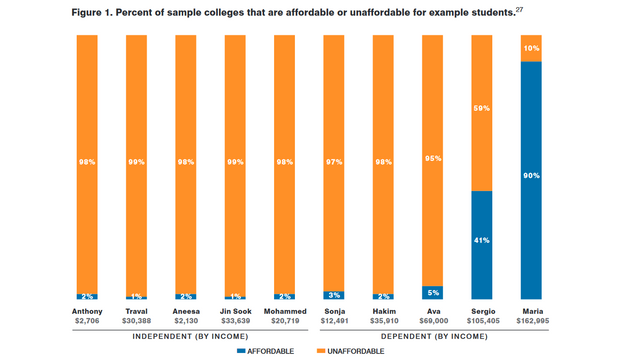
A recent report shows that US colleges are becoming increasingly unaffordable. “Limited Means, Limited Options: College Remains Unaffordable for Many Americans,” released in March 2017 by the Institute for Higher Education Policy (IHEP), shows 95 percent of American colleges are too expensive for the majority of low-income students.
The study draws shocking results. “[A]lthough the student from the highest income quintile in these analyses could afford to attend 90 percent of colleges in the sample,” the report states, “the low- and moderate-income students with fewer financial resources could only afford 1 to 5 percent of colleges.”
Working class students and youth are faced with bleak options for future employment. Most jobs that pay “decent” wages require a college degree or certificate. But over the last several decades, there has been a significant shift in financial policy for higher education: on the one hand, the cost of attaining a degree has skyrocketed and, on the other, state and federal funding for college costs has been rolled back significantly.
Percent of sample colleges that are affordable or unaffordable to example students
These tuition hikes and funding cutbacks have effectively educationally crippled millions of working class students and youth in the US. Student loan debt has again reached an all-time high, weighing in at $1.4 trillion nationally. The average 2016 college graduate has a massive $37,172 in student loan debt, according to March 2017 statistics from studentloanhero.com.
The IHEP report cites low funding for the Pell Grant as a major factor in college unaffordability. In some states, funding for the Pell Grant has gone up in recent years, but not in proportion to the continually rising cost of tuition as well as other expenses, such as books and fees—not to mention vital day-to-day living expenses like rent, groceries and health care.
“On average,” the report states, “the low-income student needs to finance an amount equivalent to more than 100 percent of their family’s annual income to attend one year at a four-year college, compared with high-income students, who must finance only 15 percent on average.”
The cost of attending college is calculated by the Higher Education Act from data reported by colleges to the Integrated Postsecondary Education Data System. It adds the cost of tuition, fees, room, board, books, supplies, transportation and “other costs,” and then subtracts grant aid from that total.
The report categorizes students by the Lumina Foundation’s “Affordability Benchmark,” standards which are already inconceivable for the average working class family. It is based on the “Rule of 10,” meaning the student “should be able to work 10 hours per week (500 hours per year) while attending college full-time.”
According to this benchmark, “To be considered affordable, the total 10-year savings plus part-time earnings should cover the entire cost of a four-year degree.” The report notes that students and/or families with an income less than 200 percent of the Federal Poverty Guideline are not expected to save for college because they have no discretionary income.
However, parents of prospective college students whose incomes are above the federal poverty line are expected to save 10 percent of their discretionary income every year over the course of a decade to contribute to their child’s college tuition.
Take for example the imaginary “Mia,” from a family of four, created for the purpose of the study but based on averaged national statistics. Her parents have a combined income of $100,000, so IHEP calculates that they should be able to contribute $54,000 to her bachelor’s degree. If Mia works 10 hours a week at a minimum-wage job during college, she should theoretically be able to contribute $14,500 to her degree. All in all, she should be able to afford the cost of her degree at $65,900 over the course of four years, or $16,475 a year. Anything beyond that is considered out of Mia’s financial reach.
According to the College Board, the average cost of tuition and fees for the 2016-2017 school year was $33,480 at private colleges, $9,650 for in-state residents at public colleges and $24,930 for out-of-state residents at public universities. Theoretically speaking, Mia can afford only the public college within her state, and that price tag does not include rent, food, transportation and other living expenses.
While useful in shedding light on the affordability crisis, the benchmark does not take into account any situation that would jeopardize that family’s financial situation even remotely. Do Mia’s parents have ample savings in pensions and retirement funds? Are Mia’s parents financially responsible for their own aging parents? Is Mia capable of working a part-time job during college? Answering “yes” to any of these questions, among countless others posed to the majority of working class Americans—even the “better off” ones—throws a wrench in the benchmark calculations.
It is also crucial to note that according to the US Census Bureau, in 2016 the median household income was $56,516. Mia is considered well off financially compared to many of her peers.
The study notes that for independent students, meaning students who cannot rely on family to contribute to their education, loans are a major factor in deciding where to attend college. The lowest-income student example cited in the study can afford to attend 3 percent of colleges without loans. With Subsidized Stafford loans, the number of schools considered affordable is raised from 3 to 9 percent, which still leaves the vast majority of higher-education institutions out of reach.
Most students in the independent and low-income dependent groups are forced to work full-time out of necessity to avoid being buried in student loan debt. Poor performance at any level of education is directly correlated to problems faced by the working class. A full-time student who needs only to worry about grades and studying is much more likely to achieve academic success than a full-time student who is also a full-time worker.
While the study itself draws important conclusions, and is useful in showing the extreme disparities that exist between the classes, it goes on to advocate for governmental changes—calling for policymakers to implement certain measures which would supposedly even the playing field for students from a wider variety of economic backgrounds.
For example, it demands that “[C]olleges with wealth at their disposal—either in the form of large endowments or company profits—should keep prices low for needy students.” Calling on policymakers to intervene in the finances of wealthy and prestigious institutions or profit-making private universities is absurd under the current economic and political system.
The results drawn from the study reflect precisely what is happening at large, in not only American society, but globally as well: the gap between the rich and the poor, and what is accessible to each, is growing larger, and has an impact on every aspect of social life.

Sharp fall in US jobs growth in March

Shannon Jones

US job growth dropped sharply in March with just 98,000 new jobs added, far lower than expected and well below the 180,000 average monthly figure for most of last year.
The Bureau of Labor Statistics (BLS) numbers stood in sharp contrast to the boasts of the Trump administration about being focused on job creation. They also underscore the disconnect between the surge in stock market values and the underlying state of the real economy.
The White House did not issue a statement relating to the March jobs numbers after rushing to take credit for the higher figures in January and February. It was the worst single month for job growth since May 2016.
“It was a disappointing report with no silver lining in the details,” said Rob Martin, an economist with Barclay’s quoted by the New York Times. “Service sector employment weakness points to a substantial slowdown in activity.” In fact, there was a loss of 29,700 retail jobs in March, with department store chains JC Penney’s and Macy’s announcing the closing of 390 stores. This was also combined with the impact of the Trump administration’s announced freeze in federal hiring.
The construction industry added just 6,000 jobs in March after adding a 59,000 in February. In addition to the tepid March numbers, the BLS also revised downward its figures for January and February by a total of 38,000 jobs. Meanwhile, education and health care related employment rose at the lowest rate in 15 months.
The US economic growth rate remains at an abysmal level, with an annual rate of 1.2 percent expected for the first quarter after growing just 1.6 percent in 2016. This compares to an average annual growth rate in previous periods of economic “recovery” since the 1960s of 3.9 percent. In the seven years since the official end of the recession in 2009, US annual economic growth has never exceeded 2.5 percent. Prior to the recent period, the longest stretch in which US annual growth rate did not top 3 percent was 1930–1933, during the Great Depression.
While business optimism has increased since the November election based on hopes for higher profits due to Trump’s pledges to slash corporate taxes and eliminate environmental, health and safety regulations, this hasn’t translated into more investment or hiring. Real consumer spending decreased in both January and February when adjusted for inflation, indicating that workers are feeling the impact of the continued stagnation of real wages.
In March, the official unemployment rate fell to 4.5 percent, a ten-year low. This was something of a statistical anomaly due to the fact that the figures for hiring and those used for calculating the unemployment rate are taken from two separate surveys conducted by the BLS. One measures hiring by business and the other household employment. It is not unusual for the numbers to diverge on a monthly basis, but they tend to converge over time.
The US civilian workforce increased by 145,000 in March after rising 340,000 in February, exceeding the actual number of new jobs created. The labor force participation rate, another measure of those working, held steady at 63 percent. The labor force participation rate measures the number of employed workers and those actively seeking work as a percentage of the total population age 16 and over. Sixty three percent is low by historical standards and indicates a substantial surplus of those able to work but who for one reason or another are locked out of the active workforce.
The number of long-term unemployed, those out of work for 27 weeks or more, was little changed at 23.3 percent of the unemployed.
In so far as jobs are being created, they continue to be concentrated in lower wage sectors. According to a report in Bloomberg, some 44 percent of college graduates in 2016 were employed in jobs not requiring a degree. Service jobs continue to account for 80 percent of the US economy.
Average monthly earnings are rising at a paltry 2.7 percent annual rate, which is approximately equal to the official US rate of inflation, meaning that workers are seeing no real improvement in their already depressed standard of living. Indeed, there has been no net increase in median household income since 2000.
The March jobs figures increased speculation about the course of action that will be taken by the US Federal Reserve at its upcoming June meeting. Fed officials had pointed to the falling unemployment rate as a sign that the economy could safely absorb continuing rises in interest rates.
A number of economists tried to downplay the sharp fall in the March jobs figures as related to the weather. Others made the absurd claim that the fall in hiring was due to the economy reaching near full employment. In other words, this is as good as it gets.
This claim is being advanced with a straight face under conditions in which the BLS numbers showed 7,202,000 out of work in March. The unemployment rate for teenagers stands at 13.7 percent, for African Americans 8.0 percent and for Hispanics 5.1 percent. In addition, 5.6 million people reported working part-time but wanting full-time employment. There were another 460,000 so-called discouraged workers, i.e., those not actively seeking employment because they believe there are no jobs available for them. On top of that, there were 1.6 million workers who were unemployed but not counted in the official statistics because they had not looked for work in the previous four weeks.
In addition to the millions of unemployed are the tens of millions working at poverty-wage, dead-end jobs with little prospect for advancement. In 2015, the most recent year for which figures are available, there were 43.1 million living under the absurdly low official US poverty threshold. Of those, 29.8 million were members of families, and 14 million were children. Nine million of those in poverty were working year-round, either full time or part time.