17 Apr 2017

Without evidence, UK parliamentary report accuses Russia of interference in Brexit referendum vote

Paul Mitchell 

A report published last week by British MPs[Members of Parliament] on the June 23, 2016 Brexit vote, “Lessons Learned from the EU Referendum,” is being used to whip up accusations of “foreign interference” and stoke up demands for a “major” new cyber security programme.
The Guardian declared in response to the report’s publication, “…foreign states may have interfered in the vote…” with the BBC proclaiming, “Brexit vote site may have been hacked.” London’s Standard newspaper cast aside any doubt, telling its readers, “Brexit voting website crash ‘caused by foreign cyber attack’,” inventing a quote along the way. The Sun similarly declared, “Russian ‘Cyber Hit’ On EU Vote Website.”
No one reading the press headlines would gather that the bulk of the report, produced by the cross party House of Commons Public Administration and Constitutional Affairs Select Committee (PACAC), is concerned with devastating criticisms of the then Prime Minister David Cameron and his Conservative Party government.
Cameron is accused of holding “a ‘bluff-call’ referendum in order to close down unwelcome debate,” using state funding and civil servants to unfairly promote a Remain vote and failing to prepare “proper planning for a Leave vote.” As a result, his credibility was “destroyed” and the reputation of the Civil Service for impartiality “damaged,” the Committee concluded.
These criticisms should have led to calls for the Conservative government to resign and action taken against Cameron and his associates for fraud. But no, all of this was brushed aside by the media. Instead, the focus was on the crash of the Voter Registration computer system on June 7, 2016 and unsubstantiated claims that Russia was involved.
At the time, the crash was put down to a sudden increase in applications as the deadline approached. More than 500,000 people tried to register on the final day, with the crash taking place 100 minutes before the registration deadline ended. There were no suggestions from government, other politicians, or the media that foreign powers may have been involved in the crash or that hacking was responsible.
The “Lessons Learned” report, based on expert testimony, explains that the cause of the crash was “an exceptional surge in demand… the sheer numbers of duplicate applications and confusion as to whether individuals needed to re-register.” In addition, the government “clearly failed to undertake the necessary level of testing and precautions” and that when problems arose they were “not further investigated and corrected.”
However, without any evidence, the report raises the false flag of foreign interference. It states, “We do not rule out the possibility that there was foreign interference in the EU referendum campaign caused by a DDOS (distributed denial of service attack) using botnets, though we do not believe that any such interference had any material effect on the outcome of the EU referendum.”
The report then makes the ludicrous claim that while US and UK government involvement in cyberspace is “predominantly technical and computer-network based,” Russia and China use “a cognitive approach based on understanding of mass psychology and of how to exploit individuals”—that is, they engage in propaganda and brain-washing.
It would appear that references in the report to Russian interference were inserted at a later stage, after the Putin government was accused of using hackers to undermine the Hillary Clinton campaign during the US Presidential race late last year. Nowhere in the report are there any references to the source of the information about DDOS, botnets, cognitive approaches or mass psychology.
None of the written evidence submitted to the committee by 104 individuals and organisations made any reference to Russia.
Of the hundreds of questions asked during the three days of oral evidence, only three questions—in the session on November 1, 2016—concerned Russian interference and were obviously introduced as an afterthought as the anti-Russian campaign in the US was reaching fever-pitch. They were asked by Labour committee member Paul Flynn and directed at Electoral Commission chair Jenny Watson.
Flynn asked Watson, “Are the rules sufficiently robust to detect interference from a government like Russia’s, knowing Putin’s declared policy of campaigning to weaken the European Union and the allegations made about Russia’s conduct in the American presidential election?”
Watson replied, “If you are talking about the outcome of the referendum, I am confident that the declaration I made on the morning of 24 June reflects the votes that were cast by voters.” She added, “I would imagine that those kinds of questions would be best asked of the security services, to be quite honest.”
It is clear that the intelligence agencies—whose heads have made numerous anti-Russian statements over the last period centred on unsubstantiated allegations of all manner of “interference” by Moscow—were duly approached to give their position.
Announcing the publication of the “Lessons Learned” report, Select Committee chair and Conservative MP Bernard Jenkin focussed on the web site crash, declaring, “We have taken advice on this and you cannot rule out the possibility it was a direct attack.”
“We’ve seen this happen in other countries. Our own government has made it clear to us that they don’t think there was anything, but you don’t necessarily find any direct evidence,” Jenkin explained.
While claims of “interference” in the Brexit referendum campaign by Russian president Vladimir Putin are uncritically accepted as good coin, the blatant—indeed unprecedented—interventions by Western leaders in the referendum were positively welcomed.
In April 2016, former US President Barack Obama flew to the UK to warn that the country would be at the “back of the queue” in any trade deal with the US if people voted to leave the EU. He declared that if he were a British voter, he would think twice about leaving a market that makes up 44 percent of British exports, and is “responsible for millions of jobs and an enormous amount of commerce upon which a lot of businesses depend.” The Guardian crowed, “Obama sends the right message.”
Days before the referendum German Chancellor Angela Merkel broke “her self-imposed vow of silence” on the Brexit vote to say, she hoped the British population would vote to remain “for the benefit of all of us.” She then threatened that the UK would get a worse deal outside the EU.
European Council President Donald Tusk warned that a Leave vote would have “dramatic” negative consequences and European Commission President Jean-Claude Juncker declared, “deserters will not be welcomed back with open arms.”
Compared to these belligerent pro-Remain “interferences”, Russian reactions, according to Newsweek magazine, were “notably restrained.” It added, “the immediate foreign policy fallout from the British referendum has been more muted than one might have expected.”
Putin attacked the claim made by Cameron that Russia would savour the crisis produced by the UK leaving, accusing him of using the anti-Russian card to instil fear ahead of the referendum. Following the vote to leave Putin warned that its “traumatic effect” would last a long time.
Whether or not Putin’s pronouncements are to be believed is not the issue. As the President of the Russian Federation, Putin is the country’s elected head of state and has every right to put forward Russia’s view on such a fundamental issue as the Brexit referendum.
The report marks only the latest episode in British imperialism’s anti-Russian campaign, backed by their media echo chambers.
In February, Ciaran Martin, head of the UK’s new National Cyber Security Centre, told the Times there had been “a step change in Russian aggression in cyberspace. Part of that step change has been a series of attacks on political institutions, political parties, parliamentary organisations and that’s all very well evidenced by our international partners and widely accepted.”
This was stated alongside a number of entirely unsubstantiated scare stories by the British political and media establishment that Russia was seeking to interfere in this year’s French and German elections.
In contrast to much hyped and unsubstantiated claims of Russian meddling in British politics, around 120 UK troops arrived in Estonia last month as part of one of the biggest British deployments to Eastern Europe in decades. These were joined by 300 UK vehicles, including Warrior infantry fighting vehicles, Challenger 2 tanks and AS90 self-propelled artillery pieces. A further 680 UK troops will arrive in Estonia this spring, as part of NATO’s enhanced Forward Presence—a critical component of NATO’s ongoing military build-up and encirclement of Russia.

Tesla’s market valuation pushes past Ford and GM

Gabriel Black 

The electric car manufacturer Tesla surpassed GM briefly this past week as the most valued US car manufacturer, achieving a market capitalization Monday (the total value of all stocks issued) of a little over $50 billion. While Tesla’s stock has dipped slightly after this high, below that of GM, its market capitalization is still higher than the Ford Corporation.
The valuation of Tesla by the stock market at a higher level than GM and Ford is remarkable given that Tesla produces a small fraction of the number of cars that either company makes. For example, in the second quarter of 2016, Tesla shipped 24,500 vehicles, nearly double what it had done the year before. However, GM sold over 2.4 million automobiles in the same quarter, 100 times more vehicles.
Since late 2016, Tesla’s market price has shot up from $30 billion to $47.62 billion today. Meanwhile, GM and Ford have seen their market capitalization decline in the past few months, a general trend for the automakers since 2014.
The valuation of Tesla at this seemingly absurd level is the result of massive financial bets by speculators that the company will be at the forefront of a coming automated and electric revolution in the global car industry. These speculators have also been driven by cheap, hot money on Wall Street which has caused the whole stock market to reach new, unprecedented levels. This trend, which began under the administration of former president Barack Obama, was further bolstered by the Trump administration’s ongoing dismantling of barriers and regulations on large corporations.
Since its founding in 2003, Tesla has focused on producing electric luxury vehicles, releasing its Tesla Roadster in 2008, followed by its Model S, an electric luxury sedan, in 2012. Although its products have been aimed at upper-class consumers, its newest car, the Model 3, will be released this summer with a price tag around $35,000 before rebates, in an attempt to grab a larger share of the auto market.
Tesla’s business model rests partly on its bet that its superior technology in the way of batteries and automated driving will allow it to wrestle a substantial share of the future car market from the long-standing auto giants. Elon Musk, founder and CEO of Tesla, said in a tweet on April 3, “Tesla is absurdly overvalued if based on the past, but that’s irrelevant. A stock price represents risk-adjusted future cash flows.”
Tesla is pioneering lithium-ion cell development and production—a primary component of all electronic devices that run on batteries. It has invested about $2 billion dollars into a gigantic battery factory outside of Reno, in the state of Nevada. In combination with this, Tesla has launched a home battery product and is working to release roofs for homes that are solar panels but look like regular roofs.
Simultaneously, the company is a leader in automated-driving—which auto and tech companies are racing to perfect. Most car companies and tech companies plan on launching a fully-automated car by 2020, including Google, Toyota, Uber, Volvo, Nissan, Daimler, Honda, and PSA.
Tesla, however, is planning on having one ready by next year and has the advantage of already having autopilot features on most of its cars for some time, allowing the company to collect large amounts of data and better perfect its software. Meanwhile, Ford has partnered with Uber to produce fully autonomous ride-sharing vehicles in 2021 and GM with Lyft to do the same thing, with test versions coming out in 2018.
Tesla’s emergence as the most-valued US car company reflects general trends in the economy. In 2006, Apple, Facebook, Google, and Amazon were far down the list for the most valuable companies in the world. Today, Apple is the most valuable company in the world ($753 billion), followed by Alphabet (Google’s parent company), Microsoft, and then Amazon. Facebook is the eighth most valuable company, in-between Johnson & Johnson and JPMorgan Chase.
These companies are all making enormous revenues off of their capacity to arrive at groundbreaking technology first. The tremendous money at stake means that these companies are at each other’s throats when it comes to property rights and research. Whoever achieves a given technology first, and reliably, can easily push out its rivals.
This has resulted in several vicious lawsuits involving Google, Uber, Tesla and others—an irrational, expensive, and time-consuming way to achieve scientific and technological progress. Undoubtedly, if these companies worked together, and solved the technical problems collectively, technology would develop at an even faster rate.
While this shift toward high-tech reflects changes in the physical economy toward production and distribution systems highly dependent on the most advanced forms of technology and computer programming, it reflects equally, if not more so, the immense financial speculation that grips the high-tech industry.
Since the crash of 2008 the world’s financial markets have been flush with cheap credit due to low interest rates and quantitative easing. This has led to large quantities of hot money trying to find the most profitable outlet. Several top companies, like Amazon and Google, have only recently made profits but have grown enormously in market value due to their tremendous growth and market dominance in their given industries.
Tesla and other tech companies have seen their stocks soar as they become repositories for this flood of cheap credit. The stock market as a whole has shot far past the heights it reached prior to the 2007 financial crisis, with tech stocks pioneering this gigantic new bubble.
In addition to these considerations, Tesla also benefits from political connections with Trump. Elon Musk, along with many other tech leaders, is on Trump’s economic advisory council.
Though he criticized Trump before the election, post-election, the billionaire Musk has been the largest proponent of working with Trump on the advisory board. In contrast, several members, including the Uber CEO, have quit in protest at Trump’s immigration policies. Tesla’s cars, which are exclusively assembled in the US, are a bargaining chip for Musk when it comes to winning further subsidies or price rebates from the government.

Amazon workers denounce working conditions

Evan Blake

In recent years, Amazon has become one of the fastest-growing and most valuable companies in the world. According to the Financial Times Global 500 rankings, Amazon has the fourth greatest market capitalization, jumping from 33rd in 2015 and now trailing only Apple, Google and Microsoft.
The Seattle, Washington-based online retail giant has an estimated 341,000 employees in at least 30 countries around the world. At the end of 2016, Amazon had roughly 180,000 full-time employees in the US, a six-fold increase since 2011. In January, the company announced plans to hire 100,000 more full-time workers in the US by mid-2018. This will be largely through the building of new fulfillment centers (warehouses as large as one-million square-feet or roughly the size of 28 football fields), which contain inventory from suppliers and enable Amazon to increasingly offer same-day delivery services for many of its products.
The rise of Amazon has funneled unfathomable wealth to the company’s founder, chairman and CEO, Jeff Bezos, who recently surpassed Warren Buffett to become the second-richest person in the world, with a total wealth of $76.9 billion. In 2016 alone, Bezos amassed $27.6 billion, largely through the rise in the value of company shares. This amount is enough to pay each of Amazon’s worldwide employees a salary of $80,938, or a wage of roughly $39 per hour.
The immense wealth accumulated by Bezos has been produced by the labor of Amazon workers, who are highly exploited and paid close to the minimum wage for highly physically-demanding work. The company uses state-of-the-art technology to maximize the output it extracts from every worker and has been routinely cited for workplace safety violations and abuse.
“Pickers,” warehouse workers who collect items scheduled for delivery, are required to wear tracking devices and routinely walk upwards of 15 miles during a shift. They are reprimanded and even fired by supervisors if their data shows any inefficiencies.
A 2014 article in Wired magazine noted “the rapid-fire way that warehouse workers” physically move and package items. “The packing stations are a whirl of activity where algorithms test human endurance. Orders stream down a computer screen that indicate the proper box size for each. Rollers spit out the bags of sealed air used to cushion items in the boxes and the tape to seal them. Workers whip through the folding, packing, and sealing of boxes at a speed that could only come through days, months, and years of practice. The pace cannot slow if Amazon wants to meet the demand the company itself has stoked through the speed and reliability of its fulfillment operation.”
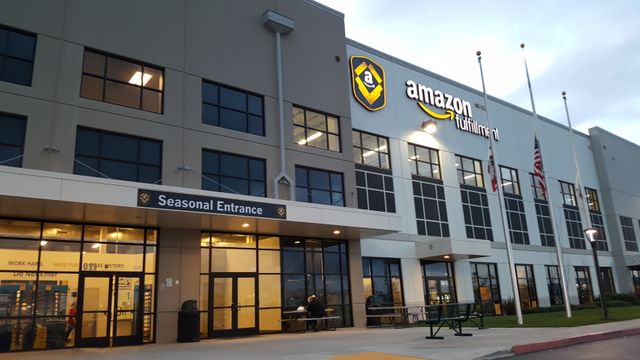
Fulfillment center in Tracy, California
In June 2014, 52-year-old Jody Rhoads was killed when machinery she was operating to move pallets crashed into shelving and pinned her at a fulfillment center in Carlisle, Pennsylvania. In another notorious incident in 2011, management at an Amazon warehouse in Breinigsville, Pennsylvania refused to open their doors to provide ventilation as temperatures reached 110 degrees. When workers began collapsing on the job, the company simply paid to have ambulances on standby outside the facility to shuttle workers to the hospital.
World Socialist Web Site reporting team recently spoke with Amazon workers in Tracy, California, 63 miles east of San Francisco. It quickly became clear that management has tried to create an atmosphere of intimidation to prevent workers from speaking out against poor working conditions. A worker with three years’ experience, at first apprehensive about speaking to a WSWS reporter, nevertheless chose to talk briefly without giving his name. Referring to the risk he was taking, the worker said, “A lot have been fired for a lot less.”
During job training workers are told speaking to the media is against company policy and could result in immediate dismissal. “I knew someone who was fired simply for saying the word ‘union’ and being overheard by a manager,” the worker told the WSWS. “The company has threatened to shut down and relocate entire fulfillment centers if they hear enough talk about forming a union.”
Another worker said the starting wage at the plant is $13.50 per hour. Workers receive a meager $0.25 per hour raise every six months, with a ceiling wage of $15 per hour, a poverty wage scale in a state with one of the highest costs of living. Nationally, starting wages for Amazon workers are often only $11-12 per hour.
Another worker told the WSWS, “The most striking thing to me about working here is the incredibly low morale. I’ve worked at other jobs, including at large factories, and I’ve never seen workers’ morale so low. You try to get by and pretend ‘it’s another day in paradise,’ but it’s really difficult when everyone seems so depressed and angry all the time.”
The Tracy fulfillment center opened in October 2013 at the same time as another facility was opened in nearby Stockton, a city devastated by the 2008 financial collapse, which in 2012 became the largest American city to declare bankruptcy, before being surpassed by Detroit the following year.
Amazon has six fulfillment centers in San Bernardino, another major city to declare bankruptcy.
The company apparently targets areas that have been hard hit by deindustrialization, which have an ample supply of unemployed workers who can be exploited for low wages. Cash-strapped states and localities offer the company large tax cuts and other subsidies to “create jobs.”
Some of the sites chosen for new fulfillment centers are Livonia, Michigan, western suburb of Detroit, where the warehouse will be built on the location of a former General Motors plant.
Amazon is also slated to open two facilities in Aurora, Illinois, where Caterpillar plans to close a plant later this year, wiping out 800 jobs. The state of Illinois is granting Amazon $12.9 million in corporate tax breaks for these two facilities, and potentially over $100 million for the company’s eight total facilities in the state.
There is a deep undercurrent of hostility among Amazon workers toward these brutal working conditions that they face, and a growing sentiment in support of a struggle. In addition to these concerns, Amazon workers at the Tracy, California facility and another warehouse in northern Virginia, just outside of Washington, DC, also spoke to the WSWS about the danger of war, expressing the general antiwar sentiment felt in the majority of the American population.
After learning that Trump had ordered air strikes directly targeting the Syrian government, one worker at the Tracy facility emphatically declared, “Trump is an idiot.” Another at the Northern Virginia facility said, “In my opinion, killing is never the way and it is definitely not the way to achieve peace in this world.” This worker noted that at a younger age he had been forced to join the US Army, as a means of paying for his school tuition.
An Amazon contractor at the Northern Virginia center said, “There are so many other things the population should be worrying about. The threat of a major war with another nuclear power is something we all should be concerned about, and it should be the media’s job to bring something like this to peoples’ attention. It seems like it’s left up to the socialists to be the ones to bring it up.”
While management seeks to silence dissent among Amazon workers there are many Facebook pages and reddit.com posts where workers actively express their opposition. There is a sense that something must be done not only about conditions on the job but the grim prospects an entire generation of young workers is facing, including massive student loan debts, dead-end and low-paying jobs and the danger of war.
Efforts by several trade unions, including the International Association of Machinists, to make inroads among Amazon workers have been rebuffed due to the decades of betrayals by these organizations. Far from improving wages and conditions for warehouse and logistics workers, including at United Parcel Service, the Teamsters and other unions have maintained multi-tiered wage and benefit systems and part-time and precarious employment conditions.
Amazon workers need organization. They do not, however, need organizations that are tied to the big business and the corporate-controlled political parties. The Socialist Equality Party urges Amazon workers to form rank-and-file workplace committees to unite Amazon workers to fight for the right to secure, good-paying and safe jobs. Amazon workers in the US and internationally possess an immense, but, as yet, untapped power, and common industrial action by workers could quickly become a choke point in the global economy.
Fundamentally, the great questions confronting Amazon workers, like all workers in the US and around the world—the immense social inequality, the underlying structure of society, the threat of a nuclear world war—can only be addressed through the building of a mass political movement of the working class against the capitalist system, which enables the few like Bezos to accumulate vast riches by exploiting the collective labor of the working class.
We encourage all Amazon workers to contact the World Socialist Web Site today. We will do everything in our power to assist workers in establishing lines of communication among Amazon workers throughout the US and internationally, to build rank-and-file committees and elaborate a fighting strategy to defend their interests.

At least 26 dead in garbage dump collapse in Sri Lanka

Vijith Samarasinghe & Wimal Perera

The death toll from Friday’s collapse of a large portion of the massive garbage dump in Meethotamulla, in the suburbs of Colombo, rose to 26 by yesterday evening. The bodies of seven children, along with 19 adults, have been found so far. Another 12 injured have been admitted to the Colombo National Hospital. Residents told WSWS reporters that there could be as many as a 100 people still buried under the debris.
The Meethotamulla garbage dump
About 145 houses have been destroyed or buried by the collapsing garbage mountain. Around 645 people from 180 families have been displaced and are temporarily sheltering in a nearby primary school and other places without basic amenities. Because the Hindu traditional New Year festival day fell on April 14, visiting relatives may also have been inside the buried houses. The Sri Lanka Electricity Board warned people to leave the surrounding area because a high voltage power line has been damaged.
The tragedy has provoked shock and outrage across the country, compounding the political crisis of the goernment, which is already facing widespread opposition over its austerity policies. President Maithripala Sirisena has held meetings with ministers, military chiefs and government officials to announce assistance and compensation for the victims. Prime Minister Ranil Wickremesinghe has cut short his tour of Asia “because of the disaster.”
With government approval, Colombo Municipal Council had established a huge garbage dump on a 16-acre block of land and heaped waste up to 30 metres high. Management of the dump lacked any scientific application or concern for the lives of nearby residents. Friday’s collapse destroyed all the houses in its southern boundary.
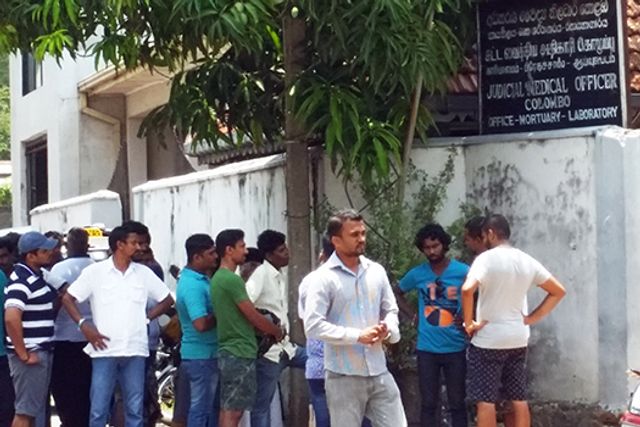
People wait near the Colombo national hospital mortuary to collect the bodies of those killed.
A woman, who had been waiting since Friday for the bodies of her brother, his wife and 12-year-old daughter to be unearthed, told the WSWS that no government officials or rescue teams reached the site for more than an hour after the disaster. “Residents themselves started searching for the buried people. Then the navy and police came with few shovels,” she said.
Facing rising anger, the government sent army “rescue teams” a few hours later. The army brigadier in charge of the disaster site told the media that a contingent of 600 has now been deployed.
Soldiers and rescue teams are searching the site with rented excavation machinery and without proper equipment or protective gear. This shows the lack of proper disaster preparedness by the government, despite the many landslides in recent years that have killed hundreds. In 2004, the Asian tsunami killed around 40,000 people in Sri Lanka.
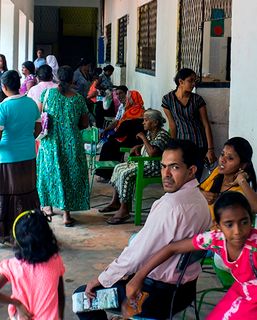
A section of displaced people in the Terence school at Kolonnawa
Another woman told the WSWS: “For how long have we been saying that this [heap of refuse] would collapse!” She said that a university professor had warned last year that the garbage mountain could collapse due to the pressure of methane gas being produced inside. “All our cries fell on the deaf ears of governments! They did nothing until so many people were buried alive,” said a man who was waiting for information about relatives.
Law and Order Minister Sagala Ratnayaka, S.M. Marikkar, a government parliamentarian for the area, and Police Chief Pujith Jayasundara faced angry protests by local people when they visited the area.
“People told them that there’s no need to visit after so many have died. What we got when we protested against dumping of garbage here was baton charges,” a man told the WSWS. “Politicians, Buddhist monks, or Catholic priests, none of them are wanted here.”
Another man, now alone with his grandson, angrily explained that these were not deaths, but murders.
Conscious of the simmering anger, the government has deployed a large number of police and soldiers in the area. Under the pretext of “public safety,” the entire area has been cordoned off. The residents are still unable to salvage valuables from their houses.
Contingents of riot police armed with water cannon, tear gas and firearms are on stand-by in nearby towns such as Wellampitiya and Gothatuwa New Town.
More than 24 hours after the collapse, Deputy Finance Minister Harsha de Silva said that the problem had been building up more than 20 years and the government had now decided to immediately stop the dumping of garbage at the site.
Blaming the victims themselves, de Silva stated that the tragedy occurred because the families had refused to move from the area, despite being offered compensation. Locals, however, told the WSWS that there had not been a resettlement program, apart from verbal promises by officials for a pittance in compensation or for rent for a house at an alternative location.
Six bodies of two families
These attempts to evict people are a part of the project initiated by the previous government of President Mahinda Rajapakse, and continued by the current government, to transform Colombo into an international financial and commercial hub. The government is now seeking to use the tragedy to push ahead with evictions.
For a long time this area was used as a place for dumping garbage. However, the dangerous situation developed after 2009 when it became Colombo’s main garbage disposal facility. People protested, warning against the potential disasters on many occasions in the past few years. In early 2014 the Mahinda Rajapakse government launched a violent police attack on the residents who were engaged in a sit-in for days blocking dumping.
During the campaign for the January 2015 presidential election, Ranil Wickremesinghe, then opposition leader, visited the area and told the residents that the problem of the garbage dump would be solved as soon as Maithripala Sirisena was elected. Yesterday he sent hypocritical condolences and cynically stated that the government had been on the point of solving the problem of the garbage dump. In reality, his government responded to local protests in May and December 2015 with brutal police attacks and the arrest of many residents.
The Meethotamulla garbage dump disaster is another tragedy generated by successive governments and the drive for profit. It demonstrates that the capitalist system cannot resolve even the most basic problems facing the masses. While President Sirisena has reportedly ordered an immediate stop to garbage disposal in the area and relief for the victims, his real concern is to prevent the disaster from becoming a focus for mounting anger against the government.

Syrian rebels massacre at least 126 civilians in suicide bomb blast

Jordan Shilton

A convoy of buses evacuating residents from the government-held towns of Foua and Kefraya in Syria’s Idlib province was targeted by a suicide bomber Saturday, claiming the lives of at least 126 civilians. The attack occurred west of Aleppo as the buses made their way to government-controlled areas.
The evacuation of the residents of the two towns began Friday morning and was part of a swap deal agreed between the government of Bashar al-Assad and rebel forces. In exchange for allowing the evacuation of residents from Foua and Kefraya, rebels agreed to resettle the populations of Madaya and Zabadani, two towns they control near Damascus. In total, around 7,250 people were evacuated from the four towns. It was part of a broader plan brokered by Iran and Qatar to move up to 30,000 people over a 60-day period.
According to the Syrian Observatory for Human Rights, which is linked to the rebels, 68 children were killed in the blast. Other sources have put the figure as high as 80.
The observatory confirmed the blast was caused by an improvised explosive device carried in a vehicle, backing up an earlier report on Syrian state TV which said the attackers used a van meant for delivering aid to gain access to the area.
An al-Jazeera reporter at the scene described how many of the buses were completely destroyed and dead bodies littered the ground. Ambulances rushed those from the scene who had been injured.
Although no group has yet claimed responsibility for the attack, it occurred in a rebel-controlled area. Ahrar al-Sham, a conservative Islamist militia, condemned the bombing and called for an international investigation to determine who was to blame.
In stark contrast to the moral outrage expressed by politicians and the media in the wake of the alleged gas attack in Khan Sheikhoun earlier this month, which the Trump administration seized upon to launch an illegal missile strike on a Syrian air base, the death of over 100 Syrians in a suicide bombing—substantially more than the number who died in the alleged gas attack—prompted virtually no condemnation from the Western powers.
The US State Department released a weasel-worded statement which, while condemning the killings, sought to strike a pose of impartiality and refused even to identify the rebel Islamist militias as being responsible. “We deplore any act that sustains or empowers extremists on all sides including today’s attack,” said State Department spokesman Mark Toner.
At a comparable stage in the aftermath of the Khan Sheikhoun incident, just hours after the alleged attack, US government officials had already acted as judge, jury and executioner, and were proclaiming the guilt of the Assad regime without presenting any evidence.
President Donald Trump, who invoked the deaths of “beautiful babies” and the need to defend the “civilized world” in justifying his April 6 cruise missile strike, which killed nine civilians, did not even comment on the bloodbath carried out by forces linked to the American CIA.
For their part, the servile corporate-controlled media reported on the incident, if at all, in a largely routine manner.
The New York Times published a lengthy front-page report concentrating almost exclusively on the crimes committed by Assad during the war, alleging that “the largest number of violations by far has been by the Syrian government.” It criticized the failure to bring government officials before the International Criminal Court in the Hague and blamed Russia for blocking any action by the UN Security Council.
The general indifference shown by the political and media establishment to the victims of this brutal massacre exposes once again the hypocrisy of the crusaders for “human rights” in the United States and the European imperialist powers. It demonstrates the fraudulent character of the propaganda campaign in the wake of the alleged gas attack, designed to conceal the real aims of US imperialist intervention in Syria: regime change in Damascus and the consolidation of Washington’s hegemonic position in the energy-rich Middle East against any challenge from its geopolitical rivals.
The reason for the lack of reaction is not hard to find. While it remains unclear precisely which faction of the rebels carried out the mass slaughter, Washington and its Gulf allies have the main responsibility for arming the collection of right-wing Islamist militias fighting the Assad dictatorship and enabling them to continue the civil war. The opposition is now dominated by the al-Nusra Front, which was formerly affiliated to Al Qaeda.
If any journalist were honest enough to follow the evidence, they would have to apportion a significant part of the blame for the bus convoy bombing to the criminal and reckless policies of US imperialism. More than six years after instigating the Syrian civil war, Washington has the blood of an estimated 500,000 Syrians on its hands.
This does not even take into account the upwards of 1 million people killed as a result of the illegal invasion of Iraq in 2003, the hundreds of thousands of deaths due to wars either led or sponsored by Washington in Afghanistan, Yemen, and Somalia, and the millions throughout the region forced to flee their homes as a consequence of conflict and societal breakdown.
The highly selective concern shown for “human rights” issues by the representatives of US imperialism is nothing new. Saturday’s bombing came less than a month after a single US air strike launched as part of the ruthless onslaught against Mosul, Iraq’s second largest city, claimed the lives of as many as 300 civilians sheltering in a basement. This horrific war crime, coming on top of the thousands of civilian deaths that have occurred since the US-backed offensive was launched last October, was largely buried by the media.
The ruling class considers the deaths of civilians to be collateral damage—a price worth paying in their ruthless struggle to uphold US imperialist interests in the Middle East and around the globe. Barely 24 hours after the bus bombing, Trump’s National Security Adviser General H.R. McMaster vowed in an ABC News interview that Washington was ready to escalate tensions with Russia still further, not only over Syria, but over Europe as well.
McMaster said of Russia’s alliance with Assad, “So Russia’s support for that kind of horrible regime, that is a party to that kind of a conflict, is something that has to be drawn into question as well as Russia’s subversive actions in Europe. And so I think it’s time though, now, to have those tough discussions with Russia.”

Ballot dispute erupts as Erdogan declares a “Yes” victory in Turkish constitutional referendum

Halil Celik 

According to results posted last night, the constitutional referendum of Turkish President Recep Tayyip Erdogan won 51.4 percent of the vote. With 99 percent of ballots counted, the “No” campaign, supported by the opposition Kemalist Republican People’s Party (CHP) and the pro-Kurdish Peoples’ Democratic Party (HDP), stood at 48.6 percent. Erdogan, who heads the Justice and Development Party (AKP), declared victory for the sweeping constitutional changes he had promoted.
The referendum was marked by large-scale voting irregularities, however, which immediately raised suspicions of electoral fraud. The High Electoral Board (YSK) ruled that it would count ballots that “had not been stamped” by its officials “as valid unless they could be proved fraudulent,” citing “a high number of complaints that YSK officials at polling stations had failed to stamp them.”
The CHP declared that it would demand a recount of about 6 percent—some 2.5 million—of the votes or about 37 percent of ballot boxes. The HDP, for its part, said the result of the referendum would remain unclear until its appeal to the YSK over voting irregularities had been decided.
The YSK’s decision led CHP’s chairperson Kemal Kilicdaroğlu to declare that the legitimacy of the referendum was open to question. In a short speech to reporters last night, Kilicdaroğlu stated that constitutions should be the result of social consensus. He said he was ready to develop the Turkish constitution on a consensus basis.
Though the referendum was supported by the AKP and the fascistic National Movement Party (MHP), the initial results show that the absolute size of the “Yes” vote was some 10—in some cities 20—percent smaller than the AKP and MHP vote in the November 2015 general election. The HDP also lost part of its vote in some of its majority-Kurdish electoral strongholds, where hundreds of thousands of people have been forced to flee fighting between the Turkish army and Kurdish nationalist groups.
In Turkey’s largest cities—Istanbul, Izmir, Ankara, Adana, Diyarbakir—the “no” vote carried, while large sections of the population voted “no” in major industrial cities such as Bursa, Kocaeli and Manisa.
As it became clear that the official result would be a “yes” victory, Turkish Prime Minister Binali Yildirim told a crowd of AKP supporters that the referendum had opened a new page in Turkey’s history. Erdogan then spoke to celebrate his razor-thin victory. “There are people who belittle the results,” he said, referring to his opponents. “Do not beat the air. It is too late now.”
Speaking at Huber Palace in Istanbul, Erdogan claimed that by approving the referendum, which effectively grants him dictatorial powers, Turkey had resolved a 200-year-old contradiction in its administration. “Today is the day when a change, a decision to shift to a truly serious administrative system was made,” he said.
Devlet Bahçeli, the leader of the pro-”yes” Nationalist Movement Party (MHP), called the result a “a significant success,” ignoring the fact that some 50 percent of MHP voters voted “no.” Dismissing the issue of vote fraud, he declared, “The great Turkish nation, the sole owner of sovereignty, has given the final word about the future of its country, clinging to its independence and future.”
The constitutional amendment is a reactionary measure replacing Turkey’s parliamentary system with an all-powerful presidency exercising total control of the legislature and the judiciary. It allows the president to issue legislative decrees, draw up the budget, appoint the judiciary, dissolve parliament and nominate the ruling party’s candidates for parliamentary elections. The parliament would become a rubber stamp.
If the “yes” vote is confirmed, the referendum will reshape Turkey’s relations with NATO and the European Union. Erdogan previously vowed to review his refugee deal with the EU after the referendum.
Even though large-scale irregularities are hanging over the vote, the pro-EU Turkish Industry and Business Association (TUSIAD) called on the electorate to support the “yes” result. It called for the population to stand “in solidarity for a stronger Turkey and look to the future without delay.” It also urged “the government and parliament to prioritize the reform agenda that is before our country,” adding, “It is time to progress by preserving freedoms, pluralism and solidarity.”
Though the referendum unmistakably grants the Turkish president dictatorial powers, TUSIAD asked Erdogan to “strengthen the independence of the judiciary” and end the state of emergency imposed after last year’s July 15 failed coup, which was backed by Washington and Berlin.
TUSIAD’s statement also called for closer relations with the EU on issues such as customs duties, media and Internet freedom, security cooperation on refugee policy, visa-free travel, a political solution in Cyprus, and a resolution to the war in Syria.
The Council of Europe made similar remarks, calling on the Turkish government to proceed carefully after its victory. In a written statement, Council of Europe Secretary General Thorbjørn Jagland said, “It is of utmost importance to secure the independence of the judiciary in line with the principle of rule of law enshrined in the European Convention on Human Rights. The Council of Europe, of which Turkey is a full member, stands ready to support the country in this process.”
In Germany, Foreign Minister Sigmar Gabriel urged the Turkish government to proceed in a “level-headed way.” Axel Schaefer of the Social Democratic Party treated the referendum outcome as a disaster, comparing it to the coming to power of Hitler in 1933.
“The Brexit vote is pushing Britain onto the sidelines, the presidential election of Trump is taking the USA on an adventure, the Erdogan referendum is leading Turkey into absolutism like the 1933 German parliamentary election led Germany into the abyss,” he said.
Erdogan’s closest allies were more supportive in their statements on the referendum. Azeri President Ilham Aliyev congratulated Erdogan, saying, “This referendum will undoubtedly mark the dawn of a new era in the history of our sister country and will strengthen the role and place of a stable, strong Turkey in the international arena.”
Qatar’s emir, Sheikh Tamim bin Hamad Al Thani, and Palestinian President Mahmoud Abbas, together with leaders from Pakistan, Hungary, Macedonia, Saudi Arabia, Sudan and Kenya, telephoned Turkish Foreign Minister Mevlut Cavusoglu to congratulate him on the result.

15 Apr 2017

Australian worker challenges union-company wage-cutting deal

Oscar Grenfell 

A legal challenge to a wage-cutting deal between supermarket giant, Coles, and the Shop, Distributive and Allied Employees Association (SDA), a trade union that covers many retail workers, has been the subject of nervous commentary this month.
Senior business figures, Labor and Liberal-National Coalition politicians and union officials have warned that an overturn of the agreement threatens the framework of company-union enterprise bargaining which has been central to the decimation of jobs, wages and conditions since the 1990s.
The challenge to the deal, struck by Coles and the SDA in 2011, was brought to the Fair Work Commission (FWC), the federal government’s industrial tribunal, by Penny Vickers, a Brisbane Coles worker and SDA delegate last year. Since then, despite multiple hearings and mentions, no date has been set for the case to be decided.
Vickers, who works night and weekend shifts, is alleging that the agreement, one of a series of pro-business deals between the union and the company, resulted in her weekly pay being slashed to $33 below the mandated award wage for the industry. While the deal contained marginal increases in base pay rates, it cut weekend and night penalty rates for affected workers, eliminating them entirely on Saturdays.
As a result of agreements between Coles and the SDA since 2011, an estimated 43,000 workers, or 56 percent of Coles supermarket employees, have been underpaid. According to Fairfax Media, the average underpayment has been around $1,500 a year, saving Coles between $70 million and $100 million per year. Up to 80 percent of the workforce is casual or part-time, with supermarket workers among the lowest paid. Some have annual wages of as little as $10,000–$15,000.
Vickers has stated that when workers voted on the agreement, they were not informed, by the SDA or Coles, that it contained pay cuts.
Vickers is not the first worker to challenge Coles-SDA wage-cutting deals. In 2015, Duncan Hart, a Brisbane Coles employee, lodged a FWC case challenging the 2014 Coles-SDA enterprise bargaining agreement, which contained substantial cuts to weekend and night penalty rates.
In May 2016, the FWC ruled that the 2014 deal would be invalid, unless the company increased penalty rates. It refused, and instead reverted to the 2011 agreement, which is the subject of Vickers’ case.
In both instances, the SDA has collaborated with Coles in seeking to quash the legal challenges. The alliance of the SDA and the company against the supermarket workers is a graphic expression of the utterly corporatised and anti-working class character of the unions.
Other unions are also implicated in similar wage-cutting. The Australian Workers Union (AWU), the largest in the country, was a party to the 2011 and 2014 agreements. The AWU, formerly headed by Labor Party leader Bill Shorten, signed a host of other deals reducing the pay of cleaners, farm labourers and other low-paid workers.
Unions across the board, including those promoted as “left-wing” and “militant,” such as the Construction Forestry Mining and Energy Union (CFMEU), have established enterprise agreements that contain real wage cuts for workers they falsely claim to represent. In February, for instance, the CFMEU pushed through an agreement covering about 900 workers at the Maryvale paper mill in Victoria’s Latrobe Valley, slashing wages by 5 percent.
Such agreements have played a central role in creating the conditions for last year’s national wage growth, across the private sector, to fall to its lowest-level since records began in 1969—just 1.8 percent.
The SDA has vehemently opposed Vickers’ case, citing slight increases in base pay rates, particularly for workers on day shifts. SDA national secretary Gerard Dwyer declared that the “rolling up” of penalty rates at Coles and Woolworths, another supermarket chain, had delivered higher wage rates to some workers.
Under current industrial legislation, however, an agreement must pass a Better Off Overall Test (BOOT), which supposedly requires that no worker be worse off “overall.”
Senator Eric Abetz, a leading figure in the federal Liberal-National government and a former industrial relations minister, called this month for the Labor Party to assist the government to remove the BOOT clauses from the legislation.
The Labor Party has fraudulently postured as an opponent of recent cuts to penalty rates. But Abetz pointed to the central role of Labor governments in creating the enterprise bargaining framework under which company-union wage-cutting deals are struck. “I think the enterprise bargaining system should be supported, it is one of those good things that came from the Hawke-Keating-Kelty era,” Abetz declared.
Enterprise bargaining, as it currently exists, was put in place by the Labor government of Paul Keating in the early 1990s, working hand-in-glove with the Australian Council of Trade Unions (ACTU) and its secretary, Bill Kelty.
The move was part of a broader agenda begin under Keating’s predecessor, Bob Hawke, which included the establishment of Accords between the government, the major corporations and the unions providing for the deregulation of the economy, and the destruction of hundreds of thousands of manufacturing jobs.
Greg Combet, another former ACTU secretary and a leading member of federal Labor governments from 2007 to 2013, echoed Abetz’s comments this month.
Combet pointed to the pro-business character of the system, stating: “Continuing a system of enterprise bargaining in our economy is extremely important because it allows companies to adjust to competitive circumstances.” In other words, enterprise bargaining allows the companies, working through the unions, to slash the wages and conditions of employees to boost profits.
Underscoring the ongoing company-union-government alignment, Business Council of Australia chief executive Jane Westacott also warned that “no one wanted enterprise bargaining to collapse.” She called for bipartisanship between Labor and the Liberal-National Coalition to defend it.
As these responses indicate, the case launched by Vickers has once again shown that any struggle by workers against the corporate assault on jobs, wages and conditions must be carried out in direct opposition to Labor and the unions.

German football team coach bus hit by roadside bombs

Dietmar Henning 

Four days after the bomb attack Tuesday on the bus of the Borussia Dortmund (BVB) football club there is still no clear information regarding either the identity of the attacker(s) or motive.
On Tuesday evening at 7:15 p.m. three bombs loaded with steel pins exploded as the bus set off from the team’s hotel to the local stadium in Dortmund. The bombs were hidden behind a hedge and detonated by remote control. They had a destructive power of up to a hundred yards.
BVB was due to play AS Monaco in a Champions League quarter-final when the bombs struck.
Despite its reinforced panels the bus was badly damaged. The Spanish BVB defender Marc Bartra suffered an injury to his wrist and was operated on the same evening. One metal splinter only just missed the BVB players and drilled into the headrest of a seat. “We are lucky nothing worse happened,” Frauke Köhler, spokeswoman for the prosecutor generals’ office declared.
Only one day after the attack she declared that the attack had a “terrorist background” and that the federal prosecutor’s office had taken over the investigation. Germany’s highest state investigation authority is responsible for terrorist offences.
Investigators from the Federal Prosecutor’s Office and the Federal Criminal Police Office arrested two men from North Rhine-Westphalia on Wednesday night. Special Forces stormed the apartments of a 25-year-old Iraqi in Wuppertal and a German living in the small neighbouring village of Unna. Both have Islamic backgrounds.
One man was arrested, but on Thursday it was announced that the investigations “had so far no evidence that the accused had been involved in the attack”. The second suspect was not even arrested.
Investigators reported on Friday that they had “serious doubts” that the attack had been carried out by Islamists as initially reported. They pointed to the suspicious character of letters found at the scene, which appeared to be written in an attempt to misdirect investigators.
Shortly after the detonation, police officers near the scene of the crime found three identical letters professing to the attack, presumed to have been left behind by the perpetrator(s). The letter stated that the “Islamic State” (IS) was behind the bombing, but there is much evidence indicating that the claim of responsibility was deliberately aimed at sending a false signal.
This would be the first ever such letter left by an IS attacker at a crime scene. The letter, written on computer, fails to include any oath of allegiance to IS leader Abu Bakr al-Baghdadi, the IS logo or any other religious formula. The 14-line letter is also written in apparently deliberately faulty German, which gives rise to even more doubts. The letter includes obvious spelling mistakes but at the same time the author has no problem with much more difficult grammatical formulations.
Another new feature of the letter is the way in which the author(s) directly address chancellor Angela Merkel (CDU): “But apparently Merkel, you do not care a jot for your little filthy subjects. Your Tornadoes still fly above the ground of the caliphate to assassinate Muslims.”
The letter specifically demands the withdrawal of German Tornado fighter planes from Syria and the closure of the Ramstein Air Base, the largest American military base in Germany. Until that is accomplished, “all disbelieving actors, singers, athletes and celebrities in Germany and other crusader countries everywhere are on the death list of the Islamic state.”
According to the Nordrhein Westfalen Interior Minister, Ralf Jäger (SPD), the three bombs were professionally constructed. Jäger said that, based on the letters found, there was a high risk of further attacks, and he announced additional personnel would safeguard the public and all major events.
A second letter published on the Indymedia website, is very likely to be spurious. “Neither the content or language point to a left-wing background, so we have already deleted it shortly after its release” the platform said. The investigating authorities drew a similar conclusion. The internet post said that the bus had been attacked as a “symbol for the policy of the BVB”, which had not done enough to combat racists, Nazis and right-wing populists.
Bearing in mind that the BVB spends €300,000 per year for so-called “Nazi Prevention”—it subsidizes trips for pupils and fans to concentration camp memorials such as Dachau or Sachsenhausen—both the investigators and many football fans consider it possible that right-wing hooligans are behind the attack on the BVB.
The football club is currently taking legal action against a group of fans from the club, including many ultra-right thugs, who were involved in provocations against a rival team from Leipzig in February.
One week after the February incident police stopped several busses containing members of the group “0231 Riot” (0231 is telephone dialing code for Dortmund). The “0231” thugs were on their way to an away game of the BVB in Darmstadt. The group recruits almost exclusively from the extreme right-wing scene.
After the BVB banned the group from its stadium, police in Dortmund found graffiti threatening the life of BVB boss Hans-Joachim Watzke.
The investigating authorities also believe that violent supporters of the RB Leipzig—the club at the receiving end of the violence in February—could be behind the terror attack. The demands contained in the alleged IS note calling for the withdrawal of German Tornado aircraft from Syria and the closure of the US air base in Rammstein are almost identical to the demands of the far-right political movement Legida, which is based in Leipzig.
Despite the attack, the football match between BVB and AS Monaco went ahead one day later. Immediately after the explosion, the Union of European Football Associations (UEFA) decided to allow the match to take place. The Dortmund coach, Thomas Tuchel, expressed his disquiet with the decision at a press conference immediately after the match. “The dates were planned in advance and we have to work,” he said, but the team would have liked more time to deal with the shock of the bombing.
Soon after the terror attack and after the game a veritable storm of solidarity messages for BVB and criticism of the UEFA decision hit the internet and social networks.
Players had also expressed their unease after the game. BVB defender Sokratis said: “The UEFA needs to understand that we are not animals. We are people with a family and children at home. I’m glad all the players and supporters are alive.”
In an interview with a Norwegian TV station, the BVB player Nuri Sahin said: “To be honest I did not think about football until I was on the pitch in the second half.” His teammate, Matthias Ginter, told ruhrnachrichten: “Nobody wanted to play today.”
BVB head Watzke concurred, however, he had agreed with the UEFA on Tuesday in order to send a “signal against terror”. He was supported by Chancellor Merkel, who called him personally Wednesday morning.
The fact that the game was put back a day created many problems for hundreds of Monaco fans who had planned their return home after the match. Many Dortmund fans responded by offering overnight accommodation in their homes for the stranded fans.

Whistleblower uncovers London police hacking of journalists and protestors

Trevor Johnson 

The existence of a secretive unit within London’s Metropolitan Police that uses hacking to illegally access the emails of hundreds of political campaigners and journalists has been revealed. At least two of the journalists work for the Guardian .
Green Party representative in the British House of Lords, Jenny Jones, exposed the unit’s existence in an opinion piece in the Guardian. The facts she revealed are based on a letter written to her by a whistleblower.
The letter reveals that through the hacking, Scotland Yard has illegally accessed the email accounts of activists for many years, and this was possible due to help from “counterparts in India.” The letter alleged that the Metropolitan Police had asked police in India to obtain passwords on their behalf—a job that the Indian police subcontracted out to groups of hackers in India.
The Indian hackers sent back the passwords obtained, which were then used illegally by the unit within the Met to gather information from the emails of those targeted.
The letter was published in part in the Guardian, with its anonymous author writing, “For a number of years the unit had been illegally accessing the email accounts of activists.
“This has largely been accomplished because of the contact that one of the officers had developed with counterparts in India who in turn were using hackers to obtain email passwords.”
The letter continued, “Over the years, the unit had evolved into an organisation that had little respect for the law, no regard for personal privacy, encouraged highly immoral activity and, I believe, is a disgrace.”
As proof of its validity, the letter contained “a list of ten people and the passwords to their email accounts.” As proof that the hacking was directed against spying on political groups and activists, the letter states that four of the ten people work for the environmental group Greenpeace, with one of them in a senior position.
The Bindmans LLP law firm, acting on behalf of Jones, contacted six of those listed to verify their passwords (the others could not be traced). In response, five of the six gave passwords that matched those given in the letter, and the sixth was nearly a match. The BBC noted that one of the 10 activists said “their password may have still been in use as recently as late 2015 or early 2016.”
The Met has claimed such activities were solely aimed at tracking down criminals, even though any evidence obtained through hacking—which is illegal—would not have been admissible in court. Rather, such claims are a cover for a hidden agenda.
Jones writes of the police acting “with impunity.” Exposing her own close relations with the state—while at the same time showing how widespread and intrusive police spying is—Jones writes the following: “The police put me on the domestic extremism database during the decade when I was on the Metropolitan Police Authority signing off their budgets and working closely with officers on the ground to fight crimes such as road crime and illegal trafficking. If someone in my position—no criminal record and on semi-friendly terms with the Met commissioner—can end up on the database, then you can too.”
The Guardian failed to point out in its report that new legislation proposed by the Law Commission would make the author of the anonymous letter, Jones herself, and the journalists at the Guardian, liable for prosecution—with up to 14 years in jail.
The intention to uncover criminal activity by the police could not be used as a defense. It is the aim of the Law Commission’s proposals to prevent whistleblowing activities that reveal the extent of mass surveillance becoming known.
The existence of a group acting illegally within the Metropolitan Police raises several questions that have not been broached by the media:
• When and on whose orders was this group set up? What was the remit of the group?
• Who authorized its use of hackers in India?
• How many people were targeted and for how long? How many of these were journalists?
• Is the group still in operation?
Under existing legislation, hacking—as described by the whistleblower—is unlawful if personal communications were intercepted for any other reason other than to combat major crime or terrorism. The home secretary must approve any such monitoring of personal communications.
The use of illegal hacking by Scotland Yard makes a mockery of the claims made by both the government and the Labour Party that judicial safeguards in the Investigatory Powers Act (IPA) can ensure that the police and spy agencies will not misuse the new powers it gives them.
Jones states in her Guardian piece, “Please don’t fall for the old establishment lie that the problem is a few rotten apples. This alleged criminality is the result of a deliberate government policy of using the police and security services to suppress dissent and protest in order to protect company profits and the status quo.”
While true, it is not simply the case that the police and security services are just being used by the government. In fact, the police and security services are becoming emboldened to take a more independent role as direct agencies of the ruling elite, overriding other bodies.
The National Domestic Extremism and Disorder Intelligence Unit (NDEDIU), which tracks political activists, illegally shredded documents they had been ordered to preserve over a number of days in May 2014.
This was revealed by another whistleblowing letter to Jones last year, which stated that the shredding began only two months after Theresa May, then Home Secretary, announced the intention to hold the now Pitchford Inquiry into undercover policing.
As a result of the revelation on shredding, in May 2016 the Independent Police Complaints Commission (IPCC) was called in to investigate. Almost a year later, nothing has been made public by the IPCC of the results of this investigation, other than to confirm that “a large number of documents were shredded over a period of days in May 2014.”
The more recent letter to Jones confirms that shredding had been taking place “for some time… on a far greater scale than the IPCC seems to be aware of.” The police had destroyed the documents because they “reveal[ed] officers were engaged in illegal activities to obtain intelligence on protest groups.”
This illegal hacking and shredding by the police is part of a pattern. It follows the shooting of innocent man Jean Charles de Menezez by an armed police unit in the aftermath 2007 London bombings, the use of undercover officers who took on the names of dead children and formed long-term relationships with people when they were already married, and the use of a plethora of illegal spying methods against millions of people—as exposed by former US National Security Agency whistleblower Edward Snowden.
The law was then changed. The Investigatory Powers Act 2016 put on the statute book the mass surveillance of the UK’s population, previously carried out illegally.
The media in Britain has recently followed the lead of the US media by subjecting people to a daily barrage of propaganda on alleged “Russian hacking”, based on no evidence other than assertions by the intelligence agencies.
Their response, however, to real hacking by the British police, backed up by concrete evidence, has been virtual radio silence, with only two newspapers and the BBC giving the story any coverage at all, which they then dropped from their coverage immediately.