26 Apr 2017

Prosecution of Assange is Persecution of Free Speech

Nozomi Hayase

US authorities are reported to have prepared charges to seek the arrest of WikiLeaks founder Julian Assange. This overreach of US government toward a publisher, whose principle is aligned with the U.S. Constitution, is another sign of a crumbling façade of democracy. The Justice Department in the Obama administration could not prosecute WikiLeaks for publishing documents pertaining to the US government, because they struggled to determine whether the First Amendment protection applied in this case. Now, the torch of Obama’s war on whistleblowers seems to have been passed on to Trump, who had shown disdain toward free speech and even called the U.S. media as “enemies of the people”.
Earlier this month, CIA Director Mike Pompeo vowed to end WikiLeaks, accusing the whistleblowing site as being a “non-state hostile intelligence service often abetted by state actors like Russia”. He also once called Edward Snowden a traitor and claimed that he should be executed. This declaration of war against WikiLeaks may bring a reminiscence of George W. Bush’s speech in the aftermath of 9-11, where he said, ‘either you are with us or against us’, and urged the nation to side with the government in his call to fight global ‘war on terror’.
In a recent interview on DemocracyNow!, journalist at The Intercept, Glenn Greenwald put this persecution of WikiLeaks in the context of a government assault on basic freedom. He spelled out their tactics, noting how the government first chooses a target group that is hated and lacks popular support, for they know attacking an idea or a group that is popular would meet resistance. He explained:
“…. they pick somebody who they know is hated in society or who expresses an idea that most people find repellent, and they try and abridge freedom of speech in that case, so that most people will let their hatred for the person being targeted override the principle involved, and they will sanction or at least acquiesce to the attack on freedom because they hate the person being attacked”.
Demonizing and scapegoating of a particular group or organization is an alarming tendency toward an authoritarian state. At a news conference last Thursday, Attorney General Jeff Sessions also chimed in to emphasize how Assange’s arrest is a priority. This targeting of WikiLeaks is a threat to press freedom and could be seen a slippery slope toward fascism.
History Repeats Itself
Recall the Weimer Republic just before the rise of Adolf Hitler. He was successfully able to install hatred in the minds of Germans and carry out massive crimes against humanity. Americans often wondered what made many ordinary Germans accept these horrendous acts that led to the holocaust. Now, in Trump’s America, it is not so far a stretch to say that Muslims, Mexicans and other immigrants are becoming like the new Jews, to be a scapegoated under this right wing administration.
Once he gained power, Hitler made his word to be above the law. Trump, in his first 75 days in office, turned the rhetoric of hatred into action through passing executive order barring refuges and citizens from seven majority Muslim nations from entering into the United States and enacting mass deportation with the ICE agents acting like Nazi Gestapo to track immigrants. Draconian policies that were more under the radar during the Obama administration are now becoming overt. More and more, Americans might now be able to get under the skin of those ‘Good Germans’.
In Hitler’s Germany, persecution of Jews didn’t happen overnight. It was a gradual escalation. The first thing Hitler did was to control media and create an arm of propaganda. By using this weapon of mass deception, the Nazi Regime garnered popular support on a platform of racial identity and nationalism and managed to brainwash citizens with the Nazi-Auschwitz ideology of anti-Semitism. Under the guise of fighting communism, the Party suppressed civil liberties, free speech and association and expanded its power by demonizing whoever stood in their way.
Identity Politics and Machination of Power
The Trump campaign slogan “Make America Great Again” spoke to middle class America and disfranchised populations who were fed up with corporate plunder enacted under Democrats. His message of putting America first also struck a chord with white nationalists. By channeling their frustration and desires, Trump successfully created a fertile soil to harvest identity politics that is now coming to resemble Nazi’s emphasis of nationalism and racial supremacy.
No one can deny how the Trump victory empowered white supremacist groups that until now were more on the fringe. These identity politics that seem to be spreading around the world tend to contract one’s heart. Whatever the ideology is, progressive or conservative, anyone gripped with it falls into a narrow vision of humanity and loses perspective. This identity, fixed by ideology becomes a point of manipulation, to be exploited by those in power and used to divide everyone into ‘Us vs. Them’.
When people lose capacity for dialogue, they become deaf to their own humanity. Then, the state can easily exert control over the masses and seize power through manufacturing wars of all against all. We are now seeing a new civil war unfolding in America. The city of Berkeley is becoming a battleground. In February, riots erupted on the UC Berkeley campus when protesters shut down an event scheduled for right wing commentator Milo Yiannopoulos. Also, at the recent free speech rally on Patriot Day, Trump supporters, along with members of far-right nationalists clashed with local activists and anti-fascist groups. Ironically, the birthplace of the Free Speech Movement in the 60’s turned into a bloody fight, devolving into violence, with each camp acting totally contrary to the principles of free speech.
Height of McCarthy Era Hysteria
This attack against Julian Assange and WikiLeaks is not something new. Consorted efforts to delegitimatize the organization through character assassination and smearing of Assange have been persistent, ever since the site came to public prominence. Assange was called a high tech terrorist by former vice President Joe Biden and incitement for his murder came from high US officials.
Assange has been holed up in asylum in the Ecuadorian embassy for 5 years, despite a UN ruling clearly stating his detention is unlawful. This is not the first time he and his organization were declared to be enemies of the State. In 2012, the US military had designated them as such enemies.
So what is different now? The head of the CIA and the Department of Justice’s declaration of war against WikiLeaks comes in a particular political climate. These efforts to arrest Assange, now backed by President Trump are taking place at the height of a kind of McCarthy era style hysteria.
Just like the recent US government cruise missile attacks on Syria, carried out without any investigation or evidence that Assad was the one using chemical weapons, the echo- chamber of the liberal media has been amplifying their own speculation of WikiLeaks alleged source of DNC leaks and Podesta emails. With the narrative that Russia meddled in the US election, they branded Assange as a Putin sympathizer and/or Russian agent without backing it up. The Left’s seeming irrational obsession with Russia is also rooted in these identity politics, namely their allegiance to the Democratic Party and America’s post-cold war national identity, defined by a hysteric red scare and its mission of defeating communism.
Whistleblowers as Democracy’s Last Line of Defense
In the wake of the possible arrest of Assange, the ACLU noted that, “prosecuting Wikileaks would set a dangerous precedent that the Trump administration would surely use to target other news organizations.” We must never forget where hatred-driven identity politics led Nazi Germany. Martin Niemöller, the famous Protestant pastor who spoke against the rise of Hitler and spent years in concentration camps, reminds us of this:
“First they came for the Socialists, and I did not speak out –Because I was not a Socialist. Then they came for the Trade Unionists, and I did not speak out –Because I was not a Trade Unionist. Then they came for the Jews, and I did not speak out –Because I was not a Jew. Then they came for me – and there was no one left to speak for me.”
Fascism begins in the mind. Its seed grows whenever we accept hatred toward someone who has different or opposing views. Enclosure happens when we suspend critical thinking in the hype of fear and turn the other into an enemy. It happens every time we close our hearts, shunning those who have been made into our enemies. Democracy dies whenever we choose to pick up the sword of ideology, rather than choosing to uphold our common humanity and instead engage in a self-righteous crusade of defeating the enemy.
When Trump signed a Muslim ban into law, outrage spread nationwide and people rallied at airports. The U.S. Court of Appeals for the Ninth Circuit refused to reinstate Trump’s travel ban and so the solidarity of the people won. As Trump pressured to cut funds in sanctuary cities, these cities defied the order, assuring to maintain their immigrant policy. Now, the US government is coming after WikiLeaks, a transnational journalistic organization, who has no allegiance to any nation, governments or corporations, only to the conscience of ordinary people around the world.
In the darkness that hovers in the veil of ideology, whistleblowers shine a light, through which we are able to recover perspectives that were lost. WikiLeaks, through their act of publishing, lets everyone see views that are forbidden, marginalized or shunned. They are last line of defense and are on the front line in this battle for democracy. One may dislike WikiLeaks and disagree with Assange, but whatever one’s opinion is, we all need to stand up against this erosion of our civil liberties. Prosecution of WikiLeaks is persecution of free speech. Setting this precedent moves us down a dangerous path.


Short Choices: The French Presidential Elections

Binoy Kampmark

The establishment got another burning in the French elections on Sunday, revealing again that there is no level of voter disgust that will not find some voice in the current range of elections.  The terror for pollsters and the establishment now is whether Marine Le Pen will realise her anti-Euro project and drag the French nation kicking and moaning into a new, even more fractious order. In her way will be the pro-European Union figure of Emmanuel Macron.
The French example is similar to others of recent times: parties with presumed tenure were confined to a punitive dustbin, rubbished for stale, estranged obsolescence.  The Gaullists got what was a fair drubbing – 19.9 percent for François Fillon of the Republicans, a figure crusted and potted with corruption.
It did not, however, mean that both candidates in the first and second positions were political virgins.  In that sense, the US election remains an exemplar, a true shock.  France retains a traditional appearance to it, albeit a violently ruffled one.
Macron, with his 23.9 percent, supposedly deemed outside the establishment, still held office as minister for economy, finance and industry but flew the Socialist coop in opportunistic fancy.  Blooded in traditional harness, he has managed to give the impression that he has shed enough of the old for the new, notably with his movement En Marche.  He is blowing hard from what commentators have termed a “centrist” position.  (To be at the centre is to be in the middle, which is not necessarily a good thing in current times.)
Just to weaken the sense of Macron as outsider, both establishment parties – the Socialist, led by Benoît Hamon, and the Republican –urged voters to go for the centrist option.  This all had the appearance of a gentleman’s seedy agreement, plotted in a traditional smoking room to undermine an unlikable contender.  The losers wanted to be vicarious winners.  The tarnished Fillon urged voters to “reflect on your conscience.” In effect, Macron as a quantity is being sanitised for stability, the firebreak against the Le Pen revolution.
Le Pen herself speaks to a particular French and nationalist sensibility, tutored to a large extent by her father, who also ran in the 2002 Presidential elections and lost to Jacques Chirac.  She is hardly one to be unfamiliar with the political argot, which has retained a reactionary punch in more measured guise.
Le Pen kept her approach punchily traditional, milking the killing last Thursday of a policeman on the Champs-Elysees with old apple and oranges comparisons on security and immigration.  Having her in the Presidential office would see the stop of “mass immigration and the free movement of terrorists.”
For Le Pen, the May 7 runoff election would enable a choice to be made between “savage globalisation that threatens our civilisation” and “borders that protect our jobs, our security and our national identity.”
Macron provides an attractive target for the Front National: having worked for Rothschild, he supplies the front for corporate interests, and is “Hollande’s baby” uninterested in French patriotism.  He certainly promises to be friendlier to companies in France, with a policy envisaging a cut of the corporate tax rate from 33 percent to 25 percent, while also permitting them to re-negotiate the sacred 35-hour week.  His vision of the European Union, in short, is business as usual.
Under Le Pen’s particular tent lie appeals to critics of globalisation, a force that has rented and sunk various industries while also seeking to reform the French labour market.  But this nostalgic throw back entails barriers and bridges, building fortifications, holding firm and wishing for the best.
Jean-Luc Mélenchon proved to be another dark horse, the spicy left-wing option to Le Pen, and a candidate who experienced a surge of popularity prior to the poll.  His result is a story that has invigorated the left while gutting the socialists, providing us a reminder of the time of a greater radicalism.
“Len Pen,” claims Roger Martelli, “was counting on turning this election into a fight with the Socialist party government, but she had to compete with a radicalized right-wing opposition and socialist opponents who had moved more sharply to the left than she had expected.”
Nor were things pretty for Hamon, with a devastating result to compare to Gaston Defferre’s 5 per cent showing in 1969.  The socialists reformed by the 1971 Épinay Congress in the wake of that electoral catastrophe, have been well and truly buried.
What Mélenchon’s popularity suggests is that the European system, at least the model as it stands, needs reform and a degree of disentangling vis-à-vis the state.  Nor has he told his supporters to vote for Macron, a paternalistic ploy that can irritate voters.
“None of us will vote for the far-right,” went the consultation to 450,000 registered supporters of the France Untamed movement.  “But does it mean we need to give voting advice?” As Der Spiegel opined with characteristic gloominess, “The presidential election in France is becoming yet another end game over Europe’s political future.”
Much will depend on voter turnout come May, and the seasoned opportunism of Le Pen.  Her latest play is to place herself above partisan considerations by stepping down from the leadership of the National Front.  “So, this evening, I am no longer the president of the National Front.  I am the candidate for the French presidency.”

Egyptian Kangaroo Court Sentences 20 People To Death

Abdus Sattar Ghazali

A court of Egyptian military leader, General Abdel Fattah el-Sisi, who assumed the title of Field Marshal after overthrowing the elected President Mohamed Morsi in July 2013, Monday sentenced 20 supporters of Morsi to death.
The brutal military dictator el-Sisi has been cracking down on the opposition since the overthrow of President Morsi. He has killed more than 800 protesters in a single day, and has imprisoned tens of thousands of dissidents since he took power.
Not surprisingly, el-Sisi became President in a controversial election in 2014.
In July 2013, the ouster of President Morsi sparked many protests by his supporters, including a pair that were held at al-Nahda Square and Rabaa al-Adawiya Square in Cairo on August 13, 2013, which led to the killing of several hundreds of demonstrators by security police.
Rights groups say the army’s crackdown on the supporters of Morsi has led to the deaths of over 1,400 people and arrest of 22,000 others, including some 200 people who have been sentenced to death in mass trials.
In late 2014, an Egyptian court issued death sentences to 188 Morsi supporters, which sparked an international outcry against the controversial verdicts. In 2015, the death penalties were reduced in 149 cases.
In October 2016 a kangaroo court in Cairo confirmed a 20-year prison sentence against Mohamed Morsi. In April 2015, a Cairo court had sentenced Morsi to 20 years in prison for inciting violence against protesters who had staged a sit-in outside the Ittihadiya presidential palace in December 2012, when Morsi was still in power.
Mohamed Ahmed, an expert at the Amnesty International, said in a press statement last month that “Egypt is currently facing a severe human rights crisis that can never be compared to the situation during Mubarak’s rule,” referring to former dictator Hosni Mubarak who was toppled after a popular revolt in 2011.
Amnesty International annual report of 2016/2017 said: “The authorities used mass arbitrary arrests to suppress demonstrations and dissent, detaining journalists, human rights defenders and protesters, and restricted the activities of human rights organizations. The National Security Agency (NSA) subjected hundreds of detainees to enforced disappearance; officers of the NSA and other security forces tortured and otherwise ill-treated detainees. Security forces used excessive lethal force during regular policing and in incidents that may have amounted to extrajudicial executions.”
Criminal courts continued to conduct mass unfair trials involving dozens — sometimes hundreds — of defendants on charges of participating in protests and political violence following the ousting of Mohamed Morsi as president in July 2013, the Amnesty report said adding: In some trials involving defendants who had been subjected to enforced disappearance, courts accepted “confessions” obtained through torture as evidence.
Interestingly, an Egyptian kangaroo court on March 2, 2017 acquitted former Egyptian dictator Air Marshal Hosni Mubarak over his involvement in the killings of hundreds of protesters in 2011. The US-client Air Marshal Hosni Mubarak ruled for more than 30 years. In June 2012 he resigned and handed over power to army.
In addition to dedicated special courts for terrorism-related trials, military courts unfairly tried hundreds of civilians, including in mass trials, the Amnesty report pointed out adding: In August the authorities extended a law vastly expanding the jurisdiction of military courts to include crimes committed against “public installations” for a further five years.

Africa’s War Lord Queen; The Bloodstained Career of Liberia’s Eleanor Sirleaf Johnson

Thomas C. Mountain

Eleanor Sirleaf Johnson is the Harvard educated, Nobel Prize winning President of Liberia with a long bloodstained history of support for warlords both past and present. She used to be the de facto foreign minister for that most bloodthirsty of warlords former Liberian “President” Charles Taylor, and she addressed the US Congress in his support.
President Johnson is the queen of the warlords, for she has granted fiefdoms to many of Charles Taylor’s top Capos in todays Liberia. This is the Charles Taylor that is an incarcerated war criminal having been found guilty of crimes against humanity by that pack of western lickspittles enthroned at the International Criminal Court.
Thats right, the ruling President in Liberia was the right hand woman for a serious killer and today is surrounded by many of his most notorious warlords.
Interestingly enough, Charles Taylor was convicted by the ICC of crimes against humanity for crimes he committed in…Sierra Leone? But wasn’t Charles Taylor President of Liberia? Yes, and he committed all sorts of terrible acts in Liberia for much longer than he did during his invasion of Sierra Leone during its bitter civil war, but the ICC couldn’t touch anything Liberian for it would leave Eleanor Sirleaf Johnson with blood on her hands for the world to see.
You see President Johnson was hand picked by the USA and it lackeys at the UN to rule Liberia when the Charles Taylor regime finally collapsed, doing so under the rubric of “democracy”, never mind Ms. Johnson tends to run unopposed?
To give you an idea just how rotten things are, the Liberian Truth and Reconciliation Commission, in front of which Ms. Johnson testified, issued an opinion calling for Ms. Johnson to be barred for life from Liberian politics.
When one speaks of warlords it is meant literally, for the lords of war under Charles Taylor now rule much of the Liberian economy and critical government departments. John T. Richardson was appointed head of the Housing Authority and was a top commander for Charles Taylor and is infamous for being the commander of the operation where 5 American nuns were murdered. Eugene Nagbe was a senior commander under Taylor and was appointed Minister of Information. Roland Dou was a senior frontlline commander and is now head of special operations at the National Security Agency along side President
Johnson’s step son Fomba Sirleaf. Charles Taylors wife, Jewel Howard-Taylor has been a Senator and is being touted as the next Vice President. And the list goes on and on, exposing how some of the worst criminals in neo colonial Africa are ensconced as warlords high up in the national crime syndicate that rules Liberia.
In the mining industry, a mainstay of the economy, many undercover documentaries have exposed how Liberia’s “government” is little more than an extortion racket run by gangsters. Pay to Play? Cash and Carry? Anything goes, never mind the environment and disaster for the locals.
As the Ebola epidemic exposed, there is little in the way of government services for ordinary Liberians, How could there be when corruption and graft are so entrenched?
For years now, while the capital city Monrovia lacked such basic services as electricity and running water, the western banksters, their minions in government and the media kept up a cacophony of praise for the Queen of African Warlords, going so far as to anoint Eleanor Sirleaf Johnson with the Nobel Peace Prize. And this for someone who stood front and center in the ranks of those who supported Charles Taylor?
Charles Taylor was a warlord who did whatever it took to preserve his power, and always worried that his mentors, if convenient, would hand him over to the ICC without qualms, which is what they did. His “trial” was fully sanitized and the automatic guilty verdict pronounced with the necessary pomp and circumstance. And the African Queen of the Warlords, Eleanor Sirleaf Johnson, would escape scott free, and remain on her throne, overseeing so much misery and suffering that Liberia should rightfully be considered a failed state, as exposed by the Ebola epidemic.
Yet Ms. Johnson is regularly welcomed in black American churches across the USA, held up as an example of “a good African” to those with the same skin color but no affinity for any real connection to the African motherland.
The Liberian diaspora in the USA has been active in educating the public about what really happened during the terrible Charles Taylor times and the present regimes links to him. Maybe the real story will see the light of day and Ms. Johnson will no longer be honored with such adulation, instead see the inside of a prison where she belongs.

Anzac As Apologia And Religion

Binoy Kampmark

Soaked to the core, Melbournians gathered around the War Memorial in thousands, gazing at the flickering, all-resistant eternal flame in an annual tribute to Australia’s fallen.  Each year, the secular religion of Anzac (the Australian and New Zealand Army Corps) receives more adherents, gathers a few more followers, and nabs a few more converts among the young.
This also shows in budget outlays.  Between 2014 and 2018, $562 million will be expended in commemoration services of the First World War. This staggering amount exceeds that of other nations involved in the conflict, including the combined budgets of Germany, Russia, Belgium, France, the United Kingdom, Italy, Bulgaria, Greece, Serbia, Romania and the United States.  France, by way of example, is set to spend 120 million euros. (To date, only 30 million of it has been secured from public institutions.)
What the Anzac Day ceremonies do not do is reflect on political folly and irresponsibility. This is the event’s greatest triumph: that of political deflection.  Human sacrifice is the enormous tent under which political blunders and military catastrophes are subsumed, negating any questioning about decisions made and engagements undertaken in conflict.
Gallipoli in 1915 was a defeat of monumental proportions for the Anzac soldiers, a needless slaughter born from a Churchillian gamble.  Editors and politicians chose to see it differently, finding in murderous folly a “baptism of fire”.  Importantly, it was an invasion of the Ottoman state, a violation of sovereignty that has somehow been lost in the annals of saccharine reflection.
The modern disaster theme, with wheels of doom re-invented for the next futile deployment, can be gathered in the latest visit of Prime Minister Malcolm Turnbull to Iraq and Afghanistan.  These are both engagements without end, costly to life and tax payer, and do little to mark out, let alone define, the national interest.
In the case of Iraq, the need to train local security forces always seemed absurd given the existence of a functioning state prior to the ill-conceived, illegal invasion of 2003, of which Australia was an enthusiastic participant.
Having essentially destroyed Iraq, crippling its infrastructure and disbanding its security forces before a hail of sectarian vengeance, Australian soldiers and personnel then found themselves in acts of feeble reconstruction.
The public relations here is typical, and again an annex of the deflection program so resonant in Anzac Day propaganda: Australian forces deemed worthy participants in the Building Partner Capacity Mission at Taji, responsible, according to the Sydney Morning Herald, for the training of more than 20,000 Iraqi Security Forces and 3,000 federal police.
As this training takes place, suicide bombers continue to act as deep, bloody reminders about this mission.  Another is the presence of Islamic State or Daesh, a target of the Australian Special Operations Task Group assisting the Iraqi Counter-Terrorism Service, this, the offspring of a deranged mother of necessity in the wake of Iraq’s sectarian violence in a post-Saddam world.
The vulgar pieties across the networks further serve to show how journalists have become votaries to the Anzac cult. Priests and priestesses interview veterans and politicians about the current role of Anzac and its importance.  Points about how best to rehabilitate the broken on returning from conflict are bandied about without asking the question as to why they were sent to a distant theatre to begin with.  Questions are asked about how best to educate children on the subject.
The Anzac Day Commemoration Committee states the prosaic point about carrying the rituals through the young.  “By building young children’s understandings about traditions, facts and folklore of ANZAC Day, the many real life stories of sacrifices and heroism of everyday Australians will not be lost, but be handed down to future generations.”
The battle over what those facts are, let alone the mythologies that tend to obscure them, is not something of interest to the memorialisers.  (A few rear guard actions have been fought against this, notably by David Stephens and Alison Broinowski in the edited collection The Honest History Book.)
More important are the social activities that might engage the entire family, as war can be so much fun.  The South Australian Advertiser lists five ways “to keep children entertained in South Australia on Anzac Day.
These include horse drawn trams to Granite Island “where eagle-eyed kids can keep an eye out for penguins” or seeing the Anzac Day Variety Concert at Elizabeth’s Shedley Theatre.  To expend energy, children will find Lollipop’s Playland and Café a treat. And so it goes on.
The rituals of the secular religion demand consistency.  Turnbull has followed, unreflectively, in the steps of a historically dysfunctional continuum.  There is no self-examination, merely belief. There is no questioning, merely acceptance.
Turnbull’s Facebook page supplies us an example: “More than 100,000 men and women have died in the service of our nation.  Many have been left wounded in body and spirit.  Their sacrifice has protected our liberty and our values.  And their legacy continues in the work of those who serve today.”
Such statements suggest that the issue of true accountability, the need to haul the political classes and decision makers before a tribunal of informed opinion, is most needed.  These are the individuals, from Prime Ministers to generals, who persist in needlessly damaging Australian citizens and those who suffer their virtue and values.  Anzac Day remains their great apologia, their alibi, and their exoneration.

Life expectancy on the rise in US, but only for the rich

Kathleen Martin

A recent report published by the National Bureau of Economic Research reveals that life expectancy is on the rise, but only for the wealthy. In 1980, a man in the highest quintile could expect to live five years longer than a man in the lowest quintile. As the inequality gap grows continually wider each day, so does the difference in life expectancy, which is up to a 12.7-year difference in 2014.
The richest quintile in the US today can expect to live seven years longer than their parents’ generation, while the poorest quintile is living six months less on average than the previous generation. From 1980 to 2010, the difference in what the rich versus the poor can expect in government benefits upon retirement has increased from $103,000 to $173,000.
Ronald Lee, professor of demography and economics at University of California Berkeley, co-chaired the study and spoke to the World Socialist Web Site on some of the findings. “If you hold everything else constant, the change amounts to about $150,000 per person over their lifetime. Think about the benefits a person gets from the government after 50. They get Social Security, they get Medicare, Medicaid, and other things—disability, perhaps, and so on,” Lee said. “The longer you live, the more benefits you receive. So when poorer people live quite a lot shorter lives than the richer people, it also means they’re getting less in benefits.”
Sections of the population with less money end up paying more overall into the Social Security system from which they do not ultimately benefit, due to their shorter life span. The report states that “our key finding is that changing the mortality and health regime from that of the 1930 to the 1960 cohort causes the gap between average lifetime benefits received by men in the highest and lowest quintiles to widen by about $130,000. The change arises from the impact of mortality on benefits and not on taxes.”
“The study is about this growing gap between socioeconomic status, and it’s extremely fundamentally important, but the most important question is, why does this occur and what can be done? These are really quite terrible differences,” Lee said. “The systems have become a lot less progressive over the years, based on this inequality. And that’s an important and useful point, but not as important as the main question.”
One of the more striking conclusions from the data shows that the life expectancy disparity between blacks and whites is shrinking. While one would assume it is due to an increase in the life expectancy for blacks, it is actually the inverse. Poor whites have been living shorter lives, reducing the gap between the races living at the same levels of poverty.
“I couldn’t believe it. I actually didn’t believe it at first,” Lee said on the shocking statistics, “but it turns out it’s true. The [life expectancy] gap between blacks and whites had been shrinking for 20 years or so.”
The opioid epidemic, as a result of the deindustrialization of large parts of the Midwest and South, has had a huge impact on the life expectancy of working class whites. Additionally, poor access to health care and increasing costs of medications, coupled with cuts to health care coverage, have resulted in the decreased life expectancy rates. “I don’t think we should reduce Social Security, especially for the people at the bottom. We don’t call for policy changes in the report, but what the report points to is the necessity for policymakers to be aware of and sensitive to this issue of fairness across income levels,” Lee said.
“One of the ‘problems,’ if you want to call it that, of Social Security and Medicaid funding, to some degree, is that people are living longer. But to the extent that that’s the problem, in reality it just is not currently sustainable. And if you look at one of the key articles that was published years ago, the gains in life expectancy have all been accruing at the top half of the income distribution, and almost none at the bottom half.”
The report also states: “Simulations assume that Social Security and Medicare benefits will continue to be paid in the future, even though the trust funds from which these benefits are projected to be exhausted. … Assuming that benefits will be paid as written under current law is the approach used by the Congressional Budget Office in its long-term budget projections and seems more in accordance with Congressional intent than assuming an abrupt cut in benefits in the future when the trust funds run out.”
While Trump claimed during his campaign for president that he would not cut Social Security benefits, Budget Director Mick Mulvaney has told news outlets that he is “working on” persuading Trump to adopt entitlement reforms that would cut funding to Medicare, Medicaid, Social Security and disability money.

22,600 retired US coal miners face loss of health benefits on May 1

Samuel Davidson

Nearly 23,000 retired coal miners and their spouses will be cut off health insurance on May 1 unless Congress passes a stop gap measure to shore up the United Mine Workers of America (UMWA) Health and Retirement Funds.
Many of the retirees have worked decades and have debilitating diseases such as black lung and emphysema, which are contracted from breathing coal dust. Others were hurt in crippling accidents and only receive a pittance in disability benefits. The retirees and disabled miners are too young to receive government-funded Medicare benefits.
Donald Trump won the election in mining states like West Virginia, Kentucky, Pennsylvania and Ohio, in part because of promises made to “bring back coal” and “stand up for the miners.” Since taking office he has rolled back pollution controls and other government regulations to boost corporate profits while remaining silent on the impending disaster facing tens of thousands of miners and their families.
About 16,000 of those facing an imminent cutoff worked at St. Louis-based Peabody Energy, the world’s largest private-sector coal company, and its spin-off Patriot Coal. These companies and others deliberately used the bankruptcy courts to escape paying into the UMWA funds. Peabody filed for bankruptcy in 2016, while Patriot filed for insolvency protection in 2012 and again in 2015. Other miners affected by the benefit cuts worked for Walter Energy or Alpha, both of which declared bankruptcy.
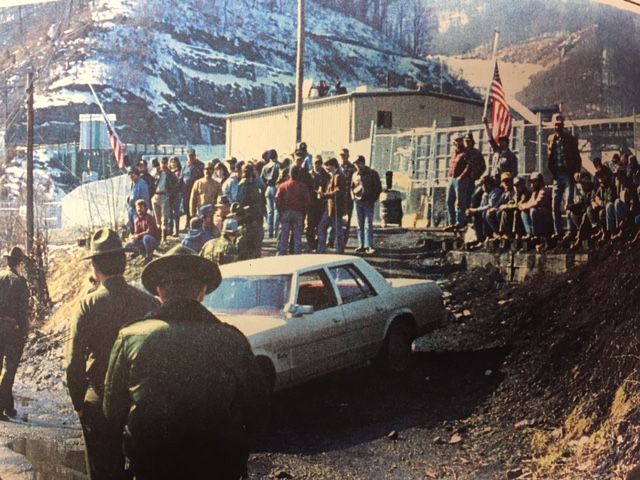
A mine near Logan, West Virignia
The funds were set to run out of money last winter and miners were sent letters informing them their health coverage would stop in December. At that time, Congress agreed to a four-month extension. Money for the 22,600 miners will run out by the end of this month.
Retired coal miners from Pittsburgh, Pennsylvania area spoke to the World Socialist Web Site about the hardships retirees face. “I worked 22 years,” Edwin explained, “But I came out when a roof fell and messed up my leg. After that I couldn’t work anymore, so I retired.”
His mine had changed ownership numerous times, he said. “It went from Ellsworth to Bethlehem Mines, to Beth Energy, to 84 Mining. Then Consol came in and they shut it down. These companies don’t want to give up anything. If you take health benefits from retirees and widows out here and in West Virginia, people will have nothing to live on. You take that away where are they going to go?
“It’s wrong to do that to people. They don’t know you once you’re out of the mines. These companies just say you’re a number—and that hurts.”
“They try to kick you off insurance,” continued Russell, who had 10 years at the same mine. “They try to kick you off everything they possibly can. They are grimy, that’s the only way I can put that. Miners put into it [the retirement fund], so why shouldn’t they keep getting it out?”
Speaking of the history of struggle among coal miners, Edwin explained, “My sister was a union rep and she was awesome. She used to go out there and lay down in front of trucks trying to move coal during strikes. She had a family, but she would lay down there and go to jail. She was something. You don’t really have anybody fighting like that now,” Russell added.
“If you don’t stay together, you can’t win anything,” Edwin concluded.
Opposed to any serious struggle, the United Mine Workers of America (UMWA) has called on miners to prostrate themselves before Congress and appeal to the corporate-controlled politicians to protect benefits, which were won only through the bitterest class battles against the coal companies and the government.
A coal train
UMWA President Cecil Roberts has called on retirees to urge Congress to pass the Coal Miners Protection Act, which would transfer funds from the Abandoned Mine Lands Reclamation Fund to the Multiemployer Health Benefit Plan and the 1974 United Mine Workers of America (UMWA) Pension Plan. Even if the measure were passed it would do nothing to protect pension funds, which could face insolvency by the end of the year. Moreover, the deal could include higher out-of-pocket costs or benefit reductions for current or future retirees.
The Coal Miners Protection Act (House Resolution 179) introduced in January by West Virginia Republican Congressman David McKinley and now in committee, “prohibits the pension plan from making certain changes to benefits during any year in which a transfer is received,” but does not preclude pension cuts in any other year. It would also relieve companies with UMWA contracts of the obligation “to pay unassigned beneficiaries premiums or backstop premiums if transfers under SMCRA (Surface Mining Control and Reclamation Act of 1977) are less than the amount required to be transferred.”
The bill, which is being pushed by several Democrats with close ties to the mining industry, including West Virginia Senator Joe Manchin III, would bail out the coal bosses and their servants in the UMWA.
Health care and pensions were never granted to miners by the coal operators. In 1946, 400,000 miners struck--as part of the massive post-war strike wave involving 4.6 million workers in some 5,000 walkouts—and defied President Truman’s threat to draft strikers into the military and order them back to work. A deal signed between UMWA leader John L. Lewis and US Secretary of the Interior Julius Krug established a royalty system that compelled the operators to pay a fee on every ton of coal the miners extracted.
From its inception in 1947, however, the new system was riddled with contradictions. Because the arrangement was based on the tonnage of coal produced, not the number of workers, the UMWA cleared the way for mass layoffs in the 1950s through the introduction of new mining technology.
Over the next several decades, the funds were undermined by the coal companies’ demands for waivers, the growth of non-union coal production, the wave of corporate bankruptcies and finally the plummet in coal production. In the name of making US coal producers more competitive against their foreign rivals, the UMWA signed one sweetheart deal after another.
To overcome the militant resistance of the miners, former union president and now AFL-CIO chief Richard Trumka and current UMWA President Cecil Roberts, deliberately betrayed strikes against AT Massey, Pittston, Peabody and others in the 1980s and 1990s. By the 2000s, tens of thousands of miners had lost their jobs and conditions had been thrown back decades—with deadly disasters at Sago and Upper Big Branch mines and a spike in the deadliest forms of black lung disease.
1984-85 AT Massey strike in Kentucky
The solvency of the funds was further undermined by the 2008 financial crash and the collapse in the global demand for coal. US coal production peaked in 2011 reaching nearly 1.1 billion tons, largely based on growing international demand for coal and steel. The slowdown in China—where nearly two million coal miners and steelworkers are losing their jobs—and around the world drastically reduced demand. In 2016, total US coal production had fallen to just 728 million tons with exports of just 60 million tons. The drop in the price of natural gas—which power plants now use more than coal—worsened the situation further.
As part of Patriot Coal’s bankruptcy restructuring, the UMWA negotiated a Voluntary Employees Beneficiary Association (VEBA) in place of the company's standard payment into the union-controlled funds. While the arrangement provided union bureaucrats with lucrative posts managing the VEBA, Patriot Coal and Peabody later used the bankruptcy courts to renege on their commitments to pay $400 million into the new scheme.
As far as the coal operators, Congressmen and UMWA executives are concerned miners are simply living too long after retirement. They are determined to solve the pension and health care “crisis” by reducing benefits and killing off workers sooner.
If miners and their supporters are to defend their hard-fought benefits they must reach out to the tens of millions of other workers facing similar attacks, including truck drivers, teachers and other public and private sector workers, to build a powerful industrial and political counter-offensive against big business, Trump and both corporate-controlled parties.
If the social rights of workers, including the right to health care and a comfortable retirement, are to take precedence over private profit and the squandering of trillions on war, workers must fight for the nationalization of the mining and energy industry as part of the socialist transformation of the economy.

Labour outlines pro-business “soft Brexit” policy for June 8 vote

Robert Stevens

Shadow Brexit Secretary Keir Starmer delivered Labour’s first major policy statement in the snap General Election on June 8 to position it as the party of “soft Brexit,” a negotiation with the EU that seeks to preserve access for UK business and finance to the European Union (EU) Single Market.
Pressured by the sizable anti-EU constituency among Conservative MPs and in the wider party, Tory Prime Minister Theresa May is committed to a “hard Brexit” that includes Britain’s departure from the Single Market.
Starmer had previously outlined Labour’s six tests for assessing May’s negotiations on the terms of the UK’s exit from the EU. These include UK businesses retaining the “exact same benefits” as they “currently have as members of the Single Market and Customs Union.”
The aim of Starmer’s speech was to go as far as possible in declaring Labour’s support for this objective, while still abiding by its pledge not to challenge the “will of the people” as expressed in last year’s referendum vote to leave the EU.
Starmer said Labour, if elected, would repeal the whole of May’s Brexit strategy and “replace it with fresh negotiating priorities that reflect Labour values and our six tests.” He added, “Labour’s White Paper will have a strong emphasis on retaining the benefits of the Single Market and the Customs Union as we know that is vital to protecting jobs and the economy.”
Big business could not be hampered in any Brexit deal, warned Starmer: “That means we will seek continued tariff-free trade between the UK and the EU, no new non-tariff burdens for business, regulatory alignment and continued competitiveness for goods and services.”
Attacking the government’s strategy of beginning trade missions to non-EU countries prior to Brexit, Starmer said, “rather than focusing on hypothetical new trade deals…Labour will focus above all else on securing strong trading arrangements with the EU.”
Labour would also replace the Conservatives’ proposed “great repeal” bill—in which all current EU law is to be repatriated/incorporated into British law, to be modified/removed by the UK parliament at a later date—with an EU rights and protections bill.
Labour’s agenda over Brexit is no less reactionary than that of the Tories. Its central preoccupation is satisfying the concerns expressed by the majority of Britain’s bourgeoisie, which supported Remain and whose interests are bound up with the EU. Some 44 percent of the UK’s exports go to the EU, while the City of London’s financial services are accessed across the continent.
In his speech Tuesday, Starmer also said Labour, if elected, would not make controlling immigration part of its negotiating position. But he added that Labour leader Jeremy Corbyn’s shadow cabinet had “agreed that reasonable management of migration and moving away from freedom of movement has to be part of the referendum result.”
“We recognise that immigration rules will have to change as we exit the EU, but we do not believe that immigration should be the overarching priority,” Starmer said.
The Guardian claimed that Corbyn “had previously strongly defended free movement of citizens within the EU.” In reality, he stated in January that “Labour is not wedded to freedom of movement for EU citizens as a point of principle.”
The gyrations in Labour’s position reflect the requirements of business to be able to access a skilled European workforce, while at the same time the party panders to the anti-immigrant sentiment whipped up during last year’s referendum.
To this end, Starmer said that from “day one” a Labour government would “guarantee that all EU nationals currently living in the UK will see no change in their legal status as a result of Brexit, and we will seek reciprocal measures for UK citizens in the EU.”
Borrowing from the “left populist” rhetoric of defeated French presidential challenger Jean-Luc Melenchon, Shadow International Trade Secretary Barry Gardiner said of Labour’s approach, “The government has a nationalistic way of looking at Brexit rather than a patriotic one. … Patriots believe you can love your own country and cooperate with others.”
Starmer’s pitch opens the door to a rejection of Brexit at the end of the two-year negotiating period, but still doesn’t go far enough for the most determined Remain faction of the bourgeoisie—represented by former party leader Tony Blair, in alliance with the Liberal Democrats.
Indeed, the hardening of Labour’s position reflects in large part the intense lobbying and continued influence of Blair in the party. This is reinforced by the fact that Blair not only speaks for powerful voices within ruling circles in Britain but also in the United States, where the Democrats and the US military backed Remain and have waged largely successful political warfare to reverse Donald Trump’s support for Brexit, for the EU’s break-up and his questioning of the NATO alliance.
May’s own motives in calling a snap election are in part bound up with this. She hopes to strengthen her position in negotiations with the EU so that London is still able to play a role in defending US/UK shared interests on the continent, especially as regards breaking down trade restrictions and preserving NATO’s monopoly against German-led plans for an independent European military capability.
Blair was provided with the opportunity to publish a major op-ed by the pro-EU Guardian, on the same day as Starmer’s announcement. In it he stressed his credentials as “someone who led the party for 13 years and through three elections.”
Outlining the strategy Labour must adopt, he rejected any attempt to stick to the “conventional election response of an opposition” such as urging, “vote Labour to keep the Tories out and return a Labour government.”
There could be no avoidance of opposing Brexit, which was “the dominant election issue”. After claiming that he has “not urged tactical voting” against Labour, which could make him subject to disciplinary action, Blair went on to argue for precisely that.
“It is up to each voter to make up their mind on how they will vote. I only want people to make an informed choice,” he declared, before stressing, “This is not the time to fight a conventional partisan election,” but rather “rallying people to a more reasonable and open position on Brexit across the party divide.”
In reality, Blair’s calculations go beyond tactical voting and point to a broader project of securing a political realignment between the Labour right, the Liberal Democrats and some pro-Remain Tories. This would likely gather greater momentum after the general election, given that the Liberal Democrats are now centred on winning Tory voters and do not want an association with Labour, and the Tories are scenting blood as a result of Labour’s crisis.
Indeed, Tory MPs Dominic Grieve, Anna Soubry and Nicky Morgan yesterday all quit the Open Britain pro-EU membership pressure group, in protest against its targeting of leading pro-Brexit, mainly Conservative MPs, in 20 seats. Had they not done so, May would have had no option but to expel them—something Corbyn will not countenance when it comes to Blair and his supporters when they call for a vote against Labour.

What lies behind the German elite’s celebration of Macron?

Johannes Stern 

Emmanuel Macron’s victory in the first round of France’s presidential election has unleashed a veritable wave of celebration among the German ruling class.
Shortly after the first projections on Sunday evening, which showed Macron slightly ahead of the second-placed candidate, the neo-fascist Marine Le Pen of the National Front, the German government’s spokesman wrote on Twitter, “Good that Emmanuel Macron was successful with his course of a stronger EU+social market economy. All the best for the coming two weeks.”
The chairman of Germany’s parliamentary foreign affairs committee, Norbert Rötgen (Christian Democrats), enthused on the Phoenix television channel, “I think it cannot get better for Germany and Europe. I believe that we can now be hopeful that Macron will be president.”
Foreign Minister and Vice Chancellor, the Social Democrat Sigmar Gabriel, declared during his three-day visit to the Middle East, “Of course I am happy that Emmanuel Macron led in the election. He had the strongest result of all candidates and will now go into the second round and I am sure he will be the new French president.” He would “do everything personally” to “continue to support” Macron. He would be “an excellent president,” but was “also an incredibly friendly person and a good friend.”
The so-called opposition parties also popped the champagne corks. Green Party chairman Cem Özdemir praised Macron on Twitter by commenting, “Merci, la France! Thank you #France! Best of luck to Emmanuel Macron! Onwards to the second round!” The chairman of the free market Free Democrats (FDP), Christian Lindner, wrote, “A signal for Europe, a signal of renewal. Emmanuel Macron also gives Germany courage.”
And the Left Party, which supported the “left” nationalist Jean-Luc Mélenchon in the first round, is now urging a Macron victory, even though they are aware that this would mean a further deterioration of living standards for the working class. The Left Party co-chair Bernd Riexinger wrote on Twitter, “Bitter: #Macron deserves support because he is up against #lePen, but his demands continue the previous misery unaltered.”
The media and politicians are publicly justifying their support for Macron by citing their alleged opposition to nationalism and racism. As Gabriel explained, he was happy “about the result” because Macron would certainly “overcome right-wing extremism and right-wing populism, and the anti-Europeans in the second round.”
Who does the German Foreign Minister think he is kidding? In reality, the outgoing Socialist Party government under François Hollande, to which Macron belonged until 2016, adopted the FN’s policies step by step. After the Paris terrorist attacks of November 2015, Hollande invited le Pen to the Elysée Palace and imposed a state of emergency under which basic democratic rights were suspended. The PS subsequently pursued the goal of establishing in the French constitution a provision for revoking citizenship, a legal measure which provided the basis for the persecution of the leaders of the Resistance under the Vichy regime and the transportation of Jews to death camps.
The establishment parties in Germany are playing a similar role in rehabilitating right-wing extremist politics. They are equally responsible for the rise of the Alternative for Germany (AfD) in two senses. Firstly, they have created the miserable social conditions which drive many workers to desperation and enable right-wing demagogues to exploit them. Secondly, under conditions of deepening social and political crisis in Europe, they ever more openly encourage xenophobia and nationalism so as to divide the working class and stabilise their own rule.
Why is Macron being applauded in Berlin as a progressive saviour and crowned the victor before the second round on 7 May has even taken place?
For one thing, Macron, a former Rothschild banker and economic minister under outgoing French President Hollande, is the most explicit advocate of the interests of European finance capital and demands an intensification of the austerity policies in France called for by Berlin and Brussels throughout Europe.
Significantly, the German Dax stock exchange reached a record high on Monday of 12.398. Stefan Kreuzkamp, chief investment strategist for Deutsche Asset Management, enthused, “Following this result I would say, Vive la France! Europe lives on. And European stocks.”
The second reason is the declared goal of Germany’s ruling elite of dominating the EU from Berlin in order to play the role of a global power. “We will only have influence if we jointly, Germany and France in particular, make Europe a genuine actor in the world,” stated German President and former Social Democrat Foreign Minister Frank-Walter Steinmeier just days before the first round of the election, in an interview with French newspaper Sud Ouest .
As an advocate for the EU and European militarism, Macron is an ally in these megalomaniac plans. Under conditions of “the United States’ new orientation, a united Europe becomes even more important,” Steinmeier noted, referring to the aggressive “America first” policies of Donald Trump. If the unification of Europe fails, “as nationalist and populist parties want in France, we will not be players but the pawns of other powers,” he warned.
But above all, the ruling class fears a revolutionary movement of the working class. In its last edition, the German weekly Der Spiegel focused on the question of whether “the country’s [France] institutions have been manoeuvred into a pre-revolutionary situation due to the incapability of officeholders. Whether what is today still called a state is already reminiscent of the world of kings, of the rotten Ancien Regime prior to the French Revolution.”
The bourgeoisie’s position must indeed be desperate—it is relying on Macron, although he is one of the “incapable officeholders” who has manoeuvred France into a “pre-revolutionary situation!”
Contrary to what the Left Party would like to make people believe, there is no lesser evil for the French working class in the second round of the election. French workers confront two candidates both of whom stand for war and major social attacks. While Macron, at least for now, supports the transformation of the EU into a German-dominated military union which will prepare for trade war and war with the US and Russia, le Pen stands for the division of Europe into hostile nation-states, which would also ultimately mean war.

UK adult social care system on verge of collapse

Dennis Moore

Massive numbers of British workers who provide care to adults in nursing homes, or in their own homes, are quitting their jobs in the face of shortages and high workloads that make it increasingly impossible to work. The impact is being felt by the most frail and vulnerable in society.
According to data gathered by the charity Skills for Care, in 2015-16, an estimated 338,520 care workers left their jobs, equivalent to 928 people a day, and of those 60 percent stopped working in social care altogether. A total of over 1.3 million were employed in the adult care sector in England.
The average front line, full-time care worker earns just £7.69p an hour, or £14,800 a year. Last year the average median salary was around £27, 600 for a full-time worker in the UK.
One in four social care workers was employed on a zero hours contract, and last year it is estimated that one in 20 job vacancies remained empty, a shortage of 84,320 care workers.
These figures point to the fact that social care providers are struggling to retain staff, with the industry’s staff turnover reaching 27 percent, twice the average for other professions in the UK.
The data was released at the same time as a letter written to Prime Minister Theresa May, from the chairman of the UK Homecare Association, which warned that the adult social care system has begun to collapse.
The fact that workers in the sector are often low paid, in what is a very demanding and difficult job, leads to difficulties retaining staff.
The number of people aged 85 and above in England has increased by almost a third in the last decade, and will more than double over the next two decades. This substantial section of the population will require increased health services and care support as they get older.
Disability Free Life Expectancy (DFLE) at age 65 has been falling from its peak in 2010-12. This is a measurement of the number of people who have reached the age of 65 without having already started to suffer from a condition that leaves them in poor health beyond the age of 65.
DFLE had increased from 2005-07 to 2009-11, with men gaining 0.4 years and women 0.5 years of good health. However, since that time women have lost 60 percent, and men a staggering 75 percent, of the gains made in an earlier part of the decade.
This is leading to more people in later life living with multiple long-term health conditions, with resultant social care needs.
Class background plays an enormous role in DFLE. A woman aged 65 has an expected 3.3 years of healthy living in the poorest areas, compared to 16.7 in the most affluent areas, representing a near fivefold difference.
In the five years preceding 2015-16, there were spending cuts of £160 million in older people’s social care. It is estimated that by 2020-21, total spending would need to increase by a minimum of £1.65 billion (to £9 billion) to be able to meet demographic and unit cost pressures alone.
Analysis by the Age UK charity shows that there are 1,183,900 older people over 65 who do not receive the help they need to carry out essential daily living activities, an increase of 17.9 percent over last year, and a 48 percent increase since 2010.
The charity estimates that an additional £4.8 billion a year would be required to ensure that every older person, who currently has one or more unmet needs, has access to social care--rising to £5.75 billion by 2020-21.
Local government spending on social care, meanwhile, will fall by 8.3 percent in real terms between 2015-16 and 2019-20. Spending remained relatively constant at around £8 billion a year, but has now rapidly declined, falling to just £6.3 billion in real terms in 2015-16.
Huge cuts have been made to public spending over the last decade to pay for the £1 trillion bailout of the banks that followed the 2008 global financial crash.
Total local authority spending on social care for older people has dropped by £1.57 billion in just six years. This is coupled with wider cuts to local authority budgets, with the National Audit Office estimating that local authority funding was reduced in real terms between 2010-11 and 2015-16.
The Care Quality Commission, which oversees standards of care, reports that 81 percent of councils have reduced spending on adult social care in the same period.
This has led to local authorities trying to acquire the cheapest contracts from care providers. This is part of the so called competitive tendering process, and has been a major contributory factor to the social care debacle.
An investigation by the BBC’s Panorama found that 95 private care firms have cancelled contracts with UK councils, as they are unable to provide even the most basic social care service at the price demanded by the councils. A devastating knock on effect of this is the closure of many home care companies and attendant job losses, with 69 closing just in the three months to January.
The immense pressures that care workers face in their day-to-day work, in a demanding and vastly under resourced profession, is a major factor in the increase in the rate of suicide among care workers in the last three years.
Figures released by the Office for National Statistics (ONS) found that the suicide rate for care workers is now twice the national average. More women care workers are taking their lives than in any other UK profession.
The government claims it will invest £2 billion over the next three years in adult social care and take on more apprentices in the sector.
This in no way addresses any of the causes of the crisis.
The exodus of workers from the profession comes as the Centre for Workforce Intelligence estimates that at least 2 million more carers will be required by 2025 for home care and care homes, just in England alone. Nothing is being done to increase low rates of pay and ease demanding workloads. There is no remedy for the fact that many employed in adult social care are on exploitative zero hours contracts—leaving them in a constant state of insecurity, not knowing if they will have work from one day to the next.
For the capitalist class the care of the elderly and disabled has become an unaffordable burden as the economic crisis deepens.
In a society marked by increasing inequality, the priority is not to look after those who have reached the end of their working lives, the disabled in need of care or the working conditions and pay of those who do their best, with few resources, to try and hold together a collapsing system of adult care.