11 May 2017

US-Turkish tensions mount over plan to arm Syrian Kurdish militia

Bill Van Auken 

The US announcement that President Donald Trump has given his authorization for the direct US arming of the Syrian Kurdish militia, the People’s Protection Units (YPG), was met with heated protests from the Turkish government of President Recep Tayyip Erdogan, who is set to visit the White House next week.
The Pentagon has determined that the YPG represents the only local force that can serve as a credible US proxy on the ground in Syria in the bid to drive the Islamic State of Iraq and Syria (ISIS) out of the northern city of Raqqa. The US is opposed to the city being retaken by forces loyal to the Syrian government, which Washington has sought to overthrow, while the so-called Free Syrian Army that the CIA had backed in the war for regime change has been largely routed and is dominated by the Syrian branch of Al Qaeda and similar groups.
Previously, under the Obama administration, Washington had indirectly funneled arms to the Kurdish militia through the so-called Syrian Democratic Forces, which includes the YPG and a far smaller Syrian Sunni Arab contingent. Hundreds of US special operations troops have also been deployed in Syria to provide assistance and training to the Kurdish militia.
Under the new plan, the US military will ship small arms, ammunition, machine guns, armored vehicles and engineering equipment to the YPG, according to Pentagon officials. US Col. John Dorrian, a spokesman for the US military in Baghdad, said that the weapons shipments had been pre-positioned and could be delivered to the Kurdish militia “very quickly.”
The position of the Erdogan government is that the YPG represents a branch of the outlawed Kurdistan Workers’ Party (PKK), which has waged an on-again, off-again guerrilla war in Turkey itself for over three decades. Not only Ankara, but also Washington and the EU, have labeled the PKK as a “terrorist organization.”
The Turkish government fears that the crisis in Syria, which it played a major role in creating by backing Islamist “rebels” in the more than six-year-old war for regime change, will pave the way to the carving out of an autonomous Kurdish territory on its southern border. Erdogan ordered troops into Syria last year under the pretext of battling ISIS, but for the real purpose of driving a wedge between Kurdish cantons in the east and west of northern Syria.
More recently, on April 25, Turkish warplanes carried out airstrikes against YPG positions in northern Syria, killing at least 20 Kurdish fighters. Washington condemned the attack and responded by deploying hundreds of US troops equipped with Stryker armored vehicles to serve as a buffer between Turkish forces and the Syrian Kurds.
The level of tensions between Washington and Ankara found expression last week when Turkish presidential adviser Ilnur Cevik warned in a radio interview that if the YPG and its US special forces advisers “go too far, our forces would not care if American armor is there, whether armored carriers are there. ... All of a sudden, by accident, a few rockets can hit them.”
Erdogan, who is scheduled to arrive in Washington on May 16, said that Turkey’s “patience has ended” with the US decision to arm the YPG. “I want to believe that Turkey’s allies will side with us, not with terrorist organizations,” he said.
Turkey’s foreign minister, Mevlut Cavusoglu, told reporters during a visit to Montenegro Wednesday, “Both the PKK and the YPG are terrorist organizations and they are no different, apart from their names. Every weapon seized by them is a threat to Turkey.”
Meanwhile the Republican People’s Party (CHP), the main bourgeois opposition party, called for Erdogan to “reconsider” his trip to Washington, saying that the US decision had put Turkey in “a weak position.”
The humiliation of the Turkish regime over the Trump administration’s decision was compounded by the presence in Washington on the day of its announcement of Erdogan’s advance team, which included Chief of General Staff Gen. Hulusi Akar, presidential spokesman İbrahim Kalın and National Intelligence Agency (MIT) chief Hakan Fidan. The three had held meetings with their US counterparts and Trump’s national security advisor, Gen. H.R. McMaster.
The Washington Post Wednesday quoted an unnamed Turkish official as saying that the officials delivered the “message to the Trump administration...that Turkey reserves the right to take military action,” while suggesting that airstrikes could be intensified.
US Defense Secretary James Mattis, who was in Turkey just days before the announcement of the decision to directly arm the YPG, dismissed the protests from Ankara. “We’ll work out any of the concerns,” he said during a visit to Lithuania. “We will work very closely with Turkey in support of their security on their southern border. It’s Europe’s southern border, and we’ll stay closely connected.”
The Wall Street Journal Wednesday provided a concrete indication of what Mattis meant by support for Turkish security. The US, the newspaper reported, is beefing up the capabilities of a so-called intelligence fusion center run by the CIA and other US intelligence agencies in Ankara “to help Turkish officials better identify and track the Kurdistan Workers’ Party, or PKK.” The plan will reportedly double the capacity of the center, while providing drones and other US intelligence assets.
Thus, US intelligence will assist the authoritarian regime of Erdogan to hunt down and kill Kurdish militants in both neighboring Iraq and Turkey itself. There is every reason to believe that, once the Syrian Kurdish forces of the PYG have completed their mission in Raqqa, the same resources will be provided to go after them.
The Pentagon’s present reliance on the Kurdish militia against ISIS—itself a product of the US interventions in Iraq and Syria—is merely a temporary tactical initiative in the protracted and bloody campaign by US imperialism to impose its hegemony over the Middle East by means of invasions, bombing campaigns and wars for regime change.

US children’s suicide-related hospital admissions double in last decade

George Gallanis

New research indicates a devastating development amongst the most vulnerable section of society. The number of children and teens ages 5 to 17 hospitalized for suicidal thoughts or self-harm in the United States has doubled since 2008.
The finding are based on a study abstract titled, “Trends in Suicidality and Serious Self-Harm for Children 5-17 Years at 32 U.S. Children’s Hospitals, 2008-2015” prepared for presentation at the 2017 Pediatric Academic Societies Meeting in San Francisco May 7.
Researchers sifted through administrative data from 32 children’s hospitals from around the country. All discharge diagnoses for suicidality or serious self-harm from emergency department and inpatient intakes were indexed between the years 2008 and 2015 for children between ages 5 and 17.
The results are staggering. Researchers tallied a total of 118,363 diagnoses for suicidality or self-harm from the 32 hospitals. They concluded that a doubling of such diagnoses took place over the study period, an increase from 0.67 percent in 2008 of all intakes to 1.79 percent in 2015.
Over half of those tallied, 59,631 patients, were 15- to 17-year-olds, with 43,682 patients, or 36.9 percent, comprising 12- to 14-year-olds. Moreover, 15,050 patients, amounting to 12.7 percent of the total, were children between ages 5 and 11.
The study also noted that the time of year could also affect when children felt suicidal or inflicted self-harm. The lowest occurrences for both diagnoses occurred during the summer months of June through August, with the highest happening during the spring, March through May, and the fall, September through November.
Dr. Gregory Plemmons, a leading researcher of the study and an associate professor of pediatrics at Monroe Carell Jr. Children’s Hospital at Vanderbilt, in Nashville, Tennessee, told CNN: “We noticed over the last two, three years that an increasing number of our hospital beds are not being used for kids with pneumonia or diabetes; they were being used for kids awaiting placement because they were suicidal. And it confirmed what we were feeling: that the rates have doubled over the last decade.”
As to why children commit or think about suicide, Plemmons said it was the “million-dollar question,” adding, “Family history of depression or suicide, family violence, child abuse, gay and lesbian youth, history of bullying—those are all risk factors that have been reported. We didn’t look at any of those specific factors in our study.”
While such factors undoubtedly play a significant role in the development of mental illness among America’s youth, they are further exacerbated by the capitalist system, which exploits the working class and savagely tears society apart into the haves and haves-nots.
For today’s youth, having been born in the past two decades means being raised in a world in which war has been waged on a daily basis. The study shows that young people are among the most vulnerable to this social crisis—facing an uncertain educational future and bleak job prospects—and are increasingly expressing their despair through suicidal thoughts and actions.
A CDC report published last fall found that US children ages 10 to 14 are now more likely to die from suicide than from auto accidents.
The desperation felt by youth is pervasive throughout American society. Recent research reveals swaths of the US population are plagued by mental illness and psychological distress. One report from the Psychiatrics Journal found that 3.4 percent of American adults, a total of 8.3 million people, suffer from “severe psychological distress” (SPD).
Another report from the US Centers for Disease Control and Prevention (CDC) showed that 52,404 people in the US died from drug overdoses in 2015, stemming in part from psychological distress.

10 May 2017

Anglia Ruskin International Excellence Scholarship for Undergraduate and Postgraduate Students 2017/2018

Application Deadline: 14th July 2017
Offered Annually? Yes
Eligible Countries: International
To be taken at (country): UK

Type: Undergraduate and Postgraduate taught
Eligibility:  Scholarships will be assessed based on the criteria below:
  1. Academic qualifications – Students achieving the equivalent to a minimum of three A levels at B for Undergraduate courses or above or a 2:1 or above for Postgraduate courses will be considered
  2. Your motivation to study at ARU and relevant extra curricula activity or work experience. This will be assessed from your personal statement
Number of Awards: 30
Value of Program: £3000
Duration of Program: 1 year
How to Apply: Complete application with all relevant supporting documentation to study a full time course at ARU submitted by the 14 July 2017
Award Provider: Anglia Ruskin University
Important Notes: Students achieving this award will be notified no later than the 31 July 2017. The awardees will be selected at the discretion of the International Admissions Team. Please also note that this scholarship can not be combined with any other scholarships or early payment discounts.

Bollywood in the Arab World

Vijay Prashad

Sitting in an al-Qaeda encampment in western Syria, the chief of this fighting unit asked about Hindi films. He was an aficionado and had many films downloaded on his laptop. It was his distraction from the perils of close combat. “Who is your favourite film star?” he asked casually. To fill the uncomfortable silence, he said: “Should I tell you my favourite?” It went on from there, a discussion of this film and that. It was surprising that many of these men — plucked from as far afield as North Africa and from Central Asia — enjoyed sentimental Hindi film songs.
In a quiet moment, away from the others, an Algerian man began to sing a song that was hard to identify. His accent was too strong and he had garbled the Hindi words. It took a while to figure out that he was signing ‘Jaane tu ya jaane na’ from Aa Gale Lag Jaa (1973). Sung by Kishore Kumar and starring Shashi Kapoor and Sharmila Tagore dancing in the snow, this song has a lovely catchy chorus. Few would argue that this movie and this song in particular would define Hindi cinema in the 1970s. In this remote camp of hardened fighters, an Algerian expatriate wanting to talk about a film that he knew only by the first two words of its hit song — Jaane Tu .
The NAM link
The Bangladeshi filmmaker Naeem Mohaiemen and this writer were recently in Algeria to shoot his new film that showcases the 1973 Non-Aligned Movement (NAM) meeting in Algiers. We travelled across the city, meeting a range of people and visiting the sites of that historical NAM meeting. It was at this conference that the Third World countries pledged to push for a New International Economic Order. The charismatic Algerian leader Houari Boumédiène urged the NAM members to be far more confrontational on the world stage against imperialism. Boumédiène backed the freedom fighters of his time, from the Palestinians to the South Africans. These were fighters from a different era, sharing only the gun with the al-Qaeda guerrillas along the western flank of Syria. The line that runs from people like Boumédiène to the al-Qaeda leader in Syria, Abu Mohammad al-Golani, is broken. Mr. Mohaiemen’s film will recover the period when that old order in the Third World began to fray and the current malignancies began to emerge.
Everywhere we went in Algiers, people would ask if we were Indian. Mr. Mohaiemen is used to this misidentification. He would correct people, but then — with a shrug — move on. It was common for people of a variety of ages to break into song — Jaane Tu . Those were the two words. They expect visiting Indians to know the rest of the lyric. The film is popular in Algeria, having been shown on state television from the 1970s to the present. There is, then, another thing that unites the al-Qaeda militants with the old revolutionaries of Algeria. Both have a thing for Bollywood films.
The young Algerian filmmaker Amine Hattou made a short film about three years ago called Nostalgic Laziness . This one-minute film is shot from the perspective of a man lying on a bed with a television set in front of him. You first see a news report of the Arab Spring protests, with the reporter commenting how Algerians — exhausted by their civil war in the 1990s — had no desire for an upheaval. The man changes the channel. Shashi Kapoor appears. He is singing “Aye mere bete sun mera kehna” from Aa Gale Laj Jaa . It is as if the syrupy nostalgia overcomes the political protest. The father tells the son to listen to him, a warning against chaos. Mr. Hattou is now making a full-length documentary called Searching for Janitou .
The line that runs from people like former Algerian leader Boumédièn, who supported freedom fighters, to the al-Qaeda leader in Syria, al-Golani, is broken

The Korea Crisis: Beyond the Smoke and Mirrors

THOMAS HON WING POLIN

Hong Kong.
Some outsiders to Asia are painting a skewed scenario of the current Korea tensions that casts China as co-villain (with the US), if not chief villain. This represents a serious misleading of what’s going on in Northeast Asia.
The real, core story here is not Donald Trump’s attention-grabbing aircraft carrier diplomacy, which is a headline-hogging sideshow that is not designed to result in war. The main story is the steadily worsening relationship between China and North Korea, which accelerated with Kim Jong Un’s rise to power five years ago and reached boiling point recently. Washington, of course, knows this and senses an opportunity to push through a decisive change in the geopolitical landscape of Northeast Asia. Trump is naturally trying to exploit it to maximum (US) advantage.
The two-giants-joining-to-bully-a-principled-midget narrative is an alluring one that also happens to be cock ‘n bull. Even more outlandish is the scenario favored in some leftist circles of “revisionist” China vs. “revolutionary” North Korea. Everyone in the real Asia knows that political ideology died long ago, in China and to a large extent even in North Korea. Lip service is paid while everyone goes about more mundane, practical pursuits. If any “ism” applies meaningfully in today’s Asia, it’s nationalism.
So what’s the story between Beijing and Pyongyang? Their traditionally strong ties are well known, forged in blood and from history. The bottom line is that if not for China’s critical contributions — including half a million PLA casualties during the Korea War — the DPRK wouldn’t even exist. Chinese throughout China, already dirt-poor after a century of war and upheaval, had to further tighten their belts for the war. The war had another fateful effect: preventing the complete unification of China. The PLA was about to cross the Taiwan Strait when the Korean War broke out. Beijing had to put on hold plans to reunite Taiwan, as all PLA troops in southern China had to be deployed to the Korean Peninsula. In the East Asian, Confucian mindset, that is the kind of debt you never forget, down through x generations.
Since the Korean War, China has continued crucial assistance and sacrifice for Pyongyang:
1) Food, fuel and fertiliser to DPRK over the years aggregating several billion USD. China has been the largest aid giver. The aid staved off many famines in North Korea over decades.
2) When China established diplomatic relations with South Korea in the 1990s, the Kim dynasty destroyed graveyards and even dug up graves where PLA soldiers killed in the Korean War were buried.
3) The DPRK deliberately sited nuclear facilities close to the Chinese border. Each time there is a nuclear test, it sets off a minor “earthquake,” destroying houses and forcing residents to evacuate.
4) In some years, half the grain production in northeast China was given as aid to North Korea.
5) Through the decades, Beijing constantly provided Pyongyang with diplomatic cover, the only major nation to do so, as well as security under its de facto nuclear umbrella. Whatever the prevailing smoke ‘n mirrors, the fact is this: The US has not attacked North Korea because that would mean crossing the thick, absolutely immovable red line that Beijing drew in blood in the early 1950s.
For China, perhaps the biggest liability of having Pyongyang as an ally is not even all the above. It is this: DPRK long provided the biggest single public pretext for the US Empire to surround China with weapons and troops in NE Asia, in a sustained containment drive that reached a climax with Washington’s “pivot to Asia,” starting 2011.
And what has the DPRK given China in return? Essentially, it served as a useful buffer between China and the US Empire’s military forces in South Korea. An exorbitantly expensive one.
For reasons best known to Pyongyang itself, that “protection” cost rose dramatically after Kim Jong Un’s ascension. The visible signs included Kim’s murder or purge of all senior people in his government known or suspected of being friendly to No. 1 benefactor China, including blood relatives. Unlike his father and grandfather, KJU never paid even a courtesy visit to Beijing since taking power. Most spectacularly, he had his half-brother Kim Yong Nam — who’d renounced politics and was under Chinese protection — killed when the latter was visiting Malaysia.
In the present crisis, knowing that his missile antics would allow the US to deploy THAAD as well as put extra diplomatic pressure on Beijing, KJU nonetheless went ahead — repeatedly. If China moved visibly to rein him in, Trump & Co. could all too easily portray China as joining their efforts to do the same, rubbishing China’s reliability as an ally and descrediting its independent, Third World credentials. That is already what Trump and his top officials have been doing.
There is a view that North Korea’s obsessive drive to develop nukes is aimed less at the US Empire than at creating trouble for China, perhaps in a bid for what Pyongyang sees as “independence” from both. Under the rule of Kim Jong Un, that once-outlandish view seems all too plausible.
Given all the above, no one should be surprised if China should seek to neutralize Kim Jong Un. That does NOT mean destroying or not continuing to protect the DPRK — far from it. If the high-risk scenario of KJU-neutralization should unfold, it will have little to do with Beijing “cooperating with” or “kowtowing to” the US-centered Empire. Instead, it will have everything to do with China’s own possibly too-toxic-to-save relationship with the incumbent representative of the Kim dynasty.

The Case For An Intellectual Discourse On Islam

Maryam Sakeenah


The righteous rage that boils over into lynchings, mobs, suspicions and allegations of blasphemy shows a loss of balance and rationality in our social behaviour. This is a disturbing truth that needs a serious collective introspection. Among other things, a lot of this (self) righteous rage is because of an inability and unwillingness to intellectually confront and address diversity, difference and dissenting opinions.
The religious discourse in our society is largely anti intellectual to the extent that even an intellectual approach to religion is sneered at as deviant, threatening and disrespectful. This simplistic, anti intellectual discourse is asserted by wielding power and instilling fear by religious leaders, and the use of threat and violence by those who lack the privilege of religious authority.
The decadence of religious discourse in this part of the world is rooted in the colonial past when the prestigious madrassah was systematically marginalized and disempowered as part of the colonial education policy of ‘schooling the world.’ The cornered madrassah took refuge behind a defensive, protectionist, insecure religious discourse, trying to hold on in a rapidly changing milieu. In an attempt at self preservation, this defensive discourse refused to engage and became airtight and obscurantist. This still characterizes the madrassah and those who emerge from the system: a stubborn refusal to intellectually engage with alternative discourses that the modern world is teeming with. But we cannot insulate our youth from the tide of intellectual assault from modern ideas and new patterns of thinking. There will be questions raised, and our refusal to engage or even bother with articulating responses will alienate thinking minds.
It is already happening at an ever-increasing rate. As a teacher on Islam, I have observed an incremental trend over the years, of skepticism among young people exposed to the kind of heavily Westernized modern education we have at private urban educational institutions. There are lots of questions as they encounter diverse patterns of thought. Unfortunately, answers through religion are most often not available, and even asking is often put down as impertinent. This produces a disenchantment with a faith that is unable to address critical and vital questions of the day. It is these disenchanted bright minds that possess social and cultural capital to make up the pool that supplies the academia, the media and the bureaucracy with fresh human resource. Hence this early skepticism which hardens into a strident secularism, filters into institutions of state and society, to be systematically wielded and exerted with power.
At the other end, this systematic empowerment of the secularized, socially privileged lot breeds frustrated rage in the conservative mind. The conservative mind is fiercely anti intellectual. This anti intellectualism takes any intellectual challenge as an audacious affront, a ‘conspiracy against Islam’- hence violence becomes the only ‘language’ to respond with.
These developments are ominous, and the cracks and gashes are already appearing, cutting across society, letting the red hot lava boil over. Unfortunately, few are cognizant of this and even fewer conscious of our responsibility to stem the process in our capacities. Any calls for a progressive Islamic discourse are put down with suspicion of hidden agendas. The truth is, developing a modern intellectual and philosophical Islamic discourse and mainstreaming it is nobody’s agenda but Islam’s own need. In fact, Islam has had progressive thinkers throughout its history. Being progressive is not deviance; it is an approach which makes human beings throughout time sift through all the narratives and reveal the essence in a way that is most relevant and applicable for their times.
In more open societies in the West, Muslim communities have no option but to engage and adapt, hence one sees an increasing realization of the need to come up with an intellectually robust spirituality that does not cave in or go berserk on encounter with difference. Thinkers and scholars like Tariq Ramadan, Yasir Qadhi, Omar Suleiman and Hamza Yusuf among others are rising up to the intellectual challenge Islam is faced with. Their fidelity to Islamic fundamentals and tradition makes their progressive voices credible and authentic.
An intellectual discourse on Islam should not be polemical but dialectical. It should be guided by Islamic tradition yet fully cognizant of influential modern and postmodern ideas. It should reflect an awareness of and respect for the diversity and pluralism within Islam and outside of Islam. It should be equipped with tools and methods for credible research and aim to mediate between ideas, creating common grounds. It should engage in a modern ijtehad with the traditional tools of Muslim jurisprudence, to address contemporary issues like homosexuality and the reconstruction of gender, new atheism, militant Islamism etc. Such a project must use the language, approach, style and tools most familiar to the modern mind. This will bring two great benefits: firstly, rescuing the skeptical modern Muslim mind from disenchantment by addressing critical questions. Secondly, mainstreaming an intellectual religious discourse which respects diversity and demonstrates to the mass Muslim mind that difference can be lived with and engaged with intellectually.
Religious scholars and intellectuals here need to realize the need to develop a new religious discourse that arms itself with reason, not fear and violence.

Australian budget set to heighten social and political antagonisms

James Cogan

The Liberal-National Coalition government has tabled its first budget since scraping back into office, less than a year ago, with a one-seat majority in the lower house and no control in the Senate. Taken together, the budget measures will intensify the class antagonisms wracking the country.
The government of Prime Minister Malcolm Turnbull and Treasurer Scott Morrison has crafted measures that amount to a desperate attempt to reassure myriad ruling class interests that it has taken into account their concerns, while trying to delay the eruption of social discontent. It will fail to do either.
While scarcely mentioned in the establishment media, the budget is, first and foremost, marked by the government’s ever-increasing allocation of resources to the military and police-intelligence apparatus.
The budget commits to boosting expenditure, in order to develop the war preparations of the Australian military and the Pentagon, by 6.1 percent over the next year, and to continue to make such increases until 2020–2021. In an unprecedented expansion, initiated by the former Labor government, some $150.6 billion will be spent on the military over the next four years. This includes the purchase of F-35 jet fighters and new warships, the first stage of construction of 10 new submarines, and the financing of the ongoing Australian involvement in military operations in Iraq, Syria and Afghanistan. Over the next decade, around $494 billion will be spent on the armed forces.
Some $320 million will be added, over the next four years, to the budget of the Australian Federal Police and the country’s intelligence agencies, boosting annual “public order” spending to $3.9 billion.
As far as the credit agencies and sections of big business are concerned, the 2017–2018 budget is the tenth in a row that, while registering a large deficit of $29.4 billion, pledges to achieve a surplus within the four-year timeframe of budget estimates. With public debt rapidly blowing out, the credit agencies are threatening to downgrade Australia’s current AAA rating, which allows it to borrow at low interest rates.
Like previous budgets, the “return to surplus” is based on fanciful projections of global economic growth, and, therefore, growth in Australia. The budget predicts that the economies of the US, Japan and China will expand in coming years, holding up the prices of Australian exports, of government, corporate and income tax revenues, and the inflow of foreign investment. Australian growth is predicted to increase from barely 1.75 percent this year to 3 percent by 2019–2020.
Even as job- and wage-cutting accelerate across the country, and consumer spending figures, released yesterday, show that Australia’s retail sector is sliding into recession, the budget projects that wages’ growth will rise from two percent to three percent over the next four years. The budget forecasts exclude the possibility of a devastating crash in the country’s vastly overheated housing market, and the ensuing destruction of hundreds of thousands of jobs, or the impact of the final closure of car manufacturing at the end of 2017. Instead, it predicts unemployment will fall from 5.9 percent to less than 5 percent by 2020–2021.
The projected return to surplus relies upon a 0.06 percent levy on the liabilities of Australia’s five largest banks, which will raise about $1.5 billion per year. The banks are expected to pass this impost on their collective $30 billion annual profit by increasing interest rates or charges. Crackdowns on corporate tax avoidance are projected to raise $1.6 billion over four years. Again, companies will pass on such costs, further dampening consumer spending.
A small 2 percent increase in tax on the incomes of the wealthy, introduced in 2014–2015, has been abolished. And small business operators can claim, for another year, tax deductions for purchases of up to $20,000.
The budget ostensibly commits to providing billions of dollars in funding to various road, rail and energy infrastructure projects around the country, as well as more than $5 billion to construct the long-delayed second international airport in Sydney, the country’s largest city. Major corporations have been demanding some of these projects for decades. Others appear intended to win back support for the Coalition in economically hard-hit states such as Western Australia and Queensland. An economic slump, however, will see such commitments tossed aside.
On every front, the budget seeks to deepen the decades-long assault on the living standards and social rights of the working class, inflicted by successive Labor and Coalition governments—but without imposing outright cuts to key areas of public spending.
In 2014, Labor, along with the Greens, blocked in the Senate savage spending cuts contained in the first Coalition budget brought down by then Prime Minister Tony Abbott and his treasurer Joe Hockey. Their motivation was not to defend the interests of the working class, but to retain whatever was left of their credibility in the face of enormous popular opposition.
Despite failing to pass the Senate, the announcement of these cuts saw a precipitous drop in support for the Coalition. In the 2017–18 budget, Turnbull and Morrison have consciously pitched for Labor’s support to push their policies through the Senate.
As well as its blanket commitments to the US-Australia military alliance, the Coalition is making an overt appeal to Labor via its health care and school education measures. Morrison announced in his budget speech versions of policies that Labor had introduced while in office from 2007 to 2013. These had as their aim the long-term transfer of essential public services to private profit interests.
The budget commits to financing the national roll-out of Labor’s National Disability Insurance Scheme (NDIS). The stated objective of the NDIS is to establish a “competitive market” for the provision of services to hundreds of thousands of disabled people, while pushing as many as possible back into the workforce and therefore off the welfare-funded Disability Support Pension (DSP).
To pay for the NDIS, the Coalition expects to raise over $4 billion a year from 2019, by increasing the Medicare “levy”—a tax on the majority of income earners, to finance the ostensibly “free” public health system—from 2 percent to 2.5 percent. At the same time, it will be calculating on savings from the reduction in outlays on the DSP.
In education, the Coalition has committed to the so-called Gonski, “needs-based” federal funding to schools, introduced by Labor. Media reports have touted the funding as an “increase” of $18.6 billion over 10 years and $1.8 billion over the next four. In fact, federal increases will be just $106 million in 2017–2018, $295 million the following year, and, purportedly, $840 million in 2020–2021. But the decade-long funding exists only on paper.
While barely any additional resources will flow to address “student need,” federal funding for schools, as Labor intended, is explicitly tied to rankings of student performance, such as the now notorious NAPLAN standardised tests. In the US and Britain, performance-ranking systems have been used to justify the transformation of public schools into for-profit charter schools or “academies.” The Australian state governments, which finance the public education system, are being pressured into pursuing a similar agenda.
In populist pitches to “Australia First” and anti-foreign worker campaigns, which are being pushed by the Labor Party, the trade unions, and right-wing nationalist formations, the Turnbull government is introducing an annual “levy,” ranging from $1,800 to $5,000, on employers who bring overseas workers into the country. Visa application costs will also increase. Foreign investors in housing will face higher taxes and a $5,000 fine if they fail to rent out or live in their property for at least six months of the year.
The unemployed, welfare recipients, and working-class and overseas students—who are viewed as politically irrelevant by the powers-that-be—will face yet more savage attacks.
For the unemployed, there will be even harsher eligibility tests, including, for the first time, random drug testing.
For local students, university fees are being increased and the income threshold at which the fees must be repaid, once they enter the workforce, has been dramatically cut. In a particularly vicious policy, most permanent residents and New Zealand citizens will now be charged “international” fees for tertiary education, rather than the same rates charged to Australian citizens.
For international students, the outrageous fees they are already being forced to pay will only increase, as universities face a 2.5 percent “efficiency dividend” or annual cut, that will accompany their government grants. Already universities and colleges around the country treat these students as a veritable cash-cow, gouging over $20 billion from them annually to study in Australia.
The Coalition government appears to have calculated that populist measures, aimed against the big banks, foreign workers and welfare recipients, could win backing for the budget from right-wing parties in the Senate, such as Pauline Hanson’s One Nation Party, the Nick Xenophon Party and the newly formed Conservative Party headed by renegade Liberal, Senator Cory Bernardi. Turnbull and Morrison clearly hope, however, that the bulk of the budget will pass with Labor’s support.
The corporate media is already signaling its displeasure with this possibility. The Australian Financial Review editorial today denounced the “Labor-lite budget,” declaring it was based on “a mixture of hopeful assumption and tax whacks on easy targets like unpopular banks and foreign workers.” Rupert Murdoch’s Australian, in a similar vein, attacked the budget’s overtures to Labor, via the NDIS and the school funding model, while “ducking the hard decisions” of imposing genuine austerity.
With such recriminations in corporate circles, the budget may well become mired, yet again, in the bitter in-fighting between—and within—the discredited establishment parties, which has characterised the parliamentary setup for the past decade.

Living standards plunge in UK

Alice Summers 

Recent analysis of the British economy shows that living standards are declining in the wake of last June’s Brexit referendum. The latest figures show that economic growth has declined more than expected, inflation is rising, and real wages are falling.
According to the Office for National Statistics, UK gross domestic product (GDP) growth fell by more than anticipated to just 0.3 percent in the first quarter of 2017, down from 0.7 percent the previous quarter. The economic slowdown is expected to continue as higher inflation dampens consumer spending, upon which the UK economy relies.
The drastic fall in the pound since the Brexit referendum, combined with higher global oil prices, has lifted the inflation rate to 2.3 percent, above the Bank of England’s target of 2 percent. But while inflation is expected to continue climbing to an estimated 3 percent in the coming months, wage growth is set to fall.
The most recent figures show that workers are already worse off—real wages are declining, as the 2.3 percent inflation rate is outpacing wages growth, now running at just 1.9 percent compared to February of last year. Regular pay growth has not been weaker than the inflation rate since August 2014, when wages were growing by 1.2 percent while inflation stood at 1.5 percent.
Brexit has exacerbated a trend of weak or non-existent pay growth that started well before last year’s referendum. Even after adjusting for inflation, employees’ average earnings are still substantially below their levels before the 2008 financial crisis, according to a new report from the Institute for Fiscal Studies (IFS).
Jonathan Cribb, a senior IFS research economist, commented, “A period of this length over which earnings have fallen is unprecedented in modern times. They had started to recover a little between 2014 and 2016, but rising inflation linked to the fall in the value of the pound since the EU referendum has put a stop to that modest recovery”.
According to current forecasts, earnings are unlikely to recover before the end of the next parliament in 2022. The Resolution Foundation think tank noted that 40 percent of the British workforce have been affected by falling wages so far. Commenting on this drastic deterioration in wages, Stephen Clarke, an economist at the Foundation said, “Britain’s brief pay recovery has come to an end; 40 percent of the workforce are experiencing shrinking pay packets, according to the latest figures, in sectors ranging from accommodation to finance and the public sector. Many more will join them in the coming months as inflation continues to rise”.
This decline is under conditions in which workers have already suffered the worst fall in wages in Europe—down by 11 percent since 2007—outside of Greece.
Nearly a decade of pay stagnation and freezes, the prevalence of zero-hour contracts—amid a mushrooming of the lowly paid and highly exploitative “gig economy”—means one third of the population are now officially below the poverty line, while more than half of all households depend upon state benefits.
Millions more only manage to stay afloat by relying on savings, credit cards and loans. Credit card borrowing is on the rise. At the end of 2016, the amount of savings held by British households hit a record low. Workers have increasingly been forced to dip into their savings to maintain spending at a time when wages are stagnating and prices are rising. According to former Bank of England policymaker David Blanchflower, while consumer spending is currently being buoyed by increased borrowing and use of savings, this cannot last.
The Bank of England’s Financial Policy Committee, chaired by the Bank’s governor, Mark Carney, stated that household indebtedness was “high by historical standards” and is rising relative to incomes. In fact, the average household now owes around £13,000, excluding mortgages, and total unsecured debt is at an all-time high of £349 billion.
Figures from the end of March revealed that real household disposable income, after adjusting for inflation, shrank by 0.4 percent as compared to the previous quarter, the steepest drop in nearly three years.
As a mark of the collapse in the purchasing power of British workers, retail sales suffered their largest fall in seven years over the first few months of 2017. This was due to the sharp fall in the value of the pound since the European Union (EU) referendum, pushing up shop prices and forcing large sections of the population to cut back on purchases.
Compared to the day of the referendum, June 23, 2016, the pound is still down by about 14 percent against the US dollar, and around 10 percent against the euro. This slide in sterling is making itself felt in the real economy by pushing up the price of imported goods. Workers are now paying higher prices for a range of goods and services, from fuel to food—including staples such as butter and tea—putting households under increasing financial pressure.
Although the fall in the pound has boosted the UK manufacturing sector to a three-year high—with domestic orders and exports both on the up—manufacturing accounts for only around 10 percent of UK economic output. This modest increase is doing little to balance out the overall decline of the UK economy.
While the living standards of large sections of the working class are deteriorating post-Brexit, stock markets continue to show near record highs. This has fuelled a feeding frenzy by the super-rich, who have boosted their wealth enormously in the last year. The latest Sunday Times Rich List reveals that the top 1,000 super-rich in Britain have increased their wealth by a massive 14 percent, to a record £658 billion collectively, almost enough to fund the entire UK government budget.
The fall in living standards and the UK’s economic decline belie the claims of pro-Brexit sections of the ruling class that leaving the EU would usher in a new era of prosperity for all.
While supposedly “taking back control” of the UK economy from the EU, the Conservative government of Prime Minister Theresa May has tied its fate to striking favourable trade deals with countries such as the United States.
US President Donald Trump, however, has made it clear that a trade deal with the EU is far more likely than one with Britain. This followed German Chancellor Angela Merkel reportedly convincing Trump in March that a trade deal with the EU would be far more advantageous for the US than one with a post-Brexit UK.
At the same time, Merkel has led the EU’s remaining 27 states in insisting that no concessions would be made in negotiations with the UK over the terms of its exit. Attacking the British government’s Brexit aspirations of negotiating a better position for the UK than it currently enjoyed within the EU, she disparaged this as “illusions” that were “a waste of time.”

Podemos no-confidence vote in Rajoy aimed at preserving bourgeois rule in Spain

Alejandro López & Paul Mitchell 

Just four months after coming to power as a minority government with the help of the Socialist Party (PSOE) and the Citizens party, Prime Minister Mariano Rajoy’s Popular Party (PP) administration is beset by yet another corruption scandal.
According to the latest survey, 45 percent of voters say corruption is one of the three main problems facing Spain, an increase of almost 10 points since January.
The revelations in the “Caso Lezo” (Lezo Case) show once again the outright criminality that lay at the heart of the country’s now-shipwrecked real estate-based economic boom. It is the latest in a long list of corruption scandals affecting one major Spanish institution after another.
Interlocking criminal networks of politicians, public prosecutors, judges, journalists, royalty and corporate executives have expanded their wealth since the 2007 economic crash, whilst brutal austerity has been meted out to the mass of the Spanish population under the mantra of “we all have to sacrifice something”. Rajoy himself has been called to testify in the “Gürtel Case”, which involves widespread bribery of PP officials in exchange for government contracts.
The central figure in the Lezo Case is Ignacio González, who was president of the Madrid regional government from 2012 to 2015, and is now in prison awaiting trial. González is accused of using his control of Madrid’s water system and largest public enterprise, Canal Isabel II, to funnel kickbacks on contracts in Spain and abroad into his Swiss bank account. He is also accused of embezzling one million euros from the Madrid regional government’s coffers to finance the PP.
Justice Minister Rafael Catalá and Spain’s chief anti-corruption prosecutor, Manuel Moix, have also been accused of attempting to protect González from investigation.
The fallout from the Lezo Case has led to the resignation of former Madrid regional president Esperanza Aguirre from leadership of the PP group in the city’s parliament. Although she has not been personally linked to the scandal, Aguirre said she had failed to properly supervise González, her protégé and successor, as regional president.
The pseudo-left party Podemos is exploiting the scandal to divert anger amongst workers and youth at yet another corruption case into an appeal to the capitalist state to clean up its own activities and bolster illusions in the PSOE.
Soon after the Leso Case broke, Podemos announced its intention to call a no-confidence vote in Rajoy, arguing, in the words of its leader Pablo Iglesias, “the corruption of the PP is a virus which affects all the institutions of our homeland [patria]”. Iglesias announced the party would present an “independent” candidate, that is, one not associated with Podemos, although no one has yet been named.
Iglesias announced ten measures that Podemos will present along with the no confidence vote directed at “regeneration and the fight against corruption”, in order to “clean up” Spain.
Five of the measures relate to corruption—the repeal of the “Berlusconi law”, which limits investigation of corruption cases, a pledge to “untie the hands of the regulators” and stop the “revolving doors” between the state and big business, an “end to bank secrecy”, “control of the financing of political parties” and an increase in penalties for corruption and economic crimes.
Iglesias made a direct appeal to sections of the state apparatus, declaring, “it is a democratic problem that there are police, civil guards, prosecutors and judges who are afraid of the government because it puts pressure on them.”
The illusion that capitalism can be purged of its corruption was exposed a century ago by the Russian revolutionary Vladimir Lenin, who described the imperialist epoch as a stage in which finance capital dominates society, headed by a “new financial aristocracy” characterized by “corruption, bribery on a huge scale and all kinds of fraud.”
Since then, these processes have vastly expanded to the point, as the 2008 global crash proved, whereby a criminal financial elite bestrides the world economy, pocketing unimaginable sums by means of speculation and parasitism and operating outside of any legal restraint.
Podemos included other measures to demonstrate its fiscal responsibility to the ruling elite: they would “bring more money in to spend better”, and “rationalize the path of reducing the public deficit”.
To cover up for this pro-capitalist appeal, a handful of unspecified social measures, including “better quality employment”, “guaranteed minimum income” and a new pensions reform were thrown in.
Iglesias stated that he would present the no confidence vote even if it does not obtain enough parliamentary support, “because it’s an ethical imperative”. To succeed in the Spanish parliamentary system, a motion of no confidence in the head of government must secure a majority in favour —176 out of the 350 deputies.
Since the PP has only 137 deputies, a vote of no confidence by the opposition parties could easily bring it down. However, both the PSOE with 85 seats and the Citizens Party with 32 seats—which have acted as the main props of the PP minority in parliament—have so far closed ranks with Rajoy.
The PSOE has dismissed the Podemos move as irresponsible political “fireworks”, and the Citizens Party called it a “circus stunt”.
By tabling a no confidence vote, Podemos is stoking illusions in the PSOE, around which it has built its hopes of coming to power though a so-called “Government of Change”, particularly involving the faction around Pedro Sánchez. To that end, Podemos is postponing a decision on when to hold the no confidence vote until after the May 21 primary election for a new PSOE leader.
Sánchez—ousted as general secretary last October for refusing to abstain in the congressional vote to allow Rajoy to form a new government—is standing in the election. With little backing from the party hierarchy and media, he received 57,000 nominations, compared with the 63,000 for Andalusian leader Susana Díaz, who was a key figure in the coup against him.
During his campaign, Sánchez, who has no programmatic differences with Díaz, promoted himself as a born-again party dissident who should have done more to reach an agreement with Podemos last year. When the nominations were announced, Sánchez said he was “overwhelmed” by the support he had received, declaring, “I believe we are standing on the threshold of a new party that is going to leave behind the days when things were decided by a handful of people, and become a party where everyone gets to decide.”
However, Sánchez has dismissed Iglesias’ initiative, declaring, “I do not discard anything at the moment, but the most important thing right now is to demand Rajoy’s resignation”—in other words, saving the PP government by sacrificing Rajoy.
Podemos is virtually indistinguishable from the PSOE in terms of its pro-capitalist programme and its imperialist foreign policy. For the past three years, it has invested huge amounts of energy in promoting itself as a party capable of serving the bourgeoisie. It cheered Syriza’s austerity measures in Greece, making clear its readiness to facilitate the imposition of similar attacks in Spain. In the local administrations controlled or backed by Podemos, the party has assiduously implemented austerity, broken strikes and supported police measures against migrants. Its main critique of the PP is encapsulated in Iglesias’ words: “The PP is not only corrupt, but is also inefficient in its economic policy.”
Podemos aims at better serving the interests of the ruling class, without the discredited corrupt baggage of the PP. Iglesias has now junked his previous criticisms of the “caste” in favour of an alliance with “patriotic businessmen” against an alleged plot between big business and politicians.
In the words of Podemos leader Juan Carlos Monedero, “Against these pirates, we have to support ‘patriotic’ business, those people who create 80 percent of employment in Spain […] who pay taxes here and have a country project, something that both the PSOE and the PP have lost sight of while they sell away Spain cheaply.”

Puerto Rico to shut down 179 public schools

Rafael Azul 

It has not taken long for the formal declaration of bankruptcy by Puerto Rican Governor Ricardo Roselló to be followed by a savage attack on social and pension rights.
On Friday, May 5, the Roselló administration followed up its May 3 request for bankruptcy protection for the US Commonwealth of Puerto Rico, with plans to shut down 179 schools across the US territory. The closures will force at least 27,000 students to seek alternative schools, in many cases far away from their homes.
This will have a devastating effect on families too poor to afford transportation, and students in special education programs, which are provided to 30 percent of all students. In addition, 2,000 teachers will be fired as a result of the school closings.
The school closures represent more than 14 percent of Puerto Rico’s 13,000 schools. This is on top of the 150 schools closed between 2010 and 2015. The government plans to transform the empty buildings into homeless and animal shelters, or both.
Rosselló made the announcement in an executive order creating a committee that will oversee the transfer of school buildings to municipalities and NGOs. The governor also raised the possibility of other uses for the school sites, such as centers for drug treatment, business startups, or tutoring. There is no word on how any of this will be financed, considering the island’s financial implosion. Most of the schools shut down between 2010 and 2015 remain empty.
With regard to the school closures it has been alleged that, as a consequence of three decades of population exodus, school enrollment has declined by 42 percent. Thousands of teachers, with sought-after bilingual skills have also migrated to the United States, together with medical doctors and highly skilled workers.
In March, the Puerto Rico Fiscal Agency and Financial Advisory Authority, established in June 2016 under the US Congress’ PROMESA Act to manage the Puerto Rican budget in the interest of Wall Street banks and hedge funds, demanded that Roselló impose a much harsher wave of budget and job cuts than had been originally agreed upon.
The latest financial board plan outlined in March includes yearly budget cuts of $7 billion (10 percent), slashing working hours and pensions, forcing unpaid furloughs, and a $450 million budget cut for the University of Puerto Rico, which is now asking for financial contributions from the public. This was coupled with a yearly debt service of $3.5 billion.
Such a strategy is bound to provoke explosive struggles among teachers and public employees. On Monday, parents, students and their supporters marched in San Juan and other communities, rejecting the closures. In some schools, protesting parents kept their students from attending
In contrast, the reaction of National Union of Puerto Rican Educators and Education Workers (UNETE PR), has signaled that it fully accepts the government’s school-closing plan. It also signaled its willingness to negotiate, saving this or that school at the expense of another, on the grounds that some the targeted communities have not been properly consulted.
UNETE, the Puerto Rican Teachers Federation, and other education unions, part of the Broad Front in Defense of Public Education (FADEP), as well as the Puerto Rican Independence Party (PIP) all share the same outlook, to contain community and working-class opposition to the school closures and austerity policies at the level of protest appeals to the corporate-controlled parties.
Except for the school closures, the government has yet to announce a budget that reflects the demands of the financial control board, as part of the restructuring of Puerto Rican finances and taxes.
With each new downward adjustment in government spending, the prospect of economic recovery for Puerto Rico becomes more distant. Confirming widespread expectations that the new austerity measures will be unbearable, Brad Setser, an economist with the Council of Foreign Relations, predicted a further decline of 15 percent in the Puerto Rico’s income, equivalent to the entire decline in output since 2016; creating conditions of economic depression like the Greek economy.
Setser estimates that the Fiscal Agency’s demand that Puerto Rico cut its state budget by $7 billion a year (a 10 percent budget cut), combined with an increase in US interest rates by the Federal Reserve Board, would further exacerbate the economic implosion.
Officially Puerto Rico owes some $72 billion to various vulture funds and another $50 billion for so-called unfunded pension liabilities to public employees. In 2015 then Puerto Rican Governor Alejandro García Padilla hired former bankruptcy judge Stephen Rhodes who oversaw the slashing of city worker pensions and the fire sale of public assets during the 2013–2014 bankruptcy of Detroit.
The big Wall Street hedge funds that control municipal bond debt see Puerto Rico as new precedent for a further wave of bankruptcies and the looting of pensions and public resources.

Life expectancy study shows 20-year gap between richest and poorest US counties

Naomi Spencer

The growth of social inequality is manifested in every facet of American life, including the health and lifespans of individuals. Inequality in life expectancy has grown substantially since 1980, a new study published May 8 in the American Medical Association’s JAMA: Internal Medicine confirms. The study documents “large—and increasing—geographic disparities among counties in life expectancy over the past 35 years.”
Researchers from the University of Washington’s Institute for Health Metrics and Evaluation (IHME) and Erasmus University in the Netherlands analyzed death records and population counts from all US counties.
Their study, “Inequalities in Life Expectancy Among US Counties, 1980 to 2014: Temporal Trends and Key Drivers,” drew data from the National Center for Health Statistics (NCHS), along with population counts from the US Census Bureau, NCHS, and the Human Mortality Database. This data set allows for a fuller picture of the scale of inequality in life expectancy that other recent research has shown. (The IHME maintains an interactive county-level map)
The study found that in 2014 life expectancy at birth for both sexes at the national level was 79.1 years (76.7 years for men and 81.5 years for women). The combined average amounts to a 5.3-year growth in life expectancy over the 1980 average of 73.8 years.
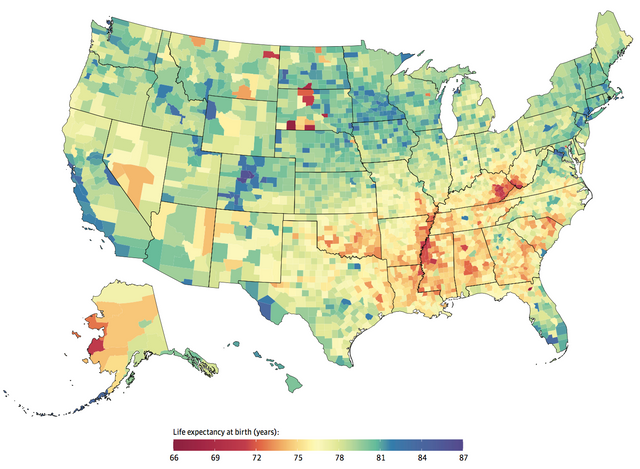
Life expectancy at birth
Behind this overall growth in lifespan, however, the study found a staggering 20.1-year gap between the lowest and highest life expectancy among all US counties.
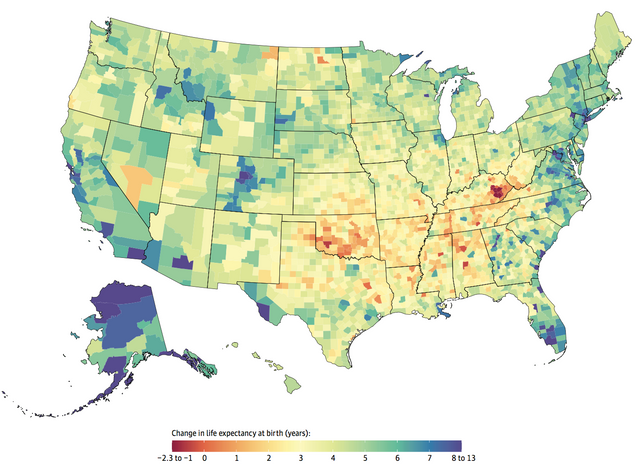
Three wealthy counties in central Colorado—Summit, Eagle, and Pitkin—recorded the longest life expectancies in the country, at 86 years on average. At the other end of the spectrum, several counties in South and North Dakota had the lowest life expectancy, along with “counties along the lower half of the Mississippi [the Delta region] and in eastern Kentucky and southwestern West Virginia,” the study found. These areas “saw little, if any, improvement” since 1980. Thirteen counties registered a decline in life expectancy.
In the Dakotas, several of the shortest-lived counties encompass Native American reservations. Oglala Lakota County in South Dakota, home to the Pine Ridge Native American reservation, had the lowest life expectancy in the country in 2014, at just 66.8 years. In a press release, the IHME researchers noted that this was lower than the life expectancies of Sudan and Iraq—countries that have been torn apart by brutal wars over the course of decades.
“Looking at life expectancy on a national level masks the massive differences that exist at the local level, especially in a country as diverse as the United States,” lead author Laura Dwyer-Lindgren of IHME explained. “Risk factors like obesity, lack of exercise, high blood pressure, and smoking explain a large portion of the variation in lifespans, but so do socioeconomic factors like race, education, and income.”
The study found that all counties saw a decline in the risk of dying before age 5 since 1980, attributable to improvements in health programs for infants and children. At the same time, the data showed an increased risk of death for adults aged 25-45 in 11.5 percent of counties, a phenomenon partially explained by the rise in suicides and drug addiction.
Although the research points to “a combination of socioeconomic and race/ethnicity factors, behavioral and metabolic risk factors, and health care factors” to account for the disparities in life expectancy, all of the factors intersect with poverty. It is not a coincidence that the poorest areas recorded the shortest life expectancies and the wealthiest areas recorded the longest lifespans.
Risk factors like obesity, diabetes, high blood pressure, smoking, and physical inactivity are highly correlated to poverty, unemployment and lack of education. In areas where the population lacks access to preventive care or they cannot afford basic health care, chronic conditions become debilitating. Cancers go undetected, mental illness is undiagnosed, pregnancies are carried without adequate prenatal care, heart disease is untreated, and work-related injuries are managed with highly addictive pain medications instead of physical therapy and rest.
Of the 10 counties where lifespans fell the most since 1980, eight are in the coalfields region of eastern Kentucky: Owsley (-3 percent); Lee (-2 percent); Leslie (-1.9 percent); Breathitt (-1.4 percent); Clay (-1.3 percent); Powell (-1.1 percent); Estill (-1 percent); Perry County, Kentucky (-0.8 percent). Kiowa County, Oklahoma, (-0.7 percent), and Perry County, Alabama, (-0.6 percent) round out the list of counties where life expectancy declined the most.
Change in life expectancy at birth
Residents of Owsley County, Kentucky saw a decline in life expectancy from 72.4 in 1980 to 70.2 in 2014—comparable to the life expectancy in Kyrgyzstan or North Korea.
Owsley County was found by a 2016 Al Jazeera analysis to be the poorest white-majority county in the US. Some 45 percent of the county’s 4,500 residents, and 56.3 percent of children, live below the poverty threshold. Official unemployment stands at 10 percent, but with only 35 percent of the working age population included in the labor force, real unemployment is approaching 75 percent. Per capita income as of 2015 stands at $15,158, according to federal Census Bureau data.
As with the rest of the Appalachian coalfields region, the counties where life expectancy has dropped have seen every metric of economic and social well-being decline over the past several decades. Coal mining employment in eastern Kentucky has fallen to levels not seen in a century. With hundreds of mines shuttered, counties have lost so-called coal-severance tax revenue paid by companies per ton of coal extracted. Thousands of families have left in search of work, triggering a further collapse in the tax base for local governments, school districts, and social programs. The elimination of thousands of coal mining jobs has left mostly low-wage occupations for residents.
Lee County, second to Owsley in terms of the decline in life expectancy, is home to “America’s poorest white town”—Beattyville, Kentucky, the county seat. Beattyville has seen an explosion of opioid addiction since the closure of its few coalmines and decline of the oil and timber industries. The median household income in the town stands at $14,871, less than a third of the national median. Like its measure of life expectancy, Lee County’s household income is lower today than it was in 1980.
Kentucky and neighboring West Virginia have among the highest opioid overdose rates in the country, with the coalfields counties especially hard-hit. In 2013, drug overdoses accounted for 56 percent of all accidental deaths in Kentucky; the state’s death rate for overdoses is 29.9 per 100,000. In the eastern counties, emergency services are less able to reach and save overdose victims and health providers have struggled to afford lifesaving anti-opioid treatments like Narcan.