15 May 2017

IRDR Young Scientists Program for International Researchers 2017

Application Deadline: 3oth June 2017
Eligible Countries: All
About the Award: The Sendai Framework for Disaster Risk Reduction (SFDRR) calls for enhanced role of science and technology for evidence based decision-making. It also urges the need for innovation and partnership, which is linked to practise and diverse stakeholders. IRDR, with its mandate for integrated and trans-disciplinary research, would like to promote capacity building of young professionals, and encourage them to undertake innovative and needs based research which makes science-policy and science-practice linkages stronger.

Objectives

  • Increase awareness among young scientists about Sendai Framework implementation and provide opportunities for further engagement through the Young Scientists Program on DRR.
  • Collate existing research knowledge on DRR and identify research gaps and priorities in relation to the Sendai Framework Priorities for Action
  • Identify opportunities to fund continued multi-disciplinary research by young scientists and early career researchers
  • Provide technical support to promising young researchers in DRR fields
  • Build and foster strong and dynamic networks among worldwide experts and institutions in DRR fields
  • Develop, over time, a community of high-quality young professionals that can provide support for policy making decisions related to DRR
Offered Since: 2016
Type: Research, Fellowship
Eligibility: To be an IRDR Young Scientist, following are the necessary criteria:
  • Age: Less than 40 years on the date of application
  • Nationality: There is no bar on nationality
  • Affiliation: The candidate needs to be affiliated with an academic program (either master or doctorate) either as a student or as a young faculty.
  • Research subject: The subject of research needs to be related to disaster risk reduction and its link to broader environment and development issues.
  • Endorsement: must be endorsed by academic supervisor (for student) or head of the department /graduate school (for the young faculties).
Number of Awards: Not specified
Value of Program: Once selected, as fellow can be an “IRDR Young Scientist” for a period of maximum three years. The fellow will receive the following benefits:
  • Link to IRDR network of professionals and practitioners
  • Access to IRDR Scientific Committee (SC) for academic support / advice
  • Participation in IRDR related training programs (there would be a different selection process for each of the training program)
  • A certificate for IRDR Young Scientist upon successful completion
Duration of Program: Minimum 1 year, and maximum 3 years. The applicant can make their choice, and the final decision will be made by IRDR.
How to Apply: There will be a selection process based on the eligibility criteria, and once finally selected by IRDR, the applicant would get a notification. The call for application is twice per year.
The applicants should submit the following materials:
  1. Application Form( Young Scientists Programme Application Form)
  2. Detailed Curriculum Vitae
  3. Detailed Research Plan (10 pages Maximum)
  4. Recommendation/Endorsement Letter from the Supervisor
  5. Copy of Student/Faculty ID Card
The applicants should submit the materials to connect@irdrinternational.org before June 30, 2017.
Award Provider: Integrated Research on Disaster Risk

Association of African Universities (AAU) Graduate Internship Grants 2017

Application Deadline: Friday 19th May, 2017
Eligible Countries: African countries

About the Award: Through support from its development partners, namely African Capacity Development Foundation (ACBF) and Swedish International Development Agency (Sida), the AAU has secured funds for its member universities in good standing (whose annual subscription payment to AAU is up to date) to offer small grants of up to US$600 per student for graduate internships.
Type: Internship, Grants
Eligibility: 
  • Grant applicants should be students pursuing post-graduate degree programmes. Applicants should note that the grants are for training purposes only and not meant for the completion of theses or dissertations.
  • Applicants shall commit to undertake an internship programme for a period between twelve (12) and twenty-four (24 weeks).
  • Applications should be supported with an authorisation note from the Head of Department of the applicant’s university as well as an official acceptance letter from the establishment wishing to host the intern.
  • All applicants should submit a detailed curriculum vitae.
  • A detailed but confidential supervisory report would be required from the host institution on the progression of the applicant during the period of internship, and from the university of the applicant on academic progress after the period of internship.
  • Past beneficiaries of the AAU Internship Scheme are not eligible to apply.
  • Consideration would be given to applicants who have no practical work experience.
Selection Criteria: Selection of successful applications would be based on a quota system revolving around gender (at least 40% of beneficiaries should be females); country (not more than 10 applicants per country) and language (at least 30% from Francophone institutions).
Number of Awards: Not specified
Value of Program: small grants of up to US$600 per student for graduate internships.
Duration of Program: Between twelve (12) and twenty-four (24 weeks).
How to Apply: Students are to apply online at:
Award Providers: African Capacity Development Foundation (ACBF) and Swedish International Development Agency (Sida)

Adelaide Scholarships International (ASI) Australia for Masters & Doctoral Studies 2017/2018

Application Deadlines:
  • Round 1: 31st August 2017
  • Round 2: 31st January 2018
  • Round 3: 30th April 2018
Offered annually? Yes
Eligible Field of Study: Courses offered at the university.
About Scholarship: The University of Adelaide offers a scholarships scheme for international students undertaking postgraduate research study for Master’s and Doctoral degrees. The purpose of the financial award programme is to attract high quality overseas postgraduate students to areas of research strength in the University of Adelaide to support its research effort.
Type: Masters & Doctoral
Selection Criteria : The selection and ranking of applicants within the University of Adelaide is undertaken by the Graduate Scholarships Committee, using the criteria of academic merit and research potential.
Eligibility
  • In order to be eligible applicants are required to have successfully completed at least the equivalent of an Australian First Class Honours degree (this is a four year degree with a major research project in the final year). All qualifying programs of study must be successfully completed.
  • Scholarships will be awarded on academic merit and research potential. Extra-curricular achievements are not considered.
  • International applicants must not hold a research qualification regarded by the University of Adelaide to be equivalent to an Australian Research Doctorate degree or, if undertaking a Research Masters degree, not hold a research qualification regarded by the University of Adelaide to be equivalent to or higher than an Australian Research Masters degree.
  • International applicants who have not provided evidence of their meeting the minimum English language proficiency requirements for direct entry by the scholarship closing date, or who have completed a Pre-Enrolment English Program to meet the entry requirements for the intended program of study, are not eligible.
  • Candidates are required to enrol in the University of Adelaide as ‘international students’ and must maintain ‘international student’ status for the duration of their enrolment in the University.
  • International applicants are not eligible if they have already commenced the degree for which they are seeking an award, unless they can establish that they were unable to apply in the previous round.
  • Scholarships holders must commence study at the University of Adelaide in the semester the scholarship is offered.
  • Applicants who applied and were eligible for consideration in an international scholarship round, and were unsuccessful, will automatically be reconsidered in the following international scholarship round, assuming they hold a valid offer of candidature for that intake. An applicant who has been considered in 2 rounds cannot be reconsidered in any future scholarship rounds.
Number of Scholarships: Not specified
Value of Scholarship:
  • Course tuition fees for two years for a Masters degree by Research and three years for a Doctoral research degree (an extension is possible for doctoral programs only),
  • An annual living allowance ($26,288 in 2016) for two years for a Masters degree by Research and three years for a Doctoral research degree (an extension is possible for doctoral programs only), and
  • For Postgraduate Research (Subclass 574) visa holders the award provides compulsory standard Overseas Student Health Cover (OSHC) Worldcare policy for the student and their spouse and dependents (if any) for the standard duration of the student visa.  It does not cover the additional 6 month extended student visa period post thesis submission. If the award holder does not hold a subclass 574 visa then he/she is responsible for the cost of health insurance.
Duration of Scholarship: 2 years for Masters; 3 years for Doctoral
Eligible Countries: All countries except Australia and New Zealand
To be taken at (country): University of Adelaide, Australia
How to Apply
To apply, you have to submit a formal application for Admission and a Scholarship via an online application system. There is no application fee.
Visit scholarship webpage for details
Sponsors: University of Adelaide, Australia
Important Notes: The offer of a scholarship is contingent upon a student not being offered another award by the Commonwealth of Australia, the University of Adelaide, or an overseas sponsor. The University reserves the right to withdraw an offer of a scholarship at any time prior to enrolment if it is advised that an awardee has been offered a scholarship equal to or in excess of the financial value of the award offered by the University.

Google Global Good Fellowship for Entrepreneurs 2018

Application Deadline: 30th June 2017
Eligible Countries: All
To be taken at (country): Washington, D. C., US
About the Award: The Global Good Fund Fellowship is a 12-month program supporting the leadership development of young social entrepreneurs across the globe. The Global Good Fund develops these innovators by pairing them with executives who serve as Mentors, and by providing leadership assessment resources, a network of peers, sector expertise, and targeted financial capital.
The result is empowered leaders who scale their social enterprises and ultimately deliver sustainable social impact. We believe growing leaders is the most effective strategy for solving complex social problems and achieving global good.
Type: Fellowship
Eligibility: In order to be considered for the fellowship, candidates must meet the following minimum requirements:
  • Enterprise that the candidate leads is at least one-year old;
  • Enterprise must have at least one full-time employee in addition to the candidate;
  • Candidate is committed full‐time to running his/her enterprise;
  • Candidate is under 40 years of age (if 40 or older, explain rationale for joining fellowship);
  • Candidate should not be currently receiving formal coaching/mentoring support;
  • Candidate has to be in a position where s/he has decision making power.
Candidates who meet the requirements will be invited to participate in Phase II of the application process.
Number of Awards: Not specified
Value of Program: Following a rigorous five-stage process, selected Global Good Fund Fellows embark on a structured 12-month journey of experiential learning, executive mentoring and that leverages proprietary leadership development tools and methods honed since 2012. At our core is The Global Good Fund 360 MIRROR – the first evidence-based leadership assessment created specifically for social entrepreneurs. Our proven leadership development tools and services are also available to individuals, social enterprise organizations, NPOs and impact-driven corporations.
Each Fellow receives a leadership development grant of up to $10,000. These funds are used explicitly for LDP implementation and leadership development with a special focus on experiential learning.
Duration of Program: 12 months (Jan 1-Dec 31 2018)
How to Apply: Apply here
Award Provider: The Global Good Fund

The World For Ransome: The Effects of Wannacry

Binoy Kampmark


What a stealthy bugger of a problem. Malware deftly delivered, locking the system by encrypting files and making them otherwise impossible to access unless a fee is paid. A form of data  hijacking that can only be admired for its ease of execution, for its viral-like replication that seeks, even hunts, vulnerable “unpatched” computer systems.
The global information environment is well and truly primed for plunder, vulnerable to such malicious “worms” as WannaCry.  Each age creates the next circumstance for profit, often outside the boundaries deemed acceptable at the time.  In a networked age reliant on huge quantities of data, times are good for the intrepid.
The weekend reporting on the WannaCry ransomeware worm was filled with predictable gruesomeness, suggesting that the unfortunates turning up to work on a Monday could well discover they were unable to access work files.
Much of the damage had already been done, with notable targets being the National Health System in Britain, and the Spanish telecommunications company Telefonica. In Britain, patients had to be relocated, and scheduled operations and treatment delayed if not cancelled altogether. Crisis meetings were held by members of the May government.  As one doctor put it in eerily apocalyptic fashion, “our hospital is down.”
Another notable country target was Russia, including networks within the Interior Ministry, suggesting that the cyber misfits in question may have overstretched in their enthusiasm. Russia tends to figure, as it does in other jottings of demonology, as a place of sanctuary for the cyber crooked, bastion where IT sorties can be launched.  But not now.
More useful, if sobering analysis, came from Nicholas Weaver, who noted that the strength of the attack was its multi-vector nature.  “If a targeted user receives a worm-laden email and clicks on the attachable executable, the worm starts running.” (Computer speak tends to get mangled in its descriptions, since worms would otherwise crawl. But not wCry, which does its damage at an enthusiastic gallop.)
This delightful worm capitalises on a vulnerability evident in the network protocol in Microsoft Windows termed Server Message Block.  This is where the ransomeware does its bit, encrypting the files in question, and locking out users on pain of ransom.
Much in this saga is based on systems that were never reformed.  UK Health Secretary Jeremy Hunt had been badgered by his shadow counterpart, Jonathan Ashworth, that the NHS’s computer systems were dangerously outdated and susceptible to attack.
While victim blaming is second nature to this trade, Weaver’s salient observation is that the computer industry is just as responsible, if not more so.  The persistent use of executable attachments should trigger liability, if not shame.
Developers and members of industry, in other words, should be made the classroom dunces.  “Our bottom line up front,” claim Ben Buchanan, Stuart Russell and Michael Sulmeyer for Lawfare, “is that, VEP (Vulnerabilities Equities Process) or no VEP, today’s ransomeware attack highlights the risks of relying on software that is no longer supported by its developer (like windows XP) and of not applying patches that the developer makes available (like MS17-010).”
This brings us to the body that keeps giving, albeit indirectly and haphazardly: the US National Security Agency.  In April, a group calling itself Shadow Brokers released a set of tools pilfered from the NSA, including the vulnerability occasioned by SMB.
The Microsoft public relations machine went through the motions of putting out the fires, explaining that the company had already dealt with the vulnerabilities (patched them, if you will) in March, including a patch against the spread of the WannaCry ransomeware.  Much of this was occasioned by a helpful disclosure to the company from US government sources.
This entire process revealed a certain dance between government agencies and vendors in the exchange system known as the VEP. Through this tense understanding, the US government designates which discovered software vulnerabilities should be passed on to vendors.
The vendors, in turn, apply the relevant, protective patches, though whether this is actually done is quite another matter.  There is also every chance that the US government will refuse to reveal such a vulnerability in the first place. Being in the business of hacking, some cards will be well and truly hidden, to be procured when required.  Such an instance arose in 2014, when the Heartbleed vulnerability was exposed to much fanfare.  The response from US government officials was one of implausible deniability.
Entities such as the Patients’ Association in Britain have condemned the outfit behind the attack, but also noted that the entire establishment remained green and inadequately prepared. Unprotected and unbacked, software left unsupported by developers is fit for the dustbin of history.  In the meantime, the catastrophe stemming from future attacks is easy to envisage.

How Al-Nusra Front Split Up From Islamic State?

Nauman Sadiq

Since the beginning of the Syrian conflict in August 2011 to April 2013, Islamic State and al-Nusra Front (currently Jabhat Fateh al-Sham, JFS) were a single organization that chose the banner of “Jabhat al-Nusra.” Although the current al-Nusra Front is led by Abu Mohammad al-Julani but he was appointed as the emir of al-Nusra Front by Abu Bakr al Baghdadi, the leader of Islamic State, in January 2012.
Thus, the current al-Nusra Front is only a splinter group of Islamic State which split from its parent organization in April 2013 over a dispute between the leaders of the two organizations.
In March 2011, protests began in Syria against the government of Bashar al-Assad. In the following months, violence between demonstrators and security forces led to a gradual militarization of the conflict. In August 2011, Abu Bakr al-Baghdadi, who was based in Iraq, began sending Syrian and Iraqi jihadists experienced in guerilla warfare across the border into Syria to establish an organization inside the country.
Led by a Syrian known as Abu Mohammad al-Julani, the group began to recruit fighters and establish cells throughout the country. On 23 January 2012, the group announced its formation as Jabhat al-Nusra.
In April 2013, Abu Bakr al-Baghdadi released an audio statement in which he announced that al-Nusra Front had been established, financed and supported by the Islamic State of Iraq. Al-Baghdadi declared that the two groups were merging under the name “Islamic State of Iraq and Syria.” The leader of al-Nusra Front, Abu Muhammad al-Julani, issued a statement denying the merger and complaining that neither he nor anyone else in al-Nusra’s leadership had been consulted about it.
Al-Qaeda Central’s leader, Ayman al Zawahiri, tried to mediate the dispute between al-Baghdadi and al-Julani but eventually, in October 2013, he endorsed al-Nusra Front as the official franchise of al-Qaeda Central in Syria. Abu Bakr al-Baghdadi, however, defied the nominal authority of al-Qaeda Central and declared himself as the caliph of Islamic State of Iraq and Syria.
Keeping this background in mind, it becomes amply clear that a single militant organization operated in Syria and Iraq under the leadership of al-Baghdadi until April 2013, which chose the banner of al-Nusra Front, and that the current emir of the subsequent breakaway faction of al-Nusra Front, al-Julani, was actually al-Baghdadi’s deputy in Syria.
Thus, the Islamic State operated in Syria since August 2011 under the designation of al-Nusra Front and it subsequently changed its name to Islamic State of Iraq and Syria (ISIS) in April 2013, after which it overran al-Raqqa in the summer of 2013, then it captured parts of Deir el-Zor and fought battles against the alliance of Kurds and the Syrian regime in al-Hasakah. And in January 2014 it overran Fallujah and parts of Ramadi in Iraq and reached the zenith of its power when it captured Mosul in June 2014.
Moreover, many biased political commentators of the mainstream media deliberately try to muddle the reality in order to link the emergence of Islamic State to the ill-conceived invasion of Iraq by the Bush Administration in 2003. Their motive behind this chicanery is to absolve the Obama Administration’s policy of nurturing militants against the Syrian regime, since the beginning of the Syrian civil war until June 2014, when the Islamic State overran Mosul and the Obama Administration made a volte-face on its previous policy of indiscriminate support to Syrian opposition and declared a war against a faction of Syrian opposition: that is, the Islamic State.
Additionally, such Syria “experts” also try to find the roots of Islamic State in al-Qaeda in Iraq; however, the insurgency in Iraq died down after “the Iraq surge” of 2007. Al-Qaeda in Iraq became an impotent organization after the death of Abu Musab al-Zarqawi in June 2006, and the subsequent surge of troops in Iraq by the Bush Administration.
The re-eruption of insurgency in Iraq has been the spillover effect of nurturing militants in Syria against the Assad regime, when the Islamic State overran Fallujah and parts of Ramadi in January 2014 and subsequently captured Mosul in June 2014. The borders between Syria and Iraq are quite porous and it’s impossible to contain the flow of militants and arms between the two countries. The Obama Administration’s policy of providing money, arms and training to Syrian militants in the training camps located in the border regions of Turkey and Jordan was bound to backfire sooner or later.
Regarding the rebranding of al-Julani’s Nusra Front to “Jabhat Fateh al-Sham” in July 2016 and supposed severing of ties with al-Qaeda Central, it’s only a nominal difference because al-Nusra Front never had any organizational and operational ties with al-Qaeda Central and even their ideologies are poles apart.
Al-Qaeda Central is basically a transnational terrorist organization, while al-Nusra Front mostly has regional ambitions limited only to fighting the Assad regime in Syria and its ideology is anti-Shi’a and sectarian. In fact, al-Nusra Front has not only received medical aid and material support from Israel, but some of its operations against the Shi’a-dominated Assad regime in southern Syria were fully coordinated with Israel’s air force.
The purpose behind the rebranding of al-Nusra Front to Jabhat Fateh al-Sham and supposed severing of ties with al-Qaeda Central was to legitimize itself and to make it easier for its patrons to send money and arms. The US blacklisted al-Nusra Front in December 2012 and pressurized Saudi Arabia and Turkey to ban it too. Although al-Nusra Front’s name has been in the list of proscribed organizations of Saudi Arabia and Turkey since 2014, but it has kept receiving money and arms from the Gulf Arab States.
Notwithstanding, excluding the western Mediterranean coast and the adjacent major urban centers controlled by the Syrian regime and the Kurdish-controlled northeastern Syria, I would divide the Syrian theater of proxy wars into three separate and distinct zones of influence:
Firstly, the northern and northwestern zone along the Syria-Turkey border, in and around Aleppo and Idlib, which is under the influence of Turkey and Qatar. Both these countries share the ideology of Muslim Brotherhood and they provide money, training and arms to Sunni Arab jihadist organizations, such as al-Tawhid Brigade, Nour al-Din Zenki Brigade and Ahrar al-Sham, in the training camps located in the border regions of Turkey in collaboration with CIA’s MOM (a Turkish acronym for military operations center).
Secondly, the southern zone of influence along the Syria-Jordan border, in Daraa and Quneitra and as far away as Homs and Damascus. It is controlled by the Saudi-Jordanian camp and they provide money, weapons and training to the Salafist militant groups, such as al-Nusra Front and the Southern Front of the so-called “moderate” Free Syria Army (FSA) in Daraa and Quneitra, and Jaysh al-Islam in the suburbs of Damascus.
Their military strategy is directed by a Military Operations Center (MOC) and training camps located in the border regions of Jordan. Here, let me clarify that this distinction is quite overlapping and heuristic, at best, because al-Nusra’s jihadists have taken part in battles as far away as Idlib and Aleppo.
And finally, the eastern zone of influence along the Syria-Iraq border, in al-Raqqa and Deir al-Zor, which has been controlled by a relatively maverick Iraq-based jihadist outfit, the Islamic State, though it had received funding and weapons from Turkey and the Gulf Arab States before it turned rogue and overran Mosul and Anbar in Iraq.
Thus, leaving the Mediterranean coast and Syria’s border with Lebanon, the Baathist and Shi’a-dominated Syrian regime has been surrounded from all three sides by hostile Sunni forces: Turkey and Muslim Brotherhood in the north, Jordan and the Salafists of the Gulf Arab States in the south and the Sunni Arab-majority regions of Mosul and Anbar in Iraq in the east.

Commoners Against Rape In Bangladesh

Farooque Chowdhury

Commoners in Bangladesh are raising their voices against rape. There are protest march, meetings, stand-ins.
Days ago, an incident of a rape came out to public light. The victims were two university-students. The incident occurred weeks ago in the capital city of Dhaka. But, the victims dared not to lodge any complaint with the concerned authority as the   perpetrators were from rich families. There were complaints of negligence on the part of an official supposed to take action.
But the media instantly took up the issue, and tried its best to bring to light the entire series of incidents: the powerful’s “game” with honor of the ordinary, the threat to hush the act of “bravery”, the ploy to not record it officially. The Dhaka press, electronic media and online news outlets are full with reports for the last few days on the developments of the incident. A few of the press reports cited powerful utterances of the powerful son of the rich person: “I’ll hack you to death and make the pieces vanish”, a threat to the victims; “my father will spend a billion Taka [Bangladesh currency, about 80 Taka equals to a US dollar] to hush the incident”. (Dainik Ittefaq, a leading Baanglaa daily from Dhaka, May 13, 2017)
At the very onset of the developments, commoners raised their voices over internet-based social media network (ISM). There were hundreds of chidings, laments, condemnations, rejections, protests and demands. The commoners were questioning the powerful, the powerful hands of the powerful, the tricky hands of the rich. They were connecting the heinous act and the wealthy. Their questionings spanned from individual rich to the system. They were expressing skepticism about the possibility of proper delivery of fairness.
Within days, the concerned agency had to jump into action, form more than one investigation committees, send a concerned official on leave, apprehend two of the five absconding “brave boys” from a north-eastern city, a few hundred miles from Dhaka.
At the same time, organizations and alliances including a few student organizations and the Gana Jaagaran Mancha organized protest meetings, stand-ins and protest-march at city centers. A few of the slogans in the mobilizations questioned the state, the administration and the society. The voice of the commoners’, yet subdued and unorganized, was felt around.
The violation-incident was preceded and followed by similar incidents around the country. The Dhaka-news-media carries these reports. As for example, in a district near Dhaka, a farm-laborer committed suicide as he failed to found any sympathetic ear to the incident of his young daughter’s dishonor.
An “amazing” aspect within these series of incidents is the “strange” silence” of political parties claiming to be progressive, to be pro-people, to be pro-poor! Probably, these organizations did not consider the incident as part of political question. Probably, the issues of safety and honor of citizens are “not” political issues to these organizations. Probably, the issues are to be taken care of by organizations active with social issues, NGO, the organizations pushed by their donors to fill-in political vacuum created by many political non-activities of apparently progressive  political organizations, other petty-organizations, and by the so-called civil society, the individuals having no constituency and posing as conscience of the nation. Probably, the apparently progressive  political organizations are busy with mechanism of coming-election-equation (?). Probably, it’s beyond comprehension of commoners who find “strange” silence on the part of pro-poor, pro-people, pro-radical change appearing political organizations on major and fundamental issues of life, of economy, society and politics. In this time, traders’ organizations raise and debate aspects related to VAT while it’s difficult to find any serious discussion on the issue by the pro-people, pro-poor appearing political organizations (PPP). Examples of similar inactivity by the PPPs are abounding.
But, the signals the society is trying to convey are significant. Politicians and political scientists will look into these, no doubt. Any politician standing for status quo will get annoyed with these signals while any politician standing for radical change will get engaged with serious, persistent and consistent political activities with the aim of reaching the people, with the aim of creating secure and honorable people’s space that helps organizing democratic movement.
Rene Dumont, the famous economist from France, was invited to Bangladesh after the country attained independence. He was requested to propose a few ideas about reconstruction of Bangladesh, a country burned, ravaged, destroyed by the occupying forces from Pakistan. One of his observations for a building up a Sonar Baanglaa, a prosperous Bengal, was: Ensure women’s safe atmosphere for fearless, unhindered movement with full honor.
Today, women constitute a major part of labor force in the country. They are not engaged just with the garments sector; their presence is felt in construction, skin and hide, recycling, and agricultural sectors also. A major portion of micro credit (MC) debtors are women while capital invested through MC is mainly in the areas of artisanal and cottage industries; and commodities produced by the MC debtors mainly reach local markets. Anyone can easily draw a few conclusions based on these aspects, which are important indicators. These aspects are related to capital, market, their development, relations these establish, and development in the society. Anyone can put the issue of women within this perspective, and, can find out the importance of the issue. Safety of women is not only an issue related to labor, but to capital also. These are known to all, especially to the PPPs. And, all after these, the issue of women’s honor is left to others by the PPPs. It’s really, a time-“unknown”, when the politically unorganized citizens active in the internet-based social media network easily are connecting the issues of dishonor of women and the rich but the PPPs find no class issue on the question, when millions of poor-women, women industrial workers walk to and fro their workplaces at early-dawn, after dusk, even, at places, at near-mid-night. Is the time beyond comprehension of ordinary citizens? Time will answer the question.

Burmese government rejects international inquiry into anti-Rohingya pogrom

John Roberts 

A European tour by the Burmese (Myanmar) head of government Aung San Suu Kyi this month has been marked by shameless hypocrisy, outright lies and cover-up of the campaign by the military and nationalist thugs to terrorise the country’s Rohingya Muslim minority.
On May 2 in Brussels, the European Union headquarters, Suu Kyi, flatly rejected a fact-finding investigation mission proposed on March 24 at the annual meeting of the 47-member UN Human Rights Council (UNHRC) in Geneva.
The military’s campaign in Rakhine state, bordering Bangladesh, seeks to drive Rohingyas from the country. The offensive began last October after attacks, allegedly by Rohingya militants, on border posts that killed nine members of the security forces.
The “clearance operation” has the full backing and complicity of Suu Kyi’s National League for Democracy (NLD) government.
UN reports from February, based on hundreds of interviews with refugees in Bangladesh and satellite imagery, provided evidence of murders, rape, pillaging, kidnappings and the burning of whole villages. Over 70,000 Rohingya had fled the country, joining over 300,000 living in squalid camps in Bangladesh, with many more dispersed throughout South and South East Asia.
At a joint press conference with Suu Kyi, EU foreign affairs commissioner Federica Mogherini said the EU supported the UNHRC mission, saying it would the reveal the truth “about the past” by “establishing the facts.”
Standing beside Mogherini, Suu Kyi declared: “We do not agree with it. We have dissociated ourselves from the resolution because we do not think it is in keeping with what is happening on the ground.”
As state counsellor and foreign minister, Suu Kyi heads a hybrid government in which the NLD shares power as a junior partner with the country’s military. Both groups are mired in anti-Rohingya chauvinism that dominates the Burmese political establishment.
This coalition was established under a 2008 constitution imposed by the military junta that exercised a brutal dictatorship for over half a century. The generals continue to retain veto power over constitutional changes and exercise direct control over key state bodies, including the defence, home affairs and border security ministries.
The Brussels statement is not Suu Kyi’s first attempt to cover up the military’s crimes against the Rohingya. Last November, her office issued a statement that no crimes were being committed because the armed forces command said so.
On April 6, as UN reports made clear the extent of the pogrom, and international concerns increased, Suu Kyi made a rare personal statement. She told the BBC no “cleansing operation” was underway in the closed-off province and expressed her support for the army. “They are free to go in and fight,” she said, “military matters are to be left to the army.”
Military commander Min Aung Hlaing, who played a major role in installing Suu Kyi, made the military’s position clear in March. He said Rohingya were illegal “Bengali” immigrants who had no right to live in Burma.
In reality, many Rohingya families have lived in the region for generations, but have been largely denied citizenship.
Suu Kyi’s Brussels statement was her most explicit on an international stage. Long promoted by the Western powers as a “democrat,” she publicly supported the pogrom in Rakhine and rejected any international scrutiny.
Nevertheless, the European political establishment continued to fete her. Mogherini said there was one point of difference but many other issues of agreement, and other progress during the NLD’s 12 months in office.
Suu Kyi’s trip included meetings with the Pope and Belgium’s King Philippe and Prime Minister Charles Michel. She also met Britain’s Queen Elizabeth and Prince Charles and was granted the Freedom of the City of London, the financial capital. That award cited her “non-violent struggle over many years for democracy and her steadfast dedication to create a society where people can live in peace, security and freedom.”
The UNHRC resolution itself proposed a watered-down investigation based on the assumption of cooperation from Burmese authorities. It was drafted as a result of direct intervention by EU diplomats at the Geneva meeting.
The UN has been complicit in covering up developments in the Rakhine region. Since 2012 the campaign against the Rohingya has continued with various levels of violence without any major UN response. The intensity of the current offensive has created a large refugee outflow, creating a regional crisis that forced the UN to act.
Yanghee Lee, the UN special rapporteur on human rights in Burma, and UN High Commissioner for Human Rights Zeid Ra’as al-Hussein urged the Geneva meeting to “at a minimum” establish a Commission of Inquiry (COI), the UN’s highest form of investigation, and al-Hussein spoke of a review by the International Criminal Court.
EU diplomats blocked the COI proposal, eventually settling on a more limited fact-finding mission, with the clear intention of protecting Suu Kyi. The Burmese UN ambassador rejected the plan, however.
Significant geopolitical and economic interests are involved. The Obama administration worked to bring the NLD into office to wedge Burma away from China as part of Washington’s strategy of undercutting Beijing’s influence in Asia. Washington took advantage of the junta’s need to end Western sanctions and lessen its economic and political dependence on China.
With an eye to its own global interests, the EU jumped in to begin the lifting of sanctions. EU corporations covet Burma’s largely untapped natural resources and potential as a cheap labour platform.
As part of its own machinations, Suu Kyi’s government has maintained a relationship with Beijing. In April, she sent Burmese President Htin Kyaw and a delegation to China to sign economic agreements and reaffirm Burma’s support for the One China policy.
Beijing, in turn, promised to help the regime in its efforts to end conflicts with ethnic groups along China’s borders and gave Burma a non-interference assurance in the Rakhine. Suu Kyi spent five days in China last August and is due to arrive again on May 14 to discuss further participation in China’s One Belt infrastructure initiative across Eurasia.

US hepatitis C infections triple amid opioid epidemic

Brad Dixon

According to reports released on Thursday by the Centers for Disease Control and Prevention (CDC), the rate of new hepatitis C infections nearly tripled between 2010 and 2015. The rate increases were concentrated heavily among injectable drug users, highlighting the relationship between the growth in new hepatitis C infections and the ongoing opioid epidemic in the United States.
The hepatitis C virus (HCV) attacks the liver, and can ultimately result in cirrhosis, liver cancer and liver failure. The CDC estimates that 3.5 million individuals are infected with the disease in the United States, making it the most common blood-borne virus in the nation.
In 2014, 19,659 deaths were associated with HCV, an all-time high and more than the combined deaths of the 60 other infectious diseases tracked by the CDC, including HIV, pneumococcal disease and tuberculosis.
The two reports were published in the CDC’s latest issue of Morbidity and Mortality Weekly Report (MMWR).
According to the first report, the number of newly reported HCV cases grew from 850 in 2010 to 2,436 in 2015, an increase of 294 percent. These figures, however, are undoubtedly lower than the actual rate of new infections because it can take years before individuals with HCV display symptoms, leaving most cases undiagnosed. The CDC estimates that the true figure for new infections in 2015 to be closer to 33,900.
The generation of baby boomers, those between the ages of 52 and 72, is the group most likely to be infected with HCV. The largest increase in rates of new infections, however, has taken place among younger people between the ages of 20 and 29, most likely due to injectable drug use. This points to the relationship between the ongoing opioid epidemic and the rise in HCV cases.
“These new infections are most frequently among young people who transition from taking prescription pills to injecting heroin, which has become cheaper and more easily available in some cases,” John Ward, director of the division of viral hepatitis at the CDC and an author of the first report, told CNN. “In turn many—most in some communities—people who inject drugs become infected with hepatitis C.”
The greatest increases in HCV infections correspond to the regions that have been hardest hit by the opioid epidemic: Appalachia, and rural areas of the Midwest and New England. Seven states had at least twice the national average of new HCV infections: Indiana, Kentucky, Maine, Massachusetts, New Mexico, Tennessee and West Virginia. Ten other states had lower rates, but were still above the national average: Alabama, Montana, New Jersey, North Carolina, Ohio, Oklahoma, Pennsylvania, Utah, Washington and Wisconsin.
A second report released by the CDC found that HCV infection rates among women giving birth nearly doubled between 2009 and 2014. The growing rates again matched closely to those areas of the country most impacted by the opioid epidemic.
“If I overlaid a map of the United States and looked at rates of newborn opioid withdrawal after birth, it would be very similar,” Stephen Patrick, lead author of the paper and an assistant professor of pediatrics and health policy at Vanderbilt, told CBS News. “We suspect this is highly linked to the opioid epidemic.”
The report found that HCV infection rates among women giving birth rose from 1.8 to 3.4 instances per 1,000 live births. The rates were the highest in West Virginia (22.6 instances per 1,000 live births) and Tennessee (10.1). The disease is transmitted from mother to infant in around 6 percent of births, although this figure could be higher, according to Patrick.
“My worry is that some infants will convert to having hepatitis C without anyone knowing, or treating the infant,” Patrick said.
The development of direct-acting antiviral drugs, first approved in 2011, marked a significant advance in the treatment of HCV. Despite the immense progress on this front, only a limited segment of the population infected by HCV has benefited. This is a direct result of the high prices charged by pharmaceutical companies for these drugs.
For example, a 12-week course of Merck’s Zepatier costs $54,000, while AbbVie’s Viekira is priced at $83,000. However, the most widely used drugs are Gilead’s Sovaldi, priced at $84,000, or $1,000 a pill, and Harvoni, priced at $94,500.
A US senate report released in December 2015, which summarized the findings of an 18-month investigation based on thousands of pages of internal company documents, called attention to substantial evidence that Gilead priced its HCV drugs at the highest price it thought the market could bear in order to maximize its revenue.
“There was no concrete evidence in emails, meeting minutes or presentations that basic financial matters such as R&D costs or the multibillion-dollar acquisition of Pharmasset, the drug’s first developer, factored into how Gilead set the price. Gilead knew these prices would put treatment out of the reach of millions and cause extraordinary problems for Medicare and Medicaid, but still the company went ahead,” said Senator Ron Wyden on the release of the report.
The high costs of these drugs, which essentially offer a cure for the disease, has led government and private health insurers to ration access to the drugs, especially among the most at-risk populations such as prison inmates where the HCV infection rate is nearly nine times as high as in the population as a whole.
In Louisiana for example—where health secretary Rebekah Gee is attempting to get generic versions of the drugs on the market before the patents of the branded versions expire by invoking a 1910 federal law—there are 73,000 people infected with HCV, but Medicaid can only cover 300 patients per year. One in 63 babies in the state are now born to mothers infected with the disease.
The growing opioid epidemic, responsible for the rising rates of HCV infections, reflects the immense social crisis in the United States in which millions of workers are facing unemployment, stagnant or falling wages, and a dramatic growth in social inequality.
The epidemic has been exacerbated by the actions of unscrupulous pharmaceutical companies—such as Purdue Pharma, maker of OxyContin, and Insys Therapeutics, maker of the fentanyl product Subsys—which have flooded communities throughout the country with highly addictive opioids since the late 1990s.
Once addicted to these prescription painkillers, many drug users switch to the often cheaper and more readily accessible alternative of heroin, often sharing needles and helping to spread HCV and other blood-borne diseases.
Drug manufacturers played down the addictive nature of their drugs, heavily marketed them to doctors (sometimes outright bribing doctors), and turned a blind eye to clinics and pharmacies that were clearly nothing but pill mills, allowing the drugs to pour into the black market. Drug distributors—such as McKesson, Cardinal Health, and AmerisourceBergen—who purchase drugs from manufacturers and then distribute them to pharmacies, have likewise ignored such abuses because they led to additional drug sales.

Report documents record levels of social inequality in Russia

Clara Weiss

The global wealth report for 2016 published last November by the bank Credit Suisse revealed that among all major economies, Russia had by far the highest concentration of wealth in the hands of an oligarchy. The report found that the top decile owns a stunning 89 percent of all household wealth in Russia, up by 2 percent from 2015. This compares to 78 percent in the United States and 73 percent in China.
The report further stated that no less than 122,000 individuals from Russia belong to the world’s wealthiest 1 percent. There are some 79,000 US-dollar millionaires living in Russia. The country also has the world’s third largest number of billionaires, 96, topped only by the 244 living in China (which has almost 10 times the population of Russia) and the 544 billionaires in the US.
The number of those counted among the middle class by Credit Suisse in 2015 (with wealth totaling at least $18,000) marked a 10.3 percent decline in the period 2000-2015, from 5.6 million to 5 million. The report from 2015 classified just 4.1 percent of the population as “middle class.” This is less than one-tenth of the German population deemed in the report to be middle class, and significantly less than in most Latin American countries, not to mention the world average of 13.9 percent.
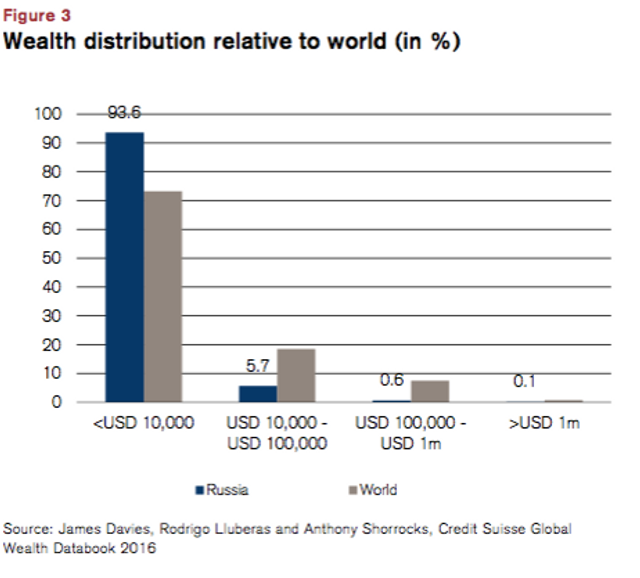
Graph showing wealth distribution in Russia relative to the world. The percentage number relates to the Russian population. Source: Credit Suisse: Global Wealth Report 2016, p. 53
This is not surprising, given that the average monthly wage in Russia, according to official statistics, is just 36,000 rubles, the equivalent to $616.
The majority of employed workers actually make much less than this, according to a report by the Nezavisimaya Gazeta from April 2017. That report noted that some 56 percent of Russian workers make less than 31,000 rubles ($531) a month. The official subsistence level was recently lowered by the government to less than 9,691 rubles ($166), a wage that is impossible to live on.
By these standards, 13 percent of the Russian population lives below the poverty line. If one takes the threshold of 15,000 rubles ($256), which a majority of respondents in a poll by VTsIOM indicated as a poverty level, 29.4 percent of the population—some 43 million people—are living in extreme poverty.
This means that a very substantial portion of the Russian working class, the rural population and the intelligentsia cannot afford to consume products like cheese, meat or even milk on a regular basis. Many families have to resort to growing food in their gardens, collecting mushrooms and berries in the forest and the like just to put food on the table.
The assurances given in the 1990s by politicians and the media—that after a certain period of harsh reforms and poverty, Russia would come out of the economic slump and living standards would rise—have proven to be lies. With the exception of a small and stunningly wealthy layer of oligarchs and a narrow upper-middle class, the restoration of capitalism has produced a disaster for the population.
Due to unusually high oil prices from 2000 to 2008, there was a certain period of economic growth in Russia, based largely on the selling of raw materials—gas, oil, timber and precious metals—on the world market. This superficial boom, which was never accompanied by a growth in manufacturing, quickly collapsed with the financial crisis of 2008-2009. However, the biggest blow to the Russian economy since the 1990s came with the Ukraine crisis.
The far-right coup in Kiev in February 2014, backed by the US and the European Union, was soon followed by drastic economic sanctions against Russia and a collapse of oil prices. This has led, among other things, to a massive devaluation of the ruble and a substantial increase in the prices of basic necessities.
According to Credit Suisse, the loss in net wealth in both Russia and Ukraine in 2014-2015 was 40 percent, more than any other country in the world, largely due changes in exchange rates.
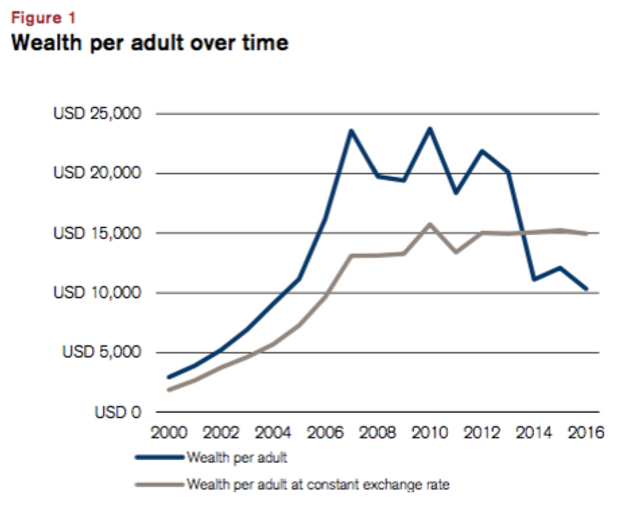
Graph showing the collapse in wealth per adult in Russia due to the devaluation of the ruble following the beginning of the Ukraine crisis. Source: Credit Suisse: Global Wealth Report 2016, p. 53
Under these conditions, the Russian working class has shown signs of increasing combativeness. Between 2008 and 2016, the number of officially registered strikes increased 4.5 times, according to the newspaper Gazeta.Ru. A particularly marked spike occurred in 2015, when 40 percent more strikes took place than in 2014.
In 2016, strikes and protest actions occurred across Russia (in 72 regions, or 85 percent of the country). While in 2009, 56 percent of all protests occurred among manufacturing workers, in 2016 this percentage dropped to only 25 percent. In 2016, more protest actions took place among transport and construction workers as well as state employees.
A substantial percentage of the strikes are taking place outside the control of the trade unions. In 2008, this was true for 62 percent of the strikes. The unions, particularly the so-called “independent” ones, succeeded in regaining control over strikes, and the percentage of walkouts not called by unions declined to 35 percent in 2013. However, the level of strike activity independent of the unions has recently been on the rise again, reaching 53 percent of the total number of strike actions in 2016.
What these workers need above all is a clear understanding of the historical origins of the situation in which they find themselves and a perspective for fighting against capitalism and the threat of war. Both the threat of imperialist aggression and the desperate social situation facing the vast majority of the Russian population are the result of the decades of rule by the Stalinist bureaucracy, which usurped political power from the working class in the decade following the Russian Revolution. The Stalinist betrayal of the revolution culminated it the bureaucracy’s dissolution of the Soviet Union in 1991.
As the Trotskyist movement had warned early on, the Stalinist bureaucracy’s nationalist program of “socialism in one country” was not only a repudiation of the international revolutionary and socialist program of the October Revolution, it was also unviable under conditions of an increasingly integrated world economy. The mounting crisis of the isolated workers state could be solved only in two ways: either by overthrowing the bureaucracy in a political revolution and extending the socialist revolution internationally, or by the bureaucracy transforming itself onto a new ruling class by reintegrating the Soviet economy into the world capitalist economy.
After decades of Stalinist betrayals and massacres of entire generations of revolutionaries, the latter alternative was realized, starting with the policies of the “perestroika” period under the secretary of the Communist Party of the Soviet Union, Mikhail Gorbachev. Under the guise of introducing “socialism with a human face,” the Stalinist bureaucracy set about smashing the foundations of the Soviet economy.
In 1987, the “law on cooperatives” effectively legalized private companies, resulting in the rapid emergence of a new layer of entrepreneurs. Simultaneously, state-owned banks were broken up and the formation of private banks was allowed. Land-leasing was also introduced, leading to the abolition of whatever nationalized land had remained. In 1989, the state monopoly of foreign trade was abolished, allowing the new private companies and the state companies to directly negotiate deals with foreign governments and companies.
There was no party outside of the International Committee of the Fourth International (ICFI) that warned of the dangers awaiting the Soviet working class. At a time when all political parties, including the supposed “left,” hailed Gorbachev’s “perestroika,” the ICFI warned of the impending restoration of capitalism.
In 1991, David North, now the chairman of the international editorial board of the World Socialist Web Site, said in a speech in Kiev:
In this country [the Soviet Union], capitalist restoration can only take place on the basis of the widespread destruction of the already existing productive forces and the social-cultural institutions that depended upon them. In other words, the integration of the USSR into the structure of the world capitalist economy on a capitalist basis means not the slow development of a backward national economy, but the rapid destruction of one which has sustained living conditions which are, at least for the working class, far closer to those that exist in the advanced countries than in the third world. (David North: Soviet Union at the Crossroads, in Fourth International, Vol. 19, No. 1, p. 109, emphasis in the original.)
In December 1991, Boris Yeltsin and the heads of the Ukrainian and Belarusian Communist Parties, Leonid Kravchuk and Stanislav Shushkevich, met to sign a decree dissolving the Soviet Union. What followed was an orgy of self-enrichment by layers of the Stalinist bureaucracy, including the trade union apparatus. These were criminal elements that had emerged from the Soviet shadow economy and were nurtured under “perestroika.” They were joined by a small, corrupt layer of the upper intelligentsia.
Soviet industry was ruthlessly destroyed, with industrial production collapsing—falling by as much as 55 percent between 1991 and 1995. Cultural institutions were dismantled; the sciences in Russia, once among the most advanced in the world, suffered a disastrous decline. Diseases such as tuberculosis became widespread. Under capitalist restoration, HIV and heroin addiction have reached epidemic proportions.
The destruction of productive forces, the stealing and selling off of state property and raw materials, the dismantling of whatever social services remained from the Soviet period—this is the economic and social basis that enabled 122,000 Russians to make it into the global top 1 percent of wealth owners. Anders Aslund, a Swedish economist who participated in the process of capitalist restoration, was once told by one of the new oligarchs: “There are three kinds of businessmen in Russia. One group is murderers. Another group steals from other private individuals. And then you have honest businessmen like us who only steal from the state.”
While there has been some change in personnel in the oligarchy, due to vicious factional infighting, nothing has changed in the essential physiognomy of the Russian capitalist class, in whose interests the Kremlin and Vladimir Putin—himself by all accounts a billionaire—rule. It is a ruling class if anything even more parasitic than the one overthrown by the working class in October 1917.