24 May 2017

A Gathering of Autocrats: Trump Puts US on Sunni Muslim Side of Bitter Sectarian War with Shias

Patrick Cockburn

It was crude stuff. President Trump called on 55 Muslim leaders assembled in Riyadh to drive out terrorism from their countries. He identified Iran as a despotic state and came near to calling for regime change, though Iran held a presidential election generally regarded as fair only two days previously.
He denounced Hezbollah and lined up the US squarely on the side of the Sunni against the Shia in the sectarian proxy war that is tearing apart the Middle East.
The impact of US presidential visits and speeches abroad are generally over-rated and turn out to have far less influence than was claimed at the time.
Barack Obama’s speech in Cairo in 2009 about the conflicts in the region was more sophisticated than anything Mr Trump said in Riyadh, but it turned out to denote no new departures in US policy. The same may turn out to be true of Mr Trump’s address.
The most important aspect of Mr Trump’s two-day visit to Saudi Arabia is that it took place at all. He chose to go first to the world’s most thorough-going autocracy where his speech will be lauded by the state-controlled media.
But the radicalism of what he said can be exaggerated because so far his policies towards Syria, Iraq, Turkey and other countries in the region are little different from what Mr Obama did in practice.
Almost all of the 55 Muslim rulers and leaders in the vast hall in Riyadh will have breathed a little easier on hearing Mr Trump’s repeated call “to drive out terrorism”, since they have always described anybody who opposes their authority as “terrorists”.
This will be a green-light to people like Egyptian President Abdel-Fattah el-Sissi to go on imprisoning and torturing Muslim Brotherhood members. American pressure on the ruling Sunni minority in Bahrain to stop persecuting the Shia majority was always tame, but Mr Trump’s praise for the island’s rulers may make the situation even worse.
Mr Trump’s failure to refer to human rights’ abuses was criticised by some observers, but more serious than his words was his presence in Riyadh before an audience of autocrats.
Saudi leaders will be pleased by Mr Trump’s condemnation of Iran as the fountainhead of terrorism. This was the most substantive part of speech and is the one most likely to increase conflict.
The Saudis will see it as a licence to increase their support for proxy wars being waged against Shia movements and communities in Iraq, Syria, Yemen and beyond. Houthi militiamen in Yemen and Shia militiamen in Iraq and Syria are often referred to as “Iranian-backed”, which may or may not be true, but it is their Shiism which is by far the most important determinant of their political identity.
In targeting them, Mr Trump is plugging the US into the ferocious sectarian conflict between Sunni and Shia.
This is not a war that is going to be won by either side, but the stance of the Trump administration will help ensure that it goes on being fought. Ever since Mr Trump was elected, Iraqi leaders in Baghdad have been concerned that a deeper confrontation between the US and Iran will further destabilise Iraq, just as the Iraqi security forces are getting control of the last enclaves of Isis control in Mosul.
An escalation in the war in Yemen by the Saudi backed forces could close the port of Hodeida on the Red Sea coast through which is imported much of the food reaching the 17 million Yemenis on the verge of famine.
In the last years of Mr Obama, US public opinion was increasingly focussed on Saudi Arabia as the country most to blame for 9/11 because 15 of the 19 hijackers were Saudis as was Osama bin Laden and, according to a CIA report, the private financing for the operation. Senior US officials have repeatedly pointed to financing from Saudi Arabia and the Gulf as essential to the rise of Isis and al-Qaeda type organisations in Iraq and Syria.
Mr Trump himself blamed Saudi Arabia for 9/11 during the presidential election campaign, but this was all forgotten when he spoke in Riyadh. This might have two serious consequences: leaders of the Shia community fear that Isis may be nominally destroyed but the bulk of its fighters could simply join other anti-Shia paramilitary movements in Iraq and Syria.
As for driving out “terrorism” from Muslim societies for which Mr Trump called, one important aspect of the growth of al-Qaeda type movements has been the way in which Saudi Arabia has used its oil wealth for half a century to spread Wahhabism, its puritanical and fanatical variant of Islam. This has become an increasingly predominant influence over mainstream Sunni Islam, increasing its sectarianism.

Manchester Attacks: What Price Hypocrisy?

John Wight 

The lack of a coherent anti-terrorism strategy in Washington and by extension the West, as emergency services deal with the devastating aftermath of yet another terrorist atrocity in Europe – this time a suicide bomb attack at a concert in Manchester, England – has been thrown into sharp relief during President Trump’s tour of the Middle East.
Specifically, on what planet can Iran be credibly accused of funding and supporting terrorism while Saudi Arabia is considered a viable partner in the fight against terrorism? This is precisely the narrative we are being invited to embrace by President Trump in what counts as a retreat from reality into the realms of fantasy, undertaken in service not to security but commerce.
Indeed those still struggling to understand why countries such as the US, UK, and France consistently seek to legitimise a Saudi regime that is underpinned by the medieval religious doctrine of Wahhabism, which is near indistinguishable from the medieval religious extremism and fanaticism of Daesh and Nusra in Syria – those people need look no further than the economic relations each of those countries enjoy with Riyadh.
The announcement that Washington has just sealed a mammoth deal with its Saudi ally on arms sales – worth $110 billion immediately and $350 billion over 10 years – is all the incentive the US political and media establishment requires to look the other way when it comes to the public beheadings, crucifixionseye gouging, and other cruel and barbaric punishments meted out in the Kingdom on a regular basis.
The sheer unreality of Saudi Arabia’s King Salman, as he stood shoulder to shoulder with President Trump during the latter’s state visit to the country recently, lamenting the chaos and carnage in Syria, which he described as having been “one of the most advanced countries” prior to a conflict that has wrought so much death and destruction, the sheer unreality of this is off the scale – and especially so considering the role the Saudis have played in providing material, financial, and ideological and religious support to groups engaged in the very carnage in Syria as has just been unleashed in Manchester.
There are times when the truth is not enough, when only the unvarnished truth will do, and in the wake of the Manchester attack – in which at time of writing 22 people have been killed and 60 injured – we cannot avoid the conclusion that neither principle nor rationality is driving Western foreign policy in the Middle East, or as it pertains to terrorism.
Instead it is being driven by unalloyed hypocrisy, to the extent that when such carnage occurs in Syria, as it has unremittingly over the past 6 years, the perpetrators are still described in some quarters as rebels and freedom fighters, yet when it takes place in Manchester or Paris or Brussels, etc., they are depicted as terrorists. Neither is it credible to continue to demonize governments that are in the front line against this terrorist menace – i.e. Iran, Russia, Syria – while courting and genuflecting at the feet of governments that are exacerbating it – i.e. Saudi Arabia, previously mentioned, along with Qatar, Kuwait, and Turkey. Here, too, mention must be made of the brutal and ongoing injustice meted out to the Palestinians by an Israeli government that shares with the Saudis a doctrine of religious exceptionalism and supremacy, one that is inimical to peace or the security of its own people.
Ultimately a choice has to be made between security and stability or economic and geopolitical advantage, with the flag of democracy and human rights losing its lustre in recent years precisely because the wrong choice has been made – in other words a Faustian pact with opportunism.
As the smoke clears, both literally and figuratively, from yet another terrorist atrocity, we are forced to consider how we arrived at this point. And when we do we cannot but understand the role of Western extremism in giving birth to and nourishing Salafi-jihadi extremism. Moreover, in the midst of the understandable and eminently justifiable grief we feel at events in Manchester, it behooves us not to forget the salient fact that Muslims have and continue to be the biggest victims of this terrorist menace, unleashed in the name of religious purity andsectarianism, and that it is Muslims who are also doing most to confront and fight it, whether in Syria, Iraq, Libya, or Afghanistan. It should not escape our rendering of the issue either that what each of those countries have in common is that they have all been victims of the Western extremism mentioned earlier.
It bears repeating: you cannot continue to invade, occupy, and subvert Muslim and Arab countries and not expect consequences. And when those consequences amount to the slaughter and maiming of your own citizens, the same tired and shallow platitudes we are ritually regaled with by politicians and leaders intent on bolstering their anti-terrorism and security credentials achieve little except induce nausea.
Enough is enough.

Return to Realpolitik: Trump in Saudi Arabia

Binoy Kampmark


“You are a unique personality that is capable of doing the impossible.”
— President Abdel Fattah el-Sisi to President Donald Trump, New York Times, May 21, 2017
The business of making money on property, badly, has shifted to the business of making money, greatly, for the US industrial arms complex.  This is the technique of President Donald Trump, who has been making various gestures, sword and wallet in hand, to various selected allies in the Middle East.
Besieged domestically, Trump did what other predecessors have done: find solace in the turmoil of Middle Eastern politics.  On Saturday, he sealed a $110 billion arms deal with Saudi Arabia, one that will include Lockheed Martin missile defence systems, BAE combat vehicles and Raytheon bombs. With characteristic hyperbole, he mentioned the “hundreds of billions of dollars of investments into the United States and jobs, jobs, jobs.  So I would like to thank all of the people of Saudi Arabia.”
Admirably, Trump never lets political awareness of a theocracy, or any state system, however brutal, get in the way of the cash heavy deal.  Whether such an ally deals in punitive amputation, state sanctioned misogyny or the funding of devastating, destabilising wars, a US ally will be well treated.
On Sunday, Trump moved to soften the stance he had taken as an electoral war horse.  Having deemed Islam the threatening bugbear of Western values in the lead-up to his nomination as the GOP Presidential candidate, he was now conciliatory to friends, hard on designated foes.
“This is not a battle between different faiths, different sects or different civilizations.  This is a battle between barbaric criminals who seek to obliterate human life and decent people, all in the name of religion, people that want to protect life and want to protect their religion. That is the battle between good and evil.”
Gone was the fragile, sanctimony of human rights chatter, the hypocrisies that tend to accompany every US delegation prompted by a moral tic or humanitarian reserve.  In such a moral universe, foreign intervention, arms sales and destabilisation can still occur, provided it is deodorised by the cheap trick of humanity.
The moral tic became particularly aggressive when the Obama administration suspended a sale of nearly $400 million in weapons to Saudi Arabia after the bombing of a funeral hall in Yemen’s capital, Sanaa last October.
Did such a move mean much? Kristine Beckerle of Human Rights Watch, writing for The Hill, thought so, mounting a far from convincing case.  “After the funeral bombing, unlawful airstrikes continued, but the decision to suspend arms sales sent an important message to the Saudis.”
Messages, weighed down by their meaningless, should still be sent in the pantomime of human rights discourse, if for no other reason to confirm that great illusion that US foreign policy remains both power and cant.
That particular cant is bound to find form in proposed amendments made by lawmakers requiring the White House to certify that the use of US weaponry be done appropriately.  “Saudi Arabia,” noted Senator Chris Murphy (D-Conn.) in a statement, “is an important partner, but we must acknowledge when a friend’s actions aren’t in our national interest.” Kill with our weapons, by all means, but do so with a tolerable degree of observance for the laws of war.
For Trump, such matters would have been, not so much hypocritical as unnecessary.  What mattered was the sound of money and the elimination of cartoon enemies, even as he spoke to an audience mindful of their achievements in rolling back the Arab Spring.
To combat such enemies as Islamic State required adjustments in tone and speech, avoiding the altogether heavy hooch of “radical Islamic terrorism” for the more watered down brew of “Islamist extremism.”
This purely cosmetic move was no doubt deemed necessary since Trump could hardly tell his hosts and recent purchasers of US hardware that they were progenitors of a species of radicalism as odious as any other.  Those listening were waiting for the verbal dance on what “extremism” he would be talking about.
For all the preparatory caution, Trump could still make the point that the Islamic world, along with the US and its allies, would have to confront “the crisis of Islamic extremism and the Islamists and Islamic terror of all kinds.”  A few in the audience would have been left squirming.
While local press outlets in the United States were churning in transfixed fashion on the latest Comey-Russian saga, a perfect cover had been provided for a deal that tilts the US into a terrain that is less varnished in its brutal aspirations.  This was Trump more controlled than before, one away from the noisy press corps.  (The press were fairly muzzled on this occasion.) Basking in the glow of authoritarianism, he seemed at ease, one might even say, at home.

Australian government demonises “fake refugees”

Max Newman

In a preparation for mass deportations, the Australian government has threatened thousands of asylum seekers with forced removal to their countries of origin if they do not complete complex visa applications by October 1.
Immigration and Border Protection Minister Peter Dutton last Sunday falsely claimed that 7,500 refugees living in Australia were “refusing to provide any detail” about their protection visa claims, referring to them as “fake refugees.” Prime Minister Malcolm Turnbull backed his threat.
Escalating the Liberal-National government’s anti-refugee witch-hunting, Dutton declared: “If people think that they can rip the Australian taxpayer off, if people think that they can con the Australian taxpayer, then I’m sorry, the game’s up, and we are not going to allow people to take Australian taxpayers for a ride.”
Dutton’s comments not only blatantly prejudice any prospect of the asylum seekers receiving a fair hearing for their visa applications. The government’s purpose is clearly to mislead and poison public opinion in order to demonise refugees fleeing persecution and wars, mostly victims of the predatory US-led military aggression throughout the Middle East.
Most of the people that Dutton slandered as fraudsters were barred from even applying for visas until late last year. Now, those who fail to lodge their complex 60-page claim forms by October 1 will be stripped of their already minimal welfare rights until their deportations can be executed.
Dutton directed his remarks, in the first instance, against the so-called “legacy caseload” of approximately 30,000 asylum seekers who arrived in Australia by boat under the previous Labor government, which then froze their refugee claims, throwing them into a state of legal limbo.
Labor’s cruel bar on visa applications operated from 2012 until the Coalition government began to permit some members of the group to initiate applications from 2015. However, the ban on applications was not fully lifted until late 2016.
Effectively Dutton is declaring every refugee “fake” who has not yet been able to lodge their visa applications, marking them guilty until proven innocent. Like the Labor government, his media release branded refugees as Illegal Maritime Arrivals (IMAs).
This is a direct violation of the 1951 Refugee Convention, which upholds the rights of people to flee persecution without discrimination, and forbids them being deported to face the risk of death, torture, punishment or oppression.
As a result of the Labor government’s anti-refugee measures, thousands of asylum seekers who reached Australia by boat after August 2012 have been living ever since on temporary bridging visas, with no right to family reunion.
Under legislation introduced by the current government in late 2014, some of these refugees can apply for two types of short-term visas: Temporary Protection Visas (TPVs) or Safe Haven Enterprise Visas (SHEV). These visas also violate basic rights and international refugee law, denying permanent protection from persecution.
TPVs must be reviewed every three years, so refugees constantly fear deportation and find it difficult to secure work and accommodation. SHEVs are even more oppressive. They turn asylum seekers into cheap labour, forced to obtain work in rural or regional areas, under immense pressure to accept sub-standard pay and conditions.
The Liberal-National government introduced a “Fast Track Assessment” regime in 2014, which deprived asylum seekers of any right to appeal to a tribunal against visa refusals, instead subjecting them to “on papers” reviews by an Immigration Assessment Authority.
With no government-funded support to complete the applications asylum seekers rely on pro bono legal firms to help complete the forms. Community legal centres have thousands of clients on their books awaiting assistance with protection claims, which require the completion of 184 questions and a detailed written statement.
Refugee lawyers denounced the government’s announcement, explaining that the deadline is arbitrary and unfair. Dutton immediately attacked the lawyers, saying they “can rant all they want.” His remark underscores the official contempt for basic legal rights.
Dutton’s announcement comes amid a mounting social crisis. The May 9 federal budget has been met with widespread hostility by working people, who face falling wages, increased taxes, cuts to education, attacks on health care and a new assault on welfare recipients and unemployed workers.
In an attempt to channel this social anger along reactionary nationalist lines, Dutton tried to blame asylum seekers for the budget deficit. “This is a very serious situation,” he said, “that’s costing Australian taxpayers hundreds of millions dollars a year—money that could be spent on education, on health, on police, on other services in the community.”
The Labor Party’s immigration spokesperson Shane Neumann hypocritically criticised Dutton’s use of the term “fake refugees” but indicated Labor’s support for the deportation deadline, insisting “it’s important the people make their application as soon as possible.”
Labor has a long record of vilifying refugees, starting with Prime Minister Bob Hawke’s denunciations of boat arrivals as “queue jumpers” during the 1980s. It was the Keating Labor government that first introduced mandatory detention of all asylum seekers in 1992, during a period of the wholesale privatisation of state assets and destruction of thousands of jobs.
In 2012, the deeply unpopular Gillard Labor government, which faced a landslide election defeat the following year, reopened the barbaric refugee prison camps on Nauru and Manus Island, Papua New Guinea. That government was kept in office by the Greens, with whose backing Labor formed a minority government in 2010.
The Greens offered a token criticism of the October 1 deadline. Greens immigration spokesperson Senator Nick McKim called it “deeply unfair and a denial of natural justice.” However, the Greens entirely support the underlying system of enforcing national borders.
Governments around the globe—from Donald Trump to his European counterparts—are scapegoating asylum seekers to direct social tensions outward. As the refugee crisis worsens, mainly due to the imperialist wars of aggression led by the US and supported by Australia, they are attempting to dehumanise the most vulnerable layers of the working class to ram through anti-democratic and draconian austerity policies.

New South Korean government pushes sham “chaebol” reform

Ben McGrath

New South Korean president Moon Jae-in, who came to office on May 10, has outlined a number of governmental and economic reforms to give his administration a progressive veneer.
One of the main thrusts of Moon’s government and the ruling Democratic Party of Korea (DPK) is ostensibly directed against South Korea’s family owned-conglomerates, known as chaebol, which dominate economic life in the country. The president has promised to strengthen the rights of shareholders, give more power to the Fair Trade Commission (FTC) and raise the corporate tax rate from 22 percent to 25 percent, reversing the 3 percent tax cut made by the former Lee Myung-bak administration. Moon said during his inauguration: “I will take the lead in reforming chaebol. The phrase ‘collusive ties of politics and business’ will completely vanish under the Moon Jae-in administration.”
The immense power and resources of the chaebol, which is backed by their close ties with the government and the state bureaucracy, has led establishment figures to criticise their owners for running the companies like personal “fiefdoms.” Investors and stockholders who want to obtain a larger share of corporate profits often complain that chaebol families use company funds for personal expenses. This is the discontented layer for which Moon Jae-in speaks.
At the same time, the administration is attempting to head off anger in the working class before it can grow into a larger, anti-capitalist movement. During the massive anti-Park rallies this past December, demonstrators denounced the chaebol and the bribes they had given to the former president and her colleagues. The rallies, which attracted millions of participants, were a focal point for social and economic discontent, but were never allowed outside of the pro-capitalist confines established by the DPK and its hangers-on in the trade unions and pseudo-left.
To supposedly deal with corruption, Moon has promised to reestablish a bureau within the Fair Trade Commission to investigate the chaebol. First established under Kim Dae-jung, the bureau was dissolved by Noh Moo-hyun under pressure from the conglomerates. Moon served as senior secretary and the chief of staff in Noh’s government.
The administration announced on May 17 that Kim Sang-jo, considered a sharp critic of the chaebol, would head the FTC. He is an economics professor at Hansung University and a shareholder activist. He also served on the so-called tripartite committee of government, business, and labor during the 1997–1998 Asian financial crisis that forced the burden of the economic collapse onto the backs of the working class.
Kim joined Moon’s presidential campaign as an economic advisor in March and spoke with the Joongang Ilbo newspaper on May 9 to outline the incoming president’s agenda. He made clear that the real motivation is not to benefit the working class, but to assist weaker sections of big business compete against the top four companies—Samsung Group, Hyundai Motors Group, SK Group, and LG Group.
Kim stated: “We are in an era where chaebol reform can’t happen just through presidential reform. We need to respect the strength of the market. Forcing a regulation will only make standards ambiguous. It will not be effective on the top chaebol, and there is a high likelihood it will only result in overregulation for lower-ranking chaebol.”
Kim stressed the primary concern of Moon’s government is the profitability, and therefore survival, of smaller companies. He asserted: “Growth itself has slowed. Chaebol that bring in such (excessive) profits are a minority. The gap in size has also widened—the assets of the top four conglomerates is half those of the top 30. Companies below the top 10 are struggling to stay afloat.”
While some big business layers with ties to the top chaebol are wary of Moon’s plans, other sections of capital have applauded them. Mark Mobius, executive chairman of Franklin Templeton Investments, expressed excitement at “exploring potential opportunities in Korea.” He predicted that “better corporate governance could lift the prices of many Korean companies.”
The concept of chaebol reform is not new. Since General Chun Doo-hwan came to power in 1979, successive governments have attempted to implement changes that would help smaller companies compete.
Chun’s government in the 1980s recognized two points: First, the enormous wealth concentrated in the hands of the chaebol owners had generated immense anger in the working class and threatened both the legitimacy of the government and capitalist relations. Secondly, the bloated conglomerates, with influence and control over various economic sectors, represented a danger to the economy as whole if they collapsed in a major crisis.
The 1997–1998 Asian financial crisis, during which Hyundai and other chaebol faced potential bankruptcy, verified this second point. The response of President Kim Dae-jung, however, the first Democratic Party president, was to rush to the assistance of the major conglomerates and the wealthy. With the support of the trade unions, Kim Dae-jung imposed the crisis on the working class by removing obstacles to the large-scale sacking of workers. He presided over the creation of an irregular labor force which is paid significantly less than their regular counterparts. Since then, companies have been able to sack employees by arguing they face financial trouble.
Structural changes were introduced that affected the chaebol, but in the interests of international finance capital, not the working class. Kim Dae-jung accepted the demand by the International Monetary Fund that South Korean companies be opened up to as much as 50 percent foreign ownership, as part of a $57 billion bailout deal during the crisis.
The mass sackings under Kim and the further growth of irregular work under Noh Moo-hyun completely discredited the Democrats in the eyes of workers, allowing the conservatives to return to power under Lee Myung-bak in 2008.
From 2001 to 2010, spanning the Kim, Noh, and Lee governments, the top five chaebol increased their sales as a portion of South Korea’s GDP from 59 percent to 70.4 percent.

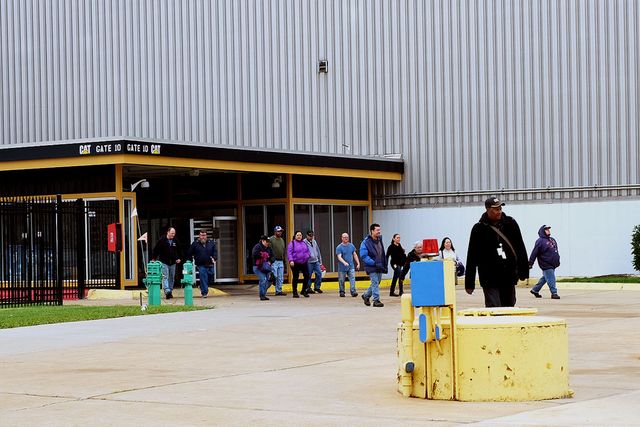
Caterpillar, Butterball to close factories in Montgomery, Illinois, laying off 1,400 workers

Marcus Day & George Marlowe 

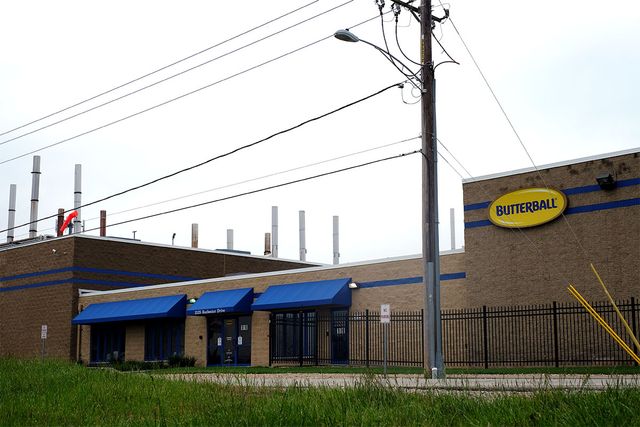
Butterball, the turkey product manufacturer, announced plans last week to close its meat processing plant in Montgomery, Illinois, located in suburban Chicago, by July 17.
The closure will wipe out some 600 jobs and comes on the heels of the announcement last month that construction equipment giant Caterpillar will shut down its Aurora production facility, also located in Montgomery, laying off over 800 workers.
The dual factory closures, taking place in an area already hard hit by decades of deindustrialization, further undermines the fraudulent claims put forth by the media and Trump administration that the US economy has reached “full employment” amidst a manufacturing renaissance.
Butterball LLC, based in North Carolina, operates plants in that state, Illinois, Missouri and Arkansas, and is co-owned by Maxwell Farms Inc. and the Seaboard Corporation, the agribusiness multinational. In the US, the company sells over 1 billion pounds of turkey annually and employs approximately 7,000 people.
Butterball facility in Illinois
A “vertically integrated” turkey processor, Butterball purchased its Montgomery plant just four years ago from Gusto Packing Company, a small pork product producer founded in 1972. It is the company’s only production facility in Illinois.
Butterball COO Jay Jandrain cited the timeworn justifications of changing “market conditions” and “consumer needs” in announcing the shutdown. Jandrain claimed disingenuously that Butterball was “committed to retaining as many of our Montgomery employees as possible” and would offer relocation assistance to employees—if there was an available position at one of the company’s plants hundreds of miles away.
The company also announced earlier this year that it would combine two shifts at its Carthage plant in western Missouri, laying off 75 workers.
The closure of the Butterball plant in Illinois will compound the painful situation workers in the area already confront following the announcement of job losses at Caterpillar in April. Both plants are located next to Aurora, a far-western suburb of Chicago and the second-largest city in Illinois.
The state has hemorrhaged 300,000 factory jobs since 2000, and currently has fewer jobs than in that year, according to the site Illinois Policy. The trend has continued and even accelerated up to the present, with 5,000 manufacturing jobs lost in 2015, 7,700 in 2016, and 800 in the first three months of this year.
The trade unions, including the United Auto Workers (UAW), the United Steelworkers (USW) and the International Association of Machinists (IAM), have facilitated this disaster, working with corporate management to slash labor costs, shut down one factory after another, and thereby inflate “shareholder value.”
As has now become a standard procedure in union-company negotiations, Caterpillar first floated the possibility of closing the Aurora plant at the opening of contract negotiations at the beginning of this year, thus seeking to intimidate workers who were determined to regain past concessions. The proposal also contained a wage freeze for older workers and new attacks on health care, among other givebacks.
Caterpillar plant in Aurora, IL
Despite the UAW’s efforts to ram through the contract without allowing members to study the full agreement, there was immense opposition among workers, with the largest local, in Peoria, voting it down by at least 55 percent.
Nonetheless, after delaying announcing the results of the vote, the union claimed a ratification, and within days, Caterpillar formally announced the planned closure of the Aurora plant by the end of 2018. Nearly two months later, the UAW has yet to release either a vote total or the full contract, or even issue a comment on the plant shutdown.
Reporters from the World Socialist Web Site recently distributed copies of the Autoworker Newsletter at the Aurora plant and spoke to workers about the impact of the job cuts and the aftermath of the contract vote.
“It’s absolutely not good,” said Charles. “I’ve worked here 45 years and I’ve been through a lot. I still can’t understand why in the world they are going to close the Aurora plant since they are making money. ”
“Back in the early 1970s,” Charles added, “the UAW was a very strong union. By the ‘90s things started to go to pot. Now it seems like they do nothing. They just collect dues. And I’m not the only one who feels like that.”
Charles and others noted that workers at the plant were either retiring or leaving for other jobs as soon as they could, and that Caterpillar was actually hiring more temporary workers in the interim.
“It’s very disturbing and I was going to be retire anyway. They said that at the end of next year they are going to close. It’s just mind-boggling.”
A temporary Caterpillar worker also spoke about the impact of the Butterball shutdown to his family. “My mother works at Butterball. It’s going to be very bad for our economy here. I used to work at that plant before it got bought by Butterball and it had very bad management then. I used to be a top worker there and the supervisors would always try to find something wrong with what I did. And so I left there.”
“I was going to call him to tell him about Butterball,” a Caterpillar worker with three years chimed in. “I thought, ‘Oh, no. Not his mother!’”
“Many of the workers [at the Caterpillar plant in Aurora] are leaving to find other jobs,” he added. Referring to the massive new fulfillment centers that Amazon is planning to open this year in Aurora—where workers will be paid a fraction of the wages at Caterpillar—he said, “Some are applying to Amazon. But I hate to see our jobs go. We are not valued as an asset to Caterpillar. We are just workers and the stockholders come before us. They’ve got the money and control things, but we are the backbone.”

Brazil crisis threatens second impeachment in less than a year

Miguel Andrade

Brazil’s influential Bar Association (Organização dos Advogados do Brasil, OAB), has called for the impeachment of President Michel Temer, increasing the odds that Latin America’s largest nation will see its second change of power in less than nine months.
The move came as details continue to emerge on the plea-bargain agreement negotiated by Joesley Batista and other executives of the J&F private investment holding company directly implicating President Temer in Brazil’s sweeping political corruption scandal.
The 25-1 vote by the OAB’s governing council is a barometer of the mood within Brazil’s ruling circles, echoing similar votes taken preceding the country’s last two impeachments: in 2016 of Dilma Rousseff of the Workers Party (PT), handing power to Temer; and previously in 1992, when the darling of the IMF, President Fernando Collor de Mello, resigned after his ouster became inevitable.
The Bar Association also gave its consent in 1964 to the toppling of the bourgeois reformist President João Goulart in a US-backed military coup, signaling the capitulation of the so-called bourgeois-democratic forces to the imposition of a brutal dictatorship that was to last for 21 years.
J&F controls JBS, considered the world’s leading animal protein processing company,
and has reported 170 billion reais (US$54 billion) in revenues in 2016, a 35-fold increase since 2007, during the first term of the Workers Party’s 13-year rule. The formation of such a monopoly was made possible largely through the PT federal government’s aid via the National Development Bank (BNDES) and the anti-trust oversight agency, CADE. The company was a target of multiple Federal Police (PF) investigations stemming from the ever-widening Operation Car Wash (Lava Jato) investigation into illegal government contracts, bribes and kickbacks in major industrial areas such as oil extraction and refining, shipbuilding and hydro-electric projects.
According to the influential financial daily Valor, the Brazilian market now accounts for only 10 percent of the company’s revenues. J&F owns 54 meatpacking plants in the US alone, operates in 22 countries and exports to 150. As part of its growth, J&F was able to buy thermoelectric plants and pine forests and negotiate lucrative energy contracts with state-owned and private providers, linking it directly with other major targets of the Car Wash and related investigations.
Against this backdrop, President Temer was taped by the company’s CEO and owner, Joesley Batista, consenting to payoffs to buy the silence of Eduardo Cunha, the former head of the lower house of Congress. Temer is also recorded indicating that Batista should “speak in his name” when asking for favors from the CADE anti-trust agency, and being told that Batista was paying off prosecutors and judges involved in investigations into his company. Furthermore, Batista received privileged information on impending changes in the country’s public debt interest rates, giving him an insider’s advantage in negotiating trades in government bonds.
After the conversation with Temer was handed over to the investigators, a sting operation was set up by federal prosecutors to have Batista ask Paraná state federal representative Rodrigo Loures to negotiate favors with the CADE and later tape him picking up money to pay for them.
With hard evidence of Loures’s access to high officials, and since Temer failed to report the conversation to the police or the Attorney General, Supreme Court Justice Edson Fachin last Friday authorized the opening of an investigation against the president on the grounds that he consented to multiple crimes. According to the Brazilian Constitution, while in office, the president may only be investigated for crimes committed during the current term. Previously, Temer had been shielded from prosecution on evidence that, before taking the reins as president, he was involved in the ubiquitous bribery and kickback scandal.
The lifting of this protection underscores the depth of the current crisis, which has been underscored by the timeline of events since the newspaper O Globo leaked information on the tapes last Wednesday.
The authorization of the investigation was followed by the official release not only of the full content of the tapes but also of videos with confessions by Batista and his associates to officials of the Attorney General’s office, in which they claimed to have put more than a thousand leading politicians on both the local and federal level on their payroll. They also confessed to having made illegal payments of almost $50 million to former PT presidents Rousseff and Lula da Silva through negotiations with former Finance Minister Guido Mantega in exchange for political favors.
As further details became known, Valor reported on Thursday that the taping of Temer was part of the sting operation from the start, but then retracted the claim on Saturday. Later, Folha de São Paulo reported on Saturday, May 20, that a close Batista associate had met a Federal Police investigator and a federal prosecutor to be “lectured” on the subject of plea bargains two weeks before the meeting in which the president was secretly recorded.
The meeting of Batista with the prosecution reported by Folha indicates that rogue elements inside the state might have been behind a bid to topple the president, since, according to Brazilian law, Batista should have had no prior advice on the conditions for a plea bargain before handing himself over to the investigators.
Temer’s defense also claims that the tape is not valid evidence since Batista aimed to provoke the president, rather than to protect himself, as would be required by law.
Moreover, it was revealed on Monday that the Supreme Court accepted the tapes as evidence without even having them evaluated by experts as to possible editing. After Folha de São Paulo reported that the tape could contain more than 50 edits, and at the insistence of Temer’s attorneys, it was returned by the Supreme Court to the Federal pPlice and the investigation put on hold until a new evaluation is made. These developments have set the tone for the São Paulo papers, especially Folha and Estado de São Paulo, in urging calm and a halt to calls for Temer’s ouster, while the powerful Globo media conglomerate continues to move against the government.
Meanwhile, it was revealed that Batista traveled to New York with his family with authorization from the investigators in order to put in place plans to transfer his company to another country, probably the Netherlands. This move comes after he reaped US$80 million in profits after buying a billion dollars the day before O Globo leaked his story and the currency went up by 8 percent against the real—the sharpest devaluation for the Brazilian currency since the Asian crisis in 1999. The revelations implicating Temer also triggered the sharpest drop on the Sao Paulo stock exchange since the global financial meltdown of 2008.
The intensification of the Brazilian crisis raises vital political questions for the working class. Multiple divisions are emerging within the ruling class, bound up with nervousness over the country’s deteriorating economy and the inability of Congress to pass legislation embodying the toxic agenda of social counterrevolution that was at the heart of the impeachment of Rousseff in 2016.
The acceptance by the Attorney General’s office and the Supreme Court of what was, even without direct initial involvement of state agents, essentially a sting operation against the president, exposes a growing breakdown of constitutional forms of rule.
Congress, threatened by the corruption investigations opened against a third of the Senate, has raised the stakes against prosecutors by threatening to punish them if they fail to prove their charges. A so-called “abuse of power” law is being discussed in Congress in order to make prosecutors “think twice” before bringing charges against politicians. At the same time, the Federal Police have increasingly made use of sting operations after the PT government approved a thoroughly anti-democratic law authorizing them in 2013, and the Supreme Court started validating ill-gotten evidence obtained through their use.
At the same time, the whole political system is thoroughly discredited by the continuous revelations of corruption, and the government’s reactionary agenda is intensifying the popular sentiment that its rule is illegitimate. Similar sentiments were initially directed against Dilma Rousseff in 2015 when her second term began with a sharp turn to the right and to austerity measures, along with the repudiation of her election platform. The hostility to the government only increased after Temer’s reactionary takeover, with growing factions of the ruling class turning against Temer and to alternatives to “legitimize” bourgeois rule, including amending the constitution in order to bring forward general elections, as initially proposed in Congress by the Workers Party after Rousseff was ousted.
Both Folha de São Paulo’s Datafolha polling institute and the union-linked Vox populi institute agreed at the end of April that 80 percent of the population supports early elections, and both Congress and the Supreme Court are set to decide on the matter in the next weeks, with one of the largest parties in Temer’s coalition, the thoroughly bourgeois Brazilian Socialist Party, abandoning the government and backing the proposal.
The demand is set to dominate the “occupy Brasília” march called by the unions in the wake of the April 28 general strike that brought out some 35 million workers. The union organizers of the May 24 march, initially called to protest pension and labor “reforms” proposed by the government, say they intend to bring 100,000 demonstrators to the isolated inland Brazilian capital.
The fundamental political premise of the unions and Brazil’s pseudo left is that the abandoning of the Temer government by growing sections of reactionary press, big business and bourgeois parties is to be hailed, and workers’ struggles must be subordinated to these political maneuvers in order to breathe new life into Brazilian capitalism. This conception was clearly exposed in two contributions published in the PT-aligned Carta Capital.
Editor Mino Carta, in an article published Monday, defended the demand for immediate elections. He contrasted the current situation to the conditions that existed under PT rule, while appealing to business, saying that the magazine was “financially asphyxiated by an illegitimate and knowingly corrupt government and by the abandonment by businessmen who used to show more commitment to diversity and plurality.”
Meanwhile, pseudo-left star Guilherme Boulos, head of the Homeless Workers Movement and one of the organizers of the May 24 demonstration, warned in the magazine that if an indirect election were to follow the fall of Temer “the country would undergo convulsions. The seriousness of the crisis allows for no arrangements. Congress has no authority to elect anyone indirectly and any succession without elections would maintain the instability.”
These elements are emboldened by recent polls showing Lula da Silva leading in the polls on support for likely candidates in the presidential election scheduled for October 2018. Their aim is a speedy restoration of a PT government in order to stabilize bourgeois rule and stifle the growing militancy of the Brazilian working class.

Australian building workers hit by construction company collapse

Declan O’Malley 

About 100 construction workers and sub-contractors were suddenly thrown out of work on an apartment building site in the Queensland state capital of Brisbane earlier this month when a major development company, CMF Projects, went into receivership.
The liquidation of the company came as a shock to the workers on the inner-city Woolloongabba site, who arrived to start work, only to be turned away. Later, they were allowed to enter the site in groups of five to collect their personal tools and belongings.
This shut-down is another indicator of the possibility of a wider collapse in the residential construction boom seen in the east coast capitals of Sydney, Melbourne and Brisbane since 2012. The jobs of an estimated 200,000 building workers and other people in the real estate industry are threatened.
By industry estimates, the apartment building boom recently peaked at 548 cranes on high-rise developments across Australia, up by 323 percent since late 2013. This unsustainable growth, fuelled by speculative investment, has kept the economy from plunging into recession since the mining boom began to implode in 2012.
CMF’s collapse, which left at least two apartment complexes unfinished in Brisbane, also sheds light on the complicit relations between employers and the main construction trade union, the Construction Forestry Mining and Energy Union (CFMEU).
While the closure came as a bombshell to the rank and file workers on the site, it did not surprise the union delegate. The delegate, who did not wish to be named, said: “The company has been in trouble for months.” Yet the union did nothing to forewarn the workers.
According to the CMFEU delegate, CMF Projects co-operates and works closely with the union. He said the union and the company were now working together to ensure that workers’ entitlements, such as unpaid wages, leave and superannuation payments, would be paid out.
The delegate immediately ruled out any action by the union to fight the retrenchments. When asked what the union would do about the sacking of scores of workers, he said: “It’s all perfectly legal, we can’t do anything about it. So we’re not doing anything about it.”
This has been the response of every trade union to the ongoing destruction of jobs throughout the mining, manufacturing and other basic industries.
There are warnings that the CMF closure is part a gathering rout. Subcontractors Alliance spokesman Les Williams told reporters he expected at least one construction company to collapse in Brisbane every month as the market unravelled. Williams said that since Christmas creditors, including sub-contractors, had already lost an estimated $100 million, as building companies went under.
According to the Australian Financial Review, CMF Projects “which has completed at least a dozen high profile apartment projects in Brisbane, is the first builder of any real significance to go into administration in a market where the number of planned apartment developments has dropped significantly.”
Several other companies have collapsed in Brisbane in recent months. Newstead-based CKP collapsed last month after it racked up debts in excess of $3 million and left four uncompleted projects around the city.
Brisbane-based Bloomer Constructions also went under, owing an estimated $15 million. Brisbane/Gold Coast-based Cullen Group collapsed just before Christmas, owing subcontractors an estimated $18 million and leaving a string of unfinished projects.
Brisbane has become the sharpest indicator of a precipitous downturn that is also emerging in Melbourne, with Sydney not far behind. According to property analysts Urbis, the number of new apartment developments approved in Brisbane has dropped by more than two-thirds over the past year. “In the December 2016 quarter, only 1,496 apartments were approved—compare this to 5,521 apartments one year ago,” Urbis said in its last snapshot of Brisbane.
This slump is intensifying. The Australian Bureau of Statistics estimates that new unit approvals in Queensland fell 29 percent in the month of March. As a result, builders are now finding it difficult to fill their order books, forcing them to cut staff and wind up work teams.
Last October, the Morgan Stanley research unit forecast a 33 percent fall in construction nationally in 2017, from 225,000 homes and apartments to 150,000 over the year, estimating that this could wipe out 200,000 jobs.
Rather than housing demand, much of the boom has been based on speculative investment, searching for capital gains and tax concessions, with many apartments remaining empty after completion. Property prices have soared, placing home ownership out of reach for many working people.
By some estimates, including by the CoreLogic real estate research firm, as many as 200,000 apartments are uninhabited in Sydney alone. Investors, rather than home-buyers, have accounted for about half of all unit purchases in Sydney and Melbourne in recent years, far higher than in previous periods.
In order to prop up property prices and protect their own profits, the banks, other finance houses and real estate firms are seeking to reassure investors that the bursting of the building bubble will not lead to a meltdown. Global investment banking giant UBS this month said the Australian housing market had peaked, but predicted that it would “correct but not collapse” to 180,000 dwelling commencements in 2018.
For the thousands of construction workers already losing their livelihoods, however, this is cold comfort. The housing boom and threatened bust underscores the irrational nature of the private profit system of capitalism—apartments are built that nobody occupies and kept on the market for prices few can afford. Meanwhile, the workers and sub-contractors bear the brunt of this gamble.

Massacre of 17 prison escapees highlights deep social crisis in Papua New Guinea

John Harris 

On May 12, seventeen prisoners were shot dead by police and prison guards, after 77 inmates escaped Buimo jail’s main compound near Lae, the second largest city in Papua New Guinea (PNG). The incident is the latest demonstration of a mounting social crisis within the Pacific Island nation and the ever-greater resort to deadly force and repression by the country’s ruling elite and state apparatus.
The jailbreak was the fourth mass escape to occur since 2014 at Buimo prison, one of the largest in PNG. In February last year, 94 inmates were involved. Police indiscriminately opened fire on the escapees, killing 12 and wounding 18. In 2015, fifty-five men escaped, while in 2014, one detainee was shot dead when 44 made a break from the facility.
The Lae police department is conducting an operation to re-capture those prisoners still at large. Police Chief Wagambie bluntly declared that any associates or family members who were caught harbouring the escapees would be arrested and charged. In a threat that the men risked being shot and killed, Wagambie declared: “I am warning them that they will be caught. They must do what is good for them and surrender.”
Correctional services commissioner Michael Waipo admitted that Buimo could only safely house 500 prisoners, while currently holding 900. The facility is also severely understaffed, Waipo said. Due to a freeze on recruitment, the ratio between staff and detainees, “instead of one to three, it is one to one hundred in a shift.”
According to the US state department, in its Country Reports for Human Rights in Papua New Guinea, 70 percent of those held at Buimo are on remand, denied bail and condemned to confinement before proven innocent or guilty. Some of those who escaped from detention in 2016 had been waiting nearly a decade to face trial.
The report labelled prison conditions “very poor” and “seriously underfunded.” It declared Buimo had “inadequate medical facilities and was overcrowded,” noting that PNG’s prisons were “designed to accommodate 4,166 inmates, but as of October (2016) they held 4,945 inmates.”
Highlighting the dire conditions in jails across the country, prisoners at the Baisu jail in Mount Hagen, Western Highlands Province, were deprived of food for at least five days in February, because Correctional Services had not paid suppliers. A report also pointed out that the full nature of conditions in PNG’s prison system could not be investigated because of the “Ombudsman Commission’s” lack of “adequate resources to effectively monitor and investigate prison conditions.”
In response to the actions by state officials, the Australian head of Human Rights Watch, Elaine Pearson, told the Guardian that “Papua New Guinea authorities don’t have a licence to kill.” In reality, they effectively do. Incident after incident has taken place, in which PNG police or army personnel have used deadly force in response to expressions of discontent and anger over inequality, official political corruption and appalling social conditions.
In June last year, police opened fire on a peaceful march by university students in Port Moresby to the parliament house, injuring at least 23. Notwithstanding the clear abuse of human rights, no officers responsible for this act, or for the massacres of prisoners, have faced charges.
State repression in PNG is aimed not only at protecting the corrupt local ruling elite. PNG became nominally independent from Australian colonial rule in 1975. US and Australian-based banks and conglomerates, however, still dominate major aspects of the country’s economic and social life. PNG’s military and police are funded through Australian government grants, and trained and advised by Australian forces.
Companies such as Newcrest and ExxonMobil operate lucrative mining and gas ventures, looting the country’s resources for the profits of transnational investors, at the direct expense of working people and the rural poor.
Newcrest operates PNG’s Lihar mine, one of the biggest gold mines in the world. It has extracted an estimated 10 million ounces of gold over the past 20 years. Local landowners have protested over the fact that next to no benefit has flowed to them from this vast wealth.
ExxonMobil has directed major investment into opening-up PNG’s vast natural gas reserves, bringing with it an ever greater interest in the country on the part of Washington. US concerns were candidly spelled out by former US Secretary of State Hillary Clinton, who declared in 2011 that “we are in competition with China… ExxonMobil is producing it [natural gas]. China is in there every day in every way trying to figure out how it’s going to come in behind us, come in under us.”
The appointment of Rex Tillerson as US Secretary of State, ExxonMobil’s former chairman, was welcomed by PNG Prime Minister Peter O’Neill, who declared him to be a “very good and genuine friend.”
Last December, the relationship between corporate interests and the PNG state was demonstrated by the deployment of the military into Hela Province, to protect ExxonMobil’s gas operations from angry villagers. Troops have intimidated the local opposition, to prevent disruption to the company’s profit interests.
While the corporations amass huge profits, nearly 40 percent of PNG’s population lives in poverty, subsisting on less than $US1.25 a day. The country has one of the highest rates of maternal death in the world, second only to Afghanistan in the Asia-Pacific region. According to OSAC’s 2016 Crime and Safety Report, nearly half the population lived in squatter settlements, and illiteracy is rampant, particularly among women.
Papua New Guinea has the highest percentage of its population in the world—60 percent—living without access to safe water. In 2016, a particularly harsh El-Nino left 2.7 million people with water shortages, food insecurity and susceptible to disease. Inadequate social infrastructure has seen an epidemic of malaria and HIV/AIDS.
The youth who move from rural villages to the towns and cities, seeking paid work, face endemic levels of unemployment. As a result, PNG also has one of the highest crime rates in the world.
And conditions are only worsening. The collapse in global commodity prices has hit PNG particularly hard; economic growth plunged from 13.3 percent in 2014 to 2.5 percent in this financial year. The austerity package imposed through the O’Neill government’s supplementary budget has devastated government programs and essential services. Public servants now receive little to no payments, while health and education funding has been gutted by 40 percent and 23 percent respectively.
The gunning down of desperate inmates by police and prison officials should raise immense political concern among workers in PNG and internationally. It is of a piece with the brutal state violence unleashed by governments internationally, in order to defend the interests of finance capital and the local elites.
The massacre took place amid the campaign for the coming PNG election, with polls due to open on June 24. Regardless of which coalition of establishment political parties ultimately forms government, it will carry out the dictates of the international banks and corporations, intensifying austerity measures and state repression against the working class and rural masses.
The critical question in PNG, as across the South Pacific, is a turn by the most serious layers of students and workers to a serious study of the history, program and perspective of socialist internationalism, and the fight to build sections of the International Committee of the Fourth International (ICFI), the world Trotskyist movement.

UK wage performance “worst in over 200 years”

Margot Miller 

Wages in the UK have fallen by a 11 percent since 2007 and are expected to be almost £1,000 a year lower in 2017 in real terms than previous forecasts.
The Resolution Foundation think tank’s pre-Brexit prediction for cuts for wages in 2017 has been revised downward by £320 to a £915 drop by the end of the year.
In addition, new figures from the Office for National Statistics (ONS) show a further fall in living standards as inflation outstrips growth in pay. In the first three months of 2017, average weekly earnings excluding bonuses rose by 2.1 percent compared to a rise in inflation of 2.3 percent. Overall, the ONS concludes that average UK workers will still be earning less in 2021 than they did in 2008.
Bank of England governor Mark Carney confirmed that the year ahead would be a “more challenging time for British households.”
Two years ago, inflation was hovering around zero. The latest rise in inflation to a four-year high of 2.7 percent is linked to last year’s Brexit referendum vote, which caused the value of the pound to slump and a resulting rise in the price of imports. This is set to worsen. The senior economist at Hargreaves Lansdown, Ben Brettell, said, “With inflation forecast to carry on rising—Bank of England policymakers predict inflation will peak a little below three percent in the fourth quarter—household budgets look certain to be squeezed further in the coming months.”
Commenting on the ONS figures, Stephen Clarke, an economic analyst at the Resolution Foundation, said, “Coming so soon after the big post-crisis pay squeeze, this new phase of falling pay means that this decade is set to be the worst in over 200 years for pay packets.”
Britain already lies third from bottom in a comparative league table of wages of 34 developed nations, in research published by the Trades Unions Congress (TUC) based on Organisation for Economic Cooperation and Development (OECD) figures. The UK is one of five countries, including Italy, Austria, Greece and Portugal, where wages are expected to be lower in 2018 than before the financial crash of 2008.
One example cited by the Resolution Foundation of how workers are being robbed of a decent wage is companies forcing an effective pay cut to fund shortfalls in defined pension schemes. An average 10 percent of money paid into defined-benefit schemes over the past 16 years has been funded by suppressing wages, an effective 0.6 percent cut compared with employees in companies that do not have a deficit. Fully 85 percent of the 6,000 defined-benefit schemes are closed to new members.
Poverty levels are set to rise further, as a result of new policies unveiled by the Conservatives in their election manifesto. To cite just one example, the Tories propose to scrap free school dinners for primary school children (up to age seven years), under conditions where a third of children are being brought up in families below the poverty threshold. With this single policy alone, families stand to lose out by an additional £440 a year for each child affected. The government has already pencilled in £9 billion in welfare cuts leading up to 2020, of which three-quarters have yet to be implemented.
In the face of this deepening social catastrophe, the Labour Party has focused on a headline commitment to raise the minimum wage to £10 an hour, but only by 2020. By this time the Tories would have raised the minimum to £8.75 an hour. A worker employed on a 40-hour week at Labour’s Living Wage—and many work shorter hours—would earn £1,600 per month before deductions, so the family would remain either around or below the poverty level. According to the Child Poverty Action Group, the poverty level after housing costs for a lone parent family with two children is £1,261 per month, and for a couple with two children it is £1,703.
Equally, Labour is telling barefaced lies when it proposes to redress the gross inequality that exists in the UK, a country where the wealthiest 1,000 individuals are worth as much as the poorest 40 percent of the population. The manifesto outlines a tax on income of earners over £80,000 of 45p in the pound, with a new higher band of 50p for income earners over £123,000. These still-low rates are similar to those imposed for a time by Labour Prime Minister Gordon Brown following the 2008 crash. Careful accounting will ensure that any hit on the wealthy is minimised. Moreover, they are a tax on income, not wealth and assets in their myriad forms. The super-rich would therefore remain safe under Labour.
The manifesto also speaks of an “excessive pay levy” for companies that pay high salaries—by which is meant a 2.5 percent levy on earnings above £300,000 and 5 percent on earnings above £500,000. This is set at a very high level, given that the average pay of a CEO is around £92,000. Labour proposes a maximum pay ratio of 20:1, but only as a condition for those private companies being awarded government contracts. This sum would be easily avoided by a shift to executive bonuses by the targeted companies.
The weekly wage of a worker, before tax, is £400 at Labour’s Living Wage rate, whereas the targeted CEO will still be taking home up to £8,000 a week.
Just as tellingly, the Resolution Foundation estimates that at least £7 billion of the planned Tory cuts will be retained, according to its appraisal of Labour’s manifesto.
As for the trade unions, TUC President Francis O’Grady said earlier this month, “British workers have endured the longest pay squeeze since Victorian times, and now even more pain is on the horizon.” But after noting that “in the world’s sixth richest economy” it is a disgrace “that nurses are having to use food banks to get by” and that “Britain badly needs a pay rise,” O’Grady then meekly urged that “all the political parties...explain in their manifestos how they will boost living standards in the UK.”
Over the past 30 years, the trade unions have collaborated with various governments in attacking jobs, wages and services. This was stepped up after the 2008 global financial meltdown, when more than £1 trillion was handed over to the banks to bail them out.
The last united day of strike action called by the trade unions was in 2011 against the gutting of pensions in the public sector. This struggle was wound down to a few single strike days on a union-by-union and regional basis, and then called off altogether. As a result, workers now have to work longer and pay higher contributions for smaller pensions. As the election unfolds, the unions are working might and main to sabotage struggles of rail, car workers, health, education and IT workers at Fujitsu.