3 Jun 2017

Prices of US branded prescription drugs rose 13 percent in 2016

Brad Dixon

According to the National Drug Index put out by the health care technology company Truveris in early May, the prices of branded drugs rose by 13 percent last year, while drug prices overall increased by 8.8 percent.
The rise in drug prices is 318 percent higher than the rise in the costs of goods due to inflation, according to the report. Truveris data for the first quarter of 2017 continued to show drug price hikes outpace inflation.
Over the past three years, drug prices have increased an average of 10 percent each year.
“Actual drug price inflation hurts the patient the most, especially individuals with high deductibles, coinsurance or no insurance at all,” A.J. Loiacono, a co-founder and chief innovation officer at Truveris, said in a statement released with the report.
The release of the Truveris data follows a report issued by Credit Suisse in April, which found that the price hikes by drug companies were responsible for 100 percent of the industry’s growth in 2016. For major biopharmaceutical companies such as AbbVie, Allergan, Amgen, Biogen, Eli Lilly, Merck and Pfizer, the report found that price increases represented at least 100 percent of their net income growth.
“Despite public scrutiny, we estimate US net price rises contributed $8.7 billion in 2016 to net income, 100% of sector EPS [earnings per share] growth,” said the report, according to Business Insider.
This past January, the month in which drug companies usually introduce their price hikes, the industry raised the list prices of 2,353 prescription drugs, according to an analysis released in February by the investment firm Raymond James & Associates. The firm found that although there were fewer price hikes overall and fewer price hikes above 10 percent, the average price hike of 8.9 percent remained about the same as in 2016.
Raymond James analyst Elliot Wilbur told the Wall Street Journal that the smaller price hikes are due to fears of public anger, so the drug companies are “sticking with what they perceive to be the rate the market will bear, high single digits.”
Driven by pressure from shareholders determined to maximize their return on capital, and facing a decline in Research and Development (R&D) productivity, drug firms have sought to maintain and ratchet up profits through frequent and often gargantuan drug price hikes.
The strategy of acquiring an old, long-available drug and then hiking the price by thousands of percentage points, carried out most notoriously by Turing Pharmaceuticals, continues to be pursued in 2017.
Marathon Pharmaceuticals, based in Deerfield, Illinois, took the drug deflazacort, a steroid used to treat children with Duchenne muscular dystrophy that was available in Europe and Canada for between $1,000 and $2,000 per year, and hiked the price by 6,000 percent to $89,000 per year.
The company took advantage of the fact that while the drug had been widely available elsewhere, it had not yet received FDA approval in the US. As such, it was considered a “new” drug (branded as Emflaza), giving the company not only a seven-year monopoly on selling the drug in the US, but also vouchers and other benefits because Duchenne muscle dystrophy is classified as a rare disease.
Amid outrage over the price gouging, Marathon delayed the release of the drug in February, ultimately selling the drug in March to the New Jersey-based PTC Therapeutics for $140 million in cash and stock.
Drug manufacturers have also pursued less legal methods for keeping drug prices high.

Lawsuits over drug price hikes

In December of last year, 20 state attorneys general jointly filed a federal antitrust lawsuit alleging that a number of generic manufacturers—Heritage Pharmaceuticals, Aurobindo Pharma ASA, Citron Pharma, Mayne Pharma, Mylan Pharmaceuticals, and Teva Pharmaceuticals—entered into illegal conspiracies in order to reduce competition and artificially inflate the prices of an antibiotic (doxycycline hyclate) and an oral diabetes medication (glyburide).
According to a lawsuit filed last month by Sanofi-Aventis, Mylan attempted to leverage the high price of EpiPen in order to “squelch this nascent competition” from Sanofi’s rival product, the Auvi-Q. The lawsuit alleges that Mylan would offer deep discounts to drug suppliers, as long as suppliers agreed that they would not purchase Sanofi’s product, ultimately dropping Sanofi’s market share from 13 to 7 percent.
Sanofi dropped the Auvi-Q from the market in 2015, although the product has been brought back by the drug company Kaleo, but with an inflated price tag of $4,500, reports Ars Technia .
Seeing the writing on the wall, a few drug companies have made largely symbolic gestures to address drug pricing. Merck and Johnson & Johnson, for example, have begun publishing pricing transparency reports, while Allergan has called on other companies to limit price hikes to single-digit increases.
Valeant Pharmaceuticals, on the other hand, which has come under attack for dramatically hiking its drug prices and other seedy business practices, is contemplating changing its name to take attention away from the company’s scandals. “Surprisingly enough, a strategy like that can sometimes work,” Bob Killian, founder of Killian Branding, told Bloomberg. “We’ve talked about our scandal—jingling the keys now—here’s the new shiny object, our name change.”
“To the insiders who are going to be cynical and giggle at it, it’s an obvious distraction,” Killian said. “That doesn’t mean it won’t work.”
In its latest public relations move, the industry trade group Pharmaceutical Research & Manufacturers of America (PhRMA) changed its membership rules to require members to spend at least $200 million on R&D and ensure that R&D spending equals at least 10 percent of the company’s global sales. Last month, the industry group kicked out 22 drugmakers who did not meet the new criteria.
These membership changes at PhRMA follow the exit from the trade group of Mallinckrodt Pharmaceuticals and Marathon Pharmaceuticals in April after they sparked outrage for their price-gouging efforts.
In 2014, Mallinckrodt acquired from Questcor Pharmacetuicals the drug Acthar, a medication developed in the 1950s that is primarily used to treat infantile spasms. Questcor, and then Mallinckrodt, came under heavy criticism for repeatedly hiking the price of the drug, from $1,235 a dose in 2005 to over $20,000 in 2008 and more than $35,000 in 2016. Likewise, Marathon left PhRMA after the negative publicity it received surrounding its pricing of deflazacort for Duchenne muscle dystrophy.
The change by PhRMA is, of course, an attempt to legitimize the continued price gouging by the industry. It allows pharmaceutical companies to draw attention to the money they spend to research and develop new drugs—the primary (and unjustified) excuse the industry uses to rationalize its high drug prices.
Meanwhile, pharmaceutical companies have continued to focus on their primary method for generating revenue: sales and marketing.
According to Medical Marketing and Media, the US pharmaceutical industry spent a record $5.6 billion on direct-to-consumer advertising in 2016, an increase of 9 percent over the previous year. Other than New Zealand, the US is the only country that allows direct-to-consumer advertising for pharmaceuticals, which encourages consumers to “ask your doctor” about a particular medication—instead of, for example, an equally effective generic version or an older drug with a longer safety track record.

Soap opera advertising

Beyond the usual direct-to-consumer advertising, at least one drug manufacturer has taken to soft-selling its wares on a TV show. The longest-running daytime soap opera, General Hospital , developed a storyline in which one of the characters is diagnosed with polycythemia vera (PV), an uncommon cancer and a form of myeloproliferative neoplasm (MPN).
According to an article published last month in the Journal of the American Medical Association ( JAMA ), the storyline was the product of a partnership between the US pharmaceutical company Incyte and the show’s producers (a fact that Incyte readily admits to, having even issued a press release). While the FDA regulates direct-to-consumer advertising (e.g., requiring the listing of potential side-effects), “disease awareness” promotions are generally not considered advertising as long as a specific treatment is not identified.
Incyte’s only FDA-approved product on the market is a second-line therapy for treating MPN, ruxolitinib, a Janus kinase 2 (JAK2) inhibitor. It is the only therapy that targets the genetic mutation in the JAK2 gene that is likely responsible for the disease process.
In the episode of General Hospital, the doctor lists the treatments used to address the disease. The character, Anna Devane, replies: “But this protocol sounds like you are treating the symptoms of this cancer; how do we beat it?” The line subtly promotes Incyte’s drug.
Vinay Prasad, co-author of the JAMA article, told Vox that the promotion of the rare and difficult therapy to diagnose cancer could lead to over-diagnosis. In such cases, individuals could seek out a possibly unneeded drug, costing upwards of $1,000 per month, that carries side effects including severe anemia and heightened risk of infectious diseases.
“It blurs the line between advertising and a public health message,” Lisa Schwartz, a Dartmouth professor of medicine who studies pharmaceutical marketing, told Vox. “This just seems like a terrible precedent and something needs to be addressed.”
Pharmaceutical companies also invest in marketing drugs to doctors, which a number of studies have found to be effective. A study published in JAMA in May that looked at the prescribing behavior of 2,126 doctors at 19 US academic medical centers found that restrictions on how and where sales reps, known as detailers, were allowed to interact with doctors led physicians to prescribe more generic medications—less-expensive equivalents of branded drugs.
This follows an article published in August of last year in JAMA Internal Medicine, which found that even the simple act of receiving an industry-sponsored meal resulted in higher prescribing rates of the brand-name medication being promoted by the company.
In response to the outrage over the prices of drugs, federal and state legislators have put forward a number of inadequate proposals to rein in high drug prices. They include speeding up the approval time for new generics, making the price hikes more transparent, requiring more transparency from pharmacy benefits managers, allowing consumers to import drugs from abroad, and allowing Medicare to negotiate drug prices.

Pro-profit medicine

Few of these proposals have any chance of actually going forward, and none would address the underlying cause of the skyrocketing drug prices, the complete subordination of health and medical decisions to the profit interests of corporations.
Nonetheless, wary that the public backlash against price hikes might translate into minor political reforms, the pharmaceutical industry has begun to flood state and federal legislatures with lobbyists.
According to the Center for Responsive Politics, PhRMA spent $19.7 million on lobbying in 2016. The trade group spent $7.98 million in the first quarter of 2017, more than any single quarter in nearly a decade, according to Kaiser Health News .
Looking at congressional records, Kai ser Health News found in April that that lobbying spending by eight pharmaceutical companies—including Celgene, Mylan, Shire Pharmaceuticals and Teva Pharmaceuticals—doubled in the first three months of 2017. In this same period, spending by 38 large drugmakers and trade groups increased by $10.1 million to a total of $50.9 million, allowing the industry to pay for 600 lobbyists.

Over 200 killed in Sri Lankan floods, now cyclone hits Bangladesh

Rohantha De Silva

After record southwestern monsoon rains caused massive damage in Sri Lanka last week, parts of eastern India and Bangladesh were hit by Cyclone Mora on Tuesday.
According to the latest figures, 203 people were killed in Sri Lanka, 96 remain missing and over 60 are seriously injured. The Disaster Management Centre reports that over 600,000 people have been affected. Around 1,500 houses are fully destroyed and 7,000 partially damaged.
Many areas are still unreachable due to floods and over 50 deadly landslides, with workers and the rural poor the hardest hit. This includes thousands of tea and rubber plantation workers in Agalawatta and adjoining areas in Western Province, and in the Ratnapura district.
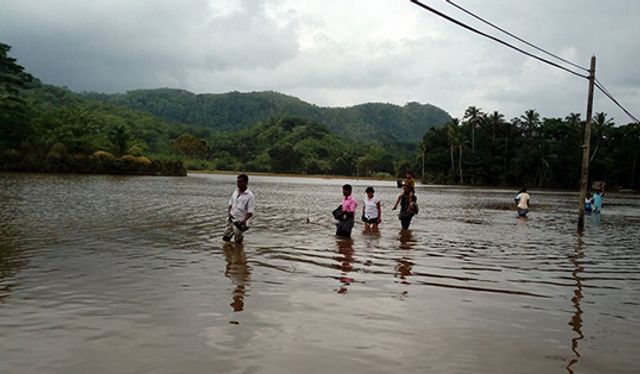
People wading through floodwaters
Thousands of people face the threat of dengue fever, cholera, diarrhea and dysentery due to the lack of basic sanitary and health facilities and cramped conditions in makeshift survivors’ camps. The Sirisena-Wickremsinghe government has so far failed to provide a concrete plan to cope with the situation.
Save the Children Sri Lanka chief Chris McIvor told Reuters that water-borne diseases were a major concern because of the damp and crowded conditions. According to government estimates, 40 percent of those affected do not have access to safe drinking water. Dengue fever, which was already at epidemic proportions before the floods, is expected to worsen as mosquitoes find new breeding grounds.
Entire communities remained marooned by floodwaters. Many survivors are forced to sleep outside because their homes have been destroyed.
“Getting in to these communities is of the highest priority right now so we can find out exactly what the needs are and respond,” McIvor said. He warned the disaster could worsen over the coming days because last week’s floods were just the beginning of the southwest monsoon season.
H. Jayanthan, a specialist physician, told the WSWS that “funguses affecting the base of fingers have already started to emerge amongst flood survivors and other skin diseases are also being reported.” Older survivors, he added, “are contracting respiratory tract infections and others are complaining of fever.”
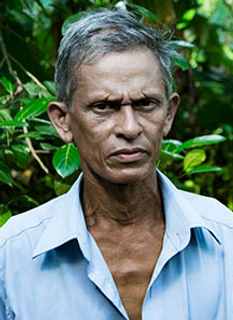
Sunil Withanage
Agricultural production has been heavily impacted, with thousands of acres of land under water. Sunil Withanage, 53, a teacher and part-time peasant from Akurukalavita in the Kalutara district, told the WSWS: “We’ve never seen floods like this in our lifetime. In this area alone, there is about 200 acres under water.” Withanage explained that because of the previous drought, only an eighth of the available paddy land had been cultivated.
Molkava, Paragoda, Pahiyangala and Nikgaha in the Kalutara district were heavily affected, with the bodies of 30 people killed by floods and landslides so far found in the area. The first naval rescue boat did not reach the area until after midday Saturday, followed by a medical team with two doctors on Monday. Some areas are still inaccessible.
A WSWS correspondent who visited the district to see relatives explained it was a poverty-stricken rural area. Many residents worked in the plantations for a daily wage of around 400 rupees ($US2.60) and others eked out an existence as small cultivators. Transport, even before the floods and landslides, was very difficult, with buses only running three times a day. The nearest, poorly-equipped and under-staffed hospital is eight miles away at Bulathsinhala.
Flood and landslide victims have no idea how they can rebuild their lives and bitterly denounced the fact that they will receive little or no government assistance.
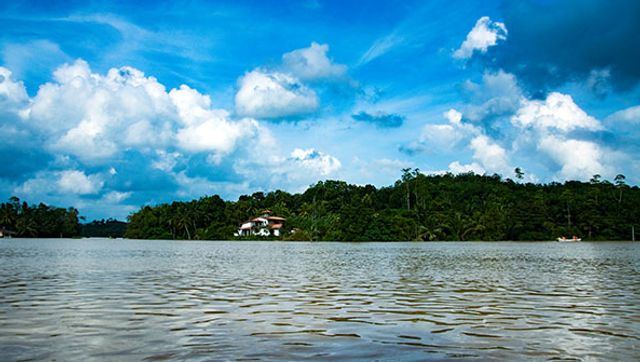
A paddy field under water
One villager told the WSWS: “My house was totally destroyed by the flood. I had a farm but now I’ll have to start from zero again. We’re afraid that there will be another flood, and don’t think there’s any point living here anymore, but we have nowhere else to go. All the governments and the authorities are responsible for these disasters.
“When the Kukule Ganga Project [an irrigation and hydro-electricity scheme] was about to start we opposed it because we knew about the damage that would be created by it. We heard that it was designed to send overflowing reservoir water into some other unpopulated area. The government didn’t allocate money to prevent that but chose easy methods.”
Inadequate state relief and Colombo’s refusal to develop measures to prevent or counteract the annual flood disasters have deepened anti-government sentiment.
President Maithripala Sirisena visited the Ratnapura district on Monday, holding discussions with ministers and officials. Sirisena then appeared on television, cynically declaring that the cabinet had decided not to buy luxury vehicles for government ministers this year, as if this represented a massive sacrifice.
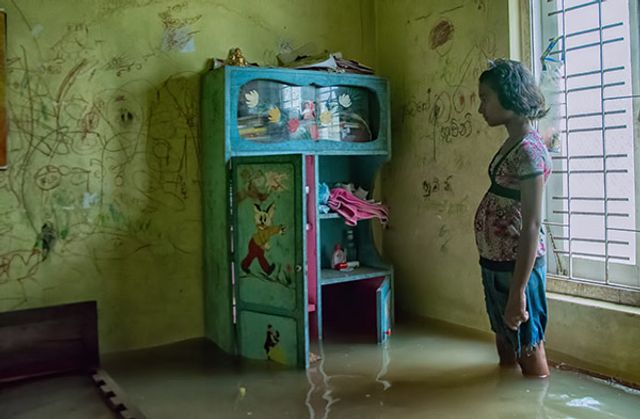
A child inside her flooded room
India, in line with US geo-strategic policies, is attempting to strengthen its ties with Colombo. It has dispatched three naval ships with 300 navy personnel to assist in relief measures. This includes divers, medical teams and inflatable boats, as well as relief supplies, such as dry rations and blankets. The Chinese government has also announced $US2.2 million in flood relief aid and Pakistan sent a shipload of relief goods and medical teams.
Washington, which played a major role in securing the presidency for Sirisena, has offered a pittance. The US ambassador Atul Keshap announced his government would only provide 15 million rupees ($US98,000).
On Tuesday, Cyclone Mora hit Bangladesh, forcing hundreds of thousands from their homes and killing at least six people.
According to the Bangladesh Meteorological Department, 117 kilometer per hour winds struck the country between the fishing port of Cox’s Bazaar and Chittagong city. The department warned that these areas and other coastal districts were “likely to be inundated” by a storm surge of four to five feet.
People in these areas were evacuated to shelters, schools and government offices. Fishing boats and trawlers were warned not to leave their ports and flights in many areas were cancelled.
According to Cox’s Bazaar’s chief administrator, Mohammad Ali Hussain, 17,500 houses were completely destroyed and 35,000 partially damaged in the district.
Refugee camps for Muslim Rohingyas who fled Burma to escape communal attacks from Buddhist supremacists, bore the brunt of the storm. Around 350,000 Rohingyas were living in flimsy shelters when the cyclone struck.
Although no deaths have been reported, “almost every shanty made of tin, bamboo and plastic has been flattened,” one refugee leader reported.

Sri Lankan government claims EU tariff facility will solve economic ills

Saman Gunadasa

The European Union (EU) announced last month that its Generalised Scheme of Preference Plus tariff concession (GSP+) would be restored for Sri Lanka, effective from May 19. The facility was originally granted after the Asian tsunami disaster in December 2004.
GSP+ was withdrawn in 2010 on the pretext that President Mahinda Rajapakse’s government violated human rights during its communal war against the separatist Liberation Tigers of Tamil Eelam (LTTE). Initiated by the US as well as the EU, the real reason for the removal of GSP+ was to pressure Rajapakse to end his government’s close relations with China.
Addressing a Colombo meeting on the eve of the EU announcement that GSP+ would be restored, Sri Lankan Prime Minister Ranil Wickremesinghe claimed that the tariff concessions would help overcome the country’s serious economic problems.
Wickremesinghe declared that Sri Lanka’s balance of payments and debt servicing issues could be “resolved by increasing exports with the regaining of GSP+.” The tariff concession, he continued, would be “a significant landmark” and “the beginning of an export-oriented economy.”
Between 2005 and late 2009, when Sri Lanka had GSP+, exports to the EU increased from $US1.8 billion to $2.4 billion. After the GSP+ concession was withdrawn in 2010, export growth dropped and reportedly led to 25 garment factories being shut down and about 25,000 jobs eliminated.
Wickremesinghe’s attempts to paint the tariff concession as a panacea are absurd. Regaining GSP+ was a key pledge to big business by President Maithripala Sirisena and Wickremesinghe during their election campaigns two years ago. Their administration has worked with the EU powers to restore the facility.
The EU decided to reinstitute GSP+ for two main reasons. Firstly, while the government continues to obtain financial support from China, Colombo has agreed to fall into line with the geo-strategic agendas of the US, EU and India.
Secondly, European corporations want greater access to cheap labour under conditions of the ongoing global economic downturn. Most of the giant retail corporations source their goods from countries like Bangladesh, Vietnam, India, Indonesia and China.
The EU remains Sri Lanka’s main export market, with more than 30 percent of the country’s annual merchandise sold to Europe, and the biggest single market for Sri Lanka’s apparel exports. Colombo hopes that GSP+ will enhance this trade.
While restoring the GSP+ facility, the EU has demanded that Sri Lanka ratify and implement 27 international conventions it previously signed. These include conventions on various social and political rights. The EU wants Colombo to remove its draconian prevention of terrorism laws (PTA) and protect the right of workers to join trade unions. The government has “pluses and minuses” in defending human rights, the EU ambassador to Sri Lanka, Tung Lai Margue, said in announcing the restoration of the tariff concession.
These statements are completely hypocritical. The EU, like the US and other imperialist powers, are notorious for their war crimes and violation of human rights. They all backed the communal war waged by successive Colombo governments against the LTTE and only began raising human rights issues when Beijing emerged as Sri Lanka’s main source of investment and military hardware.
“With the GSP+ we will have access to 6,000 products while looking at new product ranges in the apparel and fisheries sector,” Wickremesinghe said. But several economists rejected this rosy picture. The estimated increase in exports from GSP+ for the rest of 2017 will be just over $300 million.
Sunday Times economist Nimal Sandaratne wrote on May 21 that exports would not expand rapidly because of manufacturers’ inability to immediately “enhance their production capacity.”
According to the Daily Mail on May 18, the semi-government Institute of Policy Studies (IPS) warned that structural limitations, such as labour shortages, are also are a barrier. A factor in the shortage of labour is the low wages paid by companies.
Increasing production capacity, above all, depends on attracting investment. Sri Lanka’s foreign direct investment (FDI), however, halved to $300 million in 2016, from $600 million the previous year. The fall was a result of international financial volatility and investors looking for more profitable production facilities.
While Sri Lankan exports to EU countries will not attract any duty because of GSP+, other countries enjoy similar concessions, such as Armenia, Bolivia, Cape Verde, Kyrgyzstan, Mongolia, Pakistan, Paraguay and the Philippines. Enticing foreign investment and gaining greater market share is a ruthless, cut-throat affair and can be achieved only by lowering real wages and driving down working conditions.
The Daily Mirror article highlighted the austerity measures imposed by Sri Lanka’s economic rivals. This means that similar or more stringent measures must be implemented in Sri Lanka. “Whereas Sri Lanka’s competitors, such as Bangladesh and Vietnam, are embarking on large-scale economic reform agendas, Sri Lanka’s relative reticence restricts its potential for growth,” the newspaper warned.
In 2015, Vietnam, Pakistan and Cambodia had higher EU export earnings than Sri Lanka. That year, Vietnam’s apparel exports to the EU were $3.9 billion, Pakistan’s $2.9 billion and Cambodia’s $3.7 billion, compared to Sri Lanka’s $2.4 billion.
The trade unions, which politically endorsed Sirisena and Wickremesinghe and helped them come to power in 2015, have worked closely with Colombo and the EU to regain GSP+.
Union leaders even lobbied the EU, claiming they were pushing for concessions from companies for the benefit of workers. Their main concern, however, was to demonstrate to investors that the unions were needed to control workers and boost profits.
The unions involved in the lobbying included the Free Trade Zone and General Services Union, the ruling United National Party (UNP)-controlled Independent Employees Union and the Janatha Vimukthi Peramuna (JVP)-affiliated Inter-Company Employees Union.
JVP parliamentarian Sunil Handunnetti accompanied Deputy Foreign Minister Harsha de Silva to Brussels to convince EU parliamentarians. Veteran pseudo-left MP Vasudeva Nanayakkara joined them. The delegation assured European big business their investments would be safe and highly profitable.
The GSP+ will not resolve the economic crisis but will lead to even greater attacks on workers’ wages and basic rights. Foreign and domestic companies in Sri Lanka’s free trade zones are already stepping up their assault, demanding higher productivity, slashing conditions and increasing their use of contract and casual workers.

More warnings of a housing-led crash in Australia

Mike Head 

Further signs are emerging of the unravelling of the east coast apartment construction and real estate market boom that has propped up substantial parts of the Australian economy since mining investment began to slump in 2012.
Any sharp downturn in the debt-fuelled housing market in Sydney, Melbourne and Brisbane would have far-reaching consequences, including the destruction of an estimated 200,000 building industry and related jobs, a wave of mortgage defaults and a slide into recession.
This would place intense pressure on the already fragile government of Prime Minister Malcolm Turnbull, sinking any remaining hopes of it delivering its preposterous May budget forecasts of boosting economic growth from barely 1.75 percent this year to 3 percent by 2019–2020.
Fears of a housing market crash are compounding the anxieties on financial markets over rising debt levels in China, Australian capitalism’s largest export market, and the uncertainties generated by the political crisis engulfing the Trump administration.
The business media was visibly perturbed this week when fund manager Altair Asset Management made the extraordinary decision to liquidate its Australian shares funds and return “hundreds of millions” of dollars back to its clients, citing an impending property market “calamity” and the “overvalued and dangerous time in this cycle.”
Philip Parker, Altair’s chairman and chief investment officer, issued a statement on Monday saying: “We think that there is too much risk in this market at the moment, we think it’s crazy.”
Parker gave reasons that included: the Australian east-coast property market “bubble” and its “impending correction;” worries that issues around China’s hot property sector and escalating debt levels will blow up “later this year;” “oversized” geopolitical risks and an “unpredictable” US political environment; and the “overvalued” Australian share market.
The overheated property market was the most present danger, Parker said. “When you speak to people candidly in the banks, they’ll tell you very specifically that they are extraordinarily worried about the over-leverage of the Australian population in general,” he said.
“Mortgage fraud is endemic, it’s systemic, it’s just terrible what’s going on,” Parker stated. “When you’ve got 30-year-olds, who have never seen a property downturn before, borrowing up to 80 percent to buy three and four apartments, it’s a bubble.”
Altair is a relatively small fund, handling investments thought to be in the hundreds of millions of dollars and holding an advisory contract worth $2 billion. Attempts by financiers and real estate entrepreneurs to discredit or downplay Altair’s move, however, were undercut when larger corporate interests echoed Parker’s alarm.
Citigroup’s global chief economist, Willem Buiter, in Sydney for client meetings on Wednesday, declared that Australia had to “recover from a quite spectacular housing bubble.” Buiter spoke of a “housing debt overhang” and a “collective unreadiness to engage in serious infrastructure investment.”
Buiter also warned that Australia remained vulnerable to an economic slowdown in China, which was a “cyclical accident waiting to happen,” with excess industrial capacity and gross financial sector debt to gross domestic product (GDP) predicted to reach 300 percent by year’s end.
Other fund managers pointed to fears of a share market rout. In a quarterly report to clients on Wednesday, Watermark Funds Management portfolio manager Justin Braitling said: “Shares are expensive at current levels.” With interest rates rising and credit conditions tightening, investors would be exposed to the weak conditions that have persisted since the global financial crisis of 2008.
Already, the Australian share market lost $57 billion in May—a 3.4 percent fall attributed by the Australian Financial Review to international political concerns, combined with investor caution around banks.
Despite the Turnbull government’s efforts to talk up optimism, Treasury secretary and former funds management boss John Fraser said last week that Sydney and Melbourne residential property prices were “unequivocally” in bubble territory.
These concerns extend to the banking system. Ten days ago, institutional investment fund JCP Investment Partners warned that the proliferation of interest-only property loans could be “Australia’s sub-prime,” referring to the US housing loan crash that sparked the 2008 global meltdown.
JCP said defaults on such high-risk mortgage loans to young families, professionals and other over-extended borrowers, in which they were lent amounts more than six times’ household incomes, could wipe out 20 percent of the major Australian banks’ equity base.
Housing prices dropped in Sydney and Melbourne over the past month, on top of the falls that have already occurred in other parts of the country, most precipitously in the mining-dependent areas of Western Australia and Queensland.
According to property researcher CoreLogic, Melbourne’s prices fell 1.8 percent during May, after rising by 50 percent in the previous five years. Sydney’s prices were down 1.3 percent, the second consecutive monthly drop, after soaring by 75 percent in five years.
These figures hide a disparity. While prices for stand-alone houses have not dropped greatly, apartment prices have begun to tumble.
By mid-2016, it is now clear, the highly speculative boom in apartment construction began to implode after building approvals had trebled since 2012.
The latest official building approval statistics indicate that over the past year, approvals for private sector houses have fallen 8 percent and for apartments and flats, 19.7 percent.
This mostly occurred during the second half of last year, when the number of non-house dwelling approvals fell 22 percent. They were down by 30 percent in Sydney, which accounts for around 40 percent of all apartment approvals in Australia.
This turnaround is flowing into the construction industry. The latest data, released this week, showed a 0.7 percent fall in the March quarter, prompting some economists to warn that the official GDP figures out next week could show the economy went backward in the first three months of this year.
Commenting on the latest price fall figures, AMP Capital chief economist Shane Oliver said: “We’re heading for much rougher periods, which probably involve price falls of up to 10 percent in Sydney and Melbourne, and the units in those cities could be even more, 15 to 20 percent.”
Underpinning the unsustainable property boom has been a combination of record low interest rates, predatory bank profiteering and government tax subsidies for real estate investment. Investment has also poured into the housing market due to inability to generate, from manufacturing and mining, the rapacious rates of return there demanded by the financial markets.
As a result, investment has plunged to historic lows in basic industry, while buying a home has been wrenched out of the reach of millions of working class people. Adding to the inequality and irrationality of the private profit system of capitalism is that much of the boom has been based on speculative investment, searching for capital gains and tax write-offs. Thousands of apartments remain empty after completion.
Property developers have enjoyed a bonanza. Harry Triguboff, the country’s biggest apartment builder, has increased his fortune since 1984 from $25 million to $11.45 billion, while working people have faced falling real wages, endemic unemployment and under-employment and deepening cuts to social spending.

Venezuelan death toll continues to rise as Maduro government pushes for constituent assembly

Alexander Fangmann

At least 60 people have died so far in Venezuela over the past two months following a wave of protests called by right-wing opposition parties in response to the Venezuelan Supreme Court’s announcement that it had abrogated the powers of the National Assembly. The majority of deaths are the result of increasingly violent and provocative protests carried out by opposition protesters, and an increased crackdown on such protests by security forces and supporters of the government of Nicolás Maduro.
Violence has also resulted from outbreaks of looting that have occurred during and outside of protests, as sections of the population have been driven to desperation by food shortages and declining real income, only to be met by police and National Guard troops charged with defending the economy from sabotage.
Some of the latest deaths include Cesar Pereira, a 20-year-old student and activist from the opposition Popular Will party. Pereira was shot in the abdomen by a marble during a protest on May 27 in Anzoategui state and died the following morning. It is not clear who fired the marble, as marbles have been used as improvised ammunition by pro- and anti-government protesters.
A student at the Universidad de Oriente in Ciudad Bolivar, Pugas Velasquez, was shot in the head last week during opposition protests at the university. Public prosecutors have announced they will be pursuing charges against three police officers involved in the shooting.
There have also been reports of increasing violence being committed by the opposition. Danny Jose Subero, a former National Guard lieutenant, was apparently beaten to death and shot in Lara state, while his motorcycle and belongings were set on fire. According to a report in Telesur, Subero had been accused of being an infiltrator while taking selfies at the funeral of a student, Manuel Sosa, who was shot during anti-government protests in Valle Hondo.
In another dramatic case, Orlando Figuera, a 21-year-old vendor, was beaten, stabbed and set on fire during an opposition protest in the middle-class Caracas neighborhood of Altamira. The incident, which was caught on video, apparently occurred after protesters called out Figuera as a chavista and thief. Figuera survived the incident, though with burns over much of his body.
According to Penal Forum, an NGO, in addition to the deaths there have been more than 2,700 arrests and 1,000 reported injuries across the country. At least 335 people have been tried by military tribunals, with the government defending their use against civilians, claiming that those who attack members of the military or military facilities can be tried according to military law.
The military tribunals and deployment of troops around the country to quell protests, looting and riots are part of what the government calls “Plan Zamora,” under a decree giving the government the power to essentially declare martial law. On May 18, Defense Minister Vladimir Padrino Lopez said he would be transferring 2,600 National Guard and Special Forces troops to Tachira state as part of Plan Zamora in response to looting and riots in San Cristobal in which three people died.
The increasing clashes between security forces and groups of protesters have begun to cause rifts in the ruling chavista United Socialist Party of Venezuela (PSUV). The country’s attorney general, Luisa Ortega Diaz, who has become a focal point for opposition parties and imperialist media following her criticism of the Supreme Court’s move to curtail the power of the National Assembly, has come out against the violence.
Announcing that all the deaths would be investigated, Ortega has claimed that about half the deaths can be attributed to security forces. So far, over 20 members of Venezuelan security forces have been arrested for actions taken against protesters.
Ortega has also been a focal point for opposition within the ruling PSUV to Maduro’s call for a constituent assembly, which the Maduro government hopes to use as a way of reaching out and splitting the opposition to negotiate an end to the crisis. Such a resolution would be aimed at preserving the power and privileges of the boliburguesia, the layer of capitalist investors, contractors and speculators who have enriched themselves under the rule of Hugo Chávez and his successor Maduro, through a gutting of the limited social programs enacted during the previous two decades.
Elías José Jaua Milano, who was named president of the Commission for the National Constituent Assembly, said in an interview with RT that the opposition is “rejecting taking part in a dialogue and in the elections because they actually don’t want to resolve this conflict through elections” and that “they are trying to depose President Nicolás Maduro.”
Jaua Milano also said that “Venezuela’s top opposition officials are acting on the instruction of most radical parts of the US government…and are carrying out the White House’s request to start a kin-on-kin war in Venezuela.”
Details released about the constituent assembly reveal that it would comprise 540 members, with 364 elected on a regional basis, and 176 selected by various “sectors” of the population including workers, students, rural inhabitants, pensioners, indigenous peoples, disabled people, neighborhood communal councils and national business confederations.
In a leaked letter to Jaua Milano, Ortega wrote, “To resolve the undeniable crisis without precedent the country is undergoing, it is not necessary, pertinent, or advisable to carry out a transformation of the state in terms of a new constitution.” She further stated the constituent assembly would in fact “accelerate the crisis” rather than solve it, and criticized the “sectorial” representation scheme as being a form of “indirect representation.”
Ortega’s opposition has also emboldened other government figures. Supreme Court Magistrate Danilo Antonio Mojica criticized the convening of a constituent assembly without a referendum vote, calling such a process “spurious.” Another magistrate, Marisela Godoy, said that she supported the attorney general and claimed that the constituent assembly “put the structure of the state and social peace at risk, given the current political upheaval.”
According to a Reuters report, the National Electoral Council said voting for the constituent assembly would be held in late July, while regional gubernatorial elections that had been postponed from last year would be held on December 10.
In a sign of the government’s increasing desperation in the face of Venezuela’s intractable crisis and its utter lack of any progressive policy to confront it, it was revealed that the country’s Central Bank closed a deal with the Wall Street investment house Goldman Sachs, selling US$2.8 billion worth of bonds backed by the state-run oil company PDVSA for just US$865 million, or just 31 cents on the dollar.
Financial analysts have reported that Goldman Sachs is banking on US-backed regime change in Venezuela doubling the value of the bonds.
The right-wing opposition hypocritically denounced the Wall Street firm for throwing a “lifeline” to the Maduro government, with some of its leaders threatening to repudiate the debt if they come to power. These same politicians would happily participate in a wholesale transfer of Venezuela’s oil assets to the energy transnationals if they succeed in toppling the Maduro government.

Germany turns to Asia

Johannes Stern

German Chancellor Angela Merkel bluntly addressed the historic crisis in transatlantic relations exposed by last week’s NATO and G7 summits, declaring Sunday in a speech delivered in a Bavarian beer tent that the US was no longer a reliable ally and Europe had to take matters into its own hands. One aspect of that orientation is seen in Berlin’s systematic expansion of political and economic ties with Asia.
Chinese Prime Minister Li Keqiang arrived in Berlin Wednesday evening and was welcomed outside the chancellor’s office with military honors. The ceremony was followed by initial discussions with Merkel and several ministers “about issues of foreign and economic policy.” Those in attendance included Foreign Minister Sigmar Gabriel, Finance Minister Wolfgang Schäuble and Economy Minister Brigitte Zypries.
Merkel will meet with Li again today for “private discussions,” according to the German government’s website. Several bilateral agreements will be signed and a joint press conference has been scheduled. Among the issues to be discussed is a common position in advance of the G20 summit in Hamburg in early June, which Chinese President Xi Jinping is expected to attend.
Germany’s economic relations with China are more extensive than with any other country outside the European Union. Regular government consultations have taken place between both countries since 2011. China was Germany’s most important trading partner last year, ahead of both France and the United States, with total trade approaching €170 billion.
Cooperation is now to be deepened. Deutsche Bank announced prior to Li Keqiang’s arrival in Berlin that it intends to finance infrastructure projects as part of the “new silk road” initiative in the coming five years with a €3 billion loan agreed jointly with the China Development Bank. The Chinese government’s “One Belt, One Road” strategy is based on the historical Silk Road of the Middle Ages. It includes plans for the construction of a series of ports, railways and roads to connect the major economic centers of China with Europe.
At the beginning of the week, the German government agreed multibillion-euro development projects with Asia’s second giant, India. Indian Prime Minister Narendra Modi and Merkel agreed a development budget within the framework of the fourth German-Indian government consultation worth “a billion euros each year” to India.
Modi spoke of India’s major demand for the modernization of its infrastructure. Among other things “roads, railways, civilian air traffic and modern communications technology” were required. India wanted to profit from the expertise of the German economy in all of these areas, he added. “It is as if we were made for each other,” stated the Indian prime minister.
Germany is already India’s most important trading partner within the EU, with total trade of around €17 billion. But the export-dependent German economy is hoping for much more in the years to come. “The ‘Make in India’ campaign and the Indian government’s numerous economic reforms have created new impulses for investment,” enthused the president of the Federal Association of Mid-Sized Businesses, Mario Ohoven.
Along with Modi and Merkel, ministers in relevant areas also participated in the discussions. On the German side, the foreign, economy, education, environment and development ministries were represented. Along with bilateral issues, a central focus was the “framing of the global order,” according to the German government.
The meetings with Modi and Li had been planned for some time. They are part of a comprehensive reorientation by German imperialism that is bound up with the growing rift in transatlantic relations. Shortly after the inauguration of Donald Trump, Gabriel announced the development of a German and European strategy for Asia in order “to exploit the spaces vacated by America.”
Gabriel then officially announced on March 24 “a new orientation” for Germany’s “Asia policy,” and “the establishment of a new Asia and Pacific department” at the Foreign Ministry. He stated in a Foreign Ministry press release: “In many areas of international politics, we are currently experiencing crises, turmoil and new dynamics. One gets the impression that the world is being measured anew—and everyone is using his own tape measure. One thing is clear: the rising states of Asia will assume a key position in this new measuring of the world.”
It was necessary for Germany “to intensify relations with Asia and organize them more strategically so as to do justice to this region of 4 billion people and rapidly growing markets,” according to Gabriel. He had “therefore decided to build an Asian department in the Foreign Ministry for the first time in order to better pool and further develop our regional competencies.” It was “high time for us to do justice to Asia’s growing weight by changing the composition of our team in the Foreign Ministry.”
Later that day, Gabriel declared in a programmatic speech delivered to the 97th annual meeting of the German Asia-Pacific Business Association in Hamburg: “Asia is a key region for our future here at home, because the routes to resolve our global challenges can no longer be developed only by the old structures from the post-World War II period. Rather, the routes to resolve our global challenges run through Asia.”
It is not only Gabriel’s choice of words that recalls German imperialism’s old mantra of “a place in the sun.” The German Asia-Pacific Business Association’s first annual dinner began in 1901 with the declared goal of “the discussion of German interests at the most regular meetings possible.” The guest at the first event was Prince Heinrich of Prussia, the brother of Germany’s last Kaiser, Wilhelm II.
Today, German imperialism is pursuing its geopolitical ambitions in Asia even more systematically and aggressively than at the beginning of the 20th century. On April 5 and 6, the Foreign Ministry brought together Germany’s 40 ambassadors in the Indian Ocean region for an extraordinary regional conference in the Sri Lankan capital, Colombo, to inform them about the new global orientation of German policy.
State Secretary Markus Ederer declared in his opening speech, in the typical style of German great-power politics, “What a wonderful setting right at the shores of the Indian Ocean! I could not think of a more appropriate background for today’s premiere… For the first time, German ambassadors from five continents meet to discuss a region that has not traditionally been on the radar screen of German foreign policy: the Indian Ocean.”
Along with economic and trade interests, Germany and the EU are also openly pursuing security policy and military interests in a region that is already one of the most hotly contested in the world. Under Trump’s predecessor Barack Obama, the US announced its “pivot to Asia,” aimed at economically isolating and militarily encircling China. The US government is ever more openly preparing for direct military conflict with Iran, North Korea, and China.
Germany’s goal is to intervene in this explosive region and pursue its geostrategic and economic interests, including by military means.
Ederer stated in Colombo, “Europe is no longer a security ‘dwarf:’ We have been critical in achieving the nuclear deal with Iran; we help stabilize Somalia (the EU is the main contributor to AMISOM); we offer substantive humanitarian and development assistance in Yemen.” He continued, “On maritime security, the EU is successfully deterring piracy off the coast of Somalia within operation ‘Atlanta’… Yet, I believe there is room for more. We should further enhance our security cooperation with partners in the region. Can we, for instance, invest more in joint exercises?”
Despite the absurdity of such statements—the German Navy is not even close to being in a position to control the Indian Ocean or take on the heavily armed United States—these are not merely empty words. Foreign Minister Gabriel also met yesterday with the Indonesian minister for the coordination of maritime affairs, Luhut Binsar Pandjaitan, for discussions in the Foreign Ministry to prepare the signing of a declaration of intent on a maritime agenda.
Germany’s pivot to Asia is not being welcomed among all sections of the ruling elite. A comment in the Westdeutsche Allgemeine Zeitung described the belief “that Europe can, confronted with the rejection of its love by Washington, now embrace Asia” as “self-aggrandisement.” Europe is viewed “from an Asian perspective currently at best as a picture of crisis.” In addition, “from New Delhi to Beijing and Jakarta, the potential partners in Asia are not easy to deal with.” China thinks, for example, it can “thanks to its economic power… punish anybody who resists its ideas.”

Massive bombing in Kabul as Washington mulls Afghan escalation

Bill Van Auken

A massive bomb transported in a sewage tanker truck blew up Wednesday morning in the center of Afghanistan’s capital, Kabul, killing at least 90 people and wounding over 400 more. The death toll is expected to rise.
The suicide bombing took place near Zanbaq Square, a supposed high security zone that is a center for foreign embassies and Afghan government ministries. It is not far from the presidential palace.
The attack took place in a crowded area in the middle of the morning rush hour, inflicting death and destruction on civilians making their way to work. In the aftermath of the explosion, a dark cloud of smoke towered over the city, while on the ground the streets were littered with demolished vehicles, debris from damaged buildings and large numbers of bodies, mangled and burned. The force of the blast knocked out windows miles from the site.
There was speculation that the real target of the attack had been the Kabul headquarters of the NATO occupation forces, but that the truck had been turned back at a security checkpoint. It was still unclear how the bomber penetrated other security points to reach Kabul’s embassy row, with speculation that he may have had assistance from within the Afghan security forces.
The embassies of Germany, Iran, India, Bulgaria, France, Japan, Turkey and the UAE were all damaged in the bombing.
Angry crowds gathered outside Kabul hospitals searching for missing loved ones, with many denouncing the corrupt and fractured US-backed government of President Ashraf Ghani for its failure to provide minimal security.
In the aftermath of the attack, the Taliban, the largest of the insurgent groups fighting the US puppet regime’s security forces, denied any responsibility and condemned the blast, while the Afghan group identifying itself with ISIS did not initially make any comment. ISIS had claimed responsibility for previous attacks in the Afghan capital, including a May 3 suicide bombing that targeted an armored NATO convoy, killing at least eight people and wounding 28, and an attack on a military hospital in March that killed more than 50 people.
According to the Afghan media, Afghanistan’s National Directorate of Security, the country’s main intelligence service, blamed the attack on the Haqqani network, claiming it was carried out with the assistance of Pakistan’s intelligence agency, the ISI.
The Haqqani network was first formed with the assistance of the US Central Intelligence Agency and the ISI in the CIA-orchestrated war against the Soviet-backed government of Afghanistan in the late 1970s. After the US invasion of 2001, it fled to Pakistan’s tribal areas on Afghanistan’s border, launching attacks on the US-led occupation.
The unnamed sources quoted in the Afghan media provided no evidence to support the claim of Pakistani involvement in the attack, and the charge may stem from the sharp deterioration in relations between the two countries, including armed clashes over their disputed border earlier this month. Afghanistan has become an arena for the increasingly tense regional struggle between India and Pakistan, with each side covertly intervening in the country to block any settlement of the protracted war that would strengthen its rival.
The devastating attack came as the Trump administration was apparently still debating a Pentagon proposal to escalate the US troop deployment in Afghanistan in the face of mounting territorial gains by the Taliban and the evident incapacity of Afghan security forces to contain the insurgency.
The US commander in Afghanistan, Gen. John Nicholson, earlier this year told a congressional panel that the situation in the country was a military “stalemate” and he needed several thousand more American ground troops to shift it.
The Afghan regime and its security forces have faced increasing losses, in terms of both territory and casualties. By a conservative estimate, the Taliban now holds sway over roughly 40 percent of the country, the largest area under its control since the US invasion of 2001 toppled the Taliban government.
The Afghan security forces are suffering unsustainable losses. The US Special Inspector General for Afghanistan Reconstruction described fatalities as “shockingly high” in a recent report, with 807 troops from the Afghan National Defense and Security Forces killed between January 1 and February 24.
US President Donald Trump had been expected to roll out the plan for escalation in Afghanistan in advance of last week’s NATO summit in Brussels, with the aim of pressuring other NATO member governments to make corresponding increases in their own forces deployed in the country.
There are indications of sharp divisions on Afghan strategy. Before the election, Trump had repeatedly suggested that the US should withdraw all of its troops from the country and let the Afghan regime fend for itself as part of his “America First” agenda.
This was followed by reports that General Nicholson was proposing that an additional 5,000 US troops be sent to the country—in addition to the nearly 9,000 already there—a fairly insignificant number given the history of the conflict. The US had some 100,000 soldiers deployed in the country—along with 30,000 from NATO and other US allies—during the Obama administration’s surge of 2010-2011, yet still failed to quell the insurgency.
Earlier this month, the US financial news service Bloomberg cited a classified assessment from US intelligence concluding that Washington would require “at least 50,000 US forces to stop the advance of the Taliban and save the government in Kabul.”
Given the increasingly sharp social and political tensions within the US itself, launching such a major escalation in what is a nearly 16-year-old war, the longest in American history, carries with it the threat of provoking popular unrest.
From the outset of the war in 2001, successive administrations have justified the US intervention in Afghanistan as part of the “war on terror,” supposedly waged to secure the American public. The reality is that US imperialism is determined to hold onto a permanent military presence in Afghanistan, which places it within close striking distance to the oil-rich former Soviet republics of Central Asia, as well as the countries viewed by Washington as obstacles and rivals in its quest for global hegemony: China, Russia, and Iran.
A major concern in Washington is that Russia, working together with Pakistan, China and Iran, is attempting to broker a peace settlement between the Afghan regime and the Taliban. On the very eve of a conference held in Moscow last month involving all of the major regional powers—but boycotted by Washington—the US military dropped the largest non-nuclear weapon in its arsenal on the Afghanistan-Pakistan border.
At a press conference Wednesday in Moscow, Russian Foreign Minister Sergei Lavrov called attention to reports from Afghanistan of unmarked helicopters ferrying weapons and supplies to ISIS militants, particularly in Jowzjan Province.
“There is evidence that these helicopters dropped something into these areas, some helicopters without any identification signs landed in those areas and then took off from there… Witnesses confirm that they returned to the bases where there were US troops, among others. Certainly, all of this raises questions,” Lavrov said.
Since its appearance in Afghanistan, ISIS has repeatedly engaged in armed clashes with the Taliban.

31 May 2017

Tour Europe to Raise Funds for African Startups with Google for Entrepreneurs/CcHub Pitch Drive 2017

Application Deadline: 18th June 2017
Eligible Countries: African countries
To be taken at (country): London, Amsterdam, Berlin, Zurich and Paris.
About the Award: Join fifteen elite start-up founders from across Africa to explore the incredible world of European start-up ecosystems through the eyes of the Google for Entrepreneurs partners in London, Amsterdam, Berlin, Zurich and Paris. Pitch to investors, explore global opportunities and learn from frontier markets.
  • 5 Cities: An adventure of a lifetime through five of Europe’s top start-up destinations hosted by the prestigious Google for Entrepreneurs partners. Expect a carefully curated set of business and fun activities
  • 15 Startups: PitchDrive will showcase the best of African start-up ecosystems selected from across the continent and all on a mission to inspire and be inspired to grow. This is a rare exhibition of Africa’s finest, all with a strong drive to make history.
  • 300 Investors: A first of its kind, participating start-ups will spend the 3 weeks pitching to over 300 pre-qualified investors across the 5 cities. With the support of Google for Entrepreneurs partners, expect to reach the crème de la crème of the European investment community.
  • €20 Million: Be prepared to deal, our collective target is to raise a minimum of 20 million euros in funding. We are on a mission to build a new narrative for African start-ups, come join us to inspire the world!
Type: Entrepreneurship
Eligibility: 
  • Are you a tech start-up based in Africa?
  • Are you (Founder/ CEO) available for the tour from August 14th till September 2nd?
  • Are you a legally registered enterprise able to demonstrate a minimum of 12 months revenue-generating operations?
  • Are you are willing to contribute $3,000 towards the overall cost of the trip?
  • Can you demonstrate income generation of minimum $100,000 in the last 12 months?
Number of Participants: 15
Value of Program: 
Meet and share experience with other pioneering start-up founders from across Africa
Opportunity to showcase your business to over 300 investors
Explore international opportunities and learn from Europe’s frontier tech markets
Be part of a drive aiming to collectively raise a minimum of €20 million
Participate in carefully curated training sessions facilitated by renowned experts
Build a strong business network across Europe and expose your start-up to millions of viewers through the PitchDrive Diary show on Youtube.
Duration of Program: August 14th till September 2nd 2017. Starting from London, expect a journey through history, culture and excellence. Your quest to change your world continues here.
How to Apply: Apply Now
Award Provider: Co-Creation Hub, Google for Entrepreneurs

Graduate Student Fellowships at University of Notre Dame 2018/2019 – USA

Application Deadline: Monday, 16th October, 2017.
Offered annually? Yes
Eligible Countries: All
To be taken at (country): USA
Eligible Fields of Study: The Institute welcomes applications from graduate students in all disciplines, including the arts, engineering, the humanities, law, and the formal, natural, and social sciences with projects that are creative, innovative, or align with the intellectual orientation of the Notre Dame Institute for Advanced Study.
About the Award: The Notre Dame Institute for Advanced Study (NDIAS) is dedicated to fostering and supporting integrative scholarship addressing ultimate questions at the intersection of the arts, engineering, humanities, law, and formal, natural, and social sciences, especially those that transcend disciplinary boundaries.
Fellows are expected to be free of their regular commitments and to have their primary office at the Institute so they may devote themselves full time to the work outlined in their proposal and participate fully in the engaging and cooperative community of scholars at the Institute.
All NDIAS Fellows are expected to reside in the South Bend area and to remain in residence at the University of Notre Dame during the period of their fellowship (except for vacation periods, holidays, and University breaks).  To facilitate their creativity and productivity, Fellows attend twice-weekly seminars and other events hosted by the Institute, present their research twice each semester at the Institute’s weekly seminars, and engage the University community intellectually in a distinctive and appropriate manner.
While in residence, NDIAS Fellows are invited to actively participate in the intellectual and cultural community at Notre Dame. Additionally, there are many opportunities to engage with colleagues and scholars from the University of Notre Dame, from universities in Chicago and nearby, and with guest speakers through the Institute’s additional events.
Fellows are asked to continue the tradition of participating in NDIAS sponsored events including colloquia, conferences and symposia.
Type: Fellowship
Eligibility: The Institute seeks candidates with:
  • excellent records of scholarly, artistic, or research accomplishment in their field(s);
  • projects that touch on normative, integrative, or ultimate questions, especially as they engage the Catholic intellectual tradition;
  • projects characterized by clarity of thought, coherence, and impact;
  • the ability to interact with other fellows and to engage in collegial discussions of research presentations; and
  • a willingness to contribute to a cooperative community of scholars.
Candidates who are members of traditionally under-represented groups are encouraged to apply. There are no citizenship requirements for fellowships; non-U.S. nationals are welcome to apply.
Selection Criteria: Fellowship applications are evaluated according to the following criteria:
  • the academic strength of the proposal;
  •  the clarity and compelling nature of relevant methodologies and project organization and objectives, as explained in the proposal;
  • the applicant’s ability to address major questions, meta issues, and questions of value;
  • the potential for producing significant research;
  • how the proposed research aligns with the intellectual parameters of the Institute;
  • the applicant’s ability to contribute to a cooperative community of interdisciplinary scholars, as explained in their letters of reference; and
  • the significance of the research proposed by each applicant vis-à-vis other proposals submitted.
Because of the numerous criteria involved in selecting fellows, application files are reviewed and evaluated by leading scholars in the respective disciplines and fields, serving as external reviewers. The final major review, conducted by the Institute’s Selection Committee (which is made up of an interdisciplinary group of scholars), consists of a thorough review of applications as well as the evaluation of internal and external reviewers.
Number of Awardees: Not stated
Value of Fellowship: Graduate fellowships range up to a maximum of $25,000 (gross amount) and include a $1,000 research account, office facilities in the Institute, a computer and printer, access to University libraries and other facilities, and twice-weekly Institute seminars and other events.
Duration of Fellowship: 1 year
How to Apply: NDIAS Graduate Student Fellowship Applications for 2018/2019, including letters of reference and all supporting documentation, must be received at the NDIAS by 11:59 p.m. (EDT) on Monday, October 16, 2017. Apply online.
Award Provider: Notre Dame Institute of Advanced Studies (NDIAS)
Important Notes: The NDIAS is not a degree-granting institution.