22 Jun 2017

India-Bhutan: Furthering Common Interests

VP Haran


Bhutan like other neighbors, watched with interest and some anxiety as National Democratic Alliance (NDA) swept the polls in May 2014. Indian Prime Minister (PM) Narendra Modi was an enigma to them. They were unsure of what the foreign policy of the Modi government would be. Bhutan was no exception. The invitation to South Asian leaders for the swearing in ceremony was a reassuring message from the new government that it attaches the highest priority to strengthening relations with neighbours. The visit of Bhutan's PM Tshering Tobgay to Delhi and his meeting with our PM reassured him about the continuity of India’s policy towards Bhutan.

To give practical effect to the ‘neighborhood first’ policy, Modi chose Bhutan for his first foreign visit as prime minister, less than a month after taking office. On the eve of the visit, PM Modi said he is looking forward to his, "first ever visit to Bhutan and to nurturing and further strengthening India’s special relations with Bhutan." The visit, arranged at very short notice, went off smoothly and achieved the objective. PM Modi laid the foundation stone for the 600 MW Kholongchu HEP; announced that India will set up a national level digital library in Bhutan; and that there would be no embargo on export of essential items like rice, wheat, milk powder etc to Bhutan. By the time visit was over, Bhutan was confident that India’s policy towards Bhutan would continue. Subsequent developments have proved this assessment right. Meaningful progress has been achieved in the ongoing development projects, security cooperation and in the decisions announced during the visit.

Cooperation on mutual security concerns has been progressing satisfactorily in the interest of both the countries. Law enforcement agencies on both sides of the border have stepped up sharing of intelligence to keep a tab on terrorist and other anti-social activities along the border. Infrastructure for the promised National Digital Library of Bhutan has been put in place and steps are underway to make the Library operational soon. India-assisted development cooperation projects are proceeding well and Bhutan should be able to meet the targets for the 11th Plan which ends by June 2018. Continuing high level exchanges with Bhutan, Indian President Pranab Mukherjee paid a successful visit to Bhutan in November 2014.

Bhutan has shown keen interest in opening a Consulate in Guwahati. Recalling the historical ties of cooperation and friendship, Bhutan's PM Tshering Tobgay said in the inaugural ceremony of Namami Brahmaputra festival in Assam in April 2017 that he has asked the Indian government to allow opening of Bhutan's consulate in Guwahati. People on both sides of the border have had close contacts for several centuries and have economic and cultural exchanges on a daily basis, taking advantage of the open border. India has decided to accept Bhutan’s proposal to open the consulate. This would be welcome news to Bhutan.

Hydro power is the most important area of India-Bhutan bilateral economic cooperation. During the visit, PM Modi said hydropower cooperation with Bhutan "is a classic example of win-win cooperation and a model for the entire region." Three India assisted HEPs – Chukha, Kurichu and Tala – with a total capacity of 1416 MW are presently operational. They account for 13 per cent of Bhutan’s GDP and a third of its exports and have contributed immensely to the development of Bhutan. India buys all the surplus power from these projects. At Bhutan’s request, in 2008, the then Indian PM Manmohan Singh , during his visit to Bhutan agreed to India working with Bhutan to set up additional 10,000 MW of generating capacity by 2020. This commitment was reiterated during PM Modi’s visit. This target of 2020 was unrealistic even when conceived, as injection of massive funds for these projects would have overheated the Bhutanese economy. Implementation would need to be stretched out and this is understood by both sides.

Presently, four projects are under execution. Of these, 720 MW Mangdechu is expected to be commissioned on schedule next year. The 1200 MW Punatsangchu 1 and 1020 MW Punatsangchu 2 have fallen way behind schedule, due mainly to geological surprises encountered during construction. Commencement of work on the Kholongchu project, for which PM Modi laid the foundation stone, has got delayed and needs to be speeded up. Unlike earlier projects that are inter-governmental, Kholongchu and three other projects are to be executed as JVs between Bhutan and Indian PSUs. Progress on the other three could build on the model developed for Kholongchu. The National transmission grid being implemented with Indian assistance is progressing well.

Bhutan does not favour entry of private companies in the energy sector. Reports on privatisation of Indian PSUs is causing some anxiety in the context of PSUs involvement in JVs, as Bhutan does not want to end up having to deal with private companies few years later. Reassurance on PSUs involved in JVs would help clear the air. Progress is necessary on the other projects identified as part of 10,000 MW program, even if implementation is taken up later. 

Tariff for power supplied by Bhutan is considered low by some Bhutanese who see reports in Indian media about the high cost of power generated in India and the cost at which we export power to Bangladesh and Nepal. Tariff is fixed as per a mutually agreed formula based on cost of generation, agreed rate of return, increase in tariff in adjoining region of India, etc. Policymakers in Bhutan recognise the importance of an assured market at an agreed tariff and would not like to leave power trade to the vagaries of market fluctuations.

Bangladesh has also shown interest in setting up a major HEP in Bhutan, with the aim of importing power generated from the project. This will be possible only if power is allowed to be transmitted through India. India has responded positively to the proposal, making both Bhutan and Bangladesh happy.

Guidelines for cross border trade in electricity have been announced by India. Comments have been sought on draft guidelines for the same. Since it involves trade in power with our neighbors, it would be useful to consult them. Regulations should facilitate trade on commercial lines and provide for transmission of power across India by our BBIN partners. This would be in accordance with our desire for greater economic integration with neighbors.

Focus is required on some long pending bilateral issues/projects like problems faced by Indian traders, Integrated check post at the Jaigaon/Phuentshoeling border, indiscriminate and unscientific mining of Dolomite in Bhutan causing serious problems in Northern West Bengal etc. 

In overall terms, India and Bhutan have worked together closely over the past three years to further their common interests. "Bhutan and India share a very special relationship that has stood the test of time," PM Modi said in Bhutan. The positive developments since his visit testify to the same.

India and the Koreas: Promises and Follow-ups

Sandip Kumar Mishra


India's incumbent National Democratic Alliance (NDA) government showed decisive intent from the very beginning to bring more dynamism in India’s foreign policy. Exemplary of this was its policy towards Southeast and East Asia. The erstwhile Look East Policy (LEP) was not only renamed to Act East Policy (AEP), but it was announced that more substance would be put into India’s relations with these countries. Apart from more economic and political exchanges, the new policy sought to invoke more strategic and deep-rooted cultural connections of India with these countries. It was expected that the Korean peninsula, which consists of North and South Koreas would also receive more attention. 

India-South Korea economic exchanges, cultural and educational connections and political understandings have been spectacular from the early 1990s. For example, the bilateral trade between the two countries, which was less than US$1 billion, reached over US$20 billion in 2011-12. India and South Korea signed a Comprehensive Economic Partnership Agreement (CEPA) in 2009; in January 2010, India and South Korea also signed a Strategic Partnership Agreement (SPA). 
However, the momentum in India-South Korea bilateral relations was getting slowed down in the last year of the previous Indian government. The CEPA, especially, rather than propelling bilateral trade was alleged to be creating hindrances after the first two years of its implementations. There were also differences of opinion between India and South Korea over investment and business issues. 

With the NDA government coming to power, it was expected that India and South Korea would be able to overcome these hindrances and invest renewed energy in their relations. Indian Prime Minister Narendra Modi visited South Korea in May 2015 and expectedly indicated a new and important beginning in India-South Korea relations. During his one-and-a-half day visit, India and South Korea signed a number of agreements and MoUs in all possible areas. The two countries agreed to hold annual meetings of their foreign and defence ministers. Cooperation in the fields of defence, defence production, cultural and educational exchanges and various other common concerns were addressed during the visit. Furthermore, both countries enhanced their SPA to Special Strategic Partnership (SSP) and declared that India’s constructive role in resolving North Korean nuclear and missile issues along with establishment of peace regime in the region would be welcomed. India and South Korea also resolved to hold a review process of the CEPA and revise it.
South Korea was invited to participate in the Government of India’s flagship projects, ‘Make in India’ and ‘Digital India’. 

However, subsequent follow-ups have been far from satisfactory. There have been some minor achievements such as starting of daily flights between Delhi and Seoul and clearance to export Indian mangoes to South Korea, but on most of the critical issues, a lot still needs to be done. The inability to bring momentum to bilateral relations is equally attributable to South Korea. For example, while India wants more Korean investments in India’s manufacturing sector, South Korean companies do their manufacturing activities through least connections with Indian companies.

Similarly, South Korea is ready to sell LNG tankers to India without sharing its technology and know-how. While South Korea is worried about decreasing bilateral trade it is unwilling to help with India’s trade deficits. In all truth, however, this was expected to happen and therefore it was upon the NDA government to bring political will to overcome these problems. It appears that India, under the NDA government, has also not been able to look at the broad and long-term reciprocity and the political leadership has left it to bureaucrats to decide foreign policy via their narrow and mechanical approaches. For example, the review of the CEPA was declared by the Indian Prime Minister in May 2015 and even after over two years, the process is far from over. It was reported in early-June 2017 that India is implementing the highest number of trade regulations against South Korea and it does not say well about this bilateral relationship.

It is also important to note that the NDA government’s manifest closeness with Japan and show of little reluctance to be part of an alliance against China, make South Korea uncomfortable. South Korea might have a security alliance with the US but it has strong economic exchanges with China;  and it would not like to be in a situation where it has to choose between the US and China or Japan and China.
To South Korea’s further discomfort, the NDA government also had some interactions with North Korea. Overall, India-South Korea relations during the NDA government continue to face the hindrances that crept up right at the beginning. 

India-North Korea relations have also been almost static during the three years of NDA government in India. In 2015, North Korea’s Foreign Minister Ri Su-yong visited India and Indian Minister Kiren Rijiju, after attending a function at the North Korean Embassy in New Delhi, expressed India’s intent to maintain good relations with North Korea. Actually, India had consistent diplomatic relations with North Korea albeit after the revelations of nuclear and missile technology exchanges between North Korea and Pakistan, the relations had become cold. Relations strained further with economic sanctions and the diplomatic isolation of North Korea by the international community. 

Notwithstanding these strains, India continues to provide humanitarian assistance to North Korea and maintains bilateral diplomatic relations. Few extra activities in the India-North Korea relations in 2015 may be read as India’s intent to explore whether it could play a more active role in the East Asian region via North Korea.

There are also speculations that former US President Barack Obama's administration was also in favour of India’s more active role and India’s actions were prompted by covert US support.  However, soon India realised that the cost of flirting with North Korea would be huge and it would be premature for India to enter into this venture; it withdrew itself. 

Overall, in the past three years of the NDA rule, India’s foreign policy towards South Korea has not brought any significant change in their bilateral relations. Similarly there is nothing new to say about India’s relations with North Korea.

Although, India made good gestures in the first one year, on most of the issues, the follow-ups have been slow or non-existent. The blame for this stagnation cannot be put on the diplomats and bureaucrats, but on the political leadership of both the countries. It is urgent now for the NDA government to show that the dynamism, which was promised in the AEP, is not just loud and empty promises but that they indeed have substance and political will power. The leaders simply congratulating each other over twitter will not achieve this.

Australia: Telstra announces 1,400 job cuts

Oscar Grenfell 

Telstra, Australia’s largest telecommunications company, announced last week that it is axing up to 1,400 jobs across its national operations by the end of the year, in the latest of a series of pro-market restructures that have eliminated thousands of positions.
Virtually every section of the company’s workforce is set to be affected by the sackings, which will begin next month. Around 90 percent of the job cuts will take place in New South Wales and Victoria, where the company’s headquarters are located. Staff were reportedly informed of the overhaul in a text message sent on the morning of June 14.
Up to 349 of the redundancies will reportedly be in Telstra’s Operations unit, which handles the business’ front line activities including infrastructure management and customer service. Some 259 of those will be in Customer Service Delivery, with an estimated 149 in Field Service Delivery, largely in regional areas.
Maintenance, call centre, construction and technician jobs are among those that will be destroyed. At least 500 of the sackings have not been allocated, meaning that virtually the entire workforce has the threat of job cuts hanging over their heads.
The announcement has sparked warnings of a further deterioration in the quality of telecommunications services, and a deepening of the jobs crisis confronting workers across the sector.
The unions that cover Telstra have made clear that they will do nothing to oppose the restructure, instead declaring that they favour consultation and redeployments.
The Communication Workers Union (CWU), a division of the Communication Electrical and Plumbing Union (CEPU), declared that they had been “ambushed.” The union incredulously claimed that it was taken unawares by the sackings, despite continuous job cuts by the telecommunications giant over the past five years.
At the same time, on the day of the announcement, the Australian Broadcasting Corporation reported that the union had confirmed it would not take any industrial action.
The union cited federal Fair Work legislation which prohibits strike action outside of bargaining periods for a new Enterprise Agreement. The CEPU, however, along with all of the other major unions, supported the introduction of the draconian industrial laws by the last Labor government following the 2007 election. The union, as in previous restructures, was given a back-room briefing by Telstra last Thursday.
The Community and Public Sector Union, which also covers some of Telstra’s employees, made clear that it did not oppose the sackings, posting a notice on its website that stated: “Our network of organisers, delegates and industrial experts have the knowledge and experience to minimise the impact of job losses on members.” The union claimed that it could ensure workers received the redundancy payments they are entitled to.
The role of the unions in collaborating in round after round of redundancies has seen up to 6,000 jobs destroyed since 2013.
In February, Telstra revealed that it had eliminated almost 1,100 positions across its national operations over the previous six months. That followed at least 411 job cuts at its Australian call centres in 2015. Almost 80 of those were in the regional Victorian town of Ballarat, which suffers from widespread youth unemployment.
The previous year, the telecommunications giant announced that it was destroying 800 jobs at Sensis, a directory and marketing company, before selling a majority-stake to a US private equity firm for almost half a billion dollars. In August 2013, Telstra revealed its largest round of job cuts in recent history, with 2,251 positions axed over the previous financial year.
All in all, successive rounds of redundancies and layoffs have seen the company’s workforce fall from over 48,000 in 2001, to around 32,000 prior to the latest cuts.
The unions have repeatedly launched nationalist campaigns against Telstra’s outsourcing of jobs to India, the Philippines and elsewhere. This has been aimed at diverting attention from the role of the unions in enforcing the sackings and dividing workers, who operate an inherently global industry, along national lines.
The nationalism peddled by the unions has also served to obscure the roots of the unending restructuring in the relentless drive of the privately-owned telecommunications companies to deliver the highest rates of return for their shareholders, by continuously slashing costs.
Telstra’s latest sackings are part of a broader restructure, aimed at cutting expenses by $1 billion over the next five years, amid intense competition in the sector. Alongside the job cuts, a number of the business’ departments will be amalgamated, streamlined and renamed.
The move follows a half-year fall in profits to last February of 14.4 percent, from $2.09 billion to $1.79 billion, along with an overall three percent drop in revenue, including a decline in mobile and fixed-line products. In the second half of last year, Telstra secured 200,000 new customers, down by 35,000 for the same period in 2015. The comparable figure for the first half of 2013 was 739,000.
In a symptom of broader nervousness over the prospect of declining market share, Telstra’s stock price registered its biggest single-fall in five years last April, following an announcement by private equity firm TPG that it was planning to build Australia’s fourth major mobile services provider.
The National Broadband Network, once fully operational, is also expected to affect the company’s revenue, with customers moving off Telstra’s fixed-line accounts as it is rolled-out. Telstra has warned that this could create a $2–3 billion earnings hole by 2020.
The company’s main competitors are also slashing jobs. In April, Optus announced 320 staff cuts, following around 480 last year and 350 in 2014. A number of the telecommunications firms are reportedly seeking to automate ever-larger sections of their operations, and expand into new digital operations, amid fears their traditional business model is not viable in the long-term.
The gutting of Telstra’s workforce has been facilitated by the actions of successive governments, Labor and Liberal-National alike, along with the trade unions.
It was a federal Labor government that in 1991 corporatised Telstra, which was then called Telecom, by transforming it from a service provider to a profit-oriented company. The Labor governments of Bob Hawke and Paul Keating, from 1983 to 1996, backed by the unions, cleared the way for the wholesale privatisation of state-assets, including Telstra, which was later sold off by the Liberal-National government of John Howard.

German Greens seek power—at any price

Dietmar Henning

The Green Party held its official congress in Berlin last weekend. The congress slogan, “The future is made of courage,” was aimed at boosting the confidence of delegates that the party could return to power in the September federal elections. After twelve years of opposition following the end of the Social Democratic Party--Green Party federal government (1998-2005), the Greens are desperate to take part in government, irrespective of the politics of any potential partner.
The Greens, however, have a problem. The party is hovering around 5 percent in opinion polls and could fail to reach the 5 percent threshold necessary for entry into the Bundestag (German federal parliament). At the moment, the party is polling at around 6th or 7th place in the rankings, behind the two conservative parties (Christian Democratic Union and Christian Social Union), the Social Democratic Party (SPD), the neoliberal Free Democratic Party (FDP), the Left Party and the xenophobic Alternative for Germany (AfD).
Green Party lead election candidate Cem Özdemir told delegates on Friday, “We are ready to take responsibility and help shape the country.” The election program, adopted by a large majority, includes the sentence: “We already successfully governed our republic in a coalition with the SPD for seven years. We would like to take over from where we left off.”
The red-green federal government led by SPD Chancellor Gerhard Schröder and Green Party Foreign Minister Joschka Fischer oversaw the first-ever foreign military intervention by the Bundeswehr (the post-World War II German military) as well as the biggest attack on the German welfare state in its post-war history. The red-green government’s introduction of Hartz IV social policies and a two-tier health care system, together with pension cuts and the massive growth of a low-wage sector, condemned millions to poverty.
At the other pole, the rich profited immensely, including the prosperous clientele of the Greens. In its early phase during the 1980s and 1990s, the party was generally seen as progressive and somewhat leftist. Since then, it has become thoroughly conservative. It responds to growing social inequality and international tensions by supporting the buildup of state forces at home and military deployments abroad.
The Greens currently share power with the SPD, the Left Party and the CDU (Christian Democratic Union) in a number of state governments. Shortly before the congress, the party in the state of Schleswig-Holstein agreed to participate in a coalition with the CDU and the FDP, the two parties the SPD and Greens replaced at the federal level in 1998.
The right-wing policies and political opportunism of the Greens have resulted in its slump in opinion polls. The congress sought to cover up this decline with all sorts of theatrical stunts. It was staged as a sort of pop event, with lifestyle issues such as the demand for “marriage for all” playing a central role.
The Greens regard all other parties as potential coalition partners. The party’s new great hope, Robert Habeck, called out to the assembled delegates: “You have joined a horny party!” Habeck had previously sealed the Green’s participation in a coalition with the CDU and FDP in Kiel.
The congress rejected a proposal aimed at preventing the party from entering a coalition with the most right-wing of the conservative parties, the Christian Social Union. Former party chairman Reinhard Bütikofer, now chairman of the European Green Party, made it clear that agreeing such a proposal would effectively prevent the party from forming a coalition with the CDU. “Exclusion doesn’t get us anywhere,” he said.
The issue of climate change was used by all of the party leaders to promote an independent great power policy for Germany and Europe, directed particularly against the US. Katrin Göring-Eckardt, the party’s second leading election candidate, declared that in the struggle against climate change the party would “take up the fight against the climate change deniers, nationalists and egoists!” She then announced the “fight” to be carried out by the Greens in a tweet sent directly to Donald Trump.
Prior to her contribution, Özdemir roared out: “The ice in the Arctic is not interested in whether it melts because of American stupidity or German inertia.” Anton Hofreiter, chairman of the Green fraction in the Bundestag, stated that the US withdrawal from the world climate treaty was a “crime against the future of all humanity.”
The party’s 10-point plan for the Bundestag election campaign, which was adopted by a large majority, prioritizes climate protection. In addition to “marriage for all,” the Greens declare that the immediate shutdown of the country’s 20 “dirtiest” coal-fired power plants is an indispensable condition for its participation in government.
The congress cynically sought to portray the party as a protagonist of the right to asylum and an opposition force against the deportation of refugees. The party election program states: “With us in government, there will be no deportations to crisis regions as insecure as is currently the case in Afghanistan.”
In power, however, the Greens adopt a very different course. The secret star of the party congress was the premier of the state of Baden-Wuerttemberg, Winfried Kretschmann, who has deported refugees back to Afghanistan. The SPD-Green state government of North Rhine-Westphalia, voted out of office last month, deported more refugees than any other state government, including sending many back to Afghanistan.
The party program remains silent on the international drive toward war and the role of the German army, apart from one mention of “a law regarding weapons exports.” A motion calling for an international campaign opposing the use of military drones was ruled out by congress agenda chair Michael Kellner, who declared that the condemnation of drones internationally was not a realistic demand for a 10-point plan.
The silence of the Greens on Germany’s preparations for war is intended as a signal to the ruling elite that the party is serious when it says it wants to continue where it left off after losing power in 2005.
The Greens also vehemently defend the European Union, which they regard as an instrument to pursue imperialist interests all over the world. “We want to strengthen the EU parliament,” they write.
With the help of the EU, they want to gain a foothold in Africa, where German imperialism has greatly increased its political, economic and military influence over the last ten years. The Greens propose “a green Marshall Plan for Africa” to “open up new perspectives and effectively combat the causes forcing people to flee.”
When in power, the Greens supported the US-led campaign against Afghanistan and then attacked the successor CDU-CSU-FDP coalition for not taking part in the bombing of Libya. In the Syrian conflict, the Greens demanded a military deployment on the part of Germany, and now they are turning their attention to Africa.
A further central plank of the program of the former “party of human rights” is a comprehensive upgrade of the state apparatus. Evidently, the Greens anticipate fierce social and political resistance.
“We will ensure that the police are well equipped and effectively protected to fulfill their growing tasks,” the program declares. “We will intensify collaboration between the security agencies.” The program also states that video monitoring could be a “complementary measure” at “centres of risk.”
Özdemir said it was a “fairy tale” and insult to imply that the Greens had a problem with the police. He expressly thanked the police officers in attendance.
The Greens are also calling for the German intelligence agency (Federal Office for the Protection of the Constitution) to be replaced by a new federal office for the prevention of danger and espionage, which is to operate independently of the police.
A further proposal made by the Green interior policy experts Irene Mihalic and Konstantin von Notz at the recent Dresden conference of interior ministers was carried in amended form. The two Green politicians had called for the centralization and strengthening of the entire intelligence service. The Federal Office for the Protection of the Constitution was to become the central espionage and surveillance authority with four to a maximum of six external posts, involving all of the existing separate state agencies.
The ruthlessness with which the Greens promote the imperialist interests of Germany has its roots in the social and political composition of the party, which evolved 40 years ago from petty-bourgeois peace and protest movements and, like no other party, represents the interests of the upper-middle class.
In his elaborately staged guest appearance, the head of the Dutch Greens, Jesse Klaver, said: “We are witnessing the end of the era of the established parties.” He hit the nail on the head, but failed to note that this also applies to the Greens.

US hospital visits due to opioid issues top one million a year

Genevieve Leigh

report issued Tuesday by the Agency for Healthcare Research and Quality (AHRQ) shows that there were 1.27 million emergency room visits or inpatient stays for opioid-related issues in 2014, the latest year for which there is sufficient data. This represents a 64 percent increase for inpatient care and a 99 percent hike in emergency room treatment compared to figures from 2005.
Aside from the overall skyrocketing of hospital visits, the report found that the previous discrepancy between males and females in the rate of opioid-related inpatient stays in 2005 has disappeared. The rate of female hospital visits has now caught up to that of males.
Another significant finding is that from 2005 to 2014, the age groups with the highest rate of opioid-related inpatient stays nationally were 25–44 and 45–64 years—in other words, adults in their prime working years, not adolescents. The highest rate of opioid-related Emergency Department (ED) visits was among those aged 25–44 years.
This mirrors another recent report, which found that death rates have risen among the same age group, 25–44, in every racial and ethnic group and almost all states since 2010, likely driven in part by the opioid epidemic.
Using a patient’s area code to estimate the income range of people affected, the researchers were also able to report on differences between the rich and the poor. The results showed that rates of hospital admission or emergency room visits were higher in poorer neighborhoods, but that the increases were uniform, between 75 percent and 85 percent over the 10-year period, across all income ranges.
At the top of the national list for inpatient opioid care is Maryland, which recorded nearly 404 admissions per 100,000 residents. The state, which has been rocked by the epidemic in recent years largely due to the spread of the synthetic opioid fentanyl, has seen a quadrupling of opioid-related deaths since 2010. Baltimore City alone saw 694 deaths from drug and alcohol-related overdoses in 2016—nearly two a day.
Following Maryland, the top 10 states with the highest rate of opioid-related hospital admissions in 2014 were Massachusetts, Rhode Island, New York, West Virginia, Connecticut, Washington, Oregon, Illinois and Maine.
There was substantial state-to-state variation in the findings. States such as Texas, Nebraska and Iowa, for example, are reporting substantially lower rates of hospital admissions than others, which coincides with the unevenness between states in the number of overdose deaths in 2016.
This unevenness may reflect, in part, the ways in which the more potent opioid, fentanyl, has spread throughout the country. The historical divide in the nation’s heroin market between powdered heroin in the East and black tar heroin from Mexico in the West means that fentanyl has been somewhat restricted to certain areas, particularly in the Appalachian and Northeast region.
This does not mean that the opioid epidemic is less severe in the areas with lower hospital visits and deaths rates, only perhaps less deadly. If drug production and distribution makes a shift in the West from black tar to powdered heroin, there will likely be a rise in the use of fentanyl along with it, and consequently the death toll would rise to East Coast levels.
Additionally, the lower rate of hospital visits in rural areas is often due to a lack of access to medical care. Rural areas have even fewer resources to deal with the drug epidemic than their urban neighbors.
Katherine, who works for a nonprofit effort in rural Michigan relating to substance abuse, spoke to WSWS reporters about the unique challenges that face rural areas: “I work in a small rural community with quite a significant opiate crisis just as it is in urban areas. In our county, we don’t have any treatment options. We have one clinic that is limited in what they can do, and it is always at capacity. They [addicts] have to go out of county for treatment, which is about 90 miles away, and there is typically a wait list in these places that are all in major cities. Every place is pretty much running at max capacity all the time.”
If users decide they need help in a rural town it is very likely they will have to wait 72 hours or more before they can get a bed in a rehab, or in a detox facility. Katherine commented on the further challenges that this poses to addicts seeking recovery help: “Around here, if they [a user] are at a point when they are ready—which is a big step and where they often feel very vulnerable—they are basically told to continue using at their regular dosage until something opens up. ... To be told something like that I think makes them lose hope that there is a way out of addiction.”
The obstacles facing workers in the cities are different, but no less severe. Laura, who works in an adult intensive care unit (ICU) in Boston, told the WSWS: “Honestly, one of the hardest things is, even when patients bring themselves in, they have a tendency while detoxing to become verbally or psychologically abusive out of desperation. A detox that ends up in the ICU, which is usually alcoholics because the DTs are life-threatening, is a lot of work. With understaffing in hospitals being what it is, it’s kind of a nightmare.”
Drug users who voluntarily enter the emergency room are almost always looking for a safe place to detox, an extraordinarily painful and traumatic process. Patients going through withdrawal from opioids experience vomiting, uncontrollable shaking, sweating, cramping, diarrhea, insomnia, anxiety, intense cravings, etc.
Most hospitals do not have options for patients who wish to detox. Some doctors are actually authorized to prescribe patients an additional drug called suboxone to help with the symptoms. However, without support and supervision this treatment option often proves to be a futile and even dangerous one. Reports of suboxone abuse, and even overdoses, have spiked significantly since the onset of the crisis.
Laura explained the limitations that exist even for hospitals that provide resources for detox: “We have a detox unit. But it can’t do much for patients who are acutely withdrawing. If they score over a certain number on the scales that we use, they get transferred to the regular hospital units. And we don’t have addiction training. … Addicts are a underserved and vulnerable population.”
Health care workers in both rural and urban areas express frustration over the seemingly endless crisis. The sheer breadth of the opioid epidemic is astounding. It has bled into nearly every major social challenge of the day, putting a strain not only on hospital and emergency workers, but also on social welfare programs, the education system, mental health facilities, child care workers and more. This creates a situation where the drug epidemic, itself the product of a diseased social order, becomes a major contributor to its further decay.
The capitalist system as a whole is the source of the drug abuse epidemic, as any combination of the various strands of social ills affecting an individual could lead to substance abuse and addiction. The scope of the crisis represents a very complex manifestation of the problems created by a society in which every aspect of life is subjugated to private profit and where only an infinitesimal fraction of the resources available are directed to meet social need.
Katherine in Michigan touched on this reality in her comments to the WSWS: “I think that there are so many people who are suffering, experiencing poverty and extreme hardship, or who are encountering prejudice and oppression, and these factors are all compounding to create the basis for the drug epidemic to flourish. It is such a multifaceted issue. People are feeling extremely helpless watching the events in society and the political situation, and it is almost like a building up of unrest underneath the surface.”

The US escalation in Syria and the threat of world war

Bill Van Auken

In the wake of Sunday’s US shoot-down of a Syrian fighter plane and the following day’s warning from Russia that it will treat all American warplanes flying west of the Euphrates River as targets for its surface-to-air missiles, the threat of an armed confrontation between the world’s two largest nuclear powers is now greater than at any time since the Cuban Missile Crisis nearly 55 years ago.
This threat, which carries with it the grim prospect of the annihilation of humanity, is the product of a calculated escalation on the part of US imperialism.
The downing of the Syrian fighter marked the first time in this century that a US warplane has shot down the plane of another country. The last instance of such aerial combat took place in 1999 during the US-NATO war against Serbia, when an American fighter plane shot down a Serbian MiG.
The gravity of the event was underscored Tuesday with Australia’s announcement that it is grounding its planes that have been flying over Syria. Australia was one of the few members of the US-led “anti-ISIS coalition” that made any significant contribution to the increasingly murderous US air campaign against both Iraq and Syria. While the chairman of the US Joint Chiefs of Staff, Gen. Joseph Dunford, responded to the Russian threat with bravado, extolling the ability of US pilots to “take care of themselves,” the Australian military clearly believes that one of its planes could be brought down.
The escalation of the conflict continued Tuesday with a US warplane shooting down an Iranian drone in southeastern Syria.
What will be the consequences if a Russian surface-to-air missile battery fires on a US plane seen as posing an imminent threat to Moscow’s forces on the ground in Syria, or, for that matter, if a US warplane “painted” with the radar of a Russian SAM site takes preemptive action?
No one knows. Complacent US foreign policy “experts” insist that the last thing either Washington or Moscow wants is a nuclear conflagration, and, therefore, it will not happen. This fallacious argument is then employed to justify unbridled US aggression.
The supposed rationality of capitalist ruling classes has again and again proven no deterrent to the outbreak of catastrophic wars. As former defense secretary Robert McNamara recalled in the documentary “Fog of War,” during the Cuban missile crisis, “Rational individuals”—Kennedy, Khrushchev and Castro—“came that close to total destruction of their societies.”
In a number of ways, the current situation is even more combustible than that in 1962. At that time, the demand of the fascistic Air Force chief of staff, Gen. Curtis LeMay, that he be allowed to bomb Russian missile sites in Cuba was overruled by President Kennedy. Today, US military policy in Syria, and for that matter in Iraq, Afghanistan and across the globe, has been delegated by Trump to a cabal of active-duty and recently retired generals, headed by Defense Secretary James “Mad Dog” Mattis, as well as to area commanders, whose outlook, in most cases, does not differ from that of LeMay.
A glimpse of their attitude toward the Syrian crisis was provided by a recent forum of the Council on Foreign Affairs featuring the longtime Pentagon advisor on both the Afghanistan and Iraq wars, Kimberly Kagan.
Kagan, who now heads the Institute of the Study of War, first invoked the tired pretext of the “war on terror” as the justification for the US intervention. Syria, she asserted, represented a “vital national security threat” because it was “exporting terror and terror groups from its borders.” She acknowledged that ISIS posed a threat, but went on to insist that Al Qaeda posed an even greater danger because it had been allowed to carve out “its own safe haven in Idlib province.”
The hypocrisy is staggering. Syria is not an “exporter” of terror, but rather the victim of the Al Qaeda-linked militias that were unleashed upon the country by the CIA and Washington’s regional allies in a war for regime change. As for Al Qaeda’s “safe haven,” it has been defended by the US, which has repeatedly denounced the Syrian government and Russia for bombing these so-called “rebels” and insisted that only ISIS can be targeted.
Kagan dispensed with her twisted arguments about terrorism to concentrate on the real concerns within the US military and intelligence apparatus. Iran and Russia posed a “long-term strategic threat” to the US, she argued, because of their military presence in Syria, challenging American dominance of the Middle East and the Mediterranean.
The threat was to be dealt with by the US military seizing for itself “a base of operations in what is eastern Syria, along the Euphrates,” from Raqqa in the north to the Iraqi and Jordanian borders to the south. One of the aims of the American intervention, she stated, would be to “energize Sunni populations in the Euphrates River zone, which has been a hotbed of ISIS support, but before it, Al Qaida support.” In other words, Washington will seek to reignite the sectarian war for regime change based on Sunni Islamist militias, but this time with American “boots on the ground.”
How many US troops will this operation require? “I don’t know,” Kagan said. “It’s not 150,000 guys. But it’s got to be enough to be present and to extend presence forward.” Key to this military adventure, she added, was to “prepare for what the Russians and the Iranians will try to do to respond.”
In other words, what is being prepared—behind the backs of the American people and without any debate, much less a shred of legality—is another full-scale Middle East war directed not just at Syrian regime change, but at confronting Iran and nuclear-armed Russia.
Nor is this conflict confined to the Middle East. Also reported on Tuesday was a Russian jet armed with air-to-air missiles intercepting a US RC-135 spy plane over the Baltic Sea near the strategic Russian military base at Kaliningrad, with the two planes reportedly coming within five feet of each other. Each side accused the other of operating dangerously.
Meanwhile, NATO held a ceremony in the former Soviet Baltic republic of Latvia to mark what it said was the full deployment of a 4,500-strong “deterrent force” on Russia’s border. The Pentagon recently deployed B-2 stealth bombers and other aircraft as well as Army units to the region for “exercises.” Russia has reportedly countered with a buildup of its own on its western border.
NATO Secretary-General Jens Stoltenberg said he didn’t see any “imminent threat” of an armed confrontation in the Baltic region, but Russia’s ambassador to NATO, Alexander Grushko, described the “military dynamic” as “dangerous.”
The American media has treated the escalating confrontation in the Middle East and the heightened tensions in the Baltics as virtual nonissues. At the first White House press briefing held in over a week, press secretary Sean Spicer made no statement regarding recent US military actions in Syria and the assembled poodles of the press corps didn’t ask him a single question on the growing war danger.
Meanwhile, the Democratic Party, working in close sync with the Pentagon and the CIA, has conducted an unrelenting campaign of anti-Russian hysteria aimed at creating a new, ostensibly liberal, constituency for war among privileged layers of the middle class. Democrats have endorsed every new act of military escalation in Syria, demanding only that the Trump administration present a “comprehensive” plan for war and, in some cases, calling for the passage of a new authorization for use of military force to legitimize military aggression.
The efforts of the Democratic Party and the pseudo-left organizations that orbit it notwithstanding, the same crisis of US and world capitalism that gives rise to war also produces its opposite, the growth of the class struggle and ripening of the objective conditions for socialist revolution. The most urgent task is the development of a mass political movement of the working class in opposition to war and its source, the capitalist system.

20 Jun 2017

South Korean president offers phony welfare pledges

Ben McGrath

South Korean President Moon Jae-in outlined his economic agenda during a speech for a supplementary budget at the National Assembly on June 12. Moon promised job creation as well as measures to help women in the workplace, childcare, and healthcare for the elderly. While calling for a happy and united society, the real purpose of these pledges is to counter mounting social discontent and prevent the eruption of social unrest.
In his speech, the first as president to the legislature, Moon called for the passage of the 11.2 trillion won ($US9.91 billion) revised budget, claiming it would create up to 110,000 jobs for young people and 360 state-run childcare centers. He pledged that the additional money would address widening social inequality, noting that in 2016 the income for the bottom 20 percent of workers had fallen 5.6 percent year-on-year while increasing by 2.1 percent for the upper 20 percent.
Moon stated the government and the public sector needed to “prime the pump” in job creation. “A fundamental job policy is a national challenge that requires the support both of the private sector and the government, but in order to get quick results, the public sector needs to make the first move,” he said. In particular, he mentioned expanding the number of firefighters and rescue workers as well as adding addition civil servants.
However, Moon also called for additional police officers and non-commissioned officers and civilian workers in the military, thus expanding the bodies of state repression in advance of potential domestic upheavals or war. Overall, the president has promised to create 810,000 public sector jobs during his five-year term. The real unemployment rate stands at 11 percent overall and a massive 22.9 percent for youth.
Moon openly expressed the fears in ruling circles over the implications of rising social inequality. “I believe this is the fundamental reason why people are dissatisfied with representative democracy where people participate in elections and instead go out into the streets,” he said.
To suppress social unrest, Moon is relying on the trade unions. Speaking two days before his National Assembly address, he called for a “true tripartite grand consensus, among labor, business and government.”
The concept of a tripartite committee is not new. Working with the conservative Federation of Korean Trade Unions (FKTU), the Park Geun-hye administration utilized this arrangement in 2015 to gain union support for allowing companies to fire workers at will or change labor contracts.
Kim Dae-jung, the first Democratic president, set up a tripartite committee, which also included the so-called militant Korean Confederation of Trade Unions (KCTU), to ensure union support for mass sackings of workers during the 1997-1998 Asian financial crisis. In exchange, legal recognition was extended to the KCTU and its allied unions.
The KCTU, prior to and after gaining legal status, has played a leading role in isolating workers’ struggles and shutting them down before they can have an impact on the economy or grow out of their control. The KCTU and FKTU are now being called on to play the same role under Moon.
During the protests and impeachment proceedings that began last year against ousted president Park Geun-hye, the KCTU backed her removal in favor of the Democratic Party of Korea (DPK) and ultimately Moon. Now, the trade union confederation is engaged in a campaign to convince workers that the new government can be pressured into granting concessions. Among its demands is the “right to strike”—in reality, giving the KCTU a larger voice within the political establishment to better allow it to sell out workers’ struggles.
The KCTU’s other demands are window dressing, including a paltry rise in the minimum hourly wage to 10,000 won ($8.84) and the abolition of irregular jobs. Workers in this latter category are heavily exploited, earning far less than their regular counterparts and are denied contract protections. However, the KCTU has never undertaken a genuine struggle against the use of irregular labor, but instead has isolated these workers from others, even within the same company. Strikes are kept limited and designed to lessen the impact on employers.
There is no reason to believe Moon’s administration has any desire to limit or eliminate irregular positions, the use of which was incorporated into South Korea’s labor policies and expanded under Kim Dae-jung and fellow Democrat Noh Moo-hyun. Moon served in Noh’s government.
The administration’s selection of Kim Dong-yeon as finance minister is another indication of its true agenda. Upon assuming his position last Thursday, Kim stated that he had no plans to raise corporate taxes, which had been one of Moon’s pledges. He held several high positions in the right-wing Lee Myung-bak administration, including presidential secretary for economy and finance and second vice finance minister.
During his nomination hearing, Representative Jeong Byeong-guk of the right-wing Bareun Party questioned how Kim planned to implement the president’s plan for increased access to childcare as part of the government’s promise to help women in the workforce. Jeong stated, “When you were vice finance minister in 2012, you called the government’s paying for child care programs ‘excessive welfare’ and said the budget for such programs should be spent by the (metropolitan and provincial) offices of education.”
Kim replied evasively saying he would “carefully examine financial conditions and reach consensus with the National Assembly.” In other words, the government intends to cast aside its welfare and employment pledges if “financial conditions”—i.e. opposition from big business—are not favorable.
Moon’s choice of Kim as finance minister, whose appointment does not require the approval from the National Assembly, is a warning of the anti-working class agenda that will be implemented under the new administration.

Dozens die in Portugal’s worst-ever forest fire

Paul Mitchell 

More than 60 people have died, 62 have been injured and five villages evacuated in Portugal’s worst-ever forest fire. The fire, which started on Saturday, has more than doubled the deaths recorded in the country’s previous worst fire in 1966.
Last year, four people died and more than 100,000 hectares (400 square miles) were destroyed in fires. Between 2000 and 2013, Portugal, which comprises less than 10 percent of the landmass in Europe’s Mediterranean region, recorded a third of the fires. The number of fires has increased from around 3,000 in 1980 to around 20,000 a year today.
Saturday’s fire broke out in Pedrógão Grande in central Portugal and spread to the neighbouring municipalities of Figueiró dos Vinhos and Castanheira de Pera. Most of those killed had been driving on the main road between the two municipalities.
The national director of the Judiciary Police, Almeida Rodrigues, told reporters the immediate cause was lightning from a dry thunderstorm, in which rain evaporates before it hits the ground. It set a tree on fire and spread rapidly, in conditions of an intense heatwave affecting the country, low humidity and high winds.
Announcing three days of national mourning, Socialist Party (PS) Prime Minister António Costa described the blazes as “the greatest tragedy we have seen in recent years in terms of forest fires” and warned, “We will certainly find more victims on the ground.” “This abnormal situation surpasses the normal response capacity of our forces,” he added.
Interior Minister Miguel Constança Urbano de Sousa told reporters, “We are under extraordinary meteorological conditions that cannot be forecast, and are impossible to control by human beings.”
Catarina Martins, leader of the Left Bloc which along with the Communist Party keeps the minority PS government, elected in 2015, in power declared, “The fire that is occurring in Pedrógão Grande and Castanheira de Pera has assumed the dimensions of a tragedy that we have never seen before.”
Attempting to deflect criticism away from Costa and the PS, Martins said “at the moment” it was necessary to concentrate on “national and international solidarity towards the local population,” for “everyone to comply with safety rules and to be alert to Civil Protection appeals” and for the media, “to ensure the necessary respect towards the victims.”
She added, “Of course there will be an evaluation later. We know that we have problems in the country that have been badly resolved for a long time, but… We’ll have time for everything else later.”
The truth is that there have been countless evaluations after previous disasters, which have been ignored by successive governments.
Former Alentejo firefighter, Nelson Rosado, on the Facebook site, Special Unit for Combating Forest Fires 2017, said, “Does anyone know, or better, the international press know that a prisoner earns twice as much to clean the beaches as a firefighter puts out fires?
“We do not want money, we want the Government once and for all to know how to give us the due value and respect.”
“As long as there is business in our forest every year people will die and lose their lives. As for us firemen, we will always be despised,” Rosado concluded.
Writing on the firefighters website Bombeiros.pt, former Fireman Sérgio Cipriano declared, “What failed on Saturday? Everything, as it has failed for decades.”
“It was not known where the lightning was going to fall, but many warned that wherever it fell it would be a disaster.
“There is strictly nothing new to say. Everything has been studied, explained and written in the last decade and a half. There were commissions of all shapes and sizes. And a lot of serious work was done. But everything else was missing. They did not want to deal with forest fires… The integration of prevention and fire-fighting was lacking… They did not think long term. And everything has been postponed the same as always: making the forest a priority, making a third of the national territory a priority.”
Cripiano is referring to the dozens of inquiries held and reports produced after fires in 2003 that destroyed 425,000 hectares (1,650 square miles), nearly 5 percent of the country, and 340,000 hectares (1,300 square miles) two years later.
They identified the problems associated with the fact that Portugal is particularly vulnerable to fires, not only because of its Mediterranean climate but also because of climate change, which has extended the wildfire season from two to up to five months over the last 50 years. Portugal has the highest proportion of forest area in Europe (38 percent), most of which (85 percent) is in private hands and poorly managed or abandoned or planted with acres of highly flammable Eucalyptus trees, owned by paper production corporations.
According to academics Paulo Mateus and Paulo Fernandes, “The Portuguese forest service (PFS) went through copious and frequent changes in the last four decades, which clearly signals lack of understanding of its role by policy and decision makers. The PFS organization is highly volatile since 2003, with consecutive organic restructuring and changes in objectives and strategies that disturb functioning and compromise the definition and attainment of long-term goals” (Forest Fires in Portugal: Dynamics, Causes and Policies, August 2014).
The reports called for a forest fire defence plan that focused on prevention and completely overhauled and co-ordinated firefighting.
A Forest Fire Protection Plan (PNDFCI) was implemented by the PS government of José Socrates (2005-2011) but according to Cipriano, it was seen as “too ambitious” and “reduced to its smallest expression.” The Fire Analysis and Use Groups, which were created and “had an essential performance in the early years” were by 2008 “already being demobilized” and the rules governing forest management “were being forgotten” and the plantations authorised haphazardly. The Ministry of Internal Administration responsible for firefighting at the time was led by none other than António Costa, the current prime minister.
Since it came to power in 2015, the PS government, despite all protestations that it has rejected austerity, has continued on the same path. This year it has cut the Environment Agency’s paltry €1.5 billion budget by 10.5 percent.
Mário Centeno, the PS finance minister, has won the plaudits of the European Union and International Monetary Fund for his “unwavering commitment” to cutting the fiscal deficit to the lowest since democracy was restored in Portugal in 1974. Portugal has repaid loans more than it was required to at the same time as bailing out a series of banks.
A recent report stated that international businesses were returning to Portugal because of its low wages and lack of industrial strife. Bond ratings agency Moody’s said it is considering moving Portugal from junk status to investment grade—but only if the government “make further ambitious strides to bring down the deficit with faster fiscal consolidation,” i.e., more austerity.
This is the government that the pseudo-left Left Bloc and Stalinist Communist Party are maintaining in power.

Number of displaced people worldwide hits new high

Genevieve Leigh

The United Nations Human Rights Council’s (UNHRC) annual Global Trends Report for 2016, released Monday, shows that the endless military conflicts and state violence throughout the world have now displaced more people than at any time in the seven-decade history of UNHCR.
The Global Trends Report is published every year to analyze the changes in the ongoing crises of migration, including the plight of refugees, internally displaced people, people who have returned to their countries or areas of origin, asylum seekers, stateless people and “other populations of concern.” The data analyzed in the report are based on information available as of May 15, 2017.
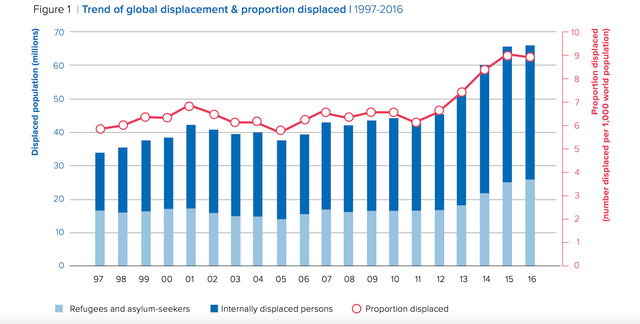
The current number of displaced people, which increased by 300,000 from the previous year, is now close to 66 million people worldwide—the highest figure ever recorded. Over the past two decades, the global population of forcibly displaced people has nearly doubled from 33.9 million in 1997 to 65.6 million in 2016.
Global displacement: 1997-2016
This number is composed from three categories of “displaced people.” The first category is refugees which, currently at 22.5 million, also stands as the highest number ever seen. The largest contributor to refugees (5.5 million) is the result of US imperialism’s regime-change operation in Syria.
The recent surge of Syrian refugees occurred between 2012 and 2015, during the height of the CIA-stoked civil war aimed at overthrowing the government of Bashar al-Assad. To date, the five-year civil war has killed nearly a half-million people and displaced nearly two-thirds of the country’s population, or some 12 million people. Following Syria, Colombia (7.7 million) and Afghanistan (4.7 million) continued to have the second and third biggest refugee population. This was followed by Iraq (4.2 million) and South Sudan, which has the world’s fastest growing displaced population, with 3.3 million having fled their homes by the end of the year.
The latter has emerged as a major contributor to refugees due to the ongoing civil war, which was sparked by the 2011 neo-colonial carve-up of the East African country by US imperialism waged under the guise of South Sudan “independence.”
The second category is displacement of people inside their own countries. These numbers saw a slight decrease from 40.3 million at the end of 2016, compared to 40.8 million a year earlier. The most significant internal displacement situations remain in Syria, Colombia and Iraq. The problem of internal displacement, however, is not limited to these countries. People become displaced daily in virtually every country and this accounts for almost two-thirds of the global forced displacement total.
The last category is asylum seekers, which is defined as people who have fled their country and are seeking international protection as refugees. The number of people seeking asylum globally at the close of 2016 was 2.8 million.
Among the report’s most important findings is that new displacement continues to be very high. Of the total 65.6 million people forcibly displaced globally, 10.3 million became displaced in 2016. To grasp the scope of this figure one should consider that at this rate one person becomes displaced every three seconds.
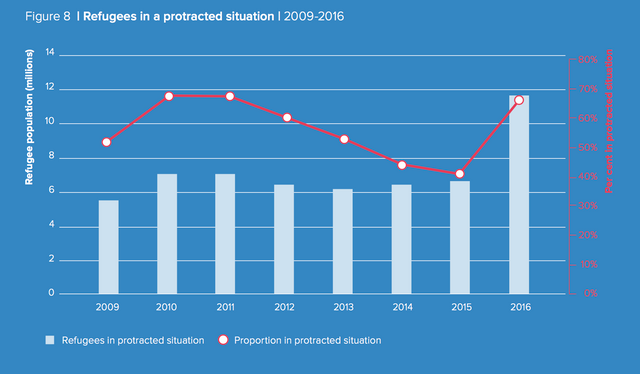
Just as damning as the high level of new displacements is its opposite, the number of refugees in “protracted refugee situations,” I.e., those who are in a situation lasting an extended period due to anti-democratic asylum and immigration laws. Some two-thirds of all refugees, 11.6 million, were in protracted refugee situations at the end of 2016. Of these numbesr, 4.1 million were in a situation lasting 20 years or more.
Refugees in protracted situation: 2009-2016
Children under the age of 18 make up half the world’s refugees. The devastating effects of living through being forced to flee from home and then enduring a protracted period without a stable home, access to education, quality health care and other necessities has the most damaging impact on children, the most vulnerable layer of the population. Horribly, in 2016 about 75,000 asylum claims were received from children traveling alone or separated from their parents. The report notes that this number is likely underestimating the true figure.
Due to the chaotic nature of the circumstances, there are many people who go uncounted. For example, UNHCR estimates that at least 10 million people were without a nationality or at risk of statelessness at the end of 2016 but data recorded by governments and made available to UNHCR for this report were limited to 3.2 million stateless people in 75 countries.
Chilling manifestations of this crisis appear daily throughout the world. Last week, Mexican authorities found 112 migrants alive, packed into a single truck traveling along a highway that connects the southern states of Chiapas and Tabasco. The migrants, which included four babies and 23 minors, were traveling mainly from Guatemala, El Salvador and Honduras—all fleeing extreme poverty and violence produced by decades of US backing for right-wing governments and death squads.
The Italian Coast Guard recovered eight corpses and reported at least 52 people missing from two incidents involving large numbers of people on flimsy dinghies off the coast of Libya last weekend. More than 2,500 people were rescued in over a dozen search-and-rescue efforts coordinated by the Italian Coast Guard over just a two-day period.
Refugees and migrants, if they survive their journey, often live in subhuman conditions. In one refugee settlement in South Sudan, 15 young children, all under the age of five, recently died in a botched measles vaccination campaign, which saw people as young as 12 years old administering the vaccines. These camps hold as many as 15,000 refugees at time without a single doctor on site.
This crisis is taking place against the backdrop of rising right-wing xenophobic demagogy being peddled by bourgeois governments throughout the world, including Angela Merkel in Germany and Donald Trump in the United States, and anti-foreigner agitation spewed by political parties spanning the extreme right to the pseudo left.
Acting in complete opposition to the sentiments of the masses who have come out in droves to defend the rights of immigrants, the ruling classes of each country are scapegoating immigrants for the problems caused by their domestic policy of job-cutting and austerity while continuing the reckless warmongering, which has forced millions to flee for their lives.