22 Aug 2017

Soil, Monsanto And The Agribusiness Giants: Conning The World With Snake Oil And Doughnuts

Colin Todhunter

In their rush to readily promote neoliberal dogma and corporate-inspired PR, many government officials, scientists and journalists take as given that profit-driven transnational corporations have a legitimate claim to be custodians of natural assets. There is the premise that water, food, soil and agriculture should be handed over to powerful and wholly corrupt transnational corporations to milk for profit, under the pretence these entities are somehow serving the needs of humanity.
These natural assets (‘the commons’) belong to everyone and any stewardship should be carried out in the common interest by local people assisted by public institutions and governments acting on their behalf, not by private transnational corporations driven by self interest and the maximization of profit by any means possible.
Concerns about what is in the public interest or what is best for the environment lies beyond the scope of hard-headed commercial interests and should ideally be the remit of elected governments and civil organisations. However, the best-case scenario for private corporations is to have supine, co-opted agencies or governments. And if the current litigation cases in the US and the ‘Monsanto Papers’ court documents tell us anything, this is exactly what they set out to create.
Of course, we have known how corporations like Monsanto (and Bayer) have operated for many years, whether it is by bribery, smear campaigns, faking data, co-opting agencies and key figures, subverting science or any of the other actions or human rights abuses that the Monsanto Tribunal has shed light on.
Behind the public relations spin of helping to feed the world is the roll-out of an unsustainable model of agriculture based on highly profitable (GM) corporate seeds and massive money-spinning health- and environment-damaging proprietary chemical inputs that we now know lacked proper regulatory scrutiny and should never have been commercialised in the first place (VAN STRUM). In effect, transnational agribusiness companies have sought to marginalise alternative approaches to farming and create dependency on their products.
Localisation and traditional methods of food production have given way to globalised supply chains dominated by transnational companies policies and actions which have resulted in the destruction of habitat and livelihoods and the imposition of corporate-controlled, chemical-intensive (monocrop) agriculture that weds farmers and regions to a wholly exploitative system of neoliberal globalization. Whether it involves the undermining or destruction of what were once largely self-sufficient agrarian economies in Africa or the devastating impacts of soy cultivation in Argentina or palm oil production in Indonesia, transnational agribusiness and capitalism cannot be greenwashed.
Soil on a doughnut diet
One of the greatest natural assets that humankind has is soil. It can take 500 years to generate an inch of soil yet just a few generations to destroy. When you drench soil with proprietary synthetic chemicals, introduce company-patented genetically tampered crops or continuously monocrop as part of a corporate-controlled industrial farming system, you kill essential microbes, upset soil balance and end up feeding soil a limited “doughnut diet” of unhealthy inputs (and you also undermine soil’s unique capacity for carbon storage and its potential role in combatting climate change).
Armed with their synthetic biocides, this is what the transnational agritech companies do. In their arrogance (and ignorance), these companies claim to know what they are doing and attempt to get the public and various agencies to bow before the altar of corporate ‘science’ and its scientific priesthood.
But in reality, they have no real idea about the long-term impacts their actions have had on soil and its complex networks of microbes and microbiological processes. Soil microbiologists are themselves still trying to comprehend it all.
That much is clear in this article, where Brian Barth discusses a report by the American Society of Microbiologists (ASM). Acknowledging that farmers will need to produce 70 to 100 per cent more food to feed a projected nine billion humans by 2050, the introduction to the report states:
“Producing more food with fewer resources may seem too good to be true, but the world’s farmers have trillions of potential partners that can help achieve that ambitious goal. Those partners are microbes.”
Linda Kinkel of the University of Minnesota’s Department of Plant Pathology is reported by Barth as saying:
“We understand only a fraction of what microbes do to aid in plant growth.”
Microbes can help plants better tolerate extreme temperature fluctuations, saline soils and other challenges associated with climate change. For instance, Barth reports that microbiologists have learned to propagate a fungus that colonizes cassava plants and increases yields by up to 20 per cent. Its tiny tentacles extend far beyond the roots of the cassava to unlock phosphorus, nitrogen and sulphur in the soil and siphon it back to their host.
According to the article, a group of microbiologists have challenged themselves to bring about a 20 per cent increase in global food production and a 20 per cent decrease in fertilizer and pesticide use over the next 20 years – without all the snake oil-vending agribusiness interests in the middle.
Feeding the world? 
These microbiologists are correct. What is required is a shift away from what is increasingly regarded as discredited ‘green revolution’ ideology. The chemical-intensive green revolution has helped the drive towards greater monocropping and has resulted in less diverse diets and less nutritious foods. Its long-term impact has led to soil degradation and mineral imbalances, which in turn have adversely affected human health (see this report on India by botanist Stuart Newton – p.9 onward).
Adding weight to this argument, the authors of this paper from the International Journal of Environmental and Rural Development state (references in article):
“Cropping systems promoted by the green revolution have increased the food production but also resulted in reduced food-crop diversity and decreased availability of micronutrients. Micronutrient malnutrition is causing increased rates of chronic diseases (cancer, heart diseases, stroke, diabetes and osteoporosis) in many developing nations; more than 3 billion people are directly affected by the micronutrient deficiencies. Unbalanced use of mineral fertilizers and a decrease in the use of organic manure are the main causes of the nutrient deficiency in the regions where the cropping intensity is high.”
(Note: we should adopt a cautious approach when attributing increases in food production to the green revolution trechnology/practices).
The authors imply that the link between micronutrient deficiency in soil and human nutrition is increasingly regarded as important:
“Moreover, agricultural intensification requires an increased nutrient flow towards and greater uptake of nutrients by crops. Until now, micronutrient deficiency has mostly been addressed as a soil and, to a smaller extent, plant problem. Currently, it is being addressed as a human nutrition problem as well. Increasingly, soils and food systems are affected by micronutrients disorders, leading to reduced crop production and malnutrition and diseases in humans and plants. Conventionally, agriculture is taken as a food-production discipline and was considered a source of human nutrition; hence, in recent years many efforts have been made to improve the quality of food for the growing world population, particularly in the developing nations.”
Referring to India, Stuart Newton’s states:
“The answers to Indian agricultural productivity is not that of embracing the international, monopolistic, corporate-conglomerate promotion of chemically-dependent GM crops… India has to restore and nurture her depleted, abused soils and not harm them any further, with dubious chemical overload, which are endangering human and animal health.” (p24).
Newton provides insight into the importance of soils and their mineral compositions and links their depletion to the green revolution. In turn, these depleted soils cannot help but lead to mass malnourishment. This is quite revealing given that proponents of the green revolution claim it helped reduced malnutrition.
And Newton has a valid point. India is losing 5,334 million tonnes of soil every year due to soil erosion, much of which is attributed to the indiscreet and excessive use of fertilisers, insecticides and pesticides. The Indian Council of Agricultural Research reports that soil is become deficient in nutrients and fertility.
The US has possibly 60 years of farming left  due to soil degradation. The UK has possibly 100 harvests left in its soils.
We can carry on down the route of chemical-intensive (and soil-suffocating, nutritionally inferior GM crops), poisonous agriculture, where our health, soil and the wider environment from Punjab to the Gulf of Mexico continue to be sacrificed on the altar of corporate profit. Or we can shift to organic farming and agroecology and investment in indigenous models of agriculture as advocated by various high-level agencies and reports.
The increasingly globalised industrial food system that transnational agribusiness promotes is not feeding the world and is also responsible for some of the planet’s most pressing political, social and environmental crises – not least hunger and poverty. This system, the capitalism underpinning it and the corporations that fuel and profit from it are illegitimate and destructive.
These companies quite naturally roll-out their endless spin that we can’t afford to live without them. But we can no longer afford to live with them. As the UN’s special rapporteur on the right to food, Hilal Elver says:
“The power of the corporations over governments and over the scientific community is extremely important. If you want to deal with pesticides, you have to deal with the companies.”
As we currently see, part of ‘dealing’ with these corporations (and hopefully eventually their board members and those who masquerade as public servants but who act on their behalf) should involve the law courts.

Young doctor suicides point to deteriorating conditions in Australia’s health system

Ed Ballesteros

The tragic suicides of young doctors have highlighted the reality facing health professionals and other hospital workers. They are suffering from acute levels of physiological and psychological stress due to the dangerous conditions and excessive workloads produced by decades of cost-cutting measures by Australian state and federal governments.
In the state of New South Wales (NSW), three young physicians took their lives in the early months of this year. The most publicised case was 29-year-old podiatrist Chloe Abbott, a fourth-year doctor-in-training at St Vincent’s Hospital in Sydney, who took her life in January. Speaking at a state government-sponsored conference on junior doctors’ mental health in June, Micaela Abbott said her sister was “eaten alive” by the medical profession.
“It’s absolutely devastating that this conversation was only generated after the loss of my sister, but we need to get these important changes in place,” Abbott said. “Chloe’s death can’t be a waste,” she said, referring to calls by her family to address the excessive hours junior doctors are forced to work, among other things.
Earlier, four junior doctors committed suicide in the state of Victoria at the beginning of 2015. A general medical intern working at Geelong Hospital died a week into his internship, while three psychiatric trainees working at St Vincent’s, the Austin and Frankston hospitals, died within weeks of each other.
In NSW, Health Minister Brad Hazzard admitted in March that coronial reports indicated that at least 20 doctors committed suicide in his state from 2007 to 2016, including two senior doctors and a medical student within the previous 20 months.
This terrible toll extends beyond doctors. In a study released last September, researchers from Deakin and Melbourne universities reported that women working in health professions have a rate of suicide more than twice that of women in other occupations. Suicide among female midwives and nurses was almost quadruple the average rate. Male nurses and midwives were almost twice as likely to commit suicide than men in other occupations.
In another report, published in 2015, the Victorian Coroners Prevention Unit found that suicide among paramedics was 35.6 per 100,000 people—almost four times higher than the average for all other jobs in Victoria.
Ostensible concern of governments for the well-being of health professionals is belied by funding cuts that have stretched public hospitals to breaking point. Waiting and treatment times in public hospital emergency departments have reached dangerous levels, due to federal health cuts under both Labor and Liberal-National governments since 2007.
As well as meeting the demands of the corporate elite for ever-deeper social spending cuts, the public hospital cutbacks are intended to coerce more people into paying for their own care, via private health insurance, driving up the profits of private hospital and health care companies.
The National Health Reform Agreement implemented by the former Labor government removed block funding for public hospitals and imposed “casemix” funding, based on each activity performed and nationally-set “efficiency” prices.
Casemix seeks to continually drive down the funding for each medical procedure. In effect, it financially penalises public hospitals, especially those treating working class, aged and psychiatric patients with complex problems and places pressure on health workers to push patients through hospitals in less time.
Same-day hospitalisations as a proportion of total hospitalisations almost doubled from 34 percent in 1994 to 59 percent in 2014, accompanied by a substantial drop in acute public bed- to-population ratios. Major public hospitals are often at overcapacity, resulting in “bed blocking” by emergency departments that can strand patients in ambulances.
The end result is that in 2017 more than half the registrars, interns and consultants in the public hospital system are working 78 hours a week, according to an Australian Medical Association (AMA) audit. The average number of hours a physician works in a shift is 18; intensive care physicians and surgeons have been recorded working unbroken shifts of between 53 and 76 hours.
Dr Tessa Kennedy from the AMA NSW Doctors in Training Committee told the junior doctors’ mental health conference in June: “Personally, I’ve worked back-to-back 16 hour shifts, 90-hour weeks and then gone home to study. I’ve felt unable to call in sick because there is no one to cover me.
“I’ve regularly stayed hours late to complete all tasks required for my patients, only to be told I can’t claim any overtime. I’ve caught myself falling asleep driving home from night shift at a rotation 90 kilometres from home … As the doctors in the room will tell you, there’s nothing remarkable about these stories.”
Such conditions help explain why one in five medical students and one in ten doctors have suicidal thoughts. And why four in ten medical students and one in four doctors suffer some form of depression or anxiety. These figures are drawn from a survey conducted on 14,000 doctors and medical students in 2013 by the beyondblue mental health advocacy group.
Doctors in training reported high rates of burnout measured across three domains covering emotional exhaustion (47.5 percent), low professional efficacy (17.6 percent) and high cynicism (45.8 percent). These were caused by excessive workloads (25.0 percent), responsibility at work (20.8 percent) and long work hours (19.5 percent).
This is an international trend. The Journal of the American Medical Association(JAMA) last December published similar results from a meta-analysis of approximately 180 studies conducted in Australia, Brazil, Canada, China, France, Germany, South Korea, Sweden, the UK, the US and 33 other countries over the past three decades.
The study found the prevalence of depression or depressive symptoms among the 129,000 medical students surveyed averaged 27.7 percent. One in 10 reported suicidal thoughts. The study also drew on other research that found a high prevalence of depression (28.8 percent) among resident physicians, indicating that physicians at all levels of medical training were affected.
Health academics and the media generally seek to blame a damaging “culture” in the medical profession. Ute Vollmer-Conna, Associate Professor in Psychiatry at the University of NSW wrote in the Conversation last December: “Medical training continues to reinforce the idea that the profession is demanding and that doctors should be invincible and immune from the effects of stress.”
Programs, such as the Basic Physician Trainee OK pilot program at Sydney’s Royal Prince Alfred, have been initiated to “destigmatise” the notion of seeking help among medical professionals and introduce collective debriefing techniques to learn how to manage trauma and recognise signs of stress and burnout. These programs, however, do not alter the fundamental problem.
The toxic environment has not emerged out of the character traits of highly-trained health workers or a supposedly intrinsic culture of medicine. The “culture” often consists of unhealthy coping mechanisms by doctors and other health workers trying to deal with depleted staff and strained resources.

Papua New Guinea government deploys troops to quell opposition

Oscar Grenfell 

In an ominous attack on democratic rights, the newly-installed Papua New Guinea (PNG) government of Prime Minister Peter O’Neill announced last week that it will deploy additional military and police personnel to two provinces in the country’s remote Highlands region.
The move is part of a broader crackdown on widespread social and political opposition, which has intensified in the wake of last month’s national election. The polling was dominated by accusations that O’Neill’s People’s National Congress had engaged in dubious electoral practices, including outright fraud, in order to cling to office.
Troops and heavily armed police will be dispatched to Hela Province, and will conduct operations in the neighbouring Enga and Southern Highlands provinces. They will join hundreds of military personnel who were sent to Hela Province several months ago, on the pretext of combatting tribal violence.
Announcing the military call-out last Thursday, O’Neill cited reports that election-related violence, involving rival clans, had resulted in up to 20 deaths in Enga province. Fatalities and serious injuries have also occurred during clashes in the Southern Highlands.
O’Neill gave no indication of how many police and military personnel would be involved. His comments, however, indicated that the authorities are preparing a violent assault on opponents of the government.
“The behaviour we are witnessing by small groups is totally unacceptable,” O’Neill stated. He menacingly added: “I am issuing a very clear warning to people seeking to cause disruption, that you will be faced with the full effort of our disciplined services, arrested and tried for criminal acts.”
The trigger for the violence in Enga province was accusations that the dubious activities of electoral authorities were responsible for prominent opposition leader, Don Polye, losing the seat of Kandep. His supporters have claimed that as many as eight boxes containing ballots from villages supportive of Polye went missing, resulting in the victory of People’s National Congress candidate, Luke Manase.
Those claims are among a litany of accusations of electoral malpractice. These have included indications of bribery, ballot-box tampering and the wholesale omission of names from electoral rolls.
Following the closure of polls on July 8, after a two-week voting period, the entire Electoral Advisory Committee, an official watchdog body, resigned. They accused the Electoral Commission of denying them access to basic information relating to the ballot.
A detailed review of the election results by Sean Dorney, on the Australian-based Lowy Institute’s Interpreter site, raised the possibility of voter-fraud on a vast scale. Dorney noted, for instance, that 55 percent of all votes were cast in the Highlands, which, according to the 2011 census, accounted for just 39 percent of PNG’s total population.
The election has resulted in an O’Neill government that is widely viewed as illegitimate. Parliament was hastily reconvened on August 2 by Governor-General Bob Dadae, even though five of the parliament’s 111 seats had not yet been declared. Dadae had already invited O’Neill to form government on July 28, when as many as a quarter of electoral returns were still outstanding.
In parliament’s first sitting, O’Neill received 60 votes to form a new government, with 46 opposed. The result means that the government’s majority is substantially reduced, setting the stage for ongoing political crises.
Underlying the election turmoil, and widespread hostility to O’Neill’s government, is the deepening social crisis facing workers, young people and the poor throughout PNG.
Almost 40 percent of the country’s population subsists on less than $US1.25 a day. The previous O’Neill government imposed a deeply unpopular austerity agenda, which included cuts to health and education budgets of up to 40 percent in the 2016-17 financial year. Many public servants had their wages slashed, or were hardly paid at all, over that period.
In imposing this agenda, O’Neill’s government was responding to the dictates of the global corporate and financial elite for a stepped-up offensive against the social rights of workers and the poor.
The trigger was the precipitous fall in global commodity prices, which led to a decline in PNG’s economic growth from highs of over 14 percent in 2014, to just above 2 percent this year. The country’s debt has ballooned to K21.6 billion ($US6.8 billion), after the government borrowed K13 billion ($US4.1 billion) in the 12 months to June.
The new government has already indicated that it will intensify the social onslaught. On August 17, O’Neill spoke at a meeting attended by senior figures from PNG’s business establishment, and representatives of major multinational companies.
O’Neill foreshadowed a 2017 “mini-budget,” that would “make necessary adjustments to achieve the fiscal deficit target of this year’s budget.” In other words, the government will press ahead with attacks on education, health and other areas of social spending, negating O’Neill’s election promises.
O’Neill stated that his government would work closely with the World Bank and the International Monetary Fund, two of the key institutions of global finance, on a review of the “medium term fiscal strategy to ensure that our budgets are framed prudently.”
O’Neill also gave assurances that his government would not impose any, even nominal tax hikes on business. One newspaper, Loop PNG, summed up the tenor of the prime minister’s remarks by declaring that “investor confidence” had been “reaffirmed.”
While seeking to capitalise on the social opposition created by O’Neill’s pro-business policies, the opposition leaders, including Don Polye, have repeatedly signalled their support for the austerity agenda.
An opposition leader Mekere Morauta summed up the position of all of the opposition parties. Morauta, who oversaw the privatisation of state-owned enterprises and other pro-business policies when he was prime minister from 1999-2002, declared earlier this month that “budget repair” was the first task of the new government. He warned that it should not seek to downplay the country’s fiscal crisis.
The entire political establishment is aware the government’s pro-business program will provoke ever-greater anger.
The deployment of troops to the Highlands is a warning of how the government will respond to social protest and opposition from the working class and young people. O’Neill’s previous government oversaw substantial attacks on democratic rights, demonstrated most graphically last year by the police shooting at peaceful student protesters calling for his resignation.
Australia, which for decades controlled PNG as a colony, has already signalled its support for the new government. Foreign Minister Julie Bishop absurdly described the election as “successful” in a statement earlier this month, and declared that her government “looks forward” to working with O’Neill.
Australian authorities were directly implicated in the anti-democratic conduct of the elections. Two hundred Australian soldiers were dispatched to PNG in June to “assist” with the ballot.

Worsening hunger for older Americans

Gary Joad 

The growth of seniors who are food-insecure has seen a staggering growth in twenty-first century America. Some 14.7 percent of this age group are said to be food-insecure, totaling at least 9.8 million in the US senior population. Compared to 2001, this constitutes a rise of 37 percent, with the number of seniors increasing in the same period 109 percent.
In an update posted at Feeding America’s web site earlier this month, Professors James Ziliak from the University of Kentucky and Craig Gundersen from the University of Illinois confirmed this worsening hunger situation for Americans age 60 and over. According to the US Census Bureau, about 10,000 people a day turn age 60 in the United States, a trend that will continue through 2030.
Feeding America’s study, titled “The State of Senior Hunger in America 2015” (and updated this month), noted that the threat of hunger to older people was especially harsh in the South and Southwestern US. And the publication noted that economic hardship constituted the main reason seniors could not obtain sufficient food, despite the government’s declaration of an improved economy and the dramatic explosion of Wall Street stock valuations.
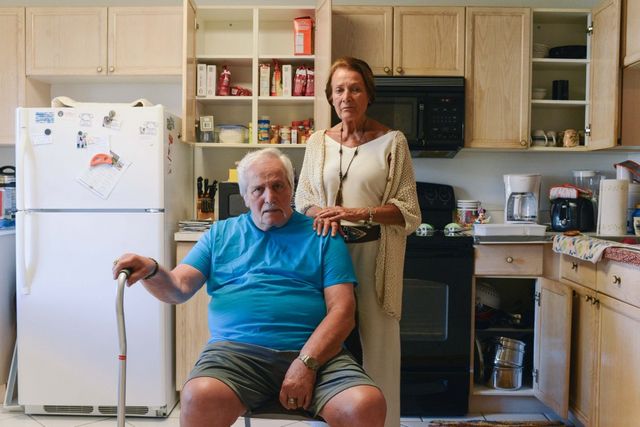
Angelo and Mina Maffucci posed for a portrait in the kitchen of their son’s apartment in 2015, where they’d been living for about five years—since they lost their house. (Photo: Ariel Min/PBS NewsHour) CREDIT: Kaiser Health News: "In Sunlit Paradise, Seniors Go Hungry” by Sarah Varney
The study also concluded that seniors living below the federally recognized poverty line have a 45.3 percent risk of hunger, and that the threat of food insecurity was significantly greater for elderly single adults than for marrieds. The threat of hunger was noted to be three times higher for the disabled elderly. If the seniors had grandchildren in the home, the risk of hunger was twice as high. The number of children living with their grandparents increased 64 percent between 1991 and 2009, to about 7.8 million. At the same time, the majority of hungry seniors live above the official poverty line, with nearly two-thirds reporting insufficient access to needed calories per day to remain healthy.
Almost three of four seniors facing hunger are white, and almost half of the retired seniors in the United States are today at risk for not having enough to eat. The top 10 states with the most persons at and over age 60 who are food-insecure are Mississippi, Louisiana, North Carolina, South Carolina, Arkansas, New York, West Virginia, Indiana, Oklahoma and Georgia. The sharpest increase in all the groupings of elderly at risk for hunger came after the Great Recession of 2008-2009.
On August 12, 2014, the Annals of Emergency Medicine published the results of a two-month review of 138 senior citizens admitted to an emergency department in 2013 and noted that 60 percent were declared malnourished. The reasons included inability to buy food, poor dentition and depression.

Seniors the most food-insecure

Feeding America has referred to seniors as the most food-insecure segment of the US population, noting that one third of its food bank clients are over age 60. On the financial collapse of 2007-2008, Feeding America noted that more than half of its clients over the age of 65 appeared at food banks monthly, and that persons over the poverty line were often not eligible for the federal Supplemental Nutritional Assistance Program (SNAP), also known as food stamps, for food relief.
Feeding America considers SNAP, which suffers regular budgetary cutbacks, the first line of defense for all food-insecure persons.
The Feeding America studies also note that from 2001 to the present, hunger has cut into a younger and younger demographic, noting that in 2011, 65 percent of the elderly food bank visitors were under age 69. Between 2007 and 2011, the number of elderly food-insecure jumped 50 percent.
The Feeding America hunger study uses a questionnaire from the Current Population Survey (CPS) of the US Census Bureau, submitted to households each December using an 18-question survey focusing on the person’s experiences of food stress in the last 30 days and the previous 12 months. A 10-question survey is used for households without children. One to three positively answered questions categorizes a household as under food stress of varying degrees.
Data for the study was also utilized from the National Center for Health Statistics (NCHS/CDC), a subsidiary of the Centers for Disease Control and Prevention (CDC), wherein 5,000 persons, 50 percent children and 50 percent adults, with seniors purposely over-sampled, are interviewed and examined related to health.
The major findings for hungry seniors concluded that they were taking in 14 percent less iron and 12 percent less protein than their food-secure peers. Health outcomes included an increased risk of at least nine diseases, including a 53 percent increased risk of heart attacks, a 52 percent increased risk of asthma, a 40 percent increased risk of congestive heart failure, along with increased reporting of diabetes and hypertension. Depression unsurprisingly increased 60 percent with hunger. Also, the increased rate of falling and resulting injuries soared among the hungry and malnourished elderly. The measure of Activities of Daily Living (ADLs) fell dramatically, which includes eating, bathing, and dressing oneself independently.
Food insecurity exists in every county of the United States, from 3 percent in Grant County, Kansas, to 38 percent in Jefferson County, Mississippi. Poor households with children are hungry at a rate of 17 percent, and homes with a single mother are food-insecure at 30 percent; single men with children are at 22 percent.
As of 2015, 59 percent of food-insecure households participated in at least one of three federal relief food programs, including SNAP, the National School Lunch Program (NSLP), and the Special Supplemental Nutrition Program for Women, Infants, and Children (WIC).
Feeding America provides food assistance to some 46.5 million people a year in the US, including 12 million children and 7 million seniors. Those assisted at Feeding America who also receive food stamps total about 55 percent, and 24 percent are getting food through the WIC program. Nearly all of the families, 94 percent, subscribe to the school lunch program. More than half of the persons receiving assistance had at least one employed person in the household. The median income for households is at $9,175.

550,000 very low food-secure seniors

About 48 million Americans live in food-insecure households, including 24.4 million people age 18 to 64 and 14.5 million children. The majority of people who are food-insecure, 57 percent, are not officially recognized by the US government as poor, which means living with an income below 100 percent of the federal poverty level. It is also estimated that almost 550,000 seniors are now essentially starving, with very low food security.
In 2013, one half of those on Medicare had an income below $23,500, or 200 percent of the federal poverty level of 2015. According to the US Census Supplemental Poverty Measure (SPM) in 2014, one out of seven persons over the age of 65 have incomes rendering them impoverished, including 45 percent of women over 65.
In a recent National Geographic article on “Hunger in America,” Janet Poppendieck, a sociologist at City University of New York, was quoted as saying, “Today more working people and their families are hungry because of wages that have declined.”
The article noted that more than half of the US hungry are white, and the total of over 48 million food-insecure people constituted a fivefold jump since the early 1960s, including a 57 percent increase since the early 1990s. The article noted that in the 1980s there existed just a few hundred food pantries in the US. Now, there are over 50,000. One in six persons runs short of food at least once a year in the US, compared to about one in 20 in the European Union.
By 2013, the federal food relief budget had reached $75 billion, or about $133.07 per hungry person a month, constituting less than $1.50 allotted for each meal, often referred to as a “minimum wage diet.” Moreover, hundreds of thousands of poor people in the US do not own or have access to a car, and live more than one half-mile from any source of food, if they had the money to buy it. In Houston, Texas, alone, at least 43,000 households reside in a so-called food desert.
As a global food availability specialist, Raj Patel, told National Geographic, “The problem can’t be solved by merely telling people to eat more fruits and vegetables, because at the heart of this [crisis] is a problem about wages, about poverty.”

Youth clashes with police in Paris suburbs point to explosive social tensions

Francis Dubois 

Clashes that erupted during an ID check last Thursday between police and youth at the Cité des 3000 urban estate in Aulnay-sous-Bois, northeast of Paris, point to enormous tensions in working class areas after two years of the French state of emergency and deepening social crisis. It was in this same neighborhood that, in February, the barbaric sexual assault by police of a 22-year-old named Théo provoked indignation across France.
During the ID check, provoked by suspicions by members of the Anti-Criminal Brigade (BAC) that “dealers” were being alerted of their presence, a youth refused to give his papers and then, with the aid of other residents, was able to flee. Policemen who tried to stop him were confronted by a large number of youth. Another group of several dozen people surrounded their car, which was guarded by a policewoman, whom they attacked. According to police, two weapons were stolen from the car: a gun firing rubber bullets and a taser-type revolver. A man reportedly fired rubber bullets at the police car with the gun, which was found on Sunday.
The press widely reported these incidents, exclusively citing police accounts. The courts rapidly swung into action: the local prosecutor’s office in Bobigny opened investigations for “assault and armed assault against individuals holding public authority,” as well as “coordinated theft and assault and degradation of public property.”
Since last Thursday, three youths aged 18 or 19 were arrested, and two are still in detention. One has been charged with “assault against individuals holding public authority” and released. Another is reportedly “implicated in the initial acts of violence against the two policemen.” The last person arrested, on Monday, is reportedly the youth who refused to give his papers.
In the same location, during a similar ID check six months ago, police had sexually assaulted a Théo, a resident of the same estate, causing a 10cm injury to the rectum that required an emergency operation. A few days later, hundreds of people marched in the neighborhood to demand “justice for Théo.” Inhabitants of the area criticized in the press daily harassment of youth in that estate by the police forces.
Numerous protests took place across France in the weeks after police sexually assaulted Théo, on slogans such as “Don't forgive, don't forget,” “Rapist cops in jail,” or “It’s impunity and injustice, so disarm the police.” The official investigation into the sexual assault of Théo is still underway, and social tensions in Aulnay are explosive.
At the time of the first protest against the assault of Théo, Abdallah Benjana, a former assistant of the Aulnay mayor, commented: “I have the impression that the population feels humiliated. All the youth in that neighborhood want is peace and quiet. What is the point of what was done? To spark something? Isn't there enough dry powder in these neighborhoods? There is unemployment, insecurity, high rents, no perspective for the future. If you do that to a youth, the only thing you will get is an explosion.”
Aulnay-sous-Bois exemplifies the social attacks that working class suburbs have suffered under a succession of governments, of the Socialist Party (PS) as of the right, over the last 30 years. The Cité des 3000 was originally built to house workers at the Citroën (PSA) plant at Aulnay. The urban estates in the north of the city housed 24,000 people, or a third of the city's population, concentrated on only four percent of its territory.
The closure of PSA-Aulnay in 2013 devastated the area. It could take place only because the General Confederation of Labor (CGT) isolated PSA-Aulnay workers in order to prevent a broader automobile strike that would have threatened the PS government of President François Hollande. The unemployment rate at Aulnay is 16.7 percent (30 percent for workers aged 19 to 30). Three years after the closure of PSA-Aulnay, many laid off workers still have no work and are running out of unemployment benefits, at €480 per month.
Newly elected President Emmanuel Macron's plan for working-class suburbs, aiming to “favor entrepreneurs,” only demonstrates his hostility to inhabitants of these suburbs.
In the legislative district including Aulnay-sous-Bois, abstention in the run-off of the legislative election reached 67.5 percent. Since 3.4 percent of voters went to the voting booths to cast blank or spoiled ballots, only 29 percent of registered voters in the area actually cast a vote in the elections. In 2012, 63 percent of voters in this district had voted for the PS and Hollande in the second round of the presidential elections.
Social inequality is exploding in Europe as around the world, and inhabitants of large impoverished estates are ever more hostile to their situation, which is correctly seen as a war of the rich against the poor. As the reaction of the London population to the social murder of the Grenfell inferno shows, those responsible for the disaster—whose victims the authorities have until now refused to count precisely—are clearly seen as the super-rich and their state agencies.
There is rising opposition to police brutality internationally. Workers, whether they live in Chicago, London, or Paris, increasingly see harassment, intimidation, and police brutality more and more as measures of class repression aimed at the population.
As the recent Aulnay incident shows, attempts at resistance to police harassment rapidly turn under these conditions into a political confrontation between the population and the state.

Polish government demands war reparations from Germany

Clara Weiss

The Polish government of the Law and Justice party (PiS) announced earlier this month that it would demand reparations from Germany for the massive damage done to the country under the Nazi occupation in World War II. Just a few days earlier, the European Union had initiated legal proceedings against Poland which could result in the country losing its voting rights in the EU. The developing conflict is symptomatic of the renewed eruption of national conflicts in Europe, which led to two world wars in the 20th century.
During World War II, some six million Poles (about 20 percent of the population) lost their lives under Nazi occupation, including over three million Polish Jews. Over 200,000 Polish civilians were killed just during the destruction of Warsaw in the summer of 1944 by the German Wehrmacht. Millions of Polish workers were employed as forced laborers in the German war economy.
Polish vice prime minister Mateusz Morawiecki has stated tht it was “clear” that the “historical accounts” had “not been settled. Our neighbors, especially the Germans, massacred Poland. I am not just talking about the six million Polish lives that were taken. Not even one percent of this was compensated.”
For decades, Berlin has been rejecting demands for reparations from Poland as well as from numerous other European countries. The German government’s vice press secretary Ulrike Demmer declared that the question of reparations to Poland had been settled, both legally and politically. Last year, former foreign minister Frank-Walter Steinmeier had similarly stated that any kind of reparation payments to Poland were out of the question.
In rejecting any demands for reparations, the German government is basing itself on contracts from 1953 and, particularly, the so called “Treaty of Good Neighborship” between Poland and Germany from 1991. The payments which occurred based on this agreement are absurdly low. Germany paid only 750 million Deutsche Marks (about 375 million Euros) directly as reparations, in addition to a few billion Euros paid to former forced laborers. This starkly contrasts with the actual material damage that Poland suffered under the Nazi occupation, which the Polish government estimated to amount to some $850 billion right after the war.
Politicians of the ruling PiS party have repeatedly raised the issue of reparations in the past. However, previous social democratic and liberal governments deliberately avoided advancing such demands, as they are politically explosive. Thus, former Polish president Aleksander Kwaśniewski warned back in 2004: “If we were to invoice [the reparations] we would indeed destroy united Europe.”
The fact that PiS is now taking up the issue in such an aggressive manner is indicative of the renewed eruption of fundamental geopolitical conflicts between Germany and Poland. Especially since the inauguration of US president Donald Trump and in light of the growing tensions between Washington and Berlin, the relations between Warsaw and Berlin have considerably deteriorated, while the domestic political crisis in Poland has deepened.
During his visit to Poland in early July, Trump signalled open support for the so called Three Seas Initiative, a thinly veiled revival of the Intermarium project. With this project, the PiS is seeking to build an alliance of Eastern and Central European states that would be directed against both Russia and Germany.
However, the Polish bourgeoisie is deeply divided over this issue. The liberal opposition is oriented toward the EU and particularly Germany, Poland’s most important trading partner.
Donald Tusk, Poland’s former president and an influential figure in the liberal opposition party Civic Platform (PO), is playing a central role in the EU’s maneuvers against the PiS government. Only a few months ago, Tusk was reelected as the president of the European Council against the opposition of the PiS government. He is considered a close ally of German chancellor Angela Merkel.
On a formal level, the legal proceedings are directed against bills providing for changes to the country’s judicial system, which the PiS introduced in the wake of Trump’s visit. By subordinating the judiciary to the government, these bills implement the de facto end of the division of powers in Poland.
In Brussels, Tusk said of the EU’s proceedings against Poland: “Today, there is a big question mark over Poland’s European future.” Further, he cautioned that Poland could soon announce “that it does not need the European Union and that the European Union does not need Poland. I’m afraid that this moment is now drawing closer.”
For about two years, the liberal opposition has been leading a protest movement against the abolition of the separation of powers and other reactionary measures of the PiS-government, such as the undermining of the right of abortion. It is supported by sections of the urban middle class who see their future bound up with that of the EU.
In contrast, the PiS represents a wing of the Polish bourgeoisie that insists on national independence and is, for this purpose, seeking a closer alliance with Washington. To prop up its policies, the PiS is trying to mobilize layers in the rural regions and sections of the working class which have particularly suffered from the neoliberal policies of Brussels and Berlin.
The EU is exploiting the conflicts within the Polish bourgeoisie and the opposition to the dictatorial measures by the PiS to step up the pressure on the Polish government.
At this point, cracks are beginning to show within the government camp. President Andrzej Duda, who was long considered a mere puppet of Jarosław Kaczyński, the head of the PiS, vetoed two of the PiS’s judicial bills, and is now in a public feud with justice minister Zbigniew Ziobro. Several members of the government and PiS have publicly supported Duda’s steps and the PiS leadership is now fearing that the president could try and build his own movement with their support.
For all the rhetoric, what is involved for the EU is neither the “rule of law” nor “democracy. ” Rather, vicious conflicts are taking place, behind closed doors, over Poland’s foreign policy orientation.
What the EU really thinks of democracy was proven not least of all in Greece, where it pushed through brutal austerity diktats against massive protests and a referendum voicing the opposition of the majority of the population. And when it comes to undermining democratic rights and building a powerful surveillance and police apparatus, Brussels is well ahead of Warsaw.
Brussels and Berlin view with great concern the emerging alliance between the right-wing PiS government and the Trump administration in Washington. The latter is now openly backing the construction of a political and military alliance in Eastern Europe under Poland’s leadership.
The Intermarium-style alliance envisioned by the PiS would create military and political structures that are independent from the EU. The Polish government’s demands for German reparations are not least of all aimed at mobilizing the support of nationalist forces within Poland to support this policy.
The liberal opposition is oriented toward Germany and the EU and rejects this policy. The liberal Newsweek Polska, which is owned by the German publishing house Axel Springer, condemned the whipping up of “anti-German resentment” through the PiS as “extremely irresponsible and fundamentally stupid.”
The conservative newspaper Rzeczpospolita, which cautioned in an earlier commentary against an exclusive orientation toward the United States, also rejected the demands for reparations. While acknowledging that they were “morally justified,” the newspaper warned of deteriorating relations with Berlin. Further, the editors commented: “Yes, Donald Trump, who spoke so nicely about us in Warsaw, is on the other side of the ocean. But that’s precisely the problem. He is on the other side of the ocean, and recently he has been looking mostly toward Asia.... ”
The Three Seas Initiative was “interesting,” the newspaper wrote, but: “It is enough to take a look at the structure of Polish exports to notice that our current economic relations with this region are extremely loose...” On a political and military level too, the ties are rather poor, it observed.
Therefore, according to Rzeczpospolita, “an institutionalization of the Three Seas Initiative can only be realized within the framework of the EU. ” However, the PiS’s policy toward Germany, the editors stated, was undermining such a possibility. The commentary cited a well-known statement by the authoritarian inter-war dictator of Poland, Józef Piłsudski, who declared that Poland could not simultaneously fight Germany and Russia without losing its independence, and concluded: “Let’s be frank: it doesn’t look good [for us].”

Growing signs of constitutional breakdown follow repeal of corruption charges against Brazil’s President Temer

Miguel Andrade 

The Congressional negotiations put in place during the month of July by Brazilian President Michel Temer in order to repeal a Congressional authorization for corruption charges to be brought against him in the Supreme Court have highlighted the depth of the political and economic crises confronting Latina America’s largest country.
The rottenness of the month-long horse-trading in the Lower House overshadowed even the unprecedented situation of a president being taped by a billionaire former ally agreeing to buy the silence of another former ally and further recommending an associate to organize the rigging of anti-trust legislation in his favor.
Michel Temer took over the presidency after conspiring to bring down Workers Party (PT) president Dilma Rousseff on trumped-up charges of budget manipulation barely one year ago, after serving as her vice-president for one-and-a-half terms in office. The right-wing move, supported by every major business association, the entire bourgeois press and a collection of right-wing parties that had supported the Workers Party rule for 13 years, signaled a declaration of class war by the ruling class. It was organized in the face of the country’s worst economic crisis in a century and particularly the contraction of previously record profits from commodity exports that had for almost a decade financed token social reforms and political stability.
Workers Party rule, which represented a key ideological and economical factor in the so-called Pink Tide in Latin America, had already started to crumble with Rousseff’s narrow re-election victory in the 2014 election, which also brought in the most right-wing Congress since the end of the US-backed military dictatorship in 1985. The elections had seen a major growth of the so-called Beef, Bullet and Bible caucus, which comprises almost a third of the Lower House and is composed of retired or active duty military, evangelical and Catholic preachers and major agribusiness heads.
Under conditions of a two-year economic contraction that slashed GDP by 10, Temer came to power promising to boost the economy by decimating the social conditions of the working class through unprecedented labor and pension “reforms” and a 20-year budget freeze.
Amid the unwillingness of even the most right-wing congressmen to pass some of the toxic legislation, Temer was subjected to a sting operation in late May, with sections of the intelligence establishment and the justice system collaborating with meatpacking magnate Joesley Batista to tape the president agreeing to favor Batista in the country’s anti-trust CADE agency, and further authorizing him to set up a monthly pay to avoid the plea-bargain agreement of jailed former Lower House speaker Eduardo Cunha, Rousseff’s political hangman who had put the 2016 impeachment to a vote.
A trial of a sitting Brazilian president on criminal corruption charges has to be authorized by Congress, nonetheless, and a political operation was mounted to avoid authorization. The success of these machinations has further exposed the protracted breakdown of bourgeois-democratic forms of rule in Brazil, which had been signaled in the internecine warfare that resulted in the covert taping of Temer in first place.
In addition to agreeing to unfreeze more than 1.5 billion dollars from the 2017 budget to meet immediate demands of members of the special panel reviewing the charges in the Lower House in mid-July, Temer issued a July 11 decree to legalizing the private ownership by major agribusiness heads of invaded state-owned land all over the country, but specially in the so-called farming borderlands that surround the Amazon forest. A July 5 report on apublica.org estimates that the total size of this land grab would be equivalent to the area of the state of Rio de Janeiro, more than 16 thousand square miles, or a staggering 0.5 percent of the country’s territory.
Later, on July 25, seeking support from representatives of mining states, a decree was issued increasing the amount of royalties paid by companies, at the same time that special legislation was introduced in order to increase the participation of mining from 4 to 6 percent of GDP. Except for the southeastern Minas Gerais, where the collapse of a BHP Billiton mining waist dam killed 18 people and caused chemical poisoning of 230 towns along the 600km of the Doce river, most of the main mining regions overlap the farming borderlands, compounding the assault on some of the poorest and most oppressed communities in the country.
Another move, on August 1, the day before the vote to repeal the investigation, pardoned 80 percent of the 3.5 billion dollars major agribusiness heads owe to the country’s social security system in the form of delayed payments to finance the retirement of their employees. Furthermore, Temer has—by decree—slashed the amount that employers have to pay in terms of social security from 2 percent to 1.2 percent of wages.
The Brazilian edition of the Spanish El País estimated on August 15 that the major beneficiary of the pardon would be Joesley Batista, who had agreed to set up Temer for prosecution. The meatpacking executive is now freed from any corruption charges by the plea bargain agreement set up with the Attorney General’s office and plans to move the headquarters of his J&F meatpacking empire to the European Union or the United States, where the company employs more than 63,000 workers in 44 plants. The pardon on unpaid social security payments was specifically written not to exclude bosses charged with financial crimes or corruption.
The pardoning of the agribusiness bosses’ debts, known as Provisional Measure 793 (MP 793), nonetheless pales in comparison with the expected pardoning of 99 percent of the 543 billion reais (180 billion dollars) owed by major businessmen to the social security system, in exchange for the immediate payment of 1 percent, as a “refinancing.” Of this amount, 3 billion reais are debts held by companies owned by congressmen, according to an April 24 report by the daily Folha de São Paulo. The representative in charge of the law, known as Refis, alone owes 68 million reais, while senator Jose Perrella from Minas Gerais owes 1,7 billion reais.
This windfall for the employers has been implemented simultaneously with the imposition of a 3 percent increase in the social security taxes on 2 million federal level public servants and negotiations to impose a pension “reform” that will impose a minimum retirement age of 65 years and the creation of private pension funds for most workers.
The adoption of a self-serving string of measures by congressmen, a deepening of the long-standing practice of vote-buying in Brazilian politics that almost brought down the Workers Party’s first President Luiz Inacio Lula da Silva, is nonetheless only the most superficial feature of a government of class war, incompatible with even the bourgeois-democratic forms of rule established in the post-dictatorship 1988 constitution. This regime is taking shape with no opposition from within the bourgeois establishment.
The Workers Party and its associate pseudo-left milieu attack Temer’s government as an anti-national regime which speaks for a semi-feudal aristocracy, obsessively describing it as a slaveholder-like, “Big House” government, not least in order to court a petty-bourgeois layer that is increasingly fixated on US-inspired identity politics. The major presence of big landowners in the government’s right-wing congressional base and cabinet is held as the ultimate proof of this fact. The opposition of the Workers Party is oriented not to the working class or the oppressed rural communities on farming borderlands, but to dissatisfied layers of the bourgeoisie and privileged sections of the petty bourgeoisie. It is directed not against capitalism or the class war waged by the Temer government, but against the cutting across of the “national bourgeoisie’s” interests, supposedly in favor of “rentier” landowners.
A prime representative of this “national bourgeois” class would be none other than Joesley Batista, who was the beneficiary of endless favors offered by the federal government in name of “national competitiveness” throughout the years of Workers Party rule. The end result of the PT’s policy was the rise of a layer of increasingly internationalized, Wall Street-connected Brazilian capitalists, personified by Batista.
The Workers Party opposition has for more than a year now claimed that Temer’s government was cutting business opportunities for the “national” bourgeoisie, with a typical piece in the semi-official Workers Party mouthpiece Carta Capital claiming on August 8 that “neoliberals” like Temer’s Finance Minister Henrique Meirelles, who served under Lula as Central Bank president, “hate credit” for business.
For the Workers Party, the self-serving laws approved by congressmen expresses the interests of an anti-business parasite state bureaucracy. The revival of the Weberian 1930s Brazilian “anti-bureaucratic” sociologist Raymundo Faoro by Workers Party intellectuals in outlets like Carta Capitalserves the purpose of ideological justification of this pro-capitalist orientation.
The fact is, however, the Refis law and the labor and pensions “reforms” are expression of a generalized attack of capitalist bosses on the social conditions of the working class. The last string of laws favors congressmen because a huge number of them are actually capitalist bosses, not landed aristocrats. The driving force behind these laws is not land income, but production costs, that is, working class wages and social rights. The “reforms” are driven by the interests of agribusiness and mining bosses, and not feudal overlords, their increasing presence on national life being the result of a conscious Workers Party commodity-oriented strategy, which saw men like Batista take charge of key industrial infrastructure such as energy plants and even a bank, with his business growing 22-fold with the financial backing of the National Development Bank (BNDES).
The waging of class war amid the country’s worst economic crisis in a century is not the product of a feudal reaction, but the ruling class’ answer to shrinking world markets and the general offensive by the world bourgeoisie against the working class’ social conditions, not least the Trump administration’s own naked oligarchic rule and “nationalist” attacks on social rights, environmental protections and democratic rights.
The corrupt character of the internecine warfare being waged within the Brazilian ruling establishment is only a symptom of the urgency and desperation with which the Brazilian capitalists are seeking to reposition themselves on the world scene.

Diplomatic row escalates tensions as US limits visa services in Russia

Niles Niemuth

The US Embassy in Moscow announced Monday that it will curtail the issuance of nonimmigrant visas in response to the Russian government’s decision to expel hundreds of US diplomats and contractors late last month. The Russian move came after the US Congress, by an overwhelming majority, passed a new sanctions bill targeting the country.
A statement published on the embassy website of the US Mission to Russia announced that the curtailment of staff will result in the suspension of nonimmigrant visa operations from August 23 until September 1.
Nonimmigrant visa interviews are set to resume in September at the US Embassy in Moscow. However, these services will be suspended indefinitely at US consulates in St. Petersburg, Yekaterinburg and Vladivostok.
Thousands of Russian citizens are expected to be impacted by the curtailment of the visa approval process. The US Embassy and its consulates issued 190,000 visas in 2016. Tourists, students and other travelers from outside Moscow who wish to visit the US will have to make the long trip to the capital for their visa interview.
The changes will also impact those applying for immigration visas, potentially delaying long scheduled interviews, extending the amount of time between the application and approval or denial by US authorities.
“You now have an entire nation’s work coming through one office with far fewer staff,” Matthew Morely, an American immigration attorney in Moscow, told Reuters. “This scenario would be like all of America suddenly only having one office in Los Angeles to process (visa applications from) New York, Chicago, DC, Boston and Miami.”
At a press conference in Moscow Monday, Russian Foreign Minister Sergei Lavrov denounced the visa restrictions as an effort to foment opposition in order to overthrow the government of President Vladimir Putin.
“The American authors of these decisions have come up with another attempt to stir up discontent among Russian citizens about the actions of the Russian authorities,” Lavrov said. “Their logic is well known—the logic of those who organize ‘color revolutions’—and it is the inertia of the Obama administration, pure and simple,” he concluded.
The latest diplomatic maneuver by the US sets the stage for a response from the Russian government that can be framed as unjustifiably aggressive and used as justification for a further escalation of tensions between the world’s two largest nuclear-armed powers.
Russian Senator Igor Morozov, a member of the Federation Council’s International Affairs Committee, had warned at the end of July that a move by the US to limit visa approvals would be met by reciprocal measures impacting US citizens seeking approval to travel to Russia.
However, on Monday Lavrov seemed to rule out the possibility of a response that would involve limiting the visa process. “As for our countermeasures, as I’ve said, we should take a closer look at the decisions that the Americans have announced today,” he told reporters. “We’ll see. I can only say one thing: We won’t take it out on American citizens.”
US President Donald Trump begrudgingly signed the sanctions legislation, which also targets Iran and North Korea, into law earlier this month. Trump objected in two signing statements to the fact that the bill limited the administration’s ability to negotiate any changes to the sanctions imposed on Russia by the Obama administration in December 2016 over Moscow’s alleged interference in the US election.
While Moscow repeatedly denied any intervention in the election, Obama ordered the expulsion of 35 Russian diplomats from the United States and closed two diplomatic compounds. This has been connected to the anti-Russia campaign that has been used to pressure Trump and ensure that tensions between the two countries remain high.
The anti-Russia campaign has been the all-consuming focus of the Democratic Party as it has sought to maintain the aggressive footing the Obama administration maintained towards Russia. Trump had made clear in his campaign and as president that he hoped to develop better relations with Putin, in order to focus attention on preparing for war with China.
To the sections of the American ruling class with which the Democrats are aligned, Russia is seen as the main barrier to US hegemony over the Eurasian land mass and the Middle East, particularly Syria, where Russian military intervention has frustrated American efforts to overthrow the government of Bashar al-Assad.
Significantly, the sanctions that Trump signed into law impact not only Russia, but also the European Union, straining diplomatic ties between the US and its ostensible allies. French, British, Dutch, Austrian and German firms all could face financial penalties for their involvement in the Nordstream2 pipeline, which transmits Russian natural gas to Germany. EU officials have warned that they are preparing countermeasures if the sanctions impact their economies.

Trump gives military green light to escalate Afghanistan war

Patrick Martin

President Donald Trump announced a major escalation of the US war in Afghanistan in a nationally televised speech Monday night, although he gave no details either about the number of additional troops that will be sent or the extent or duration of the military commitment. Trump also made menacing threats against Pakistan in remarks clearly crafted in close coordination with the top military generals who dominate his administration.
While Trump pleaded military necessity as the reason for not disclosing how many troops will be added to the 8,400 already deployed in Afghanistan, or how long they will remain there, his goal was not to keep these facts secret from the Taliban—who will know soon enough, since they have sympathizers throughout the Afghan government and in every district of the country.
Trump is mainly concerned about keeping the extent of the escalation secret from the American people, who, he admitted, 16 years after the 9/11 attacks and the US invasion of Afghanistan, were “weary of war.”
Secretary of Defense James Mattis, a former general in the Marine Corps, has been authorized since June to send up to 4,000 additional US troops to Afghanistan, but the action has been postponed while top officials conducted what was described as a comprehensive review of American strategy in South Asia.
The troops are expected to move quickly into position now, so that they can participate in an ongoing series of bloody battles across Afghanistan, seeking to blunt the traditional summer offensive by Taliban insurgents.
In the past month, five district capitals have fallen to the insurgents, who now control 48 of the 407 districts. The government-controlled districts number barely 100, less than one quarter of the total, while the remainder are contested, in some cases government-run by day and Taliban-run by night.
Aside from a brief reference to the 9/11 attacks, which were the pretext for the initial US invasion and overthrow of the Taliban regime in Kabul, Trump made no attempt to provide an explanation, let alone a justification, for the longest war in US history.
In fact, the sheer length of the war and the thousands of casualties suffered by US forces were one of Trump’s arguments for continuing and expanding the conflict. The first conclusion of the administration’s review of the war was the necessity of “an honorable and enduring outcome worthy of the tremendous sacrifices that have been made, especially the sacrifices of lives.” Death justifies more death.
The number of dead and maimed among the Afghan population is many hundreds of thousands, together with millions of refugees. This colossal toll will rise rapidly as the scale and ferocity of US military operations increase.
The war in Afghanistan will take on an even bloodier character under the new policies announced by Trump. “Micromanagement from Washington, DC does not win battles,” he declared, announcing that he is lifting all restraints on military operations, giving on-the-ground commanders the green light to use force as they see fit. This means rescinding restrictions established under the Bush and Obama administrations after well-documented atrocities, such as the bombing of Afghan wedding parties and helicopter gunship attacks that wiped out hospitals and entire villages.
Even more reckless and inflammatory is the US shift in policy towards Pakistan, which Trump denounced for “continuing to harbor criminals and terrorists.” He complained, “We have been paying Pakistan billions and billions of dollars, at the same time they are housing the same terrorists that we are fighting. But that will have to change. And that will change immediately.”
Trump is not speaking merely about the continuation of the illegal US drone missile strikes against Taliban and other Afghan militias hiding out in Pashtun tribal areas of western Pakistan. He is threatening an openly hostile stance by the United States toward to a nuclear-armed country with a population of 190 million people, beginning with a possible cutoff of US financial and military aid.
The US president menaced Pakistan with the specter of Washington further developing its “strategic partnership with India,” which he called “a key security and economic partner of the United States.” Washington has cultivated military-diplomatic ties with India over the past two decades, seeking to transform India into a front-line state in the US strategy of surrounding and isolating China. Trump’s speech was a warning to Pakistan that the US is prepared to openly side with India against Pakistan in the longstanding conflict between the two nuclear powers in South Asia.
Trump also touched briefly on the material interests that underlie the US intervention in Afghanistan, saying, “As the prime minister of Afghanistan has promised, we are going to participate in economic development to help defray the cost of this war to us.”
Behind this vague language is naked imperialist plundering. Trump has recently cited studies showing that Afghanistan possesses at least $3 trillion in natural resources, more than four times the estimated $714 billion in US military spending and reconstruction in the country since 2001. As CNBC reported Saturday, “Trump is seeking a military win in Afghanistan, but American efforts there may yet reap financial gains. Afghanistan possesses rare minerals crucial for industrial manufacturing, including copper, gold, uranium and fossil fuels …”
Trump’s announcement of a more aggressive stance in Afghanistan is the first major policy decision by the White House since Trump began a reshuffle of senior White House staff, replacing Chief of Staff Reince Priebus with former Marine General John Kelly, and sacking his chief political strategist Stephen Bannon.
In discussions within the administration going back at least to the spring, Bannon had opposed sending more troops to Afghanistan, clashing with both Defense Secretary Mattis and National Security Adviser H.R. McMaster, a serving Army general. He has opposed most US military actions in the Middle East as a diversion from the US-China conflict, declaring in an interview last week, “the economic war with China is everything.”
The top generals in the Trump administration were also furious over Bannon’s statement last week that there were no viable military options for the US in North Korea. Following Bannon’s departure, the New York Times carried a front-page article Monday reporting that discussions over “preemptive war” against North Korea are “rising in the White House.” The newspaper reported that “General McMaster and other administration officials have challenged the long-held view that there is no real military solution to the North Korean problem,” and that the administration is seriously considering a first-strike on North Korea, an action that would lead to the deaths of tens of millions of people.
Trump’s speech Monday night, announced only 24 hours in advance, was clearly an effort to cement his relations with the Pentagon brass in the wake of the Bannon firing and the political crisis that erupted after Trump’s declaration of sympathy for the neo-Nazis who rioted August 11 in Charlottesville, Virginia, leading to death of one anti-Nazi protester.
The speech began with a lengthy declaration by Trump that there was no place for bigotry or racism within the military. The language was taken straight from the declarations of members of the Joint Chiefs of Staff, who all issued statements after Charlottesville deploring racists and white supremacists and presenting the military as a model of unity across race and gender lines.
Trump’s speechwriter combined the disavowal of racial hatred with a paean to the armed services as the model for American society as a whole, using language that would not be out of place in a military dictatorship. In the men and women of the military, Trump said, “our country has produced a special class of heroes whose selflessness, courage and resolve is unmatched in human history.”
Throughout the Trump administration, and in the aftermath of the events in Charlottesville, the Democrats have attempted to subordinate and redirect all opposition to Trump behind the military and intelligence agencies, hailing figures like Kelly and Mattis for providing “stability” to the administration. The announcement of a new stage in the bloody war in Afghanistan is the fruit of their efforts.