7 Sept 2017

Germany: 60,000 people evacuated as WWII bomb is defused in Frankfurt

Marianne Arens

The defusing of a World War II bomb on Sunday led to the largest evacuation in Germany so far in peacetime. More than 60,000 people had to leave their usual environment in Frankfurt for more than twelve hours. For many older people, this awakened memories of the Second World War.
A huge bomb had been discovered during construction work close to the new Goethe University. Before it could be defused, a 1.5-kilometre-radius area had to be completely evacuated. Two hospitals, several retirement homes, the new West End university campus, the broadcasting centre of Hessischer Rundfunk, the Deutsche Bundesbank headquarters and several large residential neighbourhoods are all located in this area. Had the bomb exploded, the entire evacuation zone could have been seriously damaged—72 years after the end of World War II.
The two-meter-long HC-400 bomb contained 1.4 tons of TNT. This would have been sufficient to destroy all buildings within a radius of over one hundred meters. Within a further kilometre and a half, all windows would have been shattered, and the shards might have caused enormous damage.
To render the bomb harmless, the bomb squad had to remove three rusted detonators. There were complications with two of the detonators, but at seven o'clock in the evening, about twelve hours after the evacuation had begun, the all-clear was given.
The authorities and police used the evacuation to conduct a comprehensive coordinated exercise in controlling an urban area. For six hours, hundreds of police officers combed through every street, house, and apartment searching for those who had stayed behind, while helicopters circled overhead, surveying the scene. Officers from Kassel and the rest of northern Hesse supported the Frankfurt police force.
In the meantime, hundreds of Frankfurt residents responded by spontaneously providing help to those affected. They shared information on the Internet about private rooms for those stranded, or volunteered to assist in the evacuation. Many pensioners had been hauled out of their beds at four o'clock in the morning and were taken out of the city at half past six. More than 1,100 volunteers helped staff to transport seniors and patients, among them many wheelchair users or the bedridden, as well as mothers with new-born infants.
For many older residents, the evacuation awoke memories of the last days of the Second World War. Lively discussions arose in places where the evacuees spent the day. In halls at the Frankfurt Messe and in the Höchst Jahrhunderthalle, but also throughout the entire city area, the subject of war was ever-present.
Many drew parallels to the current preparations for war. “We can now see very well what suffering a war can cause,” a youth told a group that met Socialist Equality Party supporters in the city.
“Now is the right time to change something,” said Florian, who works as a driver. “The war is mainly a big money-making business for the upper class. Only a tiny percentage of people profit from war.”

Florian
He was very interested when he learned about the Socialist Equality Party election campaign. He had never heard of a party expressly opposing war. He added, “War is not only conducted through arms, but also through financial means. It can also take on other forms, where whole populations are impoverished and the infrastructure is destroyed, as in Greece.”
Dieter, a retiree, cycled to the Jahrhunderthalle after watching the events on TV. “The memories are inevitably strong,” he said. He was seven years old at the end of the war. “My main memory of that time is the bomber squadrons. I can still hear the deep hum in my ears as they came nearer and nearer. You never forget that.”
Dieter's family lived in Emmendingen (Baden-Wuerttemberg) at that time, where a factory made silk for parachutes. “That was a valuable target for the bombers,” he said. “We lived close by, but when the bombers came, we were up on a hill, and from there we saw the city being bombed.”
Then he described his worst memory: the company management had locked the doors “to prevent workers running away. And as we came back, we saw that people were hanging on the window bars, and they were dead. They had tried to escape, and had been caught by the second wave of bombers. That was the worst.”
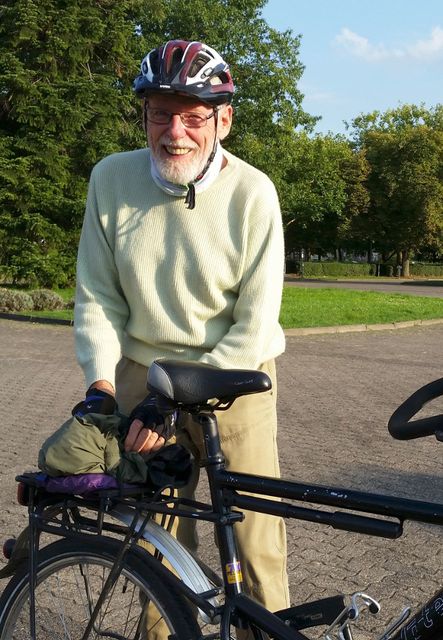
Dieter
In the Jahrhunderthalle, about 500 people, mainly seniors from retirement homes, wheelchair users and patients were waiting for the bomb to be defused. There were also several interesting conversations here.
Uwe had accompanied his acquaintance in a wheelchair. He said he found all the possible destruction “absolutely terrible … what a war like that can cause decades later.” He quickly added, “What happened in Germany then, the Germans had done to other countries, like the bombing of Coventry, Warsaw, and other cities.”
Erika, an almost 90-year-old woman from Frankfurt-Bonames, said, “I am very moved by this. It recalls a time I am reluctant to remember.” She told about how she had experienced the bombing. “For a time, we had to get up every night, mother and four children, and we were looking for shelter under the railroad lines that led to Friedberg. Soldiers had built a dugout there. The bunkers were all full.”
Then she told of an experience she had as a student on the way home from Preungesheim to Bonames. “Suddenly, someone grabbed me from behind and pulled me into the ditch that zigzagged along the road. It was a soldier who saved me from the low-flying aircraft. Otherwise I would have been shot.”
Asked what she thought about the present situation, Erika said, “What we had been through, I don't wish that on young people today. At the end of the war, everything was destroyed. We were hungry and I was not allowed to train for a real job because we had so many small siblings.”
Finally, we met Dr. Beatrix Heintze, who is currently confined to a wheelchair because of an ankle fracture. She confirmed that many elderly people had been strongly reminded of the bombings in the war, which she had also witnessed.
“I myself experienced this from a distance, but very intensively,” she said, “because my own grandfather was in the opposition to Hitler.” As it turned out, her grandfather was Walter Cramer, a friend of Carl Friedrich Goerdeler, one of the leaders of the July 20, 1944 resistance plot against Hitler. Like him, Cramer was also executed in Berlin-Plötzensee.

Dr. Beatrix Heintze
Dr. Heintze has written several books about him. “At that time, Cramer was chairman of a textile factory, the Stöhr & Co. worsted yarn spinners in Leipzig, and he was one of the few in business who actively campaigned for the Jews.” After the fall of the Berlin Wall in 1990, she gained access to sources in the former East Germany. And, as she reported, her publications contributed to the erecting of a monument to Cramer in Leipzig.
Her father had also been in the opposition to Hitler, she continued. “This whole history strongly influenced me,” she said. All these things were now alive again.
We told Dr. Heintze that professors such as Jörg Baberowski at Humboldt University now officially declared that “Hitler was not vicious,” and that newsweekly Der Spiegel spreads such views uncritically. She was quite horrified. “I have not heard of that before,” she said. “But that really cannot be said now. Hitler might not have carried out any cruelty personally, but his whole policy was inhuman and cruel.”
She said, “I am worried about the tone that has entered politics with the election of Trump in America or with the [far right] Alternative for Germany here.”

Labour will seek to block Brexit bill

Julie Hyland

As parliament begins its debate today on the second reading of the so-called Great Repeal bill, incorporating European Union (EU) legislation into British law, the Labour Party officially announced it will vote against.
The bill is the first step in legally removing the UK from the EU—scheduled for March 2019, following the Leave vote in last year’s referendum. Described as the largest legislative venture undertaken in British history, it incorporates statutes and regulations that had been adopted by the UK through its membership of the EU and its predecessor, the European Economic Community.
More fundamentally, the bill provides for “Henry VIII clauses”, dating back to the 16th century, enabling ministers and civil servants to decide which aspects of EU legislation and regulation can be kept, amended or discarded without recourse to parliament.
This massive increase in executive powers is justified on the grounds that it is necessary to “provide for a smooth and orderly exit” from the EU.
In a statement, a Labour Party spokesman said that “as democrats we cannot vote for a bill that unamended would let government ministers grab powers from parliament to slash people’s rights at work and reduce protection for consumers and the environment.”
Labour does not currently have the numbers to block the legislation. Conservative Prime Minister Theresa May has a working majority of 13, resting on the support of the Democratic Unionist Party in Northern Ireland. Despite criticisms, no Tory MPs are expected to rebel against May in Monday’s vote, although that could change when it reaches committee stage.
Labour’s denunciations of an executive “power-grab” cannot be taken at face value, especially when its real political purpose is to align the party as the main defender of the anti-democratic EU.
Its statement claims that it “fully respects the democratic decision to leave the European Union,” and “backs a jobs-first Brexit with full tariff-free access to the European single market.” (emphasis added).
It is the last part of the sentence that is the most significant.
Last June, Labour backed a Remain vote, despite party leader Jeremy Corbyn being a vocal critic of the EU throughout his 30 years on the backbenches. After the referendum, he voted with May to begin negotiations on Britain’s withdrawal from the Single Market and the Customs Union.
But this is opposed by the majority of the bourgeoisie, banks and big business. In addition to Brexit threatening corporate interests, the powers-that-be are alarmed at its consequences for the global standing of British imperialism. There are fears that it will lead to its diminishing and side-lining—especially against Paris and Berlin—under conditions of growing trade war and militarism.
In line with these concerns, May has accepted a transitional period, of up to two years following Brexit, to attempt measures that will replicate the UK’s existing relations with the EU.
May’s efforts, however, to fudge over bitter differences in the Tory Party on Brexit are regarded by many as unstable and unsatisfactory. Labour is now being refashioned as the main political vehicle to secure a de facto overturning of the referendum result.
Publicly, the Labour Party states that it accepts the Leave vote. But last week, Labour’s Brexit spokesman Keir Starmer announced Labour would support an extended period of transition after March 2019 in which Britain would continue to participate in the Single Market and Customs Union for “as long as needed.”
This has the support of most of the Labour Party apparatus—from the Blairite right-wing to the trade unions—who opposed withdrawal. Deputy leader Tom Watson said that it meant Labour was the party of “soft Brexit.”
This is the real content of Labour’s opposition to the Great Repeal Bill. It wants to make sure that the final version does not rule out continued participation in the EU.
Dennis MacShane, former Minister of Europe for Labour, said Labour’s move meant May will have to “decide whether to back the extreme anti-Europeans in her cabinet or follow the ultra-left-wing Jeremy Corbyn who is now appearing as a moderate, pro-business politician trying to delay Brexit as long as possible.”
His description of Corbyn as a stalwart of the political establishment underlines the real service the former “left” backbencher is providing to the powers-that-be. Corbyn’s supposed reluctance to wholeheartedly endorse the EU played a major role in last year’s attempted leadership coup by the Blairite right, with the support of the military-security apparatus. Now he has given his benediction to their demands, dressing up support for the EU as part of an anti-austerity programme—as if the big business bloc was not the main instrument for imposing social devastation across the continent, especially in Greece.
This has emboldened his nominal opponents in the Parliamentary Labour Party who are building relations with anti-Brexit Tories and calling for a reversal of the referendum result.
While tense official negotiations took place last week over Brexit terms in Brussels, Tony Blair met with European Commission president Jean-Claude Juncker behind the scenes. No details were released of their discussion but Blair has led demands for a second referendum.
On Tuesday, Blair’s former policy adviser Lord Adonis, said Labour would end up backing another referendum, which he described as a “first referendum on the exit terms.”
Leading Blairite Chuka Umunna has joined forces with Tory MP Anna Soubry in an all-party parliamentary group. Involving MPs from the Liberal Democrats, the Scottish National Party and Plaid Cymru, it demands the government seek to keep the UK in the Customs Union.
On Tuesday, the Labour Campaign for the Single Market was launched. Led by Labour MPs Heidi Alexander and Alison McGovern, it calls for the UK to remain “in the European Single Market and Customs Union,” and aims to build support for a motion to the Labour Party conference in two weeks to make this official policy.
Its leading personnel comprise those involved in the two attempted putsches against Corbyn’s leadership. McGovern quit Labour’s front benches after Corbyn was elected first in September 2015, and Alexander resigned the shadow cabinet in June 2016, days after the referendum, in a staged revolt by the Parliamentary Labour Party.
Advisory group members include Naushabah Khan, Leighton Andrews and Adam Harrison, who have all previously demanded Corbyn stand down or be replaced. Also on the board is Simon Darvill , who led the official Remain campaign in the referendum and Fiona Millar (partner of Blair’s spin doctor, Alastair Campbell).
In Prime Minister’s Question Time Wednesday, Corbyn avoided any mention of the government’s leaked plans to restrict immigration on a supposed “Briton’s First” basis. He has said that Labour will also look to limit freedom of movement.

British soldiers arrested for membership in banned fascist group

Steve James

Four soldiers in the British Army and one civilian have been arrested by West Midlands Police Counter Terrorism Unit, on suspicion of preparing acts of terrorism as members of the outlawed fascist group National Action.
Of the four, aged between 22 and 32, three are from England and one from Wales. The military personnel are from the Royal Anglian Regiment and the Royal Electrical and Mechanical Engineers. One of the soldiers was arrested by Royal Military police at the Dhekelia British Army base in Cyprus.
Reports describe one of those arrested as an “experienced soldier” at the Infantry Battle School (IBS) with responsibility for training and identifying private soldiers likely to have the “potential to be future leaders.”
This soldier is said to have met the others at a training course in Brecon, Mid-Wales. This is a centre used by the elite Special Forces regiment, the SAS, for training. The British Army’s web site boasts, “The commanders that lead them [armed forces overseas operations] are all trained at IBS, and the training they undertake is linked to current operations.” It adds, “[S]oldiers and officers are prepared for any operational situation they may face—conventional war, counter insurgency, security sector reform, peacekeeping or supporting civil authorities.”
The arrests, under section 41 of the Terrorism Act 2000, were described by an army spokesman as “the consequence of a Home Office police force-led operation supported by the army.” They were arrested “on suspicion of being concerned in the commission, preparation and instigation of acts of terrorism...namely on suspicion of being a member of a proscribed organisation (National Action).”
The police said the operation was “pre-planned and intelligence led.” The Daily Mail reported that the military personnel were seized “after investigators uncovered ‘inflammatory’ far-Right material, including images and slogans, on encrypted social media site WhatsApp.”
No detail has yet been made of any alleged crime they were planning, with the police saying there was “no threat to the public’s safety.”
National Action was formed in 2013. Its members, often wearing masks and balaclavas, have carried out numerous acts of racist violence and organised anti-Semitic activities.
In 2014, one of their number told the Huffington Post that he admired Antonio Primo de Rivera (founder of the fascist Spanish Falange), 1930s British Union of Fascists leaders Oswald Mosley and Alexander Raven Thomson and right-wing author Wyndham Lewis. The group appealed to “white youths between the ages of 15-29 who are looking to become racial activists,” promising “flyers, stickers and activities will be provided free of charge.” The same year, supporter Garron Helm from Liverpool was jailed for anti-Semitic tweets to Jewish Labour MP Luciana Berger.
In 2015, National Action member Zack Davies was given a life sentence in jail for the attempted murder of dentist Dr. Sarandev Bhambra, who was left with serious injuries after being attacked with a machete in a supermarket. Davies was reported shouting “white power” as he stabbed Dr. Bhambra. The same year, National Action organised a demonstration in Newcastle under a banner that included a large photo of the Nazi leader and read, “Refugees Not Welcome—Hitler was right.”
In 2016, photographs were posted on social media of National Action members performing fascist salutes in the Buchenwald death camp where 56,545 prisoners of the Nazis lost their lives during World War II. Members of the group also gathered outside York Minster to make Hitler salutes while holding the aforementioned banner.
The group’s leading figures have moved within a number of far-right groups. One of its leaders, Benjamin Raymond, was active in the New British Union, based on Mosley’s British Union of Fascists. A picture exists of Raymond—who said in an Internet post, “There are non-whites and Jews in my country who all need to be exterminated”—carrying a rifle. In the same post he added, “As a teenager, Mein Kampf changed my life. I am not ashamed to say I love Hitler.” Interviewed on BBC radio in 2015, Raymond said National Action supported Nazism and that Adolf Hitler was “absolutely” a role model.
The group has links with far-right forces internationally. Raymond described as a “hero” Anders Breivik, the Norwegian fascist who murdered 77 young people at a Norwegian Labour Party summer camp in 2011. Breivik’s act was the deadliest attack on civilians in Norway since World War II.
According to police figures, 22 members of National Action were arrested in 2016. It was proscribed in December of that year, following the murder of Labour MP Jo Cox by the fascist Thomas Mair.
Mair killed Cox, MP for the Batley and Spen constituency in West Yorkshire—during the referendum campaign on European Union membership—by shooting and stabbing her repeatedly. When he was brought before a court, Mair stated his name as “death to traitors, freedom for Britain.” This was a statement that National Action subsequently took as their own slogan, using it prominently on their former web site. They informed their social media followers, “Don’t let this man’s sacrifice go in vain.”
The arrest of the soldiers poses questions regarding possible connections between Mair’s murderous assault and National Action. Another tweet emanating from National Action after Cox’s killing referred to democratically elected members of Parliament, stating there were “only 649 MPs to go.”
The proximity of the ban on National Action to Cox’s murder invites suspicion that more is known about Mair’s political connections than was revealed publicly.
Announcing the ban, Home Secretary Amber Rudd declared the group to be a terrorist organisation, membership of which was an offence carrying a prison sentence. Publicising, organising meetings for, wearing clothing or carrying articles indicating approval of the group was also made an offence.
National Action is the only British far-right organisation among 71 mostly international groups currently banned in Britain, although a number of Northern Ireland’s right-wing loyalist groups have been banned for many years.
The existence of a neo-Nazi cell operating in the British armed forces is a dangerous development and one with parallels in other countries. With the turn towards militarism by all the major capitalist powers, there is a growing concentration of far-right and fascist forces within the state apparatus.
In Germany, the existence of a far-right network allegedly involved in preparing attacks against high-profile politicians has been revealed. Those targeted included former President Joachim Gauck, Justice Minister Heiko Maas, and the president of Thuringia, Bodo Ramelow, as well as Jewish and Muslim organisations. Later reports confirmed that the suspected terrorist cell was part of much more widespread right-wing extremist networks in the Bundeswehr.
In Greece, members of the fascist Golden Dawn work closely with the security forces, often under their protection. In the June 2012 general elections, more than half of police officers reportedly voted for Golden Dawn, with many police officers, particularly within the riot control department, members of the far-right group.
In Canada, five members of the fascistic Proud Boys organisation, who are members of the Canadian Armed Forces, disrupted a “sacred rite” ceremony by native Mi’kmaqs in July. The Proud Boys describe themselves as “Western chauvinists.” Following a military police investigation, last month the decision was taken by the Royal Canadian Navy not to punish the five.

Macron announces cuts to French social programs

Francis Dubois

Three days before its presentation of decrees to destroy the labor code on August 31, Prime Minister Edouard Philippe announced a series of measures to complete his break with what remains of the “French social model”. Under the pretext of “modernizing” social welfare systems, the government of French President Emanuel Macron is setting out to destroy all the social rights the working class gained in struggle during the 20th century.
These measures are presented as “revamping”, but in fact aim to liquidate the main social insurance and aid systems in their current form. “This is only the beginning”, Edouard Philippe had said as he presented the Labor Code decrees.
Encouraged by the support of the trade unions for its decrees but also pressed by an unpopularity that grows day by day, the government wants to attack unemployment insurance, vocational training, housing aids and medical insurance this month, before tackling pensions. The list is not exhaustive; the Medef (the French Employers Association) has already indicated that it wants to smash the SMIC (minimum wage). The method, already used against the Labor Code, remains the same: close collaboration with the trade unions to impose austerity.
Under the pretext of raising workers’ purchasing power, the government wants to eliminate unemployment contributions and replace them with a smaller increase in a separate tax paid by the population, not the employers. The ultimate goal is to eliminate the unemployment insurance system and exempt employers from any financial responsibility.
The government is pledging “drastic” oversight of the unemployed. They will lose their allowances if they refuse a job and will have to accept increasingly precarious and poorly paid jobs.
This is also a way of creating a low-wage sector, as in Germany with the Hartz laws, aiming to undermine social rights and create a broad mass of “working poor”.
The model, according to Marianne magazine, recalls “the English system and its ‘Job centers’ [set up under Margaret Thatcher] where the unemployed person has no choice but to accept what is proposed to him, the level of salary, qualifications or geographical location of the position, at the risk of losing his allowances immediately.”
Vocational training is to be treated in the same way. Joint funding between workers and employers must also be replaced and resources must be directly controlled by the State, aiming to become a source of profit. According to Le Monde a commission will ensure a “return on investment of vocational training funds.”
Under the pretext of bringing the unemployed back into jobs, the government aims to eliminate stable and comprehensive training for decent jobs and replace it with constant “bits” of training, taken between precarious jobs in various industries and depending on the bosses’ immediate needs.
Similarly, the government also announced a “rethinking” of pensions for the beginning of 2018. Under the false pretext of “simplifying” and “democratizing”, it would merge 37 pension schemes into a single one, so that all French people have the same, bargain-basement pension “regardless of their status and career path”.
The example of Britain again shows what the government has in mind. Everyone gets the same low pension, and those who want more must subscribe to private pensions sold by investment funds and insurance companies.
The medical insurance system is also being targeted. Last week, the Minister of Economy and Finance, Bruno Le Maire, announced a series of privatizations, which will submit social services to the profit motive, and disrupt and deregulate critical social or industrial sectors such as the supply of water or public transport, with disastrous consequences for the population.
Despite the technocratic jargon used by the government to define its projects, its policy is clear: it is embarking on a campaign to destroy all of the social gains of the working class for the benefit of the super-rich. This policy is clearly illustrated by the reform of the ISF (Wealth Tax). This project “is expected to reduce income from the wealth tax by three-quarters. A gift that will benefit especially the wealthiest amongst the wealthy”, says Le Monde.
Macron’s policy is fundamentally illegitimate and undemocratic. He planned his destruction of the Labor Code with the Medef and the trade unions and imposed it, despite the fact that nearly two-thirds of the French people are against it, thanks to decrees that bypass the parliament.
To impose this policy of social destruction, the financial oligarchy is planning permanent and generalized repression of the population. That is why the other priority of the government is a “second emergency parliamentary session” on 25 September for a new “anti-terror law”, i.e., moving the key repressive measures of the state of emergency into common law.
The state of emergency, imposed by the Socialist Party (PS) government of François Hollande and extended by Macron until his new law comes into force, is primarily directed against the working class. Its purpose was fully demonstrated during the repression of anti-labor law protests in July 2016. The main targets of the state of emergency are the fundamental democratic rights of the working class, rights acquired and defended during long struggles, including the bloody fight against the Nazi occupation and the collaborationist regime of Vichy.
It is also now proven that terrorist attacks in Europe over the last two years have been carried out by networks of Islamist fighters mobilized by Western intelligence agencies in their war to overthrow the Syrian regime of President Bashar al-Assad. The terrorists traveled under the protection of the intelligence services, who saw them as critical foreign policy tools. It is established, among other things, that the Belgian State had prior knowledge of the Brussels bombings in March 2016 and knew where to find its perpetrators.
Just as Trump represents the interests of the American financial oligarchy, Macron wants to impose the diktat of the French financial aristocracy against the workers. The similarity of slogans is not a coincidence. Where Trump speaks of “making America great again”, the Macron government says “France is back” or that “we must make France stronger.”

Burmese military steps up ethnic cleansing of Rohingya Muslims

John Roberts

Over the last week, the Burmese (Myanmar) government led by Foreign Minister Aung San Suu Kyi has fully collaborated with the military’s “clearance operations” against the Rohingya Muslim population of northwestern Rakhine state.
According to UN officials, since the ethnic cleansing campaign began on August 25, supposedly in response to attacks on security forces, nearly 90,000 Rohingya refugees have fled, driven out by the military’s scorched earth policy and widespread killings.
On Monday, another 20,000 refugees were massed on the border with Bangladesh. The Bangladesh government has ordered all refugees be turned back. However, as one border guard told Agence France Presse, the sheer numbers made it impossible to stop the influx. “It’s bigger than the last time,” he said.
As of Monday, the UN estimated that 87,000 new refugees had fled, bringing the total to 150,000 since October. The previous “clearance” operations that began in October and lasted for five months were in response to earlier, smaller attacks by the Arakan Rohingya Salvation Army (ARSA).
A catastrophic situation is now developing in the refugee camps. The overall numbers in Bangladesh have risen to more than 400,000.
As in October, the military, in league with Burmese nationalist thugs, exploited the ARSA attacks as the pretext for unleashing pre-planned pogroms. The army has been building up its forces in the area since at least early August. Its aim is to completely drive the Rohingya out of Burma, where many families have lived for generations.
Suu Kyi and her National League for Democracy (NLD) have backed the military at every step. On Monday, the media revealed that President U Htin Yyaw, who was appointed by Suu Kyi and the NLD, granted military chief General Min Aung Hlaing’s “request” to declare the whole region “a military operational area.”
At the border police headquarters in Kyee Kan Pyin, Major Ko Soe said the operational area covered Buthidaung, Maungdaw and Rathedaung townships as well as Taungpoletwe and Myinlut sub-townships. U Htin even backdated the decree to August 25, thus legitimising the crimes already carried out.
Major Soe said the president’s decision ensured “decisive actions can be taken against terrorist organisations in clearance operations.” As of Saturday, 11,700 non-Muslim “ethnic residents” also have been driven out of the area, which has been sealed off to the media and non-government organisations.
The army only admitted the destruction of 2,700 homes after the US-based Human Rights Watch accessed satellite images that showed 10 villages and towns had been torched in Rohingya areas parallel to a 100-kilometre stretch of coastline. HRW said the area was five times larger than that torched by security forces last October to November, when 1,500 dwellings were destroyed.
At a military ceremony last Friday, General Hlaing said 11 police and two soldiers, as well as 16 civilians and officials, had been killed and eight bridges and 2,700 homes had been destroyed. An August 31 army statement said there were 90 clashes between the security forces and the ARSA in late August, in which 370 alleged militants had been killed.
Suu Kyi and the military blame the death and destruction on the primitively-armed militia of ARSA, which announced its existence last October. Burmese security officials claim the group began recruiting six months earlier. The group has been isolated by the Bangladesh government’s offer to assist the Burmese in cracking down on the insurgents.
The NLD and the military are both deeply imbued with anti-Rohingya chauvinism that brands the Rohingya as illegal “Bengali” immigrants. They are treated as non-citizens with no basic democratic rights.
At Friday’s ceremony, General Hlaing denounced the “Bengalis” for having fought with the British military in 1942. This must never happen again, he said, and the army would defend Burmese sovereignty.
Hlaing’s reference to the “Bengalis” in 1942 points to the reactionary roots of Burmese nationalism. Whereas some Muslim Rohingya were recruited by the British colonial authorities into its military forces, a layer of Burmese nationalists collaborated with Japan after it falsely promised to grant independence.
Japan’s colonial regime formed the Burma Independence Army (BIA), which fought the British alongside the Japanese military. Among its recruits were the “Thirty Comrades,” who included Suu Kyi’s father Aung San and Ne Win, who went on to found the Burmese army after the end of World War II. Ne Win led the military dictatorship from 1962 to 1988.
When the BIA forces entered Burma with the Japanese army, they were particularly brutal in attacking ethnic minorities they defined as British collaborators. Many were killed. At one point, the Japanese had to rein in some BIA militias from attacking ethnic groups.
These are the traditions invoked by Genereal Hlaing. He said the Bengali “problem” was “a long-standing one which has become an unfinished job.” The obvious implication is that the time has come to finish the job through brutal ethnic cleansing.
That is exactly what Rohingya refugees describe.
Jalal Ahmed, 60, entered Bangladesh last Friday among a group of 3,000. He told Reuters the army arrived with 200 people and set fire to the whole village. Other specific reports of beheadings and shootings in the fields and villages have been made to the aid agency, Fortify Rights.
Reports to the UN Human Rights Council in Geneva last February, based on hundreds of interviews at different refugee centres, provided further evidence. Many Rohingya, particularly adult males aged 17-45, simply disappeared. Satellite images raised the probability of large-scale killings and abuses that constitute crimes against humanity.
UN officials called for an inquiry into the Burmese military’s activities, including in 2012 and 2014, but the Suu Kyi government refused to cooperate.
The scale of the latest “clearance operations” led to formal protests by Malaysia, Turkey and Pakistan. Indonesian President Joko Widodo sent Foreign Minister Retno Marsudi to Burma and Bangladesh. There have been demonstrations and protests outside Burmese embassies internationally.
Western nations, however, while critical of the military’s activities, have refused to condemn Suu Kyi and her government. British Foreign Minister Boris Johnson, for instance, described her “as one of the most inspiring figures of our age” and urged her to use her “remarkable qualities” to end the violence.
These comments were made, with full knowledge of Suu Kyi’s collaboration with the military pogroms, to obscure the responsibility of her imperialist backers for what is now taking place.
The Suu Kyi-led government is in large part the creation of the European Union and the United States. London, Brussels and Washington promoted her as a “democratic icon” and endorsed her alliance with the military junta in 2011.
The Western imperialist opposition to the Burmese military had nothing to do with its crimes and abuses of democratic rights but was bound up with its orientation to Beijing. Once the junta opened Burma to Western investment and reoriented its foreign policy, US and European concerns about “human rights” were quickly shelved.

Yemen’s cholera outbreak surpasses 600,000

Bill Van Auken

The humanitarian crisis unfolding in Yemen—the worst in the world—is an “entirely man-made catastrophe,” the product of a the two-and-a-half-year-old Saudi-led and US-backed war of aggression, the UN Office of High Commissioner for Human Rights stated in a report issued on Tuesday.
The war, which has increasingly assumed near-genocidal proportions, has killed at least 14,000 civilians, maimed many thousands more, displaced 2 million and left at least 7.3 million on the brink of famine.
Meanwhile, the country is confronting the worst cholera epidemic on record, with the World Health Organization and Yemen’s health ministry reporting 612,703 people infected and 2,048 of them dying from the disease since April. While the spread of the epidemic has slowed over the past two months, there are still 3,000 new cases reported daily.
Shortly after the outbreak of the epidemic, the WHO predicted a worst-case scenario of 300,000 cases within six months. That this estimate has been more than doubled is testimony to the merciless destruction wrought by a massive Saudi bombing campaign, described by the UN as the “leading cause” of death in Yemen, as well as the effects of a sea and air blockade imposed upon the country with the indispensable support of the US Navy.
The Saudi regime has dramatically escalated its bombardment of Yemen, staging 5,767 airstrikes in the first six months of this year alone, compared to 3,936 for all of 2016.
Bombs and missiles, supplied by the United States and delivered by US-made warplanes that are aerially refueled by American tanker planes and guided by US intelligence, have struck, as the UN reported Tuesday, “markets, residential areas, hospitals, schools, funeral gatherings and even fishermen and small civilian boats at sea.”
Airstrikes have demolished the country’s infrastructure, leaving 15.7 million people without access to either clean water or sanitation, creating the objective conditions for the spread of cholera.
This was also the conclusion reached by a study conducted by researchers at London’s Queen Mary University last month, which found that eight out of ten cholera deaths in Yemen were in Saudi-besieged areas controlled by the Houthi rebels. “Saudi-led airstrikes have destroyed vital infrastructure, including hospitals and public water systems, hit civilian areas, and displaced people into crowded and unsanitary conditions,” the study stated.
The Saudi war is aimed at restoring to power Yemen’s fugitive president Abd Rabbuh Mansour Hadi, a stooge of Riyadh who was first installed in a 2012 election in which he was the only candidate for a two-year transitional period that has long since expired. He was forced to flee the country by an alliance of Houthi rebels and forces loyal to the former dictator, Ali Abdullah Saleh, who seized much of the country, including the capital of Sanaa.
The main concern of the Saudi monarchy is that any Yemeni regime not under its control could establish closer ties to Iran, Saudi Arabia’s regional rival. Both Riyadh and Washington have charged, without any substantive evidence, that Iran is arming and supporting the Houthis.
The Saudi war enjoyed the support of the Obama administration, which set up a joint command center between the Pentagon and the Saudi military to oversee the war and signed hundreds of millions of dollars’ worth of arms deals with the monarchy.
This support has only been escalated under Trump, who staged a visit to Riyadh in May in which he went out of his way to praise Riyadh for its “strong actions against Houthi militants in Yemen” and signed a $110 billion arms deal that includes an option for the Saudis to purchase $350 billion worth of US weapons over the next 10 years.
US Defense Secretary James Mattis likewise issued a memo last March calling for stepped-up support for the criminal war against Yemen, which is seen by the Pentagon as part of the preparation for a US military confrontation with Iran.
Tuesday’s UN report called upon the Human Rights Council, the UN body authorized to order major international investigations, to mount such a probe of human rights violations in Yemen when it convenes later this month. The council has repeatedly rejected calls to investigate the war, leaving the matter in the hands of a Yemeni government panel that is an instrument of the Saudi monarchy.
“I have repeatedly called on the international community to take action to set up an independent, international investigation into the allegations of very serious violations of human rights and international humanitarian law in Yemen,” said Zeid bin Ra’ad al-Hussein, the UN’s high commissioner for human rights, in issuing Tuesday’s report. He added, “The reticence of the international community in demanding justice for the victims of the conflict in Yemen is shameful, and in many ways contributing to the continuing horror.”
Saudi Arabia, whose ruling monarchy regularly tortures and beheads its political opponents, is a member of the Human Rights Council, where it and the United States have been able to block any critical examination of the Yemen war.
Meanwhile, the UN’s World Food Program (WFP) also indicted Riyadh for the catastrophe in Yemen. “Saudi Arabia should fund 100 percent of the needs of the humanitarian crisis in Yemen,” the WFP’s executive director, David Beasley, said Tuesday. “Either stop the war or fund the crisis. Option three is, do both of them.”
The WFP director said that the Saudi blockade of the Red Sea port of al-Hudaidah, through which 80 percent of Yemen’s food imports arrived before the war, along with the Saudi bombing of the port’s cranes, had “substantially reduced our capacity to bring food in.”
The conditions spelled out by the UN agencies constitute war crimes inflicted by the wealthy and reactionary hereditary monarchies of Saudi Arabia and the Gulf oil sheikdoms together with their principal backers, the United States and Britain, against the most impoverished country in the Arab world.
The same capitalist politicians, corporate media, and various pseudo-left proponents of “human rights” imperialism who regularly denounce the Syrian government of Bashar al-Assad and its Russian and Iranian allies for war crimes largely ignore the mass slaughter in Yemen, where an entire population is being subjected to bombardment, disease and starvation.

UN head warns Korean crisis could spiral into world war

James Cogan

United Nations Secretary-general Antonio Guterres warned on Tuesday that the conflicts being provoked by the bellicose US stance toward North Korea’s nuclear weapons’ program could lead to “unintended consequences.”
Guterres invoked the years leading up to the outbreak of World War I, when rival responses to international incidents aggravated great power antagonisms culminating in all-out war. “Wars usually do not start by a decision taken in a moment by the parties to go to war,” he stated. “If you look at the history of the First World War, it was on a step-by-step basis, one party doing one thing, the other party doing another, and then an escalation taking place… This is the risk we need to avoid in relation to the situation of North Korea.”
The UN head issued the warning as sharp divisions emerged between the US, China and Russia over Washington’s latest demands that the UN Security Council impose a total trade embargo on North Korea, including the supply of oil and gas.
US strategic think tanks have discussed the aim of such an embargo—itself an act of war—for more than 25 years. It would seek to collapse the country’s already crisis-stricken economy, provoke starvation and social upheaval, and create conditions for a US and South Korean intervention to install a client state in Pyongyang.
The Trump administration has ruled out any negotiations on the terms being advanced by North Korea. Pyongyang has signalled it would be prepared to begin talks on ending its nuclear program only if the US and South Korea ceased their constant military rehearsals for an attack. North Korean leader Kim Jong-un is well aware of the fate of the Iraqi and Libyan regimes after they bowed down to American imperialist dictates. Both were attacked, the countries devastated and their leaders murdered.
Washington has answered the Pyongyang regime with provocative rhetoric, including President Donald Trump’s tweet last week, declaring: “Talking is not the answer.” Echoing Trump, US ambassador to the UN Nikki Haley issued an ultimatum to China and Russia on Monday “that the time has come for us to exhaust all of our diplomatic means before it’s too late.”
The implication is unmistakable. If the Security Council does not vote for harsher sanctions against North Korea, the US and its allies will launch a catastrophic war that could involve the first combat use of nuclear weapons since 1945.
Beijing and Moscow have both signaled they will not support such an economic blockade. Speaking yesterday during an economic summit in the far eastern Russian city of Vladivostok, Russian President Vladimir Putin stated: “We should not act out of emotions and push North Korea into a dead end. We must act with calm and avoid steps that could raise tensions.”
The economic and strategic interests of the Chinese and Russian ruling elites would be severely compromised by either scenario being threatened by Washington. A blockade that led to the collapse of the Pyongyang regime and its replacement by a pro-US puppet state would mean American military forces operating on their borders with Korea. A war, on the other hand, would not only devastate the Korean Peninsula, but profoundly destabilise East Asia. Among the consequences could be the nuclear fall-out and contamination of northern China and the Russian Far East as well as a flood of millions of refugees over the borders.
Beijing and Moscow are desperately seeking to close off the possibility of a US attack. Both have bent over backwards to accommodate to Washington’s demands that they increase pressure on Pyongyang to end its nuclear weapons and long-range missile programs. They have voted in the UN Security Council for ever-harsher sanctions and claim they are enforcing them. At the same time, they have repeatedly called on Washington to accept North Korea’s position that it will not cease its efforts to acquire a nuclear arsenal while it is permanently threatened with attack and invasion by the US and South Korea.
Putin signalled yesterday in a meeting with South Korean President Moon Jae-in that he is seeking to win Seoul away from the US stance and toward opening negotiations with Pyongyang.
Against Washington’s demands for an economic embargo of North Korea, Putin advocated massive investment into the besieged and isolated country. He told a press conference: “We could deliver Russian pipeline gas to Korea and integrate the power lines and railway systems of Russia, the Republic of Korea [South Korea] and North Korea. The implementation of these initiatives will be not only economically beneficial, but will also help build up trust and stability on the Korean Peninsula.”
Moon Jae-in responded favourably. He told Putin at the joint press conference: “The development of the Far East will promote the prosperity of our two countries and will also help change North Korea and create the basis for the implementation of the trilateral agreements. We will be working hard on this.”
These “trilateral agreements” have been struck between China, Japan and South Korea since 2005 to strengthen their investment and trade relations. Putin’s proposal is also in line with South Korea’s “Sunshine Policy” in the 1990s to open up the North for investment and dovetails with China’s “One Belt One Road” plans to develop energy and transport links across the Eurasian landmass to Western Europe.
Newsweek magazine noted yesterday that Putin had proposed to Moon a “vision for peace in the Korean Peninsula that marginalises the US.”
Successive American administrations—Clinton, Bush, Obama and now Trump—have aggressively intervened to disrupt any such prospect. Washington has repeatedly exploited North Korea’s “weapons of mass destruction” to ratchet up tensions in East Asia and block South Korea and Japan from developing an economic and strategic orientation to China, Russia and Europe.
The war danger today is the outcome of decades of imperialist intrigue and provocation. The warnings by Guterres serve only to underscore that in the corridors of power around the world, the real dangers posed by the aggressive drive by the American capitalist class are well understood. Washington is seeking to preserve US global dominance against the challenges it faces, above all from the ambitions of the Chinese ruling elite to place Beijing at the centre of an integrated Eurasian economic bloc that largely excludes the United States.
As in the years prior to 1914, the competing interests of rival capitalist nation-states threaten to drag humanity into a catastrophic global war, fought this time with nuclear weapons.

Hurricane Irma slams into Puerto Rico and other Caribbean islands

Jerry White

Less than two weeks after Hurricane Harvey hit Texas, leading to record flooding and damage in Houston and other areas of the state, an even more powerful hurricane has plowed through a chain of small islands in the northern Caribbean and Puerto Rico and is heading towards the Dominican Republic, Haiti, the Bahamas and Cuba. Densely populated south Florida, which includes Miami, could be hit Sunday, and the Georgia and South Carolina border by Monday afternoon.
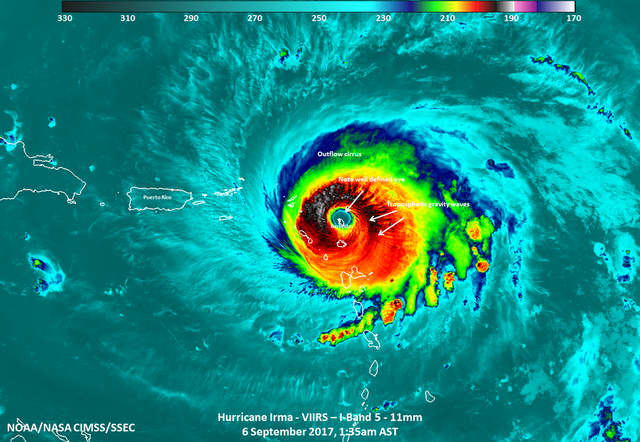
Hurricane Irma is a Category 5 storm with 185 mile per hour winds, making it the most powerful Atlantic Ocean hurricane ever measured. In the early morning hours on Wednesday, Irma smashed into the Lesser Antilles islands of Antigua and Barbuda (population 82,000 and 1,700), Saint Barthélemy (9,000), Anguilla (15,000) and Saint Martin/Sint Maarten (77,000).
Hurricane Irma over the island of Barbuda [Credit: NASA/NOAA/UWM-CIMSS, William Straka III]
At least seven people are confirmed dead, though this number is expected to rise quickly.
The eye of the hurricane passed directly over the island of Barbuda around 2 a.m. Wednesday, with reports of sustained winds of 118 mph, gusting to 155 mph, before meteorological instruments failed. Charles Fernandez, minister of foreign affairs and international trade for Antigua and Barbuda, said the destruction on Barbuda was “upwards of 90 percent.”
High winds and storm surges destroyed government buildings, tore roofs from houses and left islands without power or communication. Both the Dutch and the British dispatched naval ships and military personnel to their island possessions, while French President Emmanuel Macron, who was monitoring conditions in the French West Indies from an Interior Ministry crisis center in Paris, said the “toll would be harsh and cruel.”
Hurricane Irma began battering the US territory of Puerto Rico, with a population of 3.4 million US citizens, Wednesday afternoon. As of this writing, the eye of Hurricane Irma was 35 miles (56 kilometers) north of the capital city of San Juan and hovering above the Atlantic Ocean. Authorities say wind gusts of up to 100 mph (160 km/h) could hit the capital of 355,000 people.
More than one million people, or nearly a third of the population, are currently without power, and nearly 50,000 are without water. Fourteen hospitals are using generators after losing power, and trees and light posts are strewn across many roads.
The island has not been hit by a Category 5 hurricane since Hurricane San Felipe in 1928. Hurricane Hugo in 1989 struck Puerto Rico as a Category 4 storm, leaving 72 dead and doing $3 billion in damage. The National Weather Service predicts “extreme” danger and warns that roads are likely to become impassible, and structurally sound buildings are likely to be damaged. Rock and mudslides, particularly in rural areas, are also predicted.
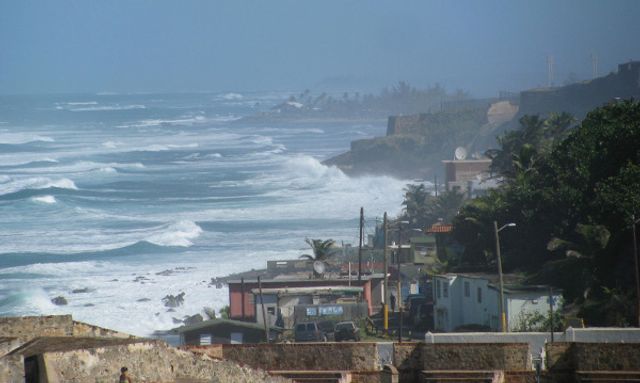
The historic La Perla shantytown in San Juan
Harvey and Irma are being followed by tropical storms Jose and Katia, which could develop into hurricanes threatening the northern Leeward Islands in the West Indies—including some of the same islands hit Wednesday—and Mexico, respectively.
The water in the Caribbean is warmer than usual, and this provides fuel for such hurricanes. The intensity of the storms and their frequency only underscore the impact of global warming, which is denied by President Donald Trump and only paid lip service by other capitalist governments around the world.
In response to Hurricane Irma, Trump has declared states of emergency in Florida, Puerto Rico and the Virgin Islands and ordered the Federal Emergency Management Agency (FEMA) to begin relief efforts. Puerto Rican Governor Ricardo Rosselló announced that the government was operating 456 shelters to accommodate 63,229 people.
As in Houston, however, the human cost of the new hurricane has been far worsened by the lack of any serious government preparations and the decay of physical and social infrastructure. In the case of Puerto Rico, the island and its people have been left ever more vulnerable by the looting operation carried out by Wall Street to extract some $70 billion in debt payments, or $12,000 from each resident of the island.
Last May, a financial oversight board appointed by the Obama administration filed for Title III bankruptcy to pave the way for Greek-style austerity measures, including slashing public-sector jobs and pensions on an island that already suffers from an official poverty rate of 45 percent and 14.2 percent jobless rate. The Puerto Rican government has hired advisors who oversaw the bankruptcy of Detroit and the sell-off of public assets to pay off wealthy bondholders.
The budget proposed by Rosselló cuts the departments of education, natural resources, housing and agriculture, including a $200 million cut for Puerto Rico’s public university that provoked a two-month-long student strike. The budget also eliminates millions of dollars in annual subsidies to 78 municipalities of Puerto Rico, forcing the mayors to find funding in other areas.
The flooding of water and sewerage systems by the hurricane threatens to create a humanitarian disaster on an island that is already supplied with water from systems that violate the US Safe Drinking Water Act, due to contaminants ranging from lead to coliform bacteria. The water system has been privatized twice, resulting in skyrocketing utility bills.
Before the hurricane hit, Ricardo Ramos Rodríguez, the executive director of the Puerto Rico Power Authority, warned that the island’s electrical system was vulnerable to a catastrophic failure from high winds because it had not been adequately maintained for years. “If we are [slammed] by this hurricane as is being outlined in the forecasts, there are certainly going to be blackouts, and certainly there will be areas that are going to spend three, four months without electricity service,” Rodríguez said in a radio interview with WIPR.
“For many years there has been no maintenance or replacement of damaged equipment,” he said, adding that the public corporation has lost about 5,000 employees in recent years, of which 86 percent were operational—linemen, plant operators or mechanics.
The power company, which is saddled with $9 billion in debt, has been a prime target for privatization by Citigroup and other vulture capitalists squeezing the lifeblood out of the island’s people.
On Wednesday evening, the World Socialist Web Site spoke with Carmen Merrill, a retired New York City sanitation worker who was born in Puerto Rico and now lives in the southeast of the island. As the interview was conducted, the electricity was cut off in the home in Guayama she was sheltering in with a friend.
“My concern is how long we will be without power. There was a news segment on television a while ago and they interviewed retired workers from the Palo Seco Power Plant in Cataño, just outside of San Juan. They said any winds above 50 miles per hour could shut the plant because maintenance never got done. A worker who complained that the plant was too dangerous was killed in an explosion. The government is not doing anything about it.
“They use the word ‘Commonwealth,’ but businesses come here and get tax breaks, and that money is not available for public services. The schools are maintained and politicians like Rosselló just talk and take no action.”
Most Puerto Ricans, she said, could not afford emergency generators. And while many homes were built with concrete to resist storms, low-income families in isolated areas and in neighborhoods like La Perla in Old San Juan live in structures that are susceptible to massive damage.
“The rising of the rivers is the most dangerous,” Carmen said. Like Houston, she said, working-class residents were helping each other put metal racks on their windows to protect their homes. “We saw what happened in Houston. It was devastating. We had a small group of people volunteering from Puerto Rico to help rescue people in Houston. People are asking here how a modern state like Texas could flood so quickly and people get washed away in unsanitary water.”
Before retiring to Puerto Rico, Carmen said, she was involved in the clean up of Superstorm Sandy in New York City in 2012. “The worst was in Rockaway in Queens, where we saw all the furniture and belongings destroyed and piled up in front of their homes. Houston reminded me of Sandy. Every house and car was flooded. An older lady came up in tears, saying, ‘I don’t care about the furniture but I want my family pictures.’ I found a black and white photo of her grandchildren and gave it to her. After that I couldn’t work, I just cried.”

North Korea: Testing the Limits of US-South Korea Relations

Sandip Kumar Mishra


North Korea’s leader Kim Jong-un must be the happiest to see the state of South Korea-US relations. One of his fundamental desires is to create a rift between the US and South Korea, and he has been trying to achieve it consistently for years. In the last few months, he has found a very helpful friend in President Donald Trump. It seems that Trump has been contributing more than Kim himself to realise North Korea’s foreign policy objective. After calculated provocations by North Korea, the Trump administration resorted to mindless and inconsistent responses, like "fire and fury" and "ready locked and loaded." It led to serious discomfort in South Korea, which wanted to engage North Korea and resolve the nuclear and missile problems through negotiations. To restrain the US, in an extraordinary assertion, South Korean President Moon Jae-in said on 15 August 2017 that “no one can make a decision on military action on the Korean peninsula without our agreement.” The statement was meant as a warning to US President Donald Trump.
Trust between the US and South Korea lowered when the US tried to install the Terminal High Altitude Area Defence (THAAD) system in South Korea, at a time when South Korea did not have an elected leader in command in the interim period after the tenure of the previous President Park Geun-hye. During his presidential campaign, Moo Jae-in identified several problems in the process of installation of the THAAD in South Korea, but the US had taken the process to an irreversible stage. After taking oath as president in May 2017, Jae-in did not have much choice but to accept the THAAD system in South Korea.
When Washington, DC’s demand that Seoul bear the cost of the THAAD was met with resentment in South Korea, the US clarified that it would go by the initial agreed terms on the matter. However, the incident definitely raised suspicion within South Korea about the Trump administration’s intent. Similarly, when the US unilaterally deliberated reinstalling tactical nuclear weapons on the Korean peninsula, it was again refuted strongly by Jae-in.
Trump's unpredictability and inconsistency have created more concerns in South Korea than in North Korea. In a recent episodes, the Trump administration threatened to scrap the Free Trade Agreement (FTA) with South Korea because it favours the latter. Given such incidents, the Jae-in administration is not sure about the reliability of US responses in any serious security and economic crises in South Korea. South Korea, which seeks dialogue with North Korea, is also worried that if an armed conflict initiated by the US occurs on the peninsula, Seoul will have to bear most of the costs. In spite of North Korean rhetoric, Pyongyang still does not have reliable capacity to hit US territories, and ultimately it would target Japan and South Korea where a substantial number of US troops are present.
North Korea’s Sixth Nuclear Test
Dissonance in US-South Korea perceptions and methods also became obvious after North Korea's sixth nuclear test on 3 September 2017. South Korea held National Security Council (NSC) meeting where it was expressed that it "will ratchet up pressure on North Korea until Kim Jong-un agrees to talk.” It is important to note South Korea’s insistence on talks with North Korea. In response, President Trump tweeted, “South Korea is finding, as I have told them, that their talk of appeasement with North Korea will not work, they (North Korea) only understand one thing.”
To resolve the North Korean issue, it is urgent to have a coordinated approach, at least among US allies. North Korea’s sixth test has been the biggest till date, of around 100-150 kilotons of yield. The North Korean state media claimed that this was a thermonuclear device, now ready to be used with inter-continental ballistic missiles (ICBM). North Korea also tested the Hyosung-12 and Hyosung-14 in July and August respectively, the latter being supposedly an ICBM with the capacity to reach the US mainland. 
Unfortunately, Trump seems more interested in blaming South Korea’s ‘appeasement’ and making provocative ‘irresponsible statements’. After the North Korean test, the White House announced another warning, of a "massive military response" by the US against North Korean provocation. US Defence Secretary James Mattis said that the US does not seek the “total annihilation” of North Korea, but threatened that it has “many options to do so,” emphasising that the US response would be “both effective and overwhelming.” When reporters asked Trump whether he had plans to attack North Korea, he answered, “we’ll see.”
Provocative statements from the Trump administration have been so oft-repeated that they appear to be empty and simply irresponsible. In yet another tweet,  Trump said that "the United States is considering, in addition to other options, stopping all trade with any country doing business with North Korea." President Trump seems to be unaware that some of these countries would include China, India, Philippines, Taiwan, France, Russia, Brazil, Germany, Turkey, Saudi Arabia, and Egypt.
In the heightened crisis on the Korean peninsula, it would be a challenge for the South Korean administration to deal with the US and the North Korean leaders simultaneously, but it would definitely have to do so. Left up to Kim Jong-un or Donald Trump, the consequences would be disastrous.