12 Sept 2017

Sri Lankan president desperately tries to rally support

W.A. Sunil 

Recent public remarks by Sri Lankan President Maithripala Sirisena underline the growing crisis of the “unity” government of Prime Minister Ranil Wickremesinghe’s United National Party (UNP) and the president’s Sri Lanka Freedom Party (SLFP).
Sirisena became president in 2015 after a US-backed regime-change operation to unseat the former President Mahinda Rajapakse’s government in the presidential elections. The US and India were hostile to Rajapakse close relations with Beijing and wanted Sri Lanka brought into line with Washington’s geo-strategic buildup against China. Sirisena and his political allies won support by exploiting popular anger over Rajapakse’s socially-destructive policies and his autocratic methods of rule.
Just two and half years later, wide layers of workers, students and youth have drawn the conclusion that the Sirisena-Wickremesinghe government’s retrogressive social program is no different to that of Rajapakse and the current administration is even more ruthless in implementing its policies.
Like its predecessor, the current administration is imposing the austerity demands of the International Monetary Fund (IMF), attacking workers’ jobs and living conditions and cutting its minimal subsidies for small farmers and the poor. Rather than honour Sirisena’s phony reform promises during the 2015 presidential and parliamentary elections, the new government is systematically undermining basic democratic rights.
Former President Rajapakse now heads a breakaway parliamentary faction of the SLFP known as the Joint Opposition (JO) and hopes, with the support of former coalition partners, to bring down the Sirisena-Wickremesinghe administration and return to power.
In an attempt to bolster support for his factionally-riven party, Sirisena decided to hold a mass rally on September 3 to celebrate the 66th anniversary of the founding of the SLFP. On August 30, Sirisena invited media heads and newspaper editors to a special meeting at his home to promote the rally.
Answering a pre-arranged question about the dissenting voices in his own party and Rajapakse’s threats to bring down his government, Sirisena declared: “It’s not me but the SLFP parliamentary group that is in the consensual government. Although some say their party will soon form government on their own, under the current composition of the parliament no single party could form a government … Even if there is another coalition, I will fulfill my responsibilities towards the people as president of the country until the end of my term.”
In other words, Sirisena, contrary to his previous promises to restore parliamentary democracy, was reminding the media indirectly that he will retain the dictatorial executive presidential powers previously used by Rajapakse. It was yet another demonstration that Sri Lanka’s political elite cannot tolerate any form of genuine democratic rule.
Sirisena, through his political proxies, has also indicated that he will seek a second presidential term after 2020. On July 18, SLFP general secretary Duminda Dissanayake told the Daily Mirror that the party’s candidate in the next presidential election will be “none other than President Maithripala Sirisena.”
In the days leading up to the commemoration rally, Sirisena used the state-owned electronic and print media establishment, government ministers and the pseudo-left organisations to promote the event, and the so-called achievements of his unity government. No expense was spared with over 2,000 buses hired and free lunches provided to transport people from distant areas to the rally.
Addressing the event, Sirisena pompously declared: “I ask every learned and intelligent person to ask their conscience where this country would be if I had not been elected at the presidential election in 2015 January. At that time we faced an election, the international community was pointing guns at us and economic sanctions were hanging over the head of our beloved motherland.”
Sri Lanka, however, he continued “regained” the support of the “international community” by establishing “consensual government.” Then, in a direct appeal to the military and Sinhala chauvinist elements, he boasted that he had blocked UN Human Rights Council plans for an international investigation into Sri Lankan war crimes.
Sirisena then compared the current situation with the crisis faced by SLFP founder and former prime minister S.W.R.D. Bandaranaike from 1956 to 1959. Bandaranaike began his parliamentary career as a member of the first UNP cabinet. He broke from the UNP and founded the SLFP in 1951, as an alternative Sri Lankan capitalist party in order to prevent a left-wing regime coming to power under the leadership of the Lanka Sama Samaja Party.
The SLFP, after forming a coalition with petty-bourgeois opportunist formations, Sinhala communalist and the Stalinist parties, won the 1956 election. The new government was challenged by a series of powerful national strikes involving all sections of the working class. In 1959, Bandaranaike was killed, the victim of an assassination plot hatched by far-right groups within his own party.
Sirisena invoked this episode in an attempt to win sympathy from politically-naïve followers of the SLFP who have rallied around Rajapakse and to threaten workers and youth involved in the current protests and strikes.
Sirisena claimed students and workers opposing his regime were “abusing” the democratic conditions created by his government. “Some are enjoying democracy inappropriately, using Facebook [and holding] campaigns, demonstrations and agitations. They are unaware that there are limits and they exceed them frequently. The country cannot tolerate such a situation,” he said.
Sirisena’s democratic posturing is a fraud. His government has deliberately strengthened the police and the army and systematically mobilised against striking workers and protests by students and the rural poor. Eight years after the three-decade war against the separatist Liberation Tigers of Tamil Eelam, Sri Lankan armed forces still occupy the North and East of the island, hundreds of Tamil families are displaced and little war rehabilitation work has been completed.
Rather than Sri Lanka enjoying a flourishing democracy, the government has postponed local council elections for more than a year and plans to pass a constitutional amendment deferring the scheduled Provincial Council (PC) elections until 2019.
Although the combined votes of the UNP and SLFP allow the government to make a range of repressive laws and constitutional changes, the Sri Lankan government is heavily dependent on the police and the army. This was clearly indicated in the show of armed strength as Sirisena addressed the rally.
Sirisena used the rally to denounce Brazilian legal moves for a war crimes investigation against Jagath Jayasuriya, a former army commander and current Sri Lankan ambassador. “I state very clearly,” he declared, “that I will not allow anyone in the world to touch Jagath Jayasuriya or any other military chief, or any of the war heroes in this country.”
Sirisena’s threatening remarks are a serious warning to the working class and further highlight the increasingly desperate crisis of Sri Lankan unity government. Facing intensifying economic problems exacerbated by the ongoing global financial crisis, the Sri Lankan ruling elite will step up their assault on democratic rights in preparation for military forms of rule.

India, China attempt to reset relations after border crisis

Wasantha Rupasinghe

India and China sought to use last week’s BRICS (Brazil, Russia, India, China, South Africa) heads of government summit and a one-on-one September 5 meeting between Indian Prime Minister Narendra Modi and Chinese President Xi Jinping to “reset” their relations after almost coming to blows during a 73-day border standoff.
However, developments during and since the BRICS summit—most notably Washington’s bullying and threats to annihilate North Korea—underscore that the dynamics of world geopolitics are pushing Asia’s two largest powers toward open confrontation.
Just six days before the September 3-5 BRICS summit opened in Xiamen, China, New Delhi and Beijing defused their most serious border crisis since the 1962 Sino-Indian war by making staggered troop withdrawals from the Doklam (or Donglang) Plateau. A Himalayan ridge adjacent to the Indian state of Sikkim, Doklam is controlled by China but also claimed by Bhutan.
The crisis began when India, which treats Bhutan as a protectorate, sent troops onto the Doklam Plateau to prevent China from expanding a road. New Delhi claimed the Chinese road-building violated a “standstill agreement” pending mutual determination of where precisely the tri-junction between the three states lies. Beijing countered that India’s intervention constituted an unprecedented provocation since its troops were confronting the Chinese army on territory over which New Delhi does not claim sovereignty, but rather, contends belongs to a third country.
Although New Delhi and Beijing both announced on August 28 they were satisfied the Doklam crisis had now ended, they issued no joint statement. Nor did they even use similar language to describe how the dispute had been resolved, a stratagem that enabled each to claim the other had given way.
At last week’s summit, Modi, Xi, and their aides sought to downplay their differences on a host of questions, adopting, according to Indian Foreign Secretary, S. Jaishankar, a “forward looking approach.” Briefing reporters on Modi’s and Xi’s more than hour-long tête-à-tête, Jaishankar said the two leaders had agreed to “shelve differences” and “make more efforts to enhance mutual trust.” Referring to the Doklam crisis, Jaishankar said that so as to “ensure” situations like that “which happened recently do not recur,” the countries had agreed their “security and defence personnel must maintain strong contacts and cooperation.”
At the previous BRICS summit in Goa, India, Modi had accused Pakistan, a close ally of Beijing, of being the “mothership” of global terrorism. While Modi refrained from strident attacks on Pakistan in Xiamen, Beijing—in a “concession” much trumpeted by the Indian press—agreed to denounce two Pakistan- based Islamist groups, the Lashkar-e-Taiba (LeT) and Jaish-e-Mohammad (JeM), as “terrorist” organizations in the summit declaration. Both LeT and JeM are active in the anti-Indian insurgency in Kashmir and New Delhi has long accused the former of organiz ing the 2008 Mumbai terrorist atrocity.
India, China and the three other BRICS member states also found common ground in calling on all countries to implement the Paris Climate Change Accord and to guard “against inward-looking policies and tendencies that are weighing on global growth prospects and market confidence.” These calls clearly targeted actions of the Trump administration, although the declaration avoided direct reference to Washington.
Both Indian and Chinese officials have said the expansion of economic ties is key to realizing a “reset” of bi-lateral relations. Indo-Chinese trade has expanded dramatically over the past decade, but is currently heavily weighted in China’s favour—a point India’s media and corporate leaders made repeatedly during the Doklam crisis. In fiscal year 2016-17, China’s $51 billion trade surplus with India was more than four times India’s total exports to China.
Following the discussions in Xiamen, Indian Commerce Minister Suresh Prabhu announced last weekend that India and China have established “industry specific working groups, to promote more exports from India” to China.
The deep tensions between India and China found their clearest expression at Xiamen in the summit statement’s short paragraph dealing with the crisis on the Korean Peninsula. Speaking from Xiamen, Russian President Vladimir Putin warned that the Trump administration’s “ramping up” of “military hysteria” in response to North Korea’s September 3 nuclear test “could lead to a global catastrophe.” Xi and the Chinese leadership , although somewhat more circumspect, have similarly warned of the incendiary character of US threats to launch “preventive war” against North Korea or wage economic warfare through a global cut-off of oil supplies to Pyongyang.
But any reference to the Korean crisis only came in the 44th of the statement’s 71 paragraphs, and was limited to condemnation of the North Korean nuclear test and a perfunctory call for the crisis to “be settled through peaceful means and direct dialogue of all the parties concerned.”
China and Russia are traditional allies of North Korea, and view Washington’s relentless pressure on Pyongyang as ultimately aimed at strengthening the US drive to strategically isolate and encircle them. At the very least, Washington is using the confrontation with North Korea to justify a vast military buildup in north-east Asia, including the deployment, in the name of “ballistic missile defense,” of systems that could threaten and target China and Russia.
India, on the other hand, has repeatedly parroted Washington’s provocative line on the North Korean crisis over the past two years. Moreover, according to a White House account of a recent conversation between Modi and Trump—an account New Delhi has in no way denied or contradicted— India’s prime minster “thanked” the US president “for his strong leadership uniting the world against the North Korean menace.” This after Trump had threatened to rain “fire and fury like the world has never seen” on the impoverished country.
India’s alignment with Washington on the Korean crisis is entirely in keeping with its transformation under Modi into a veritable frontline stance in the US military-strategic offensive against China.
Over the past three years, New Delhi has dramatically escalated military-strategic cooperation with Washington and its principal Asia-Pacific allies, Japan and Australia. It has also agreed to open its military bases and ports to routine use by US warplanes and warships and now shares intelligence with the Pentagon on Chinese ship and submarine movements in the Indian Ocean.
Until recently, Beijing sought to dissuade New Delhi from harnessing itself to Washington principally through offers of investment and cooperation. But the cementing of the Indo-US alliance has caused it to tighten its strategic partnership with India’s arch-enemy, Pakistan, leading to a further souring of relations with India.
The Doklam crisis was both an expression of and a new stage in the deterioration of Indo-Chinese ties. After 10 tense weeks of threats, provocative military deployments and increasing warnings, especially from the Indian side, that there was no guarantee a military exchange could be limited to the border, both sides pulled back.
But the capitalist crisis, the desperate attempt by the US to restore its global hegemony, and the scramble of all the imperialist and great powers for profits, resources and strategic advantage, mitigates against the attempts of New Delhi and Beijing to establish any lasting modus vivendi even were that their intent.
Modi flew directly from the BRICS summit to Burma, where India and China are vying for strategic influence. Japanese Prime Minister Shinzo Abe is visiting India for two days this week to press for a further strengthening of Indo-Japanese military-strategic ties, including through the Asia Africa Growth Corridor, a bilateral Indo-Japanese initiative aimed at countering Chinese influence in Africa.
Shortly after the conclusion of the BRICS summit, Chinese Foreign Ministry representatives were compelled to rebuke India’s Army Chief, Lieutenant-General Bipin Rawat, for telling a seminar organized by the New Delhi-based Centre for Land Warfare Studies that India could find itself forced to fight a “two-front war” against Pakistan and China. Rawat said he didn’t “see any scope” for “reconciliation” with “our western adversary” (Pakistan) and accused India’s “northern adversary,” China, with “flexing of muscles,” “salami slicing,” “taking over territory in a very gradual manner, (and) testing our limits of threshold.”

Plans for major military build-up after Germany’s federal election

Peter Schwarz 

Several comments have appeared in German and international media outlets on the boring federal election campaign, which is dragging on without provoking enthusiasm or fighting spirit. But by contrast, one finds no explanation, or only very superficial ones, as to why this is so.
In reality, there are two key reasons. The first is that the ruling elite has planned a major military build-up after the election that they do not want to speak about publicly due to its extreme unpopularity. And the second is that all parties are in agreement on this issue and are disputing publicly over second-rank issues and trivialities.
Background analyses not intended for a mass audience make clear that German capitalism faces its biggest crisis, or “challenge” as it is positively formulated, since the establishment of the Federal Republic. The economic, geopolitical and social framework within which German capitalism has operated since the founding of the Federal Republic no longer exists or is rapidly breaking apart.
As in the first decades of the twentieth century, the ruling class has only one answer to this: a massive build-up of the military and state apparatus at home and abroad, and a return to war and dictatorship.
On August 25, Handelsblatt published an analysis entitled “Red alert,” which over the course of several pages described with remarkable openness the global crises confronted by the German economy.
It begins by stating, “Several geopolitical crises threaten the global conjuncture. Standing in the eye of the storm is Germany, which more than any other country depends on trade without borders. The most important task for the next federal government is therefore: Save the global free market!”
It becomes clear in the article that this “saving” will not be confined to diplomacy and goodwill, but will include major military interventions and a resort to the methods of great power politics.
“It is no longer economic imbalances which are the main threats to growth and wellbeing. Instead, it is the many mounting political crises, which, unlike in the past, the US is inciting rather than resolving,” writes Handelsblatt. The United States has become “since the election of Donald Trump as US president a threat rather than a saviour.” The political crises are “poison for the German economy.” If they are not resolved, “Germany’s bliss will soon be over.”
Handelsblatt examines seven crisis situations in detail—North Korea, the South China Sea, Russia, Brexit, Turkey, the Middle East and North Africa, and Venezuela—and it becomes clearer following each case that the concern is not resolving the conflict and overcoming the crisis, but pushing out rivals. For example, the newspaper refers to the “important role” played by China “in the industrialisation of Africa,” and remarks with regard to Russia, “Political power is also the issue at stake in the Middle East.”
The section on Venezuela makes unmistakably clear that what Handelsblatt is speaking of is a bitter struggle for the imperialist re-division of the world in which Germany must participate.
Venezuela has “become a powder keg—with potentially global political consequences. Because in the Caribbean state…the global powers Russia, China and the US are testing their strength,” the article states. For Russia, “Venezuela [provides] an opportunity to establish a foothold in the US’s backyard.” And China, “Venezuela’s largest creditor by far,” possesses “an important card in the geopolitical balance of forces with its influence on the regime in Caracas.” President Trump is making threats “without much credibility of a ‘military intervention,’” and is “basically looking on passively as a second left-wing regime à la Cuba is established.”
The article concludes with the declaration, “Germany and the German chancellor have to be urgently clear about which part of the leadership vacuum left behind by the United States they are prepared to fill. Just like in Venezuela, others stand ready to take over this role.”
It is easy to understand what this means if one considers how the US has practiced its “leadership role” over recent decades: by conquering and destroying entire countries like Afghanistan, Iraq and Libya.
Handelsblatt is merely stating openly what large sections of Germany’s ruling class are thinking. Similar considerations are to be found in other publications. The German Society for Foreign Affairs (DGAP) published a 40-page dossier in the summer on “Foreign policy challenges for the next federal government,” which like the Handelsblatt article treats the various crisis situations around the world.
It warns of the danger “that the US significantly weakens the institution-based international order and uses its power for short-term gain.” The “growing competition between the US and China” could “meanwhile destabilise the Asia region, while potential conflicts are growing in the Middle East and the Gulf region.”
The DGAP urges the next government to “forcefully implement the comprehensive security policy approach that was introduced under the slogan of ‘new responsibility.’ ” This is a reference to the paper “New power, new responsibility,” which announced Germany’s return to militarism and an aggressive great power policy four years ago.
Britain’s Financial Times has also identified the problems confronted by Germany and describes Chancellor Merkel as appearing “to understand that the days of free-riding are over.” However, she only speaks to the voters in vague terms, it continues, “as a serious discussion of the international role Germany can no longer avoid has been missing in the campaign.”
The reason for this, as was noted at the outset, is the deep popular opposition in wide sections of the population to militarism and imperialist policies. However, the systematic rearmament of the German armed forces is being pushed forward behind the scenes, and it will assume entirely new dimensions after the election—regardless of who wins and which parties form government. This is not only accepted by the Social Democratic Party, but also by the Left Party.
The German Institute for International and Security Affairs (SWP) recently published an article entitled “Ambitious framing nation: Germany in NATO,” which enthuses about the “ambitious plans” Berlin is pursuing in security and defence policy. According to the article, the German government is ready to assume “a political-military leadership role within the alliance.” The German army should explicitly “become the backbone of a European defence capability within NATO.”
The article provides extensive detail on the measures being taken to increase the number of brigades ready for deployment to 10. “Regarding potential deployment scenarios” it is also necessary “to lay the basis for multi-national combat-ready divisions around the framing nation, Germany.” This is “new and politically and militarily very ambitious. The role of Germany in these units and structures, on land, at sea and in the air would be significant.”
Under the heading “High financial demand,” the article goes on to state, “The armed forces’ plans require long-term increases in defence spending.” Already in 2020, “the NATO goal of spending 20 percent of defence spending on investments in arms is to be achieved.”
These issues are not being discussed in the election campaign because they are opposed by the vast majority of the population. Instead, all parties are advocating a massive expansion of the police and intelligence agencies, because they expect major resistance and bitter class struggles if the costs for the military build-up and the horrific economic consequences of new wars are offloaded onto the backs of working people.
The Sozialistische Gleichheitspartei (SGP) is the only party that has placed the struggle against militarism and war at the heart of its election campaign. The SGP fights for a programme that connects the opposition to war with the fight against capitalism, and aims to construct a socialist movement in the international working class.

UK: Tony Blair calls for anti-immigration policies to stop Brexit

Robert Stevens

Former British Labour prime minister, Tony Blair, has called for the introduction of draconian anti-immigration measures, to pave the way for the reversal of last year’s referendum vote to leave the European Union (EU).
Blair is the de facto leader of the faction of the ruling elite that favours remaining in the EU and its Single Market.
In a concerted intervention over the weekend, Blair was joined by his Labour peer acolyte, Baron Andrew Adonis. Their remarks were timed to coincide with the second reading of the Tories European Union (Withdrawal) Bill—the first step in legally removing the UK from the EU in March 2019.
Blair authored a Sunday Times article, “Only a hard Brexit is on offer—and that will do Britain immense damage,” and has issued a paper setting out his anti-immigration policies via the “Tony Blair Institute for Global Change.”
When he was in office in 2004, “the economy was strong, the workers [were] needed,” he wrote. “The times were different; the sentiment was different; and intelligent politics takes account of such change.”
Those who support remaining in the EU, writes Blair, must now make “uncomfortable choices.” He declares, “There is no diversion possible from Brexit without addressing the grievances which gave rise to it. Paradoxically, we have to respect the referendum vote to change it.”
It is a lie that referendum result was primarily the product of anti-immigrant sentiment. A more critical factor was disaffection with the political establishment and anger over social inequality—both of which Blair and his Labour government were instrumental in creating.
But Blair now utilises the same argument as the xenophobic UK Independence Party to justify adopting its policies. His paper, “EU Migration: Examining the evidence and policy choices,” was authored by Harvey Redgrave, a former Labour government advisor under Blair and his successor Gordon Brown.
The paper’s introduction states that politicians have to set out “how to reform the current system of free movement of people in a way that responds to public anxietywhilst leaving open the option of remaining within the EU, or, should that not be possible, ensuring Britain retains its membership of the Single Market” (emphasis added).
This means that while visa-free travel should be maintained at the UK’s borders, EU nationals must be quizzed and refused entry if they are thought to be looking for work. “All EU nationals would be required to register on arrival,” it states.
Those EU nationals wanting to work “would need to show evidence of a job offer to be given permission to reside (and employers would be required to provide confirmation). EU nationals without permission to reside would be ineligible to rent, open a bank account, or access welfare benefits and would be subject to removal. Employers would also be required to check whether EU job applicants were illegally residing in the UK.”
Blair advocates “new, discriminatory (relative to UK nationals) terms and conditions for EU nationals taking up residence in the UK. That could include going further to restrict access to public resources (e.g., free health care) for EU migrants that are economically inactive; indexing of child benefit payments sent abroad; or enabling UK businesses and universities to give preference to UK citizens over EU nationals, for example, with respect to apprenticeship schemes and/or the charging of tuition fees for study.”
Negotiations with the EU could agree to “retain free movement but include safeguard provisions to restrict flows for a temporary period … either on the labour market or on public services.”
Blair’s demands confirm that there was nothing progressive about the Remain campaign, as the Socialist Equality Party explained at the time. It was shaped entirely by the demands of big business and the security-military apparatus. Concern for freedom of movement applies only to the freedom of capital to exploit workers internationally.
Significantly, Blair’s paper proposes finding “common cause with [French] President Macron who has expressed a desire to tackle the undercutting of wages and conditions, by amending the Posted Workers Directive …”
Macron, a former leader of the French Socialist Party, is tying his attacks on the French Labour Code and the removal of workers’ rights to changes in the Posted Workers Directive (PWD). Under PWD, European companies can send employees to work in another EU member country while continuing to pay benefits and taxes in their own country. Macron is calling for restrictions on PWD, including limiting posted workers contracts to one year.
In his Guardian article, Adonis wrote, “The EU withdrawal bill, which started in the House of Commons last week, is the mechanism by which a referendum [over the final EU/UK deal resulting from the ongoing negotiations over the terms of Brexit] can be secured. When the bill reaches the House of Lords early next year, there will almost certainly be a majority of peers prepared to insert a requirement for a referendum before withdrawal takes effect.”
On this basis, “[T]he crucial political event of 2018 will be the vote in the House of Commons next summer on a proposed referendum on May’s proposed withdrawal treaty.” In order not to be seen to overturning vote to leave, Adonis writes, “It is vital this is not conceived as a rerun of last year’s poll, but rather a referendum on May’s deal.”
German Chancellor Angel Merkel and Macron could look favourably on such a referendum, calculated Adonis, “Partly because—in Macron’s case—he (rightly) doesn’t believe that unrestricted free movement of labour is integral to the single market. Partly because many other EU leaders agree with him.”
Adonis was explicit as regards the pro-imperialist considerations animating his and Blair’s strategy. His proposed policy could win support in the EU, “[P]artly for the big strategic reason—which weighs on strategic thinkers in Berlin—that, if Britain leaves the EU, 80 percent of NATO resources will then be outside the EU, which is hardly a recipe for European security and stability if you are looking across at the Russian and Chinese bears.”
It should be noted that Jeremy Corbyn has made no statement on the anti-immigrant and militarist agenda outlined by these two leading Labourites, who continue to dictate party policy. In fact, Corbyn has agreed that free movement must be curtailed.
The sinister and far-reaching measures proposed by leading Remain figures vindicate the SEP’s call for an active boycott of the referendum.
The ballot had nothing to do with democracy, let alone genuine political debate on the issues facing workers in Britain and Europe. It was a manoeuvre, engineered by then Prime Minister David Cameron, in an attempt to settle a faction fight between two equally right-wing factions of his party.
Warning that “whichever side wins, working people will pay the price,” the SEP stressed what was needed was for the working class to “advance its own internationalist programme to unify the struggles of workers throughout Europe in defence of living standards and democratic rights. The alternative for workers to the Europe of the transnational corporations is the struggle for the United Socialist States of Europe.”

Hundreds of thousands march in Catalonia as Madrid aims to block independence referendum

Paul Mitchell

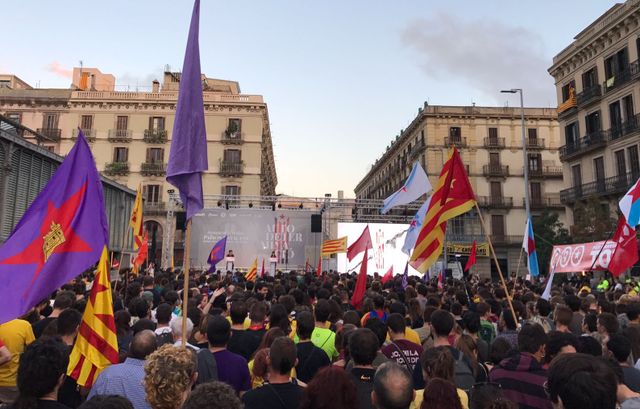
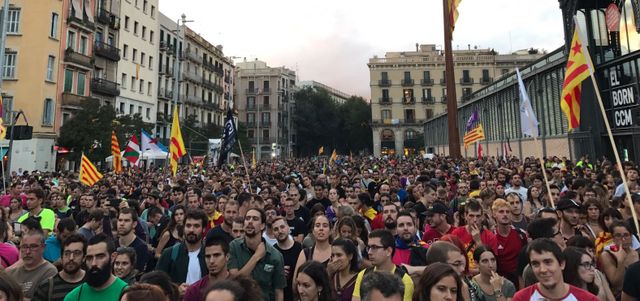
Around 1 million people demonstrated in Barcelona yesterday on Catalonia’s national day or Diada, according to local police, ahead of a Catalan independence referendum scheduled for October 1. El País, a Madrid paper opposed to Catalan independence, estimated the number of marchers at a half million. Marchers shouted slogans, waved pro-independence “estelada” flags and carried banners in support of the referendum.
The march came amid a rapidly escalating crisis of the Spanish political establishment caused by the announcement of the independence referendum. The march was called by the separatist Catalan National Assembly (ANC) to ask Catalan regional President Carles Puigdemont to defy the Spanish Constitutional Court rulings and proceed with the October 1 referendum. Whilst the Catalan population is overwhelmingly in support of having a vote, polls suggest they are divided about splitting from Spain, with a plurality still opposing separation.
Protesters in Barcelona
By all accounts, the march was smaller than a previous pro-independence demonstration of 1.8 million people in Catalonia in 2014.
The separatists are acting recklessly and provocatively advancing the reactionary referendum. Ahead of the demonstration, on Friday, 71 separatist MPs in the Catalan Parliament, from the governing, pro-austerity Junts Pel Sí (“Together For Yes”) coalition—the Republican Left of Catalonia (ERC) and Catalan European Democratic Party (PDeCAT)—and the pseudo-left Popular Unity Candidacy (CUP) passed a “Legal Transition & Foundational Law Of the [Catalan] Republic” bill outlining the independence process.
If the “yes” vote wins on October 1, the separatists are pledging to declare independence within 48 hours, regardless of the turnout. The ERC and CUP plan to call street protests if the referendum does not go ahead. The Catalan secessionists have passed an anti-democratic measure allowing laws to be approved after a single reading in the regional parliament, so independence legislation can be fast-tracked with little or no debate.
All sides saw yesterday’s demonstration as a test of the strength and appeal of the pro-independence campaign. ANC President Jordi Sànchez said, “If we’re not able to mobilize a maximum number of people on September 11, October 1 will be weakened.”
After the demonstration, Sànchez said that all Catalans should declare themselves in “contempt before all courts which only look for the unity of their homeland” in reference to Spain’s Constitutional Court, which has declared the referendum illegal and ordered 1,000 Catalan government members, mayors and officials to stop preparations for it under threat of criminal prosecution. He labeled as “cowards” mayors who refused to provide polling booths for the referendum.
A section of the rally
The referendum is opposed by the Popular Party (PP) government in Madrid, the PSOE (Spanish Socialist Party) and Citizens party, all of whom have called their supporters in Catalan to boycott the vote, a move which may strengthen the odds of its passage. PP Prime Minister Mariano Rajoy has warned that though the Spanish state might appear slow to react, “appearances should not deceive us.” “There will be no self-determination referendum,” he declared.
Citizens party leader Albert Rivera has accused Puigdemont and pro-independence parties of “staking a blow to democracy, a coup like the one that this country experienced in October 1934,” referring to the proclamation of a Catalan Republic by President Lluís Companys after Spanish President Lerroux invited members of the fascist CEDA (Spanish Coalition of the Autonomous Right) into his government.
Increasingly, leading figures on the right and in the social democracy are warning they will use violence to block the referendum.
Retired General Manuel Fernández-Monzón Altolaguirre, who held a number of positions in the Franco regime including head of the Counter-espionage Service, also praised Lerroux for suppressing the Catalan Republic, declaring: “The current situation in Catalonia should be considered an act of high treason that would necessitate the application of a state of war.” He called for the arrest of all the leaders of the Catalan Parliament. “The independence of Catalonia is not going to occur. What I do not know is whether it will be impeded in a bad way or not,” he warned.
Simiarly, Josep Borell, former PSOE minister and former president of the European Parliament, described the passing of the secessionist laws and the referendum by the Catalan parliament as a coup, adding, “We are getting to a situation of physical violence.”
Juan Luís Cebrian, director of the pro-PSOE El País, wrote an opinion piece in the newspaper, saying that those wanting to change the rules outside of the democratic channels “are predisposed to violence.”
Spain’s Director of Public Prosecutions José Manuel Maza has announced criminal charges of “contempt, abuse of authority and misuse of public funds” against all the members of the Catalan government. He has also ordered police to investigate those organising the referendum and seize materials being prepared for the vote. Printing companies have been raided to search for ballot papers, and one printer criminally charged for allegedly helping prepare the vote.
The Rajoy government hopes its threats will split the Catalan bourgeoisie and weaken the referendum. Madrid has thus far stated publicly that it wants to avoid invoking the so-called “nuclear option”—article 155 of the constitution—which would effectively revoke Catalan autonomy and place the region under the military control of the Spanish government, for fear of the degree of social opposition this would engender.
But last week, Spain’s Ministry of Interior started to reinforce state buildings in Catalonia with police from the anti-riot Intervention Units. The Civil Guard has been instructed to prepare to move to Catalonia within an hour and reinforce the Reserve and Security Group (GRS4), based in Barcelona. The GRS was created by former PSOE Prime Minister Jose Zapatero dedicated to “the restoration of public order in large mass demonstrations.” There are conflicting reports as to what the Catalan police—the Mossos d’Esquadra—will do in case of physical conflict.
Sections of the ruling elite in Europe and the US fear that a confrontation between Barcelona and Madrid could spark a crisis that will engulf Spain, dragging down the fourth largest economy of the eurozone and a key European Union and NATO member state. It risks inflaming the explosive military situation in Europe, amid a stand-off between NATO and Russia, and growing class tensions in Spain and across Europe after a decade of deep austerity.
On Thursday, European Parliament President Antonio Tajani said Catalonia must obey the Spanish Constitution and said that if Catalonia secedes, it will be out of the European Union. Credit rating agency Moody’s also warned that independence would harm the ratings of Spain and Catalonia. It hoped and predicted that “Catalonia will continue to be part of Spain,” and said it was up to Madrid to satisfy some of Catalonia’s main demands, such as budget reforms, to stem the crisis.
Behind all the talk of Catalan independence are the right-wing policies of the nationalists who rule the region and have imposed intense austerity on its working class. Funding for education, health care and other social expenditure have been slashed, and poverty has risen in one of Spain’s richest regions.
The pro-separatist factions within the Catalan bourgeoisie and the petty-bourgeois CUP are promoting nationalism in order to prevent a united struggle of the working class in Catalonia with their brothers and sisters across Spain and Europe. It offers nothing to the working class. A Catalan Republic, were it to be established, would function as a low-tax, cheap-labour platform for the benefit of the banks and transnational corporations.
Catalan independence has also caused a crisis in the Podemos party. Podemos leader Pablo Iglesias has attempted to side-step the referendum, saying it should be delayed until after Podemos, the separatist parties and the PSOE build a “new progressive government” in Spain and Catalonia that removes the PP from government. At the same time, the Podemos-backed mayor of Barcelona, Ada Colau, has said that the city council will “do everything possible” to enable Barcelona citizens to vote in the referendum.

Petrochemical giants dumped deadly carcinogens during Hurricane Harvey

Gary Joad

As Hurricane and Tropical Storm Harvey bore down on and flooded the northern Gulf Coast last month with an estimated 20 trillion gallons of rain, some 60 plants belonging to the world’s petrochemical giants on the Texas coast began shutdown procedures. During this time they vented and dumped almost a million pounds of some of the most deadly chemical compounds on earth.
“Total air pollutants from all oil and gas facilities added up to 5.6 million pounds,” according to an analysis released September 1 by the Center for Biological Diversity. The deadly cocktail that included benzene, hexane, sulfur dioxide, 1,3-butadiene, and xylene were dumped or spilled during the storm by ExxonMobil, Shell, and Chevron Phillips and other petrochemical giants over a period of eight days beginning August 23.
Reports filed by the refining industry with the Texas Commission on Environmental Quality (TCEQ) confirmed that residents of Harris County and the surrounding area sustained 61 percent of the un-permitted emissions of toxic dumping than occurred in all of 2016. The dumping of these compounds included over 13 tons of benzene.
Significantly, Houston, Texas has never met national air quality standards since the passage of the Clean Air Act of 1970.
When TCEQ spokeswoman Andrea Morrow was queried about the findings, she was quoted as saying, “All measured concentrations were well below levels of health concern,” and that “local residents should not be concerned about air quality issues related to the effects of the storm.” The US Environmental Protection Agency (EPA) stated it was observing the situation with “air quality buses,” though how this was done in the midst of a flood was not explained.
According to a Las Vegas Review-Journal article appearing September 8, the chief Houston Health Department scientist Loren Raun reported that a department air quality monitor measured an astonishing level of 14,000 parts per billion of volatile organic compounds downwind of the Valero Partners refinery on Houston’s east side, where a heavy roof had collapsed into a reservoir of stored chemicals during the storm.
For the duration of the storm-related events, Texas Governor Greg Abbott decreed a temporary suspension of emission regulations. The state’s air quality monitors were also shut off, with the initial explanation that officials made this decision to prevent damage to the expensive instrumentation. Later, air quality spokespersons began telling the press the monitors were damaged during the storm.
Ruben Basurto, a 33-year-old construction worker living two blocks from the refinery reported that the smell drove him and his friends indoors. Cindy Sanchez, 32, told the press that she became sick to her stomach and had eye burning. Nearby Galena Park mothers opened a Facebook page to describe their illnesses, saying the discharge smelled like “sweet gasoline,” or raw sewage in very thick air.
A local environmental activist Juan Flores said, “a lot of people are afraid to talk, because their husbands work at the plants.” He also said many of the residents near the refineries want to see a doctor, but they have no insurance or means to pay.
Daniel Cohan, an environmental scientist at Rice University, pointed out that the refineries, during a significant storm, delay shutdown until the very last moment. When the event is passed, they restart quickly, causing a very dramatic surge in emissions. He added, “These plants are three to four decades old,” and that the facilities are outmoded and badly overdue for modernization.
In 2010, ExxonMobil, Chevron-Phillips, and Shell were sued by the Sierra Club and Environment Texas, and this May were ordered by a federal judge to pay a settlement of $27.8 million. ExxonMobil’s share was $19.9 million and the energy conglomerate filed an appeal.
The federal Agency for Toxic Substances and Disease Registry (ATSDR) issued a Public Health Statement in August, 2007 regarding benzene, noting that it is a colorless liquid with a sweet odor, which can be smelled by humans at about 60 parts per million (ppm) of air, and correctly identified at 100 ppm. Benzene can be tasted in water at 0.5-4.5 ppm, and 1 ppm is about 1 drop in 40 gallons of water. It is in the top 20 chemicals produced in the US, used in making plastic foam and other plastics, some types of rubber, lubricants, dyes, detergents, drugs, and pesticides. It is also present in crude oil, gasoline and cigarettes.
Benzene is also slightly soluble in water, and will make its way from soil into aquifers. About 20 percent of human exposure in the US is from auto exhaust and industrial emissions. Fifty percent enters the body by breathing, and lesser amounts by ingestion and through the skin. Its human metabolites include phenol, muconic acid, and S-phenylmercapturic acid, which are known to cause leukemia and liver cancers.
At least a quarter million workers are significantly exposed to benzene in the US petrochemical and refining industry, tire manufacturing, shoe making, printing, in lab technology, fire fighting, and gasoline stations.
A 5-10 minute respiratory exposure to benzene can be fatal at air levels of 10,000-20,000 ppm, in the range captured by Houston’s health department monitor cited earlier. The compound will produce dizziness, nausea, headaches, rapid heartbeat, drowsiness, and unconsciousness at 700-3000 ppm. The US Department of Health and Human Services, the EPA, and the International Agency for Cancer Research identify benzene as a carcinogen. High levels of benzene inhaled by female workers has produced irregular menses, and has been linked to fetal changes and damaged immune and central nervous systems in experimental animals.
The EPA has estimated that the regular drinking of benzene-contaminated water at 10 ppm, or breathing air with 0.4 ppm would account for one added cancer per 100,000 people annually. The EPA also requires the National Response Center to investigate a spill into the environment of 10 pounds or more of benzene.
In August, 2008, the Environmental Health Perspective Journal published the results of a study titled “Childhood Lymphohematopoietic Cancer Incidence and Hazardous Air Pollutants in Southeast Texas, 1995-2004.” The investigation found in a review of 997 cases of childhood blood and lymphatic systems cancers that “Census tracts (from Houston, Texas and the surrounding eight counties) with the highest benzene levels had elevated rates of all leukemia(s).” The study’s conclusion reads, “Our ecologic analysis suggests an association between childhood leukemia and hazardous air pollution.”
Bakeyah Nelson, executive director of Air Alliance in Houston told the Guardian, “It’s really a serious public health crisis from pollution and other impacts people are facing. Communities in close proximity to these facilities will get the worst of it, as they get the worst of it on a daily basis. There’s also the acute danger of one of these facilities exploding in neighborhoods where storage tanks are adjacent to people’s backyards. It’s a very real threat and it’s a vey precarious situation.”
The Guardian quoted Bryan Parras, who grew up in and lives in the low income East End, “These people have very little political power and the city knows it. The real disaster is that they are poisoning these communities slowly, 24-7.”
A September 5 New York Times article reported that Arkema Company, the French-owned firm whose plant exploded and burned in Crosby, Texas during Hurricane Harvey, had little in its emergency flood plans for power loss to its cooling equipment for storage of organic peroxides, its main product, sold to plastics manufacturers. Company vice president Gilles Galinier in Crosby insisted, “It is not an industrial accident,” instead blaming the severity of the storms, despite the Houston area having experienced so-called 500-year floods each of the last three years. The company worldwide had sales last year of $8.9 billion.
After Hurricane Ike in 2008, Arkema conceded hurricanes and resulting floods were a plant safety issue. But when flood plans were filed with the EPA, there were no provisions for elevating backup generators above the floodwater line. The flooding of emergency generators last month led to the explosions and chemical fires.
At the onset of Harvey, 11 of the 50 Arkema workers in Crosby hurriedly transferred the organic peroxides from the overheated plant building to nine outside refrigerated tanker trucks. The tankers were moved to the highest spot on the Arkema grounds and as far as possible from tanks of sulfur dioxide, a very corrosive gas, and other tanks of isobutylene, a very flammable gas. As it was, all nine tanker trailers and 18 tons of organic peroxides were consumed by fire.
Tom Neltner of the Environmental Defense Fund noted, “They (Arkema) identify new hazards, but don’t change anything in their plans.”
The EPA’s risk management in fact ignores volatile explosive compounds, requiring companies to address risk for 150 identified chemicals selected for flammability and toxicity, but not reactivity. The unstable compound ammonium nitrate is not on the EPA list of monitored chemicals, and caused the 2013 explosion of a fertilizer plant that killed 15 people in the town of West, Texas.
The World Socialist Web Site spoke with a retired oil worker from the ExxonMobil refinery in Beaumont, Texas. “The major refiners are on the Neches River. The Exxon plant in Beaumont and a nearby chemical plant share a water containment facility. I’m sure it overflowed into the river. The public doesn’t hear about runoff and seepage, but the workers in the facility know about oil and processed fluids that are floating underneath us and getting into the ground. You don’t hear about the health of workers either.”

UN Security Council imposes severe sanctions on North Korea

Peter Symonds

Under heavy pressure and threats from Washington, the UN Security Council voted unanimously on Monday evening for harsh new economic sanctions on North Korea following its sixth nuclear test, the largest to date, on September 3. Far from easing tensions in North East Asia, the resolution sets the stage for further US provocations and heightens the danger of military conflict on the Korean Peninsula.
While the US made concessions to China and Russia to obtain their support, the new bans further isolate the North Korean economy and threaten to precipitate an economic and political crisis in Pyongyang. Following on from the Obama administration’s sanctions last year, the Trump administration is not specifically targeting North Korea’s nuclear and missile programs but is seeking to cripple the country economically.
After North Korea’s nuclear test, Washington pressed for a complete oil embargo, a global ban on the use of North Korean workers abroad and a mandate to use military force to inspect ships suspected of carrying goods prohibited under UN resolutions. China and Russia, which fear the US will exploit any crisis in Pyongyang to install a pro-American regime, opposed these sweeping measures.
The compromise UN resolution, however, still imposes severe penalties on North Korea, including:
* An annual cap of 8.5 billion barrels on the sale of refined and crude oil to North Korea. The sale of natural gas and condensates is prohibited to close off possible alternative fuels. A US official told the Washington Post that the figure represents a 30 percent cut.
* UN member states will be required not to renew the contracts of an estimated 93,000 North Korean guest workers, whose wages bring in an estimated $500 million a year to North Korea. The only caveat is for guest workers who are deemed necessary for humanitarian assistance or denuclearisation.
* Countries will also be obliged to inspect ships suspected of carrying North Korean goods that might be banned under UN resolutions. Any ship found to be carrying banned goods will be subject to an asset freeze and may be barred from sailing into ports. The resolution, however, drops the US proposal to allow the use of military force, and the consent of the country in which the ship is registered is required.
* The purchase of all North Korea textiles is banned. Last year textile exports were $726 million, or more than a quarter of North Korea’s total export income.
This comes on top of UN bans last month on the export of coal, iron, iron ore, lead and seafood estimated to be worth $1 billion or about one third of export income.
The resolution did not include a travel ban and asset freeze on North Korean leader Kim Jong-un as originally proposed by Washington.
While blocking aspects of the draft US resolution, China announced its own unilateral financial sanctions yesterday that could have a far-reaching impact on North Korea.
The country’s top five banks—Bank of China, China Construction Bank, Agricultural Bank of China, Industrial and Commercial Bank of China, and Bank of Communications—will freeze the opening of new accounts by North Korean individuals or companies. Three of the five banks said they had started “cleaning out” existing accounts by blocking new deposits.
The Financial Times pointed out there were ways to circumvent the new ban, including through the use of Chinese citizens as intermediaries. Two Chinese businessmen who run companies in North Korea told the newspaper that all their payments to North Korean staff were in Chinese currency, avoiding the use of Chinese or North Korean banks.
Nevertheless, the new Chinese sanctions will make it far harder for major North Korean enterprises to conduct financial transactions in China—their chief connection to the global financial system.
Beijing’s banking ban is a clear sign of rising tensions with the Pyongyang regime, which has publicly criticised China for supporting UN sanctions. Relations between the two countries, which are formally allies, deteriorated markedly after Kim Jong-un ordered the execution in 2013 of his uncle Jang Song-thaek, who was regarded as close to Beijing.
China’s President Xi Jinping is yet to meet Kim Jong-un, and the last high-level visit by a Chinese official to Pyongyang was nearly two years ago. North Korea’s September 3 nuclear test publicly embarrassed Xi who was hosting a summit of BRICS (Brazil, Russia, India, China, South Africa) leaders at the time.
While not wanting the collapse of the Pyongyang regime, China has opposed North Korea’s nuclear and missile tests because they provide a pretext for the US to maintain and expand its military presence in North East Asia. Beijing also fears that Japan and/or South Korea could exploit the “threat” posed by North Korea to justify building their own nuclear arsenals.
Before the adoption of the latest UN sanctions, North Korea lashed out at the US, warning it would respond in kind if Washington managed to “rig up the illegal and unlawful resolution.” An official statement declared that North Korea would take measures to “cause the US the greatest pain and suffering” it had ever experienced.
Far from defending the North Korean people, this empty nationalist bluster only plays directly into the Trump administration’s hands. The American ambassador to the UN, Nikki Haley, yesterday suggested the US was not looking for war and North Korea could “reclaim its future” by abandoning its nuclear program. But the Trump administration has repeatedly declared that all options are on the table—including pre-emptive military strikes against North Korea.
Last Thursday, President Donald Trump again threatened to attack North Korea, saying “military action is certainly an option.” While saying he would “prefer not going the route of the military” and it was not inevitable, Trump bluntly warned: “If we do use it on North Korea, it will be a very sad day for North Korea.”
Earlier in the week, Trump huddled together with his top military and national security advisers to review all options, which, according to NBC sources, included the possibility of pre-emptive US nuclear strikes on North Korea.

Sixteen years after 9/11: lies, hypocrisy and militarism

Bill Van Auken

The sixteenth anniversary of the September 11, 2001 attacks that killed more than 2,900 people in the United States were marked once again on Monday with ceremonies at the site of the World Trade Center’s demolished Twin Towers, the Pentagon and a field in Pennsylvania where one of four hijacked planes crashed as passengers fought to regain control of the aircraft.
Thousands gathered in New York City for the solemn reading of the names of those who lost their lives to a criminal and reactionary terrorist attack that served only the interests of US and world imperialism, which ever since have exploited the events to justify wars of aggression and attacks on democratic rights the world over.
The genuine emotions of sorrow and remembrance shared by those who lost loved ones on 9/11 once again stood in sharp contrast to the banality and hypocrisy of the official commemorations staged by US officials.
This longstanding dichotomy reached a new level with the main speech of the day delivered by the fascistic billionaire con-man President Donald Trump at the Pentagon Monday. Trump, whose first reaction on the day of the attacks was to brag—falsely—that the toppling of the Twin Towers had made his own property at 40 Wall Street the tallest building in lower Manhattan, delivered remarks that consisted of barely warmed-over platitudes from previous addresses, repeated tributes to the American flag and a vow to “defend our country against barbaric forces of evil and destruction.”
Trump repeated the well-worn cliché that on September 11 “our whole world changed.” The phrase is meant to suggest that the unending wars, police state measures and sweeping changes in American political life over the past 16 years have all been carried out in response to the supposedly unforeseen and unforeseeable events of September 11, having nothing to do with anything that came before.
That this is a cynical and self-serving lie becomes clearer with every passing year.
On the eve of the anniversary, new revelations emerged linking Saudi Arabia, Washington’s closest ally in the Arab world, to the preparation of the September 11 attacks, in which 15 of the 19 hijackers were Saudi citizens. The corporate media, which published nothing of any significance on the anniversary, largely blacked out this new evidence. The New York Timesmarked the anniversary with an editorial detailing efforts by the New York City medical examiner to identify human remains.
A federal lawsuit on behalf of the families of some 1,400 of the 9/11 victims has presented evidence that the Saudi embassy in Washington financed what was apparently a “dry run” for the 9/11 attacks in 1999. Two Saudi agents posing as students boarded an America West flight from Phoenix to Washington, D.C. with tickets paid for by the Saudi embassy. The lawsuit states that both men had trained in Al Qaeda camps in Afghanistan with some of the 9/11 hijackers. While on the flight, the two asked flight attendants technical questions about the plane that raised suspicions and twice attempted to enter the cockpit, leading the pilot to carry out an emergency landing in Ohio. Both men were detained and questioned by the FBI, which decided not to pursue any prosecution.
This is only the latest in a long series of revelations that have made it abundantly clear that the events of 9/11 could never have taken place without substantial logistical support from high places. Despite the repeated claims that the attacks “changed everything,” there has never been an independent and objective investigations into how they were carried out. And, despite being what is ostensibly the most catastrophic intelligence failure in American history, no one was ever held accountable with so much as a firing or a demotion.
What evidence has emerged makes it clear that the 9/11 hijackers were able to freely enter the country and attend flight schools despite the fact that a number of those involved had been subjects of surveillance by the CIA and FBI for as long as two years before the attack. Two of them actually lived in the home of an FBI informant.
Twenty-eight pages of heavily redacted documents released in 2016 after being concealed from the public for 13 years established that Saudi intelligence officers funneled substantial amounts of money to the hijackers in the run-up to the 9/11 attacks, while assisting them with finding housing as well as flight schools to attend.
While Saudi Arabia was the government most active in carrying out the September 11 attacks, the involvement of Saudi intelligence really means the involvement of a section of the American state apparatus. This is not a matter of conspiracy theories, but established fact. It is bound up with very real conspiracies involving the CIA, Afghanistan and Al Qaeda going back to the Islamist group’s founding as an arm of Washington’s dirty war against the Soviet-backed government of Afghanistan in the 1980s.
Far from the attacks having “changed everything,” they provided the pretext for acts of military aggression long in preparation. In the wake of the dissolution of the Soviet Union a decade earlier, the ruling class initiated a policy developed to use US military might to offset the decline of American capitalism on the world arena. Afghanistan and Iraq were targeted to secure military dominance over two major oil- and gas-producing regions on the planet, the Caspian Basin and the Middle East.
This thoroughly criminal enterprise, justified in the name of 9/11’s victims, has claimed the lives of over 1 million Iraqis and hundreds of thousands of Afghans and unleashed the greatest refugee crisis since the Second World War.
The invocation of a “war on terror”—passed down from Bush to Obama and now to Trump—to justify these crimes has become not only threadbare, but patently absurd. The results of 16 years of uninterrupted US wars of aggression have included an unprecedented growth of Al Qaeda and related Islamist militias, largely as a result of US imperialism’s utilization of these elements as proxy ground forces in wars for regime change in Libya and Syria.
Moreover, the multiple wars and interventions conducted by the Pentagon and the CIA, from North Africa to Central Asia, can quickly metastasize into a global conflagration, with Washington simultaneously threatening nuclear war against North Korea and pursuing increasingly dangerous confrontations with its principal geo-strategic rivals, Russia and China.
September 11 did not “change everything,” but it did mark the beginning of an escalation of what George W. Bush called the “wars of the twenty-first century,” that is, escalating imperialist aggression that is leading mankind toward a third world war.

11 Sept 2017

Emory University Scholars Program for International Students 2018/2019

Application Timeline: Deadline: 15th November, 2017.
October–January: Application review by Admission, Scholars, and Faculty committees
By February 15: Scholar notifications announced. Finalists will be notified.
Mid-April: Finalist awards and Scholar Programs membership announced
May 1: Enrollment deposit deadline
Offered annually? Yes
Eligible Countries: International
To be taken at (country): Emory University, Georgia, United States.
About the Award:  The aim of the campus scholar community is to empower students, through distinct resources and support, to reach their full potential and have a notable impact on the university, Atlanta, and the greater global community.
Type: Undergraduate
Qualities of an Emory Scholar: These are the seeds, the makings of an Emory Scholar. Emory University seeks grounded individuals who are looking to grow and build on these strong qualities and give of their talents to the Emory community and beyond:
  • Intellectual curiosity
  • Creative Thinking
  • Servant Leadership
  • Communication Skills
  • Contribution to community
Selection Criteria: To be guaranteed consideration for the Emory University Scholar selection process students must submit all required application materials by the November 15 Emory University Scholar Programs deadline. Applicants will need to select one of Emory’s three admission decision plans (Early Decision I, Early Decision II, or Regular Decision). Please note students applying Early Decision I (EDI) may apply for the Scholar Programs, but need to meet the EDI November 1 deadline for all application materials.
Finalist interviews for Emory Scholars take place in mid-March. If you are a finalist, you will be brought to Emory (at no expense to you) for activities designed to help you become better acquainted with programs and opportunities at Emory and to aid the Goizueta Scholars Selection Committee in making its final choices for the various awards. Attendance is mandatory for all Scholar finalists.
Number of Awardees: Roughly 175-200
Value of Scholarship: Partial or fully-funded
Duration of Scholarship: 4 years
How to Apply:
Award Provider: Emory University