18 Sept 2017

Inhabitants of Irma-ravaged Saint Martin gain nothing from French President Macron’s visit

Francis Dubois

When on Wednesday French President Emmanuel Macron finished his trip to Saint Martin in the Caribbean, an island territory that was 95 percent destroyed by Hurricane Irma, its inhabitants were still fighting for survival. Distribution of food and water remain completely chaotic and inadequate, there is a rising danger of epidemics, and thousands of people, many of them in a weakened state, are homeless, without food or medical care.
Officially, the hurricane claimed 11 lives, almost one third of the losses Irma caused in the Caribbean, as well as seven missing. The French government has not yet decided to give an official estimate of the number of wounded. The damage is initially estimated at €1.2 billion.
Macron was compelled to travel to the devastated island by a rising drumbeat of criticism from the political establishment, on the one hand, criticising the “failure of the state,” and from the French public, which was appalled by the official lack of preparation and indifference to the island’s inhabitants, even after it was clear that the most powerful hurricane in history was set to hit the island.
A crisis meeting was held at the Elysée presidential palace on September 9, even though the scope of the disaster had been obvious for two days, and just after Marine Le Pen of the neo-fascist National Front (FN) attacked the “completely insufficient means for law enforcement” in Saint Martin. Macron then announced on Twitter the “doubling of military and police forces” on the island.
Once he was on the island, Macron was confronted by the rising hostility of inhabitants who for days were left to fend for themselves without food, water, or medical care, as running water and electricity services collapsed. No evacuation order had been given before the storm, and the evacuation after the storm was very partial, while private residents of nearby Guadeloupe came by boat to help the inhabitants. Security forces sent to the island primarily guarded aid shipments that had been sent but not distributed.
Elie Domota, a trade union official in Guadeloupe, said on BFMTV: “The government mainly sent 2,000 soldiers and various police special forces units, as if we were in some sort of outlaw state.” He accused the government of “colonial-style management of this catastrophe.” He added that the first initiative of the state was to “evacuate the wives of soldiers and policemen, leaving the poorest people in chaos.”
Macron travelled to Saint Martin with three ministers in what was primarily a political manoeuvre to quiet criticisms from the conservative The Republicans (LR), the FN, or Jean-Luc Mélenchon. It also was aimed at rising discontent among workers in the Caribbean and in France, who are drawing devastating political conclusions about Macron’s government at the same time as it imposes its anti-democratic decrees for the destruction of the Labour Code.
Macron presented himself in the island as a head of state who was “rolling up his sleeves,” anxious to help his fellow citizens, in a series of carefully staged photo-ops designed primarily to appeal politically to the security forces. One of his main priorities was to participate in a police patrol on Tuesday evening and to call for the “disarmament” of the island.
Allegations of systematic ransacking immediately after the hurricane were rapidly picked up by French politicians, who tried to give the impression that the island was being taken over by organised looting. This false picture was torn to shreds by reports from the island’s inhabitants.
One said: “For four days we’ve had no water or electricity, no roof, everything is wet, we need to wash a two-month-old baby, it’s very hot and he’s breaking out in a rash, and look, there is another cyclone [hurricane Jose was threatening the island]. They give you three bottles of water and say, ‘stay at home.’ What are we supposed to do? Then they complain about looting. They gave me three bottles of water to survive a Category 4 storm, there is the issue of hygiene, my child is two months old, we have to eat, do the dishes and the laundry, flush the toilet. It’s not theft, it’s survival.”
An officer interviewed by the right-wing daily Le Figaro said, “We are dealing with people who are in need and have no more resources, now that electricity and running water have been cut off.” He said they were taking “action that is often connected to survival strategies to feed their families. In fact, the targeted shops mainly were selling basic foodstuffs and products for essential needs.”
Faced with these criticisms, Macron rejected “any idea of abandonment or neglect on the part of my government.” He announced that the island would be rebuilt by big business. “I am appealing to all big businesses and we will mobilise them,” junior minister Benjamin Griveaux said on France Inter on September 11.
Macron seized upon the proposition for a disaster management inquiry made by LR and supported by Mélenchon, saying he was “favourable” to it, but “at the right time.”
Saint Martin is divided between France and the Netherlands, and the French portion is deeply impoverished. Unemployment affects a staggering 27 percent of the population. The percentage of households dependent on relief is high: one-third relies on Universal Medical Coverage (CMU) and nearly a tenth of the population relies on welfare payments. Two thirds of tax households declare yearly incomes less than €9,400.
Infrastructure has been totally neglected for decades, which caused the collapse of running water and electricity services during the hurricane.
In the United States, decades of tax handouts and other payoffs to the super-rich financed by wave upon wave of cuts to basic infrastructure led to the devastation of Texas and Florida by this year’s hurricanes. In France, the systematic transfer of wealth from the bottom to the top by successive governments, both of the right and of the Socialist Party (PS), are now producing similar catastrophes.
This is precisely the class character of the policies being rammed through the parliament by the Macron government. Its indifference, faced with the distress of populations devastated by Hurricane Irma, is of a piece with the massive handouts to the financial oligarchy entailed by Macron’s cuts to the tax rate on the top income brackets and on corporations.

UK government officials back Trump demands for Internet censorship following London bombing

Paul Mitchell & Robert Stevens 

Moves by the ruling elites, in the US and internationally, to censor and even shut down access to the Internet, are gathering pace following Friday’s detonation of a bomb on a London Underground train.
Within minutes of the bombing at Parsons Green tube station that injured 30 people, US President Donald Trump called for the Internet to be shut off. Within hours, senior government UK officials were repeating his demands in increasingly hysterical terms.
The government of UK Prime Minister Theresa May quickly used the bombing to increase the UK terror threat level from “severe” to the highest level, “critical,” triggering Operation Temperer, the mobilisation of heavily armed soldiers working alongside armed police on the streets of the capital and other major urban areas.
Assistant Commissioner Mark Rowley, national lead for counterterrorism policing, declared, “Military personnel have been drafted in to protect national infrastructure sites, allowing additional armed police officers to carry out patrols.” These would “be patrolling at crowded places, iconic sites, transport hubs and ports.”
On Saturday, the Daily Star reported that troops from the Special Air Service (SAS) have been deployed in pairs on the London Underground “with orders to kill terrorists.” A source told the newspaper, “The unit is composed of some of both male and female personnel from the Special Reconnaissance Regiment who are trained killers and can pose as couples while travelling on public transport.”
Within hours of the explosion, an 18-year-old was arrested in the departure hall at the port of Dover on suspicion of planting the homemade bomb.
The Guardian reported that he is “suspected to have planted the device on the tube carriage, which was detonated by a timer, and would have caused much more extensive casualties had it fully exploded. Investigators do not believe the person who placed the homemade bomb on the train was present when it exploded.”
A second man, 21 years old, was arrested in Hounslow, west London, shortly before midnight on Saturday night.
Both are being held under Section 41 of the draconian Terrorism Act, allowing police to keep them detained without a warrant.
Following the arrest of the second person, the Joint Terrorism Analysis Centre (JTAC) based at MI5 reduced the threat level from critical back to severe. However, armed police will still be on Britain’s streets for days to come. Rowley said Sunday, “The military support we have had in place under Operation Temperer will start to phase out as we move through the coming week.”
Trump tweeted that the bombers were “sick and demented people who were in the sights of Scotland Yard. Must be proactive!” He declared, “Loser terrorists must be dealt with in a much tougher manner … The internet is their main recruitment tool which we must cut off & use better!”
Trump’s remarks about the attackers being known to the British authorities were borne out by a report in the Daily Mail. It cited neighbours of the 18-year-old’s foster carers, Ronald and Penelope Jones, who live in Sunbury-on-Thames, who said he was detained by police at the same tube station days before the attack. Serena Barber said, “I know about two weeks ago he was arrested by police at Parsons Green, for what I don’t know and returned back to Penny and Ron. After that Penny said she was going to have to stop caring for him, she couldn’t handle him.”
Conservative Prime Minister Theresa May immediately condemned Trump’s remarks, but this consternation derives from the fact that they pulled the rug from under her government’s attempts to cover up the fact that virtually all terror attacks in Britain and Europe have been carried out by individuals, often radicalised Islamists, who were known to and monitored by the state.
It is a matter of record that many of them had been employed by the major powers in their neo-colonial wars in Africa and the Middle East.
Following the May 22 Manchester Arena suicide bombing attack, in which 22 people died, US intelligence sources divulged the identity of the bomber, Salman Abedi. They claimed that he did not act alone, but was part of a wider network that had been allowed to operate by the British intelligence services for years. Similarly, the June 3 attack on London Bridge and Borough Market, which killed eight people and injured 48, was carried out by three individuals known to the intelligence services and police.
Trump’s outburst was aimed at putting pressure on the May government not to vacillate in its plans to step up police and intelligence operations and roll out long-prepared repressive legislation to be used against domestic opposition to its agenda of austerity, militarism and war.
May and her government are at one with Trump on curtailing the Internet. This week she is co-hosting a summit with French President Emmanuel Macron in New York “to talk about what more we can be doing to ensure that we deal with the terrorist propaganda, with the extremist propaganda, with the hatred that is put out across the Internet.”
UK Security Minister Ben Wallace warned Internet companies they had to speed up the removal of terrorist material declaring, “We are constantly trying to build that pressure, explaining to them that we think that they can do more and where we need to, we get tougher on them.”
Wallace added, “It is a 21st century phenomena. We have to deal with it. On the Internet people can learn how to make bombs, they can learn how to use weapons.”
Wallace’s comments followed lurid headlines in the UK media Saturday demanding a crackdown on Internet “extremism,” with the right-wing Daily Mail declaring that May “is to confront bosses of the web giants with blood on their hands.” The article stated that the instructions on how to make the type of bomb detonated in London last Friday was readily available on the Internet via a 10-minute Google search.
Conservative MP Jacob Rees-Mogg, who is being touted as a leadership contender against May, said Google should be held criminally liable for Friday’s attack.
Rees-Mogg declared, “Google has amazing software that makes it possible to search for anything … it is shameful that it will not use its technology to root out sites that help evil-doers.
“I would like to see the company made criminally liable for the result of any terrorist act that it can be shown to have abetted. It must do more to help prevent terror.”
Simon Kempton, head of counterterrorism for the Police Federation of England and Wales, said, “The responsibility is on the Internet providers, the hosts, to take down this material if it is clearly a threat to public safety.”
In the name of opposing “extremism,” a drastic curtailing of democratic rights and civil liberties is being readied, with the constant presence of armed soldiers and police on the streets becoming the new normal.
To this end, Colonel Richard Kemp, ex-commander of UK troops in Afghanistan, demanded in the Sunday Express, “STOP unregulated movement from EU countries to the UK, even before Brexit … VET all those entering the UK from countries where violence is rife, including refugees from countries like Syria … DEPORT all non-British citizens involved in extremism or radicalisation … SET UP special courts to hear evidence based on secret intelligence that cannot be revealed in public … SEGREGATE and if necessary isolate terrorist convicts and others who try to radicalise their fellow prisoners … TAG those involved in extremism that cannot be deported or imprisoned so their movements can be more effectively monitored … BAN burkas and other clothing that conceals identity in public places.”
Friday’s attack has been used by the Tory government to pile even more resources into facilitating state repression. On Sunday Home Secretary Amber Rudd announced that an additional £24 million was going towards “counterterrorism” operations nationwide.

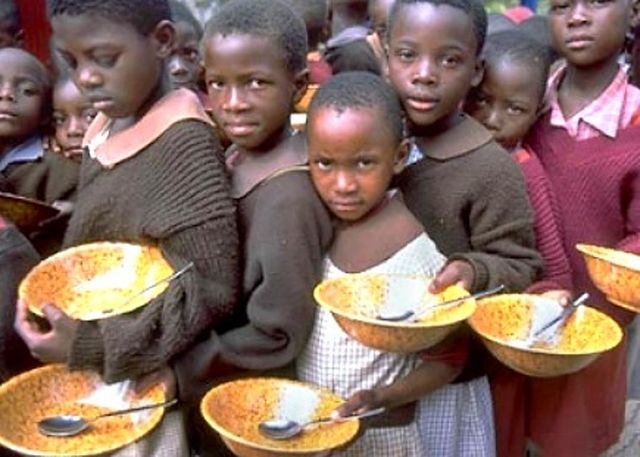
World hunger increasing for the first time in 100 years

Shelley Connor

The number of people suffering from malnutrition worldwide rose to 815 million in 2016, rising by 38 million from the year before. According to a new report co-signed by five United Nations agencies and charities, and made public by the Food and Agriculture Organisation of the UN (FAOUN) on Friday, this was the first such year-to-year increase in a century.
The development of science and technology, and their spread around the world in the form of gigantic increases in food production, have made possible a century-long reduction in the number suffering from hunger and malnutrition. In 2016, the world produced more than enough food to provide an adequate and nutritious diet to every human being on the planet.
But these gains are now increasingly offset by war and the impact of climate change, according to the UN report. Another factor—on which the UN report is largely silent—is the impact of mounting economic inequality, which means that in both comparatively wealthy and poor countries, many people are too poor to purchase the food that exists in abundance.
The five agencies involved in the study are the Food and Agriculture Organization, the World Health Organization, the International Fund for Agricultural Development, the World Food Programme, and UNICEF. As is typically the case in such reports, the language is deliberately restrained and the approach cautious and incremental, even when addressing what can only be described as a social catastrophe.
In 2016, for example, an estimated 155 million children younger than five were classified as “stunted,” too short for their age, because their physical development lagged significantly because of lack of food. Some 52 million children were considered undernourished, not heavy enough for their height. One-third of the population of eastern Africa, and one-fifth of the population of the entire continent, were undernourished. In Asia, 12 percent of the population were undernourished, mainly in South and Southeast Asia.
The report warns that significant progress in reducing malnutrition worldwide, from the level of 900 million people in the year 2000, is now in danger of being reversed. In just the last year, chronic undernourishment surged to an “extreme level” worldwide. Famine was declared in South Sudan in February. Yemen, northeast Nigeria, and Somalia teeter on the edge of famine.
The number of chronically undernourished people rose to 815 million in 2016—a number greater than the population of the entire European continent. Of that number, 489 million, 60 percent, live in countries affected by war or civil conflict.
The foreword to the report states that not only have conflicts “risen dramatically in number” over the past decade, but they have “become more complex and intractable in nature.” The residents of countries in conflict zones are almost two-and-a-half times more likely to be undernourished than those in other countries. In South Sudan, severe food insecurity afflicts around 4.9 million people—over 42 percent of the population.
In Yemen, 60 percent of the population—an estimated 17 million people—suffer from severe food insecurity. This number represents a 47 percent increase from June of 2015. Pediatric malnutrition has been “a serious problem for a long time” in Yemen, according to the report. However, acute undernutrition, or wasting, has risen sharply in the past three years. The report cites “the conflict-induced, economy-wide crisis that is affecting the entire population.”
War and internal conflict create food insecurity in myriad ways. One is through population displacement. According to the FAOUN report, the number of refugees and internally displaced persons (IDPs) has “increased significantly along with the greater number of conflicts,” doubling from 2007 to 2016 to a total of 64 million people.
One out of every 113 human beings is currently a refugee, an IDP, or seeking asylum. An estimated 70 million people worldwide are likely to suffer undernourishment as a result of displacement.
War also exacts heavy tolls on agriculture and food distribution systems, “from production, harvesting, processing and transport to input supply, financing and marketing,” states the report. In Iraq, for example, prior to the 2003 US invasion, the Nineveh and Salah-al Din districts produced a third of the country’s wheat and 40 percent of its barley. Yet by February 2016, 70-80 percent of Salah al-Din’s grain cultivations were damaged or destroyed; in Nineveh, which includes the city of Mosul, 32-68 percent of the land used for wheat cultivation had been either compromised or destroyed, as well as 43-57 percent of the land used to cultivate barley.
In Syria, where agriculture once thrived—and where many scientists believe it originated historically—six years of attempted regime change by the United States have devastated the country’s cultivation. Eighty-five percent of Syrians now live in poverty. An estimated 6.7 million faced acute food insecurity in 2016. Acute malnutrition—wasting—is currently seen at increased levels in most areas.
One of the most insidious ways that conflict drives undernourishment lies in “food … being used as a weapon of war.” The report mentions the use of trade blockades in South Sudan. It notably fails to mention the Saudi-led blockade against Yemen, where imported grains supply the bulk of the population’s nutrition.
Conflict is not the only source of undernourishment, as the FAOUN report makes clear. Climate extremes have led to sharp increases in food insecurity in Sub-Saharan Africa as well as Southwest and Southeast Asia.
In addition, as the World Socialist Website has reported in the past, diseases of malnutrition are once again on the rise in developed countries such as the United States and Great Britain. In these countries, it is not uncommon to find occurrences of morbid obesity alongside undernourishment in a single family. As wages stagnate and food prices continue to increase, many people can only afford heavily processed, starchy foods. Such products are more profitable for companies to supply, because they are less prone to spoilage and are therefore cheaper to transport and store.
This is a burgeoning health crisis, as the report points out: “food insecurity and poor nutrition during pregnancy and childhood are associated with metabolic adaptations that increase the risk of obesity and associated non-communicable chronic diseases in adulthood.”
As the report’s authors say, the results of the UN’s assessments have “set off alarm bells we cannot afford to ignore.” However, while the UN rightly points out that conflict engenders undernourishment, it blatantly omits the role that imperialism plays in these conflicts. It classifies the conflicts in South Sudan and Syria as internal conflicts, when, in fact, the chaos in both countries has been directly caused by the United States, its allies, and its proxies. It even fails to mention the United States at all in its assessment of Iraq, invaded, laid waste to and occupied by US military forces from 2003 to 2011, and still a battleground.
The report’s authors suppress any mention of the Saudi-led coalition’s attacks upon Yemen, as well as US complicity in those attacks; in many instances, the coalition has blocked humanitarian aid organizations from entering the country, and it has bombed numerous hospitals and mobile clinics. But the report details the same crimes at some length when perpetrated by “warring factions” in South Sudan.
Largely ignored are the long-range, ever more obvious effects of manmade climate change. No critique is leveled against the corrosive social effects of the profit motive, which is responsible for both climate change and the dearth of affordable nutrition in developed countries.
The worldwide capitalist crisis threatens new, more lethal wars. The imperialist nations cannot address food insecurity, not only because they have caused it with their militarism and unchecked industrial pollution, but because they are fundamentally incapable of solving their own contradictions. Even as this report was released, unprecedentedly violent hurricanes submerged entire cities, displaced thousands, and claimed lives throughout the American Gulf Coast and the Caribbean.
Global hunger can only be eradicated by putting an end to the contradictions of capitalism and replacing it with an economic system based upon social need. The UN may sound the alarm bell about widespread undernourishment, but only the struggle of a united international working class can put an end to it.

16 Sept 2017

Phanes Group Solar Incubator for PV projects in sub-Saharan Africa (Funded to Abidjan, Côte d’Ivoire and Dubai, UAE) 2017

Application Deadline: 1st October 2017
Eligible Countries: sub-Saharan Africa
To Be Taken At (Country): Abidjan, Côte d’Ivoire
About the Award: The Phanes Group Solar Incubator was initiated to select and support PV project opportunities in sub-Saharan Africa that for a number of reasons might not be able to reach beyond the planning phase. Secondly, it represents an opportunity for Phanes Group to utilize its expertise and experience to give back to the communities in the economies it serves.
The winning candidate(s) will enter a partnership with Phanes Group holding a long-term stake in the project. Jointly, we will bring the project to financial close. Phanes Group and its partners will provide extensive mentorship and knowledge transfer throughout the development partnership – kicking off with the incubator phase in Dubai, UAE, while also setting the foundations to deliver bankable projects in the future.
Type: Entrepreneurship
Eligibility: The Phanes Group Solar Incubator will only be open to PV projects, given Phane’s expertise and added value in this particular technology.
Selection Criteria: 
  • Project must be submitted by its owner(s) (or jointly “owners”) or by its/their representatives via a legally valid representation document (e.g. POA);
  • The project must be located in sub-Saharan Africa;
  • Project must utilize PV technology;
  • Project must have a capacity of minimum 10 MW up to 100 MW maximum on-grid;
  • Project must demonstrate a convincing CSR concept (e.g. community involvement).
Number of Awards: Not specified
Value of Award: 
Pre-Incubator Phase Benefits at a Glance:
  • Complimentary ticket for “Unlocking Solar Capital Africa”;
  • Complimentary return flight from country of origin to Abidjan, Côte d’Ivoire;
  • Complimentary accommodation for one night in Abidjan, Côte d’Ivoire;
  • Opportunity to present the project to a panel of high-level industry players.
Incubator Phase Benefits at a Glance:
  • Opportunity to present your project to a high-profile industry related panel;
  • Complimentary invitation to Phanes Group’s Dubai headquarters for face-to-face mentoring and remote online sessions for 2 months with the group’s finance and technical experts;
  • Knowledge transfer sessions from evaluation partners, raising your project to international standards;
  • Project funding and co-development with Phanes Group’s in-house project and finance team;
  • Implementation of strategic elements needed to obtain project bankability and financial close undertaken by Phanes Group and its partners;
  • Opportunity to find a mentor for your personal and professional development for a preagreed time if both of you are willing to commit.
Duration of Program: The final selection process will take place during the “Unlocking Solar Capital” conference in Abidjan, Côte d’Ivoire (October 25-26, 2017), where the winner(s) will be announced
How to Apply:  
  • Please fill out the application form in the Program Webpage (see Link below) send it to incubator@phanesgroup.com before October 1, 2017.
  • Application must be in English or French.
  • Candidate(s) should submit any supporting documents via WeTransfer (https://wetransfer.com/) as instructed in the application form
  • For more information, please refer to the Frequently Asked Questions (FAQ) document, also available for download
  • The submission deadline is October 1, 2017, at 11:59 pm CET (Central Europe Time)
  • Please e-mail all submissions to incubator@phanesgroup.com
Award Providers: Phanes Group

Berkeley Prize International Essay Competition for Undergraduate Architecture Students (USD25,000 Prize) 2018

Application Deadline: 1st November 2017
About the Award: The Berkeley Undergraduate Prize for Design Excellence endowment was established in the Department of Architecture at the University of California, Berkeley College of Environmental Design to promote the investigation of architecture as a social art. Each year  the PRIZE Committee selects a topic important to the understanding of the interaction of people and the built world that becomes the focus of the Essay Competition. This year the topic is: Architecture Reveals Communities.
The Committee poses a Question on this website related to the topic. Students enrolled in any accredited undergraduate architecture program or diploma in architecture program throughout the world are invited to submit a 500-word essay proposal in English responding to the Question. Undergraduate architecture students may team up with undergraduates from allied arts and social sciences programs.
Essay Question: WHAT IS THE SOCIAL ART OF ARCHITECTURE?
In answering this question, go out into your local community and find two buildings that you feel best typify the social art of architecture, one of which is no more than 10 years old.  Tell us what it is about these buildings that can act as a model for future architects in creating equally successful designs.
Offered Since: 1999
Eligibility: 
  1. The competition is open to all current full-time registered students in an undergraduate architecture degree program or undergraduates majoring in architecture in accredited schools of architecture worldwide. Diploma in Architecture students who have not yet completed their Diploma are also eligible.
  2. Essays must be submitted in English.
  3. Finalists will be required to provide proof of current registration in the form of copies of actual school transcripts. You are still eligible to compete if you were an undergraduate student on September 15, 2016, but graduate before the awards are scheduled to be given.
  4. Team Up: Two students (maximum) who meet the eligibility requirements above may collaborate as authors. An architecture student may team up with another undergraduate in architecture, landscape architecture, urban studies, arts and humanities, the social sciences, or engineering. If two students collaborate, then both names must appear on their essay and if awarded a prize, the prize is to be equally shared.
Selection Process:
  • From the pool of essay proposals received, approximately 25 are selected by the PRIZE Committee as particularly promising. The selected individual students, or student teams, become Semifinalists.
  • These Semifinalists are invited to submit a 2,500-word essay, again in English, expanding on their proposals. A group of readers, composed of Committee members and invited colleagues, selects five-to-eight of the best essays and sends these Finalist essays to a jury of international academics and architects to select the winners.
  • At the conclusion of the Essay Competition submittals, all Semifinalists are also invited to submit for a BERKELEY PRIZE Travel Fellowship. Details for the Fellowship will be announced in the spring 2018.
Essay Prize: A total of $12,500 in prize money will be awarded to the Essay Competition winners with $4000 first place prize.

Judging Criteria: Judging for the Berkeley Prize essay competition is on a numeric system. The members of the BERKELEY PRIZE Committee are asked to evaluate each essay in terms of the following criteria:
  1. Does the Proposal address the Question?
  2. How creative, or creatively developed, is the Proposal?
  3. Would the Proposal be clear to a broad audience?
  4. How does the Proposal rank in terms of writing style?
  5. How socially significant is the Proposal?
  6. What is the potential for developing this Proposal into a strong essay?
Value of Award: There is a total prize of 25,000USD, minimum 5,750USD first prize.  The remaining purse is to be allocated at the discretion of the Jury.
Duration/Timeline of Program: 
  • 15th September, 2017: Launch of 2018 Berkeley Prize Essay Competition.
  • 1st November, 2017: (Stage One) 500-word essay proposal due.
  • Mid-December, 2018: Essay Semifinalists announced.
  • February 1, 2018: (Stage Two) Essay Semifinalists’ 2,500-word essays due.
  • February 8, 2018: Launch of Travel Fellowship Competition for Essay Semifinalists.
  • Early-March, 2018: Essay Finalists announced.
  • March 12, 2018: Travel Fellowship Entries Due.
  • Mid-April, 2018: Essay winners and Travel Fellowship winners Announced
Visit Award Webpage for more details before you apply. Then Apply here

AFS Interculture Full Scholarship to the United States of America for South African Students 2018/2019

Application Deadline: 25th September 2017.
Eligible Countries: South Africa
To Be Taken At (Country): United States of America
About the Award: You will be living with a carefully selected host family and going to a local high school. The host families live in all corners of America, mostly in small towns or villages and they look forward to opening their hearts and homes to welcome you.
Type: Undergraduate
Eligibility: 
  • You are a South Africa resident.
  • You were born between 01/01/2001 and 01/08/2003.
  • You are enrolled in a secondary school at time of application.
  • Have the equivalent of a B average or better without failing grades (no grades below 50%)
  • Have not yet completed more than 11 years of primary education nor received a high school matric certificate.
  • You must be able to speak and understand English.
  • You are able to complete a preliminary application and have a teacher complete the school recommendation and email them to AFS at  prog.admin.rsa@afs.org
  • You have a valid passport, or are able to apply for one.
  • You must be Open-Minded, Flexible and Independent
  • Be able to transport yourself to the region closest to your city for the selection day. The three regions are JohannesburgDurban and Cape Town.
Number of Awards: Not specified
Value of Award: Full scholarship
Duration of Program: 10 months. August 2018 – June 2019
How to Apply:
Award Providers: Kennedy Lugar Youth Exchange and Study Programme and the Department of State.

Reuters Photojournalism Grants for Photojournalists and Students 2018

Application Deadline: 10th November 2017
Eligible Countries: All
About the Award: Reuters Pictures is offering up to eight $5,000 USD grants to passionate photojournalists or students of photojournalism who are interested in working on photo assignments and projects to advance their abilities and tell new stories.
Pictures taken by grant recipients will be distributed globally on Reuters platforms. Yannis Behrakis, Reuters photojournalist and senior editor, special projects, will advise recipients with their assignments and projects, providing advice or planning assistance.
Type: Grants
Eligibility: 
  • Any passionate photojournalist or student of photojournalism may apply.
  • Candidates need not be professional photojournalists but must demonstrate an ability to successfully conceive and complete their grant project. We are excited to work with emerging talents who can tell stories from new perspectives and as a global business we rely on diversity of culture and thought to deliver on our goals.
  • To ensure that, Reuters seeks talented, qualified employees around the world regardless of race, color, sex/gender, including pregnancy, gender identity and expression, national origin, religion, sexual orientation, disability, age, marital status, citizen status, veteran status, or any other protected classification under country or local law.
Number of Awards: up to 8
Value of Award: $5,000 USD
Duration of Program: 1 January 2018 to 31 December 2018
How to Apply: To apply:
Applicants must submit a CV and a 35-50 picture portfolio (JPEG format) of both single images and multi-image stories. Applicants must also submit a detailed cover letter explaining a project or idea to use the grant. A focused project about a subject in a community or location close to you that you can reasonably complete in a few weeks or months is advisable.
  • You must complete all the screening questions including the written proposal section.
  • Incomplete applications will be rejected.
  • Successful candidates will be contacted by Yannis Behrakis.
Award Providers: Reuters

University of Sussex Masters Scholarships for Nigerian Students 2018

Application Deadline: 1st August 2018
Offered annually? Yes
Eligible Countries: Nigeria
To be taken at (country): University of Sussex, UK
Eligible Field of Study: The scholarships relate to all full-time taught Masters degree courses at the University of Sussex (e.g. MA, MSc, LLM. MRes) with a few exceptions
About Scholarship: The scholarship is worth £3,000 for applicants that meet the eligibility criteria and will be awarded as a fee reduction upon registering at Sussex. For applicants holding/expecting to achieve a First Class degree, equivalent to a British Bachelors Honours degree from a Higher Education Institution in Nigeria, the award will automatically be enhanced to £5,000.
Type: Postgraduate taught (Masters)
Eligibility Criteria: In order to be eligible for a scholarship you must
  • be a national of Nigeria,
  • be a self-financing student
  • have accepted an offer of a full-time place on a Masters course at the University of Sussex commencing in September 2018.
  • meet the published academic requirements for your chosen course.
If your offer of a place is conditional you will need to meet the conditions of your offer before you are admitted to the University and awarded the scholarship. To receive the enhanced award, you will be required to provide evidence of your First Class degree from a recognised institution in Nigeria.
Number of Scholarships: not specified
Value of Scholarship: Scholarship will be awarded as a fee reduction of up to £5,000.
Duration of Scholarship: one year
How to Apply: 
  • Register your interest in the scholarship via PG Apply when you accept our offer of a place on an eligible Masters course. If you have applied via one of our overseas representatives, you will need to ask them to do this on your behalf.
  • If you are successful, information about the scholarship will be included in your CAS (Confirmation of Acceptance for Study) for your visa application. If the scholarship information is not showing on your CAS or you want to register for the scholarship after the CAS has been created, please contact the Admissions Office: pg.applicants@sussex.ac.uk
Visit Scholarship Webpage for details
Scholarship Provider: University of Sussex UK
Important Notes: You must accept an offer of a place on an eligible Masters course and submit the online declaration in order to receive the scholarship. You must allow sufficient time for the Masters application to be considered before the 1 August deadline. You must also have sufficient time to obtain a visa to study at Sussex, if you need one.

Women in News (WIN) Leadership Development Program for African Female Journalists 2018

Application Deadline: 2nd October 2017
Offered annually? Yes
Eligible Countries: Botswana, Rwanda, Zambia, Zimbabwe, Kenya, Tanzania and Malawi
About the Award: WIN works with media companies and their high potential female employees to overcome the gender gap in management and senior management positions. The programme seeks to equip women media professionals in middle and senior management positions with the right skills, knowledge and attitudes to help advance their careers. WIN provides them the support networks they need to take on a greater leadership role within their organizations and works with their organizations to create environments for high potential women to succeed.
In-keeping with the technological developments, this year the WIN programme launches for the first time an Online Media Management Foundation Course in association with Frayintermedia, which makes learning about media management a lot more exciting with the potential of reaching more people.
The successful applicants will be expected to volunteer time in the mentoring of up and coming journalists in their markets as a way of giving back something to the community.  This is a requirement of the WIN programme so as to help build the staying power for young  female  journalists in the media while creating a community of support  for the advancement of women.
Type: Training
Eligibility: Media women with a minimum of 2 years in a middle management position (editorial or a senior journalist)
Value of Program: Successful applicants will  benefit from the following:
  1. Online Leadership and Media Management Training
  2. One-on-one Coaching support
  3. Peer Mentoring
  4. National and Regional Networking opportunities
How to Apply:
  • Interested applicants should download the application forms through this link: womeninnews.org/join (Download form by clicking on Apply for WIN Africa)
  • For applicants from Rwanda, Zambia, Botswana and Zimbabwe, please send your applications to womeninnewsbrzz@gmail.com
  • For applicants from Kenya, Tanzania and Malawi, please send your applications to womeninnewseca@gmail.com
Award Provider: WIN is operated by WAN-IFRA, the leading association for the world’s press, with combined support from the Swedish International Development Cooperation Agency(Sida), the Norwegian Ministry of Foreign Affairs, and, the Danish Ministry of Foreign Affairs.
Important Notes: Successful participants will be expected to travel on specific occasions throughout the programme. Your availability for this will be crucial for the overall success of the programme.

Accenture Nigeria Graduate Trainee Program for Nigerian Graduates 2017

Application Deadline: Ongoing
Eligible Countries: Nigeria
To Be Taken At (Country): Nigeria
About the Award: Accenture’s graduate trainee programme provides an unparalleled opportunity to grow and advance. You will be working on projects that transform leading organizations and communities around the world. Choose Accenture, and make delivering innovative work part of your extraordinary career.
There are six different areas of our business: Strategy, Consulting, Technology, Digital, Operations and internal Corporate Functions. Each area offers a unique career experience and a compelling mix of work and training opportunities, work environment and structure for career progression.
Our work sees us acting as trusted advisors to our clients, we work directly with many of the FORTUNE© Global 500 companies across many different industry sectors.  You will be working with experts using your critical thinking skills to design and deliver realistic, achievable business strategies and solutions that address key client priorities. Much of the work we do is at the cutting edge of innovation and thinking.
Responsibilities may include:
  • Conducting industry and client research and analysis to identify opportunities for improvements
  • Gathering and documenting the client’s current business processes, people and technology capabilities and requirements
  • Performing financial assessments to support the development of new business processes and architecture
  • Assisting in the design and development of new business processes, capabilities and supporting technologies
  • Supporting the testing and implementation of new business processes
  • Developing communications, training and job aids to assist in change management activities.         
Type: Jobs
Eligibility: Fresh graduates with the following attributes are needed to join the Accenture Consulting team through the Graduate Trainee program:
  • Good leadership, communication (written and oral) and interpersonal skills
  • Desire to work in a result-driven business environment
  • Ability to transfer theoretical knowledge obtained during training into practical hands on skills
  • Ability to work independently with minimal supervision
  • Ability to work well in teams, confident and able to express your views clearly
  • Ability to capitalize on knowledge transfer
  • Ability to meet travel requirements, when applicable
  • Eagerness to contribute in a team-oriented environment
  • Ability to work creatively and analytically in a problem-solving environment
  • Desire to work in an information systems environment
  • Good communication (written and oral) and interpersonal skills
Number of Awards: Not specified
Duration of Program: Fulltime
How to Apply: Before applying, you must read and agree to the terms and conditions of the Accenture Recruitment and Hiring Privacy Statement. Then Apply on the Program Webpage.
Award Providers: Accenture Nigeria

Africa Oxford Initiative Conference on Economic Development in Africa (Funding Available) 2018

Application Deadline: Friday 27th October 2017
Eligible Countries: African countries
To Be Taken At (Country): St Catherine’s College, Oxford, UK
About the Award: Conference papers address economic analysis of the broad issues relevant for economic development in Africa. The conference consists of parallel sessions, with plenary sessions and a keynote.
Papers addressing economic analysis of the broad issues relevant for economic development in Africa are invited for the CSAE 2018 conference. Papers on countries other than those in Africa are welcome, providing they deal with issues central to African development.         
Type: Call for Papers
Eligibility: Only submissions which contain a Full Paper will go through the refereeing process as we cannot review incomplete submissions.
There is limited funding available to cover the cost of registration fees, flights and accommodation. In order to be considered for funding, the applicant must meet all of the following criteria:
  1. the applicant must be both the submitter and presenter of the paper
  2. the paper must be accepted to the Conference
  3. the applicant must be an African national
  4. the applicant must be currently living and working in Africa
  5. the applicant must be travelling to the conference from Africa
If your co-authors would also like to apply for funding, then they must be the submitter and presenter of their own unique paper that they have authored.
Applications for funding are made when you submit your paper online via Conference Maker: to apply for funding, please click on YES in the section “I would like to apply for funding…” when you complete the online submission form.
Number of Awards: Not specified
Value of Award: There is a limited budget to fund African presenters who are currently living and working in Africa and who will be travelling from Africa to the conference. If awarded, funding will cover flights, accommodation, and conference registration costs.
Duration of Program: 18-20 March 2018
How to Apply: FAQ It is important to take note of the submission information in the before applying.
  • All papers for consideration must be submitted via the online submission site at http://www.csae.ox.ac.uk/conferences/
  • If you would like to apply for funding please follow the detailed submission instructions at http://www.csae.ox.ac.uk/conferences/
Award Providers: Africa Oxford Initiative
Important Notes: Please note that due to the high demand to present papers at this conference, CSAE will only be considering FULL DRAFTS of papers for 2018. Please ensure your paper also includes a short abstract.