21 Sept 2017

Hurricane Maria devastates Puerto Rico

Rafael Azul

Hurricane María, which hit Puerto Rico Wednesday, has left the US territory in ruins. With much of the electrical, cell phone and road system severely damaged, the full scope of the devastation, including fatalities and serious injuries, is still not known, but losses to homes, businesses and critical infrastructure are expected to be massive.
María cut a 120-mile diagonal swath across the country. The leading edge of the storm began affecting southeastern Puerto Rico Tuesday night. Its eye entered the town of Yabucoa at 6 a.m. Eastern Time, and exited at noon on the northern coast between the cities of Arecibo and Barceloneta, west of the capital city of San Juan.
Governor Ricardo Rosselló, who declared an emergency and imposed a 6pm to 6am curfew, gave an initial account of the situation at 10 a.m. Wednesday, saying there had been “severe damage to infrastructure and great devastation.” He also warned of the danger of floods and mudslides which will put “lives at risk” as the tail end of the hurricane continued to pummel Puerto Rico a few hours longer.
The governor called on US President Donald Trump to declare Puerto Rico a “disaster area,” up from “emergency area,” which would allow the allocation of unlimited federal funds for Puerto Rico, as opposed to a maximum of $5 million provided to emergency areas.
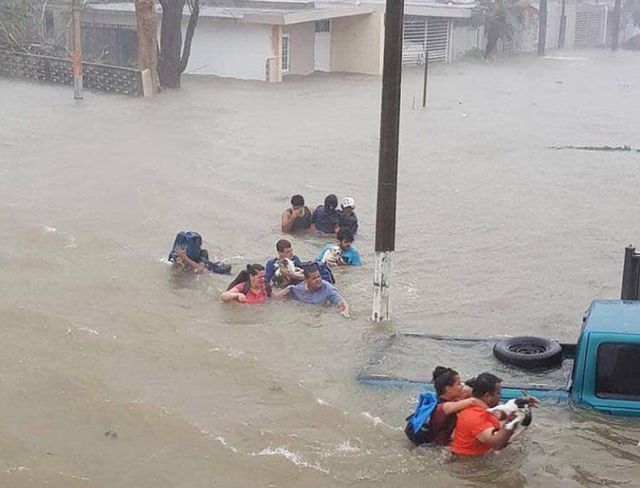
Conditions in Puerto after Hurricane Maria hit [Credit: @Jennifer2012]
This is a pittance for the island, which declared bankruptcy prior to Hurricanes Maria and Irma. Puerto Rico is saddled with a debt of $74 billion in bonds and $50 billion in supposedly unfunded pension obligations. Its electrical utility, AEE (Autoridad de Energía Eléctrica, or PREPA in English), which defaulted on its $9 billion debt in July, is also in ruin.
Initial reports said that all 3.4 million residents were without power after the hurricane, while wide swaths of the island are without clean water. Many roads are impassable. Having lost the ability to borrow, Puerto Rico is now desperately in need. Other than remittances from Puerto Ricans living in the US and elsewhere, the funds that do come in will undoubtedly include punishing financial obligations to Wall Street.
Abner Gomez, head of the Puerto Rican Emergency and Disaster Management Agency (AEMEAD) painted a bleak scene of hurricane devastation. “We are going to find that our island has been destroyed. We are receiving information that leaves no room for hope. This [storm] system has destroyed everything on its path.”
María did not spare San Juan, including working class and middle class high-rise apartment buildings that suffered broken windows and flooded rooms. Residents described to the local media torrents of water going down stairs from flooded apartments. Imy Rigaus, 53, described having to seek refuge in the hallway of her apartment. “Water cascaded down the stairs, and entered the apartments, and we are trapped in the hallways,” she said.
In the Roberto Clemente stadium, which was designated as a shelter, rain cascaded through a wind-damaged roof, forcing evacuees to hide beneath the stands. “One of the guards told me that the roof is about to collapse,” said Suzette Vega, an evacuee. “I looked up and the roof was waving around like a piece of paper. I asked, ‘Is it made out of cardboard?’ ‘No,’ they told me, ‘it is cement.’”
Carmen Yulin Cruz, San Juan’s mayor, informed its citizens that electricity would be out for a long time. “The devastation is all around us,” declared Cruz, “our life as we knew it, has changed.”
The Madrid daily El País paints a picture of utter devastation, torrential rains, floods, breached dams, six-foot storm surges, trees flying through the air, and windows exploding. Hardest hit was the central region, but no place in the island, no town, no square meter, was left unaffected.
The San Juan daily El Nuevo Día gave further details. Many residential areas have been almost totally destroyed, including hospitals, where patients were sheltered in hallways, as hurricane winds of more than 160 miles per hour smashed windows. At least one of the government shelters was left “in pieces,” the web site reported.
Late arrivers to the shelters describe having to fight wind gusts that made the sheets of rain feel like “whips,” while trying to avoid all manner of flying objects.
Others described equally harrowing scenes of roofs being torn off. Half of Puerto Rico’s citizens live under the poverty line, many of them in precarious structures with zinc roofs.
Despite government evacuation orders, the majority of residents were not able to find their way to government shelters. Nydia Pérez, who lives in San Juan, told El País, “In my house a window exploded and a door was torn off. The wind and rain damaged my living room. Across the street, the entire roof blew off.”
Benjamin Morales said via Facebook, “Mobile service comes and goes; winds are still extremely strong; there is a lot of rain. All kinds of damage is being reported ... electric service is dead, as had been expected. My house has security windows rated at 300 kilometers (180 miles); at times I thought that they would be ripped off. Everybody at the radio station feels that nothing like this has ever happened before.”
With wireless communications gone, together with many landlines, Puerto Ricans from Florida, Chicago, New York, and other US cities have been flooding San Juan radio stations in an attempt to connect with relatives. Many ask for help for relatives that suffer from medical conditions, such as diabetes.
The Financial Oversight Board that rules over Puerto Rico on behalf of Wall Street banks and hedge funds, has yet to pronounce itself about Hurricane María’s destruction, other than some pro forma remarks from its chairman, José Carrión, who declared that the board is “extremely concerned.”

US initiates plan to blow-up Iran nuclear deal

Keith Jones

US Secretary of State Rex Tillerson outlined Washington’s demands for the reopening of the 2015 Iran civil nuclear accord at a meeting yesterday of the signatories to the agreement—the US, Britain, France, Germany, the European Union (EU), Russia, China, and Tehran.
The US demands are a provocation aimed at blowing up a complex agreement that was only reached after the Obama administration provoked a crisis then imposed punishing economic sanctions on Iran, in concert with the major European powers, and repeatedly threatened Tehran with war.
Yesterday’s meeting was convened by the US on the sidelines of the UN General Assembly, where President Donald Trump had delivered a bellicose, fascistic diatribe the day before, much of it given over to denouncing Iran and the nuclear agreement.
The other parties to the nuclear accord unanimously rejected Tillerson’s call for its revision and the imposition of far more onerous terms on Iran.
EU foreign policy chief Federica Mogherini, who chaired the closed-door meeting, told reporters at its conclusion, “There is no need to renegotiate parts of the agreement because the agreement is concerning a nuclear program and as such is delivering.”
“We have all agreed,” she added, “that all sides are implementing so far the agreement.”
Referring to the acute tensions on the Korean Peninsula which US President Trump further inflamed Tuesday with his threat at the UN to obliterate North Korea, Mogherini said, “We already have one potential nuclear crisis. We definitely do not need to go into another one.”
At his own Wednesday evening press conference, Tillerson conceded that Iran has implemented the nuclear agreement or Joint Comprehensive Plan of Action (JCPOA) to the letter. However, he and President Trump have repeatedly attacked Tehran for not fulfilling the “spirit” of the agreement, by which they mean bowing completely to Washington’s diktats.
Yesterday, the former Exxon CEO all but spelled this out, saying Tehran is in “technical compliance” with the nuclear accord, but the expectation that the deal would remove a “serious threat” to the region has not been realized.
At yesterday’s meeting, Tillerson reportedly called for more intrusive IAEA (International Atomic Energy Agency) inspections, including unfettered access to Iranian military facilities, additional restrictions on Iran’s civil nuclear program after 2025, and severe limits, if not the outlawing, of Iran’s ballistic missile program—an issue that was at no time part of the nuclear negotiations.
Adding to the menacing atmosphere surrounding the meeting, Trump announced earlier Wednesday that he had come to a decision on whether to carry out his threat to declare Iran in violation of its obligations under the nuclear accord. He did not say what he had decided.
Under US law, the president must report to Congress every 90 days on Iranian compliance with the JCOPA. The next deadline falls on October 15.
In his UN speech Tuesday, Trump denounced the Iran deal as “an embarrassment to the United States” and “the worst deal ever” and all but announced his intention to scuttle it, saying “I don’t think you’ve heard the last of it.”
NBC News is reporting that it has learned from four sources, including a “senior administration official,” that Trump will declare Tehran non-compliant before the October 15 deadline. Such action would not, by itself, constitute US abrogation of the agreement, but it would set the stage for the “snapping back” of punitive US sanctions and immediately precipitate a crisis with Iran—one that could rapidly escalate into a military clash.
In arguing for acceptance of the nuclear accord, US President Obama repeatedly said the only alternative was war.
Iranian President Hassan Rouhani told the UN General Assembly Wednesday, “Iran will not be the first country to violate the [nuclear] agreement. But it will respond decisively and resolutely to its violation by any party.”
“If the US breaks its commitments,” continued Rouhani, “then no other country will be willing to enter into negotiation with the US.”
In a pointed reply to Trump’s lurid denunciations of Iran as a “terror” and “rogue” regime, Rouhani said Americans should ask themselves why the billions Washington has spent in the Middle East “has only brought” the region “war, misery, poverty” and “the rise of extremism” [a reference to al-Qaeda and ISIS].
Tillerson knew long before yesterday’s meeting that the US demands would be rejected by the other JCOPA signatories. Indeed, for Tehran to accept the dismantling of its missile program under conditions where the US Fifth Fleet is parked off Iran’s shores and the US is arming its regional rivals, Israel and Saudi Arabia, to the teeth, would be tantamount to unilateral disarmament.
For months, the other great powers have been publicly warning against any attempt to reopen or repudiate the nuclear deal, saying it would dangerously exacerbate tensions in the Middle East.
In recent days, these warning were amplified. On Tuesday, French President Emmanuel Macron told the UN General Assembly, “Renouncing [the nuclear deal] would be a grave error … would be irresponsible, because it is a good accord that is essential to peace at a time when the risk of an infernal conflagration cannot be excluded.”
Russia and China, which are themselves targets of US militarism and have developed significant strategic and commercial ties with Iran, view the Trump administration’s plans to provoke a war crisis with Iran as a major threat.
The European powers played a pivotal role in the US offensive against Iran under Obama, imposing and enforcing sanctions that halved Iran’s oil exports and otherwise crippled its trade by denying it access to the world banking system.
Since removing sanctions, the European powers have moved rapidly to stake their claim to Iran’s oil and other resources. Rouhani, for his part, has rolled out the red carpet for European investors and only last week, using the metaphor of a dinner party to describe the nuclear deal, urged the US to eschew confrontation “and also enter the room where the food is served.”
The opposition of the EU powers to Trump’s plans to scuttle the Iran nuclear accord has everything to do with advancing their own predatory interests in the Middle East. With Germany in the lead, the European imperialist powers are themselves rearming—cynically exploiting the popular opposition to Trump to advance their plans to develop European military power, including a European Army, so as to be able to act independently of, and when needed in opposition to, the US.
Hoping to avoid a direct confrontation between Washington and Europe over Iran and to dissuade Trump from setting course for war, Macron has suggested there should be further negotiations with Iran outside the framework of the nuclear accord. According to the French president, these would include restrictions on Iran’s ballistic missile program, a follow-on deal after much of the nuclear accord expires, and an “open discussion with Iran” about the “current situation in the region,” including Syria.
Everything to date suggests that the Trump administration will dismiss this proposal out of hand. Anti-Iran hawks in and around the administration argue that even if Europe dissents from re-imposing sanctions on Tehran, the US can coerce the EU into doing so by threatening to sanction any European company or financial institution that trades or facilitates trade with Iran.
The US political establishment and military-security apparatus was bitterly divided over the Iran deal at its inception and two years later, after the defeat of the US proxy forces in Syria, those divisions are even more acute. Supporters of the accord, who include both Democrats and Republicans, argue that it can be part of an effective campaign to contain Iran. This could enable US imperialism to exploit cleavages within the Iranian bourgeoisie to push Tehran to accept US hegemony over the Middle East. This faction fears a showdown with Iran will undercut American imperialism’s military-strategic offensives against its more powerful strategic rivals, China and Russia.
Like Trump, this faction favors a more aggressive stance against Iran, but not the blowing up of an agreement which did compel Iran to dismantle much of its civil nuclear program. The New York Times, which for months has been arguing that it would be blunder to repudiate the Iran deal, has also published a series of articles decrying the spread of Iranian influence from Afghanistan to Lebanon.
Defence Secretary James Mattis and National Security Adviser H.R. McMaster, who are both notorious for their animus to Iran, are reported to be cautioning Trump against a precipitous repudiation of the Iran deal. As an alternative they have championed plans for a more aggressive diplomatic and military posture against Iran across the Middle East. These plans were reportedly endorsed at a recent National Security Council meeting, with their broad outlines soon to be publicly revealed.
Press leaks indicate they include a more aggressive US naval posture against Iranian small-boats in the Persian Gulf and bolder steps against Iranian forces in Syria—steps that could easily spiral into direct clashes and all-out war.

India-Japan Civil Nuclear Cooperation: Contextualising Abe's Visit

Shivani Singh


The strong Indo-Japan bilateral relationship is a testament to the growing economic, cultural and strategic exchanges that both countries have shared in the past and this dynamic has continued to flourish under the regimes of PM Narendra Modi and Shinzo Abe. Abe’s recent visit to India was much awaited given that this was the first meeting between the two leaders since the Agreement for Cooperation in the Peaceful Uses of Nuclear Energy between India and Japan came into force on 21 July 2017. 

One of the expectations from the meeting was a clearer picture of the extent of civil nuclear cooperation that the two countries can achieve. This was attained to an extent in the sense that certain concerns regarding the deal were put to rest. However, there was one important and rather contentious area of the agreement that was left untouched: the termination clause envisaged in article 14. This article seeks to assess this visit in light of the past and present challenges regarding the agreement and whether this visit was successful in addressing the these concerns. 

Past Hurdles
The India-Japan Civil Nuclear Agreement aims to facilitate a smooth exchange of nuclear technology, equipment, nuclear material (source material and fissionable material) and non-nuclear material between the two countries subject to the clauses of the agreement. However, the road to this agreement was a bumpy one. The resistance seen on Japan’s part in forging this deal emanated not only from India’s non-signatory status to Nuclear Non-Proliferation Treaty (NPT) but also from various aspects of India’s nuclear liability regime.

In addition, India's refusal to completely bifurcate its civil and military nuclear programmes and create two separate areas of domain knowledge, a condition put forth by Japan during the negotiations were other impediments. Japanese anti-nuclear lobbyists had major concerns about the possibility of the imported fissile material for being used for the development of nuclear weapons after reprocessing the spent fuel. 

Existing Bottlenecks 
Most of the concerns were put to rest by India during the nuclear deal negotiations. However, a major bone of contention in realising the full potential of this deal on both ends - which was not addressed during this visit - is the termination clause envisaged in article 14 of the agreement.

Currently, the clause grants the party seeking termination of the agreement the right of return of all “nuclear material, non-nuclear material or equipment transferred pursuant to this Agreement and any special fissionable material recovered or produced as a by-product.” This is fashioned around the same template as the Indo-US nuclear deal where the parties have a ‘right to recall’, and is also mentioned in a separate document recording the views of both parties. Japan’s commitment to this clause arises from the pressures of domestic forces. 

However, there is some ambiguity over whether this clause is binding on India. The details of the termination process have not been specified either. For example, the condition that components should be returned in the event of termination of the agreement is  problematic because it involves shutting down a reactor, dismantling and shipping back massive vessel components which would be highly radioactive. Who will bear the cost of the dismantling and transport of the material is also not clear.

Positive Outcomes
Shinzo Abe’s visit was an opportunity for both countries to tie up loose ends and facilitate a smooth implementation of the clauses under the agreement.

Both countries expressed gratitude at the entry into force of the civil nuclear agreement and decided on setting up a working group “to strengthen bilateral cooperation in this field and reiterated their shared view that the Agreement reflects a new level of mutual confidence and strategic partnership in the cause of clean energy, economic development and a peaceful and secure world.” The details of this working group and its functions have not been chalked out yet. 

Concerns regarding India’s non-NPT status continue to flare up tensions in Japan now and then, mostly advanced by think-tanks and civil society groups. Therefore, the joint statement reaffirming “their shared commitment to the total elimination of nuclear weapons” gave weight to India’s intentions of using the imported nuclear material and technology for civilian purposes alone. 

India and Japan also reiterated their commitment to an early conclusion of negotiations on a non-discriminatory, multilateral and effectively verifiable Fissile Material Cut-off Treaty (FMCT). This will help in setting the right tone to ensure nuclear safety and security in the peaceful uses of nuclear energy.

Seen in retrospect, the meeting between Abe and Modi was successful in further strengthening nuclear energy cooperation between the two countries, and has laid the foundation for further bilateral collaboration on clean energy.  However, the visit could have gone a step further in addressing concerns regarding the termination clause in the agreement to overcome the last hurdle towards optimising the benefits of such cooperation.

A Looming Nuclear Arms Race In East Asia?

Nopur Siingh


The current East Asian security dynamics have two determinants. The first is the challenge posed by North Korea’s aggressive nuclear and missile development programmes coupled with direct threats to the US, and the second is the rise of China as a regional power. The complications arising from these factors in the region are further exacerbated by the US' inevitable and constantly increasing involvement and military presence.

The US and China have long been strategic adversaries. This, in the backdrop of the Trump administration trying to deter the North Korean regime and China’s aspirations to regional supremacy, magnifies the underlying US-China arms race into a regional ballistic and nuclear race. This, in turn, makes East Asia even more volatile to conflict than the Korean crisis alone did.
The lack of a substantive Chinese participation in reigning North Korea in while maintaining bilateral trade relations, could be attributed to three factors:
a) A cost-benefit analysis where DPRK stands as an asset for China
b) Concerns that measures like a trade embargo could lead to a fellow Communist regime's collapse
c) Fears that the frayed relations with North Korea could be exposed.
Of these, China’s cost-benefit analysis is being severely disturbed by Pyongyang’s frequent nuclear threats to the US and allies which necessitates a reaction from the US - both to protect its local interests and those of its allies, South Korea and Japan. This is in the form of increasing weapons, missile defence systems and troop’ deployment. Currently, 40,000 US troops in Japan and 37,000 in South Korea are stationed on duty. The most immediate demonstration comes in the form of two US B-1B advanced bombers and four F-35B stealth jets flying over the Korean peninsula in a live-weapon, military flight/joint bombing drill/mock bombing military exercise with South Korean F-15K fighters. In addition are a joint urban warfare and frontline rescue drills with the  Japanese military as well as more fighter deployments to the peninsula. The long-term deployments have been the installation of the Terminal High Altitude Area Defence (THAAD)  and anti-ballistic missile system in South Korea and the Patriot Advanced Capability-3 (PAC-3) system and Aegis Ashore system in Japan.
This now means the three powers are accumulating a formidable air defence system capable of intercepting a significant part of the North Korea's ballistic missile arsenal. While these deployments can easily be explained as static defensive deployments, the Republic Of Korea Navy (ROKN) and the Japan Maritime Self-Defence Force (JMSDF) in addition to the United States Navy (USN) are also significantly bolstering their naval Aegis fleets with ballistic missile interception capabilities. This cumulative force is far greater than what is needed to counter North Korea and naturally becomes a threat for China. Since force is fungible - the fact remains that any missile system capable of intercepting North Korean missiles is also capable of intercepting Chinese missiles, thus pronouncing a threat to China’s strategic missile system.
China has tried to maintain an active and diverse ballistic missile development programme, upgrading its missile forces in number, capability, and type. China has said it will conduct live-fire drills and test new weapons to safeguard its security in response to the US deployment of THAAD in South Korea. This illustrates that improving US missile defence capabilities influence the development of China’s nuclear forces. According to World Nuclear Forces, China has 270 warheads in stockpile that is a minuscule number as against 4,480 in the US stockpile. However several reports hint at a rough estimation of around 500 warheads or higher.
Although the true sophistication of Chinese missile defence technology remains unclear, it possesses approximately 1,200 conventionally armed short range ballistic missiles (SRBM), 300-400 medium range ballistic missiles (MRBM), and an estimated 81 intercontinental ballistic missiles (ICBM). Traditionally ,China maintained few ICBMs, concentrating instead on IRBMs as these were much more useful in the high-threat situation around its periphery. However, presently, the issue is all these missiles, being an intermediate range, come within the terminal velocities that THAAD and Aegis Ashore are intended to shoot down. This effectively blunts Chinese deterrence calculations and forces it to either innovate on countermeasures or simply expand its arsenal.
The missile and nuclear expansion are now happening in two ways - the first is the expansion of and investment in new ICBMs and the second is the investment in asymmetric technologies. The first investment reinforces deterrence against the US, and the second set enables accurate conventional strikes against large and threatening naval formations that would have previously required tactical nuclear weapons to take out. The first part of this expansion is visible in the newly unveiled DONG FENG(DF)-31AG ICBM, which can carry multiple warheads, meaning the actual number of ICBMs becomes less important as several warheads can be used to overcome anti-ballistic missiles (ABM).
Irrespective, it is also developing two new ICBMs - the DF-41 land-based missile with a possible range of 15,000 km and the submarine based Jù Làng-2 (JL-2) with an estimated range of around 8-9,000 km. This gives China a potent combination of first and second strike capability when taken in its totality. The second part of the expansion - a new way of dealing with regional powers - is evident in the continuing development of ‘carrier-killer’ ballistic missile to threaten US' fleet of aircraft carriers. It has also recently successfully tested a hypersonic glide weapon - DF-ZF - for the seventh time,  and is accumulating a force of well over 1,500 ground launched cruise missiles.
Developments in China's nuclear deterrent cannot be ignored given the aggressive progress of the conflict between North Korea and the US. The build-up of US assets now and the direct costs it imposes on China's own defence mean that Beijing's cost-benefit analysis may have to change. The current Chinese missile investments indicate that it is based on a revised cost-benefit analysis; that China is now retooling its missile forces to re-establish deterrence and deal with a new, possibly more hostile threat environment. Clearly then this is not a Chinese government that does not approve of North Korea's actions but rather one that was caught unawares and too early by North Korean actions which it quite possibly deemed inevitable.

Russia-Turkey: Implications of the New Arms Deal

Monish Gulati


Recently, Turkey signed an agreement with Russia to purchase the S-400 Triumf air defence system. Turkey's President Recep Tayyip Erdoğan told the Turkish media that Ankara has put down a deposit of US$2.5 billion on the sale after it found options from Western countries "too expensive."Turkey will receive two S-400 batteries under the deal.

Many observers view the S-400 deal as a part of increasing military and political ties between Turkey and Russia and gradual estrangement between this key North Atlantic Treaty Organization (NATO) member and Western powers. Turkey has the second-largest army within NATO. This article examines the implications of the S-400 deal in the context of regional strategic dynamics.

The S-400 and NATO
Manufactured by the Russian arms firm Almaz-Antey, the S-400 system has a range of 400km (248 miles) and can shoot down up to 80 targets simultaneously, aiming two missiles at each target. It is a highly potent weapon system developed after the S-300 series of surface-to-air missiles and was first deployed by Russia in 2007. Russia also deployed the S-400 at the Hmeimim air force base near Latakia, Syria, in December 2015 after Turkish jets shot down a Russian Su-24 warplane on the Syria-Turkey border. The incident caused a major diplomatic rift between Moscow and Ankara, which was ‘remedied’ months later by President Erdoğan during a trip to St Petersburg.

It appears that NATO was not informed about the S-400 deal. The alliance reacted sceptically to the decision, saying the system was not compatible with its air defence systems as no NATO ally currently operates the S-400. However, some observers are viewing Turkey’s missile deal as a rebuff to NATO after the US and Germany withdrew Patriot air defence batteries from the country.

In 2015, Turkey urged its NATO allies to keep their Patriot batteries positioned on the Turkish-Syrian border. At that time, Germany, Italy, Spain, the Netherlands, and the US all had their missile systems deployed in Turkey. Currently, only Spain’s Patriot and Italy’s Aster SAMP/T batteries remain in Turkey, both of which are under NATO’s command and are integrated into the alliance’s air defence system. If the S-400 are procured, Turkey could have an air defence system operating outside NATO command.

Earlier in 2013, Turkey announced that a Chinese firm had won the bid to supply an air defence system, the FD-2000. However, in 2015, the US$3.4 billion deal was shelved entirely as a result of strong reactions from NATO members, primarily the US, due to questions of security and compatibility with NATO’s air defence framework.

Geopolitical Implications
The decision to buy the S-400, which will pose compatibility issues during its integration into NATO's air defence system, appears to be less operational and more strategic. It is no surprise that Russia felt that the S-400 contract with Turkey was "strictly compatible with our [Russia's] strategic interests."

While Turkey has been establishing closer links with Russia after its recent souring of ties with the US and the EU, the former also objects to US military support for the Yekîneyên Parastina Gel (YPG) Syrian Kurdish rebels, who are linked to Kurdish insurgents in Turkey. The S-400 deal also took place before the next round of the Astana Process talks on Syria being held in Kazakhstan. The US, which has observer status at the talks, has been ‘locked-out’ from being the lead player in the process that is being driven by the interests of Iran, Turkey, and Russia.

Turkey’s neighbourhood is increasingly taking on a pro-Russia hue, with several of its neighbours improving their relations with Russia. Strengthened ties with Moscow are becoming an ever more important goal for Ankara, as Turkey no longer expects as much support from the US and the EU. With US lawmakers seeking to withhold the sale of F-35 Joint Strike Fighters to Turkey, it remains to be seen how the US will react to these developments, including by leveraging the new sanctions bill that imposes restrictions on US allies who buy Russian weapons.

The Indian Context
India is another potential customer of the Russian S-400 air defence weapon system, as is China. India may note with some concern that the Turkish S-400 deal includes Russian consent to jointly produce the second of the two batteries purchased by Turkey. Pakistan and Turkey share a strong and active military relationship that includes arms purchases and weapon systems development. At the same time, arms purchases form a significant component of the India-Russia strategic partnership.

As Turkey moves closer towards Russia and further away from the West and NATO, it may increase its involvement in Central and South Asia, competing for influence with Saudia Arabia and the United Arab Emirates. 

Furthermore, a stronger Russia-Turkey relationship could constrain the scope of common interests shared by both India and Russia, complicating India’s strategic choices in its neighbourhood.

20 Sept 2017

University of Oxford UK Commonwealth Shared Scholarship Scheme for Developing Countries 2018/2019

Application Deadline: 8th or 19th January 2018, depending on your course
Offered annually? Yes
About the Award: The Commonwealth Shared Scholarship Scheme is a joint initiative between the UK Department for International Development (DFID) and the University of Oxford to support students from developing Commonwealth countries who would not otherwise be able to study in the United Kingdom.
Offered Since: 1986
TypeMasters
Who is eligible to apply? Candidates must:
  • Hold a first degree at either first class or upper second class level;
  • Be nationals of a Commonwealth developing country, and not at present living or studying in a developed country;
  • Have not undertaken studies lasting one year or more in a developed country;
  • Be able to confirm in writing that neither they nor their families are able to pay for them to study in the UK (you will be asked to confirm this if you are nominated for the scholarship by Oxford – you do not need to provide confirmation in advance);
  • Be willing to return to their home country as soon as their award comes to an end (the Commission will only consider requests to extend leave to remain in the UK post-award for those wishing to progress from Master’s to PhD study and strict conditions will apply).
Number of Scholarships: Not specified
What are the benefits? The scholarship covers course fees, college fees and a grant for living costs of at least £12,780.
Duration of Scholarship: If your scholarship is offered for a course lasting more than one year, the continuation of your scholarship each year is subject to an annual renewal process based on satisfactory academic progress.
Eligible Countries: Awards are open to students from:
Anguilla, Antigua and Barbuda, Bangladesh, Barbados, Belize, Bermuda, Botswana, British Virgin Islands, Cameroon, Dominica, Falkland Islands, Fiji, Gambia, Ghana, Grenada, Guyana, India, Jamaica, Kenya, Kiribati, LesothoMalawi, Malaysia, Maldives, Mauritius, Montserrat, MozambiqueNamibia, Nauru, Nigeria, Pakistan, Papua New Guinea, Pitcairn, Rwanda, St Helena, St Kitts and Nevis, St Lucia, St Vincent, SeychellesSierra Leone, Solomon Islands, South Africa, Sri Lanka, SwazilandTanzania, Tonga, Trinidad and Tobago, Tristan da Cunha, Turks and Caicos, Tuvalu, Uganda, Vanuatu, Western Samoa, Zambia and Zimbabwe.
To be taken at (country): University of Oxford UK
How to Apply: To be considered for this scholarship, submit your application for graduate study by the relevant January deadline (8 or 19 January 2018, depending on your course). If you meet initial eligibility criteria, you will also be asked to complete an application form produced by the Commonwealth Scholarship Commission.
Sponsors: UK Department for International Development (DFID) and the University of Oxford
Important Notes: A notice will be posted on the scholarship webpage once successful candidates have been notified.

Girls Impact the World Film Festival 2018. USD20,000 Prize

Application Deadline: 20th January, 2018
Offered Annually: Yes
Eligible Countries: All. The GITW Film Fest Competition is not open to any resident of the following countries: U.S. export regulations prohibit the export of goods and services to Cuba, Iran, North Korea, Sudan and Syria. Therefore residents of these countries/regions are not eligible to participate.
To be taken at (country): Austin, Texas, USA
About the Award: Undergraduate and high school students can submit their short films and win a US$5,000 cash prize.
The Girls Impact the World Film Festival, presented by the Harvard College Social Innovation Collaborative and Connecther, is a film festival and scholarship program for high school and undergraduate college students.
The festival accepts short films that either raise awareness or propose solutions to a variety of global women’s issues, including maternal health, microfinance initiatives, child marriage, sex-trafficking and poverty alleviation.
Films must be 3 to 5 minutes long and can be narrative, documentary, investigative reporting, music video, animation or curated film (film collage).
Topics for the Green IS Competition may include: climate change, green energy, water, pollution, garbage and waste reduction, bio-diversity, and other issues. Your film can be a: narrative, documentary, investigative reporting, music video, animation, or curated film (film collage).
Type: Competition
Eligibility: 
  • Applicants must be 25 or under and currently enrolled undergraduates or full-time high school students.
  • High school and undergraduate students should submit 3-6 minute short films that address global women’s issues such as: education for girls, maternal health, violence against women and girls and a variety of other issues.
  • The GITW Film Fest Competition is not open to any resident of the following countries: U.S. export regulations prohibit the export of goods and services to Cuba, Iran, North Korea, Sudan and Syria. Therefore residents of these countries/regions are not eligible to participate.
  • Sponsor prizes including Green IS, Honest Beauty & Innovation Prize are chosen by sponsors and may include films directed and produced by graduate students.
  • Each individual applicant may be involved in the making of up to two films. You may not enter more than two films.
Videos must EITHER:
(1) Raise awareness about critical issues affecting women and girls around the world OR
(2) Propose solutions to critical challenges faced by women
Please make sure your film for the GITW addresses one of the issues below.
  • Economic independence for women and girls
  • Education for girls and women
  • Ending child marriage
  • Ending FGM
  • Gender pay gap – equal pay
  • Global health for women and girls
  • Honest Beauty
  • Maternal mortality
  • Poverty affecting women and girls
  • Refugee Stories of women and girls
  • Sex trafficking and slavery of women and girls
  • Stand Up Men
  • Teen & child marriage
  • Violence against women
  • Women and girls in media
  • Women and girls in STEM
  • Women in business (leadership)
  • Women and the environment (including water issues)
Selection Criteria: 
  • Your film should be between 3 and 6 minutes long. (see FAQ for exact length requirements)
  • Your film must contain the provide End Marker still image.
  • Your film can be a (1) narrative, (2) documentary, (3) investigative reporting, (4) music video, (5) animation, or (6) curated film (film collage). Please see the FAQ for more details about film genres and film content.
  • Your film must be created after January 1, 2017.
  • Your film must be your own original work and not infringe any copyright or ownership agreements.
  • You must not premiere your film before entering it on the Girls Impact the World website.
  • You may only be involved with two submitted entries per year.
  • Once you have submitted your video, please share and publicize it through the Girls Impact the World Gallery page. This is intended to help you further the number of facebook likes, tweets and views for the People’s Choice Grand Prize.
  • At the end of your film please add a slide that shows at least 2 or more organizations that are working on solutions to the issue area that you address in your short film. You can highlight Connecther projects and/or other organizations. (optional but recommended)
Value of Scholarship:  Winners will be awarded over $20K in prizes!
Duration of Contest: Red carpet event for 2017 awards ceremony to be held in Austin, Texas,USA. Date TBD.
How to Apply: 
(1) Follow all Film Requirements (see Selection Criteria above)
(2) Enter your video on the GITW entry submission page.
(3) Share, share and share your video from the GITW gallery. The more you share, the more likely you will win the People’s Choice Award!
(4) Upon becoming a finalist, before being eligible for prizes, you must provide proof of enrollment at your school/university.
(5) That’s it, wasn’t that easy!
Award Provider: Girls Impact the World
Important Notes: All footage, video graphics/pictures, and audio (including sound bites, music, etc.) MUST be original, unless you have the express written consent of the original owner for use in your work. We will not knowingly accept a movie that contains copyrighted material.

African Association for the Study of Religions (AASR) Conference in Africa 2018

Application Deadline: 31st January 2018.
To Be Taken At (university): Justo Mwale University, Lusaka, Zambia
About the Award: This Conference is co-sponsored by the International Association for the History of Religions (IAHR) and is recognized as an IAHR Regional Conference.
The conference invites panel and paper proposals that address this theme and related issues, taking into consideration the specific contexts of Africa and the African diaspora. Papers that engage any of the following themes, and related ones, are invited for presentation at this conference:
  • Methodological and Theoretical Perspectives: Media and religion; Religion, law, and human rights; Political implications of academic research; Methods for researching African states and political actors
  • Religion and Politics: Comparative studies of religion and states in Africa; Poiliticization of religion and religionization of politics; Religion in quest and exercise of power; Religion and solutions to political crises
  • Religion and Society: Secular constitutions and/in religious nations; Society and religious pluralism; Religion for education in African States; Social responsibility
  • Social Cohesion: Religion, Citizenship, Identity, and Nationalism: Gender and leadership; The politics of sexuality; Internal migrations and refugees in Africa; Religion and Xenophobia; Citizenship and land; Citizenship and difference; Religious nations
  • Religion, Violence, Security, and Peacebuilding: Religion and radicalization; Religion and solutions to security and peace
  • Religion and Sustainable Development: Their role and impact of the African on the State(s) in Africa; African politico-economies and religious landscapes
  • Diaspora in the context of: Retentions and transformations in the Atlantic World; International and Mediterranean immigration; Religious Ministries in the Diaspora
Type: Call for Papers, Conferences
Eligibility: 
  • Abstracts should not exceed three hundred (300) words.
  • Authors should ensure that abstracts reflect the title of their paper(s).
  • Author’s contact details (name, position, institutional affiliation, email address, and phone number) must also be provided.
Number of Awards: Not specified
Duration of Program: 1 – 4 August 2018
How to Apply:
Award Providers: The African Association for the Study of Religions (AASR)

University of Buckingham Postgraduate Scholarship for International Students 2018

Application Timeline: 3rd November, 2017
Offered annually? Yes
Eligible Countries: international
To be taken at (country): UK
About Scholarship: The University of Buckingham would like to encourage students to come to Buckingham regardless of their financial circumstances.The bursaries and scholarships being offered are awarded on merit and/or on financial need.
Offered Since: 2015
Type: Postgraduate taught
Eligibility: All awards are subject to your meeting the University’s academic entry requirements and abiding by the University’s rules and regulations. To be eligible to apply for a scholarship you will need to have been offered a place to study at Buckingham. In the case of UCAS applications, if you are made an award you will need to select Buckingham as your firm acceptance choice.
Selection Criteria: The scholarship will be automatically awarded to applicants who already have a first class honours degree that is recognised to UK standard.
Value of Scholarship: The scholarship will reduce tuition fees by 33%.
Duration of Scholarship: Duration of course
How to Apply: 
Award Provider: The University of Buckingham

INTREPiD International Fellowship for Young Researchers in Life Sciences 2018

Application Deadline: 19th November 2017
Eligible Countries: All
About the Award: The Programme aims at enabling outstanding junior scientists of all nationalities to develop a competitive research project in life sciences at CRG, thus promoting the transnational mobility and career perspectives of young scientists in Europe.
Fields of Research: Successful candidates will join research groups with top-level scientists and will carry out their research in the following areas of biomedicine:
  • Bioinformatics and Genomics Program
  • Cell and Developmental Biology Program
  • Gene Regulation Stem Cells and Cancer Program
  • Systems Biology Program
Type: Research
Eligibility: 
  • Candidates can be of any nationality, but must undertake trans-national mobility, which means that candidates must not have resided or carried out their main activity (work, studies, etc.) in Spain for more than 12 months in the 3 years immediately prior to the call deadline. Furthermore, applicants working at CRG for more than 3 months before the deadline will not be considered.
  • Candidates must have a PhD degree from a recognized university, plan to obtain a PhD degree by the time of employment, or have at least four (4) years of full-time equivalent research experience. Candidates who already hold a PhD degree at the time of application are eligible to apply only if they passed their PhD exam (or equivalent) in the four years prior to the call deadline. Exceptions up to 3 years for maternity/paternity leaves and other documented career breaks will be considered.
  • Candidates must have at least one publication as first author (either in press or published) at the time of the deadline
  • Candidates must provide two letters of reference
Number of Awards: 6
Value of Award: Fellows will benefit from an exciting international scientific environment and an integrated training programme, including access to state of the art infrastructure , lectures and seminars, specialised scientific and technological courses, complementary skills training and career development activities, postdoctoral symposia and retreats, as well as social activities.
Duration of Program: Fellows will be employed  36 months
How to Apply: Applications for the INTREPiD programme are accepted exclusively online through our online application system. The application deadline is the 19th of November 2017, at 5:00pm (local time).
Apply HERE
Award Providers: INTREPiD

Human Rights Watch (HRW) Global Fellowship for Young Leaders 2018

Application Deadline: 6th October 2017
Eligible Countries: All
To Be Taken At (Country): USA
About the Award: Established in memory of Alan R. and Barbara D. Finberg, early supporters of Human Rights Watch (“HRW”), this fellowship is open to recent graduates (at the Master’s level) in the fields of law, journalism, international relations, area studies, or other relevant disciplines from universities worldwide. Graduates with LL.B. degrees or advanced degrees in other relevant disciplines may also be considered.
Human Rights Watch is an international human rights monitoring and advocacy organization known for its in-depth investigations, its incisive and timely reporting, its innovative and high-profile advocacy campaigns, and its success in changing the human rights-related policies and practices of influential governments and international institutions.
Type: Fellowship
Eligibility: Recent graduates (at the Master’s level) in the fields of law, journalism, international relations, area studies, or other relevant disciplines from universities worldwide. LL.Ms are also eligible. Graduates with LL.B. degrees or advanced degrees in other relevant disciplines may also be considered. For this cycle, we will consider Finberg Fellowship applicants with degrees received after January 2015 and before August 2018 as “recent graduates.”
Experience: Prior research experience, including experience conducting interviews, ideally in the context of human rights research, is required.
Related Skills and Knowledge
  1. Demonstrated strong background in international human rights and commitment to building a career in human rights are required.
  2. Excellent oral and written communications skills in English are required.
  3. Proficiency in one language in addition to English is strongly desired as is familiarity with countries or regions where serious human rights violations occur.
  4. Self-motivation, ability to multi-task effectively, including having good planning and organizing skills and ability to work under pressure are required.
  5. Strong initiative and follow-through, exceptional analytical skills, the capacity to think creatively and strategically, excellent editing skills, perseverance and flexibility while maintaining HRW’s high methodological standards are required.
  6. Strong interpersonal skills in order to work collaboratively within HRW, as well as with external partners, are required.
  7. Ability to make sound decisions consistent with functions is required.
Selection Criteria:  The strongest applicants for the Human Rights Watch fellowships have direct experience interviewing victims of human rights abuses. All applicants must be able to demonstrate some kind of interviewing experience. Interviewing experience may take different forms, including: interviewing victims of human rights abuses for human rights reporting; interviewing for news articles; interviewing clients through legal aid clinics or similar settings; conducting interviews as part of refugee status determination; conducting interview-based academic research or other research, etc.
Number of Awards: Not specified
Value of Award: 
  • The salary for 2018-2019 fellows is US $60,000, plus excellent employer-paid benefits.
  • HRW will pay reasonable relocation expenses and will assist employees in obtaining necessary work authorization, if required;
  • In the event that you are offered an interview, Human Rights Watch will make the necessary arrangements and cover reasonable travel costs.
Duration of Program: I year
How to Apply: Apply here
It is important to go through the application requirements and FAQ before applying.
Award Providers:  Human Rights Watch
Important Notes: Please note that shortlisted candidates may be contacted at a later stage to submit the following: two letters of recommendation and an official law or graduate school transcript.