21 Sept 2017

Australia: Two Ipswich meatworks to close, destroying hundreds of jobs

Gary Alvernia 

Two meat processing plants in the Queensland city of Ipswich have announced plans to shut down operations, eliminating as many as 900 jobs, by the end of this month. The announcements, made at the end of August without any prior warning to workers, are part of a deepening assault on the working class.
The meatworks slated for closure are the Churchill Abattoir and the Steggles Wulkuraka chicken plant, employing 500 and 400 workers respectively. The owners of Churchill intend to shut the doors on September 28, leaving their entire workforce unemployed. As for Wulkuraka, its owners Baiada Poultry will axe 250 jobs when it closes the plant in January. While claiming it will retain the remaining workforce in an adjacent distribution facility, the company has given no guarantee.
The closures are devastating for workers in Ipswich, a largely working class city, known historically as a regional centre of coal mining and manufacturing, about 40 km southwest of Brisbane, the Queensland state capital. Workers at both facilities have been shocked by the news. Many now face long-term unemployment and the accompanying social hardship for themselves and their families. In media interviews, workers have said they will be unable to pay their mortgages and could end up homeless.
Churchill’s owners claimed that the short time-frame given for the closure was necessary in order to fully pay entitlements owed to its workforce. Workers objected that, even if true, this would not ameliorate their difficulties. One worker noted that the entitlement amounts would be based on seniority, with most employees receiving meagre payments.
The state Labor government and the Australian Meat Industry Employees Union (AMIEU) issued perfunctory, hypocritical statements about the terrible social impact of the layoffs. At the same time, they will work to ensure there is no organised opposition by the employees, or meat industry workers nationally, to the closures.
In order to stifle resistance, the AMIEU and Premier Annastacia Palaszczuk’s government have said they will speak to other employers so as to assist workers in trying to find alternative employment. In reality, jobs are being destroyed across the industry, and wages and conditions are being gutted.
Both Churchill and Baiada blamed “market conditions,” saying their facilities had become “uncompetitive,” that is, unprofitable. Churchill director Barry Moule claimed that the abattoir was at a significant disadvantage because it produced meat cuts exclusively for Australian consumption, and was unable to exploit lucrative export markets, especially for locally unpopular products like offal.
Moule said recent increases in cattle prices had exacerbated the situation, causing a decline in profits for the abattoir’s investors. In recent years, the abattoir had already undertaken cost-cutting measures, reducing workers’ shifts and operating only four days a week.
While Moule expressed an intention to secure international investment to re-open the abattoir, both he and local media sources said this was highly unlikely. Churchill has been attempting to secure export markets and foreign investment for nearly five years, without success.
Baiada managing director Simon Camilleri said the chicken processing factory was no longer viable due to “market conditions,” requiring Baiada to “consolidate our national processing operations.”
Baiada is concentrating processing at its three New South Wales plants in Beresfield, Tamworth and Hanwood. The company also operates plants at Osborne Park in Perth, Western Australia, at Mareeba in Queensland and in Adelaide.
The Ipswich closures are part of a global meat and food industry restructuring, driven by the financial markets, that has produced shut downs across Australia and New Zealand in recent years. In each case, a similar pretext of “changing market conditions” was utilised to justify the sacking of hundreds of workers. Baiada boss Camilleri offered the same rationalisation when the company closed its Laverton processing plant in Melbourne this year, axing more than 100 jobs.
In response to the Ipswich announcements, AMIEU Queensland branch secretary Matt Journeaux tried to cover up the underlying process. “The meat industry is quite volatile so we definitely see this from time to time,” he told the local media.
The truth is that food production has been increasingly dominated by speculation and corporate takeovers since the 2008 global financial crisis, driving up prices and placing meat out of reach for significant layers of the working class. There have been declines of around 15 percent in red meat consumption in the US and Britain since 2005.
Protectionist measures in a number of countries, such as import tariffs, have also impacted the export markets on which much of Australian agriculture depends. As a consequence of the failure of the capitalist market system, the agriculture and food production industries perversely confront a crisis of over-capacity and reduced profitability. The corporate response is to intensify the exploitation of the working class.
For years, the AMIEU and other food industry unions, such as the National Union of Workers (NUW), have enforced cost-cutting enterprise bargaining agreements in the meat and food industries. They have also assisted in the wholesale destruction of jobs, notably at the two largest meat processors operating in Australia, Brazilian-based JBS and US-based Teys-Cargill, and the two dominant poultry meat companies, Baiada and Inghams.
In previous closures, union officials have complained only about a “lack of consultation” by the corporations, and expressed their desire for an “orderly process” in sacking workers. The unions, in fact, have worked hand-in-glove with companies to suppress resistance. In this year’s Laverton shutdown, Baiada managing director Camilleri said the company intended to “work closely” with the NUW, which was evidently forewarned of the restructure, to supposedly help the workers find other employment.
In 2011, workers at Baiada’s Laverton plant conducted a courageous 13-day strike for improved conditions. The NUW isolated and wore them down, refusing to mobilise any support from the thousands of meatworkers across Victoria and nationally.
Complying with the demands of the employers for ever-greater profitability enforced by the unions will not save jobs—as previous plant closures in Australia and internationally have demonstrated. What is necessary is a rebellion against the union, the formation of rank-and-file committees and a turn to meat workers and other workers in Australia and internationally who are facing similar attacks. A struggle against the dictates of the market can only be based on the fight for a workers’ government and socialist policies.


Burma’s “democracy icon” Aung San Suu Kyi defends ethnic cleansing of Rohingya

Kayla Costa

Amid a growing international outcry, Burmese political leader Aung San Suu Kyi defended the military’s murdering and pillaging of the country’s Rohingya minority in a televised address on Tuesday. She offered empty condemnations of human rights violations, in order to obscure and justify the systematic ethnic cleansing underway by the army.
Suu Kyi offered a thoroughly distorted and duplicitous explanation of the violence in the Rakhine state, where the army has forced hundreds of thousands of Rohingya people to flee the country in the past month. The state counsellor blamed Arakan Rohingya Salvation Army (ARSA) insurgents for causing violent rifts after “several months of seemingly quiet and peace.” She branded them as a terrorist organization that acted against the benevolence of the government and army. The rest of the Rohingya people were referred to only as “Muslims.”
This account may as well have come from Burmese military officials, who have justified their pogroms against Rohingya for years in the guise of defending the nation against “illegal immigration” and terrorism. The ARSA attacks, which are minor by comparison to the army’s brutal operations, are the outcome, not the cause, of military state repression.
Suu Kyi said: “It is not the intention of the Myanmar government to apportion blame or abdicate responsibility. We condemn all human rights violations and unlawful violence.” With this cynical statement, she sought to brush over the military’s decades of gross human rights abuses against the Rohingya, as well as the broader Burmese population.
Suu Kyi effectively gave the military the green light to continue their “clearance operations,” claiming it was bringing “peace, rule of law, and development” to the Rakhine state. She promised humanitarian access and a limited refugee acceptance process, but asked the world to offer more patience and understanding. Just weeks ago, when the army began the onslaught against the Rohingya, Suu Kyi praised the police and security forces for their “great courage” in handling the situation. She bluntly denied reports that the army’s violence constituted ethnic cleansing and refused external investigation or aid.
From the end of August, interviews, satellite imagery and first-hand observations clearly demonstrated the fallacy of Suu Kyi’s statements. The Burmese military systematically targeted the Rohingya population, burning entire villages and murdering civilians. Over 300,000 have fled across the border to Bangladesh, living in horrid conditions in some of the world’s largest refugee encampments.
As the ethnic cleansing of Rohingya provoked public outrage, world leaders and the establishment media issued their own muted criticisms of Suu Kyi, who has been promoted for decades as a “democracy icon” and awarded the Nobel Peace Prize.
UN Secretary General Antonio Guterres last week called on Burmese officials to “de-escalate the situation,” protect civilians and resolve the refugee problem. European leaders issued similar statements, with Britain placing extra emphasis on its concern for the reputation of Burma and Suu Kyi.
This week Guterres, in his opening statement to the UN General Assembly, “took note” of Suu Kyi’s positive statements, but reiterated his hope that “the authorities in Myanmar must end the military operations, and allow unhindered humanitarian access.”
Numerous media commentaries, written more in sorrow than in anger, have pointed to Suu Kyi’s duplicity and thinly-disguised apologetics for the military’s gross abuses. The British-based Financial Times, for instance, declared that the Nobel-prize winner’s speech “fails the Rohingya test.”
The United States, which has stayed nearly silent in the past month, expressed hopes of building “tighter relations” with Burma despite the current situation.
However, no-one openly condemned Suu Kyi nor offered any explanation as to why the much-hailed figure has rapidly transformed into an apologist for the very military apparatus that kept her under house arrest for decades.
Suu Kyi and her NLD opposed the military junta not because of its human rights abuses but because it stifled opportunities for sections of the Burmese capitalist class, blocked foreign investment and was oriented to China, not the West. The US and its allies backed Suu Kyi precisely because she was a staunch advocate of their economic and strategic interests.
Once the military junta signalled a shift away from China in 2011, Washington’s attitude also changed. Burma was no longer denounced as a rogue state but praised as “a developing democracy.” The Obama administration’s efforts to woo the Burmese military were part of its broader “pivot to Asia” throughout the region against China.
The US backed the NLD government, formed after the 2016 elections, despite the fact that the military still holds key levers of power—including all the security ministries, defence, home affairs and border affairs. Like the military, Suu Kyi and the NLD are mired in the Burmese Buddhist supremacy and anti-Rohingya chauvinism that exudes from their justifications of the ethnic cleansing.
For the US and its allies, the brutal “clearance operations” are nothing more than a temporary embarrassment and potentially a tool to pressure the government if it tilts toward closer relations with Beijing. So long as this “democratic” government protects their geostrategic and economic interests, no significant action will be taken to pressure it to end the human rights abuses.

Markets hail “gradual” moves by Federal Reserve

Nick Beams

The US Federal Reserve kept its official interest rate on hold at the conclusion of its two-day meeting yesterday, as expected, in a further indication that any return to “normal” conditions will be very gradual.
The main decision to come out of the meeting was to start winding back its holdings of the $4.5 trillion in financial assets, accumulated as a result of the program of quantitative easing. This decision was also expected as the Fed had indicated back in June that it would start the wind down.
But the pace will be very slow—Fed chairwoman Janet Yellen has previously likened the process to “watching paint dry.”
The financial markets were clearly pleased with the decisions as both the Dow and the S&P 500 indexes finished the day at new record highs.
Yellen said that although the Fed had decided to maintain its target interest rate at the current level of 1 to 1.25 percent, it expected that the “ongoing strength” of the economy would warrant gradual increases as inflation moved towards the target range of 2 percent. This was taken as an indication that a further rise of a quarter percentage point could be carried out in December.
But the Fed’s open market committee is divided on the issue. While Yellen claims that inflation has remained lower than expected because of one-off factors, such as reduced charges for phone services, and these effects are transitory.
But others maintain that with inflation at below the target rate of 2 percent for the past five years and with significant falls over five months this year before an upward spike in August, low inflation is the result of structural changes in the economy. Official policy is still based on the so-called Phillips curve which maintains that as unemployment falls inflation should rise due to increased wages. But wages in the US, as in other major economies, have either remained stagnant or fallen in real terms since the 2008 financial crisis.
During her press conference, Yellen did remark that the fall in inflation this year had been something of a mystery and it was not easy to explain why it had remained low.
The other key economic factor behind the Fed’s reluctance to move on interest rates is the low US growth rate which still remains at around 2 percent. Reflecting this trend, the Fed brought down its median estimate for the so-called neutral rate—the rate which neither boosts nor retards economic growth—from 3 percent to 2.8 percent.
Yellen said the neutral rate was “likely to remain below levels that prevailed in previous decades.”
On the wind-back of the Fed’s assets holdings, Yellen indicated that the process would start next month. From October to December the reduction in assets—treasury bonds and other forms of debt—would be reduced by $10 billion a month, thereafter rising to $50 billion a month starting in 2018.
Yellen was anxious to assure financial markets that this would not bring about an end to the flow of cheap money.
“By limiting the volume of securities that private investors will have to absorb as we reduce our holdings, the caps should guard against the outsized moves in interest rates and other potential market strains,” she said. The Fed would be prepared to resume investing in financial assets should a “material deterioration in the economic outlook warrant a sizeable reduction in the federal funds rate.”
All of this was music to the ears of the financial markets which rose after the decision. But there are concerns about how long the stock market rise can continue, and, even more significantly, what will be the political consequences of a downturn in the US economy.
In an op-ed piece published in the New York Times on September 15, Nobel prize-winning economist Robert Shiller noted that, according to his cyclically adjusted price earnings ratio (CAPE), market valuations were very high.
“The CAPE ratio is above 30 today, compared with an average of 16.8 since 1881. It has been above 30 in only two other periods: in 1929, when it reached 33, and between 1997 and 2002, when it soared as high as 44.”
While he described the present level as “troubling,” Shiller maintained that the present situation was not like that which preceded the Great Depression because there was not the same mass psychology and while valuations remained “very high” there did not seem to be a worry by investors that others were on the verge of selling.
But as a student of economic history, Shiller would be well aware that market crises have generally been preceded by the claim that “this time it’s different.”
“Why people are so calm about the high-priced market is a bit of a mystery. On this I can only speculate. … I don’t really know.”
In an interview with the business channel CNBC on Tuesday, he noted that the CAPE for the US market was the highest of 26 countries. “I wouldn’t call it healthy, I’d call it obese,” he said.
A different kind of warning, directly related to underlying class relations in the US, was issued by hedge fund manager Ray Dalio. Speaking to CNBC on Tuesday, he said that perhaps the biggest economic issue of our time is a social one.
With less than 1 percent of the population having a net worth that is equal to the bottom 90 percent of the population combined, “what is a big deal is if you had an economic downturn because we have two economies.”
Pointing to the presidential election result and other signs of political turbulence in the US, along with the rise of class tensions, he said: “If you were to have a downturn, I really do believe that the wealth conflict, the left, the right and all of that would be intolerable.”
Dalio repeated earlier comparisons he has made with the year 1937 when, after a recovery from the Great Depression, the US economy again experienced a major downturn. While he did not make specific references to the events of that time, 1937 saw major class battles, particularly in the steel and auto industries.
Dalio said economists generally dealt in averages. But averages could be misleading and while the economy was showing growth the situation for 60 percent of the population was “terrible.”

Dangerous developments in Germany: AfD leader praises the Nazi Wehrmacht

Johannes Stern

Just days before the federal election, the consequences of Germany’s return to a policy of war and militarism are becoming ever more apparent. At a meeting of the right-wing extremist Alternative for Germany (AfD) in the state of Thuringia at the beginning of September, the party’s leading election candidate, Alexander Gauland, called for Germany’s Nazi past to be seen in a positive light.
No other nation had “so clearly come clean on a false past as Germany,” Gauland roared out to his jubilant audience. Addressing the Nazi terror regime which ruled Germany from 1933 to 1945, Gauland declared: “We do not have to recriminate ourselves regarding these twelve years. They no longer impact our identity. And we will address this fact.” Germans therefore “have the right not only to win back our country, but also our past.”
By this Gauland means the glorification of the vile crimes committed by German militarism in the first half of the last century. “If the French are rightly proud of their emperor and the British proud of Nelson and Churchill, then we have the right to be proud of the achievements of German soldiers in two world wars,” he said at the end of his twenty-minute rant.
Germany’s past, he said, includes both the leader of a plot to assassinate Hitler, Graf von Stauffenberg, as well as the Wehrmacht general Erwin Rommel. It includes the Battle of Sedan as well as “the slaughterhouse of Verdun”. This was “German history, and we will not allow any Turkish-born German to cast it aside.” The AfD leader was referring to a previous statement in which he demanded that Germany’s Integration Commissioner Aydan Özoguz be “cast aside” in Anatolia.
Representatives of Germany’s mainstream parties reacted to Gauland’s fascist tirade with feigned displays of opposition and calls for more state surveillance. According to SPD parliamentary faction head Thomas Oppermann, “The statements expose Gauland as an ultra-right militarist. I cannot imagine how one could summon up even a grain of pride regarding the millions of dead, barbaric war crimes and destruction of all of Europe.”
For his part, the SPD’s leading election candidate, Martin Schulz, called upon the country’s intelligence agency to place the AfD under surveillance due to its extremist tendencies. “The rhetoric of the people at the head of the AfD shows that convictions prevail not only in the party base, but also in the leadership, which are incompatible with the fundamental values of our constitution,” Schulz declared in an interview in the current issue of Der Spiegel.
Representatives of other parliamentary parties took a similar line. Stephan Mayer, a speaker for the conservative union parties (CSU and CDU), told the business newspaper Handelsblatt, “Surveillance of the AfD by our domestic secret services should not be ruled out in future should the AfD become even more radicalized”. The Green Party MP Volker Beck said: “I cannot understand why factions of the AfD and state associations such as the ‘Patriotic Platform’ and ‘The Wing,’ which publicly appeal to the far right, have not been placed under surveillance.”
Do Schulz, Oppermann, et al. really think they can throw sand into the eyes of the vast majority of the population who are repulsed by the neo-Nazism and racism of the AfD? The fact is that the same parties and media which now rail against the AfD created the conditions for its rise to prominence. Seventy years after the downfall of Hitler, they bear ideological and political responsibility for the likelihood that this weekend a far-right party will once again enter the Bundestag.
For many years the media have provided a platform for the xenophobia and nationalism that are the hallmarks of the AfD. Seven years ago, the media hyped up the racist filth propagated by former Berlin finance Senator Thilo Sarrazin (SPD) in his book Germany Abolishes Itself. Barely a day goes by in the current election campaign without leading representatives of the AfD cropping up in prominent talk shows to spout their far-right nostrums at peak viewing times.
The leading political parties have asserted (so far) that they will not cooperate with the AfD after the election, but in effect they have largely adopted its program. In the course of the election campaign, the CDU/CSU, the SPD, the neoliberal Free Democratic Party (FDP), the Left Party and the Greens have all sought to outdo one another with demands for more rearmament and a more aggressive policy towards refugees.
The rehabilitation of the Wehrmacht and the trivialisation of its crimes is not only being carried out by Gauland, a man who, for forty years, was a leading member of the so-called “Stahlhelm” wing of the CDU in the state of Hesse. Following the uncovering of a neo-Nazi terror cell in the Bundeswehr at the beginning of May, representatives of all of Germany’s leading parties lined up behind the army. Defence Minister Ursula von der Leyen, who had initially made some critical remarks about the Bundeswehr’s links to the Wehrmacht, quickly shifted her line. Several army barracks still bearing the names of Wehrmacht generals are now not to be renamed—despite promises of the contrary.
The SPD also considers any criticism of the German army’s links to the Wehrmacht, however mild, to be beyond the pale. In an interview with the Bundeswehr Association, Schulz recently declared: “We in the SPD also regarded it as very unseemly when Frau von der Leyen recently placed members of the Bundeswehr under general suspicion.” Her action had “eroded trust”.
In his speech in Thuringia, Gauland merely expressed in an outspoken manner themes that the German ruling elite have been working on for a long time: It is seeking to minimise the historical crimes of German imperialism in order to prepare new wars and atrocities.
In January 2014, Humboldt University Professor Herfried Münkler, who has links to the highest government circles, stated in an interview with the Süddeutsche Zeitung: “It is hardly possible to assume a responsible policy in Europe if one has the impression: we were guilty of everything. With regard to 1914, this is a myth.”
Just one month later, his colleague, Jörg Baberowski, told Der Spiegel: “Hitler was no psychopath and he was not vicious. He didn’t want people to talk about the extermination of Jews at his table.” Baberowski went on to defend Ernst Nolte, the historian at the centre of the famous Historikerstreit (historians’ dispute) in the late 1980s, who undertook his own fundamental revision of Germany’s past under the Nazis. According to Baberowski: “Nolte was done an injustice. Historically speaking, he was right.”
There are many passages in Baberowski’s books in which he seeks to minimise the crimes of the Nazis. For example, he has asserted that Stalin’s army “forced” the Wehrmacht to carry out a war of extermination. The manner in which Baberowski agitates against refugees in countless articles and interviews also replicates arguments used by the AfD.
However, when the Sozialistische Gleichheitspartei (Socialist Equality Party, SGP) and its youth and students’ organization, the International Youth and Students for Social Equality (IYSSE) publicly criticised Baberowski, leading media outlets and academics reacted with fury and lined up behind the right-wing extremist historian. Today, no one can deny that there is a direct link between the revisionist stench issuing from Humboldt University and the return of German militarism. The AfD is merely the sharpest expression of this development.
Gauland is a declared supporter of Münkler’s call for German hegemony in Europe to defend its global geopolitical and economic interests. “What Herfried Münkler wrote about the Macht in der Mitte [Power in the Centrethe title of Münkler's book calling upon Germany to once again become the “taskmaster” of Europe] was all very clever”, Gauland told Die Welt.
Baberowski is now moving in AfD circles. He presented his most recent book, Räume der Gewalt (Spaces of Violence), in the Library of Conservatism, an extreme right-wing think tank in Berlin, which Gauland and other AfD politicians regularly frequent. Other figures like Björn Höcke, the chairman of the AfD in Thuringia, have spread Baberowski’s agitation against refugees on their personal Facebook pages.
The representatives of the established parties may seek to distance themselves from the AfD in the election campaign, but what they really think of Gauland’s speech is reflected in their attitude towards Baberowski. The latter is not only a welcome guest in the Konrad-Adenauer Foundation, associated with the CDU; he has also featured as guest speaker at meetings held by the Greens and the Left Party. The Social Democratic President of Humboldt University, Sabine Kunst, has even threatened critics of Baberowski with criminal prosecution, although a German court confirmed that Baberowski can be called a “right-wing extremist”.
The censorship of left wing and anti-militaristic websites by Google is not least a reaction to the criticism made of Baberowski by the World Socialist Web Site. Google’s search engine manger, Ben Gomes, met with German government representatives in Berlin in April. Since then, WSWS articles about Baberowski have virtually disappeared from Google searches in Germany.
As was the case on the eve of the First and Second World Wars, the German ruling class is once again seeking to intimidate and silence anyone who opposes war and militarism. Everything now depends on the independent intervention of workers and young people into political developments. This is the goal of the Sozialistische Gleichheitspartei. The SGP is the only party standing in the federal elections on a socialist program directed against war and capitalism, and which fights to build an international movement of the working class against social austerity, racism and the return of barbarism.

Spanish police raid Catalan government buildings, arrest officials

Paul Mitchell

Spain’s Civil Guard Wednesday arrested 14 senior public officials in the Catalan regional government and local Catalan businessmen, as the Popular Party (PP) government steps up its efforts to halt the independence referendum planned for October 1.
The Civil Guard seized voting cards, referendum posters, pamphlets and printing plates. They also raided the offices of the pseudo-left separatist party Popular Unity Candidacy (CUP), which has no executive positions in the Catalan state, and Fundació puntCAT, which oversees “.cat” regional internet sites. The government has launched an investigation into more than 700 local mayors who have backed the referendum and has ordered them to appear in court.
Spain’s Finance Ministry confirmed that the central government has taken over the Catalan government financing system, preventing it from borrowing money, and taking control of politicians’ and officials’ credit cards.
The demonstration in Barcelona
In response, large opposition demonstrations broke out in the regional capital Barcelona and other Catalan cities. A sympathy demonstration also took place in Madrid’s Puerta del Sol against the Spanish government’s police raids.
Catalonia Prime Minister Carles Puigdemont has called an emergency meeting of the regional government. Reports suggest it has made provisions in secret for voting on the day and lined up international observers led by Dutch diplomat Daan Everts and Helena Catt, who was chairman of the New Zealand electoral commissionalthough more prestigious observers have so far refused.
The Mayor of Barcelona, Ada Colau, spokesperson of Catalunya in Comú, a coalition involving Podemos, United Left and the Greens, who recently handed over some of Barcelona’s institutions to the regional government to allow voting to take place, called on her members and supporters to “defend Catalan institutions.”
“It is a democratic scandal that institutions are being searched and public officials arrested for political motives,” Colau declared.
The chairman of the umbrella separatist organisation, the Catalan National Assembly, Jordi Sánchez, said “The moment has arrived. Let’s resist peacefully. Let’s go out and defend our institutions in a non-violent manner.”
Catalan government spokesman Jordi Turull described the situation as “a police state of siege.”
In Madrid, Republican Catalan Left (ERC) MPs walked out of Congress, with one MP, Gabriel Rufián, telling the Popular Party (PP) Prime Minister, Mariano Rajoy, “I ask and demand that you take your dirty hands off Catalan institutions”.
Rajoy replied that “what is happening in Catalonia is an attempt to liquidate the Constitution and the [Catalan] Statute, and now there are people breaking the law, so logically the state has to react. They were warned. I ask Puigdemont to comply with the law.”
Reports suggest that on Friday the PP government will begin the formal process of activating Article 155 of the Spanish Constitution to suspend home rule in Catalonia, “until the situation of risk for the general interest in the autonomous community of Catalonia disappears.”
The PP has been spurred on by the bourgeois media, with many editorials criticising it for being too weak. Most revealing, the ostensible liberal pro-Socialist Party (PSOE) newspaper, El País, declared, “The democracy and constitutional order with which Spaniards bestowed themselves in 1978 following a long dictatorship are currently at a critical juncture. The challenge laid down by the Catalan government, and by the parliamentary majority behind it, is threatening to destroy our unity and social harmony.
“By acting irresponsibly… separatists have embarked on an unprecedented challenge against Spain. The central government, like all other institutions, has an obligation to act firmly and use all legal means to defend the Constitution, democracy and the rights and freedoms of all Spaniards.”
El País condemned the Catalan police force, the Mossos d’Esquadra, for “standing by while crimes are being committed against the Constitution and the Statute.”
It told Rajoy “he has the responsibility and the obligation to act in order to prevent Spain from becoming a state that is unable to enforce the law or uphold its own Constitution.”
It called on the prime minister to drive a wedge between the “true independistas” and the federalists that they have attracted over recent years by offering reforms, even though it “would very probably generate a great hostility in the rest of the autonomous communities.”
The right-wing newspaper, El Espanol, declared, “Rajoy’s lack of determination and clarity at the moment of stopping the independence coup weakens the counteroffensive of the state while at the same time emboldens the most hostile parties to the constitutional regime…”
“Rajoy and [Deputy Prime Minister] Sáenz de Santamaría have allowed the secessionist bloc to always go one step ahead for their fear of activating 155, which allows for autonomy to be suspended… This strategy not only generates unnecessary tensions… but also compromises the unity of the constitutionalist parties in the face of the challenge. The bewilderment is very visible in the PSOE, which has gone from opposing to not wanting to pronounce on a hypothetical application of 155.”
The PSOE is in crisis over Rajoy’s actions, with a leaked internal party document declaring, “The train crash in Catalonia is already irreversible.”
The party’s officials make contradictory statements. The PSOE is opposed to Catalan independence, but has objected to the invocation of article 155, saying, for fear of arousing popular outrage, that it is “a disproportionate measure”. While PSOE leader Pedro Sanchez more recently has stopped ruling out the invocation of article 155 in public, the party’s spokesman Óscar Puente this week declared, “It wouldn’t be desirable… We don’t know what will happen, [so] taking any categorical stance would be imprudent”.
The crisis became more acute in Congress on Tuesday when the right-wing Citizens party leader Albert Rivera introduced a motion of confidence in Rajoy's handling of the situation. Rivera said he wanted the Chamber to express “its support for the Government, the Constitutional Court, the Public Prosecutor’s Office and the other representatives of the Judiciary and Public Authorities, in defense of democratic legality in Catalonia and, in particular, in all those measures that are necessary and proportionally adopted to prevent the organization of the referendum on secession of Catalonia, convened by the Generalitat and declared unconstitutional by the Constitutional Court.”
However, when the PSOE proposed an amendment to open “a space for dialogue to seek an agreed and legal way to banish the divisions and strengthen the coexistence of all the sensibilities of our country,” Rivera refused.
As a result, the PSOE voted against the motion instead of abstaining as expected. It was defeated by 166 votes against and 158 in favour.
El Espanol complained, “The proposal could have served to show the unity of the constitutionalist forces against the referendum of Carles Puigdemont, but it has become a trap for the Executive after the PSOE disarmed and voted against. Although it has also divided the Socialists themselves, as four members of the group have abstained.”
Pressure is mounting on the Catalan separatists from the international ruling elite. European Parliament President Antonio Tajani and European Commission President Jean-Claude Juncker said that the law and constitution of member states must be respected. If Catalonia became independent it would not only be considered a third country, but would only be allowed to use the euro in a limited way, as in Kosovo.
In a Financial Times editorial published on September 17, the newspaper said the Constitutional Court was “the ultimate authority on these issues” and arbiter on the “indissoluble unity of the Spanish nation.” Any declaration of independence would be “an empty rhetorical gesture.”

Hurricane Maria devastates Puerto Rico

Rafael Azul

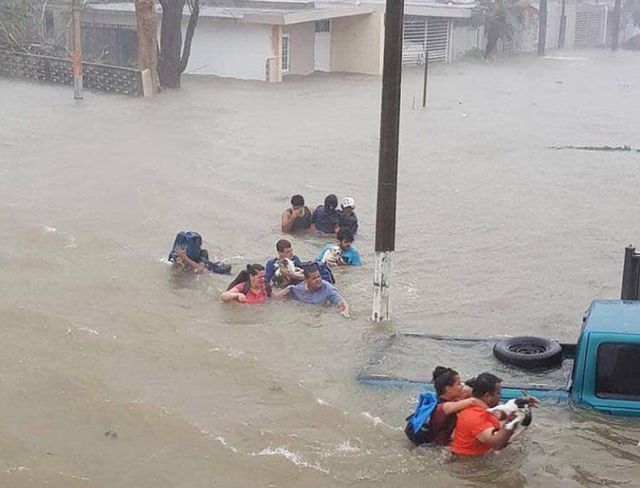
Hurricane María, which hit Puerto Rico Wednesday, has left the US territory in ruins. With much of the electrical, cell phone and road system severely damaged, the full scope of the devastation, including fatalities and serious injuries, is still not known, but losses to homes, businesses and critical infrastructure are expected to be massive.
María cut a 120-mile diagonal swath across the country. The leading edge of the storm began affecting southeastern Puerto Rico Tuesday night. Its eye entered the town of Yabucoa at 6 a.m. Eastern Time, and exited at noon on the northern coast between the cities of Arecibo and Barceloneta, west of the capital city of San Juan.
Governor Ricardo Rosselló, who declared an emergency and imposed a 6pm to 6am curfew, gave an initial account of the situation at 10 a.m. Wednesday, saying there had been “severe damage to infrastructure and great devastation.” He also warned of the danger of floods and mudslides which will put “lives at risk” as the tail end of the hurricane continued to pummel Puerto Rico a few hours longer.
The governor called on US President Donald Trump to declare Puerto Rico a “disaster area,” up from “emergency area,” which would allow the allocation of unlimited federal funds for Puerto Rico, as opposed to a maximum of $5 million provided to emergency areas.
Conditions in Puerto after Hurricane Maria hit [Credit: @Jennifer2012]
This is a pittance for the island, which declared bankruptcy prior to Hurricanes Maria and Irma. Puerto Rico is saddled with a debt of $74 billion in bonds and $50 billion in supposedly unfunded pension obligations. Its electrical utility, AEE (Autoridad de Energía Eléctrica, or PREPA in English), which defaulted on its $9 billion debt in July, is also in ruin.
Initial reports said that all 3.4 million residents were without power after the hurricane, while wide swaths of the island are without clean water. Many roads are impassable. Having lost the ability to borrow, Puerto Rico is now desperately in need. Other than remittances from Puerto Ricans living in the US and elsewhere, the funds that do come in will undoubtedly include punishing financial obligations to Wall Street.
Abner Gomez, head of the Puerto Rican Emergency and Disaster Management Agency (AEMEAD) painted a bleak scene of hurricane devastation. “We are going to find that our island has been destroyed. We are receiving information that leaves no room for hope. This [storm] system has destroyed everything on its path.”
María did not spare San Juan, including working class and middle class high-rise apartment buildings that suffered broken windows and flooded rooms. Residents described to the local media torrents of water going down stairs from flooded apartments. Imy Rigaus, 53, described having to seek refuge in the hallway of her apartment. “Water cascaded down the stairs, and entered the apartments, and we are trapped in the hallways,” she said.
In the Roberto Clemente stadium, which was designated as a shelter, rain cascaded through a wind-damaged roof, forcing evacuees to hide beneath the stands. “One of the guards told me that the roof is about to collapse,” said Suzette Vega, an evacuee. “I looked up and the roof was waving around like a piece of paper. I asked, ‘Is it made out of cardboard?’ ‘No,’ they told me, ‘it is cement.’”
Carmen Yulin Cruz, San Juan’s mayor, informed its citizens that electricity would be out for a long time. “The devastation is all around us,” declared Cruz, “our life as we knew it, has changed.”
The Madrid daily El País paints a picture of utter devastation, torrential rains, floods, breached dams, six-foot storm surges, trees flying through the air, and windows exploding. Hardest hit was the central region, but no place in the island, no town, no square meter, was left unaffected.
The San Juan daily El Nuevo Día gave further details. Many residential areas have been almost totally destroyed, including hospitals, where patients were sheltered in hallways, as hurricane winds of more than 160 miles per hour smashed windows. At least one of the government shelters was left “in pieces,” the web site reported.
Late arrivers to the shelters describe having to fight wind gusts that made the sheets of rain feel like “whips,” while trying to avoid all manner of flying objects.
Others described equally harrowing scenes of roofs being torn off. Half of Puerto Rico’s citizens live under the poverty line, many of them in precarious structures with zinc roofs.
Despite government evacuation orders, the majority of residents were not able to find their way to government shelters. Nydia Pérez, who lives in San Juan, told El País, “In my house a window exploded and a door was torn off. The wind and rain damaged my living room. Across the street, the entire roof blew off.”
Benjamin Morales said via Facebook, “Mobile service comes and goes; winds are still extremely strong; there is a lot of rain. All kinds of damage is being reported ... electric service is dead, as had been expected. My house has security windows rated at 300 kilometers (180 miles); at times I thought that they would be ripped off. Everybody at the radio station feels that nothing like this has ever happened before.”
With wireless communications gone, together with many landlines, Puerto Ricans from Florida, Chicago, New York, and other US cities have been flooding San Juan radio stations in an attempt to connect with relatives. Many ask for help for relatives that suffer from medical conditions, such as diabetes.
The Financial Oversight Board that rules over Puerto Rico on behalf of Wall Street banks and hedge funds, has yet to pronounce itself about Hurricane María’s destruction, other than some pro forma remarks from its chairman, José Carrión, who declared that the board is “extremely concerned.”

US initiates plan to blow-up Iran nuclear deal

Keith Jones

US Secretary of State Rex Tillerson outlined Washington’s demands for the reopening of the 2015 Iran civil nuclear accord at a meeting yesterday of the signatories to the agreement—the US, Britain, France, Germany, the European Union (EU), Russia, China, and Tehran.
The US demands are a provocation aimed at blowing up a complex agreement that was only reached after the Obama administration provoked a crisis then imposed punishing economic sanctions on Iran, in concert with the major European powers, and repeatedly threatened Tehran with war.
Yesterday’s meeting was convened by the US on the sidelines of the UN General Assembly, where President Donald Trump had delivered a bellicose, fascistic diatribe the day before, much of it given over to denouncing Iran and the nuclear agreement.
The other parties to the nuclear accord unanimously rejected Tillerson’s call for its revision and the imposition of far more onerous terms on Iran.
EU foreign policy chief Federica Mogherini, who chaired the closed-door meeting, told reporters at its conclusion, “There is no need to renegotiate parts of the agreement because the agreement is concerning a nuclear program and as such is delivering.”
“We have all agreed,” she added, “that all sides are implementing so far the agreement.”
Referring to the acute tensions on the Korean Peninsula which US President Trump further inflamed Tuesday with his threat at the UN to obliterate North Korea, Mogherini said, “We already have one potential nuclear crisis. We definitely do not need to go into another one.”
At his own Wednesday evening press conference, Tillerson conceded that Iran has implemented the nuclear agreement or Joint Comprehensive Plan of Action (JCPOA) to the letter. However, he and President Trump have repeatedly attacked Tehran for not fulfilling the “spirit” of the agreement, by which they mean bowing completely to Washington’s diktats.
Yesterday, the former Exxon CEO all but spelled this out, saying Tehran is in “technical compliance” with the nuclear accord, but the expectation that the deal would remove a “serious threat” to the region has not been realized.
At yesterday’s meeting, Tillerson reportedly called for more intrusive IAEA (International Atomic Energy Agency) inspections, including unfettered access to Iranian military facilities, additional restrictions on Iran’s civil nuclear program after 2025, and severe limits, if not the outlawing, of Iran’s ballistic missile program—an issue that was at no time part of the nuclear negotiations.
Adding to the menacing atmosphere surrounding the meeting, Trump announced earlier Wednesday that he had come to a decision on whether to carry out his threat to declare Iran in violation of its obligations under the nuclear accord. He did not say what he had decided.
Under US law, the president must report to Congress every 90 days on Iranian compliance with the JCOPA. The next deadline falls on October 15.
In his UN speech Tuesday, Trump denounced the Iran deal as “an embarrassment to the United States” and “the worst deal ever” and all but announced his intention to scuttle it, saying “I don’t think you’ve heard the last of it.”
NBC News is reporting that it has learned from four sources, including a “senior administration official,” that Trump will declare Tehran non-compliant before the October 15 deadline. Such action would not, by itself, constitute US abrogation of the agreement, but it would set the stage for the “snapping back” of punitive US sanctions and immediately precipitate a crisis with Iran—one that could rapidly escalate into a military clash.
In arguing for acceptance of the nuclear accord, US President Obama repeatedly said the only alternative was war.
Iranian President Hassan Rouhani told the UN General Assembly Wednesday, “Iran will not be the first country to violate the [nuclear] agreement. But it will respond decisively and resolutely to its violation by any party.”
“If the US breaks its commitments,” continued Rouhani, “then no other country will be willing to enter into negotiation with the US.”
In a pointed reply to Trump’s lurid denunciations of Iran as a “terror” and “rogue” regime, Rouhani said Americans should ask themselves why the billions Washington has spent in the Middle East “has only brought” the region “war, misery, poverty” and “the rise of extremism” [a reference to al-Qaeda and ISIS].
Tillerson knew long before yesterday’s meeting that the US demands would be rejected by the other JCOPA signatories. Indeed, for Tehran to accept the dismantling of its missile program under conditions where the US Fifth Fleet is parked off Iran’s shores and the US is arming its regional rivals, Israel and Saudi Arabia, to the teeth, would be tantamount to unilateral disarmament.
For months, the other great powers have been publicly warning against any attempt to reopen or repudiate the nuclear deal, saying it would dangerously exacerbate tensions in the Middle East.
In recent days, these warning were amplified. On Tuesday, French President Emmanuel Macron told the UN General Assembly, “Renouncing [the nuclear deal] would be a grave error … would be irresponsible, because it is a good accord that is essential to peace at a time when the risk of an infernal conflagration cannot be excluded.”
Russia and China, which are themselves targets of US militarism and have developed significant strategic and commercial ties with Iran, view the Trump administration’s plans to provoke a war crisis with Iran as a major threat.
The European powers played a pivotal role in the US offensive against Iran under Obama, imposing and enforcing sanctions that halved Iran’s oil exports and otherwise crippled its trade by denying it access to the world banking system.
Since removing sanctions, the European powers have moved rapidly to stake their claim to Iran’s oil and other resources. Rouhani, for his part, has rolled out the red carpet for European investors and only last week, using the metaphor of a dinner party to describe the nuclear deal, urged the US to eschew confrontation “and also enter the room where the food is served.”
The opposition of the EU powers to Trump’s plans to scuttle the Iran nuclear accord has everything to do with advancing their own predatory interests in the Middle East. With Germany in the lead, the European imperialist powers are themselves rearming—cynically exploiting the popular opposition to Trump to advance their plans to develop European military power, including a European Army, so as to be able to act independently of, and when needed in opposition to, the US.
Hoping to avoid a direct confrontation between Washington and Europe over Iran and to dissuade Trump from setting course for war, Macron has suggested there should be further negotiations with Iran outside the framework of the nuclear accord. According to the French president, these would include restrictions on Iran’s ballistic missile program, a follow-on deal after much of the nuclear accord expires, and an “open discussion with Iran” about the “current situation in the region,” including Syria.
Everything to date suggests that the Trump administration will dismiss this proposal out of hand. Anti-Iran hawks in and around the administration argue that even if Europe dissents from re-imposing sanctions on Tehran, the US can coerce the EU into doing so by threatening to sanction any European company or financial institution that trades or facilitates trade with Iran.
The US political establishment and military-security apparatus was bitterly divided over the Iran deal at its inception and two years later, after the defeat of the US proxy forces in Syria, those divisions are even more acute. Supporters of the accord, who include both Democrats and Republicans, argue that it can be part of an effective campaign to contain Iran. This could enable US imperialism to exploit cleavages within the Iranian bourgeoisie to push Tehran to accept US hegemony over the Middle East. This faction fears a showdown with Iran will undercut American imperialism’s military-strategic offensives against its more powerful strategic rivals, China and Russia.
Like Trump, this faction favors a more aggressive stance against Iran, but not the blowing up of an agreement which did compel Iran to dismantle much of its civil nuclear program. The New York Times, which for months has been arguing that it would be blunder to repudiate the Iran deal, has also published a series of articles decrying the spread of Iranian influence from Afghanistan to Lebanon.
Defence Secretary James Mattis and National Security Adviser H.R. McMaster, who are both notorious for their animus to Iran, are reported to be cautioning Trump against a precipitous repudiation of the Iran deal. As an alternative they have championed plans for a more aggressive diplomatic and military posture against Iran across the Middle East. These plans were reportedly endorsed at a recent National Security Council meeting, with their broad outlines soon to be publicly revealed.
Press leaks indicate they include a more aggressive US naval posture against Iranian small-boats in the Persian Gulf and bolder steps against Iranian forces in Syria—steps that could easily spiral into direct clashes and all-out war.

India-Japan Civil Nuclear Cooperation: Contextualising Abe's Visit

Shivani Singh


The strong Indo-Japan bilateral relationship is a testament to the growing economic, cultural and strategic exchanges that both countries have shared in the past and this dynamic has continued to flourish under the regimes of PM Narendra Modi and Shinzo Abe. Abe’s recent visit to India was much awaited given that this was the first meeting between the two leaders since the Agreement for Cooperation in the Peaceful Uses of Nuclear Energy between India and Japan came into force on 21 July 2017. 

One of the expectations from the meeting was a clearer picture of the extent of civil nuclear cooperation that the two countries can achieve. This was attained to an extent in the sense that certain concerns regarding the deal were put to rest. However, there was one important and rather contentious area of the agreement that was left untouched: the termination clause envisaged in article 14. This article seeks to assess this visit in light of the past and present challenges regarding the agreement and whether this visit was successful in addressing the these concerns. 

Past Hurdles
The India-Japan Civil Nuclear Agreement aims to facilitate a smooth exchange of nuclear technology, equipment, nuclear material (source material and fissionable material) and non-nuclear material between the two countries subject to the clauses of the agreement. However, the road to this agreement was a bumpy one. The resistance seen on Japan’s part in forging this deal emanated not only from India’s non-signatory status to Nuclear Non-Proliferation Treaty (NPT) but also from various aspects of India’s nuclear liability regime.

In addition, India's refusal to completely bifurcate its civil and military nuclear programmes and create two separate areas of domain knowledge, a condition put forth by Japan during the negotiations were other impediments. Japanese anti-nuclear lobbyists had major concerns about the possibility of the imported fissile material for being used for the development of nuclear weapons after reprocessing the spent fuel. 

Existing Bottlenecks 
Most of the concerns were put to rest by India during the nuclear deal negotiations. However, a major bone of contention in realising the full potential of this deal on both ends - which was not addressed during this visit - is the termination clause envisaged in article 14 of the agreement.

Currently, the clause grants the party seeking termination of the agreement the right of return of all “nuclear material, non-nuclear material or equipment transferred pursuant to this Agreement and any special fissionable material recovered or produced as a by-product.” This is fashioned around the same template as the Indo-US nuclear deal where the parties have a ‘right to recall’, and is also mentioned in a separate document recording the views of both parties. Japan’s commitment to this clause arises from the pressures of domestic forces. 

However, there is some ambiguity over whether this clause is binding on India. The details of the termination process have not been specified either. For example, the condition that components should be returned in the event of termination of the agreement is  problematic because it involves shutting down a reactor, dismantling and shipping back massive vessel components which would be highly radioactive. Who will bear the cost of the dismantling and transport of the material is also not clear.

Positive Outcomes
Shinzo Abe’s visit was an opportunity for both countries to tie up loose ends and facilitate a smooth implementation of the clauses under the agreement.

Both countries expressed gratitude at the entry into force of the civil nuclear agreement and decided on setting up a working group “to strengthen bilateral cooperation in this field and reiterated their shared view that the Agreement reflects a new level of mutual confidence and strategic partnership in the cause of clean energy, economic development and a peaceful and secure world.” The details of this working group and its functions have not been chalked out yet. 

Concerns regarding India’s non-NPT status continue to flare up tensions in Japan now and then, mostly advanced by think-tanks and civil society groups. Therefore, the joint statement reaffirming “their shared commitment to the total elimination of nuclear weapons” gave weight to India’s intentions of using the imported nuclear material and technology for civilian purposes alone. 

India and Japan also reiterated their commitment to an early conclusion of negotiations on a non-discriminatory, multilateral and effectively verifiable Fissile Material Cut-off Treaty (FMCT). This will help in setting the right tone to ensure nuclear safety and security in the peaceful uses of nuclear energy.

Seen in retrospect, the meeting between Abe and Modi was successful in further strengthening nuclear energy cooperation between the two countries, and has laid the foundation for further bilateral collaboration on clean energy.  However, the visit could have gone a step further in addressing concerns regarding the termination clause in the agreement to overcome the last hurdle towards optimising the benefits of such cooperation.

A Looming Nuclear Arms Race In East Asia?

Nopur Siingh


The current East Asian security dynamics have two determinants. The first is the challenge posed by North Korea’s aggressive nuclear and missile development programmes coupled with direct threats to the US, and the second is the rise of China as a regional power. The complications arising from these factors in the region are further exacerbated by the US' inevitable and constantly increasing involvement and military presence.

The US and China have long been strategic adversaries. This, in the backdrop of the Trump administration trying to deter the North Korean regime and China’s aspirations to regional supremacy, magnifies the underlying US-China arms race into a regional ballistic and nuclear race. This, in turn, makes East Asia even more volatile to conflict than the Korean crisis alone did.
The lack of a substantive Chinese participation in reigning North Korea in while maintaining bilateral trade relations, could be attributed to three factors:
a) A cost-benefit analysis where DPRK stands as an asset for China
b) Concerns that measures like a trade embargo could lead to a fellow Communist regime's collapse
c) Fears that the frayed relations with North Korea could be exposed.
Of these, China’s cost-benefit analysis is being severely disturbed by Pyongyang’s frequent nuclear threats to the US and allies which necessitates a reaction from the US - both to protect its local interests and those of its allies, South Korea and Japan. This is in the form of increasing weapons, missile defence systems and troop’ deployment. Currently, 40,000 US troops in Japan and 37,000 in South Korea are stationed on duty. The most immediate demonstration comes in the form of two US B-1B advanced bombers and four F-35B stealth jets flying over the Korean peninsula in a live-weapon, military flight/joint bombing drill/mock bombing military exercise with South Korean F-15K fighters. In addition are a joint urban warfare and frontline rescue drills with the  Japanese military as well as more fighter deployments to the peninsula. The long-term deployments have been the installation of the Terminal High Altitude Area Defence (THAAD)  and anti-ballistic missile system in South Korea and the Patriot Advanced Capability-3 (PAC-3) system and Aegis Ashore system in Japan.
This now means the three powers are accumulating a formidable air defence system capable of intercepting a significant part of the North Korea's ballistic missile arsenal. While these deployments can easily be explained as static defensive deployments, the Republic Of Korea Navy (ROKN) and the Japan Maritime Self-Defence Force (JMSDF) in addition to the United States Navy (USN) are also significantly bolstering their naval Aegis fleets with ballistic missile interception capabilities. This cumulative force is far greater than what is needed to counter North Korea and naturally becomes a threat for China. Since force is fungible - the fact remains that any missile system capable of intercepting North Korean missiles is also capable of intercepting Chinese missiles, thus pronouncing a threat to China’s strategic missile system.
China has tried to maintain an active and diverse ballistic missile development programme, upgrading its missile forces in number, capability, and type. China has said it will conduct live-fire drills and test new weapons to safeguard its security in response to the US deployment of THAAD in South Korea. This illustrates that improving US missile defence capabilities influence the development of China’s nuclear forces. According to World Nuclear Forces, China has 270 warheads in stockpile that is a minuscule number as against 4,480 in the US stockpile. However several reports hint at a rough estimation of around 500 warheads or higher.
Although the true sophistication of Chinese missile defence technology remains unclear, it possesses approximately 1,200 conventionally armed short range ballistic missiles (SRBM), 300-400 medium range ballistic missiles (MRBM), and an estimated 81 intercontinental ballistic missiles (ICBM). Traditionally ,China maintained few ICBMs, concentrating instead on IRBMs as these were much more useful in the high-threat situation around its periphery. However, presently, the issue is all these missiles, being an intermediate range, come within the terminal velocities that THAAD and Aegis Ashore are intended to shoot down. This effectively blunts Chinese deterrence calculations and forces it to either innovate on countermeasures or simply expand its arsenal.
The missile and nuclear expansion are now happening in two ways - the first is the expansion of and investment in new ICBMs and the second is the investment in asymmetric technologies. The first investment reinforces deterrence against the US, and the second set enables accurate conventional strikes against large and threatening naval formations that would have previously required tactical nuclear weapons to take out. The first part of this expansion is visible in the newly unveiled DONG FENG(DF)-31AG ICBM, which can carry multiple warheads, meaning the actual number of ICBMs becomes less important as several warheads can be used to overcome anti-ballistic missiles (ABM).
Irrespective, it is also developing two new ICBMs - the DF-41 land-based missile with a possible range of 15,000 km and the submarine based Jù Làng-2 (JL-2) with an estimated range of around 8-9,000 km. This gives China a potent combination of first and second strike capability when taken in its totality. The second part of the expansion - a new way of dealing with regional powers - is evident in the continuing development of ‘carrier-killer’ ballistic missile to threaten US' fleet of aircraft carriers. It has also recently successfully tested a hypersonic glide weapon - DF-ZF - for the seventh time,  and is accumulating a force of well over 1,500 ground launched cruise missiles.
Developments in China's nuclear deterrent cannot be ignored given the aggressive progress of the conflict between North Korea and the US. The build-up of US assets now and the direct costs it imposes on China's own defence mean that Beijing's cost-benefit analysis may have to change. The current Chinese missile investments indicate that it is based on a revised cost-benefit analysis; that China is now retooling its missile forces to re-establish deterrence and deal with a new, possibly more hostile threat environment. Clearly then this is not a Chinese government that does not approve of North Korea's actions but rather one that was caught unawares and too early by North Korean actions which it quite possibly deemed inevitable.