2 Oct 2017

Puerto Rico faces health catastrophe as Trump tweets “We have done a great job”

Andrea Lobo

In anticipation to his scheduled visit to the island on Tuesday, President Donald Trump sent a barrage of tweets throughout the weekend from his luxury golf course in Bedminster, New Jersey, which essentially blamed Puerto Ricans for the suffering they are facing.
After San Juan Mayor Carmen Yulín Cruz criticized the administration’s response—comparing conditions on the US territory to “something close to a genocide”—Trump branded all criticisms as “fake news” and attacked Cruz’s “poor leadership.”
“They want everything to be done for them when it should be a community effort,” Trump tweeted Saturday, typifying the contempt of the US financial oligarchy to the island’s 3.4 million people. To Wall Street the demands of the island’s population for water, electricity, cell phone connections, gasoline and other basic necessities is an unwanted interruption to milking the island for debt repayments.
The president escalated his attacks on Sunday, criticizing “politically motivated ingrates” and insisting “We have done a great job.” He fraudulently declared in another tweet that all buildings had been inspected even though many towns, especially in rural and mountainous areas, remain out of reach of rescuers, let alone building inspectors.
Aping Trump, the right-wing correspondent for Fox News Geraldo Rivera confronted Mayor Cruz Sunday morning, cynically declaring, “I don’t see people dying.”
Speaking on Sunday, David Lapan, spokesperson of the Department of Homeland Security, which integrates FEMA, indirectly criticized the San Juan Mayor for any suggestion that they are not all in the “life-saving team”.
There is every indication officials are grossly under-reporting the death toll, which stands at 16. The Center for Investigative Journalism contacted several of the hospitals and the Forensic Science Institute finding that dozens and perhaps hundreds of corpses are piling up and going unreported.
Including the 1,500 national guardsmen in Puerto Rico, the number of military personnel deployed to the island is now over 6,400 soldiers, according to Caribbean FEMA director, Alejandro de la Campa. Eleven days after the hurricane, FEMA has received 63,000 claims of damaged homes. De la Campa indicated that a mere $21 million has been approved via FEMA’s infrastructure program for an “initial response.”
In addition, about 3,000 road obstructions are blocking half of all highways. Of the 69 hospitals, only one functions fully and 55 partially. Less than 5 percent of the electrical grid is operating, only half of the supermarkets are open, although they are running out of food, and ATMs and credit cards are largely not working.
Ricardo Ramos, executive director of the publicly-owned electric agency AEE, said only 3 percent of the electric grid had been restored across the island. Ramos acknowledged that the island-wide blackout was connected to decades of austerity measures and, more recently, to the decisions by the Financial Oversight Board, which oversees Puerto Rican finances on behalf of Wall Street.
“Our plants are very antiquated. Our generating infrastructure is very old and was designed for another epoch. Part of our fiscal plan was to build it with more resistance to the pounding of storms. It was rejected [by the Financial Oversight Board]; it was not meant to be, evidently,” declared Ramos. Due to austerity measures, 4,500 badly needed linesmen have been sacked since 2012. “They are the ones most urgently needed right now,” said the AEE director.
Officials have also said the cities of Isabela and Quebradillas would continue evacuating because of the danger of a collapse of the Guajataca dam, whose breach is expanding two to four inches each day. Repairs are scheduled to begin today.
Even in the areas where it is reported as available, the water service is being frequently interrupted. The pumps for the aqueduct that feeds water to the north of the island keep running out of fuel, shutting off water.
The head of the Aqueduct and Sewage Authority (AAA), Eli Díaz, indicated that the problem would be resolved over the weekend after a “deal” with FEMA. Such “deals” underscore the anarchic character of relief efforts, which are still being carried out on a for-profit basis. The availability of fuel and energy for water, hospitals, and other critical infrastructure is dependent on FEMA’s ability to sign contracts with private diesel or gasoline suppliers.
The dean of Public Health School at Florida International University, Tomás Guilarte, warned in an op-ed in the Miami Herald that the lack of electricity means sewer systems are failing. “This leads to bacterial infections—such as cholera, dysentery, E. coli and typhoid—that can be disastrous. The typical treatments, like tetanus shots or powerful antibiotics, are not readily available on the island, where medical supplies are quickly running out.”
The mosquito-borne diseases dengue and conjunctivitis are already showing outbreaks, according to a report Thursday by the Washington Post, which also indicated that thousands are not receiving urgent care and have had critical surgeries postponed.
The warning of a cholera epidemic underscores the devastated state of the infrastructure, given that Puerto Rico hasn’t suffered such an outbreak since the 1850s.
Guilarte also warned about the grave risks from the exposure to chemicals and pollutants, given the 18 open and six closed Superfund toxic sites in Puerto Rico, which he describes as areas where “mismanagement of contamination threatens human health and the environment.”
The EPA’S 2014 Climate Change Adaptation Implementation plan warns Superfund cleaning teams explicitly to plan for “increased intensity of hurricanes” to protect people from toxic releases. Not only did these warnings not prevent 13 sites from being flooded in Texas and leaking chemicals after Hurricane Harvey, but the report, even for future consideration, was removed from the web site by President Trump after his inauguration.
An EPA spokesperson warned last week that it was getting its teams in place to assess the Superfund and oil sites and other regulated facilities. Juan Declet-Barreto of the Union of Concerned Scientists warned that toxins will “add even more to what is undoubtedly going to be a public health crisis.”
A 2013 study by the Puerto Rico Climate Change Council reported that natural drainage for storm water was being undermined through real estate development, particularly in the cities. It notes that fully half of the population lived in areas susceptible to landslides, while a “relatively high poverty rate increases the island’s social and economic vulnerability to climate change impacts.” Nearly half of the population lives below the official poverty line.
A 2016 Congressional report found that more than half of Puerto Rico’s landfills were in violation of EPA regulations. InsideClimateNews reports that a five-story coal ash pile near the impoverished city of Guayama could be of greatest concern, a risk already compared by EPA advisor Michael Dorsey to the polluted water in Flint, Michigan.
Governor Roselló indicated that two regions in the island still have “disconnected communities.” Eliván Martínez, a journalist for the Center of Investigative Journalism, reported last week from Guaonico, one of the villages still inaccessible in the Utuado district, that residents are getting water from a nearby river and scavenging the forest for food. “The mountains near my house melted…We have gone back to ancient times, bathing in the river with muddy water. In this situation, human pride crumbles down,” said neighbor Edgardo Matías.

Millions defy brutal crackdown by Spanish police to vote in Catalan referendum

Alejandro López & Alex Lantier

Mass protests engulfed Catalonia Sunday as large parts of the region’s population mobilized against a brutal and indiscriminate crackdown by Spanish national police, who were dispatched to block the Catalan government’s referendum on secession from Spain. Millions worldwide reacted with horror to television news reports showing Civil Guard riot police assaulting peaceful protesters, including teenagers and elderly people, who were defending polling stations or lined up to vote.
The Popular Party (PP) government of Prime Minister Mariano Rajoy sent some 16,000 police to Catalonia to shut down polling stations, seize ballot boxes and attack voters. At least 844 people were injured across the region as police launched baton charges and fired rubber bullets. The police operation failed to overcome mass popular resistance, however. Catalan authorities claimed that 90 percent of the 2,315 polling stations organized for the referendum had remained open.
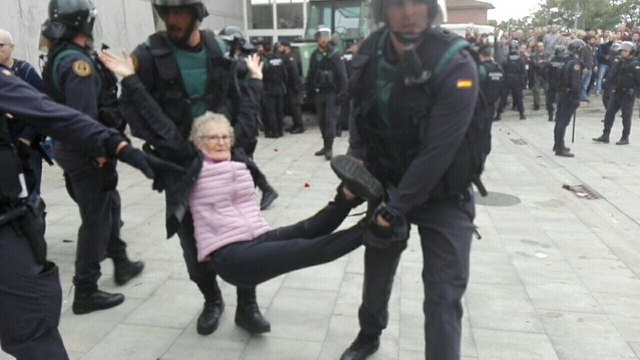
Early on Sunday, a helicopter and some 100 Civil Guards descended on Sant Julià de Ramis, the voting place of regional Premier Carles Puigdemont, and attempted to storm the village’s polling station. Hundreds of voters blocked the doors of the local sports center that served as the polling station, chanting “We will vote!”, but police used a hammer to break the glass, forced their way into the building, and beat or dragged off the voters.
Civil Guards drag away elderly woman in Sant Julià de Ramis
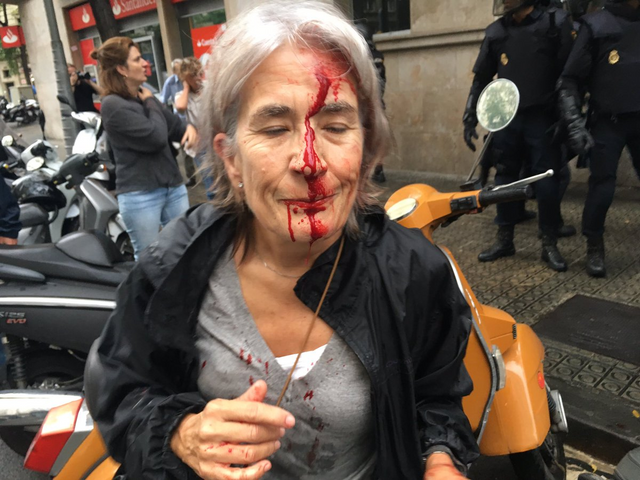
Police attacked and beat voters at schools and other polling places across the regional capital, Barcelona. Videos emerged of officers kicking people sitting in polling places and dragging women away by their hair. At the Escola Infant Jesús School polling place, police assaulted Maria José Molina, 64, whose picture with her head drenched in blood went viral on the Internet.
Maria José Molina outside the Escola Infant Jesús voting school
Molina told Barcelona-based daily La Vanguardia that she was sitting next to her husband several meters from the door when riot police grabbed her shoulders and legs and carried her off. “I am a light woman,” she said, adding that police officers “threw me face first to the pavement.”
Police arriving in towns across the region rapidly found themselves facing large, hostile crowds who booed and demanded that they leave. In Girona, police tried to seize the ballots at the Escola Verd de Girona, when a crowd shouting, “We want to vote! We want to vote!” blocked the main entrance. Police then assaulted the crowd, which began to chant “Murderers! Murderers!”
Opposition to the police crackdown extended throughout the region, including in areas opposed to independence. In L’Hospitalet de Llobregat, Catalonia’s second city—home to first, second and third generation Spanish-speaking migrant workers who went to Catalonia in the 1960s—police were met with protesters chanting in Spanish, “Go away, occupation forces!” and “We want to vote!”
Spanish police also clashed with Catalan officials, including firefighters who turned out to form human shields between riot police and voters, and the region's police, the Mossos d'Esquadra.
After the Spanish police’s rampage across Catalonia yesterday, the explosive conflict between Madrid and Barcelona is set to further escalate today. While Puigdemont claimed a victory for the Catalan referendum and called for secession late last night, Spanish officials in Madrid offered a brazen defense of their onslaught against the population of Catalonia and demanded that the Catalan administration submit to its diktat.
Denouncing the referendum as “an illegal mobilization with disorganized logistics,” Spanish Prime Minister Rajoy spoke from the Moncloa Palace to defend his decision to unleash his police against the Catalan population. He said that “the state responded with firmness and serenity… We did what we had to do. I direct the government and we have carried out our responsibilities.”
Rajoy bluntly demanded that the Catalan government abandon the referendum: “I ask them to end their irresponsibility, to admit that what was never legal is now clearly unrealizable, and that continuing this farce will take them nowhere… Put an end to it. It will lead to nothing good.”
Late last night, in Barcelona, Puigdemont responded by saying that the Spanish state had “written today a shameful page in the history of its relations with Catalonia.” He added, “Catalonia’s citizens have won the right to have an independent state constituted in the form of a republic… In consequence, my government will transmit in the coming days to the Parliament, the seat and expression of the sovereignty of our people, today’s electoral results so that it can act as specified by the Referendum Law.”
The Referendum Law states that under these conditions, Catalonia will declare independence and secede from Spain, even though only a minority of the total population voted “yes.” 2.26 million people voted yesterday, or 42 percent of the 5.34 million voters in Catalonia. Of these, 2.02 million voted “yes”, and 176,000 voted “no.”
Puigdemont appealed for support from the European Union bureaucracy in Brussels, asserting that Spain’s conduct “violates its fundamental principles” and adding that the Catalan issue was “no longer an internal matter” of Spain.
The crackdown, coming after weeks of threats and police operations launched by Madrid in Catalonia, is a political indictment not only of the PP, but of the entire Spanish ruling elite and all of Spain’s main NATO allies. While Spanish police raided offices, confiscated ballots and arrested officials, and the government in Madrid sent police reinforcements, heads of state including US President Donald Trump and French President Emmanuel Macron met with Rajoy and issued cordial joint statements calling for Spanish unity.
Last night, Britain’s Foreign Office whitewashed the PP crackdown. Its spokeswoman said, “The referendum is a matter for the Spanish government and people. We want to see Spanish law and the Spanish Constitution respected and the rule of law upheld.”
This is a fraud! Madrid’s barbaric crackdown was not a legal action, but an act of terror against innocent people aimed at whipping an entire region of Spain into line. The country has seen nothing like it since the Spanish Civil War and the end in 1978 of the 40-year regime of the fascist dictator Francisco Franco.
The stench surrounding the ruling establishment in Madrid extends to Washington and the major European powers. They  are reprising the role they played during Franco’s rule: endorsing a bloodstained right-wing Spanish regime they see as a key military ally, and one that is dedicated to the suppression of the working class.
The crackdown has also exposed the bankruptcy of the two main opposition parties in the Spanish parliament, the Spanish Socialist Party (PSOE) and Podemos. Unsurprisingly, the PSOE, a tool of the Spanish state machine, refounded as an explicitly anti-Marxist, social democratic party in 1979, unequivocally endorsed Rajoy’s crackdown.
PSOE General Secretary Pedro Sánchez, who is often presented as a “left” within the party, hailed Rajoy and the PP: “I want to express the full support of the PSOE for Spain’s rule of law, its rules and its institutions, the support of the PSOE for the territorial integrity of this country that is now at risk. We are in a moment in which the general interest must prevail over the parties… it is the moment of reason, of common sense.”
As for Podemos, while hordes of riot police beat and bloodied innocent people across Catalonia, it issued impotent appeals for the PSOE to abandon its tacit support for the minority PP government in Madrid and instead form a coalition government with Podemos. As the first police attacks began, Podemos officials began appealing to the PSOE. Iñigo Errejón, secretary for policy and strategy, asked in a tweet, “Why is the PSOE so silent?” Irene Montero, spokesperson for Podemos in parliament, said “the PSOE has to be more democratic.”
Podemos General Secretary Pablo Iglesias told the press: “The PSOE cannot continue looking away. They have made a serious mistake by supporting the PP’s strategy. Better late than never and hopefully they will rectify and support us to get the PP out.”
The bankruptcy of the PSOE and Podemos notwithstanding, the minority PP government hangs by a thread after its bloody crackdown. The Basque Nationalist Party (PNV), whose support was key to passing the PP government’s budget this year, has criticized the PP and on Saturday it led a march in Bilbao in defense of the Catalan referendum.

30 Sept 2017

AIMS NEI Fellowship Program for Women in Climate Change Science 2018

Application Deadline: 27th October 2017
About the Award:  Applications are invited from outstanding female scientists currently residing anywhere in the world. Successful applicants are expected to execute in a suitable African host institution a self-initiated project with the potential to contribute significantly to the understanding of climate change and its impacts, and/or to the development and implementation of innovative, empirically grounded policies and strategies for mitigation, adaptation, and/or resilience.
This Fellowship Program was made possible by a grant from the International Development Research Centre, Ottawa, Canada, www.idrc.ca, and financial support from the Government of Canada, provided through Global Affairs Canada (GAC), www.international.gc.ca.
It is part of a broader effort by AIMS NEI to build the intellectual capital needed to solve the myriad challenges to Africa’s development resulting from climate change.
Type: Fellowship
Eligibility: To be eligible, applicants must be:
  • female
  • in possession before the fellowship start date of a doctorate in a quantitative discipline, including, but not limited to, applied mathematics, climatology, physics, chemistry, computer science, theoretical biology, and engineering
  • currently employed, on either a permanent or a temporary basis, in a non-profit work environment, including government
  • actively engaged in research, policy, and/or practice relevant to climate change modelling, mitigation, adaptation, and/or resilience
  • the lead and/or senior author of at least one refereed publication on a topic relevant to climate change modelling, mitigation, adaptation, and/or resilience.
Selection Criteria: All reviews done by the Selection Committee members and other reviewers will be based on the following criteria:
  • Quality of applicant: academic qualifications; quality of publications; experience in climate change-related work; real-world impact & recognition (e.g. through awards) of prior work.
  • Quality of proposed project: relevance to climate change modelling, practice and policy; strength of connection to the mathematical sciences; experience of applicant in project topic; quality of project design; feasibility; suitability of proposed host institution environment and of named collaborator; quality and realism of budget projections.
  • Potential impact of proposed project on scientific knowledge, practice and policy.
Number of Awards: Not specified
Value of Award: The fellowship is worth up to USD 35,000. The exact amount of the fellowship will be specified at the time of the award. This amount will be paid to the Fellow in three installments in accordance with a schedule that will be defined at the time of the award. Fellows must submit accurate banking details (using the form provided below) to avoid undue delays in receiving their fellowship payments.
How to Apply: To apply, email to ms4cr-fellows@nexteinstein.org (using as subject “MS4CR fellowship application – first and last name of applicant”) the following documents on or before 11:59 pm CAT on 27 October 2017:
It is important to go through the Application process on the Program Webpage (see Link below) before applying.
Award Providers: International Development Research Centre, Ottawa, Canada, The Government of Canada, provided through Global Affairs Canada (GAC).

Quebec Government Research Internship for International Students 2018 – Canada

Application Deadline: 1st March, 2018, 11:59 PM
The internship must start no later than March 31, 2018.
Eligible Countries: All
To be taken at (country): Quebec, Canada
About the Award: The FRQNT’s (Fonds de recherche du Québec – Nature et technologies) international internship aims to foster international mobility of students whose research activities are part of the scientific program of a strategic cluster funded by the FRQNT.
The internship is a supplementary tool available to a strategic cluster to strengthen its position at the international level through research projects and partnerships that have already been established or which are under development.
The proposed research outlined in the application as part of the internship must be part of the scientific program of the strategic cluster.
Type: Research, Internship
Eligibility: 
  • All of the strategic clusters supported by the FRQNT may submit an application to this program.
  • The applicant proposed by the strategic cluster must meet all of the eligibility requirements listed here after.
  • The applicant must have the valid study permits or visa for the entire duration of the internship;\
  • The applicant can’t be enrolled in a co-degree from more than one institution including a Québec university. For the students enrolled in a co-degree see the rules of the Frontenac program.
  • Students who are jointly supervised by a researcher in a foreign university (co-degree) are not eligible to apply for an international internship scholarship to visit one of their home universities.
Selection Criteria: 
  • The academic excellence and research aptitude of the candidate: 50 points
  • The correspondence of the internship with the scientific program of the cluster’s: 25 points
  • The insertion of the internship in international action of the strategic cluster: 25 points
Number of Awardees: Not specified
Value of Internship: The scholarship for internship is of a maximum value of $15,000. However, the FRQNT will allow no more than the equivalent of $2,500/month in living expenses and will permit internship expenses (ex.: airfare, room rental agreement, etc.) to be covered by the strategic cluster.
Duration of Internship: The internship must be of a minimum duration of 2 months and a maximum of 6 months.
How to Apply: 
  • Candidates interested within this program must file their application within their strategic cluster (see list on FRQNT’s Web Site) Validate the list of documents required for this application with the specific strategic cluster.
  • The strategic clusters which recommend a candidate must fill the specific form available on FRQNT’s Web site as well as transmit it electronically. The form includes the complete addresses of the student, the academic supervisor, and the internship supervisor. A brief description of the nature of the internship is also required.
  • The strategic clusters must also submit the selection committee report that states the results for each of the three criteria in effect, the assessment process and the names of the committee members.
  • The strategic clusters must also send in the electronic form, a letter signed by the supervisor of the student specifying the start and end dates of the internship.
  • Any internship application must be filed by the strategic cluster and approved by the FRQNT before the leaving of the trainee.
Award Provider: FRQNT’s (Fonds de recherche du Québec – Nature et technologies)
Important Notes: All projects involving human subjects or biological materials (body parts, products, tissues, cells or genetic material from a human body, of a person living or dead) or administrative, scientific or descriptive data from human subjects, require the approval of the research ethics board of the principal applicant’s institution (Common General Rules , article 5.3). Furthermore, if applicable, researchers must report any environmental impacts of their research and employ reasonable efforts to minimize them. To this end, they must obtain the required authorization and permit before the start of the project.

Kenya DAAD Postgraduate Training Program 2018/2019 – Germany

Application Deadline: 31st October 2017
Eligible Countries: Kenya
To Be Taken At (Country): Germany
About the Award: The Kenya Vision 2030 policy document recommends investment in Science, Technology & Innovation (ST&I) in priority key sectors. One such area involves capacity building in the universities through advanced training of personnel.
The programme will offer twenty-one (21) PhD vacancies to eligible academic personnel teaching in Kenyan universities (both public and private) for a duration of up to forty-five (45) months (exclusive six (6) months German language course) at a German university.
The general aim of the programme is to train young academics and scientists through funding of Ph.D. degree studies in Germany.
The German Academic Exchange Service or DAAD is the largest German support organization in the field of international academic co-operation.
Type: PhD 
Eligibility: To be eligible, candidate must:
  • Be a citizen of the Republic of Kenya;
  • Be teaching (full or part-time) in Kenyan universities (both public and private);
  • Should have obtained the Master’s degree preferably within the past 6 years (date of graduation);
  • Be willing to undertake a six (6) months German language course.
Number of Awards: 21
Value of Award: 
  • 6 months preparatory German language course (fulltime) including accommodation and pocket money
  • co-financed monthly scholarship instalment
  • Reimbursement of travel costs through an adequate travel lump sum that is disbursed after arrival in Germany, during the funding period respectively
  • study and research allowance
  • accident, health and personal liability insurance cover
  • further individual allowances upon application
Duration of Program: Up to forty-five (45) months (exclusive six (6) months German language course).
How to Apply: The following documents must be prepared for the online application:
  • Curriculum Vitae and list of publications (use the Europass specimen form at http://europass.cedefop.europa.eu/documents/curriculum-vitae)
  • Abstract of one page, research proposal (not more than 10 – 15 pages) including detailed timetable; academic degree certificates and transcripts, whereby the Bachelor’s degree must have been passed with at least second class upper division and a Masters degree with at least a B+ grade (or equivalent).
Invitation letter from a German supervisor OR admission letter to a structured PhD programme at a German university
  • Two academic reference letters from university professors (forms provided in the online portal below)
  • A no objection Letter from the university, indicating the prospective function of the applicant within the university after return to Kenya and a commitment by the University to the job security of the applicant till the period of return (those on who qualify will be required to produce the Bonding document).
Award Providers: DAAD

Open Society Internship for Students (Fully-funded to Hungary) 2018

Application Deadline: Ongoing
Eligible Universities: Applications will only be accepted from the following universities:
  • An-Najah National University, Faculty of Economics & Social Sciences
  • An-Najah National University, Faculty of Law
  • American University of Beirut, Faculty of Arts & Sciences
  • Birzeit University Muwatin Institute for Democracy and Human Rights
  • Harvard Kennedy School of Government
  • Makerere University School of Law
  • School of Public Policy at Central European University
  • Sciences Po Paris School of International Affairs
  • The International University of Rabat, School of Political Science (Science Po Rabat)
  • The University of Chicago, Harris School of Public Policy
  • The University of Hong Kong, Journalism and Media Studies Centre
  • The University of Hong Kong, Faculty of Law
  • University of the Andes, Alberto Lleras Camargo School of Government
  • University of the Andes, Masters in International Law
  • University of Pretoria Centre for Human Rights
  • University of Toronto Munk School of Global Affairs
To Be Taken At (University): Centreal European University, Budapest
About the Award: The Open Society Internship for Rights and Governance is a project of the Open Society Foundations that launched in the summer of 2013 in partnership with the School of Public Policy at Central European University. It is designed to inspire a new cohort of practitioners committed to working both in the public interest and at the forefront of global policy.
The highly competitive program allows a limited number of students from top public policy schools to immerse themselves in the ideas and practice of open society through a clinical seminar held in Budapest at the School of Public Policy at Central European University, followed by an 8- to 12-week intensive internship at a policy- and rights-oriented nongovernmental organization selected for its outstanding work.

Type: Internship
Eligibility: 
  • Only candidates of the above schools will be accepted.
  • If you are not a master’s candidate in one of the programs listed above, we cannot accept your application at this time.
Number of Awards: Not specified
Value of Award: The OSIRG program is fully funded. The cost of student travel and accommodations during the clinical seminar and internship period will be covered by OSF. The Foundations will also provide a stipend during the seminar and internship periods. The stipend is comprehensive and will include a per diem as well as visa costs, travel insurance, and currency conversion fees. In addition to funds to cover accommodations, students will also be awarded a relocation fund during the internship period. OSF will not be responsible for any costs that exceed the allocated stipend.
Duration/Timeline of Program: Please consult your university for the specific timeline.
How to Apply: Applications for 2018 participation will be released to eligible universities in fall 2017.
Award Providers: Open Society Foundations and the School of Public Policy at Central European University.

Goethe-Institut Game Mixer Contest for Game Developers in Africa 2017

Application Deadline: 5th October 2017
Eligible Countries: South Africa and other countries in Sub Saharan Africa
To Be Taken At (Country): Johannesburg, South Africa
About the Award: Within the program “Game Mixer”, the Goethe-Institut aims to promote professional exchange between game developers from around the world. In 2015, the first Game Mixer Program took place in Jakarta and Bandung,
Indonesia. The following year, the second iteration of the program took place in Sao Paulo, Brazil. In its third iteration, the Game Mixer program seeks to mix up the international game development scene even further by not only including game developers from Germany and the host country of South Africa, but by also inviting participants from broader Sub-Saharan Africa and the former host countries Indonesia and Brazil, too.
Type: Contest
Eligibility: If you are interested and want to apply, you should:
  • be a professional developer from an African game company that has released at least one game;
  • be committed to participate full-time during the whole ten-day program; and
  • be able to communicate in English.
  • Smaller, emerging studios are preferred, since they would benefit most from this programme.
Selection:  The participants will be chosen by a jury of the Goethe-Institut and Interactive Entertainment South Africa.
Number of Awards: Seven from South Africa and eight from Sub Saharan Africa
Value of Award: The Goethe-Institut will provide:
  • travel expenses to and from Johannesburg
  • accommodation (for participants not living in Johannesburg)
  • local transfers
Duration of Program: 16-24 November 2017
  • Thursday 16 November – Arrival of guests in Johannesburg, get together, welcome dinner
  • Friday and Saturday 17 and 18 November – Game Camp
  • Sunday 19 November – Public showcase of the games
  • Monday 20 November – Leisure time or Sightseeing
  • Tuesday 21 November – Studio visits
  • Wednesday 22 November – Internal showcase for participants
  • Thursday and Friday 23 and 24 November – Game Jam
  • Saturday 25 November – Departure of guests
How to Apply: Your application should include:
  • a CV highlighting your professional background
  • a one-page letter of motivation;
  • a one-page profile of your studio including: founding date, number of games produced / released, number of developers, performance (e.g. downloads, users, revenue);
  • a one-page summary of one product that you want to highlight in the showcase including: game details, game performance (e.g. downloads, users, revenue, KPIs), screenshots
Please send your application to Ralf.Eppeneder.extern@goethe.de.
Award Providers: The project is funded by the Foreign Office of the Federal Republic of Germany.

19th World Bank Annual Conference on Land and Poverty 2018

Application Timeline:
  • Deadline: 13th October 2017
  • Conference registration should be completed by 1st February, 2018.
  • Full papers should be uploaded by 15th February, 2018.
To Be Taken At (Country): Washington, DC, USA.
About the Award: The Land and Poverty conference will present the latest research and practice on the diversity of reforms, interventions, and innovations in the land sector around the world. The 2018 conference theme will be: Land Governance in an Interconnected World
The conference has become one of the largest international events on land governance, attracting over 1,300 participants in 2017 from governments, academics, civil society, and the private sector. Please consult the  World Bank Land and Poverty Conference website  for video recordings, papers and powerpoints presented at the 2017 conference.
Field of Study: Conference priority themes for oral presentations and posters:
  1. New academic research on the impact of land tenure security for sustainable development, equity and prosperity, (results and their policy relevance;  new research methodologies);
  2. New rigorous impact evaluations on scalable approaches toward strengthening land governance;
  3. New ways of using spatial data (imagery, drones, mobile phones etc.) to strengthen land governance, sustainable land use, and/or support land administration services in urban and/or rural settings;
  4. Innovations for securing land and resource rights in customary settings, gender, collective action, and role of customary authorities;
  5. Progress with land governance performance monitoring, approaches to (gender) disaggregation, and Sustainable Development Goals;
  6. Requirements for moving from pilots to land administration service delivery at scale: good, cheap, fast and equitable;
  7. Improving resilience and resilience impact of national land and geospatial systems; and seamless, unified and comprehensive geospatial data for enhanced management of landscapes and inclusive land reform;
  8. Modernizing and financing land service delivery and organizations, contribution private sector;
  9. New insights on land governance strategies for conflict prevention and supporting peace agreements;
  10. Fair leverage of land for realizing and financing infrastructure, housing, urban expansion, and public goods;
  11. Achieving responsible large-scale land based investments: lessons learned 10 years on.
Type: Call for Papers/Conferences
Eligibility: 
  • Abstracts should be between 800 and 1,500 words, anonymous, written in American English, and submitted online in Word format. Abstracts less than 800 words will not be reviewed.
Selection Criteria: Abstract selection for presentation is on the basis of a double blind peer-review process. Criteria are
  • relevance to conference thematic tracks;
  • evidence-based and methodological appropriateness;
  • innovative and new;
  • significance of findings for policy or research agenda; and
  • clarity of presentation.
More than one abstract can be submitted; due to space limitation only one accepted abstract can be presented by a participant.
Duration of Program: March 19 – 23, 2018
How to Apply: Please submit abstract for oral presentation of an individual paper, poster, or MasterClass by October 13, 2017 via Conftool (Please view guidelines on how to create a new user account and submit an abstract).
Award Providers: The World Bank
Important Notes: 
  • Abstract acceptance for oral presentation, poster and masterclass will be communicated by December 4, 2017.
  • Kindly note that inclusion of an accepted presentation in final conference program is conditional on timely conference registration and uploading of full paper or poster.

Living Territories Young Scientist Travel Grant for Developing Countries

Application Timeline: 
  • Deadline: 13th October 2017
  • Notification Date: 20th October 2017
Eligible Countries: Developing countries
To be Taken at (Country): France
Type: Grants
Eligibility: 
  • The application to LVT2018 YSTG is restricted to citizens from developing countries (UN definition)
  • The YSTG aims primarily at PhD students and young postdoctoral fellows (3-6 years after PhD thesis completion)
Number of Awards: Not specified
Value of Award: YSTG will include travel stipend, registration fees and accommodation.
How to Apply: 
  • Applicants must submit a complete and signed application form, together with all required documents for examination by the YSTG Committee.
  • Only files with the file extensions “.pdf” or “.doc” (word) are accepted.
Download the application form here
Award Providers: Living Territories

Wasted Lives: The Worldwide Tragedy of Youth Suicide

Graham Peebles

The pressures of modern life are colossal; for young people — those under 25 years of age — they are perhaps greater than at any other time. Competition in virtually every aspect of contemporary life, a culture obsessed with image and material success, and the ever-increasing cost of living are creating a cocktail of anxiety and self-doubt that drives some people to take their own lives and many more to self-abuse of one kind or another.
Amongst this age group today, suicide constitutes the second highest cause of death after road/traffic accidents, and is the most common cause of death in female adolescents aged 15–19 years. This fact is an appalling reflection on our society and the materialistic values driven into the minds of children throughout the world.
The World Health Organization (WHO) estimates that in total “close to 800,000 people die due to suicide every year, which is one person every 40 seconds. Many more attempt suicide,” and those who have attempted suicide are the ones at greatest risk of trying again. Whilst these figures are startling, WHO acknowledges that suicide is widely under-reported. In some countries (throughout Sub-Saharan Africa, for example) where stigma still attaches to suicide, it is not always recorded as the cause of death when in fact it should be, meaning the overall suicide figures are without doubt a great deal higher.
Unless there is fundamental change in the underlying factors that cause suicide, the WHO forecasts that by 2020 – a mere three years away, someone, somewhere will take their own life every 20 seconds. This worldwide issue, WHO states, is increasing year on year; it is a symptom of a certain approach to living — a divisive approach that believes humanity is inherently greedy and selfish and has both created, and is perpetuated by, an unjust socio-economic system which is at the root of many of our problems.
Sliding into despair
Suicide is a global matter and is something that can no longer be dismissed, nor its societal causes ignored. It is the final act in a painful journey of anguish; it signifies a desperate attempt by the victim to be free of the pain they feel, and which, to them, is no longer bearable. It is an attempt to escape inner conflict and emotional agony, persecution or intimidation. It may follow a pattern of self-harm, alcohol or drug abuse, and, is in many cases, but not all, related to depression, which blights the lives of more than 300 million people worldwide, is debilitating and deeply painful. As William Styron states in Darkness Invisible, “The pain of severe depression is quite unimaginable to those who have not suffered it, and it kills in many instances because its anguish can no longer be borne. The prevention of many suicides will continue to be hindered until there is a general awareness of the nature of this pain.”
Any suicide is a tragedy and a source of great sadness, particularly if the victim is a teenager, or someone in there twenties, who had their whole life ahead of them, but for some reason or another could not face it. As with all age groups, mental illness amongst young people is cited as the principle reason for, or an impelling cause of suicide, as well as for people suffering from an untreated illness such as anxiety anorexia or bulimia; alcohol and drug abuse are also regularly mentioned, as well as isolation.
All of these factors are effects, the result of the environment in which people — young and not so young — are living: family life, the immediate society, the broader national and world society. The values and codes of behavior that these encourage, and, flowing from this environment, the manner in which people treat one another together with their prevailing attitudes. It must be here that, setting aside any individual pre-disposition, the underlying causes leading to mental illness or alcohol/drug dependency in the first place are rooted.
Unsurprisingly young people who are unemployed for a long time; who have been subjected to physical or sexual abuse; who come from broken families in which there is continuous anxiety due to job insecurity and low wages are at heightened risk of suicide, as are homeless people, young gay and bi-sexual men and those locked up in prison or young offenders institutions. In addition, WHO relates that, “Experiencing conflict, […] loss and a sense of isolation are strongly associated with suicidal behavior.”
Lack of hope is another key factor. Absence of hope leads to despair, and from despair flows all manner of negative thoughts and destructive actions, including suicide. In Japan, where suicide is the leading cause of death among people aged between 15 and 39 (death by suicide in Japan is around twice that of America, France and Canada, and three times that of Germany and the UK), the BBC reports that, “young people are killing themselves because they have lost hope and are incapable of seeking help.” Suicides began to increase dramatically in Japan in 1988 after the Asian financial crisis and climbed again after the 2008 worldwide economic crash. Economic insecurity is thought to be the cause, driven by “the practice of employing young people on short-term contracts.”
Hope is extremely important, hope that life will improve, that circumstances will change, that people will be kinder and that life will be gentler. That one’s life has meaning. Interestingly, in the aftermath of Princess Diana’s death in 1997, suicides in Britain increased by almost 20 per cent, and cases of self-harm rose by 44 per cent. To many people she was a symbol of compassion and warmth in a brittle, hostile world, and somehow engendered hope.
The list of those most vulnerable to suicide is general and no doubt incomplete; suicide is an individual act and flows from specific circumstances and a particular state of mind. Generalizations miss the subtleties of each desperate cry. Some suicides are spontaneous acts, spur of the moment decisions (as is often the case in Asian countries, where poison is the most common method of suicide), others may be drawn out over years, in the case of the alcoholic for example, punctuated perhaps by times of relief and optimism, only to collapse under the weight of life’s intense demands once more.
It is these constant pressures that are often the principle causes of the slide into despair and the desire to escape the agony of daily life. They are all pervasive, hard to resist, impossible, apparently, to escape. Firstly, we are all faced with the practical demands of earning a living, paying the rent or mortgage, buying food, and covering the energy bills etc. Secondly, there are the more subtle pressures, closely related to our ability to meet the practical demands of the day: the pressure to succeed, to make something of one’s life, to be strong – particularly of you’re a young man, to be sexually active, to be popular, to know what you want and have the strength to get it; to have the confidence to dream and the determination to fulfill your dreams. And if you don’t know what you want, if you don’t have ‘dreams’ in a world of dreamers, this is seen as weakness, which will inevitably result in ‘failure’. And by failure, is meant material inadequacy as well as unfulfilled potential and perhaps loneliness, because who would want to be with a ‘failure’?
These and other expectations and pressures constitute the relentless demands faced by us all, practical and psychological, and our ability to meet them colours the way we see ourselves and determines, to a degree, how others see us. The images of what we should be, how we should behave, what we should think and aspire too, the values we should adopt and the belief system we should accept are thrust into the minds of everyone from birth. They are narrow, inhibiting, prescribed and deeply unhealthy.
The principle tool of this process of psychological and sociological conditioning is the media, as well as parents and peers, all of whom have themselves fallen foul of the same methodology, and education.
Beyond reward and punishment
Step outside the so-called norm, stand out as someone different, and risk being persecuted, bullied and socially excluded. The notion of individuality has been outwardly championed but systematically and institutionally denied. Our education systems are commonly built on two interconnected foundations – conformity and competition – and reinforced through methods, subtle and crude, of reward and punishment. All of which stifles true individuality, which needs a quiet, loving space, free from judgment in which to flower. For the most sensitive, vulnerable and uncertain, the pressure to conform, to compete and succeed, is often too much to bear. Depression, self-doubt, anxiety, self-harm, addiction and, for some, suicide, are the dire consequences.
There are many initiatives aimed at preventing suicide amongst young people – alcohol/drug services, mental health treatment, reducing access to the means of suicide – and these are of tremendous value. However iff the trend of increased suicides among young people is to be reversed it is necessary to dramatically reduce the pressures on them and inculcate altogether more inclusive values. This means changing the environments in which life is lived, most notably the socio-economic environment that infects all areas of society. Worldwide, life is dominated by the neoliberal economic system, an extreme form of capitalism that has infiltrated every area of life. Under this decrepit unjust model everything is classed as a commodity, everyone as a consumer, inequality guaranteed with wealth and power concentrated in the hands of a tiny percentage of the population — 1% of 1%, or less in fact. All facets of life have become commercialized, from healthcare to the supply of water and electricity, and the schooling of our children. The educational environment has become poisoned by the divisive values of the market place, with competition at the forefront, and competition has no place in schools and universities, except perhaps on the sports field: streaming and selection should be vetoed totally and testing, until final exams (that should be coursework based), scrapped.
All that divides within our societies should be called out and rejected, cooperation inculcated instead of competition in every area of human endeavor, including crucially the political-economic sphere; tolerance encouraged, unity built in all areas of society, local, national and global. These principles of goodness together with the golden seed of social justice – sharing – need to be the guiding ideals of a radically redesigned socio-economic paradigm, one that meets the needs of all to live dignified, fulfilled lives, promotes compassion, and, dare I say, cultivates love. Only then, will the fundamental causes of suicide, amongst young people in particular, but men and women of all ages, be eradicated.