5 Oct 2017

Of Spiritual Smugglers and Stone Capitalists

V Geetha

Keeping tabs on those murdered for their rational, questioning world views, you realise that the dead are reminders of civilizational values that have been handed down by the great dissenting traditions of thought in this sub-continent. Whether rational, agnostic, atheist, or shramanic in origin, these traditions have sustained their vigour through time, though they appear to be eclipsed by more rhapsodic or coercive forms of spiritual authority as the case may be. Yet they remain, and today, they offend than ever before, because they are everywhere, in colleges, on the streets, speaking English and in the vernacular, they write, are present in public life, they challenge verities of every kind, including those that are deemed ‘progressive’ but in all instances, they remain committed to an open, democratic society and a social order that hinges on equality and fraternity, on compassion and comradeship. The dissenting tradition has found its bahujan votaries, and this is clearly not a good thing for those who dislike dissent as well as the bahujan.
Kancha Ilaiah Shepherd is an eloquent representatives of critical bahujan thought, and an original exponent of its various aspects. Anyone who’s spent time with him knows what a valuable and rich experience that usually is: you are made to reflect, are startled out of your habitual ways of knowing and importantly, Ilaiah is civility itself, ready to argue, debate, and follow you around into the kitchen if you are a woman friend, offering to assist with this or that domestic task of the day.
This way of being, critical, rational, standing up to the coercive power of Brahminical Hinduism, speaking truth to those who don’t want to hear it– this is clearly a problem not only for the ideologues and soldiers of the Hindu right, but also for all those who hold onto their caste identities and refuse to brook any critique of the latter. Ilaiah has earned the ire of sections of the Arya Vaisya caste, because he described their economic role as an instance of ‘spiritual smuggling’ – a brilliant use of language, reminiscent of what another rationalist and iconoclast said many decades ago, when he described the deities in Brahminical Hindu temples as ‘stone capitalists’ (this was Kuthoosi Guruswamy of the Self-respect movement, arguing with his communist peers in the pages of his magazine and theirs in the 1940s).
By targeting the great unproductive social existence of the upper castes, who live off the productive labour of others, Ilaiah has consistently called attention to the makers of social and economic wealth, those who ‘till the field and turn the pot’. In the post-Mandal period, when upper caste students flaunted their so-called merit to call attention to their being kept out (sic) of the citadels of learning and government, Ilaiah turned the very notion of merit on its head and developed a new measure for judging skill, intelligence, discretion and wisdom – based on what the working (caste) communities do of a day. He thus went on to develop a ‘labour theory of value’, adequate to a complex social reality, where labouris both exploited as well as degraded and viewed as polluting, and the spiritual surplus extracted from it, deemed pure, divine and necessary to shore up birth-determined cultural capital. His extolling of the worth and science behind different forms of labour, albeit caste labour, and his suggestive sense of what the productive bahujan are all about, and how may they be destigmatized are very important points for us to ponder.
Sadly, those who appear to have pondered long and hard over these matters are those who are dismayed, angered by his views. They may not be of the vintage Hindutva variety, but they are far more durable and locally visible and powerful – for caste hierarchy is sustained not on account of a proclaimed religious ideology alone, but by the exercise of petty power and banal attempts to belittle some folks and worship others, in short by a descending scale of contempt and an ascending scale of reverence. This caste way of being, a primal expression of a partial, alienated selfhood, is what fascism feeds on, pandering to its fears and anxieties on the one hand, and drawing from its impulse to denigrate, on the other. So, when so-called sentiments are hurt, we realise that it is democracy that is being called out, critical rationality that is being censored, and in all this the dissenter is viewed as expendable. The crude violence of Hindutva is recognizable and identifiable, but the sustained, whining violence of thwarted caste folks is less so, being localized and easily marked as an ‘atrocity’ rather than the norm that it is.
Ilaiah has dared show up this norm, for the unlovely thing that it is – the product of an exploitative, dissembling and parasitic social order. And he is thus to be censored, attacked. In this context, it is important to read him, debate his views, affirm his politics of dignified labour and skill and stand with him.


Toyota ends car production in Australia

Will Marshall

On Tuesday, Toyota wound up production at its plant in Altona, a working-class suburb in southwest Melbourne. The closure marks the end of the company’s 54-year Australian manufacturing operation. The shutdown left 2,700 workers unemployed, and threatens tens of thousands more jobs in the car components industry.
The Australian Manufacturing Workers Union (AMWU), which covers car workers, previously oversaw the shutdown of Ford’s production in Melbourne and Geelong in October last year, eliminating the 600 remaining jobs. Once Holden closes its operation in South Australia, in less than three weeks, a further 944 workers will be left unemployed, and car production will cease in Australia.
A University of Adelaide study in 2014 predicted this would result in the destruction of some 200,000 jobs across the country.
The string of shutdowns is an indictment of successive Labor governments, at the state and federal level, and the trade unions. Having imposed round after round of sackings, speed-ups and cuts to conditions, the unions, functioning as an industrial police force of the car corporations, have done everything they can to ensure “orderly closures.”
The Toyota plant in Altona
On Tuesday, Toyota held a private “event” for its sacked employees. Speaking via video link, the company’s global manager Akio Toyoda expressed his “sincere appreciation again to you, our dedicated employees.” Different Toyota models were driven around the plant. As always, a large private security force was on hand to keep workers in check.
These cynical exercises, promoted by the unions, have become the norm for the car giants. Ford raffled off several cars as part of its final “celebration.” Holden is planning a “street party.”
The reality is that after extracting vast profits from their employees, Ford, Toyota and Holden, have decided their Australian operations are not providing a sufficient return for their ultra-wealthy shareholders. They have thus ended manufacturing, wreaking social havoc on devastated working-class communities.
This is part of a global restructuring by the major car producers, aimed at taking advantage of poverty-level wages and economies of scale in Asian manufacturing hubs. Workers in every part of the world, from Asia and the US and Europe, are paying the price.
Toyota has been engaged in a continuous overhaul of its operations over the past decade, which has included plant closures in the United States and elsewhere, and the stepped-up exploitation of its Japanese workforce. As a result, the second largest car company in the world registered a 2016-2017 operational profit of $US16.28 billion.
The unions, taking their nationalist and pro-capitalist program to its logical conclusion, support this global race to the bottom, helping companies pit workers against each other along national lines. The AMWU, working with Toyota and the major companies, drove down wages and conditions over the past 20 years, seeking to ensure Australian car manufacturing was “internationally competitive.”
At the Altona Toyota plant, the union enforced enterprise agreements in 2008 and 2011 that included real wage cuts and shorter working hours. In 2011, the union enforced 350 sackings and collaborated in the expansion of casualised and temporary labour. The union supported a series of massive subsidies to the car companies, by the former federal Labor government, which came with the proviso of a stepped-up assault on jobs, wages and conditions.
In 2014, the union insisted workers had to accept Toyota’s closure announcement, and suppressed any resistance. Since then, the AMWU has assisted Toyota with a highly planned transition of its Australian operations away from manufacturing to sales and distribution.
At the same time, the union helped the company squeeze as much profit as possible out of its workforce. Until Tuesday, Toyota continued day and night shifts, making certain the production goal of 61,000 vehicles for the year was attained.
AMWU National Vehicle Division secretary Dave Smith bragged of the union’s role on Monday, declaring: “This is the best performing Toyota plant in the world, for efficiency, for quality, right to the end.”
Toyota, with the backing of the AMWU, established a paltry $32 million fund to provide “re-training programs” for workers. The federal Liberal-National government and the Labor Party opposition issued statements promoting such programs.
Similar hollow declarations were made after Ford closed. Both the company and the government asserted they had spent millions on retraining workers. But only around half of those workers have found new jobs over the past year. Many are working casually on far lower conditions and pay.
Research conducted in 2008, after the closure of Mitsubishi in Adelaide, showed that just one-third of workers gained permanent work six months after the closure. The rest were either unemployed, under-employed or forced into retirement.
This is part of a broader corporate offensive against jobs, wages and conditions, following the collapse of the mining boom, amid a deepening crisis of Australian capitalism. Massive job cuts have been imposed in the energy sector, telecommunications, and virtually every other industry.
A Roy Morgan survey in August found that more than 10 percent of the national workforce, more than 1.2 million people, were out of work. In the working-class suburb of Elizabeth, in Adelaide, where Holden is closing its plant, unemployment has been estimated at 33 percent.
In other words, car workers are being thrown onto the scrapheap, deepening an unprecedented social crisis.
Ronnie
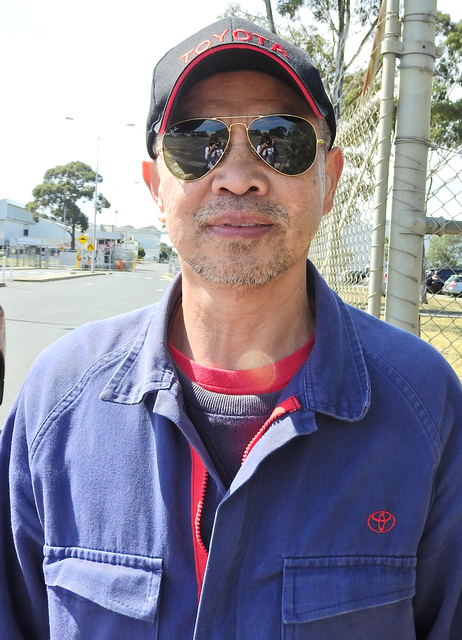
Ronnie, a 60-year-old worker with 23 years’ experience at the Altona plant, spoke to WSWS reporters on the day of the closure. “I am really worried about the young ones at the factory,” he said. “They all have mortgages that they have to pay. I’m not sure how they are going to do it. Toyota aren’t happy with the amount of their profits they are making so they are closing, even though there has been cost cutting, which has made things harder and harder for us.”
Ronnie commented: “The union always works with the company. When I first started working, I paid $8 dues to the union. Now we pay double that.” Pointing to the corporatised character of the unions, he noted: “They will be unhappy when GM closes in South Australia, because they will receive less union dues.”
The role of the unions underscores that jobs and conditions can be defended only through a rebellion against these pro-business organisations.
The closure of the car industry demonstrates that workers in every sector of the economy must develop independent organisations of struggle, including rank-and-file committees, to prosecute a struggle against the corporate elite’s offensive. These would be tasked with breaking the isolation imposed by the unions, unifying workers across the country and internationally, and developing coordinated industrial and political action.
Above all, what is required is a socialist perspective, aimed at establishing a workers’ government, which would place the banks and major corporations under public ownership and democratic control. This is the only means of opposing the continuous destruction of jobs, and the reduction of workers to conditions not seen since the 1930s.

Australian Greens demand disqualification of all “foreign” MPs

Mike Head

The Australian Greens last week reinforced their position as the most nationalist advocates of expelling from parliament anyone—including their own representatives—accused of the slightest appearance of divided loyalty to the Australian nation state.
In a submission to the High Court, which is due to hear challenges to the eligibility of seven MPs next week, the Greens call for the removal of any parliamentarian who, even unwittingly, is eligible for citizenship of another country.
The High Court, the country’s supreme court, will sit from October 10 to 12 in an unprecedented session that could disqualify all seven, including Deputy Prime Minister Barnaby Joyce, producing a crisis for the unstable Liberal-National Coalition government. Up to another 20 MPs are believed to face potential disqualification if the High Court rules against the seven.
The Greens’ submission goes far further than those of the government or the other politicians who have been referred to the High Court for potential disqualification under section 44(i) of the 1901 colonial-era Australian Constitution.
The submissions of the other five parliamentarians facing removal all argue, in various ways, that the court should not punish those who were ignorant of their dual citizenship or their eligibility for foreign citizenship.
The Greens, however, insist that the ban on MPs should be applied to the fullest extent, even if, for example, parliamentarians unknowingly acquired foreign citizenship entitlements from their parents or grandparents.
The Greens also demand this prohibition even though it disqualifies an estimated half of the population of Australia, which has always been an immigrant nation. The Greens’ submission defends this anti-democratic constitutional provision, arguing that it should be strictly applied despite its “blunt and limiting effect on democratic participation.”
The submission was made by two ex-Greens senators, Scott Ludlam and Larissa Waters, who dutifully resigned from the Senate, and apologised profusely, as soon as the reactionary witch hunt against alleged “foreign” MPs was first launched in mid-July. Ludlam and Waters quit their seats simply because they were born in New Zealand and Canada respectively, even though both have lived in Australia since they were infants.
Their submission reiterates that they “properly complied with the duty imposed by S 44 not to sit when disqualified by reason of being a citizen of a foreign power.”
Section 44(i) is far-reaching. It states that any person who “is under any acknowledgment of allegiance, obedience, or adherence to a foreign power, or is a subject or a citizen or entitled to the rights or privileges of a subject or a citizen of a foreign power” is “incapable” of being elected to parliament.
None of the other MPs referred to the High Court has stood aside. They are three National Party MPs—Joyce, Regional Development Minister Fiona Nash and ex-resources minister Matt Canavan—Senator Malcolm Roberts from the anti-immigrant Pauline Hanson’s One Nation and Nick Xenophon, who represents his own four-member Nick Xenophon Team.
In the government’s own submission to the High Court, Attorney-General George Brandis argues only Ludlam and Roberts were wrongfully elected because they allegedly should have known of their supposed foreign entitlements. Brandis contends that the other five MPs were all completely ignorant of their dual citizenships and should be allowed to stay.
The Greens’ submission is in line with the demand issued from the outset of the furore by party leader Senator Richard Di Natale for an “audit” of all 226 current federal MPs to determine their eligibility. This call, later taken up by the xenophobic One Nation, would trigger a McCarthyite inquisition into the loyalty of politicians.
What explains this extraordinary stance? First, the Ludlam-Waters submission objects that the government’s proposition would undermine the “integrity” of parliament and public confidence in the institution.
“Section 44 has a special status because it is protective of matters that are fundamental to the Constitution, being representative and responsible government in a democracy,” the submission states. “The integrity of that system requires the government to be conducted by officers who enjoy the confidence of the people.”
Thus, the Greens emphasise their devotion to the parliamentary set-up, which is already discredited in the eyes of millions of people because of the responsibility of successive governments for declining social conditions and worsening inequality.
Above all, the Greens invoke the importance of unquestioned patriotism, especially amid mounting war tensions. Referring to section 44, the submission insists: “The provision prevents persons with foreign loyalties and obligations from serving in the Australian Parliament. This is one aspect of the purpose of safeguarding the integrity of parliament and Australian sovereignty, because the potential for the foreign power to call upon a citizen’s duty, even if it had never done so in the past and even if the person concerned was hitherto unaware of the citizenship, remains a real possibility.”
A submission footnote links to evidence submitted by former independent MP Tony Windsor, who lost his rural-based seat to Joyce in 2013 and is petitioning the High Court for a by-election in the electorate on the grounds that Joyce’s father was born in New Zealand.
Windsor’s submission directly ties the disqualification demand to preparations for war, including military service obligations. It harks back to the lead-up to World War I, when young Australian men of dual nationality faced conflicting requirements to serve in rival armed forces. Windsor argues that similar conflicts arise today, with some countries, such as Greece, imposing compulsory military service on its citizens.
Extending the wartime scenario, Windsor invokes the possibility of dual citizens being charged with treason by a foreign government for acts committed in support of Australia. He also cites an ancient British court ruling, in Calvin’s Case of 1609, that “[e]very subject is by his natural ligeance bound to obey and serve his sovereign” and therefore “to go with the King, &c. in his wars, as well within the realm as without.”
Such precedents are being dredged up because of the rising dangers of war internationally. Prime Minister Malcolm Turnbull’s government, backed by the Labor Party, has already committed Australia to join any US-led war against North Korea, the central purpose of which would be to confront China, which is regarded by Washington as the primary threat to American global hegemony.
Alongside the parliamentary witch hunt, the corporate media has mounted one propaganda campaign after another against “Chinese influence.” Over the past year, media-driven “investigations” have increasingly vilified political and business figures, Chinese-born Australians and Chinese students studying in the country as a potential fifth column of the Chinese “communist” regime.
The promotion of nationalism is also a reactionary domestic diversion. It is occurring under conditions of growing social inequality and deepening class antagonisms, generated by the destruction of full-time jobs and deteriorating health, education and social services. There have been ever-deepening attacks on basic legal and democratic rights under the cover of the endless “war on terrorism.”
The Greens once appealed to young people by posturing as opponents of war and supporters of environmental protection. Increasingly, these pretences have been abandoned. Between 2010 and 2013, the Greens supported the minority Labor Party government of Julia Gillard, which unconditionally committed itself to the Obama administration’s “pivot” to the Indo-Pacific and the underlying US war plans against China.
Like their counterparts internationally, the Greens represent an upper middle-class layer, which is ever-more integrated into the capitalist state as growing international and social tensions threaten their social and economic status.
Whichever the way the High Court rules after next week’s hearings, the verdicts will be designed to shore up the political establishment and the entire capitalist state apparatus, of which the court is a key part.
The inquisition against “foreign” loyalties will not stop with MPs. The Greens’ submission underscores the warning issued by the Socialist Equality Party in a statement on September 6:
“The demand for unquestioned ‘allegiance’ on the part of the parliamentary servants of the capitalist state is intended as a benchmark for implementation throughout society. Anyone who opposes the policies of the government will be labelled ‘un-Australian,’ a servant of foreign interests, or, under conditions of war, downright treasonous.”

Germany’s Social Democratic president calls for tougher refugee policy and adaptation to AfD

Christoph Vandreier

The Alternative for Germany’s (AfD) electoral triumph has triggered horror and resistance from the vast majority of working people. But the ruling elite considers the presence of the right-wing extremists in the Bundestag (parliament) as an opportunity to shift official politics further to the right and make right-wing extremist positions socially acceptable once again.
German President Frank-Walter Steinmeier (Social Democrats, SPD) left no doubt about this. He used his speech on German Unity Day on Tuesday to advocate cooperation with the AfD, call for a harder line on refugee policy, and speak the language of “German patriotism.”
Although Steinmeier employed worn-out phrases and rhetorical devices, he was absolutely clear on the central issues. With regard to the AfD’s electoral success he stated, “We cannot allow hostility to emerge from our differences—out of disagreements no irreconcilability.”
This offer to reach an understanding with the AfD ran like a red thread through Steinmeier’s entire speech. Sealed off from the population in a high-security zone, as even the Frankfurter Allgemeine Zeitung remarked, he asserted in the Rheingoldhalle that “flight and migration” became the issue “that has affected our country more over the past two years than any other.”
The humanitarian concern for the refugees’ fate displayed by millions of people was thus placed by Steinmeier on the same level as the AfD’s slogan that a limited acceptance of refugees was a “betrayal of our own people.” In all seriousness, he described this neo-Nazi slogan as a moral pole against which it is necessary to remove “the walls of irreconcilability.”
Steinmeier got to work straight away on this, propagating some of the right-wing extremists’ central demands. Germany has to take back the right to decide who is being politically persecuted and who is fleeing from economic distress, blustered the president. In reality, not only are people who fled extreme poverty being deported en masse already, but also refugees from wars, who according to the Geneva Convention must be granted protection.
Instead, Steinmeier wants to organise migration according to the interests of German big business. He called for an immigration system “which directs and controls migration according to our stipulations.”
Anyone coming to Germany must not only learn the language, stated Steinmeier, but also adopt certain convictions. “The rule of law, respect for the constitution, the equality of man and woman” are basic tenets of life in Germany, he said. This is based, among other things, on an “enlightened German patriotism.”
This right-wing tirade from Germany’s president can only be understood in the context of the deep gulf between the politics of the ruling elite and the sentiments of the vast majority of the working population. It is no accident that Steinmeier, Chancellor Merkel and Co. had 4,000 police officers to protect them from the population. Substantial sections of Mainz city center were transformed into areas on lockdown.
To impose war and social cutbacks, the ruling class is ready to mobilise the dregs of society and to resort to dictatorial measures. In this context, Steinmeier’s speech is highly significant.
Four years ago, then-President Gauck used the period between the election and the coalition negotiations to introduce for the incoming government a new foreign policy line, which had been previously worked out by influential think tanks, political parties and the newspapers. In his speech of October 3, 2013, Gauck called for a foreign policy shift in the direction of militarism and great power policies.
Following lengthy coalition talks, the Bundestag elected the new government of the Christian Democratic Union and SPD on December 17, 2013. Just six weeks later, new Foreign Minister Frank-Walter Steinmeier delivered a speech at the Munich Security Conference in which he proclaimed the end of German military restraint and stated, “Germany is too big to comment on world politics from the sidelines.”
The return of German militarism was subsequently systematically implemented. The German armed forces are currently deployed in 18 foreign interventions, have stationed combat troops on the Russian border, and have been implicated in major war crimes in Afghanistan and Syria. Over the coming years, the astronomical sum of €130 billion in additional extra spending for the armed forces is planned.
The programme of the incoming government was also discussed in detail by think tanks and influential newspapers in the months prior to this year’s election. The unanimous tone was that Germany must dominate Europe and rearm itself as a military power so as to be able to play a global role and stand up to the United States. The new government has to launch a major military build-up to enforce the interests of German big business as far afield as the South China Sea, it was argued.
The AfD’s rise is the direct product of this policy, which has been advocated by all established parties. War and militarism are inseparable from nationalism, xenophobia and the strengthening of the repressive state apparatus. The right-wing extremists were deliberately promoted and built up by the media.
Now, their presence in the Bundestag is being used to shift the entire political framework further right and press ahead with militarism. Steinmeier left no doubt about this. As in 2013, the president’s speech on German Unity Day served to introduce the new government’s agenda.
In the case of the SPD politician Steinmeier, this also applies to the opposition. The SPD, together with the Left Party, are preparing to attack a coalition of the CDU, neo-liberal Free Democrats and Greens from the right. SPD parliamentary group leader Andrea Nahles, as well as her counterpart in the Left Party, Sahra Wagenknecht, have criticised Merkel’s refugee policy from the right and have adopted many of the AfD’s positions.

Germany’s Network Enforcement Act: Legal framework for censorship of the Internet

Katerina Selin

On October 1, the Network Enforcement Act took effect in Germany. Under the cover of a fight against “fake news” and “hate speech,” it creates a legal framework for censorship of the Internet.
The law requires operators of Internet platforms with over two million users to “remove or block obviously unlawful content within 24 hours of receipt of a complaint.” In what are called less obvious cases, a seven-day period applies. A platform must regularly report on its handling of complaints. If it does not comply, it faces fines of up to 50 million euros.
The assumption behind the law is the expectation that companies will opt to delete a controversial post rather than risk severe financial penalties. There are no sanctions against platforms that erase legitimate posts. In this way, the basic rights of users are undermined.
When the bill was passed in the Bundestag (the federal parliament) at the end of June , the World Socialist Web site warned of a “major attack on freedom of expression,” adding that the law “turns giant corporations such as Facebook, Twitter and YouTube into prosecutors, judges and juries, determining what is and is not permitted on the Internet.”
There is a transitional period ending in January 2018, during which time social networks must take measures to implement the new legal requirements. Facebook already announced in August that it was setting up a new data centre with 500 employees in Essen to handle take-downs; one already exists in Berlin. This is where Facebook systematically carries out censorship of the Internet. A spokesman proudly told business daily Handelsblatt, “We have already made considerable progress in the removal of illegal content.”
It is still unclear which Internet platforms will be affected by the new law. The text of the law, which was published on September 7, defines social networks as “telemedia service providers operating for-profit platforms on the Internet for the purpose of enabling users to share any content with other users or make it available to the public.”
All online platforms which, in the eyes of the Federal Office of Justice, meet this definition must undergo scrutiny in the coming months. According to the news weekly Der Spiegel, this includes not only well known social media platforms such as Facebook, YouTube and Twitter, but also other networks such as the photo sharing site Flickr, the video portal Vimeo, the social news aggregator Reddit, the blogging platform Tumblr and the Russian equivalent of Facebook, VKontakte.
The Federal Office of Justice has set up a new department with two units, one to deal with questions of principle and one for individual cases. Half of the 50 new employees will begin work next week, according to Der Spiegel, to determine the number of registered members of each platform. Networks with more than two million registered users will then have to comply with the new law from January of 2018.
Networks are obligated to appoint a contact person in Germany who will be responsible for user complaints and will answer queries by the investigators within 48 hours. This is to ensure that deleted posts, which the provider must retain, can be effectively used in prosecutions.
Facebook, which cooperates closely with the US government in the field of Internet censorship, is implementing these regulations swiftly and obediently. Questioned by broadcaster Bayerischer Rundfunk, a Facebook spokeswoman stated: “We have our own team for cooperation with law enforcement agencies, which consists largely of former employees of law enforcement agencies. The task of this team is to answer queries from the law enforcement agencies.”
At the same time, Internet platforms are now “permitted,” for civil law purposes, to provide information on the authors of posts that evoke complaints. The only requirement is an order from a regional court. Up to now, such personal data could be provided only to law enforcement agencies. This tightening of the telemedia law is another attack on anonymity and privacy on the Internet and prepares the ground for the targeted intimidation of political opponents.
Although numerous associations and experts, including eight out of ten experts at a hearing in the Bundestag, declared the bill unconstitutional, Social Democratic Party (SPD) Justice Minister Heiko Maas whipped it through parliament in a few months. It is no coincidence that the SPD is playing a pioneering role in the implementation of censorship measures. It conducted itself as a law-and-order party in the recent general election campaign and has tried to overtake the Christian Democrats and the far-right Alternative for Germany (AfD) from the right.
The new law is part of a political offensive against the working class, which is entering a new phase following the election. The incoming German government will speed up the arming of the state at home and abroad. The myth of the fight against “right-wing hate speech” and “fake news” serves as a pretext to silence left-wing and critical voices on the Internet.
A look at recent months and years is sufficient to demonstrate that the day-to-day producers of “fake news” and lies can be found in the executive offices of the political establishment and the mainstream media. Who invented the story of weapons of mass destruction in Iraq in 2003 to reduce a whole region to rubble? Who propagated and supported the Maidan movement in Ukraine in 2014 as a supposed “revolution” in order to strengthen right-wing extremism and nationalist forces and foment conflict with Russia? Who used the lie about mass rape in Cologne on New Year’s Eve 2015/2016 to ignite a wave of anti-refugee sentiment? And who spread images of alleged “left-wing extremist” violence at the G20 summit in Hamburg to criminalize left-wing opponents and ban left-wing websites such as Indymedia.linksunten.org?
All of these state propaganda campaigns—genuine examples of fake news—have served to legitimize wars, repression and witch-hunts, with catastrophic consequences for millions of people.
Even the justification for the new law is fake news, to use its own terminology. The law is not, as claimed, predominantly directed against hate crimes, right-wing extremism or racism, but rather against left-wing opposition. It is especially those posts and articles that uncover the crimes of capitalism and the return of German militarism that are thorns in the side of the ruling elite.
This is particularly clear in light of the censorship being carried out by Google. In April, Google modified its search algorithms allegedly to promote “authoritative content” and downgrade “fake news” and “conspiracy theories” in Google searches. In fact, this has been used to censor left-wing, progressive and anti-militarist websites, which have since recorded a massive decline in traffic from Google searches. The World Socialist Web Site has been hit particularly hard.
As Google’s censorship and the collaboration of Facebook CEO Mark Zuckerberg with the US government show, Germany’s Network Enforcement law is part of an international phenomenon. Similar mechanisms have been and are being created worldwide to control and censor the exchange of opinions on the Internet.
According to Reporters Without Borders, the new German law has already served as a model for Russia. In mid-July, deputies of the pro-Putin party “United Russia” introduced a very similar bill to control social networks and explicitly cited the German law. When the Russian counterpart is adopted, it will also come into effect on January 1, 2018.
The European Union is also working to reduce freedom of expression on the Internet. A week ago, the EU Commission published guidelines for online platforms to “proactively” identify and remove illegal content. The press release states that the EU Commission will “closely monitor and evaluate the progress of online platforms in the coming months,” in order to decide whether “legislative measures to complement the existing legal framework” may be necessary.
The bourgeoisie is aware of the danger it confronts from social media. The global networking and mobilization of the working class using the Internet is causing concern for governments and think-tanks worldwide. The Science and Politics Foundation recently published a study on “Urban Protests in the Digital Age.” It states that decision-makers and experts increasingly regard the “occupation and blockade of public squares, streets or buildings as a global political challenge.” The study continues: “This ‘politicization of the streets’ is being amplified by the accelerated digital and often (audio) visual distribution of protest activities via social media. It allows events to be visible all over the world.”

Spanish government sends troops to Catalonia

Paul Mitchell 

The Popular Party (PP) government in Spain has dispatched troops into Catalonia. The media reported that this was to provide support to the Civil Guard and national police in preparation for a declaration of independence by Catalan President Carles Puigdemont.
According to information leaked to El Confidencial, the Ministry of Defense has dispatched army units, including the Logistic Support Group 41 based in the Aragonese capital of Zaragoza, which lies 300 kilometres to the west of Barcelona.
At 19.00 hours on Tuesday, just one hour after it was known that King Felipe VI was going to address the nation in a speech denouncing the Catalan nationalist parties, army commanders told their subordinates to prepare to send to Barcelona two contingents in 20 trucks. The unit had already been in pre-alert for a week to ensure it could be relocated rapidly.
The troops left at night to arrive early in the morning at the barracks in Santa Eulalia de Sant Boi de Llobregat, a few kilometres from the city.
According to El Confidencial’s sources, the main objective is to reinforce the supply of food, clothing and washing facilities for the Civil Guard and the National Police as a result of hotels refusing to house them following their brutal actions during the October 1 referendum vote.
However, it is clear the troops are specialised in preparing the ground for future troop deployment. El Confidencial explains that acting as an expeditionary logistics unit, they have the capacity to “project to any place of the world, in a short space of time, personnel and means before a possible contingency and to respond immediately and with total efficiency where its logistics services are needed.”
The unit has participated in missions in Bosnia, Kosovo, Iraq, Lebanon and Afghanistan.
According to Defensa.com, Spain’s Directorate of Naval Supply and Transport has also purchased riot gear for different military units. The order included 295 aerosol sprays for personal defence, 253 tear-smoke cans, 1,500 cartridges, 1,500 rubber balls and 300 triple smoke grenades for 12-gauge shotguns and 1,000 tear gas grenades.
The stage is now being set for a violent provocation that can be used to justify intervention. Xavier García Albiol, the leader of the PP in Catalonia, has called for a “massive” demonstration this Sunday in Barcelona, declaring, “We call on the mobilization of the Catalans who feel Spanish… A democratic exercise to go out to defend democracy, institutions and dignity.”
Faced with such threats, last night Puigdemont made a TV broadcast appealing for mediation. He omitted any reference to declaring independence after previously stating that his government would submit the results of the October 1 referendum to the Catalan parliament and declare independence within 48 hours of all the official results being declared. The last votes from abroad are due to arrive by the end of the week.
An “extraordinary regular plenary meeting” of the parliament is planned for Monday to be addressed by Puigdemont to “evaluate the results and their effects.”
According to one parliamentarian from Puigdemont’s PDeCat who is opposed to secession, “Puigdemont is desperately seeking international mediation… to be able to stop the declaration of independence.”
The European Parliament rejected his appeals yesterday, saying it was “an internal Spanish matter.” Russian President Vladimir Putin also said that Russia regards the Catalonia conflict as a “domestic affair,” which he hoped the country could overcome.
The bourgeois press in Spain has praised the king’s speech, contrasting it with what is decried as vacillation by Prime Minister Mariano Rajoy and urging action to be taken.
In a de facto call for yet greater repression, the pro-Socialist Party (PSOE) El País declared, “With harsh words, the King has pointed out that the Catalan authorities have violated the Constitution and the Statute of Catalonia and systematically violated the legally and democratically approved norms… it is the responsibility of the legitimate powers of the State to ensure the constitutional order and the normal functioning of institutions, the rule of law and self-government of Catalonia, based on the Constitution and its Statute of Autonomy.”
El Mundo declared, “The message that Spaniards needed, and which they might have expected from their political representatives, they received from the Head of State with diamond clarity, with a force far removed from all cold protocol.
“Those who are now in charge of the Catalan sedition… have observed a military discipline to impose their authoritarian project on the whole society, disobeying the courts, shredding the political rights of the opposition and finally relying on Jacobin control of the street for the success of its revolution.
“Yesterday we asked him [Rajoy] to apply article 155 [of the Constitution to restore legal order in Catalonia] to end the unpunished rebellion of Puigdemont and his partners. This urgency becomes more urgent today. The King’s message calls him to it.”
The ABC editorial decried Catalonia for “moving from the illegal referendum to the generalized insurrection.” It labelled Tuesday’s general strike “an internal coup” led by “the tiger of extreme left-wing separatism, which is out of control and aims to devour Catalan society in a revolutionary process in which the middle classes will not have the protection of a State worthy of such a name.”
ABC called for Article 155 to be invoked and warned that the longer the government takes, the more the “insurrection of the Generalitat” will necessitate the calling of a “state of emergency and siege” under article 116. Article 116 details how the states of alarm, exception and siege will be implemented.
The official “left” parties have mouthed only platitudes. The leader of the Stalinist United Left, Alberto Garzón, expressed disappointment that the speech by “citizen Felipe de Borbón” was not the “balanced and measured speech” he expected. Speaking as an advisor to the monarch, he continued, “I personally know the head of state. I have talked to him several times and I know he thinks things through before he talks. Today, however, I fear he has been advised by his enemies.”
Iñigo Sáenz de Ugarte, writing in the pro-Podemos El Diario complained that Felipe’s speech was “in practice a declaration of war” on the autonomous government of Catalonia and represented “an amendment to the whole of the positions held by Podemos in this crisis.”
This position consists of an appeal to the PSOE to work with Podemos to oust Rajoy and form a left government to rescue the Spanish state.
The PSOE has refused to countenance such an offer and the appeal was bitterly criticised by veteran PSOE leader and former vice-President of the PSOE government under Felipe González from 1982 to 1991, Alfonso Guerra.
Guerra called for the PSOE to openly support article 155 and defended the use of the army in Catalonia if the police could not control the situation, blaming it on a “pro-fascist” independence movement carrying out a coup. Expressing views previously the preserve of the far-right, he labelled the leader of the Catalan police, the Mossos d’Esquadra, Josep Lluís Trapero a “traitor to democracy” and argued that “maybe the Mossos should be dissolved.”
On Friday, Trapero was ordered to appear in court along with the presidents of the Catalan National Assembly, Jordi Sánchez, and Omnium Cultural, Jordi Cuixart, as part of an investigation into charges of sedition relating to demonstrations on September 20.

Wall Street demands Puerto Rico pay up

Rafael Azul

A day after Trump’s visit to Puerto Rico, where he contemptuously told survivors that they were not facing a “real catastrophe” like Hurricane Katrina in 2005 and that their demands for emergency aid were throwing the US budget “out of whack,” administration officials made it clear there would be no debt relief for the hurricane-ravaged US territory.
Trump tossed out paper towels and other supplies at a local church in what might be described as the billionaire president’s “let them eat paper towels” moment. With 95 percent of the island’s residents without power, half the population without clean water, a lack of gasoline and medical supplies, and a death toll, which is officially 34 now and potentially hundreds more, the president said the condition on the island due to the federal response was “nothing short of a miracle.”
This contrasts sharply with a statement of the UK-based anti-hunger organization Oxfam, which said last week that it would provide relief to the island because of the Trump administration’s “slow and inadequate” response.
Prior to the visit, Trump sat down with Fox News correspondent Geraldo Rivera. In a pre-recorded interview, which was aired Tuesday night, the president blurted out that it was like that Puerto Rico’s massive debt would have to be wiped out due to huge recovery costs now estimated to be $90 billion.
“We are going to wipe that out,” declared the president in reference to Puerto Rico’s $74 billion debt obligation. “They owe a lot of money to your friends on Wall Street and we’re going to have to wipe that out,” Trump said in pseudo-populist fashion. “I don’t know if it’s Goldman Sachs but whoever it is you can wave goodbye to that.”
The president’s remark produced a sell-off on Wednesday of Puerto Rico’s defaulted bonds, which dropped from 56 percent of face value to 36 percent.
Administration officials rushed to downplay the president’s remarks and reassure the vulture capitalists which control the island’s debt.
Trump’s own budget chief, Mick Mulvaney, told CNN, “I wouldn’t take it word for word with that. We are not going to deal right now with those fundamental difficulties that Puerto Rico had before the storm.”
The head of the government’s Office of Management of Budget made it clear that there was no plan to relieve the island of its debt burden. “Puerto Rico’s going to have to figure out how to fix the errors that it’s made for the last generation on its own finances.”
In other words, Puerto Ricans did this to themselves. Storm or no storm, they must pay up.
In fact, the island’s massive debt is the result of its colonial legacy, a decades-long economic recession resulting from runaway US corporations seeking cheaper labor elsewhere, and the financial looting of the island by Wall Street which has long profited from buying up its high risk and high return debt.
In June 2015 then Puerto Rican governor Alejandro Padilla, declared Puerto Rico was in a “death spiral” because its debt is “not payable… There is no other option… this is not politics, this is math.” Having already imposed draconian austerity measures, Padilla demanded concessions from debt holders.
However, the Promise Act, passed by the Obama administration, mandated that the debt crisis would be resolved with ever more savage austerity measures that involve the dismantling of public budgets and social services. The Promise Act imposed a non-elected Financial Oversight and Management Board that would administer Puerto Rico’s budget and distribute the debt payments among debt holders.
The appointed members were front men for powerful financial interests. For example, two of its members, José Ramón Gonzalez and Carlos García came straight out of Banco de Santander, one of the banks that, operating in the middle, between Puerto Rico and the hedge funds, profited greatly from designing “financial instruments” and then selling them to investors.
And not just Banco de Santander; other Wall Street banks, including the infamous Goldman Sachs helped convince Puerto Rican officials to borrow more at terms that have been described as “payday loans” in a report by the Refund America Project.
The report describes how a $4.3 billion loan quickly morphed into a $33.5 billion debt, through the mechanism of compounded interest. It suggests that this portion of the debt violated Puerto Rican law and amounted to “unconstitutional debt” that can justifiably be repudiated. Tellingly, the current administration of Governor Ricardo Rosselló refused to cooperate with this study.
“We plan to do more with less,” was the phrase Rosselló used this June to describe his administration’s plan to deal with Puerto Rico’s financial implosion. He then went on to list the various austerity measures and job cuts that had already been enacted since he took office this January.
The Puerto Rican government’s $74 billion in tax-exempt bond debt to hedge funds and wealthy investors is the result more than ten years of negative economic growth, at the rate of about two percent per year, and mass emigration of skilled and professional workers in the context of some three decades of deindustrialization.
Prior to the storm the official rate of unemployment was 11.5 percent. Forty-six percent of all households existed under a dismal poverty line. One-third of workers were ineligible for Social Security benefits. A record 400,000 Puerto Ricans have left since 2007 with another 240,000 are expected to leave by 2025.
Retirees are among the most vulnerable. Three years ago, the Puerto Rican government changed the retirement system that guaranteed public sector workers a full pension after 30 years of employment to a system that forces workers to work up to 15 additional years for full benefits.
Driving the discussion in the bankruptcy court over further public pension cuts is the fact that the system is scheduled to run out of money this July, leaving some $50 billion owed to retirees unpaid. It is anticipated that ten percent or more may by slashed from existing pensions. Caps on Medicare imposed by the federal government force many seniors to pay more for their medical care
Had the US Federal Reserve bank adopted the same criteria toward Puerto Rico that it did toward Wall Street financial institutions behind the 2008–2009 crash and deemed “too big to fail,” it would have bought up Puerto Rico’s toxic assets long ago. That never happened and now the suffering people on the island are to be squeezed again.
Instead, the working class in Puerto Rico and on the US mainland should demand the cancellation of the debt and an end to the plundering of public assets. The Wall Street banks and other giant financial institutions should be transformed into public enterprises democratically controlled and collectively owned by the working class.
Only in this way can the necessary hundreds of billions be poured into Puerto Rico to repair and update the electrical power grid, the water system and flood control system, roads and schools, which are essential for the functioning of a modern society.

4 Oct 2017

United States of America (USA) State Department Electronic Diversity Visa Lottery 2019

Application Deadline: 7th November 2017
Offered Annually? Yes
Eligible Countries: For DV-2019, natives of the following countries are not eligible to apply, because more than 50,000 natives of these countries immigrated to the United States in the previous five years:
Bangladesh, Brazil, Canada, China (mainland-born), Colombia, Dominican Republic, ElSalvador, Haiti, India, Jamaica, Mexico, Nigeria, Pakistan, Peru, Philippines, South Korea, United Kingdom (except Northern Ireland) and its dependent territories, and Vietnam.
Persons born in Hong Kong SAR, Macau SAR, and Taiwan are eligible.
About the Award: The Department of State administers the Congressionally-mandated Diversity Immigrant Visa Program annually. Section 203(c) of the Immigration and Nationality Act (INA) provides for a class of immigrants known as “diversity immigrants” from countries with historically low rates of immigration to the United States. For Fiscal Year 2019, 50,000 Diversity Visas (DVs) will be available. There is no cost to register for the DV program.
Applicants who are selected in the program (“selectees”) must meet simple but strict eligibility requirements to qualify for a diversity visa. The Department of State determine selectees through a randomized computer drawing. The Department of State distributes diversity visas among six geographic regions, and no single country may receive more than seven percent of the available DVs in any one year.
The entry form will only be available for submission during this period and this period only. Entries will NOT be accepted through the U.S. Postal Service.
Before beginning the entry process, you can verify that your picture(s) comply with all requirements in the Photo Tool.
Type: Contests/Awards
Eligibility: 
Requirement #1:
  • Individuals born in countries whose natives qualify may be eligible to enter.
  • If you were not born in an eligible country, there are two other ways you might be able to qualify.
  • Was your spouse born in a country whose natives are eligible? If yes, you can claim your spouse’s country of birth – provided that both you and your spouse are named on the selected entry, are found eligible and issued diversity visas, and enter the United States simultaneously.
  • Were you born in a country whose natives are ineligible, but in which neither of your parents was born or legally resident at the time of your birth? If yes, you may claim the country of birth of one of your parents if it is a country whose natives are eligible for the DV-2019 program.
Requirement #2:
  • Each DV applicant must meet the education/work experience requirement of the DV program by having either:
  • at least a high school education or its equivalent, defined as successful completion of a 12-year course of formal elementary and secondary education;
OR
  • two years of work experience within the past five years in an occupation that requires at least two years of training or experience to perform. The Department of State will use the U.S. Department of Labor’s O*Net Online database to determine qualifying work experience.
Number of Awards: Not specified
How to Apply: 
  • Applicants must submit entries for the DV-2019 program electronically at dvlottery.state.gov between noon, Eastern Daylight Time (EDT) (GMT-4), Tuesday, October 3, 2017, and noon, Eastern Standard Time (EST) (GMT-5), Tuesday, November 7, 2017.
  • Do not wait until the last week of the registration period to enter, as heavy demand may result in website delays.
  • No late entries or paper entries will be accepted.
  • The law allows only one entry by or for each person during each registration period.
  • The Department of State uses sophisticated
Award Providers: US Department of State
Important Notes: As indicated in the instructions, for the purposes of eligibility some countries include components and dependent areas overseas.  If you are a native of a dependency or overseas territory, please select the appropriate country of eligibility.  For example, natives of Macau S.A.R should select Portugal, and natives of Martinique should select France.

Graywolf Press Africa Prize for African Authors ($12,000 + publication) 2018

Application Deadline: 31st October 2017
Eligible Countries: African countries
About the Award: Graywolf Press is always looking for work that is distinctive, artistically singular, and of a high literary quality. For this prize, we are seeking novels that are engaged with the current moment—stories that could only be told in our time. We are excited by the wealth of talented and imaginative writers coming from a wide range of African countries and look forward to encountering authors who approach contemporary issues with innovative prose and fresh perspectives.  With this prize we hope to amplify the voice of a new author, whose novel will be published alongside exemplary African writers on the Graywolf list such as Tsitsi Dangarembga (This Mournable Body, forthcoming 2018), Binyavanga Wainaina (One Day I Will Write About This Place, 2012), Nuruddin Farah (Sweet and Sour Milk, 2006), Anouar Benmalek (The Lovers of Algeria, 2004), and this year’s judge, A. Igoni Barrett (Love Is Power, or Something Like That, 2013, and Blackass, 2016).
Type: Contests/Awards
Eligibility: 
  • All submissions must be full-length, previously unpublished novel mansucripts.
  • Submissions must be in English, but translations are acceptable.
  • Applicants with prior books are eligible, so long as none of those books is a novel.
  • Please follow these formatting guidelines: a PDF or Word file (.doc and .docx), twelve-point font, double-spaced text, numbered pages.
Value of Award: The winning manuscript will receive a $12,000 advance and publication by Graywolf Press, which will include a dedicated effort to making the book available in major markets in African countries.
How to Apply: Only electronic submissions will be considered, and submissions will be accepted through Submittable.
Award Providers: Graywolf Press
Important Notes: The winner will be notified directly, and public announcement of the winner will be made on the website. All decisions are final, and neither the judge nor Graywolf staff can comment on individual submissions.

Google Nigeria Business Internship for Students 2018

Application Deadline: 12th November 2017
Eligible Countries: 
To be Taken at: By applying to this position your application is automatically submitted to the following locations: Amsterdam, Netherlands; Copenhagen, Denmark; Bratislava, Slovakia; Prague, Czech Republic; Athens, Greece; Warsaw, Poland; Johannesburg, South Africa; Kiev, Ukraine, 02000; Oslo, Norway; Brussels, Belgium; Helsinki, Finland; Vienna, Austria; Stockholm, Sweden; Dubai – United Arab Emirates; Munich, Germany; Bucharest, Romania; Milan, Italy; Hamburg, Germany; Zagreb, Croatia; Paris, France; Zürich, Switzerland; Moscow, Russia; Tel Aviv-Yafo, Israel; Lagos, Nigeria; Lisbon, Portugal; Madrid, Spain; Budapest, Hungary; Istanbul, İstanbul, Turkey
Eligible Fields: Google Business Internship is typically offered in the following business areas:
  • GMS Sales and Operations
  • Large Customer Sales
  • Google Cloud
  • Marketing
About the Award: Interns at Google bring questions and build answers. We offer a range of internships across EMEA and durations and start dates vary according to a project and location. Applications will be reviewed on a rolling basis and our recruitment team will determine where you fit best based on your resume.
Type: Internship
Eligibility: 
Minimum qualifications:
  • Currently enrolled in a Bachelor’s or Master’s degree program and maintaining student status throughout the internship. Priority is given to students graduating end of 2018 or in 2019 so please include your graduation date on your resume.
  • Returning to education on a full-time basis upon completing the internship.
  • Ability to commit to a minimum of 10 weeks and up to 6 months at Google.
Preferred qualifications:
  • Previous internship experience in Sales, Advertising, Consulting, Analysis, Customer Service, Marketing or related fields.
Number of Awardees: Not specified
Value of Internship: 
  • As an intern, you’ll have the opportunity to work on projects core to Google’s business, whether it be Sales, Google for Work, Finance, People Operations (HR), Legal, Trust and Safety, or Marketing. Our intern recruitment team will determine where you fit best based on your CV and the preferences you indicate on the application form.
  • Our internships expose you to the technology industry, as well as provide opportunities for personal and professional development. From being challenged, to collaborating with a team, join our team to make an impact.
Duration of Internship: duration and start date of internship vary depending on the position.
How to Apply: Apply here
Award Provider: Google