18 Oct 2017

Open Society Disability Rights Scholarship (LL.M) Program for Africans 2018/2019

Application Deadline: 1st December, 2017
Eligible Countries: China; Ghana, Mozambique, Sudan, South Sudan, Tanzania, Uganda; MexicoPeru
To be taken at (schools): Participating schools include:
  • School of Law, National University of Ireland, Galway, Ireland
  • Faculty of Law, McGill University, Canada
  • School of Law, University of Leeds, UK
  • College of Law, Syracuse University, USA
  • Washington College of Law, American University, USA
About the Award:  The Open Society Disability Rights Scholarship Program provides awards for master’s degree study to disability rights advocates, lawyers, and educators to develop new legislation, jurisprudence, policy, research, and scholarship to harness the innovations and opportunities offered by the United Nations Convention on the Rights of Persons with Disabilities (CRPD).
With the knowledge and networks gained through the program, we expect that fellows will deepen their understanding of international law and education, with a focus on disability rights, and gain the tools necessary to engage in a range of CRPD implementation strategies, such as: challenging rights violations in their home countries by drafting enforceable legislation consistent with the CRPD; utilizing enforcement mechanisms set forth in the convention; taking forward disability rights litigation requesting CRPD-compliant remedies; engaging in disability rights advocacy; and developing law, education, or other academic curricula informed by the CRPD.
Eligible Fields of Study: Bachelor of laws (LLB; in exceptional circumstances, those without a LLB but with substantial relevant experience may be considered); for inclusive education, a degree in teaching, public administration/policy, anthropology, social work, psychology, or related field.
Type: Masters, Fellowship
Eligibility: The Open Society Disability Rights Scholarship is merit based and open to those meeting the following criteria:
  • be a citizen and legal resident of an eligible country: China; Ghana, Malawi, Mozambique, Sudan, South Sudan, Tanzania, Uganda; Mexico, or Peru at the time of application;
  • have work experience in the legal profession or advocacy focusing on human/disability rights;
  • have an excellent academic record with a Bachelor of Laws (LL.B.; in exceptional circumstances, those without a LL.B but with substantial relevant experience may be considered)—degree must be awarded by the application deadline;
  • have demonstrated leadership in the field of disability rights;
  • be proficient in spoken and written English or French and able to meet university-designated minimum scores on standardized language tests;
  • be able to participate in an intensive academic writing program in Summer 2018;
  • be able to begin the graduate program in August or September 2018;
  • be able to receive and maintain visa or study permit required by host country;
  • demonstrate a clear commitment to return to home country to contribute to advancing the inclusion and full participation of persons with disabilities in their communities.
The Open Society Disability Rights Scholarship does not discriminate on the basis of age, race, color, sex, religion, sexual orientation, or disability. Candidates with disabilities are particularly encouraged to apply.
Selection: Competition is merit based, and selection is made on the basis of academic excellence, professional aptitude, leadership potential, and proven commitment to work in the field of disability rights in the home country.
Selection proceeds as follows:
  • Preliminary Selection and Testing
  • Interviews and Final Selection
Value of Scholarship: The fellowship provides:
  • tuition and mandatory university fees;
  • monthly stipend for room, board, and other living expenses;
  • program-related travel;
  • accident and health insurance during the program;
  • funds for educational materials and professional development;
  • all costs associated with pre-academic summer program and annual conference;
  • support for students with disabilities to obtain reasonable accommodations necessary for participating in the program of study.
The fellowship does NOT provide funding for dependent family members.
Duration of Scholarship: 1 year
How to Apply: It is important to see the complete guidelines and submit an application online, or contact the appropriate regional coordinator in the Program Webpage (See Link below)
Award Provider: Open Society Foundation

Funding for War vs. Natural Disasters

Chris Ernesto

I have an aunt who lives in paradise – Paradise, California, that is.  But in 2017 it has been anything but, as the communities surrounding Paradise have been evacuated on two separate occasions due to natural disasters and crumbling infrastructure. In February, torrential downpours caused the Oroville Dam to fail, washing out homes, businesses, memories and lives.  And now they are dealing with devastating wildfires that have killed dozens, displaced thousands, and are being fought by firefighters, some of whom are only making minimum wage and working 70 straight hours.
The fires in California are just the latest natural disaster to inflict suffering on Americans, as the people in Puerto Rico, Florida and Texas can attest, following massive hurricanes over the summer.
Nearly one month after being crushed by Hurricane Maria, 85% of Puerto Ricans still do not have electricity, and 40% do not have running water, and people from the Southwest and the Southeast US continue to struggle with the aftermath of Hurricanes Irma and Harvey.
The destructive California wildfires are predicted to cost the US economy $85 billion.  The costs of recovery post-Hurricanes Harvey, Irma and Maria are estimated to be a minimum of $65 billion$25 billion and $45 billion, respectively.  The combined estimated cost of the recent natural disasters is $220 billion which is just a fraction of the $700 billion the US will spend on the military in 2017.
In fact, Congress appropriates more than 70 times the amount of money for the military as it does for the Federal Emergency Management Administration’s (FEMA) Disaster Relief Fund:
If the US allocated disaster relief funds to its own citizens as religiously as it allocated tax payer dollars to US wars abroad, everyone in affected areas could easily be provided the help they need to get back on their feet.
For example, instead of spending $1.25 trillion dollars to modernize the US nuclear arsenal, and $566 billion to build the Navy a 308-ship fleet, wouldn’t Americans prefer to have that money available to rebuild Southeast Texas, Florida, Puerto Rico and California?
Wouldn’t this military allocation be better utilized by modernizing our infrastructure, building more disaster relief centers, and hiring more firefighters and first responders?  Or earmarked to groups like Team Rubicon, a veteran-led organization that trains disaster relief volunteers?
Instead of spending money on war, which leads to destruction, we should spend money in the US to help Americans whose lives are destroyed by natural disasters.
We can’t prevent natural disasters but we as a country can fund the improvement of infrastructure and services so that after a natural disaster hits, the outcome is less devastating to the American people.

Washington, Not China, is the Biggest Threat to American Power

Paul Craig Roberts

Readers at home and around the world want to know what to make of the announcement that China henceforth will conduct oil purchases and sales in gold-backed Chinese currency.
Is this an attack by Russia and China on the US dollar? Will the dollar weaken and collapse from being discarded as the currency in which oil is transacted? These and other questions are on readers’ minds.
Below is my opinion:
The US dollar’s value depends on whether central banks, corporations, and individuals are content to hold their assets or wealth in dollars. If they are, it does not matter what currency is used to transact oil. If they are not, it does not matter if all oil is transacted in dollars. Why?
Because if they don’t want to hold dollars, they will dump the dollars as soon as the transaction is completed and move into other currencies or gold. What China is doing is creating a currency that might be a more attractive currency to hold.
It is possible that the gold-backed Chinese currency is a move against US power, but I see it differently. I see it as a protection against US power. China and Russia are disassociating from the dollar system, because Washington, in its abuse of the world currency role, uses the dollar payments mechanism to impose sanctions on other countries and to threaten them with exclusion from the payments clearing system.
In other words, Washington, instead of operating a fair system, uses its world currency role to dominate other countries. Russia and China are too strong to be dominated, and, thus, are throwing off the dollar system. If other countries follow, the dollar will cease to be an instrument of US control over the rest of the world.
To put it in different words, Bretton Woods gave Washington the responsibility for the world financial system. Washington abused the power entrusted to it by using the dollar system to destabilize other countries, such as Venezuela currently. Washington’s abuse of the world currency role in order to advance American financial and business interests and Washington’s power over the foreign and domestic policies of other countries has set in motion forces that will eliminate the dollar’s role as world reserve currency.
The hubris and arrogance of Washington are destroying American power.

The Real Reason Behind Trump’s Angry Diplomacy in North Korea

Ramzy Baroud

To understand the United States’ stratagem in the Pacific, and against North Korea in particular, one has to understand the fundamental changes that are under way in that region. China’s clout as an Asian superpower and as a global economic powerhouse has been growing at a rapid speed. The US’ belated ‘pivot to Asia’ to counter China’s rise has been, thus far, quite ineffectual.
The angry diplomacy of President Donald Trump is Washington’s way to scare off North Korea’s traditional ally, China, and disrupt what has been, till now, quite a smooth Chinese economic, political and military ascendency in Asia that has pushed against US regional influence, especially in the East and South China Seas.
Despite the fact that China has reevaluated its once strong ties with North Korea, in recent years, it views with great alarm any military build-up by the US and its allies. A stronger US military in that region will be a direct challenge to China’s inevitable trade and political hegemony.
The US understands that its share of the world’s economic pie chart is constantly being reduced, and that China is gaining ground, and fast.
The United States’ economy is the world’s largest, but not for long. Statistics show that China is blazing the trail and will, by 2030 – or even sooner – win the coveted spot. In fact, according to an International Monetary Fund report in 2014, China is already the world’s largest economy when the method of measurement is adjusted by purchasing power.
This is not an anomaly and is not reversible, at least any time soon.
The growth rate of the US economy over the past 30 years has averaged 2.4 percent, while China soared at 9.3 percent.
Citing these numbers, Paul Ormerod, an economist and a visiting professor at University College, London, argued in a recent article that “if we project these rates forward, the Chinese economy will be as big as the American by 2024. By 2037, it will be more than twice the size.”
It is no wonder why Trump obsessively referenced ‘China’ in his many campaigning speeches prior to his election to the White House, and why he continues to blame China for North Korea’s nuclear weapons program to this day.
As a business mogul, Trump understands how real power works, and that his country’s nuclear arsenal, estimated at nearly 7,000 nuclear weapons, is simply not enough to reverse his country’s economic misfortunes.
In fact, China’s nuclear arsenal is quite miniscule compared to the US. Military power alone is not a sufficient measurement of actual power that can be translated into economic stability, sustainable wealth and financial security of a nation.
It is ironic that, while the US threatens to ‘totally destroy North Korea,’ it is the Chinese government that is using sensible language, calling for de-escalation and citing international law. Not only did fortunes change, but roles as well. China, which for many years was depicted as a rogue state, now seems like the cornerstone of stability in Asia.
Prudent US leaders, like former President Jimmy Carter understand well the need to involve China in resolving the US-North Korean standoff.
In an article in the Washington Post, Carter, 93, called for immediate and direct diplomatic engagement with North Korea that involves China as well.
He wrote on October 4, the US should “offer to send a high-level delegation to Pyongyang for peace talks or to support an international conference including North and South Korea, the United States and China, at a mutually acceptable site.”
A few days leader, Chinese foreign ministry spokeswoman, Hua Chunying, quoted Carter’s article, and reasserted her country’s position that only a diplomatic solution could bring the crisis to an end.
In a recent tweet, Trump claimed that “Presidents and their administrations have been talking to North Korea for 25 years, agreements made and massive amounts of money paid … hasn’t worked.”
He alleged that North Korea has violated these agreements even “before the ink was dry”, finishing with the ominous warning that “only one thing will work!”, alluding to war.
Trump is a bad student of history. The ‘agreements’ he was referring to is the ‘Agreed Framework’ of 1994, signed between President Bill Clinton and Kim Jong-il – the father of the current leader Kim Jong-un. In fact, the crisis was averted, when Pyongyang respected its side of the agreement. The US, however, reneged, argued Fred Kaplan in ‘Slate’.
“North Korea kept its side of the bargain, the United States did not,” Kaplan wrote. “No light-water reactors were provided. (South Korea and Japan were supposed to pay for the reactors; they didn’t, and the U.S. Congress didn’t step in.) Nor was any progress made on diplomatic recognition.”
It took North Korea years to react to the US and its partners’ violation of the terms of the deal.
In 2001, the US invaded and destroyed Afghanistan. In 2003, it invaded Iraq, and actively began threatening a regime change in Iran. Iraq, Iran and North Korea were already blacklisted as the “axis of evil” in George W. Bush’s infamous speech in 2002.
More military interventions followed, especially as the Middle East fell into unprecedented chaos resulting from the so-called Arab Spring in 2011. Regime change, as became the case in Libya, remained the defining doctrine of US foreign policy.
This is the actual reality that terrifies North Korea. For 15 years they have been waiting for their turn on the US regime change path, and their nuclear weapons program is their only deterring strategy in the face of US military interventions. The more the North Korean leadership felt isolated regionally and internationally, the more determined it became in obtaining nuclear devices.
This is the context that Trump does not want to understand. US mainstream media, which seems to loathe Trump in every way except when he threatens war or defends Israel, is following blindly.
Current news reports of North Korea’s supposed ability to kill “90% of all Americans” within one year is the kind of ignorance and fear-mongering that has dragged the US into multiple wars, costing the economy trillions of dollars, while continuing to make bad situations far worse.
Indeed, a recent Brown University Study showed that, between 2001 and 2016, the cost of wars in Afghanistan, Iraq, Syria and Pakistan has cost the US $3.6 trillion.
Perhaps, a better way of fending against the rise of China is investing in the US economy instead of wasting money on protracted wars.
But if a Trump war in North Korea takes place, what would it look like?
US Newsweek magazine took on this very disturbing question, only to provide equally worrying answers.
“If combat broke out between the two countries, American commanders in the Pacific would very quickly exhaust their stockpiles of smart bombs and missiles, possibly within a week,” military sources revealed.
It will take a year for the US military to replenish their stockpile, thus leaving them with the option of “dropping crude gravity bombs on their targets, guaranteeing a longer and bloodier conflict for both sides.”
Expectedly, North Korea would strike, at will, all of the US allies in the region, starting with South Korea. Even if the conflict does not escalate to the use of nuclear weapons, the death toll from such a war “could reach 1 million.”
Both Trump and Kim Jong-un are unsavory figures, driven by fragile egos and unsound judgement. Yet, they are both in a position that, if not reigned in soon, could threaten global security and the lives of millions.
Calls for diplomatic solutions made by Carter and China must be heeded, before it is too late.

The Return of One-Man Rule in China?

GERRY BROWN

As the 19th National Congress of the Communist Party of China ( CPC) draws near, western corporatist media and analysts are out in full force and working overtime to smear and demonize CPC and its top leaders, particularly President Xi Jinping. Their ploy and antics are wearing thin. Increasingly, they don’t even bother to conceal their mendacity and hatred for China and CPC. It’s an unmistakable sign that CPC and its leaders have done good things for China and her people. To paraphrase the Bard, hell knows no fury like an imperialist frustrated.
Their narrative revolves around the sacking (purging according to the presstitutes) of Chongqing party Secretary Sun Zhengcai for corruption, whom they claim was the most worthy successor to Xi after 2022. They said the same thing about Bo Xilai when he was charged and convicted of corruption before Xi became President in 2012.
Fact is there are two other candidates eminently qualified to succeed Xi. One is Hu Chunhua, party Secretary of Guangdong province. The other is Chen Min’er, the new party Secretary of Chongqing who took over from the disgraced Sun. Veteran observers of Chinese politics regard Chen as the more likely successor of the two, given his rapid promotion since 2012.  Xi and the previous President Hu Jintao were promoted quickly before they were elected to the Politburo Standing Committee (PSC) without spending time in the Politburo first.
The presstitutes claim that Xi’s failure to name a successor now (or after the party Congress) reveals his ambition to serve a third term after 2022. They are deliberately obtuse or ignorant of the fact that it’s not for Xi to name a successor. That’s the prerogative of the 200-strong Central Committee in 2022. Any observer worth his salt can make an educated guess as to the likely successor by looking at the new PSC members after the party Congress.
Since 2002, China’s leadership transition has been very much institutionalised. One major feature is collective leadership exercised by PSC, comprising 5 to 9 members. PSC acts like a cabinet in a Westminster parliamentary system. In fact, the composition and working of the PSC are more democratic than the Westminster cabinet. One, unlike the cabinet appointments which are decided by the Prime Minister in a Westminster parliamentary system, members of PSC are elected directly by the 200-strong Central Committee. Two, unlike the Westminster cabinet where the PM is the first among equals, Xi as General Secretary is just like other PSC members. PSC works on a consensual basis, rather than on the basis of majority as in a Westminster cabinet.
Talk that Xi is working to stack the 25-member Politburo (separate from PSC) and 7-member PSC with his own men is plain silly. The Central Committee, comprising 200 odd members, elect members of the Politburo and PSC. The Central Committee members are, in turn, elected by close to 2,300 delegates from the provinces, directly-administered municipalities, armed forces and other government organs. The delegates themselves are elected by tens of millions of CPC members. The provinces and municipalities control more than two thirds of the 2,000 plus delegates. No one could conceivably control the whole election process.
Credit should be given to Xi for grooming Chen, who isn’t a Red “princeling”. Chen rose through the ranks, from local official to provincial head. He was tested at his post as party Secretary of Guizhou province, an economic backwater in south -western China. Within 3 years, he has transformed the province into a centre for Big Data, and lifted many out of poverty.
When the party Congress concludes on October 24, the question as to who will succeed Xi as China’s President and General Secretary in 2022 will be answered. If I may venture my prediction here : Chen will make it to PSC and groomed as a successor to Xi, while Hu Chunhua may get elected to the Politburo or PSC in line to be the next Prime Minister in 2022 to head up the State Council, the executive branch of China’s central government.

Pakistan Faces a Life-Threatening Military Coup

LIAQUAT ALI KHAN

Strong signs are indicating that another military coup in Pakistan is in the making. Pakistan remains a fragile democracy despite several successful general elections in the past seventy years. The military generals, senior bureaucrats, and even high court judges, despite their rhetoric supportive of democracy, do not respect politicians or political parties. It is Pakistan’s tragedy that each unit of the establishment, be it the military, bureaucracy, or judiciary, believes that it alone can safeguard the interests of Pakistan.
Overconfident generals advocate simplistic models of government founded on the notion of law and order and ignore social and ethnic complexities of the people of Pakistan. Corrupt bureaucracy, obsessed with promotions and kickbacks, implements policies without any sense of obligation. Self-righteous judiciary spins out half-digested theories of constitutionalism borrowed from the West, such as Kelsen’s theory of effective government or doctrine of necessity, to endorse military interventions.
Catastrophic Military Governments
In 1962, the military government of General Ayub Khan introduced an ill-advised constitution, purportedly mimicking the U.S. Electoral College, under which 80,000 elected representatives were empowered to choose the President. The system created 80,000 puppets open to manipulation and corruption. The constitution also divided Pakistan into two autonomous units, pitting West Pakistan against East Pakistan, thus sowing the seeds of future secession of Bangladesh from the Western unit.
In 1971, the military government of General Yahya Khan, a gentleman who enjoyed remaining in a state of whiskey-induced intoxication, invaded East Pakistan, ordered the commission of genocide of local population in a tough law and order policy, only to be defeated by India, a geopolitical rival looking for opportunities to dismember Pakistan. Instead of bemoaning losing Bangladesh, the cheerleaders of the military were inviting yet another general to save Pakistan from corrupt politicians.
In 1977, the military government of General Zia-ul Haq, a religious fanatic, introduced harsh punishments, such as public lashings, to turn Pakistan into a spiritual society.  The screams of individuals (whipped in public) amplified through microphones denoted his vision of an Islamic Pakistan. General Zia also introduced blasphemy ordinances opening the way for the persecution of religious minorities, particularly Hindus and Christians, accused of insulting the prophet of Islam. Corroborating with the U.S., Zia also championed the notion of jihad as an Islamic obligation for defeating the enemies (the Soviets) occupying Muslim lands (Afghanistan). This law and order Islamization of Pakistan will sow seeds for the emergence of the Taliban and Al-Qaeda.
In 1999, the military government of General Pervez Musharraf, a secularist who loved to drink and dance, nudged Pakistan away from Islam. However, the religious forces unleashed by General Zia had solidified to an extent that they were able and willing to take on the armed forces of Pakistan. The 9/11 attacks on the U.S. emboldened the Taliban and al-Qaeda to intensify terrorist attacks in Pakistan. In pursuit of power, General Musharraf turned to criminality, violating laws with audacity and impunity. The massacre of seminarians in Islamabad, the military murder of Akbar Bugti in Balochistan, the cold-blooded assassination of Benazir Bhutto, and the detention of Supreme Court Justices, nothing was prohibited in the maintenance of law and order.
This Coup is Treacherous
A trap has been laid for the dismemberment of Pakistan, like a hidden abyss covered with straws. Already, Pakistan is nearly isolated in the world as its reputation as a terrorist state deepens throughout the world. India and the United States have joined strategic forces to pressure Pakistan to confront domestic religious forces that support the resistance wars in Kashmir and Afghanistan. If the Pakistan military refuses to fight domestic terrorists, while the U.S. bleeds in Afghanistan and India in Kashmir, the charges of state-sponsored terrorism would grow against Pakistan. If the military fights domestic terrorists, a civil war will intensify in all the provinces of Pakistan.
Seeing such an existential threat to the country, the military may overthrow the civilian government. Consequently, like before, political repression will begin and vocal politicians will be arrested, if not exiled. The electronic media will protest but face a choice, either close down the shop or support the military government. Rebel journalists will be detained or they will disappear.
In a political vacuum, the militants fighting for the Islamic state in Pakistan will join hands with the Taliban as the Indian intelligence network covertly enters the battlefield. The civil war will turn bloodier. The movement of independence in Balochistan, supported by some members of U.S. Congress, will gain credibility. India will most probably supply arms, as it already does, to local militants fighting the military. The U.S. might also enter the conflict to dismantle the economic and geostrategic threat posed by the Chinese One Belt One Road initiative, known as CPEC in Pakistan.
The General Whoever leading the new military government in Pakistan will come under tremendous pressure to surrender the nation’s nuclear weapons to prevent a threat to international peace and security. If the General refuses to do so, the international press will demonize the General Whoever following the script that painted Saddam, Gaddafi, and Assad as diabolical demons. Stronger the General, the better the script would work.
And thus, a nation-state, called Pakistan, with potentially great promise, will be threatened with an unfortunate extinction.  The military needs to engage in consequentialist analysis before it overthrows a functioning democracy, how imperfect it might appear to the generals.

The Real Destabilizer in the Middle East is Not Iran But Trump

Patrick Cockburn

As President Trump withdraws certification of the nuclear agreement with Iran, commentators across the world struggled for words to adequately convey their outrage and contempt. A favourite term to describe Trump is as “a wrecking ball”, but the phrase suggests a sense of direction and capacity to strike a target which Trump does not possess.
The instant that Trump decertifies the deal struck by President Obama in 2015, the US becomes a lesser power and Iran a greater one, because he will confirm the belief that America is led by an egoist motivated by ignorant prejudice. Accusations of mental derangement have always been part of common currency of political abuse, but there is a growing belief among international leaders that in Trump’s case there might be something to it, though they have few ideas about what they should do about this.
Their bemusement is understandable given that the situation is so bizarre. In the past, highly neurotic individuals were most like to gain power as hereditary monarchs, Kaiser Wilhelm II of Germany being a prime example. Full blown psychoses are less common, though madness of Charles VI of France and Henry VI of England in the late Middle Ages precipitate both countries into civil wars. What is extraordinary about Trump’s all-consuming egomania, or what some call “malignant narcissism”, is that it did not prevent his rise to power.
Iranian leaders may calculate that, short of all-out war, they come out the winner: the US-led coalition of states that once isolated Iran has disintegrating and today it is the US that risks isolation. Germany, Britain, France, Russia and China and the UN nuclear watchdog all say that Iran has abided by the terms of the agreement. The ability of the US to line up all the other big powers in support of a deal brokered by itself was proof that the US was a superpower; its abandonment will have the opposite effect. As if this was not damaging enough to the US, turning over the whole mess to a dysfunctional Congress only highlights the implosion of US influence in the world.
Suggestions in western capitals that they might paper over the breach with America by disagreeing with Washington over the nuclear deal but supporting US allegations that Iran is trying to destabilise the Middle East do not really work. This demonisation of Iran as the sinister hidden hand in the Middle East is just as misleading and simple-minded as Trump’s views on the nuclear weapons deal. Much of what he and his administration says is regurgitation of Saudi and Israeli propaganda which may not even be believed in Riyadh and Tel Aviv.
The relationship between Iran and the US has always been a complex mixture of hostility and cooperation. The antagonism dates from the overthrow of the Shah in 1979, the seizure of US diplomats and embassy in Tehran, and the Iran-Iraq war. But this has also been accompanied by a high degree of de facto – and often covert – cooperation: since Saddam Hussein’s invasion of Kuwait in in 1990, Washington and Tehran have often found themselves sharing the same enemies. Tehran benefited as a regional power in 2001 when the US overthrew the Taliban in Afghanistan and again in 2003 with the fall of Saddam Hussein. Iran and the US had a similar interest in preventing Isis and al-Qaeda winning in Syria or Iraq after Isis captured Mosul in 2014.
The US and its allies were always circumspect, when they were not being dishonest, about their cooperation with Tehran in Iraq. After Nouri al-Maliki was chosen as Iraqi PM in 2006, an Iraqi official called me to say that “the Great Satan”, the Iranian term for the US, and “the Axis of Evil”, the US term for Iran, had “come together to give us our new leader.” His successor, Haider al-Abadi, also required endorsement from both Washington and Tehran.
One of the many negative consequences of the election of Trump is that his failings are so glaring that they obscure those of the rest of his administration and other US and international leaders. Hillary Clinton’s grasp of the likely consequences of US actions in Iraq, Syria and Libya was always limited. David Cameron and Nicholas Sarkozy happily led the way for Nato to overthrow Muammar Gaddafi with no sensible thoughts about the aftermath. Secretary of State Rex Tillerson won some credit by reportedly calling Trump “a moron”, but he quite untruthfully told the Iranian Foreign Minister Muhammad Javid Zarif that the US-Iranian “relationship has been defined by violence – against us”.
In reality, Iranian strength in the Middle East depends on its position as the leading Shia power and its influence is largely confined to countries with significant Shia communities: Iraq, Syria, Lebanon, Afghanistan and Yemen. The US, Saudi and Israeli picture of Iran, as permanently plotting to destabilise the Middle East, misstates Iranian ambitions and exaggerates their capacity.
So much of what Trump says turns out to be the soon-to-be forgotten tweet of the day, that the impact of decertification is impossible to predict. He denounced President Obama’s weakness in Iraq and Syria, but changed US policy has changed very little because the Pentagon largely calls the shots and he does not know what else to do. A summary of his new approach says the new policy will in future focus “on neutralising the government of Iran’s destabilising influence and constraining its aggression, particularly its support for terrorism and militants”. This could mean that in the future the US will regard anyone opposing Saudi Arabia or its allies as a terrorist or it could mean nothing at all.
The current crisis in the Middle East consists of multiple crises that cross-infect each other. The biggest crisis is with Isis which is facing defeat in Iraq and Syria, but is not quite eliminated. It has lost the war in both countries because it has been under attack from a range of enemies from the US air force to Hezbollah, Syrian Kurds, Iraqi Shia paramilitaries, Syrian army and Russians. These countries and movements may not like each other and may not coordinate their attacks on Isis, but cumulatively they have worn down the jihadis. Isis commanders will hope that the new Trump policy will open up divisions among its numerous enemies enabling it to survive and regenerate itself.
The Iranians are sensibly saying very little, presumably calculating that nothing they do will be quite so damaging to US interests as what Trump is doing. The true destabiliser in the Middle East is not Iran but Trump himself.

The Real Reasons Trump Is Quitting UNESCO

Jonathan Cook

Nazareth: At first glance, the decision last week by the Trump administration, followed immediately by Israel, to quit the United Nation’s cultural agency seems strange. Why penalise a body that promotes clean water, literacy, heritage preservation and women’s rights?
Washington’s claim that the UN’s Educational, Scientific and Cultural Organisation (Unesco) is biased against Israel obscures the real crimes the agency has committed in US eyes.
The first is that in 2011 Unesco became the first UN agency to accept Palestine as a member. That set the Palestinians on the path to upgrading their status at the General Assembly a year later.
It should be recalled that in 1993, as Israel and the Palestinians signed the Oslo accords on the White House lawn, the watching world assumed the aim was to create a Palestinian state.
But it seems most US politicians never received that memo. Under pressure from Israel’s powerful lobbyists, the US Congress hurriedly passed legislation to pre-empt the peace process. One such law compels the United States to cancel funding to any UN body that admits the Palestinians.
Six years on, the US is $550 million in arrears and without voting rights at Unesco. Its departure is little more than a formality.
The agency’s second crime relates to its role selecting world heritage sites. That power has proved more than an irritant to Israel and the US.
The occupied territories, supposedly the locus of a future Palestinian state, are packed with such sites. Hellenistic, Roman, Jewish, Christian and Muslim relics promise not only the economic rewards of tourism but also the chance to control the historic narrative.
Israeli archaeologists, effectively the occupation’s scientific wing, are chiefly interested in excavating, preserving and highlighting Jewish layers of the Holy Land’s past. Those ties have then been used to justify driving out Palestinians and building Jewish settlements.
Unesco, by contrast, values all of the region’s heritage, and aims to protect the rights of living Palestinians, not just the ruins of long-dead civilisations.
Nowhere has the difference in agendas proved starker than in occupied Hebron, where tens of thousands of Palestinians live under the boot of a few hundred Jewish settlers and the soldiers who watch over them. In July, Unesco enraged Israel and the US by listing Hebron as one of a handful of world heritage sites “in danger”. Israel called the resolution “fake history”.
The third crime is the priority Unesco gives to the Palestinian names of heritage sites under belligerent occupation.
Much hangs on how sites are identified, as Israel understands. Names influence the collective memory, giving meaning and significance to places.
The Israeli historian Ilan Pappe has coined the term “memoricide” for Israel’s erasure of most traces of the Palestinians’ past after it dispossessed them of four-fifths of their homeland in 1948 – what Palestinians term their Nakba, or Catastrophe.
Israel did more than just raze 500 Palestinian towns and villages. In their place it planted new Jewish communities with Hebracaised names intended to usurp the former Arabic names. Saffuriya became Tzipori; Hittin was supplanted by Hittim; Muyjadil was transformed into Migdal.
A similar process of what Israel calls “Judaisation” is under way in the occupied territories. The settlers of Beitar Ilit threaten the Palestinians of Battir. Nearby, the Palestinians of Sussiya have been dislodged by a Jewish settlement of exactly the same name.
The stakes are highest in Jerusalem. The vast Western Wall plaza below Al Aqsa mosque was created in 1967 after more than 1,000 Palestinians were evicted and their quarter demolished. Millions of visitors each year amble across the plaza, oblivious to this act of ethnic cleansing.
Settlers, aided by the Israeli state, continue to encircle Christian and Muslim sites in the hope of taking them over.
That is the context for recent Unesco reports highlighting the threats to Jerusalem’s Old City, including Israel’s denial for most Palestinians of the right to worship at Al Aqsa.
Israel has lobbied to have Jerusalem removed from the list of endangered heritage sites. Alongside the US, it has whipped up a frenzy of moral outrage, berating Unesco for failing to prioritise the Hebrew names used by the occupation authorities.
Unesco’s responsibility, however, is not to safeguard the occupation or bolster Israel’s efforts at Judaisation. It is there to uphold international law and prevent Palestinians from being disappeared by Israel.
Trump’s decision to quit Unesco is far from his alone. His predecessors have been scuffling with the agency since the 1970s, often over its refusal to cave in to Israeli pressure.
Now, Washington has a pressing additional reason to punish Unesco for allowing Palestine to become a member. It needs to make an example of the cultural body to dissuade other agencies from following suit.
Trump’s confected indignation at Unesco, and his shrugging off of its vital global programmes, serve as a reminder that the US is not an “honest broker” of a Middle East peace. Rather it is the biggest obstacle to its realisation.

Neutron star merger observed through gravitational waves and light

Don Barrett

A series of papers published and presented Monday announced a new milestone in the era of gravitational wave astronomy: the first detection of two merging neutron stars and the first observation of an astronomical event using both gravitational waves (ripples in space and time), and electromagnetic radiation, including visible light, infrared light, radio waves, microwaves, X-rays and gamma rays.
The announcement occurred barely two weeks after the Nobel prize in physics was awarded for the first direct detection of gravitational waves on September 14, 2015. These detections now establish gravity wave astronomy as an enduring addition to science, a triumph of technology and social labor.
The merger signal was first detected by the LIGO and Virgo gravitational wave observatories on August 17, 2017. Within six minutes of the burst, automated systems had alerted astronomers to the arrival of gravitational waves and, moreover, that the frequency of the ripples induced by these gravitational waves had a higher pitch than the preceding detections, an indication of less massive objects orbiting more tightly. The masses suggested the merging objects were not black holes, but rather another type of compact exotic object, neutron stars.
Artist's rendition of two merging neutron stars showing both the rippling in spacetime and the beams of gamma rays shot out seconds after the gravitational waves. Credit: NSF/LIGO/Sonoma State University/A. Simonnet
When stars at least 10 times the mass of our Sun reach the end of their lives, an instability in their internal structure develops: the outward pressure caused by the continuous generation of energy in their cores is overwhelmed by the core’s own gravity and the core implodes in on itself. The paroxysm within the star ignites remaining fuel in the outer layers in an explosion seen as a “supernova,” one of the most violent and energetic events in the known Universe.
Inside the core, the pressures reach such a degree that the empty space within all atoms is filled in by the crowding atomic nuclei until they touch. If the core contains more than three times the mass of the Sun, spacetime itself is collapsed to a singularity, forming a black hole. But cores that weigh less than that live on as neutron stars.
Neutron stars are more complex objects than black holes, which essentially retain only the mass and spin of the core from which they were born. The substance of neutron stars is incredibly dense: toward the center, a teaspoonful of their matter would equal the mass of Mount Everest. They are suspected to have an internal structure, possibly layers of increasingly dense and exotic matter. In a diameter of only a dozen miles, they pack the mass of several Suns.
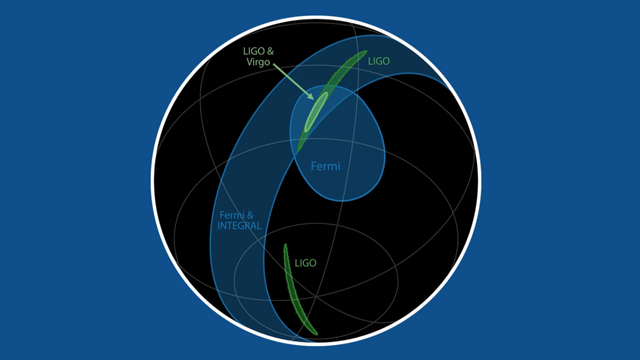
The location of the latest gravitational wave was narrowed down using a combination of the LIGO and Virgo observatories as well as NASA's orbiting Fermi and INTEGRAL gamma ray telescopes. Credit: LIGO/Virgo/NASA/Leo Singer (Milky Way image: Axel Mellinger)
As such, a merger of neutron stars involves distortion of and then contact between material objects themselves, with disruption of the stars and eventual consolidation of most of the matter into a more massive remnant, generally a black hole. And unlike black hole mergers, the neutron star mergers have been predicted to eject large quantities of extremely energetic ordinary matter, making them astronomical beacons of not just gravitational waves, but also of electromagnetic radiation.
NASA’s space-based Fermi telescope is one instrument that is used to look for the optical signatures of neutron star mergers. On August 17 at 12:41:06 UTC, just 1.7 seconds after the LIGO and Virgo gravitational wave detection, Fermi detected a short surge of highly energetic radiation known as a gamma ray burst. Thanks to communications channels that had already been established for precisely these types of events, researchers from all three collaborations realized almost immediately that the two events were likely from the same source. The next half hour was devoted to confirming that each instrument was functioning properly and narrowing down the region of the sky where the burst likely occurred.
Forty minutes after the initial detection, alerts went out to a worldwide network of observatories both on Earth and in orbit to find a transient brightening in the search area that had been narrowed down to 50 candidate galaxies. Eleven hours after the burst, the first identification of a bright new object within the galaxy NGC 4993 was made by a telescope in Chile. Five other teams quickly made this discovery independently, before a bulletin announced the target to others. In the first 48 hours, 130 separate sets of observations were made with over 30 different ground-based and space-based instruments.
This map shows the location of the nearly 70 light-based observatories that detected the gamma ray burst released just after the gravitational waves. Credit: LIGO-Virgo
Over the following two weeks, a wide range of detections were made in ultraviolet, infrared, X-ray, and finally radio wavelengths to observe the aftermath of the explosion as it propagates through space and interacts with the dust and gas of its parent galaxy. To date, the observations of the neutron star merger and its aftermath have involved 3,554 authors from 952 institutions across all seven continents. This represents one-third of the world’s active astronomers.
With the complexity of neutron star mergers and only two months of analysis since the event, the first generation of papers represent only an initial stage of scientific inquiry. What is known is that the two merging objects weigh together about 2.8 times that of the Sun, and that the detection of a fireball in other telescopes indicates that at least one and probably both were neutron stars.
The short gamma ray burst, of a kind with several dozen seen before, was expected to originate from these types of mergers, but the gravity wave signature provides the first proof. Follow-up observations have shown evidence of neutron-rich elements in the cooling fireball ejected from the merger. A significant proportion (by no means all, as has largely been reported) of elements heavier than iron found in the contemporary Universe originate from these merger-ejections, which have come to be known in the last few years as “kilonovae.” The result of the merger was probably a black hole, but the signature is unclear, and the physics of neutron stars are uncertain enough that we do not know and may never know the fate of this particular object.
A variety of other measurements were made using these data. The expansion rate of the universe was measured for the first time using gravitational waves, and radio observations have observed the merger’s shockwave as it collides with the gas and dust of its host galaxy. Astronomers even used the slight time delay between the gravitational and electromagnetic signal, which is predicted for neutron star mergers, to show that gravitational waves do indeed travel at the speed of light, or extremely close to it.
Within a year, new upgrades to gravitational observatories should increase the detection rates by a factor of 10, ushering in an era of new exploration. Regular detections of neutron star mergers in gravitational radiation will begin to probe not just their external properties like mass and spin, but their internal structure itself, about which many questions remain. The mastery and potential demonstrated through the organized scientific thought and labor of this tiny fraction of the world’s population stands in stark relief to the chaos of human organization elsewhere. Immense achievements like the successful probing of nature through gravitational waves illuminate the possibilities for when scientific knowledge and collective labor can be brought more broadly to address the social needs of humanity.

US ambassador intervenes in New Zealand’s political crisis

Tom Peters

Since the inconclusive New Zealand election result on September 23, US ambassador Scott Brown has given three extraordinary media interviews. He defended President Donald Trump’s threats to wage war on North Korea and sought to pressure the next New Zealand government to more openly align and integrate with Washington.
A government has yet to be formed. The incumbent National Party and opposition Labour Party, which both failed to gain a majority, have held secretive coalition negotiations with New Zealand First, which received just 7.2 percent of the votes. NZ First, a right-wing nationalist and anti-Chinese party, says it will decide by the end of the week which party it will support.
The reckless actions of the US, under Barack Obama and Trump, have brought the world to the brink of war. Days before New Zealand’s election, in a fascistic speech to the United Nations, Trump threatened to “totally destroy” North Korea. The American ruling elite is attempting to reverse its economic decline by using its overwhelming military strength to dominate the Asia-Pacific region, above all at the expense of China. Washington is demanding the support of all its allies, including Australia, Japan, South Korea and New Zealand.
New Zealand’s ruling class faces a fraught dilemma. It has significant economic links with Australia and the US, and relies on the US alliance to protect its own neo-colonial interests in the Pacific region, including in Samoa, Niue, Kiribati and Tonga. The National Party government, like the 1999-2008 Labour government, strengthened military and intelligence ties with the US and sent troops to Iraq and Afghanistan.
However, National also cultivated close business ties with China, New Zealand’s second largest trading partner. It has been reluctant to explicitly endorse the US military build-up and threats of trade war against Beijing. Labour and NZ First have called for greater military spending and attacked the government for encouraging Chinese investment and immigration.
Brown’s role is to ensure that the next government ends any wavering and fully aligns with the US war drive. A former Republican Senator for Massachusetts, he was appointed ambassador by Trump and arrived in June. He spent 35 years in the Army National Guard and is known for supporting waterboarding and other forms of torture. He has also spoken of his admiration for Trump’s fascist ex-advisor Steve Bannon, describing him as “a patriot.”
In a TVNZ interview on October 15, Brown rebuked Prime Minister Bill English for failing to fully endorse Trump’s threats against North Korea. In August, English said he would “consider” supporting a US war against North Korea, but offered no definite commitment and described Trump’s threat to rain “fire and fury” on the impoverished country as “not helpful.”
Brown told TVNZ: “With respect to the prime minister... the president’s policy, after years of basically languishing, are (sic) actually working.” He pointed to the crippling UN sanctions imposed on North Korea, which are heightening the danger of war. With breathtaking hypocrisy, the ambassador declared that North Korean leader Kim Jong-un was the one “threatening to wipe out and kill people.”
TVNZ journalist Corin Dann asked Brown if the US was “concerned ... that New Zealand is becoming too aligned, particularly economically, with China.” Brown replied that trade was “up to the Kiwi government” but declared that China was “destroying coral reefs and militarising islands and changing the law of the air and sea.”
So far, the National government has been wary of openly criticising China’s construction on disputed islands in the South China Sea, which the US has used as a pretext for its own militarisation of the region, including provocative naval exercises.
On September 27, Brown was asked by Newshub if Washington expected New Zealand to “join some kind of fight against North Korea.” He replied: “That’s completely and totally up to your government, whichever government it is.” However, he added: “I would hope that New Zealand would do whatever it can do to protect its environmental interests, its fishing interests, its territorial interests... China is ... building and militarising islands. That has a direct effect. And then their trade with North Korea, that’s important, we have to stop that.”
In his interviews, Brown stressed New Zealand’s importance as a partner in the US-led Five Eyes intelligence network. He told Fairfax Media on October 2 that New Zealanders “should be really proud of that fact.” NZ’s Government Communications Security Bureau plays a major part in war preparations by spying on China and other countries, in collaboration with the US National Security Agency.
Brown’s statements coincide with an intensifying anti-Chinese campaign by sections of the New Zealand media, working with the Washington-based think tanks, the Wilson Center and the Jamestown Foundation. A widely-publicised report by the Wilson Center’s Anne-Marie Brady, published days before the election, claimed the government was beholden to Chinese business interests and alleged, without any evidence, that National Party MP Jian Yang and Labour MP Raymound Huo were “agents” of the Chinese Communist Party. Brady called for the NZ Security Intelligence Service to carry out a sweeping investigation of Chinese “influence” in New Zealand politics.
NZ First echoed Brady’s demands and called for Yang to step down while an “inquiry” is conducted. Labour leader Jacinda Ardern also indicated she would consider empowering the spy agency to investigate Chinese “influence,” as Australia’s intelligence agency is now doing.
None of the parliamentary parties has commented publicly on Brown’s extraordinary post-election statements, which undoubtedly have been discussed behind the backs of the population as part of the coalition negotiations with NZ First.
All the parties, including the Greens, support the alliance with US imperialism and are extremely concerned about the widespread anti-war sentiment in the working class. This is why the immense danger of war was barely discussed during the election campaign.
The Daily Blog, funded by several trade unions and supported by the pseudo-left Socialist Aotearoa and the Communist Workers Group, is playing a key role in whipping up anti-Chinese xenophobia. After the election it declared Chinese influence in the National Party was “the major issue” facing the country. The blog, which is pushing for a Labour-Green-NZ First government, endorsed Brady’s report and has published racialist articles opposing Asian immigration.
Washington’s intervention into the political crisis is an indication of the immense dangers facing the working class. The next government, whichever party leads it, will intensify the attacks on immigrants, whip up nationalism and xenophobia, and accelerate the preparations to drag the country into war.

Kenyan government bans demonstrations ahead of October 26 election re-run

Eddie Haywood 

On Thursday the government of Kenya, attempting to quell days of mass unrest ahead of the October 26 election re-run, issued a ban on protests in the cities of Nairobi, Mombasa, and Kisumu. Continuing for an indefinite duration, the ban specifically bars demonstrations in the central business districts of the three cities.
The proscription on demonstrations is the latest action from a government mired in crisis, coming after the Kenyan Supreme Court nullified the August 8 election which had declared that incumbent Uhuru Kenyatta defeated opposition candidate Raila Odinga for the presidency. In its ruling, the court cited that it found the vote tally was “tainted by irregularities and illegalities,” and ordered a new election to take place within 60 days.
The news of the protest ban sparked widespread outrage and thousands poured into the streets in defiance of the government edict. During the past two weeks Odinga’s National Super Alliance party (NASA) have called regular demonstrations to protest changes to the country’s election laws that would block the Supreme Court from overturning future election results.
The issuing of the protest ban displays a clear shift toward police state methods of rule by the government. The government’s violent crackdown on demonstrations and its enacting of the Electoral Amendment law constitute an attack on the democratic rights of the Kenyan population, reflecting the fear within the ruling elite of the growth of mass opposition to its rule.
In the Western town of Siaya on Friday, police fired live rounds into a crowd of 2,000 demonstrators, killing two and wounding three more. Demonstrators in the western city of Kisumu blocked streets and burned tires, and threw rocks at police who fired tear gas.
Concurrently, Nairobi police fired tear gas and live rounds at thousands of protesters marching towards the city center, and the police in Mombasa deployed tear gas and beat demonstrators.
In the weeks after the August 8 poll declaring Kenyatta the winner in the hotly contested election, frequent demonstrations and unrest have occurred in the three major Kenyan cities, with police responding violently, killing at least 45, including a number of children caught in police crossfire, according to a joint Amnesty International/Human Rights Watch report.
The two organizations documented that the victims of police violence were largely the poor residents of slum districts of urban centers, including Mathare, Kibera, and Kawangware in Nairobi, as well as scores of victims in Kisumu.
Witnesses recounted to researchers that police fired randomly at protesters, and when protesters attempted to flee the volley of bullets they were chased down and beaten or shot to death.
When questioned by the media regarding the report’s allegations, Kenya’s police chief Joseph Boinnet denied the police carried out the killings and said the report was “totally misleading and based on falsehoods.” Boinnet claimed the police were only aware of 12 deaths, which are still under investigation.
Odinga called for the daily protests to push the government to enact reforms of the Independent Electoral and Boundaries Commission (IEBC). Amid a series of suspicious circumstances which occurred during the August 8 poll, Odinga accused the IEBC of not fulfilling its obligation to ensure a free and fair election.
The opposition candidate officially withdrew his participation in the October 26 re-run last week in protest of proposed election law changes being pushed by Kenyatta. The following day the government rammed through parliament the anti-democratic Electoral Amendments Law, which curbs future nullifications of elections by the Supreme Court.
The crackdown on demonstrations is motivated by fears within the Kenyan ruling elite of falling bank and corporate profits and a decline in foreign investments as a consequence of uncertainty caused by the continued unrest.
Interior Minister Fred Matiangi in announcing the protest ban told the media, “Due to the clear, present and imminent danger of breach of peace, the government notifies the public that, for the time being, we will not allow demonstrations within the central business districts of Nairobi, Mombasa and Kisumu.” He went on to deride demonstrators as criminals who were taking advantage of the chaos to loot businesses.
Significantly, Matiangi met with the Kenyan Private Sector Alliance (KEPSA), an organization comprised of Kenyan and Western capitalists, hours before issuing the ban. Matiangi afterward stated to the press that he had “received complaints from the business community about the negative effects the protests were having on their businesses.”
Since the beginning of the election crisis, Kenyan stocks have suffered a fall and yields on its Eurobonds have soared. According to Bloomberg, growth in East Africa’s top economy could fall short of the 5.5 percent previously projected.
Kenyan Central Bank governor Patrick Njorege, in Washington on Saturday to attend the annual gatherings of the International Monetary Fund and World Bank, stated, “The growth rate won’t be as strong as we expected, but I don’t think we can say that we’ve gone over the precipice.” Njorege also spoke of the historic famine affecting Kenya, which is damaging profits in the agricultural sector with markets anticipating lower crop yields.
In a press statement last Wednesday to the media, KEPSA attempted to soothe the jittery nerves of international markets by insisting that despite the election crisis, Kenya was still an attractive investing destination. “To all investors, Kenyan and international: Kenya remains an attractive investment destination. Our noisy, colorful and very long election will, in fact, result in the country becoming an even more attractive investment destination, as dispute resolution institutions and mechanisms, and other guarantors of the rule of law, become further entrenched as they pass through this institution ‘character building’ election period."
For its part, Washington is concerned that its imperialist projects in Kenya and East Africa are not derailed by the chaos erupting due to massive unrest. Kenya has forces conducting a US-backed war in neighboring Somalia to stabilize its puppet government in Mogadishu.