25 Oct 2017

Xi Jinping consolidates grip over Chinese Communist Party apparatus

Peter Symonds

In an extraordinary step yesterday, the Chinese Communist Party (CCP) Congress not only concluded with a ringing endorsement of President Xi Jinping’s opening report. It also included his “thought” into the Chinese constitution. Barely known five years ago when he became president, Xi has consolidated his position as the “core” or indispensable strongman in the CCP apparatus.
Far from being a sign of strength, the elevation of Xi to supreme leader is a sign of crisis in the CCP regime. It is beset with mounting economic and financial turmoil, and the danger of growing social unrest at home, as well as an aggressive US administration that threatens war with North Korea and China itself.
All the key resolutions were passed overwhelmingly, if not unanimously, without significant debate. The 2,300 hand-picked delegates are not accountable to the CCP’s 89 million members, let alone the broader population. However, significant differences over economic and foreign policy exist between the rival party factions. In these circumstances, Xi has emerged as political supremo to ensure and impose party unity.
By entrenching himself in the constitution, Xi undoubtedly hopes to make his position unchallengeable. The new constitution does not simply contain a symbolic reference to “Xi Jinping Thought on Socialism with Chinese Characteristics for a New Era.” It enshrines specific policies: the modernisation of and, absolute party control over, the army; Xi’s “One Belt, One Road” geo-strategic initiative; and target dates for enhancing China’s position in the world.
In reality, this is a sign of political weakness. It is aimed at giving constitutional legitimacy to the ongoing purge of critics and potential rivals through Xi’s so-called anti-corruption drive and suppression of dissidents who express “politically incorrect” views. The tightening up of Xi’s control of the CCP and its police-state apparatus is the preparation for looming political and social explosions.
Xi is well aware that the CCP regime is sitting atop a social time bomb. He maintains the absurd fiction that China is progressing toward socialism in a desperate attempt to obscure the gross inequities of Chinese society that the CCP’s policies of capitalist restoration have created. He told the congress social inequality is the number one challenge, but his policies of ensuring “the decisive role of market forces” and advancing “supply-side structural reform”—now enshrined in the constitution—will only widen the gulf between rich and poor.
The CCP does not represent the hundreds of millions of Chinese workers and urban and rural poor, but a tiny stratum of ultra-rich billionaires, some of whom were congress delegates, as well as layers of the wealthy middle classes, inside and outside the party.
The ideological cement to bind the party together and to subordinate the masses to the interests of the capitalist class is Chinese nationalism and xenophobia—now under the banner of Xi’s “Chinese dream of national rejuvenation,” which also has been included in the constitution.
By “national rejuvenation,” Xi means an end to China’s colonial subjugation in the 19th and early 20th centuries, and its emergence as a “strong nation” that is “moving to centre stage” in the world. “The Chinese people and nation have a great and bright future ahead,” Xi told the congress as it concluded.
Xi came to power in 2012 as US President Barack Obama was implementing his “pivot to Asia”—a comprehensive diplomatic, economic and military strategy aimed at undermining and preparing for war against China. Trump is pursuing the same US objective more openly and aggressively, reflecting the view in American ruling circles that Beijing is the key obstacle to Washington’s world dominance.
Under Xi, China has reacted by accelerating its own military build-up and its efforts to expand its diplomatic and economic influence in Asia and around the world. Xi’s signature One Belt, One Road policy involves massive infrastructure projects, including rail, roads and ports, linking the Eurasian landmass, to the exclusion of the United States. It is aimed, in particular, at encouraging the major European powers to loosen their ties to Washington.
Xi has also sought to manoeuvre with Washington. The CCP has bowed to some US demands for greater access for trade and investment in China and for punitive sanctions on North Korea, while refusing to budge on key issues such as Chinese land reclamation in the South China Sea. In his opening report to the congress, Xi declared: “No one should expect China to swallow anything that undermines its interests.”
Xi has emerged from the congress as the party’s undisputed strongman, publicly at least, but sharp differences undoubtedly remain. In 2012, a key potential rival, Bo Xilai, party boss in the major city of Chongqing, was removed on trumped-up corruption charges, expelled from the party, tried and jailed. Bo was an advocate of stronger measures to protect state-owned enterprises and a tougher response to the US “pivot.” While Bo’s closest supporters have been purged also, sections of the Chinese military no doubt continue to push for stronger measures against US provocations, particularly in the South China Sea.
At the same time, elements within the CCP apparatus are pushing for an acceleration of pro-market measures and the opening up of the Chinese economy to foreign investors. Premier Li Keqiang, who was installed in 2012 along with Xi, championed these policies and worked closely with the World Bank to draw up the China 2030 economic blueprint. Li, however, largely has been sidelined over the past five years. Xi has established key “small groups” under his control to manage many policy areas, including finance and the economy.
The congress concluded yesterday with the installation of a new central committee of 204 members and 172 alternate members. Today a central committee plenum will elect the politburo and the top decision-making body, the politburo standing committee—currently with 25 and seven members, respectively.
The committees will be stacked with Xi’s close supporters. However, the new era proclaimed by Xi will not be one of peace and stability. The attempt to hold together the sclerotic CCP apparatus through bureaucratic means only sets the stage for future political turmoil as the regime attempts to grapple with acute internal and external crises.

The American oligarchy prepares a new tax windfall for the rich

Barry Grey

The drive to enact the most massive tax cut for the rich in US history accelerated Tuesday as Donald Trump met behind closed doors with Senate Republicans to finalize the plan.
The House of Representatives is set to approve Thursday the Senate budget resolution passed last week, a parliamentary maneuver that will allow the Republicans, under expedited rules, to pass the tax plan by a simple majority in the Senate rather than a filibuster-proof three-fifths vote. The actual proposal will be released on November 1, setting the stage for the final push to secure passage by the end of the year.
Wall Street celebrated the stepped-up push for the plan with a 167-point surge in the Dow, bringing the index closer to 24,000. Since Trump was elected last November, the Dow has risen by more than 25 percent. It has quadrupled since 2009, thanks to the multitrillion-dollar bank bailout and other handouts to the corporations and banks under Obama.
The Trump tax measure, however, will raise to a new level the plundering of society’s resources by the ruling class.
Its provisions read like a Christmas wish list for the rich: slashing the corporate tax rate from 35 percent to 20 percent, generating additional corporate revenues of $6.7 trillion by 2037; reducing the top personal income tax rate from 39.6 percent to 35 percent; abolishing the alternative minimum tax, which applies only to the wealthy; and slashing to 25 percent the rate at which business owners are taxed on money recorded as “pass through” income.
It also abolishes the estate tax, which affects those worth over $5 million, just 0.02 percent of the population. This measure has long been desired by the corporate oligarchy, allowing its members to pass on to their children all the wealth accumulated through fraud and speculation, effectively establishing a form of dynastic rule.
The top 1 percent will see their after-tax income rise by 8.5 percent if all these measures are adopted. The Center for Budget and Policy Priorities estimates that half of the tax cuts will go to the top 1 percent of households, those making more than $700,000 per year. Within this group, the top 0.1 percent will receive 30 percent of the tax cuts, for an average cut of $800,000 a year.
The bottom 90 percent of the population, the working class and lower-middle class, will get little or nothing. A married couple with one child that earns less than $24,850 a year will receive no tax cut, while a similar family earning $48,700 will see a cut of just $180. At the same time, the budget deficits produced by the tax cuts will be used by both parties to demand massive cuts in social programs, including Social Security and Medicare.
As is to be expected, Trump and the Republicans are promoting the plan with shameless lying, denying that their plan is designed to benefit the rich and insisting it is aimed at cutting taxes for “hard-working Americans” and creating jobs.
The Democrats, for their part, support a huge cut in corporate taxes and are offering only token opposition to the other handouts to the rich. Following the Republican meeting on Tuesday, Senate Minority Leader Charles Schumer and other Democratic senators held a press conference. Schumer, the senator from Wall Street, accused Trump of lying about the plan but said nothing about corporate taxes. Other Democrats attacked the plan for being fiscally irresponsible.
As always, the Republicans set the reactionary framework for policy and the Democrats ensure that it is enacted virtually intact. The Democrats’ main function is to disarm the working class by creating an illusory smokescreen of democratic debate and opposition.
The Trump tax plan is the outcome of a decades-long social counterrevolution that has produced a colossal transfer of wealth from the working class to the rich and the super-rich, creating levels of social inequality unseen since the 1920s and transforming the United States into an oligarchy.
The Sixteenth Amendment to the US Constitution, granting Congress the power to tax people’s income, was passed in 1913, as part of the progressive movement’s efforts to rein in the robber barons. The estate tax was enacted at the same time.
During the Great Depression, the Roosevelt administration raised the top rate from 25 percent to 63 percent as part of the New Deal reforms aimed at heading off a socialist revolution. During World War II, the top rate peaked at 94 percent. Over the next three decades, the top rate never fell below 70 percent.
The first postwar reduction was carried out by John F. Kennedy, but this was only a foretaste of what was to come, as the ruling class adopted a policy of social counterrevolution under Ronald Reagan. The Democrats, who controlled Congress, capitulated to Reagan in 1981 and slashed the top rate from 70 percent first to 50 percent and then to 28 percent. This gradually rose back to the current rate of 39.6 percent.
At the same time, taxes on capital gains from stock and bond speculation were slashed to 25 percent as part of the inflation of the stock market that has proceeded since the 1980s. Tax cuts for the wealthy have been an essential part of the mechanism by which the stock market and other forms of financial speculation have been used as the primary mechanism for wealth accumulation by the financial aristocracy.
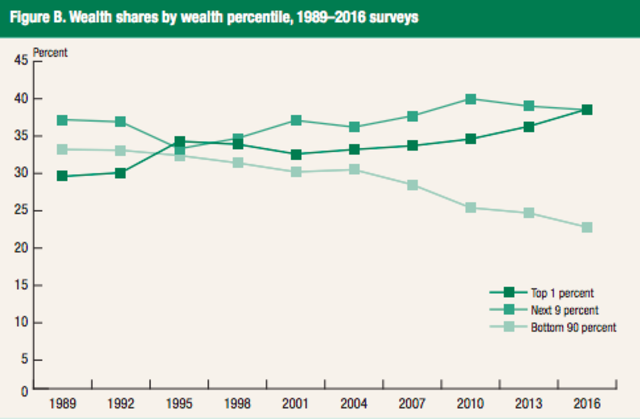
Wealth shares by wealth percentile, 1989-2016 surveys
The consequences are clear. Since the 1980s, the share of national income going to the top 1 percent has risen from 12 percent to 20 percent, while that of the bottom 50 percent has fallen from 20 percent to 12 percent.
The most recent Survey of Consumer Finances from the US Federal Reserve shows that the top 10 percent of Americans now own 77 percent of all wealth. The top 1 percent owns 38.5 percent, an increase even since 2013. The share of the bottom 90 percent has declined by more than two percentage points to 22.9 percent.
The impact of these shifts in wealth and income on the conditions of life of millions of people can be seen in myriad forms: declining life expectancy, rising infant and maternal mortality, rampant drug addiction and a rising suicide rate.
This growth of parasitism has coincided with the destruction of large swathes of industry, the devastation of former industrial centers all over the country, and the impoverishment of broad sections of the working class. Now, with the Trump tax cut—authored by the Goldman Sachs alumni Treasury Secretary Steven Mnuchin (net worth $500 million) and economic adviser Gary Cohn (net worth $610 million)—a new level of enrichment of the oligarchy is being launched that will make current levels of inequality seem quaint by comparison.
The conditions are being created for a social upheaval. The emerging working-class opposition must take up the demand for a massive revision of tax policy to break the stranglehold of the financial oligarchy and radically redistribute the wealth in favor of the working people. The top rate for both personal income and corporate wealth must be raised once again to what it was in the 1940s and 1950s, to end the theft of social resources and provide for the social needs of the broad masses of people.
These are in themselves democratic demands. They cannot be achieved, however, without a frontal assault on the source of the power of the corporate and financial elite: its control of economic life, and with that, the entire political system. The redistribution of wealth to the working class must be connected to the fight for workers’ power, the transformation of the giant corporations and banks into publicly owned utilities, and the socialist reorganization of economic life.

Sri Lanka: Phony moves toward democratic constitutional change

K. Ratnayake

Sri Lankan Prime Minister Ranil Wickremesinghe presented a “constitutional assembly” steering committee report last month. Although he declared the aim of a new constitution was “reconciliation and development,” the accompanying debate shows that every faction of the ruling elite is thoroughly steeped in divisive Sinhala communalism.
The report presented on September 21 will be debated for three days from October 30 to November 1, during which time the Sri Lankan parliament will meet as a constitutional assembly.
In March last year, the parliament decided to act as a constitutional assembly (CA) to prepare a new constitution. This is an anti-democratic body and not a genuine constitutional assembly directly elected by workers and poor.
The decision was backed by the ruling coalition led by the Sri Lanka Freedom Party (SLFP) and United National Party (UNP), as well as the Tamil National Alliance (TNA), Janatha Vimukthi Peramuna (JVP) and a faction of SLFP MPs supporting former president Mahinda Rajapakse.
Wickremesinghe boasted the CA would present a “consensus constitution” of all political parties for the first time since independence in 1948. However, the discussion has dragged on for more than a year and, after 60 sittings of the “steering committee,” only an interim report has been produced.
During the 2015 presidential election, President Maithripala Sirisena promised “democratic changes” to the constitution, including the abolition of the executive presidency and the strengthening of parliament to ensure “good governance.” This phony campaign, backed by the JVP, TNA and various pseudo-left organisations, was a means of exploiting popular anger toward Sirisena’s rival, the incumbent President Rajapakse, and his attacks on democratic rights.
The ousting of Rajapakse was in reality a regime-change operation backed by the US and India. Washington was hostile to Rajapakse’s close relations with Beijing and wanted Sri Lanka to line up behind its military build-up in Asia against China.
Presenting the report to parliament, Wickremesinghe said the new constitution would ensure no divisions on the basis of race, religion, ethnicity or social background. It would provide “equal distribution of the benefits of economic development … widen democracy and establish peace and stability.”
At the same time, the prime minister declared: “Sri Lanka should be a unitary state.” He stated: “We are a proud Buddhist nation. And the constitution is to be drafted on ‘Buddhist policies and principles.’”
Wickremesinghe noted the report replaced the words “unitary state” with more suitable words and formulas such as “Sri Lanka should be an undivided and indivisible country.” He said Buddhism would be given “the foremost place while assuring to all religions their rights.”
These comments demonstrated the utter hypocrisy of Wickremesinghe’s claims that the constitution will ensure no racial or religious divisions and will establish equality and democracy. His remarks are nothing but a vow to maintain the supremacy of the island’s ethnic majority Sinhalese Buddhists.
Under the banner of defending the unitary state and the “foremost place to Buddhism,” the Sinhalese ruling elite has systematically discriminated against the Tamil minority and exploited communalism to divide the working class. That resulted in the 30-year communal war against the separatist Liberation Tigers of Tamil Eelam (LTTE), which was defeated in May 2009.
Sirisena and Wickremesinghe have promised some minor concessions to the Tamil elite and its main party, the TNA, in order to strengthen bourgeois rule. The US and India, which are concerned about the risk of communal unrest, have advised the government to accommodate the TNA in a power-sharing arrangement.
The TNA earlier presented a proposal for a federal system, but later dropped it. TNA leader R. Sambandan praised the interim report, adding, “we must not be hanging on to words like federalism.” However, the TNA is hoping that the 13th Amendment to the existing constitution will be implemented, devolving greater powers to the majority Tamil provinces of the north and east.
The interim report demonstrates that the ruling coalition is not agreed on how far to go in making concessions to the Tamil elite. The UNP is proposing to merge the northern and eastern provinces—a longstanding TNA demand. But the SLFP is opposed. It demands the removal of a clause in the present constitution to hold a referendum to merge the provinces.
Just one week after the interim report was announced, Sirisena spoke at a Buddhist ceremony. He declared that the report “does not project a concept of federal state,” then added: “I will never allow a constitution that will break up this unitary status.” He affirmed there would be no “downgrading in the new constitution of any clause or paragraphs pertaining to Buddhism that are in the current constitution.”
Sirisena and Wickremesinghe campaigned to abolish the executive presidency but there is also no agreement between the ruling parties on this matter.
For all its claims to be establishing a new democratic constitution, the government is in fact preparing dictatorial rule and taking repressive measures against workers and the poor.
After nearly three years in office, the government has been discredited because of its implementation of savage, IMF-dictated austerity measures. Struggles have erupted in the plantations, power sector, petroleum industry, railways and universities, to mention a few. About 8,000 medical students have boycotted lectures for nine months, while other students are continuing to campaign against the privatisation of education.
The government depends on the betrayals of the trade unions, on one hand, and, on the other, the unleashing of the police and military to crush strikes and student protests. Fearing defeat, the ruling coalition has postponed local government and provincial council elections.
Along with these repressive measures, the government has integrated the country more closely into US war plans against China. Last week, the Sri Lankan armed forces held joint exercises sponsored by the US military in Trincomalee. Next month, US Deputy Secretary for Political Affairs Thomas Shannon will visit Colombo for a “Partnership Dialogue” between the two countries.
The Rajapakse-led faction of the SLFP, with the backing of various chauvinist groups and Buddhist monks, has launched a virulent communal campaign. While participating in the CA, this faction is accusing the government of seeking to divide the country and create a federal system to satisfy the TNA.
In a statement on October 16, Rajapakse warned the government to stop its “destructive measures.” He is seeking to exploit the growing opposition to the government and divert it into reactionary communal channels. He is openly campaigning to topple the government.
The struggle for genuine democratic rights is bound up with the fight against war and attacks on living conditions. In the struggle for a secular democratic state, every form of discrimination, including on a racial or religious basis, must be opposed. These tasks can be achieved only by the working class, supported by the oppressed masses, in the fight for socialism.

Australian spy agency promotes anti-China witch-hunt

Oscar Grenfell 

The Australian Security Intelligence Organisation (ASIO), the country’s main domestic spy agency, used its annual report, released last Wednesday, to further fuel a hysterical media campaign alleging widespread Chinese “interference” in Australian politics.
ASIO’s public reports are always highly political documents. Their purpose is not to disclose the agency’s activities, but to promote the anti-democratic agenda of successive governments, including ramping up the powers of ASIO and the entire military-intelligence apparatus.
For the past 16 years, ASIO’s reports have centred on declarations that Australia is threatened by “Islamist terrorism.” Such claims have been used to justify Australia’s role in predatory US-led wars in the Middle East, and sweeping inroads into civil and political rights.
This year’s report, while maintaining the “war on terror” rhetoric, includes vague and unsubstantiated assertions that “foreign powers” are conducting a wide-ranging campaign of “espionage” and “covert influence operations.” It declares that the “the scale of the threat to Australia and its interests is unprecedented.”
ASIO did not name any “foreign powers.” But the media outlets that function as little more than adjuncts of the intelligence agencies and the political establishment, filled in the gap.
An article in the Murdoch-owned Australian newspaper was headlined “ASIO battling spy threat from China and Russia.” The state-owned Australian Broadcasting Corporation (ABC) declared that unnamed “government officials … believe China is becoming more aggressive with its activities against Australia.”
As in previous “exposures” of supposed Chinese “espionage” and “political interference,” the articles provided no evidence or detail for their sweeping assertions. That is because they are part of what can be described only as a long-running exercise in state-propaganda.
The purpose of the repeated anti-China campaigns by the ABC, Fairfax and Murdoch-owned publications has been to legitimise Australia’s central role in US plans for war in the Asia-Pacific, including against North Korea, and, above all, China.
This is in line with Australia’s integration into Washington’s “pivot to Asia,” a vast military build-up in the region, announced by US President Barack Obama in 2011 from the floor of the Australian parliament. Since then, Labor and Liberal-National governments have expanded US basing arrangements and deepened the collaboration between the Australian and American militaries.
ASIO’s report coincided with Australian involvement in US provocations against North Korea, including the deployment of two Australian frigates to waters near the Korean peninsula, ready to participate in any US-launched attack.
Because these policies are deeply unpopular, they cannot be discussed openly. To fill the breach, and attempt to create a nationalist and pro-war atmosphere, lies and fabrications are invented out of whole cloth, presenting China as an aggressive power and an imminent danger to Australia.
In its report, ASIO asserts, without evidence: “Foreign intelligence services sought access to privileged and/or classified information on Australia’s alliances and partnerships.” It warns of “foreign powers clandestinely seeking to shape the opinions of members of the Australian public, media organisations and government officials.”
ASIO claims that by “seeking to unduly influence public perceptions of issues,” these activities “represent a threat to our sovereignty, the integrity of our national institutions and the exercise of our citizens’ rights.”
This is in line with several joint “investigations,” earlier this year, by the ABC and Fairfax, conducted in close collaboration with ASIO. The investigations “exposed” that a handful of Chinese-born businessmen made donations to the Labor, Liberal and National parties.
These were supposedly part of a coordinated campaign by the Chinese Communist Party to “interfere” in Australian politics, even though the businessmen named included long-time Australian citizens and avowed opponents of the Chinese government.
University research funded by Chinese companies has been targeted also in the witch-hunt. Fairfax publications and the Guardian recently warned that research into areas such as marine technologies and solar power may, in the future, have military implications.
The ASIO report obliquely concedes that the activities are benign and mundane. It cynically states, “activities that may appear relatively harmless today can have significant future consequences.”
ASIO’s rhetoric mirrors the McCarthyite campaign being waged by the US intelligence agencies, in league with the Democratic Party and the corporate press, against supposed “Russian interference” in American politics.
In addition to pressing for the Trump administration to escalate the confrontation initiated by the Obama administration against Russia, it seeks to present growing opposition to militarism, social inequality and poverty among ordinary people as the result of a Kremlin plot.
ASIO’s report foreshadows a similar crackdown on democratic rights, in the name of combatting an external “enemy.” It declares that the agency is “no longer meeting key performance indicators” and demands more resources for “personnel security assessments” and other measures to counter “foreign influence.”
In June, the spy agency demanded the extension of sweeping powers, associated with draconian anti-terror laws, to “foreign interference” investigations. These powers include secret detention and questioning for seven days without charge.
The Liberal-National government this month also issued draft legislation that would give relevant ministers sweeping “last resort” powers to impose binding directives on owners of “critical infrastructure,” including barring them from selling assets to foreign companies. The new laws are being advanced on the pretext of combatting “foreign espionage,” “sabotage” and “coercion.”
Last month, the Fairfax-owned Sydney Morning Herald reported that the government plans new legislation to target Chinese “sub-espionage,” including the creation of a foreign agent registry.
Among those identified by Fairfax as potential targets was a lobby group of Chinese-Australians contesting local elections. Chinese associations previously have been denounced for opposing aggressive US military activities against China in the South China Sea.
Chinese international students, who number an estimated 140,000, have been branded in media reports as a potential “fifth column” of the Chinese government.
ASIO’s report followed by an unprecedented address earlier this month by Frances Adams, the head of the Department of Foreign Affairs, whose remarks were later reinforced by Foreign Minister Julie Bishop.
Speaking at the University of Adelaide’s Confucius Centre, a body funded by the Chinese government, Adams warned “international students” that the “silencing of anyone in our society—from students to lecturers to politicians—is an affront to our values.”
Adamson was apparently referencing sketchy reports that inflated minor disagreements between Chinese students and lecturers, allegedly over how Chinese foreign policy was presented in classes.
Adamson told the students that when they disagreed with something, they should not “blindly condemn,” but “respectfully engage.” The thinly veiled message was that Chinese students are welcome to study and pay their exorbitant fees, but should think twice before disagreeing with the Australian government or its plans for war against China.
A week later, on October 15, reports appeared in the ABC and Fairfax, declaring that Australia was at the centre of a push by the “Five Eyes” spying network, headed by the US, to counter “China’s pervasive and subversive influence,” especially at universities.
The reports were based on statements by an unnamed “senior foreign diplomatic figure,” who menacingly told the ABC: “It’s time for the federal government to insist the Chinese comply with Australia’s values and interests.”
The campaign is a warning to students, young people and the entire working class. It presages more direct forms of political repression, as opposition mounts to the criminal and reckless US and Australian preparations for war against North Korea and China.

Airbnb and eBay paying virtually no tax in the UK

Margot Miller 

Two of the world’s largest corporations, Airbnb and eBay, have paid virtually no tax in the UK.
Last year Airbnb Payments UK paid a derisory £188,000 in taxes to the UK Treasury—£8,000 less than in 2015. This was despite collecting £657 million in rents and making a pre-tax profit of £960,000.
Airbnb Payments is one of two UK subsidiaries of the web-based multinational Airbnb. The other subsidiary, Airbnb UK, which markets the web site for British consumers, did not pay a penny in tax, even though its pre-tax profits amounted to £463,000.
It evaded paying tax quite legally, by issuing each of its employees with shares that are tax deductible, thus shifting profits away from taxable income.
Airbnb links travellers and holidaymakers in 65,000 cities with landlords/homeowners, undercutting hotels and bed and breakfasts. Taking a commission from landlords—3 percent for each booking and a 6-12 percent service charge from guests—it is a highly lucrative business. The company has mushroomed since it was founded in San Francisco in 2008, so that today it is valued at $24 billion and is planning to diversify into commissioning tours.
The company has been accused of driving up rents and contributing to housing shortages, as private landlords can generate bigger rental income from short-term lets. This led to protests earlier in the year in Barcelona, Spain, where 3,000 people are homeless.
Internet auction giant eBay managed to massively avoid paying tax, causing its US account managers to boast of £233 million in tax savings. While eBay’s main UK arm raked in profits of £7.7 million from advertising and marketing, its tax bill came to £1.6 million.
Fees charged for web site listings, however, were booked through Luxembourg and Switzerland, so that out of £1 billion of sales last year in the UK, only £200 million were shown on the books for UK tax purposes.
This is the latest in a growing list of high-tech giants revealed to be carrying out similar operations. Their kid gloves treatment by the authorities is in stark contrast to ordinary taxpayers, who face severe penalties if they fail on their tax bills.
While profits soar to exponential heights, these corporations engage in myriad complex scams to evade paying even the minimal and ever decreasing corporation tax rates taxes levied by governments.
Last week a report by the Organisation for Economic Co-operation and Development and the G20 revealed that laws permitting companies to shift profits to tax havens meant that between $100 billion and $240 billion tax revenue was lost annually—accounting for up to 10 percent of global tax revenues.
This vast amount could resolve much of the world’s social ills. According to US-based global finance company, Goldman Sachs, it would cost about $175 billion per year to end extreme poverty worldwide in 20 years.
The European Commission is currently investigating Amazon, Google, a division of the Fiat motor company, Starbucks and Uber over their tax arrangements with EU states.
The commission recently ordered Luxembourg to reclaim £224 million from online retailer Amazon over a concessionary tax deal it made with the company, following a three-year investigation. At the time the deal was struck in 2003, the prime minister of Luxembourg was Jean-Claude Juncker—now president of the European Commission.
Last year Google paid the Italian authorities €306 million to end a criminal investigation into its decades-long tax avoidance practises. This amounts to small change for parent company Alphabet, worth $26 billion and growing.
The usual corporation tax rate in Ireland is 12.5 percent—less than half the European average and nearly a third the US rate of 35 percent—though the Trump administration is in the process of substantially lowering this. Corporation tax is levied in the UK at 19 percent, falling to 18 percent by 2020.
In 2014, the social network giant Facebook paid £4,327 to the UK treasury. This was less tax than an average Facebook employee earning an annual salary of £26,000, who would pay £5,392 in tax and insurance.
Last January, Facebook reported a 34 percent increase in profits from the previous quarter, up to £462 million. Total profits for the year amounted to $2.9 billion, double the profits amassed in 2013.
Facebook paid share bonuses worth £96,000 to each of its 362 UK employees, enabling it to register a pre-tax loss of £28.5 million loss with the Treasury.
Another way Facebook UK avoids tax is by billing advertising customers via Facebook Ireland Ltd. Facebook Ireland Ltd makes little profit on paper because it makes payments to Facebook’s parent company in the US and royalty payments to Facebook Ireland Holdings, which owns the rights to use of the platform.
Prior to this, an EU investigation into Starbucks uncovered that in the 14 years the Seattle-based chain has been operating in the UK, it has only paid £8.6 million in corporation tax. Since being exposed, fearful of customers boycotting its products, the company has promised to pay the Treasury additional amounts of corporation tax, but this will be just £20 million in each of the next two years.
The car service company Uber is using UK and EU tax loopholes to avoid paying VAT (value added tax). It does this by treating its 40,000 UK drivers as self-employed workers, i.e., separate businesses that are too small to qualify for VAT payments. As a result, the approximate tax avoided for 2015 was £20 million.
Uber drivers, who have no employment rights, have reported earning as little as £5 an hour after expenses.
This month, Transport for London made the announcement that the company’s minicab driver’s licence would end in September, unless it appealed. However, if Uber drivers lose their jobs they face destitution, as many have accrued debts to pay for the new cars demanded by Uber as a condition of employment.
The EU Commission has estimated that Fiat has avoided tax bills of €20 million and €30 million in the last three years in deals with Luxembourg authorities.
The super-rich continue to avoid taxes. In 2009, Her Majesty’s Revenue and Customs (HMRC) set up a specialist unit to chase up £2 billion in missing tax revenues, following the public outcry after the release of the “Panama Papers” in 2016.
The Papers consisted of 11.5 million files, leaked from the database of the world’s fourth biggest offshore law firm, Mossack Fonseca. They revealed the many nefarious operations of the rich, who use offshore tax havens to protect their personal fortunes.
Since 2009, while total UK tax receipts have increased, the share paid by the super-rich actually fell, in 2015, by £900 million. As wealth inequality widens even further, the bottom 90 percent of society are proportionally being asked to pay far more.
At the beginning of the year UK Prime Minister Theresa May said that local authorities, which provide essential services, could increase council tax by up to 6 percent to offset cuts in central government funding.
Governments today exist only to offer transnational corporations the best conditions to reap vast profits. Last year the EU’s competition authorities ordered US technology giant Apple to pay the Irish government more than €13 billion euros in back taxes. The California-based company had reported its Europe-wide profits in shell companies in Ireland, after sealing a sweetheart deal with the Irish government to pay virtually no tax—just 0.005 percent in 2014 and an average rate of 1 percent over 25 years.
Earlier this month it emerged that Brussels is considering court action against Ireland over its failure to collect the billions it is owed by Apple.

Puerto Rico power blackout the biggest in US history

Rafael Azul

One month after Hurricane Maria devastated Puerto Rico, the bulk of the US island territory is still without electrical power, a blackout that is the most extensive in modern US history. Some 3 million people are without electricity, and there are predictions that some remote parts of the mountainous island will not see power restored until next June.
While the hurricane caused the initial damage, the long-term power failure demonstrates the combined impact of the relatively primitive character of the island’s infrastructure before the storm, and the complete indifference of the US government and the Trump administration since Maria swept through the island.
The power restoration has been hampered by an acute shortage of skilled labor, according to press reports this weekend. While thousands of repair workers went to Texas and Florida after hurricanes Harvey and Irma, only 300 workers from outside Puerto Rico are now on the island repairing infrastructure and restoring service, leaving the main work to the overburdened staff of the 900 working for the island’s public utility, AEE.
Similarly, according to the New York Times, the Army Corps of Engineers, in overall charge of the recovery effort, has mobilized only 200 of the 2,000 workers it needs for power restoration, and most of these are installing emergency generators, not repairing the devastated infrastructure.
By contrast, more than 5,000 out-state utility workers went to Texas and 15,000 went to Florida, enabling rapid restoration of power in both storm-damaged regions.
Another startling statistic: The Federal Emergency Management Agency says that only 392 of Puerto Rico’s 5,073 miles of road were open this week, about 8 percent, one month after the hurricane.
“Electricity is something you do not notice until its gone,” says a Vox News Service article, which on Monday painted a picture of what it is to live without electricity for over a month, even for those that have some access to gasoline-driven generators. Roughly 79 percent of households have no electricity. The reader is confronted with people having seen stored food going bad, isolated from intermittent mobile phone service, and with no air conditioning or refrigeration.
“When the power goes out, that sense of comfort quickly disappears. The parts of daily life that were once taken for granted are suddenly gone, with no clear sense of when they’ll be back. To not have power—to be literally and figuratively in the dark—is to leave the modern world and retreat into an older and more precarious one. In the aftermath of Hurricane Maria, that’s Puerto Rico’s new normal.”
At the current pace of repairs, it will take months to restore power in the island, longer in some isolated locations. Estimates for the cost of the repair range upwards of $5 billion.
Meanwhile, the demand for generators has skyrocketed, as have their prices, placing them out of reach for most. “There are regular reports of generators being stolen” by desperate Puerto Ricans.
The lack of electricity also affects the supply of clean, filtered and potable water, and the treatment of sewage, as well as the relief effort itself.
“That means the lack of electricity is a literal life-and-death issue—and one that may wind up killing more Puerto Ricans than the storm itself. The island’s government says 48 people died because of the hurricane, but my colleagues Eliza Barclay and Alexia Fernández Campbell estimate that the real death toll from the storm is probably well into the hundreds.”
“That number could spike even higher if the blackouts continue because the island needs electricity to operate its water and sewage systems; if the grid remains offline, huge numbers of Puerto Ricans will be at real risk of dying from heatstroke, dehydration, or exposure to contaminated water.”
As predicted, the mosquito population has exploded, helping spread deadly tropical diseases. That and the failure of air conditioning (no electricity) means that more children are playing outside, prey to those mosquito-borne diseases. This is in addition to the leptospirosis outbreak (so far 74 people have been officially reported as infected) that comes from contaminated water entering the bloodstream through cuts and sores.
The government of the US territory is promising an aggressive response to the mosquito problem, with civilian and military crews assigned to abate the insect population. However, a lot of the burden is being placed on parents. They have been asked to control their children’s exposure and to provide mosquito repellent.
When Puerto Rico’s governor, Ricardo Rosselló, met with President Trump in Washington last week he reported that in addition to the near total destruction of Puerto Rico’s outdated electric grid (which has suffering from decades of neglect), 240,000 homes were destroyed by the storms, and 42 roads have been severely damaged. Given Rosselló’s previous estimates, the above calculations are most likely conservative.
In this meeting it was suggested that the total cost estimate of reconstructing Puerto Rico now adds up to $120 billion. President Trump made it clear that that amount would have to be added to the island’s total $74 billion debt load to Wall Street. Such a debt could only be serviced at brutal human cost, abolishing pensions and social programs, such as medical care.
The US president, who in previous statements has said that he was leaving the reconstruction of Puerto Rico in the hands of the US Congress, indicated that the island would need a new power plant, to replace a thermo-electric plant, one of the two Palo Seco generating plants near San Juan, not reactivated following the determination by an engineering firm in August—before the storms hit—that it was “near collapse.” The same engineering report also warned that Palo Seco employees were “in danger,” given conditions at those plants.
Trump made it clear that this new plant would have to be paid for by Puerto Rico, on the basis of new loans to AEE, backed by the federal government. Those loans would take priority over the $9 billion debt that the AEE has already defaulted on. Rosselló agreed, calling for a public-private alliance, a code phrase for a project that guarantees private profits at public expense.
In response to a question by a reporter about Trump’s remark on debt financing for Puerto Rico, Rosselló attempted to place it in the light of rebuilding efforts. At the same time, Rosselló declined to expand on his answer, allegedly because Puerto Rico is undergoing bankruptcy proceedings under Title III of the Promesa bankruptcy legislation for the territory.
Congress is close to approving a $4.9 billion liquidity line of credit requested by the Puerto Rican government and urged on by the Financial Oversight Board. Any hope by Rosselló that this smaller amount would be given to Puerto Rico as a grant, not a loan, were dashed by Trump. This, too, will have to be added to the debt load.
In his meeting with Rosselló, Trump repeated what he said in his tweets of October 12, that Puerto Rico represents a burden to the US federal budget, threatening to end federal assistance to this US colony.
Trump’s brutal indifference is not unique to Puerto Rico, an island that today represents one of the more extreme examples of life under capitalism. Just as with Greece, Detroit, Houston and many other cities and regions, the profit needs of the financial oligarchy are placed above the needs of human beings.
While Trump stands with the oligarchs of Wall Street, it is up to the international working class to stand with Puerto Rico, demand the planned rebuilding of Puerto Rico, beginning with cancellation of the old debt and the designation of billions of dollars in a massive effort to restore Puerto Rico on the basis of the most advanced technologies available.

China faces growing debt problems, says central bank governor

Nick Beams

A warning by the governor of the People’s Bank of China, Zhou Xiaochuan, that the country’s financial system faces a possible “Minsky moment” has again raised concerns over the level of the country’s debt.
Zhou, who is expected to retire soon from his position as head of the central bank, made his remarks at a sideline meeting during the Chinese Communist Party congress last week.
The term “Minsky moment” refers to a situation described by the US economist Hyman Minsky in which growth in the economy hides potential financial risks that suddenly reveal themselves and lead to a crisis. It was widely used during the 2008 global financial crisis.
Zhou clearly employed the term to ensure his comments would have maximum impact. Zhou, who has said he will “retire soon,” has been speaking increasingly candidly about the problems confronting the Chinese economy.
Zhou said asset speculation and property bubbles could pose a “systemic financial risk” that would be made worse by wealth management products and off-the-books lending. Corporate debt had reached disturbingly high levels and local governments were using tricks to evade curbs on their credit.
“If there is too much pro-cyclical stimulus in an economy, fluctuations will be hugely amplified,” Zhou stated. “Too much exuberance when things are going well causes tensions to build up. That could lead to a sharp correction, and eventually to a so-called Minsky moment. That’s what we really must guard against.”
Zhou’s remarks are particularly significant. In general commentary on the state of the Chinese economy, the prospect of a full-blown crisis is often ruled out because the banks are under government control. This control has been undermined, however, by “free market” measures introduced by the regime as it seeks to integrate the Chinese economy and financial system more deeply into the global economy.
Zhou himself has been an advocate for greater liberalisation of the Chinese financial system, including the relaxation of government controls on capital movements and increased access for foreign banks, but has faced opposition within government circles.
Zhou was the main force behind the push to have the International Monetary Fund (IMF) recognise the renminbi as an international currency last year. Without the freedom of movement of capital in and out of the financial system, however, it does not have the status of other reserve currencies.
Free capital movement is a two-edged sword. On the one hand it is seen as applying pressure to domestic financial institutions, forcing them to deal with bad debt on their balance sheets. On the other, it runs the risk of creating the conditions for a major outflow of capital, as was seen in the Asian financial crisis of 20 years ago, an occurrence which would have a major impact on the Chinese economy.
Zhou’s warnings came as the growth rate for the third quarter was reported to be 6.8 percent on an annual basis, well above the government’s target of “around” 6.5 percent. But there are concerns that this higher growth rate has been achieved largely as a result of stimulus measures, relying on the expansion of credit, particularly in the property market, which is creating risks for the future.
Eswar Prasad, economics professor at Cornell University and former head of the China department at the IMF, said the latest growth data painted a “reassuring” picture of an economy that “on the surface, is firing well on all cylinders. But beneath the surface, potential financial market stresses continue to build up but remain at bay for now.”
If growth continues at the current level, China will experience its first acceleration in growth since 2010. At that time, the economy expanded rapidly due to stimulus measures—increased government spending and credit—adopted in response to the global financial crisis, which resulted in the loss of around 23 million jobs.
In his remarks last week, Zhou said corporate debt was “very high” and household debt, while still low, was rising rapidly. While there were no plans to reduce household debt, its quality would need to be monitored as it grew.
The IMF has issued several warnings about the high level of Chinese corporate debt, describing it as “dangerous.” Last August, it expected China’s total non-financial debt to rise to almost 300 percent of gross domestic production by 2022, up from 242 percent last year.
Last month, the S&P global ratings agency cut China’s sovereign credit rating, following a similar decision by Moody’s in May. The Chinese finance ministry claimed the S&P downgrade was the “wrong decision.”
The concerns over the financial system centre on the property market, which is assuming ever-greater significance for the Chinese economy and the banking system. According to official data, 38 percent of all bank loans in the year to August were for home mortgages, while local government bought 18 percent of all residential floor space.
Last August, a senior government legislator warned of the effects of the property boom.
Yin Zhongqing, deputy director of the National People’s Congress finance and economics committee, said in a speech: “The real estate industry’s excessive prosperity has not only kidnapped local governments but also kidnapped financial institutions—restraining and even harming the development of the real economy, inflating asset bubbles and accumulating debt risk. The biggest problem currently facing the country is how to reduce reliance on real estate.”
Zhou’s remarks underscore this warning. Financial Times market columnist John Authers described them as a “startling moment of clarity,” likening them to shouting “fire” in a crowded theatre. He said the term “Minsky moment” should never be used by a central banker.
Authers pointed to the timing of Zhou’s comments to coincide with the CCP congress. The installation of President Xi Jinping and his supporters for another five years could be the optimum time to take uncomfortable measures that could allow China to avoid a debt unravelling “to match the Lehman crisis.” The invocation of Minsky “was the earliest possible point to send the signal, and a sign of urgency.”

Catalan government in turmoil over Spain’s suppression of autonomy

Paul Mitchell

On Saturday, three weeks after the crackdown on the October 1 Catalan independence referendum, Spanish Prime Minister Mariano Rajoy invoked Article 155 of the Spanish Constitution to suspend Catalan autonomy.
The action drew 450,000 people to a protest demonstration in Barcelona later in the day—a sign that the anti-democratic measures to be imposed under Article 155 will provoke a violent confrontation with the Catalan population.
The unprecedented measures allow the Spanish Popular Party (PP) government to sack Catalan Premier Carles Puigdemont and his ministers, assume the right to call regional elections, and take control of Catalonia’s economic institutions, the regional Mossos d’Esquadra police force and Catalan public media. Plans have been finalised to send in Civil Guards and troops to establish a de facto police-military occupation.
This Friday, Rajoy’s measures will be put to the Spanish Senate, where the PP has an absolute majority, for approval. They have the support of the Spanish Socialist Party (PSOE) and Citizens Party, as well as the European Union and the Trump administration.
In the face of the PP onslaught, the Catalan regional bourgeoisie is in turmoil. In an attempt to prevent the response to Rajoy erupting outside of official channels, it has pursued a policy of appealing to the PP and PSOE for dialogue and to the Spanish judiciary and the EU to intervene. On Monday, the European Commission reiterated that its attitude to Catalonia had not changed. “The position is well known,” a Commission spokesman declared. “We’ve always said we respect the constitutional and legal arrangement of Spain.”
Also on Monday, Catalonia’s parliament indicated that it will hold a full session on Thursday morning to lay out its response to Madrid. Catalan Republican Left (ERC) spokesman Sergi Sabrià accused the PP, PSOE and Citizens of “squandering” the “opportunity for dialogue” afforded by Puigdemont’s suspension of a declaration of independence last week. He said the best answer “to Article 155 and the coup d’état” is to declare independence.
The petty-bourgeois secessionist Candidatures of Popular Unity (CUP) party is demanding that independence be declared immediately, threatening “massive civil disobedience” otherwise.
Catalonia’s minister of foreign affairs, Raul Romeva, told the BBC that Catalan institutions would respond with defiance. He said, referring to the region’s population: “It is not a personal decision. … It is a 7 million-person decision.”
He continued: “I have no doubt that all civil servants in Catalonia will keep following the instructions provided by the elected and legitimate institutions that we have right now in place.”
Albert Donaire, a spokesman for a section of the regional police force called the “ Mossos for Independence,” urged the regional government to declare a Catalan republic before Article 155 takes effect and the Spanish Interior Ministry takes control of the Mossos. The Mossos will remain “loyal to the [Catalan] parliament and government,” Donaire said.
A student strike has been called for October 26 by the “Universities for the Republic” group to demand the “immediate” release of imprisoned Catalan activists Jordi Sànchez and Jordi Cuixart.
The invocation of Article 155 has caused a crisis in the PSOE’s Catalan section, the Socialists’ Party of Catalonia (PSC). In its heyday in the 1990s, the PSC held 52 of the 135 seats in the Catalan parliament and polled around 38 percent. In the last election in 2015, however, the number of PSC deputies slumped to 16 on 13 percent of the vote, largely due to anger over austerity measures it imposed as part of a regional coalition government.
The PSC is divided over the PSOE’s support for Article 155. PSC leader Miguel Iceta has rejected calls from within the party to oppose “frontally” the imposition of article 155. Instead, he met with Puigdemont, pressuring him to call new elections and claiming this would halt the dissolution of the government and the holding of forced elections. “We turn to President Puigdemont with a double option: to call elections based on the current legality or to use the process of a hearing in the Senate to offer a dialogue. This is our position,” Iceta explained.
However, the Catalan Republican Left (ERC) is calling for more municipalities to break their coalition arrangements with the PSC. ERC deputy Gabriel Rufian said, “You cannot govern with those who participate in the savagery of the state. We have to end the municipal pacts with PSC/PSOE.”
On Sunday, a communiqué signed by seven current and former leaders of the PSC rejected the “abusive and absolute” application of Article 155, saying that with the Spanish PSOE’s support for the PP’s hardline policy, the PSC “can already bid farewell to building an alternative majority government for many years.”
Joan Majó, PSC co-founder and ex-industry minister under PSOE Prime Minister Felipe González (1982-1986), resigned, saying that without aligning himself with the Catalan independence movement, he has “increasingly disagreed with” many of the policies of the PSC “regarding the relationship between Catalonia and the State.”
PSC support for Article 155 has also caused problems for Barcelona Mayor Ada Colau, who relies on the PSC to keep her Barcelona en Comú coalition in power. Seeking to deflect criticism over her close relations with the PSC, Colau said she was “worried” by the “drift” of PSOE leader Pedro Sánchez. The deputy mayor, Jaume Asens, promised that BComú will undertake to analyse “the implications of the application of Article 155.”
The application of article 155 has also been threatened in the Basque country. The former minister of health and regional PP party president, Alfonso Alonso, has warned that the region has “all the ingredients” to end up in “the same situation” as Catalonia. He declared that it was his party’s responsibility to “prevent” these “ingredients” from becoming mixed.
Alonso was speaking during celebrations to mark 40 years of “democracy” in Spain and the sixth anniversary of the moment when the Basque terrorist organisation ETA “recognised its defeat” and abandoned its weapons.
During his speech, Alonso declared that, as in Catalonia, so also in the Basque country “nationalism is in power,” referring to the Basque Nationalist Party (PNV). There are “radical forces that still justify violent positions,” he continued, alluding to EH Bildu (a reincarnation of the ETA political wing Batasuna.” He added that ”the Podemos populists are the third force,” and the platform Gure Esku Dago is an “incipient” Basque National Assembly.
The general coordinator of EH Bildu, Arnaldo Otegi, declared that “the authoritarian drift of the state” in relation to Catalonia “will certainly reach” the Basque Country. He called for an “urgent political responsibility exercise” to defend “national and democratic unity” among the parties opposed to the application of Article 155.

Trump, Pentagon shaken by mounting crisis over Niger deaths

Patrick Martin

Gen. Joseph Dunford, chairman of the Joint Chiefs of Staff, gave a televised press briefing Monday afternoon on the US military presence in the West African country of Niger. His hour-long appearance came in the midst of a mounting clash between the White House and the widow of Sgt. La David Johnson, one of the four US soldiers killed in Niger on October 4.
Myeshia Johnson appeared early Monday on the ABC program “Good Morning America,” following nearly a week of public acrimony between the Trump administration and her family and friends, including Democratic Representative Frederica Wilson, over Trump’s arrogant and callous phone call October 17, in which he told the widow that her husband “knew what he signed up for” when he enlisted in the US Special Forces.
In her interview, Johnson refuted the lies told by Trump about his “condolence” call and confirmed the account given by Wilson in a series of media interviews last week, saying that Wilson’s remarks were “100 percent true.” She added that Trump appeared not to know her husband’s name, stumbling over it even though he said he had the military report on his death in front of him.
Johnson said the condolence call “made me cry because I was very angry at the tone of his voice.” The widow added that Pentagon officials had told her nothing about the circumstances of her husband’s death or why it took 48 hours to recover his body. The bodies of the other three US soldiers killed in action were recovered in the course of the firefight with Islamist militants.
Nor would the Pentagon allow her to view her husband’s remains, she said, even after the coffin was turned over to the family for burial. “There could be an empty box,” she said. Pentagon rules supposedly give the family final say in whether to see the remains.
She concluded the interview by declaring that she had nothing further to say to the president. Johnson is six months pregnant with the couple’s third child, who will never know her father. Her husband was buried Saturday in Hollywood, Florida, attended by relatives and members of Johnson’s military battalion.
Trump compounded the political damage by responding to Myeshia Johnson in a series of tweets that all but called her a liar, claiming that he had spoken the name of her husband during the call, “from the beginning, without hesitation,” while denying that anything he said was of a demeaning or dismissive character.
Dunford’s press conference had the character of a damage-control operation, with the highest-ranking US military officer, a highly political general who was appointed to a two-year term by Barack Obama and reappointed last month by Trump for a second term, intervening to pull the White House’s chestnuts out of the fire.
Dunford was also responding to comments by an array of senators and congressmen who have claimed they knew little of the US deployment in Niger and were surprised to discover, in the wake of the October 4 debacle, that there were 800 US soldiers protecting a US drone base and engaged in training and reconnaissance missions with the Nigerien military. The deployment in Niger—clearly a war zone—is the third largest US active combat mission, after Afghanistan and Iraq, but larger than Syria, at least in the number of troops deployed on the ground.
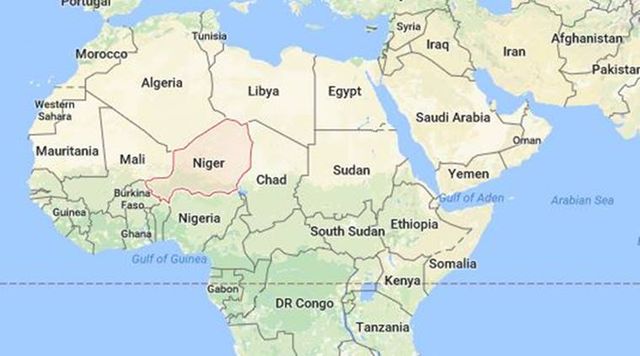
A map with Niger indicated by red border
The chairman of the Joint Chiefs noted that US troops have been operating in Niger off and on for two decades, and permanently since 2013, when the Obama administration prevailed on the government in Niamey to permit the establishment of the drone base, from which US Special Forces and intelligence agencies conduct surveillance throughout the Sahara and Sahel regions from a central location.
Dunford gave few details of the October 4 raid that ended with five Nigerien and four American soldiers killed and two more Americans wounded. He was unable to state how many Islamists had been killed, if any, thus confirming indirectly that the US forces and their allies had been forced to leave the battlefield in the hands of their opponents.
The general revealed that roughly equal numbers of fighters were engaged on both sides, with 30 Nigerien and 12 American soldiers confronted by 50 or so Islamists. Given the disparity in weaponry and the US ability to call in airstrikes, the protracted character of the combat and its bloody outcome suggest that the Islamists took the US-Nigerien force by surprise.
Dunford disputed accounts circulating online suggesting that there was an undue delay in the arrival of air support, in the form of French Mirage jets. The US-Nigerien force did not call for air support until an hour after the firefight began, he said. It took half an hour for the Mirage jets to be prepared for takeoff, and another half an hour to reach the battlefield, at which point they did not drop any bombs because they could not find the Islamist fighters.
Dunford added that the ground rules in Niger were that the US troops were to accompany Nigerien forces on missions only where no resistance was expected, let alone full-scale combat, thus confirming that the operation was carried out on the basis of faulty intelligence.
The main purpose of the press conference was not so much to convey new information, as to take a step back from the confrontational posture of Trump and White House Chief of Staff John Kelly, a retired four-star general, and from the suggestion by White House Press Secretary Sarah Sanders that any questioning of the Niger operation or Trump’s handling of the condolence calls was “inappropriate,” i.e., illegitimate.
General Dunford was at pains to declare that the American people had a right to get answers about the Niger operation. “I think we owe the families and American people transparency,” he said. He conceded that there was a “perception that the Department of Defense has not been forthcoming,” and repeatedly reassured the press representatives that they were asking “fair questions.”
At the same time, the top US general provided precious little information, only appealing for patience while the military continues its internal investigations. The Pentagon has not released many of the basic facts nearly three weeks after the battle. That did not stop the press from making a fawning show of prostration before the military chieftain. A number of reporters began their questioning by thanking the general for deigning to appear before them.
Congressional Democrats pressed ahead with criticism of Trump’s phone call and the overall conduct of the Niger operation, as always, seizing the opportunity to attack the Trump administration from the right and portray Trump as insensitive to the needs of the troops. Following the lead of Representative Wilson, they also sought to characterize Trump’s attitude to Sgt. Johnson and his widow, as well as Kelly’s criticism of the congresswoman herself, as racist.
This is a cover-up and a political diversion. Trump’s callous indifference towards the tragic fate of Sgt. Johnson is a class issue, not a race issue. It expresses the attitude of the financial aristocracy as a whole to the impact of the profit system on working people: whether it is young men and women sent into battle as cannon fodder, or workers maimed and killed on the job, or families whose livelihoods were destroyed by the financial looting that led to the 2008 Wall Street crash.