2 Nov 2017

More MPs face disqualification after Australian Senate president quits

Mike Head

Australian Senate president Stephen Parry will submit his resignation today to Governor-General Sir Peter Cosgrove, both as president and a member of parliament, after the UK Home Office confirmed that he is a British citizen, as well as an Australian citizen.
As Parry’s departure demonstrates, what has become, in effect, a nationalist purge of parliament, is far from over. Today, the Australian, Rupert Murdoch’s flagship, published a list of 21 other MPs whom it claims have not provided documentary proof that they renounced their entitlements to citizenship of other countries before standing for election.
Parry, a Liberal Party senator, became the sixth MP since July to be removed for breaching section 44(i) of the reactionary 1901 Constitution, which forbids anyone from even nominating for parliament if they hold “allegiance” to a “foreign power” or are “entitled” to citizenship rights of another country.
Like the five MPs disqualified by the High Court last Friday, Parry’s “entitlement” to dual citizenship was tenuous. He fell foul of section 44(i), despite being born in Australia, simply because his father emigrated from Britain in 1951—66 years ago.
Those already removed on a similar basis are deputy prime minister and National Party leader Barnaby Joyce and deputy National Party leader Fiona Nash, as well as two Greens senators, Scott Ludlam and Larissa Waters, who resigned in July as soon as the citizenship furore began, in order to prove their commitment to Australian nationalism. Malcolm Roberts, a Senate representative of Pauline Hanson’s anti-immigrant One Nation, was also ousted.
As with the other disqualified senators, Parry will be replaced by a nominee of his own party. His successor is likely to be Richard Colbeck, a former senator and tourism minister who lost his seat in the 2016 election. The implications of the ongoing disqualification saga are far broader, however, directly affecting the basic democratic rights of millions of people.
Dual citizenship has been permitted in Australia since 2002. An estimated half of the country’s increasingly diverse adult population now has, or is entitled to, that status. But in a sweeping anti-democratic ruling, the seven High Court judges last week unanimously applied a strict interpretation of section 44(i) that disqualifies them all from election to parliament unless they formally renounce their dual citizenship rights.
The supreme court’s judgment was replete with nationalist and patriotic language, demanding “unqualified allegiance to Australia” and “single-minded loyalty,” free from any “foreign loyalties or obligations.” The judges insisted that anyone “entitled” to citizenship of another country was “ineligible” to stand for parliament, even if they had no knowledge of that entitlement and had never accepted it.
Following Parry’s resignation, growing calls are being made throughout the media and political establishment for an “full audit” of the 226 senators and members of the House of Representatives, and all other candidates in the 2016 double dissolution election, to determine their eligibility.
This would be a full-scale McCarthyite-style witchhunt. It would require a genealogical investigation of every candidate, tracing their ancestry back, at least to their grandparents, to see whether the law of any other country potentially bestowed citizenship entitlements on them.
So far, Prime Minister Malcolm Turnbull and other leaders of the ruling Liberal-National Coalition are rejecting demands for such an investigation, together with the Labor Party leadership. Both parties fear losing more MPs. But several backbench government and Labor members have now joined the chorus, which was first instigated by the Greens in July. Others agitating for an “audit” include the xenophobic One Nation, Senator Cory Bernardi’s Australian Conservatives and another right-wing populist, Nick Xenophon.
Today’s Australian editorial reiterated that demand, which it originally took up in August, reminding its readers that it had declared “this time the Greens are right.” The editorial expressed alarm that “since then time has been wasted and the turmoil has increased.”
On national television last night, Greens leader Senator Richard Di Natale urged the government and Labor to “show some leadership” by backing the Greens’ audit call, in the interests of the “national wellbeing” and to halt the slide into “constitutional crisis territory.” Once again, the Greens are proving themselves to be the most loyal servants of the existing political order.
Despite the Coalition government losing two key cabinet ministers, and facing the prospect of losing its one-seat majority in the House of Representatives if Joyce fails to regain his seat at a December 2 by-election, there is nothing progressive whatsoever in this purge.
None of the MPs are being removed because of their right-wing and anti-working class policies. They are being ousted, on the orders of the High Court, the judicial pinnacle of the state apparatus, for being potentially disloyal to Australian capitalism. The judges explicitly referred to the need to ensure undivided allegiance, and freedom from any overseas military service obligations, in times of war.
The nationalist cleansing of parliament has a definite political agenda. It is being conducted under conditions of preparations for the Australian government to join even more catastrophic US-led wars, not just against North Korea but China and Russia, the two powers regarded most by Washington as obstacles to global US hegemony.
For more than a year, the media, working hand-in-glove with the US-linked Australian intelligence agencies, has repeatedly mounted frenzied propaganda campaigns against supposed Chinese “interference” in Australian politics, society, universities and business.
A column in today’s Australian by editor-at-large Paul Kelly pointed to the underlying connection between the disqualification saga and this promotion of an anti-Chinese and pre-war atmosphere. Kelly denounced any suggestion of amending the Constitution, via a referendum, to remove or modify the requirements of section 44(i), declaring: “The most ludicrous idea in the citizenship trauma is the proposal for a referendum to make our parliament truly multicultural by allowing MPs to be dual citizens.”
The veteran Murdoch editor drew a direct link to a potential conflict with China, asking: “How do you feel about having as prime minister an Australian-American dual citizen or an Australian-Israeli dual citizen or, if Beijing changes its policy, an Australian-Chinese dual citizen?” The references to the US and Israel were to provide a thin veneer for invoking the prospect of a confrontation with Beijing.
Kelly declared the necessity for a “powerful sense of sovereignty”—that is, xenophobic nationalism—and condemned any concession to the ever-more diverse character of the Australian population or popular internationalist sentiment. “Any serious push to reverse the import of section 44 would be a social engineering project aimed at weakening Australian sovereignty in the cause of internationalism.”
Others in the media and corporate elite are expressing alarm at the damage being done to the parliamentary edifice by the political turmoil surrounding the disqualification imbroglio. In today’s Fairfax Media outlets, national affairs editor Mark Kenny wrote: “The dual citizenship question burning like a subterranean coal fire beneath capital hill, is threatening collapse. A full blown ‘legitimation crisis’ looms. Confidence between the represented and the representative, is threadbare.”
This only poses the question of why such a destabilising witch-hunt has been unleashed. It can be understood only as a means of disciplining and re-shaping the political establishment, and acclimatising public opinion, for conditions of war and even deeper accompanying austerity measures and attacks on basic democratic rights.
It is increasingly possible that the political crisis could see the Turnbull government fall, wracked by recriminations and rifts over the disqualifications. However, outside the independent intervention of the working class, fighting for an alternative socialist and internationalist perspective, this would only pave the way for the return of yet another right-wing, pro-US Labor government, most likely propped up by the Greens and the various populist formations in the parliament.

Catalan, Spanish workers face grave dangers from Madrid’s repression

Paul Mitchell & Chris Marsden

The Catalan nationalist parties are working openly with the Popular Party (PP) government in Madrid in return for hoped-for concessions from the European Union. The result of their efforts is to allow the Spanish regime to set a dangerous precedent for imposing its will by police-military fiat, with the full backing of the Socialist Party (PSOE) opposition.
Last Friday, the regional parliament of Catalonia voted for independence from Spain and the start of a “constituent process” to draft a new constitution for a Catalan Republic. Of the 135 deputies in the parliament, 70 from the Democratic European Party of Catalonia (PDeCat), the Republican Left of Catalonia (ERC) and the pseudo-left Candidatures of Popular Unity (CUP) voted in favour.
The nationalist politicians pledged to resist the threatened invocation of Article 155 of the Spanish Constitution by the PP and to oppose attempts by Spanish Prime Minister Mariano Rajoy to oust Catalan President Carles Puigdemont and his regional ministers, dissolve the Catalan parliament and organise snap regional elections.
Instead, the nationalists have agreed to participation in the snap elections called for December 21—a move that will place a seal of legitimacy on Spain’s suspension of Catalan autonomy and rule of the region by decree.
Puigdemont and other ousted government ministers fled to Belgium, ostensibly to escape prosecution. But while there, Puigdemont repeated his appeals to the EU to intervene in the secession crisis by brokering a deal between Madrid and his deposed government. As a quid pro quo, he acquiesced in Rajoy’s call for snap elections, which he described as a “democratic plebiscite.”
According to a Radio Catalunya journalist, Ernest Marcià, speaking to the BBC, Puigdemont’s endorsement of the elections indicated that secret talks are taking place between Puigdemont and Rajoy, mediated by the EU. “In my opinion,” Marcià said, “something is going on that nobody knows is happening, and probably Europe is intervening… Not publicly, they will not recognize anything. But Spain has done something that they didn’t say a few weeks ago and Catalonia is accepting the authority of Spain, which is also very strange from the secessionist point of view.”
There is nothing strange in Puigdemont’s actions. The Catalan nationalists’ aim from day one was to whip up popular support for separatism, in part by exploiting legitimate grievances towards Madrid and the social unrest generated by austerity. But this was focused primarily on an appeal to middle-class layers, based upon demands that relatively prosperous Catalonia stop subsidising Spain’s poorer regions.
Catalonia is Spain’s richest region, representing a fifth of the country’s gross domestic product. The aim of the separatist parties is to create a new mini-state, or at least accrue the necessary degree of independence to establish direct relations with the global banks, transnational corporations and the EU. The goal is to consolidate Catalonia as a low tax, free trade area based on the stepped-up exploitation of the working class.
Their mobilisations on the street were never more than a form of leverage to negotiate greater tax-raising powers and other concessions from Madrid. The Catalan nationalist parties have spent years imposing brutal austerity measures while sending the regional Catalan police to smash up strikes and protests.
But once the European Union and its governments pledged support for Rajoy’s clampdown, a retreat was only a matter of time. On Monday, the PDeCAT and ERC affirmed their abandonment of opposition to the December 21 elections and announced they would field candidates.
ERC spokesman Sergi Sabrià, while declaring the election “illegitimate” and “a trap,” added that “nevertheless, we are not afraid of the ballot box.”
The Catalan National Assembly, whose leader remains in jail on sedition charges, insisted it still “only recognises the Catalan Republic” and rejected Article 155, only to declare in the next breath it would call a meeting “before November 3” to decide on a “joint strategy” for the December 21 elections.
The petit-bourgeois Popular Unity Candidacy, CUP, which kept the ERC-PDeCAT coalition in power while acting as the most intransigent promoters of the bourgeois nationalist cause and hailing its supposed leftist credentials, was even more explicit, cavalier and criminal. “The Spanish state has neutralized us with intimidation and fear,” it complained.
“What has happened,” CUP spokesperson Benet Salellas concluded, is “that there has been an excess of improvisation in some of the actions during the last months.” He then reiterated support for Puigdemont, praising him for focussing on Brussels, which supposedly “internationalizes the massive violation of human rights,” and ended with a pathetic call for him to “approve the first republican decrees.”
The CUP’s Political Council is organising a meeting on November 4 to decide whether to support Rajoy’s elections and register before the November 7 deadline.
Those sections of the Catalan-speaking working class that lent support to the nationalists have drawn initial conclusions from the ongoing rout. Reports are that most public-sector workers, including teachers and fire fighters, as well as the regional police, have continued working after earlier indicating backing for a campaign of civil disobedience. The trade union bureaucracy is more than happy to climb down, with Intersindical-CSC declaring Monday that it has called off a threatened general strike.
This situation is fraught with dangers.
The nationalists first championed a divisive programme that helped create maximum confusion—dividing Catalan workers from those in Spain, and dividing Catalan- and Spanish-speakers in the region—at a time of universal opposition to the austerity agenda imposed by Madrid and Barcelona alike.
Now, after the PP seized on an opportunity to mobilise the army and civil guard and impose rule by decree, they offer their services as a political gendarme in the hope of striking a new bargain with Madrid and Brussels.
The attempt by Madrid and the EU to impose a dictatorial regime, whether or not this is sanctioned by imposed elections, must be opposed by the entire Spanish and Catalan working class. The hand of the PP government has only been strengthened by allowing it to implement repressive and anti-democratic measures that will inevitably be employed against workers throughout Spain.
But an implacable struggle against Madrid and its EU backers can be waged only if it is entirely independent of the Catalan bourgeois parties and their reactionary agenda of national separatism.
A progressive answer to the crisis confronting the working class of Spain, whatever language is spoken, demands an end to all national divisions through the adoption of the perspective of socialist internationalism. Against a capitalist Spain and the plan to create a capitalist Catalonia, the working class must wage a unified struggle for the formation of workers’ governments in Spain and throughout Europe as part of the progressive socialist unification of the continent.

Niger defense minister exposes US military role in West Africa

Eddie Haywood

Making clear the October 4 ambush that killed four Green Berets is to be utilized as a pretext for a major escalation of American military operations in the region, Nigerien Defense Minister Kalla Mountari requested that the US deploy armed drones against reputed militants.
During an interview with Reuters on Wednesday, Mountari said, “I asked them some weeks ago to arm them (the drones) and use them as needed.” When asked if Washington had granted the request, Mountari replied ominously, “Our enemies will find out.”
Washington has claimed that the 800 US special forces personnel stationed in Niger are restricted to providing training and surveillance assistance to Nigerien forces and have no direct combat role.
Shedding further light on the nature of the joint operation of October 4 conducted by the US elite troops with Nigerien forces, Mountari revealed that the team of 12 elite commandos and 30 Nigerien troops had been “right up to the Mali border and had neutralized some bandits” moments before the ambush took place.
Further exposing Washington’s fraudulent claims of a non-combat role, Mountari said, “They [U.S.-Nigerien contingent] came back to Niger, they greeted the population, they gathered intelligence and it was inside the country, when they didn’t expect anything, that the attack happened.”
This damning admission by the top military official in Niger not only exposes as a lie Washington’s claim that its elite soldiers have no direct combat role, but illustrates clearly that the US is spearheading the military offensive in the region.
Mountari corroborated this, saying, “The Americans are not just exchanging information with us. They are waging war when necessary. We are working hand in hand. The clear proof is that the Americans and Nigeriens fell on the battlefield for the peace and security of our country.”
The public announcement of the request for drone strikes comes as the Trump administration has agreed provide $60 million for a new UN-backed military offensive in West Africa, together with the completion of a $100 million drone facility in Agadez, Niger.
When all these developments are taken together it must be presumed that a major US military onslaught is imminent in the resource rich region.
The extent of US forces arrayed across the region has been highlighted by recent reports on the June murder of Green Beret Staff Sgt. Lance Melgar in a housing complex at the US embassy in neighboring Mali, suspected to have been carried out by two unidentified Navy Seals.
The elite troops were part of the US counter-terrorism effort in Mali, charged with a mission similar to the one carried out by elite soldiers in Niger.
Illustrating the murderous character of the type of operations carried out by the elite commandos deployed to the Sahel, Navy Seals were part of the special operation that conducted the 2011 raid on Osama Bin Laden’s compound in Abbottabad, Pakistan, in which the Al-Qaeda leader was killed.
The US soldiers deployed to West Africa have been mostly drawn from elite military units, such as Navy Seals and Green Berets, which carry out Washington’s most secret and illegal operations around the globe, including assassination, counter-terrorism raids, special reconnaissance, unconventional warfare, psychological operations, and training of foreign troops.
On Monday in an appearance before the United Nations Security Council, UN Ambassador Nikki Haley officially pledged $60 million towards the UN-authorized G5 Sahel force, a joint US-French-led military unit consisting of 5,000 troops from the five West African countries of Burkina Faso, Chad, Mali, Mauritania, and Niger.
In June, France drafted a resolution before the UN Security Council asking the body to fund G5 Sahel, as well as requesting the council grant the five-nation force a sweeping mandate to use “any means necessary” to carry out its mission of neutralizing Islamist militants, drug smugglers, and human traffickers.
The request for the designation of G5 Sahel as an offensive force bears similarity to the mandate granted to the UN Force Intervention Brigade formed in 2013 to neutralize the Rwandan M23 militia in eastern Congo.
Washington, in agreeing to provide funding for the G5 Sahel, sharply opposed the French proposition to give the force full authorization, arguing that the resolution was overly broad and unnecessary. Fundamental to Washington’ s opposition is concern that France may gain a strategic advantage over the US in West Africa.
US Secretary of State Rex Tillerson, in announcing the funding pledge, elucidated Washington’s aim of geopolitical domination of the Sahel: “Defeating terrorism depends on making sure terrorist organizations cannot have safe havens on any continent. This is a fight we must win, and these funds will play a key role in achieving that mission.”
Washington’s professed objective of “fighting Islamist rebels” deliberately leaves out the fact that these same Islamist militants wreaking havoc across the Sahel are the product of the US strategy of utilizing these forces as a proxy army in the 2011 US/NATO war against Libya. Following the shattering of Libyan society and the assassination of the country’s leader Muammar Gaddafi, these fighters scattered across northern Africa and throughout the Sahel.
Behind the US escalation of its military offensive in the Sahel is Washington’s broader imperialist design of securing Africa’s vast economic resources for the American capitalist elite, in direct competition with European rivals who maintain significant economic interests in their former colonial holdings on the continent.
Above all, Washington’s push for geostrategic dominance over West Africa is being driven by concerns over China’s expanded economic influence in the region, which Washington perceives as an intolerable intervention which can only be countered by military might.
Beijing secured agreements with the Nigerien government in 2008 to extract the country’s oil deposits, acquiring the Agadem block near the border with Chad. Under the terms of the agreement, China’s state-owned China National Petroleum Company (CNPC) set out a plan for the construction of a refinery and a 2,000-mile pipeline for a capacity of 20,000 barrels per day.

Lawmakers demand tech companies censor journalists and conduct mass surveillance

Andre Damon

Wednesday’s hearings by the House and Senate Intelligence committees on “extremist” political views served as the occasion for members of Congress to urge technology companies to flagrantly violate the US Constitution by censoring political speech, carrying out mass surveillance, and muzzling journalists in pursuit of the government’s geopolitical aims.
The hearings revolved around allegations, promoted ceaselessly in recent months by the intelligence agencies, leading figures within the Democratic Party, and newspapers such as the New York Times, that social opposition to the political establishment results from “fake news” promoted by Russia.
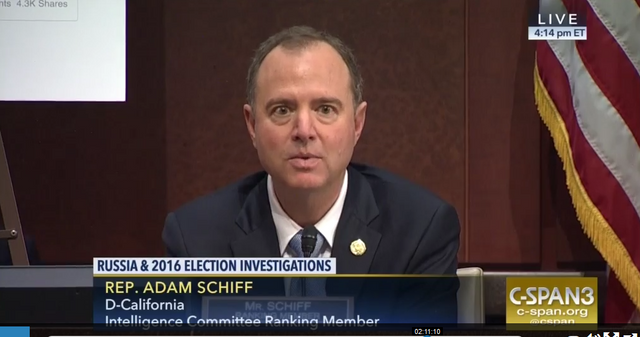
As Democratic Congressman Adam Schiff put it, “Russia” promoted “discord in the US by inflaming passions on a range of divisive issues” and sought to “mobilize real Americans to sign online petitions and join rallies and protests.”
The basic problem, however, as Schiff put it, is “not just foreign.” The algorithms used by Facebook and Twitter have the “consequence of widening divisions among our society.” Schiff complained: “What ends up percolating to the top of our feeds tends to be things we were looking for,” as opposed to US government propaganda disseminated by the establishment media, which he referred to as “true information.”
Congressman Adam Schiff
In line with Schiff’s assessment, members of Congress who participated in the hearings spent the bulk of their time demanding that the companies censor such “fake” news, which they equated with the writings of exiled journalist Julian Assange and other political dissidents.
It is a testament to the decay of American democracy that it was left to the representatives of Facebook and Twitter, who have been broadly accused of violating users’ privacy for their own financial gain, to inform members of Congress about the ABC of constitutional law.
In an exchange that embodied the total contempt for freedom of speech that pervades the ruling elite, South Carolina Representative Trey Gowdy demanded that Facebook and Twitter block their users from making inaccurate statements about the current day of the week.
“Can I ‘say today is Thursday’,” the South Carolinian demanded. “What are you going to do with that?” Gowdy asked which constitutional amendment protects the right of people to make such statements, totally oblivious that almost all false statements are protected under the First Amendment.
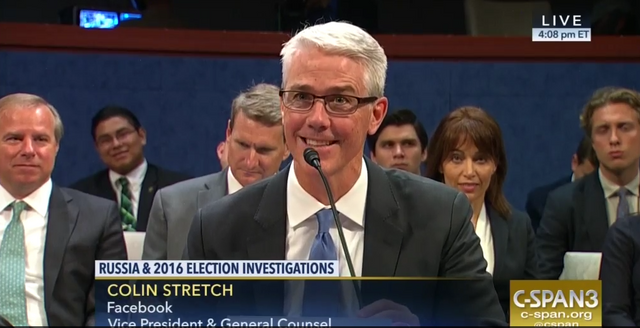
Colin Stretch, Facebook’s general counsel, fighting back a skeptical smile, replied: “There is Supreme Court precedent on that…”
Facebook General Counsel Colin Stretch
Gowdy, befuddled, demanded: “On which side?” Stretch answered: “That it is, in most cases, protected.” He continued: “On Facebook, our job is not to decide whether content is true or false.”
Although the representatives of the technology companies largely played along with the narrative of “Russian meddling” in American politics, their resistance to the most flagrant censorship demanded by the government piqued the ire of the senators leading the witch-hunt.
“I don’t think you get it,” fumed Senator Dianne Feinstein, who said the past year had seen “a cataclysmic change” in American politics. This is “the beginning of cyber warfare,” she declared, and technology companies “have to really take a look at that and what role you play.”
Senator Mark Warner, for his part, complained that his accusations had been “frankly blown off by the leaderships of your companies and dismissed.”
Earlier this month, Google removed Russia Today (RT), a Russian-sponsored TV station and online news outlet that reports stories largely censored by the mainstream press, from its list of “preferred” channels on YouTube. Feinstein took issue with Google’s statement that it revoked RT’s status as a preferred channel for non-political reasons, and demanded to know why Google had not acted against RT earlier.
Google’s general counsel Kent Walker replied: “We have carefully reviewed the content of RT to see that it complies with the policies that we have against hate speech, violence, etc. So far, we have not found violations.”
California Democratic representative Jackie Speier asserted that RT “seeks to influence politics and fuel discontent in the United States.” She asked: “Why have you not shut down RT on YouTube? … It’s a propaganda machine, Mr. Walker, the intelligence community says it’s an arm of one of our adversaries.”
The clashes continued. Senator Tom Cotton demanded to know why Twitter refused to turn its platform over to the CIA in order to conduct mass surveillance. He asked: “Do you see an equivalency between the Central Intelligence Agency and the Russian intelligence services?” Sean Edgett, Twitter’s general counsel, replied: “We’re not offering our service for surveillance to any government.”
Cotton likewise demanded that Twitter censor WikiLeaks’ editor Assange. “The current director of the CIA, Mike Pompeo, as well as this committee, has labeled WikiLeaks a non-state hostile intelligence service who aids hostile foreign powers like the Kremlin,” he said. “Yet, to my knowledge, Twitter still allows him to operate uninhibited.”
Receiving a reply from Twitter general counsel Edgett that the company applies its policies “without bias,” Cotton retorted: “Is it biased to side with America over our adversaries?”
In yet another incitement for technology companies to violate the Constitution, this time the Fourth Amendment, which prohibits unreasonable searches and seizures, Texas Democratic Congressman Joaquin Castro asked: “Are you also intending to turn over to the committee any kind of direct messages” on accounts suspected of being linked to Russia?
When Edgett pushed back that this would be possible only through legal channels, Castro responded: “Certainly you’re not making the argument that a Russian account, a fakely created account, has some protection of privacy here.” Edgett replied: “Some users may end up being fake. Others will be real.”
The most surprising element of the hearings, however, was the extent to which Walker, Google’s general counsel, sought to separate Google’s search tools from the social networks operated by Facebook and Twitter when it comes to “fake news.”
In reference to a question regarding fake news, Walker interjected: “I think there’s a distinction between say Google search, whose goal is to provide accurate, relevant, comprehensive information and social network concerns,” such as those related to Twitter and Facebook. “We think the heart and soul of the products is to try to provide useful and, to the extent we can, accurate information to users.”
This was in addition to his prepared testimony, where he noted: “At Google News, we use fact check labels to spot fake news. At Google search, we have updated our quality guidelines and evaluations to help surface more authoritative content from the web.”
Based on the stated goal of fighting “fake news,” Google has implemented sweeping changes to its search algorithm that has led search traffic to 13 leading left-wing, progressive and anti-war sites to plunge 55 percent. Search traffic from Google to the World Socialist Web Site has fallen by 74 percent, and the site has been blocked from Google News.
Wednesday’s testimony makes clear the political motives behind Google’s actions. Rather than seeking, as it publicly claims, to provide “true” and “authentic” content, Google is acting as the proxy of the US government and its agencies to muzzle its critics and political opponents.

1 Nov 2017

Problems of the Super-Rich

Lawrence Wittner

Based on recent economic developments, the super-rich don’t have much to complain about.
A study just released by UBS, a major global financial services company, has revealed that, during 2016, the total wealth of the world’s billionaires rose by 17 percent―from $5.1 trillion to $6.0 trillion. Furthermore, the number of billionaires grew by 10 percent to 1,542, with more than a third of them located in the United States. As of late October 2017, the five wealthiest Americans were Jeff Bezos ($93.8 billion), Bill Gates ($88.7 billion), Warren Buffet ($81.0 billion), Mark Zuckerberg ($75.4 billion), and Larry Ellison ($56.0 billion).
There is a very substantial gap between the circumstances of what Senator Bernie Sanders calls “the billionaire class” and average Americans, including the nearly 28 million Americans working for companies these billionaires own or partly own. The five members of the Walton family who are heirs to the Walmart fortune now have a collective net worth of $140 billion. Recently, in fact, their wealth jumped $5 billion in one day. Walmart workers, though, are unlikely to ever amass any wealth―indeed, many find it necessary to apply for government food stamps to feed themselves and their families―for their wages are pathetic. Walmart sales associates earn an average of $9.41 an hour, while Walmart cashiers average $9.36 an hour.
Given these wealth disparities in what has been called “a new Gilded Age,” you might think that government action would be taken to redress the balance. But you would be wrong. Despite rising economic inequality in the United States, Congress has kept the minimum wage stuck at $7.25 an hour since 2009. If anyone thinks this is a living wage, he or she should try living on it some time. Meanwhile, as Senator Sanders pointed out, the Republican tax plan moving through Congress provides $1.9 trillion in tax breaks for the richest Americans and the largest corporations. About 80 percent of the tax breaks would go to the top 1 percent, with 40 percent going to the top 1/10 of 1 percent.
But the super-rich do have problems.
Key among them is how to spend the enormous amounts of money that they are amassing. Many of their new purchases include very expensive art and, particularly, sports teams. Indeed, more than 140 of the top sports clubs around the world have been gobbled up by just 109 billionaires, of whom 60 are from the United States. Billionaires now own two-thirds of NBA and NFL teams and half of all Major League baseball teams. But there’s plenty of wealth left over, and so the super-rich spend it on driving $4 million Lamborghini Venenos, acquiring megamansions for their horses, flying luxurious underwater planes, taking $80,000 “safaris” in private jets, purchasing gold toothpicks ($600 each), creating megaclosets the size of homes, having champagne delivered to them by parachute, building new megamansions and leaving them vacant for years, residing in $15,000 a night penthouse hotel suites, installing luxury showers for their dogs, covering their staircases in gold, and building luxury survival bunkers. Commenting on his expenditure of at least $600 million to create an exact replica of the Titanic, one billionaire remarked: “I’ve got enough to pay for it, so that’s all that really matters.”
Of course, there’s also the issue that has plagued the upper classes for centuries: how to deal with “the Servant Problem.” For the most part, the very wealthy do not want to shop for and cook their own food, serve their meals, wash their dishes, care for their children, clean their homes, and engage in the many other tasks that consume large portions of the lives of ordinary people. Therefore, the very wealthy rely heavily on those other people to do these things for them. But they are frequently dissatisfied with the service they receive and, as a result, spend a good deal of time among themselves complaining about “the help” and looking for better, more dutiful workers. Not surprisingly, the new super-rich are now scrambling to acquire well-trained, impeccably-groomed, and properly-behaved servants, even at a substantial cost.
Finally, the super-rich face the problem of how long people are going to tolerate a situation in which just eight men possess the same wealth as half the world’s population: 3.6 billion people. “Wealth concentration is as high as in 1905,” warned the lead author of the UBS report, and “this is something billionaires are concerned about.” The “question is . . . at what point will society intervene and strike back?” This is a perennial problem for economic elites and, to head off popular resistance or revolt, they have, at various times, resorted to government repression or to anti-Semitic, racist, and xenophobic appeals to divert popular discontent. Yes, they could also give way gracefully to public pressure and accept a redistribution of wealth. But there is no evidence that this is a popular position among the “billionaire class.”
In any case, the problems of the super-rich are rather unique, and do not appear to be those of most other people. In the United States, at least, there seems to be far more widespread concern about unemployment and underemployment, stagnant wages, climate change, and the enormous cost of healthcare and higher education than there is about acquiring gold toothpicks. Furthermore, like most Americans, the vast majority of the world’s people are not going to have their problems addressed as long as the world’s riches remain concentrated in the hands of the wealthy few, whose priorities determine public policy.

China Rising: Global Opportunity or Global Threat?

ROY MORRISON

The recent tightly scripted 19th Chinese Communist Party National Congress has generally been viewed as evidence and celebration of the rise to great power of Chinese President Xi Jinping. President Xi is in ascendance. But what does that really mean for China and the rest of us.
It’s far more useful for us to focus on facts on the ground, on China’s actions than on attempts to parse the meaning of the makeup of the 7 member Standing Committee (SC) at the pinnacle of Party and Chinese government power whose decisions are driven by completely private discussions behind closed doors.
The facts. China has rapidly emerged in the 21st century as global leader in renewable resource development. China’s leadership and success in helping build a global efficient renewable resource system is absolutely crucial if we are to escape climate change driven global ecological catastrophe. Our collective futures are suddenly, to a considerable extent, in President Xi’s hands given the Trump administration’s opposition to effective action on climate change and support for accelerated coal, oil,and natural gas development.
China is manufacturing and installing solar electric and wind energy systems at an astounding rate. China is responsible for 40% of global renewable energy growth according to the International Energy Agency (IEA). Last year, global solar electric (PV) capacity grew by 50%, over 74 gigawatts, with China responsible for almost half of this. By 2022 the IEA forecasts global PV capacity will expand to 920 gigawatts. China, with India soon to follow, is leading the way.
Global investment in renewables now exceeds that in fossil fuel plants. China is also global market leader in electric vehicles, hydropower and biomass systems. China is, as well, global leader in reforestation. China has begun implementing a carbon tax that is being systematically applied across all aspects of the economy,not just on power generation. It will gradually ramp up to help send clear signals for sustainability. China, the largest market for low quality recycled plastic has just banned such imports in part to encourage domestic recycling, and in part to refuse to being the destination for foreign garbage. Building an ecological civilization is official Chinese policy, both at home and internationally. This is a matter of collective self-interest for all of us.
As the United States under Trump pulls out of foreign trade agreements and embraces protectionism and nativism, China is quickly filling the void. Australia’s leading trade partner, for example, is China. China is now the world’s second largest economy, and still growing rapidly at a 6.5 % annual rate.
China is pursuing the multi-trillion dollar One Belt One Road investment program to connect China on land and sea to Asia, Africa and Europe ,investing in building roads, rail, ports, power plants, power lines. In countries like Pakistan, Chinese investment has become a major economic and political fact of life. One Belt One Road can play out as sustainable co-development that builds economic vitality for all and win-win for all with China as central hub. Or will One Belt One Road lead to imposed stringencies upon debtor countries, neo-colonialism with China as the new master instead of the IMF, World Bank and U.S., using debt to ensnare the credulous and gaining control of natural resources? Success of One Belt One Road will depend on China pursuing fair and equitable partnerships sensitive to the political dynamics of dozens of nations where the realities of One Belt and One Road will be determined.
China is a very unusual one party state with the intention of becoming global economic leader. The power and influence of the Communist Party of China is not just political, but economic, financial and social. There are inherent problems inherent in continued success of a one party state. Dealing with these problems is central to President’s Xi’s program.
A unitary hierarchy with economic power presents ongoing problems of inefficiency and corruption including the protection of inefficient state controlled provincial enterprises, manipulation and abuse of investment and finance, and vanilla kleptocratic behavior. A feature of Xi first five years have been very strong anti-corruption efforts that disciplined and punished Party members. Less well known have been efforts to strengthen rule of law and a conditionally independent judiciary . An independent judiciary in China must accomplish the most difficult dance within the context of a one party state where President Xi is the ultimate decider. An independent judiciary with Chinese characteristics is key not just to a belief in fairness and equity, but for the conduct of business with China both nationally and internationally.
China is a one party state that is becoming global economic leader whose ecological conduct and leadership has become key to our common survival. It is a system that allows considerable personal autonomy but not political opposition to the rule of the Communist Party.
There is every reason to make common cause with China in the pursuit of global economic development and sustainable economic growth. We should offer China partnership and cooperation for meeting common goals and encourage our Chinese partners to honor the rights of Chinese citizens in their constitution. China, under President Xi Jinping is focused on a carefully considered long term plan for building a prosperous and sustainable China as a global leader. It is a project that we all can support in our mutual self-interest. To pursue trade war and military confrontation with China is a grave error.

Iraq to End Decades-Old Policy of Semi-Independent Rule in Kurdistan

Patrick Cockburn 

Iraqi Prime Minister Haider al-Abadi is triumphant as he describes his country’s security forces driving out Isis from its last strongholds in western Iraq. “Our advances have been fantastic,” he said in an interview with The Independent in Baghdad. “We are clearing the deserts of them right up to the border with Syria.” Isis is being eradicated in Iraq three years after its columns were threatening to capture Baghdad.
Once criticised as vacillating and weak, Mr Abadi – who became Prime Minister in August 2014 – is now lauded in Baghdad for leading the Iraqi state to two great successes in the past four months: one was the recapture of Mosul from Isis in July after a nine-month siege; the other was the retaking of Kirkuk in the space of a few hours on 16 October without any resistance from Kurdish Peshmerga.
The son of a neurosurgeon in Baghdad, Mr Abadi, 65, spent more than 20 years of his life in exile in Britain before the fall of Saddam Hussein. Trained as an electrical engineer, he gained a PhD from the University of Manchester, before working in different branches of industry. A member of the Shia opposition Dawa party from a young age, two of his brothers were killed by Saddam Hussein’s regime and a third imprisoned. He returned to Iraq in 2003 where he became an MP and a leading figure in the ruling Dawa party.
As the man with the strongest claim to be the architect of the two biggest victories ever won by the Iraqi state, Mr Abadi’s reputation has soared at home and abroad. He is particularly pleased that there were so few casualties when Iraqi forces retook the great swath of territory disputed with the Kurds, which stretches from Syria in the west to Iran in the east. “I gave orders to our security forces that there should be no bloodshed,” he says, explaining that fighting the Peshmerga would make reconciliation difficult between the Kurds and the government.
Soft-spoken and conciliatory, Mr Abadi is determined to end the quasi-independence of the Kurdistan Regional Government (KRG) that dates back to Saddam Hussein’s defeat after his invasion of Kuwait in 1991. He says: “All border crossings in and out of Iraq must be under the exclusive control of the federal state.” This includes the Kurdish oil pipeline to Turkey at Faysh Khabour, by which they once hoped would assure their economic independence, as well as the main Turkish-Iraqi land route at Ibrahim Khalil in the north west KRG. This crossing has been Iraqi Kurdistan’s lifeline to the rest of the world for a quarter of a century. Iraqi officials will likewise take over the international side of the airports in the Kurdish cities of Irbil and Sulaimaniyah.
These administrative changes do not sound dramatic, but they effectively end the semi-independence of the Iraqi Kurds which they had built up over the past 26 years. Kurdish president Masoud Barzani, who is to give up his post on 1 November, put these gains at risk when he held a referendum on Kurdish independence on 25 September.
Mr Abadi is in a strong position because the KRG’s two biggest neighbours, Turkey and Iran, agree with him on re-establishing federal control of the border and Kurdish oil exports. Mr Abadi says the Turks admit that “they made a mistake” in the past in dealing directly with the KRG and not with the central government in Baghdad. He emphasises  that he will not be satisfied with Iraq government officials having a symbolic “spot” at different crossing points on the border, but they must have exclusive control of borders and international flights. Asked if this would include visas, Mr Abadi says: “This is a must.”
He wants the Peshmerga either to become part of the Iraqi government security forces or a small local force. He is curious to know how many Peshmerga there really are, expressing scepticism that there are really 300,000 men under arms as claimed by the Kurdish authorities. He says: “I have been told by many leaders in Kurdistan that there is a small fighting force and the rest stay at home.”
He recalls that when he became Prime Minister in 2014 after Isis unexpectedly captured Mosul, he made inquiries as to why five Iraq divisions had collapsed. He found that the main reason was corruption and in many units half the soldiers were drawing their salaries but were not there. He suspects the Peshmerga operate the same corrupt system, which he says would explain “why they failed to defend the borders of KRG [against Isis] in 2014 and had to seek the help of the US and Iran”.
The number of the Peshmerga may be in dispute, but Mr Abadi is adamant that “I am prepared to pay those Peshmerga under the control of the federal state. If they want to have their local small force – it must not be that large – then they must pay for it.” He says that the KRG must not become “a bottomless well” for federal payments. He would also expect Kurdish government expenditure to be audited in the same way as spending in Baghdad.
If all these changes are implemented then Kurdish autonomy will be much diminished. It is easy to see why Mr Barzani is stepping down to avoid the humiliation of giving up so much of his authority. Resistance by the Kurdish leadership will be difficult since they are divided and discredited by the Kirkuk debacle. But Mr Abadi’s strength is that for the first time since 1980, the Kurds do not have any backers in neighbouring states and the US has done little during the crisis except wring its hands at the sight of its Kurdish and Iraqi government allies falling out. When Mr Barzani unwisely forced Washington to choose between Baghdad and Irbil, the Americans were always going to choose the Iraqi state.
Iraqi forces enter Kirkuk
Queried about Iranian influence on the Iraqi government. Mr Abadi is exasperated and derisive by turns, particularly about Qasem Soleimani, the director of foreign operations of the Islamic Revolutionary Guards Corps (IRGC)  whose negotiations with the Kurdish leadership have been reported as playing a decisive role in the retreat of the Peshmerga from Kirkuk.
“He definitely didn’t have any military role on the ground in the crisis [over Kirkuk],” says Mr Abadi. “I can assure you that he had zero impact on what happened in Kirkuk.” Mr Abadi says that it was he himself who called the Kurdish leadership and persuaded them not to fight and to withdraw the Peshmerga from the disputed territories.
A more substantive allegation is that the Hashd al-Shaabi, the powerful Shia paramilitary units which have fought alongside the Iraqi regular forces, are sectarian and under Iranian influence or control. Asked about his recent meeting with Rex Tillerson, the US Secretary of State, who said the Hashd should “go home” or be dismantled, Mr Abadi said that there was either “a misquotation or misinformation” and Mr Tillerson seemed to be under the impression that the IRGC was fighting in Iraq and did not know that the Hashd were all Iraqis.
He said that Iraq had plenty of foreign advisers from the US, UK, France and elsewhere, including Iran, but the number of Iranian advisers was only 30, well down from 110 a few years ago. As for the Hashd, he said they had to be under government control, well-disciplined and to have no political role, particularly not in the Iraqi general election on 12 May 2018 which he pledged not to postpone.
Mr Abadi is in a strong position because he is one of the first Iraqi leaders whose government has good relations with all Iraq’s neighbours: Turkey, Iran, Kuwait, Saudi Arabia, Jordan and Syria. Iraq, a country deeply divided between different sects and ethnic groups, has traditionally been destabilised by domestic opponents of the central government combining with state sponsors abroad who supply money, weapons and a sanctuary. This is not happening for the moment, which is why the Kurdish leadership is so isolated.
Part of Mr Abadi’s success during the Kirkuk crisis stemmed from disastrous miscalculations made by Mr Barzani about the reaction of Baghdad and the rest of the world to the independence referendum. Bur Mr Abadi showed an acute sense of how to exploit his opportunities.Turkey and Saudi Arabia, who once supported or tolerated al-Qaeda type organisations operating in Iraq, now fear them and are frightened of their dispersal as the self-declared Caliphate is destroyed.
“We got the international community on our side,” says Mr Abadi, reflecting on the course of the Kirkuk crisis. “We made it very simple: we said the unity of Iraq is very important for combating terrorism.” The division of Iraq, through the prospect of Kurdish independence,  would open up cracks which Isis would exploit. Mr Abadi certainly knew what buttons to press when it came to getting neighbouring states on his side.  He is patient and strong-minded and the tides that once tore Iraq apart may now be running in his favour.

A Devils’ Alliance: the U.S./Israel Obstacle to Peace

Michael Hager

In Obstacle to Peace: The US Role in the Israeli-Palestinian ConflictJeremy R. Hammond, publisher and editor of the online Foreign Policy Journal, makes a convincing case that the American government has routinely collaborated with Israel to block a genuine peace process, avoid compliance with international law and co-opt the mainstream media.
Hammond traces the conflict from the rise of Hamas in Gaza in 1987 through the U.N. vote on Palestinian statehood in 2012. His chapters on “Operation Cast Lead,” The Goldstone Report and the Gaza Flotilla Incident (“Murder on the High Seas”) are especially revealing of the U.S.-Israel complicity.
With 70 pages of detailed notes to support his case, the author cites as continuing U.S. policies:
+ Refusal to accept a two-state solution;
+ Refusal to negotiate with Hamas;
+ Refusal to call Israel to account for war crimes;
+ Opposition to Palestinian statehood; and
+ Co-option of the mainstream media.
+ The following are the book’s significant conclusions:
“Two-state solution”
In the wake of the 1967 war, the unanimously approved UN Security Council 242 laid the legal foundation for the two-state solution that we know today.  Among other things, the Resolution provided for Israeli withdrawal from the occupied territories and “acknowledgment of the sovereignty, territorial integrity and political independence of every State in the area and their right to live in peace within secure and recognized boundaries free from threats or acts of force.” Although both the United States and Israel have accorded lip service to Res.242, the book shows how both countries have worked in tandem to block its implementation. According to Hammond, U.S./Israel policies “are not premised on the equal rights of all human beings and are not intended to achieve the fulfillment of a just settlement through the application of international law.”
Negotiating with Hamas
Ignoring repeated Hamas offers of a ceasefire and a readiness to accept two-states, both Israel and the U.S. have consistently refused to negotiate with that organization, either alone or in concert with Fatah. In 2006 the U.S. refused to recognize the democratically-elected government in Gaza, plotted unsuccessfully to overthrow it and later failed to stop Israel’s collective punishment of Gazans for their election of Hamas.
Tolerating war crimes
According to Mr. Hammond, the U.S. government “condemned only the violence committed by Palestinians while giving its blessing to Israel’s onslaught.”  Both Israel and the U.S. rejected the Goldstone Report and other reports that documented IDF war crimes. A constant theme during the 2009 war on Gaza and beyond has been the refusal of Israel and the USG to acknowledge the demands of international law (e.g. mandates against the use of white phosphorus munitions and the bombing of civilian places).  As American-made arms devastated Gaza, the USG declined to criticize Israel for its attacks on schools, mosques and apartment buildings.  Hammond’s chapter on “Operation Cast Lead” is replete with examples of Israeli war crimes that the USG repeatedly failed to condemn.
Palestinian statehood 
Opposed by the U.S. and Israel in its effort to achieve statehood, the PA attempted to secure international recognition through the UN, initially by joining UNESCO.  Facing certain opposition by the U.S. in the Security Council on a bid for full UN membership, the PA managed to secure from the General Assembly an upgrade of its status to non-member observer state.  Along the way, Palestinians faced dire threats of aid cut-offs and other sanctions.
Mainstream media
Throughout the volume, Hammond cites mainstream media articles that make Israel appear the victim.  There are, for example, a number of New York Times articles that either applaud Israeli attacks on Gaza (e.g. “Israel Reminds Foes That It Has Teeth”) or blame the Palestinians for initiating conflict when the facts are otherwise.  Parroting IDF reports, western journalists have regularly emphasized Israeli losses without citing Palestinian casualties. They have tended to equate military violence, as if the Palestinians had a war machine remotely equal to Israeli might.
In its detailed review of America’s role in the Israeli-Palestinian conflict, Obstacle to Peace convincingly exposes USG complicity with Israel in blocking the peace process, undercutting a two-state solution (despite pious words to the contrary), resisting the demands of international law, disregarding war crimes, endorsing the Gaza blockade and opposing Palestinian statehood.  The book also offers abundant evidence of pro-Israel bias in the mainstream media, the result of which has kept most Americans in the dark.
What the book doesn’t do is explain why Israel has continued to earn the unquestioning support of the American Congress and why the mainstream media has acted as an echo chamber for Israeli spokespersons.  Is it only the backing of Zionist or Evangelical Christian constituents that fuels pro-Israel policies?   Or could it be the money that flows from the lobbyists of AIPAC-affiliated organizations to fund political campaigns, reward elected officials and offer lawmakers all-expense junkets to Israel?  Perhaps the author’s next volume will answer those questions.
In the meantime Jeremy Hammond has produced a valuable record of a U.S. collusion with Israel that resounds to the detriment of Palestinians, disrespects international law and shames America.

Indonesia: At least 47 dead in Jakarta factory fire

John Roberts

A massive explosion and blaze swept through a fireworks factory at Kosambi in Tangerang, a satellite city on the outskirts of Indonesia’s capital, Jakarta, last Thursday. Most of those trapped inside were killed or suffered horrific burns.
Of the 103 workers thought to be in the plant, at least 47 died inside the factory and 46 were injured. The workforce was largely composed of women, teenagers and at least three under-age children. A 14-year-old girl was among the dead.
Tangerang police chief Hary Kurniawan has stated that the death toll is likely to rise as a result of the severity of burns suffered by the injured. According to doctors, many have burns to 80 percent of their body and are in a critical condition. At least 10 more workers are unaccounted for.
Angry and distraught relatives crowded three hospitals in the area searching for their family members last week. They were well aware of the appalling safety record of the plant, and previous fires in similar facilities. Indonesian authorities are notorious for failing to enforce basic safety regulations in the country’s many sweatshops.
Photos from the scene have pointed to the conditions that led to the tragedy. They show a confined space in which over 100 workers were operating in close proximity to dangerous materials.
Most of the victims were burned beyond recognition. Jakarta police medical and health division chief Umar Shahab said DNA testing and dental records will be required for their identification.
A large explosion, sounding like a massive bomb occurred at around 8:30 am local time. Police said it was caused by a spark from welding in the warehouse section, igniting gunpowder used in the production of fireworks. A fire rapidly spread and the roof collapsed. Panicked workers tried to escape.
Witnesses have stated that the front gate, the only exit from the factory, was closed, preventing workers from escaping. One police account denied this, but authorities have confirmed that most of the bodies were found stacked in one area of the factory, indicating that the workers were trapped.
The devastating impact on the local community was underscored by a report in the Jakarta Post on Saturday.
Twenty of those killed and four injured came from the nearby Gang Pipa neighbourhood in the village of Belimbing. Sutisna and his wife Rohini were among those killed along with 18 of their neighbours. Sutisna was foreman at the factory. When it began operations six weeks ago, he invited his neighbours to work there.
The factory was owned by Panca Buana Cahaya Sukses (PBCS). The local Metro TV reported that, while the factory had a permit, the establishment of a fireworks factory near a residential area was contrary to existing regulations.
The authorities have sought to scapegoat individuals for the blaze, in order to obscure the safety violations that are abetted by the authorities.
Police named three “suspects”—factory owner, Indra Liyono, the company’s operational director Andri Hartanto and the welding equipment operator Subarna Ega. The first two have been interviewed by police and Ega has not been located.
The suspects face the possibility of being charged with workplace negligence causing death, punishable by a maximum of five years imprisonment and a fine of 500 million rupiah ($US37,000).
However, the causes of the catastrophe lie in the ruthless exploitation of workers in so-called developing countries such as Indonesia.
The factory was set up to quickly exploit new opportunities in fireworks manufacture. In 2014, 600 billion rupiah ($US44.261 million) was being spent in Indonesia on fireworks but most were imported from China and Japan.
The state-owned PT Pindad munitions manufacturer developed plans in 2014 to expand from military products to large scale fireworks to exploit the lucrative market. Other investors have followed suit.
The workforce for these profiteers is readily available, as seen by the women and children marched by poverty from the Gang Pipa neighbourhood into the PBCS death trap.
The Indonesian economy has grown 500 percent since 1998. According to World Bank figures, this was largely based on the exploitation of cheap labour by domestic and foreign capital.
Some 80 percent of Indonesians, or 205 million people, are worse off than 20 years ago. Over 100 million live below or just above the meagre official poverty line of less than $2 per day.
Some 54 percent of the workforce is employed in the largely unregulated “informal” sector of the economy, where wages are as low as one third of those for comparable jobs in the “formal” sector.
From 2003 to 2010, the bottom 40 percent of the population increased its consumption by just two percent. In 2014 the richest 10 percent of the population consumed as much as the bottom 54 percent. Meanwhile one percent of the population controls 50 percent of national wealth.
The growth of social inequality has been accompanied by ever-more dangerous work conditions. In 2015, an estimated 2,300 workers perished in industrial accidents.
There have been a number of industrial fires in Indonesia this year affecting the poorest workers in Jakarta:
* On New Year’s Day, 23 people perished when an inter-island ferry caught fire travelling from Jakarta to Tidung Island.
* On January 19, a fire in the historic Senen Market in Central Jakarta destroyed three blocks and 500 vendors’ kiosks. It was the eighth major fire at the markets since 1974.
* On June 22, a fire swept through the Kebayoran Lama market, killing a young boy, causing one billion rupiah in damage and destroying the homes of 80 residents.