20 Nov 2017

Sri Lanka: Racialist attack on Muslims in Gintota

Ratnasiri Malalagama & Nandana Nanneththi 

Sinhala-Buddhist thugs unleashed a series of violent assaults on Muslims in Gintota area near Galle, capital of southern Sri Lanka, last Friday night.
Three mosques were targeted and about 50 buildings, including houses and business places owned by Muslims, were damaged by club-wielding gangs. They set fire to properties and several vehicles in the Hapugala, Ampitiya, Gintota Galle Road and Weliwitimodara areas at about 8 p.m.
World Socialist Web Site correspondents visited the area on Saturday to investigate what had happened. Muslim residents told us that a number of Buddhist monks who were involved in organising the attack had held a meeting at Thuparamaya, a Buddhist temple in the area, two hours before the assault.
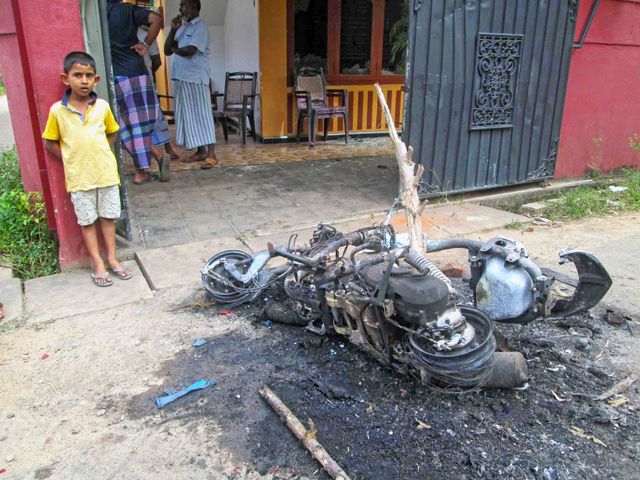
A burnt bike on the Hiluru Mosque road
At 4.17 p.m. on Friday, one of the monks, Uchitha Arunodha Gunasekera called for everyone in the Galle area “to gather at the Thuparamaya temple in Gintota against Muslims.”
The violent attack was discussed and prepared at the temple with the encouragement of the monks who used a couple of relatively minor incidents earlier in the week to whip up anti-Muslim sentiment and initiate the rampage.
On November 13, a Muslim woman and her daughter were hit by a motor bike driven by a Sinhala youth. While all three people were injured and hospitalised, they were released after treatment later that day. The dispute over the accident was quickly settled between two parties at a local police station with motorbike rider paying 25,000 rupees as compensation to the woman and her daughter.
The next evening a conflict broke out between a few Sinhala and Muslim youths in the area with one Muslim youth injured and two Sinhala-owned homes attacked. Niyas Hussain, a United National Party (UNP) local government representative, and two Sinhala youths were arrested in relation to the conflict.
The Sinhala extremists seized on these events and began targeting local Muslim families who had nothing to do with the incidents.
Police were deployed to local villages in the name of “maintaining peace” but their presence was no obstacle to the Sinhala thugs. In fact, the police declared a curfew at about 9 p.m. on Friday, an hour after the assaults began. The racists continued to be active throughout the area until 11 p.m.
Muslim residents explained to the WSWS how their homes and property were attacked. Most said that the assaults on their communities were directed by organised gangs but the police had tacitly backed the thugs.
In Ampitiya, Mohammad Ali said: “Once the thugs began attacking our home, we phoned the police with our last call at 9.02 p.m. The police received hundreds of similar calls and could have stopped the devastation. When our place was attacked the police jeep was passing by but it didn’t stop.” Mohammad’s three-wheeler taxi, which provides a living for his family, was torched by the thugs.

Haneer's burnt bike
M. A. Haneer from Weliwitimodara said that his motor bicycle was also set on fire. He is still making monthly payments on the bike.
Another three-wheel driver, Mohammad Nishar, from Hiluru Mosque Road said: “We were informed in advance that an organised group was preparing for this attack but the STF [Special Task Force], which had been deployed here, was withdrawn at about 6 p.m. We’d been told to contact the police about any incidents but they didn’t act to prevent this in due time.”
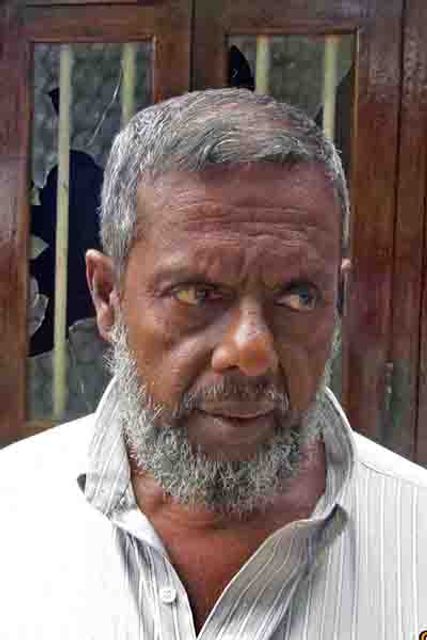
Mohammad Nishar
Homes and properties were also looted at several places and personal valuables taken. Goods worth 650,000 rupees were stolen from the Shoe and Shoe shop in Gintota.
Sri Lanka President Maithripala Sirisena and Prime Minister Ranil Wickremesinghe immediately seized on the incident to mobilise the police, STF officers, as well as army and navy personnel to “maintain peace” in the area. The air force was also placed on standby.
As with previous racist attacks, the mobilisation of these forces has nothing to do with stopping the violence. In fact, Sinhala extremist groups operate with police and armed forces support.
Police media spokesperson, Superintendent of Police Ruwan Gunasekera, declared that action would be taken “against those who spread this false propaganda.” But Gunasekera’s threats will be the basis for a crackdown on government opponents and to intensify its attacks on social conditions and basic democratic rights of working people and the oppressed masses.
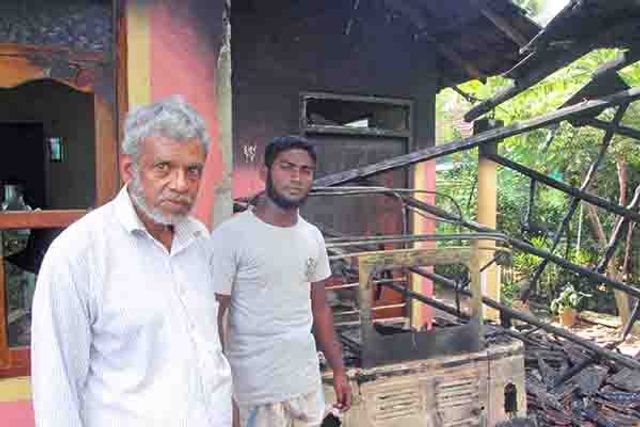
Mohammad and his son in front of their damaged home
The Sri Lankan inspector general of police toured the area, promising investigations and action against those responsible. Prime Minister Wickremesinghe, Law and Order Minister Sagala Ratnayake and several ministers from Galle also visited, calling on residents to “live in peace.” Wickremesinghe claimed the government would prevent future racist attacks and promised that the victims would be paid full compensation for the damage to their property.
These promises are worthless. The Sinhala-Buddhist racialist groups and associated gangs are operating under the patronage of the Sirisena-Wickremesinghe government, just as they did during former President Mahinda Rajapakse’s rule.
The police claim that 19 people have been arrested over the rampage in the Gintota area. Prosecutions, however, will be limited to a few of those directly involved, leaving those who politically organised the assaults off the hook.
Between April and June, Muslim-owned shops, houses and mosques were attacked throughout Sri Lanka. The Bodu Bala Sena (Buddhist Power Force or BBS) emerged about six years ago with the blessing of Rajapakse. In June 2014, the BBS and other Sinhala chauvinist groups unleashed anti-Muslim violence in Aluthgama, about 50 kilometres south of Colombo. Three Muslims were killed, scores were assaulted and extensive damage caused to houses and shops.
While the BBS has been accused of perpetrating the latest violence, this formation is being courted by the Sirisena-Wickremesinghe government.
Like its predecessor, the current government, which faces a growing wave of strikes and protests, depends on the BBS and other extreme right elements, such as Sihala Ravaya (Echo of Sinhalese) and Ravana Balakaya (Brigade of Ravana) to divide working people. The government also calculates that these formations can be used in the future as fascistic shock troops against the working class.

Campaign continues over “Chinese influence” in New Zealand

John Braddock

While New Zealand Prime Minister Jacinda Ardern and other senior members of the new Labour-led government attended the recent Asia Pacific Economic Cooperation (APEC) leaders’ gathering and East Asia Summit (EAS) in Vietnam and the Philippines, an ongoing campaign against so-called Chinese “influence” in the country’s political and business affairs was ramped up.
The purpose of the anti-China campaign, which peaked during the September 23 election, is to further align the country’s defence and foreign policy with Washington. The Trump administration is demanding that all countries in the Asia-Pacific fall in with its advanced preparations for war against North Korea and confrontation with China.
US ambassador to NZ Scott Brown used several media interviews in the wake of the poll to ensure that the incoming government backed the US war drive. He openly rebuked former National Party prime minister Bill English for appearing to waver over Trump’s confrontation with North Korea and emphasised New Zealand’s importance as a partner in the US-led Five Eyes intelligence network.
The media, working with Washington-based think tanks, the Wilson Center and Jamestown Foundation, meanwhile stirred up virulent anti-Chinese propaganda. A widely-publicised report by the Wilson Center’s Anne-Marie Brady, published days before the election, claimed National was beholden to Chinese business interests. It alleged, without any evidence, that National Party MP Jian Yang and Labour MP Raymond Huo were “agents” of the Chinese Communist Party.
Brady, billed as an academic “expert” based at NZ’s Canterbury University, called for the Security Intelligence Service (SIS) to carry out a sweeping investigation of Chinese “influence” in New Zealand politics. The right-wing NZ First Party, now a partner in the new government, echoed Brady’s demands and called for Yang to step down while an “inquiry” was conducted. Ardern indicated she would consider empowering the SIS to investigate Chinese “influence,” as Australia’s intelligence agency is now doing.
The first item on Labour’s legislative agenda was to ban foreigners from buying houses—a move calculated to stoke xenophobia. While in opposition, Labour and NZ First repeatedly scapegoated foreigners, especially Chinese immigrants, who make up about 4 percent of the population, for the housing crisis, low wages and other social problems. Ardern intends to cut migrant and foreign student numbers by up to 30,000 a year, or 40 percent.
Last week Brady released a fresh “policy brief” demanding the government proceed with a raft of anti-China measures. “It is time to face up to some of the political differences and challenges in the New Zealand-China relationship, including the impact on our democracy of Chinese political interference,” Brady declared.
Brady alleged, again without substantiation, that China’s “covert, corrupting and coercive political influence activities in New Zealand are now at a critical level.” Under the leadership of Chinese Communist Party general secretary Xi Jinping, Brady claimed, Beijing has been more assertive and was seeking to become a “global great power and is seeking change in the global order.”
Such claims turn reality on its head. American imperialism, seeking to overcome its economic decline, has for the past 25 years used its overwhelming military might to foment a series of wars around the globe and is now threatening nuclear catastrophe.
In this increasingly volatile global situation, New Zealand’s ruling class has sought to balance its economic links with China, its second largest trading partner, against its military and diplomatic ties with Australia and the US, which it requires to protect its own neo-colonial interests in the Pacific.
Brady borrowed a Chinese diplomatic phrase—to “light a new stove”—to demand the government end any prevarication and institute a sweeping witch-hunt. Her policy prescriptions, which undoubtedly had Washington’s input, include investigations by both the SIS and Prime Minister’s department into China’s “subversion and espionage activities in New Zealand,” as well as its “political influence activities.”
Brady further demands the Commerce Commission investigate the Chinese Communist Party’s so-called “interference” in the local Chinese language media sector and for the attorney general to draft new laws on political donations and “foreign influence activities.” Parliament is called on to pass anti-money laundering and terrorism financing legislation, including in New Zealand’s Pacific territories. The government is urged to make appointments to “strategically important” groups that “help shape” China policy, such as the NZ China Council.
Brady told Newsroom on November 14 that New Zealand should work with “like-minded countries”—specifically Canada and Australia—on investigations into Chinese influence. She stated: “We would be very unusual amongst our allies if we don’t address this issue.” Brady told TVNZ’S “Q+A” program: “This is not the time to head-butt China.” The investigations, she warned, should be handled “carefully” and conducted behind closed doors. “These are sensitive topics and we certainly don’t want to stir up racism,” she declared hypocritically.
Brady has a vociferous ally in the Daily Blog, which is the central mouthpiece of the trade unions, which oppose immigration and Asian investment. A November 14 post by editor Martyn Bradbury absurdly asserted: “The truth is that we are economically occupied by China.” He then claimed that in Beijing’s looming conflict with the US over the Pacific, “they intend to push their interests aggressively as they seek to become the dominant force in our region.”
The government’s involvement in the APEC and EAS summits underlined the shift now under way. In Manila, Ardern issued a statement highlighting “the need for all actions short of military action” when it came to North Korea.
Interviewed by TV3, Ardern said New Zealand will “intervene in North Korea if backed by a United Nations resolution.” The increase in testing and capability of the tests conducted by North Korea show there is a “genuine threat” coming from the country, Ardern claimed. She added that every world leader needs to “put pressure on Pyongyang to make sure they are responding to the sanctions and messages coming from the international community.”
Ardern also set out New Zealand’s position on the South China Sea dispute, claiming its opposition to Chinese territorial claims is based on international law and through consensus on a “code of conduct.” These terms echo the “rules based order” invoked by the US—whereby it sets the “rules”—to assert its interests against China in the region.
The New Zealand Herald reported on November 15 that US Secretary of State Rex Tillerson had twice sought out Foreign Minister Winston Peters during the summits to discuss “a mystery project about the Asia-Pacific region.” The report prompted speculation that this involved North Korea, which Peters visited in 2007. In his first press conference as foreign minister, Peters had said: “We do not think that North Korea is an utterly hopeless case.”
On the economic front, Ardern reversed Labour’s previous opposition to the Trans-Pacific Partnership (TPP). She fell into line with Japan’s efforts, supported by Australia, to re-forge the TPP without the US or China. Under the Obama administration, the TTP was designed to exclude Beijing until it deregulated protected sectors of its domestic economy. Trump repudiated the TPP upon taking office, on the protectionist grounds that it gave member-countries greater access to American markets.
There is no doubt that New Zealand will come under further pressure to join Japan, Australia and India to support the “Quadrilateral” alliance proposed by the US, to consolidate a military and strategic “Indo-Pacific” bloc to confront China and shatter its growing regional and international influence.

Chile’s elections marked by voter abstention and growth of both the pseudo-left and fascistic right

Andrea Lobo 

Chile’s ex-president Sebastián Piñera, the third-richest man in the country and presidential candidate for the far-right coalition Chile Vamos (Let’s Go Chile), was expected to come close to the majority needed to become president in Sunday’s elections. Most polls showed him reaching between 40 and 45 percent.
However, as the preliminary results came in, the late-night party at Piñera’s campaign hub was overshadowed by the prospect of an uphill second round on December 17 against Alejandro Guillier, a senator of the ruling Social-Democrat and Stalinist coalition, the New Majority.
The presidential race underscored the vast gulf between the political establishment and the Chilean working class. With 14.3 million eligible voters, the abstention rate reached 53 percent. And out of the minority who cast their ballots, 36.6 percent (2.4 million votes) went to Piñera and 22.6 percent (1.5 million votes) went to Guillier. The biggest shift in vote was toward Beatriz Sánchez of the pseudo-left Frente Amplio (Broad Front), which placed third with 20.3 percent (1.3 million) of the votes.
In his speech Sunday, Guillier said that both the Christian Democrat Carolina Goic and Sánchez called to congratulate him, suggesting they will back him in the second round.
Another significant shift was the casting of over half a million votes, or almost 8 percent, for the fascistic José Antonio Kast, an anti-immigrant demagogue who openly vindicates the legacy of the US-backed military dictatorship of Augusto Pinochet (1973-1990), which murdered, tortured and imprisoned tens of thousands of Chilean workers and youth.
On Sunday, Kast immediately threw his support behind Piñera, who has also appealed to Christian fundamentalism and the military throughout his campaign, and publicly accepted Kast’s support on Monday. “Piñera will fulfill all of our most fundamental desires,” Kast declared.
Most of the coverage in the corporate-controlled press has focused on the results of Frente Amplio, portraying the coalition as the upcoming new official “left,” which “deserves to celebrate.” This reaction represents a sigh of relief that bourgeois rule has found a new “left” flank to divert the anger of growing number of workers and youth toward all the traditional parties.
This was the first round of elections since President Michelle Bachelet’s reform of the electoral “binomial system,” which favored the election of one legislator for each of the two main coalitions and relegated smaller parties to obscurity. The new “proportional system” was introduced by the Bachelet government partly in response to a string of corruption scandals during past elections, including one involving her son.
The new legislation also reshaped the electoral districts, imposed a 40 percent minimum of female candidates and limited campaign financing by companies. The avowed goal was to reverse the sharp fall in turnout that was already taking place, illustrated by a drop from 87 percent in the 1989 elections to 50 percent in the 2013 elections.
The result was the opposite. The law’s increase of seats in the Senate from 38 to 43 (and 50 by 2021) and of deputies from 120 to 155 deputies was received with disgust by many. The Economist quoted a common Chilean reaction that the “reform” would only yield “more clowns for the circus.”
Overall, Sunday’s results manifest a continuous growth in opposition toward the political establishment, especially against the incumbent coalition, which has ruled the country for the better part of the three decades since the end of the Pinochet regime. Minor changes to the extreme free-market framework established under Pinochet notwithstanding, the Social Democrats and Stalinists, which also control the trade union bureaucracy, have defended the continuous accumulation of wealth by the same powerful economic groups while leaving a majority of Chileans facing precarious economic conditions.
The New Majority had already lost an entire faction of its coalition, the Christian Democrats, as a result of its loss of popular support. On Sunday, moreover, their number of deputies fell from 67 to 43 and their senators from 21 to 15. In comparison, Chile Vamos jumped to 73 deputies and 19 senators, and Frente Amplio will have 20 deputies and one senator.
The New Majority campaigned on the basis of defending the reforms carried out by the Bachelet administration, namely its increase of the corporate tax from 20 to 27 percent, which was carried out ostensibly to finance universal free education. Grants for the poorest college students have already benefitted 280,000 youth, but its universal expansion is still being discussed in Congress. Her administration also partially legalized abortion and same-sex civil unions.
After coming to power promising deep reforms with the support of the Communist Party-dominated trade union bureaucracy and the pseudo-left, Bachelet’s measures have been a complete disappointment. Piñera, for his part, has threatened to fully or partially revoke the extremely limited measures undertaken by Bachelet.
The country’s fiscal system still receives the bulk of its income from a regressive value-added tax of 19 percent, the third-highest in Latin America, while average tuition for higher education is still one of the most expensive relative to per-capita income. Nonetheless, the government still found money to increase its defense budget last year to over $2.5 billion, which equals the second highest share of GDP in South America after Ecuador.
Throughout this past year, the forces around the government have suppressed student protests for free education, betrayed a copper miners’ strike in February and turned their back on a march of 2 million Chileans against the privatized pension funds (AFPs). Such a response has in turn further deepened this social opposition against the entire political establishment, including against the pseudo-left. Furthermore, in the context of extreme wealth inequality and a stagnant economy pulled down by low commodity prices and the global economic crisis, the stage is being set for a major intensification of the class struggle.
Half of all workers in Chile make less than US$400 each month, and, up until the 95th percentile of the population, family income remains roughly below US$1,500, or a million pesos. However, it’s at this point in the income curve that the elbow turns sharply. According to the World Bank, the remaining top 5 percent in Chile receives 51.5 percent of all income, making it the most unequal country of the OECD.
Beyond pitiful electoral reforms, such wealth inequality means in practice that at least 95 percent of the population has no genuine political representation. A 2015 study by economist Fernando Leiva reported that the income of a handful of 20 economic groups adds up to 52.6 percent of Chile’s GDP. The document then goes into the long-term support by the most powerful conglomerate, the Luksic group, behind the New Majority.
According to El Mostrador, this period of economic downturn has also seen a massive growth of finance capital. Stock capitalization, for instance, reached 82 percent of GDP in 2015, with 13 groups controlling two-thirds of this amount. Oxford University professor, José Gabriel Palma, described it in stark terms: “Chile is not a market economy. It’s an economy of market groups, in which giant conglomerates extract incomes via an oligarchic concentration.” It must be added that such extraction and extraordinary accumulation of income fundamentally proceed from the unpaid labor of the Chilean working class.
Income inequality is particularly sharp within the top 5 percent. For instance, just the top 0.1 percent receives almost two-fifths of the income of the top 5 percent, or 18 percent of national income.
The bitter struggle for a more favorable distribution of wealth within this top 5 percent has found expression in such formations as the Frente Amplio, which has combined left populism with nationalism and identity politics to seek greater privileges for these layers.
At the same time, whether it’s through its growing presence in the trade union bureaucracy or in Congress, Frente Amplio’s chief concern is to politically disarm Chilean workers to defend these privileges, which are dependent upon the explosive levels of wealth in the hands of the Chilean financial oligarchy and the financial elite in the US and Europe.
Their spokespeople, Sebastián de Polo (Democratic Revolution) and Karina Oliva (Power Party), said in April that they are not a “left” organization, rejecting the term altogether, but a “citizen’s coalition.” Such word games seek to blur the orientation of their policies toward the defense of the interests of the capitalist class. Similarly, their co-thinkers in Spain, Podemos, which congratulated the Frente Amplio for their results Monday, have also insisted that they reject the “politics of left and right,” as their leader Pablo Iglesias stated in 2014, but see themselves as defenders of the “citizenry.”
Santiago University political analyst René Jara told the AFP news agency that Frente Amplio’s results had “completely reshaped Chile’s political landscape.” The vote, he said, gave the front “a very strong negotiating power in the second round.” He added that, while Frente Amplio had been reluctant to back Guillier, “They are obliged to do so because if not they will be responsible for the return of Piñera.” In other words, the task of the pseudo-left will be to attempt to corral its voters behind the ruling party.
The only way to confront the social and political attacks by the ruling class against workers, whether they are being imposed by the traditional bourgeois parties or pseudo-left formations like Podemos, Syriza, Frente Amplio and others, is through the independent political mobilization of working class organizations on the basis of an internationalist and socialist program.

12,000 Sears workers laid off as Canadian retailer liquidates operations

Carl Bronski 

An Ontario Supreme Court judge ratified the liquidation of Sears Canada last month and the closure of its 130 outlets, entailing the loss of 12,000 jobs by early next year. In the run-up to the liquidation, the company had shed an additional 4,000 retail jobs earlier this year.
While top Sears executives will be rewarded with a multi-million dollar payout for their role in destroying the livelihoods of thousands of workers and their families, the workers have been left to fend for themselves.
With the collapse of the company, 36 executives and senior managers will share $6.5 million in “retention bonuses” for overseeing the “restructuring,” despite failing to save a single outlet from closure. Meanwhile, the 16,000 store workers who have already, or will shortly, lose their jobs will receive no severance pay. A federal “Companies Creditors Arrangements Act” relieves bankrupt corporations of severance pay obligations.
Many of the laid-off workers have spent a decade or more in the company’s employ. Benefits are immediately ended for all sacked employees. To deflect from public outrage over management bonuses, Sears Executive Chairman Brandon Stranzl undertook to donate $500,000 for an “employee relief fund”. However, to date the fund has received only $300,000. In any case, because any employee drawing from the fund will have the money clawed back from Employment Insurance claims, only 22 workers have applied for the emergency relief.
Sears management consistently underfunded the corporate pension plan. While the plan had a surplus of $220 million in 2008, today there is a $270 million shortfall. Some 13,000 retirees with defined benefits and 4,000 other workers nearing retirement have been warned that they will be forced to take an as yet undisclosed “haircut” in their monthly cheques. They have already lost their health benefits.
Sears workers are justifiably outraged. Vera Asselin, who worked for Sears for 33 years and was laid off in June, told CBC, “We are getting absolutely nothing. It’s a complete joke.” Sobedida Maharaj, with 28 years of service, told the Toronto Star, “It’s like getting slapped in the face.”
The liquidation of Sears Canada offers a case study in the mechanisms that have allowed for the continued enrichment of financial parasites at the expense of low-paid workers in retail and other economic sectors. For over a decade, billionaire hedge fund manager and CEO of Sears Holding Corporation, Eddie Lampert, oversaw a massive asset-stripping operation of Sears Canada. Under a predatory “efficiency plan,” $1.4 billion was funneled into stock buy-back schemes and special dividends rather than investments in retail operations. Just prior to declaring bankruptcy, Sears Canada registered a quarterly profit of $244 million, despite a continuing collapse in retail sales, largely as a result of asset sales.
The fate of Sears workers is only the most extreme expression of a broader assault on the jobs and working conditions of retail workers. Canada’s largest food retailer, Loblaws, announced last week that it plans to close 22 grocery stores in early 2018 as part of a restructuring drive that has already seen the company slash 500 store support positions at its head office. In addition, Loblaws will open an internet-based home delivery e-commerce option as part of a shift by retailers away from “brick and mortar” retail outlets.
The cost-cutting moves have been explained by corporate spokesmen as a response to anticipated economic “headwinds” in 2018, including pending minimum wage increases in Ontario and Alberta and the encroachment of Amazon into the retail grocery space. Loblaws more than doubled its third quarter profit this year to $883 million, largely due to the sale of its gas bar division.
The store closure announcement at Loblaws came the same week that business analysts raised the spectre of a possible restructuring of the iconic Hudson’s Bay Company department store chain. HBC shares have dropped a precipitous 60 percent since 2015 with 2,000 employees laid off this past summer. The retailer has posted almost $1 billion in losses since 2016.
These events follow closely on the heels of another major retail bankruptcy. Target Canada ceased operations in early 2015 as it was projected to lose $2 billion annually, forcing over 17,000 workers out of a job over the course of the year.
A major contributor to the fall in retail sales and the ensuing bankruptcies in Canada—and internationally— has been the emergence of online shopping. This sector is dominated by Amazon, whose lower prices are underwritten by the brutal exploitation of a workforce subject to poverty wages, grueling working conditions, forced overtime and temporary contracts. Last Christmas, Amazon reported shipping a total of 1 billion items worldwide, accounting for 38 percent of all internet sales.
The steady demise of brick-and-mortar retail is also an expression of stagnant and declining wages. Statistics Canada reports that real wages across the country have flat-lined for the last 40 years. This year has seen the lowest rise in hourly wages—a paltry 0.7 percent—since the government began tabulating this statistic in 1997. The tiny increase means a cut in real wages, when inflation is added into the equation.
The plight of Sears workers and retirees mirrors situations faced by workers at Nortel, US Steel, Algoma Steel, Wabush Mines and other instances of major bankruptcies in Canada. Despite promises whilst in opposition to address the massive inequities in Canada’s bankruptcy laws, the big business government of Prime Minister Justin Trudeau has explicitly rejected introducing any such legislation. Trudeau, whose election was promoted by the trade unions and who continues to be lauded by them as a “progressive,” restricted himself to offering his sympathies to the 16,000 Sears workers who have been robbed of their jobs, benefits and pensions.
The bankruptcy laws are designed to ensure that the interests of the banks and other so-called “preferred” creditors are protected, while workers are left empty-handed. Only after the preferred creditors receive what they are “owed” by Sears in full, will any consideration be given to workers’ claims.
The unions have not lifted a finger to defend Sears workers. A Teamsters article on their plight in July restricted itself to appealing for new customers to the Teamsters pension plan. This is in keeping with the unions’ role over the past three decades as enforcers of the demands of big business and the ruling elite’s chief instrument for suppressing the class struggle.
The social-democratic NDP has confined itself to impotent appeals to Trudeau’s big business Liberals to see the light and reform the bankruptcy laws so as to provide a small measure of protection for the wages and pensions that workers have already earned. Predictably, the NDP has said nothing that calls into question a “legal” system in which the courts rubber-stamp the fleecing of workers or an economic system where capitalist owners line their pockets by throwing workers onto the garbage heap.
The gang-up of the corporate elite, their bought and paid for political representatives, and trade union bureaucrats against Sears workers underscores that working people cannot take a single step forward in the defence of their most basic interests to a decent-paying, secure job without taking matters into their own hands.
Workers at Sears and throughout the retail industry must form their own independent action committees to wage a struggle against the destruction of their livelihoods. The power of the super-rich elite to take decisions ruining the lives of tens of thousands of workers at a shot must be broken. This requires the turn to a socialist program and the fight for the establishment of a workers’ government committed to the prioritization of the social needs of the vast majority, rather than the profit drive of a handful of speculators and corporate criminals.

Access to selective US universities reserved for the wealthy

Michael Anders

The think tank New America recently released a detailed report on access to higher education in the United States, titled “Moving On Up?” The report is based on data from new research, contained in the paper, “Mobility Report Cards: The Role of College in Intergenerational Mobility”. One of the researchers was Emmanuel Saez, whose work on inequality has been cited by the World Socialist Web Site on many occasions.
The report provides shocking statistics on the declining access to selective universities for low income students. The report finds that “colleges heavily covet students from wealthy families, and help them excel further than their low-income peers.”
Notably, the study also revealed that while these students are systematically rejected from selective universities, students from low-income families are just as likely to succeed in higher education, and eventually attain a similar income level to their counterparts from high-income families.
How different types of colleges compare
The table above, taken from the report, shows the access and success rates, expressed as percentages of total enrollment. Access rates are the percentage of students whose families are in the bottom quintile, while success rates are the percentage of students with families in the bottom quintile who eventually enter the top quintile.
Ivy Plus schools—Ivy League plus other elite institutions—tend to have 3.70 percent enrollment of students with families with incomes in the bottom quintile. Highly selective and selective public universities have an enrollment of 6.10 percent and 10.90 percent, respectively. Working class students are mostly relegated to nonselective public and private universities, with enrollments of 15.60 percent and 11.70 percent, respectively. The colleges with the highest access rates are four- and two-year for-profit institutions.
These statistics also demonstrates that, while access rates increase for less prestigious universities, success rates are decreasing. Nonselective public and private schools have a success rate, which is explained above, of 14.20 percent and 18.60 percent, respectively. Four- and two-year for-profit institutions, which have the highest access rates, have the lowest success rates. Unsurprisingly, the universities with the lowest access rates and highest success rates for students from low-income families are Ivy League universities.
The researchers discovered that students with families that are in the top 1 percent “are 77 times more likely to attend an Ivy League university” than their counterparts from families in the bottom quintile. In spite of this, Barrett also notes that “over half [of students from the bottom quintile who attend these schools] enter the top quintile” by the time they are 32 years old.
These numbers, when considered together, shatter the idea that access to higher education in the United States is meritocratic. It also destroys the illusion maintained by the bourgeoisie that people have freedom to move from one class to another by virtue of hard work. Students do not get into universities based on academic merit and ability, but rather their enrollment is decided to a large degree by their economic class. As more and more high-paying positions require a college degree from a noteworthy institution, the working class is denied the tools necessary to attain these degrees. In other words, someone born into the working class is forced to remain there.
Average published tuition and fees
New America analyst Stephen Burd notes that the move to deny access to selective universities for low-income students has been part of a long process dating back over two decades. He explains that two thirds of the 32 public flagship universities considered in the study have seen steady increases in the percentage of students from wealthy backgrounds since the late 1990s.
This process was achieved by shifting from a need-based disbursement of institutional financial aid, to a non-need-based disbursement policy. The starkest example of this is the University of Alabama, “which spent over $100 million” on “so-called merit aid” in 2014-15. This was met by an increase of 13 percentage points of students being from the top quintile.
Universities have become tools of the ruling elite. They are beginning more and more to fulfill the bourgeois counterrevolutionary task of concentrating wealth in an increasingly minuscule minority, by more and more excluding the working class from even the possibility of gaining wealth. In the United States, this minority is already tiny. Jeff Bezos, Bill Gates, and Warren Buffett collectively own more wealth than the bottom 160 million people. Worldwide, an Oxfam 2017 report suggests that the global number is 8—i.e., 8 people own more wealth than the bottom 3.5 billion.
It must be noted that the “Mobility Report Cards” data was collected from 1999-2013. The policies which have led to the decline in access to higher education for students from low income families was a bipartisan effort, presided over not only by the Bush administration, but also the Obama administration.
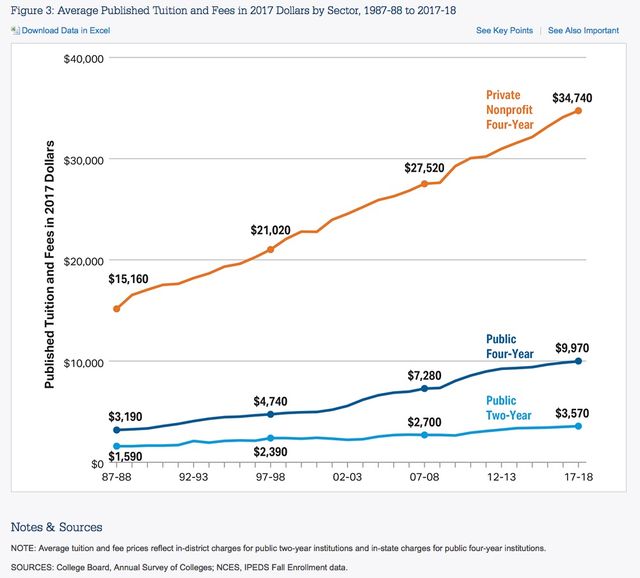
The rising tuition that can be seen since 2013 in the US will only put higher education further out of the reach of the working class. The graph above is derived by the College Board, showing the rise in tuition costs from the 1987-88 academic year to 2017-18. The dollar values here are shown in 2017 dollars. Despite a few twists and turns, the general direction of these lines is obvious—tuition is rising steadily as time goes on. This trend has continued, regardless of the President in office.
However, “Moving On Up?” notes that the data found in the “Mobility Report Cards” could not have been collected by the Department of Education. In section 2 of Chapter 2, Clare McCann notes that the Department of Education is forbidden by Congress to access and compile data on a student level, thus restricting the comprehensiveness of any data they can release. In other words, the privileged layers at the top level of universities have the perfect cover to do whatever they want, while the Democrats and Republicans in Congress need not bother themselves with the resulting inequality.
This attack on education, consciously waged at all levels, is evidence of what Trotsky called the “thoroughly thought-out counterrevolutionary strategy of the bourgeoisie,” recorded in Volume 2 of The First Five Years of the Communist International.
The bourgeoisie has the task of ensuring the concentration of wealth, and the sharp class divisions of society on which it is based. Counterposed to this, Trotsky adds, the working class must have “its own revolutionary strategy, likewise thought out to the end.”
Access to education—like the right to a job, quality health care and housing—is an inalienable social right, not a privilege for the very wealthy, which must be fought for by the working class on the basis of a socialist program.

Crisis erupts as Turkey is labelled a hostile power in NATO military exercise

Halil Celik

Amid growing fears of a region-wide war in the Middle East and a mounting crisis in the European Union (EU), Turkish-NATO relations are under deep strain after an incident at a computer-assisted exercise of NATO’s Joint Warfare Centre, in Norway. Turkish officers found Turkish President Recep Tayyip Erdogan listed as an “enemy collaborator,” and Mustafa Kemal Atatürk, the founder of the Republic of Turkey, on the “hostile leader list” for the exercise.
After Turkish troops withdrew from the exercises and Ankara lashed out at NATO, on November 17, NATO reported that a Norwegian technician, who was allegedly responsible for the “unpleasant accident,” had been dismissed. Meanwhile, NATO Secretary-General Jens Stoltenberg and Norwegian Defence Minister Frank Bakke-Jensen issued apologies to Turkey.
These statements did not resolve the issue, however. Since the main NATO powers backed a failed coup that sought to overthrow the Turkish government and personally murder Erdogan on July 15, 2016, Turkey’s relations with its erstwhile Western allies have rapidly deteriorated. There are bitter tensions over the war in Syria and Turkey’s improving relations with Russia.
Erdogan responded to the unambiguous threat from NATO by trying to whip up a Turkish nationalist atmosphere. At a provincial congress of his Justice and Development Party (AKP) in the eastern province of Bayburt, on November 19, he called the incident an attack against “Turkey and the Turkish nation. … Today there is a Turkey that cannot be compared with 15 years ago in every field—from the economy to the defence industry and from trade to diplomacy.”
The pro-EU and pro-NATO Republican People’s Party (CHP) condemned the incident as “insult” to Turkey, stating that it was not a “topic that can be avoided with an ordinary ‘we apologize’ thing.”
Erdogan’s de facto political partner, the leader of the fascistic Nationalist Movement Party (MHP), Devlet Bahceli, even called into question Turkey’s NATO membership. On November 18, he declared on Twitter: “It is necessary for Turkey to question NATO. What does NATO want from Turkey? What is it waiting for? What does it want to achieve?... If we cannot stay in this structure [i.e., NATO] it would not be the end of the world.”
On November 19, Turkish EU Minister Omer Celik called for investigating the entire chain of command involved in the NATO exercise in Norway. Speaking at the 9th annual Halifax International Security Forum in Canada, he asked: “Is there no chain of command? Does he [the Norwegian civilian contractor] not have a commander?”
The issue was also a key topic in the Turkish Chief of General Staff Gen. Hulusi Akar’s speech at the Halifax forum. Underscoring that the “NATO administrators responded timely and appropriately,” Akar said that his forces would “not allow anyone to undermine our alliance and our solidarity.”
According to Turkey’s state-owned Anadolu Agency, Akar alleged that the movement of cleric Fethullah Gulen—the principal Turkish suspect in the 2016 coup attempt—could be involved. He declared, “Recently, in one of the NATO exercises we had an unpleasant and unacceptable event, reportedly committed by an individual who may be backed by [Fethullahist Terrorist Organization] FETÖ members.”
In March, Norway granted political asylum to five Turkish officers based in Norway, who refused to return home after the failed July 2016 coup attempt, provoking a harsh response from Ankara.
Akar also criticized Turkey’s NATO allies for arming the Syrian Kurdish Democratic Union Party (PYD), and its armed wing, People’s Protection Units (YPG). “It was unfortunate to witness the utilization of terrorist organizations as proxies during this conflict. This has further complicated the situation,” he said. Akar concluded his speech by quoting Erdogan’s criticism of the UN Security Council: “The world is bigger than five.”
As the crisis between Ankara and NATO intensified, the EU decided to cut “pre-ascension funds” by €105 million ($124 million), while freezing another €70 million in previously announced spending. The EU was scheduled to provide €4.5 billion ($5.31 billion) to Turkey from 2014 to 2020, to support Turkey while it had pre-membership relations to the EU.
After the launch of negotiations over Turkish EU membership in 2005, talks between Ankara and Brussels entered into a stalemate as various EU governments raised objections.
Ankara’s relations with several EU member states, including Germany, Austria and the Netherlands, further collapsed after these countries supported the 2016 coup attempt. Bourgeois politicians during the Dutch elections and elsewhere across Europe sought to whip up anti-Turkish sentiment amid growing social discontent. Turkish leaders for their part slammed their European counterparts for “providing support to [terrorist] groups hostile to Turkey,” i.e., the Kurdish nationalist Kurdistan Workers’ Party (PKK) and its Syrian offshoot PYD, as well as the Gulen movement.
Turkish-US relations are collapsing over similar issues. On October 8, days after the chief prosecutor in Istanbul issued a detention warrant for a local employee of the US Consulate in Istanbul, Ankara and Washington mutually suspended all non-migrant visa services. Less than two weeks ago, a Turkish court arrested another individual for spying and attempting to overthrow the government, based on his alleged links with the Gulen movement.
Another topic in the Turkish-US relations is the pending action against the Turkish-Iranian gold trader Reza Zarrab on charges of violating US sanctions on Iran via Turkish banks. Zarrab was arrested in the United States in March 2016. Another defendant in the trial is Hakan Atilla, a deputy general manager of Halkbank, who was arrested in March 2017 over charges of cooperating with him.
Turkish Deputy Prime Minister Bekir Bozdag described the case as a “political plot” against Turkey, while President Erdogan has previously claimed that the US authorities had “ulterior motives” in prosecuting Zarrab.
Reportedly, Zarrab has recently offered to provide evidence to the court—a move Washington could use to turn up the pressure on the Turkish government.
Lying behind the crisis in NATO-Turkey relations are deepening strategic conflicts, as Ankara improves its ties with Russia and Iran, two of the main targets of the US war planning.
The Turkish army is mounting its operation mainly against the YPG/PYD under an agreement reached in Astana, Kazakhstan and backed by Russia and Iran, which support Syrian President Bashar al-Assad’s regime. On September 14, Russia, Turkey and Iran, as well as the Syrian government and opposition groups, came together to implement a cease-fire in so-called de-escalation zones in Syria. Turkish troops are to be stationed in Idlib, while Russia and Iran will hold the surrounding territory.
Meanwhile, Turkish troops are operating in Iraq’s Kurdish Regional Government territory against the PKK, again, with the support—or at least acceptance—of Baghdad and Tehran. With thousands of troops, artillery and tanks deployed to its Syrian and Iraqi borders, Ankara has long been prepared to move against the Kurdish nationalists, both in Syria and Iraq—an attack that could lead to a direct confrontation between Turkish and US troops.
On November 22, Russian, Iranian and Turkish leaders are to meet in the Russian Black Sea resort city of Sochi, for the first such meeting between the three states as they cooperate to end the more than the six-year civil war in Syria. Last week, in the run-up to the Sochi summit, the three countries’ foreign ministers met in Antalya, Turkey. Following the meeting, the foreign ministers appeared optimistic over the results of the so-called Astana Process. Russian Foreign Minister Lavrov stated, “The parties agreed on all issues.”

Defeat of ISIS in last stronghold signals new stage of US war in Syria

Bill Van Auken

Syrian government troops, supported by Iranian-backed Iraqi and Lebanese Shia militia forces, have routed ISIS from its last stronghold in Syria, the Euphrates River town of Albu Kamal just across the border from Iraq.
Far from signaling an end to the US intervention in Syria, launched in the name of fighting ISIS in that country and in Iraq, the collapse of the Islamist militia has only set the stage for a further escalation in Washington’s drive to assert its hegemony in the Middle East by military means.
Remaining ISIS fighters withdrew from Albu Kamal in the face of the government offensive. The group is now believed to control only a few small villages along the Euphrates and small nearby desert areas.
The taking of Albu Kamal follows the driving out of ISIS from the Iraqi city of Qaim, where Iranian-backed militias also took the lead. The linking up of these forces effectively secured the much vaunted “land bridge” linking Tehran to a northern tier of Arab states—Iraq, Syria and Lebanon—which have all established close ties to Iran.
Washington’s main aim now is to blow up these ties. To that end, the Trump administration has sought to sabotage the Joint Comprehensive Plan of Action (JCPOA), the nuclear accord struck between Tehran and the major world powers, while seeking to forge an anti-Iranian axis linking the US, Israel and the reactionary Sunni Persian Gulf oil monarchies led by Saudi Arabia.
This anti-Iranian alliance has found its most destructive expression in Washington’s backing for Saudi Arabia’s two-and-a-half-year-old war against Yemen, where an unrelenting bombing campaign combined with a blockade of the country’s airports, sea ports and borders is unleashing a famine that could claim the lives of millions.
The Saudi regime orchestrated the convening of a meeting of the Arab League in Cairo on Sunday for the purpose of condemning Iran and the Lebanese Shia movement, Hezbollah. Saudi Foreign Minister Adel Jubeir told the assembly that the monarchy “will not stand by and will not hesitate to defend its security” from Iranian “aggression.”
This supposed “aggression” consists of a missile fired from Yemen on November 4 which was brought down near Riyadh’s international airport without causing any casualties or significant damage. This, after Saudi warplanes have bombed Yemeni schools, hospitals, residential areas and essential infrastructure into rubble. Both Iran and Hezbollah have denied Saudi claims that they supplied the missile, while a UN monitoring agency has stated that there are no indications of missiles being brought into the impoverished war-ravaged country.
Lebanese Foreign Minister Gebran Bassil and Iraqi Foreign Minister Ibrahim al-Jaafari boycotted the meeting in Cairo, while Syria has been expelled from the Arab League. While hosting the meeting and heavily dependent on Saudi aid, the Egyptian regime of Gen. Abdel Fattah el-Sisi appeared to distance itself from the aggressive anti-Iranian line from Riyadh, with Egypt’s Foreign Minister Sameh Shoukry calling for the defusing of tensions in the region. Sisi himself called for the return of Prime Minister Saad Hariri to Lebanon in the interest of “stability.” Hariri was apparently kidnapped by the Saudi regime and forced to resign his position in an attempt to blow up the Lebanese government, which includes Hezbollah.
Within Syria itself, US military operations have already shifted from combating ISIS to countering Iranian influence and Syrian government consolidation of control over the areas previously held by the Islamist militia and other Al Qaeda-linked forces.
This has been made explicit in the form of the direct US role in evacuating ISIS fighters and commanders from areas under siege by the Pentagon and its proxy ground troops organized in the Kurdish-dominated Syrian Democratic Forces (SDF). Repeated charges by both Iran and Russia of such complicity have been confirmed by the BBC, which documented the US military and the Kurdish YPG militia organizing a convoy that rescued some 4,000 ISIS fighters and family members together with tons of arms, ammunition and explosives from Raqqa last month.
The purpose of this operation was to redirect the ISIS forces against the offensive by Syrian government troops, while freeing up the US proxies in the SDF to make a dash for strategically vital oilfields north of the Euphrates.
Both Iran and Russia have charged that the US also intervened in an attempt to prevent the fall of Albu Kamal to the Syrian government troops and their Shia militia allies. The Russian Defense Ministry charged that US warplanes were deployed to effectively provide air cover for ISIS by preventing Russian planes from bombing the Islamist militia’s positions.
Last week, US Defense Secretary Gen. James “Mad Dog” Mattis made clear that Washington has no intention of ending its illegal military intervention in Syria, ostensibly launched for the purpose of defeating ISIS. “We’re not just going to walk away right now before the Geneva process has traction,” he said.
Mattis was referring to the long-stalled UN-brokered talks between the government of President Bashar al-Assad and the so-called rebels backed by the CIA, Saudi Arabia and the other Sunni Gulf monarchies.
Washington is attempting to uphold this process—and the demand for the ouster of Assad—in opposition to attempts by Russia, Iran and Turkey, the three largest regional powers, to broker their own political solution to the Syrian crisis, the product of the US-backed war for regime change.
Russian President Vladimir Putin is hosting his Iranian and Turkish counterparts, Hassan Rouhani and Recep Tayyip Erdogan, at a summit in Sochi Wednesday to discuss a joint position on Syria. Washington’s reliance on the Syrian Kurdish forces has served to further solidify relations between Ankara and Moscow.
While there are tactical difference within the US establishment and its military and intelligence apparatus over how to proceed in the Middle East, there is general consensus on an escalation toward military confrontation with Iran.
In a piece published by the Wall Street Journal titled “Iran Strategy Needs Much Improvement,” Kenneth Pollack of the Brookings Institution argues that the nuclear deal, Yemen and Lebanon are distractions from the main arena for such a confrontation: Iraq and Syria.
Pollack, a former CIA agent and National Security Council official, who was one of the leading advocates of the US invasion of Iraq, argues that Tehran is “badly overexposed” by its intervention on the side of both the Iraqi and Syrian governments against ISIS.
“Washington could take advantage of this by ramping up covert assistance to Syrian rebels to try to bleed Damascus and its Iranian backer over time,” he writes, “the way the US supported the Afghan mujahedeen against the Soviets in the 1980s.”
That the US support for the Afghan mujahedeen produced Al Qaeda, US imperialism’s supposed arch enemy in an unending global war on terror, does not give this imperialist strategist the slightest pause. He like others in US intelligence circles know that such movements have a dual use, serving at one point as proxy forces in wars for regime change, only to be transformed at another into a pretext for US interventions in the name of fighting terror.
At the same time, Pollack calls for the US to maintain “a large residual military force” in Iraq to counter Iranian influence.
What is involved in this proposal is a continuation and escalation of the campaigns of US military aggression that have already claimed the lives of over a million Iraqis and hundreds of thousands of Syrians. To thwart Iran’s influence, Washington is prepared to blow up the entire region.

Zimbabwe: Defying calls to step down, Mugabe faces impeachment

Eddie Haywood & Bill Van Auken

After ignoring a mid-Monday deadline to resign, impeachment proceedings were initiated against President Robert Mugabe by Zimbabwe’s ruling party Zimbabwe African National Union–Patriotic Front (ZANU-PF), after the military staged a palace coup on Saturday and placed Mugabe under house arrest. Mugabe was widely expected to step down on Sunday.
After Mugabe failed to tender his resignation, ZANU-PF’s deputy secretary for legal affairs, Paul Mangwana, declared that lawmakers would submit a motion for impeachment before parliament and vote Mugabe out, possibly as soon as Wednesday. Mangwana also declared that he had secured the votes of the opposition party, Movement For Democratic Change (MDC), assuring the majority necessary for Mugabe’s impeachment.
The central charge against Mugabe in the impeachment draft is that “Mugabe allowed his wife to usurp power” and that the president, at age 93, “is too old to even walk without assistance.”
The political crisis in Harare began with Mugabe’s sacking of Vice President Emmerson Mnangagwa on November 6. Mugabe had made preparations to install his wife Grace as president when he left office, presumably after his death.
Grace Mugabe holds the popular support of the younger generation of ZANU-PF, embodied by the G40, a section of the ruling class so named for the constitutional amendment allowing anyone over 40 years of age to to run for president. Nearly the entire leadership of G40 have been arrested, and Grace Mugabe has reportedly fled to Namibia.
Mugabe’s move to install Grace as president incurred the ire of the country’s military leadership, which erupted into open political warfare with his sacking of Vice President Mnangagwa on November 6. The military, in seeking to give its removal of Mugabe a veneer of legality and to avoid accusations of staging a coup, have appealed to Mugabe to voluntarily resign. Having the support of the army, Mnangagwa is expected to take power.
After the army took control of the country on Saturday, the War Veterans Association led by Chris Mutsvangwa rallied thousands of demonstrators in the capital city of Harare demanding the resignation of Mugabe. The War Veterans Association, an organization of soldiers who fought the struggle for independence which brought Mugabe to power in 1980, has taken undeserved political advantage of the widespread contempt of the masses for Mugabe to promote Mnangagwa to replace him.
The Zimbabwean military, meanwhile, appears anxious primarily to avoid its intervention provoking any popular movement among the masses. Gen. Constantino Chiwenga, who led the army’s intervention last week, issued a warning Monday that Zanu-PF, the war veterans, the opposition and the people of Zimbabwe should not take any actions that “threaten peace, life and property.”
Sources familiar with the thinking among the military commanders indicated that they were not insisting on Mugabe’s immediate resignation, but rather wanted a “smooth transition” that precluded any eruption of social and political struggle. The Financial Times of London quoted an official familiar with the thinking of the military command as saying that if the move for Mugabe’s precipitous ouster continued, “There’s a possibility the army might try to stop Zanu-PF forcefully, and that might result in blood on the streets.”
The United States and Europe, while supporting Mugabe’s removal, voiced their fears that the coup staged by the army could create further chaos, especially in the event that Mugabe is persistent in his refusal to step down, which could spiral out of control. Mugabe is still regarded as a popular figure, as one of the last living “liberation” leaders on the continent.
In calling for a “new era” in Zimbabwe, acting US Assistant Secretary of State for African Affairs Donald Yamamoto called for Mugabe to step down, indicating that Washington would not countenance his maintaining a transitional role in the government.
Washington has signaled that it wants a role in any new government for the MDC party and its leader Morgan Tsvangirai, who was backed by the US during elections held in 2008. Mugabe was declared the winner amid evidence of fraud, although the MDC won a majority of seats in the parliament. The Mugabe government responded with a bloody crackdown on the political opposition, with security forces committing rapes, torture, forced disappearances and murder.
Mugabe incurred the ire of Washington with the campaign of “indigenization” in 1986, a program which consisted of “nationalizations” of foreign companies and property. Relations with the US further soured in 2000, and the Clinton administration imposed economic sanctions against the Harare government. With the end of Mugabe’s rule, Washington is hoping to reestablish economic ties and assert its dominance over a new regime in Harare.
As the result of US sanctions, Zimbabwe sought out and developed significant trade relations with Beijing, in which Chinese firms have invested vast sums, namely in the country’s mining sector. Washington aims to reverse Beijing’s economic dominance in Harare.
“Our position has always been that if they engage in the constitutional reforms, economic and political reforms, and move forward to protecting political space and the human rights, then we can start the dialogue on lifting sanctions,” Yamamoto said.
Dangling the potential for a resumption of US aid if a new regime in Harare submits to US dominance, he added, “Now whether we give to the government, that depends on what happens in Zimbabwe.”
In reality, what Yamamoto means is that improved economic relations with the United States depend on the new government agreeing to Washington’s dictates to remove any restrictions on the exploitation of Zimbabwe’s significant mineral wealth and working masses for the profit of American banks and corporations.
In indicating Britain’s support for Mugabe’s removal, James Slack, spokesperson for Prime Minister Theresa May, stated that Mugabe has lost the support of the Zimbabwean people. Slack stated, “We don’t yet know how developments in Zimbabwe are going to play out. What does appear clear is that Mugabe has lost the support of the people and of his party.”
Expressing Britain’s concern that the military takeover could disrupt the flow of profits, not just in Zimbabwe, but also the potential for the political chaos to spread beyond the country’s borders, particularly to South Africa, Slack said, “[We] would appeal for everyone to refrain from violence and hope to see a peaceful and swift resolution to the situation.”
In the final analysis, the Zimbabwean masses will find no relief from widespread social misery and political repression with the removal of Mugabe and the installation of Mnangagwa. After years of high inflation, chronic unemployment, and stark poverty, the political factions seeking to take the reigns of power embodied in the ZANU-PF and MDC, both of which represent a wealthy Zimbabwean bourgeoisie determined to reap ever greater profits from Zimbabwe’s resources and working class, are unwilling and incapable of carrying out any program to improve the social conditions of the Zimbabwean population.

Google announces moves to censor RT and Sputnik

Trévon Austin

All but admitting that Google is engaged in censorship, Eric Schmidt, executive chairman of Google’s parent company Alphabet, announced that Google will create algorithms designed to “de-rank” web sites such as RT and Sputnik on its news delivery services.
In a question and answer session at the Halifax International Security Forum in Canada over the weekend, Schmidt laid out Google’s intentions. When asked if the internet giant had a role in preventing the “manipulation of information,” Schmidt stated, “We are working on detecting and de-ranking those kinds of sites—it’s basically RT and Sputnik.”
In response to a question about “Russian propaganda,” Schmidt replied, “We are well of aware of it, and we are trying to engineer the systems to prevent that. But we don’t want to ban the sites—that’s not how we operate.” Instead, Schmidt said he viewed the “misuse of information” as bugs in a program. “If you’re misusing information, then our programs are not doing a good enough job of properly ranking it.”
During the session, Schmidt claimed that he was “very strongly not in favor of censorship,” while at the same time professing faith in the “ranking” process that is used to demote content not deemed authoritative—clearly a form of censorship, since ranking is used to make certain web sites virtually invisible on “Google News” and similar news aggregators.
Schmidt added that Google’s algorithm was capable of detecting “repetitive, exploitative, false, and weaponized” information, but did not elaborate how such criteria are defined.
The World Socialist Web Site has been engaged in a campaign to expose Google’s efforts to censor left-wing and anti-war sites. Since it discovered that its search traffic originating from Google had dropped by 74 percent since April of this year, the WSWS has provided detailed data showing that Google is effectively banishing the WSWS from its lists of articles and news sources. The WSWS has published an Open Letter and launched a petition drive to demand that Google end its censorship of the WSWS and other left-wing, progressive and anti-war web sites.
Google has refused to respond to the WSWS’ allegations, even after the New York Times published an article based on an interview with the chairman of the WSWS International Editorial Board, David North, describing the systematic and obvious purging of the WSWS from its search requests.
However, Schmidt’s statements over the weekend amount to an admission that Google is actively censoring sites because of their political views.
The blacklisting of media platforms RT and Sputnik is part of a broader campaign of internet censorship, backed by the US intelligence agencies and supported politically by the Democratic Party, in particular.
Earlier this month, RT America was forced by the US Justice Department to register as a foreign agent under the Foreign Agents Registration Act (FARA). The platform has been a prime target of the efforts of tech companies, including Twitter, Facebook and Google, to combat so-called “extremist content,” a term that embraces information and opinions at odds with the policies and propaganda of the government.
The report released last January by the intelligence agencies on alleged “Russian meddling” in the 2016 elections makes clear that the government defines social and political dissent as tantamount to foreign subversion. The report stated: “RT broadcast, hosted and advertised third-party candidate debates and ran reporting supportive of the political agenda of these candidates. The RT hosts asserted that the US two-party system does not represent the views of at least one-third of the population and is a ‘sham.’”
The popularity of RT and other news platforms critical of the US government reflects the mood of broad layers of the American public. An NBC poll in July reported that 76 percent of Americans were worried about a war breaking out with North Korea, and 59 percent preferred diplomacy to solve conflicts with that country. A report by the anti-communist Victims of Communism Memorial Foundation revealed that most young people in the US, age 21 to 29, preferred socialism to capitalism.
US politicians such as Senator Mark Warner, the ranking Democrat on the Senate Foreign Relations Committee, claim that RT is an arm of the Kremlin, used to “sow divisions” within the United States. This month’s congressional hearings on “extremist content” on the internet were replete with demands for social media companies to take decisive action in censoring “harmful content.”
At one of the hearings, Senator Dianne Feinstein, Democrat from California, questioned Google’s legal counsel on why it took so long for YouTube to remove RT as a “preferred” channel. She demanded to know, “Why did Google give preferred status to Russia Today, a Russian propaganda arm, on YouTube?”
Representative Jackie Speier from California asserted that RT “seeks to influence politics and fuel discontent in the United States.” She asked, “Why have you not shut down RT on YouTube?... The intelligence community says it’s an arm of one of our adversaries.”
The American people do not need RT to understand that the political system is corrupt and dominated by Wall Street. The results of the McCarthyite witch-hunt over supposed “Russian interference”—algorithms to promote “authoritative content,” the demoting of “extremist content,” the blacklisting of left-wing sites—have set a dangerous precedent. The hysterical campaign against Russia, including RT, has served as a cover for a frontal attack on the First Amendment rights to free speech and political expression.