27 Nov 2017

IMF lays down the law for Zimbabwe post-Mugabe

Chris Marsden

Even before Emmerson Mnangagwa was inaugurated as president Friday, the International Monetary Fund (IMF) issued a list of demands post-Mugabe Zimbabwe must meet before being reconsidered for financial aid packages.
The demands make a nonsense of Mnangagwa’s platitudes and bromides about renewed democracy, his promise “to serve our country as the president of all citizens” and to provide “jobs, jobs, jobs,” delivered in a packed stadium in the capital Harare.
On Thursday, Reuters was told by IMF mission chief for Zimbabwe Gene Leon, “While growth in 2017 will be boosted by the bumper harvest due to the exceptional rainfall, the challenge is to sustain growth going forward in a context where macroeconomic stability is threatened by high government spending, the foreign exchange regime is untenable, and the pace of reform inadequate.”
The first task was to address “Excessive government spending” and “the central bank creating money” that was “potentially jeopardising the financial sector.”
This meant deficit reduction (through cuts), accelerated “structural reforms” to “restore fiscal and debt sustainability” (more cuts) and to “rebalance the economy towards one where growth is driven by the private sector” (more cuts to the public sector as well as privatisations).
Before re-engaging “with the international community to access much needed financial support,” Zimbabwe, which has already paid its arrears to the IMF, must also pay off arrears to the World Bank, the African Development Bank (AfDB) and the European Investment Bank accrued since international aid was cut off in 1999.
This amounts to US$1.4 billion to the World Bank and US$600 million to the AfDB. But Zimbabwe’s total debts as of October to the IMF, World Bank and African Development Bank stand at $9 billion—so it faces being bled dry in celebration of the brave new world heralded by last week’s deposing of Mugabe.
The replacement of Mugabe with the equally corrupt billionaire Mnangagwa, installed by the billionaire leadership of the armed forces, was prepared for months during which Mnangagwa and his backers reassured the US, Britain and other imperialist powers, as well as key trading partners China and Russia, that he would meet all demands placed on him.
Prior to the palace coup against Mugabe, the November 7 Zimbabwe Mailwrote mourning Mnangagwa’s deposing as deputy prime minister in the factional struggle between the ZANU-PF old guard and the Generation 40 faction led by Grace Mugabe.
The article, “With Mnangagwa gone, back to square one for the economy!”, explained that while in charge of economic ministries, he “began a gamut of reforms. Channels were opened with international financiers that had shunned Zimbabwe, among them the IMF, World Bank and the AfDB,” as well as the European Union.
In China, Mnangagwa met entrepreneurs and the China Development Bank Corporation, setting up Special Economic Zones and the Industrial Park Project in Zimbabwe. In a 2015 interview with Chinese TV channel, CCTV, he was asked which areas of the economy needed urgent attention. Mnangagwa replied: “You cannot say there are areas of our economy which we are happy with… We have to see how we can create an investment environment which will attract the flow of capital. We must know that investment can only go where it makes a return so we must make sure we create an environment where investors are happy to put their money because there is a return.”
Mugabe responded to the interview by warning, “This is where we are beginning to differ with some of our people; they’re going to the extent of approaching the Chinese, saying we want a new leader).”
With Mnangagwa’s key ally and former finance minister Patrick Chinamasa declaring during international negotiations that he had “fallen in love with the IMF and World Bank,” Mnangagwa was praised by Eddie Cross, economic secretary of the opposition Movement for Democratic Change (MDC) led by Morgan Tsvangirai, as “a business man who understands business.”
Cross now anticipates that the MDC and other oppositional groups will end up in some form of power-sharing with ZANU-PF—possibly even prior to the general election scheduled for next year. In a November 22 interview with The Zimbabwean, Cross, a political puppet of the imperialist powers and financial institutions, put flesh on the bones of what is expected of ZANU-PF under Mnangagwa. The “very tough issues… on the table for the new regime” include:
• Shaping the upcoming national budget to reduce the “huge fiscal deficit” this year after the US$1.4 billion deficit in 2016.
• “Free and fair” elections as a precondition for “an IMF guided stabilization and recovery plan.”
• The reduction of the fiscal deficit from 15 percent of GDP to just 3 percent “by both reducing recurrent costs and increasing State revenues. Both are going to be difficult to achieve as Zimbabweans are already heavily taxed and any cuts in employment costs are going to be very unpopular.”
• Amending or removing the “Indigenisation Act” providing for 51 percent local ownership of corporations, complete autonomy for the Reserve Bank and revisiting land reform by “paying compensation to the [wealthy white] farm owners who had their land taken from them without compensation. Then what to do with the millions of hectares of farm land that is affected by this exercise.”
• “Finally, the government is going to have to deal with the national debt which now stands at over US$30 billion [a trebling] if farm compensation is included as a contingent liability.”
Another opposition politician with a story to tell is Tendai Biti, the former Minister of Finance from 2009 to 2013 during the period of cooperation between ZANU-PF and the MDC, who fell out with Tsvangirai and now heads the MDC-Renewal party. Biti told Deutsche Welle during an economic forum in Johannesburg, South Africa Thursday that Zimbabwe must mend relations with foreign donors. “We have to make peace with London, Brussels and Washington. We have to find the boys and girls with money,” he said.
Biti stated, “We have removed the baobab [tree] that is Robert Mugabe. We are not going to allow a little mopane tree, a little acacia tree, to be another Mugabe. People will go back on the streets again.” But to make absolutely clear that he was not advocating any popular action against Mnangagwa or the army, he added, “The minister himself will also go back to the streets again with the tanks.”
These are the participants in the political and social conspiracy being prepared against the workers and rural poor behind the official celebration of Mugabe’s fall.
NKC African Economics, an Oxford company dealing in sovereign risk in 30 African states, insisted in Business Week, “The task facing Mnangagwa, Zanu PF, the Movement for Democratic Change (MDC) factions, Joice Mujuru [formerly of ZANU-PF and now Zimbabwe People First] and several others is to put aside party-political issues and begin to implement economic and social policies that will encourage the wider international community to take Zimbabwe seriously and send the resources it needs to rebuild.”
Everyone concerned knows full well that the policies that will be taken “seriously” are those which facilitate an international looting operation, hiked up debt repayments and fat compensation packages for Zimbabwe’s former masters and the continued impoverishment of working people.
This explains why Zimbabwe’s former colonial master is now busy seeking restored relations with Zimbabwe. UK Minister for Africa Rory Stewart made the first ministerial visit to Harare since 1998 on Thursday, where he met and was photographed with Mnangagwa prior to his inauguration. Stewart also met with Tsvangirai and Majuro. The Conservative government announced that Britain is putting together a package of support for Zimbabwe that is made conditional on “political and economic reform.”

UK living standards facing longest decline in more than 60 years

Julie Hyland

A devastating decline in Britain’s living standards is set to worsen.
Last Thursday, the Resolution Foundation issued its forecast that the UK faces the longest fall in living standards on record. Real disposable incomes will decline for 19 successive quarters, the Foundation said. This is the longest fall in more than 60 years.
Torsten Bell, director of the Resolution Foundation, said that the impact on public finances was “grim” but that on families would be “far worse.”
“Our incomes are expected to be £540 lower [by the start of 2022] than previously thought and pay is not set to return to pre-crisis levels until the middle of the next decade,” he said. For the poorest third of households, the thinktank forecasts “an average loss of £715 a year by the end of the parliament.” In contrast, the richest third will gain an average of £185.
The Foundation was commenting after Conservative government Chancellor Philip Hammond delivered his budget, which sharply downgraded projected economic growth. According to the Office for Budget Responsibility (OBR), the UK will be among the world’s weakest economies over the next five years. The OBR has cut expected growth from 2 percent to 1.5 percent in 2017, and averaging just 1.4 percent over the subsequent four years.
Workers’ living standards have already suffered an unprecedented squeeze. Although earnings, excluding bonuses, rose 2.2 percent in the quarter to September, when adjusted for inflation they fell by 0.5 percent in real terms. This marks seven months of negative pay growth.
No end is in sight. The OBR estimates that average yearly earnings will be down by £1,000 in real terms by the start of 2022.
The ruling elite seized on the 2008 financial crisis to impose savage austerity measures. Pay cuts, wage freezes and deep cuts in services and welfare provision were proclaimed as a means of eliminating the massive deficit built up due to the bail-out of the banks and super-rich.
However, far from cutting the debt it has risen to £1.7 trillion. Interest payments to the same banks whose massive losses were socialised at taxpayers’ expense, cost the UK population £46 billion just in the one year 2015/2016.
The OBR’s bleak reassessment caused the Institute for Fiscal Studies (IFS) to warn that the “age of austerity” was far from over. IFS director Paul Johnson said the fact that GDP was expected to be 3.5 percent lower in 2021 than anticipated amounted to a “£65 billion hit to the economy.”
The UK was now “in danger of losing not just one but getting on for two decades of earnings growth,” Johnson said, with average earnings in 2021 expected to be lower in real terms than in 2008.
According to Larry Elliot in the Guardian, “This would be the equivalent of earnings being lower when John Major left Downing Street in 1997 than when Margaret Thatcher began 18 years of Conservative rule in 1979. Historically, it is without precedent.”
Johnson said that the government’s new target of eliminating the deficit by the mid-2020s was unlikely and would require “another round of spending cuts.” This is under conditions in which the last “few years have been marked by constant (small) upgrades to implausibly tight spending plans to avoid problems in prisons, social care and now health.”
Hammond’s budget came nowhere near addressing the scale of the crisis.
Despite claims that he would outline “revolutionary” measures, little was on offer. A cut in stamp duty—a tax on first time house buyers—will only fuel the housing price bubble.
A promised £12.8 billion “investment” in the National Health Service is barely a sticking of plaster to cover over a developing national crisis. The NHS requires more than £4 billion next year to prevent a collapse in patient care, according to the Nuffield Trust, the King’s Fund and the Health Foundation.
Public services outside the NHS face a 7 percent cut in day-to-day spending over the next five years, according to the IFS. Moreover, Hammond refused to retreat on the universal credit scheme which will cut a further £12 billion in welfare benefits, forcing tens of thousands of families even further into poverty.
The chancellor’s main boast was that £700 million had been “invested… in Brexit preparations.” He would allocate a further £3 billion over the next two years to clear the way for the UK’s exit from the European Union, he said, and more if needed.
Larry Elliot described the chancellor’s statement as the UK economy’s “Suez moment”—a reference to Britain’s 1956 failed intervention that put the official seal on the end of its global empire.
The OBR’s “gloomy outlook marks the moment when Britain has to stop kidding itself,” he wrote. With a 21 percent gap between output per hour now and where it should be based on its pre-2007 course, growth was “not going to return to its pre-crash levels… Britain is substantially and permanently poorer.”
Labour is positioning itself as the party that can offer the bourgeoisie a route out of this crisis. In the run-up to the budget, Shadow Chancellor John McDonnell trilled that business leaders were “welcoming the stability” of a future Labour government and the “strong and stable leadership we will provide.”
McDonnell hosted an economic conference in Lincoln the weekend prior to the budget, aimed at raising “the level of debate around economic issues.” Workshops explored potential new forms of “democratic ownership structures,” including “the role of co-operatives, social enterprises and self-organised groups” in ensuring “our economy can deliver for the many not the few.”
Labour’s effort to provide an economic alternative is motivated by concern at the political consequences of growing social inequality. Commenting on the latest figures, Kamal Ahmed, the BBC’s Economics Editor posed the question point blank:
“What is the point of capitalism?” The answer should be “to provide people the opportunity through work to become richer,” he answered. But what “if the economy fails in that endeavour? If the system leaves you—despite all your efforts—worse off in December than you were the previous January? Or worse off now than you were a decade ago?”
The subtext is the fear that millions will draw the conclusion that there is no point to capitalism and that, far from benefiting them, they will only benefit by ending it.
It is to block such an understanding that Labour insists the source of the economic crisis is not the capitalist profit-system per se, but only a “type” of capitalism—neo-liberalism—which can be overcome by Keynesian-style measures, and the most minimal at that.
Beyond vague references to certain state stimulus measures to “pump-prime economic growth,” Labour’s economic policy is deliberately short on any detail. Absent entirely are any measures to break the economic stranglehold of a wealthy elite over the productive forces—the essential first step in ensuring the economy is reorganised in the interest of social need, not private greed.

Protesting workers at bankrupt Air Berlin denounce Merkel government

Gustav Kemper 


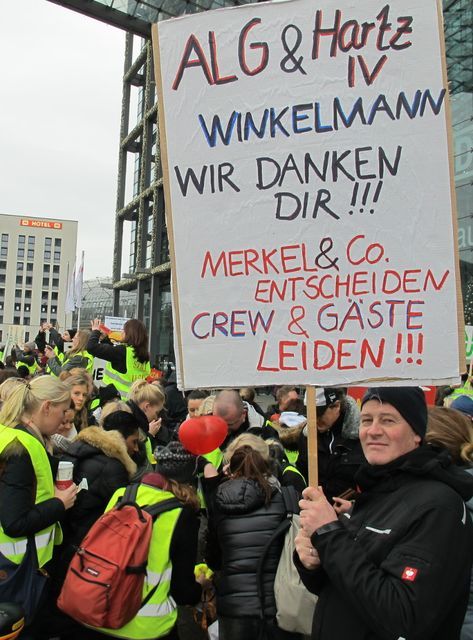
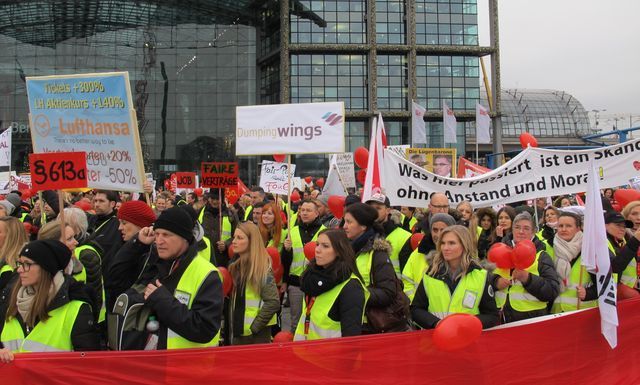
More than a thousand employees of the insolvent airline Air Berlin protested last Wednesday in front of Berlin Central Station to oppose mass layoffs. The workers were accompanied with family members and supporters from all over Germany
Insolvency proceedings were officially opened on 1 November, after Lufthansa agreed to take over 81 Air Berlin aircraft, plus Air Berlin’s landing rights at various airports. The British airline EasyJet secured another 20 aircraft. Other bidders that offered to take over the Air Berlin workforce were not taken into account by the insolvency administrator and the German government.
Demonstrators were angry and fiercely criticised the way the deal had been reached behind their backs by the German government, Lufthansa CEO Carsten Spohr and Air Berlin CEO Thomas Winkelmann.
The protest in front of the main terminal
Both Lufthansa and EasyJet refused to take on the staff of Air Berlin. Instead employees are being told to reapply for jobs at Eurowings-Europe, a Lufthansa subsidiary based in Vienna, on terms well below their previous salaries.
The demonstration was organised by a group headed by a stewardess from Düsseldorf, Chantal Meyer, who has worked for the company since 2004. She spoke to the World Socialist Web Site at the rally held in front of the Chancellery in Berlin.
"We are currently in revocable release from work, which means we have nothing to do, a lot of time on our hands, and no income, unfortunately, because there are no funds left following bankruptcy proceedings." Affected are thousands of Air Berlin workers. Only around 1,700 employees of the Air Berlin subsidiary Niki, headquartered in Vienna, have retained their jobs.
Meyer organised the protest to demonstrate "that we will not be blackmailed into reapplying for our own jobs." Air Berlin workers applying for position as the rival cheap fare Eurowings company will face estimated wage cuts of 40 percent, and up to 50 to 60 percent for pilots, depending on professional experience.
Meyer and her supporters organised a petition to pressure Lufthansa and the UAE Etihad air company to take the Air Berlin workers and the company’s aircraft. The petition had been signed by 46,123 persons prior to the rally.
The hopes of the protesters are based on paragraph 613a of the German Civil Code (BGB), which protects workforces in company takeovers--at least for a limited time. So far, Lufthansa has justified its refusal to abide by the code by arguing that the law only concerned the takeover of entire concerns, but not the transfer of parts of a company, such as the 81 Air Berlin aircraft.
During the rally, the petition was handed to Gregor Gysi, a leader of the Left Party in the German parliament, who was to hand it to Chancellor Angela Merkel.
Responding to the WSWS's question as to why she placed her hopes in Gysi, a politician who had supported the privatisation of airport ground operations in Berlin ten years ago, which resulted in drastic cuts to pay and working conditions, Chantal Meyer naively responded, "The Gysi of today is not the Gysi of that time."
Gysi read his letter to Chancellor Merkel during the rally. It consisted of a worthless plea that she “take seriously the indignation and despair” of Air Berlin workers. Any hope among workers that such appeals will change the mind of the German chancellor is completely unfounded. Just this summer Merkel flew to Abu Dhabi, along with Lufthansa chief Spohr and Air Berlin CEO Winkelmann, to discuss a takeover of Lufthansa by the Saudi airline Etihad, a move that would result in further attacks on airline workers.
In discussions with WSWS reporters, several protesters explained why many Air Berlin workers were not registering as unemployed with the Federal Labor Office, a fact that the news media has greeted with amazed disbelief.
Protest against Air Berlin boss Winkelmann
Sabine who has worked as a flight attendant at Air Berlin for 17 years described the paradoxical situation. "We are revocable, which means theoretically we can be called back to work, although we have already been instructed to destroy our uniforms." In the event of an irrevocable release from work, she could apply for a job elsewhere or register as unemployed but she did not want to simply quit because "Then I would give up any rights I have to entitlements from Air Berlin", she explained. In addition, other airlines were not offering part-time employment. She has two small children and cannot accept full-time work.
"We have not seen much of the union since the bankruptcy", she replied when asked about the role of the Verdi public sector worker union in the labor dispute. "They should have been active much earlier, but Christine Behle [board member of Verdi] also sits on the supervisory board of Lufthansa," she said, before adding. "It all seems rather corrupt.”
Sabine went on, “Mr. Winkelmann was also with Lufthansa for a long time, before he became our CEO and was able to guarantee his salary with a bank guarantee of 4.5 million euros. He is also a good buddy of Carsten Spohr, the head of Lufthansa."
Daniela, a flight attendant for 15 years, said, "We have done all we can to save the airline for the past three months, since August. We knew it was faring badly, but we always thought that somebody would take care of us and we would obtain secure employment from the new purchasers of the planes. Now we know better. After three months came the so-called ‘revocable release from work’ and now we are all out of a job", she concluded.
Along with Gregor Gysi, the deputy regional director of Verdi Berlin-Brandenburg, Roland Tremper, also addressed the rally. Tremper began by declaring, “Our social system is defined by providing people with a perspective and giving workers and their families an opportunity to live a socially secure and peaceful life”, he said, in remarks that bore little relation to reality.
After a number of accusations against the policy of the Federal Government and the irresponsibility of the company chiefs, Spohr and Winkelmann, Tremper admitted he was also chair of a management committee at the employment agency in Berlin. A week ago, he said, he received an application for mass layoffs of ground staff.
Tremper reported that he rejected any request to approve layoffs that came in the form of a written letter or a teleconference. Instead he demanded a face-to-face meeting so he could look others in the eye and see who was really willing to agree to the dismissal of hundreds of workers. In a few weeks, he would do the same when the application for the mass sacking of cabin crew staff arrived.
"I do not know if it helps. But whether it helps or not, we will not just do via the phone or at the warm desk, definitely not", he impotently declared.
Whether on the telephone, at the desk or via direct eye contact the decision remains the same, with devastating results for Air Berlin employees.

Jeff Bezos’ $100 billion: The case for expropriation

Eric London

After a Black Friday surge in Amazon’s stock value, CEO Jeff Bezos’ wealth surpassed the $100 billion mark, making him over $10 billion dollars richer than the world’s second wealthiest man, Microsoft CEO Bill Gates.
The rise of the $100 billion man is a further milestone in the unprecedented growth of social inequality worldwide. Bezos’ wealth would make the robber barons of the 19th century green with envy.
In November, the Institute for Policy Studies found the three wealthiest billionaires owned as much as the poorest half of the United States. Thanks to Bezos, this study is already out of date, because the billionaire increased his wealth by roughly $20 billion since its publication. Worldwide, the five richest billionaires own as much wealth as half the world’s population, some 3.5 billion people.
Bezos acquired his wealth through the exploitation of his 300,000-strong international workforce. Amazon workers make as little as $233 per month in India, to an average of just $12.40 an hour in the United States. Workers toil for long hours with minimal safety protections, very limited benefits, and often in temporary or “flex” positions. In September, when 59-year-old Phillip Terry was crushed by a forklift at an Amazon facility near Indianapolis, the Department of Labor said the company might be forced to pay $28,000 in fines. Bezos makes this much each minute, more than his US employees make in a full year.
The company demands tribute from governments worldwide, requiring billions in tax breaks and free handouts in exchange for building its warehouses. Amazon is bringing back the “company town” of the late 19th century. It has forced over 200 American cities into a bidding war to lure the company’s second headquarters with massive handouts. Chicago, for example, offered Amazon a $2.25 billion “incentive package,” while Stonecrest, Georgia’s city council voted to change its name to “Amazon” and appoint Bezos as “mayor for life” if the company grants them the second headquarters.
Bezos has transformed his corporation into a semi-official organ of the US military-intelligence apparatus. Just this month, Amazon and the CIA announced the launching of a new “Secret Region” cloud system where the company will host data for the CIA, NSA, Defense Department, and other military-intelligence agencies.
A CIA spokesmen recently called the 2013 $600 million deal between Amazon and the government “the best decision we ever made.” Earlier in November, the Senate approved a $700 billion defense spending bill that included an “e-commerce portal” amendment guaranteeing that Amazon will supply the military-intelligence apparatus with computers, chairs and other office supplies.
The $100 billion man has wielded his wealth to curry tremendous influence in the halls of power. Amazon has spent over $9.6 million lobbying the federal government this year. Bezos has used the pages of the Washington Post, which he bought in 2013, to advance the Democratic Party’s agenda. The Post, under Bezos’ direction, has been a foremost advocate of the campaign against Russia, publishing in November 2016 the “PropOrNot” list, a false compilation of alleged “Russian propaganda” news agencies that included left-wing news web sites.
While Bezos accumulates a personal fortune by colluding with the military-intelligence agencies, the material needs of growing numbers of people are going unmet.
The UN estimates that it would cost $30 billion to solve world hunger by providing 862 million people with food for a year. The World Health Organization claims just $11 billion is needed to halve the number of people without access to clean water. Another UN study found that $26 billion would provide education to every child that does not receive one .
The Guttmacher Institute estimates that with $13 billion, free maternal and prenatal care could be provided for every mother in the developing world. It would cost $11 billion to house each of the 150,000 people who are homeless on a given night in the US. The cost of preventing 4 million malaria deaths would be $6 billion each year.
The total cost for these essential changes would be roughly $97 billion.
The accumulation of such immense wealth is proof that the conditions for the socialist transformation of the world are pregnant in the present situation.
In 1880, Friedrich Engels wrote in Socialism: Utopian and Scientific that for socialists, the abolition of classes is not a utopian dream. Rather, it “presupposes, therefore, the development of production carried out to a degree at which appropriation of the means of production and of the products, and, with this, of political domination…by a particular class of society, has become not only superfluous but economically, politically, intellectually, a hindrance to development.”
Engels continued: “The socialized appropriation of the means of production does away, not only with the present artificial restrictions upon production, but also with the positive waste and devastation of productive forces and products that are at the present time the inevitable concomitants of production, and that reach their height in the crises. Further, it sets free for the community at large a mass of means of production and of products, by doing away with the senseless extravagance of the ruling classes of today, and their political representatives. The possibility of securing for every member of society, by means of socialized production, an existence not only fully sufficient materially, and becoming day-by-day more full, but an existence guaranteeing to all the free development and exercise of their physical and mental faculties—this possibility is now, for the first time, here, but it is here.”
Even more so today. The technological advances of the past quarter century and the international integration of the world economy have become weapons in the hands of massive corporations that control the world and its governments. On the one hand, the private ownership of these corporations facilitates the concentration of wealth. On the other hand, the contradiction between the global character of the world economy and the nation-state system is everywhere erupting in the form of war, dictatorship, and the expulsion of tens of millions of refugees from their homes.
The Socialist Equality Party demands that the major corporations be placed under international social control to be organized democratically by the workers themselves to meet the needs of society.
The vast wealth of the financial oligarchy, expressed in their ownership of massive corporations, must be seized and expropriated, while the complex technologies, supply chains, and advanced transportation systems must be integrated in an organized, planned manner to harness the anarchic force of the world economy and eliminate material scarcity.
Amazon is a prime example. Its supply lines and delivery systems could distribute goods across the world, bringing water, food, and medicine from each producer according to his or her ability, to each consumer according to his or her need.
The massively sophisticated computational power used by the technology companies to censor and blacklist political opposition could instead be used for logistical analysis to conduct rescue and rebuilding missions in disaster zones like Houston and Puerto Rico. Drones used in the battlefield could be scrapped and rebuilt to distribute supplies for building schools, museums, libraries, and theaters, and for making Internet service available at no cost for the entire world.
The ruling class and all of the institutions of the political establishment stand inexorably in the way of efforts to expropriate their wealth. What is required is to mobilize the working class in a political struggle against the state and the socio-economic system on which it is based, through the fight for socialism.

The R4+S Approach for Afghanistan

Rajat Ahlawat


The new US strategy for Afghanistan has switched from a 'time-bound', 'troop numbers-based' approach to a 'conditions-based' approach. A conditions-based approach would give the US administration more flexibility in terms of determining troop numbers and their roles and cooperation levels. US Secretary of Defense, James Mattis and Chairman, Joint Chiefs of Staff, General Joseph Dunford, in their testimony before the Senate Armed Services Committee on 3 October 2017, explained the new strategy with the acronym ‘R4+S’ which stands for Regionalise, Realign, Reinforce, Reconcile and Sustain.

Theoretically the strategy looks solid, but it will require long-term commitment and cooperation by the US to bring sustainability and stability to Afghanistan.

The Four 'R's, According to the US:

Regionalise: The US will focus on the roles of regional states neighbouring Afghanistan; according to Mattis, these are  India, Pakistan, China, Iran and Russia.
Realign: The US troops will focus on advising Afghan forces at battalion levels, and will participate with them in combat operations. 
Reinforce: This entails a further addition of over 3,000 US troops, and fighter and heavy bomber aircraft. The US also expects NATO and its allies to contribute with more troops (around 1,000 in total) and financial support.
Reconcile: The hope of a desired political outcome from the enhanced military operations.

'Regionalise'?
With the US focusing on India as a security and economic partner under the new strategy, India's economic role in Afghanistan will see a boost. But much against Washington's desires, India will not maintain military presence in Afghanistan. Meanwhile, the likelihood of Pakistan cracking down on terror-groups acting against India and operating from its territory is low, despite US pressure. Islamabad is also unlikely to accept New Delhi's greater role in Afghanistan. The US will have to navigate through this fundamental difference of opinion.

US President Donald Trump's administration has also failed to reach out to Russia. Moscow-Washington cooperation in Afghanistan is unlikely to see the light of day in the near future. This apparent divide, which has manifested since the US-backed Quadrilateral Contact Group (QCG) meeting in Oman did not invite Russia and the Shanghai Cooperation Organisation (SCO) meeting on Afghanistan in Moscow did not see any US participation, points against a possible 'regionalisation'.

Although President Trump has tried to reach out to his Chinese counterpart President Xi Jinping, it is still doubtful whether this will translate into any real cooperation on ground in Afghanistan. While China’s participation in both the formats points towards its rising role in Afghanistan, the US' failure to develop a consensus on the technicalities of China's future role in Afghanistan would prevent any potential US-China cooperation in Afghanistan. This might result in China pursuing its independent economic interests primarily based on its Belt and Road Initiative.

Iran is also a key regional player which shares a long and porous border with Afghanistan, and is directly affected by the Afghan security situation and illicit drug economy. Both countries share some common interests like curbing the illicit drug economy in Afghanistan and suppressing the presence of Islamic State in the country. But with the current US administration viewing Iran unfavourably, especially with President Trump’s aggressiveness against the nuclear deal, Tehran might not hold itself back in acting against Washington's potential interests if it seeks to benefit from them.

'Realign' and 'Reinforce'
The Realign and Reinforce components are expected to go hand-in-hand. After 2014, NATO had ceased combat roles and restricted its troops to training and advisory capacities, and primarily on the brigade and divisional levels. Now the US troops would focus more on lower battalion levels and participate in combat operations led by the Afghan forces, and coordinate NATO’s fire support. 

However, doubts remain whether the alliance countries would be willing to send their troops into combat. NATO Chief Jens Stoltenberg has stated his preference for NATO troops not partaking in battles. This might lead to over-burdening of US troops who will be expected to conduct 'advise and assist' missions in active combat operations. This begs the question: 16 years on, why are the Afghan forces not operationally capable, and why is the Afghan Air Force, largely incompetent?

'Sustain'
The most difficult component of the new strategy is the 'S', which stands for 'Sustain'. Achieving long term "stability and security" in Afghanistan would require effective and independently-capable Afghan security forces; and there is still a long way to go before this is achieved. The limited capabilities of the Afghan forces means US troops would remain in the country for at least the coming six to seven years, which in turn would reaffirm the Taliban's resolve of not agreeing to negotiate.

Except for a renewed focus on 'advising and assisting' at battalion levels during Afghan-led combat operations, there is nothing new in the Trump administration's strategy that the US has not tried earlier. Though a conditions-based approach would give the US more adaptability on how they define "victory," the current security situation combined with the US' differences with Russia, China, Iran, and now Pakistan will prove to be major hurdles in the success of the strategy.

Microbeads and Microfibre: A Big Challenge for Blue Economy

Vijay Sakhuja


A recent BBC documentary titled Blue Planet II that has an agonising three-minute clip of a dead pilot whale moving along with her dead calf, apparently poisoned due to chemical pollution, left many audiences in shock. Wildlife expert Sir David Attenborough, the narrator of the documentary, pleaded, “Unless the flow of plastics and industrial pollution into the world’s oceans is reduced, marine life will be poisoned by them for many centuries to come.”
While plastic litter has been acknowledged as one of the many pollutants being dumped into the sea, two more materials - microbeads and microfibre - have been discovered deep in the oceans and are affecting marine life. However tiny these may be, the sheer scale of the problem they pose is enormous. Some countries have banned the use of microbeads, and clothing companies are being asked to step up in a big way to address the problem of microfibre.
Microbeads are tiny particles of plastic found in ‘wash-off, rinse-off, and leave-on’ personal care products for scrubbing, exfoliating and cleansing. These are found in body wash prodcuts, scrubs, age-defying makeup products, lip gloss, lipstick, nail polish and even toothpastes, and are washed by the billions every day into drains. Most wastewater treatment plants and systems cannot filter out microbeads which end up in large and small water bodies such as oceans, rivers, lakes and static ponds. Microbeads can absorb contaminants such as pesticides, flame retardants, motor oil, etc, and are inadvertently consumed by marine life all the way up into human food.
It is estimated that five mililitre of facial scrub contains between 4,500 and 9,4,500 microbeads. The Personal Care Products Council (PCPC), an international body that represents the cosmetics industry worldwide, has conceded that they understand the problem and are voluntarily phasing out plastic microbeads in scrub products. However, they argue that microbeads represent only “the tiniest fraction of plastic pollution in aquatic environments” and that 99 per cent of the microbeads are removed by water purification plants. In the US, acknowledging the impact of microbeads on marine and human life, President Obama signed the Microbeads Free Waters Act of 2015, barring the use of plastic microbeads in personal care products sold in the country.
While that may be the case with developed countries. particularly in Europe and the US, the microbeads menace in developing countries is far worse. The existing sewage treatment plants are not designed to capture and remove microbeads. For instance, a report by the Environment and Social Development Organisation (ESDO), Bangladesh, notes that nearly 7928.02 billion microbeads are washed every month into the rivers, canals and other water bodies in major cities such as Dhaka, Chittagong and Sylhet. Further, little is known about the adverse impact of microbeads on marine life, and the fish confuse them for eggs or zooplankton and accidentally ingest them. The report has called on the government to bring about legislation banning the use of microplastic and microbeads in the country.
The issue of microfibre is as complex as microbeads. Nearly 60 per cent of all clothing used by humans is made of synthetic (acrylic, nylon and polyester) fabrics. Synthetic fibres are non-biodegradable and soak up as the molecules of harmful chemical pollutants found in wastewater. Scientists believe that synthetic fibres from apparel are a threat to both the environment as also marine life, which forms an important component of the human food chain. Among these, acrylic has been identified as the worst microfibre-shedding material, up to four times faster than the polyester-cotton blend.
Even though clothing made from natural fibres such as cotton and wool may be biodegradable, it can be a source of contamination for marine life given that the cotton-growers use hazardous insecticides. The remedy lies in using non-genetically engineered organic cotton or wool items with natural dyes that can help solve marine environmental problems.
It is estimated that 1.4 million trillion microfibres are already contaminating the world's waters. Further, tests have revealed that a synthetic fleece jacket releases an average of 1.7 grams of microfibre and top loading washing machines release about 530 per cent more microfibre than front loading models. To get a better sense of the problem, a study notes that “100,000 people could send anywhere from 20 to 240 pounds of microfibres into local waterbodies daily, which averages out to around 15,000 plastic bags.” Ironically, "clothing brands have been slow to respond to this growing threat" but some brands such as Patagonia and Nike are engaged in research to respond to the impact of microfibre.
The presence of microbeads and microfibres in the oceans, seas and rivers poses a major challenge for the development of 'Blue Economy', which is high on the agenda of a large number of countries. If the aim is to harness the resources of the seas in a sustainable manner, society may need to take a step back and think about the everyday products they use.  The remedy lies in accurately understanding the ‘extent, nature and sources’ of microbeads and microfibres before using these products, which certainly enhance human appearance, but adversely impact the marine environment. Perhaps the reason for the lack of a robust response to the problem is that nobody wants to take responsibility. 

25 Nov 2017

UNICAF Undergraduate & Graduate Scholarship at University of South Wales for International Students 2018

Application Deadline: 19th January 2018
To Be Taken At (Country): Wales, UK
About the Award: The UNICAF Scholarship Programme was founded to offer gifted, underprivileged students the opportunity to further their education, by earning internationally recognised qualifications, at low cost, through online study, or through blended learning (only available for Unicaf University programmes).
The University of South Wales is one of the largest in the UK, offering more opportunities and better prospects for students.
The partnership between the University of South Wales and UNICAF, brings together the resources and capabilities of both organisations to offer innovative learning solutions and programmes which are delivered fully online to the needs of a wide range of students and professionals.
Fields of Study: The University of South Wales offers many exciting opportunities for undergraduate and postgraduate candidates to STUDY ONLINE for the following programmes of study:
  • BA (HONS) – Business Studies (Top-up degree)
  • MBA – Master of Business Administration
  • MA Education (Innovation in Learning and Teaching)
  • MSc in Psychology
  • LLM (Master of Laws)
  • MSc in Public Health
Type: Bachelors, Masters
Eligibility: To apply for the UNICAF Scholarship Programme, candidates should:
  • Be earning less than 20,000 USD per year
  • Be available to commence their academic studies within 6 months from the date of receiving admission to one of the programmes offered
  • Meet the entry requirements of the respective programme of study
To find out if you are academically qualified to apply for your programme of choice, visit the University of South Wales Admission Page.
Number of Awards: Not specified
Value of Award: Up to 50%
How to Apply: The Scholarships will be awarded on a rolling basis, so don’t wait to apply!
Take & Complete the Sqore Challenge
Apply with UNICAF directly for the program you selected
Stand a chance to receive a partial scholarship
It is important to go through the Application process on the Program Webpage (see Link below) before applying.
Award Providers: UNICAF

Åbo Akademi University (Win a Scholarship) 2018

Application Timeline: 

Application opens: 1st December 2017
Application Closes 31st January 2018.
Eligible Countries: International
To Be Taken At (Country): Finland
About the Award: Are you a prospective Master’s student looking to start in 2018? Did you know that Åbo Akademi University is known as one of the most international universities in Finland?
Åbo Akademi University is committed to research and research-based education of the highest quality. We are a recognized leader in many research areas including biosciences, computer science, democracy, human rights, material sciences, process chemistry, and psychology.
Åbo Akademi University has 3 international Master’s degrees in Social Sciences offered in 2018 including:
  • Master’s Programme in International Law and Human Rights
  • Master’s programme in Peace, Mediation and Conflict Research
  • Master’s Degree Programme in Social Exclusion

Type: Masters
Eligibility: 
Eligibility for Master’s Programme in Peace, Mediation and Conflict Reseach
  • A Bachelor’s degree in Humanities, Social Sciences, or Behavioral Sciences
  • Prove their knowledge of the English language
  • All submissions must be the original work of the user
  • All users must provide personal information that is truthful and accurate
  • Sqore reserves the right to exclude users at its sole discretion
Eligibility for Master’s Programme in International Law and Human Rights
  • A Bachelor’s degree in Law, or a Bachelor’s with at least 45 ECTS in law
  • Prove their knowledge of the English language
  • All submissions must be the original work of the user
  • All users must provide personal information that is truthful and accurate
  • Sqore reserves the right to exclude users at its sole discretion
Eligibility for Master´s Programme in Social Exclusion
  • A relevant BA in Comparative Religion, Gender Studies, History, Philosophy, Theology or an equivalent degree
  • Prove their knowledge of the English language and fulfill the general academic requirement
  • All submissions must be the original work of the user
  • All users must provide personal information that is truthful and accurate
  • Sqore reserves the right to exclude users at its sole discretion

Number of Awards: Not specified
Value of Award: €18720
How to Apply: 
  1. Complete the Sqore challenge for a chace to win the scholarship
  2. Apply to Åbo Akademi on studyinfo.fi during the application period (open 1 December 2017 – 31 January 2018
The Sqore challenge is not the university application. During the application period, the Finnish university application form is available through studyinfo.fi. You can find the application form for Åbo Akademi University by searching the study options on the website. In the search field, enter the name of a programme or university you are looking for.
It is important to go through the Application information on the Program Webpage (see Link below) before applying.
Award Providers: Åbo Akademi University
Important Notes: 
  • No prize alternatives or cash equivalents are offered
  • Prizes are non-transferable
  • The winner is solely responsible for all applicable taxes related to the acceptance of the prize

Africa Energy Indaba African Youth Energy Innovator 2018

Application Deadline: 15th January 2018
About the Award: Africa needs to invest in and grow its next generations of energy leaders if its countries and the broader continent are to compete in the global arena. Africa Energy Indaba is committed to empowering talented young Africans by allowing them to be seen by the industry experts and energy decision makers. Africa Energy Indaba wants to encourage empowerment and help find solutions to energy problems in Africa. We want to foster inspirational and innovative thinking, starting with the talented youth in Africa.
Type: Entrepreneurship
Eligibility: 
  • Individuals who are between 18 to 35 years old; AND
  • Have citizenship to any country in Africa
Selection Criteria: 
1. Energy Security: Can your innovation help with effective management of energy supply, reliability of energy infrastructure, or meet a specific set of current and future demands?
2. Environmental Sustainability: Does your innovation provide clean renewable or low carbon supply energy?
3. Energy Equity: Can your innovation improve accessibility and affordability of energy in Africa?
4. Job creation: Could your innovation create jobs?
5. Target customers: Who is the innovation going to benefit? For example Utilites / Rural communities / Corporates etc.?
6. Customer value: What are the key benefits of your innovation to customers?
7. Your unique value proposition: How will you differentiate and position yourself?
Number of Awards: 5. A winner and 4 runners-up
Value of Award: 
• The winner will receive the Best Innovator Award and will be recognized at the Africa Energy Indaba 2018 in Johannesburg.
• The winner and the 4 runners-up will each receive an all-inclusive ticket to attend the Africa Energy Indaba 2018 and showcase their innovations in a 2-day exhibition. This will provide the following benefits:
– Publicity and exposure of the winning innovations to local and international market opportunities
– Access to exclusive Business Matchmaking networking program to meet with potential investors
– Opportunity to meet key public and private sector stakeholders
– The possibility of attracting funding or sponsorship
How to Apply: Download the Proposal Submission Form and submit the completed forms with any diagrams and pictures to deveena@energyindaba.co.za BY 15 January 2018.
Award Providers: Africa Energy Indaba