30 Nov 2017

Columbia Centre Executive Training on Sustainable Investments in Agriculture for Developing Countries 2018

Application Deadline: Applications will be accepted on a rolling basis; the final application deadline is 31st March, 2018. Applicants are strongly encouraged to apply as early as possible, particularly if seeking a partial scholarship.  
Eligible Countries: Low and Middle Income countries
To Be Taken At (Country): Columbia University (New York)
About the Award: The program adopts an interdisciplinary approach to sustainable investments in agriculture. It provides an overview of pressing issues related to agricultural investments, as well as an introduction to relevant practical skills. The overarching goal of the course is to equip participants with the knowledge and skills necessary to support responsible agricultural investment, and to facilitate a rich dialogue about best practices from around the globe. By working through case studies with practitioners and experts in the field, participants will focus on how to use analytical tools and frameworks to harness international agricultural investments for sustainable development.
Type: Training
Eligibility: This interdisciplinary program is designed for mid-level public sector officials and civil society representatives from low- and middle-income countries, whose responsibilities relate to investments, agriculture, land or rural development. A select number of representatives from development agencies and the private sector may also be admitted. (Please note that you are responsible for securing a visa for your participation; we recommend applying for a tourist visa. If you need a letter from us, please let us know as soon as possible. All participants must be able to read and communicate in English.) 
Number of Awards: Not specified
Value of Award: The program fee for this nine-day training is USD $3,800 – this covers lectures, on-campus accommodation, breakfasts and lunches, and social events. Without accommodation, the program fee is USD $2,500. A limited number of partial scholarships are available.
Duration of Program: The 2018 program will be held from June 19-29.
How to Apply: The application is available here.
Award Providers: Columbia Centre

French Committee for International Solidarity (FCIS) Grants for Family Agriculture in West Africa 2018

Application Deadline: 26th February 2018
Eligible Countries: Benin, Burkina Faso, Cape Verde, Gambia, Ghana, Guinea, Guinea-Bissau, Ivory Coast, Liberia, Mali, Mauritania, Niger, Nigeria, Senegal, Sierra Leone, and Togo.
About the Award: Faced with the rapid growth of cities and increased demand from urban consumers who change the city-countryside relationship, family farming must now strengthen its capacity to feed cities through local production.
In order to support them, the Fondation de France and the French Committee for International Solidarity (CFSI) joined forces in 2009 to launch a program to strengthen family farming in sub-Saharan Africa, refocused since 2010 on the African continent.
The overall goal of this call is to:
  • promote local initiatives to increase access to food through viable and sustainable West African family farming;
  • to share the gains on larger scales;
  • and to contribute to documenting the sustainability of this agricultural model that is likely to challenge decision-makers to take these issues into account in public policies.
The program supports projects that address one and the other of the following two themes:
  • connect family farming and markets / promote “local consumption”;
  • develop sustainable agriculture practices / sustainable food systems.
The 2018 call for projects exclusively targets innovations specific to the connection with mass markets. In 2018, only those projects demonstrating a real capacity to implement innovations responding to the following priority questions will be selected:
How to go beyond the niche markets? – whether through institutional purchases or through actions aimed at reaching a significant number of consumers in the middle and poor or very poor categories.

Type: Grants
Eligibility: This call is for non-profit corporations:
  1. Farmers’ Organizations (POs) in West Africa;
  2. support NGOs active in West Africa or in Europe as long as they work with local partners;
  3. research and / or training organizations.
Selection Criteria: After verifying that the project responds well to the 2018 priority issue, the selection committee will make a selection according to the following criteria:
  • admissibility of the dossier from an administrative point of view (complete dossier, correctly filled in and with the accompanying documents as requested, files correctly named and in the requested format, amount of the grant and duration of the project, no error in the budgets, etc.);
  • eligibility of applicants, partners and projects;
  • relevance of the innovation(s) put in place by the project and the extent to which they enable sustainable family farming production to have access to urban and rural markets and to enhance consumption of healthy local products;
  • quality of the project (its impact on family farming and on access to food in towns and cities; preservation of natural resources and of biodiversity; adaptation to climate change; rural employment; governance; skill-based partnerships, at local and international level; etc.);
  • taking into account former experiences or experiences led by other actors on similar themes and/or on the same territory;
  • feasibility: relevance of project’s budget and action plan, coherence of the general objective, specific objectives, planned activities, expected results and the indicators of these same results; coherence between estimated budget and financial planning;
  • criteria for inclusion of scaling-up (measures to ensure the continued benefits over the long run, capitalization, dissemination and valorization, replication of the innovations, advocacy, etc.).
Number of Awards: Not specified
Value of Award: In order to encourage applicants to develop diversified partnerships, especially local ones, the Pafao program will not finance the whole project (maximum at 80%). The financing plans will mention the other solicited/acquired financial partners, as well as the self-financing part which is forecast.
Two kinds of initiatives will be supported:
  • short-term projects (one-year duration), with a granted amount of 10,000€ to 15,000€;
  • multi-year projects (3 years maximum), with a maximum amount of 50,000€ for the whole period (3 years) and paid in annual installments in light of the progress of the project.
The supported projects can already be under way, or be specific parts of wider projects, whether under way or new. The financed actions must unfold after January 1st, 2018 and begin before December 31st, 2018
How to Apply: 
  • The file composed of the application form (word file), the budget (excel file) and the annexes requested – completed in French or in English – is to be sent by email only to the following address: secr.aea@cfsi.asso.fr. See all Links in Program Webpage Link below.
  • The shipment will be made in several mails, each of which will have a maximum weight of 8 MB.
  • The files will be processed by the program secretariat provided by the CFSI.
  • Any question relating to this call for projects, and remained unanswered after a careful reading of the guidelines, can be asked by mail only to: secr.aea@cfsi.asso.fr
Award Providers: French Development Agency.
Important Notes: The call for projects is reserved for proposals for actions in formalized partnership between a West African organization and a European organization. The leading organization can be West African or European.

Japan’s Imperial Eclipse

Tom Clifford 

The Japanese government is preparing for a rare event, an imperial eclipse, an emperor’s abdication and ascension. April 30, 2019, is the date set for the abdication of Emperor Akihito, clearing the way for his eldest son, Crown Prince Naruhito, to become the 126th occupant of the Chrysanthemum Throne.
Akihito, turns 84 on Dec 23 has had heart surgery and treatment for prostate cancer and highlighted his desire to step down last year when he said that age might make it hard to fulfill his duties.
Since the Meiji Restoration of 1868, when the shogunate collapsed and the emperor was plucked from relative political obscurity in Kyoto to reside in Tokyo, there have only been four emperors.
The succession, when it comes, will provide Japan with symbols of its past, though some will try to hijack them as markers for the future. Especially as the country grapples with the issue of changing the war-renouncing Article 9 of the constitution to allow the Japanese army to be deployed in battle.
The Liberal Democratic Party, who have been in power for all but a handful of the last 60 years, proposed scrapping the second paragraph of Article 9, which reads: “land, sea, and air forces, as well as other war potential, will never be maintained. The right of belligerency of the state will not be recognized.”
Under the government’s new proposal, the second paragraph of Article 9 would remain intact, but include new text legitimizing the existence of the Self-Defense Forces, which were established in 1954 in contradiction to Article 9.
Akihito’s retirement and the engagement of his granddaughter Princess Mako to a commoner, have reignited debate about the shortage of male heirs and a possible succession crisis in an imperial line some claim stretches back 2,600 years.
The prime minister, Shinzo Abe, has also rejected moves to include a clause allowing princesses to establish their own branches within the imperial family after they marry commoners. This would give their sons the right to become emperors.
It gets down to sheer numbers. Once Mako marries, the imperial family will have just just 18 members – 13 of whom are women – and only four heirs to the throne: 57-year-old Naruhito, his younger brother Akishino and his son, 10-year-old prince Hisahito, and the emperor’s 81-year-old brother, prince Masahito.
If Hisahito fails to have any sons, the imperial line is endangered.
The Imperial House Council will hold a meeting on Dec. 1 to present proposals for Abe to consider regarding the abdication date from the heads of both Diet chambers as well as Imperial family members.
The government intends to seek cabinet approval as early as Dec. 8 for a government ordinance to officially set the abdication date.
A law enabling the emperor to abdicate specifies that the abdication should take place within three years from the law’s promulgation, which was in June this year.
Japan’s royal family claims lineage back to the first emperor, Jimmu (about 650 BC), and is the world’s oldest hereditary monarchy. Despite this long lineage, succession was never a problem, due mainly to the system of concubinage which was only abolished in 1926, the year Akihito’s father, Hirohito, became emperor.
In 1945, the Americans realised that this system had produced a number of possible competing claimants to the throne. This fear resulted in the Imperial Household Law, introduced in 1948, which limited the succession to male descendants of the emperor, Hirohito.
For many Japanese, the only succession they recall was Akihito’s in 1989. The country was severely disrupted in the months before the death of Hirohito. Cabinet ministers cancelled meetings overseas, television programmes were curtailed, festivities called off and the media portrayed the situation in reverential tones.
Japan in 1989 was a far different place. When Hirohito died, mourning for his passing aside, there was an air of unbridled optimism, the foundation of which lay in the country’s phenomenal economic power. From the debris of war, the country had rebuilt itself, joined the economic superpowers and was challenging the US for pre-eminence.
Today, the country is frustrated at its lost economic opportunities and troubled that the post-bubble remedy has seemed so elusive to its leaders. And the rise of China has led to a sense of vulnerability that was missing in 1989.
The imperial family, the only institution in Japan not beset by scandals, have been portrayed as the last bastion of ‘good, traditional values’.
In any country with a monarchy, succession is a time for rejoicing, to reaffirm the country’s values and to give the people a sense of identity and hope for the future. But there is a dark side to Japan’s succession.
Rightists groups will portray the Shinto rituals, especially the rite of enthronement where the new emperor is in symbolic communication with deities, as evidence of the ‘real Japan’. This will be taking place against a backdrop of Japan changing the status of its military and that will alarm some its neighbors.

Killing The Biosphere To Fast-Track Human Extinction

Robert J. Burrowes

Several years ago in Cameroon, a country in West Africa, a Western Black Rhinoceros was killed. It was the last of its kind on Earth.
Hence, the Western Black Rhinoceros, the largest subspecies of rhinoceros which had lived for millions of years and was the second largest land mammal on Earth, no longer exists.
But while you have probably heard of the Western Black Rhinoceros, and may even have known of its extinction, did you know that on the same day that it became extinct, another 200 species of life on Earth also became extinct?
This is because the sixth mass extinction event in Earth’s history is now accelerating at an unprecedented rate with 200 species of plants, birds, animals, fish, amphibians, insects and reptiles being driven to extinction on a daily basis.And the odds are high that you have never even heard of any of them. For example, have you heard of the Christmas Island Pipistrelle, recently declared extinct? See Christmas Island Pipistrelle declared extinct by IUCN.
Apart from the 200 species extinctions each day however, and just to emphasize the catastrophic extent of this crisis, myriad local populations of many species are driven to extinction daily and millions of individual lifeforms are also killed. See Biological annihilation via the ongoing sixth mass extinction signaled by vertebrate population losses and declines.
Is anything being done to end this omnicide (the destruction of all life)?
Not really, although there is plenty of rhetoric and limited action in some contexts as all bar a few committed individuals and organizations ignore this onslaught while even fewer take action that addresses the underlying cause and/or fundamental drivers of this killing. Unfortunately, most effort is still wasted on lobbying elites.
For example, in the latest example of the foolishness of lobbying elites to take action in our struggle to defend Earth’s biosphere, the European Union has again just renewed Monsanto’s licence to keep poisoning (and otherwise destroying) our world – see German vote swings EU decision on 5-year glyphosate renewal – despite the already overwhelming evidence of the catastrophic consequences of doing so. See, for example, Killing Us Softly – Glyphosate Herbicide or Genocide?and GM Food Crops Illegally Growing in India: The Criminal Plan to Change the Genetic Core of the Nation’s Food System.
Of course, massive poisoning of the biosphere is only one way to destroy it and while elites and their agents drive most of this destruction they nevertheless often rely on our complicity. To itemize just a few of these many techniques for destroying our biosphere in most of which we are complicit, consider the following. We destroy rainforests – see Cycles of Wealth in Brazil’s Amazon: Gold, Lumber, Cattle and Now, Energy – we contaminate and privatize the fresh water – see Groundwater drunk by BILLIONS of people may be contaminated by radioactive material spread across the world by nuclear testing in the 1950s and Nestlé CEO Denies That Water is an Essential Human Right– we overfish and pollute the oceans – see New UN report finds marine debris harming more than 800 species, costing countries millions– we eat meat despite the devastating impact of animal agriculture on Earth’s biosphere – see The True Environmental Cost of Eating Meat– we destroy the soil – see Only 60 Years of Farming Left If Soil Degradation Continues – and we use our cars and air travel (along with our meat-eating) as key weapons in our destruction of Earth’s atmosphere and climate with atmospheric carbon dioxide, methane and nitrous oxide levels all breaking new records in 2016. See Greenhouse Gas Bulletin.
But if you think that is bad enough, did you know about the out-of-control methane releases into the atmosphere that we have triggered – see 7,000 underground gas bubbles poised to “explode” in Arctic and Release of Arctic Methane “May Be Apocalyptic,” Study Warns– and did you know that scientists at the University of Leicester warn that we are destroying the Earth’s oxygen? See Global warming disaster could suffocate life on planet Earth, research showsand ‘The Extinction Event Gains Momentum’.
In addition, relying on our ignorance and our complicity, eliteskill vast areas of Earth’s biosphere through war and other military violence (without even considering the unique, and possibly life-ending, devastation if the recently and repeatedly threatened nuclear war eventuates) – see, for example, the Toxic Remnants of War Project and the film Scarred Lands & Wounded Lives – subject it to uncontrolled releases of radioactive contamination – see Fukushima Radiation Has Contaminated The Entire Pacific Ocean – And It’s Going To Get Worse– and use geoengineering to wage war on its climate, environment and ultimately ourselves. See, for example, Engineered Climate Cataclysm: Hurricane HarveyPlanetary Weapons and Military Weather Modification: Chemtrails, Atmospheric Geoengineering and Environmental WarfareChemtrails: Aerosol and Electromagnetic Weapons in the Age of Nuclear War and The Ultimate Weapon of Mass Destruction: “Owning the Weather” for Military Use.
Of course, all of this is done at immediate cost to human beings, particularly indigenous peoples – see, for example, Five ways climate change harms indigenous people–  and those who are in the worst position to resist – see Global Poverty: How the Rich Eat the Poor and the World: The Big Lies – but elites know they can ignore our lobbying and occasional, tokenistic and disorganized protests while relying on the fear and powerlessness of most of us to ensure that we do nothing strategic to fight back.
And given the unrelenting criminal onslaught of the insane global elite – see The Global Elite is Insane  – directed against Earth’s biosphere, together with the elite’smany sycophantic academic, bureaucratic, business, legal, media, military, political and scientific servants who deny science and threaten human survival in the interests of short-term personal privilege, corporate profit and social control, it is long past time when those of us who are genuinely concerned should be developing and implementing a strategy that recognises the elite and its many agents as opponents to be resisted with a careful and powerful strategy.
So, in essence, the problem is this: Human beings are destroying the biosphere and driving countless lifeforms, including ourselves, to extinction. And there is little strategic resistance to this onslaught.
There is, of course, an explanation for this and this explanation needs to be understood if we are to implement a strategy to successfully halt our omnicidal assault on Earth’s biosphere in time to save ourselves and as many other species as possible in a viable ecological setting.
This is because if you want to solve a problem or resolve a conflict, then it is imperative to know and act on the truth. Otherwise you are simply acting on a delusion and whatever you do can have no desirable outcome for yourself, others, the Earth or its multitude of creatures. Of course, most people are content to live in delusion: it averts the need to courageously, intelligently and conscientiously analyse what is truly happening and respond to it powerfully. In short: it makes life ‘easier’ (that is, less frightening) even if problems keep recurring and conflicts are suppressed, to flare up periodically, rather than resolved.
And, of course, this is how elites want it. They do not want powerful individuals or organizations interfering with their scheme to (now rapidly) consolidate their militarized control over the world’s populations and resources.
This is why, for example, elites love ‘democracy’: it ensures disempowerment of the population. How so? you might ask. The fundamental flaw of democracy is that people have been deceived into surrendering their personal power to act responsibly – in relation to the important social, political, economic, environment and climate issues of the day – to elected ‘representatives’ in government who then fearfully represent the elites who actually control them (whether through financial incentives, electoral support or other means), assuming they aren’t members of the elite themselves and simply represent elite priorities out of shared interest (as does Donald Trump).
And because we delegate responsibility to those powerless politicians who fearfully (or out of shared interest) act in response to elite bidding, the best scientific information in relation to the state of the Earth is simply ignored or rejected while conservative ‘scientific warnings’ advocating ‘strategies’ that must fail are widely circulated. See, for example, World Scientists’ Warning to Humanity: A Second Notice.
So this widespread failure to respond thoughtfully and powerfully is a fundamental reason that we are killing the biosphere and destroying life on Earth. Too few humans are willing to accept personal responsibility to understand why the violence is occurring and to participate in a carefully designed strategy to avert our own extinction, let alone save countless other species from premature entry into the fossil record. It is easier to leave responsibility to others. See The Delusion “I Am Not Responsible”’.
And, clearly, time is running out, unless you are gullible enough to believe the elite-sponsored delusion that promotes inaction, and maximizes corporate profits in the meantime, because we are supposed to have until ‘the end of the century’. Far from it, however. As some courageous scientists, invariably denied access to mainstream news outlets, explain it: near-term human extinction is now the most likely outcome.
One of these scientists is Professor Guy McPherson who offers compelling evidence that human beings will be extinct by 2030. For a summary of the evidence of this, which emphasizes the usually neglected synergistic impacts of many of these destructive trends (some of which are noted above) and cites many references, listen to the lecture by Professor McPherson on Climate Collapse and Near Term Human Extinction.
Why 2030? Because, according to McPherson, the ‘perfect storm’ of environmental assaults that we are now inflicting on the Earth, including the 28 self-reinforcing climate feedback loops that have already been triggered, is so far beyond the Earth’s capacity to absorb, that there will be an ongoing succession of terminal breakdowns of key ecological systems and processes – that is, habitat loss – over the next decade that it will precipitate the demise of homo sapiens sapiens.
In relation to the climate alone, another scientist, Professor Kevin Anderson, who is Deputy Director of the UK’s premier climate modelling institution, the Tyndall Centre for Climate Change Research, has warned that emissions are now out of control and we are heading for a world that is 6 degrees hotter; he pointed out that even the International Energy Agency, and conservative organisations like it, are warning that we are on track for a 4 degree increase (on the pre-industrial level) by 2040. He also accused too many climate scientists of keeping quiet about the unrealistic assessments put out by governments. See What They Won’t Tell You About Climate Catastrophe.
So be wary of putting any credence on ‘official’ explanations, targets and ‘action-plans’ in relation to the climate that are approved by large gatherings, whether governmental or scientific. Few people have the courage to tell the truth when it guarantees unpopularity and can readily manifest as career-extinction and social and scientific marginalization.
As an aside, it is perhaps worth mentioning that most people have long forgotten that a decade ago (when the global temperature was .8 degrees above the pre-industrial level) it had been suggested that a decrease in global temperature to not more than .5 degrees above the pre-industrial level was actually necessary to achieve a safe climate, with the Arctic intact (although there was no clear feasible method for humans to reduce the global temperature to this level with any speed). Sadly we have made little progress in the past decade apart from to keep raising the ‘acceptable’ limit (whether to 2 degrees or ‘only’ 1.5). Most humans love to delude themselves to avoid dealing with the truth.
Hence, for those of us committed to responding powerfully to this crisis, the fundamental question is this: Why, precisely, are human beings destroying life on Earth? Without an accurate answer to this question, any strategy to address this crisis must be based on either guesswork or ideology.
So let us briefly consider some possible answers to this question.
Some people argue that it is genetic: human beings are innately violent and, hence, destructive behaviors towards themselves, others and the Earth are ‘built-in’ to the human organism; for that reason, violence cannot be prevented or controlled and humans must endlessly destroy.
However, any argument that human beings are genetically-predisposed to inflict violence is easily refuted by the overwhelming evidence of human cooperation throughout the millennia and there are endless examples, ranging from the interpersonal to the international, of humans cooperating to resolve conflict without violence, even when these conflicts involve complex issues and powerful vested interests. There are also plentiful examples of humans, particularly indigenous communities, living in harmony with, rather than destroying, nature.
Other analysts argue that human violence and destructiveness are manifestations of political, economic and/or social structures – such as patriarchy, capitalism and the state, depending on the perspective – and while I agree that (massive) structural violenceactually occurs, I do not believe that these structures, by themselves, constitute an adequate explanation of the cause of violence.
This is simply because any structural explanation cannot account for violence in all contexts (including the violence that led to creation of the structure in the first place) or explain why it doesn’t happen in some contexts where a particular perspective indicates that it should.
So is there another plausible explanation for human violence? And can we do anything about it? Let me offer an explanation and a way forward that also takes advantage of the insights of those traditions that have critiqued structural violence in its many forms.
I have been researching why human beings are violent since 1966 and the evidence has convinced me that the origin of all human violence is the violence inflicted by adults on children under the guise of what sociologists call ‘socialization’. This violence takes many forms – what I call ‘visible’, ‘invisible’ and ‘utterly invisible’ violence – and it creates enormously damaged individuals who then personally inflict violence on themselves, those around them (including their own children) and the Earth, while creating, participating in, defending and/or benefiting from structures of violence and exploitation. For a full explanation of this point, see Why Violence? and Fearless Psychology and Fearful Psychology: Principles and Practice.
Hence, in my view, the evidence is overwhelming that if we want to end human violence, whether inflicted on ourselves, others or the Earth, then the central feature of our strategy must be to end adult violence against children. See My Promise to Children.I claim that this must be ‘the central feature of our strategy’ for the simple reason that each damaged child grows up to become a willing and active perpetrator of violence when, if they were not so damaged, they would be powerful agents of peace, justice and sustainability committed to resisting violence and exploitation in all contexts until it is eliminated.
This profound evolutionary inheritance – to be an individual of integrity who consciously chooses and lives out their own unique, powerful and nonviolent life path – has been denied to virtually all of us because humans endlessly terrorize their children into mindless obedience and social conformity, leaving them powerless to access and live out their conscience.
And this makes it very easy for elites: By then using a combination of our existing fear, indoctrination (via the education system, corporate media and religion) and intimidation (via the police, legal and prison systems), sometimes sweetened with a few toys and trinkets, national elites maintain social control and maximize corporate profits by coercing the rest of us to waste our lives doing meaningless work, in denial of our Selfhood, in the corporate-controlled economy.
As I implied above, however, we need not be content with just working to end violence against children. We can also work to end all other manifestations of violence – including violence against women, indigenous peoples, people of color, Islamic and working class people, and violence against the Earth – but recognize that if we tackle this violence without simultaneously tackling violence at its source, we fundamentally undermine our effort to tackle these other manifestations of violence too.
Moreover, tackling structural violence (such as capitalism) by using direct violence cannot work either. Because violence always feeds off fearit will always proliferate and remanifest, whether as direct, structural, cultural or ecological violence, however beneficial any short-term outcome may appear.
Importantly then, apart from understanding and addressing the fundamental cause of this crisis, we must implement a comprehensive strategy that takes into account and addresses each and every component of it. There is no point working to achieve a single objective that might address one problem no matter how important that particular problem might be. The crisis is too far advanced to settle for piecemeal action.
Hence, if you wish to tackle all of this violence simultaneously, you might consider joining those participating in the comprehensive strategy simply explained inThe Flame Tree Project to Save Life on Earth. If you wish to tackle violence in a particular context, direct, structural or otherwise, consider using the strategic approach outlined in Nonviolent Campaign Strategy or Nonviolent Defense/Liberation Strategy.
And if you would like to publicly commit yourself to participate in the effort to end all human violence, you can do so by signing the online pledge of The Peoples Charter to Create a Nonviolent World.
Killing the biosphere is the most effective way to destroy life on Earth because it destroys the ecological foundation – the vast array of incredibly diverse and interrelated habitats – on which organisms depend for their survival. And we are now very good at this killing which is why averting human extinction is already going to be extraordinarily difficult.
Hence, unless and until you make a conscious personal decision to participate strategically in the struggle to save life on Earth, you will be one of those individuals who kills the biosphere as a byproduct of living without awareness and commitment: A person who simply over-consumes their way to extinction.
So next time you ponder the fate of humanity, which is inextricably tied to the fate of the Earth, it might be worth considering the unparalleled beauty of what Earth has generated. See, for example, Two White Giraffes Seen in Kenyan Conservation Area.
And as you do this, ask yourself how hard you are willing to fight to save life on Earth.

Rohingya refugees face appalling conditions in Bangladesh

Wimal Perera 

In contrast to Prime Minister Sheikh Hasina’s propaganda about the “humanitarian treatment” given to Rohingya refugees in Bangladesh, they living in miserable conditions in make-shift camps.
Because of the deep-felt sympathy of the ordinary masses for the Burmese refugees, the Hasina government pretends it is looking after them well. However, it is seeking to push them back into Burma as soon as possible.
Rohingya people, an oppressed Muslim minority, have lived for generations in Burma’s northwestern Rakhine state. In 1982, the Burmese regime stripped away their citizenship rights.
More than 622,000 refugees have entered Bangladesh since the Burmese military stepped up its violent attacks in August, triggering a mass exodus from Rakhine state. An estimated 834,000 refugees are living in Bangladesh, including those who fled earlier.
Though the Bangladesh government tried to block the refugees by military means, it was later forced by sheer weight of numbers to allow the mass exodus. Refugees were tortured, women raped, houses torched and villages destroyed in what amounts to “ethnic cleansing” by the Burmese military and its associated gangs.
The refugees are crammed in unhealthy and unplanned squalid camps at Cox’s Bazar, 400 kilometers south of Dhaka and close to the border with Rakhine state. The refugees are short of clean water, sanitary facilities, health care and food.
Aid worker Kym Blechynden, speaking to the media on November 21, described the situation at one refugee camp, the Kutapalong camp located in Cox’s Bazar. “Steep hillsides are covered in makeshift homes closely packed together like a jigsaw and built with pride from bamboo and tarpaulins,” she said. “There is no space left untouched, as far as the eye can see.”
Blechynden said: “We see more than 150 patients a day in each clinic; malnourished children and adults, people suffering from dangerous diarrhoea and respiratory infections.”
The conditions inside the camp are appalling. There are no roads in the camps, only steep muddy tracts. With torrential rain, the situation becomes worse.
With thousands more people coming across the border, the situation will continue to deteriorate.
The overwhelming majority of refugees are women and children. One media report noted the plight of two small children less than two years of age, listless in their mother’s arms. Dying of thirst, they were revived by dropping water with sugar into their mouths. Many refugees are in this state.
Many children are traumatised by their experiences. Rabea, a six-year-old girl, said she was standing with her siblings when a soldier shot her father in the head. “Blood flowed from his ears, his body dropped lifeless to the ground… Her mother was shot soon after,” the Daily Star reported.
Rabea’s aunt, who cares her, said Rabea cries at night, and spends her days roaming through the camp, unable to understand what happened.
Child protection specialist Graner Marak with World Vision said: “With the horrors they have gone through, it is difficult to say if they can recover. Children have seen killings and atrocities and this will take time to process.”
Another doctor said most girls are “rape survivors.” He said his clinic treated 3,000 to 5,000 refugees daily, many of them children, for numerous diseases, including waterborne diseases like cholera and diarrhea.
According to the World Health Organisation (WHO), 62 percent of the water available to the refugees is contaminated with E. coli, an indicator for measuring faecal contamination. UNICEF (United Nations Children's Fund) spokesperson Christophe Boulierac said: “We are also concerned by an increase in cases of acute watery diarrhoea (AWD) which has included several deaths.” Between 25 August and 11 November, a total of 36,096 AWD cases were reported, including 10 related deaths. Reportedly, there is only one toilet per 327 refugees.
Malnutrition has developed to life-threatening levels. UNICEF and its partners screened a total of 59,604 children as of October 25. They identified 1,970 or 3.3 percent as “severely acutely malnourished” and 6,971 or 12 percent as “moderately acutely malnourished.”
One refugee leader told the UNHCR team: “When it rains, the rain comes down from the hills behind, and during the high tides, the water comes from that side.” He said the water often reached knee height, saturating their shelters.
To try to survive, refugees are engaged in work such as pulling rickshaws, fishing, making bricks or working in nearby salt fields.
On September 12, Prime Minister Hasina visited the Kutupalong refugee camp to put on a show of sympathy. She hugged refugees and lamented the deaths of women and children. Hasina told reporters: “We gave them shelter in our country on humanitarian grounds.”
Likewise, Bangladesh Foreign Minister A. H. Mahmood Ali accompanied a delegation of three foreign ministers from Germany, Sweden and Japan.
Meanwhile, Hasina’s government is biometrically registering all the refugees to monitor their movements. It is desperate to send back hundreds of thousands of people, despite the atrocities they face in Burma.
On November 23, Foreign Minister Mahmood Ali and Burmese minister U Kyaw Tint signed an agreement to repatriate Rohingya. It is based on a pact signed in 1992 to send back refugees who fled Burmese military violence.
According to the terms, Aung San Suu Kyi’s Burmese government will accept only those who can produce official identity papers. However, many of the refugees have no such documents because they escaped from the country while facing ruthless repression.
The refugees are refusing to return. Reuters reported one refugee, Salimullah, saying: “We will go back to our country if our demands are met. Our demands are that we are given citizenship. They also have to give us back our land.
The Bangladesh government is violating the basic rights of refugees. The international powers are equally two-faced in their pretences of concern. The European countries have violently blocked refugees who fled the wars in Syria and other Middle Eastern countries.

China invests billions in Eastern Europe, heightening tensions with Germany

Peter Schwarz

Chinese investments in Eastern Europe have met with strong criticism from the European Union. Germany in particular views the rapidly expanding Asian economic power as a rival rather than a partner.
The sixth summit of the so-called 16 plus 1 Cooperation took place in Budapest on Monday and Tuesday. It was attended by Chinese Prime Minister Li Keqiang and included some 1,000 businesspeople.
Li committed to providing $3 billion in investments and development projects for Eastern Europe. He signed 11 bilateral agreements with Hungarian Prime Minister Viktor Orban alone.
Founded in 2012, the 16 plus 1 Cooperation comprises China and the states of the former Soviet-dominated Eastern Bloc. Eleven of its participants are also members of the European Union, while five Balkan states are not.
China’s Cooperation with Eastern and Central European states (CEEC) is part of its New Silk Road strategy, also known as “One Belt, One Road” (OBOR), which includes major investments in transportation and economic projects along trade routes between China and Europe.
The most important project agreed at this week’s summit was the building of a new railway link from Budapest to the Serbian capital Belgrade. Eighty-five percent of the $2.1 billion project will be financed by China’s Exim Bank. It will link the Greek port of Piraeus, which is under majority control of the Chinese supplier Cosco, to the European rail network. Additional rail and road projects in the Balkans will also be financed by China.
Investment and trade between China and Eastern Europe has grown rapidly within the framework of the 16 plus 1 Cooperation. Total trade grew by 86 percent from 2009 to 2014, to $100 billion. The percentage of Chinese imports to the region rose from less than 2 percent to more than 6 percent. Hungary and the Czech Republic now import more goods from the Far East than they do from France, Italy or the Netherlands.
Current Chinese investments in the region total between $6 billion and $8 billion. The Washington-based CSIS think tank estimated that planned Chinese investments amount to $15 billion.
This remains, as before, a small percentage of the total. In Poland alone, total foreign direct investment is $200 billion, and EU budget transfers for the period 2014-2020 to the Visegrad states—Poland, Czech Republic, Slovakia and Hungary—total up to €150 billion.
The Chinese leadership constantly stresses that its engagement in Eastern Europe is not aimed at challenging the EU’s interests. At last year’s meeting of the 16 plus 1 Cooperation in the Latvian capital Riga, Li Keqiang stated that the Cooperation is aimed at strengthening peace and stability and developing cooperation between China and the EU. China has an interest in a united, prosperous and stable Europe, he added.
However, Brussels and Berlin see things differently. German Foreign Minister Sigmar Gabriel warned this summer of a division of Europe by China. He described the silk road initiative as a major geopolitical, cultural, economic and ultimately military strategy with which the EU cannot at present compete.
Bernd Lange, chairman of the Trade Committee in the European Parliament, expressed a similar view. “China’s investments in Eastern Europe contain the danger of a deepening division of the EU,” the German Social Democratic Party politician warned. The fear is that China, with the many billions at its disposal, is “buying influence over European politics.”
In a comment titled “China tames Eastern Europe,” the Süddeutsche Zeitungnoted, “The issue at stake in the conflict with China is nothing less than Europe’s self-assertion.” The newspaper accused the Chinese government of exploiting the “weak spots and dividing lines in Europe” to secure a route into the EU “that does not lead through Brussels.” As in Asia, Africa and Latin America, China also intends in Europe to “satisfy its claim for global power by expanding economically.”
Following the restoration of capitalism, Eastern Europe served for some time as the backyard of Germany and other Western European powers. Corrupt regimes supported by the EU destroyed social services and the education system, while Western European companies exploited well educated workers at poverty wages that often amounted to less than a third of wages in the West.
Right-wing forces, by distancing themselves from Brussels, have exploited the sustained social decline to direct growing anger into nationalist channels. In Hungary, Poland and the Czech Republic, such parties are now in power. For Hungarian Prime Minister Orban, the state visit from China offered a welcome opportunity to demonstrate his independence from the EU. Berlin and Brussels reacted with outrage.
However, China’s advance into Eastern Europe is only one reason for growing tensions. The German government cooperated closely with China for some time, including by holding regular government consultations since 2011 so as to deepen collaboration. China is the most important sales market for Germany’s machinery and auto industries. Volkswagen, Germany’s largest auto concern, sells more vehicles in China than in Germany.
But Berlin’s attitude has changed since Chinese companies have caught up technologically and begun competing with German firms on the world market and purchasing German companies. While German direct investment in China was several times higher than Chinese investment in Germany in 2015, last year saw a sudden reversal of this trend.
Berlin reacted especially aggressively to the purchase of German hi-tech firms by Chinese companies. After a Chinese firm bought the robot and equipment manufacturer Kuka, the German government adopted a provision last summer enabling it to block similar takeovers in the future.
In the final analysis, the growing tensions between Beijing, Brussels and Berlin are a product of the intensification of trade war measures that have assumed new global dimensions with Washington’s adoption of Donald Trump’s “America First” policies. The imperialist powers, as they did a century ago, are responding to the global capitalist crisis with a bitter struggle for influence and markets, which is increasingly taking on military forms.

UK newspaper exposé details Amazon’s super-exploitation of workforce

Robert Stevens & John Newham

An undercover investigation by the Sunday Mirror newspaper has exposed brutal working conditions at Amazon’s warehouse in Tilbury, in southern England.
A reporter from the newspaper, Alan Selby, spent five weeks working at the “fulfilment centre”, which opened a few weeks ago and is the biggest warehouse of its kind in Europe. The four-storey plant occupies 2.2 million square feet—the size of 11 football pitches--and employs 1,500 workers.
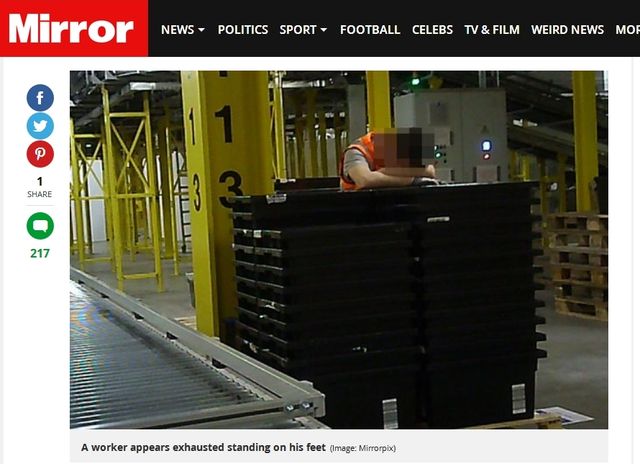
Screenshot from the Sunday Mirror website with the caption "a workers appears exhausted standing on his feet"
Selby used a concealed camera to take video footage and photos of exhausted workers slumped at their work stations, while he himself was under constant pressure to increase his workload. He worked 10.5 hour shifts, with just two 30 minute breaks, for £8.20 (US $10.92) an hour —just a few pence above the £7.50 (US $9.99) minimum wage.
Selby explained, “Two half-hour breaks were the only time off my feet, but it was barely enough time to race to the canteen and wolf down some food to keep my energy up.”
Describing his workday, Selby wrote, “Alone in a locked metal cage, 10 feet from my nearest colleague, a robot approaches from the shadows and thrusts a tower of shelves towards me. I have nine seconds to grab and process an item to be sent for packing--a target of 300 items an hour, for hour after relentless hour.”
He reports how a computer screen in front of him gave constant reminders of his “units per hour” and exactly how long each has taken. Workers are given impossible targets under threat of being sacked. Breaks are timed and people are so exhausted that they fall asleep. Three of the photos in the exposé show workers slumped at their workstation, with one woman described as being asleep. Exhausted workers are warned about the consequences of even sitting down.
Screenshot from the Sunday Mirror website showing a worker asleep standing up and an ambulance outside the Tilbury plant
An angry co-worker asked, “Why are we not allowed to sit when it is quiet and not busy? We are human beings, not slaves and animals.”
One of Selby's pictures was of a filthy and unusable staff toilet. The plant is so huge that “walking to the toilet could take more than five minutes—almost a third of a mile from some of my workstations, and even longer when those on my floor were out of order, as they often were...the system would know I had not been active, so the pressure was on to hold it in.”
Selby was moved from the picking to the packing department. But the exploitation was just as extreme. He writes, “I was told to pack 120 single items an hour, or 85 multiple items. And I’ve since been told this will rise to 200 items.”
Workers are regularly fired for not meeting targets. Selby told of scores of staff sacked because of missed performance targets in the lead up to Black Friday.
The constant pressure has dangerous health consequences. “Workers reported ambulances being called to the warehouse on at least 2 occasions when one woman suffered a panic attack after being told she had to work compulsory overtime over Christmas, which would mean her working up to 55 hours a week, and another collapsed on the job, after struggling on despite feeling unwell.”
One worker told him, “Everybody suffers here. I pulled my hamstring but I just had to carry on. My friend spent two days off after she damaged her knee ligaments.”
Another said, “At my induction someone was asking why the staff turnover was so high here. It’s because they’re killing people. All my friends think I’m dead. I’m exhausted.”
Staff whiteboard with workers complaints about filthy toilets (Selby-Sunday Mirror)
Selby recalled "two safety incidents that could have seen somebody seriously hurt” in his final fortnight.
Selby also noted that he was barely able to tolerate Amazon's punishing regime even though he is physically fit. “Weeks before I went in, I had finished a summer running season which included two marathons and a handful of half marathons. Physically I am no slouch--yet my body felt drained every day. My blood pressure and resting heart rate both rose from the stresses of the job.”
He reported his body ached with the workload. His fitness tracker showed he walked at least 10 miles most days, with the physical effort leaving him on occasion feeling dizzy.
Despite the low wages, many workers have long, expensive commutes. Workers spend £4 (US $5.33) a day out of their own wages to get a bus to the plant from a site in London. Some spend four hours a day commuting.
These inhumane conditions are replicated at Amazon’s 16 UK fulfilment plants. Last December it was reported that workers at the Amazon plant in Dunfermline, Scotland, were forced to sleep in tents nearby in order to save on transport costs.
The company’s exploitation of its workforce is constantly being ramped up. This year Tilbury is due to ship 1.2 million items. In an article prior to Black Friday, the Daily Mail reported that workers at Amazon’s plant in Peterborough, Cambridgeshire were being expected to dispatch an aggregate of 85 items every second for the duration of the sale period.
One of the staff toilets at the Tilbury plant (Selby-Sunday Mirror)
To achieve its targets, Amazon is recruiting an additional 20,000 temporary workers--on poverty level wages--at its UK operations in the run up to Christmas. These are on top of its regular 24,000-strong workforce. This is the model employed by all the major players in the retail and delivery industry. The Commercialfleet.org website reported, “To help cope with the sheer volume of orders, an extra 49,000 seasonal staff will be hired across Royal Mail, Argos and Amazon bringing the total staff numbers working for all brands to 263,701.”
Based on the super-exploitation documented by Selby, Amazon--the UK’s largest retailer--made £7.3 billion (US $9.2 billion) in the UK last year alone. He concludes, “Its army of 24,000 unhappy elves are paid as little as seven pence per item to help pack and deliver each one across the UK. My final shift was two days ago, Black Friday--when millions of Brits logged on to help founder Jeff Bezos earn an extra £1.8 billion overnight.”
The World Socialist Web Site reported that Bezos recently became the world’s richest man with a net worth over £75.11 billion ($100 billion) due to the exploitation of Amazon’s 300,000 strong international workforce, the undercutting of competitors and monopolising the home delivery market. Workers make as little as £175 (US $233) per month in Amazon’s Indian plants, to an average of just £9.31 (US $12.40) an hour in the United States.
A final point should be noted about Selby’s exposure. He writes that the “Tilbury warehouse is a slick operation, up to speed on health and safety and workplace law. But just because it is legal does not mean it is good for you.”
This statement is damning indictment of the present Conservative government and past Labour ones who have eviscerated workplace standards and regulations to a point where such degradation of workers is legal!
This is all with the connivance of the trade unions. Some 2,500 Amazon workers in Germany struck six plants last week to demand better pay. Staff at an Amazon facility near Piacenza in northern Italy also struck on the same day to demand “dignified salaries” and more staff. The strikes were held last Friday to coincide with Black Friday. The role of the unions as appendages of management was summed up by its role in Italy, with the Daily Mirror reporting, “The unions advised workers who are on short-term, work-on-demand contracts to stay on the job, so they would not risk losing future gigs.”
The Sunday Mirror report sheds further light on the conditions reported by the International Amazon Workers Voice (IAWV), which is published by the WSWS and fights to link the struggles of Amazon workers in Europe, the US, Asia and Latin America in a unified fight for workers’ rights and socialism.