7 Dec 2017

CVS to purchase Aetna for $69 billion, in move expected to disrupt health care industry

Gabriel Black 

CVS Health Corporation announced Sunday that it had agreed to buy Aetna, the nation’s third largest health insurer, for $69 billion. The merger will create an unprecedented level of vertical integration in the health-care industry, and is expected to reshape how the industry as a whole operates.
CVS Health Corporation is the 7th largest US Corporation measured by annual revenue, taking in over $177 billion in net revenue in 2016. Its assets include almost 10,000 CVS Pharmacies nationally as well as CVS Caremark, which is one of the largest pharmacy benefit management systems in the country. It also operates medical clinics at pharmacy locations throughout the country that go by the name MinuteClinic. All told, CVS has 158,000 employees.
Aetna, the third largest health insurance company in the United States, has 23.1 million medical insurance members and works with 1.2 million health-care professionals.
The merger, the largest ever in the health insurance industry, follows several record years of consolidation in healthcare more broadly.
Among healthcare providers, 2017 is on track to outpace 2016 in the number and value of mergers and acquisitions. Last year 102 occurred, and by the end of the third quarter this year another 87 had taken place. Last year, four of those were mergers that involved companies taking in revenue exceeding $1 billion. Ten $1 billion-plus mergers have occurred so far in 2017.
In April of this year the Center for Health Policy at the Brookings Institution and Carnegie Mellon University’s Heinz College published a white paper, “Making Health Care Markets Work,” that argued that the growing consolidation of the health-care industry was both driving up healthcare costs and reducing the quality of care. This can be seen clearly in relation to hospitals.
Glenn Melnick, a researcher at the University of Southern California, found that the average price for hospital admissions in California increased 70 percent from 2004 to 2013. However, among the largest hospital chains it increased much more, by 113 percent.
In addition to the rising cost of hospitalization, drug prices are another factor driving up healthcare costs. Branded drugs rose 13 percent just last year, and it is just one of the many economic and political pressures that are pushing healthcare companies to scale-up into larger and larger conglomerates.
Modern Healthcare, a leading healthcare industry business paper, writes, “Scale can insulate providers from looming policy changes, prepare them for expected reimbursement cuts, accommodate rising labor, technology and pharmaceutical costs, allow them to take on more risk and help tackle new payment models in an evolving value-based industry.”
The Aetna-CVS merger has been called a pre-emptive response to Amazon’s anticipated entrance into the prescription drug market. Following Amazon’s acquisition of Whole Foods in the summer, several major pharmaceutical middlemen, such as Walgreens and CVS, saw their stocks fall, a sharp warning from Wall Street. Bernstein analyst Lance Wilkes wrote in a note to investors that Amazon’s “major advantages come from eliminating 70,000 retail locations (and related staffing and other expenses), which could be replaced by automated distribution centers with efficient pharmacist oversight.”
Amazon, headed by Jeff Bezos, the richest man in the world, has upended all manner of traditional businesses that rely on storefronts. Amazon has emerged as one of the most important companies in the world by combining advanced logistics technology with the intense exploitation of hundreds of thousands of warehouse workers and deliverymen.
The merger of Aetna and CVS would give the companies a chance to bypass expensive hospital visits and instead encourage pharmacy and clinic visits, as well as in-home visits. This could put a huge downward pressure on prices throughout the whole healthcare industry, cutting into the revenues of hospitals across the country. While some aspects of this move might appear to benefit consumers, the overall quality of care will likely suffer. Given the increasingly unaffordable character of high quality healthcare for most Americans, cheap local clinics that specialize in prevention and routine care is all that is in reach for tens of millions.
In this vein, the CVS-Aetna merger is also a reaction to the growing use of digital doctors and nurses performing check-ups, as opposed to doctor-to-patient treatment. A study by Harvard Medical School and the RAND Corporation published last May showed that video consultation increased an average of 45 percent every year between 2004 and 2014 among rural Americans on Medicare. While this technology is in and of itself a progressive addition to healthcare, under a for-profit, corporate-controlled health system, it becomes a means of replacing quality healthcare with cheaper, makeshift alternatives.
Given the relentless drive by the government and corporations to cut health care costs through the continual erosion of Medicare and the elimination of employer-paid healthcare for workers, both the younger millennial generation and the so-called baby boomers who are now reaching retirement age will increasingly be forced to rely on cheap substitutes for their healthcare, as they will be unable to afford what they actually need.
Wall Street’s perspective on the merger is best summed up by the half billion dollars that outgoing Aetna CEO Mark Bertolini is expected to pocket as a reward for reaching this deal. This giant sum, however, would still be just a fraction of the profits that those who own these companies can expect. Aetna, like many major corporations, is primarily owned by major hedge funds and private equity firms like BlackRock, the Vanguard Group, and State Street Corporation, whose overriding concern is the stock valuation of the companies they hold.
Though the companies agreed to the merger Sunday, it has yet to be approved by the Trump Administration, which recently sued to block the merger of Time and AT&T. However, the CEOs of both firms don’t expect the Justice Department to block the merger. The deal will likely be finalized over the course of the next six months, and is expected to be fully in place and approved by regulators and shareholders by mid-2018.

Growing numbers of US teachers abandon unions

Nancy Hanover

Union membership among American teachers is in a steady, and in some regions precipitous, decline.
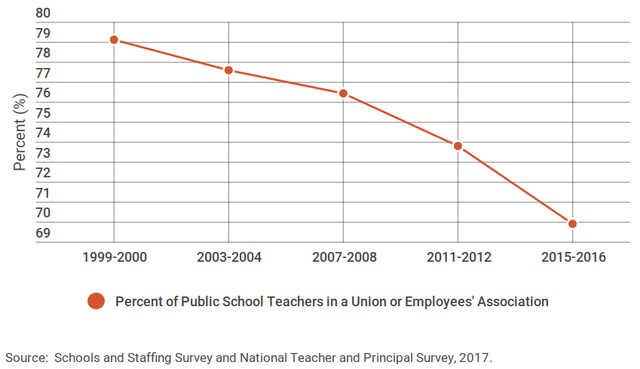
The percentage of US public school teachers participating in unions has dropped by 9 percent since 1999-2000, according to the 2015-2016 National Teacher and Principal Survey. Today, 70 percent of elementary or secondary teachers in public schools are union members, down from 79 percent in 1999-2000.
The decline of teacher unionization rates accelerate during the Obama administration. Source: Schools and Staffing Survey and National Teacher and Principal Survey, 2017.
Overall, workers in education, training and library occupations have a 34.6 percent union membership rate, according to the Bureau of Labor Statistics. This is down from 50 percent in 2013 and 53 percent just a decade ago. As recently as 1984, teachers’ union coverage was 64 percent.
Unprecedented losses of teacher union membership have occurred in: Wisconsin (-58.3 percent), Arizona (-49.6 percent), North Carolina (-47.8 percent), Tennessee (-33.5 percent), Idaho (-28.9 percent), Indiana (-26.5 percent), with many other states recording double-digit losses.
Unionization rates in the private sector, including manufacturing, have fallen for decades, plummeting to a historic low of 6.4 percent in 2016, down from 11.9 percent in 1983 and a peak of 35 percent in 1954. Although the percentage of unionized public-sector workers fell to 34.4 percent last year, it was still five times more than the private sector rate.
Two interrelated processes contributed to the falling unionization rate for teachers. First, the Obama administration accelerated the assault on teachers and public education on behalf of Wall Street hedge funds and other school privatization interests. The 2008 financial crash and the subsequent budgetary crises of states and local school districts was used to effect a historic defunding of public education, eliminating the jobs of an estimated 366,000 teachers and other school employees.
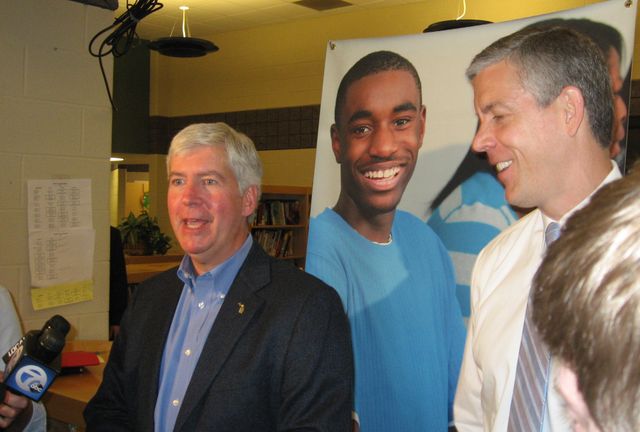
Obama's education secretary Arne Duncan and Michigan Governor Rick Snyder hailing "school reform" in Detroit where more than half students now attend charter schools.
While the Democratic president bailed out Wall Street with no strings attached, Obama increasingly tied federal education funding to the expansion of largely nonunion charter schools and test-based schemes used to fire staff and close so-called failing traditional public schools.
Obama’s Race To The Top, a “hunger games”-style competition for funding of school districts had devastating effects. In Louisiana, virtually the entire New Orleans school system was turned over to charters, and in Michigan, the birthplace of the autoworkers union—50 percent of Detroit students now attend the mostly nonunion charters. Teachers are hired on the cheap, with no pension benefits, or seniority rights. The drop in teacher union membership in both states has been dramatic, a drop of 37.6 percent in Louisiana and 26 percent in Michigan since 2011.
Far from opposing the attack on public education, the American Federation of Teachers (AFT) and the National Education Association (NEA) were the first unions to endorse Obama in both 2008 and 2012, and they worked assiduously to implement his corporate-backed “school reforms.” When struggles erupted against school closings, teacher layoffs and privatization, as in the 2010 mass protests in Wisconsin, the 2012 Chicago teachers strike and the wildcat teacher sickouts in Detroit in 2016, the unions worked to smother these struggles and shore up the Democratic Party.
AFT President Randi Weingarten justified the unions’ compliance with the grave erosion of teachers’ rights with the cynical phrase “school reform with us, not against us” Both she and the AFT, as well as the NEA, have accepted substantial funds from the billionaire proponents of privatization, Bill Gates and Eli Broad.

“Right to Work”

The second factor in the decline of teacher unionization rates was the spread of “right to work” laws, which stipulate that employees are not compelled to join the union in unionized workplaces. Largely pushed by Republicans, like Wisconsin Governor Scott Walker, and right-wing billionaires, including the Koch brothers and the family of Trump’s education secretary Betsy DeVos, these measures have been successfully enacted in 28 states, including former union strongholds such as Michigan and Indiana in 2012, Wisconsin in 2015, West Virginia in 2016, and Missouri in 2017.
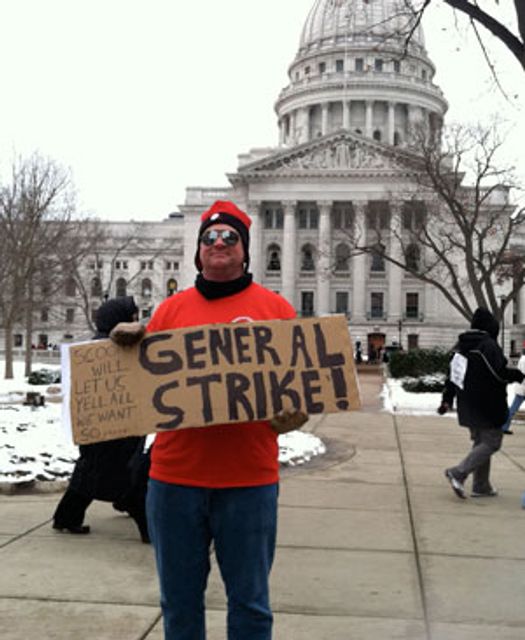
Jesse Lyne, a substitute teacher from Madison, Wisconsin carried a sign for a general strike during the mass protests in 2010 against brutal budget cuts.
While Democrats like Obama have traditionally relied on the unions to impose their pro-corporate agenda, the Republicans have utilized “right to work” laws to severely weaken the unions, undermining the financial support they provide the Democratic Party.
This process is expected to be exacerbated this year with a likely decision by the US Supreme Court in Janus v. American Federation of State, County, and Municipal Employees Council 31 . This case could illegalize “agency fees”—those required in some states by employees who opt out of union membership. Because these fees are often nearly equal to the cost of dues, should this measure pass, a further major exodus from the public service workers’ unions is anticipated.
The union executives blame these legal changes for their loss of membership, while denouncing teachers who opt out as “freeloaders” for not paying for the privilege of having their wages and benefits cut with the complicity of the unions. In fact, the laws only accelerated the dissolution of the unions, which has long been underway.
In a vote of no confidence in the unions, teachers—who for many years had the highest rate of unionization among any section of the working class—have voted with their feet and withdrawn from the unions by the tens of thousands.
What the “right to work” laws do show is that once the state backing of the unions is removed, and the employers no longer automatically deduct dues from workers’ paychecks, the unions are incapable of retaining the large numbers of members who see no point in paying tribute to organizations that abandoned their interests long ago.
The union bureaucracy has responded to the spread of such laws by doubling down in its collaboration with Democrats and Republicans, demonstrating to the state the value of maintaining the unions to suppress the class struggle and impose its reactionary agenda of tax cuts to the rich and draconian austerity for the rest of the population.

The real interests of the union tops

On the basis of their nationalist and pro-capitalist orientation, the unions were incapable of responding in any progressive way to the global integration of production and the historic decline of American capitalism. The United Auto Workers and other unions abandoned any connection to the traditions of the class struggle and openly embraced labor-management “partnership” and their transformation into the direct tools of the corporations.
Randi Weingarten, president of the American Federation of Teachers (Credit: US Department of Education)
The teachers’ unions, which once provided nominal protection for teachers and pressed for an expansion of the share of national income that went to public services, have degenerated into organizations that impose austerity, attacks on teachers’ jobs and living standards, and prevent opposition to school closings and privatization.
They have come to represent, not the interests of the membership, but of a well-heeled upper-middle class layer entirely hostile to workers and devoted to maintaining their top-level state connections. Focused on suppressing the class struggle and safeguarding their bloated salaries through a steady stream of dues, or coerced agency fees, this union bureaucracy is a breed apart.
NEA President Lily Eskelsen Garcia last year took in $416,633 in salary and expenses, while AFT President Randi Weingarten netted $497,300, putting them both at or near the top 1 percent of earners.
Additionally, they maintain an extensive apparatus, a well-paid cadre of over 1,000 salaried positions at the national level. This reporter counted a total of 396 NEA operatives on the payroll with countless officials, “associate directors” and “organizational specialists,” each bringing home from $100,000 to $430,000 annually. An average teacher’s salary is $56,383, with large numbers of teachers earning far less. Only a few administrative assistants and “limited term employees” draw such modest salaries at NEA headquarters.
Lily Eskelsen Garcia, president of the NEA (Credit: Gabriel Castro - IEAL)
In point of fact, the AFT and NEA have been transformed into business entities and money managers. Weingarten was ranked #1 on Institutional Investor magazine’s 40 most “influential players in US pensions” in 2013, according to Axios. The union has involved itself in myriad enterprises, including credit cards and insurance peddled to the membership.
In March or April 2017, Weingarten held a secret meeting with Stephen Bannon, Trump’s fascistic aide who was then White House chief strategist. In addition to seeking a political alliance with Trump, it was widely speculated that Weingarten also discussed investing some of the teacher union pensions funds in infrastructure projects being planned by the Republican administration.
The historic decline of union membership among teachers highlights the extent to which these unions exist only at the behest of the government. Without state sanction and the automatic dues checkoff system, the unions—incapable of commanding the allegiance and loyalty of teachers—are deservingly suffering a shipwreck.

Germany: Nationwide raids on G20 protesters

Johannes Stern

Amid attempts in Berlin to maneuver a right-wing government into office, German police are reviving the myth of "extreme left" violence at last July’s Hamburg’s G20 summit.
On Tuesday, the police carried out large-scale raids in several German states. Police officers headed by the Hamburg Special "Black Block” Commission (Soko) searched more than 20 premises in Hamburg, Berlin, Hesse, North Rhine-Westphalia, Baden-Württemberg, Saxony-Anhalt, Rhineland-Palatinate and Lower Saxony.
The Hamburg public prosecutor is investigating 22 men and women who were allegedly involved in violent activities in Hamburg during the G20 summit last July. Twenty of the 22 suspects are alleged to be members of the "extreme left-wing spectrum", and charges include "serious breaches of peace".
According to police, 583 police officers were involved in the latest raids. A total of 35 mobile phones, 26 laptops, other data carriers and documents were confiscated during the action. Nobody was arrested.
These raids are largely for propaganda purposes. It has since emerged that the violence in Hamburg stemmed mainly from the security forces and right-wing provocateurs. Most of the original reports about "violent, left-wing extremist" demonstrators were fictitious, e.g. the claim of an "armed ambush" by leftists in the city’s Schanzenviertel, which justified the use of sophisticated special operations commandos armed with assault rifles. Travelling in armoured cars, the commandos terrorised an entire urban area.
It was also the police who provoked violent clashes in Hamburg-Rondenbarg. Videos show that a demonstration by some 200 G20 protesters was attacked and fired on by heavily armed police on 7 July. The police video shows how one policeman abruptly hit a demonstrator passing by. On the run from the rampaging hordes of police, 14 protesters fell from a scaffold, sustaining injuries.
In recent weeks, more and more details about the extent of brutal police violence against innocent citizens have been revealed. In a video published by Spiegel Online, a young worker, Sarah Nothdurft, reported on her own experience. She and her boyfriend were on their way home when they found themselves trapped in a police cordon. They were dragged off their bikes by police, dragged across the ground and kicked. "The worst thing” in her recollection, however, were "those incredibly hateful eyes under the masks,” Sarah declared. Her lawyer Christian Woldmann describes the actions of the police as “dangerous bodily harm while on duty”.
The operation in Hamburg involving more than 20,000 heavily armed police officers was a civil war exercise in which weapons of war were illegally used. The Hamburg city authorities admitted that police fired rounds of rubber bullets at least 15 times, and tear gas from a multipurpose gun (MZP1) on 67 occasions. According to the federal Ministry of Economics, this weapon falls under the War Weapons Control Act and is listed in the German war weapons list under the category "grenade machine guns, grenade guns, grenade pistols".
In an interview immediately after the G20 summit, Sven Mewes, commanding officer of the Saxon Special Operations Command (SEK), praised the action of his unit in the Schanzenviertel, stating: "Our approach [was] extremely robust on securing our own safety, but also designed for highly dynamic situations. That is, we were freely allowed to use firearms, we used distraction pyrotechnics in buildings and opened closed doors with firearms using special ammunition. All those we found were immediately placed on the ground, tied up and then led away. [...] There was no resistance at all on their part."
The fact that the campaign against "left-wing extremism" is now being resumed is a warning. The German ruling class aims to establish a police state that criminalises and brutally represses protests and resistance to social inequality, militarism and war. At the same time the recent congress by the far right Alternative for Germany was protected by police from demonstrators, and right-wing terrorists like Franco A. have been set free.
According to a report in Die Welt, the Soko “Black Block" commission is the "largest investigation unit of the Hamburg police in decades”, involving around 100 Hamburg officers and "almost as many additional investigators from almost all federal states and federal police, who rotate every three weeks". "The unit is also supported by reconnaissance units such as the units for securing evidence and arrest".
The city-state administration of Hamburg consists of a coalition of the Social Democratic Party and the Greens, who are leading the campaign against "left-wing extremism" with all of Germany’s other parliamentary parties, ranging from the AfD to the Left Party. The victims of the campaign are thousands of people who have merely sought to exercise their right to demonstrate.
There are currently more than 3,000 investigations pending, most of them directed against still unknown persons. "We will get many of you. That’s for sure,” threatened the head of SOKO, Jan Hieber, following a raid in late September. "We have visual material on a scale never seen before in German criminal history."
Those who go to court must expect draconian punishments. Already in August, a Hamburg court imposed a prison sentence of two years and seven months on a 21-year-old Dutch citizen alleged to have tossed two empty glass bottles at a policeman and then resisted arrest (the allegations were made exclusively by police officers). On Monday, another show trial imposed the longest prison sentence handed out so far in the G20 trials. The 30-year-old online art dealer Benjamin S. was jailed for three years and three months for “serious breach of the peace".
At the government level the German Interior Minister Thomas de Maizière plans to use a conference of Interior Ministers in Leipzig next weekend to press for further measures to beef up the state apparatus. He is reportedly planning nothing less than total surveillance measures. Redaktionsnetwerk Deutschland (RND) reported that de Maizière wants to drastically expand "so-called eavesdropping" by the "use of technical means against individuals".
According to circles close to the Interior Ministry, "Investigators and the secret services find it increasingly difficult to install and hide bugs" to spy on apartments, cars and equipment. De Maizière would therefore require internet companies to hand over their programming protocols.
Eavesdropping would then be possible wherever devices are connected to the Internet. The industry is advised to give the state "exclusive access rights, such as private tablets and computers, smart TVs or digitised kitchen appliances."
Bernhard Rohleder, managing director of the industry association Bitkom, characterised these Orwellian surveillance plans to Spiegel Online: "In the future, all devices, buildings and almost all people will be connected to the Internet." De Maizière's initiative is about "state access to just about anything, anyone and everyone".

UK terror report confirms Manchester and London terror attackers known to MI5

Robert Stevens 

The assessment by David Anderson QC of nine classified internal reviews by counterterrorist police and intelligence services into four UK terrorist attacks confirms that three of the six attackers were well-known to the state.
The four attacks reviewed took place this year at Westminster on March 27, the Manchester Arena on May 22, London Bridge on June 3, and Finsbury Park on June 19. They resulted in 36 deaths and multiple injuries.
Anderson, the UK’s former independent reviewer of terrorism legislation, writes in his executive summary, “Three of the six attackers were on MI5’s radar, either as an active subject of interest (Khuram Butt—London Bridge) or as closed subjects of interest (Khalid Masood—Westminster, Salman Abedi—Manchester).”
Such was the extensive knowledge about the individuals that Anderson’s 61-page report concludes, in the case of Salman Abedi, who murdered 22 people on May 22 at Manchester Arena, “It is conceivable that the Manchester attack in particular might have been averted if the cards had fallen differently.”
This is a damning admission. It means that police and security services could have stopped the attack, but failed to do so. This raises the question how and why this was the case. Anderson goes to huge lengths to conceal the implications of this finding, producing a whitewash.
Anderson presents his review, commissioned in June by Home Secretary Amber Rudd, as an independent inquiry. But he has played a key role in calling for the strengthening of state powers. He first came to prominence in a BBC Panorama documentary, “Edward Snowden: Spies and the Law” propagandizing in favour of the spying carried out by the Government Communications Headquarters (GCHQ) on millions of people. As Independent Reviewer, he authored the report, “A Question of Trust”, helping pave the way for the introduction of the anti-democratic Investigatory Powers Act, known as the Snoopers’ Charter.
Anderson’s task was to ensure that the intelligence services and police—who exonerate themselves in their own reviews—were given a clean bill of health in his assessment. He writes, “It is not the purpose of the internal reviews, or of this report, to cast or apportion blame.”
His document offers only oblique references regarding the detailed knowledge that the state had of the perpetrators prior to their attacks. He notes that classified documents being withheld amount to 1,150 pages and comprise “some 650 pages of text, with a further 500 pages of Annexes and references,” adding, “Collectively, these detailed and highly classified documents provide a comprehensive account of the handling of intelligence prior to each attack…”
These reviews are being kept away from the public, and even parliament, with Anderson stating that only Prime Minister Theresa May, Home Secretary Rudd and the Chair of the Joint Intelligence Committee are privy to their contents.
However, in the case of Abedi, evidence already in the public domain points to the fact that the intelligence services were well aware, months before he carried out the Manchester attack, that he was planning to take part in a terrorist operation.
Anderson writes, “[S]alman Abedi was first actively investigated in January 2014, when it was thought that he might have been an individual who had been seen acting suspiciously with an SOI [Suspect of interest].” He claims that this turned out not to be the case and that his MI5 record was closed. He continues, “Salman Abedi was again opened as an SOI in October 2015, on the basis of his supposed contact with a Daesh figure in Libya, but he was closed as an SOI on the same day when it transpired that any contact was not direct.”
There is no innocent explanation for two such failures. Anderson continues, “Although he remained a closed SOI until the day of the attack, Salman Abedi continued to be referenced from time to time in intelligence gathered for other purposes . On two separate occasions in the months prior to the attack, intelligence was received by MI5 whose significance was not fully appreciated at the time. It was assessed at the time to relate not to terrorism but to possible non-nefarious activity or to criminality on the part of Salman Abedi. In retrospect, the intelligence can be seen to have been highly relevant to the planned attack .” [Emphasis added]
In fact, as reported by the World Socialist Web Site, on May 27 the Mail on Sunday published a story detailing how “the FBI told MI5 that Abedi was part of a North African Islamic State cell plotting to strike a political target in the UK.
“The FBI passed these warnings to MI5 in January [five months before the Manchester bombing], after placing Abedi on their terrorist watch list in 2016. An unnamed ‘security source’ told the Daily Mail that the FBI informed MI5 that Abedi ‘belonged to a North African terror gang based in Manchester, which was looking for a political target in this country. … Following this US tip-off, Abedi and other members of the gang were scrutinised by MI5. It was thought at the time that Abedi was planning to assassinate a political figure. But nothing came of this investigation and, tragically, he slipped down the pecking order of targets.’”
Abedi was not even stopped and questioned at the UK border when he arrived back from Libya—just four days before the Manchester attack. He and his family were considered to be valuable state assets. Abedi’s parents were members of the Libyan Islamic Fighting Group, who had participated in the 2011 military operations to overthrow Colonel Muammar Gaddafi as part of the regime change carried out at the behest of US and British imperialism.
None of this figures in Anderson’s report. Instead, he blandly asserts that although Abedi was not under active investigation at the time of the attack, “MI5 nonetheless came by intelligence in the months before the attack which, had its true significance been properly understood, would have caused an investigation into him to be opened. It is unknowable whether such an investigation would have allowed Abedi’s plans to be pre-empted and thwarted: MI5 assesses that it would not.”
Khuram Butt, states Anderson, was “a live SOI, under active investigation at the time of his attack.” One of Butt’s two accomplices in the London Bridge attack was Youssef Zaghba, who Anderson acknowledges was put on a Europe-wide warning list after telling officials at Bologna Airport he was travelling to Turkey to be a “terrorist.” He was still allowed to travel by UK Border Force staff through British ports on three occasions. In June 2016, one year before the London Bridge attack, Italian intelligence requested that MI5 provide information on Zaghba—who was working in Britain—and his desire to travel to Syria, “and any contacts he had in the UK with individuals linked to Islamist extremism and/or with Italy.”
Of this, Anderson writes, “MI5 has no record of responding to this enquiry, noting by way of possible explanation that it arrived in the incorrect mailbox in MI5.”
Anderson’s assessment is the culmination of a state cover-up. Earlier this year, the Daily Star wrote that a DSMA Notice, known as a D-Notice, was issued by the Defence Security Media Advisory Committee in relation to the Manchester bombing. D-Notices are requests to news editors to voluntarily not publish or broadcast items on specified subjects on the grounds of “national security”. An article published five days after the bombing in the Washington Post revealed that, “According to Geoffrey Dodds, secretary of the Defense and Security Media Advisory Committee, two D-Notices have been issued in relation to the attack in Manchester…”
No other information has surfaced in the UK media about the role of Abedi or the other perpetrators since the Daily Mail article cited above.

Conflicts within US ruling class intensify following Flynn guilty plea

Andre Damon

Over the past week, the ferocious political conflict within the ruling class in the United States has entered a new stage. In the wake of the guilty plea by Trump’s former National Security Advisor Michael Flynn on Friday, the media is again filled with discussions over possible methods for removing Trump from office.
On Monday, the New York Times ran an editorial, “Yes, the President Can Obstruct Justice,” answering the claim by Trump’s lawyer that the “president cannot obstruct justice because he is the chief law enforcement officer.” Citing previous articles of impeachment drawn up against Richard Nixon and Bill Clinton, the Times argued that the precedent applies equally, if not more, to Trump.
The entire framework of the Times’ argument against Trump revolves around the investigation, headed by Justice Department Special Counsel Robert Mueller, into alleged Russian involvement in the 2016 US election. In securing a guilty plea from Flynn, the Mueller probe is now targeted directly at Trump’s inner circle, including his son-in-law Jared Kushner and his son Donald Trump Jr., as well as Trump himself.
In his reported call for then-FBI Director James Comey to drop the probe into Flynn earlier this year, the Times writes, Trump “tried to shut down an investigation into his own campaign’s ties to the Russian government’s efforts to swing the 2016 election in his favor.”
The editorial echoes the language of Democratic Party Senator Diane Feinstein of California, who said in her Sunday appearance on NBC’s “Meet the Press”, “I think what we’re beginning to see is the putting together of a case of obstruction of justice.”
That Mueller is moving to develop a case against Trump was indicated by news this week that he has subpoenaed Trump’s financial records with Deutsche Bank, prompting speculation that he could force Trump to resign by threatening to prosecute him over his business dealings before he came to the White House.
Another possible avenue raised by Trump’s critics within the political and media establishment is the use of the 25th Amendment of the US Constitution, which allows the cabinet to remove the president if he is so impaired that he is “unable to discharge the powers and duties of his office.”
Last week, conservative Washington Post columnist Jennifer Rubin reiterated her previous proposal to invoke the amendment, citing reports that Trump continues to believe that Obama was not born in the US, and that he has asserted that the voice in the “Access Hollywood” tape released during the 2016 elections was not him. If he believes such statements, Rubin wrote, it would be proof that he is “mentally and emotionally incapable of performing his duties (which require one to grasp and process reality) and it would be long past time for him to go.”
It is evident that a significant faction of the ruling elite has concluded that Trump must go, in one form or another.
There is not, however, an ounce of democratic or progressive content to this campaign. The conflicts in Washington are conflicts within the ruling class, pitting the Trump administration—which is increasingly relying on far-right and fascistic forces—with powerful elements of the military and intelligence apparatus with which the Democratic Party is aligned.
Significantly, Democratic Congressman Al Green on Thursday moved a vote in the House of Representatives to bring articles of impeachment against Trump, which was overwhelmingly rejected by congressional Democrats and unanimously by Republicans. Unlike Mueller’s investigation, Green’s proposal was based on the president’s defense of white supremacists in Charlottesville and his re-tweeting of anti-Muslim videos previously posted by British fascists.
Democratic leader Nancy Pelosi made clear that the Democrats’ votes against the measure reflected not their support for Trump, but their desire to wage their campaign on charges on Trump’s “collusion” with Russia, saying that “those [i.e., Mueller’s] inquiries should be allowed to continue.”
Even as they have intensified their efforts to brand Trump a traitor and a Russian agent, the Democrats have avoided any opposition to his right-wing domestic policies. As Congress moves to pass Trump’s tax bill—a handout to the financial elite that will set the stage for major cuts to Social Security, Medicare and Medicaid—the Democrats have done nothing to oppose its passage. They have held no hearings on its contents and called no demonstrations.
Rather, the Democrats’ dispute with Trump is centered on their concern that his administration has undermined the fundamental foreign policy interests of US imperialism. The reality of the United States’ geopolitical decline under Trump was made apparent by two recent events—the agreement between Russia and Egypt that allows Russia to station aircraft on Egyptian airbases, and the proclamation by German Foreign Minister Sigmar Gabriel that the “protective” role played by the United States over Europe “is beginning to crumble.”
The witch-hunt over allegations of sexual misconduct orchestrated by media outlets affiliated with the Democratic Party, particularly the New York Times, is part of this same process. It is an effort to mobilize sections of the upper middle class behind the agenda of the financial elite and military-intelligence agencies based on a deeply anti-democratic and reactionary campaign. It is of a piece with the campaign over Russian “meddling,” which has been utilized not only to go after Trump, but to lay the framework for a regime of Internet censorship and the suppression of domestic discontent.
The eruption of ferocious conflicts within the states is the expression, however, of a deeper disease, for which the ruling class has no solution. If Trump’s ruling class critics were to succeed in removing him, it would not resolve the crisis of class rule that is engulfing the United States. It would place in power a government even more firmly under the control of the military-intelligence apparatus, committed to continuing the offensive against the working class and escalating the military confrontation with Russia.
An altogether different conflict is developing, between the ruling class and the working class. Three billionaires now control more wealth than half of the population in the United States. The broad mass of the population is suffering from an escalating crisis—mass indebtedness, low-wage jobs, an expanding drug epidemic, and other manifestations of social distress. The financial system, inflated through an endless infusion of cash, is teetering on the edge of another collapse, on the scale of the 2008 Wall Street meltdown, with incalculable consequences.
Even as they furiously denounce each other, what all factions of the ruling class fear above all is that the crisis will prompt the political radicalization of the working class.
Workers and young people seeking to oppose the Trump administration must avoid the deeply diseased and reactionary Democratic Party like the plague.

6 Dec 2017

Canon Collins/Embassy of Ireland in South Africa Fully-funded Fellowships for South African Students 2018/2019

Application Deadline:  Tuesday 20th February 2018.
Eligible Countries: South Africa
To be taken at (country): Ireland
Fields of Study: The fellowship programme has two strands:
  • 13 annual awards for postgraduate study in Business Management • Agriculture, Food Science & Nutrition; and • Public Administration
  • One annual award will be made for a fellowship in Human Rights Law (LLM in Law) at Trinity College Dublin. This will be selected by the Council for the Advancement of the South African Constitution (CASAC).
Type: Masters, Fellowship
Eligibility: Applicants must:
  • be a South African citizen holding a South African Permanent Residence Permit
  • have achieved the necessary standard to be accepted onto a postgraduate course in an institute of higher education in Ireland
  • be seeking funding for a full-time postgraduate programme in one of the above listed subject areas
  • be able to take up fellowship in the academic year 2017/2018
  • Not have already applied for a course at an institution in Ireland – if you have already been admitted to a university you are not eligible
Please note applicants already in possession of a Master’s degree are not eligible
Number of Awardees: 13.
Value of Scholarship: The Kader Asmal Fellowships will cover:
  • university application fees
  • tuition fees
  • examination and other fees
  • economy travel to and from your country of residence to Ireland;
  • settling in allowance, book allowance and study allowance
  • accommodation
  • a monthly personal living allowance (stipend) to cover other living expense for you only and
  • the costs of an entry clearance (student visitor visa) application
How to Apply:  Click here to apply for the Kader Asmal Fellowship for Postgraduate study in Ireland in 2018-2019.
Award Provider: Embassy of Ireland in South Africa

Edinburgh Global Undergraduate Maths Scholarships for International Students 2018/2019

Application Deadline: 30th April 2018.
Eligible Countries: International
To be taken at (country): University of Edinburgh, UK
Accepted Subject Areas? Mathematics
About the Award: Edinburgh Global Undergraduate Maths Scholarships are offered to students who are nationals of countries outwith the EU for undergraduate study in Maths offered by the University of Edinburgh, UK.
The scholarships are worth £1,000 per year and tenable for the duration of the programme of study, subject to satisfactory progress.
A student is deemed to have made Satisfactory Progress in each year if there has been a formal School decision of either “Progress” or “Conditional Progression”, without the student needing to repeat a year. If a student does not make satisfactory progress in any one year the award will terminate from that point onwards.
Scholarship cheques are handed to the winners at an award ceremony at the beginning of the academic session.
University of edinburgh
Type: Undergraduate
Eligibility
  • It is awarded to applicants from countries outside the European Union who are accepted for full-time admission to an undergraduate degree programme offered by the School of Mathematics at the University.
  • The scholarship is not available to students already on programme.
  • Applicants should have applied through the University and Colleges Admission Service (UCAS) and been offered a place at the University of Edinburgh by the scholarship closing date of 30th April 2018.
Selection Criteria: This scholarship is competitive and based on academic merit.
Number of Scholarships: Minimum of Fifteen (15)
Scholarship Worth: £1,000 per year.
Duration of  sponsorship: Awards are tenable for the duration of the programme of study.
How can I Apply? Eligible applicants should complete an online scholarship application.
  • Please note you will not be able to access the online application form unless you have applied for admission to the University of Edinburgh.
  • The online scholarship application form is located in EUCLID and can be accessed via MyEd our web based information portal here
  • When logging in to MyEd, you will need your University User Name and password.
Sponsors: The University of Edinburgh
Award Provider: University of Edinburgh

Wells Mountain Education Scholarship Program for Undergraduate Students in Developing Countries 2018

Application Deadline: 1st April, 2018
Offered annually? Yes
Eligible Countries; Developing Countries
Accepted Subject Areas? All fields are eligible although WMF intend to favor helping professions such as health care, social work, education, social justice, as well as, professions that help the economy and progress of the country such as computers, engineering, agriculture and business.
About the Award:
wells mountain foundation scholarship
Wells Mountain Foundation offers undergraduate scholarship to students from developing countries to study in their home country or any other developing country. The foundation’s hope is that by providing the opportunity to further one’s education, the scholarship participants will not only be able to improve their own future, but also that of their own communities. The foundation believes in the power and importance of community service and, as a result, all scholarship participants are required to volunteer for a minimum of one month a year.
Applicants are only allowed to select a university in a developing country. Applications to study in UK, USA, Europe and Australia will not be accepted
Offered Since: 2005
Type: undergraduate
Who is qualified to apply? To be eligible to apply for this scholarship, applicant must be a student, male or female, from a country in the developing world, who:
  • successfully completed a secondary education, with good to excellent grades
  • will be studying in their country or another country in the developing world
  • plans to live and work in their own country after they graduate
  • has volunteered prior to applying for this scholarship and/or is willing to volunteer while receiving the WMF scholarship
  • may have some other funds available for their education, but will not be able to go to school without a scholarship
  • submits a complete, legible application in English (please proof-read). Incomplete applications will not be considered.
Number of Awards10 to 30 per year
What are the benefits? Maximum scholarship is $3,000 USD.
  • tuition and fees
  • books and materials
  • room rent and meals
How to Apply: Applicants are required to submit two letters of recommendation written by someone who knows you, but is not a family member, who can tell why you deserve to receive a WMF scholarship. What qualities do you possess that will make you an excellent student, a successful graduate and a responsible citizen who will give back to his or her country? These letters of recommendation may come from a teacher, a religious leader, volunteer supervisor, or an employer.
Visit Scholarship Webpage for details
Sponsors: Wells Mountain Foundation
Important Notes:
  • WMF does not require the applicant to pay an admission or processing fee or to buy a number to have the application reviewed.
  • You must maintain good grades, submit a semester report and your grades each semester to WMF to maintain your sponsorship.
  • A photo is required, which can also be scanned and emailed.
  • You can apply before you receive your official acceptance letter, but you will not be awarded a scholarship until you are accepted. When you receive your acceptance letter, send a copy to the foundation to attach it to your application. In the subject line of the email when you send this or any additions to your application, type “application addition”.
  • WMF scholarship application require an official transcript from secondary school and from any tertiary school classes you have already completed.
  • The scholarship awards are determined by the Board of Directors of the Wells Mountain Foundation and awarded once a year.
  • Applicants will be notified if they have been selected as a WMF Scholarship student by August 1st

The Real Causes of Deficits and the US Debt

Jack Rasmus

With the Senate and House all but assured to pass the US$4.5 trillion in tax cuts for businesses, investors, and the wealthiest 1 percent households by the end of this week, phases two and three of the Trump-Republican fiscal strategy have begun quickly to take shape.
Phase two is to maneuver the inept Democrats in Congress into passing a temporary budget deficit-debt extension in order to allow the tax cuts to be implemented quickly. That’s already a ‘done deal’.
Phase three is the drumbeat growing to attack social security, Medicare, food stamps, Medicaid, and other ‘safety net’ laws, in order to pay for the deficit created by cutting taxes on the rich. To justify the attack, a whole new set of lies are resurrected and being peddled by the media and pro-business pundits and politicians.
Deficits and Debt: Resurrecting Old Lies and Misrepresentations
Nonsense like social security and Medicare will be insolvent by 2030. When in fact social security retirement fund has created a multi-trillion dollar surplus since 1986, which the U.S. government has annually ‘borrowed’, exchanging the real money in the fund created by the payroll tax and its indexed threshold, for Treasury bonds deposited in the fund. The government then uses the social security surplus to pay for decades of tax cuts for the rich and corporations and to fund endless war in the middle east.
As for Medicare, the real culprit undermining the Medicare part A and B funds has been the decades-long escalating of prices charged by insurance companies, for-profit hospital chains (financed by Wall St.), medical devices companies, and doctor partnerships investing in real estate and other speculative markets and raising their prices to pay for it.
As for Part D, prescription drugs for Medicare, the big Pharma price gouging is even more rampant, driving up the cost of the Part D fund. By the way, the prescription drug provision, Part D, passed in 2005, was intentionally never funded by Congress and George Bush. It became law without any dedicated tax, payroll or other, to fund it. Its US$50 billion plus a year costs were thus designed from the outset to be paid by means of the deficit and not funded with any tax.
Social Security Disability, SSI, has risen in costs, as a million more have joined its numbers since the 2008 crisis. That rise coincides with Congress and Obama cutting unemployment insurance benefits. A million workers today, who would otherwise be unemployed (and raising the unemployment rate by a million) went on SSI instead of risking cuts in unemployment benefits. So Congress’s reducing the cost of unemployment benefits in effect raised the cost of SSI. And now conservatives like Congressman Paul Ryan, the would be social security ‘hatchet man’ for the rich, want to slash SSI as well as social security retirement, Medicare benefits for grandma and grandpa, Medicaid for single moms and the disabled (the largest group by far on Medicaid), as well as for food stamps.
Food stamp costs have also risen sharply since 2008. But that’s because real wages have stagnated or fallen for tens of millions of workers, making them eligible under Congress’s own rules for food stamp distribution. Now Ryan and his friends want to literally take food out of the mouths of the poorest by changing eligibility rules.
They want to cut and end benefits and take an already shredded social safety net completely apart–while giving US$4.5 trillion to their rich friends (who are their election campaign contributors). The rich and their businesses are getting $4.5 trillion in tax cuts in Trump’s tax proposal—not the $1.4 trillion referenced in the corporate press. The $1.4 million is after they raise $3 million in tax hikes on the middle class.
Whatever financing issues exist for Social Security retirement, Medicare, Medicaid, disability insurance, food stamps, etc., they can be simply and easily adjusted, and without cutting any benefits and making average households pay for the tax cuts for the rich in Trump’s tax cut bill.
Social security retirement, still in surplus, can be kept in surplus by simply one measure: raise the ‘cap’ on social security to cover all earned wage income. Today the ‘cap’, at roughly US$118,000 a year, exempts almost 20 percent of the highest paid wage earners. Once their annual salary exceeds that amount, they no longer pay any payroll tax. They get a nice tax cut of 6.2 percent for the rest of the year. (Businesses also get to keep 6.2% more). Furthermore, if capital income earners (interest, rent, dividends, etc.) were to pay the same 6.2% it would permit social security retirement benefits to be paid at two thirds one’s prior earned wages, and starting with age 62. The retirement age could thus be lowered by five years, instead of raised as Ryan and others propose.
As for Medicare Parts A and B, raising the ridiculously low 1.45 percent tax just another 0.25 percent would end all financial stress in the A & B Medicare funds for decades to come.
For SSI, if Congress would restore the real value of unemployment benefits back to what it was in the 1960s, maybe millions more would return to work. (It’s also one of the reasons why the labor force participation rate in the U.S. has collapsed the past decade). But then Congress would have to admit the real unemployment rate is not 4.2 percent but several percentages higher. (Actually, it’s still over 10 percent, once other forms of ‘hidden unemployment’ and underemployment are accurately accounted for).
As for food stamps’ rising costs, if there were a decent minimum wage (at least US$15 an hour), then millions would no longer be eligible for food stamps and those on it would significantly decline.
In other words, the U.S. Congress and Republican-Democrat administrations have caused the Medicare, Part D, SSI, and food stamp cost problems. They also permitted Wall St. to get its claws into the health insurance, prescription drugs, and hospital industries–financing mergers and acquisitions activity and demanding in exchange for lending to companies in those industries that the companies raise their prices to generate excess profits to repay Wall St. for the loans for the M&A activity.
The Real Causes of Deficits and the Debt
So if social security, Medicare-Medicaid, SSI, food stamps, and other social safety net programs are not the cause of the deficits, what then are the causes?
In the year 2000, the U.S. federal government debt was about US$4 trillion. By 2008 under George Bush it had risen to nearly US$9 trillion. The rise was due to the US$3.4 trillion in Bush tax cuts, 80 percent of which went to investors and businesses, plus another US$300 billion to U.S. multinational corporations due to Bush’s offshore repatriation tax cut. Multinationals were allowed to bring US$320 billion of their US$750 billion offshore cash hoard back to the U.S. and pay only a 5.25 percent tax rate instead of the normal 35 percent. (By the way, they accumulated the US$750 billion hoard was a result of Bill Clinton in 1997 allowing them to keep profits offshore untaxed if not brought back to the U.S. Thus the Democrats originally created the problem of refusing to pay taxes on offshore profits, and then George Bush, Obama, and now Trump simply used it as an excuse to propose lower tax rates for repatriated the offshore profits cash hoard of US multinational companies. From $750 billion in 2004, it’s now $2.8 trillion).
So the Bush tax cuts whacked the U.S. deficit and debt. The Bush wars in the middle east did as well. By 2008 an additional US$2 to US$3 trillion was spent on the wars. Then Bush policies of financial deregulation precipitated the 2007-09 crash and recession. That reduced federal tax revenue collection due to collapse economic growth further. Then there was Bush’s 2008 futile $180 billion tax cut to stem the crisis, which it didn’t. And let’s not forget Bush’s 2005 prescription drug plan–a boondoggle for big pharmaceutical companies–that added US$50 billion a year more. As did a new Homeland Security $50 billion a year and rising budget costs.
There’s your additional US$5 trillion added by Bush to the budget deficit and U.S. debt–from largely wars, defense spending, tax cuts, and windfalls for various sectors of the healthcare industry.
Obama would go beyond Bush. First, there was the US$300 billion tax cuts in his 2009 so-called ‘recovery act’, mostly again to businesses and investors. (The Democrat Congress in 2009 wanted an additional US$120 billion in consumer tax cuts but Obama, on advice of Larry Summers, rejected that). What followed 2009 was the weakest recovery from recession in the post-1945 period, as Obama policies failed to implement a serious fiscal stimulus. Slow recovery meant lower federal tax revenues for years thereafter.
Studies show that at least 60 percent of the deficit and debt since 2000 is attributable to insufficient taxation, due both to tax cutting and slow economic growth below historical rates.
Obama then extended the Bush-era tax cuts another US$803 billion at year-end 2010 and then agreed to extend them another decade in January 2013, at a cost of US$5 trillion. The middle east war spending continued as well to the tune of another $3 trillion at minimum. Continuing the prescription drug subsidy to big Pharma and Homeland Security costs added another $500 billion.
In short, Bush added US$5 trillion to the US debt and Obama another US$10 trillion. That’s how we get from US$4 trillion in 2000 to US$19 trillion at the end of 2016. (US$20 trillion today, about to rise another US$10 trillion by 2027 once again with the Trump tax cuts fast-tracking through Congress today).
To sum up, the problem with chronic U.S. federal deficits and escalating Debt is not social security, Medicare, or any of the other social programs. The causes of the deficits and debt are directly the consequence of financing wars in the middle east without raising taxes to pay for them (the first time in U.S. history of war financing), rising homeland security and other non-war defense costs, massive tax cuts for businesses and investors since 2001, economic growth at two thirds of normal the past decade (generating less tax revenues), government health program costs escalation due to healthcare sector price gouging, and no real wage growth for the 80 percent of the labor force resulting in rising costs for food stamps, SSI, and other benefits.
Notwithstanding all these facts, what we’ll hear increasingly from the Paul Ryans and other paid-for politicians of the rich is that the victims (retirees, single moms, disabled, underemployed, jobless, etc.) are the cause of the deficits and debt. Therefore they must pay for it.
But what they’re really paying for will be more tax cuts for the wealthy, more war spending (in various forms), and more subsidization of price-gouging big pharmaceuticals, health insurance companies, and for-profit hospitals which now front for, and are indirectly run by, Wall St.