9 Dec 2017

Google hiring 10,000 reviewers to censor YouTube content

Zaida Green

Google is escalating its campaign of internet censorship, announcing that it will expand its workforce of human censors to over 10,000, the internet giant announced on December 4. The censors’ primary focus will be videos and other content on YouTube, its video-sharing platform, but will work across Google to censor content and train its automated systems, which remove videos at a rate four times faster than its human employees.
Human censors have already reviewed over 2 million videos since June. YouTube has already removed over 150,000 videos, 50 percent of which were removed within two hours of upload. The company is working to accelerate the rate of takedown through machine-learning from manual censorship, according to YouTube CEO Susan Wojcicki in an official blog post.
The hiring drive by Google is yet another advance in the campaign against any expression of political opposition. Other social media giants have implemented measures against “fake news”; Facebook has altered its algorithms to reduce the visibility of certain news stories, and Twitter has banned the Russian-funded media outlets RT and Sputnik from advertising on the platform. While railing against “extremist content,” “child exploitation” and “hoaxes” in the interest of “public safety,” the ultimate goal of this campaign is the suppression of left-wing, anti-war sentiment.
Any censorship on YouTube will undoubtedly have an immense impact on online political discourse. According to a white paper by technology conglomerate Cisco, video will account for 69 percent of all consumer-based internet traffic in 2017; this is expected to rise to 80 percent by 2019. YouTube essentially operates a monopoly on prerecorded video sharing and general video monetization, with some 1.5 billion viewers who watch 1 billion hours of video each day on the platform; in 2015, Google policy manager Verity Harding informed the European Parliament, which was then pressuring YouTube to censor “terror-related” content, that 300 hours of video were being uploaded to the platform every minute.
YouTube began removing photographic and video documentation of war crimes in Syria in August, terminating some 180 accounts and removing countless videos from other channels, including footage uploaded by Airwars of coalition air raids that have killed civilians, according to Hadi al-Khatib, the founder of Syrian Archive. YouTube later stated that it would work to “quickly reinstate” any videos and channels that it “removed mistakenly.”
In November, YouTube removed over 51,000 videos concerning Anwar al-Awlaki, the Yemeni-American imam who was assassinated via missile raid by the Obama administration on September 30, 2011. Awlaki was never charged with, let alone convicted of any crime. The mass removal was praised by the New York Times, one of the largest mouthpieces of the American ruling elite, as a “watershed moment.”
YouTube’s automated video removal system, implemented in August, places some videos under a “limited state” which makes it impossible for users to access the videos without already having the URL. Limited videos will not appear in search results, playlists, or viewers’ own histories. In addition, the videos can no longer be liked or disliked, commented on (all previous comments are hidden as well), monetized, embedded on other websites, or easily shared on social media through YouTube’s share buttons. YouTube has not revealed what criteria it uses to categorize a video as “extremist” and delist it.
The company has also begun using automated demonetization to financially censor video producers who upload content it deems “inappropriate” for monetization, including “controversial or sensitive subjects, war, political conflicts, natural disasters and tragedies, even if graphic imagery is not shown.” In August, the videos of “Ron Paul’s Liberty Report” were demonetized after a “manual review” by YouTube found it “unsuitable for advertisers.” Julian Assange referred to the action as “economic censorship,” noting that the “unsuitable” videos featured the former congressman’s criticism of president Donald Trump’s decision to send more American troops to Afghanistan, as well as criticizing the US Senate Intelligence Committee for branding Wikileaks a hostile foreign intelligence service.
YouTube has openly admitted on Twitter that it is censoring videos based on content, stating, “if the video is also not suitable for a wider audience … then it might see poorer performance.”
The system may also pre-emptively flag videos as unsuitable for advertising even before it is uploaded. In the cases where the censorship system cannot evaluate the content of the video—because it doesn’t exist—it bases its decision on the video’s description, tags, and thumbnail.
The requirements to file an appeal against demonetization are extremely demanding, leaving most small producers with zero recourse. To file an appeal, the channel must either have more than 10,000 subscribers, or the video in question must have at least 1,000 views within the past seven days. Producers are also not informed of when or what in their video the system finds inappropriate. Both small and large producers have complained on Twitter of double-digit percentage drops in new views after their videos have been demonetized, making it even more difficult to meet appeal requirements.
Google is not alone in its expansion of automated censorship. Last week, Facebook announced its newly implemented system to scan users’ posts and contact police and other first-responders, ostensibly to prevent suicide.
Last month, Google admitted to “demoting” content from RT and Sputnik news in its search engine and news service, confirming allegations by the World Socialist Web Site that the company engages in mass political censorship in the name of fighting “fake news.”

British “aid” diverted to jihadi forces in Syria

Jean Shaoul 

UK Foreign and Commonwealth Office (FCO) officials were forced to suspend a multi-million-pound foreign aid project directed to opposition groups in Syria that were supporting jihadi forces.
The funding for the project, ostensibly aimed at training a civilian police force in rebel-held Aleppo, Idlib and Daraa provinces, was halted after a BBC Panorama investigation exposed how officers from the force worked with courts carrying out brutal sentences.
The Jihadis You Pay For investigation targeted the Access to the Justice and Community Security Scheme (Ajacs), running since late 2014 in areas outside Syrian government control. The project, managed by British consultants Adam Smith International (ASI), began after David Cameron’s Conservative-Liberal Democrat coalition failed to persuade parliament to support military action in Syria in August 2013.
The revelations confirm Britain’s covert support of jihadi forces as proxies to topple President Bashar al-Assad in Syria, which is aimed at weakening Iran and preparing for a US-backed Israeli war against that country.
According to the BBC, the scheme was supposed to train police in the Free Syrian Police (FSP) to restore “law and order”, and not to cooperate with the Islamist extremists who largely controlled the three provinces. The opposite was true. As well as showing how the FSP was complicit in extra-judicial killings and torture, Panorama also revealed how the project was mired in corruption and mismanagement.
Extremists linked to al-Qaeda had handpicked police officers to serve at Ajacs-funded police stations in Idlib province. The officers were cooperating with courts run by the al-Nusra Front, an al-Qaeda offshoot, which handed out extreme punishments including summary executions. In one case, police officers closed the road near Sarmin in December 2014 so that the execution of two women by stoning could take place.
According to an ASI report of July 2016, the police handed over cash, up to 20 percent of their funds at one point, to an extremist group, Nour al-Din al-Zinki. The group is linked to human rights abuses and atrocities including the beheading of a young prisoner in 2016. Justification cited for the payments was “the military and security support that Zinki provides to the five Free Syrian Police stations located in areas under its control.”
The BBC saw documents that ASI was aware that the police officers had collaborated with Al-Zinki’s unsanctioned courts “by writing up warrants, delivering notices, and turning criminals over to the court.”
Furthermore, the police payroll included the names of dead and fictitious people. The BBC cited Koknaya in Idlib province that was supposed to be the base for around 57 officers, but where there were none in 2016.
An ASI spokesman said the company “strongly refutes Panorama’s allegations,” calling them “entirely inaccurate and misleading.” ASI added that it operated “under the close supervision of the Foreign and Commonwealth Office and five other governments.”
This only raises the question of how much Britain’s FCO and other governments knew about such relations.
ASI was set up in 1992 and grew rapidly, with its turnover tripling between 2010 and 2015 to £130 million. It has received £450 million in aid contracts from the Department for International Development (DfID).
This is not the first time that the company, whose senior executives pay themselves around £250,000 a year, has come under fire for profiteering and unethical behaviour.
According to the Global Justice Network, electricity consumers in Nigeria faced price increases of up to 45 percent because of “a controversial energy privatisation programme supported by UK aid through a multimillion-pound project implemented by ASI.” In Afghanistan, local NGOs reported that a new minerals law, drawn up with ASI’s support, had done little to help them.
In February, DfID cut off funding after it emerged that ASI had tried to take advantage of confidential department documents to gain additional contracts. The parliamentary select committee on international development said that ASI had “overstepped the mark” in soliciting testimonials submitted as evidence to the MPs’ inquiry into the government’s use of aid contractors. It called ASI’s actions “deplorable”, “entirely inappropriate” and showing a “serious lack of judgment.” The scandal led to the resignation of four senior ASI executives and later, its chairman Sir Martin Davidson.
DfID spends £13.3 billion a year on “development” projects to build “a safer, healthier, more prosperous world for people in developing countries and in the UK.”
While the government makes much of its commitment to spend 0.7 percent of national income on aid—and it is popularly believed that this is spent on developments aimed at alleviating poverty—most of it is spent on promoting Britain’s commercial, “national security” and geostrategic interests. Many students are brought to British universities via a plethora of aid programmes.
Much aid has now been “securitised,” with aid money used to prevent migration from Africa and the Middle East, and to provide security, meaning military, and police operations and training. It is channelled through a handful of corporations.
The Ajacs project was funded via the little known Conflict, Stability and Security Fund (CSSF) set up in 2015, replacing the previous Conflict (Prevention) Pool.
CSSF receives funding of over £1 billion a year to tackle conflict and instability overseas, as part of its international development programme. Overseen by the National Security Council, it draws funding from various government departments “to help prevent conflict that affects vulnerable people in the world’s poorest countries, and tackle threats to British security and interests from instability overseas.” It includes programmes delivered directly or through the government’s contractors, such as developing human rights training, strengthening local police and judiciaries, and facilitating political reconciliation and local peace processes.
While more than 80 percent of its budget comes from DfID, it is largely administered by the Foreign and Commonwealth Office. According to Sir Mark Lyall Grant, National Security Adviser, most of the fund in 2016 was spent in Afghanistan (£90 million), Syria (£60 million) and Somalia (£32 million), with some 40 countries also receiving money. One of the projects relating to Syria included providing a press office for the Free Syrian Army’s fighters in Syria.
While the media has decried the fraud and mismanagement of Britain’s aid budget, it has said nothing about Britain’s flagrant breach of Syria’s sovereignty. Neither has it noted that all this is in direct contradiction of former Prime Minister David Cameron’s promise not to intervene in Syria after the August 2013 vote in parliament.
Covert support of Syrian proxies to bring about Assad’s ouster is in addition to Britain’s participation in the US-led air operations in Syria in late 2014 that only became public knowledge long after it had begun and well before parliament voted in favour of air strikes in Syria in autumn 2015.
British special forces have been operating on the frontline in Syria, most notably in May 2016, in support of an opposition outfit known as the New Syrian Army near al-Tanf near the Syrian-Iraqi-Jordanian border.
In December 2016, the government reported that the Royal Air Force’s (RAF) operations in Syria far outstripped the intensity of the UK’s operations in Iraq and Afghanistan.
Last year, the Ministry of Defence announced that British troops would resume training the so-called moderate Syrian rebels—which it did not name—fighting Islamic State. British personnel would teach basic infantry drills, battlefield medicine and skills to avoid mines and booby-traps, working at bases in Turkey and Jordan.
By September 2017, more than 1,000 UK personnel were involved in operations in Syria, with the RAF having conducted around 900 airstrikes, at a cost of £265 million.

US homeless total increases for the first time in seven years

Trévon Austin

A report published by the Department of Housing and Urban Development (HUD) found that the number of homeless individuals in the United States has increased for the first time since 2009. On a single night in late January 2017, when the point-in-time count was conducted across the country, some 553,742 people were recorded as homeless in the US.
Nearly two-thirds of the homeless were staying in emergency shelters or transitional housing programs, while one third were living on the streets or in shacks and other abandoned dwellings classified as unfit for human habitation. The vast majority of the unsheltered homeless were in California, Texas and Florida.
The number of homeless individuals has increased by 1 percent, or 3,814 people, since 2016. Over one-fifth of homeless individuals were children under 18, some 114,508, and 10 percent were between the ages 18 and 24. About 36,000 youth between the ages of 18 and 24 were homeless without families, as were about 4,800 children under the age of 18.
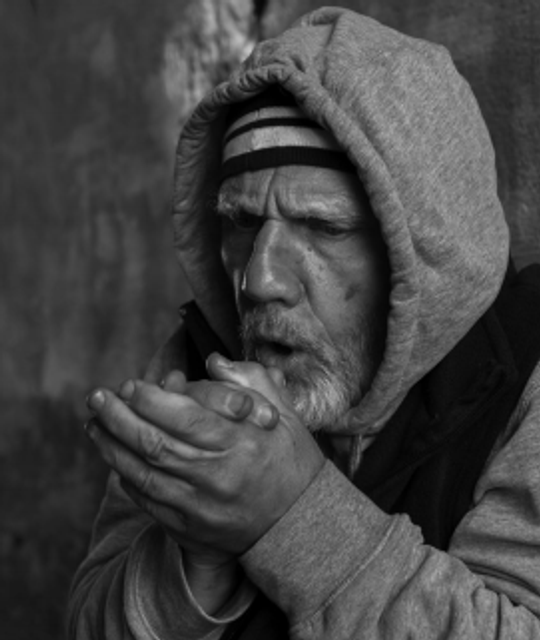
A homeless person in Boston next to the Millenium Tower, where condos go for a minimum of $900,000
The unsheltered accounted for the entire increase in homelessness from 2016 to 2017. California alone accounted for an increase of 16,136 homeless year-on-year, more than the total net increase nationwide (in other words, outside of California, homelessness actually declined slightly).
California has by far the largest number of unsheltered people, nearly 92,000, and the highest proportion of homeless people outside of shelters, some 68.2 percent. New York state accounts for the largest number of homeless people living in shelters—nearly 85,000, compared to 43,000 in California. New York also has the largest percentage increase in homelessness over the past decade, a staggering 43 percent, while the national total, as counted by HUD, has declined slightly.
Five states account for half of all the homeless people in the US, with Florida (32,190), Texas (23,548) and Washington state (21,112) following California and New York.
Credit: United States Department of Housing and Urban Development
The issues of underemployment and low wages are key factors in the number of homeless individuals in the US. The various statistics used to indicate the success or recovery of the economy are misleading as well. For example, Harvard Professor Lawrence Katz found that nearly 94 percent of jobs created between 2005 and 2015 have been contingent—temporary, short-term or on contract.
Press reports tell the story of “nomadic” workers who live in their vehicles while working for Amazon, unable to afford proper housing. A significant portion of the workers travel in order to obtain temporary jobs during Amazon’s peak season, when shipping demands are at their highest.
The social crisis workers face is only exacerbated by the Trump administration. This week, the White House has been pushing to compel those receiving federal aid to work for assistance, particularly SNAP (food stamps). The US Department of Agriculture announced it would work with states to “promote self-sufficiency.” Denying eligibility for food stamps will only swell the toll of homelessness and extreme poverty, with desperate people forced to choose between feeding their children and paying the rent. Already one in eight individuals and 12 million children face food insecurity.
“The American dream has never been to live on government benefits,” wrote Brandon Lipps, the Department of Agriculture’s Food and Nutrition Service administrator. “People who can work should work. We must facilitate the transition for individuals and families to become independent…”
Credit: United States Department of Housing and Urban Development
Homelessness among US veterans declined over the past decade, only to rise by 2 percent between 2016 and 2017. The Trump administration aims to encourage this trend, reneging on an election campaign promise to house all homeless veterans. The Department of Veteran Affairs (VA) recently announced that a $460 million program that targeted chronically ill and vulnerable veterans would be ended, then abruptly reversed itself after a public outcry. Further cuts can be expected in a budget deal with congressional Republicans and Democrats.
More broadly, in the wake of the Senate passage of massive tax cuts for the wealthy, congressional Republican leaders are looking to slash funding for social programs such as Medicaid, Medicare and Social Security.
House Speaker Paul Ryan stated that the Republican Party aims to reduce spending on social programs, arguing for the need to reduce the federal deficit. At an appearance on a talk radio show, Ryan stated, “Frankly, it's the health care entitlements that are the big drivers of our debt, so we spend more time on the health care entitlements—because that's really where the problem lies, fiscally speaking.”
Senator Marco Rubio added, “You also have to bring spending under control. And not discretionary spending. That isn't the driver of our debt. The driver of our debt is the structure of Social Security and Medicare for future beneficiaries.”

Trump and Jerusalem: The end of the Mideast “peace” charade

Bill Van Auken

US President Donald Trump’s arrogant and provocative speech declaring US recognition of Jerusalem as Israel’s capital, and Washington’s intention to move its embassy there, bore its first fruits Thursday in the form of over 100 Palestinian workers and youth wounded by Israeli troops using live ammunition, rubber bullets and tear gas to quell protests throughout the occupied territories.
In his speech Wednesday, Trump overturned seven decades of a US policy founded on hypocrisy. While the State Department has formally held that the status of Jerusalem can only be determined based on a negotiated settlement between the Israelis and Palestinians, successive US presidential candidates, Democrats and Republicans alike, have vowed to move the embassy, only to back off from the promise once in office. Similarly, the US Congress voted in near unanimity for the move, while providing the president with a national security waiver to postpone the relocation.
The explosive character of disputes concerning jurisdiction over Jerusalem, which is home to what are considered among the most holy sites of Islam, Christianity and Judaism, has been recognized by international diplomacy since well before the founding of the state of Israel.
In one stroke, Trump upended the posturing of past administrations. In doing so, he sent a clear signal to the right-wing government of Prime Minister Benjamin Netanyahu that its expansion of Zionist settlements, expropriation of Palestinian land, ethnic cleansing and wholesale repression will enjoy unconditional support from Washington.
To the Palestinian Authority, he offered nothing outside of a demand that it continue its role as a security guard for Israel and the West, calling upon it to join in an American crusade “to defeat radicalism” and ensure that the Palestinian people “respond to disagreement with reasoned debate, not violence.”
A people subjected to unrelenting Israeli violence, the confiscation of its land, arbitrary imprisonment of its youth and the killing of tens of thousands of its people in successive wars and acts of repression is told to engage in “reasoned debate,” when the issues have already been settled in complete contempt for their fundamental aspirations and rights.
Trump cast the recognition of Israeli sovereignty over Jerusalem—40 percent of whose residents, some 320,000 Palestinians, are denied the rights of citizens—and the moving of the American embassy as a “long overdue step to advance the peace process.” This is a “process” that is overseen by his son-in-law Jared Kushner and the former top lawyers for his corporation, Jason Greenblatt and David Friedman, the US ambassador to Israel, all of them ardent supporters of the illegal Israeli settlements in the occupied territories.
Trump crassly portrayed his speech as an act of “delivering” on his campaign promises, made in 2016 to win the support of both right-wing Christian Evangelicals and a small group of wealthy right-wing American Zionists who provided him with campaign financing. Under conditions in which his administration is beset by crises, he is anxious to solidify this “base.”
More fundamentally, however, his act of political aggression against the Palestinians is bound up with the drive toward war throughout the Middle East, particularly against Iran. On the same day that Trump delivered his speech, the Pentagon acknowledged that it has 2,000 US troops deployed in Syria—four times the number previously admitted—and no intention of withdrawing them after the routing of ISIS.
In the wake of Trump’s speech, there have been numerous warnings that the shift in US policy will provoke new terrorist attacks, with Islamist groups such as Al Qaeda appealing to religious sentiments. No doubt this has been factored into the calculations of the US military and intelligence apparatus, which will seize upon any new act of terrorism as the pretext for war abroad—particularly against Iran—and intensified attacks on democratic rights at home.
Trump’s speech has met with near universal condemnation, including from virtually every Arab regime as well as all of Washington’s nominal allies in Western Europe.
The European bourgeoisie sees Washington’s provocative unilateral move as cutting across its interests, risking the incitement of Muslim populations within their borders while furthering an anti-Iranian policy that would deny them access to lucrative investments and markets. At the same time, it is clear from the response of the German and French governments, in particular, that the European ruling classes will use Trump’s move as a justification for pursuing their own independent great power interests in the Middle East and elsewhere, including by military means.
As for the Arab regimes, the protests ring ever more hollow. The Saudi monarchy, the Egyptian police state dictatorship of General Sisi, the Jordanian Hashemite monarchy and the Palestinian Authority (PA) of Mahmoud Abbas were all informed in advance of the change in US policy on Jerusalem.
There are credible reports that the Saudi strongman, Crown Prince Mohammed bin-Salman, summoned Abbas to Riyadh last month to dictate to him the terms of a US-Israeli “peace” that would leave all of Jerusalem and virtually all of the West Bank settlements in Israeli hands, deny Palestinian refugees the right of return and reduce a Palestinian “state” to a patchwork of discontinuous Bantustans whose borders would remain under Israeli control. Abbas was reportedly given the ultimatum to either accept this monstrosity or be “fired,” i.e., cut off from the Saudi money upon which his Palestinian Authority depends.
The Arab regimes, which have betrayed the Palestinians countless times over the past 70 years, have no interest in opposing Trump and Netanyahu. Saudi Arabia and the other reactionary Sunni Gulf monarchies want to unite with them against Iran.
The Islamist Palestinian group Hamas, which has been in negotiations with the PA over sharing governance of the besieged Gaza Strip, is no different. While warning that Trump’s decision would “open the doors of hell,” it represents just another faction of the Palestinian bourgeoisie, camouflaging itself in religious fundamentalism while seeking a deal with the imperialists and Israel.
While Netanyahu hailed Trump’s decision as a “historic landmark,” in reality it is merely a tombstone erected on the grave of the political fictions known as the “peace process” and the “two-state solution” that have been used to mask and justify the oppression of the Palestinian people for decades.
Trump’s action has laid bare—once again—the fraud of the claims that the aspirations of the Palestinian people and an end to their oppression by the Zionist state can be obtained through deals and maneuvers between imperialism and the Arab bourgeois regimes.
The growing Middle East crisis, marked by multiple ongoing wars and increasing Israeli-Palestinian tensions, has exposed the historic bankruptcy of bourgeois nationalism.
In its Zionist variant, it claimed legitimacy on the grounds of establishing a homeland for Jews fleeing the horrors of the Holocaust. Instead, it has created a militarized state based upon colonialism and expansionism, pitting the Jewish population against the Palestinians and the other peoples of the region, while presiding over one of the most unequal societies on the face of the planet. As Leon Trotsky warned, the creation of this state has proven to be a “bloody trap” for the Jewish people.
Palestinian nationalism has itself proven utterly incapable of achieving the democratic and social aspirations of the Palestinian people based on the bourgeois nationalist program of creating a new mini-state in the Middle East. Instead, it has created only the Palestinian Authority, which represents the interests of no one outside of Abbas and his fellow officials and millionaires who feed off of foreign aid contracts and CIA stipends, while repressing resistance to occupation.
Putting an end to the decades of oppression, poverty and violence suffered by the Palestinians, and stopping the danger of a region-wide war, is the task of the working class, which must unite its forces across all national and religious boundaries in a common struggle against imperialism and its local agents, both Israeli and Arab.
The breakdown of the political fictions that have dominated the region, fueled by the insoluble crisis of capitalism, poses the urgent necessity of uniting the Jewish and Arab working class in the struggle for a Socialist Federation of the Middle East as part of the struggle to put an end to capitalism across the planet.

7 Dec 2017

Global Health Corps Paid Fellowship for Young Professionals in Africa 2018/2019

Application Deadline: 7th January 2018
Eligible Countries: All African countries and other regions
To be taken at (country): USA
About the Award: Global Health Corps is building the next generation of diverse health leaders. We offer a range of paid fellowship positions with health organizations in Malawi, Rwanda, Uganda, the United States, and Zambia and the opportunity to develop as a transformative leader in the health equity movement. Everyone has a role to play in the health equity movement.
new-beach
Type: Fellowship
Eligibility: Global Health Corps Fellowship is looking for a global and diverse group of passionate and talented emerging leaders who:
  • Are willing to push themselves outside their comfort zones, to embrace failure, and to approach a personally transformative year – with many challenges in the day-to-day – with integrity, humility, and self-reflection.
  • Are ready to strengthen and use their voice — the most powerful tool for change that you have — in order to engage others, create space for critical conversation, and effect meaningful social change in global health.
  • Are excited by a design-thinking approach to building a better world, creatively embracing wicked problems and ready to embrace failure as learning.
  • Are committed to bringing your best and doing the work in the day-to-day, showing up as a critical part of the global health equity movement.
  • Are passionate about social justice in global health and about finding and building their voices to effect health impact.
  • Are committed to inclusivity and collaboration across sectors, cultures, and borders of all kinds, while investing in and supporting others.
Selection Criteria: By the start of the fellowship, June 24, 2018,  fellows must:
  • Be 30 years or younger.
  • Hold a bachelor’s or undergraduate university degree.
  • Be proficient in English.
Number of Awardees: Not specified
Value of Fellowship: Yearlong paid placements (June 24, 2018 – July 8, 2019) within partner organizations in Malawi, Rwanda, Uganda, the US, and Zambia to address real-time capacity gaps and strengthen health systems.
  • In addition to on-the-job training, we engage fellows in a comprehensive leadership training curriculum to build effective, empathetic, and innovative leaders of tomorrow. The fellowship starts at our Training Institute at Yale University from June 24-July 6, 2018.
  • Fellow receive additional logistical and financial support during the year, including:
    • Monthly living and utilities stipend
    • Housing
    • Health insurance
    • Professional development grant of $600 and completion award of $1500
    • Travel coverage to and from placement site, all trainings, and retreats
Duration of Fellowship: The 2018/2019 fellowship year which begins in late June 2018 and ends in July 2019.
How to Apply: Apply here
It is important to go through the Application Requirements before applying.
Award Provider: Global Health Corps

Full-fee Development Africa Scholarships at Loughborough University 2018/2019 – UK

Application Deadline: 30th April 2018
Offered annually? Yes
Eligible African Countries: All African Countries
To be taken at (country): Loughborough University UK
Accepted Subject Areas: Masters Taught Courses offered at Loughborough University
About the Award: Towards the end of each year, Loughborough University, UK announce its full-fee scholarships for international full-time taught postgraduate students who are currently domiciled (permanently living) in Africa. The Loughborough University Graduate School Development Trust Africa Scholarships covers 100% of the course fees for your chosen postgraduate taught course for one year (replacing any Departmental or Loughborough University scholarships or bursaries you may already have been awarded).Loughborough University UK
Selection Criteria: For 2018 entry the scholarship application procedure is an open competition. Students may only apply for the scholarship after an offer for a place has been made. Students who are in possession of an offer (conditional or unconditional) of a place on a postgraduate taught course can apply for the scholarship using the application form which will be provided from the link below.
Who is qualified to apply? The selection panel will use the following eligibility criteria when assessing applications:
  • Currently domiciled (permanently living) in Africa
  • Evidence of exceptional academic achievement (normally a 1st Class Honours Degree)
  • Commitment to return to their home country on completion of postgraduate programme
  • Evidence of the ability and commitment to making a significant contribution to their home country on their return
  • Full understanding of the costs involved in coming to study and live in the UK
  • Evidence of strong motivation and initiative to secure funds to cover the remainder of the costs involved
How Many Scholarships are available? The University will award a limited number of scholarships
What are the benefits? The scholarship will cover 100% of the course fees. Students will be expected to fund their travel and maintenance costs through other sources.
How long will sponsorship last? Financial award will last for the full duration of the postgraduate taught degree programme
How to Apply: Applicants are advised to spend considerable effort ensuring that this application reaches the selectors in a form that is clear, well presented and which reflects your abilities and motivation.
The application form should be returned (by post, fax or email) to:
International OfficeMarketing and Advancement
Loughborough University
Leicestershire LE11 3TU
UK
Award Sponsors: The scholarships are being funded through a combination of generous external funding and Loughborough University funds UK.
Important Notes:
  • Note that scholarship applications will not be considered unless the applicant is holding an offer or a place at the time of submission (this offer may be conditional or unconditional).
  • Do not submit your scholarship application until you have received your offer letter.
  • Applications will be initially shortlisted and the final decision on the awards will be made by a selection panel of senior staff of the University.
  • All those applying will be notified of the outcome of their application by email by the end of May at the latest.

Harvard South Africa Fellowship Program (HSAFP) for South African Students 2019/2020

Application Deadline: 4th April 2018
Eligible Countries: South Africa
To Be Taken At (Country): USA
About the Award: President Derek Bok established the Harvard South Africa Fellowship Program (HSAFP) in 1979 to address the needs of South Africans who were denied access to advanced education by the apartheid system.
This program was established, and is still intended, for mid-career professionals educationally disadvantaged by past laws and resource allocations in South Africa. Under the current presidency of Drew Gilpin Faust, the HSAFP seeks to expand its reach to institutions and organizations across South Africa in a continued effort to draw the broadest possible range of candidates for the program. In addition, the University – reflecting the current South African constitution – has expanded its applicant pool to extend to all South Africans, regardless of ethnicity or race.

Type: Fellowship (Academic)
Eligibility: The following candidates are eligible:
  • Candidates who have just completed, or who have not yet completed, a first degree are not selected unless this degree has been pursued concurrently with, or subsequent to, experience in the workplace.
  • Fellows usually range in age from 30 to 45 years.
  • Fellows must be South African citizens.
  • Fellows submit their applications directly to the Harvard South Africa Fellowship Program at Harvard University. A committee of HSAFP alumni, Center staff and the CAS Faculty Director will interview the short-listed applicants in South Africa. Successful candidates must then apply to and be admitted at the specific Harvard school where they intend to study.
  • Applicants should determine well in advance whether, if awarded a fellowship, they can be granted leave by their employers for Harvard’s academic year. They should generally plan to be in residence at Harvard from September until June. However, some programs require fellows to begin residence on July 1st. No candidate should accept an interview unless assured that such leave will be granted. The Center does not wish to assign fellowships to anyone who subsequently finds it impossible to use the opportunity.
Selection Criteria: Fellows are selected because they have shown considerable skill in their chosen fields, and are expected to benefit from advanced training. Since the inception of the Harvard South Africa Fellowship Program, the Center for African Studies has awarded over 200 fellowships.
Number of Awards: Not specified
Duration and Value of Program:  Fellowships are for a year of study (2019-2020) in one of Harvard’s Professional Schools or Graduate School of Arts & Sciences, with tuition waivers provided by the School once fellows are admitted.  General administrative funds for program management, stipends, and airfare for the fellow are provided by the Office of the President, and administered by the Center for African Studies, under the directorship of Professor John Mugane.
How to Apply: Apply here
Award Providers: Harvard University

TEACH Sub-Saharan Africa Regional Learning Lab 2018

Application Deadline: 8th December 2017
Applicants will be notified of next steps after 15 December 2017
Eligible Countries: Sub-Saharan Africa
To Be Taken At (Country): Johannesburg, South Africa
About the Award: TEACH is an initiative by MSMGF and IRGT: A Global Network of Trans Women and HIV designed to strengthen the capacity of trans-led organizations to more competitively apply for grant funding and build local organizational capacity to effectively respond to the HIV/AIDS epidemic.
This learning lab will be led by regionally-focused, Sub-Saharan-based trans individuals who have been identified, trained, and supported to serve as TEACH Technical Advisors.
Type: Training
Eligibility: Is your organization lacking the resources, support, capacity, or infrastructure to be self-sustaining? Want to learn how to more effectively meet the specific HIV treatment and prevention needs of your community? Then apply.
Number of Awards: Not specified
Value of Award: The training will take place at a date to be determined in early 2018 and includes lodging, travel and per diem for participants. Instruction will be available in English.
Duration of Program: 3 days
How to Apply: Apply to take part in a TEACH Learning Lab
Award Providers: TEACH

New York University (NYU) World Journalist Fellowship 2018

Application Deadline: 15th April 2018
Eligible Countries: International
To Be Taken At (Country): USA
About the Award: The Fellowship provides an opportunity for internationally based journalists to study in the Master of Arts program in Journalism at NYU’s Arthur L. Carter Journalism Institute. The fellow will pursue the degree in one of our nine concentrations: Business and Economic Reporting; Cultural Reporting and Criticism; Global and Joint Program Studies; Literary Reportage; Magazine Writing; News and Documentary; Reporting the Nation & New York; Science, Health and Environmental Reporting; and Studio 20.
Type: Fellowship
Eligibility: Candidates must:
  • hold a non-U.S. passport
  • applicants must be fluent in English and at least one additional language
  • have at least two years of international journalism experience or a combination of free-lance journalism assignments equal to at least two years of work (Public Relations and corporate communications experience will not be accepted. Work done for internships and student publications do not count.)
  • complete applications for both the fellowship and for admission to the M.A. program in Journalism
  • some graduate concentrations require the GRE and some make it optional. Check with the website of the concentration to see if the GRE is required.
  • take the TOEFL or IELTS. The TOEFL is waived only if English was an applicant’s language of instruction in his or her degree program.
Number of Awards: Not specified
Value and Duration of Award:
  • The 2018 Fellowship covers tuition and fees for two semesters of one of our graduate concentrations, as well as a stipend for each of the two semesters. Most of our graduate programs require three semesters of study to complete the M.A. degree, with one program requiring four semesters.
  • The fellow will also receive a stipend of approximately $13,000 for each of the two semesters of the fellowship.
How to Apply: APPLY
Award Providers: New York University’s Arthur L. Carter Journalism Institute.

Education for Sustainable Energy Development [ESED] Scholarship for Developing Countries (US$ 23,000/year) 2018/2019

Application Deadline: 9th March, 2018.
Offered annually? Yes
Eligible Countries: Developing countries and territories identified for OECD official development aid in the DAC List of ODA Recipients are eligible to apply.
To be taken at (country): All universities are eligible for the ESED scholarship. It is preferable that the candidate pursues her/his studies in a university outside his home country.
Accepted Subject Areas: Programs eligible for this scholarship must show a 75% focus on renewable energy and/or the power sector in general.
About Scholarship: The purpose of the Education for Sustainable Energy Development [ESED] scholarship is to support outstanding students from developing countries pursuing advanced studies in sustainable energy development and to encourage meaningful contributions to the collective body of knowledge about this subject. These scholarships are available to up to 10 outstanding students from developing countries and economies in transition, for a period of up to two years for Masters Degree, awarded annually.
Type: Masters
Offered Since:  2001
Selection Criteria: The Global Sustainable Electricity Partnership considers an outstanding student to be one who:
  • graduates with excellent grades in the top 20% of her/his class
  • is determined to advance her/his knowledge and understanding
  • has a history of community involvement
  • is committed to sustainable energy
  • is committed to return and contribute to her/his home country
Who is qualified to apply? To be eligible to apply for this scholarship, students must
  • plan to undertake studies at the Masters level in areas directly related to sustainable energy development
  • be citizens of the developing countries and territories identified for OECD official development aid in the DAC List of ODA Recipients
Number of scholarships: Up to ten (10) Masters scholarships will be awarded annually.
Value of Scholarship: Scholarships of US$ 23,000 per year.
Duration: Scholarship will last for a period of up to two years for Masters Degree
How to Apply: Applications should be submitted using our Online ESED Scholarship Application Submission. Applications will be available in mid-January 2018.
As the volume of incoming applications is extremely heavy around the deadline, we strongly urge you to submit your file as early as possible.
Visit Scholarship webpage for details
Sponsors: Education for Sustainable Energy Development [ESED]
Important Notes: Please note that applications sent by e-mail or mail will no longer be accepted.

Facebook AI Research (FAIR) Residency Program 2018

Application Deadline: 26th January 2018
Eligible Countries:
To Be Taken At (Country): USA
About the Award: The Facebook AI Research (FAIR) Residency Program is a one-year research training program with Facebook’s AI Research group, designed to give you hands-on experience of machine learning research. The program will pair you with a senior researcher or engineer in FAIR, who will act as your mentor. Together, you will pick a research problem of mutual interest and then devise new deep learning techniques to solve it. We also encourage collaborations beyond the assigned mentor. The research will be communicated to the academic community by submitting papers to top academic venues (NIPS, ICML, ICLR, CVPR, ICCV, ACL, EMNLP etc.), as well as open-source code releases. Visit the FAIR research page for examples of research performed in FAIR .
The AI research residency experience is designed to prepare you for graduate programs in machine learning, or to kickstart a research career in the field. This is a full-time program that cannot be undertaken in conjunction with university study or a full-time job.
Type: Internships/Jobs
Eligibility: Prior experience in machine learning is certainly a strength but we seek people from a diverse range of backgrounds, including areas ostensibly unrelated to machine learning such as (but not limited to) math, physics, finance, economics, linguistics, computational social science, and bioinformatics.
  • Bachelors degree in a STEM field such as Mathematics, Statistics, Physics, Electrical Engineering, Computer Science, or equivalent practical experience.
  • Completed coursework in: Linear Algebra, Probability, Calculus, or equivalent.
  • Coding experience in a general-purpose programming language, such as Python or C/C++.
  • Familiarity with a deep learning platform such as PyTorch, Caffe, Theano, or TensorFlow.
  • Ability to communicate complex research in a clear, precise, and actionable manner.
Preferred Qualifications
  • Research experience in machine learning or AI (as established for instance via publications and/or code releases).
  • Significant contributions to open-source projects, demonstrating strong math, engineering, statistics, or machine learning skills.
  • A strong track record of scholastic excellence.
Number of Awards: Not specified
Value of Award: Residents will be paid a competitive salary. Residents will also:
  • Learn how to perform research in deep learning and AI.
  • Understand prior work and existing literature.
  • Work with research mentor(s) to identify problem(s) of interest and develop novel AI techniques.
  • Translate ideas into practical code (in frameworks such as PyTorch, Caffe 2).
  • Write up research results in the form of an academic paper and submit to a top conference in the relevant area.
Duration of Program: 
  • Residency Program start: August 2018
  • Residency Program end: August 2019
How to Apply: To apply, complete the application in the Program Webpage (Link below) and include the three required documents in PDF format. The deadline for applications is Jan 26, 2018. Any applications or late materials after this date will not be considered.
If your application passes an initial screening, we will contact you to request a letter of recommendation. Following this, we may want to interview you in person over video conference.
Award Providers: Facebook