22 Dec 2017

Pentagon admits presence of US troops in Yemen as cholera cases top one million

Bill Van Auken

The Pentagon admitted for the first time this week that it has “conducted multiple ground operations” in Yemen, the impoverished and war-ravaged country on the Arabian Peninsula, while conducting more than 120 air strikes there this year, triple the number in 2016.
This revelation of an escalation on yet another front in the expanding US military intervention in the Middle East came as Yemen marked the 1,000th day of the war being waged by Saudi Arabia and its fellow Gulf oil sheikdoms against the poorest nation in the Middle East.
Multiple aid agencies issued statements warning that the deaths of millions are threatened as the war claims more victims and plunges vast portions of the population into conditions of famine and disease.
The depth of the country’s humanitarian crisis was underscored this week with the announcement by the International Committee of the Red Cross (ICRC) that the number of cholera cases in Yemen had reached one million, making the ongoing epidemic by far the worst in recorded human history.
The rapid spread of the disease, which has claimed the lives of over 2,200 people since April, a third of them children, is an unmistakable manifestation of the destruction of Yemen’s social infrastructure by the nearly three-year-long, unrelenting US-backed Saudi bombing and blockade of the country.
Cholera is easily preventable and treatable so long as there is access to clean water. US-supplied Saudi bombs and missiles, however, have destroyed much of the Yemen’s water and sanitation infrastructure, while the air, sea and land blockade has deprived the country of fuel needed to run whatever systems have survived the onslaught. Meanwhile, at least 50 percent of Yemen’s health care facilities have been destroyed.
According to the ICRC, fully 80 percent of Yemeni population now lacks access to food, fuel, clean water and health care, creating the conditions for the spread not only of disease, but also famine.
In a report released Thursday in Cairo, the UN’s Food and Agriculture Organization said that fully one-quarter of the Yemeni population, nearly 8 million people, was suffering from severe food insecurity, placing their lives at imminent risk. Another 36 percent of the population faced what the agency referred to as “moderated food insecurity.”
Prices of what food is available reportedly shot up 28 percent in the month of November alone, placing basic necessities out of reach for the majority of the population.
While 12,000 civilians have been reported killed since the beginning of the war in 2014, this number is vastly eclipsed by deaths from the hunger and disease caused by the war. Last month, the aid agency Save the Children warned that 50,000 children would die before the year’s end, while the United Nations has reported that one Yemeni child is dying every ten minutes from preventable causes.
Oxfam, which described conditions in Yemen as “apocalyptic,” said in a statement: “For 1,000 days, huge amounts of sophisticated modern weapons have pounded Yemen, and on top of that we are now witnessing a Medieval siege where mass starvation is being used as a weapon of war.”
To put it bluntly, Saudi Arabia and its allies and arms suppliers, principally the United States and Britain, are guilty of a world historic war crime that has employed methods against the people of Yemen comparable to those used by Hitler’s Third Reich.
Begun in March of 2014, the war has been waged for the purpose of returning the Saudi puppet, Rabbu Mansour Hadi, to the presidency and to prevent the emergence of a government with friendly ties to Iran.
The US ground intervention and air strikes acknowledged by the Pentagon’s Central Command on Wednesday is ostensibly directed against Al Qaeda in the Arabian Peninsula (AQAP) and the Islamic State in Yemen, Sunni Islamist militias that are virulent enemies of the Houthis, whose base is among the Zaidis, a sect that emerged historically from Shia Islam.
Many of the victims of the US operations are civilians killed in both air strikes and search and destroy missions carried out by special operations troops on the ground. In an unusually publicized raid last January in central Yemen’s Al Baydah Province, special operations troops backed by drones and attack helicopters killed 57 people, at least 16 of them civilians, while one American soldier was killed.
Washington has been waging a covert drone war against Yemen since 2002. Before this year, the number of Yemenis killed in this campaign is estimated at nearly 1,500, according to the Bureau of Investigative Journalism.
In the same statement acknowledging its ground operations and the dramatic escalation of its bombing campaign, the Pentagon reported that the number of ISIS fighters in Yemen had doubled since the beginning of the year, an estimate that suggests the US campaign is having little impact outside of killing civilians, and is a sideshow compared to the war being waged by the Saudis with Washington’s backing.
The Saudi monarchy would be unable to wage this criminal war without the support of the US government and military. Massive US arms contracts have supplied the Saudi Air Force with missiles, cluster bombs and other munitions that have been used to reduce Yemeni schools, hospitals, residential areas, farms, factories and basic infrastructure to rubble. US Air Force planes are flying refueling missions to allow the Saudis to carry out round-the-clock bombing, while intelligence officers are supplying them with targets. The US Navy is deployed off Yemen’s coast backing up the Saudi blockade.
While the Trump administration, with the collaboration of the US corporate media, has remained virtually silent on the deepening of the worst humanitarian crisis on the face of the planet, it has repeatedly signaled its support for Saudi Arabia’s near-genocidal aggression. It views the war entirely through the prism of its bid to build up a military alliance with Saudi Arabia and the other Sunni Persian Gulf oil sheikdoms, along with Israel, to reverse the growth of Iran as a regional obstacle to the imposition of American hegemony in the oil-rich Middle East.
Washington’s support for Saudi Arabia and its determination to provoke a military confrontation with Iran found particularly noxious expression last week when the US ambassador to the United Nations, Nikki Haley, staged a televised presentation at a military base in Washington, DC in front of the wreckage of what was proclaimed an Iranian missile fired from Yemen at Riyadh’s international airport last month. The missile caused no casualties.
Haley insisted that the debris placed on display constituted “undeniable” evidence that Iran is arming the Houthi rebels, violating the 2015 nuclear accord negotiated with the major powers and acting as a “threat to the peace and security of the entire world.”
The presentation called to mind nothing so much as the “undeniable” evidence presented by then US-Secretary of State Colin Powell to the United Nations Security Council in February 2003 of Iraqi “weapons of mass destruction” in preparation for the US invasion little more than a month later.
In this case, the US evidence is every bit as concocted. According to Foreign Policy, which viewed a UN report prepared following an examination of the same debris used in Haley’s television appearance, UN investigators found not just Iranian, but also American parts in what was left of the missile, suggesting that the device was cobbled together by the Yemenis themselves.
Unexplained by Haley’s presentation is how Iran could have smuggled missiles into Yemen through a naval blockade maintained by the Saudis and the US Navy that has turned away ships carrying food, medicines and fuel. Moreover, the Yemeni military, whose stockpiles were taken over by the Houthi-led government, had scores of its own missiles.
Responding to Haley’s performance, Iranian Foreign Minister Mohammad Javad Zarif on Wednesday described the US allegations as “provocative” and “dangerous.” “They try to hide their support for the bombardment of the innocent Yemenis through such accusations,” Zarif said.
On December 19, the Houthi leadership claimed responsibility for another missile fired at Riyadh, declaring that it had been aimed at the Saudi royal palace. Like the earlier missile, it was brought down without causing any casualties.
The White House condemned the abortive missile attack, again claiming without any substantiation that Iran was responsible. US imperialism is supporting and exploiting the slaughter of the Yemeni people to create the conditions for a new region-wide war against Iran with incalculable global consequences.

Power outage at Atlanta airport causes chaos

Kranti Kumara

A massive power outage last Sunday lasting 11 hours affecting the entire Hartsfield-Jackson International Airport resulted in unprecedented chaos with the authorities abandoning passengers, visitors, employees and others to their own devices at the airport. The outage occurred around 1 p.m. and power was only restored shortly before midnight.
As a result of the blackout at the world’s busiest airport, over 1,200 flights were cancelled on Sunday and another 300 flights cancelled on Monday. As of this writing the situation was still not back to normal with many passengers still waiting to get on departing flights. Travel distress is expected to continue for several days.
What is particularly striking about this latest catastrophe was the absence of any sort of help from the authorities to stranded, tired and hungry passengers. Flights which were in mid-air were diverted to multiple airports throughout the country with passengers having to make their own arrangements for hotels without any reimbursement.
This is a second major disaster to occur at Hartsfield-Jackson recently, following the August 2016 outage of the computer system of the Atlanta-based Delta Airlines. That outage also led thousands of flight cancellations and worldwide travel chaos.
Sunday’s electrical outage was the result of a fire erupting from a connect/disconnect switchgear, similar to an automatic circuit breaker, located in the underground tunnel carrying thick electrical cables supplying electrical energy to the airport. The cause of the fire has not been made public, the power company, Georgia Power, told local media that they are still investigating.
The restoration of power had to be delayed for several hours because of the toxic fumes filling up the tunnel. These fumes had to be completely vented out before the repair crew could commence restoration work.
The CEO of Georgia Power, Paul Bowers, blamed the outage on a failed switchgear without elaborating on why it could have failed. It cannot be ruled out that the company, which has been making annual cuts to the maintenance budget, deliberately postponed requisite maintenance leading to the switchgear’s deterioration.
However, the design of the power supply itself is preposterous since both the primary and backup cables, despite being sourced from different substations, were housed in the same underground tunnel with the cables in close proximity to one another. As a result of this set-up the primary and backup feed were both vulnerable to fire and flooding at the same time and in this instance they did get knocked-out simultaneously. In addition, even the substations which were the source of electrical power were “impacted,” perhaps referring to automatic isolation due to faults.
The existing design—no doubt chosen by the city authorities perhaps with the connivance of Georgia Power management as a cheap option—if not corrected quickly makes this major national and international transport hub extremely vulnerable to similar failures in the future.
Other major airports in the US are sure to possess similar vulnerabilities and the Atlanta debacle reveals the utter irresponsibility of the authorities who, in order to save money, are willing to risk the well-being of thousands of travellers.
The shutdown of Hartsfield-Jackson caused a cascading impact upon air travellers not just in Atlanta but also across the country and the world. Stranded passengers at the airport organized themselves in an ad hoc fashion to help others requiring assistance, including carrying numerous passengers in wheelchairs up or down steep and lengthy escalators.
Other passengers were livid with rage after being stuck on planes stranded on the airport’s tarmac for many hours without food or water. One of the passengers who was allowed to leave the plane only after seven long hours told local media that she saw people being forced to sleep on the floor just like the homeless and said that she had never experienced anything like it in her life.
Airport authorities absurdly instructed employees working at the airport and passengers to keep track of updates via Twitter feed even while passengers were walking about with dead cell phones or desperately trying to find cell-phone signal.
These shameful scenes revealed not only the utter incompetence and bewilderment of airport management in the face of a real disaster but also the fact that no genuine emergency plans had been put in place.
Atlanta’s outgoing Democratic mayor, Kasim Reed, in his comments to the press after several hours of absence, displayed his utter ignorance of the situation, insisting that “the airport has a very redundant system, a very robust system.” He has long been lobbying big businesses to move to Atlanta, touting the airport as one of the city’s strengths.
Ultimately the chaos at Atlanta’s airport shines a bright light on the decrepit state of infrastructure in the United States. A report released in March of this year by the Airports Council International- North America found that it will require about $100 billion over the next five years to perform “much-needed” maintenance and upgrades to the United States’ airports.

Maldives and China sign free trade agreement

Rohantha De Silva

Maldives President Abdul Yameen made his first state visit to China early this month to sign a Free Trade Agreement (FTA), underscoring the growing partnership between the two countries. Yameen praised China, declaring it to be his country’s “closest development and commercial partner.”
The Maldives is strategically located in the Indian Ocean, close to the southwestern tip of India, and astride important sea-lanes from the Middle East and Africa to South East Asia and East Asia. It has become a focal point of geo-political rivalry between the US and India on one side and China on the other.
During Yameen’s visit, the Maldives minister of economic development, Mohamed Saeed, signed a deal to participate in Beijing’s One Belt, One Road (OBOR) initiative. The huge OBOR project is to establish ports, roads and rail lines connecting China with Europe and now involves 60 countries and covers 70 percent of the world’s population.
Chinese President Xi Jinping declared that Beijing regarded the Maldives as an “important partner in the construction of the 21st Century Maritime Silk Road.” The OBOR initiative is to counter Washington’s efforts to encircle China and undermine its economic and strategic interests in Asia and around the world.
The Maldives is the second South Asian country, after Pakistan, to sign an FTA with China. Under the agreement both countries will waive tariffs on each other’s imports, which will benefit fish exporters in the Maldives. Under conditions where fish exports have declined since 2014, this is crucial for the tiny nation’s economy. China is also currently the country’s biggest source of tourist income with around 240,000 visitors arriving in the first nine months of this year.
Yameen also hopes that the FTA will help enhance the country’s finance sector. Speaking at a Business Leaders’ Forum in Beijing, he appealed to Chinese businessmen to invest in the Maldives, saying that the Maldives welcomes foreign direct investments, particularly in its Special Economic Zones.
In 2013, the European Union (EU), used the excuse that Maldives failed to comply with international conventions on freedom of religion to drop the country from its list of Least Developed Countries and scrap its tariff concessions. Maldives Minister of Fisheries and Agriculture Mohamed Shinee said that a 40 percent reduction in fish exports to the EU zone forced the country to look to China.
Citing human rights, the reintroduction of the death penalty and an alleged increase in Maldivians joining Islamic extremist groups, a European Parliament resolution on October 5 also called on its member states to impose sanctions on Maldives. The real reason for these measures is the Yameen government’s close relations with China, which cuts across the EU’s strategic interests and ambitions in the region.
The International Monetary Fund has also defined Maldives as a “fragile state,” putting increased pressure on the Yameen regime. According to the finance ministry, the estimated public debt by the end of 2018 will be around 60 percent of GDP. International financial institutions have predicted that this will climb to 121 percent of GDP by 2020.
India’s ruling elite has voiced its concerns over the Maldives-China free trade agreement. A December 6 editorial in the Hindu declared: “While New Delhi has made no public statement, it has reportedly made its displeasure known, particularly on the speed and stealth with which the negotiations were completed.”
The next day India’s external affairs ministry spokesman Raveesh Kumar told his weekly press conference: “It is our expectation that as a close and friendly neighbour, Maldives will be sensitive to our concerns in keeping with its ‘India First’ policy.” In other words, all countries in the region must accept Indian dominance and adhere to its dictates.
Kumar went on to criticise Sri Lanka’s recent agreement with a Chinese company to lease the Hambantota Port. India, he declared, continues “to take up with Sri Lanka issues related to the security concerns in the region.”
On December 8, Japan’s Nikkei Asian Review commented: “China’s latest inroads into the Maldives expand on a foundation it has laid through loans, grants and foreign direct investment—all aimed at gaining a foothold at a strategic point in the Indian Ocean at India’s expense.” Tokyo has close military strategic relationships with the US, and also India to counter China’s rising economic power.
Former president and current opposition leader Maldivian Democratic Party leader Mohamed Nasheed denounced the FTA, claiming that it subjugated the country to China. He told the Times of India on December 3 that the deal would “deepen the debt trap to China” and said Beijing has “huge leverage over us, undermining Maldivian sovereignty and independence.”
Nasheed, who wants to oust Yameen with the help of the US, India and other Western powers, openly supports Washington and New Delhi’s geo-strategic manoeuvres against China.
In fact, almost all political parties in the Maldives, including Nasheed’s Maldives Democratic Party, the Jumhooree Party and a section of the ruling Progressive Party, oppose Yameen’s pro-China tilt, and have formed an alliance. Yameen has responded with police-state methods to suppress the pro-Western opposition.
Twelve opposition members, including Mohamed Waheed Ibrahim, Mohamed Ameeth, and Saud Hussein, are currently facing obstruction charges—for allegedly breaking through police ranks and entering parliament grounds on July 24. If convicted they could be jailed for between four months and one year.
Washington is determined to bring the Maldives under its control. In early November, Atul Keshap, the US ambassador to Sri Lanka and Maldives, held talks with Indian Foreign Secretary S. Jaishankar regarding its concerns over China’s influence on Maldives and Sri Lanka as well.
As US war escalates its war threats against North Korea and intensifies its military preparations against China, Washington and New Delhi will escalate their moves against Yameen’s government and to bring Maldives under their influence.

Court ruling allows Canadian spies to conduct mass surveillance of cellphones

Laurent Lafrance

Federal court judge Chief Justice Paul S. Crampton has ruled that the Canadian Security Intelligence Service (CSIS), Canada’s premier domestic spy agency, can make use of cellphone surveillance technology to carry out warrantless spying.
Crampton’s decision, released late last month, relates to CSIS’ use of cell-site simulators (CSS) in the course of a recent “Islamist terrorism” investigation. The reactionary ruling argued that “state objectives of public importance [i.e., national security] are predominant, the intrusive nature of the search was minimal, and the method of the search was both highly accurate and narrowly targeted.”
Crampton concluded that the use of CSS by CSIS does not represent an “unreasonable search,” and is thus not in violation of the Charter of Rights and Freedoms. In other words, the ruling gives a green light to the spy agencies to use tools of mass surveillance.
CSSalso known as IMSI catchers or “Stingrays”are briefcase-size devices that imitate cellphone towers and trick nearby cellphones into establishing a connection with them. They can record phones’ geolocation, phone numbers, personal information and even the content of texts and phone calls.
While officials claim the devices are only used to track a targeted suspect in the course of a police investigation, the reality is that CSS can cover a half-kilometre radius in urban areas and a two-kilometre radius in open spaces, meaning that intelligence agents can intercept communications of hundreds or thousands of civilians at a time. This kind of technology has been regularly used to conduct mass surveillance during protests in various countries.
The latest ruling grants even greater powers to Canada’s intelligence apparatus, which under successive Conservative and Liberal governments has been dramatically expanded in the name of the “war on terror.” The scaffolding of a police state has been erected in the more than 15 years since the 9/11 terrorist attacks, with core democratic rights, such as the presumption of innocence, right to remain silent and freedom of assembly, having been gravely undermined.
Privacy advocates in Canada and around the world have long criticized the use of IMSI catchers due to the anti-democratic implications for ordinary citizens. Tamir Israel, a staff lawyer at the Canadian Internet Policy and Public Interest Clinic (CIPPIC) characterized the IMSI catchers as “inherently intrusive” and said of the court ruling, “[T]he impact on non-direct targets can actually be, I think, much more serious than is presented here.”
Crampton’s pro forma insistence that any information collected incidentally must be “quickly destroyed and not subject to any analysis whatsoever” and that CSIS cannot legally capture the content of communications nor geolocate someone without a warrant will not reassure anyone over the age of ten.
CSIS routinely flouts the law and has repeatedly been found guilty of lying to the courts. In 2016, it was revealed that CSIS and the Royal Canadian Mounted Police (RCMP) had been secretly using CSS technologies for over ten years, sometimes without any warrant.
Last November, Federal Court Judge Simon Noel sharply criticized CSIS for concealing the existence of a mass data collection programthe Operational Data Analysis Centre. Established in July 2006, the ODAC has gathered metadata on a vast and unspecified number of Canadians, including email addresses, telephone numbers and IP addresses of anyone who has been in contact with a person surveilled by CSIS.
In 2013, Justice Richard Mosley ruled that CSIS systematically lied for years in a series of applications it made to the courts to secure authorization for wiretapping operations. The domestic spy agency failed to disclose that it was collaborating with CSE (Communications Security Establishment), Canada’s foreign signals intelligence service, which is part of the NSA-led “Five Eyes” alliance and is formally prohibited from collecting information on Canadians.
Since these revelations became public, lifting a small corner of the veil of secrecy surrounding the intelligence agencies’ activities, the Liberal government has been engaged in damage control.
The suggestion that government officials were unaware that police forces utilized CSS does not hold water. Information came to light in 2016 revealing that during a six-month period in 2015, the RCMP used IMSI catchers without warrants under the direct advice of the Department of Justice and an intergovernmental working group on wiretapping technology.
The granting of legal authority to CSIS to use tools of mass surveillance is in keeping with the Liberals’ National Security Act, 2017 (Bill C-59). The legislation empowers CSIS to actively “disrupt” vaguely defined “threats” to national security, including by using illegal means if necessary. Bill C-59 is the promised reform of the draconian Bill C-51 that the previous Conservative government of Stephen Harper rammed through parliament in 2015 in the name of fighting “terrorism.”
Bill C-59 retains all the anti-democratic provisions contained in the Harper government’s law, while giving the new legislation a veneer of legitimacy by providing a list of “permitted” illegal acts for CSIS to use. These include restricting people’s movements, disrupting communications and financial transactions, and damaging property, as long as the damage does not endanger life or cause bodily harm. It also authorizes CSE to launch offensive cyberattacks against what it deems “hostile actors,” including foreign states.
Public Safety Minister Ralph Goodale, who at the end of November sent Bill C-59 for study to the House Public Safety and National Security Committee, recently boasted that the bill will make it easier to combat “homegrown extremism” by improving existing provisions.
The Liberal government trumpeted the creation of a new committee of seven MPs and two senators with the power to review intelligence and security operations in any department or agency, as well as the nomination of a new Intelligence Commissioner tasked with authorizing the warrants granted to the intelligence agencies.
In truth, these mechanisms merely serve to provide the intelligence agencies with a legal-constitutional fig leaf as they continue their mass surveillance of the population. Committee members are barred from making their findings public, and the government has wide powers to withhold information from the committee if a responsible minister deems that a review of an operation would harm “national security.”
The Library of Parliament recently released a discussion paper underscoring that CSIS and CSE are out to data-mine electronic records in “bulk” about ordinary people as they look for so-called terrorist threats. The report states that parts of Bill C-59 “would accommodate the bulk acquisition of any publicly available information that has been published or broadcast for public consumption, including, for example, facial imagery captured in social-media posts.”
The report went on to suggest that Bill C-59 could be a windfall for service providers and information brokerscompanies that will gather bundles of data such as credit histories, web browsing history, online purchases, social-media connections, marital status, etc., and sell them to government agencies.
The Liberals’ assault on the population’s basic democratic rights and defence of Canada’s national security apparatus goes hand in hand with their aggressive, imperialist foreign policy. Bill C-59 was introduced just two weeks after the Trudeau government unveiled a 70 percent hike in defence spending over the next decade as part of its new defence policy. A key element of this is the deepening of Canada’s strategic partnership with the Trump administration, with which Ottawa wants to be able to cooperate in the waging of wars around the world to uphold both countries’ imperialist interests.
Such militarist policies, which will be paid for by an intensification of the assault on the social position of the working class, cannot be implemented democratically. In the final analysis, these repressive measures will be used against any form of social opposition to the government’s right-wing policiesfrom environmentalists, to native organizations, leftist and antiwar groups, and above all the working class.

German police publicly name and shame G20 protesters

Peter Schwarz

Five months after protests in the German city of Hamburg against the G20 summit, the police and state prosecutors have published pictures of hundreds of demonstrators online. In a co-ordinated campaign with the right-wing Bild newspaper, they are calling on members of the public to denounce those pictured. The initiative is not only disproportionate, but unlawful. Nothing comparable has taken place since the founding of the German Federal Republic.
“Pictures of criminals are generally only published if they have been accused of committing capital offences, such as murder, grievous bodily harm or armed robbery,” commented the weekly news magazine Die Zeit. The last time state prosecutors publicly sought alleged left-wing motivated criminals was during the period of the Red Army Faction, whose members murdered representatives of the state and big business.
Heribert Prantl, a jurist and head of the Süddeutsche Zeitung’s internal affairs desk, wrote, “This is unlawful, and it remains unlawful even if the investigation is successful in one or another case. Will future investigations really consist of the police in cooperation with the Bild newspaper hunting people down? This is not solving crime, but a scandal.”
If the Hamburg case becomes the norm, any participant in a left-wing protest must reckon with being placed in the stocks by the police and denounced in front of their neighbours, work colleagues and employers as a potential criminal.
This does not only do away with individual rights, such as the right to privacy and the presumption of innocence, but also basic democratic rights such as the rights to protest and express one’s opinion freely. Only dictatorships or semi-dictatorial regimes like Turkey have raised the threat of treating people like hardened criminals merely for participating in a protest.
In this particular case, the police are seeking information on 104 people accused of participating in violent clashes and looting. But the hundred photos and video segments they have published feature “very, very many people,” as Prantl put it in the Süddeutsche Zeitung. “Are they all really criminals? No one knows, the police merely suspect it; they conclude it from the spatial context, from the proximity to a criminal incident.” The evidence, according to Die Zeit, “is often scant.”
From the outset, the G20 summit served to launch a public campaign against “left-wing extremism,” and construct a police state. Isolated incidents of violence, for which police and intelligence agency agents were often responsible, were deliberately exaggerated and exploited so as to criminalise all opposition to the ruling elite or capitalism.
This began with the decision to hold a gathering of the most powerful heads of government in the world, against which strong protests have occurred over recent years, in the middle of a major city and in the immediate proximity of the Schanzen quarter, a stronghold of anarchist groups.
A huge police operation was assembled for the summit, which cracked down brutally against peaceful demonstrators, intentionally dispensed with proven methods of de-escalation and watched for hours as several businesses were looted. They claimed that the police could not intervene due to an alleged ambush.
Almost everything spread by the police and media at the time was subsequently exposed as lies. Although a special “Black Bloc” commission has been searching for evidence for five months with the help of 163 officials, only a handful of charges have been brought to date. Those affected have been mainly foreign demonstrators, who due to an alleged “flight risk” were held in investigative custody following the summit.
An 18-year-old Italian worker, Fabio V., was held in custody for four months even though, according to the criminal justice authorities, there was no evidence he had committed an individual act of violence. He did not even throw a stone. He was accused of being “jointly responsible for creating the civil war-like conditions” on the basis that at the time he was arrested he was part of the black bloc.
His trial, which is to conclude early next year, is seen as a test case. “If the now 19-year-old is convicted of a severe breach of the peace, many demonstrators are sure to be receiving post from the state prosecutor in the coming months. By contrast, if he is acquitted, other charges are likely to collapse,” wrote Die Zeit.
The judiciary in Hamburg has stood out for its draconian ruthlessness in the few trials that have taken place thus far. In the first trial held at the end of August, the court sentenced a 21-year-old from the Netherlands without any criminal history to two years and seven months in custody because he allegedly threw two glass bottles at a police officer and resisted arrest. The evidence for this: the statements of the two police officers.
By contrast, the judiciary is taking no action against the police in spite of well-documented incidences of brutality. Although more than a hundred police officers are suspected of inflicting bodily harm in the course of their duties, denial of freedom or duress, the authorities have not filed a single charge.
Police officers being investigated are permitted to read the witness statements of their colleagues. This gives them the opportunity to ensure their narrative fits with that of their fellow officers. Matthias Wisbar from the Republican Lawyers’ Association described this as a “special service” only available to police witnesses.
On the other hand, the intimidation and pursuit of left-wing individuals and organisations continue to spread. At the end of August, the interior minister banned the left-wing website linksunten.indymedia. On September 4, the police carried out raids in many parts of the country involving large numbers of officers. With the public search for hundreds of people, the exploitation of the G20 summit for the establishment of a police state has assumed new dimensions.
This can only be understood in the context of intensifying global and social tensions. The ruling class is preparing a major programme of militarism in its foreign policy and a violent clampdown on any social and political opposition domestically.
This is also the reason for the difficulties in forming a new government. The call for an end to “Merkelism” (Spiegel) is growing ever louder. Merkel, notwithstanding her right-wing policies in the European Union and Germany, is increasingly seen as a figure of balance and compromise. But in the view of the sections of the economic and political elite who call the shots, the time for this approach is past. They want a government that asserts itself on the global stage as a great power and imposes itself ruthlessly at home.
The Social Democrats are playing a leading role in this. It is significant that the police state offensive has been launched in Hamburg, which together with Bremen is the only federal state where the SPD still governs in a two-party alliance with the Greens. Hamburg Mayor Olaf Scholz is among the favourites to replace the hard-pressed SPD leader Martin Schulz. Like Foreign Minister Sigmar Gabriel, he is one of the advocates for militarism and a strong state.

DACA deal put off to 2018 leaving 800,000 under deportation threat

Norisa Diaz

Congress has put off until the new year any decision on the Deferred Action for Childhood Arrival, or DACA, the executive order to defer the deportation of individuals who came to America as minors. The postponement leaves nearly 800,000 DACA youth in danger in the run-up to a March 5 deadline for the passage of legislation regularizing their status set by President Donald Trump when he terminated the program in September.
If the legislation is not passed, all of them will be subject to deportation. As it is, some 11,000 youth have already lost permission to work as a result of DACA’s repeal, and an estimated 120 more are facing the same fate every day.
In November, House Minority Leader Nancy Pelosi promised DACA recipients that a deal would come before the new year and vowed that the Democratic caucus would withhold support on stopgap spending legislation to prevent a government shutdown if a DACA deal was not reached before Congress adjourned for the holidays.
Senate Majority Leader Mitch McConnell announced Tuesday that he had reached an agreement with Democratic Senate Minority Leader Chuck Schumer to forego any action: “No, we’ll not be doing DACA … this week ... That’s a matter to be discussed next year. The president has given us until March to address that issue. We have plenty of time to do it.”
Seven DACA supporters were jailed last Friday after staging a sit-in at Schumer’s office and then carried out a hunger strike.
Democrats, especially those up for reelection in states won by Trump, are quickly distancing themselves from threats of a government shutdown to force action on DACA.
“We’ve got to get it done, but I’m not drawing a line in the sand that it has to be this week versus two weeks from now,” said Senator Claire McCaskill (D-Mo.), who faces reelection next year. Echoing those sentiments were Senators Joe Manchin III (D-W.Va.) and Joe Donnelly (D-Ind.). These senators all voted “yes” when the temporary funding bill passed the Senate last night by a 66-32 margin. Seventeen Democrats voted “yes,” including Hillary Clinton’s running mate Tim Kaine (D-Va.), who attempted to use his poor Spanish language skills during the 2016 campaign to convince Latino voters to support the Democratic ticket.
While many DACA enrollees are frustrated that a decision has been kicked down the line to 2018, the reality is that any DACA “deal” that emerges will be a piece of reactionary legislation to further escalate the crackdown on undocumented immigrants, militarize the border, limit immigration and sentence millions of immigrants and refugees to increasingly dangerous journeys.
Following a meeting to discuss immigration policy this past Tuesday, White House chief of staff John Kelly and other officials went into detail about the size and scope of fencing off the southern border and what measures the White House requires in exchange for a DACA deal.
This so called “deal” will allow the Democrats to help pass a bill for the increased militarization of the border and the crackdown on immigrants, while dressing it up as “progressive” by trading on the lives of 800,000 youth.
What is being portrayed in the media as some kind of virtuous fight by Democrats to “save DACA” must be called out for all of its hypocrisy. From day one, DACA has been nothing but a bargaining chip for the political establishment.
Indeed, some are already hoping to cash in, using the passage of a DACA deal to propel their own careers. Representative Michelle Lujan Grisham (D-N.M.) announced that she is canceling her Christmas plans to stay in Washington to work on legislation. “I believe that my leadership is gonna close the deal and I have to believe that,” she said. Lujan Grisham has announced her bid for Governor of New Mexico in the 2018 election.
DACA was first unveiled as a cynical maneuver in 2012, just three months before the presidential election. The popular realization that the Obama administration had continued and expanded upon the Bush policies of war abroad and austerity at home, while dramatically increasing the number of deportations, reflected itself in the polls leading up to November. The worried administration produced the executive order out of thin air in August of 2012 in an attempt to court Latino voters at the eleventh hour. DACA offered only deferred deportation for a small fraction of the 11 million undocumented.
For the first two years of the Obama administration, the Democrats controlled the House, Senate, and presidency, yet there were zero efforts to put forth legislation to offer routes to citizenship or amnesty for the 11 million undocumented.
This should come as no surprise, as the administration was too focused on deporting a record number of immigrants (nearly 3 million), establishing mandatory bed quotas for detention facilities (34,000) and massively expanding ICE throughout the country to disappear people from their workplaces and homes.
While the conditions of the DACA deal are still being worked out, there can be no doubt that the Democrats will negotiate a deal that will introduce some of the most reactionary anti-immigrant legislation since Japanese internment.
Trump and the Republican right are lining up behind Senator Tom Cotton’s (Republican-Arkansas) “RAISE Act,” which would end green cards for the parents of adult U.S. citizens, eliminate all family sponsorship beyond spouses and minor children of U.S. citizens and Legal Permanent Residents, reduce the age limit for minor children from 21 to 18 and reduce green card caps from 226,000 to 88,000.
Another GOP proposal, the SECURE Act, would offer only “provisional status” in the form of three-year work permits to 690,000 DACA youth, while tying it to increased funding for the construction of a border wall and the hiring of more border guards, limiting the ability of immigrants to reunite with their families, a tightening of the e-Verify system to exclude undocumented immigrants from jobs and the penalization of so-called “sanctuary cities” that refuse to cooperate with federal immigration-enforcement agencies.
On Wednesday, the Supreme Court issued an unsigned opinion which stated that the Trump administration is not required to turn over documents which “informed” or were related to its decision to end DACA, as was ordered by a San Francisco federal court to respond to five lawsuits which have been filed against the Trump administration by immigration lawyers and activists.
Wednesday’s opinion, further exposing the right-wing character of the Supreme Court and the overall anti-immigrant consensus in Washington, comes just weeks after justices voted 5-4 to issue a temporary order protecting the administration from having to turn over documents before a December 22 deadline.
The postponement of any action on DACA until next year exposes the criminal indifference of both political parties to the fate of immigrant youth who are threatened with deportation to countries that they, in many cases, left as infants. Underlying this indifference is a bipartisan consensus on essential policies of US imperialism that drive mass immigration from Latin America and war-torn countries in the Middle East and North Africa.
DACA youth and their supporters must draw the critical lessons from this experience and break completely from the Democratic Party, whose every action serves to expose it as a party of warmongers and Wall Street cronies. The Democrats deserve only contempt, and any policy based on appeals to them serves to merely instill illusions and to divert any genuine struggle against the assault on immigrants. Where was the Democrats’ “concern” for immigrants during the millions of abductions and deportations that took place under Obama?

Catalan nationalists win narrow majority in crisis elections

Alex Lantier & Alejandro López 

Late last night, Catalan nationalist parties were set to win a narrow majority of 70 seats in the 135-seat Catalan parliament, in special elections the Spanish government called amid the crisis unleashed by the October 1 Catalan independence referendum.
Together for Catalonia (JxCat) had won 34 seats, the Republican Left of Catalonia (ERC) 32, and the Candidatures of Popular Unity (CUP) 4 seats. In the anti-separatist camp, the Citizens party won 36 seats, the Socialist Party of Catalonia (PSC) 17, and the Popular Party (PP) 3. Catalonia en Comú (CeC)—the Catalan branch of the Podemos party, which claimed to be neutral between Spanish and Catalan nationalism—won 8 seats. Voter turnout was high, at 82 percent.
This result puts paid to hopes in the Spanish ruling elite that elections would allow them to rapidly resolve the standoff between the Spanish and Catalan regional governments. Instead, the conflict between Madrid and Barcelona is set to continue and escalate, amid deep political uncertainty.
The PP government of Spanish Prime Minister Mariano Rajoy called the election as part of its repressive strategy in Catalonia, which is backed by the European Union (EU). On October 1, backed by Citizens and the Spanish Socialist Party (PSOE), it organized a brutal crackdown on peaceful voters in the independence referendum organized by the Catalan separatist parties. It then invoked Article 155 of the Spanish constitution to suspend the Catalan government and called yesterday’s elections in the hope of obtaining a pro-PP majority.
In the event, however, Rajoy’s strategy backfired. Despite the PP’s threats and its jailing of many Catalan nationalist politicians, the Catalan nationalists retained their majority. The PP, traditionally weak in Catalonia, suffered a humiliating collapse of its vote.
Already last night, recriminations were appearing in the pro-PP press. In an article in the right-wing newspaper ABC titled “Elections for this?” columnist Curri Valenzuela declared, “Mariano Rajoy made a mistake in calling elections as quickly as possible.”
The precise outcome in the Catalan parliament remains unclear. Eight of the 70 Catalan nationalist deputies to be elected cannot physically go to the parliament. Five have fled abroad to avoid Spanish arrest warrants (deposed Catalan regional premier Carles Puigdemont, Clara Ponsatí, Toni Comín, Lluís Puig and Meritxell Serret); three (deposed regional vice-premier Oriol Junqueras, Jordi Sanchez, and Joaquin Forn) have been jailed. This would leave the Catalan nationalists six votes short of the necessary 68-vote majority.
These individuals could give up their seats to lower-ranking JxCat or ERC members to obtain the necessary parliament majority. However, Puigdemont might also seek to return to Catalonia and demand his reinstatement, citing the victory of the Catalan nationalist forces, among which his party was the top vote getter.
The PP’s initial response was to signal that it is preparing stepped-up repression. Yesterday, Rajoy repeated his threats to again invoke Article 155 and suspend the Catalan government if it did not obey Madrid, declaring, “Obey the law, or else you already know what will happen.”
The Guardia Civil announced new accusations before the Supreme Court against more Catalan nationalists, including Marta Rovira (the leader of the ERC while Junqueras is in jail) and CUP spokeswoman Anna Gabriel. They also laid the grounds for new accusations against more Catalan nationalists, by denouncing a peaceful protest called on the Diada national day as an act of treason.
The Guardia Civil alleged that the protests promoted “a dangerous germ of a sense of rejection or even hatred of the Spanish state and the institutions supporting it. … In these citizens’ protests, there were calls for implementing a permanent strategy of deliberately planned disobedience.”
During the election campaign, PP officials dispensed with the pretense that these are independent investigations by the judicial branch of government. In fact, the PP is using it to settle accounts with its opponents, as PP Deputy Prime Minister Soraya Saenz de Santamaría told a rally in Girona: “Who has left ERC and the PDECat leaderless after decapitating both parties? Mariano Rajoy and the PP. Who put an end to the law being flouted? Mariano Rajoy and the PP. ... So, who deserves the votes to continue liquidating separatism? Mariano Rajoy and the PP.”
Voters delivered a rebuke not only to the PP, however, but also to the coalition of Catalan nationalist parties. The results of the Catalan elections, while humiliating for the PP, did not signify majority support for the Catalan nationalists’ reactionary program of building an independent capitalist Catalan Republic oriented to the EU and hostile to Spain—a program which traditionally faces broad opposition among urban workers in Catalonia.
The Catalan nationalists failed to win a majority of the popular vote, or to substantially increase their vote. The Citizens party received the most votes (25.36 percent), followed by JxCat at 21.68 percent and the ERC at 21.4 percent. Together with the CUP’s 4.45 percent, this signifies that the Catalan separatist parties collectively obtained only 47.53 percent of the vote.
They obtained a majority in the regional parliament, however, as an unintended consequence of the gerrymandering of electoral districts by the Spanish fascist regime during the Transition to parliamentary democracy in the late 1970s. This gerrymandering favored rural districts over urban ones that, at that time, voted for social-democratic or Communist Party candidates. Since then, however, this has turned into an advantage for the Catalan nationalists, whose electoral support is now concentrated in rural areas.
Separatist forces only won 44 and 49.5 percent of the votes in Catalonia’s two main urban districts, Barcelona and Tarragona. However, they won 63.7 percent in Girona and 64.2 percent in Lleída.
In another indication of weariness among voters for forces that try to dress up the Catalan separatist program in “revolutionary” colors, the vote for the CUP fell drastically, from 8.2 percent in 2015 to 4.45 percent this year. The number of CUP deputies fell from 10 to 4.
The traditionally anti-separatist “red belt” around Barcelona—the working-class suburbs that historically voted for the social democrats or the Communist Party in the period immediately after the Transition—voted not for the PSC or Podemos, but for the Citizens party. Citizens, a right-wing party with close ties to the PP, nevertheless ran a campaign criticizing the PP and proclaiming that it wanted a more rational and less aggressive strategy to resolve the crisis. Citizens was able to increase its score from 25 to 37 seats.
The election was also a significant setback for the petty-bourgeois party Podemos and its Catalan branch, CeC, which fell from 11 to 8 seats. This represents a response by the voters for the failure of Podemos, despite the millions of votes it received in recent national elections, to organize any opposition whatsoever to the PP’s dictatorial policies, as well as opposition to Podemos’s support for austerity.
The Podemos-backed mayor of Madrid, Manuela Carmena, recently passed millions in budget cuts to comply with austerity demands by Spain’s Ministry of Finance. Podemos General Secretary Pablo Iglesias defended the cuts, saying it is “logical” that the cities have to “comply with the law,” because “there is a spending rule.” He added, “The City Council of Madrid is an example of good management and will continue to be so.”

UN General Assembly repudiates Trump over Jerusalem announcement

Jordan Shilton

The Trump administration suffered a humiliating defeat in the UN General Assembly Thursday as 128 countries condemned the president’s December 6 announcement recognizing Jerusalem as the capital of Israel. The 128-9 vote, with 35 abstentions, reflects the extreme isolation of the United States and increases the prospect of a violent clash in the Middle East.
The vote was preceded by an aggressive campaign of bullying and intimidation by Trump and other officials. On Wednesday, Trump threatened any country that voted against the US with the cut-off of development aid. “They take hundreds of millions of dollars and even billions of dollars, and then they vote against us,” Trump said. “Well, we're watching those votes. Let them vote against us. We'll save a lot. We don't care.”
US ambassador to the UN Nikki Haley continued the attacks in her speech at the General Assembly yesterday. “The United States will remember this day in which it was singled out for attack in the General Assembly for the very right of exercising our right as a sovereign nation,” declared Haley. “And we will remember when so many countries come calling on us, as they so often do, to pay even more and to use our influence for their benefit.” She proceeded to arrogantly inform the assembly that regardless of the outcome of the vote, Washington would stick by its policy.
Only Togo, the Marshall Islands, Micronesia, Palau, Nauru, Guatemala and Honduras sided with the US and Israel in support of recognizing Jerusalem. Thirty-five countries abstained and 21 were absent from the vote, an indication that Trump and Haley’s threats had some impact.
Although the US has often found itself in a small minority with its support for Israel on a series of UN resolutions, the readiness of many states to so explicitly defy the US is an expression of growing inter-imperialist antagonisms and the protracted decline of US capitalism.
Traditional US allies like Britain, France, and Germany, who have tended to abstain on resolutions related to Israel, voted to condemn Trump’s announcement. Even Canada, arguably the closest US ally and a country which has voted repeatedly in defense of Israel at the UN, abstained.
The fact that Trump’s blustering threats made such little impression and the decisive repudiation of Washington’s position only increase the danger that the US could lash out aggressively in the Middle East and trigger a catastrophic regional conflict.
The Trump administration’s thuggish and bullying actions are bound up with the resort to the waging of great power conflicts as elaborated earlier this week in Trump’s National Security Strategy. Having been engaged in virtually uninterrupted war for over a quarter century, claiming the lives of millions in the process, the American ruling class is now openly contemplating military conflicts on a scale not seen since the two world wars of the 20th century.
Were Trump to carry out his threat to cut financial aid to those states opposed to his line on Jerusalem, it would only further escalate great power tensions over the Middle East. Egypt, Jordan, Afghanistan, Iraq and Pakistan all defied Washington by supporting the resolution. The European powers, led by Germany, interpreted the Jerusalem decision as an opportunity to expand their influence in the region at the expense of the US and would rapidly fill the void left behind by a drawdown of US support. Russia and China, the chief obstacles in Washington’s aggressive drive to consolidate unchallenged dominance over the energy-rich region, would also seize the opportunity.
The General Assembly vote, which is non-binding, came three days after Haley cast the only vote against the resolution in the Security Council, vetoing its passage.
Trump’s Jerusalem decision ended the decades-long fraud of a two-state solution to the Israel-Palestine conflict promoted by Washington and the other major imperialist powers. It laid bare the bankruptcy of the bourgeois nationalist perspective which claims that the Palestinians can secure their democratic and social aspirations by achieving a bargain with the imperialist powers.
This was on full display Thursday, as Palestinian Authority officials applauded the passage of a resolution which essentially asserted the status quo under which Israel has ruthlessly oppressed the Palestinian people for decades. PA President Mahmoud Abbas, whose regime has loyally served as a security guard for US imperialism and is widely hated among the Palestinians, celebrated the vote as a “victory for Palestine.”
“We will continue our efforts in the United Nations and at all international forums to put an end to this occupation and to establish our Palestinian state with East Jerusalem as its capital,” added Nabil Abu Rdainah, Abbas’ spokesman.
In reality, Washington has made clear it is not prepared to tolerate the emergence of such a state. The European imperialist powers are no more concerned for the fate of the Palestinians, but are hoping to exploit Washington’s inability to broker a settlement between the Israelis and Palestinians, and the crisis of its military intervention in Syria, to advance their own predatory ambitions in the Middle East.
The bourgeois Arab regimes, which used the General Assembly to attack Trump’s policy, are thoroughly complicit in the terrible conditions faced by the Palestinians. All of these regimes were informed of Trump’s policy announcement in advance. Saudi Arabia, which is keen to win Israeli support for its policy of militarily confronting Iran, reportedly ordered Abbas to Riyadh in November to dictate terms of a settlement to him that involved accepting Israeli control of Jerusalem and reducing Palestinian territory to a few small non-contiguous enclaves.
The Jerusalem decision strengthened the hand of Benjamin Netanyahu’s right-wing government, which has injured over 1,900, arrested over 200 and killed 10 Palestinians in the two weeks since Trump’s speech as Israeli security forces have responded to mass protests with live ammunition. The US decision has also emboldened Tel Aviv to continue flouting international law in the Occupied Territories, including by persisting with its illegal settlement program.
Predictably, Netanyahu went on the offensive following the vote. Blasting the outcome as “preposterous,” he proclaimed that Jerusalem “always was, always will be” Israel's capital.
Trump’s Jerusalem policy is bound up with efforts to construct an anti-Iranian alliance in the Middle East with the aim of preparing for war with Tehran. Since he visited Saudi Arabia in May to deliver a speech to the assembled Arab leaders in which he called for the formation of a Sunni alliance to combat Iran, Trump and his senior officials have escalated tensions with Tehran and its allies at every opportunity.
Trump’s recognition of Jerusalem came less than two months after he refused to certify Iranian compliance with the 2015 nuclear accord negotiated under the Obama administration. He has demanded that Congress adopt tougher sanctions, including on the country’s ballistic missile program.
The lead-up to Thursday’s UN vote only underscored the deepening tensions across the Middle East. Turkish President Recep Tayyip Erdogan denounced Trump’s threats to curtail financial aid, calling on the international community to teach the US “a good lesson.” “Mr Trump, you cannot buy Turkey's democratic will with your dollars. Our decision is clear,” he continued. “I call on the whole world: Don't you dare sell your democratic struggle and your will for petty dollars.”
While there is no small amount of political posturing in such remarks, with Turkey seeking to exploit the Palestine issue to bolster its position in the region, Erdogan’s comments reflect Ankara’s growing rift with Washington. Erdogan has met with Russian President Vladimir Putin seven times this year and his government has indicated its intention to purchase a Russian anti-aircraft defense system. In addition, the Turkish government appears set to reach an agreement with Russia and Iran over the presence of Kurdish representatives at peace talks on Syria from which Washington has been largely excluded.

Drug deaths drive down US life expectancy for second year

Eric London

Two reports published yesterday by the Centers for Disease Control (CDC) reveal that the life expectancy of the American working class is declining due to an increase in drug overdoses and suicides.
The data reflects, in empirical terms, the social devastation wrought on the lives of millions of people by decades of bipartisan policies aimed at enriching the wealthy. The decline in life expectancy, a fundamental measure of social progress, is a historical milestone in the decline of American capitalism. This is the second year in a row that life expectancy has fallen in the US, marking the first time in nearly half a century that life expectancy has declined in consecutive years.
Life expectancy dropped from 78.7 years in 2015 to 78.6 years in 2016, driven by a 0.2-year decline from 76.3 to 76.1 years among men. Life expectancy for women remained at 81.1 years, as the gap between women and men reached an all-time high.
However, life expectancy for those who make it to old age continues to improve, and the mortality rates for heart disease, cancer, and other illnesses are declining as technological and medical advances improve the capacity to extend human life. The decline in life expectancy is caused by a dramatic increase in the mortality rate among those under age 44 who are overdosing, particularly on opioids, or taking their own lives.
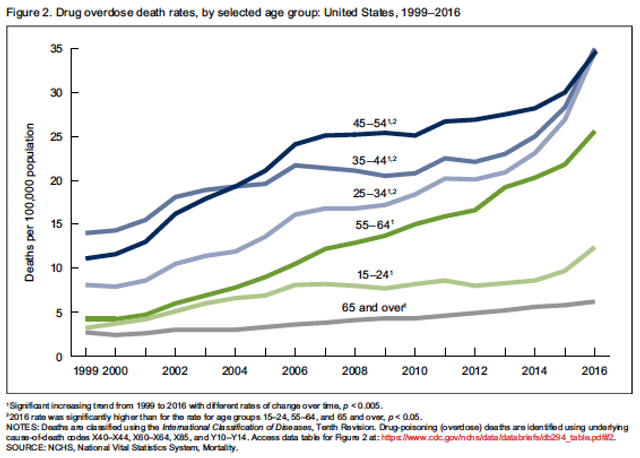
The CDC report shows a 21 percent year-to-year increase in drug overdoses, which took the lives of 63,600 people in 2016. It is as if each year, a city the size of Palo Alto, California; Bismarck, North Dakota; or Fort Myers, Florida was killed off entirely. Since 2006, roughly 430,000 people have died of drug overdose, more than the number of US soldiers killed during World War II. An army of people who should be alive today is not.
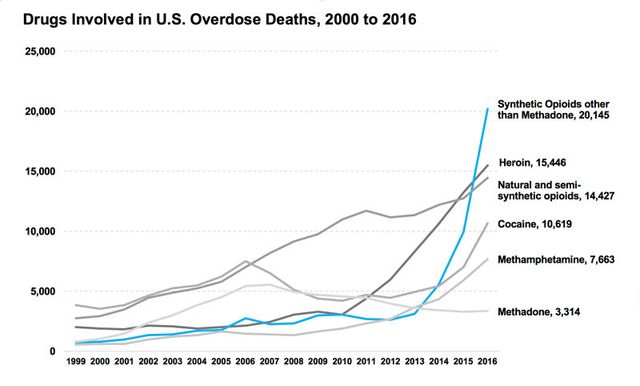
A total of 42,249 people died from opioid overdoses in 2016, a 28 percent increase from the year before. While Barack Obama was traveling the country on behalf of Hillary Clinton, proclaiming, “America is already great,” 115 people were dying each day from opioids alone.
Corporations have been flooding poor areas with pills and are shielded from prosecution by the government. Between 2007 and 2012, for example, drug distributor Miami-Luken shipped 11 million doses of oxycodone and hydrocodone into Mingo County, West Virginia, which has a population of 25,000.
Former Drug Enforcement Administration (DEA) official Joe Rannazzisi told 60 Minutes in October that it is “a fact” that companies inundate poor areas with the knowledge that many will die as a result. While lawsuits against the drug companies have forced paltry penalties of several million dollars, this is part of the cost of doing business. The Obama administration slashed the number of DEA cases against drug distributors by 69.5 percent between 2011 and 2014.
The decline in life expectancy and the increase in drug overdoses are the product of a massive growth in social inequality. Daniel Kim, a professor at Northeastern University, told Reuters yesterday that “what we know from numerous health studies is that a wider gap between the rich and the poor means that more people will die unnecessarily.”
Over the past 40 years, the Democratic and Republican parties have been engaged in a conscious strategy to pare back the gains won by the working class through the social struggles of the early 20th century. A bipartisan cabal has slashed wages, eliminated pensions, cut social programs, reduced taxes on the rich, and done away with employer-provided healthcare.
In the process, the government has transferred trillions from the working class into the bank accounts of the financial elite. Today, the top 10 percent owns 77 percent of the wealth. The richest 3 billionaires own as much as the poorest 160 million—half the country’s population.
The social counterrevolution was intensified under the Democratic administration of Barack Obama, which oversaw the bailout of the banks following the 2008 financial crisis, conducted the bailouts of the auto industry that slashed the wages of autoworkers to historic lows, and enforced the Detroit bankruptcy. The enactment of Obamacare has coincided with a drastic increase in the number of drug overdose deaths. While the rate per 100,000 of overdoses was increasing by 3 percent from 2006 to 2014, it began increasing by 18 percent per year in 2014, the year Obamacare came into force.
The death rate will continue to rise as the Trump administration deepens tax cuts for the wealthy. Citing Kim’s research, Reuters wrote, “the income inequality produced by the [tax bill] will mean 29,689 more deaths each year, perhaps more.” Billions in cuts to Medicare, mandated by laws that require budget cuts to match drops in revenue, will lead to the deaths of thousands more.
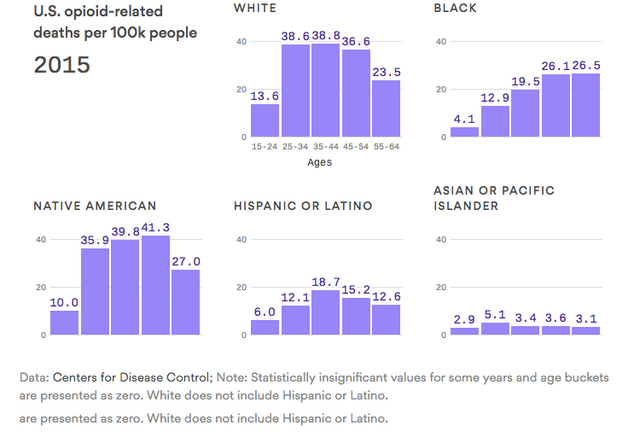
The victims of the opioid crisis come from all regions and social backgrounds, but the overwhelming majority of those killed are poor and working class. According to last year’s CDC data, 90 percent were white, and most were men, with overdoses for whites roughly triple the rate for African-Americans and double the rate for Latinos. The Native American overdose rate equals the rate for whites.
This reality exposes the reactionary lies advanced by Black Lives Matter and its claims of “white supremacy,” and by the #MeToo movement, which asserts that society is organized on the principle of patriarchy and male domination.
New York Times contributor and racial politics proponent Michael Eric Dyson recently attempted to turn the opioid crisis into an example of white privilege when he said in March 2017, “White brothers and sisters have been medicalized in terms of their trauma and addiction. Black and brown people have been criminalized for their trauma and addiction.”
Seething with contempt for the working class, Dyson ignores the fact that if adequate medical services were available, tens of thousands would not die each year from drug overdose. Instead of helping the victims, state governments have responded by calling in the National Guard to police the streets (West Virginia) and by calling for the quadrupling of jail terms for opioid users (New Jersey). Meanwhile, both parties voted to increase military spending by $80 billion over last year’s levels.
The Socialist Equality Party calls for expropriating the billions of dollars the drug companies have made from the ongoing crisis. This money, and the personal wealth of the corporate and financial aristocracy, must be put into an emergency fund to pay for the immediate construction of a network of hospitals and health clinics, staffed with well-trained doctors, to provide permanent, free medical care to all those effected.
Rehabilitation centers must be expanded and new ones built so that the millions with addiction and dependency problems can seek help free of charge. A 90 percent tax must be imposed on all income above five million dollars to provide funds for massive jobs and public works programs in those areas hardest hit by the crisis to alleviate inequality and poverty.
These demands can be met only through the building of a mass movement of the working class, independent of the Democratic and Republican parties, aimed at linking workers of all races and nationalities in a common fight against the capitalist system.

21 Dec 2017

The Bitcoin Bubble

ROY MORRISON

The price of a rare tulip bulb on the futures market in Amsterdam in January 1637 was equal to ten times the annual wage for a skilled crafts worker. A single bulb was reportedly exchanged for 1,000 pounds of cheese at the height of tulip mania. The market collapsed precipitously starting in February 1637, bottoming out in May 1637
According to economist Brian Dowd, “By the height of the tulip and bulb craze in 1637, everyone.. rich and poor, aristocrats and plebes, even children had joined the party. Much of the trading was being done in bar rooms where alcohol was obviously involved…bulbs could change hands upwards of 10 times in one day. Prices skyrocketed… in 1637, increasing 1,100% in a month.”
Bit coin, the original crypto-currency, was valued at $.08 in July 2010; $8100 on November 20, 2017, and $17,900 on Dec.15 2017. The sky is apparently the limit.
The danger of course,is not just that at some point, the bigger fools, the last purchasers of bit coin and the long term holders (“hodlers” in crypto-speak) will loose some or all of their money. That would be regrettable. But like straight forward pump and dump market manipulations of a stock some will win while others loose.
But, as in 2007 and 2008, the creative greed behind global financialization is creating not just a bubble in bit-coin and many other crypto-currencies as investors , as in Holland in 1637, pile into markets as buyers. There is a real and, I believe, rapidly emerging threat that bit coin and its ilk could follow dynamics similar to mortgage back securities as the basis for highly leveraged and complex financial instruments, like credit default swaps that were traded in unlimited volumes with no limits based on the actual number of mortgages.
Cyrpto-currency has now entered the leveraged futures market. Speculators now can leverage futures purchases 15 to one. This means a 7% drop in the price of bit-coin (a familiar phenomena) will wipe our your capital, returning us quickly to the momentous margin calls of 2007-8. And there is no limit to the number of futures contracts. Derivative instruments of more complexity and undefined risks are almost certain to swiftly appear as they did in 2007 when,for example, insurance giant AIG took enormous bets to earn premium on credit default swaps on mortgage backed securities. After all were, these were AAA rated… The sudden collapse of mortgage backed securities led to a liquidity crisis. The securities could not be sold for almost any price and the giant financial institutions on wrong side of the bets were suddenly bankrupt.
As Frances Coppola in Forbes points out, “As more and more financial institutions with connections to the real economy pile into the cryptocurrency mania, the chances of a similar disastrous collapse rise ever higher, and along with it, the likelihood of Fed or even a government bailout.”
The intent of those driving the explosion of crypto-currency prices is not a desire use crypto-currency as a low cost ,reliable medium of exchange verified by a transparent block-chain, but as a magic carpet to wealth. If you’d bought $100 worth of bit coins in 2010, they would be worth $1.79 million as of Dec. 15. 2017. It is paradoxical that crypto-currency, allegedly meant to free us from fiat currency, finds its liquidity and value in the all mighty dollar.
There is much to recommend block-chain for its potential use as a reliable and low-cost means of trade whether is is tied to crypto-currency or not. For example, bock chain is being used in Brooklyn, NY to test sale of solar energy from local producers to local buyers, with the exchange medium in dollars not crypto-currency.
The Media Lab at MIT is working on designing crypto-currency projects that could facilitate, for example, trades and transaction by the global poor purchasing and selling locally produced community renewable energy. Crypto-currency and block chain could be an important tool for people not just beyond power lines, but who live unbanked and with little access to cash or liquidity of any kind. Crypto-currency could become a reliable exchange medium and basis for a community controlled economy.
Bit-coin is also seeing the transaction costs for bit-coin transaction soar rising to $20 charged by block-chain “miners” whose computers verify transaction and at the same time create more blocks and produce more bit coins as part of the solution of the algorithm that verifies transactions. Far from being a means for vey quick cheap, anonymous financial transactions, bit coin is becoming slow and expensive to use. A newer generation of crypto-currencies like IOTA offers an improved block-chain with zero transaction costs and faster transaction all the better to attract investors.
Crypto-currencies could represent a tool for self-management and community economies, a way to use the internet to help challenge the growing netocracy of the Googles, Facebooks, Twitters, Amazons, Ali Babas and their ilk. But by making crypto-currency into an investment who use is part of a get rich quick scheme as opposed to a free instrument of exchange and trade it has become just another arrow in the quiver of making the rich richer and worsening the already grotesque distribution of income. Crypto-currency speculation will make some people rich, as does day trading and house flipping, where many more will loose then win.
I suppose the original sin of crypto-currency was to allow its purchase in dollars, and not, for example, in services provided by one to another based on labor time and materials. But the crypto-currency model is based on a limited quantity that makes it resistant to inflation, but enshrines scarcity and therefore value and the siren calls of greed and desire as it does for scarce commodities like cocaine or diamonds or gold.
The bit-coin and crypto-currency bubble will not end well.