28 Dec 2017

UK: Thousands to see in the New Year sleeping rough on the streets

Margot Miller

Thousands of UK families are suffering acute social distress, their lives blighted by low income, debt or homelessness.
Last week, a committee of MPs in the cross-party Public Accounts Committee were forced to acknowledge that homelessness was a “national crisis.” They cited a report from the Local Government and Social Care Ombudsman that more than 9,000 people are rough sleepers and 78,000 families are living in temporary accommodation in England alone, including 120,000 children. Many of these are working families who have been made homeless due to the rocketing cost of private rent.
Fourteen million people live in poverty in the UK today—one in five of the population—including 8 million working age adults, 4 million children and 1.9 million pensioners.
And the numbers are rising.
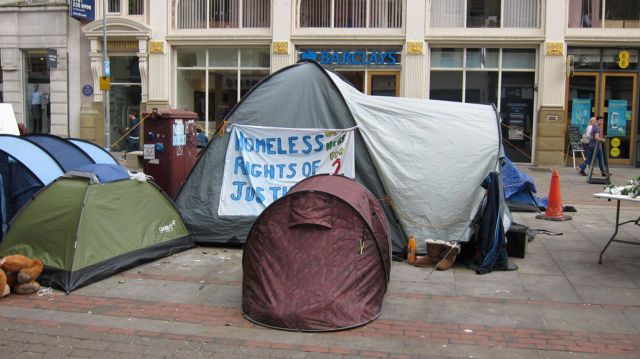
Tents of homeless people in Manchester St Anne's Square in 2015 before they were served an eviction notice by the city council
Among the poorest—those at or below 60 percent of the median income—are some one-and-a-quarter million people classed as destitute, including 312,000 children.
The destitute, as defined by the Joseph Rowntree Trust, are “people [who] have: slept rough, had one or no meals a day for two or more days, been unable to heat or to light their home for five or more days, gone without weather-appropriate clothes or gone without basic toiletries.”
The figures are startling in one of the richest countries in the world. Hunger has now become endemic, with severe levels of poverty forcing many to turn to food banks or other charities just to survive.
Research by the United Nation’s Food and Agriculture Organisation indicates that one in five children in the UK live with an adult who is moderately or severely food-insecure and one in ten live with a severely food-insecure adult. Parents or carers skip meals to feed their children.
Earlier this year, a cross-party panel of MPs warned that up to 3 million children risk going hungry during the school holidays, when children from poorer families can no longer access free school meals.
A recent article in the Manchester Evening News alerted readers to a food bank in the town of Heywood, outside Manchester, which had run out of food.
Father Paul Daley, who runs the food bank from nearby St. Joseph’s church, told a World Socialist Web Site reporter that this crisis was caused “not because people are giving less,” but because “demand is increasing.”
“There has been a phenomenal response [donations from the public] since the article,” he said.

A homeless man in the Piccadilly area of Manchester city centre
Last year, the Wood Street Mission charity, based in Manchester city centre and established in 1869, helped 2,000 Greater Manchester families with donated food and toys over the Christmas period. Due to their work, 4,500 children were able to receive gifts on Christmas Day last year.
Just before Christmas, the manager of the Wood Street Mission, Des Lynch, who has worked for the charity for 20 years, spoke about its work to the WSWS.
He explained that the families the Wood Street Mission staff meet are referred to them by health visitors, mental health nurses or social workers. The help they give is varied—from donations of nursery equipment such as cots and prams, to the provision of school uniforms in the SmartStart project at the beginning of the school term.
“Last New Year we distributed £6,000 worth of brand new coats,” explained Lynch, “because poorer kids turn up at school cold and wet.”
To help children live normal lives, 10,000 chocolate eggs were distributed to them last Easter. “Every year we have a book club,” he said. “We hire a venue, take 3,000 books, and invite the kids in—they can take the books they want.”
Lynch emphasised, “There are 50,000 in poverty in Salford and Manchester today. ... If we’re dealing with 7,000 over Christmas last year, the point is we’re not even scraping the surface.”
Since the international banking collapse in 2008 and the bailout by the Labour government, it is the working class, not the rich, who are paying the price—through endless austerity cuts, the creation of precarious work and a low-wage economy, and changes to the benefits system. Successive Labour and Conservative governments have eviscerated the welfare state.
“We have seen an increase in families coming to us who are in work of some kind,” said Lynch. “Zero hours contracts are not helping. You can be the best budgeter in the world, but if you’re only working 12 or 14 hours a week, how can you possibly budget?”

A homeless young woman in the Piccadilly area of Manchester city centre
When asked if he thought the election of a Jeremy Corbyn-led Labour government would do anything to alleviate poverty, he replied with an emphatic “No!”
“We’ve had multiple changes of government since the Mission was founded in 1869, and no government of any colour has ever tackled child poverty, whether Labour, Lib[eral] Dems [Democrats] or the Tories. If we change the government tomorrow, would it make a difference?”
Increasing inequality is visible in all the major cities of the UK. “Manchester is extremely affluent. … But walk 20 minutes out of the city centre, the people on the outskirts don’t venture in, they don’t feel they belong, it’s too expensive for them. ... Take Ancoats [a gentrified former working class city centre district], it’s totally socially cleansed.”
From Manchester’s main Piccadilly railway station, every few feet there are homeless people snatching some rest in shop doorways, with their only protection against the elements a few blankets and perhaps a sleeping bag.
In 2015, the Labour-run Manchester City Council obtained a court injunction to remove makeshift tent cities that had sprung up to provide rough sleepers with some shelter from the cold.
This month, the Salford Star reported there has been an “explosion” in homeless squats in the past three years in Greater Manchester, coinciding with the rollout of Universal Credit—the new benefit system aimed at cutting welfare spending and further impoverishing the working class. A Freedom of Information request from Greater Manchester police files revealed 850 squat incidents and 39 evictions.
The number of privately owned empty properties far exceeds the number of homeless adults and families. The skyline of Manchester, as in other major cities, is being transformed by cranes and new residential tower blocks. These are not being built for working people, but as luxury apartments to be sold as buy-to-lets at exorbitant rents. No cheaper council homes are being built, when at least 80,000 are needed nationally.
People sleeping rough since 2011 has increased by 134 percent, while the number of families in temporary accommodation has risen by 60 percent since 2010. The Public Accounts Committee report condemns the attitude of the Department for Communities and Local Government as “unacceptably complacent.” The government has cynically committed to eliminating rough sleeping by 2027—10 more winters!

Profiteering by insulation industry central to Grenfell Tower fire in London

Tom Pearce

An investigation by Sky News highlights the role of profiteering by corporations in the Grenfell fire.
Conducted over four months, the report reveals a culture of intimidation, bullying and lies within the plastics industry. Not only were the rules manipulated to have more plastic fitted to buildings, but people were also silenced who would speak out against criminal practices.
Senior figures in the fire safety sector had warned well in advance that a disaster of the type seen at Grenfell was likely to happen. Moreover, many advisers had been telling successive Labour and Conservative governments about the dangers and that the building regulations were not fit for purpose.
Sky News found that no one would go on camera because they were told that “speaking out about [the plastic insulation industry] was impossible” and that people involved had had “threats to sue.”
Rockwool, which produces “non-combustible mineral-based alternative to plastic insulation,” was sued for “malicious falsehood” because they made the claim that their product did not burn and that plastic does.
In 2013, an insurance firm investigated the safety of plastic insulation. It found that the panels burned more fiercely in real life than in official tests. As the result of posting the footage on YouTube, they were threatened with legal action and had to conceal the brand of insulation.
Just a week after the Grenfell fire, the insulation industry was making sure it was business as usual. Sky revealed that “six European plastic industry lobby groups” had complained in a letter about a paper that highlighted the dangers of toxic smoke from burning plastic. It said, “We request that the article is withdrawn. … The consequences […] are enormous and could well lead to significant consequential losses.”
The main lobby group for the plastics industry changed its name in the wake of Grenfell. They went from being the “British Rigid Urethane Foam Manufacturers’ Association [BRUFMA]” to the Insulation Manufacturers Association [IMA]. The group cited “events of the year” as the reason for the change.
Sky found evidence that the BRUFMA/IMA had driven government policy on building regulations. It reported that the body has “high level involvement in the drafting and regular revision of British and European standards [and] the Building Regulations.” It “even boasts that as a member you have the “opportunity to influence Government bodies and NGOs” and “direct input into relevant British Standards committees.”
How this took place was seen in 2011 when the Department for Energy and Climate Change (DECC) invited industry members to create a committee around the “Green Deal.” This was an initiative to push more insulation into homes to meet climate change targets. Of the 10 firms and construction industry groups on that committee, “four were members of BRUFMA. One of them was Celotex, the firm whose plastic insulation would be fitted to the outside of Grenfell Tower four years later.”
Celotex was embedded in government policy, with its technical director, Rob Warren, a leading committee member. He boasted that he was “working inside government” to “shape this critical policy enabling the insulation industry to maximize the benefits.”
By 2015, Warren was even more brazen with the trade magazine Urethanes Technology International, reporting he had said “regulatory change was the ‘greatest driver’ of plastic insulation sales.”
Without new regulations, Warren was reported as saying, “You cannot give insulation away and the public are not really interested.” As a result of the new legislation that the insulation corporations were instrumental in formulating, the market value of the plastic insulation products doubled between 2012 and 2016.
This coincided with fire safety being virtually ignored. Sky News spoke to Simon Hay who also sat on the DECC committee and who recalled that fire [was not] “mentioned in any of the meetings.”
Instead the “government’s 2012 Green Deal launch report ‘Opportunities for Industry,’ contains 126 mentions of ‘cost’ and 119 of ‘saving,’ but nothing about fire safety.”
Fire safety expert Niall Rowan from the Passive Fire Protection Association told Sky: “Due to the green agenda we’ve had a push to insulate buildings and the easiest and cheapest way to insulate was using these combustible materials […] our eye was off the ball.”
One government department was peddling combustible plastic products, even as another was being warned of the massive risks in the use of plastic insulation in residential homes.
In 1999, a group of flats caught fire in Ayrshire, Scotland, killing one and injuring others. A government inquiry found that the building regulations were “totally inadequate.” In 2009, the Lakanal House fire in London saw six people killed due to the use of combustible plastic insulation, but resulted in no change to regulations.
After being refused access by the DCLG to “54 submissions they received in a 2010 consultation into how the fire safety rules needed to change,” Sky Newsused the Freedom of Information Act to try to “read them [but] our application was refused on the grounds that releasing them was ‘not in the public interest.’”
They managed to gain access to one from the Fire Protection Association (FPA). “Urgent research is required,” it warned the government, into whether building regulations were “fit for purpose.” The submission continued, “building regulations enforcement is not effective” with inspectors turning up “less frequently if at all.” Ministers “should act.”
The plastic industry utilised deregulation to amass large profits. In 1984, under the Thatcher Conservative government, the Construction Industry Council (CIC) was formed to allow the privatisation of Building Control. There are now over 150 companies that provide the service, speeding up the completion of building works to save money for the firms involved.
Under the Blair Labour government, the Regulatory Reform Order 2005 scrapped fire certificates for buildings—leaving landlords responsible for ensuring fire risk assessments are carried out.
Technical expert Ian Abley said that the 2005 legislation “was a significant weakening of fire safety protection. … A system of self-certification by building owners is weaker than a system of certification by a fire officer, somebody whose interest is directly to make sure his men and women fire officers don’t die in fighting fires.”
Abley continued, “There are holes in the regulatory reform order that don’t necessarily include the outside of a block of flats—which is Grenfell.”
Despite myriad warnings, there have been no changes in fire safety in the last 12 years. The government has continued to seek advice from the industry that has profited from the reckless use of flammable material on buildings.
The fire tests to prove the validity of plastic cladding are monopolised by one company: the Building Research Establishment (BRE). Sky News revealed that “in 2005, to manage the risk from plastic insulation and cladding [BRE] creat[ed] a fire test called BS 8414.” With millions of pounds spent on these tests and with vast profits at stake, “BRE told the Government that the building regulations could cope.”
In April 2016—just 14 months before Grenfell—playing down the risks of adding combustible cladding to high-rise buildings, the BRE said that “with the exception of one or two unfortunate cases, there is currently no evidence from BRE Global’s fire investigations for DCLG to suggest that current building regulation recommendations, to limit vertical fire spread up the exterior of high rise buildings, are failing in their purpose.”
Simon Hay, an architect who sat on the DECC committee in 2011, said, “I’m afraid there will be buildings that are unsafe, and that must be a worry for people who are falling asleep in them.”

Was the 2016 terrorist attack on the Berlin Christmas market an “intelligence operation with deadly collateral damage?”

Dietmar Henning

One year ago, Łukasz Urban, Sebastian Berlin, Klaus Jacob, Dorit Krebs, Angelika Klosters, Dalia Elyakim, Fabrizia Di Lorenzo, Christoph Herrlich, Nada Čižmár, Peter Völker, Anna Bagratuni and Georgiy Bagratuni died as victims of the terrorist attack on the Christmas market at Breitscheidplatz in Berlin.
Their killer was Anis Amri. “This disastrous crime will be solved—in every detail—and it will be punished,” said Chancellor Angela Merkel immediately after the attack.
In fact, the police and intelligence agencies that had been shadowing the Tunisian since he had entered Germany in the summer of 2015 are likely to have a vested interest in keeping such details in the dark. New documents obtained by Welt am Sonntag and also the Berliner Zeitung corroborate the suspicion that the authorities abandoned their surveillance of Amri a few months before the deadly attack because they knew he was planning just such an action.
Although the government claims to date that the foreign intelligence service (BND) and the domestic secret service (BfV) played no operative role in the Amri case, Die Welt has obtained a two-page secret service analysis from January 2016 regarding Amri. It is signed personally by BfV boss Hans-Georg Maaßen.
The Berliner Zeitung writes that Amri possibly “had already come to Germany as a suicide bomber of the terrorist militia Islamic State (IS)”. On 26 January 2016, the secret service established that he had been accompanied on his entry by Habib S. and Bilal Ben Ammar; the latter is “believed to belong to IS.”
In October 2015, in the context of an “Islamism test case”, the North Rhine-Westphalia State Criminal Police Office (LKA) had already written that the “obvious ideological connection to the so-called ‘Islamic State’” was “significantly increasing the danger” of terrorist attacks.
Since Amri’s smartphone was monitored 24/7, the authorities knew that on 14 December 2015 he had already downloaded detailed instructions on blending explosives, and building bombs and hand grenades.
The would-be assassin was constantly involved in Islamist circles. With the help of a “probationary source”, the secret service could observe that he repeatedly visited the now closed Fussilet Mosque in Berlin and met there with known jihadists.
One of his most important contacts in North Rhine-Westphalia (NRW) was Boban Simeonovic whose alias in Dortmund was Abdul Rahman. This person was again one of the closest confidantes of the Islamist Ahmad A., called Abu Walaa, who is currently on trial in Celle. The police informant “Murat” operated in his circle for the NRW LKA. The undercover informant “VP 01” had close contact with Amri, at least since November 2015. At least once, he personally drove Amri to Berlin.
In the Celle trial, the testimony of a witness who warned about Murat has emerged. “He said again and again that one should commit attacks in Germany, that one needs good men who are capable of doing so”, the Süddeutsche Zeitung quoted from the testimony. So Amri could have been encouraged in his terror plans by Murat, an undercover informant.
The Die Welt article and its authors Stefan Aust and Helmar Büchel put forward the hypothesis—held by Green politician Hans-Christian Ströbele to be the most plausible—of the “involvement of international secret services”, namely the American. “These may have seen Amri as bait that could lead them to those pulling the strings, the IS planners in Libya.”
By February 2, 2016 at the latest, Amri phoned two middle-ranking IS cadres in Libya and offered himself as a suicide bomber for an attack in Germany.
When Amri arrived in Berlin by bus on 18 February 2016, he was briefly arrested by local LKA officials, although the NRW LKA had specifically requested only observation be conducted and not an arrest, to keep the surveillance secret and to enable the gathering of further evidence against Amri and his contacts. This supposed “glitch” was already dubious, and now it turns out that it was mainly about Amri’s mobile phone, which was seized when he was arrested.
The more than 12,000 pieces of data, including communication with Amri’s IS contacts in Libya, were forwarded by the BKA to the BfV. Whether the BND, and through it, foreign secret services, also received this data is unclear. The government refuses to provide answers, citing a threat to state security.
Then, with the help of the informant “Murat”, Amri’s new phone was “cloned” so that from then on his encrypted chat communication with IS cadres using the messenger services Telegram and WhatsApp could be followed in real time.
Although it is clear from intercepted calls and chat records that Amri was planning a suicide attack, he remained at large.
The Die Welt reporters support Ströbele’s thesis of a protective American hand. They point out that “in a German-controlled secret operation on 19 January 2017, US Air Force B2 stealth bombers attacked the very IS desert camp in Libya, where they suspected those behind Amri were located.” They raise the question of whether the attack on the Berlin Christmas market, rather than the result of “official sloppiness”, was an “intelligence operation with deadly collateral damage.”
Neither the Green, Ströbele, nor Die Welt reporters ask the obvious question: might the German police and intelligence services also have welcomed an attack for domestic political reasons?
Like the terrorist attacks on September 11, 2001 in the United States, Paris 2015 and Brussels 2016, the attack on Berlin’s Breitscheidplatz was systematically used to strengthen the state apparatus and tighten anti-refugee laws. And in all four cases, there were perpetrators at work who had long been known to and monitored by the security authorities.
The new documents prove that both the US and the German secret services and police authorities had an interest in Amri being able to move freely.
When he was afraid of being exposed and arrested because of a stabbing in the drug milieu of Berlin Neukölln, he tried to leave Germany via Switzerland in the direction of Italy and to settle in Tunisia or Libya.
“The investigators are alarmed when they realize that Amri wanted to leave Germany,” writes the Berliner Zeitung. Apparently, that would have been bad for the surveillance of Amri. Immediately, the LKA in Berlin organised the live surveillance of Amri’s smartphone, while he travelled by long-distance bus to Zurich. Each of his conversations was immediately translated by interpreters and submitted to the investigators.
On July 30, 2016, Amri was arrested in Friedrichshafen, near the Swiss border, with drugs and fake papers. He was recorded as being an Islamist threat in the police computers, however, to the amazement of the duty judge, the public prosecutor’s office refused a detention request. “In order to hold Amri at least over the weekend, the judge in charge seized on an emergency solution, a temporary detention order, to secure deportation,” writes Die Welt. That could be imposed without a prosecutor.
Amri was irritated. According to the interrogation record, he said, “The deportation is 100 percent safe if I go now.” He wanted to leave Germany. But he was not allowed to. Instead, he was taken to the prison in Ravensbrück and was released from there just two days later. Whether Amri received a visit during these two days, and if so, by whom, is currently unknown. In any case, Amri did not flee abroad, but returned to Berlin.
Since his arrest in Friedrichshafen, Amri’s cloned mobile phone was confiscated, and the security authorities allegedly had no further knowledge from then on. In May 2016, the NRW LKA had already ended their surveillance of Amri, and on 21 September 2016 the Berlin LKA then did the same.
When, on November 2, 2016, the last time Amri was the subject of the “Common Counter-Terrorism Centre” (GTAZ), where representatives of more than 40 security agencies share knowledge and coordinate their actions, it was said that no “concrete danger” was discernible.
Even when Abu Walaa and his accomplices were arrested based on statements by the informant “Murat”, Amri remained at large. One month later, on December 19, 2016, he committed the fatal attack in Berlin.
Since the police did not initiate the search for the fugitive Amri until several hours later, he was able to run unmolested through the city with a pistol and flee across Western Europe. Shortly before Christmas he returned to Italy, from which he had started his trip to Germany in the summer of 2015—under the eyes of the Italian secret service, as Die Welt writes. He was finally shot dead by two policemen on the night of December 23, 2016 in Milan, by chance, as it is officially claimed.

VW colluded in torture of militant workers during military dictatorship in Brazil

Ludwig Weller

The Volkswagen Group worked closely with the CIA-backed military dictatorship in Brazil, which held power in from 1964 to 1985, and collaborated in the persecution, torture and murder of militant autoworkers. That is the finding of an investigation of VW do Brasil, published by the Brazilian Federal Prosecutor’s Office in mid-November.
The 406-page document produced by lead investigator Guaracy Mingardi is a damning exposure of the German-based auto giant. Not only does it confirm research published by broadcaster NDR and newspaper Süddeutsche Zeitunglast July, it also reveals much more. Mingardi concludes that “VW had an active role. It was not forced. The company took part because it wanted it that way.”
VW do Brasil workers who were persecuted by the military junta have joined forces in the “Workers Forum for Truth, Justice and Reparation” (Fórum de Trabalhadores por Verdade, Justiça e Reparação). They filed a legal complaint on September 22, 2015, raising five allegations against Volkswagen do Brasil:
First, the company actively participated in the arrest of VW employees. Second, it harassed and dismissed oppositionist workers. Third, it aided and abetted the government in torture. Fourth, VW officials financially supported the Operação Bandeirante (OBAN) torture centre and the DOI-CODI (Departamento de Operações de Informações-Centro de Operações de Defesa Interna). Fifth, VW is guilty of conspiracy and participation in the military coup of 1964 and the two decades of military rule that followed.
The OBAN torture centre was established in 1969. A year later, it was renamed DOI-CODI and directly subordinated to the military. An estimated 2,000 people were imprisoned there, most without trial. At least 66 were murdered, 39 of them under torture.
The workers’ charges have now been fully vindicated by the investigation.
Mingardi’s research also confirms the statements of former VW employees Lúcio Bellentani and Heinrich Plagge that they were arrested by secret police at their workplace under the supervision of armed VW plant security and taken to the DOPS torture centre.
Knowing that the federal prosecutor in São Paulo has been investigating VW since 2015 and would submit his findings in autumn 2017, the VW board in October 2016 commissioned historian Christopher Kopper, the son of former Deutsche Bank boss Hilmar Kopper, to investigate the case and submit his findings by the end of 2017.
This VW report was published last Thursday in São Bernardo do Campo. Originally, VW had hoped to stage a PR event with VW Human Resources Director Karlheinz Blessing personally shaking hands with torture victim Lúcio Bellentani. This did not happen, however, because workers refused to participate in the farce.
“None of the workers will appear at this event,” Bellentani declared. “We will stand outside the factory gate expressing our dissatisfaction with the company’s behaviour. So far, VW refuses to contact us officially.” Workers Forum wrote in a letter, “Despite international reporting, VW has not commented on the allegations… During the various witness hearings, in which former employees reported repression by the VW plant security, the links to the repressive organs of the state and of torture and arrests, the VW lawyers remained silent... So far, there is no signal from VW that the company really wants to work with the investigators.”
The VW Group apparently still believes it can escape any accountability.
In the press release published last Thursday, the VW board tried again to dodge responsibility. “Against the background of the scientifically evaluated sources, Professor Kopper concludes that ‘cooperation between individual members of the Volkswagen do Brasil plant security and the Political Police (DOPS) of the former military regime has taken place. But no clear evidence has been found that the collaboration was based on institutional action by the company.’”
The company statement cites Kopper’s assertion that a labour relations and cultural transformation began in 1979 when Volkswagen do Brasil became a pioneer of “employee participation” by establishing a works council. By 1982, the historian claimed, the existence of the works council, democratically elected by workers in a secret ballot, meant that “union members were no longer disadvantaged,” Kopper asserted.
The company’s press release was reported by most German newspapers without mentioning, let alone quoting, the Brazilian investigator’s findings. But even the Kopper report admitted, “The management of VW do Brasil remained completely loyal to the military government and shared its economic and domestic policy goals.” In another place, it says that the chief of the plant security service, Adhemar Rudge, had acted “on his own initiative, but with the tacit knowledge of the board.”
The “tacit knowledge of the board” can only mean that VW corporate board members, at least of VW do Brasil, were well aware of and supported the factory security service when it handed over oppositionist workers for torture. In legal terms, this is called, at the very least, aiding and abetting the criminal acts of torture and murder.
The Mingardi report is even clearer. It quotes from a document of September 11, 1975, in which VW plant security chief Rudge describes in detail the procedure for the preparation and transfer of data to the intelligence agencies. “It clearly shows,” says Minardi, “that Volkswagen’s plant security organization coordinated things with [intelligence agency] SNI. And above all, that information about these processes was known on the part of the company director [Wolfgang Sauer].”
So, the question is not how much the VW board knew. The evidence on this is clear: all information about unionized and politically active workers first went across the table of company director Wolfgang Sauer. He decided what went to the secret police of the Brazilian military junta, and thus who was arrested and tortured.
Another revelation could have serious legal and financial consequences for the VW group. Mingardi proves that VW do Brasil had also financially supported the Brazilian military dictatorship. On page 63 of his review, he writes, “There is no doubt that there was real support from Volkswagen for the OBAN [torture centre] and maybe even for the [future torture centre] DOI-CODI.”
Kopper too had to accept this. While claiming, “There was no clear evidence to suggest that VW do Brasil materially supported the operation of an Army Torture Centre (DOI-CODI),” he admitted, “Indirect financial contributions through membership fees to the industrial association FIESP were just as possible as was the free provision of vehicles.”
Kopper explains elsewhere: “Since the FIESP industrial association actively supported OBAN, and VW was one of the largest members of the association, direct (through the provision of vehicles) or indirect material support of the OBAN (via membership fees to FIESP) by VW do Brasil appears probable.”
Since almost all documents have been destroyed, evidence of the involvement of companies such as VW and wealthy individuals has long been concealed. It is well known that OBAN was financed, especially in its early days, by large donations from business figures in São Paulo. The average donation is said to have been $100,000 a year. Just how much the Volkswagen Group contributed is still unknown.
VW is responsible for these crimes. Workers must demand that the company and German political officials who are responsible be held to account and that the former VW workers and all the surviving victims of the OBAN torture centre and their relatives be made as whole as possible.
Last week, business daily Handelsblatt reported there had been a willingness on the German side at VW to set up a Victim Support Fund for South America, comparable to the fund from which forced labourers under the Nazi regime were compensated.
But even this proposal, which would be largely for public relations purposes, has been resisted.
“[T]he idea from Germany met with little favour from South American Volkswagen colleagues,” continues Handelsblatt. “They warned against paying compensation in Brazil. ‘It will be boundless, Volkswagen will open the tap with that,’ the Brazilian management informed the head office in Wolfsburg. The financial consequences are incalculable.”
The article concluded, “The South Americans prevailed in the end; there will be no compensation fund for the time being.”

Months after hurricane, Puerto Rican workers face worsening jobs crisis

Genevieve Leigh & Zac Corrigan

Hundreds of thousands of workers in Puerto Rico are struggling to make ends meet through the holiday season as over two-thirds of the island’s 45,000 small and mid-size businesses remain closed. Those that are open are often forced to operate on limited schedules due to ongoing power outages.
For those workers who are employed, conditions are onerous: Christmas bonuses were withheld for many and regular hours were dramatically slashed. US Department of Labor figures show that in October employers in Puerto Rico cut payrolls the most they ever had in 21 years, while unemployment claims surged to an 11-year high the following month.
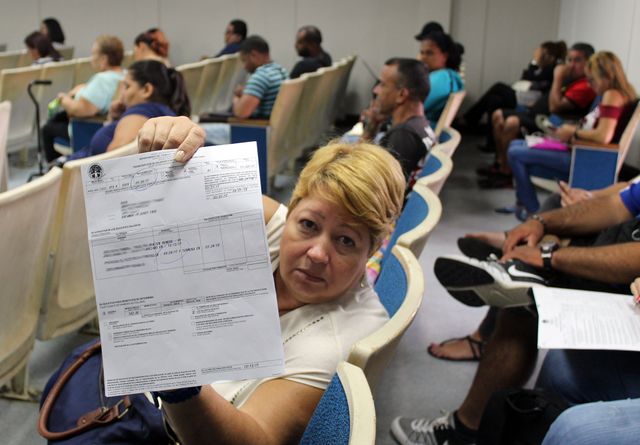
At the unemployment office in San Juan, Madeline Vasquez of Bayamon explained to WSWS reporters what impact these conditions have had on the lives of the working-class and poor residents on the island.
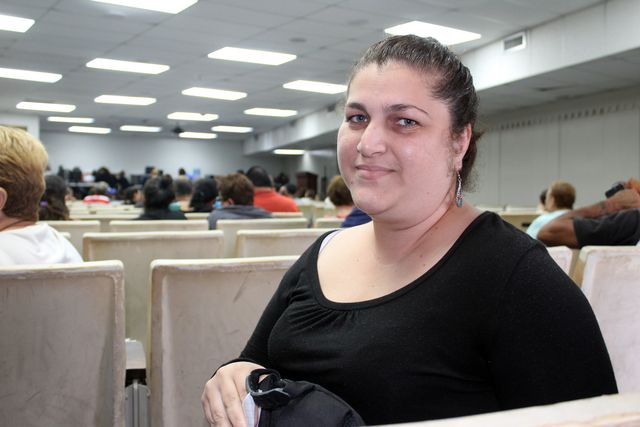
Madeline Vasquez
Holding up a letter from the unemployment office, she explained, “I am supposed to be receiving $138 a month, but they haven’t sent me anything even though this letter says I was approved in September. I have two kids. Even if I were to receive this money, how am I supposed to live on $138 a month? This is why so many people have left the island. There is nothing left for them here. They are forcing people to make decisions, between food and health care, or buying the things they need to survive.
“If you are lucky enough to have a generator you will be spending maybe $75 week for fuel. We have one and have been doing this since Irma, even before María. If it wasn’t for my family helping me, I think I would have to leave the island.”
Mrs. Vasquez lost her job working in an administrative office, which has not reopened since the storm. Other residents sitting nearby Mrs. Vasquez nodded along as she spoke about her situation. Each person had a similar story: they had lost their jobs from the hurricane damage, applied for unemployment, and received nothing in response. Each showed us their letters granting them a paltry sum of money—not one over $138. Of the dozen or so workers who spoke with WSWS reporters not one had received “even one cent” of aid, several exclaimed, since the storm hit in September.
Employees of the Department of Labor office told our reporters that in the immediate aftermath of the storm the line to apply for unemployment benefits in San Juan was so long that the office had to set up tents outside for the overflow. Director of the unemployment insurance department, Carmen Morales Rivera, reported to various media outlets that officials in the capital saw between 800 and 1,000 people a day.
According to the Bureau of Labor Statistics, the unemployment rate has increased every month since the storm and is on track to rise again by the end of December. The current unemployment rate stands at 10.8 percent, nearly 118,000 people. These numbers are likely an underestimation of the real figures as it is unclear how the nearly 200,000 workers who have left the island are considered. Many who reached the US mainland are still jobless.
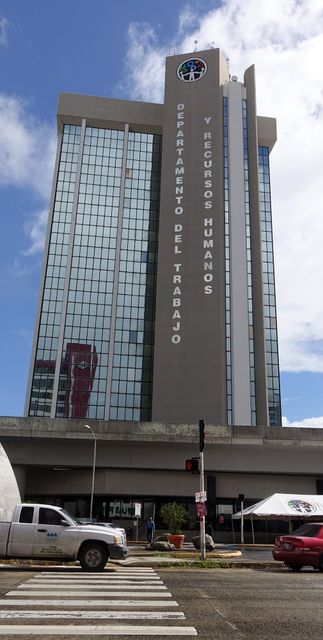
Department of Labor and Human Resources in San Juan
One former clothing shopkeeper sitting nearby speculated, “I think the government is hiding the real number of people who will now be unemployed from the storm. There are so many industries which were affected, administrative offices of all types, shopping, tourism, nearly every industry.”
Mrs. Vasquez noted that the economic situation of the island had been bad before the storm. In August, a month before María, Puerto Rico had an unemployment rate of 10.1 percent with a poverty rate of 43.5 percent, more than double that of Mississippi, the poorest state in the US.
“The government has really done nothing. I mean what are these people thinking? And it is not just here but on the mainland too. Do they know how many kids and people are hungry? Or how many need houses and benefits? I often wonder who is really doing more damage—the Republicans who are on a rampage or the Democrats who are doing nothing! Neither of those parties is for us. We have two parties here on the island as well and they are the same.”
A row back, Marta Feliciano voiced her agreement, “The rich can have generators but what about the working class and poor? We have to just make do. I heard today that a person in San Juan died of hunger—of hunger! We are human beings. How can this be happening?”
Mrs. Feliciano explained, “My husband lost his job at the airport. They sent him a letter initially saying they were temporarily laying him off because of the damage to the airport. They opened other positions back up but they never called back my husband, and they never sent him a letter or anything. He just had to keep calling. I don’t think many people know just how many jobs have been cut but I know for sure they still haven’t called back at least 200 people at the airport, but there are probably many more.
“I have two daughters, both in elementary school, and the truth is we are really surviving now on our food stamps.”
Marta Feliciano
Another airport worker, who wished to remain anonymous for fear of reprisal at his job, explained that many companies who work at the airport are preparing to start massive layoffs. “I am the head of my department. I have meetings with my bosses each week where they threaten to start laying off the workers below me. It feels so horrible but I have to tell my employees to do their jobs as best as they can, to not spend lots of money on their families at Christmas, to start saving, to not buy new things, because I really don’t know what is going to happen with their jobs.”
The same worker was at the unemployment office with his wife who lost her job working with special needs children. While they waited for his wife’s turn at the office, he worked on a university assignment, so he can finish school and try to get a better job.
The fate of thousands of more jobs and livelihoods hang in the balance as corporations and politicians work through the implications of the Trump administration’s new tax bill. One provision, which will treat Puerto Rican subsidiaries of American companies as if they are located in a foreign country, excluding various tax breaks and subsidies, is predicted to eliminate as many as 200,000 additional jobs, spurring even further economic depression on the island.
The system, which granted the island both foreign and domestic status, has made Puerto Rico a tax haven for drug and medical device makers, who can incorporate in the commonwealth as foreign subsidiaries but label their products as made in the US.
The response of much of the island’s political establishment, including Governor Rosselló, a Democrat and member of the island’s pro-statehood New Progressive Party, has been to double down on offers of corporate tax cuts and incentives, and to accelerate the campaign to privatize the publicly owned electrical grid, school system and other public services. This will also lead to a wave of job-cutting and the destruction of the wages and benefits of teachers and other public sector workers.
“If it is looking this bad for us now I cannot imagine what it will be like after the tax bill,” Mrs. Feliciano declared. “And what are the Democrats going to do about it? Nothing!”

Russia charges Pentagon with training ex-ISIS fighters

Bill Van Auken 

US special operations troops are secretly harboring and training former fighters of the Islamic State in Iraq and Syria (ISIS) at the remote American base in Al Tanf, Syria near the strategic nexus of the country’s borders with Iraq and Jordan, according to a report issued by the Russian military command.
The charge was made Wednesday by General of the Army Valery Gerasimov, chief of the Russian military’s general staff and deputy defense minister. He said that Russian drones and satellites had detected brigades of ISIS militants in and around both Al Tanf and another US military base near the Kurdish-controlled city of Al-Shaddadi in the country’s northeast.
“They are in reality being trained there,” Gerasimov said in an interview with the Russian daily Komsomolskaya Pravda. “They are practically Islamic State,” he added. “But after they are worked with, they change their spots and take on another name. Their task is to destabilize the situation.” The Islamist fighters, he indicated, are being re-branded as the “New Syrian Army.”
According to the estimates of the Russian general staff, there are some 750 of the militants at the Shaddadi base, and roughly another 350 in Al-Tanf.
There was no immediate response from the Pentagon, which in the past has routinely denied charges of US collaboration with ISIS. In the waning days of the brutal US siege of the Syrian city of Raqqa, the so-called capital of ISIS, however, incontrovertible evidence emerged that Washington and its proxy ground force, the Kurdish-dominated Syrian Democratic Forces, intervened to rescue and relocate ISIS fighters trapped in the city.
The BBC documented the fact that the Pentagon and its Syrian Kurdish proxies organized a four-mile-long convoy to evacuate thousands of ISIS fighters, along with tons of weapons, ammunition and explosives from Raqqa last October.
The report was confirmed by the former official spokesman of the Syrian Democratic Forces, Talal Silo, who defected to Turkey in October. He told the media that some 4,000 people were driven out of the city, all but about 500 of them armed ISIS fighters.
Silo also charged that the same kind of operation had been carried out during the earlier sieges of Manbij in northern Aleppo province and Al Tabqah on the Euphrates River, where thousands of other ISIS fighters had been allowed to leave with their weapons and ammunition.
The American strategy was not, as repeatedly proclaimed by top US officials, to “annihilate” ISIS, but rather to turn it against Syrian army troops in order to prevent the government from reclaiming strategic territory, including the oil fields of Deir Ezzor province and the eastern border with Iraq, where Washington is attempting to carve out a zone of control.
The charges from Russia are entirely consistent with these earlier reports and serve as another damning exposure of the so-called “war on terrorism” that has been invoked as the rationale for US imperialism’s current intervention in Iraq and Syria, as well as its earlier wars in the region.
ISIS was itself a byproduct of Washington’s interventions in the Middle East, serving as both an instrument of and a pretext for American military aggression aimed at asserting US imperialist dominance over the oil-rich region.
The report of US forces training the ex-ISIS militants for deployment as a new anti-government militia in Syria constitutes one more indication that Washington is preparing a new and far more dangerous phase of its military intervention in the war-ravaged country.
In one sense, US strategy is coming full circle back to where it started, with the CIA’s fomenting of a war for regime change through the arming, funding and training of Al Qaeda-linked Islamist militias directed at toppling the government of President Bashar al-Assad and installing a more pliant US puppet regime.
These militias, however, were routed, thanks to not only the military support given by Russia and Iran to Assad’s forces, but also the overwhelming popular rejection of the socially and politically reactionary Islamist elements backed by Washington, the other Western powers, as well as Saudi Arabia and the other Gulf oil sheikdoms, Turkey and Israel.
The attempt to launch a war for regime change 2.0 is conceivable only on the basis of a far more direct and massive US military intervention in the country.
The governments of both Iraq and Syria have declared victory in the campaign against ISIS. The Pentagon itself told the Reuters news agency Wednesday that fewer than 1,000 ISIS fighters remained in both countries.
The US military refused to respond to a question from Reuters on whether some ISIS fighters could have escaped to other countries, saying that it would not “engage in public speculation.” In reality, the US military and intelligence apparatus knows full well where these fighters are and is reorganizing and retraining them.
Despite this supposed victory in the war on ISIS, Washington has given no indication that it intends to reduce its troop levels in either Iraq or Syria.
Russia, meanwhile, has announced the renewal of its agreements with the Syrian government on what it terms “permanent deployment bases” at the Mediterranean port of Tartus and at the airfield and command-and-control center in Hmeymim. Moscow has indicated that it intends to expand its Tartus naval base to accommodate a fleet of 11 warships, including nuclear-powered vessels and missile-armed destroyers.
Russian Foreign Minister Sergei Lavrov said on Wednesday that with the defeat of ISIS, “the main anti-terrorist objective” was now the eradication of the Al Nusra Front, the Islamist militia formed as the Syrian affiliate of Al Qaeda. With its main forces now concentrated in northwestern Idlib province, Al Nusra operates in close alliance with the so-called rebels armed and funded by the CIA and Washington’s regional allies, and has been the principal beneficiary of the vast quantities of arms they have funneled into the country.
The shift toward a “post-ISIS” strategy in Syria places US imperialism ever more directly on a collision course with both Iran and Russia. From the beginning, Washington’s strategic objective, masked by the “war on terror” pretext, has been to exert military force as a means of countering Russian and Iranian influence, which it views as the principal obstacle to the assertion of US hegemony in the region.
The increasing threat of a direct military confrontation between the world’s two largest nuclear powers has been underscored by recent reports from both Washington and Moscow of alleged close encounters and provocative confrontations between US and Russian warplanes in the skies over Syria’s Euphrates River valley.
At the same time, the Trump administration has elaborated a vociferously anti-Iranian policy based on the forging of an alliance between the US, Saudi Arabia and its fellow Sunni oil monarchies and Israel. Saudi Arabia has repeatedly charged Tehran with carrying out “acts of war” based on unsubstantiated allegations of Iran arming Yemen’s Houthi rebels with missiles fired at the kingdom. For its part, Israel has warned that it will intervene militarily to prevent the creation of Iranian bases in Syria.
As US imperialism moves toward another escalation in Syria, with the threat of it mushrooming into a regional and even global war, the victims of the so-called anti-ISIS campaign continue to mount. Hundreds of thousands of refugees who were forced to flee and saw their homes bombed into rubble in both the Iraqi city of Mosul and the Syrian city of Raqqa are now facing near freezing cold along with the lack of adequate food and medical care, leading to new deaths.
A report last week by the Associated Press, based on data collected by the morgues and grave diggers of Mosul, indicated that the known toll in civilian lives resulting from the US “liberation” of the Iraqi city last July is approximately 11,000. This figure—10 times the civilian death toll acknowledged by the Pentagon—does not include many bodies still buried under the rubble.
Last July, Patrick Cockburn, the veteran Middle East correspondent of the British Independent, reported that Iraq’s former foreign minister Hoshyar Zebari had been informed by the intelligence service of Iraq’s Kurdistan Regional Government that the real death toll in Mosul was over 40,000.
That figure, like the latest reports of US protection and training for former ISIS fighters, was largely blacked out by the US corporate media, which faithfully covers up Washington’s war crimes.

Socialism and the problem of the super-rich

Barry Grey

Nearly one hundred and fifty years ago, Karl Marx, citing the early 19th century French economist Jean Charles Léonard de Sismondi, observed that “the Roman proletariat lived at the expense of society, while modern society lives at the expense of the proletariat.”
Never has this been so true as today, as day after day, week after week, reports are published showing the massive social wealth piled up by the financial oligarchy at the expense of the working class.
The latest of these is the Bloomberg Billionaires Index published on Friday, which showed that the fortunes of the world’s wealthiest 500 billionaires rose 23 percent over the past year, making them $1 trillion richer than at the end of 2016. The combined wealth of this group reached $5.3 trillion. The gain of $1 trillion was four times last year’s increase.
Bloomberg found that the world’s richest 500 people as a group added an average of $2.7 billion to their fortunes every day in 2017. This means that, on average, each of these individuals added $5,400,000 every day, or $225,000 every hour—roughly equivalent to the combined income of five working-class households in the US over the course of a year.
The rapid expansion of the wealth of the financial oligarchy accompanies growing indicators of social misery at the other pole of society, exemplified in the report this month by the Centers for Disease Control that life expectancy in the US fell for the second year in a row.
Wealth concentration on the scale reflected in these reports has immense social implications. It is impossible to seriously address a single social issue without confronting the problem of economic inequality. The colossal diversion of resources into private wealth accumulation by the financial oligarchy effectively starves society of the resources it needs to deal with the most basic problems.
The United Nations estimates that it would cost $30 billion a year to eradicate world hunger, a small fraction of the wealth monopolized by the world’s billionaires. Amazon founder Jeff Bezos alone added $34.2 billion to his fortune in 2017.
America’s 159 billionaires added $315 billion to their fortunes last year, giving them a collective net worth of $2 trillion. This is double the $1 trillion spent by the US government in 2015 on health care ($980 billion), education ($70 billion) and housing ($63 billion) combined.
The funneling of these vast sums into the bank accounts of the super-rich, combined with the nearly $1 trillion set aside every year to fund the military machine that protects the oligarchy’s financial interests around the world, leaves virtually nothing to address the crumbling social and physical infrastructure (roads, bridges, rail, mass transit) of the United States.
The tax bill just passed by the Trump administration will fuel a further growth of social inequality in the US and around the world beyond what are already the highest levels since the Gilded Age at the turn of the 20th century.
The economic life of the planet is determined by the drive of the ruling elite for ever greater self-enrichment. The policies of all capitalist governments and parties, whether right-wing or nominally “left,” are driven by this requirement. The unprecedented rise in the stock market has been engineered by the world’s central banks, led by the US Federal Reserve, to enable the capitalist class to recoup its losses and increase its share of wealth and income in the aftermath of the 2008 financial crisis. The Fed, first under Bush and then under Obama, led the way in organizing bank bailouts and the infusion of trillions into the financial markets by means of ultra-low interest rates and “quantitative easing” money-printing operations.
To provide a certain context, the total of $5.3 trillion in assets controlled by the richest 500 people is greater than the combined GDPs of the UK and France. The $2 trillion owned by US billionaires is almost twice the GDP of Mexico, a country of 128 million people. It is also more than double the combined GDPs of Argentina, Chile and Peru.
Bezos’ gain for the year is itself only slightly less than the combined GDPs of Jamaica ($14 billion), Niger ($7.5 billion) and Zimbabwe ($16 billion), with a combined population of 40 million.
The financial elite has definite social interests, which it enforces through the wholesale buying of political parties and politicians, making democracy under capitalism nothing but a hollow shell.
What would happen in response to any serious effort to reform this state of affairs, to pursue a modest reallocation of social resources, within the framework of the capitalist system, to ensure that all people received the basic rudiments of nutrition, health care, and education?
It would inevitably be met with massive and overwhelming opposition on the part of the financial oligarchy, which controls all levers of the state power, and has at its disposal not only the courts and politicians, but, even more decisively, the police and the army.
When social reform is impossible, social revolution becomes inevitable. There is no way to avoid the conclusion that it is necessary to expropriate the wealth of the financial oligarchy.
These resources are derived from the social labor of the working class, which produces all the wealth of society. The working class is the only social force that can and must carry out this historic task. The only answer to the growth of poverty and immiseration for the masses alongside ever more obscene levels of wealth for a tiny minority is socialism, based on common ownership and democratic control of the productive forces and the rational, planned international coordination of economic life.

27 Dec 2017

AFRIKA KOMMT! Fellowship Program for Young African Leaders (fully-funded Internship Program in Germany) 2018/2020

Application Deadline: 19th January 2018
Eligible Countries: Sub-Saharan African countries
To Be Taken At (Country): Germany, Candidate’s home country
About the Award: Nineteen of Germany’s leading businesses have committed themselves to a common cause. In 2008, they launched the AFRIKA KOMMT! initiative for economic and capacity development. The programme trains young, future managers from Sub-Saharan Africa on-site with German companies. The main idea behind the initiative is to create a win-win-situation for the programme participants and the partnering companies. Thus, the initiative lays the foundation stone for sustainable economic cooperation with Africa and aims at forming stable cooperative partnerships for the future.
Type: Internship, Career Fellowship
Eligibility: Candidates need to fulfil the following formal eligibility requirements:
  • University degree in a relevant subject (please see individual company profiles below)
  • Postgraduate degree (e.g. MBA) is an advantage
  • Two to five years of relevant work experience
  • Excellent English language skills
  • Basic knowledge of the German language is an advantage
  • Not older than 35 years and physically fit
  • Female candidates are welcome
Selection Criteria: Besides the specific technical expertise relevant to the partner company, the programme requires candidates to have the following set of general skills and attributes:
Language and communication skills:
Excellent English skills
Strong oral and written communication skills
High willingness to learn German
Professional skills:
High leadership potential
Strong self-motivation and self-starter mentality
High level of dedication, commitment and target-orientation
Strong capacity for teamwork
Personal attributes:
High level of enthusiasm, flexibility and resilience
Outstanding intercultural competencies
Ability to adapt to new environments quickly
Number of Awards: Not specified
Value of Award: At the heart of the AFRIKA KOMMT! fellowship programme is an eight-months practical training in a leading German enterprise benefiting both, fellows and partner companies – a classic win-win situation:
The programme fellows benefit through:
  • gaining first-hand practical experience in a leading German enterprise
  • being exposed to leadership concepts and management techniques in practice
  • becoming acquainted with working processes and business culture in German enterprises
  • extending their international management competencies
  • initiating networks of cooperation partners between Sub-Saharan Africa and German companies
The partner companies benefit through:
  • establishing networks of cooperation and trust in promising future markets in Sub-Saharan Africa
  • extending their experience with the working and business culture in Sub-Saharan Africa
  • improving their knowledge about cultures, markets, countries etc. in Sub-Saharan Africa
The AFRIKA KOMMT! fellowship programme also includes: Language course, Travelling expenses (Flights, Visa, local travels etc), Monthly living allowances, Accommodation, Insurance, Trainings and Study tours, Alumni activities, Certificate
After five completed programme years, a significant number of the participants now work in the branch office of their respective partner company in Africa.
How to Apply: Applications can only be submitted through the online application system.
Please read the application requirements carefully. You will find all necessary information in the application guide: AFRIKA KOMMT! 2018 – 2020
Award Providers: AFRIKA KOMMT! receives valuable contributions from the German Federal Foreign Office (Auswärtiges Amt) and the German embassies in Sub-Saharan Africa. The programme is supported by the Federal President of Germany Frank-Walter Steinmeier
Important Notes:  You will have to apply for the whole programme and not for a certain company or placement. There is no guarantee that the practical training in a specific company is possible.