5 Jan 2018

The Dow at 25,000: The bonanza for the oligarchy continues

Nick Beams

The surge of the Dow Jones Industrial Average stock index past 25,000 points yesterday marks a further escalation in the speculative binge that has gripped Wall Street and global stock markets over the past year, signifying a massive transfer of wealth to the heights of society.
It took just 23 days for the Dow to jump from 24,000 to its latest milestone, the shortest period between 1,000-point increments in the index’s history.
During 2017, the S&P Global Broad Market Index soared by 22 percent, the biggest increase since the global financial crisis of 2008–2009. This represents a rise of around $9.6 trillion in market value. The FTSE All-World index rose 1.6 percent in December, notching up 14 straight months of gains, the longest such run on record.
The market escalation has prompted predictions that it will continue into 2018, with some forecasters even pointing to a market “melt up” in the coming period.
Notwithstanding a slight increase in global growth over the past year, the market surge is not an expression of a recovery in the world economy, a decade after the eruption of the global financial crisis. Rather, it is a mechanism for an accelerating transfer of income to the upper echelons of society. For example, Amazon chief Jeff Bezos increased his wealth by $33 billion in the past year.
All arms of government and the financial institutions are directed toward fuelling the equity bubble. In the first place stand the US Federal Reserve and the other major central banks around the world. They have pumped an estimated $15 trillion into global financial markets and sent interest rates to historic lows, providing the conditions for the share buybacks and financial mergers that have played such a significant role in boosting the stock markets.
The extent of this financial largesse is indicated by the fact that central banks have bought up virtually all the bonds issued by the governments of the world’s 10 biggest economies over the past two years—a key factor in keeping interest rates close to zero in real terms.
These policies represent a continuation and deepening of the process that began 30 years ago in response to the US stock market crash of October 1987, when US Federal Reserve Chairman Alan Greenspan guaranteed that the financial spigots would be opened to sustain asset prices.
The response to every financial storm throughout the 1990s and early 2000s has been the same: the provision of still more money to finance the next round of speculation, culminating in the bailout of the banks after 2008 and the policy of quantitative easing over the past decade.
These measures have been pursued in tandem with the slashing of spending on social services, along with health and education. In the US, as in all the other major capitalist economies, government policies—whatever the political colouration of the regime in power—are based on austerity measures aimed at transferring the wealth created by the labour of the working class up the income scale.
Having just handed out a bonanza to the corporations and the ultra-wealthy in the form of the biggest tax cuts in history, all sections of the US political establishment are united in developing an agenda that makes ever-deeper inroads into the provision of social services.
The character of the stock market boom can be gauged by contrasting the situation with that in previous periods.
Over the past nine years of economic “recovery,” the Dow Jones Industrial Average has shot up by 177 percent, while the real US gross domestic product has grown by only 19 percent.
Over a similar period 50 years ago, between 1959 and 1968, the Dow grew by only 22 percent, while the real economy grew by 48 percent, or more than twice the current rate.
The massive growth of stock values has occurred during the worst economic “recovery” in the post-war period, characterised by historically low levels of investment, falling productivity growth and stagnant wages.
The parasitic nature of the boom is evidenced by the fact that about one-quarter of the total increase in share prices has come from just five of the largest US companies by market value: Apple, Alphabet (the owner of Google), Amazon, Facebook and Microsoft.
The characteristic feature of these firms is that their profit accumulation derives not from investment in plant and equipment and the employment of large numbers of workers, as with the industrial giants of the past, but via the appropriation of wealth through intellectual property rights, a modern form of rent. This form of parasitism ultimately depends on the super-exploitation of workers in China and other cheap-labour regions.
Amazon, in contrast to the other technology giants, has a big workforce. Its massive share price increase reflects its role in driving smaller distribution networks out of business through a combination of monopolistic market power and the slave-like exploitation of its impoverished workforce.
There is another, no less decisive, aspect to the stock market boom: the suppression of the class struggle and the virtual disappearance in recent decades of major strike actions.
This is not the result of some organic incapacity of the working class to rise to the challenges that confront it. Rather, it is the outcome of the role of the trade unions and the political parties, supported by the various pseudo-left tendencies, which have dominated it for decades.
The crucial role of these organisations in facilitating the stock market bonanza is not the result of “mistakes” or incorrect assessments, but derives from their material interests and privileges, which are rooted in the maintenance of the private profit system.
With the beginning of the New Year, however, there are indications that the working class is once again preparing to enter into convulsive struggle, as evinced by mass demonstrations in Iran, the latest wildcat strike by auto workers in Romania, and growing labour militancy throughout Europe and the Middle East.
The capitalist profit system constitutes nothing less than a coordinated instrument for the transfer of the wealth of society to its upper echelons and their hangers-on. It cannot be changed through a perspective of reform, but only through its overthrow and the reconstruction of society from top to bottom on the basis of a socialist program.
That is, as Marx put it, there is no way forward other than the “expropriation of the expropriators,” ending the private ownership of the means of production and establishing a socio-economic order to meet human need. The necessity to undertake the political rearming of the working class in the fight for this perspective is the conclusion that must be drawn from the stock market frenzy, and the growth of poverty and social misery that accompanies it.

Indian Foreign Policy and the Hafiz Saeed Problem

Abhijit Iyer Mitra


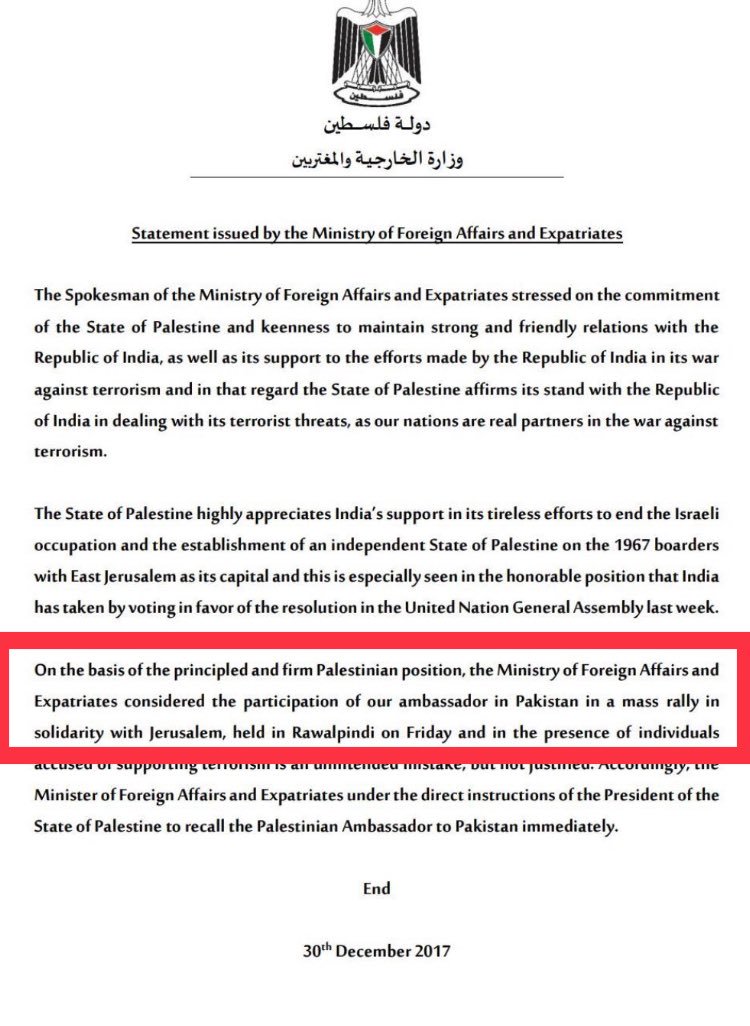
On Friday, 29 December 2017, the Government of India faced a major public embarrassment, one that provides some insights into the failure of intelligence. What it shows is one of three things: a failure of gathering, collation and transmission of intelligence; a failure to archive, collate and assess foreign policy; or, possibly, a serial failure of both intelligence and foreign policy fronts and a diagnostics problem within the Prime Minister's Office (PMO).
Background
On 21 December, India voted for a resolution at the United Nations General Assembly (UNGA), condemning the US' decision to shift its embassy to Jerusalem (a move thus supportive of the Palestinian position and condemnatory of the Israeli and US position). On 29 December, pictures started circulating on the Internet of a meeting between the Palestinian ambassador to Pakistan, Walid Abu Ali, and wanted terrorist, head of the Jamaat ud-Dawa (JuD), and founder of the Lashkar-e-Toiba (LeT), Hafiz Saeed. By the time India lodged a diplomatic protest and Palestine formally recalled Abu Ali, documentary and photographic evidence emerged of at least two previous meetings (August 2014 and December 2014). While knowledge of these meetings may not have changed India's vote, the Ministry of External Affairs' (MEA) actions in dealing with the snafu seems to indicate no prior knowledge of the meetings, which was particularly galling in the backdrop of the 21 December vote.
Implications
Hafiz Saeed is one of India's most wanted men, responsible for masterminding the 26/11 Mumbai attacks and the 2006 Mumbai train bombings, and as such a prime target for 24/7 surveillance by India. Given his accessibility to the public, keeping tabs on him is not particularly challenging, complemented by the Difa-e-Pakistan Twitter handle and coverage by Pakistani newspapers. This points to one of two possibilities. Either Indian intelligence is not equipped to perform such basic OSINT activities as what Indian Twitter users can. Or, such intelligence existed but was buried deep in the system and could not be archived for efficient extraction when required to make policy decisions, either on 21 December when the UN vote happened, or indeed on 29 December when pictures of the December 2017 meeting surfaced.
What is however known for a fact is that even after the situation blew up publicly, the diplomatic protest note sent to the Palestinians referred only to the December 2017 meeting, which indicates that the MEA had no knowledge of the previous meetings (by this time, the open source verification of previous meetings had not emerged). This is particularly worrying as it implies that either the MEA did not seek intelligence inputs on previous meetings, or that despite requests such inputs were not provided, that there was no intelligence on the subject to provide, or that the MEA decision was taken despite knowing the scale and extent of links between the Palestinian Authority and Hafiz Saeed.
While the last option points to questionable policymaking, the previous three possibilities beg the question, why has the MEA not invested in public source intelligence gathering  or outsourcing the work to a think-tank? This is all the more jarring given the minister-in-charge's penchant for playing twitter agony-aunt. If it is assumed that the MEA has in fact invested in such open source intelligence gathering, then clearly the archiving and retrieval systems were not in place for such intelligence to be used rapidly and in a policy-relevant manner.
What is most indicative of systemic failure on the MEA's part is the Palestinian explanation, which was accepted without demur by South Block. First, it made the Palestinian state's regret over its ambassador's actions conditional, dependent on India's continuing support to the Palestinian position. Second, it claimed the meeting was a mistake, ignoring the fact that there were several meetings. Incredulously this would also lead on to accept that Walid Abu Ali, a former Palestinian Intelligence official, did not know who he was deep in conversation with, given the fact that the LeT was co-founded by a Palestinian, Abdullah Azzam, who for a while had cooperated with the Palestine Liberation Organisation (PLO) against Israel.
Finally, the PMO's functioning must be examined. By all accounts this is a prime minister who takes a great deal of interest in foreign policy. That the PM has not been able to diagnose and institute rectifying measures since the Nuclear Suppliers Group (NSG) debacle (where official statements emanating from Delhi were in significant variance from ground reports from Vienna and Seoul) does not instil confidence in his stewardship of intelligence matters. Depending on preferences and biases, it can be concluded that either intelligence or the MEA have been tried and found wanting, or that all have failed in equal measure, as there were no redundancies in place to damage control the situation. What is however undeniable is the PMO has neither diagnosed the problem over the last three years, or taken corrective action.

4 Jan 2018

Social Media Madness: the Russia Canard

Norman Solomon

For several months we’ve been hearing a crescendo of outcries that Russia used social media to sway the 2016 presidential election. The claim has now been debunked by an unlikely source — one of the most Russiagate-frenzied big media outlets in the United States, the Washington Post.
Far away from the media echo chamber, the Post news story is headlined: “There’s Still Little Evidence That Russia’s 2016 Social Media Efforts Did Much of Anything.”
The article focuses on “what we actually know about the Russian activity on Facebook and Twitter: It was often modest, heavily dissociated from the campaign itself and minute in the context of election social media efforts.”
In fact, the ballyhooed Facebook ads were notably not targeted to be seen in swing states, the piece by Post journalist Philip Bump reports. As for the much-hyped tweets, they were smaller than miniscule in quantity compared to overall election-related tweets.
But don’t expect the fervent canard about Russian manipulation of social media to fade away anytime soon. At this point, the Russiagate atmosphere has become so toxic — with incessant propaganda, credulity, fear-laced conformity and partisan opportunism — that basic logic often disintegrates.
One of the weirdest aspects of claims that Russia undermined the election with social media has involved explaining away the fact that few of the ads and posts in question actually referred to Hillary Clinton, Donald Trump or the election. Instead, we’re told, the wily Russians tried to help Trump by inflaming social divisions such as racial tensions. It’s a rampant storyline (rendered here by NBC News political director Chuck Todd) that’s reminiscent of the common claim during the civil rights movement that “outside agitators,” such as Russian-directed reds, were inflaming and exploiting racial tensions in the South.
From there, it’s just a hop skip and jump to smearing Americans who dissent from U.S. orthodoxies as useful idiots who serve the interests of plotters in the Kremlin.
Of course history is not exactly repeating itself, but it’s rhyming an awful lot. There are real parallels between the McCarthy Era and today’s anti-Russia fervor in the United States.
Despite all the information and analysis that have strengthened progressive understanding in this country during the last few decades, fixating on Russia as culpable for the election of Trump has been widely irresistible. Perhaps that fixation is less upsetting than deeper realization of just how rotten the U.S. corporate system of injustice has become — and how the forces that brought us the horrors of the Trump presidency are distinctly homegrown.
Narratives scapegoating Russia now have an extremely powerful grip on the USA. The consequences include heightened U.S.-Russia tensions that absolutely mean heightened risks of nuclear war — and worsening threats to democratic discourse at home.
The conditioned reflex to label as somehow “pro-Putin” any opinion that overlaps with a Kremlin outlook is becoming part of the muscle memory of much of the American body politic. Countless journalists, pundits, activists and politicians have fallen under the Russiagate spell. They include the liberal primetime lineup on MSNBC, where — as the media watchdog group FAIR pointed out last month — Rachel Maddow and Chris Hayes routinely bypass stories of great importance in order “to lead with minutiae from the ongoing Russia investigation that has consumed MSNBC‘s coverage like no other news event since the beginning of the Trump presidency.”
Across most of the media landscape, the meme that Russians attacked American democracy with social-media posts has been treated as self-evident.
In a typical exercise of the conformity that afflicts the national press corps, the Washington bureau chief for Mother Jones magazine, David Corn, wrote this fall that the House intelligence committee needed more staff to investigate, in his words, “how” — not whether — “a foreign adversary attacked American democracy.” His piece breathlessly declared that “the Trump-Russia scandal” was “expanding — it now includes new revelations regarding Moscow’s use of social media in the United States to influence the 2016 campaign.”
That kind of stenography for powerful spin may snag cable TV appearances and lucrative book contracts, but it’s a notable disservice to journalism and democracy.
Meanwhile, most Democrats on Capitol Hill are eager to engage in such rhetoric. So, it was just another routine appearance when Senator Richard Blumenthal went on CNN a week before Christmas and declared “there is increasing evidence that the Russians are continuing their attack on our democracy.” He said: “The Russian attack on our elections in 2016 was endlessly ingenious and inventive, using all kinds of social media, all kinds of intermediaries, sources of information for them.”
To put it mildly, that sort of bombast gains vastly more airtime than discussing the urgent need for détente between the world’s two nuclear superpowers.
On MSNBC, Rachel Maddow has climbed with her ratings to great mass-media acclaim, while advancing herself from the outset of the Trump presidency as one of the most prominent and irresponsible Russia baiters in U.S. media. At this rate, when Maddow retires — if she and the rest of us are lucky enough to avoid a nuclear holocaust — she can look back on a career that deteriorated into an obsessive crusade against Russia that increased the chances of World War III.
In the poisonous media environment that keeps boosting her fame and fortune, it’s grotesquely fitting that Maddow — time after time after time — has devoted so much of her program to the illusory Russian assault on democracy via social media.
That’s the way it goes in the propaganda-polluted land of Russiagate.

President-elect George Weah opens Liberia for plunder

Eddie Haywood

Former football star George Weah was declared the winner in Liberia’s run-off election December 28, defeating incumbent Vice President Joseph Nyuma Boakai. Allegations of vote fraud by Boakai forced the runoff after a contested poll held in October. The run-off margin for Weah was a decisive 61.5 to 38.5 percent.
The contest for president took place between several representatives of the Liberian wealthy elite. Weah, the candidate of the Coalition for Democratic Change (CDC) party, campaigned on an anticorruption platform. Weah’s running mate for vice president, Jewel Taylor, is the former wife of imprisoned ex-president Charles Taylor.
Other candidates included Vice President Boakai of the outgoing Sirleaf government, Prince Johnson, the former Chief Training Officer of imprisoned ex-president Taylor, multimillionaire businessman Alexander Cummings, and MacDella Cooper, a fashion model and Weah’s former girlfriend.
The election has been hailed by the corporate media as a major victory for democracy and the first peaceful transfer of power since 1944. Washington and the European powers telephoned to congratulate the newly elected president. International media have largely characterized Weah’s victory as part of the sweeping to power of so-called “antiestablishment” political figures, such as Donald Trump in the US, Narendra Modi in India and Rodrigo Duterte in the Philippines.
On behalf of Washington, White House Press Secretary Sarah Huckabee Sanders congratulated Weah in a statement: “This is Liberia’s first peaceful transfer of power from one democratically elected head of state to another in decades, and represents a major milestone for Liberia’s democracy. The United States is deeply committed to our longstanding relationship with Liberia and its people. We will continue to support the success of this historic democratic transition and the peace and prosperity of Liberia.”
In November 2016, when Weah was a senator, he congratulated Donald Trump on his election and made the vapid assertion that the “United States of America, exercise the very tenets of democracy they have introduced to other nations around the globe, the Americans did not disappoint as they proved to the rest of the world why they are a true role model and one of the prime architects of modern democracy.”
That Weah casts the election of Trump as evidence that the ruling class in Washington “exercises the very tenets of democracy” is a telling exposure of Weah’s own political orientation and social outlook.
As a wealthy ex-footballer and businessman, his claims of being antiestablishment are a fraud. Weah occupies the wealthiest layer of Liberian society.
Weah took advantage of widespread disaffection with the corrupt Sirleaf regime, seeking to redirect social anger away from the social catastrophe experienced by the masses by waging a hollow campaign against corruption, casting the blame on the Sirleaf government for Liberia’s economic woes.
Revealing the true character of a Weah government before it has even been inaugurated, Weah gave a clear indication that he is prepared to offer up Liberia’s economic resources and its masses to the transnational banks and corporations for plunder. In his first speech as president-elect, Weah declared that he was working to assemble a cabinet in the days before his inauguration on January 22, and was already pursuing the task of expanding Liberia’s revenue base, stating, “To investors, we say Liberia is open for business.”
Since it possesses immense economic resources, particularly minerals, oil and gas, American and European corporations are lining up to carve Liberia up for profits and have expressed their pleasure at the prospect of a Weah government.
In the same speech, and after praising outgoing president Ellen Johnson Sirleaf, Weah issued empty threats to the corrupt clique making up Sirleaf’s government: “Those looking to cheat the Liberian people through corruption will have no place.” In condemning corruption, Weah seeks to assure investors that their money will be safe in Liberia.
As a measure of his cynicism in claiming that he will hold anyone to account for corruption, Weah indicated his willingness to pursue collaboration and peace with the country’s former rulers: “We are not enemies. We welcome you with open arms as we try to build our country.”
Weah takes the reins of power amid a slowing economy and exacerbated social misery for the Liberian masses. He will preside over a government wracked by corruption that metastasized over the 12 years of the Sirleaf government. The extent of corruption spooked banks and corporations, resulting in a further decline in Liberia’s economy.
Liberia’s economy has yet to recover from the devastating impact of the 2014-2016 Ebola outbreak that gripped Western Africa, including Sierra Leone, Guinea and Nigeria, with Liberia experiencing the worst of the epidemic, with nearly 5,000 deaths. The outbreak had a devastating impact on the health care infrastructure of the country, which was criminally starved of vital funding from the outset.
After 12 years of corruption and mismanagement under the Sirleaf government, unemployment has skyrocketed in Liberia, along with chronic poverty. The majority of the population lives without access to electricity, and in the capital city Monrovia alone, only 7 percent have access to electricity. The cost per kilowatt-hour in Liberia is the most exorbitant in the world.
Liberia ranks 177 out of 188 in development, making it one of the poorest countries on earth. 80 percent of the population lives on $1.25 a day. As 70 per cent of the total population is under 35 years of age, young people are left with little hope or prospects for the future.
Weah appealed to the masses’ disgust over the failure of the Liberian ruling elite to ameliorate the deteriorating economic situation by making cynical promises to eradicate the criminality of the Sirleaf government.
Exposing this cynical exercise to combat corruption as a fraud is the fact that Weah chose Jewel Taylor, the wife of former president Charles Taylor, now serving 50 years in prison after his conviction by the International Criminal Court for war crimes and crimes against humanity, as his running mate.
Notably, Taylor provoked an uproar when she stated during the campaign that the former president “still had promises to keep” and called for “putting Mr. Taylor’s agenda back on the table.”

New Zealand government prepares attack on foreign students

Sam Price

New Zealand’s Labour Party-led coalition government, which includes the Greens and the right-wing NZ First, is preparing to slash foreign student numbers as part of a broader assault on immigrants and the country’s tertiary education system. It plans to cut immigration by 20,000 to 30,000 entrants per year, or up to 40 percent, mostly by targeting students.
International students would no longer be permitted to work while studying unless they are enrolled in a bachelor’s degree program, or the school provides work as part of their study. Graduates from lower-level courses will be barred from applying for a 12-month post-study visa.
According to Labour’s web site, its proposed changes will result in 6,000 to 10,000 fewer student visas and a reduction of 9,000 to 12,000 post-study work visas. New regionalised skills shortage lists will reduce the number of work visas by a further 5,000 to 8,000.
The web site asserts that immigration has “contributed to the housing crisis, put pressure on hospitals and schools, and added to the congestion on roads.” Working with the Trump-like NZ First, the Labour Party is scapegoating immigrants to divert attention from the real source of the social crisis. For decades, Labour and National Party governments alike have carried out pro-business restructuring and austerity measures, including cuts to health, education and housing. The lack of affordable housing is the result of rampant speculation by investors, of whom the overwhelming majority are privileged layers in New Zealand.
By whipping up anti-Chinese xenophobia, in particular, the government is also seeking to condition the population to support a US-led military conflict with China.
The tertiary education system has suffered decades of cuts and user-pays policies, beginning with the 1980s Labour government’s introduction of student fees. Successive governments have encouraged ruthless, profit-driven business practices in major universities and smaller private training establishments (PTEs), resulting in hundreds of cuts to academic jobs and wages and the closure of departments and entire institutions.
Labour campaigned for the September 23 election with a fraudulent promise of “free education.” In fact, course fees will be abolished for one year, for first-time students only. This will not ease the pressure on tertiary institutions or reduce the $15 billion total student debt. International students, who frequently pay $20,000 to $40,000 in course fees annually, will not be eligible for any free courses. This includes Australians who have not lived in New Zealand for at least three years.
Labour will continue the National government’s crackdown on training providers offering qualifications below a bachelor’s degree to international students, which Labour described as a “back door” for residency.
The party’s web site states that, “10,000 fewer Private Training Establishment enrolments will reduce fee revenues by $70 million.” This will force smaller PTEs, which often provide training in specialist trades such as IT, to shut down, making thousands of teachers and academic staff redundant.
When Labour announced its immigration policy in June, Independent Tertiary Education New Zealand representative Christine Clark warned it could cause 70 percent of the PTE sector to collapse. On October 31, she told Radio New Zealand the changes to student visas and rules for lower-level training establishments would result in “up to 10,000 job losses.”
There have been hundreds of job cuts in the tertiary education sector already in recent years.
Unitec, in Auckland, announced 300 job cuts in 2015. In April 2017, Waikato University cut 17 jobs in its Faculty of Arts and Social Sciences. Otago University confirmed in October that it would cut 160 equivalent full-time positions. Also in October, NorthTec announced a plan to axe 50 jobs and potentially close down its campuses in Kerikeri and Rawene.
The Labour government will preside over hundreds more job cuts.
In early December, Auckland-based Best Pacific Institute of Education announced its closure after a funding cut by the government, affecting 150 staff and 1,200 students.
In November, 1,000 staff throughout Massey University’s Auckland, Wellington and Manawatu campuses were sent letters asking for voluntary resignations as the university sought to slash around 90 jobs as part of a drive to cut $15.7 million in costs. Over 70 staff accepted offers to resign, including several internationally sought-after scientists.
The government’s Tertiary Education Commission (TEC) sets unrealistic passing and retention targets, often as high as 85 percent, for institutions to qualify for government funding. These targets increase annually. A Tertiary Education Union (TEU) survey in March 2017 found 63 percent of educators felt pressured to pass failing or cheating students so institutions could continue accepting their fees to offset reduced government funding.
University lecturers also complained of pressure to produce “worthless” research, at the expense of teaching time, so their institute would be eligible for the Performance Based Research Funding system, which Labour introduced in 2003.
Labour bears chief responsibility for the ongoing cuts to tertiary education. After introducing fees in 1989, Labour passed the Education Amendment Act in 1990, which made all tertiary institutes independent legal entities, dropped the exclusivity of bachelor’s degrees from universities, and encouraged competition between institutes. The act laid the foundation for PTEs to proliferate.
Government funding for PTEs began under the Clark Labour government in 2000, based on the number of students enrolled. Labour established the TEC in 2003, which determines the amount of funding an institute receives based on how successfully it can turn a profit.
Far from fighting the assault, the TEU has assisted the job cuts by keeping each dispute isolated and opposing any political and industrial campaign against austerity. The union sought to subordinate workers to Labour’s election campaign and issued a December 15 statement falsely declaring that the new government is “committed to publicly funded and publicly controlled tertiary education.”
Last June, the union endorsed Labour’s plan to cut foreign student numbers, claiming this would shield institutions from global market volatility. On September 28, the TEU also praised the right-wing populist NZ First’s Tracey Martin as “a passionate advocate of accessible education at all levels.”
In opposition to the nationalist and pro-capitalist perspective of the unions and the political establishment, the Socialist Equality Group and the International Youth and Students for Social Equality (IYSSE) insist that everyone must have the right to study and work in any country they choose, with full democratic rights.
Billions of dollars are needed to restore the education system, wipe out student debt and provide free, accessible education and decent living allowances for all students. Staff must be guaranteed job security, high wages and a manageable workload. Education must be made genuinely public and freed from the narrow interests of big business and the profit system.
We call on students who support these socialist demands to join the IYSSE and help us to establish branches at universities, polytechs, PTEs and high schools.

Deaths continue to mount amid freezing temperatures across much of the US

Trévon Austin

The death toll from cold-related fatalities continues to rise as below freezing temperatures persist across much of the United States. Freezing temperatures were reported Tuesday night in every state of the continental US Tuesday night.
At least three more lives have been claimed since Monday when the death toll stood at nine. The deep freeze reached even the deep south, forcing cities to open warming centers.
In Houston, Texas, police said two homeless people died from exposure to freezing cold temperatures. Tuesday night was Houston’s coldest of the season, reaching temperatures in the low 20s Fahrenheit.
A 75-year-old woman was found dead, along with her three dogs, in her home in Clemmons, North Carolina. Her home caught fire, and firefighters found her deceased while fighting the flames. According to the Winston-Salem Journal, the elderly woman had various health issues and needed an oxygen tank.
In Hutchinson, Kansas, a family’s home was set ablaze after an attempt to thaw out frozen pipes with an open flame. The entire family was able to escape their home, but firefighters stated the cause of the fire is common when temperatures drop below freezing.
The rising number of deaths from cold at the beginning of this year has exposed the severity of the affordable housing crisis in the United States, the wealthiest country in the world.
As the market value of homes in the US reached a record high of $31.8 trillion by the end of 2017 the number of homeless people increased for the first time since the Great Recession, with more than 553,000 people recorded as homeless.
Economists point to rising home prices, economic growth, and a drop in national poverty levels to indicate a recovery from the 2008 housing crisis, but these “official” figures only obscure reality. In 2016, 13.5 percent of Americans were living in poverty—a rate similar to pre-2008 recession levels—but even the high official rate is not representative of the actual conditions confronted by millions of workers.
According to Vox, the way poverty is measured in the United states is sorely out of date. Poverty levels are based on the “subsistence food budget” for a family. The measure was developed in 1961 using family food consumption data from 1955. In no way does it capture the needs of a household in 2017.
Much of the rise in homelessness is connected to the ever rising cost of housing while real wages have stagnated. The median wage in the United States has remained virtually unchanged since the 1970s, only rising by 0.2 percent per year when adjusted for inflation.
According to the Guardian, the hourly wage needed to afford housing in New York City is $27.29, and $22.78 in Los Angeles, but the median US wage is just $17.86. The reality is similar in other cities across the nation, meaning millions of Americans cannot afford housing.
The tax reform bill signed into law late last year by President Donald Trump is already threatening to exacerbate the affordable housing crisis. According to a report by the NHP Foundation, the tax law is expected to eliminate 300,000 affordable housing units over 10 years, primarily because it will reduce the value of banks’ low-income tax credits, which finance half of all affordable housing units.
The need for affordable housing in the US is quite pressing. According to Harvard University’s Joint Center for Housing Studies, the number of renter households in the US has been steadily rising, but more than a quarter of the growth is represented by households living on less than $15,000 a year. For these Americans, a missed paycheck or loss of a job could mean homelessness.

More Britons than ever forced into homelessness due to rent increases

Tom Pearce 

In the run up to the New Year, the cross-party Public Accounts Committee (PAC) of MPs called homelessness a “national crisis.” They revealed that more than 9,000 people were rough sleepers and 78,000 families were living in temporary accommodation in England alone.
Homelessness is hitting families that previously would not have been affected.
In his report, “Still No Place Like Home,” Michael Kingthe local government and social care ombudsmannotes that in 2016-17 one in three complaints received about homelessness services delivered by English authorities came from outside London. A majority were from people who found themselves in a situation where they have been “forced to call on their local council’s help by the increasing unaffordability of private tenancies.”
King said, “Our cases show many preconceived ideas about the people affected by homelessness simply no longer ring true. The increasing cost of private rents has meant we have seen a shift towards more people in professions such as nursing, and their families, becoming affected.”
Many families are finding themselves on the brink of homelessness due to being priced out of the housing market. One-third of cases involved councils in South-East England, often in affluent areas with high housing costs, such as Berkshire, Sussex and Kent.
“People are coming to us not because they have a ‘life crisis’ or a drug and alcohol problem, but because they are losing what they thought was a stable private-sector tenancy, being evicted and then being priced out of the [rental] market,” King said.
In April 2004, the government introduced legislation to limit the use of bed and breakfast (B&B) accommodation for homeless familiesThe Homelessness (Suitability of Accommodation) (England) Order 2003. The law states that bed and breakfast accommodation is not suitable for families or pregnant women unless no other accommodation is available and, even then, must only be provided for a maximum of six weeks.
During 2016-17, 450 complaints were issued to the Ombudsman concerning temporary accommodation and homelessness. Of the cases investigated, a staggering 70 percent found that councils were at fault.
There’s Still No Place Like Home references the 2013 report, No Place Like Home, on the inappropriate use by councils of bed and breakfasts (B&Bs) to house families. Four years later, the same problems have worsened and there has been no coordinated response nationally in implementing recommendationsput forward by the ombudsmanto avoid people being shoved into B&Bs “for months on end.”
The horror stories featured in this year’s report reveal a situation comparable with Victorian slum housing. Living conditions for many are such that many councilsfollowing a complaint to the ombudsmanspend thousands of pounds paying compensation to residents due to the poor state of the accommodation they provided.
One family with two young children lost their home when they were evicted from their private tenancy and were placed in a B&B. They all lived in one room together and had to share washing and cooking facilities with other tenants. The shower didn’t work, and cockroaches were found in their bedroom. The owner did not address these problems and they spent significantly longer than is legal in the accommodation. The council paid the £1,750 in compensation.
Other stories show the impact of welfare cuts on the most vulnerable. A single mother with a disability—requiring the use of crutches—and her four children were forced into B&B after they became homeless due to her welfare benefits changing.
The council placed her in an unsuitable property with steps separating key facilities. To worsen the situation, “the rooms were two floors apart so Susie [the mother] would either be separated from one or more of her children, or they had to share crowded conditions.” The accommodation was found to be uninhabitable due to its appalling condition. Despite this, they lived in this situation for two years and four months.
Council delays causing additional stress on the poorest are detailed in the case of Rebecca, a mother of three children, including a baby with Type 1 diabetes. They were housed in a B&B without access to cooking facilities. The council made Rebecca wait until bailiffs came to evict her before rehousing the family in temporary accommodation. She was moved on numerous occasions between different types of housing, each one unsuitable. Her baby son was hospitalized due to infections. The report concluded, “The council had plenty of opportunity to secure suitable accommodation for Rebecca and her family before she became homeless, but failed to do so.”
In another case, the council paid out £2,325 for the injustice caused to a family who had to live in a single room with one kitchen shared with five other families. The kitchen had only one working hob and was filthy, and bed bugs were found along with stained bedding.
Under the Conservative government’s austerity programme, councils are under immense pressure due to the slashing of budgets. This is set to worsen, with councils facing a £5.8 billion overall funding shortfall by 2020.
The reduction and removal of vitally needed services—carried out mainly by the Labour Party-led councils in urban areas—has resulted in many thousands of job losses, leading to mistakes being made to the detriment of many families.
The most graphic example of the indifference of the authorities to the fate of those thrust into homelessness is that of the Grenfell fire survivors. Out of 208 households that needed homes following the tragedy, 118 are still in hotels and bed and breakfasts(B&Bs) or living with friends, including 29 families with children. The Royal Borough of Kensington and Chelsea council has acted unlawfully by having families spend more than six weeks in B&B accommodation. When the figure is adjusted to include residents forced to leave blocks adjacent to Grenfell Tower, it is estimated that a staggering 857 people, including 303 children, spent Christmas in temporary accommodation.
The PAC’s figures are damning, but they are an underestimation of the true number of homeless people in one of the richest countries on the planet.
The BBC reported in December on the phenomenon of the hidden homeless. Usually young people, who are dubbed “sofa surfers,” find themselves sleeping in friends’ houses as a stop-gap before they eventually get their own accommodation. However, some youth interviewed had been doing this for over six years. This group are usually not included in official statistics, but UK-wide research commissioned by the BBC found that out of 1,000 questioned, “41% of young people had stayed with friends for at least one night and 9% did so for over a month.”

Facebook deleted accounts at the behest of US, Israeli and German governments

Niles Niemuth

Facebook has admitted to deleting the accounts of Palestinian activists and journalists at the behest of the Israeli government as well as the accounts used by the former leader of Chechnya at the command of Washington in an active campaign of international political censorship.
The social media company, which has more than 2 billion active users worldwide, has also been systematically removing hate speech and other “illegal” content from its platform in Germany.
Facebook, which has nearly 4 million active users in Israel, has been engaged in a “censorship rampage” against activists and journalists who oppose the illegal Israeli occupation of Palestinian territory according to the Intercept’sGlenn Greenwald.
The current campaign of censorship against Palestinians began after high-level meetings in September 2016 between Facebook representatives and Israeli officials including Justice Minister Ayelet Shaked of the far-right, pro-settlement Jewish Home party. Shaked once notoriously referred to Palestinian children as “little snakes.”
After the meetings with Facebook, Shaked publicly bragged that the company had granted 95 percent of more than 150 requests by Tel Aviv for removal of content during a four-month period that the Israeli government declared “incitement.”
Following the Israel-Facebook summit, ten administrators for the Arabic- and English-language Facebook pages for the Palestinian Information Center, with more than two million followers, had their accounts suspended, seven permanently. Facebook also briefly took down the page run by Fatah, the largest faction of the Palestinian Liberation Organization, when it posted a picture of Yasser Arafat holding a rifle.
Most recently the former head of the Chechen Republic, Ramzan Kadyrov, had both his Facebook and Instagram accounts deleted at the behest of the US last month. According to Facebook, it had deleted the two accounts, which had approximately 4 million followers, after the Trump administration had placed Kadyrov on a financial sanctions list.
The move against Kadyrov sets the precedent that allows the US government to silence the social media accounts of any foreign politician or official who may voice opposition to US interests by placing them on a sanctions list.
Along the same lines as the US and Israeli government’s censorship campaigns, the German government adopted a new law in October that bans “hate speech” and other “illegal” content on social media outlets by threatening the companies with a possible $56 million fine if they do not quickly remove offending posts.
Coinciding with the new law, Facebook opened a “deletion center” in Essen, Germany employing 500 censors to sort through posts and delete comments, videos and photos that violate the company’s rules. The first such deletion center in Germany was opened in Berlin and now employs 700 people.
Richard Allan, Facebook’s European Vice President for Public Policy, reported last year that 15,000 posts had been deleted in a single month for violating Germany’s hate speech laws.
In what was reported to be the first use of the new social media hate speech ban, Beatrix von Storch, the deputy parliamentary leader for the right-wing extremists Alternative for Germany, had her Twitter and Facebook pages blocked after she posted a racist comment disparaging Muslim man. The offending post was promptly deleted by the social media companies’ censors.
While Facebook’s campaign is justified publicly by targeting right-wing extremists and autocrats, the real aim is to use these powers against anyone who is branded an “extremist,” in particular political opponents of the financial oligarchy. Facebook’s censorship campaign, carried out in coordination with Western governments, is of a piece with Google’s efforts to block access to left-wing and antiwar web sites by demoting their pages in search results, resulting in traffic drops by as much as 75 percent.

Germany’s “Network Enforcement Law” goes into effect: A move to censor the Internet

Johannes Stern

The German Network Enforcement Law (NetzDG) went into effect on January 1. The law, drafted by Social Democratic Justice Minister Heiko Maas and passed by the outgoing Grand Coalition with the Christian Democrats, is a massive attack on free speech. Under the guise of fighting “fake news” and “hate speech”, it enables the state to regulate and censor the Internet.
The law requires operators of Internet platforms with more than two million users to remove or block access to “obviously illegal content within 24 hours of receiving the complaint.” For “unlawful content,” a period of seven days applies. If platforms such as Facebook, YouTube, Instagram, Twitter and Snapchat violate the rules, they face fines of up to 50 million euros.
The law opens the door to censorship of the Internet by multi-billion-dollar corporations, which already work closely with the state. It uses 21 specific legal norms—including slander, libel, blasphemy, sedition, violent images, use of symbols of unconstitutional organizations and violations of privacy through capturing images—as the basis for determining whether content can be reported and its immediate deletion demanded.
The law has already had far-reaching consequences. According to its own data, even before the NetzDG came fully into force, Facebook deleted 15,000 so-called “hate comments” a month. The corporations will now take even more aggressive action to avoid possible fines. To deal with the law, Facebook set up a second “deletion centre” with 500 employees in Essen in November, and further expanded the already existing centre in Berlin.
Even those who appeared as experts at the hearings in the Bundestag (parliament) said that the NetzDG is unconstitutional. “With the network law, the state is violating its duty of neutrality in the exchange of opinions. This affects a very fundamental basis of our democracy,” said lawyer Simon Assion of the German Bar Association. “It is quite possible that the leading figures of the state will exert a direct influence. The Federal Ministry of Justice has access to how social networks implement their deletion mechanisms.”
The law is part of an international campaign to censor the Internet. In mid-December, the Trump administration abolished net neutrality in the United States, giving US Internet Service Providers the ability to throttle and block content. At the same time, the European Union is preparing to set up an anti-“fake news” agency to censor the Internet. These measures serve one purpose above all” to suppress and censor left-wing news and views that contradict the official political line of the government and the establishment media.
At the last debate in the Bundestag on NetzDG in December, Tabea Rößner, the spokeswoman for the Greens, justified the regulation of the Internet by declaring: “Quality journalism is one of the bulwarks against irrationality and brutalization of public discourse. It deserves our critical but constructive supervision.” Just as the state must “ensure the fulfilment of the function of public service broadcasting”, it is “obliged to integrate social networks into the legal system of a free constitutional state”.
The expansion of Internet censorship is also supported by the Left Party, which introduced its own bill in the Bundestag. In the debate, Left Party deputy Anke Domscheidt-Berg described the current version of NetzDG as “ineffective”, as it did not apply to the Russian platform Vkontakte “and other platforms”. She also found “an initiative of the federal government to increase and train personnel at the investigating authorities” to be lacking.
The far-right Alternative for Germany (AfD), which is now objecting after an anti-refugee tweet by deputy chair Beatrix von Storch was blocked by Twitter, is not against the censorship of the Internet. In the parliamentary debate, far-right deputy Markus Frohmaier said angrily: “Again and again it is repeated here that the AfD wants law-free areas on the Internet. That’s not true. If you had listened to us, then you would have realized we are simply saying… something like that should be heard in the courts and not transferred to private companies.”
The agenda of the right-wing extremists is well known. While spreading their reactionary rhetoric using the cynical argument of freedom of expression, they work closely with the establishment parties and the state to suppress left-wing and anti-militarist views.
When the German government banned the Internet platform “linksunten.indymedia” in August last year, AfD chairman Jörg Meuthen cheered: “The action against the left-wing extremist platform linksunten.indymedia was long overdue… I have been calling for it for more than a year. Now that the election date is approaching, action is finally being taken. Very late and very predictable, but at least it shows: The AfD is effective.”
While the ruling class is adopting the extreme right policies of the AfD, it is aggressively opposed to platforms exposing the crimes of capitalism and the return of German militarism and discussing left-wing and socialist perspectives. In close coordination with German government circles, Google has been censoring left-wing and progressive websites since last April, most notably the World Socialist Web Site.
The NetzDG will be used primarily to suppress left-wing and socialist opposition. Maas, who is responsible for the law, had already called for the establishment of a European database of left-wing radicals and for a “rock against the left” concert after the demonstrations against the G20 summit in Hamburg. Now he is using the alleged attacks on the security forces on New Year’s Eve to argue for a massive increase in police powers.
In the 200th anniversary year of Karl Marx’s birth, the ruling class in Germany and around the world is once again confronted with the spectre of revolution. A recent comment on news platform Spiegel Online titled “Welcome, Year of Upheavals!” warns: “The poor are getting poorer and the rich are getting richer: society has to change so that inequality does not tear it apart—and so we have a turbulent year ahead of us.” And further: “There are now enough people who understand that this will not go on forever—that inequality tears apart every society and eventually leads to struggles and revolutions.”
The efforts of ruling classes internationally to control speech online are aimed at suppressing and blocking the growth of such a movement.

Working class opposition erupts in Iran: A harbinger for the world in 2018

Keith Jones

The long-suppressed and brutally exploited Iranian working class has burst onto the scene shaking Iran’s bourgeois-clerical regime.
Since Dec. 28, tens of thousands have defied the Islamic Republic’s repressive apparatus and taken to the streets in cities and towns across the county. They have done so to voice their anger over food price rises, mass unemployment, gaping social inequality, years of sweeping social spending cuts and a pseudo-democratic political system that is rigged on behalf of the ruling elite and utterly impervious to the needs of working people.
The scope and intensity of this movement and its rapid embrace of slogans challenging the government and the entire autocratic political system have stunned Iranian authorities and western observers alike. Yet, it was preceded by months of worker protests against job cuts and plant closures and unpaid wages and benefits.
In the days immediately prior to the eruption of the antigovernment protests, discussion of the ever-deepening divide between Iran’s top 1 and 10 percent and the vast majority who live in poverty and economic insecurity raged on social media. The trigger for this explosion of popular discontent was the government’s latest austerity budget. It will further slash income support for ordinary Iranians, raise gas prices by as much as 50 percent, and curtail development spending, while increasing the already huge sums under the control of the Shia clergy.
Yesterday, after days of an ever-widening mobilization of security forces, mass arrests, and bloody clashes that left at least 21 dead, General Mohammad Ali Jafari, the head of the Islamic Revolutionary Guards Corps, declared the unrest over: “Today we can announce the end of the sedition.”
The rulers of the Islamic Republic are trying to justify their brutal crackdown with spurious claims that the protests are being manipulated by Washington and its principal regional allies, Israel and Saudi Arabia, as part of their incendiary drive for regime change in Tehran.
The claim that the current protests are akin to those mounted by the Green Movement in 2009 is a base slander meant to justify a bigger crime. The Green challenge to the results of the 2009 Iranian presidential election was a long-prepared political operation that followed the script of similar US-orchestrated “color revolutions” in the Ukraine, Georgia, Lebanon and elsewhere. It was aimed at bringing to power those elements of the Iranian elite most eager to reach a quick rapprochement with US and European imperialism. It drew its popular support almost exclusively from the most privileged layers of the upper middle class, who were mobilized on the basis of neoliberal denunciations of the populist President Mahmoud Ahmadinejad for “squandering” money on the poor.
The current challenge to the Iranian regime is of an entirely different character. It is rooted in the working class, including in smaller industrial cities and district towns; draws its greatest support from young people who face an unemployment rate of 40 percent or more; and is driven by opposition to social inequality and capitalist austerity.
Whatever the immediate fate of the current wave of protests, a new stage in the class struggle has opened in Iran that will unfold over the coming weeks and months. What is certain is that the working class, having thrust itself onto center stage, will not be quickly or easily silenced.
The working-class unrest in Iran has already upset the calculations not just of the Iranian elite, but of governments around the world. Trump, whose anti-Muslim travel ban targets Iranians, has hypocritically and fatuously claimed his “support” for the protests, with the hope that he can use them to demonize Tehran and thereby provide grist for US war preparations against Iran. The European powers have been more circumspect, and not only because the protests cut across their plans to cash in on the Iranian government’s offers of oil concessions and cheap labor. They fear the destabilizing impact of mounting class struggle in Iran on the entire Middle East.
To understand the significance of the resurgence of the Iranian working class for Middle East and world politics, it is necessary to examine it in historical context.
The 1979 Iranian Revolution, which overthrew the tyrannical US-sponsored regime of the Shah four decades ago, was a massive, working class-led, anti-imperialist social explosion. It was a growing wave of political strikes that broke the back of the Shah’s regime, and in the months that followed, workers seized factories, placing them under the control of workers’ councils.
But a social revolution expropriating the Iranian bourgeoisie and establishing a workers’ republic in alliance with the rural toilers was blocked by the nominally socialist organizations, above all the Stalinist Tudeh Party. The Tudeh party had deep roots in the working class, which had a long history of secularism and revolutionary socialism. But for decades it orientated to the impotent liberal wing of the national bourgeoisie and then in 1979 swung round to giving uncritical support to the Ayatollah Khomeini, on the grounds that he was the political leader of the “progressive” wing of the bourgeoisie and leading a “national democratic” (i.e. capitalist) revolution.
This aged Shia cleric had long been a politically marginal figure. But he was able to gain a mass following among the urban and rural poor by exploiting the political vacuum created by the Stalinists, and by drawing on the longstanding connections between the Shia clergy and the bazaar, the bastion of the traditional wing of the Iranian bourgeoisie.
With the working class politically neutralized by the Stalinists, Khomeini was able to reorganize the state machine following the Shah’s overthrow while manipulating and diverting the mass movement, then restabilize bourgeois rule through savage repression of the political left, including the Tudeh party, and the destruction of all independent workers’ organizations.
These developments fed into and were part of a broader process in which, due to the betrayals of the Stalinists, Islamist forces were able to politically profit from the mounting crisis of the postcolonial bourgeois nationalist regimes and movements, including the Palestine Liberation Organization, and their inability to realize their bourgeois-democratic programs.
Before his death in 1989, Khomeini oversaw a further lurch to the right of the Islamic Republic, with a turn to the IMF and overtures to the “Great Satan,” US imperialism. This had been prepared the previous year in a further ferocious assault on the left, in which thousands of political prisoners were killed.
Over the course of the past three decades, Iran’s government has been led by different factions of the political elite, including so-called “reformists” and Shia populists like Ahmadinejad. All have further rolled back the social concessions made to working people in the wake of the 1979 revolution and savagely suppressed the working class.
The Western press has long sought to vilify Iranian politics and social life. But at its core, the experience of the working class in Iran mirrors that of workers around the world, who for decades have faced an unrelenting assault on their social rights and politically have been utterly disenfranchised.
In response to the 2008 crisis, the universal response of the bourgeoisie has been to drastically intensify this class war. Precarious employment, crumbling public services, unprecedented social inequality, exclusion from political life and the threat of imperialist war—this is the lot of workers the world over.
But the period in which the class struggle could be suppressed is coming to an end.
In country after country around the world, the parties, organizations and political mechanisms, including the establishment left parties and pro-capitalist unions, through which the bourgeoisie has managed its affairs and above all suppressed the class struggle are breaking down.
The events in Iran will resonate across the Middle East, where the working class has passed through decades of bitter experiences, not only with the secular bourgeois nationalist movements, but also with various forms of Islamist politics, including the Muslim Brotherhood in Egypt and Erdogan’s Justice and Development Party in Turkey.
And while the ignoramus Trump tweets about injustice in Iran, how different will American workers deem their circumstances from those of Iranian workers? Last month as the Iranian government was presenting a budget that slashes social spending while funneling additional money to the mullahs, the US Congress rewarded the rich and super-rich with trillions in additional tax cuts. These tax cuts are now to be paid for through a massive assault on Social Security, health care and other core social rights.
The events in Iran must be recognized as a harbinger of a vast eruption of working-class struggle around the world.
The task of revolutionary socialists is to turn into this movement and to fight to arm the international working class with an understanding of the logic of its needs, aspirations and struggle. Capitalism is incompatible with the needs of society. Working people, the class that produces the world’s wealth, must unite their struggles across state borders and continents to establish workers’ political power, so as to undertake the socialist reorganization of society and put an end to want and imperialist war.