5 Jan 2018

Tax Cuts as a Route to Cutting Social Security

Pete Dolack

Conservatives are fond of saying that if you give a man a fish you can feed him for a day, but if you teach him how to fish you can feed him for a lifetime. This is supposed to tell us that social benefits, such as government programs, are bad for people. A much better example of conservative thought would be to say if I put a fence at the entrance to the pier and don’t let anyone else have access to the water, I can have all the fish for myself.
Let those peasants starve! Such a privatization of fish isn’t distant from the actual mechanics of class warfare as it is practiced, unfortunately.
Take the latest salvo in ongoing class warfare, United States edition: The coming assault on Social Security. Curious as to why the Republican Party’s mania for balanced budgets suddenly vanished? I mean, besides the mind-boggling hypocrisy we can expect from the Right. The immediate cause was to placate their billionaire donors who issued marching orders last June. A “donor retreat” at a Koch brothers’ compound in Colorado was attended by 400 people, and, as The Guardian reported, the “price for admission for most was a pledge to give at least $100,000 this year to the Kochs’ broad policy and political network. Donors decreed that Republicans must pass “tax reform” and reverse the Affordable Care Act (because health care is a socialist plot?) or their checkbooks would be shut.
That the Trump/Republican tax plan will be a bonanza for the wealthiest is well documented by this point, with the “Corker kickback” not only giving “dissident” Republican Senator Bob Corker a multimillion-dollar payday to ensure his vote but giving Donald Trump himself tens of millions of dollars thanks to the special rule benefiting real estate speculators. But lurking behind this devastating corporate offensive is the little matter of the extra $1.5 trillion to be added to the deficit. When Republicans (probably assisted by the more spineless among the Democrats) decide in the near future that deficits matter after all, social benefits will be in the cross hairs, with Social Security and Medicare likely to be the prime targets.
In advance of this, we will be treated to a rerun of horror stories designed to convince United Statesians that Social Security is unsustainable. The claim will once again be that either we’ll have to accept steep cuts to Social Security payments or privatize it, putting our retirements in the hands of Wall Street. This has been the wet dream of financiers for decades, and as an added bonus, Wall Street is another major beneficiary of the Trump tax cuts. “Heads I win, tails you lose” is always the way of Wall Street and here we have it again, pocketing untold millions from tax cuts and then taking away your Social Security when the ensuing deficit mounts.
One way of promoting privatization is to allege that there isn’t enough being paid into the system to cover future claims. It is true that in recent years Social Security has been paying out more than it is taking in, although it is far from broke. Concomitant with that argument is the claim that everybody takes out much more than they pay into it over their working lives. But that isn’t necessarily true — a Congressional Budget Office (CBO) report, issued in 2006, found that people earning near the median income get back about the same as they pay into the fund. Low-income earners do receive more than they pay, but conversely high earns get back less. But Social Security is supposed to be progressive. Indeed, the CBO’s report says, “The Social Security benefit formula is designed to provide beneficiaries who had lower life-time earnings with monthly benefits that are higher, as a percentage of their lifetime average earnings, than those received by higher-earning beneficiaries.”
The corporate interest in gutting Social Security
Those saddled with a lifetime of low or median earnings have spent a lifetime being exploited on the job, so whatever extras are received are pennies on the stacks of dollars extracted from them. Remember that profits come from the usually wide gap between what you are paid and the value of your work, and what financiers haul in is skimming off that pot collected by employers dealing in tangible services and products. There is a symbiotic relationship between financiers and industrialists and although there is much wrangling between them (which is why corporate press releases so often proclaim “enhancing shareholder value” as an important part of their mission), they have a mutual interest in exploiting employees.
That mutual interest extends to gutting Social Security, even if financiers have the more immediate interest. The challenge of funding Social Security isn’t a difficult one. An important reason why that is so is because Social Security taxes are only imposed on income up to $127,200. Anything above that is untouched. So why not raise the bar? Senator Bernie Sanders has introduced a bill that would apply this tax to all income above $250,000. This plan would eliminate 80 percent of the projected shortfall, according to an analysis from the Social Security office of the Chief Actuary. For whatever reason, Senator Sanders’ plan wouldn’t touch income in between. Taxing all income would raise still more money.
Another method is suggested by Dean Baker of the Center for Economic and Policy Research. He argues that a payroll tax increase of four percent would be sufficient to fully fund Social Security and Medicare for another 75 years. He acknowledges that such an increase would be difficult for many workers, but he estimates that the loss of income from decades of upward distribution of income to be 40 percent — a loss ten times greater. That figures comes from the gap between the rate of earnings increases for working people and the rate of increases in productivity. He explains:
“[U]pward redistribution over this period has reduced wage growth by more than 40 percentage points. In short, our children are 40 percent poorer than they would otherwise be because of the money going to people like Bill Gates and Steve Zuckerberg rather than ordinary workers.
So by very conservative estimates, a typical person in their twenties or thirties has seen their income reduced by more than 40 percent because of all the money redistributed to those at the top. However, the generational warriors want young people to be upset about the possibility that a bit more than one-tenth of this amount could be used to pay for their parents’ and their own Social Security and Medicare. (This upward redistribution is also responsible for about half of the projected shortfall in Social Security, as more income going to profits and high-income workers escapes the Social Security tax.)
It is also important to understand that government action was at the center of this upward redistribution. Without government-granted patent monopolies for Windows and other Microsoft software, Bill Gates would probably still be working for a living.”
A trillion dollars for Wall Street
Privatizing Social Security would additionally cut benefits because financiers would take hefty cuts. The administrative costs of the retirement portion of Social Security (the bulk of the program) is 0.4 percent. In contrast, Dr. Baker reports, “even relatively well-run privatized systems, like those in Chile or the United Kingdom, are 10–15 percent of benefits.”
Such ratios were Social Security privatized would cost nearly $1 trillion in a decade, he calculates — $1 trillion taken from Social Security benefits and diverted into Wall Street’s bottomless pockets. Consider that the standard payment for hedge-fund managers is to receive an annual fee of two percent of the value of the total assets under management and 20 percent of any profits. The fee gets paid even when the fund loses money. In 2014, the top 25 hedge-fund managers hauled in $11.6 billion despite collectively underperforming the stock market.
Fees for ordinary money managers are not this high, and a privatized Social Security wouldn’t pay fees as exorbitant as those charged by hedge funds. But it would still be huge sums of money. That is why Wall Street has long lusted to get its hands on it.
Then there is the matter of returns. Would gambling Social Security funds on the stock market really result in better results? Not necessarily. In studying the stock market’s long-term returns for an article I wrote a decade ago, not long after the 1990s bubble had burst, I found that you would have to time your retirement to the peaks of bubbles. When adjusted for inflation, the Dow Jones Industrial Average — the ultimate index of stock-market health and which has its components continually adjusted so as to replace low-performing stocks with high-performing ones — was below its 1929 peak as late as 1991. Here are some long-term results:
  • The Dow peaked at 995 in February 1965. Adjusted for inflation, that was 42 percent more than it was worth at its previous bubble peak in 1929, not so impressive when it took 36 years to get there.
  • The ensuring crash bottomed out in December 1974. At this point, the Dow, adjusted for inflation, was worth only half of what it was worth in 1929 and little more than one-third of its 1965 peak.
  • The most recent crash bottomed out in March 2009, at which point the Dow was three percent below its 1965 peak, adjusted for inflation.
The stock market is edging into bubble territory as we begin 2018, and stocks are priced high by historical standards. The basic measure of stock-price sustainability is the price/earnings ratio of the S&P 500, representing the largest companies on U.S. stock markets. The ratio’s average, calculated back to 1872, is 14. Prior to the 1990s bubble, the S&P 500 P/E ratio rose above 20 four times; each time it subsequently fell below 10. A standard measurement of the P/E ratio today is 26. One way to understand that number is that an investor is essentially paying $26 for each dollar of corporate profit, which is considered too high. It is true that the P/E ratio has been almost continually above the historic average since the 1990s bubble, but nonetheless this more recent rise indicates that a stock collapse is looming.
Goodbye retirement, goodbye disability payments
There aren’t any free lunches. A Center on Budget and Policy Priorities study notes that Social Security is not only a retirement program, but also an insurance program that could not be duplicated if privatized:
“Social Security is not only a retirement program but also an insurance program. About one-third of payroll taxes go to fund Social Security disability insurance and survivors insurance. Comparable insurance products would be extremely expensive to buy in the private insurance market, if one could even find such products. Social Security also provides an inflation-indexed annuity: Social Security benefits are adjusted each year for inflation and are paid until death, regardless of how long a beneficiary lives. These features of Social Security provide a valuable form of insurance against the risks of inflation and of outliving one’s savings.”
Nor would sinking funds into stock markets necessarily be a wise gamble, the Congressional Budget Office has said:
“Government investment in private securities does not offer a free lunch: although it would increase the expected value of budgetary resources, it would do so at the cost of exposing the government, future taxpayers, and beneficiaries of federal programs to greater risk. If that risk was taken into account, the returns on private securities would be no greater than the returns on government securities. … Using risky investment portfolios to finance spending by government agencies could weaken budgetary control of federal financial resources.”
That last item, however, is a lure of Republicans and their corporate masters. Create a larger deficit, cut social spending, repeat. This reduces lifespans, reducing payouts through Social Security and corporate retirement plans, for those lucky enough to still have one. Earlier deaths has already been declared a “silver lining” by U.S. corporations.
And let us not forget the sometimes bipartisan nature of Social Security cuts — Barack Obama had proposed a change to the way inflation is calculated for the determination of cost-of-living increases that would have resulted in lower adjustments for inflation, effectively a small yearly reduction. He did so as a bargaining chip in an effort to force Republicans in Congress to agree to modest tax increases. Ultimately, a Democratic Party revolt, spurred by grassroots opposition, forced an end to this plan, but this episode does serve as a reminder that social movements, not hoping for political office holders to do good, is the key to being able to retire some day.
In Chile, in 1998, the government actually asked workers not to retire because of a sustained economic downturn. (The Chilean retirement system was forcibly privatized under Pinochet). Think it can’t happen elsewhere? Keep in mind these words by Stephen Moore of the far right groups Club for Growth and Cato Institute: “Social Security is the soft underbelly of the welfare state. If you can jab your spear through that, you can undermine the whole welfare state.”
You’ll work until you drop, but Wall Street will profit.

The Immoral Misuse of Psychology in Support of Empire

Howard Lisnoff

The baby boom generation that came of age in the 1960s produced legions of psychologists. If readers happened to be fortunate enough to attend college in the sixties, then it will be easy to recognize this phenomenon of academic concentration and career choice. We wanted to be of use and to help. We wanted to change the world. It was as simple and as complicated as that and psychology was one of the means of doing that. It was, and is, one way of ameliorating emotional turmoil, not enhancing that turmoil.
But psychology always had internal conflicts and unfinished business. Sigmund Freud, a genius, studied a small sample of people on which he based much of his writing and the “talking cure” (psychoanalysis) he founded was never meant for the poor schmuck on the street trying to survive in a hostile world.
The medical model of psychology and psychiatry was built upon and tweaked by the behavioral and humanist movements in both fields of study. Unfortunately, they had their shortcomings, too. Read B.F. Skinner’s Walden Two for a dystopian view of how behavioral psychology could turn out, or Abraham Maslow’s description of his hierarchy of needs (Motivation and Needs). If memory serves me correctly, Maslow disdained sixties radicals while providing seminars in self-actualization for some of those in command of lethal military forces.
But it wasn’t until the endless War on Terror that psychologists were enlisted to actually turn interrogation techniques on their head and propose and carry out programs of torture. Psychologists and other professionals had always been available to service the needs and dictates of empire in lending a hand in wrongdoing, but it was the War on Terror that released some to do deeds that documents of international law, once followed by many nations at least in spirit, such as the Geneva Conventions, strictly forbid.
In August 2017, the psychologists James Mitchell and Bruce Jessen reached a settlement in a suit brought by the American Civil Liberties Union for three former CIA detainees who had been tortured through a CIA torture program put in place following the September 2001 attacks. Their consulting company made “tens of millions of dollars…”  “… designing, implementing, and overseeing the CIA’s experimental program of torture and abuse” (“Psychologist are facing consequences for helping with torture. It’s not enough,” Washington Post, October 13, 2017). Their attorneys argued that the psychologists were not culpable for the offenses outlined in the settlement.
The psychologist, Roy Eidelson, the author of the Washington Post article (and a frequent CounterPunch contributor), is a strong proponent of ethical guidelines for psychologists. Still, a substantial minority within the psychological community maintain support for work within the military and intelligence agencies that produced the CIA torture program, or what are euphemistically referred to as enhanced interrogation techniques such as slamming detainees against a wall, waterboarding, sleep deprivation, extreme exposure to sound, and changes in the detention environment such as exposure to cold or immersing people in cold water, among other techniques. As has long been known, even outside of the ivy walls of academia and intelligence agencies, torture simply makes detainees say whatever the interrogator wants them to say. Torture is not only immoral: it is counterintuitive.
And if this grotesque wrongdoing was not enough, the American Psychological Association actually spent a significant amount of time arguing the merits of the torture program before issuing a final condemnation of it.  The American Psychiatric Association had no such qualms and unequivocally condemned torture.
Those in the U.S. are divided about accepting the use of torture techniques. The latter is perhaps partly due to the September 2001 attacks, but also may be related to the acceptance of war in general and is one of the many outcomes of a predatory economic and political system where force is the final arbiter of the dictates of the state. In a way, it is a kind of extension of the myth of the open frontier with its acceptance of violence. In another way, it also has to do with the myth of American Exceptionalism: If the U.S. does it, then it must be right and moral.
An educated guess is that most psychologists are ethical in their view of people and in the way they conduct themselves in their profession. Psychologists operate under the same principle as physicians do with the admonition and guideline to “First, do no harm.” It’s one of the so-called helping professions. But the dictates of empire, and how those dictates warp the rules of war that come down to us from ancient societies, including ancient India, Greece, and Rome, have been ignored in the service of empire and personal aggrandizement. Some psychologists may even feel that they are doing a lesser evil or good by helping to attack a perceived greater evil (terrorism), but the fact that two presidents, George W. Bush and Donald Trump, have endorsed and perpetrated, in the case of Bush, acts of torture in the name of empire is more than telling. That many others follow the dictates of empire, no matter how wrong or evil, is also quite telling.
Somewhere around 45 million people, including many millions of children, are either near or below the poverty line in the U.S. There are few good jobs. Yet, there are some who make big bucks kowtowing to this system. Some of those people have read Freud, Skinner, Maslow, Erikson and others, but they missed learning right from wrong and they wouldn’t recognize the laws of war if someone subjected them to the torture plans they design and implement or approve.
When and if the dust clears from the torture debate, perhaps mental health professionals will seriously turn their attention to how both psychiatry and psychology have in some cases been the enablers of empire. How many children and adults who are exposed to the horrors of poverty in this predatory and racist economic, political, and social system have the slightest chance of ever seeing a mental health professional on a serious basis? There are many competent and caring people who attempt to be of use with daunting societal problems, but that has not always been the thrust of where these professions have focused resources in the past and will use those limited resources in the future.  Sometimes the fault is neither in our stars nor in ourselves, but rather in the systems of the society that surround us.

Tackling Poverty, One Meaningful Step At A Time

Moin Qazi

The test of our progress is not whether we add more to the abundance of those who have much; it is whether we provide enough for those who have too little.”
– Franklin D. Roosevelt
In India, the priorities of village people are constantly undergoing changes. These are, in fact, a result of the changes the development landscape is undergoing. A generation or two ago, ending hunger would have been the overwhelming need.
Not anymore even if malnutrition remains a challenge. Development also has brought electricity, more roads, pumps and overhead tanks—all non-existent a generation or two ago.
But we haven’t woken up to the reality that the effective maintenance of these assets and the effective provision of services is what is now needed. Nothing so cruelly mocks village India as electricity in the wires but bulbs which don’t switch on, or pumps costing several thousand rupees rendered idle because a five rupee rubber washer needs replacement. We give Harijans free pucca houses because they cannot build their own. Yet how many of them suffer from substandard construction and water seepages, we don’t care. It is time we ask the people what they want. Or, better still, leave it to the people to ask each other what they want and then decide themselves how they want to spend their resources.
Development economists acknowledge that the poor act rationally, however straitened their circumstances. If their undertakings are too small, or their efforts too thinly spread, to be efficient, it is not because they have miscalculated, but because the markets for land, credit or insurance have failed them. Good management of even the smallest asset can be crucial to very poor people, who live in precarious conditions, threatened by lack of income, shelter and food. To overcome poverty, they need to be able to borrow, save and invest, and to protect their families against adversity they need to be insured. With little income or collateral, poor people are seldom able to obtain loans from banks and other formal financial institutions.
The development community in India has a vast trove of expertise and wisdom on advancing social change. However, not all of it is accessible, locked as it is in people’s heads or within organisations. It is important to enable access to these valuable lessons, insights and decisions in order to move the field forward.
What is needed most of all is moral leadership willing to build solutions from the perspectives of poor people themselves rather than imposing grand theories and plans upon them. Big ideas that are impractical and are not shared by the people who implement them are doomed to failure. Rather, what is needed is leadership that understands how to facilitate the process of idea creation within the context of a community.
Programmes can be more effective when issues and problems are identified by the people. Though well thought, externally introduced projects can help development, an absence of people’s active involvement and linking these projects with their problems, such projects will most likely not be sustained. When villages organize, identify needs and communicate problems, the community becomes the solution.
The most powerful weapons for reducing poverty are policy instruments that benefit poverty reduction without in any way harming the dominant coalition of political power. If a set of instruments harms the interests of the dominant coalition, it will not be implemented, even if it is known to reduce poverty. Advocacy for poverty reduction must mean not only advocacy for instruments that we know will lead to this outcome, but also for a realignment of the dominant coalition in a way that will orient it to the interests of the poor. We should alternately advocate for the empowerment of the poor so that they can indeed challenge the dominant interests, and re-engineer alliances in a way that will make possible policies and interventions for poverty reduction.
During the last several decades, Third World governments, backed by international aid organizations, have poured billions of dollars into cheap-credit programmes for the poor, particularly in the wake of the World Bank’s 1990 initiative to put poverty reduction at the head of its development priorities. And yet those responsible for such transfers had, and in many cases continue to have, only the haziest of ideas of what they achieved, and how their interventions could have been better designed to achieve real impact.
The international poverty industry is worth trillions of US dollars a year. It’s bursting with experts, advisors and consultants. There is a surfeit of reports studies, books publications, PhD grants, consultancies, loans. Rural development is now becoming an old-fashioned cause. It is now dominated by a new breed of savvy professionals calling themselves development experts. Social entrepreneurship is another of its kind and has become the bandwagon everybody is clambering on and every progressive politician across the country wants a piece of the development pie? There is big money in these development projects. What the new bandwagon implies is a new way of development in the villages.
Although imported programmes have the benefit of supplying ‘pre-tested’ models, they are inherently risky because they may not take root in the local culture when transplanted. Home-grown models have greater chances of success. The hundreds of millions of households who constitute the rural poor are a potential source of great wealth and creativity who, under present institutional, cultural and policy conditions, must seek first and foremost their own survival. Their poverty deprives not only them but also the rest of us of the greater value they could produce if only they were empowered and equipped with the right tools.
We need to temper our optimism about several untested interventions whose potential is grossly overvalued. One of them is technology. Technology—no matter how well designed—is only a magnifier of human capacity and intent but is not a substitute. If you have a resource of competent, well-intentioned people, then the appropriate technology can amplify their efforts and lead to amazing outcomes. But, in circumstances where that devotion is lacking, as in the case of corrupt government bureaucrats, or minimal capacity, as in the case of people who have lack basic education, no amount of technology will turn things around. A glaring case is of telemedicine. It has been touted as a revolutionary tool for curing dysfunctional rural health. But we all know it has not been able to deliver the promised results. Most projects rarely fulfil their promise. For instance, teaching farming practices through video requires capable agriculture-extension officers and devoted nonprofit staff. Technology has positive effects only to the extent that people are willing and able to use it positively. Our obsession with so many shiny gadgets has never helped us in delivering development in developing societies. This is the lesson of most social programmes the world over. They have a role to play when we develop the capacity of the people to absorb it.
What we really need is solutions that the end users can work with and sustain them in the long term. This is now a popular approach, known in development discourse as the “bottom-up”approach. It is about living and working with the poor, listening to them with humility to gain their confidence and trust. It cannot be bought and manipulated with money, or by grafting urban assumptions of development which will destroy existing workable low-cost structures. It is about respecting and implementing the ideas of the poor, encouraging them to use their skills and knowledge for their own development. It is about taking a back seat and providing the space for them to steer themselves.
In my own engagement with rural projects, I saw villages that enjoyed a dramatic increase in crop yield and incomes after agricultural scientists advised farmers on watershed techniques—a fancy term for digging ditches so good that soil is not washed away. While it will not solve India’s deep-rooted agriculture problems, better information can significantly boost food production and rural incomes. We now have the techniques and resources to get rid of poverty. The real question is whether we have the will.

Parallel Worlds: Trump, Nuclear Buttons And Korean Diplomacy

Binoy Kampmark


It has been said that what is required in dealing with the Trump administration is less an army of diplomats than keen and attentive psychiatrists.  Those psychiatrists would have had dreams of splendour contemplating how a statement about having access to a nuclear button could quite become this.
It all began, as it tends to do, with a goading remark from North Korea’s Kim Jong-un.  Evidently relishing an opportunity to give President Donald J. Trump a good new year’s poke, that man in Pyongyang informed the world that had had his nuclear button within easy reach on the table.
Trump duly went for the bait, claiming that his nuclear button “is a much bigger & more powerful one than his, and my Button works!”  Was this a statement of his unfitness for office?  Not so, claimed White House spokesperson Sara Sanders. “The president and the people of this country should be concerned about the mental fitness of the leader of North Korea.”
The nursery of politics is not a sophisticated place, and Sanders was keeping an appropriate front for the fiery show, suggesting that Trump was not a person who was “going to cower down and who’s not going to be weak and is going to make sure that he does, what he’s promised to do and that is stand up and protect the American people.”
All this talk about buttons has more cultural than substantive reality.  For one thing, those in circles in the know find any reference to a neatly defined button amateurish.  “The image of a leader with a finger on a button – a trigger capable of launching a world-ending strike,” writes Russell Goldman, “has for decades symbolised the speed with which a nuclear weapon could be launched, and the unchecked power of the person doing the pushing.”
The stress on symbolism is exactly the point. For one thing, procedure must still be complied with: the formation of a coherent order; communicating that order to the Chairman of the Joint Chiefs of Staff, which is duly relayed to US Strategic Command HQ in Nebraska for subsequent dissemination.  There is also the slim chance that the order in question might be disobeyed.
Notions of having that ease of access to a button, one that will incinerate enemy and earth at a moment’s notice, are stretched.  Political speak, however, has generated a mythology of buttons and triggers gazing at the summit of the apocalypse.  As President Lyndon B. Johnson told Barry M. Goldwater in an exchange in 1964, the leader had to “do anything that is honourable to avoid pulling that trigger, mashing that button that will blow up the world.”
Nuclear footballs (or the nuclear football in the case of the US presidency) would be more accurate, a creature of promised mayhem that never leaves the President’s side.  To keep that particular ball company is the biscuit, a card containing the relevant codes.  (The sense of the absurd is unavoidable before the enormity of possible catastrophe.)
Within that particular ball, far more accurately termed a briefcase, is essentially a package of war plans and communication tools.  It is carried by one of five military aides, with each branch of the armed forces represented.  Those plans are far from sophisticated, coming down to what former director of the White House Military Office Bill Gurley termed “rare, medium or well done.”
Such talk does resemble the triggers of a boy hood nightmare.  There is something of the disturbed in the articulations of the President.  “Little Rocket Man” sounds like a leitmotif for past familial abuse; references to matters of size and questionable potency suggest much the same: somewhere, in that dark subconsciousness, lie certain answers.
As the president fantasises about such adolescent competitiveness, the two Koreas have been getting busy in an unfussy way.  Fury in public; quiet deliberation behind the scenes.  This is a show that is of much interest, even if US officials might be looking at it with skewed eyes.  Kim has, for instance, expressed interest in re-opening channels of dialogue with South Korea, feeding on signals from Seoul about the possibility of Olympic diplomacy centred on the winter events.
According to North Korea’s KCNA news agency, making reference to Ri Son Gwon, chairman of North Korea’s Committee for the Peaceful Reunification of the Fatherland, “We will try to keep close communications with the south Korean side sincere stand (sic) and honest attitude, true to the intention of our supreme leadership, and deal with the practical matters related to the dispatch of our delegation.”
The response from Seoul on Tuesday was swift: a proposal to open high-level discussions at the Korean border, followed by Wednesday’s reopening of a border hotline closed since October 2016.  Such small steps are to be viewed favourably, but the jaundiced in Washington only see wedge politics at work.  A continued insistence on all or nothing, and more to the point, all at once or nothing at all regarding the nuclear imbroglio, remains Washington’s continuing problem.

AT&T and other US telecoms begin wave of layoffs

Mark Witkowski

AT&T, the largest telecom firm in the US, has announced a new wave of layoffs, which will begin in early 2018. This comes after AT&T laid off hundreds of installers in its DirecTV unit despite having announced strong subscriber growth. AT&T recorded $10.4 billion in profits in the first three quarters of 2017, after a $20 billion profit in 2016.
Just before the Christmas holiday, AT&T laid off 700 DirecTV home installers, according to a New York Post report. A subsequent report from the Chicago Tribune said the telecom giant cut an additional 600 employees in the Midwest. The company cut another 700 jobs in the Southwest region, according to an unnamed source cited by DSLReports.
Telecom firms traditionally announce a “Reduction in Force” (RIF) late in the year in order to have workers off the payroll before the New Year when their benefits and vacation time reset. While such RIFs traditionally hit lower-level managers, these job cuts have affected hundreds of hourly technicians.
AT&T has attributed the layoffs, which could number in the thousands, in part to “technology improvements” related to its declining landline voice and data services. The new job cuts, however, are just a prelude to the blood-letting that will result from a wave of industry mergers, including the proposed $85 billion AT&T and Time Warner deal.
The layoffs were announced shortly before AT&T announced it would pay $1,000 bonuses to each of its 200,000 workers and invest an additional $1 billion in capital spending in 2018 due to Trump’s newly passed tax rules.
AT&T effectively handed the Trump administration a propaganda tool to support claims that his tax cuts for corporate America and the super-rich would trickle down to workers. Trump quickly pointed to the bonuses while neglecting to mention the layoffs.
The bonuses for workers are actually regressive because they are not compounded into base pay, used to calculate pensions and future pay raises, and can be tied to various corporate profit and productivity metrics that employees have little control over.
The move by AT&T is aimed at bolstering its support with the Trump administration, which is currently holding up the merger, largely because of the president’s hostility to Time Warner’s CNN news network.
If approved the deal would give AT&T control over media content, which is more lucrative than the delivery of content, and result in one of the largest media monopolies ever, with the telecom giant taking control of CNN, HBO, Cinemax, Warner Bros. Pictures, Castle Rock Entertainment and others.
The Communications Workers of America (CWA) union has claimed the new layoffs are an “act of bad faith” and a violation of the union’s four-year labor agreement covering 20,000 AT&T workers in the southwestern US. Far from organizing the genuine opposition of hundreds of thousands of CWA workers around the country, the union filed a toothless lawsuit in a US district court and a complaint with the National Labor Relations Board. The complaint charges that the layoff of 713 workers in Texas, Oklahoma, Arkansas and other states, and their replacement with non-union subcontractors, was a “bad faith diminution of the bargaining unit.”
The lawsuit is little more than a public relations stunt aimed at shoring up the dues income of the union apparatus, while covering up the CWA’s long-standing collusion in the downsizing of the industry.
After the CWA signed a sellout agreement covering 20,000 AT&T Mobility workers in mid-December, the union issued a press release offering its “full support for the AT&T-Time Warner Merger,” a move that will destroy tens of thousands of jobs. So much for the CWA’s slogan of “fighting corporate greed.”
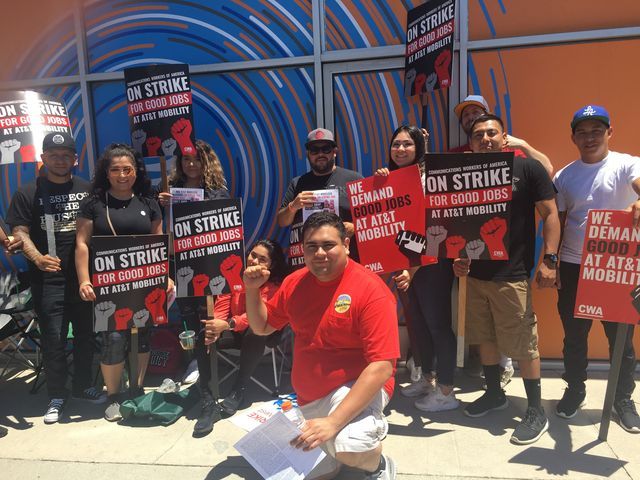
Having long abandoned the principle of “No contract, no work,” the CWA kept wireless AT&T Mobility workers on the job for 11 months after the expiration of their contract. Facing rank-and-file opposition, the union called a three-day strike in May, which was joined by 17,000 wireline workers in California and Nevada. This was another publicity stunt that was shut down before it had any impact on AT&T.
AT&T Mobility pickets in Culver City, California during last May's three-day strike
The four-year deal for the AT&T Mobility workers will help the union extend its reach into the wireless division—and increase dues income—while maintaining substandard wages and benefits for wireless workers.
Predictably the CWA called this sellout a “groundbreaking” victory. Pay raises barely keep pace with inflation. While the CWA touts the $19-an-hour workers will be making at the end of the contract, this is less than the hourly wage needed to rent a two-bedroom apartment in many states, and most metropolitan areas in the US.
It is also about half what CWA employees earn in the legacy landline units where, for example, business office representatives at Verizon’s New York City locations are paid over $35 an hour while technicians earn over $40 an hour. Far from advancing wages the CWA is working with the telecom companies to use the low wages in the wireless units as the benchmark for lowering wages throughout the industry. Meanwhile, the CWA will be able to collect dues from these miserably paid workers.
The CWA press release on the contract celebrates how calls would be routed to call centers in the US. As it has done in the past, the CWA promotes its nationalist agenda in line with Trump’s America First economic program, which pits workers in the US against their class brothers and sisters in the Philippines and other countries, and blocks a common international struggle by the working class.
The CWA functions as a tool of the corporations and both big business parties. In July 2015, CWA President Chris Shelton accompanied other union officials at a White House meeting with President Barack Obama to discuss the danger of a “wages push” by millions of workers coming up for new labor contracts.
After leaving the meeting, Shelton and other union leaders systematically blocked any unified action by telecom, auto, steel and public-sector workers, and instead extended contracts or signed deals with meager pay raises that were more than eaten up by increased health care contributions pushed by the Obama administration.
Facing a rank-and-file rebellion by 39,000 Verizon workers, the CWA and the International Brotherhood of Electrical Workers (IBEW) did everything to isolate and defeat the seven-week walkout before signing a deal with higher out-of-pocket medical costs, a reduction in sick leave and other concessions. Verizon workers who have spoken to the WSWS Telecom Worker Newsletter say they still have not seen the CWA contract a year and a half after the conclusion of the strike.
CWA chief Chris Shelton and other union leaders meet with Obama in July 2015 (Source: CWA)
As for the IBEW, it has followed up its betrayal of New England Verizon workers with its treacherous isolation of the 11-month strike of 1,700 Spectrum workers in New York and New Jersey.
After colluding with the Democratic Obama administration, the unions are now cozying up to President Trump.
Millions of people are opposed to the administration’s attack on net neutrality, which gives internet service providers power to censor web sites and data. It will also give telecom companies like AT&T and Verizon a greenlight to scale back on investments, since restricting the flow of data requires less robust transmission networks, and allowing the companies to trim their workforces further.
While issuing perfunctory criticism of the Federal Communications Commission’s decision to repeal net neutrality, the CWA has no more intention of fighting this undemocratic measure than fighting “corporate greed.” As one union bureaucrat speaking on the repeal of net neutrality privately told this reporter, who is a member of CWA at Verizon, “I don’t see the problem with it. It’s making our stock go up.”

Trump administration to roll back regulations on offshore drilling

Matthew Taylor 

Nearly eight years after the Deepwater Horizon oil spill that killed 11 workers and spewed millions of gallons of oil and toxic chemicals into the Gulf of Mexico, the Trump administration has moved to repeal regulations on offshore drilling that were implemented in the aftermath of the disaster.
The Bureau of Safety and Environmental Enforcement (BSEE), a division of the Department of Interior, issued a proposal last week that would eliminate multiple safety measures required for offshore oil drilling operations.
The proposal would make significant changes to the well control rule, a series of safety requirements that cover many aspects of offshore oil drilling, including the use of safety equipment, best operational practices, and reporting requirements that were intended to prevent future spills.
The Wall Street Journal has reported that the administration intends to remove the word “safe” from a section of the regulations, allowing the BSSE far greater latitude in issuing drilling permits.
Rules requiring third-party inspections of safety equipment would also be repealed. This would include inspections of blow-out preventers, whose failure in 2010 contributed significantly to the Deepwater Horizon spill. The proposal would also eliminate rules that mandate real-time streaming of data on oil drilling operations to onshore facilities where regulators monitor production.
The BSSE has also issued a stop-work order on December 7 on a study conducted by the National Academies of Sciences, Engineering, and Medicine intended to “review and update the bureau’s offshore oil and gas operations inspection program to enhance safety,” according to the Academies’ web site. This followed a similar order issued in August by the Interior Department suspending a study by the same organization on the impact of surface coal mining operations on the health of residents in central Appalachia.
The regulatory repeal follows the announcement by the Interior Department in October that it intended to sell leases for all remaining unleased areas on the outer continental shelf of the Gulf of Mexico. At approximately 77 million acres, roughly the size of New Mexico, the sale would be the largest in US history.
The auctioning off of the remaining waters in the Gulf are in line with the administration’s policy of rescinding environmental protections to clear the way for commercial interests. In April, President Trump ordered a review of Obama-era regulations governing where offshore oil exploration is allowed. Those regulations banned oil drilling off the southeast Atlantic coast and the coast of Alaska. The administration has also sought to abolish or reduce federally protected marine sanctuaries. This would be a boon to the commercial fishing industry as well as the oil companies.
On Thursday, The Trump administration released its first proposal for new oil exploration in the oceans. Included in the proposal are multiple regions off of the Alaskan coast that have long been targeted by energy companies. Environmental groups have opposed efforts to open these pristine areas up for drilling. Public efforts to ban drilling in these areas had been largely successful in recent decades due to public outrage after the 1989 Exxon Valdez oil spill, which devastated marine life and was the largest oil spill in US history until the Deepwater Horizon disaster in 2010.
New areas in the Atlantic and Pacific would be opened for drilling for the first time in decades. The administration’s proposal would grant nine new leases in the Atlantic Ocean, with two in the north Atlantic, three each in the central and southern Atlantic, and one off of the coast of Florida. There are no current leases in the Atlantic, and the last sale was in 1983.
Seven new leases will be offered along the Pacific coast. In 1969 an oil spill of some 3 million gallons occurred off of the coast of Santa Barbara, California, sparking public outrage and leading to the eventual ban on drilling along the west coast. No new leases have been granted in the Pacific since 1984.
In seeking to justify the rollback the Trump administration and its allies in the energy industry have promoted the lie that opening up new areas for oil drilling will boost the economy and make the United States “energy independent.” The document released last week announcing the new Gulf leases claims that the rule changes “would fortify the Administration’s objective of facilitating energy dominance though encouraging increased domestic oil and gas production.”
The notion that the United States can free itself from the need to import foreign oil by increasing domestic production is false. The US currently imports at least 40 percent of its oil each year, or over 3 billion barrels annually. Figures compiled by the US Energy Information Administration ranks the United States’ proven oil reserves at tenth globally, with an estimated 39,230 million barrels. This is a fraction of the reserves held by top-ranked Venezuela (300,878 million), Saudi Arabia (266,455 million), and Canada (169,709 million). Further, much of the new oil discovered in the United States in recent decades requires hydraulic fracturing to extract, making it far more expensive to produce than sources in the Middle East and elsewhere.
On an annual basis, the US consumes approximately 25 percent of the world’s petroleum, while producing only 6 percent.
The assertion that thousands of high paying jobs will be created by new oil exploration is also misleading. While some new jobs will undoubtedly be created, the workers employed will be subjected to the same dangerous and exploitative conditions that have led to the deaths of hundreds of oil workers in the last decade. Their jobs will also be highly tenuous, as the global price of oil has long been a weapon wielded by the US and its allies in OPEC.
Included in the various countries that the United States has targeted for regime change is Russia, which has over twice the proven oil reserves of the US; Iran, which has four times the proven reserves; and Venezuela, with nearly 10 times the proven reserves. Petroleum sales are the largest source of state revenues for each of these countries. If the Trump administration decides to target any, or all, of these states by slashing the price of oil in concert with the Gulf monarchies which control OPEC, thousands of workers in the US and globally will lose their jobs.

Berlin Senate authorises brutal deportation of refugee family before Christmas

Carola Kleinert 

On December 15 the Ajazaj family was woken at three in the morning. Police officers stood at the door of their flat in the Berlin suburb of Lichtenrade and demanded the family pack essential baggage. A van was waiting on the street to transport the parents with their three daughters, Klara, 8, Lejman, 4, and six-month-old Carolina to the city’s main airport Schönfeld. At 8:30 a.m., a deportation plane then flew the family to Tirana, the Albanian capital.
The family has lived in Germany since February 2015. After rejection of their application for asylum, the family received a temporary stay in 2016. The father, 31-year-old Xhezo Ajazaj, had made a name for himself as a tiler in a local company. His 29-year-old wife Artjola planned to begin training as a geriatric nurse. Klara, in the third grade of the Käthe Kollwitz elementary school, and her sister Lejman speak more German than Albanian.
All of the family’s efforts to integrate were fruitless. A vote by the Berlin Hardship Commission recommending a right to stay for the family was rejected out of hand by Berlin Interior Senator Andreas Geisel (SPD). He declared that “prevailing law” had to be implemented and went onto defend the nighttime raid on the family.
Neighbours and friends of the family, including the manager of the firm for which Xhezo Ajazaj worked, have angrily protested against the brutal action of the Berlin Senate—a coalition of the Social Democratic Party (SPD), Left Party and Greens. A petition against the deportation on the Internet platform change.org, addressed to the Immigration Office and Interior Senator Geisel, received 2,000 signatures in the space of two weeks.
This latest deportation underlines the vicious nature of the refugee policy of the Berlin coalition. The Left Party, which fills the post of Senator for Social Affairs and Integration (Elke Breitenbach), and the Greens play a particularly despicable role. They are quite prepared to criticise such deportations verbally but in practice play along.
Hakan Tas, Left Party spokesman for internal affairs, declared that even former Interior Senator Henkel, a Christian Democrat, had not organised such deportations in winter. Katina Schubert, the leader of the Berlin Left Party, tweeted succinctly that the deportation contradicts “the spirit of the coalition agreement” and a “human rights-based integration policy.” The Interior Senator had failed to use his “room for maneuver,” she complained.
Green MEP and immigration lawyer Canan Bayram complained that “getting someone out of their flat at three o’clock” was not allowed and “incompatible with the coalition agreement.” Based on the crimes of the Nazis, when “people were picked up and deported at night,” she said there was general agreement “not to undertake state action before six a.m.”
The fact is that neither Left Party nor the Greens prevented the deportation. Their criticisms merely provide a fig leaf for the reactionary policies of the SPD and are aimed at silencing all opposition.
Between January and the end of October 2017, the Berlin Senate deported a total of 1,427 people, including 632 to Moldova, 150 to Albania, 101 to Kosovo and—despite protests from the refugee organisation Pro Asyl—19 to Iraq, where war still rages. In November, a further 122 were deported, bringing the total to 1,549. This figure will rise further when details of the deportations in December emerge.
Nationwide, more than 22,000 people had been deported by October. In addition, there were tens of thousands of “voluntary” returns. Asylum seekers from so-called “safe countries of origin” were especially affected. The list of such countries include the Balkan states, including the NATO member Albania. Asylum applications of refugees from these countries are rejected out of hand.
Refugees have also been deported to Afghanistan, which has been repeatedly rocked by bombings and is not yet considered a safe country of origin. According to the federal Interior Minister de Maizière (CDU), those deported are regarded as “threats.” In fact, many of the deportation transports have included people who have been living productive lives in Germany for years and have not even committed minor traffic offences.
So far the Berlin state government, which has been in office for over a year, has refused to participate in mass deportations to Afghanistan. Currently, however, coalition leaders are discussing changing their policy to include deporting those alleged to be “threats.”
At the same time, the Berlin Senate is working closely with the Immigration Office to force as many refugees as possible to “return voluntarily” after their asylum applications have been rejected. This group includes Afghans. In the coalition program of the SPD, the Left and the Greens in Berlin, this policy of “voluntary return” was adopted as an allegedly more humane alternative to forcible deportation.
Taking into account the many people “persuaded” to return to avoid forced deportation, the number of “repatriations” from Berlin in 2017 has more than doubled.
The Berlin Senate is increasingly pursuing the same racist course as the current conservative- social democratic federal coalition, a deliberately targeted policy of “foreigners out.” This is confirmed by a document from the senate administration, reported on by the Berliner Morgenpost at the end of November.
Together with two social democratic senators from Bremen and Hamburg, Geisel wants to enforce an extension of residence requirements for refugees, which would ban refugees from leaving their assigned neighbourhoods. The legal regulation is due to expire in August 2019. The SPD senators claim that the abolition of the residence restriction would lead to an increased influx of refugees into cities and overload social services.
It is a blatant attempt by the SPD to incite impoverished sections of the population in Berlin, dependent on Hartz IV and other social benefits, against those fleeing war and misery, who in the past have experienced considerable social solidarity in German cities.

Russia: Siberian shoe factory fire kills 10 workers

Clara Weiss

At least ten workers died Thursday in a fire at a shoe factory in a small village in the Siberian region of Novosibirsk. The tragedy is only the latest in a series of workplace accidents and fires which take the lives of at least 15,000 workers in Russia every year.
According to media reports at least seven of them were Chinese immigrant workers. The others might have been from the Central Asian republic Kyrgyzstan, and one might have been from Russia, but other media reports suggest that all victims were Chinese.
The relatively scarce Russian media reports indicate that the fire broke out around 8:47 a.m. local time, and was extinguished only at around 1 p.m. local time, destroying about 2,000 square meters of the factory.
Over 80 firefighters were involved in extinguishing the fire, which quickly released heavily toxic smoke due to the material that were used for producing shoes. According to a local media report, firefighters had great problems extinguishing the fire, because of the way the factory was constructed and because of the extreme cold.
One member of an emergency response team told the news agency Interfax: “[The victims] tried to extinguish the fire before the arrival of the firefighters. However, they died of carbon monoxide poisoning.”
The number of victims might still rise since the factory employed some 30 people, all of them immigrant workers. While the reasons for the fire has not been determined, local media reports suggest that violations of fire safety regulations might have caused the fire.
Factory fires like the one in Siberia are an indictment of capitalist restoration in the former USSR. As far as the Russian oligarchs, and rising entrepreneurs are concerned, anything goes when it comes to exploiting the working class. Even minimum investments in maintaining or establishing safe working conditions are not made. They have no penalties or punishment to fear. Thus, basic safety provisions are lacking in innumerable workplaces, warehouses, mines and factories in Russia.
The result has been a shockingly high rate of workplace-related deaths. While the Russian government officially reports about 3,000 workplace deaths per year, the International Labor Organization found that the real number was approximately 15,000. Some 190,000 workers die annually as a result of exposure to dangerous conditions at work.
More recent accidents include a fire at an oil factory, operated by Russia’s largest privately-owned oil company Lukoil, which killed at least 4 workers in early October 2017. A few weeks later, in a particularly gruesome incident, a 31-year-old mother was boiled alive in a candy factory, leaving behind a 10-year-old son.
None of these statistics include the millions of immigrant workers who come to Russia, permanently or seasonally, voluntarily or as a result of human trafficking. The majority of them come from the deeply impoverished countries of Central Asia and the Caucasus, where wages are lower and unemployment is often higher than in Russia. However, there is also a sizeable immigrant working class population from China, particularly in the Russian Far East.
Often, employers and factory owners feel they can maintain even worse working conditions for immigrant workers who have little to no rights, especially if they are undocumented immigrants or have been the victims of human trafficking, a widespread occurrence throughout the former USSR.
There have been several fires in recent years with high death tolls at factories and workplaces that employ mostly or exclusively immigrant workers. Thus, at least 17 workers from Tajikistan, the most impoverished of all Central Asian republics, died in a fire at a Moscow textile factory in early 2016. Another 17 workers from Kyrgyzstan died in August of 2016, in a warehouse fire in Moscow.
In addition to the catastrophic conditions in Russia’s factories, the deterioration of social conditions has made it difficult or impossible for fire fighters and doctors to help those affected by accidents in time to save their lives. As of 2008, the rate of deaths in fires in Russia was eight per 100,000, eight times higher than it was in the United States, Britain or Greece. In what is geographically the largest country in the world, there are only some 5,000 fire stations. Notably the much smaller Poland has over 15,000 fire stations.

Chinese president orders troops to be “ready to fight”

Mike Head 

Reflecting mounting global and internal tensions, Chinese President Xi Jinping conducted a “mobilisation meeting” of the country’s armed forces on Wednesday, ordering soldiers to be ready to fight and win wars.
Speaking at a large military assembly in the northern province of Hebei, Xi told about 7,000 People’s Liberation Army (PLA) soldiers they should fear “neither hardship nor death” as they obeyed their orders.
Xi’s speech was a measure of the escalating pressure on the Chinese regime by the US “pivot to Asia”—launched by Barack Obama and ramped up by Donald Trump—to combat China’s growing influence, if necessary by war. The unprecedented military rally was also an indication of the buildup of the armed forces to deal with mounting domestic unrest.
Like the US and other governments around the world, the Chinese Communist Party (CCP) administration, which represents a thin layer of the super-rich billionaires, is resorting to nationalism and militarism in response to growing geo-strategic conflicts and internal political discontent.
The Peoples Daily, the official newspaper of the CCP regime, reported that troops assembled in 4,000 separate locations across China to hear Xi’s address.
Sending a calculated message, the publication highlighted the event on its front page yesterday. It showed thousands of soldiers, lined up in battle gear, chanting in response to Xi, alongside a photograph of him addressing them, clad in combat fatigues and black leather gloves.
Xi, who is also general secretary of the CCP, spoke in his capacity as chairman of the Central Military Commission (CMC)—effectively the armed forces commander-in-chief. The Peoples Daily emphasised it was the first time the CMC had held a mobilisation meeting for the whole armed forces.
According to the newspaper, Xi declared that the PLA should “create an elite and powerful force that is always ready for the fight, capable of combat and sure to win in order to fulfill the tasks bestowed by the party and the people in the new era.”
Another CCP publication, the Global Times, called the assembly a “landmark” event. “This is the first time since the founding of the country that instructions on military training have been directly issued by the chairman of the CMC, and it shows that improving combat readiness is now a strategic mission for the Chinese military,” Xu Guangyu, a retired major general, told the Global Times.
Xu presented the shift as a defensive reaction to the expansion and increasing combat readiness of the much larger US military. “China can’t copy the US measures to improve combat capability through actual combat overseas since our national defence policy is defensive rather than offensive. Therefore, military training becomes extremely important for China.”
On the same day that the CCP staged the assembly, Trump used Twitter to blatantly threaten a nuclear war against North Korea, the small impoverished state that sits on China’s northeastern border, just 800 kilometres from Beijing. Taunting North Korean leader Kim Jong-un, Trump wrote: “I too have a Nuclear Button, but it is a much bigger & more powerful one than his, and my Button works!”
The turn by China’s venal, corrupt and despotic capitalist class to military mobilisation is not only a reaction to Washington’s war-mongering, however. It expresses the material interests and aspirations of the wealthy elite that has arisen rapidly in China since the restoration of capitalism under CCP leader Deng Xiaoping in the 1970s and 1980s.
Song Zhongping, described as a military expert and TV commentator, told the Global Times that the ceremony demonstrated the new norm of military training after the 19th CCP National Congress, held last October.
That congress saw Xi, who came to power in 2012, consolidate his position as state president, party general secretary and military commander, after ousting factional rivals and restructuring the PLA to concentrate control in the CMC, which he chairs.
As the WSWS explained at the time, Xi has emerged not as an unchallengeable political strongman, but as a Bonapartist figure, seeking to maintain party unity by balancing, arbitrating and suppressing the conflicting interests in the CCP’s massive bureaucratic police-state apparatus.
Domestically, the social chasm between the party bosses and billionaires, and the vast majority of the population whose cheap labour has underpinned global capitalism for three decades, is generating explosive class tensions, aggravated by signs of economic turmoil.
This year, while officially forecasting growth to continue at around 6.7 percent, Chinese officials are warning of “over-capacity” in traditional industries, “structural contradictions” in the economy and financial risks produced by record levels of debt.
Around 600 strikes or protests were reported during the first eight months of 2017, according to the China Labour Bulletin, a Hong Kong-based monitoring web site, which said this tally may represent only 10–15 percent of the actual number. This was despite increased police powers to break up demonstrations.
Unable to credibly claim to represent “socialism,” the CCP is drumming up nationalism, invoking an image of restoring China to a mythical great power status, in a bid to divert the disaffection of the working class.
The social powder keg is being exacerbated by Trump’s “America First” threats of trade war and nuclear conflict. Trump is ratcheting up Obama’s “pivot” even more openly and aggressively, reflecting the view in American ruling circles that Beijing is a key obstacle to Washington’s world dominance.
Trump’s National Security Strategy, released last month, branded China and Russia as “revisionist powers” and “hostile competitors” seeking “to shape a world antithetical to US values and interests” and “challenge American power, influence, and interests.” In essence, the document called for the preparation for a new era of “great power” conflict and world war.
Under Xi, China has reacted to Washington’s offensive by accelerating its own military build-up and efforts to assert economic power. Xi’s One Belt, One Road policy, in particular, involves ambitious transport and infrastructure projects to link up the Eurasian landmass, excluding the US and encouraging the European powers to loosen their ties to Washington.
While the CCP has sought to postpone a confrontation with the US, bowing to some demands for greater trade and investment access in China and for punitive sanctions on North Korea, it has refused to back down on critical strategic issues such as Chinese land reclamation in the South China Sea. Xi’s military “mobilisation” ceremony is another warning that global capitalism, with the US in the lead, is threatening to plunge humanity into another, even more terrible, world war.

British National Health Service faces escalating crisis due to chronic underfunding

Dennis Moore

The British National Health Service (NHS) is in the midst of an escalating crisis caused by prolonged underfunding and a surge in demand this winter. Patients face extremely long waits, and many hospital trusts are unable to provide adequate care.
At least 21 trusts—responsible for multiple hospitals—have reported this week that they are on “back alert,” meaning they cannot guarantee patient safety and provide the full range of their services. Many other hospitals are severely strained.
British Prime Minister Theresa May and Health Secretary Jeremy Hunt both issued statements this week seeking to deflect growing public outrage.
Bob Kerslake, chairman of the board of Kings College hospital trust in London, resigned from one of the UK’s largest NHS trusts. He tweeted, “[T]he Govt & regulator are unrealistic about the scale of the challenge facing the NHS & the Trust. I want to pay tribute to the staff & their excellent patient care.”
Kerslake quit after a long dispute with the NHS watchdog over finances, saying that ministers are in denial about the reality of how much extra money the NHS requires. A senior figure in British politics and head of the civil services as recently as 2015, he resigned just days before NHS Improvement, which regulates the health service’s finances in England, was to put Kings College into “special measures” because the hospital had not been able to meet its budget for this year.
The hospital had agreed a plan with NHS Improvement that it would have a deficit for the year of £38 million. Instead, the deficit is likely to be in the region of £96 million.
In an article written for the Guardian, Kerslake explained that he was standing down because hospitals are being asked to meet unrealistically demanding savings targets.
Kings has drastically reduced spending on expensive agency staff and consultants. However, the overall financial situation has gotten worse since it took over the running of the troubled Princess Royal hospital in Bromley in 2014. In the last two years, the hospital has made savings of £80 million, twice the average of other hospitals, yet has not in any way resolved the financial crisis it faces.
Kings is one of the busiest hospital trusts, serving a population of over 1 million people in southeast London. It is considered a centre of medical excellence, with specialist expertise in several areas, performing well on cancer waiting times, with some of the best health outcomes in the country.
The hospital serves a diverse and often deprived community. It was one of the capital’s leading trauma centres treating the victims of the Westminster Bridge and London Bridge terror attacks, and those affected by the fire at Grenfell Tower.
Kings, like many hospitals across the UK, is facing an increased demand on services, while having to face increased costs for drugs and medical supplies.
The chief executive of the NHS, Simon Stevens, had asked for an extra £4 billion a year from the government. What was offered in the Chancellor of the Exchequer Philip Hammond’s recent budget fell far short of this, a mere £1.6 billion. There was no increased spending for social care, which has faced unprecedented demands and is at breaking point with a funding gap of £2.5 billion.
Following the budget, Stevens said the refusal to pay the £4 billion needed by the NHS for 2018-19 would lead to increased rationing of care, increased waiting times, and “painful” choices about what a cash-strapped health services could and could not afford.
Professor Anita Charlesworth, director of research at the Health Foundation think tank, backed Kerslake’s claim that the financial problems in the NHS were due to underfunding. “Hospitals in the NHS are caught between a rock and a hard place. Emergency admissions have increased by 3.4 percent in the first half of this year, there is a shortage of 30,000 nurses and it has proved really hard to free up beds occupied by people who are medically fit to leave but need social care support,” she said.
The NHS Confederation represents 240 trusts in England and has urged the government to ditch its policy of giving the NHS small increases, saying it deserved a greater share of national income.
Niall Dickson, the confederation’s chair, said that Hammond’s £1.6 billion increase is what the NHS needs just to stand still for the coming year 2018-19. Total health spending in England for the year 2017-18 is nearly £124 billion and is expected to rise to over £127 billion by 2020-21, taking inflation into account.
A report by the National Audit Office in 2016, “Financial Sustainability of the NHS”, found that for the years 2015-16, 66 percent of NHS trusts and NHS foundation trusts (156 out of 238) were in deficit.
Several years ago, the NHS was asked to find £22 billion in savings by 2020.
Health experts from the Nuffield, Health Foundation and Kings Fund have said that tight spending in recent years and increase in demand for services have been “taking a mounting toll on patient care.” They add that there is “growing evidence that access to some treatments is being rationed and that quality of care in some services is being diluted.”
A joint statement by the three institutions in response to the government’s autumn budget raised grave concerns about the impact of seven years of austerity, a growing demand for services, and the devastating toll this is taking on the NHS. The Care Quality Commission (CQC) 2017 State of Care report has warned that health and care services are at full stretch, and some services have deteriorated. Key waiting time standards are routinely being missed all year round, with the four-hour waiting time for treating patients in A&E not being met since July 2015.
The 62-day standard for beginning treatment for cancer following an urgent referral has not been met for three years.
In July 2017, there were 900 patients with acute mental health needs that were inappropriately placed outside their local area, due to a lack of available inpatient beds.
The CQC notes that the care that patients receive across England is mostly good, and is due to the efforts of NHS staff, who are delivering compassionate care in challenging circumstances. Yet the delivery of good quality care cannot be predicated on the compassion of overworked NHS staff in the absence of properly funded services.
The official narrative pumped out about targets and inefficiency stands in stark contrast to the fact that productivity in the NHS is actually improving by 1.7 percent a year, and is outperforming the wider economy. Yet this will not resolve the underlying crisis, with the lack of funding.
Sally Gainsbury, senior analyst at the Nuffield Trust, said, “I don't think this is a story about Kings. I think Kings is the canary down the coal mine.”
Hospitals had been asked to cut their costs in real terms by 4 percent annually since 2011, which was “the equivalent of spending this year £750 in real terms on a patient that you would have spent £1000 on in 2010.”