11 Jan 2018

The Politics of the Cold War Between Iran and Saudi Arabia

Sohail Mahmood

Saudi Arabia and Iran are bitter rivals for power and influence in the Middle East and are engaged in a cold war in which proxy warfare is the preferred mode of conflict. Earlier, in 2008 Saudi Arabia’s King Abdullah had famously called for the United States to “cut the head off the snake” by bombing Iran.
Today, Saudi Arabia and Iran back opposing sides in wars and have rival interests and alliances across the Middle East. Iran seeks leadership of the minority Shias, while Saudi Arabia considers itself as the natural leader of the majority Sunnis. Very often these regional conflicts see Sunni Saudi Arabia and Shia Iran supporting different factions that are often split down sectarian lines. Clearly, the tensions between Saudi Arabia and Iran are also a struggle for religious authority in the Middle East.
Today, relations between Saudi Arabia and Iran have deteriorated to a new historic low.
Very recently, Prince Mohammad Bin Salman, Saudi Arabia’s Crown Prince called the Supreme Leader of Iran, Ayatollah Ali Khamenei, “the new Hitler of the Middle East”, suggesting Iran’s expansion needed to be confronted. Earlier, Prince Mohammad said that the kingdom would make sure any future struggle between the two countries “is waged in Iran”.
The current unrest in Iran is adding to the tension between Saudi Arabia and Iran. The protests began on Dec. 28, 2017 after the Iranian government announced plans to raise fuel prices and cut monthly cash handouts to lower-income Iranians.  These protests had initially focused on economic issues but later turned into wider anti-government sentiment. Clearly, Iran’s foreign interventions, along with falling oil prices, have tightened the flow of cash needed to support the national economy, which already suffered from high youth unemployment. Undoubtedly, Iran has its own domestic challenges to contend with. The current unrest has led to the death of 22 people. On January 7, 2018 Iran’s powerful Iran’s Islamic Revolutionary Guard Corps (IRGC) said that the regime has ended the wave of unrest linked to the protests which has led to the death of 22 people.
As expected, Iran’s leaders are blaming Saudi Arabia, among others, for the current unrest in the country Iranian Attorney General Mohammad Jafar Montazeri said on January 4, 2018 that the CIA and Israel’s Mossad were backing the protests as part of an alleged Saudi-financed plot to destabilize Iran. On January 5, 2018 Iranian Foreign Minister Mohammad Javad Zarif accused Saudi Arabia and the United States of colluding with the Islamic State militant group (ISIS) to “endorse violence, death and destruction in Iran.” Zarif stated on January 8, 2018 that the Saudi-led military invasion of Yemen is “one of the key factors creating tension in the region,” adding that after engaging in 33 months of futile warfare, the invaders should have come to the realization that Yemen’s crisis will require a political solution, and that negotiation and consensus alone can contribute to the ultimate resolution of the situation.
Meanwhile, confrontation with Iran is a popular cause in Saudi Arabia and most of its allies in the Gulf Cooperation Council. Undoubtedly, recent Iranian expansionism has rattled Saudi Arabia. Iran has gained influence in the region as a Shia zone of influence was successfully established in Iraq, Syria, Lebanon and Yemen which stretches from the Mediterranean Sea to Tehran. Russia has assisted Iran in this development. Earlier, in 2016, Saudi Arabia’s strongman, Crown Prince Mohammed bin Salman had sounded the alarm and talked of the danger of the rise of the Shia zone and further warned of Iran’s influence in Sudan, Pakistan and Djibouti.
Meanwhile, French President Emmanuel Macron has accused the U.S., Israel and Saudi Arabia of instigating a war as their mutual foe, Iran, was rocked by protests. On January 3, 2018 he called for dialogue with Tehran and criticized three of his international partners for pursuing what he considered bellicose policies toward a country the trio have increasingly sought to isolate and undermine in recent years.
Though Saudi Arabian media has eagerly carried news of the unrest in Iran, the government has kept its silence on the matter. Undoubtedly, Saudis are quietly acting through their proxies to combat Iran. Saudi Arabia, along with the United States is attempting to isolate Iran diplomatically and is very supportive of Trump admiration’s attempts to place Iran with new sanctions over its missile program and backing for groups designed as foreign terrorist organizations.
Earlier, Saudi Arabia convened its Arab League allies in Cairo for an emergency meeting to discuss what it said were “violations” in the region. The group criticized Iran and its Lebanese Shi’ite ally Hezbollah and called for a united front to counter Iranian interference. “The kingdom will not stand by and will not hesitate to defend its security,” Saudi Arabia’s Foreign Minister Adel Al-Jubeir told the assembly.
Iran’s increasing support for Shiite militias is well-documented. Lebanese Hezbollah has evolved into a central pillar of Iran’s capability against Israel. The Hezbollah even provides ground forces to bolster the Assad regime in Syria. Iran has played a vital role in helping Syrian President Bashar al-Assad and his allies overcome a 2011 uprising by jihadis and rebels, some of whom were backed by Saudi Arabia.
Iran’s support for mostly Shiite Muslim militias in Syria and Iraq helped put an end to the territorial expansion of the Islamic State militant group (ISIS), but also gave Iran a larger foothold across the region, stretching from Tehran through Baghdad, Damascus and Beirut.
In Iraq the Iranian-backed militias have been provided with Iranian air support, artillery, electronic warfare equipment and medical support. Badr, the main Shiite militia in Iraq, fought as a military division in the Iranian order of battle during the Iran-Iraq War. Badr now leads Iraq’s largest security institution, the half-million Ministry of Interior, and the Shia militias are being formed into a proto-ministry that resembles their patron, IRGC.
In a surprising move Saudi Arabia reached out to Israel to thwart the rising power of Iran, which they both fear and resent. On January 7, 2018, Israel’s energy minister confirmed that there had been what he called “covert” contacts between Saudi Arabia and Israel amid concerns over Iran but suggested that Saudi Arabia had wanted to keep “the ties quiet,”
Israel views Saudi Arabia as a natural ally due to their mutual enmity for Iran. Israel has labeled Iran an existential threat. Regional developments are now establishing an informal axis between the United States, Israel and Saudi Arabia.
Both countries were vicious critics of former President Barack Obama’s 2015 nuclear deal with Iran and have been proponents of President Donald Trump’s efforts to scrap it. Also, both Israel and Saudi Arabia have opposed Iranian support for foreign political and militant movements across the region. Iran was crucial in creating and supporting the powerful Lebanese Shia Muslim movement Hezbollah, which twice forced Israel into a stalemate in Lebanon.
Meanwhile, the conflict between Iran and Saudi Arabia is destabilizing the region as it now involves the United States and Russia backing opposite sides. In Syria, Iran and Russia have consistently backed Assad; while Saudi Arabia is supporting rebel groups.  While, the United States fought against the Islamic State, it did not oppose the Assad regime in any meaningful manner. In Yemen, Saudi Arabia has waged war against the country’s Houthi rebels, complete with a blockade of the country and airstrikes. The United States backs Saudi Arabia in its Yemen intervention.  More than 10,000 civilians have died in the conflict. In Iraq, the Saudi Arabia and Iran are at odds over efforts to rebuild after the collapse of the Islamic State.
In Lebanon, Saudi Arabia opposes Iran’s ally Hezbollah, which has wide influence in the country. However, the Saudis have failed in their attempt to contain the Hezbollah and Iranian influence in the country. Seemingly, the Saudi-Iranian rivalry has become the organizing principle for future Mideast alliances, with the United Sates backing Saudi Arabia and Russia backing Iran, and others taking sides.
The Iranian hardliners wish to continue their expansionist policy in the region. Further Iranian advances shall translate into an escalation of the confrontation with Saudi Arabia.  The conflict in Yemen between forces loyal to the government of President Abdrabbuh Mansour Hadi, a Sunni, and those allied to the Shia Houthi rebels is largely a proxy war between Saudi Arabia and Iran.
Earlier, in 2009, Riyadh had launched a short, failed military campaign against the Houthi rebels in Yemen. This led to Saudi Arabian, Jordanian and UAE support for the anti-Houthi militias in Yemen. The Saudi Coalition airstrikes began in March 2015 in response to Houthi rebels’ seizing control of much of Yemen in late 2014. The Houthi uprising forced Hadi to flee abroad in March 2015 which led to the start of Saudi airstrikes. Saudi Arabia desires to restore the Hadi government while Iran backs the Shia Houthi rebels loyal to the country’s former President Ali Abdulla Saleh, who was killed very recently by Houthi rebels.  Today, the Houthis are inflicting heavy damage on the Saudi military, seizing terrain in southern Saudi Arabia and firing missiles at military bases deep within the kingdom. Saudi Arabia accuses Iran of backing the Houthis. Now the Gulf States are building up new proxy forces in Yemen to assist in the Saudi-led military campaign against the Houthis.
Meanwhile, Yemen’s destitute civilian population has been caught in the middle of the conflict.  The starved population has been pushed to the brink of famine and is facing the world’s worst cholera epidemic. Since March 2015, the Yemen war has claimed 10,000 victims with 20 million more in dire need of assistance. The Yemen intervention is proving costly for Saudi Arabia. Given the lack of a credible alternative, the Yemeni conflict shall continue..
Saudi Arabia also accuses Iran of intervention in majority-Shia Bahrain, where the pro-Saudi Sunni Muslim royal family blames Iran-backed militants for fermenting unrest in the past and also recent terrorist incidents.
The rivalry between Saudi Arabia and Iran will continue unabated in the future, leading to further regional chaos. Iran is bent on a costly military buildup and is projecting its influence in the region. It has largely accomplished a decrease in Saudi Arabia’s regional influence and therefore thwarted a direct attack from its rival. Overall, the region will be further destabilized. Most likely, the current battlegrounds in Yemen, Syria, Bahrain, Pakistan and Lebanon shall continue to exist in the future. While, the existing pattern of proxy warfare between Iran and Saudi Arabia shall intensify, the possibility of a direct clash remains unimaginable.

“Dishonest” and “Disgraceful” – Monsanto Attempts to Gain Backdoor Entry for GE foods

Colin Todhunter

At the recent Codex meeting in Berlin, there was an attempt to define genetically engineered (GE) food ingredients as ‘biofortified’ and therefore mislead consumers. This contravened the original Codex mandate for defining biofortification. That definition is based on improving the nutritional quality of food crops through conventional plant breeding (not genetic engineering) with the aim of making the nutrients bioavailable after digestion. The attempt was thwarted thanks to various interventions, not least by the National Health Federation (NHF), a prominent health-freedom international non-governmental organization and the only health-freedom INGO represented at Codex. But the battle is far from over.
The Codex Alimentarius Commission’s Codex Committee on Nutrition and Foods for Special Dietary Uses (CCNFSDU) convened in Berlin during early December and drafts provisions on nutritional aspects for all foods. It also develops international guidelines and standards for foods for special dietary uses that will be used to facilitate standardized world trade.
Based upon previous meetings, the initial intention of the Committee was to craft a definition for biofortification that could then be used uniformly around the World. Biofortification originally referred to increasing certain vitamin and mineral content of basic food crops by way of cross-breeding, not genetic engineering, for example by increasing the vitamin or iron content of sweet potatoes so that malnourished populations would receive better nutrition.
However, according to president of the NHF, Scott Tips, Monsanto wants to redefine the definition to include GE ‘biofortified’ foods and it has seemingly influenced Codex delegates in that direction. Tips says, “I am sure that Monsanto would be thrilled to be able to market its synthetic products under a name that began with the word ‘bio’.”
This year’s CCNFSDU meeting witnessed a lively debate about biofortification. At the 2016 CCNFSDU meeting, chairwoman Pia Noble (married to a former Bayer executive) had opined that the definition should be as broad as possible and that recombinant technology should be included. By the 2017 meeting, the proposed definition had morphed to include GE foods.
Deceptive marketing par excellence
The EU has raised a valid objection that “biofortification” would cause confusion in many European countries due to the widespread use of the word “bio” being synonymous with “organic.” Countries within the EU have been very vocal and support this position, arguing that the definition needs to be restrictive, not broad.
Including GE foods within any definition of biofortification risks consumer confusion as to whether they are purchasing organic products or something else entirely. “Monsanto seeks to cash in on the organic market with the loaded word ‘bio’,” argues Scott Tips.
At the Codex meeting in Berlin, Tips addressed the 300 delegates in the room. “Although NHF was an early supporter of biofortification, we have since come to see that the concept is in the process of being hijacked and converted from something good into something bad,” explained Tips.
He added that if Codex is to allow any method of production and any source to be part of the biofortification definition, it would be engaging in marketing deception of the worst sort.
As Steven Druker has shown in his book Altered Genes, Twisted Truth, GE foods should not even be on the commercial market, given the deceptions and bypassing of procedures that put them there in the first place. But now that they are on the market, most consumers want GE foods labelled. In the United States alone, some 90% of consumers want such labelling. The definition being proposed seeks to disguise GE foods under the term “biofortification.”
“That is dishonest. It is disgraceful, and for all of those sincerely concerned with the credibility and transparency of Codex, you should absolutely and positively oppose this definition,” says Tips.
The NHF feels that this is simply a strategy to gain a backdoor entry into countries for GE foods that are unneeded and unwanted. In his address to the assembled delegates, Tips added, “It is a very sad state of affairs where we have come to the point where we must manipulate our natural foods to provide better nutrition all because we have engaged in very poor agricultural practices that have seen a 50% decline in the vitamins and minerals in our foods over the last 50 years. We will not remedy poor nutrition by engaging in deceptive marketing practices and sleight of hand with this definition.”
The delegates to various Codex committees tend to be national regulatory bureaucrats and representatives from large corporations, including agritech giants like Monsanto. These interests have undue influence within Codex. Over the years, although heavily outnumbered at meetings, Scott Tips and his colleagues at the NHF have been tireless in their efforts to roll back undue corporate influence at Codex. Thanks to NHF and others urging the committee to adopt a clear, non-misleading definition that excluded GE foods, no final decision was taken on the definition of biofortification.
It is now left to the committee to resolve the matter at next year’s meeting or even the one thereafter.
The National Health Federation
The National Health Federation is the only health-freedom organization accredited by the Codex Alimentarius Commission to participate at all Codex meetings. It actively shapes global policies for food, beverages, and nutritional supplements.
Codex
The Codex Alimentarius Commission is run by the Food and Agricultural Organization and the World Health Organization. Its some 27 committees establish uniform food-safety standards and guidelines for its member countries and promote the unhindered international flow of food goods and nutritional supplements. Learn more about the Codex on GreenMedInfo.com’s page related to the topic.

Monsanto, Bayer And Neoliberalism: A Case of Hobson’s Choice

Colin Todhunter

A Bayer marketing professional recently stated on Twitter that critics of GMOs deny choice to farmers. It’s a common accusation by the pro-GMO lobby. In a previous article, I noted the idea that GMOs offer increased choice is erroneous and that, by implication, corporations like Bayer or Monsanto restrict options. Much evidence suggests that GMOs provide a false choice.
However, to get drawn into endless debates about the whys and wherefores of GMOs tends to overlook the fact that GMOs belong to a particular model of agriculture which is increasingly being challenged. To quote Charles Eisenstein from a recent piece, what we should be talking about is the “choice between two very different systems of food production, two visions of society, and two fundamentally different ways to relate to plants, animals, and soil” (the table featured here provides concise insight into these visions).
The fact that someone chooses to market for a giant transnational company says much about a person’s allegiance to and belief in corporate power, let alone the prevailing economic system that company benefits from and the model of agriculture it promotes. Corporate-inspired visions of the world tend to define choice – and indeed how the world should be – within strict parameters.
Choice, development and the future of agriculture in India 
If current trends in India continue, it could mean dozens of mega-cities with up to 40 million inhabitants and just 15-20% of the population (as opposed to around the current 60% or more) left in an emptied-out countryside. It could also mean hundreds of millions of former rural dwellers without any work.
Thanks to the model of agriculture being supported and advocated under the banner of ‘growth’, the trajectory the country seems to be on may entail a future comprising vast swathes of chemically-drenched monocrop fields containing genetically modified plants and soils turning into a chemical cocktail of proprietary biocides, dirt and dust.
Monsanto, Bayer, Cargill and other large corporations will decide on what is to be eaten and how it is to be produced and processed. From seed to field to plate, the corporate take-over of the food and agriculture chain will be complete.
Eisenstein notes the consequences of the model of agriculture being rolled out by these corporations:
“… an endless succession of new chemicals and GMOs to compensate for the consequences of mechanized chemical agriculture, which include depletion of the soil, herbicide-resistant weeds, and pesticide-resistant insects.”
In other words, as farmers become trapped on a high-tech, agrochemical-drenched treadmill, the ‘choice’ will be restricted options from an endless stream of proprietary inputs, which are churned out under the banner of ‘innovation’ in an attempt to address the issues and failures resulting from the previous roll-out of ‘cutting edge’ company technology.
In India, the existing productive system based on livelihood-sustaining smallholder agriculture and small-scale food processing will be all but a memory, while those remaining in the sector will be squeezed, working on contracts for market-dominating global seed and agrochemical suppliers, distributors and retail concerns.
Independent agricultural producers and village level processors will have long been forced out of the system and industrial agriculture will be the norm, with all the social, environmental and health devastation and externalised costs that the models entails.
The model of agriculture currently being promoted serves to further embed India into a US-dominated global political system which has played a significant role in creating food-rich and food-deficit regions. Throughout much of the world, a globalised system of ‘capitalism’, facilitated by the WTO, IMF and World Bank, has led to structural inequality and poverty; the privatisation of seed, knowledge, land and water; unfair international trade policies which have devastated indigenous agriculture; the marginalisation of smallholders, the backbone of global food production; commodity speculation, resulting in food shortages; and debt and export-oriented agriculture, which has undermined rural economies.
Challenging the neoliberal agenda
It hasn’t helped that, since the 1990s, India has increasingly tied itself to a system of neoliberal globalisation, an unsustainablecrisis-ridden system that fuels national debt and relies on hand-outs (demonetisation) for banks and corporations. A system based on a credit/debt-based consumer economy, financial speculation, derivatives and bubbles, with nations no longer able to carry out their own policies, tied down by undemocratic trade deals, beholden to rigged World Trade Organization rules and following a path prescribed by the World Bank, regardless of any democratic will of the people. A system whereby governments are paralysed to act as both eyes are firmly fixed on ‘market confidence’ and fearful of capital flight.
It raises the question about what could be done to prevent a future full-fledged neoliberal dystopia taking hold in India.
The authors of this piece argue that long-term measures could include land reforms and correcting rigged trade that is against the cultivating class:
“Far-sighted and sustained policy initiatives to provide farmers dignified livelihoods are required. In an economy driven by jobless growth, compulsive migration to cities is often a case of distress transhumance. These migrants then become the new “serfs” of the informal services and construction sector, while the existing rural and agrarian problems remain unresolved.”
Such policy initiatives may well be based on agroecological solutions that could be developed and scaled up to move beyond the dynamics of the farm itself and become part of a wider agenda, which addresses the broader political and economic issues that impact farmers and agriculture.
Various official reports have argued that to feed the hungry and secure food security in low income regions we need to support small farms and diverse, sustainable agroecological methods of farming and strengthen local food economies (see this report by the UN Special Rapporteur on the right to food and this (IAASTD) report).
Olivier De Schutter, former UN Special Rapporteur on the right to food:
“Today’s scientific evidence demonstrates that agroecological methods outperform the use of chemical fertilizers in boosting food production where the hungry live, especially in unfavorable environments.”
The success stories of agroecology indicate what can be achieved when development is placed firmly in the hands of farmers themselves. A decentralised system of domestic food production with access to local rural markets supported by proper roads, storage and other infrastructure must take priority ahead of exploitative international markets and supply chains dominated and designed to serve the needs of global agribusiness.
If policy makers were to prioritise and promote agroecology to the extent ‘Green Revolution’ practices and technology have been pushed, many of the problems surrounding poverty, unemployment, rising population and urban migration could be solved. With that in mind, readers may wish to read some important things that farmer/campaigner Bhaskar Save had to say on the matter.
As long as agroecology and a commitment to localisation and local/regional self-sufficiency continue to be marginalised, however, we need look no further than Mexico to see what may be in store for India. Aside from destroying the nation’s health and home-grown food supply chain, ‘free’ trade under NAFTA allowed subsidised US corn to be dumped in the country, fuelled unemployment and transformed a former productive peasantry into a problematic group.
Instead of proscribing a neoliberal death warrant for many of those currently involved in agriculture, India must try to delink from capitalist globalisation, manage foreign trade to suit its own interests and expand domestic production, which can be achieved by protecting and encouraging indigenous small producers, not least smallholder farmers.
By encouraging localisation, self-sufficiency and support for these types of producers, meaningful work can be generated for the majority. The exact opposite of the globalisation agenda (tens of millions of livelihoods are in danger as foreign corporations move in).
The real choice
Charles Eisenstein argues that if we believe society’s main institutions are basically sound, it is irrational to oppose the (GMO-)high-tech, chemical-intensive model of agriculture. By implication, it is also irrational to question the notions of ‘progress’ and ‘development’ currently being fuelled by the neoliberal globalisation agenda. And if we take for granted the narrative that justifies the continued depopulation or the countryside in places like India, there is little alternative to the current unsustainable, livelihood-destroying system.
Thereafter, once you have indicated an allegiance to corporate power and neoliberal capitalism (and all it entails), everything falls into place. Any choices offered will occur within the narrow parameters set by the global food and agribusiness conglomerates. While spouting rhetoric about providing a choice of approaches, any genuine alternatives will be (and are being) marginalised.
However, once you acknowledge that society’s institutions are anything but sound, that scientific institutions and government bodies have been steadily corrupted by corporate money, funding and influence and that the neoliberal agenda has been little more than a recipe for corporate plunder – then you are in the position to appreciate that the real choice is between a dystopian future of deregulated capital and unaccountable corporate conglomerates and a wholly different way of viewing the world and the role of agriculture in shaping it for the better.

Prolonged fall in average Australian living standards

Mike Head

Working class living standards have fallen in Australia since mid-2016 and are now lower than in 2011, marking six years of stagnation and decline. This is the most sustained drop suffered by the population since at least the 1990–91 recession.
As share prices soar and corporate profits rise, millions of households are being pushed to the financial edge by declining real wages and soaring living costs, especially for essentials such as electricity, housing, health and child care.
Despite the collapse of the mining investment boom since 2011, Australia is still depicted by the government and the media as an exceptional place where there has been a quarter century of uninterrupted economic growth.
Australian Bureau of Statistics (ABS) data, adjusted for inflation, taxes and interest payments, indicate that average household incomes declined by 1.6 percent in the year to September. That was the fifth consecutive quarter of falling incomes.
By an alternative measure, real household disposable income fell 1.9 percent over the same period, taking it lower than it was five years ago.
The benefits from this social reversal have flowed to the wealthiest layers of society, such as mining magnate Gina Rinehart, whose fortune rose $3.5 billion, to $19 billion during 2017, on the back of higher iron ore and share prices.
For workers, wages growth is at record lows, and has not kept up with the cost of living, even measured by the official inflation rate, which underestimates the impact on most households of sharply rising costs for basic items.
Between 2005 and 2011, households saw an average improvement in their living standards of 17 percent. But there has been no improvement since 2011, and the ­decline since the middle of 2016 represents a new downward shift.
After adjusting for living costs, interest and taxes, average earnings in the three months to September were 0.7 percent lower than in the same period of 2011. Even this figure understates the historic cut to workers’ incomes.
The ABS Wage Price Index showed a 1.9 percent rise last year, but this was measured before tax, and recorded average increases, hiding the more severe cuts in income levels for the growing numbers of low-paid, temporary or casual workers.
When calculated in terms of average real compensation per employee, the cut in wages is greater. That indicator rose by only 0.9 percent last year, well below the official inflation rate of 1.9 percent, and is now nearly $1,000 per year below 2010 levels.
There is no doubt that the prolonged cut in living standards is causing mounting social distress. Charities are warning that increasing numbers of people are being forced to seek their aid.
“Cost of living pressures are pushing families to the brink, more so than ever before,” Yolanda Saiz, acting CEO of St Vincent De Paul in the state of New South Wales, said. “In the last six months the Society has handed out over three and a half million dollars in electricity vouchers and that’s compared to one and a half million for the same period last year,” Saiz told 9NEWS.
Within the financial elite, the primary concern is that this decline is dampening consumer demand, helping to push the Australian capitalist economy into a prolonged period of low growth.
National Australia Bank’s head of research Peter Jolly said 60 percent of the increase in living costs over the past five years had been driven by electricity, rent, health, new housing and tobacco. “Households are spending their money on non-discretionary items—the things you can’t avoid—and they’ve been going up much more quickly than discretionary items.”
Missing from the media coverage is the fact that the two major components of this social crisis—low wage growth and sky-rocketing living costs—are not aberrations. They both express fundamental processes that have intensified since the 2008 global financial breakdown.
In Australia, as in other economies around the world, there has been no upward movement in wages despite a fall in the official unemployment rate. This is due to far-reaching structural changes in the labour market associated with the growth of part-time working, casualisation and the increasing use of contractors to replace permanent employment conditions.
Employers are relentlessly slashing jobs and conditions in order to compete globally and satisfy the insatiable demands of the financial markets for ever-higher rates of return. While unemployment rates have dropped, under-employment has risen, with most new jobs being lower-paid and casualised.
Similar processes, bound up with privatisation and out-sourcing, are driving up prices for “non-discretionary” items. According to the Australian Competition and Consumer Commission, retail customers now pay 44 percent more for electricity than ten years ago.
More than a quarter of that price increase has been due to higher profit margins extracted by the privatised utility companies. In the 1990s, when the Keating Labor government launched the privatisation drive via the “national competition policy,” the political and media establishment insisted that retail competition would deliver lower prices.
The exact opposite has occurred, as companies fight to outdo each other in delivering higher returns to investors. In Victoria, the state that in 2009 became the first to completely deregulate its retail electricity market, the retail component of the bill has contributed to 36 percent of the price increase over the past decade.
Fees for childcare, another industry increasingly dominated by for-profit operators, are another major factor. The latest federal Department of Education data showed average childcare costs rising by 5 percent to $6,536 during 2016, costing 890,000 families about an extra $300 annually. For a family with children in care for 48 weeks a year, the increase was $480.
Over the past four years alone, fees have risen by about 20 percent, after increasing by as much as 14 percent a year in 2009 under the Gillard Labor government. This is placing an enormous burden on most working class households, where both parents must work to make ends meet, and on sole-parent families.
For decades, especially since the Hawke and Keating Labor governments of the 1980s and 1990s, the trade unions have systematically suppressed the resistance of workers to the destruction of jobs and conditions, permitting an unprecedented transfer of income and wealth into the pockets of the super-rich.
Throughout this period, the unions claimed that if workers made the necessary sacrifices to ensure the “global competitiveness” of Australian-based industry, then jobs and living standards would be maintained.
The accelerating social reversal now taking place further exposes the fraud of these claims and sets the scene for an eruption of the class struggle.

Upturn in global economy will not last, says World Bank

Nick Beams

The World Bank has pointed to an uptick in global economic growth for the coming year but warned that the small expansion is as good as it will get for the foreseeable future.
In its Global Economic Prospects report issued on Tuesday, the bank said world economic growth would reach 3.1 percent in 2018. This was after a better than expected outcome for last year, with a recovery in investment, manufacturing and trade, as well as increasing commodity prices.
Global growth is estimated to have been 3 percent in 2017, above last June’s forecast of 2.7 percent, with increases in more than half the world’s economies. A rise in global investment growth—a result of favourable financing costs, rising profits and improved business sentiment—accounted for three quarters of the increase.
However, the report described this movement as largely a “short-term upswing,” with growth potential slowing over the longer term. It cited “particularly worrying” longer-term risks associated with “subdued productivity and potential growth.”
“The slowdown in potential growth is the result of years of softening productivity growth, weak investment, and the ageing of the global labour force,” the bank said in a press statement summarising the report. “The deceleration is widespread, affecting economies that account for more than 65 percent of global GDP [gross domestic product].”
The slowdown is expected to start in the advanced economies, with growth to “moderate slightly” from 2.3 percent last year to 2.2 percent in 2018, and slow to just 1.7 percent by 2020.
The main factor in global growth over the coming year will be expansion in the emerging market and developing economies (EMDEs). Yet this will not be sustained.
“Despite the projected firming of activity among EMDEs over the forecast horizon, their underlying potential growth—which has fallen considerably over the past decade—appears likely to further decline over the next 10 years, reflecting a more subdued pace of capital accumulation, slowing productivity growth, and less favourable demographic trends,” the report stated.
The bank cited “important downside risks,” warning that disorderly financial market movements, such as an abrupt tightening of financial conditions and a rapid rise in market volatility, could trigger turbulence and derail the expansion. Such conditions could be “particularly acute” for those countries with large external financial needs and fragile corporate balance sheets.
The report said the “extraordinary monetary stimulus” of recent years raised concerns that it “may have encouraged excessive financial risk-taking.” Central banks had to be very careful about how they normalised monetary policy because, despite measures to improve the financial system, “there are still risks to financial stability, including possible asset price overvaluation, rising leverage, and a concentration of risks in the non-bank financial institutions.”
The bank pointed to dangers in China, echoing the analysis by the International Monetary Fund that China continued to face “vulnerabilities associated with high corporate indebtedness, particularly in sectors with overcapacity and deteriorating profitability.” These could have “significant adverse repercussions on activity,” with negative impacts on other economies, especially commodity exporters.
The report indicated that the 4.3 percent increase in the volume of goods and services traded internationally last year had been an important factor in lifting global growth. But it warned that the threat of protectionism was “still a major concern,” highlighted by “the failure of G20 economies to renew their long-standing commitment to free trade and to resist all forms of protectionism.”
That commitment was deleted from statements by all major global economic bodies last year, due to the insistence of the US that it be removed in line with the Trump administration’s “America First” policy.
This sea change was underscored by an article by Rebecca Harding, published in the Financial Times yesterday, in which she pointed to the “the weaponisation of the language of trade.”
Harding, the co-author of a recent book on global economic relations, wrote: “We now talk of enemies and adversaries instead of partners; of national interest, instead of opportunities for all; and of protectionism and walls rather than open borders and the end of the nation state. Gone are the halcyon days of ‘everyone’s a winner’ version of globalisation that we have become accustomed to over the past 30 years.”
These trends would continue, Harding noted. Trump was expected to announce a trade crackdown on China in his State of the Union address at the end of this month, following the recent issuing of the US National Security Strategy that advanced a strident “America First” agenda.
Pointing to the drivers of the slowdown in potential growth outlined in the World Bank report, the bank’s senior director for development economics, Shantayanan Devarajan, called for reforms to promote education and health, as well as infrastructure spending, in order to bolster the economy. However, he warned that “some of these reforms will be resisted by politically powerful groups.”
In keeping with the diplomatese of major global institutions, Devarajan named no names but these forces are easily identified. They are the financial and corporate oligarchies that dominate and control the global economic agenda and determine policy in every country.
These forces are implacably opposed to any so-called reform measures aimed at public spending on social services such as health and education, or on vital infrastructure needs, because that represents a deduction from the wealth available for appropriation by finance capital.
The US is a standout case in point. After passing the Trump tax cut agenda, handing out trillion of dollars to the corporate and financial elites, the two parties of financial capital, the Democrats and Republicans, are preparing for a further onslaught on social services to pay for these measures. In the so-called developing countries, the cuts in social spending in Iran and Tunisia, that have sparked major protests in recent days, are part of the same agenda.
The increase in global growth over the past year has helped fuel the stock market boom and financial speculation more broadly. But there are warnings that there is too much focus on the present cyclical upturn and not enough on the long-term trends.
According to World Bank economist Franziska Ohnsorge: “It is when growth fizzles out that there is a reassessment of growth prospects, which usually comes [with] a reassessment of debt sustainability, of any debts, public, private.”
Jeremy Lawson, chief economist at the investment company Aberdeen Standard, said “one of the dangers of the current economic environment is to mistake a cyclical upswing for a sign that potential growth is much higher.” While the present cycle could be considered “healthy,” it had some “really concerning long-term features.”

UK: Cabinet reshuffle leaves May’s government impotent and divided

Chris Marsden 

Britain’s media obsessed for days over Prime Minister Theresa May’s cabinet reshuffle. Adjectives such as “massive” were bandied around, alongside suggestions that she would “stamp her authority” as leader by making the party leadership less “white, male and stale.”
Instead, May confirmed the weakness of her premiership due to the intractable conflicts over Britain’s exit from the European Union (EU). So much so that at least as much attention has focused on the possibility that Labour, under the leadership of Jeremy Corbyn, can offer an alternative government that would reverse or at least ameliorate the impact of Brexit on the economic fortunes of British imperialism.
Even before May’s two days of announcements, she had made clear that whatever changes were being considered—supposedly to ensure that ministers more amenable to a deal with the EU were in the ascendant—could not come at the cost of open conflict with the pro-Brexit wing of the party.
May was pro-Remain before becoming prime minister. Her reshuffle was made necessary in part by the loss of key allies Damian Green, her deputy prime minister, and Defence Secretary Sir Michael Fallon—both due to allegations of sexual misconduct. Green was replaced by May loyalist David Lidington. May’s ally Brandon Lewis became Conservative Party chairman.
However, May was forced to leave key cabinet positions in the hands of contending Brexit factions—the soft-Brexit Finance Minister Philip Hammond and Home Secretary Amber Rudd on one side and leading Brexiteers Boris Johnson as Foreign Minister and David Davis as Minister for Brexit.
Some of her other planned cabinet changes unravelled after Jeremy Hunt, a former Remain advocate who now pitches himself as a staunch critic of the EU, refused to move from his post as Secretary of State for Health. His intransigence, amid the gravest crisis ever faced by the National Health Service for which he bears responsibility, was rewarded by a change in job title to Health and Social Care Secretary.
Hunt’s happy fate was contrasted with that of Justine Greening, who resigned after refusing to quit her post as Education Secretary to move to Work and Pensions. May took a hard line against someone in favour of a “pragmatic Brexit” and who represents an overwhelmingly pro-Remain constituency.
As for presenting a more “representative face,” there are now more privately educated ministers than in May’s original cabinet—at 34 percent, up from 30 percent, while the number of Oxford and Cambridge graduates is up by 4 percent to 48 percent.
Even as cabinet seats were being rearranged, the comparison with deck chairs on the Titanic was underscored by the escalating crisis inside and outside Westminster over Brexit.
Cabinet ministers met Monday with leading pro-Remain Conservative MP Dominic Grieve to propose amendments to the EU Withdrawal bill. This is to prevent a repeat of December’s parliamentary defeat due to a Tory rebellion. The proposed changes include limiting the scope of “Henry VIII” powers that allow laws to be changed without full parliamentary scrutiny and an extension of three months after the date of Brexit, during which court cases over alleged breaches of the general principles of EU law can be launched.
Yesterday, Hammond and Davis united to make an appeal to German business leaders to support a post-Brexit trade arrangement that would safeguard Britain’s financial services industry—part of a bespoke deal that would be “the most ambitious in the world,” covering “the length and breadth of our economies.”
Warning of a financial catastrophe for Europe in an article in the Frankfurter Allgemeine, Hammond and Davis warned that “contagion can spread from one economy to another without global and regional safeguards in place,” especially given that the City of London is the financial capital of Europe. They appealed to mutual economic interests based on trade between the UK and EU worth €750 billion a year, with a quarter of EU exports to Britain, worth €113 billion, coming from Germany.
The appeal was made in response to memos sent by Brussels to 15 industries in November and December, warning of a “regulatory no-man’s land” should the UK leave the EU without a deal, which provoked an angry response from Davis. EU chief Brexit negotiator Michel Barnier also publicly insisted that there was no place in any trade agreement for financial services, including retaining a “passport” to do business in the single market, or of the UK benefiting from “a system of generalised equivalence of standards.”
So fractious have relations become that May was forced to fend off demands from Brexit hardliners to create a special ministerial post to oversee a no-deal Brexit. Her opponents expressed their dismay publicly, while the first public comment by newly appointed junior Brexit minister Suella Fernandes was that a no-deal Brexit would be “great” for Britain.
With the possibility of opposing Brexit within May’s Tory Party closing down, the ongoing offensive to shape Labour as the leadership of a pro-Remain parliamentary block has escalated.
Last month, leading Blairite Lord Andrew Adonis resigned from May’s National Infrastructure Commission (NIC), declaring, “The European Union Withdrawal Bill is the worst legislation of my lifetime. It arrives soon in the House of Lords and I feel duty bound to oppose it relentlessly from the Labour benches.”
In a January 7 interview with the Independent, Adonis urged Corbyn to call for a second referendum on a final Brexit deal, stressing that it would become “increasingly difficult” for him to stand “shoulder to shoulder” with May “when the living standards of ordinary and hardworking Brits are being trashed.”
His remarks were meant to reinforce the intervention of his former Prime Minister, Tony Blair, who also demanded Labour propose a second referendum to “Make Brexit the Tory Brexit.”
The Independent cited a YouGov survey for the Daily Mirror and the pro-EU Best of Britain campaign asserting that eight out of ten Labour members either agree or strongly agree with having a second vote and that nearly 60 percent of Labour voters would switch their allegiance if Corbyn backed leaving the EU without a vote.
Of that total, however, only 38 percent are completely or mainly against Brexit, while 21 percent back it. Another recent poll found that 87 percent of Labour’s 600,000 members want to stay in the EU single market and customs union. Divisions in the country are much narrower, with 51 percent wanting to remain in the EU, compared with 41 percent for Brexit and 10 percent undecided.
With the Blairites having suffered a major setback due to Labour’s strong performance in last year’s general election, Adonis took pains to state, “As the Government gets worse and worse I think the Labour alternative looks stronger and stronger. … Jeremy looks very good next compared to this very unimpressive Government we have at the moment.”
But all professions of peace are conditional on Corbyn continuing to accede to the demands of the right wing as he has on Trident, NATO membership, opposition to deselections, and so much else.
Corbyn and his key allies such as Shadow Chancellor John McDonnell have so far maintained a position of “constructive ambiguity,” insisting that the party shares the desire of the City of London and business for negotiated access to EU markets, but without EU membership. He reiterated this position to a closed meeting of the Parliamentary Labour Party Monday evening. Single market membership was tantamount to staying in the EU, and people voted to leave the EU and therefore the single market, Corbyn said.
Corbyn also rejected an invitation to attend an anti-hard Brexit “summit” meeting Tuesday involving leaders and MPs from the Scottish National Party, the Liberal Democrats, the Welsh nationalist Plaid Cymru and the Greens in the House of Commons. That same evening, 40 Labour MPs rebelled in a vote to block the crucial cross-border trade taxation bill, giving Her Majesty’s Revenue and Customs the power to collect taxes on EU imports after Brexit.

160,000 industrial workers strike in Germany

Peter Schwarz

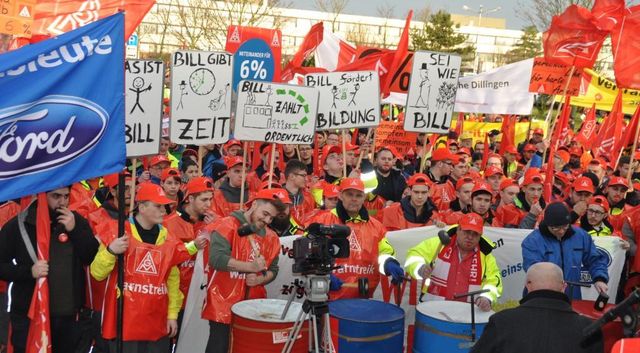
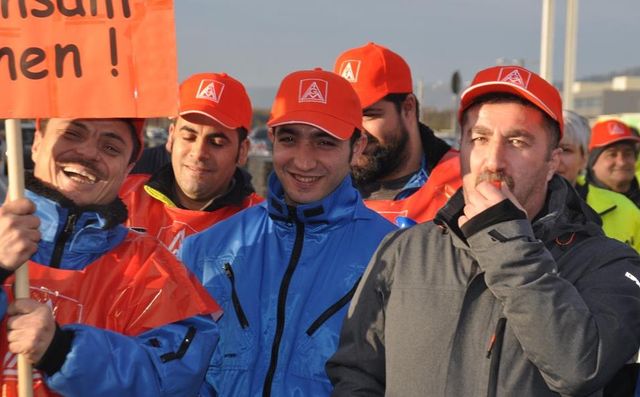
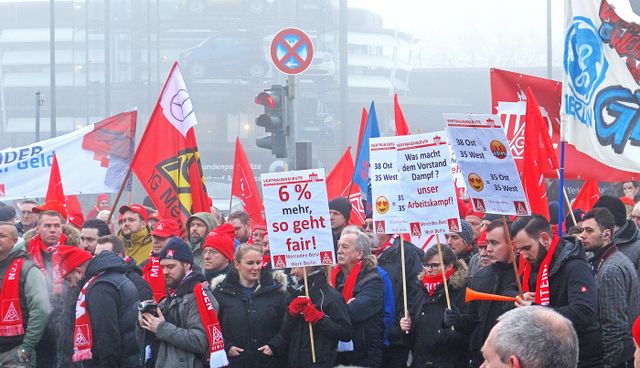
Around 160,000 employees in the automotive, steel and electrical industries have in recent days engaged in token strikes called by the IG Metall union, which is currently negotiating a new wage contract for 3.9 million workers in Germany’s largest industrial sector. The actions include workers at Porsche, Daimler, Bosch and other auto, auto parts and electrical companies like Siemens and AEG.
A rally at Daimler in Berlin
The union says the job actions will be expanded in coming days, and IG Metall leader Jörg Hofman has threatened to call one-day strikes or hold a vote on an open-ended strike if the employers’ association does not make concessions by the end of January. This would be the first full strike called by IG Metall in the sector since 2003, when it called off a four-week strike to expand the 35-hour work week into eastern Germany.
Amid widespread anger over social inequality and the wave of job-cutting by Siemens and other profitable corporations, there is a growing determination among workers to fight for significant improvements in wages and working conditions. IG Metall, however, is attempting to bring the bargaining to as quick a conclusion as possible. The metal and electrical sector is key for German exports and IG Metall is determined to prevent anything from disrupting its longstanding corporatist partnership with the companies.
In addition, the unions support the establishment of a new grand coalition government of Angela Merkel’s Christian Democratic Union/Christian Social Union (CDU/CSU) parties and the union-backed Social Democratic Party (SPD). IG Metall executives want to prevent the outbreak of any major struggles that could imperil the ongoing secret talks over the formation of a right-wing government committed to austerity and rearmament.
The leader of the German Trade Union Association (DGB), Rainer Hoffmann, explicitly called last weekend for a new grand coalition, which would offer “a good perspective for Germany and Europe.”
Pointing to the high profits and record anticipated contracts for the metal and electrical industry, IG Metall head Hofman said he expected the employers’ association to reach a rapid agreement. “A brief and strong struggle would perhaps be better for both sides,” he said. “We want to achieve our demands and ensure the production stoppages are manageable for the employers,” Hofman added.
There is an enormous chasm, however, between the maneuvering of the union apparatus and the aspirations of millions of industrial workers who are dissatisfied, angry and ready to fight.
A warning strike at Ford Saarlouis
For years, workers have witnessed how profits, salaries for executives and the wealth of the super-rich exploded while their income has stagnated or declined. Increasing rent prices and health care costs, which are hardly noted in the official inflation rate, pose an existential threat for many.
Dividend payouts to shareholders increased in the metal and electrical industry by 11 percent per share in 2014, 9 percent in 2015 and 12 percent in 2016, while nominal wages rose by between 2 and 3 percent annually, resulting essentially in a real wage freeze. Of the €43.5 billion (US$52 billion) in pre-tax profits made by the industry in 2015, companies paid out €10.8 billion (US$12.9 billion), or 24.8 percent, to shareholders. In 2016, the figure rose to 28 percent.
Despite the much vaunted 35-hour work week, almost 20 percent of all metalworkers already work longer hours. According to the union’s own opinion poll of the 680,000 workers in the sector, 57.3 percent of workers work overtime, almost half work Saturdays, one quarter work Sundays, and one third work split shifts. In addition, hundreds of thousands of temporary contract workers labour in the factories and portions of production have been outsourced to Eastern Europe, where wages range from one third to one tenth of what is paid in Germany.
Hostile to any struggle to unite autoworkers in Western and Eastern Europe, IG Metall has joined the employers in using threats of expanding production in the East to undermine the wages and working conditions of German workers.
The unions and the SPD bear chief responsibility for these conditions. The Hartz laws, adopted by the last SPD-led federal government in 2003, laid the basis for the huge expansion of temporary work and low-paid jobs. IG Metall and their works councils have participated in the drafting of the downsizing measures in the plants and imposed them over the stiff resistance of rank-and-file workers.
As a result, the SPD achieved its worst result in the September 2017 federal election. The party long ago lost its mass support among workers. Most workers also view IG Metall with distrust, if not outright opposition. The rallies accompanying the “warning strikes,” which usually last an hour and have no economic impact, are mostly dominated by union bureaucrats.
A 62-year-old worker at Siemens’ dynamo plant in Berlin spoke for many when he told the World Socialist Web Site, “We really should be here in greater numbers. If we want to defend jobs and enforce our contract demands, we should be calling for a general strike. That would be just right, a general strike.”
Well aware of this sentiment, IG Metall executives are tailoring their demands to maintain control over workers while they prepare another sellout.
Permanent and temporary workers
On the one hand, IG Metall is demanding a six percent wage increase for one year. While the union has presented this as a substantial wage demand, it would not even come close to covering real needs. Moreover, IG Metall routinely reaches a deal well below the original demand and “stretches out” the pay raise by extending the contract beyond one year. In 2016, IG Metall demanded a five percent pay raise and settled for a two-step 4.8 percent hike spread out over 20 months.
The daily Tagesspiegel assumes that IG Metall will get the 6 percent “in stages... which is not a problem with a long contract duration of 20 months or more.” Since IG Metall leader Hofman wants to avoid another contract fight ahead of the trade union conference in October 2019, the web site said, the contract will “run into late autumn of next year.” It is therefore likely that the wage increase will fall well below the 3.5 percent which the pro-corporate Ifo Institute estimated would be the average wage increase across Germany this year.
IG Metall’s second demand, under the slogan “my life–my time,” is that every worker be allowed to reduce his work week from 35 hours to 28 hours for up to two years, with a corresponding reduction in pay. Only split shift workers, parents with children under the age of 14, or workers who care for relatives will receive modest wage compensation for the reduced hours they work.
This demand finds support mainly among younger workers, for the obvious reason that it is impossible to start a family or care for relatives with the stress of working a full-time job. According to an IG Metall poll, 82 percent of respondents would like to work shorter hours temporarily, while 89 percent would like to adjust their hours of work at short notice to meet their needs.
But this is also a trap. The corporations are resisting the demand by arguing for their own purposes that workers currently working part-time would be treated unfairly. Industry observers expect employers to reach a deal with IG Metall if the union agrees to abandon the 35-hour work week and accept more flexibility for longer working hours. “The employers will agree to the claim for part-time work as well as the right to return to full-time so long as the overall labour volume is not reduced,” commented Tagesspiegel.
“Concretely, this means a further distancing from the 35-hour work week once so famously fought for. It has been the case thus far that up to 18 percent of metal workers can work longer than the contractual 35-hour work week. This quota could disappear and an agreement reached on a corridor from 28 hours to 40 hours.”
If workers are to fight for their justified demands, they must take the conduct of the struggle out of the hands of IG Metall. New organizations of struggle, rank-and-file action committees, controlled by workers themselves, must be built to fight for the broadest mobilisation of the working class in Germany, across Europe and internationally.
The struggle in Germany is part of the growing resistance of the working class around the world. In France, opposition is mounting to the Macron government’s labour laws. Over the past year, Fiat workers in Serbia and VW workers in Slovakia went on strike against starvation wages and conditions of slave labour. Autoworkers in China and India have also conducted bitter struggles, while autoworkers in North America rebelled in 2015 against the corrupt United Auto Workers. In December, Ford workers in Romania conducted a wildcat strike in opposition to the company-controlled union.
The nationalist and pro-capitalist perspective of the unions has brought workers to a dead end. The defence of wages, jobs and social achievements requires an international perspective to unite the working class around the world in a common struggle to defend the right to a good-paying and secure job, to high quality health care and decent housing, and the right to leisure time and access to culture for all workers.
The defence of the workers’ hard-won gains requires a socialist perspective. Capitalist governments around the world, led by the Trump administration in the US, are preparing for new wars and attacks on the working class. In Berlin, a political conspiracy is taking place behind the backs of the population to install the most right-wing government since the downfall of the Third Reich. The program being discussed by the conservative parties and SPD is so anti-worker that they have agreed to maintain strict secrecy on the talks.
The Sozialistische Gleichheitspartei (SGP) calls for new elections. A clique of right-wing conspirators cannot be permitted to unilaterally impose their will on the population. The SGP is building a socialist alternative to capitalism, war and the strengthening of the repressive state apparatus. The social rights of the workers, who produce society’s wealth, must be prioritised over the amassing of grotesque levels of wealth by the corporate bosses and financial oligarchy.