Eligible Countries: Participants will come from Algeria, Egypt, Israel, Jordan, Lebanon, Libya, Morocco, Palestine , Tunisia and Syria
To be taken at (country): Activities to be held mostly in the European Neighbourhood South and Brussels.
About the Award: Youth leadership occurs when young people, by giving of themselves – their energy, gifts, and beliefs – inspire and propel others to action for the common good. The CSF South (EU funded) with this Call for Applications intends to mobilise youth leaderships from the Southern Neighbourhood to work with them and their network of CSOs towards a vision of social justice, create a safe platform for them to share their experiences in building resilience to violent extremism in their communities.
While this Fellowship programme builds on the expertise and experience made during the first two batches of fellowship programmes of 2016 and 2017, the 2018 programme and subject of this Call will be working with Fellows 2018 on the Youth Action Agenda, a direction of priorities and actions to be led by the youth and their network of youth and CSOs in the region. Such an Agenda shall introduce doable solutions and articulate youth views and recommendations to national and regional concerns within the ENPI, e.g. related to resilience, migration, employability and violent extremism.
Fields of Dialogue:
Due to the evolving development in the region, the 2018 programme will give some focus on the role of youth and CSOs to countering and building resilience to violent extremism in their communities and how those local best practices can form a common agenda at the regional level too. Moreover, the Fellows will be further introduced to essential skills and knowledge building on these clusters: activism and governance, entrepreneurship and innovation, youth countering and building resilience to violent extremism.
Policy related research and projects results/youth agenda will be presented by the Fellows during the closure event of the dialogue Fellowship programme. Such a gathering will bring together Fellows from the previous batches too, for networking, best practices and results sharing.
Eligibility: Eligible CSOs from eligible countries can nominate ONE participant based on these requirements:
1 applicant /participant per organization (CSO) who did not participate on previous batches;
Proposed applicant should be within the age limits of 25-35 years old;
Proposed applicant has at least 3 years-experience being involved in sectorial policy projects, specifically in actions of advocacy and policy dialogue and related fields to this call;
Good Command/ Proficiency in English language proficiency in addition to Arabic/French is required.
Number of Awardees: 30
Value of Program: CSFS will cover these fees: economy class air ticket, full accommodation, and Visa costs, only.
Duration of Program: 3 workshops will take place in the region between February and June 2018.
How to Apply: Required Documents to Apply:
Recommendation letter (1-page max.) from the applicant’s CSO supporting his/her candidacy;
Motivation letter written by the applicant in Arabic or English and co-signed by the CSO;
Curriculum vita of the applicant;
Copy of passport or ID (with birth date).
Applications can be submitted to:( csfsouth.org@gmail.com ) copying the CSFS Team Leader, Dr Ahmed Al Damrawy, at: (a.aldamrawy@csfsouth.org) by latest 2 February 2018 in Arabic, English or French (for the ones in Arabic, a summary of the cover letter and profile should be translated in English)
Award Provider: This programme will be managed by the Civil Society Facility South (CSFS), based in Tunis on behalf of the European Union (DG NEAR), in close collaboration with partner CSOs from the region and EU Delegations.
Important Notes:
Selected applicants will receive a confirmation of selection by email. They will have to confirm their presence to all activities. Invitations for obtaining visas will be sent.
Workshops will be held in Arabic and English: a good command of English is required
About the Award: The United Nations Global Compact pursues two complementary objectives: (1) making the UN Global Compact and its principles part of business strategy and operations everywhere; and (2) facilitating cooperation among key stakeholders by promoting partnerships and other collective action in support of UN goals.
Depending on their level of experience and training, UN Global Compact interns will:
conduct research relating to the topic of corporate citizenship, especially on human rights, labour, the environment and anti-corruption;
draft and edit publications, papers and other documents;
liaise with Global Compact stakeholders on key corporate citizenship topics;
support the organization of meetings and events;
assist with outreach activities;
handle email and other inquiries;
assist in the implementation of the Global Compact’s integrity measures;
perform administrative tasks as assigned.
Type: Internship
Eligibility:
Applicants must be enrolled in an undergraduate or graduate degree programme (bachelors or second university degree, or higher) at the time of application and during the internship; or
Under some circumstances, applicants may have graduated within less than one year to commence a UN internship.
Value of Internship: Internships at UN Headquarters are unpaid. Interns must therefore be able to cover their costs of travel, accommodation, as well as living expenses during the internship period.
Duration of Internship: Internships with the UN Global Compact are available for a duration of three to six months. The timing of internships is flexible. We encourage candidates to apply for the following sessions:
Summer / Fall: August to November (with a possible extension to December)
Winter / Spring: January to May (with a possible extension to June)
How to Apply:
Those interested in pursuing an internship with the UN Global Compact must submit an online application at the UN Careers website.
Scroll down to the bottom of the homepage to the “Search Job Openings” section and select “Internship” under the Category field, and “New York” under the Duty Station field. Click on the Search button. This will lead you to a list of various internship openings. You will need to search for the UN Global Compact internship by Job Opening ID Number.
The Global Compact Internship Job Opening Number is 89920. Candidates are strongly recommended to pay attention to the job opening number to make sure that their applications reach the UN Global Compact Office.
Important Notes: Due to the large number of applications received, only accepted interns will be notified a few weeks before the beginning of the session or within 4 weeks after each session’s application deadline.
About the Award: The African Critical Inquiry Programme (ACIP) seeks to advance inquiry and debate about the roles and practice of public culture, public cultural institutions and public scholarship in shaping identities and society in Africa. The ACIP is committed to collaboration between scholars and the makers of culture/history, and to fostering inquiry into the politics of knowledge production, the relationships between the colonial/apartheid and the postcolonial/postapartheid, and the importance of critical pluralism as against nationalist discourse. ACIP is a partnership between the Centre for Humanities Research at the University of the Western Cape and the Laney Graduate School of Emory University in Atlanta, Georgia (USA).
Funding is to be used for on-site dissertation research; research cannot be at the applicant’s home institution unless that institution has necessary site-specific research holdings not otherwise available to the applicant. Applicants who have completed significant funded dissertation research by the start of their proposed ACIP research may be ineligible to apply to extend research time. Eligibility will be at the discretion of the ACIP Selection Committee, depending on completed research time and funding. Please note that the Ivan Karp Doctoral Research Awards support dissertation research only and may not be used for dissertation write-up, tuition, study at other universities, conference participation, or to reimburse debts or expenses for research already completed. The programme does not accept applications from Ph.D. programmes in Law, Business, Medicine, Nursing, or Journalism, nor does it accept applications in doctoral programmes that do not lead to a Ph.D.
Type: Research
Eligibility:
The Ivan Karp Doctoral Research Awards are open to African postgraduate students (regardless of citizenship) in the humanities and humanistic social sciences.
Applicants must be currently registered in a Ph.D. programme in a South African university and be working on topics related to ACIP’s focus.
Awards will support doctoral research projects focused on topics such as institutions of public culture, particular aspects of museums and exhibitions, forms and practices of public scholarship, culture and communication, and the theories, histories and systems of thought that shape and illuminate public culture and public scholarship.
Applicants must submit a dissertation proposal that has been approved by their institution to confirm the award; this must be completed before they begin ACIP-supported on-site research or by December 2018, whichever comes first.
Selection Criteria: Selection will be based on the merit and strength of the application.
Awards are open to proposals working with a range of methodologies in the humanities and humanistic social sciences, including research in archives and collections, fieldwork, interviews, surveys, and quantitative data collection.
Applicants are expected to write in clear, intelligible prose for a selection committee that is multi-disciplinary and cross-regional.
Proposals should show thorough knowledge of the major concepts, theories, and methods in the applicant’s discipline and in other related fields and include a bibliography relevant to the research.
Applicants should specify why an extended period of on-site research is essential to successfully complete the proposed doctoral dissertation.
Guidance and advice on how to write a good proposal and budget can be found in the Resources section of the ACIP website (see Links in Program Webpage below)
Number of Awards: Not specified
Value of Award: Grant amounts vary depending on research plans, with a maximum award of ZAR 40,000.
How to Apply: To apply, eligible applicants should submit the following as a single file attachment with documents in the order listed:
abstract of the proposed research project (250 words maximum)
research proposal outlining the project’s goals, central questions, significance, and relevance for ACIP’s central concerns. Proposals should include a clearly formulated, realistic research design and plan of work responsive to the project’s theoretical and methodological concerns. Applicants should provide evidence of appropriate training to undertake the proposed research, including the language fluency necessary for the project. Proposals should be no longer than 5 pages; they should be double spaced, with one inch margins and a font no smaller than 11 point. Applications that do not follow this format will not be considered.
bibliography of up to two additional pages
project budget listing and justifying project expenses to be supported by the award
your curriculum vitae
current transcript
two referee letters; one of these must be from your supervisor. Your referees should comment specifically on your proposed project, its quality and significance, and your qualifications for undertaking it. They might also evaluate the strengths and weaknesses of your project and how you and your work would benefit from receiving the research award. Referee letters should be submitted directly to the selection committee.
Please submit materials as a single file attachment with documents in the order listed above. Applications should be sent by email with the heading “ACIP 2018 Research Award Application” to lameezlalkhen@gmail.com.
The rule of law and the independence of the judiciary are fragile achievements in many countries — and susceptible to sharp reversals.
Brazil, the last country in the Wessstern world to abolish slavery, is a fairly young democracy, having emerged from dictatorship just three decades ago. In the past two years, what could have been a historic advancement ― the Workers’ Party government granted autonomy to the judiciary to investigate and prosecute official corruption ― has turned into its opposite. As a result, Brazil’s democracy is now weaker than it has been since military rule ended.
This week, that democracy may be further eroded as a three-judge appellate court decides whether the most popular political figure in the country, former President Luiz Inácio Lula da Silva of the Workers’ Party, will be barred from competing in the 2018 presidential election, or even jailed.
There is not much pretense that the court will be impartial. The presiding judge of the appellate panel has already praised the trial judge’s decision to convict Mr. da Silva for corruption as “technically irreproachable,” and the judge’s chief of staff posted on her Facebook page a petition calling for Mr. da Silva’s imprisonment.
The trial judge, Sérgio Moro, has demonstrated his own partisanship on numerous occasions. He had to apologize to the Supreme Court in 2016 for releasing wiretapped conversations between Mr. da Silva and President Dilma Rousseff, his lawyer, and his wife and children. Judge Moro arranged a spectacle for the press in which the police showed up at Mr. da Silva’s home and took him away for questioning — even though Mr. da Silva had said he would report voluntarily for questioning.
The evidence against Mr. da Silva is far below the standards that would be taken seriously in, for example, the United States’ judicial system.
He is accused of having accepted a bribe from a big construction company, called OAS, which was prosecuted in Brazil’s “Carwash” corruption scheme. That multibillion-dollar scandal involved companies paying large bribes to officials of the state-owned oil company, Petrobras, to obtain contracts at grossly inflated prices.
The bribe alleged to have been received by Mr. da Silva is an apartment owned by OAS. But there is no documentary evidence that either Mr. da Silva or his wife ever received title to, rented or even stayed in the apartment, nor that they tried to accept this gift.
The evidence against Mr. da Silva is based on the testimony of one convicted OAS executive, José Aldemário Pinheiro Filho, who had his prison sentence reduced in exchange for turning state’s evidence. According to reporting by the prominent Brazilian newspaper Folha de São Paulo, Mr. Pinheiro was blocked from plea bargaining when he originally told the same story as Mr. da Silva about the apartment. He also spent about six months in pretrial detention. (This evidence is discussed in the 238-page sentencing document.)
But this scanty evidence was enough for Judge Moro. In something that Americans might consider to be a kangaroo court proceeding, he sentenced Mr. da Silva to nine and a half years in prison.
The rule of law in Brazil had already been dealt a devastating blow in 2016 when Mr. da Silva’s successor, Ms. Rousseff, who was elected in 2010 and re-elected in 2014, was impeached and removed from office. Most of the world (and possibly most of Brazil) may believe that she was impeached for corruption. In fact, she was accused of an accounting maneuver that temporarily made the federal budget deficit look smaller than it otherwise would appear. It was something that other presidents and governors had done without consequences. And the government’s own federal prosecutor concluded that it was not a crime.
While there were officials involved in corruption from parties across the political spectrum, including the Workers’ Party, there were no charges of corruption against Ms. Rousseff in the impeachment proceedings.
Mr. da Silva remains the front-runner in the October election because of his and the party’s success in reversing a long economic decline. From 1980 to 2003, the Brazilian economy barely grew at all, about 0.2 percent annually per capita. Mr. da Silva took office in 2003, and Ms. Rousseff in 2011. By 2014, poverty had been reduced by 55 percent and extreme poverty by 65 percent. The real minimum wage increased by 76 percent, real wages overall had risen 35 percent, unemployment hit record lows, and Brazil’s infamous inequality had finally fallen.
But in 2014, a deep recession began, and the Brazilian right was able to take advantage of the downturn to stage what many Brazilians consider a parliamentary coup.
If Mr. da Silva is barred from the presidential election, the result could have very little legitimacy, as in the Honduran election in November that was widely seen as stolen. A poll last year found that 42.7 percent of Brazilians believed that Mr. da Silva was being persecuted by the news media and the judiciary. A noncredible election could be politically destabilizing.
Perhaps most important, Brazil will have reconstituted itself as a much more limited form of electoral democracy, in which a politicized judiciary can exclude a popular political leader from running for office. That would be a calamity for Brazilians, the region and the world.
Forida is a 22-year-old sewing machine operator in a clothing factory in Dahka, Bangladesh. She often works 12-hour days producing clothes for brands such as H&M and Target. Sometimes, during busy production cycles, the hours are even longer.
“Last year, I worked until midnight for a full month,” Forida explained. “I used to feel sick all the time. I was stressed about my son and then after I got home from work, I had to clean the house and cook and then go back to work again the next morning. I would go to bed at 2am and get up at 5.30am each day.”
Even with the combined income from her husband, Forida’s family barely had enough food to eat.
Meanwhile, a CEO from a top clothing brand would have to work only four days to earn what a garment worker in Bangladesh earns in a lifetime.
Forida’s story is included in a report released today by the anti-poverty organization Oxfam. The report, Reward Work, Not Wealth, reveals how the global economy empowers the richest 1% while hundreds of millions of people struggle to survive.
Oxfam found that 82% of the global wealth produced last year went to the richest 1% of the world’s population. In other words, four out of every five dollars of wealth created in 2017 went into the pockets of the 1%.
While a new billionaire was created every other day, the 3.7 billion people making up the poorest half of the world’s population saw no increase in their wealth last year.
“The billionaire boom is not a sign of a thriving economy but a symptom of a failing economic system,” said Winnie Byanyima, the Executive Director of Oxfam. “The people who make our clothes, assemble our phones and grow our food are being exploited to ensure a steady supply of cheap goods, and swell the profits of corporations and billionaire investors.”
Oxfam reported that the 42 richest people now own as much wealth the poorest half of the world’s population.
Since 2010, billionaire wealth has risen annually by 13%, a rate six time higher than that of average workers.
Key factors contributing to this concentration of wealth, Oxfam found, are erosion of workers’ rights, corporate influence in political and labor policy-making, rewarding inherited wealth, tax evasion, and cutting costs to maximize profits for company owners.
“A perfect storm is driving up the bargaining power of those at the top while driving down the bargaining power of those at the bottom,” Paul O’Brien, Oxfam America’s Vice President for Policy and Campaigns, explained. “If such inequality remains unaddressed, it will trap people in poverty and further fracture our society.”
Oxfam pointed to President Trump’s policies as widening the gap between rich and poor, and empowering the 1% on the backs of the American working class.
Since taking office, Trump has chosen a cabinet with more billionaires in it than ever before in US history, and whose combined wealth is greater than the 100 million poorest Americans. Oxfam cited Trump’s proposed tax and healthcare reforms as policies favoring the super-rich.
Meanwhile, the three richest Americans own the same wealth as the poorest half of the country’s population.
Such data underlines the plight of the American poor. Oxfam’s report included a portrait of Dolores, a former poultry worker in Arkansas. She and her co-workers were provided so few bathroom breaks at the factory that they were forced to wear diapers to work.
“It was like having no worth,” Dolores said. “We would arrive at 5 in the morning… until 11 or 12 without using the bathroom… I was ashamed to tell them that I had to change my Pampers.”
Work in the US poultry industry has one of the highest rates of injury in the country. Oxfam found that “repetitive strain injuries can be so severe that after only one year on the production lines, some workers reported being unable to straighten their fingers, hold a spoon or even properly hold their children’s hands.”
Across the world, poor people’s labor fuels the rising concentration of wealth.
“Dangerous, poorly paid work for the many is supporting extreme wealth for the few,” Oxfam explained. “Women are in the worst work, and almost all the super-rich are men. Governments must create a more equal society by prioritizing ordinary workers and small-scale food producers instead of the rich and powerful.”
The biggest problem for families in Cuba these days is the financial difficulties caused by the United States blockade. It has not been removed even though diplomatic relations were established following former President Obama’s visit to Cuba. This is due to, among other things, the fact that there are laws that have to be repealed by the US Congress. So far, the changes have been blocked by the Republicans. The Helms Burton Act, which makes it very difficult for other countries to trade with Cuba, is still in place.
On June 15, 2017, President Donald Trump gave a speech in Florida, especially directed to the extreme right-wing Cuban exiles in the city of “Little Havana” in Miami. He said that the money from tourists travelling in Cuba goes directly to Cuba’s military and because of that he will not open up US tourism to Cuba. Consequently there must still be travel restrictions and trade with Cuba is still prohibited. The US Embassy in Havana and the Cuban Embassy in Washington D.C., however, should not close, and the direct flights between The United States and Cuba will continue. Trump demanded internationally monitored elections, several parties, a free press, release of all political prisoners, and the extradition of Assata Shakur (Joanne Chesimard), who has political asylum in Cuba. The speech was symbolic (and warmly welcomed) thanks to the Cuban exiles who supported him during the election. The trade and travel restrictions are out of his hands based on laws that would have to be abolished by the US Congress. More and More Republicans believe that 50 years are enough and that the blockade does not work as intended: to have regime change in Cuba. The speech was a repetition of demands Trump knew would never be accepted by the Cuban government. Let’s see what happens.
In Cuba, life continues with shortages of everything. For example, toilet paper is missing, and when it comes onto the shelves again, there is no soap powder; when that returns, there’s a lack of tooth paste, and so on. It is also difficult to get spare parts for cars, for example, and for many other imported goods.
In 1992, the double currency was introduced, so they have both the national pesos and the special tourist currency, convertible pesos called C.U.C. The value of the C.U.C. is between one dollar and one Euro. Recently it is been close to the dollar. You need 24 national pesos for one C.U.C. , and the Cubans can calculate the exchange between the two in their heads. We cannot do that, and it is a mystery how Cubans can live for 400-800 national pesos a month, equivalent to 20-40 dollars. Indeed, they have their “libretta”, a sort of ration book, but is does not cover their entire food needs. It is still difficult to afford all the necessary food.
About 3 years ago, the government announced that the C.U.C. would cease to exist; leaving only the national peso, but that has not happened yet and has probably proven to be harder than expected. The dual currency causes more and more inequality between those who have access to the C.U.C. and those who have only their salary in national pesos. They are free to exchange them to C.U.C. but is makes no difference. Slowly society has become more affluent, but money is unevenly distributed and prices rise making it worse for those who are being paid in national pesos.
The reforms introduced five to six years ago have meant changes in Cubans´ everyday lives. Now Cubans can become self-employed; there are more than 100 professions in which they can work legitimately by paying taxes. Before, all were state employees. Now an increasing number are working independently, for example selling agricultural products. Many have opened small shops or cafes. It is also possible to open a restaurant or start a cooperative where several people share a company. There is good money in transportation; many are driving taxis, both for tourists or shared taxis for Cubans. Good money can also be made by renting rooms and apartments to tourists, the so-called “casas particulars”.
Cubans can now sell and buy their houses, which was a necessary reform because an increasing number of houses literally collapsed in the streets because of lack of maintenance. The residents could not afford to maintain them, nor could they buy paint and other building materials. Fortunately, they now can. For example, if you can get your cousin in Miami to invest in a house, you can renovate it and sell it for double the previous price and share the profits. Foreigners cannot buy the houses but Cubans can with foreign capital or if they have other access to C.U.C. More and more houses are being built and renovated, especially in the more upscale neighborhoods. It is absolutely about time, as many of the houses have not been maintained for 50 years.
Some other changes have been introduced since August 2017: no more private lease permits (the so-called “casas particulares”) will be issued, and permission to create family restaurants, small cafes and gift shops has been stalled. The tax system for self-employed does not work well enough, and they need to make some changes.
Daily life presents challenges. Although all households in Cuba have a pressure cooker and a rice cooker, cooking is a slow affair. Rice must be cleaned, garlic must be peeled, beans must be boiled and a sofrito (oil with garlic, onions and peppers) must be made. Many poor Cubans eat only one, main meal a day, an almuerzo (lunch) in the middle of the afternoon – of course depending on their work schedule and whether they get food at work. There are many problems with water and electricity, at least in Havana. For a period of time there were many and long-lasting power outages, now there are short-circuit interruptions. The water supply in Havana is the source of difficulty and irritation. In some neighborhoods, the water supply is closed daily in the middle of the day, in other places, there is water only every other day. When there is no water, you get it from a tank on the roof and it needs to be opened and closed. Sometimes the water does not come at night as expected. Last time I was in Havana, it was missing for 3 days.
When you see a clinic or hospital, you are not impressed because the equipment is a bit old-fashioned, certainly not new and modern, but the doctors are incredibly skilled and you will be carefully examined. It is not about just prescribing any medicine. It can be difficult to get hold of because of shortcomings in that area. On the other hand, the medical service is probably the best in the world. In every city and every Havana neighborhood, there are outpatient clinics with several doctors, and it is open 24 hours a day. You can also call a family doctor. I experienced an example three to four years ago, when I was visiting a father who had his nine month old daughter with him. When I arrived and touched her arms, she seemed hot. I told the father I thought she had a fever. “She has a fever?” he asked, and, frightened he immediately went to the phone and called the family doctor. A young, female doctor arrived ten minutes later and took the child in her arms. She took her temperature and examined her and then walked around in the living room with her in her arms, singing to her. When the child had fallen into a half-sleep, she gave her a pill without waking her. A few minutes later the father took the child, and the doctor left the house. What a service!
The health service also provides free dental visits. In the district of Playa in Havana, in addition to a general dentist in the outpatient clinic, there is a 24-hour emergency clinic. Last time I was in Cuba, one of my Cuban friends got a toothache one a Saturday evening, I went with him to the clinic at ten o’clock at night. There was a watchman looking at television and a dentist who immediately treated my friend for a problem in his molar. A few days later he came for follow-up care.
Did I mention there is free education in Cuba, from first class to phd-level at the university? Other courses are not very expensive, for instance cooking courses or taking a drivers lice nse.
Surprisingly, there has been a shortage of food in Cuba, and not only in that special period for the first ten years after the dissolution of the Soviet Union. At that time Cuba lost half of its gross national income with the loss of financial support from the Soviet Union. It has seemingly been difficult to restructure agriculture from monoculture, such as sugar cane and tobacco, to cultivating different crops that can feed the population. Cuba has a tropical climate where everything grows all year round, root vegetables such as sweet potatoes, malanga and yucca. You can also grow rice if you have irrigation. In addition, you can grow various tropical fruits, avocados, bananas, coconuts, pineapple, guayava, papaya, mamay, citrus fruits and many more. They are rich in vitamins and contain many other important nutriments.
In some areas they have eco-gardens, small community gardens where they grow vegetables without any pesticides or additives. Most of the people who work there are volunteers, and they sell the products to people in the community,
It is difficult to transport the goods. There has been a shortage of gasoline and the shortage has returned now, because Venezuela is no longer sending so much oil. The Cubans in Havana complain that they cannot afford to buy vegetables, and prices are too high both in the state sales and in the private markets. Prices of groceries like garlic, onions and small peppers have risen. The daily problems continue.
As the 86-year old grandmother said, “Cuba is a nice country, if only we had a little more money.”
(And if your goal be truth, Is this the right road—
Europe’s faults all glossed, and all Islam’s held to so strict an audit?)
-Sir Muhammad Iqbal
Too often in the news, Islam is only associated with terrorism and extremism. An uninformed viewer may think: How could anyone in their right minds find inspiration and solace from such a faith? However, to billions of people across the world, Islam is the avenue for seeking liberation and peace.
A lot of ink, an infinite number of film reels, and a frantic churn of news stories bristling with violent tones on Islam have fixated the Muslims as a stereotyped homogeneity. There is a cottage industry of authors who keep the midnight oil burning to ensure that the flashlights on bad Muslims keep beaming. These are churned out by a well-oiled Islamophobia machine with financial backers, think-tanks, and misinformation experts who are constantly manipulating the already flawed image of what a Muslim is, of what Islam is. They are attacking the identity of Muslims, which is so diverse that it cannot possibly fit into a box. Islam has been projected as a misogynistic religion and Muslims the most barbaric community, especially when it comes to dealing with women.
From terrorists to dictators, provocative literature to fabricated threats, Muslim identity is marred by almost every imaginable negative stereotype and menacing trope. Amidst these, the images of good Muslims, in every medium, are few and far between.
In an ideal world, journalism is a profession of incredible integrity and Journalists, among the most dexterous and skilled people in the world. We have all benefited from the work of persistent journalists who put life, limb, family and even sanity on the line in their pursuit of truth. There is no sane, decent, and democratic polity possible without journalists who challenge power, relentlessly pursue and disseminate the truth and always find the next story to tell.
Sadly, journalism is failing to perform its fundamental role of objective reporting and analysis and continues its job by rehashing tired old narratives of “radical Islam” or a “fight within Islam”. The truth is much more convoluted than that and the entire world has a direct role in creating the dangerous reality which so many Muslims have to live with every single day.
The press once seemed to have a conscience, thanks to history’s painful social conflicts and questions of war and peace. The world, however, has changed, and many of us may be in the time warp of old values. Like all institutions, the media has also suffered in terms of its reputation.
The media shows remarkable consistency in employing an arsenal of semantic games and incendiary phrases to link most of the violence around the world with some form of Islamic ideology or some Islamic group.
It is much easier for the media to limit the complex debate on various issues confronting Muslims to a series of clichés, slogans and sound bites, rather than examining root causes. It is easier still to champion the most extreme and prejudiced critics of Islam while ignoring the voices of mainstream Muslim scholars, academics and activists. There is a strong voice of moderates from within the Muslim ranks that could be channelized properly by the media to give a rounded assessment of Islamic issues.
Societal understandings of “good Muslims” are just as narrow as its conception of “bad Muslims”. Both of these characterisations are rooted in a common baseline, which gives rise to linear caricatures that overshadow representations of “good Muslims” as Olympians or scholars, and even mayors of world-class cities.
Indeed, the hegemony of “bad Muslims” has entirely eclipsed representations of “good Muslims”. Like the “bad Muslim”, the identity of “good Muslims” is also linked to terrorism with the accusation that they failed to stop it. Muslims are tagged with the affirmation of collective guilt that obliges them to condemn or apologise for entirely unrelated actors and unconnected actions. Terrorism is not only conflated with Islam but tied exclusively to it and nothing else.
Muslim bashing is in several cases a by-product of the new brand of journalism which sees value in the “social weight” of the message. The media keeps beaming recurring images of the deep-seated communal ruptures that already exist in the walls of our society and are too well known.
By reinforcing them wittingly and unwittingly contributes to further deepening their impact. The new media not only reflects the mood but is responsible for building it as well. Media oxygen is provided only to those who say something communally inflammable and in such an environment, the efforts of pacifists and even of the moderated segments suffer great damage.
Religion has been simply reduced to a social or political construct, although for millions of people, it is a daily practice and the very framework for understanding, that connects their lives to a spiritual reality. Their faith is the prism through which they view the world, and their religious communities are their central environments.
It is difficult to overstate the importance of faith in the lives of so many. Yet, often the only religious voices on the front page are those speaking the language of hatred or violence, especially in stories about conflict or social tensions. The media can carefully balance and moderate the coverage by injecting more reasoned and saner voices.
Good journalism requires an understanding of reliable and rigorous academic studies, attentive listening to diverse sources, dogged examination of data and other records and close observation of policies and institutions, especially when their messages deal with human faith.
It takes time, skill and the support of editors and other prominent news leaders who live in the community to truly follow the fundamental principles of journalism. These principles do not guarantee publishers a return in eye-popping audience numbers, but they guide and monitor the community truthfully.
M Scanlon’s classic essay, “The Difficulty of Tolerance“, offers an attractive affirmative answer: Tolerance is valuable for its own sake because of the attitude it allows us to bear towards our fellow citizens, an attitude of fraternity and solidarity that is deeper than the intractable disagreements that divide us.
The solution is not difficult. What is needed is a meaningful engagement between the media and authentic caretakers of the Muslim faith. The media has to learn to seek out the saner voices and not just line up opinions that suit its own narrative. Most importantly, it should reports facts faithfully.
The distorted images of Islam stem partly from a lack of understanding of Islam among non-Muslims and partly from the failure of Muslims to explain themselves. The results are predictable: hatred feeds on hatred. Ignorance of Islam exists both among Muslims and non-Muslims. Non-Muslims misunderstand Islam in their ignorance and in turn, they fear it. This way, fantasy, conjecture and stereotypes replace fact and reality.
Similarly, Muslims have their own misconceptions. They react to the hate and fear of non-Muslims by creating a defensive posture within their societies and sometimes, a combative environment built on militant rhetoric.
John Pilger advises in his book “Hidden Agendas” that, “It is not enough for journalists to see themselves as mere messengers without understanding the hidden agendas of the message and the myths that surround it.”
One of our big challenges in wildlife conservation is to stop poaching and habitat degradation which leads to animal human conflict which always has only one ending, destruction of the animal.The backbone of the conservation team in a Reserve Forest or a National Park is the Forest Guard. This individual lives inside the forest, many in the Core Areas in highly substandard conditions, is paid a pittance and is expected to be self-motivated enough to walk miles of boundary tracks to ensure that no illegal activity is happening. He is unarmed, except with a stick and walks as he has no vehicle. In many places where he is required to go there are no roads for him to use any vehicle, even if he had one. He lives away from his family who he sees perhaps once a week.
I am given to understand that the average age of the Forest Guard is 50 years and that young people are unwilling to take this job because of its hardship and deprivation. All these forests are starved of funds, thanks to our bureaucracy and many a time, even sanctioned funds are not released by State Governments. Be that as it may and no matter how unglamorous the job of the Forest Guard is, it is the most critical link in the chain that protects our wildlife and forests. It is critical that State Governments take note of the plight of these people and enhance their salaries and living conditions and do what it takes to ensure that they can do their jobs comfortably and effectively.
I firmly believe that the key to wildlife and forest conservation is the wholehearted support of local people. That can’t happen when they don’t know the forest, don’t know how to conduct themselves respectfully and safely in it and so live in fear of forests and wildlife instead of loving and enjoying them. That is also why we see the completely despicable and deplorable behavior of people when they do go to spend a few days in our National Parks. Go to any of our major parks and you will see people drunk, smoking and throwing cigarette butts and matches, eating junk food and throwing plastic wrappers anywhere, blaring radios and music from all kinds of devices, shouting and behaving in ways that can leave one in no doubt that the humans didn’t descend from monkeys. If they had, they would behave like monkeys, with respect and sensitivity to others who share the forest with them. Darwin would have changed his mind if he had visited Dhikala in Corbett National Park. But how do you get local people involved and interested in forests and wildlife conservation?
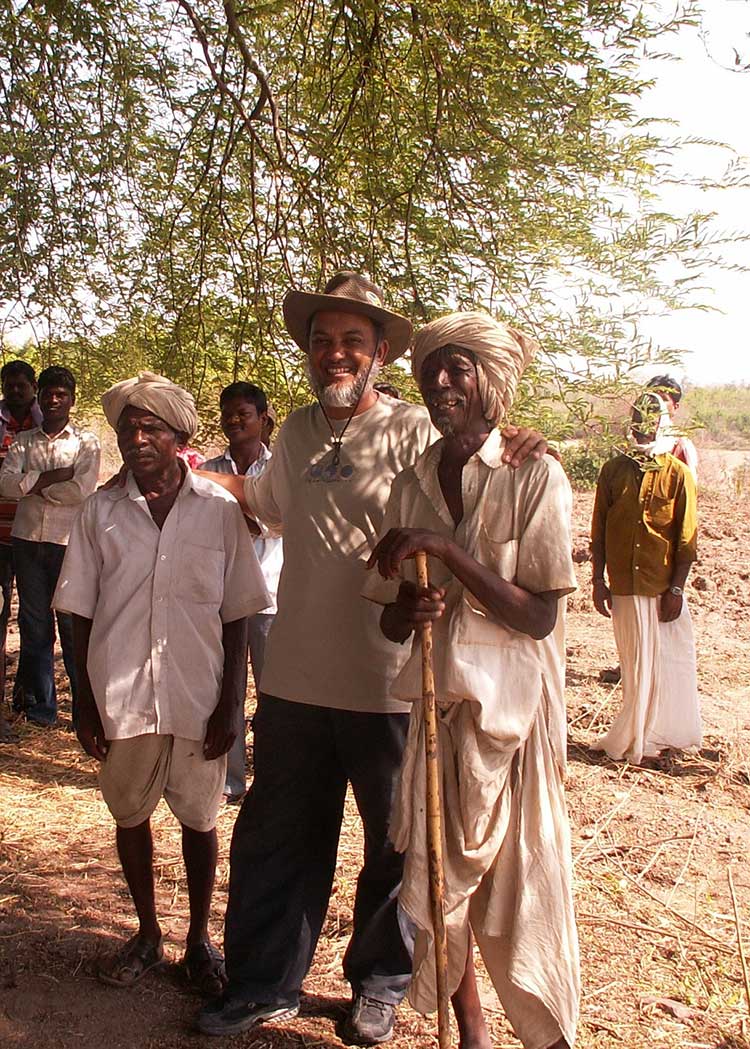
Shivayya & Kishtiah
What I believe will help hugely in more ways than one is to involve our High School and College youth in wildlife conservation. It is only when the young generations learn to appreciate nature that they will do what needs to be done to protect and preserve it. I spent my entire school and college time in the 1960’s and 70’s, in the forests of the Sahyadri Hill Range in what is today called the Kawal Tiger Reserve. I would go off to the farm of Mr. Venkat Rama Reddy on the bank of the Kadam River and spend my entire summer and winter holidays with him. No electricity, no telephone, no running water. Wake and sleep with the sun. I walked uncounted miles of animal tracks with my friend Shivaiyya, Uncle Rama’s Gond tracker, fished, bathed and swam in the Kadam and Dotti Vagu Rivers and sat at innumerable waterholes, watching animals and birds come to drink water in the summer where water is very scarce. As most of these rivers dry up in the summer, you can walk long distances on the river bed, where though the soft sand underfoot makes the going a little strenuous it saves you from the thorn bushes on the bank.
If you walk up in the Kadam streambed and turn right to go up the Dotti Vaagu, you would come to some deep pools in a very shaded spot. The water there does not dry out for a long time even in the summer. It is amazing how, as I write this today more than 45 years later, I can literally see in my mind the river, the pools, the bamboo fronds that cover that part of the forest, the light, and shade. I can still smell the forest on a sweltering hot afternoon and then the fresh smell of the earth in the morning, still wet with dewfall in the night. Memory is a powerful thing indeed. We didn’t have cameras then, but we lived these beautiful times and the memory will stay with me for as long as I live. After that, who cares?
I recall vividly as if it were yesterday, one time when I was sitting in a blind that had been cut into the middle of an acacia thorn bush, about 30 feet up the bank of the Dotti Vaagu. Very cramped space, a log to sit on and a small space opened in the front of the bush to stick the barrel of the gun through to give me a clear shot, if some animal came to drink water. The bush itself was about 50 yards up the slope that borders the water hole. On this very hot summer day, this is the only source of water for miles around, left over dregs of Dotti Vaagu.When you sit silently, you become a part of the surroundings. Your ears initially buzz with the residual sound of the bustle you have left behind. But after a while, they fall silent and then you begin to hear the sounds ofthe forest. The buzzing of the cicadas, the incessant call of the Brain-fever bird, the distant barking of dogs from the village.
Then as your ears get more attuned to the sounds, you start hearing the subtler ones; the rustle of the leaves as a rat snake makes his way from one shaded spot to another, the cooing of the turtle doves, bark of the Chital sentry when she sees something alarming. You hear the breeze in the dry leaves on the forest floor as they play chase with each other. The teak trees having shed most of their leaves, the dominant color is brown. There is very little shade, except under the acacia thorns like the one I am sitting in. There is some bamboo, but most of it is young and does not provide shade. There are no elephants in this forest, but the Bison (Gaur) browse on what they can reach of the bamboo and so do the Chital, Sambar, and Nilgai.
As I keep sitting very still, even controlling my breathing, knowing that above all else it is movement that attracts attention and becomes visible, I suddenly see a pair of jackals materialize in front of me. The bitch is more cautious and is lagging behind. The dog is ahead. Both sense that something is perhaps not as it should be. However, the wind is blowing steadily in my face and so I know they can’t smell me. The bitch even looks directly at me; perhaps she knows, maybe she can sense the rise and fall of my chest as I breathe or maybe it is an old memory she is trying to place. The moment passes and she follows her mate into the open. First, they drink, then they sit in the water on the edge and cool off in the intense heat of the day, then they start playing, chasing each other around like little puppies, secure in the knowledge that they are alone. It is a very rare moment for me, to be observing animals doing what they do when they are not afraid.
Even if I had a video camera, it could never capture the entire atmosphere; the excitement, the challenge of sitting silent and still like a tree stump, my outline broken by the bush I am sitting inside. The memory of those jackals is still so vivid in my mind that even today, 45 years later, I can see them playing in and around the water. Nothing lives that long in the wild. That pair of jackals is long gone. But I will remember them and that day, all my life.
After a while I realize that the jackals are a mixed blessing. Their presence will allay the fears of other animals heading to the water, as it is an indication that all is well. But at the same time, it will keep the smaller game, the Chinkara, the Chowsinga, and the Black-naped Hare away from the water hole. I want to make them leave but without alarming them so much that they warn everyone else of my presence. I gently clear my throat. It is as if an electric shock goes through their bodies. One minute they are carefree playmates. The next instant they go rigid for a split second and then like a flash, they are gone, each in a different direction to confuse the pursuer. I settle once again into the ritual of watching life happen. This enforced immobility and silence, the attendant boredom, initially; then the flow of thoughts in the mind, while trying to keep aware of the surroundings, is an incredibly powerful exercise for introspection. And waiting for and watching animals on a watering hole is the best way to do it.
I have not seen any initiative in our schools and colleges to encourage youth to spend time in the forests, not zipping around in Gypsies but actually camping and walking. They have no idea of the joy of waking up and watching the dawn breaking at the edge of a lake, waiting for the flights of duck and in season, geese to start coming over the horizon. I recall the incredibly beautiful magic of these flights, in V-formation come from one side before the rising sun, ‘disappear’ into it and then reappear on the other side as if they came out of the sun itself. As you watch the flights, you can hear fish plop in the water in the early morning feeding frenzy. They have no idea of the joy of listening to Cheetal alarm calls, asking a question and Sambhar answering it. That is when you understand the meaning of the term, ‘Silence speaks louder than words’. Because if a Sambhar doesn’t confirm the Cheetal’s sighting, I for one, would put it down to the Cheetal’s natural skittish nature of taking alarm at every shadow. I think this is the key to conservation, get the youth involved.
As the sunlight strengthens, the bird calls start. Invariably it is the Jungle Fowl rooster who calls first; his call that ends in a question. If you look for him, you will find him on any small rock or dry tree branch rising out of the wet morning forest floor, that catches the first rays of the rising sun. A little later the Peafowl call out their very loud and raucous bugles. The Langur sentinel alerts the jungle to the fact that he is awake and watching.
The problem is that today parents and teachers don’t know the joy of spending time in a forest, so they can’t teach others. Also, since they never learnt how to live in a forest, they are afraid and don’t enjoy it. It is a vicious spiral. The love of the forest must be inculcated early in childhood through controlled experiences which are monitored to ensure safety and are essentially immersion learning classes in life skills. If we do it right, then I believe that we will create a generation that truly loves the wild places and will invest time, energy and resources to ensure that they remain unspoilt for future generations. This will also bring about a better understanding of matters critical to survival like Global Warming, which currently seems to be suffering from the problem of having been defined in a way that makes it almost impossible for the average city dweller who thinks that his eggs and milk come from the supermarket, to comprehend, much less relate to in a personal way.
I suggest that the government starts a program like the NCC (National Cadet Core) which we have in most schools and colleges. A National Forest Core (NFC) can be formed which can be run by the Forest Department (Wildlife Conservation Wing) which can hold jungle camps, seminars, photography lessons and contests and wildlife tracking and spotting activities in school holidays. All these can be self-financed, paid for by the children as they are excellent educational and leadership development activities. In these camps in addition to learning about nature, flora and fauna, they can be taught orienteering, survival skills, camping, tracking and photography. These camps must be held inside forests and Forest Guards must be involved in them. They can talk to the children, tell them stories of their encounters with wildlife and teach them the basics of being safe in a forest. They can take small groups of children and their teachers on nature walks where they can experience the forest. Walk to a lake and sit quietly on the bank, just inside the tree line and sketch the scenery. As they sit there, they can watch animals and birds that come to the lake and observe their behavior and try to identify them. What can be done on such outings is endless and beyond the scope of this article. I just want to give you a taste so that you will be motivated to take action.
What is more important is that children will learn to appreciate and love nature and the natural world and understand how much quality it adds to life and how much we need it. They will meet tribal people (Adivasis) and learn about their lives, stay with them, understand their problems and learn to empathize with them. They will learn the importance of the many cycles of life and death that take place in the forest, where everything that dies, gives life to something else. They will be detoxified and experience what it means to breathe fresh air where it is made; in forests. They will remember the sight of the night sky above them and see the millions of stars that they can never see in their cities. They will learn to enjoy silence, punctuated by sounds, each of them evidence of life and activity.They will take away with them, memories which will last them their lifetimes and remind them of what they owe the earth.
The Forest Department can give children who participate in these programs, Honorary Forest Guard badges and a National Park Membership card which will entitle them to concessional fees when they visit any National Park in the country. They can hold competitions, quizzes and practical challenge competitions and give prizes. The first prize could be a badge making that child, Honorary Wildlife Warden. Children who have been to several camps could be recruited to participate in the Annual Wildlife Census that happens in all parks. They will be energetic, enthusiastic and incorruptible and not likely to write numbers of tigers and leopards in census forms, while imbibing tea in the village.
What better way to spend the holidays camping out in forests, walking the earth and learning about those who we share the earth with?
On January 15, millions of Americans commemorated Martin Luther King’s Day. His famous speech, ‘I Have a Dream’ was repeated numerous times in media outlets as a reminder of the evil of racism, which is being resurrected in a most pronounced way in American society.
But that is only one version of Dr. King that is allowed to be broadcast, at least in polite company. The other, more revolutionary, radical and global King is to remain hidden from view.
Exactly one year before he was assassinated, on April 4, 1968, Dr. King delivered a truly scathing speech that challenged not only the state apparatus by the liberal hierarchy which posed as if they were his allies. It was called: “Beyond Vietnam“.
“We must stop now,” he said, his voice thundering. “I speak as a child of God and brother to the suffering poor of Vietnam. I speak for those whose land is being laid waste, whose homes are being destroyed, whose culture is being subverted.”
Then, he added these words, which sent much alarm among those who sought to isolate anti-war efforts from King’s own struggle:
“I speak of the – for the – poor of America who are paying the double price of smashed hopes at home, and death and corruption in Vietnam.”
Unlike the more famous speech ‘I Have a Dream’ – delivered in the 1963 ‘March on Washington’ – ‘Beyond Vietnam’ pushed past the boundaries of what is acceptable by ‘liberal’ America into whole new territories, where Dr. King’s anti-war and global solidarity values were unapologetically linked to the fight against racism and poverty at home.
On that day, the American civil rights struggle courageously broke free from the confines of American exceptionalism, to join a worldwide movement of struggles against racism, colonialism and war.
Unsurprisingly, Dr. King’s speech angered many members of White communities who were directly or indirectly affiliated with the Washington establishment.
Merely three days after the speech, the New York Times countered in its editorial: “There are no simple answers to the war in Vietnam or to racial justice in this country. Linking these hard-complex problems will lead not to solutions but to deeper confusion.”
In fact, there was no ‘confusion’, but total and complete clarity and coherence. To be truly meaningful, human rights values cannot be sectionalized and isolated from one another.
Yet, what alarmed the so-called liberals is the intellectual growth and awareness of the civil rights movement at the time, which matured enough to the point of pushing for greater integration among all struggles.
A more vibrant and empowered King, aged only 38 years at the time, seemed to have fully fathomed the link between the oppression of poor, Black Americans at home and the oppression of poor Vietnamese peasants abroad. They were all victims of what he dubbed the “giant triplets of racism, extreme materialism, and militarism.”
Right there and then, King had achieved a revolutionary and terrifying idea that might have contributed to his assassination a year later, for many of his allies outside the Black communities began disowning him.
But this passage in particular gave me a pause, as I reflected on the plight of millions of refugees and poor migrants forced to leave their homes in Africa and the Middle East, driven by wars, corruption and extreme want.
“A true revolution of values will soon cause us to question the fairness and justice of many of our past and present policies,” he said.
“On the one hand, we are called to play the Good Samaritan on life’s roadside, but that will be only an initial act. One day, we must come to see that the whole Jericho Road must be transformed so that men and women will not be constantly beaten and robbed as they make their journey on life’s highway.”
The metaphor of the road – to salvation, freedom, safety – was particularly emotive and foretelling.
If Dr. King was alive, he would have certainly placed the refugees as a top priority in his “revolution of values.”
Africa in particular, is being robbed. Tens of billions of dollars are being siphoned out of the continent, while Black men and women are being sold for slavery, in Libya and elsewhere.
Libya was torn apart by the NATO-led war that left the country without a government. The war on Libya channeled massive armaments to neighboring African countries, leading to new wars or resuscitating old conflicts.
According to the United Nations, there are nearly 700,000 African refugees in Libya who hope to reach Europe. The latter, which has fueled the Libya conflict, has taken no responsibility for the crisis.
The International Organization for Migration (IOM) reported that 2,550 refugees and migrants died trying to cross to Europe from the Libyan coast in the first 9 months of 2017. One of every 50 persons who embarks on the journey dies on that tragic “Jericho Road.”
They do so while knowing the risk, because staying in Libya or going back home could mean a far worse fate.
While in Libya news reports speak of ‘slave markets’, in Israel, the country’s immigration ministry is offering civilians lucrative jobs to ‘locate, detain and monitor’ African refugees, who are all being pushed outside the country and thrown into other perilous regions.
In the US, the government and media, selectively exploit the legacy of Dr. King, but behave in ways that are completely contrary to the true values of that noble man.
The US military is expanding its operations in Africa faster than in any other part of the world. This means more weapons, more political instability, coups, wars and eventually millions more of poor men, women and children being driven to flee, often to their own demise.
The legacy of Dr. King, as presented in mainstream media, has become about the whitewashing of a racist, militaristic and materialistic system, although King himself has championed the exact opposite.
“Now let us begin,” he concluded in his anti-war speech. “Now let us rededicate ourselves to the long and bitter, but beautiful, struggle for a new world.”
50 years after his assassination, maybe it is time to truly listen.