25 Jan 2018

Syriza mounts savage assault on living standards and democratic rights in Greece

John Vassilopoulos

Thursday marked three years to the day since Syriza, led by Alexis Tsipras, was swept into power on an anti-austerity ticket.
By August 2015, after just eight months in power, Tsipras and his government repudiated its mandate and capitulated to the European Union (EU) and the International Monetary Fund (IMF) by agreeing to a new austerity package. This was only weeks after Greek workers and youth voted decisively against austerity in the referendum called by the Syriza-led government.
Since then, Syriza and its right-nationalist governing partners, the Independent Greeks, have presided over the implementation of successive brutal attacks on the living standards of an already impoverished Greek working class. Pensions and benefits have been slashed and taxes hiked, while every few months additional state-owned companies have been lined up for sale.
The measures contained in the multi- bill passed January 15 by Greece’s parliament are among the most savage yet imposed—befitting a right-wing government whose “radical left” credentials are in tatters.
The bill was passed just in time for this week’s assessment by the EU and financial institutions of Greece’s adherence to the previously agreed austerity programme. Syriza’s total compliance with their diktats—with around 100 of a total of 113 austerity measures requiring adoption carried out—ensured the release of a further €6.7 billion tranche to be paid to Greece over the next four months. Or, more properly, to be loaned to Greece so that it can pay the money back to its creditors, the European powers.
Among the measures enacted were historic curtailments on the right to strike. The threshold for a strike vote to be legal will be raised from one-third to at least 50 percent of all paying union members, not simply those who take part in the vote.
The bill drastically cuts the level of child benefits, with almost 70,000 families to suffer massive cuts. Approximately 15,000 families, mainly those with three children, with an income of more than €33,000, will be deprived of their annual child benefit payments entirely. A further 54,550 families with an income of more than €13,500 who have three or more children—a pittance for such a family—will suffer benefit cuts of between 1.66 percent and 32.12 percent.
Another measure is the establishment of an electronic foreclosures portal next month that will enable the banks to easily offload properties of citizens that have mortgage arrears. This is to facilitate a smoother running of the process, given that in recent months foreclosures taking place at the district court have been met with fierce resistance by protesters, who were attacked by riot police. This measure marks an explicit repudiation of one Syriza’s key anti-austerity slogans before coming into power—“No house in the hands of the bankers.”
From May, electronic foreclosures will also come into force to settle the debts of members of the public to the state, starting at just €500. Citizens will be given just two weeks to settle debts, otherwise their property will be auctioned.
The bill earmarks a further 14 Public Services and Utilities (DEKOs), employing approximately 40,000 workers, for privatisation. Among them are the Postal Service; the Athens Mass Transit System; over half of the Athens and Thessaloniki Water Supply Companies; 34 percent of the Public Power Corporation and 25 percent of Athens airport, Athens Central Market and Fishery Organisations and 25 percent of Thessaloniki Central Market. Thessaloniki International Fair-HELEXPO, the Hellenic Salt Works, Etva Industrial Zones, Corinth Canal and Athens Olympic Centre are also being sold off.
Within the context of privatisation, the bill establishes an Energy Exchange, which will enable “the reorganisation of the Greek energy market in accordance with [European] legislation for establishing a unified European electricity market.” This allows for the financialisation of the energy market, which will encourage speculation at the expense of working-class households.
The bill contains attacks on education, with “specific criteria, procedures and timetables” set “for the mergers of primary and secondary schools, with the aim of rationalizing school units.”
These are attacks first pioneered by the previous social democratic PASOK government. Teachers must also increase their hours of work and be on school premises for 30 hours each week.
The bill establishes a committee tasked with overhauling the current legal framework regarding “hazardous and unhealthy” occupations. Under Greek law, workers in these occupations have historically enjoyed certain privileges, such as additional wage top-ups and being able to retire earlier. The committee will redefine the criteria of health-related risks, the level and the different categories of wage packet top-ups, as well as the occupations, workplaces and industry branches eligible by May this year.
The multi-bill imposes further deregulation on pharmacies by stipulating a minimum of 40 hours a week that a pharmacy must stay open—8 a.m. to 9 p.m. in the daytime and 9 p.m. to 8 a.m. at night.
Extended working hours had already been imposed by previous legislation, as well as allowing other stores, such as supermarkets, to provide pharmacy services. Imposing a minimum on the hours a pharmacy must keep open will make it impossible for small neighbourhood pharmacies to keep up with larger pharmacies. Local pharmacies will close, impacting sick and vulnerable patients unable to travel far to obtain their medicines.
Syriza makes explicit overtures to one of the most parasitic layers of the bourgeoisie by introducing a new framework on casino licensing, to come into force at the start of 2020. This includes lowering taxation to between 8 percent and 20 percent from the present range of 22 percent to 35 percent.
The statutory entry charge, in place to discourage gambling, has been scrapped. The aim of the new licenses is to increase the number of casinos from nine to 13—including one on the site of the former Athens airport at Hellenikon undertaken by Lamda Development, owned by shipping magnate Spiros Latsis.
Greece’s austerity programme is due to officially end in August, with Tsipras boasting that “the prescribed exit from the memorandums cannot be stopped by anyone.” In reality, even if the current programme is completed, supervision of the country’s finances and unviable €323 billion sovereign debt—a staggering 180 percent of GDP—by the EU and banks, will continue.
In the Greek daily Kathimerini, outgoing Eurogroup Working Group chief Thomas Wieser referred to the “enhanced supervision” regime that Ireland, Portugal, Cyprus and Spain will remain under until their debts are fully paid. In Greece’s case, this is not likely to be until 2060, if ever. According to Wieser, “enhanced supervision” must take into account a worsening economic and financial situation: “If the risks are predominantly in the financial sector or fiscal, you have a more frequent and intensive monitoring by the institutions with a more structured and extensive discussion.”
Extending the regime of supervision is strongly advocated by the Greek ruling elite, with a recent poll revealing that 64 percent of Greek CEOs advocate additional supervision post-August.

Amid state censorship campaign, French media denounce “conspiracy theories”

Anthony Torres

After French President Emmanuel Macron announced a bill targeting “fake news” on the Internet and social media, the French press has launched a campaign against “conspiracy theories” that it complains are popular in France. The daily Libération devoted its entire front page to the issue. In an article titled “French people believe in conspiracy theories but this is not a conspiracy,” it writes that according to an Ifop poll for the Jean Jaurès Foundation and the Conspiracy Watch group, 79 percent of the French people believe in at least one popular conspiracy theory.
This denunciation of the population—which tends to support reactionary arguments that the mainstream media should help censor “fake news” that gullible readers might find online—is anything but politically innocent. It takes place amid an escalating campaign, led by Washington and the major technology corporations including Facebook and Google, to censor the Internet. For months, Google has been cutting down the visibility of socialist and antiwar web sites, including the World Socialist Web Site. It has openly proclaimed that it is censoring Russian state media.
As for Facebook, its CEO Mark Zuckerberg has announced an initiative to limit the number of news articles published on Facebook in order to promote “personal moments” on social media.
An examination of the press campaign against the French people’s alleged “conspiracy mania” proves one key point: what drives this campaign is not the desire to better inform the public, but to muzzle the Internet in order to strangle rising social and political opposition.
Libération focuses to a very large extent on the population’s views about Al Qaeda, the Islamic State (IS), and terror attacks in France. It denounces as conspiracy theories the idea that IS and Al Qaeda are “in fact manipulated by Western intelligence agencies,” or the fact that “somewhat more than a fifth of the French population has doubts about the official account” of the 2015 terror attack against Charlie Hebdo magazine.
The questionnaire cited by Libération pours scorn on these ideas, comparing them with the fact that, supposedly, 9 percent of French people believe the Earth is flat. However, such views are not absurd ideas, but contentions confirmed by a wide array of supporting evidence reported in official media.
The historic ties between the CIA and Al Qaeda are well known. Al Qaeda emerged during the CIA’s secret war in Afghanistan—first against the pro-Soviet regime in 1979 and then the Soviet army after the Soviet intervention in Afghanistan. It was Zbigniew Brzezinski, the US National Security Advisor at the time, who confirmed it subsequently in 1997, in an interview in France with Le Nouvel Observateur (since renamed L  Obs ).
In the 2010s, the CIA helped mobilize and arm the descendants of Al Qaeda, like IS and Al Nusra, which were initially promoted as democratic “rebels” fighting the Syrian regime. In its 2013 article “Arms Airlift to Syria Rebels Expands, With Aid From CIA,” the New York Times wrote, “With help from the C.I.A., Arab governments and Turkey have sharply increased their military aid to Syria’s opposition fighters in recent months, expanding a secret airlift of arms and equipment for the uprising against President Bashar al-Assad, according to air traffic data, interviews with officials in several countries and the accounts of rebel commanders.”
In France, the Islamist networks used by NATO to organize its proxy war in Syria—from which came the Kouachi brothers and Amédy Coulibaly, who carried out the attacks against Charlie Hebdo— benefited from the tacit support of the police and intelligence agencies. They were allowed to freely travel across Europe to recruit networks of fighters, arm themselves, and prepare terror attacks against the Assad regime.
Libération angrily adds that concerning the Charlie Hebdo attack on “7 January 2015, shortly after the Kouachi brothers’ attack against the satirical weekly’s editorial board, an incalculable number of conspiracy theories challenging the information provided by the police and media spread online, as average Internet users tried to act as investigators or self-styled journalists.”
Again, however, reports drawn from the most established bourgeois media refute the official account that the Charlie Hebdo attack was an unpredictable event carried out by a few “lone wolves” who had totally escaped the attention of the intelligence services.
A year and half after the Charlie Hebdo attack, Le Monde published a report based on notes from the General Directorate of Internal Security (DGSI) that the Kouachi brothers were members of Al Qaeda in Yemen and linked to Coulibaly. The Kouachi brothers had been followed intensely by the intelligence services, who considered them extremely dangerous, for several years before the surveillance was suddenly called off for no apparent reason.
The links between this attack, the state machine, and neo-fascist circles are also well documented. La Voix du Nord and Libération itself reported the arrest in July 2016 of arms dealer Claude Hermant, a former National Front (FN) operative and police informant, whose company provided the weapons that were used in the Charlie Hebdo attack.
Médiapart has reported that as early as 14 January 2015, Slovak intelligence and Europol apparently informed French authorities that Coulibaly’s weapons had passed through the hands of Hermant’s company.
These revelations are not “fake news” concocted by obscure web sites. What is taking place is this: the media are now falsifying events and cover up their previous reporting, in order to avoid discrediting political lies which the ruling elites across Europe used to justify carrying out reactionary and unpopular police-state measures based on false pretenses.
Terror attacks by Al Qaeda and IS in France and across Europe provided a pretext for the ruling class to impose stepped-up police-state measures like the French state of emergency.
As states across Europe oversaw a broad media campaign to incite suspicion and paranoia towards Muslims, the French government was able to use the state of emergency to violently repress protests against its deeply unpopular labor law. In this, it had the support of an entire series of reactionary, petty bourgeois pseudo left parties, like the New Anticapitalist Party. These forces had previously created even more confusion by promoting the CIA-backed militias fighting for regime change in Libya and Syria as tools of a democratic revolution.
Now employers across France are using the labor law, completed by Macron’s labor decrees, to prepare job and wage cuts in numerous industries.
This entire policy was based on political lies concocted by the ruling class about Islamism and IS, claiming that the only way to fight the supposedly unprecedented and incomprehensible terror threat was to give vast police powers to the state.
Now, the French media and ruling elite fear that growing awareness of the links between the intelligence services and the Islamist terror groups could bring down the entire edifice of lies on which they built their reactionary policies.
In its article, Libération underscores the danger, from its standpoint, that popular mistrust of the “war on terror” and of NATO imperialist wars will provoke even deeper hatred of the traditional ruling parties. It writes, “Effectively, conspiracy theories can be a powerful tool for indoctrination carried out by radical far-left or far-right organizations.”
Social opposition cannot, however, find any progressive expression in the rise of petty-bourgeois parties like the NPA, nor of more explicitly right-wing parties. The critical task is the building of an international movement of the working class against war, austerity and censorship.

Far-right Alternative for Germany receives cross-party support

Christoph Vandreier

On Tuesday, all of the political parties represented in the German parliament (Bundestag) agreed that a deputy from the far-right Alternative for Germany (AfD) can chair the most important parliamentary committee, the Budget Committee. The AfD will also head the committees on legal affairs and tourism.
The leadership of the Budget Committee is traditionally assigned to the main opposition party, which will be the AfD in the event of a renewal of a grand coalition between the conservative parties (Christian Democratic Union/Christian Social Union—CDU/CSU) and the Social Democratic Party (SPD). This accepted practice is, however, not binding. The distribution of committees is determined by the heads of the various parliamentary groupings, and they could have decided otherwise.
Instead, the right-wing extremists are being allowed by the other parties to occupy central positions on Bundestag committees that are crucial for the work of the parliament. The Budget Committee is responsible for forging agreement on budgetary resources and has a decisive influence on all other government departments. Outlays from the Euro Rescue Fund, for example, must be approved by the committee.
In recent years, the Legal Affairs Committee has prepared laws curtailing fundamental democratic rights. It has jurisdiction over the NetzDG law, which obliges social networks to censor Internet content. The law has already been used extensively to censor left-wing web sites, a practice that is bound to intensify with the AfD chairing the committee.
Allowing right-wing extremists to head such important committees is supported not only by those parties negotiating a renewal of the grand coalition, but also by the opposition parties. “Completely in order,” was the comment by the parliamentary manager of the Greens, Britta Haßelmann. Gesine Lötzsch of the Left Party told the media that it was quite natural for the AfD to assume leadership positions.
The AfD has evidently been encouraged by such statements and has appointed three of its most notorious right-wingers for the three committees. According to the AfD, Peter Boehringer is to head the Budget Committee. Shortly after joining the AfD in 2015, Boehringer criticised the party’s leader at the time, Bernd Lucke, and called for a campaign against the “over-exploitation of Germany by millions of illegal economic refugees and Muslims seeking to convert our culture.”
Boehringer is notorious for his fascistic remarks. In October of the same year, he ranted about the “threat to the right of ownership of autochthonous Europeans who have cultivated European land as their property and are now unwilling to surrender it to millions of invaders through brutal, supranational or even supra-state violence.” He accuses the central banks of “money socialism” and in the manner of right-wing conspiracy theorists, speaks of a “supranational elite” that operates to “disempower nation-states.”
The German public broadcasters WDR and NDR have published excerpts from Boehringer’s letters, which display his contempt for humanity and his vulgarity, and make clear how such social scum is being elevated into the highest government offices.
The same applies to Stephan Brandner, whom the AfD wants to install as chairman of the Legal Affairs Committee. Brandner is a confidante of the neo-Nazi AfD leader Björn Höcke. He has described a typical Syrian family as “father, mother and two goats” and slandered antifascists as the product of inbreeding and sodomy.
The Tourism Committee is to be headed by an AfD thug. Last October, 28-year-old Sebastian Münzenmaier was sentenced to six months in prison and placed on probation with a fine of 10,000 euros. In 2012, he assisted hooligans attached to a football club in Kaiserslautern in assaulting and beating up fans of a rival club.
This ultra-right cabal will now be involved in key parliamentary work with the support of all the parliamentary parties. In its editorial on Tuesday, the Frankfurter Allgemeine Zeitung celebrated the way in which the Bundestag had finally been constituted as a “central authority” and was going about its work “in a collegial way,” as distinct from the situation that prevails in the coalition negotiations. The AfD should not be “marginalized” or “curtailed in their parliamentary rights,” declared Reinhard Müller in the comment.
The fact that right-wing extremists are being courted and integrated into parliamentary work highlights the character of the government currently being negotiated by the conservative Union parties and the SPD.
The grand coalition exploratory paper, which was adopted by an SPD party congress last weekend as the basis for coalition negotiations, reveals that the three parties are essentially implementing the program of the AfD. The CDU, CSU and SPD are planning the most right-wing government since the downfall of the Nazi regime.
The paper includes extremely restrictive refugee policies, an aggressive foreign policy, massive attacks on workers’ social rights and the build-up of the state apparatus. Leading representatives such as Foreign Minister Sigmar Gabriel (SPD) and Chancellor Angela Merkel (CDU) have made it clear that the grand coalition will be committed to massive rearmament and German great power politics.
This reactionary program is embodied in the AfD and the scum it mobilises. The party was deliberately built up by the ruling class to enforce policies of militarism and social cuts against popular opposition. Now it is being employed for precisely these ends.
The broad support for the AfD’s involvement in parliamentary work underlines the fact that there is no force in the Bundestag willing to fight against the right-wing policies of the grand coalition and the AfD. The only way to prevent the installation of a new right-wing government is to mobilize the working class on the basis of a socialist program. To this end, the Sozialistische Gleichheitspartei (Socialist Equality Party) demands and fights for new elections to expose the ruling class conspiracy against the working class and raise the necessity for a socialist alternative.

Will there be a US nuclear sneak attack on North Korea?

Bill Van Auken

Under the cover of the pre-Winter Olympics thaw between North and South Korea and the momentary lull in the “fire and fury” rhetoric from the Trump White House, there are growing signs that the Pentagon and the CIA are pressing ahead with preparations for a preemptive war against North Korea, including the use of nuclear weapons.
There have been multiple reports in the American corporate media of behind-the-scenes discussions between the US military and intelligence apparatus and the Trump administration of the feasibility of a so-called “bloody nose” attack, involving US air strikes on North Korean nuclear facilities, with the expectation—however ill-founded—that they would not provoke a full-scale war.
In a rare public speech, CIA Director Mike Pompeo hinted obliquely at these plans. Speaking before the right-wing think tank American Enterprise Institute Tuesday, Pompeo warned that Pyongyang was a “handful of months” away from achieving the capability of staging a nuclear attack against the US mainland.
The CIA director said that Washington was “going to foreclose that risk” and “denuclearize permanently” North Korea.
While asserting that the Trump administration was committed to a “solution through diplomatic means”—a claim belied by Trump’s chiding of his Secretary of State Rex Tillerson last October for “wasting his time” by seeking negotiations with the government of Kim Jung Un—Pompeo said that the CIA was working with the Pentagon to “prepare a series of options to make sure that we can deliver a range of things so the president will have the full suite of possibilities.”
He added that he would “leave to others to address the capacity or the wisdom of a preemptive strike.”
The issue of “capacity,” however, is already being decided through a series of ominous actions taken by the US military.
Earlier this month, the Air Force deployed six B-52H Stratofortress bombers along with 300 Airmen from Barksdale Air Base in Louisiana to Guam to replace six B-1B Lancer bombers. The positioning of the B-52s, which unlike the B-1B bombers are capable of delivering nuclear weapons, marks a major escalation.
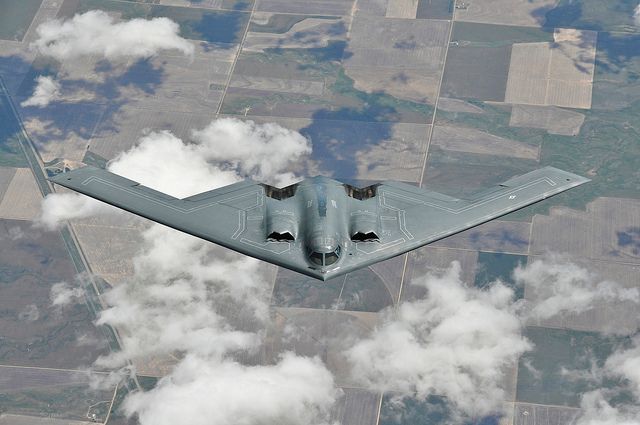
US B-2 nuclear capable bomber
“The B-52H’s return to the Pacific will provide [US Pacific Command] and its regional allies and partners with a credible, strategic power projection platform,” the Air Force said in a statement. “The B-52 is capable of flying at high subsonic speeds at altitudes up to 50,000 feet and can carry nuclear or precision guided conventional ordnance with worldwide precision navigation capability. This forward-deployed presence demonstrates the continued commitment of the US to allies and partners in the Indo-Pacific region.”
A week earlier, the Pentagon deployed three B-2 nuclear-capable stealth bombers to the Guam air base.
The deployments mark the first time in nearly two and a half years that all three bombers—the B-52s, B-2s and B-1Bs—have been assembled together in Guam, only 2,200 miles away from targets in North Korea.
The Bloomberg News agency reported Wednesday that the US Air Force “deployed an upgraded version of the U.S’s largest non-nuclear bomb—a 30,000-pound “bunker buster” that can only be carried by the B-2 stealth bombers now based in Guam.”
The weapon, which is larger than the so-called Mother of all Bombs (MOAB) dropped on Afghanistan last April “could be used if the US decided to hit underground nuclear missile facilities in North Korea,” Bloomberg reported
Meanwhile, the USS Carl Vinson, a US Navy Nimitz-class supercarrier, together with its accompanying strike group of guided-missile destroyers and other warships, departed from San Diego earlier this month and is scheduled to arrive off the Korean peninsula in advance of the Winter Olympic Games set to begin in Pyeongchang, South Korea on February 9. It will join the USS Ronald Reagan carrier battle group already deployed in Japan.
The USS Wasp, a 40,000-ton miniature aircraft carrier, is now operating from Japan, carrying F-35B jets, the Pentagon’s most advanced warplanes, which are capable of carrying B61 thermonuclear gravity bombs, a ground-penetrating bunker buster weapon that could be used against underground nuclear and command and control facilities in North Korea.
Alongside this buildup of nuclear strike forces, US ground and airborne troops have been rehearsing for an invasion at bases throughout the United States, while 1,000 Army reservists have been called up for active duty to man “mobilization centers” used for the rapid movement of troops overseas.
These feverish military preparations are taking place as South Korea has persuaded Washington to call off planned joint military exercises on the Korean peninsula itself, which Pyongyang had denounced as a provocation and preparation for invasion.
The South Korean government of President Moon Jae-in has used the upcoming 2018 Olympics Winter Games to resume dialogue with North Korea, which has agreed to send a large delegation to the games, with North and South Korean women ice hockey players joining for the first time in a unified team.
Kim Jong-un issued a conciliatory statement Thursday calling for all Koreans “at home and abroad” to work to “rapidly improve north-south relations” and for a “breakthrough for independent reunification.”
In Davos, meanwhile, South Korea’s Foreign Minister Kang Kyung-wha said at a news briefing, “The nuclear issue has to be solved through negotiations and diplomatic endeavors. This idea of a military solution is unacceptable.”
She declined to comment when asked if Washington had given Seoul clear assurances that it would not carry out a unilateral military strike. She added, “This is our fate that is at stake. Any option that is to be taken on the Korean peninsula, cannot be implemented without us going along.”
It is by no means clear, however, that the Trump administration has given Seoul any veto power over US military action. There is no doubt that Washington views the talks between Seoul and Pyongyang as a threat to its policy of “maximum pressure” against North Korea and a potential obstacle to its preparations for war. Far from decreasing the US war drive, any move toward accommodation between Seoul and Pyongyang is likely to only increase the pressure within the US ruling establishment and its military and intelligence apparatus to resolve the issue by means of military aggression.
Amid the US military buildup, the US government Wednesday rolled out a new round of sanctions aimed at strangling North Korea’s economy. These latest sanctions targeted nine entities, 16 individuals and six North Korean ships. Among those on the sanction list were two China-based trading firms.
Beijing reacted with hostility to the new sanctions. “China resolutely opposes any country using its own laws to carry out long-arm jurisdiction on Chinese companies or individuals,” a foreign ministry spokesperson said.
The continuing danger of war on the Korean peninsula, which carries with it the threat of a nuclear conflagration that could claim the lives of millions, was cited Thursday by the Bulletin of the Atomic Scientists in moving its so-called Doomsday Clock, which it has maintained since 1947, 30 seconds forwards, to two minutes to midnight. This is only the second time in more than seven decades that the group has assessed this grave a threat of nuclear war.
It also cited the Trump administration’s threat to upend the Iran nuclear deal and rising tensions between the US and Russia, the world’s two largest nuclear powers. It called attention as well to the Trump administration’s Nuclear Posture Review which seeks to “increase the types and roles of nuclear weapons in US defense plans and lower the threshold” for their use.
The administration and the Pentagon have also recently issued a National Security Strategy and a National Defense Strategy, which spell out a fundamental shift in US strategy, replacing the two-decade-old “global war on terror” with the preparation for “great power” conflict and world war, in which an emphasis is placed on the buildup of Washington’s nuclear arsenal.

Dag Hammarskjöld Journalism Fellowships at United Nations Assembly for Developing Countries 2018

Application Deadline: 12th March, 2018. 
Offered annually? Yes
Eligible Countries:
  • Developing nations of Africa, Asia (including Pacific Island nations), Latin America and the Caribbean.
  • For 2018 only, the Fund will not accept applications from the countries of the 2017 fellows – Afghanistan, Nigeria, Sudan and Zimbabwe – in an effort to rotate recipient countries.
To be taken at (country): New York, USA
Area of Interest: Journalism
About Fellowship: The Dag Hammarskjöld Fund for Journalists accepts applications from journalists of the developing nations of Africa, Asia (including Pacific Island nations), Latin America and the Caribbean to cover the United Nations General Assembly beginning in September each year. The fellowships offer a unique opportunity for promising young journalists from developing countries to see the United Nations at work and to report on its proceedings for news media in their home countries.
These awards require the presence of the selected journalist in New York during the first few months of the General Assembly session and should be regarded as an opportunity for news organizations and journalists to provide their audiences with special assignment news coverage from U.N. headquarters.
Offered Since: 1961
Type: Fellowship (Career)
Eligibility: The Dag Hammarskjöld Fund for Journalists fellowships are open to individuals who:
  • Are native to one of the mainly developing countries of Africa, Asia (including Pacific Island nations), Latin America and the Caribbean. For 2018 only, the Fund will not accept applications from the countries of the 2017 fellows – Afghanistan, Nigeria, Sudan and Zimbabwe – in an effort to rotate recipient countries.
  • Currently live in and write for media in a developing country.
  • Are between the ages of 25 and 35.
  • Have a very good command of the English language since United Nations press conferences and many documents are in English only.
  • Are currently employed as professional journalists for print, television, radio or internet media organizations.  Both full-time and freelance journalists are invited to apply.
  • Have approval from their media organizations to spend up to three months in New York reporting from the United Nations.
  • Receive a commitment from their media organizations that the reports they file during the term of the Fellowship will be used and that they will continue to be paid for their services.
Selection Criteria
  • Successful applicants must obtain a leave of absence from their employers.
  • By endorsing the application of a staff journalist for a fellowship, the editor undertakes to meet all telephone or other transmission charges and to publish or broadcast copy filed by the reporter.
  • Applicants must be full-time, professional journalists between 25 and 35 years old, be employed by a recognized print, radio, television, or internet media organization, and have a good working knowledge of English.
Number of Fellowships: not specified
Value of Fellowship: The Fund will provide: round-trip airfare to New York; accommodations; health insurance for the duration of the fellowship, and a daily allowance to cover food and other necessities. The Fund will not be responsible for other expenses of a personal nature, such as telephone calls.
Duration of Fellowship: first three months of the General Assembly session
How to Apply: 
  • CLICK HERE for the application in Word format
  • CLICK HERE for the application in PDF format (requires Adobe Reader, free download)
You MUST ALSO INCLUDE ALL necessary documentation as outlined in the Eligibility and Documentation Requirements with your application.
An originally completed AND signed application, along with all six (6) of the Documentation Requirements, should be sent by postal or courier service (such as DHL, FedEx, Airborne) to:
Dag Hammarskjöld Fund for Journalists
512 Northampton Street, No. 124A
Edwardsville, PA 18704 USA
Fellowship Provider: Dag Hammarskjöld Fund for Journalists
Important Notes: Applicants and/or their employers are required to provide equipment necessary for the applicants to efficiently and effectively report from the United Nations. Such equipment should include a laptop or notebook computer, digital camera (if appropriate), audio/visual recording and equipment needed for transmission, especially for TV. Selected journalists must be prepared technically to file their news stories over WIFI, whether broadcast or print, and arrive with a computer enabled for WIFI.

Doctoral Research Scholarships for Graduate Teaching Assistantships at RUFORUM Member Universities 2018

Application Deadline: 30th January 2018 5.00 pm Uganda time.
Eligible Countries: African countries
To Be Taken At (University): RUFORUM Member Universities
About the Award: The research supported through these scholarships should be aligned to the project challenge as well as contribute to the SENTINEL thematic areas. During this first round, we would like to invite applicants to propose research on one of the following topics:
  1. Environmental impact of different agricultural development pathways: What is the evidence regarding the environmental impact of smallholder / family farms in Africa vs commercially oriented larger farms in Africa? This could be either done via a systematic review of existing studies, or via a comparative, field based analysis between smallholder farms and commercial farms in a specific ‘hot spot’ (where there appears to be a tension between increasing agricultural production and conserving terrestrial ecosystems such as forests, wetlands etc.).
  2. Social impacts of different agricultural development pathways: As 1., but focusing on social impacts (such as impacts on equality, farmer empowerment, control over natural resources and other means of production etc.).
  3. A review and critical analysis of the extent to which, and effectiveness with which the current agricultural research agenda (in a specific country) incorporates environmental and social impacts of different agricultural approaches and technologies. This would be done initially at the national level (policy and practice review), but then zoom in on specific environmental and social impacts that are a priority in a given country.
  4. A review and critical analysis of the extent to which, and effectiveness with which the current agricultural extension / advisory services agenda (in a specific country) incorporates environmental and social impacts of different agricultural approaches and technologies. This would be done initially at the national level (policy and practice review), but then zoom in on specific environmental and social impacts that are a priority in a given country.
  5. A review and critical analysis of the extent to which, and effectiveness with which the current national farmer organisation’s agenda (in a specific country) incorporates environmental and social impacts of different agricultural approaches and technologies. This would be done initially at the national level (policy and practice review), but then zoom in on specific environmental and social impacts that are a priority in a given country.
  6. An analysis of the conditions favoring success (enabling condition, critical success factors) in efforts in the agriculture and/or the forestry sector to better manage the trade-offs between agricultural production and conservation of the remaining natural forests and woodlands.   This will be based on 1 or more success stories that will be identified by October 2017. This will require a holistic analysis exploring issues of governance and political economy alongside technology development and extension.
  7. An analysis of the effectiveness of current land use planning mechanisms / approaches in taking into account social and environmental impacts of agricultural development pathways.
  8. A historic analysis of the drivers for agricultural intensification and expansion a specific country, and how these are likely to change in the future.
Fields of Research: The project will focus on 3 research themes listed below:
  1. Understanding the past and present: Historical trends and current status of agricultural development and its social and environmental impacts, and the major technical, institutional, political and economic determinants;
  2. Scenarios of future agriculture and land use change: Driving forces that will shape the future of agricultural development – identifying key impacts, risks and trade-offs within and between socioeconomic and environmental dimensions and plausible alternative scenarios that warrant further investigation;
  3. Understanding impacts, risks and assumptions and trade-offs: within and between socio-economic and environmental dimensions of alternative scenarios for agricultural development, and the implications for biodiversity loss and ecosystem processes, and for the productivity and resilience of agriculture.
Type: Research
Eligibility: Graduate Teaching Assistants and potential PhD students should submit their research proposals that clearly articulates the justification, objectives, hypotheses, activities and methodology, detailed budget and the final outputs. The proposal must have a plan for disseminating findings from the research. The entire proposal should be a maximum of 10 pages (A4) with 1.5 line spacing.
Selection Criteria: The external reviewers will mainly use the following criteria to judge/rank proposals.
  • Overall project design, content and articulation/write-up
  • Appropriateness/relevance and contribution to SENTINEL project challenge and relevance to the Project research (themes proposed above)
  • The originality, innovativeness and contribution to science or development
  • Research activities clearly defined
  • Clear identification of pertinent research issues, achievable objectives
  • Evidence of a good understanding of the literature, rationale for the particular
  • Well-articulated methodological approach with evidence of good understanding of applicable methods
  • Clearly articulated engagement process with key stakeholders throughout the research process, and pathway for dissemination of results to communities, academia and, where appropriate, to service agencies, partners and policy-makers
  • Feasibility: Can the PhD student achieve this in the time available and is it of the expected standard for a PhD?
Number of Awards: 15
Value of Award: Each scholarship is a maximum of $7,500 and are meant to provide funds for student to carry out credible research in line with the Sentinel Project
Duration of Program: Two years
How to Apply: Apply for a scholarship via RUFORUM Information Management System (RIMS)
It is important to go through the application procedure and instructions on the Program Webpage (see Link below) before applying.
Award Providers: RUFORUM

Graduate Institute’s Geneva Challenge for Graduate Students Worldwide 2018

Application Deadline:
  • Registration for teams ends: 16th April 2018
  • Submissions are due by: 20th August 2018
Offered annually? Yes
Eligible Countries: Graduate students from all over the world
To be taken at (country): Geneva, Switzerland
About the Contest: “The Challenges of Climate Change”
The idea is to gather contributions that are both theoretically grounded and offer pragmatic solutions to a relevant international development problem stemming from an interdisciplinary collaboration between 3 to 5 enrolled master students from anywhere in the world.
This year, five prizes will be distributed; one in each of the following categories (based on the UN Statistics list):
  • Universities located in Africa
  • Universities located in Asia
  • Universities located in Europe
  • Universities located in North America and Oceania
  • Universities located in South America
Students are invited to
  • identify a challenge stemming from climate change;
  • construct an interdisciplinary analysis on how it affects different aspects of development in a specific (but transposable) context;
  • propose innovation at the policy, practice, process or technology levels turning the challenge into development opportunity.
Type: Contest (Essay)
Eligibility: Eligibility is based on evaluation by an interdisciplinary academic steering committee.
Selection Criteria:
  • An interdisciplinary academic steering committee will assess all submissions by students and select semi-finalists which will be published on the competitions website and then reviewed by an independent jury of experts with academic, governmental and private sector backgrounds.
  • Five finalist teams, one team per continent, will be invited (traveling and accommodation expenses covered) to an oral presentation in Geneva, where they will defend their ideas and answer questions from the jury and from the public. The finalists will also be present at an awards ceremony where the results of the contest will be announced preceded by a high-level key-note speech on the challenges of climate change.
Number of Awardees: Five teams (One team from each continent) of 3 to 5 enrolled Master students will be selected at the final stage.
Value of Contest: The ADG contest distributes 20,500 CHF in monetary prizes. The winning project is awarded CHF 10,000; the two teams in second place will receive CHF 5,000 and the two teams in third place, CHF 2,500.
How to Apply: 
Award Provider: The Graduate Institute, Geneva.
Important Notes: Endeavour to apply now, you may submit proposals later.

MTN Nigeria Graduate Programs for Young, Talented Nigerian Graduates 2018

Application Deadline: 28th January, 2018
To be taken at (country): Nigeria
About the Award: With over 52 million subscribers, we are one of the largest telecommunications operator in Nigeria, providing cellular network access and digital solutions to millions of people, connecting whole communities with each other and to the rest of the world. We are also the first Nigerian company to receive the prestigious Investors in People (IiP) accreditation, a global people management standard which reinforces MTN’s position as an employer of choice and our unique Employer Value Proposition (EVP). As we progress with our operations, our employees will continue to demonstrate our vision to lead the delivery of a bold, new Digital World to our customers, propelled by a mission to make our customers’ lives a whole lot brighter.
Global Graduate Development Programme (GGDP):
Our Global Graduate Development Programme (GGDP) provides an unparalleled opportunity to grow and advance your career. It is a 2-year structured development programme for young graduates, combining formal development (in partnership with Duke Corporate Education and the MTN Academy) and on-the-job learning. Upon completing the 2 year programme, graduates will be offered FULL EMPLOYMENT into MTN Nigeria subject to satisfactory performance during the 2 year period.
Thus, if YOU are:
• 26 years and below, with a 2.1/upper credit and have completed NYSC
• Willing to take accountability, get things done, actively collaborate, and are completely candid
• Excited about joining the team with the widest reach, a dynamic work culture and a passion for improving lives
Please go to “Vacancies” page to apply for the MTN Global Graduate Development Programme.
Accelerated Internship Programme (AIP)
Our Accelerated Internship Programme (AIP) is 2 year programme for graduates who aspire to develop a career in Customer Service with the team that has the widest reach. The AIP offers you the unrivalled opportunity to work with Customer Service Professionals in the industry and also exposes you to experienced mentors and coaches who will guide you on this quest. A Certificate of Completion will be issued to you upon completing the 2 – year Internship programme which will jumpstart your career in the industry.
Thus, if YOU are:
• 26 – 28 years old with a 2.2/lower credit and have completed NYSC
• 1 – 2 years experience in a client facing role
• Have a big picture focus, are emotionally intelligent and results driven
• Willing to take accountability, get things done, actively collaborate, and are completely candid
• Excited about joining the biggest telecommunications company with the widest reach and a passion for improving lives
Please go to “Vacancies” page to apply to our Accelerated Internship Programme.
Number of Positions: Not specified
How to Apply: Apply
Award  Provider:  MTN Nigeria
Important Notes: Applicants can only apply to ONE of our Graduate Programmes; applying to both will automatically disqualify you.

IFCN Education and Research Scholarships for Young Clinical Neurophysiologists in Developing Countries 2018

Application Deadline: 30th March 2018
Eligible Countries: Developing Countries
To Be Taken At (Country): Canada
About the Award: 
  • Education Scholarship: The IFCN awards THREE scholarships each of $25,000 USD for young clinical neurophysiologists wishing to spend at least 6 months in a neurophysiological laboratory with a national/international reputation. Applicants are expected to advance their training in Clinical Neurophysiology.
  • Research Scholarship: The IFCN awards THREE scholarships each of $25,000 USD for young clinical neurophysiologists wishing to spend at least 6 months in a neurophysiological research laboratory with a national/international reputation. Applicants are expected to participate in a research project.
Type: Training, Research
Eligibility: These scholarships will be split between applicants from economically disadvantaged countries and applicants from developed countries and covers at least 6 months of study (application should stipulate duration of studies). Applicants who are 35 years of age or less will be given preference.
Number of Awards: 6 (3 for each scholarship)
Value of Award: Both the education and research scholarships are for $25,000 USD.
Duration of Program: At least 6 months
How to Apply: In order to apply for these scholarships, applicants must attach:
• A Curriculum Vitae and list of publications
• Copy of identity card or passport with date of birth
• Description of the goal of the intended project (1 page)
• Letter of recommendation from home institution – *Letter must be signed and on the institution letterhead• Letter of acceptance from the host institution – *Letter must be signed and on the institution letterhead
Kindly note that the above documents must be in the order listed above on 1 PDF file.
The IFCN requires a positive progress report from the winners’ supervisor at the end of the first semester to continue the scholarship support, plus a final report by the winner to be sent within 3 months after completing the scholarship.
The Executive Committee of the IFCN will judge applications and its decision is final.
Deadline for submission is Friday, March 30, 2018 (date of receipt). 
Please send your application to the Secretariat of the IFCN via email at sstevenson@venuewest.com or mail to:
IFCN Secretariat – Stephanie Stevenson
c/o Venue West Conference Services Ltd.
300 – 1040 Hamilton Street
Vancouver, BC, Canada, V6B 2R9
Fax: 1.604.681-2503
Award Providers: International Federation of Clinical Neurophysiology

Commonwealth Eye Health Consortium (CEHC) Scholarships for Masters Students in LMIC Commonwealth Countries 2018/2019

Application Deadline: 11th May, 2018 17.00 BST.
Offered annually? Yes
Eligible Countries: Developing Countries
To be taken at (country): UK
About the Award: The Masters in Public Health for Eye Care at the London School of Hygiene & Tropical Medicine is a well-established course that aims to train leaders in prevention of blindness and to strengthen research and academic capacity for eye care programmes and training facilities, particularly in low- and middle-income countries. The course provides eye health professionals with the public health knowledge and skills required to reduce blindness and visual disability in their population.
Type: Masters
Eligibility: The applicant must:
  • come from low or middle income Commonwealth countries that are less represented in the alumni body of the MSc Public health for eye care.
  • work in regions where there are severe constraints in human resources for eyehealth
  • work in regions where there are no / limited training opportunities in PHEC /community eye health
  • demonstrate previous involvement / commitment to community eye healthactivities or VISION2020 programmes
  • present a clear career plan in public health for eye care, which they will realistically
  • be able to follow on completion of the MSc
  • have experience in public health for eye care based research and/or training in eyecare
  • fulfil the UK Border Agency English Language Requirement by passing the LSHTM English language requirement by 11 May, 2018.
Number of Awardees: Several scholarships are made available each year.
Value of Scholarship: Each scholarship covers course fees, two return flights, dissertation project funds, living costs and accommodation at the International Students House in Central London.
Duration of Scholarship: Duration of program
How to Apply: 
Apply to the London School of Hygiene & Tropical Medicine for a place on the course:
– For new applicants: LSHTM online application system is open for the 2018/19 academic year now. Apply here.
– For those who have been accepted from 2017/18: if you applied and were accepted to the 2017/18 academic year you must have requested to “be deferred” for the 2018/19 academic year. If you do not already hold a deferred offer of admission you will need to complete a new application.
2. To download the CEHC application, please click: CEHC 2018.19 – MSc PHEC Scholarships Application.
Download and complete the form and submit to the ICEH Student & Alumni Engagement Officer – Romulo Fabunan at Romulo.Fabunan@Lshtm.ac.uk by the deadline
Award Provider: London School of Hygiene & Tropical Medicine