5 Feb 2018

French president Macron to end lifetime job guarantee for public sector workers

Francis Dubois 

On Thursday, French Prime Minister Edouard Philippe and Public Finances Minister Gerald Darmanin announced a sweeping attack on public sector workers aimed at scrapping the legal statute of public sector workers’ rights established after the liberation from Nazi occupation.
“This plan aims to shatter to pieces the last taboos surrounding public sector workers and also marks the end of the dogma of life-time employment guarantees, upon hiring, for all public sector workers,” wrote the right-wing daily Le Figaro. The two ministers stated that the attacks would not apply to the police and intelligence forces, the military or the top ranks of the state bureaucracy, but to the mass of public sector workers.
They are directly targeting the roughly 4 million workers who have public sector status in France. Though eroded by attacks under Socialist Party and right-wing governments alike, the “statute” governing their working conditions has still formally guaranteed fundamental rights including lifetime employment, guaranteed base pay, regular promotion and regular wage increases.
It also grants vacations and easier conditions for retirement or early retirement without penalties. Only 10 years ago, public sector workers still retired three years earlier than private sector workers. They also had a guaranteed right to strike and to join political and trade union organizations.
The measures announced by Philippe and Darmanin include a massive resort to “contract workers,” who will replace public sector workers but be denied the rights of the public service. At the same time, a plan for an essentially unlimited number of “voluntary departures” aims to sack tens of thousands of workers who will have to find jobs in the private sector. This will allow the state to cut public-sector wages by €4.5 billion ($5.6 billion) by 2020.
No economic sector is to be left untouched. Particularly heavily hit will be services earmarked for “reorganization,” including teachers, health care workers, and local services. Until now, public sector job cuts had always been limited to attrition, i.e., to not replacing workers as they retired.
The government also aims to introduce “merit pay,” a poison pill that would eliminate the right to a fixed salary for a specified duration of work. It is to be used as a financial whip against the public-sector workers, to break solidarity among them. For public administrations, including the schools and the hospitals, the government is demanding “indicators of results,” thanks to which it will be possible to measure the “return” produced by the workers (and so, ultimately, their pay), who are thus to be placed under constant pressure.
Another measure that is not widely discussed but actively prepared is the privatization of work carried out by public sector workers and various public enterprises and administrations. These privatizations should occur “wherever the private sector can find its place,” former government spokesman Christophe Castaner said last May. Thursday, from Tunis, Macron stressed that the public service should “reorganize itself faster, as companies do.”
It is not only the statute of the rail workers that is to be suppressed, for example, but also their retirement plan. Since September, Macron has insisted that the change to the statute of the rail workers should include the suppression of their special pension system.
A wide swath of the social gains introduced after World War II are targeted for destruction. Macron stated Thursday that the statute had to be reformed since “elements of business practice … cannot be implemented due to rigidities.”
This confirms the analysis of the WSWS during the brutal attacks of the European Union (EU) in Greece: the European financial aristocracy was taking aim at the basic social gains that workers obtained after the defeat of Nazism in 1945, and that went back ultimately to the 1917 revolution in Russia.
Macron’s attack is part of a broad confrontation of the continent’s ruling elites with the European working class. In Germany, the largest EU economy, a “Grand Coalition” government is being prepared that will carry out massive attacks on the working class to finance the re-militarization of Germany and its return to great-power politics.
Powerful strikes of German metal and auto workers in recent days are for now effectively blocking the installation of a new coalition government of social-democratic and conservative parties, which have presided for years over a vast transfer of wealth from the workers to the super rich. On Saturday, tens of thousands of people protested in London against the attack on the National Health Service by the right-wing, pro-Brexit government. The NHS is another fundamental gain of the working class in Britain, obtained after World War II.
Just as the German unions are aiming mainly to let off steam to avoid a mass movement against the ruling parties, the French unions have no intention of damaging Macron by defending the public-sector workers. The union leaders are aware of the historic magnitude of the attacks, and their reactions of surprise and indignation are utterly hypocritical. They called for a vote for Macron last year, well aware of his plans for an attack on the public sector, which they have been discussing with him since September, just as they had also negotiated with him the attack on the Labor Code.
Their nationalist program of defense of the competitiveness of their “own” bourgeoisie on the world market, sacrificing the workers to this aim, is essentially the same as that of Macron. They are organically opposed to uniting the struggles of the working class internationally.
The statute of the public sector was, with Social Security, one of the major reforms at the Liberation, introduced by the French Communist Party, which used them to justify Stalin’s policy of strangling proletarian revolution against the discredited fascist bourgeoisies across Europe. Now, the Stalinists, the social democrats and the trade unions are trying, by capitulating to a reactionary governmental cabal led by a free-market president, to definitively destroy it.
A struggle to defend every gain of the working class requires drawing a balance sheet of the bankruptcy of nationally based perspectives, which all lead in the final analysis to collaboration with the capitalist class, and organizing the struggles internationally across Europe independently of the trade unions. The basis of this struggle is a truly socialist and internationalist program for the taking of power of the working class and the building of the United Socialist States of Europe.

German grand coalition parties negotiate over rearmament and war

Johannes Stern

A third edition of the grand coalition will not simply continue the policies of the current one. It will massively upgrade the military, initiate a new round of social attacks and establish a police state in close cooperation with the far-right AfD. This is becoming increasingly clear with the approaching agreement between the SPD and the conservative Christian Democratic Union and the Christian Social Union (both parties known as the Union).
While the media reported “breakthroughs” in health and housing policies on Sunday evening, initial information on the coalition paper shows what it is really about.
The Handelsblatt reported that the Bundeswehr should get combat drones “as soon as possible.” That is what the Union and the SPD had agreed on in the foreign policy and defense negotiating group. The purchase is part of a broader push for a joint European military and major power policy. The draft of the Foreign and Defense Policy chapter states: “We will continue the development of the Euro-drone in the framework of the European Defense Union.” As a “temporary solution” is “the Heron TP drone leased.” It should serve the Bundeswehr “until the Euro drone to be developed is ready.”
Comments and strategy papers by influential military strategists leave no doubt as to what is being prepared behind closed doors. “The coalition negotiations are not just about the usual machinations,” write Thomas Kleine-Brockhoff, the speechwriter of former German president Joachim Gauck, and Jan Techau, the director of the Richard C. Holbrooke Forum at the American Academy in Berlin, in a contribution for the German daily Die Welt. “In the midst of increasingly threatening times, it is about decisions of strategic importance: Will the Federal Republic in future [...] entertain modern, combat-ready and coalition-able armed forces?”
The entire comment makes clear what the next federal government is planning: “It wants to invest €130 billion in new material within 15 years and to increase troop strength by a few thousand men. The defense budget should approach two percent of gross domestic product by 2024. The German government—with support from the ministers of the grand coalition—has already pledged this to its NATO partners in 2014 and 2016.”
Claudia Major, a representative of the government-affiliated think-tank German Institute for International and Security Affairs (SWP), goes even further in a comment entitled “Germany’s dangerous nuclear sleepwalking.” She writes, “The next German government will have to tackle several controversial security issues, from arms exports to meeting NATO’s target of spending 2 percent of GDP on defense. But the one item that is particularly difficult for Berlin—and that it is ill-prepared to deal with—is nuclear weapons.”
The Socialist Equality Party (SGP) has already warned during the federal election campaign last summer that the policy of the next government will be determined not by the electoral promises of the parties, but by the international crisis of capitalism and the reaction of the ruling class. This is now being confirmed in a dangerous way.
Major writes, “In February, the United States wants to publish its Nuclear Posture Review. North Korea wants to stay high on Washington’s security agenda. The Iran deal is fragile. As for NATO, nuclear policies remain at issue; the alliance has voiced its concern on Russia’s alleged violation of the Intermediate-Range Nuclear Forces (INF) Treaty. All this will affect the German debate, whether it is prepared for it or not.”
Comments such as these expose the promises of the SPD and the Union to spend more on education and social issues as bold lies. In fact, the next federal government will make the working class pay in every respect for its militarism and imperialist power politics—as cannon fodder in war and in the form of massive welfare cuts to finance rearmament. Leading business representatives, such as Siemens boss Joe Kaeser, are demanding multibillion-dollar tax cuts à la Trump also for the local companies in order to make German capital competitive internationally.
Domestically, the Union parties and the SPD are planning the establishment of a police state. According to media reports, both want to strip alleged terrorists with dual nationality of their German passports and expand DNA analysis. So far, it was only allowed to analyze the genetic material in criminal proceedings to determine a person’s ancestry and gender. In the future, the analysis should include the age and external characteristics such as eyes, hair and skin color. Also, the video surveillance at so-called “focal points” should be “effectively expanded.” The judiciary is to create 6,000 new jobs, one-third of them in the penal system alone. Union and SPD are seeking 15,000 additional jobs from federal and state security agencies.
The ruling class is reacting to the growing resistance to their anti-social and militarist policies. In Germany and many other countries anger is brewing below the surface. The strikes of more than a million workers in the metal and electrical industry last week are part of a revival of the international class struggle. Previous mass protests have already taken place in Iran and Tunisia, tens of thousands protested in Greece against the austerity policies of the Syriza government, and in Romania, Ford workers were striking against the company-controlled union.
Under conditions of growing class struggle and sharp international conflicts, the ruling class, as in the 1930s, is relying on right-wing forces. Domestically, it became apparent in the past few days that the grand coalition will essentially take over the program of the AfD.
After the Union parties and the SPD had already taken up the demand of the extreme right for an upper limit (“Obergrenze”) for refugees, they decided on Thursday to abolish the right to family reunification for refugees. At the same time, they made three representatives of the extreme-right-wing of the AfD chairmen of important Bundestag committees.
This decision was also supported by the Left Party. “I think the AfD is entitled to these functions. That is parliamentary custom. And she [the AfD] is elected, and insofar she has the right to these functions,” stated Sahra Wagenknecht, the leader of the Left party faction, on a television talk show.
The SPG is the only party that fights the right-wing conspiracy in Berlin on the basis of a socialist program and demands new elections. For the establishment of the most right-wing German government since the fall of the Nazi regime, the ruling class has no mandate at all. Already in the elections in September, the Union and the SPD had their worst results in the postwar period and lost a total of 14 percent of the vote. Now, according to a recent survey, the SPD stands at its all-time low of 17.5 percent. Another recent poll showed that not even one in three (32 percent) support the formation of a grand coalition government.

UK unions and Labour suppress struggle to defend National Health Service

Robert Stevens

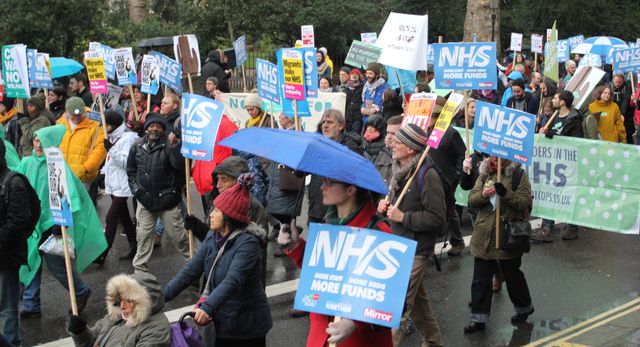
Around 40,000 to 60,000 people demonstrated in London Saturday in defence of the National Health Service (NHS).
The demonstration, headlined, “NHS in crisis—Fix it Now,” was organised by the People’s Assembly and the Health Campaigns Together coalition.
A section of the march to defend the NHS
The march assembled in Gower Street, with protesters marching through central London to Downing Street where a rally was held.
The People’s Assembly is backed by the Trades Union Congress (TUC), the UK’s two largest trade unions—Unite and Unison—the Green Party and an assortment of Stalinist and pseudo-left groups.
Health Campaigns Together unites various local initiatives in defence of the NHS.
The march was significantly smaller than a demonstration called last March by the same organisations, which attracted up to 250,000 people. The lower participation does not represent any lessening of hostility to the government’s ongoing destruction of public health care. The march was held under conditions of an ongoing “winter crisis,” which has seen many people denied basic health care and scores of people dying due to a lack of basic funding and resources. Many who attended brought their own homemade banners in protest at the cuts and demanded more funding for the NHS and an end to its privatisation.
The main reason for the decline in numbers was twofold.
Despite the pledges by the trade union bureaucracy to organise a “fight” in defence of the NHS, they have not lifted a finger as the government has intensified its attacks. Many workers did not attend as they have concluded that the unions will not mobilise to defend anything. In 2016, the British Medical Association, agreed a sell-out deal imposing an inferior contract on tens of thousands of striking junior doctors. The doctors had widespread support among other health workers and the working class for their struggle, but the betrayal of the BMA allowed the Tories to go on the offensive against the NHS.
The unions did virtually nothing to mobilise their membership in support of Saturday’s demonstration. Unison has around 500,000 members employed in the NHS, while Unite boasts of having has 100,000 members “across the health sector.”
The main demands of the organisers were based on pleas to the Conservative government, which has slashed tens of billions from the NHS budget since 2010, to fund the NHS properly. The call for the demonstration stated, “The Tories must heed the call of the public, staff and patients alike who demand that #ourNHS is not only funded properly but brought back into public hands away from the waste and demands of shareholders and bankers’ bonuses.”
In place of any recognisable national figures, the unions sent people to speak on their behalf who few will have heard of. Speaking on behalf of the Trades Union Congress was Paul Nowak, apparently the organisation’s deputy general secretary and before that its assistant general secretary. Speaking on behalf of Unison was one Helga Pile and for Unite, its “national officer” Sarah Carpenter.
Speaking on behalf of the Labour Party was Shadow Health Secretary, Jon Ashworth, who has held the position for just 15 months. He was sent because Labour leader Jeremy Corbyn and his advisers took the decision that he should absent himself from the protest. Corbyn was featured at last year’s demonstration as the keynote speaker and told the hundreds of thousands who attended, “We’ve got the faith, we’ve got the fight and we are up for it!”
This rhetoric was in reference to the statement of Anuerin Bevan, who inaugurated the NHS in 1948, that “The NHS will last as long as there are folk left with the faith to fight for it.”
The People’s Assembly and Health Campaigns Together maintain that the NHS can only be defended by the health unions, while the election of a Corbyn-led Labour government offers the only political road forward. On this basis, Ashworth was introduced as the representative of “the government in waiting.”
In reality, the NHS has been brought to the brink of destruction by decades of attacks by successive Labour and Tory governments. The large-scale introduction of the Conservatives Private Finance Initiative (PFI) into the NHS—which pioneered its ongoing privatisation—was carried out by the 1997-2010 Labour government. In 2012, the Tories introduced the Health and Social Act—which removed the responsibility from the Health Secretary to provide a universal healthcare system in England. This has now been in place for six years.
A general election is not scheduled to be held until 2022, by which time there will be little left of the NHS to “fight” for, with more than £20 billion in additional “efficiency saving,” i.e., savage cuts, set to be imposed.
Labour have no intention of lifting a finger in defence of the NHS. Rather, the prospect of a Labour government that will reverse all the attacks on the NHS is being used by Corbyn and his backers among the pseudo-left groups to dampen down and suppress any fightback based on the class struggle and a mass mobilisation of the working class.
Last year, Corbyn and his main ally, Shadow Chancellor John McDonnell, were greeted with genuine enthusiasm by workers who saw his rise to leadership as proof that a genuine fightback was being prepared after years in which Labour was dominated by the Blair and Brownite advocates of the market and privatisation.
A year on, Corbyn decided it was more important to address a meeting of party bureaucrats instead of the NHS rally. Instead of fight, workers have been told to wait until Corbyn is comfortably ensconced in Number 10.
Corbyn sent a brief video statement to protesters that was meant to be shown on the big screen at the rally’s climax, but the organisers—who said it would be the only fitting end to the rally—could not get their act together in order to show it.
Had the protesters been given the opportunity to watch the video—which lasted just 90 seconds—they would have seen Corbyn offer a message that everyone was doing a grand job in protesting on a “cold winter’s day.”
Corbyn declared, “It can’t have escaped anyone’s notice that the NHS is in crisis,” but offered nothing other than the prospect of an end to Tory rule in 2022. Declaring that Labour would fight for the NHS, he added that in government the party would “end the Tories’ privatisation” and give the “NHS and its amazing staff the resources they need.” Everyone should apparently “celebrate our wonderful National Health Service.”

Downing of Russian fighter in Syria threatens wider war

Peter Symonds

The shooting down of a Russian warplane over northern Syria on Saturday threatens to dramatically escalate the confrontation between Washington and Moscow over the US-backed proxy war to oust the Russian-supported regime of President Bashir al-Assad. The Russian media and senior political figures are already accusing the United States of involvement.
The Russian Defence Ministry reported that a Sukhoi Su-25 was struck by a portable surface-to-air missile, or MANPAD, in the northern Syrian province of Idlib. The pilot, who has not been named, ejected from the plane but was killed on the ground during “a fight with terrorists.” The Su-25 is a low-flying, ground attack aircraft.
The Al Qaeda-aligned Tharir al-Sham claimed responsibility, saying one of its fighters scored a direct hit with a shoulder-launched anti-aircraft missile. The Russian Defence Ministry announced that retaliatory strikes against anti-Assad forces in the area killed more than 30 fighters.
Russian senator Frants Klintsevich, deputy chairman of the Russian Federation Council Defence and Security Committee, blamed the US for the downing. “I am absolutely convinced... that today the militants have MANPADs, and they were supplied by the Americans through third countries,” he said.
Klintsevich called for a thorough investigation to determine the type of MANPADs that have been supplied and the “circumstances of the downing of the Su-25.” He warned “the loss of one aircraft is nothing, but it has great significance and far-reaching consequences.”
Russian parliamentarian Dmitry Sablin blamed an unnamed country, neighbouring Syria, for supplying the MANPAD used to shoot down the plane. “Countries from whose territory weapons arrive, that are then used against Russian servicemen, must understand that this will not go unpunished,” he said.
The Pentagon quickly denied supplying MANPADs to US-backed militias and reiterated the lie that its combat operations are solely focussed on the now-defeated Islamic State of Iraq and Syria (ISIS). “The US has not equipped any partner forces in Syria with surface-to-air weapons and has no intent to do so in the future,” Pentagon spokesman Eric Pahon told the Russian media on Saturday.
The denial does not stand up to serious examination. The US announced just last month that it would arm and equip a 30,000-strong “border force” made up predominantly of Kurdish People’s Protection Units (YPG) to carve out, in effect, an American-aligned enclave in northern Syria from which to launch attacks on the Assad regime.
The US plans are rapidly unravelling. Turkey, which brands the YPG as terrorists aligned to the separatist Kurdistan Workers Party in Turkey, launched a full-scale offensive in the Kurdish enclave. At the same time, Syrian government forces, backed by Russia, began their own attacks on Western-aligned militias seeking to cling onto what remains of opposition-controlled territory.
A lengthy editorial in the New York Times last Wednesday entitled, “As US allies clash, the fight against ISIS falters,” reviewed Washington’s incoherent and contradictory policy that has led to all-out fighting between NATO ally Turkey and the US proxy forces in Syria. Desperate to square the circle, the US gave the green light for the Turkish offensive but drew a line at the Syrian town of Manbij, where hundreds of American troops are based, along with Kurdish militias.
In concluding, the New York Times bitterly attacked Russia and Iran for manoeuvring “to ensure they will have a permanent presence and influence” and accused the United States, effectively President Donald Trump, of “shirking its responsibility for Syria’s political future.” The editorial can be read only as a call for action to rein in Russia and Iran so as to prevent the US from being further marginalised in the Syrian quagmire that it created. Days later, the apparent response came in the form of the downing of a Russian warplane that was attacking US-aligned forces.
In the murky world of Syrian oppositional intrigues, where right-wing Al Qaeda-aligned militias collaborate with openly pro-Western groups and the CIA and US Special Forces, it is impossible to know exactly who supplied the MANPAD and who gave the decision to fire it, or even which militia did the firing.
The Debkafile, which has close ties to Israeli intelligence, reported last month that the Pentagon was “sending the YPG [Kurdish militia] man-portable air defence systems—MANPADs—which are especially effective against low-flying jets and helicopters.”
In an article entitled “Who pulled trigger on Russian jet in war zone bristling with arms?” Al Arabiya pointed out that a number of Syrian opposition militias have access to anti-aircraft missiles. It said US FIM-92 Stingers, one type of MANPAD, were manufactured under licence in Turkey by the Roketsan corporation, and, according to US-based analyst Theodore Karasik, had been delivered to “many Syrian opposition forces, like the [Western-aligned] Free Syrian Army, around Idlib.”
Regardless of who precisely pulled the trigger, the latest incident underscores the extremely tense situation in which Russian and American military forces face off at close quarters on opposing sides of Syria’s disastrous civil war.
The danger of a conflict between the two nuclear-armed powers has been greatly exacerbated by the Trump administration’s release of a new National Defence Strategy in January, which declared that “inter-state strategic competition,” not terrorism, was “now the primary concern.” It branded China and Russia as “revisionist powers” and said the US must “prioritise preparedness for war.”
That was further reinforced last Friday with the release of the latest US Nuclear Posture Review. It names Russia, along with China, North Korea and Iran, as potential threats and calls for an expansion of the US nuclear arsenal. It recommends the development of a range of new weapons that could be used in situations other than full-scale nuclear war, effectively undermining agreements to wind back nuclear arsenals.
The Syrian civil war is just one of the dangerous flashpoints in the Middle East and around the world that could set off a catastrophic conflict as all sides manoeuvre and intrigue to boost their presence and influence. The chief responsibility, however, lies with US imperialism. For the past quarter century, it has waged one war of aggression after another, turning Syria, Yemen, Iraq and the entire region into a volatile powder keg.

2 Feb 2018

Orange Knowledge Programme (OKP) Fellowships for Students in Developing Countries to Study in The Netherlands 2018

Application Deadlines: Deadlines vary by choice of institution
Offered Annually? Yes
Eligible Countries: Afghanistan, Albania, Armenia, Bangladesh, Benin , Bhutan, Bolivia, Burkina Faso, Cambodia, Colombia Cuba, , DR Congo, Egypt Ethiopia Ghana Georgia, Guatemala India, Indonesia Kenya  Jordan, Lebanon, Liberia Macedonia, Mali, Mozambique Myanmar Nepal, Nicaragua, Nigeria, Pakistan, Palestinian Territories Peru, Philippines, Rwanda Senegal, Sierra Leone Somalia, Sri Lanka, South Africa South Sudan, Sri Lanka Sudan, Suriname, Tanzania Uganda Thailand, Vietnam Yemen Zambia Zimbabwe.
To Be Taken At (Country): The Netherlands
About the Award: On 1 July 2017 the Netherlands Fellowship Programmes (NFP) entered a new phase as a new programme under the name Kennisontwikkelings programma (KOP). KOP aims to advance the development of the capacity, knowledge and quality of both individuals and institutions in higher and vocational education.
Type: Fellowship, Masters, Short Courses/Training
Eligibility: One must be a professional and a national of, and working and living in one of the countries on the OKP Country list valid at the time of application;
  • One must have a current employer’s statement that complies with the formal Nuffic has provided. All information must be provided and all commitments that are included in the formal must be endorsed in the statement;
  • One must not be employed by an organisation which can be expected to have their own funds for staff development, e.g.: a multinational corporation (e.g. Shell, Unilever, Microsoft) a large national and/or a large commercial organisation; a bilateral donor organisation (e.g. USAID, DFID, Danida, Sida, Dutch ministry of Foreign affairs, FinAid, AusAid, ADC, SwissAid); a multilateral donor organisation (e.g. a UN organisation, the World Bank, the IMF, Asian Development Bank, African Development Bank, IADB); an international NGO (e.g. Oxfam, Plan, Care).
  • One must have a current employer’s statement which complies with the format Nuffic has provided. All information must be provided and all commitments, which are included in the format, must be endorsed in the statement;
  • One must have a government statement that meets the requirements of the country in which the employer is established (if applicable);
  • One must have an official passport valid at least three months after the submission date of the registration form by the candidate
Selection Criteria: The fellowships are awarded in a very competitive selection to highly motivated professionals who are in a position to introduce the newly-acquired skills and knowledge into their employing organisation.
Number of Awards: Not specified
Value of Award: A KOP NFP fellowship is intended to supplement the salary that you should continue to receive during the study period in the Netherlands. The allowance is a contribution towards your costs of living, the costs of tuition fees, visas, travel, insurance and thesis research. If applicable, the fellowship holder is expected to cover the difference between the actual costs and the amount of the personal KOP NFP allowances.
Duration of Program: 
How to Apply:
  • Before you apply, make sure you review the eligibility criteria carefully and check whether your employer is willing to nominate you for the scholarship.
  • When you are certain that you are eligible for a KOP NFP scholarship, you can start making the necessary preparations for your application.
  • It is important to read thoroughly about the application process on the Program Webpage before applying.
Award Providers: OKP NFP is initiated and fully funded by the Dutch Ministry of Foreign Affairs under the budget for development cooperation. 

Masters and PhD in New Zealand Through the Commonwealth Scholarships 2018/2019

Application Deadline: 28th March 2018
Eligible Countries:
  • Africa: Botswana, Cameroon, Ghana, Kenya, Lesotho, Malawi, Mauritius, Mozambique, Namibia, Nigeria, Rwanda, Seychelles, Sierra Leone, South Africa, Swaziland, Tanzania, Uganda, Zambia.
  • Caribbean: Belize, Dominica, Grenada, Guyana, Jamaica, St Lucia, St Vincent and the Grenadines.
  • Asia (Other)Bangladesh, India, Malaysia, Pakistan, Sri Lanka
  • Pacific: Cook Islands, Kiribati, Nauru, Niue, Papua New Guinea, Samoa, Solomon Islands, Tonga, Tuvalu, Vanuatu.
To be taken at (country): New Zealand
About the Award: The Commonwealth Scholarship and Fellowship Plan (CSFP) is an international programme under which member governments offer scholarships and fellowships to citizens of other Commonwealth countries. The CSFP was established at the first Commonwealth education conference in 1959 and is reviewed by education ministers at their triennial meetings – the only scholarship scheme in the world to receive such high-level recognition.
Type: 
  • Master’s
  • PhD
Eligibility: Applicants must meet the following conditions to be eligible for a New Zealand Scholarship:
  • Be a member of a Commonwealth country
  • Be a minimum of 18 years of age at the time of commencing your scholarship.
  • Be able to satisfy Immigration requirements for international student entry to New Zealand or the country in which you will undertake your scholarship (i.e. medical checks, police clearances/character checks, etc.)
  • Be academically and linguistically able to obtain an Offer of Place for the proposed programme of study from the tertiary institute where you will undertake your scholarship.
  • Not have been previously terminated from a New Zealand Government Scholarship
  • Seek a qualification that will contribute to the sustainable development of your home country
  • Commit to return to your country for a minimum of 2 years at the end of your scholarship.
Number of Awardees: Not specified
Value of Scholarship: New Zealand has first-rate education institutions that offer world-recognised qualifications. Successful applicants will have access to excellent academic knowledge in quality facilities. The scholarships include financial support for tuition, living costs while in New Zealand, and airfares. The partners of students are eligible for a work visa that allows them to live and work in New Zealand for the duration of their partner’s study.
Duration of Scholarship: New Zealand Commonwealth Scholarships are available for the following postgraduate qualifications:
  • Master’s Degree (1 – 2 years)
  • PhD (up to 3.5 years)
How to Apply: The application process for a New Zealand Commonwealth Scholarship is different to other New Zealand Scholarships. Applicants must submit their applications to their country’s ‘Nominating Agency’ first. The Nominating Agency then ‘nominates’ two applicants from the submitted applications to send to the New Zealand Ministry of Foreign Affairs and Trade. Read the Commonwealth section of the How to Apply page carefully before you submit an application.
Award Provider: New Zealand Commonwealth Scholarships are funded by the New Zealand Aid Programme and managed by the Ministry of Foreign Affairs and Trade (MFAT).
Important Notes: only applications studying within your country priority sectors will be considered.

New Zealand Development Scholarships for African and Developing Countries’ Students 2018/2019

Application Deadline: 14th March 2018
Offered annually? Yes
Eligible African countries: Algeria, Angola, Botswana, Cameroon, Djibouti, Egypt, Ethiopia, Gambia, Ghana, Kenya, Lesotho, Malawi, Mauritius, Morocco, Mozambique, Namibia, Nigeria, Rwanda, Senegal, Sierra Leone, South Africa, Swaziland, Tanzania, Tunisia, Uganda, Zambia, Zimbabwe.
To be taken at (country): New Zealand
Fields of study: Preference will be given to candidates who apply to study in academic disciplines relating to one or more of the following:
Agriculture development
  • Agri-business Management, AgriComerce, Agriculture Economics, Agricultural and Environmental Systems, Agriculture Systems, Agriculture Systems extension and innovation; Dairy Systems;
  • Agriculture and/or Horticulture Management, Rural Development, Agriculture and/or Horticulture Domestic Supply Chain Management and Distribution, Natural Resource and Environmental Impact Assessment
  • Public Policy, Administration, Finance, or Governance directly related to one of the above areas
Renewable energy
  • Geothermal, Solar, Hydro-electric and Wind Energy, Energy Engineering and Renewable Energy Distribution Systems
  • Market reform and sector management, including Energy Economics and Energy Efficiency
  • Public Policy, Administration, Finance, or Governance in the above areas
About Scholarship: New Zealand Development Scholarships (NZDS) give candidates from selected developing countries an opportunity to gain knowledge and skills through study in specific subject areas which will assist in the development of their home country. Awardees are required to return to their home country for at least two years after the completion of their scholarship to apply these new skills and knowledge in government, civil society or private business organisations.
Who is eligible to apply? Applicants must meet the following conditions to be eligible for a New Zealand Scholarship:
  • Be a minimum of 18 years of age at the time of commencing your scholarship.
  • Be a citizen of the country from which you are applying for a scholarship.
  • Not have citizenship or permanent residence status of New Zealand, Australia, USA, Canada, European Union countries, United Kingdom, Japan, Israel, South Korea, Qatar, United Arab Emirates, Saudi Arabia. Have resided in your home country for at least two years immediately prior to commencing your scholarship. Have at least 2 years of work experience (part time or fulltime, paid or voluntary).
  • Not be serving military personnel.
  • Be able to satisfy Immigration requirements for international student entry to New Zealand or the country in which you will undertake your scholarship (i.e. medical checks, police clearances/character checks, etc.)
  • Be academically and linguistically able to obtain an Offer of Place for the proposed programme of study from the tertiary institute where you will undertake your scholarship.
  • Not have been previously terminated from a New Zealand Government Scholarship
  • Seek a qualification that will contribute to the sustainable development of your home country
  • Commit to return to your country for a minimum of 2 years at the end of your scholarship.
Number of Scholarship: Several
What are the benefits? New Zealand has first-rate education institutions that offer world-recognised qualifications. Successful applicants will have access to excellent academic knowledge in quality facilities. The scholarships include financial support for tuition, living costs while in New Zealand, and airfares. The partners of students are eligible for a work visa that allows them to live and work in New Zealand for the duration of their partner’s study.
Duration of sponsorship: New Zealand Development Scholarships are available for the following qualifications:
  • Postgraduate Certificate (6 months)
  • Postgraduate Diploma (1 year)
  • Master’s Degree (1 – 2 years)
  • PhD (3 – 4 years)
How to Apply: If you are interested in applying for a scholarship, we encourage you to go through and complete the required Steps way before application deadline in March 2018.
See the How to Apply page for details.
Sponsors: The New Zealand Development Scholarships are funded by the New Zealand Aid Programme, the New Zealand Government’s overseas aid and development programme and managed by the New Zealand Ministry of Foreign Affairs and Trade (MFAT).

Making India Healthy

Ashish Kumar Singh

In today’s world, where almost everything is a click away for many, access to healthcare, descents into alcoholism, and misperceptions about illnesses can still take us back to the eighteenth century. In this brief article, the idea is to give an overview of the interplay between the aforementioned determinants while presenting some evidence from the ground.
The World Health Organization (WHO) defined human health as “a state of complete physical, mental, and social well-being and not merely the absence of disease or infirmity.”; and mental health as “a state of well-being in which the individual realizes his or her own abilities, can cope with the normal stresses of life, can work productively and fruitfully, and is able to make a contribution to his or her community”. The main factors influencing health of an individual vary from socio-economic status to individual habits and behaviours. As any society moves from one demographic to another, the challenges to health and well-being of its citizens also change accordingly. While many of these challenges can be tackled by the timely and good healthcare facilities, ignorance and relying on unrealistic treatment methods and mechanisms can lead to harmful effects, which is not so such an unusual case in developing societies.
India, with a population of 1,324,171,354 in 2017, stood second as the most populous country in the world. More than 50% of its population ranks below the age of 25 and more than 65% below the age of 35. With 158,789,287 people between the age group of 0-6 years, 69% of the population still living in the rural areas, 74.03% of India’s people are literate. One-fifth of maternal deaths and one-quarter of child deaths in the world occur in India. Life expectancy at birth is 63 years for males and 66 for females, and the under-5 mortality rate of 69 per 1000 births in India falls behind the South-East Asia regional average. While health outcomes have improved over time, they continue to be patterned along dimensions such as gender, caste, wealth, education, and geography. Substantial geographic inequalities in health outcomes in India, with life expectancy ranging between 56 years in Madhya Pradesh to 74 years in Kerala; a difference of 18 years, which is higher than the provincial differences in life expectancy in China, or the inter-state differences in the United States.
Perceptions and utilization of preventive services such as antenatal care and immunizations also vary among different groups of society by gender, socioeconomic status, and geography, household wealth and education, caste, and place of residence (rural vs urban). Inadequate access to appropriate maternal health services remains an important determinant of maternal mortality. General hospitalization rates also vary by gender, wealth, and urban-rural residence.
Perceptions about illness among patients and the people close to them play an important role in the overall health condition of individuals and society. These illness perceptions, directly influence the individual’s emotional response to the illness and their coping behaviour such as adherence to treatment. An important point to remember is that the patient’s view of the symptoms caused by the illness may be quite different from that of the medical staff treating the condition. Although, there may not be any clear and direct correlation between the perception of illness among patients and the clinical diagnosis, these perceptions are associated with increased future disability and a slower recovery, independent of the initial medical severity of the condition. Then again, a very crucial question comes up, especially in developing societies like India, about a small percentage of the population relying on modern health facilities, rather than going to a traditional healer, or conducting self-medication or religious rituals.
Let us look at the challenges related to alcoholism. Although Max Mueller observed that there was no common root in the Aryan languages for wine or liquor, as per a World Health Organization report cited that one in every twenty Indian males have an addiction or alcohol related disorder; with 38.3 per cent of the world’s population consuming alcohol regularly. In comparison, thirty per cent of Indian population consumes alcohol regularly, with approximately 11% of Indians being moderate to heavy drinkers. Alcohol is available in close vicinity for majority of the population, and people in different areas (depending on their socio-economic class, literacy level etc.) drink with different frequencies and in varying amount. Alcoholism as well as treatment to alcoholism is a gradual process. The harmful psychological effects of uncontrolled alcohol consumption leads to serious threats to the society, including affecting the financial conditions of the individuals and families involved in it. Another report added that alcoholism increased by about 55 percent between 1992 and 2012. In 2012 alone about, 3.3 million deaths in India were attributed to alcohol consumption. This amounts to some 5.9 percent of the global deaths that year. Drunkenness and alcohol misuse by the male partner are associated with poor mental health and spousal violence among married women in India. Men’s alcohol problems increase the risk of depression in their female partners; exceeding the risks associated with women’s own alcohol use disorders or spousal violence. Gender inequities play a key role in women’s health, including in the impact of spousal violence. The prevalence of alcohol use among women has consistently been estimated at less than 5 percent. There is also a widespread notion that alcohol use is confined to tribal women, women of lower socio-economic status, commercial sex workers and to a limited upper crust of the rich, and not favored by women from the middle or upper socioeconomic classes. The public discourse on alcohol in India, has traditionally focused on the plight of women at the receiving end of alcohol-related violence and impoverishment. Clearly, alcohol misuse represents a public health crisis in India that is yet to receive adequate attention.
Alcohol dependence is both one of the most severe and most prevalent mental disorders. The World Health Organization estimates that 76.3 million people worldwide suffer from alcohol use disorders. About 4% of all deaths and 5% of all disability-adjusted life-years lost can be attributed to alcohol. The stigma of alcoholism is likely to aggravate these effects- it may hinder the seeking of professional and lay help, because people fear being labelled alcoholics and subsequently experiencing loss of status and discrimination. The stigma may contribute to social exclusion of those in particular need of social support. Further, the stigma may also produce structural discrimination against alcohol-dependent persons with regard to coverage of addiction treatment by private or public health insurance. People suffering from alcohol dependence (and from other addictions) are particularly severely stigmatized. They are less frequently regarded as mentally ill, they are held much more responsible for their condition, they provoke more social rejection and more negative emotions and they are at a particular risk of being structurally discriminated against. Only with regard to being dangerous, they are perceived similarly negative as people suffering from schizophrenia, and support for legal coercion in the United States was also stronger regarding schizophrenia. Most conceptions and perceptions of mental illness stigma in Indian society are negative, misinformed stereotypes.
Alcohol problems are more common among people with more severe mental health problems. This does not necessarily mean that alcohol causes severe mental illness. Evidence shows that people who consume high amounts of alcohol are vulnerable to increased risk of developing mental health problems and alcohol consumption can be a contributing factor to some mental health problems, such as depression.
Various scientific studies have shown that the mental disorders are also thought to be occurring due to less sexual desire, God’s punishment for their past sins and polluted air. People living in joint families than in nuclear families also believed that sadness and unhappiness cause mental disorders. Both in rural and urban areas many people believe that children do not get mental disorders, which means they have conception of adult-oriented mental disorders. Among the misconceptions the worst one is that mental illnesses are untreatable, besides accepting the fact that a family member can suffer from a mental illness.
In one of our ongoing studies, which covers several states in India, also has data from countries like UK, USA, Canada, Nepal and Russia, we found that while the more educated strata of the society is aware about mental health problems, the less educated ones are not. Further, people accept the insufficiency of mental health facilities in their surroundings but on the contrary do not accept the likelihood of a family member having a mental health disease. The results suggest a strong requirement to spread awareness regarding mental health to people, especially the less educated ones. In some regions, we find people are more interested in going to a religious preacher or treating alcohol addiction problem at home, while in others they are open to going to a specialist. The study also highlights and quantifies the difference between actual prevalence rates of mental health problems in India and the perceived likelihood among the population. The data for this study was collected by using door to door, and online survey. Individual involved this study come from various backgrounds- Dr. Sukant Khurana (a neuroscientist at CDRI), Mr. Ishan Goel (data scientist), Mr. Raamesh Gowri Raghavan (expert in behavioral biology and advertising) and Mr. Farooq Ali Khan (one of the coordinators of World Health Congress 2017).
Without doubt, we can say that India being a culturally loaded country with respect to perception towards illness and healthiness faces many challenges, which will be added with newer ones as the demographic changes take place. Existing infrastructure and facilities are not enough, misinformation and illiteracy adds fuel to fire. A joint effort, positive approach, stricter regulations, and health education could be just the new beginning towards making the society healthy-both mentally and physically.

Australian government defies criticism of sweeping “foreign interference” bills

Mike Head

The Turnbull government this week rejected calls by a wide range of groups to narrow the scope of its draconian “foreign interference” bills or provide clearer exemptions for political, media, university and human rights activities.
Attorney-General Christian Porter said he was open to minor amendments to the laws, which would brand and criminalise many forms of political activity as treasonous. But he ruled out what he derided as “sweeping, blanket exemptions for a variety of professions,” including journalists, academics and lawyers.
Numerous submissions and testimonies given to a rushed two-day parliamentary committee hearing this week underscore how far the bills would eviscerate free speech, political dissent and media reporting.
Fuelling the virulent anti-China witch-hunting campaign in the media, Porter and others suggested that the critics are playing into the hands of enemies seeking to damage Australia’s “national interests.”
Porter defended the tenfold increase, to 20 years, in the potential penalties for breaches of official secrecy laws, and the extension of the laws to cover material deemed “harmful to Australia’s interests,” even if not classified as secret. “That is simply about having the proper and modern disincentives in place for people to deal with information in a way that’s contrary to our national interests,” he said.
Government MP and former SAS captain Andrew Hastie, who heads the parliamentary committee examining the bills—the Joint Committee on Intelligence and Security—declared he was not convinced any changes to the proposed bills were needed.
Before any hearings were even held, Hastie told the Australian Broadcasting Corporation: “I think if you’re seeking to build Australia, and not undermine it as an Australian citizen, then you shouldn’t be concerned.”
Hastie added: “Our agencies have told us that we’re experiencing unprecedented levels of espionage and foreign interference in this country—directed against our political institutions, our commercial interests, our critical infrastructure and our migrant communities.”
The Australian Security Intelligence Organisation (ASIO) itself intervened. Deputy director-general Peter Vickery told Hastie’s committee that Australia faces adversaries on a scale that exceeds the Cold War, during which ASIO conducted massive operations against government opponents in the name of combating alleged subversion by the Soviet Union. “We do have examples, current examples of (countries) where the threat level is at extreme,” he declared.
While Vickery declined to name any country, a “government source” confirmed to Channel 9 News that China topped the ASIO list of “extreme” threats to national security.
ASIO’s intervention further points to an orchestrated operation, conducted in collaboration with its US partners to poison public opinion in preparation for military conflict against China.
CIA director Mike Pompeo this week insisted that China posed “as big a threat to the US” as Russia, and the Washington Post has reported that the Trump administration regards Australia as a “catalyst” for proposing similar “foreign interference” measures.
These comments confirm that the Australian bills, while purportedly directed at “improper influence” by any foreign power, are aimed particularly against China, which hysterical media reports have demonised as a menace to Australia.
Bound up with these ideological preparations for war, the package of five bills has profound implications for basic democratic rights, imposing prison terms of up to 20 years for undertaking any political activity in partnership with an overseas organisation.
In addition, all individuals or organisations engaged in any political campaigning involving an international group or individual would have to register under an invasive and complex Foreign Influence Transparency Scheme.
This week’s parliamentary submissions and hearings provided some graphic examples of the anti-democratic consequences.
The US-based Human Rights Watch said the bills would outlaw reporting on abusive governmental policies or “misconduct” by intelligence agencies. Disclosing any information deemed to “prejudice national security” would be criminalised.
Its submission pointed out that the bills define “national security” to include “the country’s political, military or economic relations with another country or other countries.” In effect, “national security” means protecting the profit interests and predatory activities of the Australian capitalist class, which rest on the US for military and strategic support.
Paul Oosting, the national director of the lobby group GetUp!, testified that requiring donors to provide statutory declarations when donating more than $250 a year, in order to enforce a ban on “foreign” donations, would choke his organisation’s revenue stream and impose an unmanageable administrative burden. “It would simply wipe out organisations like GetUp!” he said.
Charities said the legislation would have a “chilling” effect on public debate by requiring all “political campaigners” that spent more than $25,000 a year on political activities to register and lodge financial records if they might receive foreign donations. Community Council for Australia chief executive David Crosbie said: “I can’t think of a single charity I work with that wouldn’t be a political campaigner.”
Universities Australia (UA), representing 39 public universities, said the more than 350,000 international students living in Australia could be classified as “foreign principals” under the bills. “If a university was to make a representation to government on their behalf, this could potentially become registrable conduct,” it said.
UA pointed to the crippling impact on research, which often requires international collaboration. For example, a recently-announced blood test for eight rare cancers, which could save thousands of lives, might be jeopardised because some Australian researchers received funding from a US university.
A coalition of media companies said journalists, editorial staff and lawyers could be jailed for possessing “harmful” information, even before publishing. The bills provide a defence where information is dealt with in “the public interest and in the person’s capacity as a journalist.” However, the bills declare that information likely to “harm or prejudice the health or safety of the public or a section of the public” can never be in the public interest—thus significantly restricting the scope of such a legal defence.
The media alliance also objected to the registration scheme covering “communication activities” with a “foreign principal” for “the purpose of political or governmental influence.” This could extend to TV programs like “The Simpsons” and “Saturday Night Live,” not just Russia Today and Al Jazeera, and newspaper content derived from the Financial Times or the Wall Street Journal.
The Law Council of Australia said lawyers making representations to a government on behalf of a foreign client, “perhaps an asylum seeker in detention,” would not be protected by a narrow exemption extending only to advice or representation in actual court proceedings.
As its submission indicated, the same would apply to assisting a client to seek a government approval or a social security payment, and to advocacy, public or private, by a lawyer or professional association, for a policy change.
None of these submissions, however, referred to the underlying agenda of war preparations. Instead, most emphasised their agreement with the supposed need to ramp-up the protection of “national security.”
One witness urged the Liberal-National government to go further. Former Greens candidate Professor Clive Hamilton submitted a 48-page dossier claiming to document huge “influencing” operations in Australia by the Chinese Communist Party that included “manipulating” 130,000 Chinese students, as well as university institutes and business activities. The dossier complained that many of these activities could escape the bills’ coverage.
The Labor Party underlined its bipartisan backing for the bills, while warning that some “justifiable concerns” could make them unusable. Opposition legal affairs spokesman Mark Dreyfus stated: “Labor will always support practical measures that strengthen protections in line with our national security interests, but it is highly likely that the government’s bill will need amendment in order for it to be workable.”
The Greens were even more vehement in urging the government to sharpen the bills’ focus. Greens justice spokesperson Senator Nick McKim said: “The legislation is shoddily drafted and too broad in scope, and needs amending to ensure that it properly targets foreign interference in our political system.”
This is a revealing political line-up. As the WSWS has explained, the far-reaching anti-democratic measures in the bills are bound up with preparations for draconian political repression, amid fears in the ruling elite of rising popular discontent over the dangers of war and deteriorating social conditions.

Amazon reports record profit in final quarter of 2017

Will Morrow

Amazon’s global profit reached $1.9 billion for the final quarter of 2017, an increase of more than 150 percent from just a year earlier, according to the company’s financial earnings report released Thursday. Amazon CEO and founder Jeff Bezos’ personal wealth has increased more than $17 billion in the past month. This compares to the average monthly wage of an Amazon warehouse worker as the weight of an elephant compares to an ant.
This transnational corporation is a world behemoth with market capitalization of almost $700 billion. Total revenue was $60.5 billion for the quarter and $177.9 billion for the year, up from $137 billion in 2016. The report was celebrated with a rally on Wall Street, sending the share price up by 6.2 percent in after-hours trading Thursday. Despite the largest one-day Wall Street sell-off since 2008 on Friday, Amazon’s shares closed up by 2.9 percent from the previous day, at $1,431.
Amazon reported that more than a third of its record profit, or $789 million, was the outcome of the Trump administration’s $1.5 trillion corporate tax cut for the financial oligarchy, passed in December with insincere and muted opposition from the Democratic Party, which supported slashing the corporate tax rate, differing with Republicans only over size of the cut.
Bezos, who owns a roughly 16 percent stake of company shares, saw his personal wealth rise by $6.5 billion overnight Thursday as a result of the stock market rally, cementing his place as the world’s richest individual. According to Forbes, Bezos is now worth $118.8 billion, more than $20 billion ahead of Microsoft founder Bill Gates.
Amazon’s enormous profits and the grotesque enrichment of Bezos himself are based upon the brutal exploitation of the company’s global workforce, which by the end 2017 numbered more than 550,000 workers, spanning the United States, Europe, Africa, Asia and Australia.
A typical Amazon “picker” in the United States earns approximately $12 an hour, barely above the official poverty line for a family of three. A packing worker for Amazon in India typically earns just over $233 a month.
To make what Bezos earned as he slept on Thursday night, the average American Amazon warehouse employee would have to work without pause for approximately 60,000 years. A packing worker in India would have to work for just under 12 years to make what Bezos made each minute of 2017.
The word “Amazon” has itself become synonymous with a perfected and onerous system of exploitation involving the continuous monitoring of employees’ performance and work-rate. The average warehouse worker walks more than 10 miles per shift across giant warehouses, some of them the size of more than 25 football fields. Workers’ locations are tracked throughout their shift via electronic trackers to tell whether they stop to take a break, and the company receives regular updates informing them of whether workers are falling behind their quota.
The company’s bumper fourth quarter was on the back of unprecedented holiday season sales. Amazon captured almost half of total e-commerce holiday sales, and revenue from the Amazon Prime membership subscription service, which offers benefits including faster delivery times, increased by 49 percent in the quarter, to $3.2 billion. Four million people signed up to Prime in the course of one week.
This increase in holiday demand translated to even more onerous conditions for workers, who were under enormous pressure to meet the higher quotas. On December 14, a full-time Amazon worker in Sacramento, California who vomited blood during his shift had to be hospitalized, and died the following day.
Amazon’s record profit highlights the social irrationality of the global capitalist system. Society’s wealth, the product of the collective labour of billions of working people around the world, is monopolised in the hands of a tiny oligarchy.
When Bezos’ wealth first surpassed $100 billion in November 2017, the WSWS wrote:
“The UN estimates that it would cost $30 billion to solve world hunger by providing 862 million people with food for a year. The World Health Organization claims just $11 billion is needed to halve the number of people without access to clean water. Another UN study found that $26 billion would provide education to every child that does not receive one.
“The Guttmacher Institute estimates that with $13 billion, free maternal and prenatal care could be provided for every mother in the developing world. It would cost $11 billion to house each of the 150,000 people who are homeless on a given night in the US. The cost of preventing 4 million malaria deaths would be $6 billion each year.
“The total cost for these essential changes would be roughly $97 billion.”
Half of the now more than $20 billion that would be left over could also be used to fully repair Puerto Rico’s crumbling electricity grid.
Amazon’s revenue for the quarter also received a boost from the operations of fresh food supermarket Whole Foods, which Amazon purchased in August, 2017 for $13 billion. Earlier this month, Amazon announced a restricted opening of the first “Amazon Go” food retail store in Seattle, which will employ no cashiers at all, using apps on customers’ smartphones to process all purchases.
Significantly, the largest driver of Amazon’s profit came from Amazon Web Service (AWS), the company’s cloud platform, which accounted for more than 60 percent of total profits. AWS accounted for 8.5 percent of Amazon revenues in 2017, up from 5 percent in 2014.
The growing weight of AWS operations within Amazon reflects the complete integration of the company into the American capitalist state and its intelligence apparatus. Last November, AWS announced that it was constructing a new “Secret Region” to host government data, the outcome of Amazon’s 2013 deal worth $600 million to build a private computing cloud for all 17 US intelligence agencies. Amazon’s growth reflects the integration of the intelligence agencies with the technology and social media corporations, including Facebook and Alphabet, the owner of Google. These corporations are actively collaborating to censor the Internet to prevent workers and young people from reading the World Socialist Web Site and other anti-war and left-wing organizations and publications.
The growth of Amazon’s wealth and power is the product of the exploitation of Amazon workers worldwide. The only solution is the socialist solution: to expropriate the wealth of their corporate management and place the companies under the democratic control of the workers themselves to be organized not for profit but to meet human need.