21 Mar 2018

Turkey’s seizure of Afrin and the growing threat of a regional war in the Middle East

Halil Celik

The seizure of the predominantly Kurdish-populated Syrian town of Afrin by Turkish troops and the so-called Free Syrian Army (FSA), coming amidst Washington’s mounting threats of a direct military attack on the Syrian government, has not only further exacerbated Ankara’s already troubled relations with its NATO partners, but opened up a new stage in the Syrian civil war that could rapidly escalate into a regional and even global war.
Indicating a shift in the Syrian Kurdish forces’ military tactics toward guerrilla warfare against Turkish troops, Othman Sheikh Issa, co-chair of the Afrin’s Executive Council, said on Sunday that Ankara’s occupation would be met with “unparalleled steadfastness and resistance.”
On Monday, the Syrian government condemned the occupation of Afrin by Turkish troops as an “illegitimate act” and called “on the Turkish invading forces to immediately withdraw from Syrian territory.” In two letters addressed to the UN secretary general and chairman of the Security Council, Syria’s Foreign and Expatriates Ministry accused Turkey of looting the property of the city’s citizens, destroying their homes and detaining many of them, “as part of the crimes committed by the Turkish armed forces, including the ethnic cleansing policy.”
In a statement issued by the US State Department on Monday, Washington declared its concern over the Turkish occupation of Afrin, which—according to the Syrian Observatory for Human Rights monitor and Kurdish officials—has forced more than 200,000 people to flee amid the plundering of shops and homes by Turkish-backed FSA forces.
Calling on “all relevant actors operating in the northwest, including Turkey, Russia, and the Syrian regime, to provide access for international humanitarian organizations,” the statement said: “The United States remains committed to the full and immediate implementation of UNSCR 2401, which calls for a nationwide cessation of hostilities throughout Syria for at least 30 days.”
Ankara supports this UN Security Council resolution for other parts of Syria, such as Eastern Ghouta, where the Syrian regime is carrying out an offensive against Western and Turkish-backed Islamist “rebels,” but insists that it does not apply to its own invasion in Afrin, which it claims is directed against “terrorists,” i.e., the Syrian Kurdish Democratic Union Party (PYD) and its militia, the People’s Protection Units (YPG), the Pentagon’s main proxy force in Syria.
Similar statements against Turkey’s invasion against the Kurds in Syria, dubbed “Operation Olive Branch,” have previously been made by Ankara’s other NATO allies, but were met with a harsh response from Ankara.
Speaking at the parliamentary group meeting of his ruling Justice and Development Party (AKP) on Monday, Turkish President Recep Tayyip Erdogan criticized the US statement on the Afrin operation, saying, “They say now that they’re concerned over Afrin. Where were you when we conveyed our concerns, when we asked you to clear out the terrorist groups together?” He also accused Washington of attempting to deceive Turkish authorities by continuing to provide the YPG with weaponry. “You did not give us weapons when we asked for them but gave them to terrorists instead. Now, that ammunition is in our possession.” he said.
On March 14, he stated that the Turkish Army would continue its operations until clearing “both Afrin and Manbij of the terrorists.” He added, “Likewise, we are going to clear the area, which extends from the east of Euphrates to our border with northern Iraq.”
Previously, Erdogan responded to calls from Ankara’s European allies for the Turkish government to end its invasion in Afrin by declaring that they are in no position to lecture Turkey on what it should do. “Those who massacred five million people in Algeria should first give an accounting for this, they should not call us to account. They killed hundreds of thousands of people in Rwanda and Libya, they should first give an account for this. Those who have not given accounts for these acts should not attempt to call Turkey to account,” he exclaimed.
With consent of Moscow, the Turkish military and the FSA launched their Afrin invasion against the PYD/YPG, Washington’s main proxy force in Syria, on January 20. Ankara’s aim was to demolish Kurdish domination along Turkey’s southern border with Syria, what it refers to as a “terror corridor”.
In late August 2016, the Turkish army launched its first major military operation in Syria, codenamed “Euphrates Shield,” under the pretext of “strengthening Turkey’s security by clearing terrorist groups from the border and maintaining Syria’s territorial integrity.”
Ankara’s NATO partners’ reaction to the Turkish military invasion in Syria has until now been limited to declarations of “concern” and Ankara has faced no open sanctions. This, however, doesn’t mean that the NATO powers, first of all the US and Britain, will restrain themselves forever. If Turkish troops advance to Manbij and then to the eastern side of the Euphrates River, where more than 2,000 US troops are stationed, an armed conflict between the two NATO members will be almost inevitable.
The AKP government of Erdogan has been increasingly alienated from its NATO partners over several strategic issues, mainly focused on the Syrian civil war, where Ankara sees its supposed allies’ strategies as a main threat to Turkey’s “territorial integrity” and “national survival.”
There are other critical issues, such as Turkey’s purchasing of a Russian S-400 surface-to-air missile system, the trade war measures recently signed by US President Donald Trump and disputes over oil and gas exploration in the eastern Mediterranean, that are further inflaming tensions between Ankara and its NATO allies.
As another sign of deteriorating relations between the US and Turkey, the Wall Street Journal reported on March 11, “The US military has sharply reduced combat operations at Turkey’s İncirlik air base and is considering permanent cutbacks there.” According to the WSJ, the Pentagon has already moved A-10 close air support planes from the base, leaving only refueling aircraft, and reduced the number of US military personnel stationed there.
While drifting away from its NATO partners, Ankara has forged closer relations, including both trade and military ties, with Russia and Iran, two main targets of US imperialism. On March 12, the Russian news agency TASS reported that Moscow would accelerate the delivery of the S-400 air defense systems to Turkey. Turkish-Russian economic and trade ties also continue to grow rapidly. Ankara and Tehran are developing close ties in different areas, including commerce and tourism, as well military relations, with almost daily reciprocal visits by government officials and business representatives. The main issue of cooperation between the two countries, however, remains that of “fighting terrorism,” which for Turkey is focused on Kurdish separatism.
Under conditions in the which main NATO powers—led by the US and Britain—have launched a new wave of aggression against Russia and Iran, Ankara’s position within NATO is becoming increasingly tenuous, raising the specter of the collapse of the 65-year-old military alliance.
Escalating geostrategic tensions focused on the Middle East are also finding their expression within Turkey, where the most powerful section of the Turkish ruling class, represented by Erdogan, has long been aware that its own interests, and even its existence, are severely threatened by the US aim of dominating the Middle East and reshaping the political structure of the region as part of its drive toward a global war against Russia.
As Ankara comes to the brink of an open clash with its ostensible NATO allies, all the disputes between rival sections of the Turkish ruling class—repressed by Erdogan through a state of emergency, and the nationalist fervor whipped up by the official political establishment and the media over the military intervention in Syria—are inevitably rising to the surface.
This, however, will not lead to the emergence of any section within the ruling class prepared to struggle for peace, democracy and social equality. On the contrary, under conditions of ever-deepening economic and political crisis, the fight between rival factions of the ruling class will be of a strictly tactical character, with Erdogan’s opponents advocating pro-Western regime change, while others gathered around him try to find another solution within imperialist system, preferably through accommodating their differences with the US and European imperialists, if possible.
It is not this or that bourgeois or petty bourgeois opponent of Erdogan, but the working class that must consistently fight against the drive toward imperialist war and its devastating economic and social consequences, including the authoritarian forms of rule prevailing in Turkey.
The Turkish working class can stop this drive to disaster only through the foundation of its political leadership, the Socialist Equality Party, based on the internationalist, revolutionary socialist perspective and program developed by the International Committee of the Fourth International, in close cooperation with Middle Eastern, American and European workers.

UK-EU draft deal pleases neither side of ruling elite’s Brexit divide

Chris Marsden

The agreement reached Monday on a proposed transition period to Brexit, between March next year and December 2020, testifies to the extraordinarily weakened position not only of Prime Minister Theresa May’s government, but of British imperialism.
Struck against the background of demands for unified action against Russia over the Kremlin’s alleged poisoning of double agent Sergei Skripal, the agreement gave expression to rising national antagonisms between the UK and its European rivals.
Even as the City of London and business circles welcomed an agreement that hopefully prevents a “cliff-edge” and “hard Brexit,” commentators on both sides of the Brexit divide agreed that the UK had been forced to make major concessions.
Pro-remain and pro-Brexit forces concurred that the deal was on the EU’s terms. Pro-EU forces worried that it could still unravel, while the hard-Brexit wing of the Conservative Party cried betrayal, while urging acceptance on the basis that Brexit was now an accomplished fact.
The transition period will only begin if both sides reach a legal Article 50 withdrawal agreement. Given that the text is colour-coded—green denoting full agreement, yellow denoting agreement in principle—commentators noted large sections of the document—around a quarter of its length—have no highlighting at all. However, quantity is less important here than quality. There remain substantive differences that could see any deal unravel.
The key issue, which could yet cause the May government to fall, is the status of Northern Ireland. The draft agreement indicates that the UK has been forced to accept that Northern Ireland and the Irish Republic will stay in “regulatory alignment.” This would prevent the restoration of a hard border—based on accepting a “backstop” arrangement in which Northern Ireland stays in the EU’s single market and customs union.
When this was proposed by the EU in December, the Democratic Unionist Party (DUP) was incensed. May’s majority depends on the backing of the DUP’s ten Westminster MPs. She therefore declared that no UK Prime Minister could agree to the backstop arrangement outlined by the EU, which could “threaten the constitutional integrity of the UK by creating a customs and regulatory border down the Irish Sea.”
This is now the de facto backstop—with the sole proviso that both sides are working towards technological and legal alternatives that might avoid a hard border without the necessity for full regulatory alignment.
In Brussels on Monday, Brexit Secretary David Davis said the UK’s goal is to achieve a “partnership that is so close as to not require specific measures in relation to Northern Ireland.” In the meantime, he suggested that the “backstop” the UK eventually agreed to would be one “acceptable to both sides.”
This is a fudge that will ultimately have to be resolved one way or the other.
For the Republic of Ireland, Deputy Prime Minister Simon Coveney declared that “in the absence of agreement the UK will maintain full alignment with the rules of the customs union and single market to protect North South cooperation, an all-island economy and the Good Friday Agreement. That is pretty clear to me what that means.”
Speaking alongside Ireland’s Prime Minister Leo Veradker Tuesday, German Chancellor Angela Merkel fired her own shot across the UK’s bow, declaring, “We heard yesterday with great joy that there was a consensus between the EU and the UK on the transitional phase. But of course we know that there are still a lot of problems to resolve, especially the border issue in Northern Ireland, which is very sensitive and central. Germany fully supports the Irish position here.”
This will not be acceptable to the DUP and raises the issue of how such a “regulatory alignment” will be possible without the same rules applying to the rest of the UK.
The dangers of this “ambiguity” were stressed in an op-ed for the Independentby Jonathan Powell, the chief negotiator for the Blair Labour government in the peace talks culminating in the 1998 Good Friday Agreement—based on power-sharing between designated Republican and Loyalist parties.
“The Good Friday Agreement was all about identity,” Powell wrote. “People in Northern Ireland could feel British, Irish or both because there is no visible border. Once we again block off the small back roads with huge concrete slabs to stop smuggling and put in checkpoints on the main roads we reopen the issue of identity.”
“That does not mean we are automatically tipped back into the Troubles again ... but it does mean we force Northern Ireland back into identity politics.”
For the pro-Brexit Tories, the deal entails abandoning large tranches of their programme for leaving the EU. Britain must abide by European Court of Justice (ECJ) rulings during the transition and continue paying into the EU budget until 2064—meaning that it will repay in full the £35-39 billion divorce bill demanded by Brussels. It also agreed to grant EU citizens full rights, including free movement, during the transition, with ECJ oversight until 2027.
The UK will have no representation or say in the EU decisions it must uphold for the 21 months from next March. It can negotiate trade deals during the transition, but only if they do not become operational until after Brexit—more than four years after the referendum vote.
It agreed that EU vessels will have continued access to UK fishing waters.
Plotting against May’s leadership will continue.
The hard-line Brexiteers tempered their criticisms, happy that Brexit is being timetabled earlier than the two-year transition initially sought. But former leader Iain Duncan Smith told the BBC, “It appears that at least through the implementation period nothing will change and I think that will be a concern and the government clearly has to deal with that because a lot of MPs are very uneasy about that right now.”
The former leader of the UK Independence Party, Nigel Farage, called for “Theresa the appeaser” to be removed from office.
One of May’s major rivals for leadership, Jacob Rees-Mogg, has put himself at the head of a protest by fishermen, whose leader, Alan Hastings, founder of Brexit campaign group Fishing for Leave, said the industry now faced “obliteration” and accused Davis of “abject surrender.” To ride the anti-May wave, Rees-Mogg plans to throw fish from a boat into the Thames outside parliament.
There are major concerns for business as well. The shorter transition period cannot be extended; therefore any problems will only create another “cliff-edge” further down the line. The future relationship with the EU cannot be negotiated until the transition is over—meaning the Confederation of British Industry’s statement that the deal “lifts a cloud of uncertainty” is not true.
The pro-Brexit Telegraph editorialised, “The Brexit transition agreement could yet lead Britain into another cul-de-sac.” But the most scathing and politically damaging verdict for May came from the Financial Times, which is for a “soft-Brexit” or reversal of the referendum, as desired by the City.
It described the deal as “ A Brexit withdrawal agreement in name only.”
“The UK’s exit from the EU will be largely on the EU’s terms. On almost every substantial point, the UK has accepted the EU’s position. ” And o nce the UK is outside the EU, “I t may not be legally possible for the EU to amend the agreement. So a new cliff edge is created…”
The FT said the right to negotiate trade deals prior to Brexit “is an illusory power. No serious potential trading partner will want to enter into an agreement with the UK until the ultimate trading relationship with the EU becomes known.”

Cambridge Analytica used harvested data from 50 million Facebook profiles

Kevin Reed

Facebook’s chief information security officer Alex Stamos announced his resignation on Monday following revelations that Cambridge Analytica, a London-based data services company that offers products for commercial and political purposes that purport to “change audience behavior,” harvested tens of millions of Facebook profiles without users’ permission prior to the 2016 elections.
While the actions taken by Cambridge Analytica point to a substantial violation of democratic rights, they pale in comparison to the massive surveillance and content harvesting operation carried out by Facebook itself, with the assistance of the leading US intelligence agencies and Democratic Party. In the name of fighting “fake news” and extremist content, the aim is to review and censor everything posted on the social media platform.
In fact, Cambridge Analytica’s connection to the Trump campaign has been used to accelerate the push for the subordination of the social media companies to the US intelligence agencies, and to further the Democratic Party’s campaign against “fake news” and “Russian meddling.”
Both the actions of Cambridge Analytica and the operations of the intelligence agencies on Facebook render absurd the argument that a few hundred thousand dollars of Facebook advertisements allegedly bought by “Russians” swayed the 2016 election. Both parties spent hundreds of millions of dollars on the types of data operations carried out by Cambridge Analytica, seeking to analyze, quantify, and affect the political viewpoints of the population.
According to its website, Cambridge Analytica’s political arm has “redefined the relationship between data and campaigns. By knowing your electorate better, you can achieve greater influence while lowering overall costs.”
The 2016 presidential campaigns of President Donald Trump, Texas Senator Ted Cruz and current Housing and Urban Development secretary Dr. Ben Carson collectively paid more than $10 million to Cambridge Analytica for their services. Notably the firm is partially owned by wealthy Republican donor Robert Mercer, who backed Cruz before switching to Trump, while former Trump advisor Stephen Bannon was once the company’s vice president and White House counselor Kellyanne Conway is a former consultant.
Reports in the New York Times and the Observer over the weekend detailed how Cambridge Analytica used deceptive methods to exploit the lax security practices at Facebook to gather a trove of personal information on users including identities, friend networks and “likes.”
The information was gathered by Cambridge Analytica by asking Facebook users to take a personality survey and download an app onto their mobile devices. Without telling users what they were doing, the data company scraped private information from users’ Facebook profiles as well as those of their friends. According to published reports, this kind of data mining was a standard Facebook business practice at the time and proceeded without objection, oversight or review.
Cambridge Analytica then repackaged the information it collected and marketed it to political parties and election campaign consultants as “psychometrics” and “psychographics” that could predict the voting behavior of the public. In other words, the social media activity of millions of Americans was collected, profiled, categorized and sold based on the vulgar conceptions of bourgeois political hacks.
Cambridge Analytica’s CEO, Alexander Nix, was suspended after he told undercover Channel 4 News reporters posing as potential clients from Sri Lanka that the company’s efforts had played a key role in electing Trump. “We did all the research, all the data, all the analytics, all the targeting. We ran all the digital campaign, the television campaign and our data informed all the strategy,” Nix boasted.
“We just put information into the bloodstream of the internet and then watch it grow, give it a little push every now and again over time to watch it take shape,” the executive explained. “And so this stuff infiltrates the online community, but with no branding, so it’s unattributable, untrackable.”
According to interviews with Christopher Wylie, an information expert with Cambridge Analytica who was involved in the data harvesting operation, the profiles of 50 million Facebook users were gathered from about 270,000 individuals who participated in the personality survey. Those who took the survey were falsely told that the information was being collected for academic purposes.
Facebook initially responded to this week’s reports by claiming that nothing was amiss since no passwords or “sensitive pieces of information” had been compromised. The social media corporation has insisted that the criminal activity of Cambridge Analytica and those associated with it was not a security breach because researchers are routinely permitted to access user data for academic purposes.
Meanwhile, Cambridge Analytica officials—after denying that they even had the Facebook data to begin with—have blamed the harvesting on Aleksandr Kogan, a Russian-American assistant professor at Cambridge University in England who built a personality app in 2014 and sold the Facebook data that he collected to the firm.
The deceptive harvesting and use of the Facebook profiles of tens of millions of people by Cambridge Analytica and other firms is a significant violation of democratic rights. Along with a series of similar data breaches in recent years, it points to the dangers facing the public in the era of big data, the Internet and social media under capitalism.
Combined with the degeneration of bourgeois politics internationally, the availability of the personal information of large numbers of people is being used increasingly for manipulative and repressive purposes. As pointed out by many data experts, including the whistleblower Edward Snowden, the most popular and commonly used social media platforms, in coordination with governments around the world, have been transformed into a massive state surveillance operation.
The response of the corporate media to these developments is significant in that publications such as the New York Times have sought immediately to prove that Hillary Clinton and the Democrats lost the 2016 elections because of psychographics and similar manipulation of the public consciousness on social media. They have also moved rapidly to highlight the connection of Cambridge Analytica to Russia through Kogan as further “evidence” of efforts by the Kremlin to meddle in the 2016 elections in favor of Trump by encouraging the growth of social divisiveness in America.
As further details come to light about the arrangements between Facebook, Cambridge Analytica and other companies that use their personal information in efforts to manipulate social behavior, the merger of corporate criminality and the rot of capitalist politics will become ever more apparent.

Global struggles by teachers mounting against austerity and attacks on public education

Jerry White

The movement of teachers throughout the United States is continuing to expand. Educators in Kentucky are converging on the state capitol in Frankfort today to protest pension cuts, and teachers in Arizona and Oklahoma are preparing for mass protests and statewide strikes on March 28 and April 2.
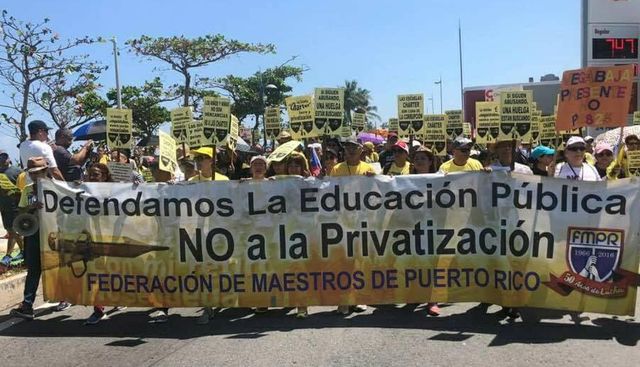
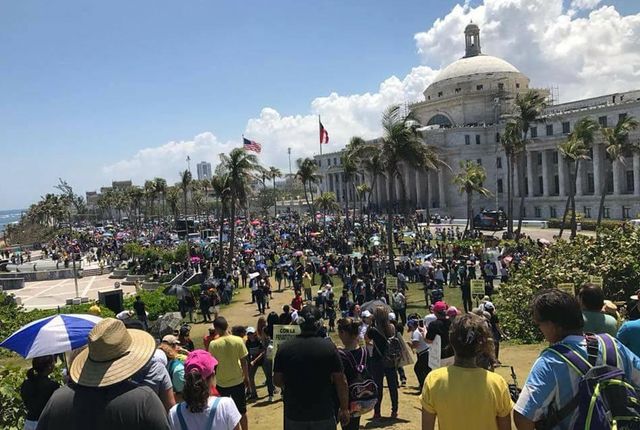
On Monday, thousands of educators carried out a one-day strike in Puerto Rico to oppose plans, backed by Trump’s billionaire Education Secretary Betsy DeVos, to expand for-profit charter schools. The island’s governor, Ricardo Roselló, is proposing to close 300 public schools and wipe out 7,000 teachers’ jobs. Carrying signs such as “They believe in money, not education,” thousands marched to the capitol building in San Juan as calls for an island-wide strike mounted.
Puerto Rican teachers march on capitol in San Juan Monday
Teachers in Prince George’s County, Maryland began work-to-rule and sickout protests this week over pay; hundreds of students protested faculty cuts at Treasure Valley Community College in Ontario, Oregon; adjunct professors and other non-tenured-track faculty at Loyola University in Chicago are threatening to strike on April 4.
The struggles in the US are part of a global struggle of educators against the austerity demanded by the international banks and capitalist governments all over the world. There are ongoing struggles in Kenya, Niger and other African countries. In Latin America, after a two-day national strike by Argentinian teachers earlier this month, teachers in Mexico are planning an April 9-10 national strike to overturn the government’s free market “education reforms.” Last week, thousands of teachers on the Caribbean island of Jamaica held “sick-outs” to demand higher wages and allowances for books and software.
In Europe, Dutch teachers from four provinces struck last week and protested in Amsterdam, while teachers in Slovenia walked out to demand higher wages and better working conditions. University lecturers in the United Kingdom have engaged in a month-long series of rolling strikes and rebelled last week against efforts by the unions to impose a sellout agreement that betrayed their fight against pension cuts and casualization.
Over 850 administrative, technical, library, counseling and athletic staff are continuing a two-week strike at Carleton University in Canada’s capital city of Ottawa.
The international scope of these struggles underscores the common problems teachers, school employees, and university workers confront in every country ten years since the global financial meltdown, which led to campaigns of savage austerity by capitalist governments around the world that continue today.
Puerto Rican marchers opposing school privatization plans
While the Obama administration and governments around the world handed over trillions to bail out the financial criminals responsible for the crash and re-inflate the stock market bubbles, entire countries, states and municipalities were driven to near bankruptcy. This crisis was used to accelerate the destruction of public employee jobs, loot health and pension funds and implement privatization schemes to turn public education and other critical social infrastructure into moneymaking operations.
In the US, funding for public education in most states still lags behind pre-2008 levels. Over the last decade, teachers have suffered a five percent decline in real wages and a nine percent increase in medical costs, adjusted for inflation. Obama oversaw the destruction of 300,000 school employee jobs and a vast expansion of for-profit charter schools. Now Trump is demanding billions in federal school spending cuts and school vouchers to divert money from public schools to religious schools and private education businesses.
Educators are deeply committed to the egalitarian ideals embodied in public education and opposed to efforts to create a class-based education system. They are also intimately aware of the impact of social inequality, growing poverty and the danger that the children they teach could be dragged off to war.
The nine-day strike of 33,000 teachers and school employees in West Virginia was betrayed by the National Education Association (NEA), the American Federation of Teachers (AFT) and their state affiliates, which are determined to prevent a unified struggle of educators and other sections of the working class. The deal the unions cut with the state’s billionaire governor, Jim Justice, does nothing to address the teachers’ main demand: to fully fund the public employee insurance agency and stop crippling out-of-pocket costs. The meager five percent raise will not be paid for by increasing taxes on the state’s coal, natural gas and chemical giants, but through deep cuts in other essential services.
However, the West Virginia strike, which temporarily broke free from the control of the unions, inspired educators throughout the US and the world. Underscoring the global character of this struggle, the most popular social media posts during the walkout were messages of class solidarity from teachers in Ghana, Australia and other countries.
Kentucky teachers
On the eve of the teacher protests in Kentucky, the Republican-controlled state senate unveiled a new budget, which includes Governor Matt Bevin’s cuts while rejecting any tax increases on corporate interests. The cuts will hit state universities and will continue to deplete the teachers’ health care and pension funds, a move that all but guarantees further cuts. At the same time, state senators proposed a derisory increase in the per-pupil funding formula for K-12 schools to $3,984 in Fiscal Year 2019 and $3,985 in Fiscal Year 2020, keeping Kentucky near the bottom in the United States.
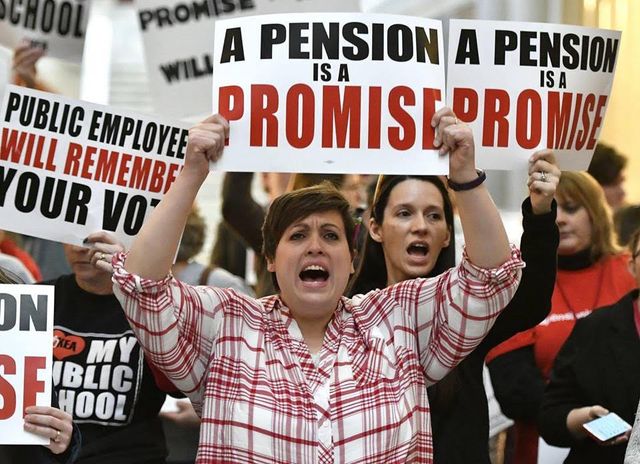
Several school districts, mostly in the state’s eastern coal mining counties, have announced they will close today because teachers are protesting at the state capitol in Frankfurt. In addition to other cuts, Governor Bevin is pushing a measure, Senate Bill 1, which would reduce annual cost-of-living increases on teachers’ pensions from 1.5 percent to 1 percent. For teachers, who do not qualify for Social Security, the result would be a loss of $62,000 in income over a lifetime. SB 1 would also increase future health care contributions and end defined-benefit plans for future teachers.
Just as the strike in neighboring West Virginia inspired teachers around the country and the world, the fight in Kentucky to defend current and future educators is also generating widespread support. “We absolutely stand with Kentucky teachers,” an elementary school teacher in Nashville, Tennessee, told the World Socialist Web Site. “We are watching every state where teachers are under attack. Each instance only strengthens our resolve to fight for educator rights at the local, state and national level. When one group of our sisters and brothers are being abused, we are all being abused.”
In Oklahoma, momentum is building for a statewide walkout on April 2 to demand a $10,000 raise for some of the lowest-paid teachers in the nation. The strike movement was initiated by rank-and-file teachers, using social media, who rejected efforts by the Oklahoma Education Association to block or delay a walkout. School is presently suspended for April 2 in districts that serve 70 percent of Oklahoma students, according to the Facebook page, “The Time is Now.”
“As cost of living continues to rise my teaching salary has not,” Lisa Price posted on the page. “I haven’t had a raise in 11 years. But 7 years ago, I started working a second job to help fill in the gap. I shouldn’t be denied a raise nor have to beg for a raise nor walk off the job after 11 years of being an experienced and highly effective teacher with a college degree when our legislators are getting raises each year and our GPT (Gross Production Tax on new oil and gas wells) is 2%. This is exploitation of teachers.”
Teachers and school employees in Jersey City, New Jersey returned to work Monday after the Jersey City Education Association (JCEA) shut down a one-day strike against soaring health care costs imposed by a 2011 state law passed by the Democratic-controlled state legislature and signed by the Republican governor.
As teachers returned to work, they expressed their anger over being ordered back to their classrooms without ever seeing the details of the agreement, let alone having a chance to vote on it. “I am frustrated at going back today,” an English teacher with seven years told the WSWS. “It is similar to what happened in West Virginia. The details on pay were emphasized by the mayor but not for health care, which is our greatest concern. We have a right to see it and vote.”
A special education teacher for 15 years added, “We want health care and a raise, or we should not go back to work. We should go back on strike if we don’t like the agreement. Teachers are not even middle class. Teachers are poor.”
Damian Williams, a ninth grader, said he had marched last Friday with many other students to support the striking teachers. “I was for the strike because teachers need to be able to teach.” Another student added, “Teachers should have their health care. They are underpaid for what they give us. This is an economically divided society.”

20 Mar 2018

The Privatization of Water and the Impoverishment of the Global South

Julian Vigo

Argentina just experienced its worse drought in thirty years; California recently suffered its worse drought since the 1400s according to ring tree research carried out by the University of Arizona; Oregon Governor Kate Brown just signed an executive order over the dire conditions of drought in the Klamath Basin, agriculture disaster was recently declared by the U.S. Department of Agriculture in four states (Louisiana, Mississippi, Arkansas and Texas) due to drought, concentrated in to a total of 25 parishes and 124 counties; last week Iranian farmers in Isfahan protested the government’s failure to act on a drought that has plagued the region for over a decade; farmers in Maharashtra, India protested over loan waivers, prices, and land rights with state ministers due to the growing problem of drought in the region; on Tuesday, Kansas Governor, Jeff Colyer, signed a drought declaration for all 105 counties in the state of Kansas; and also on Tuesday the South African government declared that the drought afflicting Cape Town and other parts of the country is a national disaster.
These are just a few facts regarding the mounting problems of water supply around the world with Cape Town being one of the more serious cases.  Aside from the obvious problems of climate change where drought poses a threat to green spaces and wildlife, to the local economy, and tourism, the more obvious danger is to agriculture as well as to health and sanitation.  In its third year of consecutive drought, Cape Town residents are limited to 50 liters of water per day and “Day Zero,” said to arrive on 9 July of this year, is that moment when the water supply is so low that three-quarters of the population will have its water shut off.
While droughts are a natural phenomenon in the Western Cape, climate change has exacerbated the conditions for inhabitants of this region and it is widely believed that climate change is playing a principle role in the devastation.  While global warming has already resulted in extreme conditions in this region and beyond, scientists underscore the need for humans to adapt to this new reality where, for instance, in the Western Cape, the weather is expected to warm by around 0.25C over the next decade. This fact alone means that the likelihood of drought will increase sevenfold and affect the state of health, hygiene, and food insecurity in the region.
One strange player that has come to the “rescue” in the Western Cape is Coca-Cola Peninsula Beverages, in partnership with the Coca-Cola Foundation and suppliers. Attempting to provide millions of liters of water to the Western Cape and the City of Cape Town during the water crisis, providing free “prepared water” in 2-liter recyclable PET bottles marked “Not for resale.”  South Africa is the only country in the world which has a Constitution that guarantees the right to water in the Bill of Rights but this right is not only being denied to millions of residents of the country.   In the Western Cape and other provinces, over 1 million people have been affected by water shortages and water restrictions with many having to walk tens of kilometers to source drinking water.  So the protection of South Africa’s constitutional guarantee of water has become especially dear to many.
Back in the early 2000s, townships surrounding the cities of Johannesburg and Durban became politically mobilized in protesting water privatization given the fact that at the time over 10 million residents had their water cut off by the government’s implementation of a World Bank-inspired “cost recovery” program.  This program made water availability dependent on a company’s ability to recover its costs plus a profit and more than 100,000 people in Kwazulu-Natal province became ill with cholera after water and sanitation services to local communities were cut off for nonpayment.
In their brilliant exposé of this situation in South Africa and beyond, “Who Owns Water?”, Maude Barlow and Tony Clarke give a scathing explanation of what was at stake back in 2002, the situation far more aggravated today.  They identify the ten major corporations making a profit from freshwater beginning with France’s Vivendi Universal and Suez whom they label the “General Motors and Ford of the global water industry.” Barlow and Clare go on to characterize how these two and other companies:
deliver private water and wastewater services to more than 200 million customers in 150 countries and are in a race, along with others such as Bouygues Saur, RWE-Thames Water and Bechtel-United Utilities, to expand to every corner of the globe.” In the United States, Vivendi operates through its subsidiary, USFilter; Suez via its subsidiary, United Water; and RWE by way of American Water Works.
But what about the World Bank and its’ “cost recovery” programs?  Aren’t they working?  The short answer is yes: they are working to help increase the coffers of the World Bank and the IMF as poor countries continue to become poorer and Barlow and Claire elaborate:
They are aided by the World Bank and the IMF, which are increasingly forcing Third World countries to abandon their public water delivery systems and contract with the water giants in order to be eligible for debt relief. The performance of these companies in Europe and the developing world has been well documented: huge profits, higher prices for water, cutoffs to customers who cannot pay, no transparency in their dealings, reduced water quality, bribery and corruption.
In a country where the minority of white farmers (six hundred thousand) consume 60 percent of the country’s water supplies for irrigation, it is no surprise that the country’s 15 million black citizens have no direct access to water. Labor unions like the South African Municipal Workers Union have collaborated with township activists to organize neighborhood actions where citizens are connecting water up themselves and ripping out water meters.  The injustices of foreign-owned companies coming into South Africa are being addressed but all too slowly as residents’ water is cut off, rarely is it the water of white South Africans.
Such is life in the twenty-first century when older trade deals such as NAFTA (North American Free Trade Agreement) saw governments signing away their control over domestic water supplies and the later failed attempt to create the Free Trade Area of the Americas (FTAA), and also the the World Trade Organization.  It is increasingly clear given the current state of drought which bodies have access to water, which ones do not.  And despite our desire to “fix” these problems thought hackathons in the Nevada Desert or by adjusting the Computerized Maintenance Management System (CMMS) which can be used to address drought structurally, the reality is that there is a lot of neo-colonial control over those areas of the world in conditions of severe draught, and a load of white, western institutions making money over the death and hardships of dark-skinned bodies. So of course, it is not surprising to see white South Africans asking that Coca-Cola be put in charge of its water supplies!
Skip over the Indian Ocean to the Indian state of Tamil Nadu and a similar story has erupted in recent years. Indians have been protesting the condition of drought that has been pushed to the hilt by Pepsi-Cola and Coca-Cola depleting local water resources.  Amit Srivastava, director of India Resource Centre, an ecological NGO, estimates that it takes 1.9 liters of water to make one small bottle of Coca-Cola only if you don’t factor in the use of sugar. Sugarcane uses a lot of water to cultivate for which Coca-Cola is the number one purchaser of sugarcane and Pepsi-Cola number three.  If you account for the water used to create all ingredients in Pepsi-Cola or Coca-Cola, then it actually takes 400 liters of water to make a bottle of cola.
The move against fizzy drinks in Tamil Nadu gained momentum in March, 2017 when the High Court rejected rejected the request by petition to ban the use of water from the Thamirabarani River used to produced Coca-Cola and Pepsi-Cola.  This effectively has nullified a previous injunction passed by a court in November, 2016.  Petitioners have argued that thousands of farmers in Tamil Nadu have been suffering from water shortage and drought while both companies freely used the river water for their commercial gains. Coincidental to the Supreme Court’s decision in the Spring of 2017 was another ban on jallikattu, a local form of bullfighting, pronounced in January 2017.  The momentum from these two court decisions resulted in a reinvigorated mass protest against both Coca-Cola and Pepsi-Cola.  And in the state of Kerala in March 2017, retailers voted to ban the sale of sodas.
In 1999, Coca-Cola established a bottling plant in the village of Kaladera in Rajasthan, a desert state where farmers rely on groundwater for the cultivation of their crops.  Since this time, these farmers have been confronted with a steep decline in water levels whereby the irrigation of land and the sustenance of crops is nearly impossible.  Official documents from the government’s water ministry show that water levels remained stable from 1995 until 2000:  “According to data compiled by the Rajasthan Groundwater department, in the 16 years from 1984 the groundwater levels at Kaladera dropped from 13 to 42 feet, at an average annual rate of 1.81 feet. But from 2000 to 2011, the drop was sharp from 42 to 131 feet at the rate of 8.9 feet a year.”
India and South Africa are not alone in this usurpation of public resources for the private sector. In San Felipe Ecatepec in the state of Chiapas, a Coca-Cola factory run by FEMSA is draining wells which forces local residents to buy bottled water.  It is reported that this bottling plant “consumes more than a million liters of water a day.” FEMSA  claims to be  “committed to the sustainable development of its associates, communities and the environment,” but little action is seen to demonstrate this.  And in Brazil, Guatemala, Colombia, and Mexico, PepsiCo faces similar problems with criticism for depleting water resources in these areas.  Both Pepsi-Cola and Coca-Cola seek out the clean image it needs to win over public opinion, much most of their claims are theatre.  While Coca-Cola claims to replenish the water it removes from the ground, the fact is that the water is never replaced at the source of its original removal. And as much as these companies try to rebrand and “green up” their image, you will never win over a population whose water you steal while selling the public their own water back to them.  For instance, Ethiopia’s East African Bottling Company has introduced Dasani to its market which is more rinse and repeat of the same old for Africans:  Coca Cola owns Dasani.
In 2017, 81 million people in the world experienced severe food insecurity or shortage. Approximately 80 percent of those affected live in Africa.  The reality of food and water shortage is one that can be addressed and rectified, but we can do neither if our societies do not recognize the need to understand how the privatization and abuse by corporations of public resources is adding to or creating conditions of drought. The human contributions leading to the credible risk of famine and thirst experienced in countries such as Ethiopia, Somalia, Yemen, Nigeria, and South Sudan, though more pronounced, are emblematic as to what is happening in South Africa, India, Mexico and beyond.
There is a corporate takeover of public resources and we need to support a Global Water Convention now such as the proposed model, The Treaty Initiative: To Share and Protect the Global Water Commonspenned by Maude Barlow and Jeremy Rifkin that lays out what we must do to secure the right of access to water.  There are also others proposals for a Global Water Convention similar to the model suggested by Barlow and Clarke in their 2002 Nation article.  Still, so many people around the planet have not mobilized towards a legal decree obligating the sharing of water resources and the end to corporate encroachment upon public resources. As water is the 21st century’s most precious commodity, we need to act quickly to ensure that the limited resource of water does not translate to the limited resource of life.

Islamic State’s Leadership and Arms Pipeline

Nauman Sadiq

In June last year, the Russian Ministry of Defense claimed that according to information, the leader of the Islamic State Abu-Bakr Al-Baghdadi had reportedly been killed as a result of airstrikes conducted by the Russian aircrafts on a southern suburb of Raqqa on May 28.
According to Russian claims, the airstrikes targeted a meeting of high-ranking Islamic State leaders where Al- Baghdadi was reportedly present. The meeting was gathered to plan exit routes for militants from Raqqa. Apart from Al-Baghdadi, 30 field commanders and up to 300 militants were also killed in the airstrike.
Last month, Nick Paton Walsh reported for the CNN, “The Islamic State’s leader Abu Bakr Al-Baghdadi was wounded in an airstrike in May last year and had to relinquish control of the terror group for up to five months because of his injuries, according to several US officials who spoke exclusively to CNN.”
Now, even the mainstream media is admitting the possibility the Russian airstrike might have incapacitated Al-Baghdadi. As the CNN report further states: “It’s believed the airstrike occurred close to the date offered by the Russian military in June when they claimed to have killed or injured the Islamic State leader.”
According to another report last month by Al-Jazeera, “Islamic State’s leader Abu Bakr al-Baghdadi is alive and being treated at a medical facility in northeastern Syria after being severely wounded in an air raid, a senior Iraqi official said.”
“The head of Islamic State sustained serious wounds to his legs during air raids,” Abu Ali al-Basri, Iraq’s intelligence and counterterrorism department chief, was quoted last month by the Iraqi government-run al-Sabah daily as saying. “Al-Baghdadi suffers from injuries, diabetes and fractures to the body and legs that prevent him from walking without assistance,” said al-Basri.
Although al-Baghdadi has not publicly appointed a successor, two of the closest aides who have emerged as his likely successors are Iyad al-Obeidi, his defense minister, and Ayad al-Jumaili, the in charge of security. The latter had already reportedly been killed in an airstrike in April last year in al-Qaim region on Iraq’s border with Syria.
Therefore, the most likely successor of al-Baghdadi would be al-Obaidi. Both al-Jumaili and al-Obeidi had previously served as security officers in Iraq’s Baathist army under Saddam Hussein, and al-Obeidi is known to be the de facto deputy of al-Baghdadi.
Excluding al-Baghdadi and some of his hardline Islamist aides, the rest of Islamic State’s top leadership is comprised of Saddam-era military and intelligence officials. Hundreds of ex-Baathists reportedly constitute the top and mid-tier command structure of the Islamic State who plan all the operations and direct its military strategy.
Apart from training and arms that have been provided to militants in the training camps located in Turkey’s and Jordan’s border regions adjacent to Syria by the CIA in collaboration with Turkish, Jordanian and Saudi intelligence agencies, the only other factor which contributed to the astounding success of the Islamic State from early 2013 to August 2014 is that its top cadres are comprised of professional military and intelligence officers from the Saddam era.
Moreover, it is an indisputable fact that morale and ideology play an important role in the battle, and well-informed readers must also be aware that the Takfiri brand of most jihadists these days has directly been inspired by the puritanical Wahhabi-Salafi ideology of Saudi Arabia, but ideology alone is not sufficient to succeed in the battle.
Looking at the Islamic State’s spectacular gains in Syria and Iraq from early 2013 to August 2014, a question naturally arises that where did its recruits get all the training and state-of-the-art weapons that are imperative not only for hit-and-run guerrilla warfare but also for capturing and holding large swathes of territory?
The Syria experts of foreign policy think tanks also appeared to be quite ‘worried’ when the Islamic State overran Mosul in June 2014 that where did the Islamic State’s jihadists get all the sophisticated weapons and especially those fancy Toyota pickup trucks mounted with machine guns at the back, colloquially known as the ‘Technicals’ among the jihadists?
According to a revelatory December 2013 news report from a newspaper affiliated with the UAE government which supports the Syrian opposition, it is clearly mentioned that along with Kalashnikovs, rocket-propelled grenades and other military gear, the Saudi regime also provided machine gun-mounted Toyota pick-up trucks to every batch of five jihadists who had completed their training in the training camps located in the border regions of Jordan.
Once those militants crossed over to Daraa and Quneitra in southern Syria from the Jordan-Syria border, then those Toyota pickup trucks could have easily traveled to the Islamic State’s former strongholds in Syria and Iraq. Furthermore, it is clearly spelled out in the report that Syrian militants got arms and training through a secret command center known as the Military Operations Center (MOC) based in the intelligence headquarters’ building in Amman, Jordan, that was staffed by high-ranking military officials from 14 countries, including the US, European nations, Israel and the Gulf Arab States to wage a covert war against the government in Syria.
More recently, however, a report by the Conflict Armament Research (CAR) on the Islamic State’s weapons found in Iraq and Syria has been doing the rounds on the media during the last few months. Before the story was picked up by the mainstream media, it was first published in the Wired News on December 12, which has a history of spreading dubious stories and working in close collaboration with the Pentagon and DARPA (Defense Advanced Research Projects Agency).
The Britain-based Conflict Armament Research (CAR) is a relatively unknown company of less than 20 employees. Its one-man Iraq and Syria division is headed by a 31-year-old Belgian researcher, Damien Spleeters. The main theme of Spleeters’ investigation was to discover the Islamic State’s homegrown armaments industry and how the jihadist group’s technicians have adapted the East European munitions to be used in the weapons available to the Islamic State. He has listed 1,832 weapons and 40,984 pieces of ammunition recovered in Iraq and Syria in the CAR’s database.
But Spleeters has only tangentially touched upon the subject of the Islamic State’s weapons supply chain, documenting only a single PG-9 rocket found at Tal Afar in Iraq bearing a lot number of 9,252 rocket-propelled grenades which were supplied by Romania to the US military, and mentioning only a single shipment of 12 tons of munitions which was diverted from Saudi Arabia to Jordan in his supposedly ‘comprehensive report.’
In fact, the CAR’s report is so misleading that of thousands of pieces of munitions investigated by Spleeters, less than 10% were found to be compatible with NATO’s weapons and more than 90% were found to have originated from Russia, China and the East European countries – Romania and Bulgaria in particular.
By comparison, a joint investigation by the Balkan Investigative Reporting Network (BIRN) and the Organized Crime and Corruption Reporting Project (OCCRP) has uncovered the Pentagon’s $2.2 billion arms pipeline to the Syrian militants. It bears mentioning, however, that $2.2 billion were earmarked only by Washington for training and arming the Syrian rebels, and tens of billions of dollars that Saudi Arabia and the oil-rich Gulf states have pumped into Syria’s proxy war have not been documented by anybody so far.
More significantly, a Bulgarian investigative reporter, Dilyana Gaytandzhieva, authored a report for Bulgaria’s national newspaper, Trud News, which found that an Azerbaijan state airline company, Silk Way Airlines, was regularly transporting weapons to Saudi Arabia, United Arab Emirates (UAE), and Turkey under diplomatic cover as part of the CIA covert program to supply militant groups in Syria. Gaytandzhieva documented 350 such ‘diplomatic flights’ and was subsequently fired from her job for uncovering the story. Unsurprisingly, both these well-researched and groundbreaking reports didn’t even merit a passing mention in any mainstream news outlet.
It’s worth noting, moreover, that the Syrian militant groups are no ordinary bands of ragtag jihadist outfits. They have been trained and armed to the teeth by their patrons in the security agencies of Washington, Turkey, Saudi Arabia and Jordan in the training camps located at Syria’s border regions with Turkey and Jordan.
Along with Saddam’s and Egypt’s armies, the Syrian Baathist armed forces are one of the most capable fighting forces in the Arab world. But the onslaught of militant groups during the first three years of the proxy war was such that had it not been for the Russian intervention in September 2015, the Syrian defenses would have collapsed.
The only feature that distinguishes the Syrian militants from the rest of regional jihadist groups is not their ideology but their weapons arsenals that were bankrolled by the Gulf’s petro-dollars and provided by the CIA in collaboration with regional security agencies of Washington’s traditional allies in the Middle East.
While we are on the subject of Islamic State’s weaponry, it is generally claimed by the mainstream media that Islamic State came into possession of state-of-the-art weapons when it overran Mosul in June 2014 and seized huge caches of weapons that were provided to Iraq’s armed forces by Washington.
Is this argument not a bit paradoxical, however, that Islamic State conquered large swathes of territory in Syria and Iraq before it overran Mosul when it supposedly did not have those sophisticated weapons, and after allegedly coming into possession of those weapons, it lost ground?
The only conclusion that can be drawn from this fact is that Islamic State had those weapons, or equally deadly weapons, before it overran Mosul and that those weapons were provided to all the militant groups operating in Syria, including the Islamic State, by the intelligence agencies of their regional and global patrons.

The Geopolitics of Targetting Russia

Chandra Muzaffar

The escalation of tensions between the United States, Britain and France, on the one hand, and Russia, on the other, should not surprise anyone. In the last few years, the US leadership and mainstream British media have presented Russia as a major threat to global peace and the international order. Russian president Vladimir Putin in particular has been demonised as a ‘war-monger,’ an ‘aggressor,’ an ‘unscrupulous politician’ hell-bent on restoring Russia’s past glory’ at whatever cost.
This projection of Russia as a threat to world peace has intensified in recent days partly because of Putin’s unveiling of Russia’s cutting edge military technologies on 1st March 2018. They include advanced generation missiles with unlimited range and capability that can evade US or NATO anti-missile defences. Apart from the new Sarmat missile, the Russian defence industry has also developed a low-flying stealth missile capable of carrying a nuclear warhead with the ability to bypass interception boundaries that is “invincible against all existing and prospective missile defence and counter-air defence systems.”
Putin also revealed that  his country has invented “ unmanned submersible vehicles that can move at great depths intercontinentally at a speed multiple times higher than the speed of submarines, … torpedoes and all kinds of surface vessels … “ He also spoke of  the Kinzhal or dagger system, “ a high-precision hypersonic aircraft missile system… the only one of its kind in the world.”  Not only does the missile fly 10 times faster than the speed of sound but it also delivers nuclear and conventional warheads in a range of over 2.000 kilometers. The Russian president also drew attention to the development of Avangard, a hypersonic missile whose gliding cruise bloc engages in intensive lateral and vertical manoeuvring and is therefore “absolutely invulnerable to any air or missile defence system.”
With these military technologies, Russia has effectively brought to an end the US reign as the world’s sole military superpower. If Putin had made this his goal, it is not because of any obsession with military supremacy. As he explained, the strengthening of Russia’s military prowess was his country’s response to the unilateral US withdrawal from the 1972 Anti-Ballistic Missile (ABM) Treaty in 2002 engineered by President George Bush Junior and Vice-President Dick Cheney. As a consequence of the withdrawal, the US and NATO began deploying missile systems to encircle Russia, as observed by veteran analyst, William Engdahl.  Countries that were once part of the demised Soviet Union and the dismantled Warsaw Pact in Eastern Europe were drawn into the US-NATO orbit either formally or informally. Anti-ballistic missile bases were built in Romania and Poland. The US global missile defence system now includes destroyers and cruisers deployed “in close proximity to Russia’s borders.”
It is against this backdrop that one should view another major episode that is responsible for the current tension between the West and Russia. It is true that the Russian annexation of Crimea, then part of Ukraine, in early 2014 had incensed the US and European elites and led to the imposition of crippling sanctions against Russia. While the annexation itself in strict legal terms was a violation of international law, an honest analysis of the episode cannot afford to ignore the larger geopolitical concerns that prompted Moscow to act the way it did. By organising a coup against Ukraine’s democratically elected president in February 2014, the US and its local surrogates demonstrated clearly that they intended to tighten their grip over a land that was not only part of the Soviet Union but also integral to Russian history and culture. Crimea with its strategic port was what the US and NATO coveted. It was all interwoven into the US-NATO agenda of expanding eastwards and emasculating Russia. That the overwhelming majority of the citizens of Crimea endorsed in a referendum conducted on the 16th of March 2014 what they viewed as the restoration of Crimea to its Russian fatherland testifies to the actual feelings of the people — feelings informed by a notion of identity and a sense of justice.
There is yet another recent development that has also contributed towards the exacerbation of tensions between the two sides. It is obvious that the rebels and terrorists in Syria fighting the Assad government backed by the centres of power in the West and supported by their allies in the region have been defeated. The concerted drive to crush the Hezbollah-Syria-Iran triumvirate opposed to Israeli occupation and US hegemony in West Asia has been thwarted. Since Russia played a significant role in the defeat of the US and Israel and their partners, the antagonism towards Putin among the elites in Washington and Tel Aviv in particular has heightened. Providing material support to some of the rebels and terrorists holed up in Eastern Ghouta, one of their last few footholds in Syria is a desperate attempt by Washington to ensure that it remains relevant to the emerging post-war political scenario. Highlighting the alleged use of chemical agents by the Syrian Army and the killing of children in government aerial bombardments are tools of propaganda that the Western media have exploited to the hilt in the Syrian war in spite of the effective demolition of some of these lies and half-truths in the past by independent Western journalists themselves reporting and analysing from actual zones of conflict in the country. For Western elites and their media it is not the death of children — after all many children have been killed in Yemen — that is their real concern. It is how Russia has anchored and buttressed its position in Syria and the region as a whole and has challenged American-Israeli hegemony that causes great distress.
The latest manifestation of the incessant manipulation of issues pertaining to Russia is of course the alleged use of a nerve agent, “ Novichok” to attempt to murder a Russian double agent, Sergei Skripal and his daughter now living in Salisbury Britain. British authorities have offered no concrete proof that the attempted murder was the work of the Russian state. The Russian government has vehemently denied the allegation.
One should ask, what would the Russian government and Putin gain from killing Skripal a week before the Russian presidential election and in the midst of US sanctions? This is the question that the well-known American columnist, Eric Margolis, poses. A former British diplomat, Craig Murray, also doubts that the Russian government had the motivation to kill a double agent who was part of a spy swap some years ago. He suggests the assassination bid may be linked to an outfit known as ‘Orbis Intelligence’ or to the Israeli Mossad. In Murray’s words, “Israel has a clear motivation for damaging the Russian reputation so grievously. Russian action in Syria has undermined the Israeli position in Syria and Lebanon in a fundamental way, and Israel has every motive for damaging Russia’s international position by an attack aiming to leave the blame on Russia.”
If Israel’s hand is behind the Skripal episode, the truth will never be known. Neither Britain nor any of the other Western powers, not even the UN, would want to conduct an honest, independent investigation. All that Washington and its allies want to do is to increase and expand the economic and financial sanctions against Russia — using Skripal as the excuse.
The aim is clear. It is to compel Moscow to submit to the hegemonic power of the Washington elite. Anyone who has a rudimentary understanding of Russian history knows that this will not happen. Russia will continue to resist. And Russian resistance may well hold the key to a different future for humankind.