9 Apr 2018

ICC Warns Israeli Leaders Over Gaza Killings

Ali Abunimah

The International Criminal Court has issued an unprecedented warning that Israeli leaders may face trial for the killings of unarmed Palestinian protesters in the Gaza Strip.
“Since 30 March 2018, at least 27 Palestinians have been reportedly killed by the Israeli Defence Forces, with over a thousand more injured, many, as a result of shootings using live ammunition and rubber bullets,” Fatou Bensouda, the ICC’s chief prosecutor, stated on Sunday.
“Violence against civilians – in a situation such as the one prevailing in Gaza – could constitute crimes under the Rome Statute of the International Criminal Court, as could the use of civilian presence for the purpose of shielding military activities,” Bensouda said.
“Any person who incites or engages in acts of violence including by ordering, requesting, encouraging or contributing in any other manner to the commission of crimes within ICC’s jurisdiction is liable to prosecution before the court,” Bensouda added.
Bensouda’s reference to using civilians for “shielding military activities” appears to be a nod to Israel’s claims that the Great March of Return mass rallies organized by Palestinians over the last two Fridays along Gaza’s boundary with Israel are a Hamas ploy to shield “terrorist” activities.
However, as an investigation by Human Rights Watch determined, and observations by journalists have confirmed, there have been no such “military activities” by Palestinians taking part in the demonstrations.
The festival-like rallies have brought out tens of thousands demanding an end to Israel’s blockade of Gaza and the right of return for refugees.
No Israelis have been reported injured as a result of the Palestinian protests in Gaza.
But what is not in doubt is that Israeli leaders have ordered the targeting of unarmed civilian protesters in what Human Rights Watch termed “calculated” killings of people who posed no threat whatsoever.
Three of those slain have been children.
In advance of this Friday’s demonstrations, the Israeli human rights group B’Tselem had warned soldiers that they would be committing crimes if they obeyed “patently illegal” orders to shoot unarmed civilians.
Israeli snipers stationed along the boundary with Gaza killed nine Palestinians on Friday.
Breaking ranks with the European Union, which is still refusing to condemn Israel’s actions, France on Saturday condemned Israel’s “indiscriminate fire” against Palestinian civilians in Gaza.
But despite such warnings, Israeli leaders have refused to change their live-fire orders, and have repeatedly commended their soldiers for the bloodshed.
On Sunday, defense minister Avigdor Lieberman declared in effect that all two million of Gaza’s residents are legitimate targets, telling Israeli media that “in the march of terror there were no innocent civilians, they were all Hamas members.”
According to The Times of Israel, Lieberman “later clarified that his use of the Hebrew word tamim was intended to mean not ‘innocent,’ but ‘naive.’”
His walking back the comment is not surprising since such statements can be used as evidence of intent in any international criminal trial.
Lieberman had been slamming calls to investigate the killing of journalist Yaser Murtaja who was fatally shot while wearning a vest clearly marked with the word “Press” on Friday.
“We have seen dozens of cases of Hamas activists [who] were disguised as medics and journalists,” Lieberman claimed.
“We also saw a journalist approach the border and operate a drone, we do not take chances in those cases,” he added, an assertion which the Israel military has found no evidence to support.
At the rallies the week before Murtaja’s slaying, Israeli forces injured 10 journalists, including several with live ammunition, according to the Committee to Protect Journalists.
Despite Lieberman’s objections, the Israeli army on Sunday named one of its own generals to investigate its actions that have led to the killings of Palestinians in Gaza, including of Murtaja.
But such military self-investigations have historically been nothing more than whitewashes that have served to bolster Israeli impunity and deter investigation by the ICC.
This is why the ICC prosecutor’s statement carries particular significance, since the international court is only mandated to step in when national judicial authorities are unwilling or unable to carry out genuine proceedings.
In her statement Sunday, Bensouda noted “the situation in Palestine is under preliminary examination by my office.” That is the procedure by which the prosecutor decides whether to open a formal investigation that could lead to indictments.
But the open-ended preliminary examination has been going on for years with Bensouda appearing to drag her feet.
In a case related to Israel’s 2010 attack on a flotilla to Gaza, Bensouda has acknowledged that Israeli forces likely committed war crimes in international waters, but she has nonetheless declined to open a formal investigation.
The lawyers for the families of those killed when Israeli commandos stormed the Mavi Marmara have accused Bensouda’s office of going “out of its way to sidestep having to launch any real investigation at the international level, knowing full well that the national [Israeli] authorities are not investigating these crimes.”
Since its founding, the ICC has lost much credibility because of its exclusive focus on prosecuting Africans, despite the fact that the 1998 Rome Statute mandates the court to “put an end to impunity” for the gravest crimes no matter where they are committed.
Palestinians are planning more mass rallies in Gaza in the weeks leading up to Nakba Day – the 15 May annual commemoration of the 1948 ethnic cleansing of Palestine.
It remains to be seen if Bensouda’s warning will deter Israeli leaders from further slaughter and if the court will finally move to end the impunity Israel has enjoyed for decades.

Swiss Mining Corporations in Flagrant Violation of Human Rights – Swiss Government Complicit

Peter Koenig

Peru, Espinar (Cusco Province), 4 April 2018 – Violent attacks have been carried out by the copper mining giant Glencore’s security forces and Glencore-contracted national police on defenseless women and even children, on the poorest of the poor segment of Peru’s population. Glencore, is a Swiss registered Anglo-Swiss mining corporation, exploiting mineral resources in developing countries around the globe, where they pay almost no taxes, as their profit center is in Switzerland, in Baar, Canton Zug, one of the Cantons, that has the lowest tax rates in Switzerland.
In addition, none of the socioenvironmental standards, to protect the environment and the local communities, are generally applied in developing countries. In the specific case of Peru, local laws are totally ignored. In fact, never mind Peruvian laws, they are like non-existent for the corporate world; they are simply bought. Never mind Glencore’s own “Due Diligence” rules, they are not respected in a country so corrupt, where laws, judges, lawyers, police, politicians – and even medical facilities are bought.
Above Espinar, on about 4,000 to 4,200 m elevation, Glencore operates open pit copper mining complexes, Tintaya and Antapaccay (“Antapaccay” was a Peruvian mining company bought by Glencore in 2013). The mine is also yielding gold (copper and gold usually go together), at the tune of some 221,000 tons of copper and 115,000 Troy ounces of gold per year (Troy ounce = 31.1 grams). Both figures are for 2016. To do so, Glencore moves some 80,000 to 100,000 tons of earth and rock per day.
An adjacent new mining area, Coroccohuayco, is being explored for continuous exploitation as the current mine is approaching its end. The capacity of this mining complex is estimated at 20 to 30 years, about two and a half generations of rural dwellers will be exposed to this horrendous Glencore atrocities and injustice, if nobody takes actions in their defense. Plus, after the mine is fully exploited, the miners usually packs up and leave – leaving an environmental disaster of poisoned soil and water – what’s left of it – behind. Restauration of such huge areas of mining ruins can take hundreds, if not thousands of years.
Glencore, with a total production of 1.23 million tons (2016) is the world’s third largest copper producer, employing some 55,000 people in 30 countries. According to MarketWatch, Glencore’s profit for 2017 registered a massive increase to $5.78 billion, from $1.38 billion in 2016 (compared to the Swiss food Giant, Nestlé, with CHF 8.3 billion, or US$ 8.6 billion, equivalent – 2017).
Glencore would have no shortfall of money to respect socioenvironmental laws, which includes compensating local communities for confiscated land and water, for avoiding deadly contamination of water and soil, spreading into human and animal bodies, causing countless deaths. They have plenty of means to take such protective measures. Butit’s obviously cheaper and less cumbersome to corrupt Peruvian authorities, so that nobody dares opening their mouth and speaking up in front of such abuse. Local authorities are all afraid or bought, or both.

Anti-mining riots in 2012, when the new pits “Antapaccay” opened, caused 3 deaths and more than 100 injured. The mayor, who supported the protesting campesinos was temporarily jailed. Peruvian central government authorities have taken full position in favor of the mining corporations; and this throughout the country, where similar disasters are repeated – no respect for local communities, force-expropriating them, poisoning their waters and soil with toxic heavy metals – mercury, cyanite, cadmium, arsenic and others, causing slowly countless deaths and destroying the landscape, water and soil.

Arriving in Espinar in the early morning hours of 4 April, we were hit by the news of violent physical aggressions having been perpetuated by Glencore’s security forces and hired national police, on destitute defenseless, unarmed women around noon the day before, 3 April. This happened when the men were out working either at the mine or in the fields, eking out a modest living for their families.
The mine is surrounded by some 6 mountain communities of an average of 1,200 people. None of them have running water or electricity. They are extremely poor and would fall way below the World Bank standard of extreme poverty (less than US$ 1 / day). The community that was attacked has a well and a close-by small river which the mine wants for refining purposes and for diversion to other mining communities where water had already been stolen. There was not even an attempt of negotiating compensations. A local leader, advised about the violence, reached the community towards the end of the assault and took video testimonies of the beaten women.
In an exercise of intimidation, the assault was executed by some 30 to 50 Glencore security forces and hired police. The police were equipped with government provided riot gear. They were beating down on the totally vulnerable women with their typical police batons. In one case, four men grabbing a 65-year-old woman, beating her almost to death. A bulldozer was ready to destroy their modest stone shacks. While one house was already destroyed about two weeks ago, thanks to the protesting women and the village men that eventually came to their rescue, it didn’t happen this time.
We met with activists, including the former mayor of Espinar. They all confirmed the Glencore assault. Then we went to the mining area, surrounded by small impoverished farmer communities. We met with the women who told us in tears what happened, showing their bruises all over their bodies – crying. The elderly 65-year-old woman was so badly beaten, she almost died. She was laying in herrickety stone hut that was earlier demolished and shakily rebuilt, moaning from pain, possibly with several broken ribs, no medication and no medical attention. Her situation is highly precarious. In addition to her state of health, her stone hut could collapse at any moment from the tremors of the daily mining explosions.
This bullying campaign is by no means new. It’s a common practice, as was confirmed by former mine workers and farm laborers of the area. Glencore wants to expropriate the peasants without compensation, because they want their water. Mining needs a huge amount of water to the detriment of the population – and Glencore doesn’t pay a penny for the water they consume and pollute with toxic heavy metals. Glencore doesn’t even offer the peasants alternative housing and living areas. – The women attempted to file complaints with the local police – but the police refused to even hear them. Of course, they are paid and fully under Glencore’s control.
Other leaders and activists told us about their health situation. How people die like flies from cancer around them and living in the vicinity of the mine – even if they are not directly working for the mine – water, earth and vapor contamination of the air they breathe, is so toxic, affecting every living being in the surrounding area, eventually dying a slow death.
Corruption is almost unimaginable. Glencore buys literally not only all police, lawyers, judges, politicians, but also medical doctors, clinics, laboratories in the vicinity. Two community inhabitantstold us how already three months ago they were giving blood and urine samples to be tested for heavy metals. The analysis results have not been returned yet – and will probably never be handed out to the victims, as they would reveal the heavy intoxication. One of them said under tears that he had lost one of his sons (31) to mine-induced cancer.
According to them, a similar fate afflicts a number of other inhabitants living in the zone. Some 1,200 victims suffer from various heavy-metal related diseases, mostly in their lungs and joints, extreme tiredness, memory loss and lack of concentration. Heavy metals accumulate in the body and are known to affect the nervous system. Several of the people interviewed said they and many of their neighbors and friends were resigned to simply die without any help.
Not only does Glencore not provide for medical assistance, but mine workers are hired from other regions of Peru.When they get sick, protest or die they are immediately ‘repatriated’ to their home region, so as not to cause havoc in the Espinar vicinity. Hence, it follows Glencore’s unethical logic: They pay doctors, clinics and labs not to reveal the level of toxins they discover in the victims’ bodies.

According to testimonies from several inhabitants of the region, including the ex-mayor of Espinar, mental retardation of children and other birth defects are increasing exponentially since Glencore first started operating in 2006 under Xstrata which later merged with Glencore.

The Swiss Government is fully aware of and consequently complicit with these corporate crimes. They know what is going on outside the Swiss borders – inside of which the same corporations would have to adhere to strict rules and follow the rule of law. About four years ago, a Swiss parliamentary delegation visited the Glencore site in Espinar. The visit was announced much in advance, so that Glencore had plenty of time to “clean up”, getting rid of potentially protesting voices. The delegation met with the then mayor, who worked in defense of the people and who gave the Swiss parliamentarians a dose of reality. Nevertheless, the delegation was wined and dined during two days by Glencore. The report back to Parliament was accordingly benign.
When recently approached on another case of flagrant mining abuse, including child work, prostitution and drug trafficking – in this case goldmining related to Metalor in Rinconada, near Puno, Peru – representatives of the Swiss Foreign Ministry’s Ethics Office simply said they had nothing to do with this case. Each one of these companies observed their “Due Diligence” and the government trusts them to adhere to their own standards. In case they wouldn’t, it was up to the host government where they work, i.e. Peru, to hold them responsible. Period.
That’s the noble stand of the Swiss authorities, who know very well that in Peru, like in many other countries where these Swiss-registered corporations operate, corruption is so rampant, that they buy themselves out of every crime, including homicide caused by intoxication of heavy metals from their mining operations. After all, Switzerland like other countries, have diplomatic representations in almost all countries, reporting back home on the state of their host country.
It is not widespread knowledge among the Swiss people, that the highest echelons of the Swiss Government meet regularly with CEOs of key corporations to discuss Switzerland’s future finance and economic policies. This may be common practice also in Germany, France and other EU countries – typical for neoliberal economies, that big business decide on the economic fate of the people.
Switzerland is the only OECD country where parliamentarians are allowed to sit in as many Boards of Directors of the business and finance sectors as they please. It is a virtually built-in lobby. This accepted inherent conflict of interest is diagonally opposed to the democratic principles of which Switzerland boasts itself as being a model.
Switzerland has long seized being the Switzerland where I was born. I feel deep pain for the peasant women living in the area of the Glencore exploited mine, the victims of Glencore’s abject and shameless human rights abuses, and for other sufferers of unethical corporate misconduct.

Bangladesh garment workers jailed on bogus attempted murder charges

Wimal Perera

Seven garment union officials and a number of workers are being framed up on “attempted murder” charges initiated by the Bangladesh Garment Manufacturers and Exporters Association (BGMEA). They have also been accused of vandalising office equipment.
At the request of police, a Dhaka court initially remanded the officials and workers on April 1. They are members of the Garment Workers Trade Union Centre (GWTUC), which is controlled by the Stalinist Communist Party of Bangladesh (CPB).
On April 5, amid growing opposition by garment workers, the court granted the accused men three months’ bail, pending a hearing into the charges. According to media reports on Saturday, however, they remain in Dhaka Central prison.
Those jailed include GWTUC general secretary Joly Talukder, CPB central committee member Sadekur Rahman Shamim, K.M. Mintu, Manzur Moin, Jalal Hawlader, Lutfar Rahman Akash and Mohammad Shahjahan.
This persecution follows a series of provocations against workers at the Ashiana Garments plant, south of the capital Dhaka. The garment workers established a union branch at the plant last May and applied for official recognition. Bangladesh’s trade union registrar rejected the application.
On January 29, Ashiana workers protested over the dismissal of a fellow employee. Management then shut down the plant and summoned a group of GWTUC leaders and members to meet with police, company authorities and the Directorate of Inspection of Factories at the BGMEA’s offices.
The GWTUC told the media that union officials and workers waited inside the building but were told the meeting had been cancelled. Manzur Moin, one of the arrested officials, said Mansur Khaled, a senior BGMEA official, and others started attacking garment workers demonstrating outside the building.
“At least 25 to 30 people from BGMEA swooped on the labourers with sticks and rods and began beating them heavily,” Moin said. Several protestors were injured and BGMEA officials seized a rickshaw carrying workers’ banners and microphones.
The BGMEA made various false complaints to the police of violence and property damage by garment workers. Charges were laid against union officials and 150 members. Some of those named in the allegations were not even in Dhaka at the time.
On February 4, a Dhaka court granted eight weeks’ bail for those charged. When this expired on April 1, police remanded six union officials in order to interrogate them.
This is a joint conspiracy by the BGMEA and the police, backed by the Bangladesh government. Its aim is to intimidate the GWTUC and Ashiana workers, and the more than 4.5 million garment sector employees fighting against poverty-level wages and oppressive working conditions.
The attempted murder charges are similar to those involved in the prosecution and jailing of 13 workers from the Maruti Suzuki car assembly plant in Manesar, Haryana in India, including the entire leadership of the newly-established Maruti Suzuki Workers Union. They were sentenced to life in prison on frame-up murder charges in March 2017. Their only “crime” was to fight against the brutal exploitation at the plant.
In the context of the growing militancy of the international working class, the BGMEA, Prime Minister Sheikh Hasina Wazed’s government and international retailers are acutely nervous about the eruption of major struggles.
Bangladesh garment workers have been fighting to have the poverty-level monthly wage ($US64) increased three-fold to 16,000 taka ($US192) to compensate for escalating price rises.
In December 2016, thousands of garment workers from about 20 factories in Ashulia industrial area, outside Dhaka, struck for a pay rise. The BGMEA closed about 60 factories in the area for several days and locked out thousands of workers. Thirty-four workers and union leaders were arrested on fabricated criminal charges in February 2017.
In an attempt to prevent further eruptions, the Bangladesh government, at the BGMEA’s request, established a panel to set a minimum monthly wage. The government will not declare a new wage structure until after the panel issues a report in the next six months. That means workers will not receive any wage increase for more than two years.
A. K. Azad, a panel member and former president of the Federation of Bangladesh Chambers of Commerce and Industry, bewailed the falling growth in the garment sector, from 14 percent in 2015 to 6 percent in 2016. “We will lag again if worker unrest occurs,” he declared.
While the garment sector in Bangladesh, the world’s second largest clothing exporter, accounts for around $28 billion in annual revenue, its workers are the lowest paid. According to recent Oxfam research, top fashion industry CEOs, on average, take home in just four days the lifetime income of a Bangladesh garment worker.
Giant retailers particularly in the US and Europe, such as Wal-Mart, H&M, C&A, Esprit, GAP and Li & Fung, earn huge profits by keeping these workers toiling under dire conditions. The brutal and life-threatening conditions were epitomised by the 2013 Rana Plaza multi-storey building collapse, which killed more than 1,000 workers and maimed thousands more, and in scores of factory fires across the country.
There has been a growing wave of strikes and protests among other workers in Bangladesh.
Hundreds of Dhaka Electric Supply Company workers demonstrated in Dhaka on February 18 for trade union rights and improved conditions. Hundreds of Community Health Care Providers Association members have staged hunger strikes since January 22, calling on the government to nationalise their companies and provide permanent employment.
At the end of January, about 500,000 teachers and employees from some 35,000 non-government secondary schools and colleges were involved in protests demanding the nationalisation of their institutions and permanent jobs.
While the Bangladesh unions, including the GWTUC, and the Stalinist CPB, have called protests over wages, working conditions and frame-ups of union members, they are promoting illusions that the government and companies can be pressured into granting concessions.
As typified by the attempted murder charges, however, the Hasina government’s response to the growth of working class opposition has been increased police repression.

India: Modi government accelerates anti-worker privatization drive

Kranti Kumara

As part of a renewed push for “investor-friendly reform,” India’s big business, Hindu supremacist Bharatiya Janata Party (BJP) government is sharply accelerating its disinvestment drive—the partial or complete privatization of central government-owned enterprises.
According to the Ministry of Heavy Industries and Public Enterprises, these enterprises, known as CPSEs or CPSUs (Central Public-Sector Enterprises or Undertakings), numbered 331 in 2017. They span most sectors of the economy, including railways, shipping, telecommunications, arms manufacturing, mining, banking, petrochemicals, airlines, and electricity generation and transmission.
In India, where working conditions as a rule are brutal and wages extremely low, CPSE jobs have traditionally been coveted as a source of relatively secure employment and better than average wages and working conditions. In a jobs competition that ended last month, more than 25 million people applied for 90,000 jobs, ranging from engine driver and carpenter to track inspector, on India’s state-run railways.
India’s ruling elite has been pursuing disinvestment for over a quarter-century, as part of its push to make India a cheap-labor haven for international capital. But the Narendra Modi-led BJP government has gone much further than its predecessors, including by targeting for privatization highly-profitable companies in what have previously been considered strategic sectors of the economy.
In this it has two long-term goals. One is to entirely eliminate CPSEs, so as to enable rapacious private investors and companies to gorge on enterprises that, although never run by or in the interests of the working class, are the product of the collective labour of generations of workers. The second is to progressively dismantle whatever social protections the CPSE provide against low-wages, mass-sackings and deleterious working conditions so as to further undermine the social position of the working class as a whole and thereby make India even more attractive to investors.
There is also a pressing short-term need for the government to raise revenue, in order to appease the international bond rating agencies, which have been pressing for India to lower its deficit to GDP ratio even while investing large sums in troubled state-owned banks.
The working conditions in CPSEs have been under concerted assault over the past two decades. Coal India Ltd. (CIL), from which the government has already sold off 20 percent ownership, is a case in point. It has announced that it plans to slash its workforce by 30 percent by 2020. This despite the fact that at least half of the 500,000 miners in CIL’s employ are contract workers whose wages, at a mere Rs. 8,500 (US $130) per month, are half those paid regular workers.
All sections of the political elite—including the Congress Party, which for the first four decades after independence championed state-led capitalist development—agree on the goal of wholesale CPSE privatization, claiming this will make India’s economy more “efficient.” By this they mean that it will unshackle management to squeeze greater profits from their workforces though an all-out assault on jobs, wages, benefits and working conditions.
When last in office (2004-14), the Congress Party implemented sweeping neo-liberal reforms, including privatization, but made a show of opposing the selling off of state-owned arm-manufacturers and the so-called “navratnas,” a handful of profitable CPSEs in strategic sectors like oil production and refining that it argued had the potential to be world-leaders.
Congress now has effectively dropped this stance, just it as has accommodated itself to Modi’s induction of India into an all but publicly proclaimed US-led anti-China alliance along with Japan and Australia.
The Stalinist Communist Party of India (Marxist) and the smaller Communist Party of India (CPI) oppose privatization, but only from the standpoint of nationalism and an alternative strategy for the Indian bourgeoisie. They argue that retaining state-owned banks and other enterprises will strengthen Indian capitalism vis-a-vis imperialist finance capital and give the India ruling elite greater room to maneuver on the world stage.
In his February 1 “2018-19 Budget Speech”, Finance Minister Arun Jaitley proudly highlighted the fact that in the 2017-18 financial year, which ended March 31, government disinvestment receipts would exceed Rs.1 trillion (US $15.6 billion).
This was a considerable increase from the goal of Rs. 720 billion ($11.3 billion) he had set during last year’s budget speech.
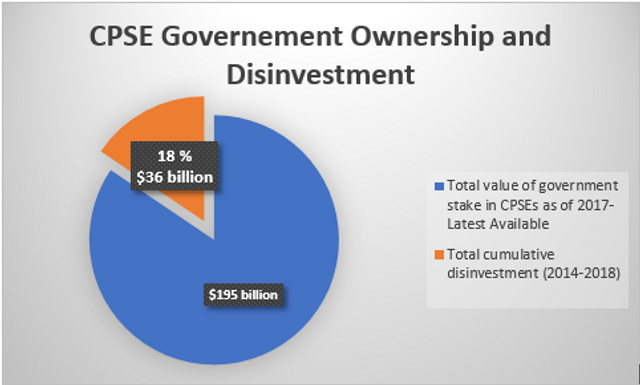
Cumulatively, disinvestment receipts under the BJP government, which came to power in May 2014, amount to more than Rs. 2,3 trillion or more than $36 billion. And for the current financial year, Jaitley has set a disinvestment goal of Rs. 800 billion ($12.3 billion.)
The scale of the government’s privatization drive emerges when the cumulative disinvestment receipts of more than $36 billion are contrasted, as in the pie chart, below with the government’s 2017 valuation of its stake in all 331 CPS at Rs. 12,5 trillion or $195 billion.
In addition to reducing the budget deficit, the Modi government has used the disinvestment windfall to sharply increase military spending to almost $55 billion per year.
One of the major enterprises now in the Modi government’s crosshairs for privatization is Air India, the national carrier. Over the past fifteen years, successive governments, including those headed by the Congress Party, have essentially driven Air India into bankruptcy by starving it of funds while forcing it to order in 2005, 111 new planes at the cost of Rs. 700 billion or close to $16 billion at the then prevailing exchange rate.
For years Air India has been forced to borrow funds even for its day-to-day operations, resulting in a debt-load exceeding Rs. 500 billion (about $8 billion). According to an article on the corporate media website FirstPost, the airline sustains daily loss of Rs. 100 million ($1.5 million), while its daily interest obligation on its loans amounts to Rs. 165 million ($2.5 million).
Prior to auctioning off Air India later this year, the Modi government plans to transfer the company’s full debt burden onto the books of the Indian treasury thus effectively gifting private investors a vast fleet of aircraft debt-free. There is no doubt that the jobs, wages and working conditions of Air India’s 27,000 employees are under major threat.
The unions have responded with a half-hearted protest campaign. Other than verbal denunciations of the Modi government, the Centre of Indian Trade Unions (CITU), the trade union affiliate of the Stalinist Communist Party of India (Marxist), has done nothing to oppose the Modi government’s plans to privatize Air India.
India’s public sector banks are also under the scanner for privatization. The government and corporate media have exploited recent scandals concerning politically-connected Indian billionaires and multi-millionaires getting additional credit even while not meeting payments on their existing debts to argue that the state-owned banks need to be put in “surer,” private hands.
In fact if India’s backs are riddled with “non-preforming assets,” i.e. loans in default, it is because BJP and Congress-led governments have pressed them to keep lending to India’s business houses to prop up a flagging economy. Now the BJP government intends to “socialize” these debts, making India’s workers and toilers pay through increased taxes and social-spending cuts for the cash infusions needed to strengthen the banks’ balance sheets and prepare them to be sold off to big business.
The rapacious big business interests animating the Modi government’s privatization drive are exemplified by its appointment of Reliance Mutual Exchange Traded Fund, an investment fund owned by the billionaire Anil Ambani, to serve as the “consultant” and “expert” overseeing the quick, partial or complete privatization of ten giant and highly profitable CPSEs, including Oil and Natural Gas Ltd. (ONGC), Gas Authority of India Ltd.(GAIL), Oil India Ltd., Indian Oil Corporation (IOC), Coal India Limited, and Bharat Electronics Limited. Anil Ambani’s brother, Mukesh Ambani, is the richest person in Asia. The Ambani brothers were early enthusiasts for a government led by the Hindu “strongman” Modi, which they saw as an instrument for the Indian ruling elite to more aggressively pursue intensified exploitation of the working class and its predatory great-power ambitions on the world stage.

Isle of Wight Council continues to cut services

Paul Bond

Conservative-run Isle of Wight Council, which runs the largest and second-most populous island in England, has approved £7.5 million in cuts to services and a council tax rise of nearly 6 percent. The cuts follow reductions in government funding and will see a further erosion of social provision.
Attention has focused on cuts to the island’s health service, but every aspect of social provision on the island stands as an indictment of the capitalist system.
As an example, the council Cabinet approved, against the advice of its own Scrutiny Committee, that the most severely affected people living at home and in receipt of Attendance Allowance, Disability Living Allowance or Personal Independence Payments should pay more for their care charges in order to cover cuts of £678,700 from 2018/19. The council admitted that it had failed to make an almost identical agreed efficiency saving (£700,000) from its Private Finance Initiative (PFI) contract with Island Roads for road maintenance.
This was immediately contradicted by the Council’s CEO, John Metcalfe, who said the saving had been made. It emerged that the £700,000 had been saved through individual management issues rather than as the rolling annual saving originally proposed, so further cuts will still be required.
PFI contracts place meeting the contractor’s financial servicing above any services or provisions they cover. The isle has two PFI agreements, the other being with Amey for waste management. Ahead of the budget negotiations, the chief proposal from the Independent group of councillors, the largest opposition grouping, was just to refinance the roads PFI loan to reduce interest payments. The Council’s budget, according to Leader Dave Stewart, involved “‘smoothing out’ our financial gap repayments,” increasing reserves and spending around £10 million on capital projects to encourage business rate income.
The Isle of Wight has a population of around 140,000. As a favoured retirement location its population is slightly older than the national average: 27.1 percent of the population are over 65, while only 14.7 percent of the population is under 15, compared with a national average of 17.5 percent.
The relative affluence of this inward migration disguises the levels of rural and coastal poverty. The End Child Poverty charity recently estimated that nearly a third of children (29.49 percent, more than 7,500 individuals) live in poverty after taking housing costs into account. In 2015, five Local Service Order Administration (LSOA) areas were in the 10 percent of most deprived areas in England, with another 19 in the top 20 percent. The island had no LSOAs within the 20 percent of least deprived areas.
The 2011 Census revealed a lower average standard of education across the island than nationally: higher than national average percentages of people with no or minimal qualifications, and lower than national average percentages of those with higher qualifications.
The one hospital, St Mary’s, coordinates with mainland hospitals. The island NHS Trust was placed in Special Measures in April last year, with all the signs of a service being systematically deprived of cash. Last June, St Mary’s was cancelling operations because it could not cope with patient numbers.
A year ago, the Council sought to offset its crisis in adult social care provision by appealing to the NHS Trust to continue paying into a joint fund. The Clinical Commissioning Group (CCG) said it was required to pass on funding allocated for social care, but where it had previously been able to supplement this it was now struggling with its own £12 million deficit.
Health and social provision is being subject to drastic cutting from both sides, with predictable results. Last December, only 38.89 percent of highest priority emergency ambulance calls arrived within the required eight minutes. The government’s target of 75 percent has been missed every month since last May. In December the British Medical Journal reported that cuts to the sexual health services were the worst in the country, with the budget having been slashed by 47.9 percent in the previous two years.
The CCG put forward five options for service “redesign”, ranging from no change—which was ruled out immediately—to cutting all local hospital services apart from Accident and Emergency (A&E) and Maternity. This scenario was clearly introduced to soften up public opinion for drastic cuts.
In February, the CCG agreed Option 4 of the Acute Services Redesign plan. This would see 89 percent of current activity retained on the island, but closer study points towards further erosion along the worst case lines. A&E would remain the same, but 20 percent of acute medicine would be transferred off the island, with 80 percent of critical care and 30 percent of emergency surgery. Elective surgery, trauma care and obstetrics would stand at 90 percent of current provision, but paediatric care would be reduced to a short stay assessment unit, effectively cutting the department by half and transferring all children requiring more than 24-hours’ care to the mainland.
The main purpose of the redesign was to save some £80.6 million over the next 30 years.
Stephen Parker, clinical lead for the redesign, said it would reduce “the number of times people are asked to travel to the mainland.” It was announced that a “seamless” transfer system would be developed.
This highlights the problem of transport off the island, which is provided by private ferry companies. Reducing the number of patient voyages will not make the situation easier for families visiting patients in hospital for any length of time.
Tory MP Bob Seely urged the government to grant Isle of Wight Council powers to force the ferry companies to provide a “public service.” He said that islanders spend some £100 million a year on what have been described as some of the most expensive ferry routes in the world.
The redesign proposal is due to go to public consultation later in the year but there is no reason to think this will make any difference. When the Scrutiny Committee voted 6-3 against increasing care charges, Cabinet member for Adult Social Care, Clare Mosdell, said she had threatened to resign over it but decided not to because of “all the hard work and good that I am doing” and the Council pressed ahead.
Cuts to the island’s fire service are also being discussed. It is proposed crew numbers be reduced from five to four, with a 15 percent reduction in firefighter numbers. The loss of eight permanent and five retained firefighters through non-replacement is based, as Spence Cave of the Fire Brigades Union (FBU) put it, “on budget saving and not on risk.” In a letter to the Isle of Wight County Press Dave Hunt, brigade organiser of the FBU, warned that the cuts would limit “the actions the first crew can take to carry out rescues and tackle the fire until a second appliance arrives. This second appliance would NOT be guaranteed to arrive promptly, particularly at night when as few as four whole-time crew may be immediately available for the whole Island.”
The Council is presenting these cuts, like those to the NHS, as a service development, but it is now reneging on an initial pledge to put them to public consultation, probably fearing any adverse reactions.
An NHS protest march in February promoted Labour as the NHS’s saviours. At a rally after the march, Labour’s parliamentary spokesman Julian Critchley pointed to the fact that all of the “redesign” proposals were directed to cuts, and that this was national policy. However, the game was given away by Colleen Brannon of Ryde Labour Party. Noting the present government’s privatisation programme she also admitted the responsibility of the last Labour government in introducing such plans.
Brannon insisted that Labour was now “under new management.” The reality is that since coming to office she and Shadow Chancellor John McDonnell have gone to great lengths to reassure the financial elite that they pose it no threat.

Spain responds to German court decision on Puigdemont with threats of stepped-up repression

Alejandro López

Spain’s Popular Party (PP) government has made clear it will seek to overturn the decision by a German court rejecting the extradition of Catalonia’s deposed regional premier Carles Puigdemont on charges of rebellion. Backed by the media, it is insisting that there will be no let-up in the repression meted out to those involved in organising the Catalan independence referendum last year.
On Thursday, the Schleswig Higher Regional Court in Germany ruled against the extradition of Puigdemont back to Spain on charges of rebellion, declaring that the levels of violence Spain claimed had taken place in Catalonia did not satisfy the only possible comparable crime, high treason, in Germany. The court also released Puigdemont on bail.
The court upheld a second allegation, misuse of public funds, which could yet lead to his extradition. However, the ruling means that if Puigdemont were to be extradited on the lesser charge, a ludicrous situation would arise whereby the leader of the region’s secessionist drive would be tried for misuse of public funds, while 13 of his Catalan associates would remain charged with rebellion.
The court’s decision is a setback for Madrid, which was confident Puigdemont would be on his way back to Spain and a possible sentence of 30 years in jail based on the tacit agreement of the German government on the need to suppress the separatist movement. This sentiment was evident in the Frankfurter Allgemeine Zeitung, which insisted that Puigdemont remained “a criminal” who “cannot escape justice.” Deutsche Welle warned that the decision would “destroy” cross-border cooperation and encourage other separatist movements in Europe, including in Germany.
Publicly, the PP government sought to diminish the significance of Puigdemont’s release. Spokesperson Íñigo Méndez de Vigo insisted on Friday that the extradition procedure had not yet been completed, and that only then would it be possible to determine if Spanish justice was able to try him for rebellion. Behind closed doors, however, there was a different mood.
Government sources told El Español, “Nobody in the government expected this setback. The relationship with Germany has been seriously damaged by this… For German justice it seems that we are not a comparable democracy.”
Other government sources told the Catalan daily La Vanguardia that the news was “a disaster for Spain” because the German decision questioned the Spanish justice system in front of Europe and “will give wings to the secessionist movement.”
The Spanish public prosecutor’s office is considering appealing to the European Court of Justice and said it was “certain” that the court’s final ruling would respect the principle of “mutual recognition” of judicial decisions that is inherent in the European arrest warrant (EAW) system.
Spanish Supreme Court Judge Pablo Llarena, who is investigating 25 Catalan nationalists for rebellion, the misuse of public funds and contempt, is also considering asking the European Court of Justice to clarify EU law and the status of EAWs.
The major Madrid-based dailies reacted with undisguised horror at the German court decision.
Prior to last Thursday’s ruling, their pages were splashed with triumphal articles describing how Spain’s intelligence services had tracked Puigdemont once he had left his safe haven in Belgium and collaborated with the German police to capture him. They were confident that Prime Minister Rajoy’s professed close relationship with German Chancellor Angela Merkel and her refusal (along with the rest of Europe) to intervene in Spain’s internal affairs would ensure Puigdemont’s return.
Warning of a danger to the PP’s campaign to reimpose direct rule over Catalonia, the pro-PP daily ABC described the decision as “a serious setback, mainly political, which, if it leads to the investiture of Carles Puigdemont, can mean the disabling of Article 155.”
El Mundo called the decision an “oxygen cylinder” for the separatists that will “move Catalonia even further away from constitutional normality.” It attacked Germany, stating, “If this is the confidence that Europeans should have in continental solidarity to repel internal coups, then the EU is a failed project. A country like Germany, which expressly forbids secessionism as a political option and that recently ruled against the desire of Bavaria to hold a referendum on self-determination, disregards that same problem when it affects Spain.”
The most critical newspaper was El Español, which has recently shifted its allegiance from the PP towards the right-wing Citizens Party, (Cuididanos). The latter dominated the anti-independence vote in last December’s Catalan elections, while the PP was wiped out.
Calling for new elections, in a situation where Citizens is leading the PP in opinion polls, its editorial declared the German court decision to be “a severe setback to the cause opened by the Supreme Court.”
El Español continued, “Rajoy is politically responsible… Here the problem is no longer the Catalan question: we are facing a national problem, which affects the whole of Spain, and that is why all Spaniards must resolve it in the ballot box according to the different options that the parties propose. We must appeal now more than ever to the sense of patriotism that Rajoy has presumed on occasion: a new government is necessary to formulate another policy.”
For pro-Socialist Party (PSOE) daily El País, the decision is also a “setback for Spain,” but not final. The newspaper echoes the position taken by the PP government, saying, “Carles Puigdemont has not been tried, nor therefore acquitted. The Supreme Court’s case against him is still valid and has not been invalidated.”
The PSOE has been severely damaged by this decision, having defended the rebellion charges against the secessionists. Its leader, Pedro Sanchez, framed the most polite and non-committal response possible, stating that it was now “difficult to have confidence in the political strategy of the Spanish government to solve this crisis… We need a political solution both in Catalonia and also in the country as a whole.”
Citizens leader Albert Rivera said, “What happens in Catalonia is a problem for both the Spanish and Europeans.” The decisions made by judges can be “liked more or less,” but what “cannot be allowed is that people who are criminals for not complying with the laws in their country can roam around as if nothing has happened.”
The separatist “criminals,” Rivera continued “have been allowed to win the battle outside their borders,” but within their borders “they are in jail for not respecting Spanish law.”
Whatever the criticisms within factions of the ruling class against Prime Minister Rajoy and the decision of the German court, all factions agree that there should be stepped-up repression.
On the same day as Pugdemont’s release, the Spanish National Court, the direct descendant of Franco’s Public Order Court set up to punish “political crimes,” charged Josep Lluís Trapero, former chief of Catalonia’s Mossos d’Esquadra regional police, with criminal conspiracy and sedition.
Judge Carmen Lamela accused Trapero of belonging to “a complex and heterogeneous organization,” whose aim was to achieve “the secession of the Autonomous Community of Catalonia,” thus “clearly contravening the constitutional order.”
According to Lamela, the regional police were put at the service of the secessionist movement and the “illegal referendum,” and spied on Spanish police officers.
Lamela also charged the former Mossos director, Pere Soler, and the former secretary general of Catalonia’s Interior Ministry, César Puig, with criminal organisation and sedition. Mossos officer Teresa Laplana has been charged with sedition.
Podemos, the largest pseudo-left party in Spain, functions verbally as a “loyal opposition,” while suppressing all expressions of anti-PP sentiment and hostility to the lurch towards authoritarianism. Parliamentary spokeswoman Irene Montero declared that Podemos had always thought that “judicializing” political affairs was an “error.” However, she made sure to strike a patriotic pose, warning that the government’s “strategy” is “endangering” the international image of Spain and “making us all feel embarrassed.”

Britain piles on lies to shore up Skripal poisoning accusations against Russia

Robert Stevens

The British government is doubling down on its campaign of dissembling and lies in response to the unravelling of its efforts to blame Russia for the poisoning of Sergei and Yulia Skripal.
With Yulia getting “stronger by the day” and her father also recovering well, a United Nations Security Council meeting Thursday saw Russian Ambassador Vassily Nebenzia tear apart the claims by Prime Minister Theresa May and Foreign Secretary Boris Johnson that the Skripals were victims of a novichok nerve agent produced in Russia.
He noted how on Tuesday Gary Aitkenhead, chief executive of the UK Porton Down chemical and military research laboratory, admitted that it had not in fact identified the origins of the nerve agent used against the Skripals. His admission proved the government and Johnson in particular, to be serial liars.
Nebenzia recalled that prior to the UN meeting called by Britain on March 14, May issued a letter containing “heinous and totally unsubstantiated accusations against Russia of using chemical weapons on the UK soil.”
“UK representatives promised at that meeting to regularly brief the Council on the course of the investigation,” he said. “However, no briefings came from their side.”
Britain had ridden roughshod over basic standards of international law, refusing all requests for information or to answer more than 40 questions asked of them by Russia. Nebenzia added that Sergei and Yulia Skripal were Russian citizens, yet Russia had been denied consular access even though they “may have become victims of a possible terrorist attack carried out on British soil.”
In response Britain ratcheted up the anti-Russian rhetoric still further, with Karen Pierce, the UK’s Permanent Representative, stating after Nebenzia spoke, “We gave 24 hours,” for Russian to respond to the UK’s allegations of culpability, “because this is a weapon of mass destruction.” In another part of the speech, Pierce again stated that a weapon of mass destruction had been used in an “attempt to kill civilians on British soil.”
Pierce’s comments assumed the level of farce, given that the “weapon of mass destruction” referred to—one supposedly ten times more powerful than any other nerve agent—has killed no one. Instead, all its alleged victims—including Detective Sergeant Nick Bailey, who was the first to attend the scene and the only other person affected—have now substantially recovered. Yulia Skripal even told her cousin Viktoria by telephone that she will be discharged shortly!
As for their long-term health, Rupert Murdoch’s Sunday Times reported that the UK is considering offering the Skripals new identities and a new life in the United States according to “unnamed” officials of MI6.
On Saturday, Russia demanded a meeting between its Ambassador to Britain, Alexander Yakovenko, and Johnson “to discuss the whole range of bilateral issues, as well as the investigation of the Salisbury incident.” The Foreign Office said it would respond in “in due course,” but that the meeting request was a “diversionary tactic” by Russia.
Faced with such a devastating exposure of the May government’s concoctions within the space of a month, the British media went into damage limitation mode, pleading with the government to stop digging a deeper hole for itself.
The day after the UN Security Council meeting, the Guardian, Telegraph and Fin an cial Times produced co-ordinated editorials warning, in the FT’s words, “Getting drawn into a misinformation war is an unhelpful distraction.”
Instead, it demanded, “While the UK continues to investigate the circumstances of the Skripal attack, it should be drawing up the next set of penalties against Russia.”
The Guardian editorialised, “Russia is engaging in an aggressive disinformation war over the Skripal poisoning. It would be disastrous to respond in kind.”
The Telegraph, the Tory government’s house organ, urged the government to now “give details of Skripal case” and warned that the UK’s policy of assigning blame without providing a shred of evidence had backfired badly. “[T]here is a real risk that the Russians will win the information war if the British side continues to be so secretive.” It added, “What is important now is not to lose the initiative or to allow the Russians to sow doubts in the minds not just of Britain’s allies but of the public.”
The UK media also decided that it was now necessary to row back on its previous claims of how deadly novichok supposedly is.
On Friday, stories began to circulate in the corporate media and the state-run BBC to account for the Skripals’ miraculous recovery. Sky News, for example, claimed in the vaguest terms that it was “likely” that “one of several general antidotes” had been given to the Skripals and “they appear to have helped.”
On Sunday, the Daily Mail went one step further into the realm of the absurd. It cited the comments of Hamish de Bretton-Gordon, a former army commander in the UK’s Chemical, Biological, Radiological and Nuclear Regiment, who claimed, “This botched double murder attempt was defeated by the brilliance of British scientists and the doctors in Salisbury who, under immense pressure, came up with a bespoke set of treatments to thwart a boutique chemical weapon specifically designed for assassinations.”
It cited an “anonymous source” backing up Bretton-Gordon’s claims of the “boutique” character of the novichok employed:
“The Kremlin wanted to get its agents out of Britain before the Novichok could be identified. So they reduced its toxicity and used it in a gel form rather than as a gas—had the Skripals inhaled the nerve agent they would have died very quickly. The Russians still banked on Sergei and Yulia dying as a result of their exposure, even though they had effectively watered it down.”
On Sunday, Johnson himself entered the fray, authoring an op-ed in the Sunday Times, complaining of how Russia was making a “cynical attempt to bury awkward facts beneath an avalanche of lies and disinformation.”
Assured of the servile backing of Britain’s media, he attributed all the government’s woes and the fact that the Kremlin was being lent a “false credibility to its propaganda onslaught” to the cause that Labour Party leader “Jeremy Corbyn has joined this effort... Truly he is the Kremlin's useful idiot.”
The Observer, the Guardian’s Sunday sister paper, was more realistic in its appraisal. Editorialising on “a dangerous new world of competing global visions,” it warned that “regardless of the justice of Britain’s grievance,” Russia was “succeeding in persuading much ‘unofficial’ global public opinion that its denials are credible.”
As is always the case, the Observer proposed as an answer measures to counter “the Kremlin’s ruthless use of social media and disinformation and propaganda tools” in the name of combating “fake news.”
In words that were more honest than they were clearly meant to be, it suggested, “What we face now is a struggle over opposing models of political and social control, rather than geo-strategic dominance or competing ideologies, involving not only Russia but all the countries of the modern world… Put bluntly, it is about truth and lies.”