25 Apr 2018

Diagnosing The West With Sadistic Personality Disorder (SPD)

Andre Vltchek

The Empire Is Obsessed with Perverse Types Of Punishment
Western culture is clearly obsessed with rules, guilt, submissiveness and punishment.
By now it is clear that the West is the least free society on Earth. In North America and Europe, almost everyone is under constant scrutiny: people are spied on, observed, their personal information is being continually extracted, and the surveillance cameras are used indiscriminately.
Life is synchronized and managed. There are hardly any surprises.
One can sleep with whomever he or she wishes (as long as it is done within the ‘allowed protocol’). Homosexuality and bisexuality are allowed. But that is about all; that is how far ‘freedom’ usually stretches.
Rebellion is not only discouraged, it is fought against, brutally. For the tiniest misdemeanors or errors, people end up behind bars. As a result, the U.S. has more prisoners per capita than any other country on Earth, except the Seychelles.
And as a further result, almost all conversations, but especially public discourses, are now being controlled by so-called ‘political correctness’ and its variants.
But back to the culture of fear and punishment.
Look at the headlines of the Western newspapers. For example, The New York Times from April 12. 2018: “Punishment of Syria may be harsher this time”.
We are so used to such perverse language used by the Empire that it hardly strikes us as twisted, bizarre, pathological.
It stinks of some sadomasochistic cartoon, or of a stereotypical image of an atrocious English teacher holding a ruler over a pupil’s extended hands, shouting, “Shall I?”
Carl Gustav Jung described Western culture, on several occasions, as a “pathology”. He did it particularly after WWII, but he mentioned that the West had been committing terrible crimes in all parts of the world, for centuries. That is most likely why the Western mainstream psychiatrists and psychologists have been glorifying the ego-centric and generally apolitical Sigmund Freud, while ignoring, even defaming, Carl Gustav Jung.
The extreme form of sadism is a medical condition; it is an illness. And the West has been clearly demonstrating disturbing and dangerous behavioral patterns for many centuries.
Let’s look at the definition of sadism, or professionally, Sadistic Personality Disorder (SPD), which both the United States and Europe could easily be diagnosed with.
This is an excerpt of a common definition of the SPD, which appears in Medigoo.com and on many other on-line sites:
“…The sadistic personality disorder is characterized by a pattern of gratuitous cruelty, aggression, and demeaning behaviors which indicate the existence of deep-seated contempt for other people and an utter lack of empathy. Some sadists are “utilitarian”: they leverage their explosive violence to establish a position of unchallenged dominance within a relationship…” 
It is familiar, isn’t it? The Empire’s behavior towards Indochina, China, Indonesia, Africa, Latin America, Russia, the Middle East and other parts of the world.
What about the symptoms?
“…Sadistic individuals have poor behavioral controls, manifested by a short temper, irritability, low frustration tolerance, and a controlling nature. From an interpersonal standpoint, they are noted to be harsh, hostile, manipulative, lacking in empathy, cold-hearted, and abrasive to those they deem to be their inferiors. Their cognitive nature is considered rigid and prone to social intolerance, and they are fascinated by weapons, war, and infamous crimes or perpetrators of atrocities. Sadists classically are believed to seek social positions that enable them to exercise their need to control others and dole out harsh punishment or humiliation…” 
Just translate “sadistic individuals” to “sadistic states”, or “sadistic culture”.
Is there any cure? Can a sadist be effectively and successfully treated?
“Treating a sadistic personality disorder takes a long time…”
And many sites and publications carry a clear disclaimer:
“The above information is for processing purpose. The information provided herein should not be used during any medical emergency…”
And humanity is right now clearly at the crossroads, facing annihilation, not only a ‘medical emergency’. The world may soon have to literally fight for its survival. It is because of the SPD of the West and its Empire.
*
So, what is in store for us now; for instance, for Syria?
What will the sadistic psychopath do to a country that refused to kneel, to prostitute itself, to beg for mercy, to sacrifice its people?
How horrible will the “punishment” be?
We have just witnessed 103 missiles being fired towards Damascus and Homs. But that is only what the Empire did to entertain its masses. It has been doing much more evil and cruel things to the nation which constantly refuses to glorify the Western imperialist and its neocon dogmas. For instance, the Empire’s ‘professionals’ have been manufacturing, training and arming the most atrocious terrorist groups and injecting them into the body of Syria.
The torture will, of course, continue. It clearly appears that this time the script will be based on some latter adaptation of the Marquise de Sade’s work, on his novel Juliette, not Justine. You see, in Justine, women were ‘only’ tied up, slapped and raped. In Juliette, they were cut to pieces, alive; they were burned and mutilated.
While Justine can still be read, no normal human being could go through the 700 pages of pure gore that is Juliette.
But our planet has somehow got used to the horrors that have been administered by the sick Western Empire.
People watch occurrences in places like Afghanistan, Syria, Iraq or Libya as ‘news’, not as the medical record of a severely ill psychiatric patient.
The most terrible ‘novel’ in the history of ourPlanet has been written, for centuries, by theappalling brutality and sadism of first Europe and then by its younger co-author – the United States.
And the human beings in many parts of our Planet have gotten so used to the carnage which surrounds them that they do not throw up anymore; they do not feel horrified, do not revolt against their fate. They just watch, as one country after another falls; is violated publicly, gets ravaged.
The mental illness of the perpetrator is undeniable. And it is contagious.
In turn, the extreme violence that has been engulfing the world has triggered various neuroses and mental conditions (masochism, extreme forms of submission, to name just two of many) among the victims.
*
Freedom Equality Brotherhood. For French maybe but not for colonized Vietnamese
Exposure to the constant and extreme violence ‘prescribed’ and administered by the West, has left most of the world in a neurotic lethargy.
Like a woman locked in a marriage with a brutal religious fanatic husband in some oppressive society, the world has eventually stopped resisting against the Western dictates and tyranny, and ‘accepted its fate’.
Many parts of the planethave developed ‘Stockholm Syndrome’: after being kidnapped, imprisoned, tormented, raped and humiliated, the victims have ‘fallen in love’ with theirtyrant, adopting his worldview, while serving him full-heartedly and obediently.
This arrangement, of course, has nothing to do with the healthy or natural state of things!
In Africa, Latin America, the Middle East and Asia, bizarre things are happening! People from those nations that have been robbed and devastated for centuries by the European and North American despots, have been flying happily and proudly to Paris, Berlin, London, Madrid, New York and other Western cities, in order to ‘learn’, to ‘study’ how to govern their own countries. There is usually no shame, and no stigma attached to such obvious intellectual prostitution.
Many victims are still dreaming about becoming like their victimizers, or even more so.
Many former and modern-day colonies of the West are listening, with straight faces, to the Europeans preaching to them (for a fee) about ‘good governance’, an ‘anti-corruption drive’ and’democracy’.
The media outlets of non-Western nations are taking news reports directly from Western press agencies. Even local political events are explained by those ‘wise’ and ‘superior’ Europeans and North Americans, not by the local thinkers. Locals are hardly ever trusted – only white faces with polished English, French or German accents are taken seriously.
Perverse? Is it perverse? Of course, it is! Many servile intellectuals from the ‘client’ states, when confronted, admit how sick the continuous global dictatorship is. Then they leave the table and continue to do what they have been doing for years and decades; the oldest profession in short.
Such a situation is truly insane. Or at least it is extremely paradoxical, bizarre, absurd. Even a mental clinic appears to make more sense than our beloved planet Earth.
However, clinical psychiatrists and psychologists are very rarely involved in analyzing the neuroses and psychological illnesses of the brutalized and colonized planet. They hardly ever ‘analyze’ the perpetrators, let alone expose them for what they really are.
Most of psychologists and psychiatrists are busy digging gold: encouraging human egotism, or even serving big corporations that are trying to ‘understand their employeesbetter’, in order to control and to exploit them more effectively. Other ‘doctors’ go so far as to directly serve the Empire, helping to oppress and to ‘pacify’ the billions living in the colonies and new colonies of the West.
In 2015, I was invited as one of the speakers to the 14th International Symposium on the Contributions of Psychology to Peace, held in Johannesburg and Pretoria, South Africa (hosted by legendary UNISA).
During that fascinating encounter of the leading global psychologists, I spoke about the impact of wars and imperialism on the human psyche, but I also listened, attentively. And I learned many shocking things. For instance, during his chilling presentation, “Human Rights and U. S. Psychologists’Wrongs: The Undermining of Professional Ethics in an Era of ‘Enhanced Interrogation’”, Professor Michael Wessells from Columbia University, New York, spoke about U.S. psychologists and their participation in torturing political prisoners.
Instead of diagnosing the Empire with SPD and other violent and dangerous conditions, many psychologists are actually helping to torture those who are opposing this unacceptable arrangement of the world.
*
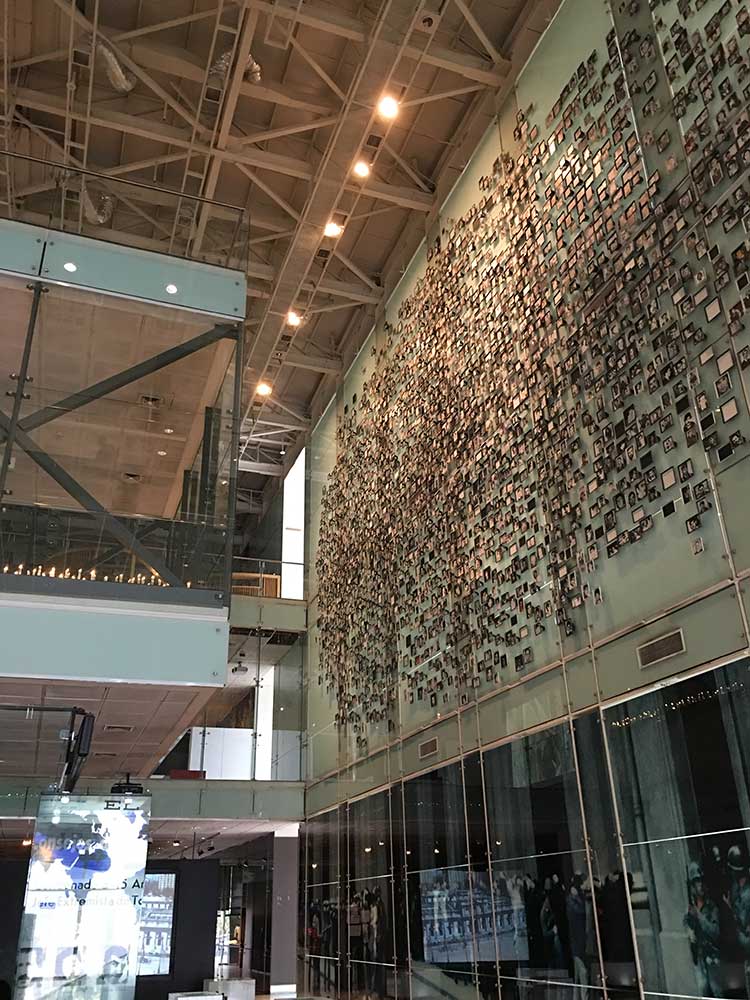
Names of and photos of murdered Chilean people by pro-US military junta
Those who refuse to ‘learn from the West’, to fall in love with it, or at least to serve it faithfully, are being brutally punished.
Lashes are hitting exposed flesh. Entire nations are being destroyed, genocides distributed to all continents. East Timor, Afghanistan, Iraq: it never stops.
Flogging Punjabi man by British colonialist
Torrturing Vietnamese patriots by French colonialists
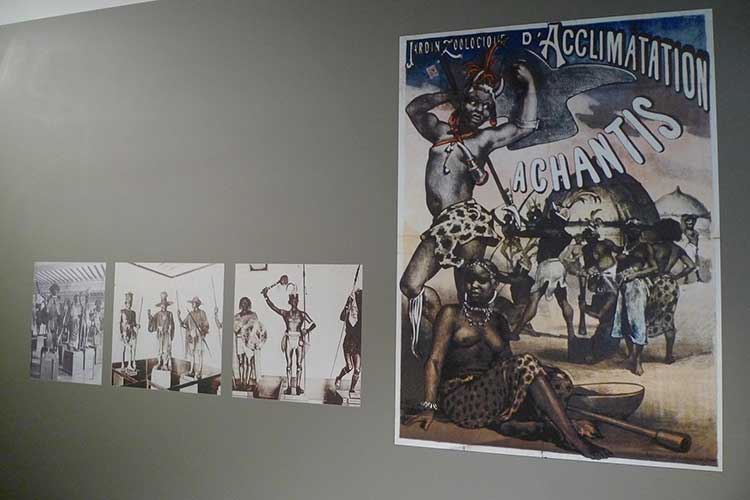
Poster of human zoo at Military Museum in Paris
I follow the discourses of the US and especially British UN delegations, ‘discussing’ Syria and even Russia. What comes to my mind is Punjab in India. I recall those old, historic photos of Indian men being hanged by the Brits, pants down, and flogged in public.
They have been doing this kind of stuff, for centuries. They like it. It clearly excites them. This is their democracy, their respect for human rights and for other cultures!
If someone refuses to take his or her pants down, they catch the person, rape him or her, then do the flogging anyway.
I also recall what my Ugandan friend used to tell me:
“When the Brits came to Africa, to what is now Uganda, their army would enter our villages and first thing they’d do was to select the tallest and strongest man around. They’d then tie him up, face towards the tree. Then the British commander would rape, sodomize him in front of everybody. This was how they showed the locals who is charge.”
How symbolic!
How healthy is the culture that has been controlling our world for centuries!
One of the most frightening things about mental illnesses is that the patient usually does not realize that he or she is suffering from them.
It is about the time for the rest of the world to treat the West as a mental patient, not as the ‘leader of the free and democratic world’.
We have to think, to gather, to develop a strategy of how to deal with this unfortunate, in fact, terrible situation!
If we refuse to understand and to act, we may all end up in the most dangerous situation: as complacent servants of the perverse whims of a frustrated, extremely aggressive and truly dangerous SPD patient.

Australian government imposes harsh financial burdens on immigrant families

Max Newman

The Liberal-National Coalition government has just made it harder for working class families to migrate to Australia, and effectively cut migration numbers at the same time.
The changes feed into the right-wing agitation against immigrants, making them scapegoats for deteriorating economic and social conditions. They also take to a new level the corporate model of migration, imposed by successive Coalition and Labor governments. This utilises a points-based system to prioritise readily-exploitable skilled employees for business, while restricting the number of poorer families.
As of April 1, Prime Minister Malcolm Turnbull’s government made significant alterations to the “assurance of support scheme.” This reactionary scheme denies migrants the right to bring family members to Australia unless they demonstrate to the government they can financially provide for them. The scheme is specifically designed to target poorer migrant families and is touted as a means to keep new migrants off welfare.
The amount of income that families must have to act as financial backers for their parents has been doubled. For example, previously a couple had to have a combined annual income of $45,185 to vouch for their parents. That total is now $115,475 a year. Similarly, a single person must now earn $86,606, up from $45,185.40. These income levels exclude millions of working class households.
Additionally, as of April 1, 2019, bank guarantee requirements for certain visas will be increased and expanded. These guarantees force migrant families to provide lump sum assurances to the government, which they must pay if a newly-arrived family member requires a payment from the government. For example, an assurer must guarantee $15,000 if the family member applies for a Contributory Parent or Aged Parent visa, up from $10,000 previously.
Chelsea Liu, a migration agent, told the media her clients, predominately from Chinese backgrounds, were confused and worried. “Some of our clients, they are already thinking of withdrawing their application, or [getting] family members’ or friends’ help to support their parents as well,” she said.
This attack on poor migrant families has paralleled moves by Home Affairs Minister Peter Dutton to reduce the annual immigration intake. In February, Dutton publicly called for immigration levels to be cut. At the time, Treasurer Scott Morrison said that would cost the Australian economy up to $5 billion over four years by slowing growth and reducing the pool of skilled workers for employers.
It was reported this month that in a private meeting Dutton proposed reducing the annual immigration intake, currently capped at 190,000, by 20,000. Both Turnbull and Morrison denied the media report, but it is now clear that such a cut is being implemented.
The Australian reported last week that with tighter “vetting” methods undertaken by the Department of Home Affairs, the intake for 2017-18 was expected to hit a 10-year low of between 160,000 and 170,000.
Senator Pauline Hanson’s right-wing populist One Nation party has continued to demonise immigrants and refugees, especially Muslims and “Asians,” and demand harsher cuts to immigration. Former Prime Minister Tony Abbott has echoed this demand, reflecting worsening rifts inside the Coalition government.
Despite Turnbull’s formal rejection of large-scale immigration reductions, the entire migration policy is geared toward denying entry to poor and working-class families, while prioritising wealthy business people and workers with specialised skills required by big business.
The Australian Broadcasting Corporation (ABC) recently reported that changes made in July 2017 to the skilled independent subclass 189 visa may already have cut the migration intake. The new visa subclass is allocating places to New Zealand residents who have been in the country for five years or more.
The ABC revealed that 1,512 of these new visas had been issued since February, with 7,500 applications still being processed. With a 44,000-annual cap on skilled visas and between 60,000 to 80,000 eligible New Zealand residents in Australia, the changes may crowd out applicants from other countries.
New Zealanders living in Australia should have full civil, employment and political rights, as should all workers internationally, but the government is playing them off against other immigration applicants.
As part of this divisive policy, the government is also seeking to introduce university-level English language tests for citizenship, and give “special” treatment to white South African farmers supposedly facing persecution.
Greens immigration spokesman Senator Nick McKim said he was “deeply concerned” by the changes. “[Dutton] is seeking to cut immigration by stealth and to have more English-speaking, white and wealthy people migrate to Australia,” he told the Guardian.
The reality is Australia’s immigration policy has always been biased against poor working-class people, dating back to the racist White Australia policy, championed by the Labor Party and the trade unions, which existed for most of the 20th century.
Since the 1980s, one government after another has introduced anti-working class immigration cuts. During 1989–90, the Hawke Labor government specifically cut the parent intake from 10,900 to just 2,500 annually. In 1992, the Keating Labor government slashed migrant intakes and introduced vocational English language proficiency tests into the visa points system.
These policies were intensified by the Howard Coalition government from 1996 to 2007. It increased the required pass mark on English tests, imposed further limits on family immigration and introduced the Regional Sponsored Migration Scheme for companies in regional or remote areas to recruit workers from overseas.
After 2007, the Rudd-Gillard Labor governments and the Abbott-Turnbull Coalition governments stepped-up these discriminatory policies, focusing on making residency and citizenship for poor families increasingly difficult. While the Greens voice “concern,” they had firsthand experience in overseeing anti-immigrant and anti-refugee policies when they formed a de facto coalition with the minority Labor government from 2010 to 2013.
The latest attacks on poor migrant families will leave thousands of people scrambling to get large sums of money together, while their elderly parents and relatives languish, often in isolation, denied the basic right to family reunion.

Seychelles opposition alliance rejects India’s plans for military base

Rohantha De Silva

Long-standing Indian plans to build a naval base on Assumption Island in Seychelles have stalled amid mounting resistance throughout the sparsely-populated 115-island, Indian Ocean nation.
Seychelles is strategically situated in the western Indian Ocean, about 1,500 kilometres east of Kenya. Its 94,000 people live on a group of 42 islands that sit astride east African and south Asian sea lanes, amongst the busiest in the world.
Wavel Ramkalawan, leader of the Linyon Demockratik Seselwa (LDS), a four-party opposition alliance, declared on March 22 that it will not ratify the India-Seychelles base agreement. Other political activists also have denounced the deal. The LDS holds a majority in the country’s parliament, after winning 15 positions in the 25-seat legislature in 2016.
The construction of an Indian base was first agreed between then Seychelles President James Michel and Indian Prime Minister Narendra Modi in March 2015. The first visit to Seychelles by an Indian prime minister in more than 30 years was part of New Delhi’s drive to dominate the Indian Ocean and boost its strategic influence in Africa and the Middle East.
India has promised to invest $US550 million in the project. This includes renovating Assumption Island’s airstrip, upgrading its jetty and constructing new buildings for the Seychelles Coast Guard. Indian soldiers would also train archipelago forces as part of the 20-year agreement.
The Seychelles government hoped that the military base would increase the country’s capacity to patrol its 1.3-million square kilometre exclusive economic zone against illegal fishing, drug trafficking and piracy.
Full details of the agreement, however, were kept secret and not presented to the parliament as legally required, even when the Michel administration had a majority.
Information about the deal was then leaked and published on YouTube. This forced some revisions, including the insertion of clauses preventing India from using the base in times of war and disallowing nuclear-armed vessels at the facilities. LDS leader Ramkalawan declared, however, that the alliance would still not back the agreement in its current form.
If established, the base would dramatically increase India’s military presence in Seychelles, which has had a military cooperation deal with New Delhi since 2003. India built the Coastal Radar Surveillance (CRS) system in Seychelles in 2016 and has given the Seychelles Defense Forces three fast-track patrol vessels and one Dornier aircraft.
While the CRS is supposedly assisting Seychelles to combat piracy it also helps India track the movement of Chinese navy and merchant vessels across the Indian Ocean. A March 29 article by Abhishek Mishra in the Diplomat noted that apart from assisting “ensure safe passage of shipping vessels,” the “base could counter Chinese unilateralism and increasing securitisation of the Indian Ocean Region.”
Ralph Volcere, a Seychelles opposition activist, who has led protests against the base agreement, told Al Jazeera that India’s principal aim was to “monitor the energy transport of China.”
Volcere said Seychelles “cannot afford to be taking sides” in the “rivalry between China and India” over geo-strategic influence in the Indian Ocean. “[The] Chinese also wanted to build a base here, but we turned that down… we don’t want foreign military personnel here,” he said.
Although the anti-base opposition of Volcere and others is premised entirely on nationalist considerations, it reflects growing popular concern about the dangerous consequences of escalating rivalry between major powers in the Indian Ocean.
Washington’s strategic aim is to diplomatically and militarily isolate Beijing. It has enlisted India as a frontline state in this geo-strategic manoeuvring.
India, however, is facing “a lot of blowback in the region,” Delhi-based foreign policy commentator Manoj Joshi warned recently. “China is a subtext in India’s troubles in both Maldives and Seychelles,” he told Al Jazeera, adding: “China offers a leverage [for small countries] against a big neighbour like India.”
New Delhi’s attempts to strengthen military relations with Seychelles include offering assistance in health, science and technology, and renewable energy. It has promised also to invest $8.36 million in various civilian projects.
The Seychelles government is maintaining its political and economic relations with Beijing, however. Congratulating Xi Jinping on being reappointed Chinese president last month, Seychelles President Danny Faure said: “The One Belt, One Road initiative, in particular, reflects China’s determined willingness to play a more important role to improve the infrastructure for facilitation of world trade and integration.”
India is continuing its efforts to revive its stalled agreement with Seychelles. On April 10, the Wire, an Indian-based web site, reported apparent “closed door” activity between the two countries. The report quoted Seychelles Vice President Vincent Meriton who said: “A declaration will be made very soon to find a feasible way to build this facility because the country really needs it.”

Armenian prime minister resigns after mass protests

Clara Weiss

After almost two weeks of mass protests, Armenia’s prime minister, Serzh Sargsyan, announced on Monday, April 23, that he would step down. Commentators in Russia and internationally expressed fears that the political crisis could lead to a renewed escalation of the frozen military conflict over Nagorno-Karabkh with neighboring Azerbaijan with potentially far-reaching consequences for the entire region.
The protests started 11 days earlier, after Sargsyan announced he would be the country’s prime minister after serving 10 years as president. In 2015, Sargsyan had pushed for changes to the constitution that would give him the same powers as prime minister that he had wielded as president.
Initially limited to a few hundred people, drawn largely from supporters of the liberal, pro-EU opposition, the protests rapidly embraced broader sections of the population and spread to cities other than the capital, Yerevan. By April 21, about 100,000 people had joined the protests across the country. Thousands of students at the country’s most important universities went on strike. There were also reports of strikes by workers at a number of factories. In a country of just under 3 million people, the protests involved a significant portion of the population and are among the largest in Armenian history.
Nikol Pashinian, who has been celebrated in the Western media as the opposition leader, announced on April 17 that the protest movement constituted a “non-violet velvet revolution.”
The scope of the protests, which took virtually everyone by surprise, and the involvement of sections of the working class indicate that more was involved than just the machinations of the pro-EU opposition, which has received barely 8 percent of the votes in the country’s last parliamentary elections.
After over a decade in power, Sargsyan was widely associated with a state of corruption and ill-begotten wealth at the top side-by-side with desperate poverty for the majority of the population.
The official unemployment rate stands at almost 18 percent, and almost every third Armenian lives beneath the very low poverty line. The average salary in the capital Yerevan was just $390 a month in 2016.
Unlike Russia, Azerbaijan or Kazakhstan, Armenia does not have any significant raw material resources, making it one of the poorest and economically most underdeveloped states that emerged out of the dissolution of the Soviet Union in 1991. Since then, about a third of the population has left the country because of the lack of jobs in Armenia.
Hundreds of protesters were arrested by the government, including several opposition leaders.
The situation tipped after the release of the opposition leader Nikol Pashinian on Sunday, April 22, failed to quell the protests. In a televised debate between Sargsyan and Pashinian on April 22, the opposition leader said, “You do not understand the situation in Armenia, the power is now in the hands of the people,” to which Sargsyan replied: “a party that has registered only 8 percent at the [legislative] elections cannot speak in the name of the people.”
On Monday, up to 200,000 people—almost a tenth of the country’s population—again took to the streets calling for Sargsyan to step down. Hundreds of members of the armed forces as well as clergy joined the protests, indicating that important sections of the state apparatus had by then also turned against Sargsyan.
However, the biggest fear of the Armenian bourgeoisie as a whole was that the protests would turn into a full-blown movement by the working class. In a desperate attempt to regain control over the situation, Sargsyan announced his resignation, describing the demonstration as a “turning point for the country.” Tens of thousands of people celebrated his resignation.
Pashinian immediately stepped forward, demanding snap elections and for allies of Sargsyan in the government to step down. Protests in support of Pashinian and the opposition on Tuesday drew significantly fewer people than those of the previous days, with about 10,000 supporters marching in Yerevan.
The Russian government has issued statements, insisting that the demonstrations were a matter of Armenia’s internal affairs, and indicating Moscow’s hope for a “smooth and peaceful political transition.” There is little question that the Kremlin, like the Armenian political establishment, fears a movement of the working class in the Caucasus that could quickly spread beyond the borders of the small country.
The US government and the European Union (EU) are closely following the situation, hoping that a change in government will further their own interests in the region by bringing the liberal opposition into power. US media like the Atlantic have celebrated the demonstrations as “Armenia’s Democratic Triumph.”
While broader sections of the working class and youth were involved in the protests, under conditions of the absence of any political organization that expresses their interests, the liberal opposition has been able to step forward in an attempt to reassert control over the situation in the interests of the bourgeoisie and to advance its own foreign policy agenda.
The political crisis in Armenia has implications far beyond the borders of the country. Due to its geographic location in the Caucasus, which functions as a bridgehead between eastern Europe and the Middle East and possesses some of the world’s largest oil reserves, developments in the region have far-reaching implications for the geopolitical situation internationally.
Ever since 1991, the Armenian government has maintained very close ties to Russia, by far its most important economic and military partner. Russia also has an important military base in southern Armenia. In recent years, however, the Armenian government has undertaken tentative steps toward a rapprochement with the EU. Yet in 2013, the government backed away from signing an Association Agreement with the EU, and instead joined the Russia-led Eurasian Union. The liberal opposition has sharply criticized this move and has continued to advocate for an Association Agreement with the EU.
In February 2017, the Armenian government announced that it wanted to work within both the EU and the Eurasian Union, and signed an agreement for closer economic and political ties with the EU. The liberal opposition advocates a pro-market platform and deeper cooperation with the EU, including EU membership. Several members and trustees of the opposition party Civil Contract, which Nikol Pashinian represents, are entrepreneurs, current or former members of the Armenian political establishment, or are working in the US.
The tactical differences over foreign policy within the Armenian bourgeoisie have been significantly exacerbated by the escalating war drive of US imperialism against Russia in both eastern Europe and the Middle East, while the development of growing working class struggles in both Europe and the Middle East has sent shock waves through the ruling class in the region.
Armenia is surrounded by Turkey, Georgia, Azerbaijan and Iran. Turkey is a NATO member and has historically had hostile relations with Armenia, while Georgia and Azerbaijan are closely aligned with US imperialism.
Iran, Armenia’s only foreign policy ally among its neighbors, was shaken by mass working class protests last winter. At the same time, the increasingly aggressive posture of US imperialism, which threatens all-out war with Iran, has exacerbated nervousness and tensions in the entire Caucasus. Russian media have been running reports that US-backed Israel and Iran are standing on the brink of war.
Armenia itself has been in a state of war with its neighbor, Azerbaijan, over Nagorno-Karabakh, a small mountain enclave in southern Azerbaijan, since the late 1980s. The war over the territory from 1988 to 1994 took the lives of 20,000 to 30,000, wounded 50,000 and permanently displaced hundreds of thousands of people. The conflict was never resolved, and border clashes have occurred repeatedly in recent years.
Both in the Russian media and in Armenia there were warnings that the current political crisis might fuel a renewed outbreak of the conflict. Thus, the Russian online newspaper Gazeta.Ru warned that the South Caucasus could become “something like a Middle East in miniature, the hearth for a new war,” if Azerbaijan were to exploit the current political crisis in Armenia and intervene militarily to reestablish control over Nagorno-Karabakh. Azerbaijan, one of the most important oil-producing countries in the world, has maintained close ties to both the EU and especially US imperialism, which has built up extensive ties with Azeri oil and gas companies since 1991. Azerbaijan has also been an important ally in the US war preparations against Iran and would likely receive US backing in any open military clash with Armenia.

Rise in interest rates sparks panic on Wall Street

Trévon Austin 

US stocks tumbled Tuesday after a warning from executives of the industrial giant Caterpillar scared investors and the 10-year Treasury yield climbed to 3 percent for the first time since 2014. The Dow Jones Industrial Average fell more than 600 points at one point, extending the index’s losing streak to five sessions.
The S&P 500 dropped 35.73 points, or 1.3 percent, to 2634.56. The Nasdaq Composite fell 121.25 points, or 1.7 percent, to 7007.35.
Markets opened higher, but fell significantly after Caterpillar released its profit margins for the first quarter. It reported earnings and revenue that beat expectations, sending the stock higher initially. Investors cheered the latest corporate earnings, sending the Dow up by 131 points at its session high. Major corporations such as United Technologies, Verizon and Coca-Cola reported better-than-expected earnings as well.
But the industrial giant’s shares sunk later in the day, sparking a mass sell-off throughout the stock market, after Caterpillar Chief Financial Officer Brad Halverson said the company’s first-quarter profit “will be the high-water mark for the year” because of expected increases in investment later in 2018.
Caterpillar is seen as a barometer for the state of the economy and stock market. According to Kensho, an analytics company, Caterpillar’s stock has had a 0.81 correlation with the Dow over the last six months.
Caterpillar shares fell by 6.2 percent after Halverson’s comment, with other corporations following suit. 3M, the maker of scotch tape and Post-it notes, saw its shares fall by 6.8 percent. Alphabet, Google’s parent company, saw its shares decline by 4.8 percent. Facebook, Amazon and Netflix shares all fell over 3 percent.
Meanwhile, Wall Street was also spooked by the changes in the 10-year Treasury yield. The 10-year Treasury is seen as a proxy for interest rates and a predictor of the long-term outlook for the US economy. The yield on the 10-year is one of the most closely followed financial measures in the world, as mortgages and corporate loans are closely tied to the government bonds.
The stock market’s fall reflects investors’ fear of rising interest rates and a national struggle for higher wages. Workers winning wage increases would be considered a disaster for Wall Street. The parasitic growth of the stock market has been fueled by the suppression of the class struggle. A rise in working-class militancy would send the inflated share values into a precipitous decline.
The American ruling class is well aware of the threat and is ruthlessly attempting to prevent a nationwide movement. Earlier this month, JPMorgan CEO Jamie Dimon suggested a sharp rise in interest rates to halt economic growth and increase unemployment. The aim of such a policy would be to demoralize workers, allowing more pressing austerity measure and wage cuts.
The national wave of teacher strikes in West Virginia, Oklahoma, Kentucky, Arizona and other states is particularly alarming to the American ruling class. Wage increases have been a central demand in each movement. The ruling class is frightened that the teachers’ demands may trigger a nationwide struggle for higher wages.

Facebook codifies its censorship regime

Andre Damon

Facebook, the world’s largest social media company, spelled out for the first time the criteria it uses to censor speech on its platform, purely at its own discretion, and with no legal oversight or recourse.
Its “community guidelines” are so sweeping and broad that effectively any statement expressing any critical political view can be constrained as violent, defamatory, “extremist,” “bullying” or—in the most sweeping catchall—“fake news,” and flagged for removal or undetectable censorship.
These “community guidelines” are used by the 20,000 in Facebook’s “security” and “moderation” departments—constituting the absolute majority of the company’s employees—to shape political discourse and block content the massive and unaccountable technology monopoly deems objectionable.
The centerpiece of this censorship apparatus is Facebook’s policy regarding “fake news.” In its newly released community guidelines, the social media monopoly made clear that it would not let users know their content is being blocked from distribution as “fake news” because such censorship is a “sensitive issue”:
Reducing the spread of false news on Facebook is a responsibility that we take seriously. We also recognize that this is a challenging and sensitive issue. We want to help people stay informed without stifling productive public discourse. There is also a fine line between false news and satire or opinion. For these reasons, we don’t remove false news from Facebook but instead, significantly reduce its distribution by showing it lower in the News Feed.
The campaign against “Fake News” was initiated in November 2016, immediately following the 2016 election, by the US intelligence agencies, the Democratic Party, and the major technology giants. This cabal, shocked by the electoral defeat of Hillary Clinton, the favored candidate of the military/intelligence apparatus, and the widespread support for socialist ideas reflected in broad support for the campaign of Bernie Sanders, initiated a media offensive aimed at pinning the growth of social opposition on an amorphous, and rarely defined, concept called “fake news.”
Although the hundreds of accounts in major newspapers devoted to the topic never defined what “fake news” is, Hillary Clinton, in her memoir of the 2016 election, put the genesis of “fake news” with WikiLeaks and its release of documents revealing the Clinton campaign to have rigged the 2016 primary and engaged in corrupt relations with Wall Street.
Given that no one has ever pointed out any inaccuracies in WikiLeaks’ reporting, the clear implication is that the definition of “fake news” is any information, whether true or false, that is damaging or discrediting to the state.
In other words, the blocking of “fake news” by the major technology giants, working on behalf of the US intelligence agencies, is nothing but political censorship.
Given this fact, Facebook’s wording is highly significant. Because the suppression of “fake news,” i.e., censorship, is a “sensitive issue,” the company will do it secretly, by “significantly reduc[ing] its distribution by showing it lower in the News Feed.”
La Rochefoucauld’s maxim that “hypocrisy is the compliment vice pays to virtue” applies here. Since journalists, publishers and users would raise a hue and cry over their content being censored, Facebook simply carries out its censorship in secret. By blocking distribution on the Facebook news feed, the company’s actions have the same effect as simply deleting content, but without any legal proof that the company violated its users’ First Amendment rights.
While Facebook is the only technology company that has spelled out these actions with such directness, Google and Twitter have both admitted, via legal representatives in congressional testimony that they follow a similar policy to suppress “fake news”—i.e., oppositional viewpoints.
Facebook’s admission is yet another vindication of the campaign launched by the World Socialist Web Site to expose political censorship by Google and other technology giants, an allegation in an open letter published August 25 that the company was engaged in “enforcing authoritarian-style direct and deliberate blacklisting.”
The World Socialist Web Site published its letter in response to the revelation that leading left-wing, anti-war, and socialist web sites had their search traffic from Google fall by up to 75 percent after the company announced measures to “improve” its search system.
It is now clear that the WSWS’s allegations were entirely correct. The technology giants, unbeknownst to their users, are blocking “alternative” news sources and promoting “trusted” news outlets, including, as Facebook CEO Mark Zuckerberg put it earlier this year, the New York Times and Wall Street Journal .
The measures taken in secret to limit the distribution of critical political viewpoints are accompanied by more explicit censorship measures. In a quarterly report published Monday, Google bragged that it removed over 8 million videos from YouTube, of which the great majority—some 6.7 million—were “first flagged for review by machines rather than humans.” More than three quarters of the videos flagged by Google’s AI systems “were removed before they received a single view.”
The company declared, “Deploying machine learning actually means more people reviewing content, not fewer. Our systems rely on human review to assess whether content violates our policies.” Like Facebook, Google has hired an army of censors, aiming to employ 10,000 people in this department by the end of the year.
Facebook and Google are under no legal obligation to police its content. As communications companies, they are not responsible under US law for what its users say or do on its platform. They have, rather, voluntarily become an arm of the US police and law enforcement agencies, but with one caveat: as a private corporation, they claim exemption, speciously, from the protections under the First Amendment barring the state from impinging on the freedom of expression.
The real target of the crackdown by the technology giants on the freedom of speech is not “fake news,” “extremist content,” or any other of the myriad catchphrases used to justify censorship. It is, rather, the growth of oppositional sources of news and political analysis, and the use of social media to organize political resistance. As the strike movement by workers in the United States and internationally continues to grow, the technology giants will only expand their assault on the freedom of expression.

Australian unions impose sweeping job and pay cuts via “interest-based bargaining”

Mike Head

Over the past six years, with virtually no publicity, some of Australia’s most prominent trade unions have pioneered a “new cooperative approach” to workplace bargaining to inflict mass retrenchments, wage reductions and the overturning of hard-won conditions on their members.
Supervised by the Fair Work Commission (FWC), established by the last Labor government of Kevin Rudd and Julia Gillard, the “interest-based bargaining” (IBB) system takes to a new level many decades of union collaboration with employers and governments.
The IBB regime has already been used to implement wholesale restructuring, casualisation and the demolition of basic conditions at major workplaces, including Sydney Water, News Corp, Orora Fibre Packaging, Alcoa and Patrick stevedoring.
In the forefront are prominent unions, such as the Australian Services Union (ASU), the Australian Manufacturing Workers Union (AMWU), the Maritime Union of Australia (MUA) and the National Tertiary Education Union (NTEU).
Ever since the Keating Labor government and the unions imposed enterprise-by-enterprise bargaining during the early 1990s, unions have used enterprise bargaining agreements (EBAs) to split the working class into individual workplaces, suppress most industrial action and subordinate workers to the profit demands of “their” employers.
This corporatist partnership was forged between the unions, governments and the corporate elite through the “Accords” struck by the Australian Council of Trade Unions (ACTU) with the Hawke Labor government in the 1980s, in order to make Australian capitalism “internationally competitive.”
IBB goes further by junking the previous “position-based bargaining” approach, in which some unions still went through the motions of presenting employers with logs of claims, supposedly based on a mandate from their members, before entering closed-door talks with corporate executives behind workers’ backs.
IBB casts aside even the notion of employers and unions starting from different “positions.” Instead, it is based, from the outset of a bargaining period, on delivering “collaborative transformations” by “exploring the common interests” with management and devising means of satisfying those interests at workers’ expense.
What this means in practice can be seen from three IBB case studies on the Fair Work Commission’s website. The first was at Sydney Water, a semi-privatised New South Wales state government utility. The ASU worked with senior executives to push through a 2012 EBA that delivered a near-20 percent cut in costs to satisfy the demands of the state government.
The EBA, which allowed Sydney Water to outsource maintenance, also “amended redundancy and re-deployment provisions” and “rosters and shift changes.” A joint ASU-management “road show” travelled to depots to persuade union members to accept the agreed changes, but encountered “difficult discussions” and “hot meetings, with hot conversations.”
That hostility reflected the fact that “many employees in Civil Delivery saw significant declines in take-home pay because of new shift arrangements.”
Beating down this opposition was just the beginning of a “new cooperative relationship between the enterprise and the union,” formalised by a memorandum of understanding signed by the managing director and the ASU state secretary.
New consultative mechanisms were established at different levels throughout Sydney Water. “At the top,” the managing director “agreed to attend two meetings each year of the ASU’s Committee of Management, while the ASU secretary attended two meetings each year of Sydney Water’s Executive.” More “informally,” the two leaders “established a relationship that allowed them to contact each other whenever issues arose.”
In other words, from the top down, the union works with management to report on and silence opposition by workers. One union official noted: “Of course, they still have a blue every day, but we’ve really changed the culture of the workplace.”
Union and company officials alike heaped praise on the “facilitator” of this partnership, Fair Work Commission (FWC) deputy president Anna Booth, a former national secretary of the Textile, Clothing and Footwear Union of Australia and ACTU vice president.
At Orora packaging, which was “demerged” from Amcor in 2013, there was similar acclaim for Booth and another FWC commissioner, ex-AMWU national president Julius Roe. With their facilitation, the printing division of the AMWU partnered with Orora to shut down a plant at Somerton, near Melbourne, carry out three rounds of redundancies and impose other “negative effects on the workforce, notably a reduction in take-home pay for many workers.”
This process was enforced from the top. It began with a February 2013 “off the record” discussion at the FWC. Participants included the AMWU national secretary and the CEO of Amcor Australasia. On the shopfloor, union delegates acted as “troubleshooters as required” for an AMWU-management Steering Group.
Even greater job losses—up to 70 percent of the workforce—were inflicted by the AMWU and Electrical Trades Union (ETU) at Rupert Murdoch’s News Corp Melbourne Print Centre (MPC), during 2015 and 2016.
After a “training session” at the FWC, attended by union officials and delegates, and a host of senior News Corp managers, the “collaborative change” also featured “changes to shift and roster arrangements,” “multi-skilling,” greater “use of casual staff” and reduced payment of wage penalty rates.
A union official acknowledged that the process was difficult because it required many redundancies, both forced and “voluntary,” so “there was conflict there … very emotional.”
The “MPC Collaboration Team”—a three-level hierarchy of joint management-union committees—was headed by a Senior Steering Committee consisting of the AMWU Printing Division national secretary and News Corp’s national director of production.
Murdoch’s managers were so impressed with the outcomes that the partnership is being extended. According to the FWC case study: “Beyond the MPC, the next step is to continue the collaboration to other print sites around Australia.”
Among the FWC’s other “success stories” are three involving the MUA, which has been falsely depicted by the media and various pseudo-left groups as a “militant” union. They relate to two rig crewing companies, Go Offshore and MMA Offshore, and Patrick, a national stevedoring business.
Patrick led a major attack on dockworkers in 1998, then worked with the MUA to halve its workforce. It joined the FWC’s “New Approaches” program with the MUA in 2015. Since then, “the parties have been able to focus on shared interests in the success of the ports and have saved millions of dollars.”
At Sydney’s Macquarie University, the NTEU, which postures as a “progressive” union, is collaborating intensively with management through IBB to try to push through an EBA that will mean a real wage cut and academics being coerced into having 80 percent of their workloads allocated to teaching.
According to the FWC’s latest annual report, its “New Approaches: Cooperative and productive workplaces” program was in operation at 24 workplaces as at June 30, 2017, up from 17 a year earlier.
The IBB process is a new stage in the decades-long transformation of the unions into corporatist entities. They have been totally integrated into management, functioning as nothing but instruments for imposing the agenda of the corporate elite on their members.
This also exposes the reality behind the ACTU’s current “Change the Rules”advertising blitz. Conscious of the hostility that has built up in the working class against the corporate assault that the unions have policed for decades, the ACTU is trying to divert the discontent into a campaign for the return of yet another pro-business Labor government. At the same time, the unions are using IBB and the other Fair Work “rules” to accelerate the dismantling of workers’ jobs and conditions.

India’s BJP government imposes death penalty for child rape

Wasantha Rupasinghe

India’s Hindu supremacist Bharatiya Janata Party (BJP) government promulgated an ordinance last weekend that sharply increases penalties for those convicted of rape, including providing the death penalty for persons found guilty of raping, or participating in the gang rape, of children aged 12 and under.
The “Criminal Law (Amendment) Ordinance, 2018” is a cynical and transparent attempt to divert attention from the role BJP leaders in Jammu and Kashmir, India’s only Muslim-majority state, have played in seeking to shield the perpetrators of the brutal gang rape and murder of an eight-year-old Muslim girl, Asifa Bano.
Last January’s rape-murder of Asifa Bano was—as authorities in Jammu and Kashmir now concede— a communally motivated crime directed against the Bakkarwal, the impoverished, semi-nomadic Muslim community to which Bano belonged. Its perpetrators aimed to terrorise the Bakkarwal into fleeing Kathua, a Hindu-majority district, where for decades, if not much longer, they have grazed their goats, sheep, and horses for part of the year.
With their ordinance, Prime Minister Narendra Modi and his BJP government are also seeking to exploit public revulsion over Bano’s horrific fate and several other recent instances of brutal sexual violence to promote their reactionary law-and-order agenda. In the name of “protecting India’s daughters,” the BJP government is increasing the repressive powers of the state and further befouling the political climate by equating “justice” with state violence.
Jammu and Kashmir police have charged six people—including the custodian of a Hindu temple and two police officers—with kidnapping, repeatedly raping and, after a week-long ordeal, murdering Asifa Bano. Two other police officers, those first tasked with investigating the case, are also under indictment for destroying evidence and otherwise protecting the accused.
BJP leaders in Jammu and Kashmir have mounted a communally charged agitation in defence of the Kathua rape accused. They have organised meetings and protests at which they have denounced the police investigation as “biased” because it included Muslim officers and have demanded that the case be turned over to the BJP central government-controlled Central Bureau of Investigation.
After the BJP’s actions provoked an all-India outcry and concern in Indian ruling circles that they were undermining New Delhi’s shaky hold over the disputed Kashmir Valley, the BJP national leadership took action against the two most prominent BJP leaders associated with the agitation. The two were forced to resign their cabinet posts in the Jammu and Kashmir state government, in which the BJP serves as the junior partner of the Kashmiri Muslim-based Peoples Democratic Party.
Last weekend’s ordinance was a further attempt at political damage control.
It was approved at what was described as an “emergency” cabinet session last Saturday. The next day, Indian President Ram Kovind, himself a former BJP legislator, signed the ordinance into law, saying he was “satisfied that circumstances exist which render it necessary” for the government to “take immediate action.”
Ordinances are an arbitrary, anti-democratic power of India’s executive, under which the sitting government can, with the president’s approval, rewrite the country’s laws when parliament is not in session. For such laws to remain in force permanently, they must be approved by parliament within six weeks of its reconvening.
Last weekend’s ordinance amends the Indian Penal Code, the Evidence Act, the Code of Criminal Procedure, and the Protection of Children from Sexual Offences Act (2012).
It empowers courts to impose the death sentence on persons convicted of raping a child 12 and under and stipulates a minimum sentence of 20 years in prison. Those who participate in a gang rape of someone 12 or under are also liable to death by hanging but must receive at least a sentence of imprisonment for the “rest of life.”
The minimum sentences have also been increased for rapes of children aged 13 to 15 from 10 to 20 years, with a maximum penalty of imprisonment for the remainder of the “convict’s natural life”, and for all other rapes from 7 to 10 years, with a maximum penalty of life imprisonment.
In addition to these legal changes, the cabinet approved a series of institutional measures. These include setting up so-called fast-track courts in consultation with the states and high courts to speedily hear rape cases, the hiring of additional public prosecutors, and the provision of special forensic kits for rape cases to all police stations and hospitals.
No one should have the slightest illusion these measures will provide justice to rape victims.
India’s police are notorious for their corruption, incompetence, use of torture and fake-encounter killings, and, last but not least their subservience to their political masters, big business and the rich.
The courts are little better. They provide only a slightly more polished veneer for a system in which there is one law for the poor and oppressed and another for the rich and powerful.
Moreover, like other institutions, India’s legal system has become increasingly communalised. The BJP, Shiv Sena and Congress Party leaders behind numerous communal atrocities from the 1984 anti-Sikh riots in Delhi, to the 1992 razing of the Babri Masjid, and the 2002 anti-Muslim pogrom in Gujarat have gotten off scot-free. Only last week, the Gujarat High Court overturned the conviction of former BJP Gujarat minister Maya Kodnani for her well-documented role in inciting attacks on Muslims during the 2002 pogrom.
And as the BJP has trumpeted, the various “saffron terror” cases—that is, the prosecution of Hindu communalists charged with carrying out bombings and other terrorists attacks—have apparently unraveled “for lack of evidence,” one after another, after years of being stalled in the courts.
In so far as they have chosen to comment on Modi’s rape ordinance, the political establishment has by and large been favourable.
The Congress chief minister of Punjab, Amarinder Singh, tweeted, “Am all for death for Rapists [of] minor children. Such men deserve no mercy and I welcome the Ordinance passed by the Union Cabinet today. Exemplary and deterrent punishment is the need of the hour.”
The Congress, it should be noted, resumed executions in India after almost 10 years during which death sentences had been held in abeyance, ordering two in the space of three months, between November 2012 and February 2013.
The second—that of Azfal Guru, a Kashmiri Muslim who was framed up for the December 2001 terrorist attack on the Indian parliament—was especially calculated to demonstrate that India’s then-Congress-led UPA government was prepared to act with utter ruthlessness. To prevent mass protests and a possible last minute appeal to the courts to stay the order of execution, the gove rnment carried it out in secret.
The ordinance has been criticised by civil liberties organisations, some womens’ rights groups, and even the Delhi High Court.
Yesterday, a bench or panel composed of two Delhi High Court justices asked the government if it had “conducted any scientific assessment or study before passing of your ordinance.” The judges noted that the government was “not even looking at the root cause” of sexual violence or “educating people”, nor did its ordinance take account of the fact that many offenders are themselves below the age of 18 or family members.
Vrinda Grover, a prominent Delhi civil rights lawyer and outspoken opponent of the death penalty, for her part, warned that the harsh new minimum sentences and the prospect capital punishment imposed on rapists will likely dissuade victims from coming forward: “Far from reporting the crime, death penalty is going to deter the victim from reporting sexual assault when the offender is from the family or is known to them. This will lead to the crime being suppressed and the victim being left completely helpless.”
Indian Express columnist Shalini Nair cited a report from the National Law University in Delhi that shows the death penalty is “disproportionately imposed on vulnerable persons along the axes of economic and social parameters.” Based on interviews with 373 of the 385 prisoners currently on death row in India, it found that 23 percent of them had never attended school, 9.1 percent had not completed primary school, and 61.6 percent had not completed secondary school. The study also showed that more three quarters of those sentenced to death were from “backward classes” (i.e., Dalits and other traditional lower caste groups) or religious minorities.

Saudi airstrike kills 33 at wedding in northern Yemen

Niles Niemuth

An airstrike by Saudi-led coalition jet fighters on a wedding in northern Yemen killed at least 33 people and wounded 55 others Sunday night.
The bombs, supplied by the United States, rained down on a tent in the northwestern province of Hajjah where women and children had gathered, killing dozens, including the bride. Most of those injured in the attack were children, many of whom were sent to hospital with grievous shrapnel wounds and severed limbs.
Abdel-Hakim al-Kahlan, a Health Ministry spokesman, reported that ambulances were delayed from reaching the injured and dying out of fear of a repeated attack as Saudi jets continued to fly overhead following the attack. Such so-called “double tap” strikes have been used repeatedly in Yemen by the Saudi coalition.
Video from the scene depict scattered limbs and a young boy clinging to a man’s corpse as he is removed from the rubble.
The bloody attack was one of three Saudi airstrikes over the weekend which claimed mass civilian casualties in Yemen. A separate airstrike Sunday night on a home in Hajjam killed five members of a single family. The previous day 20 civilians were killed outside the city of Taiz when Saudi planes bombed a commuter bus.
Saudi Arabia has been waging an unrelenting war against Yemen for more than three years, with the full support of the United States and its allies.
Utilizing American-made jet fighters armed with US-supplied bombs and refueled by the US Air Force, the Saudis have pushed the poorest country in the Arab world to the brink of famine and sparked the worst cholera outbreak in modern history. The US Navy has provided ships to enforce a blockade of the country, which has cut off critical supplies of food and medicine.
Saudi coalition jets have attacked residential neighborhoods, schools, markets, factories and hospitals, as well as water and electrical systems. No civilian target is apparently off limits for Saudi bombs. Earlier in April Saudi warplanes struck a housing complex for displaced people in port city of Hodeida. Once the attack ended at least 14 had been killed and nine wounded, the victims were predominantly women and children.
More than 13,000 civilians have been killed in the course of the three-year war, with Saudi Arabia responsible for the majority of all casualties.
The UN has recorded more than a million suspected cases of cholera since 2017, and more than 8.5 million Yemenis are on the brink of starvation.
Crown Prince Mohammad bin Salman, Saudi Arabia’s de facto autocratic ruler who was recently hailed by the political and financial elite in the United States and Europe as a great progressive reformer, launched the near-genocidal war in 2015 with the backing of the Obama administration in an effort to reinstall the US and Saudi-backed puppet government of Abd Rabbuh Mansur Hadi, who had been forced to flee the country by a rebellion led by Houthi militants.
Above all, the war has been framed as part of a critical effort to counter the influence of Iran, Saudi Arabia’s chief rival in the region, based on unsubstantiated claims that the Houthis are being funded and armed by Tehran. The mainstream media has pushed this narrative and continues to ignore repeated war crimes carried out by the Washington’s chief Arab ally.
President Donald Trump welcomed bin Salman and his retinue to the White House in March to discuss hundreds of billions of dollars in planned Saudi investments in the US. Trump boasted about the close relationship with leaders of the theocratic autocracy and the hundreds of millions of dollars in advanced weaponry which the kingdom has pledged to purchase from the United States.
“The relationship [with Riyadh] is probably as good as it’s really ever been, and I think will probably only get better,” Trump told reporters in advance of his meeting with the Saudi delegation. “We understand each other. Saudi Arabia is a very wealthy nation and they’re going to give the United States some of that wealth, hopefully, in the form of jobs, in the form of the purchase of the finest military equipment anywhere in the world, there’s nobody even close.”
The Saudi Crown Prince, adoringly referred to as “MBS” in the American media, then took his entourage on a grand tour of the United States.
Among those who welcomed the butcher of Yemen with open arms were Facebook CEO Mark Zuckerberg, Amazon founder Jeff Bezos, Google CEO Sundar Pichai, Twitter CEO Jack Dorsey and Apple CEO Tim Cook. Google’s parent company, Alphabet, and other American-based tech firms are reportedly in talks with the Saudi government to open a major research hub in Saudi Arabia. Hundreds of millions of dollars are expected to flow from Saudi Arabia to these companies as a result of these deals.
Bin Salman also held tête-à-têtes with former presidents Bill Clinton, George W. Bush and Barack Obama; former secretaries of state Henry Kissinger, John Kerry and Hillary Clinton; Democratic Senate minority leader Chuck Schumer; and the former billionaire mayor of New York City, Michael Bloomberg.
The Crown Prince, who runs a country where people are beheaded for criticizing government policy, was also granted favorable interviews with Timeand Vanity Fair as well as a feature on the CBS News program “60 Minutes.” This was in addition to meeting with the editorial boards of the New York TimesWashington PostWall Street JournalLos Angeles Times and San Francisco Chronicle.
On top of this he dined with Times columnist Thomas Friedman, the Atlantic’sJeffery Goldberg and media mogul Rupert Murdoch, all noted warmongers. Bin Salman’s trip to the US was reportedly capped off with a private visit with billionaire Oprah Winfrey.