12 May 2018

Google, Amazon assist in blocking encrypted communications

Will Morrow

Google and Amazon are assisting authoritarian governments in the Middle East aligned with Washington to censor the internet and prevent the use of encrypted communications by their populations.
On May 1, the developers of the Signal encrypted messaging application revealed that over the previous month, Google and Amazon took steps to stop Signal from continuing to bypass censorship measures in place in Egypt, Oman, Qatar and the United Arab Emirates. Workers, youth, journalists, lawyers and human rights advocates will no longer be able to use the application to send encrypted messages and evade government surveillance.
All of these affected countries are ruled by blood-soaked and repressive regimes. Egypt is run by General Abdel Fatteh el-Sisi’s military dictatorship, which came to power in a US-backed military coup in 2013 through the overthrow of the elected Muslim Brotherhood president Mohamed Morsi and the slaying of more than 1,600 of his supporters on the streets of Cairo. In the five years since, el-Sisi’s government has rounded up and imprisoned some 60,000 opponents and sentenced 1,000 to death in political trials. The UAE, Qatar and Oman are controlled by despotic monarchies.
Around December 2016, these governments instructed internet service providers to begin blocking all traffic to Signal’s servers. In response, Signal implemented a change to its software code, known as “domain fronting,” to make its web traffic appear to service providers and censors as though it were directed to Google’s web domain (google.com). This allowed users to continue using the messaging service just by updating the app on their phones.
Sometime in mid-March, 2018, however, Signal received a 30-day advance notice from Google that it was introducing internal changes to stop domain fronting. The changes came into effect on April 16.
When Signal’s developers announced plans to switch from Google to the web domain of Amazon’s online marketplace in the Middle East, Souq.com, Amazon quickly sent a letter in late April warning that it would “immediately suspend” Signal if “you use third party domains without their permission.” Then on April 27, Amazon modified its system architecture to prevent domain fronting altogether.
The practise of domain fronting requires that the “front” be a widely-popular service. In order to block Signal, government censors would previously have had to block traffic to Google or Amazon’s online market as well. According to Signal’s public statement, the changes by Google and Amazon mean there is no alternative to prevent government censorship of its application.
The change has implications beyond Signal. Other applications aimed at allowing users to evade surveillance and censorship, including the secure and anonymous web browser Tor, as well as the Great Fire Free browser, which is specifically designed to evade the Chinese government’s internet firewall, also reportedly rely or have relied on some form of domain fronting.
Explaining its decision to end domain fronting in a statement to the Verge, Google claimed that it “has never been a supported feature at Google” but that “until recently it worked because of a quirk of our software.”
Yet in 2014, Google’s CEO Eric Schmidt co-wrote a New York Times op-ed declaring his support for such measures, claiming that “obfuscation techniques—when one thing is made to look like another—are also a path forward. A digital tunnel from Iran to Norway can be disguised as an ordinary Skype call … and the collateral damage of blocking all traffic is often too high for a government to stomach.”
In the intervening period, Google and the other technology giants have completely integrated themselves into the campaign for internet censorship and surveillance by the US intelligence agencies.
Under changes introduced in April 2017, Google has begun censoring left-wing, socialist and anti-war websites, principally the World Socialist Web Site, by removing and demoting links to these publications in its search engine results. Under the banner of combating Russian-backed “fake news,” Google and Facebook have hired thousands of content censors, largely drawn from the intelligence agencies, to monitor content that is posted online, assisted by a rapidly expanding network of artificial intelligence algorithms.
There is no doubt that the coordinated decisions by Google and Amazon, which have vast foreign-policy implications for Washington, were made in close consultation with the State Department and CIA in order to assist their allies in repressing their populations. The change also assists the censorship efforts of the Russian government, which in mid-April, after Google announced it was ending domain fronting, ordered the shutting down of the Telegram secure messaging service, and sought to prevent it from using domain fronting.


Middle East teeters on brink of region-wide war after US withdrawal from Iran deal

Jordan Shilton

Tuesday’s decision by President Donald Trump to withdraw from the Iranian nuclear agreement has pushed the Middle East to the brink of a catastrophic regional conflict that could rapidly draw in the major powers.
Within minutes of Trump’s announcement, Israeli fighter jets violated Syrian airspace to launch a missile strike on a government base close to Damascus. The strikes caused the deaths of 15 people, including at least seven Iranian military personnel stationed in the country to support the regime of Syrian President Bashar al-Assad.
The situation escalated further late Wednesday, as reports emerged of Israeli shelling of Syrian army positions from the Golan Heights. Rocket sirens sounded in the north and explosions were heard. According to the Golan Regional Council, several towns in the region were targeted by rocket fire.
The Israeli military released a statement early Thursday accusing Iran’s Revolutionary Guard Corps’ Quds force of firing 20 rockets at army border posts in the Golan. It claimed several projectiles had been intercepted and reported no injuries.
According to the Syrian state news agency, Sana, Israeli war planes began firing missiles at targets near Damascus early Thursday, soon after the alleged Iranian attack. As of this writing, the extent of these air raids and whether they caused any casualties remain unclear.
Tel Aviv justified Tuesday’s air strike with the unsubstantiated claim that Tehran was preparing to strike Israel in retaliation for a raid on the T4 airbase in April that claimed the lives of nine Iranians. The absurdity of such allegations is obvious, given that Iran would have nothing to gain from being the first to launch an attack just as Trump was set to announce his decision on the Iran nuclear agreement.
Everything points to the Israeli attack having been closely coordinated with the US. On Sunday, Israeli media began reporting unverified allegations of an Iranian plot to strike targets in Israel. Then on Tuesday, CNN reported that the Pentagon was concerned about alleged preparations for an Iranian strike.
In light of this, it is all but certain that the right-wing government of Benjamin Netanyahu, informed in advance of Trump’s decision, planned the aggressive strike on the Syrian airbase to coincide with the US announcement, with the aim of provoking a response from Iran that would serve as the pretext for a wider military assault.
The air strike was accompanied by a campaign to whip up a war fever in Israel. Amid the reports of an immanent Iranian attack, the military revealed that it had deployed additional batteries for Israel’s Iron Dome missile defence shield in the north, while the US embassy in Tel Aviv prohibited US government employees from traveling to the Golan Heights without prior authorization.
Speaking from Moscow, where he traveled to secure Russian assent to Israel’s continued targeting of Iranians in Syria, Netanyahu preposterously compared the Tehran regime to the Nazis. He belligerently asserted Israel's right to “defend itself” from “Iranian aggression,” and alleged that Iranian forces were using Syria as a base to move troops and lethal weapons into position for an attack.
Underscoring that Tuesday’s air strike is merely a foretaste of what is to come, an Israeli government defence official told Haaretz, “The strikes on the Iranian missiles in Syria are a drop in the ocean. Even the army understands that this won’t prevent missiles and other systems from arriving in the area and we’re seeing that happen.”
Trump’s abandonment of the Iranian deal is only the latest in a long line of reckless actions by US imperialism that have emboldened the unstable Zionist regime to provoke a military conflagration across the Middle East.
Israel's bombing of Iranian targets inside Syria has been intensified following the US air strike on pro-Assad forces in early February that killed dozens of Russian military personnel in Deir Ezzor province.
Over the past month alone, Israel has struck inside Syria on at least three separate occasions, including Tuesday’s strike, killing dozens of Iranians.
Washington is encouraging Israel to go on the offensive as it prepares for war with Iran. In Syria, where the US has sought, in collaboration with Islamist “rebels,” to overthrow the pro-Iranian Assad regime for over seven years, killing hundreds of thousands of Syrians in the process, American forces are focused on thwarting attempts by Iran to open up a land bridge from Tehran to Damascus. To this end, US air power and ground forces have been directed towards holding territory in the east of Syria near the Iraqi border—territory that is also home to much of the country’s oil reserves.
In its drive to consolidate control over the energy-rich Middle East, Washington is determined to confront Russia in Syria, even at the risk of inciting a conflict fought with nuclear weapons.
Trump made clear in Tuesday’s White House address announcing Washington’s withdrawal from the Iran nuclear agreement that plans for war with Iran are far advanced. He announced that the highest level of economic sanctions would be imposed against the country, indicating that the next step in an escalation of the conflict would involve military force.
That Trump is aware of this fact was clear from the tone of his speech. The president of a country that has waged virtually uninterrupted war over the past quarter-century in the Middle East and Central Asia denounced Tehran as the leading “state sponsor of terror” in the world. In language usually reserved for enemy nations during a war, Trump ranted against Tehran's “malign and sinister” influence across the Middle East.
On Wednesday, Trump issued a bellicose threat to Iran, warning that it would face “very severe consequences” if it restarted its nuclear programme.
Under these conditions, the bourgeois-clerical regime in Tehran, confronting a deepening crisis, may conclude that its only option is to fight back. Representatives of the hard-line faction, including the head of the powerful Revolutionary Guard Corps, have already proclaimed the nuclear accord dead and dismissed claims by the European powers that it can be revived without Washington.
While a clash between Israel and Iran poses the most immediate war threat in the Middle East, Trump's torpedoing of the Iran deal has further destabilised an already explosive region. Apart from Israel, his announcement received endorsements from Saudi Arabia and the United Arab Emirates, two countries bitterly hostile to Iranian influence in the Persian Gulf. Riyadh has waged a genocidal war in Yemen since 2015 against Houthi rebels it claims are backed by Tehran.
In a speech last May, Trump called for Saudi Arabia to take a leading role in the formation of an anti-Iranian alliance across the region. His administration, following from where Obama left off, has supplied weaponry and intelligence to enable Saudi aircraft to continue their murderous bombing raids in Yemen, which have killed tens of thousands of civilians.
Just days prior to Trump's announcement, it was revealed that US special forces have been operating in Yemen since December 2017.
As oil rose to over $77 in the wake of Trump’s Iran announcement, Saudi officials declared they would consult with the UAE on increasing oil production to stabilise prices, a move that would severely impact Iran.
Seizing on missiles fired into Saudi Arabia by Houthi rebels Wednesday, Saudi Foreign Minister Adel Al-Jubeir blamed Iran for the attack, which he said amounted to a “declaration of war.” Iran has to be “held accountable for this,” he ominously declared. “We will find the right way and at the right time to respond to this … We are trying to avoid at all costs direct military action with Iran, but Iran's behavior such as this cannot continue.”
Al-Jubeir also vowed that should Tehran restart its nuclear programme, Riyadh would take steps to acquire nuclear weapons.

9 May 2018

Sri Lankan president makes anxious calls for political unity

K. Ratnayake

President Maithripala Sirisena opened a new session of the previously suspended Sri Lankan parliament yesterday with a desperate appeal for unity within the ruling coalition and among all other parliamentary parties.
The speech was a response to ongoing government in-fighting, mounting economic problems and growing opposition from working people across the island.
Voicing the fears of a section of the ruling elite, Sirisena declared: “This is not a time for parties to engage in a power struggle. It needs to deflect the power struggle between the parties in the national unity government and between the government and opposition.” Sri Lanka, he said, faced “a colossal debt burden.” It was, he declared, “the last chance [for the government]…to steer this nation forward.”
Last month, Sirisena suspended parliament until May 8 in response to sharp divisions within the ruling coalition—an alliance between the United National Party (UNP), led by Prime Minister Ranil Wickremesinghe, and Sirisena’s Sri Lanka Freedom Party (SLFP).
Divisions within the SLFP widened to breaking point last month after the resignation of sixteen of the party’s government ministers who endorsed an opposition no-confidence motion against the prime minister. The resolution was moved by the SLFP faction headed by former president Mahinda Rajapakse. The resigned ministers yesterday sat on the opposition benches in the parliament.
On May 1, Sirisena and Wickremesinghe were forced to make a fourth reshuffle of ministerial positions since the fragile coalition government was formed after the August 2015 general election. It was the second change since February this year. Ministerial positions are being used in an attempt to glue together the coalition and the internally divided parties that comprise it. The UNP has made several changes to its party leaders and has promised a new look for the government.
The government crisis came into the open after the humiliating defeat of the SLFP and UNP in February’s local government elections. Rajapakse’s newly formed front, the Sri Lanka Podujana Peramuna (SLPP), won control of a majority of local government institutions. Sirisena hypocritically blamed UNP policies for the election defeat.
Rajapakse was ousted in the January 2015 presidential elections as millions of Sri Lankans rejected his anti-democratic regime and its attacks on living conditions and social rights. Local election support for his SLPP was not an indication of popular backing for Rajapakse, but was a protest vote against the ruling coalition government’s brutal austerity program.
In his speech to the parliament yesterday, Sirisena claimed that the government had made important changes, including “restoring the rule of law, making the judiciary independent, reconciliation and winning back the good will of the international community.”
He claimed that the government has “raised income levels while fighting to tackle the debt” and had made “progress” in education, health services and agriculture.
But instead of “progress,” Sri Lankan working people are facing an onslaught on their living standards, which has produced a wave of strikes and protests by workers demanding higher wages, improved conditions and pension rights. Last week, tens of thousands of workers defied the government’s ban on May Day events, participating in meetings and demonstrations.
Farmers across the country have held protests demanding subsidies for essential items, such as fertilisers and water, and for guaranteed prices for their crops. University students have held a series of protests against the privatisation of education and for improved facilities.
Sirisena’s claim that the government is achieving reconciliation—the ruling class term for doing away with ethnic discrimination—is bogus.
Protests by Tamils in the north of the island, whose social conditions were devastated by the ruling elite’s 26-year war against the separatist Liberation Tigers of Tamil Eelam, continue almost every week. Tamil demonstrators are demanding the return of all lands seized by the military, information about disappeared relatives, and an end to anti-democratic military rule.
At the same time, recent anti-Muslim violence and riots were provoked by extreme-right Sinhala-Buddhist groups that have been nurtured by the ruling coalition parties and by Rajapakse’s opposition.
Sirisena came to power as part of a US-orchestrated regime change operation to oust Rajapakse and bring the country into line with Washington’s military and diplomatic offensive against China. The campaign was backed by Wickremesinghe, former President Chandrika Kumaratunga and a host of pseudo-left groups, including the Nava Sama Samaja Party, the Frontline Socialist Party and the United Socialist Party, along with the Janatha Vimukthi Peramuna (JVP) and the Tamil National Alliance.
On taking power, Sirisena and Wickremesinghe changed the government’s foreign policy in favour of the US and its ally India, developing close military relations with both countries.
The ruling coalition introduced some cosmetic measures to increase wages and subsidies and then turned to the International Monetary Fund (IMF) for a bailout. The loan was tied to austerity demands for the halving of the country’s fiscal deficit to 3.5 percent of GDP by 2020. This is to be achieved by increasing taxes, cutting subsidies, and privatising education, health and other government-owned ventures.
Government claims to have restored democratic rights are false. The coalition, in fact, has invoked essential service orders and emergency laws to deploy the military and police to violently suppress protests by workers, farmers and students. Yesterday, for the second time in a week, the government mobilised police who used water cannons, tear gas and barricades to suppress protests by unemployed graduates in Colombo.
Sirisena also claimed in parliament that changes had been made to the hated and autocratic executive presidency, through the introduction of a 19th amendment to the constitution. While the amendment reduces some the president’s powers, Sirisena previously claimed that he would completely abolish the executive presidency.
Sirisena’s unity calls echo fears being voiced by other sections of the ruling elite. A comment in last weekend’s Sunday Times said the government faced a “dilemma.” It warned: “The biggest problems for the Sirisena-Wickremesinghe coalition are not the grandiose plans for development. Instead, it is the reality that a larger mass of the people will see their stomachs hurt more as living costs keep soaring.”
A recent press release from the Central Bank said there should not be any “financial slippage” by the government. It was crucial, the release stated, that “policymaking remains rational with a long term focus on greater public good, while minimising policy swings motivated by short term political gains.”
The Economist Intelligence Unit, a mouthpiece of international finance, also warned: “As the tensions within the coalition government remain high, there will be heightened instability in the political system” in the next period. It called for “stable” rule. The World Bank and rating agencies, such as Fitch, have also raised concerns that political instability in Sri Lanka will impact on Colombo’s austerity measures and its ability to attract foreign investment.
All factions of Sri Lanka’s ruling elite are calculating how to take on a developing movement of the working class against the government’s austerity measures. Sirisena and Wickremesinghe are attempting to patch up tensions in the coalition in order to unleash even greater attacks on the social and democratic rights of working people.
At the same time, Rajapakse and his group are building a right-wing movement, provoking anti-Tamil communalism and appealing to the Buddhist establishment and the military. The former president has demanded a snap election in order to establish a “stable government,” code for dictatorial measures directed against the working class.
The main political props of the ruling elite, including the trade unions and the pseudo-left, are desperately working to contain and dissipate every struggle by Sri Lankan workers and youth.

Putin begins his fourth term as Russia’s president

Clara Weiss

On Monday, May 7, Vladimir Putin was inaugurated for his fourth term as president of Russia. His presidency will be shaped by growing encirclement and pressure by US imperialism and by social struggles at home as the new government prepares to launch far-reaching attacks on the working class.
A pompous inauguration ceremony on Monday was preceded on Saturday by mass arrests of anti-Putin protesters, including supporters of the nationalist, right-wing, pro-Western opposition politician Alexei Navalny. More than 1,600 people were arrested, including Navalny himself. He was released on Sunday. Putin was reelected in the presidential elections of March 18 with over 76 percent of the vote. He is set to remain president until 2024.
In his inaugural speech, Putin, echoed his last address on the state of the nation, combining the whipping up of nationalism with phony promises of social reforms and an announcement of far-reaching economic changes.
Putin began his inaugural speech by saying that he acknowledged “the responsibility before you,...before Russia, a country of grandiose victories and achievements” and “before the 1,000-year-old history of Russian statehood.” He declared his commitment to a “holy relationship toward our native soil” and stated: “I consider it the goal and sense of my entire life to do everything for Russia.” He went on praising the Russian Constitution which was passed 25 years ago, in 1993, to solidify the new capitalist property relations that had been introduced by the Stalinist bureaucracy with its dissolution of the Soviet Union.
Putin argued that the past quarter century had shown that “all beauty and power lies in our autonomy [samobytnost’] and unity” and that Russia had learned “to defend our interests.” He declared that Russia was willing to collaborate with all states in the world “to our mutual benefit” and “in the interests of stability on the planet.” However, Putin stressed, the focus of his next term in office would be on “domestic” issues and major changes in the Russian economy.
Under conditions where the US Navy just launched a new fleet to escalate war preparations against Russia, Putin made little to no mention of the growing imperialist encirclement, stating only that the country was able to defend itself and that its defense capabilities would be secured in the future as well. As in his speech on the state of the nation in early March, Putin made no mention of the US and EU sanctions that have had a devastating effect on the Russian economy.
Putin formulated a series of goals for his presidency until 2024. In exceedingly vague terms, he promised to make Russia one of the top five economic powerhouses in the world, and one with particular success in cutting-edge technologies (where Russia is now hopelessly lagging behind); turn it into one of the top 10 countries with the best education; reduce the official poverty rate by half; introduce full coverage of child support for working mothers and assure a “better quality of life“ for the elderly; etc.
The proposals, totaling more than four pages and encompassing virtually every sphere of social and economic life, essentially suggest that Russia, 25 years after the restoration of capitalism and amid a deepening crisis of the world capitalist system, could become within the next few years the most successful capitalist economy that has ever existed, combining an almost unrestrained free market with near-perfect provision of health care, education and ideal working conditions for the population.
This is, of course, sheer demagogy. No such proposals are realizable under the rule of the criminal oligarchy that Putin represents. His demagogy served a definite purpose of covering up what he and the new cabinet that is now being put in place are actually preparing: a whole-scale attack on working class living standards and privatizations as part of a marked shift toward making major concessions to both the liberal opposition and the demands of international finance capital.
Much of the speech by Putin and his proposals were almost literal quotations from the report “A Strategy for the Development of the Country, 2018-2024,” which he had earlier commissioned from the Center for Strategic Research (CSR). The CSR is headed by the former finance minister and close Putin ally Alexei Kudrin, who is generally considered to be the greatest darling of both the liberal opposition and the world financial elite among Putin’s inner circle.
Apart from similar demagogic and vague promises for a better social future, the report was more open about the actual direction in which the Kremlin should head: “Until 2024 entrepreneurial freedom will be guaranteed in Russia on a new level, real competition in the economy will be secured. … State policy will be aimed at a partnership with private business and a reduction of the direct involvement of the state in the economy.” Key proposals—not mentioned by Putin on Monday—include:
• The reduction of control and overseeing functions of the state in the business sector by half.
• The selling of state assets that are not “essential” to the functioning of the company.
• An increased role for non-profit organizations (NGOs) in providing social services, while state involvement in providing them is to be cut.
• An increase in labor productivity by a third.
• Raising the retirement age to 63 for men and 65 for women. The Russian government has already announced in late April that it is actively working on realizing this demand.
• The facilitation of rules for customs and tariffs and lowering of taxes for both domestic and foreign companies.
• Salaries for state employees should be tied to their work performance.
• A number of measures toward granting cities and regions more autonomy, such as the creation of city police forces, as opposed to the current police acting on a federal level, as well as more control by cities and regions over local taxes.
• The creation of professional army with all members of the armed forces to be working on a contractual basis.
• A further reduction of military spending.
The “expert team” of Kudrin’s center has characteristics of a parallel government. It includes multiple members of the Putin’s cabinet as well as of various presidential councils, the Finance Ministry and other government agencies. Included among its members, to name but a few, are German Gref, the head of the Sberbank, the largest bank in Russia, a regional governor, and Vladimir Mau, a member of the President’s Economic Council and the board of Gazprom, who is also a former co-worker of Yegor Gaidar, one of the heads of the notorious “shock therapy” with which capitalism was restored in Russia.
The fact that the Kremlin is now determined to enact these proposals is also shown by his proposed new government. Putin has nominated Dmitry Medvedev to continue as prime minister. Medvedev, in turn, nominated a number of people close to Kudrin for ministerial positions.
The most significant nomination was that of Anton Siluanov, who as first vice prime minister would be in charge of the Ministry of Finance. Siluanov started his career in the finance ministry of what was then the Russian Soviet Federative Socialist Republic (RSFSR) during the early stages of perestroika, in 1985-1987, and continued it in the ministry of finance during capitalist restoration until 1992. He has worked as the vice-finance minister under Kudrin for several years. Tatiana Golikova, the proposed new minister for social and labor issues, has also worked closely with Kudrin in the past. The nominated ministers still must be confirmed by both the parliament and the president.
The attempts by the Kremlin to appease discontented factions within the oligarchy and the demands of international finance capital through privatizations and attacks on the working class will inevitably lead to a growth of social struggles in Russia. Meanwhile, the concessions in the realm of the economy will by no means ease the aggression of imperialism. On the contrary, they will encourage further pressure and military provocations aimed at isolating Russia and preparing for war to achieve its complete subordination to imperialism.

8 May 2018

World Bank Group ACE II Masters Scholarships for Female African Students 2018

Application Deadline: 4th June 2018 (5.00 PM East African Time)

Eligible Countries: ACE II participating countries (Ethiopia, Kenya, Malawi, Mozambique, Rwanda, Tanzania, Uganda and Zambia) or Burundi

To Be Taken At (Country):

About the Award: The World Bank is partnering with eight Governments in Eastern and Southern Africa in an innovative project with the aim of improving the quality of training and research in higher education, and reducing the skill gaps in key development priority areas.
The Eastern and Southern Africa Higher Education Centers of Excellence (ACE II) Project supports the governments of Ethiopia, Kenya, Malawi, Mozambique, Rwanda, Tanzania, Uganda, and Zambia in strengthening selected African Centers of Excellence (ACEs) to deliver quality post-graduate education and build collaborative research capacity in the following priority areas: (i) Industry, (ii) Agriculture, (iii) Health, (iv) Education, and (v) Applied Statistics.
The ACE II Project implements three components, namely (i) strengthening the 24 higher education institutions into regional ACEs in Eastern and Southern Africa in a set of defined regional priority areas (US$ 140 million); (ii) providing capacity building support to these ACEs through regional activities (US$3 million); and (iii) supporting coordination and management of the implementation of components (i) and (ii) (US$5 million).

Type: Masters

Eligibility: In order to be eligible for the ACE II Masters Scholarships, applicant must:
  • i) be a female national of one of ACE II participating countries (Ethiopia, Kenya, Malawi, Mozambique, Rwanda, Tanzania, Uganda and Zambia) or Burundi
  • ii) be under the age of thirty five (35) years
  • iii) be a holder of a Bachelor’s Degree from a reputable university in the relevant field, at the level of Upper Second Class Honours
  • iv) have been admitted in any of the 24 ACEs to study full-time in any of the priority disciplines of the ACE II Project: (i) STEM (Science, Technology, Engineering and Mathematics) or Industry, (ii) Agriculture, (iii) Health, (iv) Education, and (v) Applied Statistics;
  • v) have demonstrated outstanding academic achievement as evidenced by academic transcripts, and academic awards, if any.
Number of Awards: Not specified

Value of Award: The provided financial support for each of the ACE II Masters Scholarships will cover:
  • i) University tuition fees: Approximately USD 3,000 per year (payable directly to the Host University according to an official invoice)
  • ii) Stipend: USD 800 per month to support living expenses such as housing, food, utilities, local transportation, medication and settlement expenses
  • iii) Research: USD 4,800 to support student research, payable upon approval of research proposal
  • iv) Allowance: USD 2,000 one-off allowance to cover visa, laptop and books
  • v) Air ticket: A round-trip economy fare for the most direct route between the beneficiary’s home country and the study destination of Host University
Duration of Programme: 24 months.

How to Apply: To apply for the ACE II Masters Scholarships, interested candidates are advised to fill in the application form found at
www.iucea.org   or   ace2.iucea.org attach all requested documents, and send by e-mail to exsec@iucea.org with a copy to ace2rfu@iucea.org. All applications must be received not later than 5.00 PM East African Time on June 4 2018.

For proof of eligibility, an applicant should ensure that the following are provided:
  1. Completed application form
  2.  Recent passport-size photograph
  3. Summarized CV with names and contacts of two referees
  4. Certified copies of academic certificates and transcripts
  5. Certified copies of passport or national identity card indicating citizenship
  6.  Copy of admission letter from one of the host universities (please refer to the attached table on Countries, ACEs and Universities)
Visit the Programme Webpage for Details

Award Providers: World Bank Group, Participating Governments in Eastern and Southern Africa.

Important Notes: Candidates must complete all academic work within the specified period of the programme as the scholarship cannot be extended beyond a maximum of 24 months.

Government of Canada Postdoctoral Fellowships for International Scientists 2018

Application Deadline: 19th September, 2018 (20:00 EDT)

Offered Annually? Yes

To be taken at (country): Canada

Fields of Research: 
  • Health research
  • Natural sciences and/or engineering
  • Social sciences and/or humanities
About the Award: The objective of the Banting Postdoctoral Fellowships program is to:
  • attract and retain top-tier postdoctoral talent, both nationally and internationally
  • develop their leadership potential
  • position them for success as research leaders of tomorrow
Fellowships are distributed equally among the Canadian Institutes of Health Research (CIHR), the Natural Sciences and Engineering Research Council (NSERC) and the Social Sciences and Humanities Research Council (SSHRC)

Type: Fellowship

Eligibility: 
  • Canadian citizens, permanent residents of Canada and foreign citizens are eligible to apply with the stipulations sstated in the Program (Link below)
  • Applicants to the 2018/2019 Banting Postdoctoral Fellowships program must fulfill or have fulfilled all degree requirements for a PhD, PhD-equivalent or health professional degree stated in the Programme (Link below)
  • Applicants must not hold a tenure-track or tenured faculty position, nor can they be on leave from such a position
Selection Criteria: The Banting Postdoctoral Fellowships program is unique in its emphasis on the synergy between the following:
  • applicant – individual merit and potential to launch a successful research-intensive career
  • host institution – commitment to the research program and alignment with the institution’s strategic priorities
An applicant to the Banting Postdoctoral Fellowships program must complete their application in full collaboration with the proposed host institution.

Number of Awards: 70 fellowships are awarded annually

Value of Program: $70,000 per year (taxable)

Duration of Program: 2 years (non-renewable)

How to Apply: It is important to go through the Application Guide before applying for this Fellowship

Visit Programme Webpage for details

Award Provider: Government of Canada

Important Notes: Interruptions used to extend the eligibility window for degree completion must have occurred after the fulfilment of your degree requirements and before the application submission deadline.

IMD Switzerland Emerging Markets Scholarships for Developing Countries 2018/2019

Application Deadline: 30th September, 2018.
Courses start January 2019.

Offered annually? Yes

Eligible Countries: Developing countries

To be taken at (country): IMD Switzerland

Eligible Field of Study: Courses offered at the University MBA program

About the Award: IMD offers a variety of MBA scholarships and applicants may apply to several simultaneously, however only one scholarship can be awarded per candidate. Scholarships are granted subject to nomination by the scholarship selection committee, acceptance into the program and confirmation of candidate’s intention to participate in the program by paying the advance deposit of CHF 15,000.
IMD’s choices of scholarship participants continuously earn them the accolades for offering an educational experience second to none. Applying for the IMD MBA program develops technical competence, self-awareness and moral judgment of any candidate.

Type: Masters in Business Administration (MBA)

Eligibility: 
  • A candidate is only eligible for  the program if they have been accepted into an IMD MBA Program.
  • Accepted candidates who demonstrate exceptionally strong leadership potential.
  • Demonstrate financial need by completing the Financial Aid Application
  • Good academic results (GMAT)
  • Strong reference letters
  • Steady career progression
Number of Awardees: 3 scholarships are awarded each year

Value of Scholarship: CHF 200’000 (to be split between the winners of the scholarship)

Duration of Scholarship: Duration of course

How to Apply:
  • Candidates must submit a 750-word essay on the following topic: “It has been said that success in business requires flexibility to be responsive, but also commitment to a recognized set of values. Discuss using your personal and professional experience.”
  • Candidates must submit a completed MBA Financial Aid Application Form (when requested) and submit their essay using the IMD MBA Scholarship Template.
  • It is important to visit the official website (link found below) to access the application form and scholarship template and for detailed information on how to apply for this scholarship.
Visit Scholarship Webpage for details

Award Provider: IMD, Switzerland

Days of Dorcas Photography Competition and Workshop for African Female Photographers 2018

Application Deadline: 17th May 2018.

Eligible Countries: African countries

To Be Taken At (Country): Lagos, Nigeria

About the Award: The Days of Dorcas photography competition for African Female Photographers Online Competition is open to photographers across Africa that will be able to attend the workshop in Lagos, Nigeria from Monday the 28th of May 2018 to Saturday the 2nd June 2018.
Workshop Topics to be covered:
  • The best use of existing conditions and the art of mastering low, mid and high tones.
  • Principles of visual storytelling/photo essay.
  • Understanding exposure and making exposure decisions.
  • How lighting directions affect images.
  • LINES: (A) Exploring the association of lines (B) Analyzing lines (C) Forming lines.
  • CROPPING: Altering and changing the content.
Type: Contest, Workshop

Eligibility: 

Phase 1
  • To attend the workshop submit your entry in the online competition. If you are selected among the top entries you will be invited to attend the workshop.
  • Each applicant for the competition must upload 3 photographs on the theme “the elegance of the African people”.
  • Each work must be labelled with the artist’s name, date, title and Days of Dorcas.
    (e.g. obu_peter_2_8_2017_myface_
    kitten_DaysofDorcas).
  • All photographs must have a resolution of 72 dpi with dimension not larger than 1200 X 1800 pixels.
  • All materials (texts and photographs) should be added to the application form for the competition.
  • Each applicant is expected to include a Motivation statement in their competition entry of not more than 300 words of why they want to attend.
  • Applicants whose entries are eligible for the competition will be notified via email within 2 working days.
  • The application for the competition will account for 40% of the total score used to determine the winner of the online competition.
Phase 2
  • All applicants with eligible entries will be contacted to register for the Art635 gallery (if they are not already artists in the gallery) to participate in the competition
  • Once registration for the Art635 gallery is complete, emails will be sent to participants that registered.
  • Once registration for the Art635 gallery is complete, entry for the online competition is now validated.
Phase 3
  • Among the eligible applicants the top 25 will be shortlisted and invited for the workshop.
  • The workshop attendants will be sent an information pack email with more instructions.
  • Workshop attendants will attend the workshop were the winners of the online competition will be decided on the last day.
Number of Awards: 25.

Value of Award: 
  • Grand Prize: Canon EOS 80D DSLR camera + a Canon EF-S 35mm f/2.8 Macro IS STM Lens + a Canon Backpack BP10(worth $2,000.00)
  • 1st runner-up: Canon EF-S 35mm f/2.8 Macro IS STM Lens + a Canon Backpack BP10(worth $1,000.00)
Other Prizes/ Opportunities
  • All workshop participants will receive certificates of attendance and be noted as finalists of the 2018 GTBank art635 Gallery Days of Dorcas photography workshop.
  • All workshop participants will be included in an Exhibition organised by the Art635 gallery.
  • All workshop participants will receive mentorship from the facilitators of the Days of Dorcas workshop.
  • All workshop participants will be offered all the opportunities available to artists of the GTBank Art635 gallery.
Duration of Programme: Online Competition is open to photographers across Africa that will be able to attend the workshop in Lagos, Nigeria from Monday the 28th of May 2018 to Saturday the 2nd June 2018.

How to Apply: Apply Here

Visit the Programme Webpage for Details

Award Providers: The Days of Dorcas Photography Workshop for African Female Photographers is a corporate social responsibility initiative of Guaranty Trust Bank plc

Visa Everywhere Initiative in Sub Sahara Africa for African Entrepreneurs (USD25,000 Prize) 2018

Application Deadline: 18th May 2018

Eligible Countries: Sub Sahara African countries

To Be Taken At (Country): The Visa Everywhere Intiative for Sub-Saharan Africa Finals will take place in Johannesburg, South Africa.

About the Award: Visa Everywhere Initiative is a global open innovation program tapping into startup communities to drive regional business objectives, curate the startup ecosystem for Visa clients and accelerate bigger and bolder ideas, enriching consumer experience.
Wherever you want to be, Visa’s Everywhere Initiative helps you get there. Coming to Sub Sahara Africa for the first time, Visa’s Everywhere Initiative offers participants a chance to win up 50 000usd and a chance to have a support development program with Visa business or partnership with Visa’s partners.

Fields: 
  • To move away from cash on delivery (COD) culture for ecommerce in Africa: How can your startup leverage Visa Developer APIs to either: Enable smaller merchants to accept payments in-store digitally OR Provide a safe and secure solution for online merchants to drive eCommerce and reduce cash on delivery?
  • Leveraging partner social media platforms like FaceBook to create amazing bank to business onboarding user journeys in order to remotely enable businesses to accept digital payments: How can your company use Visa’s APIs to leverage mass reach partner platforms like Facebook to help businesses operating in fast-paced consumer centric environments improve cash flow and receive payments?
Type: Entrepreneurship

Eligibility: The Visa Everywhere Intiative for Sub-Saharan Africa is open to fin-tech entrepreneurs in sub-Saharan African countries.

Number of Awards: 3

Value of Award: 
  • 3 winners of 25 000 usd each.
  • Each Company selected as a Brief Winner will be awarded $25,000 DOLLARS. If Visa determines in its sole discretion that a Brief Winner has created a standout solution, Visa may provide further investment and mentoring support to that Brief Winner, subject to the parties agreeing a suitable development program and additional terms for the investment.
Duration of Programme: The Visa Everywhere Intiative for Sub-Saharan Africa Finals will take place on 7th July 2018.

How to Apply: Apply Here

Visit the Programme Webpage for Details

Award Providers: Visa Everywhere Intiative

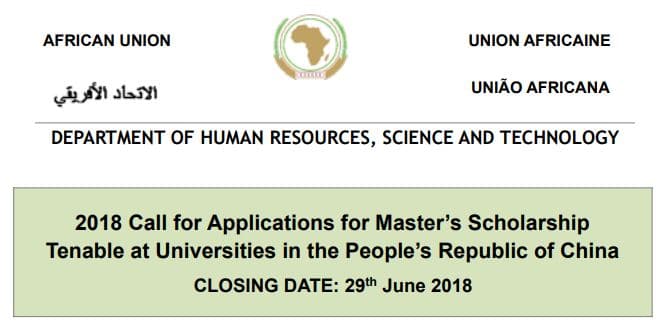
Chinese Government African Union Scholarships (Masters and PhD) for African Students 2018/2019

Application Deadline: 29th June 2018

Eligible Countries: African countries

To be taken at (University): Scholarships will be taken in the following universities (See list of universities below)

Fields of Study: Various (Click to view acceptable fields of study in the various university links above)

About the Award: The Department of Human Resources, Science and Technology of  the African Union Commission has the role of coordinating AU programs in education and human resource development; science, technology and innovation and youth empowerment.
The Department provides technical support to Member states in the development and implementation of programs towards harmonisation, intra-African collaboration, and experience sharing, as well as quality assurance in these fields as contribution to the attainment of AU vision of integration, peace and prosperity in Africa. The Government of the People’s Republic of China has made Chinese Government African Union Scholarships offers to the AU through the Department of Human Resources, Science and Technology, to enable Africans to study in China for the 2018/2019 academic year.

Type: Masters, PhD

Eligibility: To be eligible for the Chinese Government African Union Scholarships:
  • The scholarships are open to all African nationals who meet the Admission requirements set below
  • The language of instruction shall be English
  • Candidate with potential, motivation and desire to play transformative roles in Africa, are encouraged to apply
Admission Requirements: Candidates applying for the Chinese Government African Union Scholarships must fufil the following
  • Undergraduate degree from a recognised university with at least a second class upper or its equivalent, in a relevant field
  • For Doctoral Candidates (Master’s degree in a relevant field is required)
    • Maximum age of 35 years
  • Fluency in English as it is the teaching language
  • Candidate may be willing to undergo a written or oral examination after pre-selection
Number of Awards: Not specified

Value of Program: The scholarship will cover the cost related to teaching and the administration of the university and the living expenses of the students from the fund of the foreign aid, supervising thesis.
  • The cost related to teaching includes tuition, teaching materials, field trips and study tours.
  • The basic living expenses include the accommodation, living allowances, the one-time settlement fee, and the medical insurance. Of which, the 3000 RMB of settlement fee will be given to the students in one time.
  • The living allowances (36000 RMB/year for Master students and 42000RMB/year for Doctor students) will be given to the students on a monthly basis. All the other funds will be managed by the university or Chinese
Duration of Program: Duration of program

How to Apply: Applications must be submitted with a cover letter stating motivation and how the qualification will enable you serve the continent
Applications must also be accompanied with the following:
  • Curriculum Vitae including education, work experiemce and publications if any
  • Certified copies of relevant Certificates, transcripts and personal details page of national passport (at least 6 months validity)
  • Clear, coloured passport photograph (3*4)
  • Recommendations from two academic referees,  one professional referee
  • Health certificate
All applicants must apply directly through the respective University website and send copies by email to Caseley Olabode Stephens:   StephensC@africa-union.org.
The Closing date for the submission of applications with all supporting documents is: 29TH June 2018. Applications received after this deadline will NOT be considered


Visit Program Webpage for details

Award Provider: Chinese Government

Report underscores Australian rental affordability crisis

Oscar Grenfell 

Anglicare Australia’s “2018 Rental Affordability Snapshot” has provided a glimpse into a deepening housing crisis affecting millions of workers and young people across Australia. The worst impacted are the most vulnerable layers of the population, who have been the victims of cutbacks to welfare, pensions and the gutting of public housing stocks by successive state and federal governments.
The charity’s annual snapshot, released late last month, was based on a survey of over 67,000 properties listed on the national rental market over a single weekend in late March. The report examined whether they were “appropriate and affordable,” defined as costing less than 30 percent of household income for a range of demographics, including pensioners, welfare-recipients and workers on the minimum wage.
Commenting on the results, Anglicare Australia CEO Kasey Chambers noted that “Sydney and Melbourne now outstrip London, New York, and Los Angeles for expensive housing.” Along with Australia’s other capital cities, including Perth, Brisbane and Adelaide, they “rank as among the most expensive cities in the world for housing.”
The survey found that just three properties across the country were “appropriate and affordable” for a single person living on the Newstart unemployment allowance. None of the homes were located in a major capital city. For an unemployed couple with two children, just 1,097, or 1.63 percent of the listed properties, were “affordable and appropriate.”
Successive Labor and Liberal-National federal governments have frozen unemployment benefits for decades. A single jobseeker on Newstart receives an average of just $535 per fortnight.
For unemployed young people on Youth Allowance—a payment even lower than Newstart—just two properties were “affordable,” along with just two rooms in share houses across the entire country.
The official unemployment figures for April, which substantially understate the extent of the jobs crisis, showed that over 730,000 people were actively looking for work. The growth of joblessness is a result of widespread sackings and the destruction of full-time positions, overseen by Labor and Liberal-National governments alike, and enforced by the corporatised trade unions, especially since the 2008 financial crisis.
Single parents similarly have been priced out of the rental market. For a single parent with two children receiving the Parenting Payment only 530 properties were affordable.
Just 180 homes, or 0.27 percent of the total, were within the price range of a single parent receiving Newstart with one child. In 2012, the Labor government of Prime Minister Julia Gillard forced around 100,000 single parents off their Parenting Payment, and onto unemployment benefits. The austerity measure reduced the fortnightly income of many affected families by $118.70.
Single individuals on the Disability Support Pension were able to afford 485 properties, less than 1 percent of the total. For a couple on the aged pension, less than 5 percent of homes were affordable. The statistics highlight the impact of the cuts to every form of social welfare over recent decades.
Sydney, the centre of the speculative property boom, is among the most unaffordable cities in the world. Median house prices reached over $1 million last year. Rental costs have also risen dramatically. Median unit rental prices now stand at $525 per week.
No properties in Sydney were “appropriate and affordable” for single individuals on Newstart, Youth Allowance or the Parenting Payment.
Only 2,709 properties, out of over 18,000, were affordable for a family of four with both parents working on the minimum wage. The overwhelming majority were located in the western and southwestern suburbs, in the far reaches of greater Sydney, or even further out, on the Central Coast and the Blue Mountains—both more than an hour-and-a-half from the Sydney central business district by train.
The report noted that over 266,000 workers are employed on the minimum wage of $17.70 per hour, or just $672.70 per week on a full-time basis. Wage growth fell to its lowest recorded level last year, at just 1.9 percent, which is less than the rising cost of living, as a result of pay-cutting agreements imposed by big business and the unions.
Case studies from Sydney demonstrated the deepening social crisis resulting from soaring housing costs. Louise, a single parent in a three-bedroom rental paid “$400 per week in rent but receives only $600 per week in income.” The report noted: “Although she finds it hard to make ends meet, she has been in her current rental for three years. However, the landlord has refused to carry out requested repairs and has threatened to evict her if she perseveres with her requests.”
Unaffordability was increasing outside Sydney and Melbourne. In Tasmania, the situation had gone from “bad to worse.” “Affordability in and around the state’s capital is at such a low point that more than half of the low-income household types measured had no affordable rental options available,” the report stated.
In South Australia’s capital, Adelaide, the number of affordable properties for a couple on the minimum wage declined by almost 2 percent over the past year.
Anglicare Australia pointed to a number of the factors underlying the housing crisis. Successive governments, both Labor and Liberal-National, have encouraged a speculative frenzy in the property market, through incentives to investors, including “negative gearing,” which allows them to claim rental property costs as tax deductions. The influx of hot money into housing has coincided with a collapse of confidence among investors in productive investments, amid a deepening slump of the real economy.
At the same time, amid the ongoing destruction of public housing stocks, almost 200,000 people across the country are on waiting lists for government-provided properties.
Anglicare called on the major parties to boost public housing, and to increase poverty-level welfare payments. The commitment of Labor and the Liberal-Nationals to the austerity dictates of the corporate and financial elite, however, makes clear that such calls are destined to fall on deaf ears.

Argentina: Government responds to peso crisis with panic selling of dollar reserves and interest rate increase

Rafael Azul 


In the midst of increasing financial volatility across the world, a massive flight of financial capital took place last week from the weaker emerging economies as speculators converted their peso investments into US dollar denominated securities. The flight was in part triggered by the recent efforts by the US Central Bank to incrementally raise domestic interest rates.
Last week, the currencies of the largest economies in Latin America—Mexico, Brazil and Argentina—suffered drops in value of 5.25 percent, 4.83 percent and 8.26 percent respectively as speculators moved billions of dollars out of the region and into Wall Street and US banks.
Among them, Argentina was the most affected. In an attempt to avert a collapse of the peso, the Argentine Central Bank fed the dollar buying frenzy, selling six billion US dollars from its reserves at the beginning of May (roughly one fourth of its total dollar reserves).
The Argentinian government also raised the interest rate for short-term government and bank bonds three times over the span of several days to 40 percent (i.e., for every 10,000 pesos the government borrows from speculators, it must pay back 14,000). The great fear is that runaway inflation will lead to a repeat of the 2001 collapse of the peso which provoked mass demonstrations and led to the fall of several presidential administrations.
By Monday, these measures appeared to have forestalled a further drop, at least for the time being.
The decrease in value of the benchmark 10-year US government bond (to 3 percent per year) and the anticipated repatriation of financial assets held overseas by US corporations, in response to the Trump administration’s corporate tax cuts and its one-time offer to lower taxes on repatriated profits, have fed into the run on emerging markets.
The banks were also partly motivated to pull funds out of Argentina attempt by the Macri government’s imposition of a small capital gains tax on short term Central Bank bonds (know as Lebacs ) owned by foreigners as a way of reducing the country’s fiscal deficit. Speculators responded by cashing in their bonds and sending their money out of the country.
Fearing that domestic inflation will explode to 30 percent this year, up from the current 24.5 percent and double the government’s goal of 15 percent, Argentine monetary authorities are preparing for new budget adjustments and social cuts.
Since the right-wing government of Mauricio Macri took power in 2015, the administration has attempted to control the peso’s value with respect to the dollar by maintaining an artificially high peso value, through restrictions on circulation.
By raising the yield on Central Bank debt to forty percent and thereby flooding the bond market with bank debt, the Argentine Central Bank is lowering the money supply and purposely slowing down the economy, part of its overall policy of financial austerity. In announcing the increase in bank interest, the Central Bank declared that it would continue to use every means at its disposal to lower inflation to fifteen percent and prevent the peso from dropping further. The new interest rate is the highest in the world. Argentina has the highest inflation rate of any Latin American nation, except for Venezuela.
Preparations for an intensified attack on living conditions and wages are being sped-up as all indications are that inflation may rise further still. In yearly contract negotiations (paritarias) between employers and the union bureaucracies overseen by the government, the unions, businesses, and government have so far managed to limit wage increases to 15 percent, generally by offering non-monetary benefits to the workers.
There are indications of a broader wage push by workers fighting to break the 15 percent ceiling which amounts to a wage cut in real terms. This week saw strikes by drivers on the Buenos Aires subway system against the wage lag. The leader of the Union of Automated Tramworkers (UTA), Roberto Fernández, noted with concern yesterday that “the political situation has much uncertainty” as a result of growing working-class discontent. In a sign that the trade unions fear they will lose control of mass discontent, Fernández called for the General Workers Confederation (CGT) to hold “a national strike” if “the national government doesn’t convoke a roundtable dialogue with business and the CGT to find a way out of this critical economic situation.”
In a nation with a labor force increasingly dominated by the presence of part time and contingent workers, many of whom work for wages two-thirds lower than full-time workers that do the same work, the high levels of inflation are contributing to rising levels of poverty and economic insecurity.
With poverty rates of 30 percent and increasing unemployment, particularly among the youth, Macri has no option but to risk a mass confrontation with the working class if he is to reassure foreign investors that his government will stabilize the argentine economy and make good on cuts in government spending and debt payments to Wall Street.
According to the IMF's most recent Fiscal Monitor report, Argentina's budget deficit in 2018 will be 5.5 per cent of GDP. The report points out that total global debt is at record levels and calls on governments to “capitalize on the good times” to build rainy day reserves, rather than increase social programs or invest in infrastructure.
The Macri administration faces a debt payment deadline of May 16 of $1.6 billion that it expects to make. However, the events of last week motivated the financial magazine Forbes to say it may be time for investors to abandon Argentina.