13 Jul 2018

Lutheran World Federation (LWF) Scholarships in Theology, Diaconal and Development for Developing Countries 2018

Application Deadline: 1st October 2018.

Eligible Countries: Developing countries in Asia, Africa, Latin America and the Caribbean.

About the Award: Through the LWF scholarships program LWF works alongside its member churches in developing their capacity to serve effectively in their contexts. The scholarship program helps churches to acquire qualified personnel for spiritual care and diaconal work. The main criteria for a candidate approval is the church’s corresponding need to increase its human and institutional capacity, either in areas of theology or diakonia/development.

Type: Undergraduate, Masters, PhD/Postdoctoral, Research

Eligibility: 
  • Church affiliation of the candidate: Only applications from active members of LWF member churches are considered. All applications must be endorsed and submitted by the church. No applications submitted by individuals will be considered.
  • Nationality of the candidate: Only candidates from developing countries are eligible for scholarships in fields of diakonia/development. The theological scholarships are, in principle, open to candidates from all regions and countries.
  • Age limits: Only candidates up to a certain age are eligible for LWF scholarships, depending on the pursued degree:
    DegreeMaximum age at the time of application*
    Bachelor degrees35
    Master degrees40
    Doctorate45
    Post-doctoral/research50
    *Special considerations:
    • For candidates who are church employees at the time of application, age limits may be exceeded by up to 7 years for female candidates and up to 5 years for male candidates.
    • For candidates who are actively engaged in the church’s theological or diaconal work at the time of application, age limits may be exceeded by up to 5 years for female candidates and up to 3 years for male candidates.
    • Relatively higher consideration is made for female candidates due to social and cultural factors which cause them to pursue studies later.
Selection Criteria: 
  • HICD needs of the church: The proposed training field and degree has to respond well to the human and institutional capacity development needs of the church. The requesting church must demonstrate convincingly how a given application would meet a specific and crucial personnel need in its overall ministry in church and society.
  • Current and future position of the candidate: All candidates are expected to have been in the service of the church and/or community as employees or volunteers. There has to be a clear commitment by the church to engage the candidate as employee or volunteer in an area related to the proposed training after completion of the candidate’s studies/training.
  • Quality of the application: The candidate must demonstrate convincingly his/her commitment, ability and motivation to pursue the training and to support the church afterwards (good educational and professional qualifications, recommendations and certificates, convincing character).
  • Study place. The LWF encourages candidates to study in their home country or home region. In case a study or training program abroad is proposed, convincing reasons must be given in the application.
  • Gender and youth quota: At least 40% of the approved candidates will be female; at least 20% will be youth below the age of 30 years. These quotas will not only apply to the overall approvals, but also to each church and region.
  • Regional balance: The LWF seeks to ensure that candidates from different regions, countries and churches are being supported.
Number and Value of Awards: In total, 50-80 scholarships will be awarded for studies in diaconia and development and 20-25 for theological studies. Additional funding is available for short-term training of up to six months in the areas of diakonia and development. An endorsement by the respective LWF member church is required.

Duration of Programme:  
  • Regular scholarships for study programs of at least 1 year: The candidates are approved for at least 1 year of support to take up or complete their proposed study program. For candidates who have already started with their study program, this means that the study program has to last for at least 1.5 years at the time of application, hence 1 year at the time of approval.
  • Short-term scholarships for training of up to 6 months: The candidates are approved for a short-term training which may last up to 6 months. This may include training courses, workshops, exchange programs or research projects which respond to the needs of the applying church. Application forms and selection criteria are the same as for regular scholarships.
How to Apply: 
  • Application Form for LWF Scholarships: The application form has to be filled in by both the candidate, his/her congregational pastor and the head office of the endorsing church. The Step-by-Step Guidance on How to Complete the Application Form should be read carefully beforehand.
  • Attachments to the Application Form: Applications are considered incomplete without attachments.
  • Human Resource Capacity Profile of the Applying Church: Each applying church is supposed to provide information on its overall human resource needs by completing or updating the form.
maximum of 5 applications per church may be submitted. They should be sent as a scan to scholarships@lutheranworld.org; the hard copies should be sent to:
The Lutheran World Federation
Department for Mission and Development
Diakonia and Development Desk
P.O. Box 2100 CH-1211 Geneva 2
Switzerland


Visit Programme Webpage for Details

Award Providers: Lutheran World Federation (LWF)

Is ISIS About to Lose Its Last Stronghold in Syria?

Patrick Cockburn

Several hundred suicide bombers and 4,000 fighters belonging to Isis are preparing to defend Hajin in eastern Syria close to the border with Iraq.
The town is the last stronghold of the Islamic State, the militarised Islamic cult that three years ago controlled territory the size of Great Britain.
The struggle for Hajin comes exactly a year after Isis suffered a decisive defeat with the capture of Mosul on 10 July 2017 by Iraqi forces backed by a US-led coalition.
Multiple anti-Isis forces are now closing in on Hajin, which is on the east bank of the Euphrates in Deir ez-Zor province, says a local eyewitness who spoke to The Independent after escaping to Kurdish-held territory.
“I heard from people who are working with Daesh [Isis] officials that there are more than 200 child suicide bombers, called the Lion Cubs, in Hajin,” said Sattam, 32, an Arabic teacher who lived until recently in Bahara, a northern neighbourhood of Hajin.
“There are still more than 35,000 people and 4,000 Daesh in the town,” he said, adding that his relatives, who are still in Hajin, say that Isis has dug deep tunnels there to protect themselves from aerial attack.
He believes that the struggle for Hajin might take longer than the four-month siege of Raqqa, the de facto Isis capital in Syria which was captured by the US-supported Syrian Democratic Forces, a Kurdish-Arab group, in October.
Sattam says that Hajin is being regularly shelled and hit by airstrikes, but it has yet to be seriously attacked by ground forces.
The Iraqi government says that its F-16 bombers targeted a meeting of Isis leaders in three houses, linked by a tunnel, in Hajin on 23 June and killed 45 of them.
The dead included the Isis deputy war minister, chief of police and a messenger of Abu Bakr al-Baghdadi, the self-declared caliph of the Islamic State, who is thought to currently be in the Syria-Iraq border area.
Sattam, who does not want to give his full name because he has a cousin, a farmer, still living in Hajin, gives a detailed picture of life in the last town held by Isis.
On a small scale, it maintains the complex administrative system with which it used to rule large cities like Mosul, Raqqa, Fallujah and Ramadi, as well as many towns in Syria and Iraq.
“I was in contact with some Iraqi friends who were working in the tax office of Daesh in Hajin,” says Sattam.
“They were collecting fees from people of the town who are rich because many are landlords and others have businesses in Saudi Arabia and Qatar.”
He says the town is well known locally for its large and well-decorated houses owned by traders who belong to powerful local tribes.
He says there was friction last summer between Isis and the people of Hajin: “I remember when some Iraqi and Syrian young men managed to set fire to a centre for Daesh security men.”
Currently, Isis is preventing civilians fleeing the town, a tactic it used in Mosul and Raqqa which led to heavy loss of life from airstrikes and artillery fire.
Whatever the timing of the final assault on Hajin, it will inevitably fall because it is encircled by three different armies.
Sattam ticks off the town’s besiegers: the coalition-backed SDF, a Kurdish-Arab force with Kurdish leadership to the north, northeast and west; the Iraqi Shia paramilitary Hashd al-Shaabi to the east; and the Syrian army of President Bashar al-Assad to the south.
One reason for the defeat of Isis, despite its military skills and fanaticism, is the sheer number of its enemies.
Asked about what was known locally of the whereabouts of al-Baghdadi, Sattam says that Isis members or those working for their institutions “no longer talk about him or any new statement or decision he made.”
He adds that the word is common in the Deir ez-Zor countryside that “even if the caliph is dead, he left hundreds of his sons as suicide bombers”.
This is not proof that al-Baghdadi is dead since, if this were true, it would either be admitted or be a secret closely held by his inner circle.
His 18-year-old son, Huthaifa al-Badri, was reported last week by Isis to have been killed fighting Russians and the Syrian army in Homs province in Syria. His martyrdom is being heavily promoted by Isis social media channels, though these are much diminished in volume and influence.
The SDF and the US-led coalition launched Operation Roundup on 1 May with the purpose of taking the last Isis-held territory along the Syria-Iraq border.
The offensive has already seized the only other town that was still held by Isis – Dashisha in Hasakah province – in June. Isis had occupied it for five years, during which conditions had become progressively grimmer for its inhabitants.
Salim Abu Ali, 48, a farmer from Dashisha, gave a graphic account to The Independent of life under Isis, in the town where he remained until it was captured by the SDF.
“I couldn’t leave the town because my wife is disabled and my sons left the country for Iraq in 2013 because Daesh had taken the town,” Salim says.
When Isis first took over in July 2013 they treated people well, he says, but the following year, probably because their victories had made them overconfident, they became more intimidating and started public executions.
“The horrible thing that I witnessed many times was that people did not realise that Daesh was going to behead them,” Salim says.
“I still remember a man I knew, Abu Mohammed, who was blindfolded and crying out that he was innocent, but suddenly a big knife cut into his neck, ripped through his throat, and suddenly blood gushed out.”
The man who had beheaded him was shouting: “God orders us to kill disbelievers without mercy.” Salim says that his friend had been accused by somebody who hated him of trading with the Syrian government.
He recalls that this happened in November 2016 when Isis fighters were angry because they were getting bad news from Mosul, which was being besieged by the Iraqi army.
Isis fighters began arriving from Iraq in large numbers with armoured vehicles and women prisoners. “Later we have been told they were Yazidis to be taken to Raqqa.”
The attack on Dashisha by the SDF began two months ago, accompanied by airstrikes every day.
“There wasn’t fighting in the town,” says Salim, “it was in the farms around Dashisha. Most of those who fought were foreigners, mostly from Azerbaijan.”
The local Isis fighters withdrew and many surrendered to the authorities in Syria or Iraq. Salim ended up being detained in a camp called al-Hol, run by the SDF, until he was rescued by a cousin who guaranteed that he was not a threat.
After a series of calamitous defeats in Iraq and Syria, Isis fighters may be getting demoralised and no longer as determined as before to fight to the end. If so, this would be good news for the thousands of people trapped in Hajin, waiting for the final battle to begin.

Millions of refugees face harsh conditions across South Asia

Rohantha De Silva

While immigrants and asylum-seekers are being persecuted in Europe, the US and Australia, millions of refugees face no less brutal treatment by governments across South Asia.
The most prominent group of refugees in the region at present are the hundreds of thousands of Burmese Rohingya people in Bangladesh. Housed in rudimentary and highly vulnerable dwellings, the refugees have no real protection from the monsoon season, which has already begun. The influx of Rohingya was in response to escalating violent attacks and atrocities carried out by the Burmese military and Buddhist supremacist forces over the past 12 months.
According to news reports late last month, at least 200,000 people confront the danger of major landsides and floods in the Cox’s Bazar, near the Burma-Bangladesh border. Over 700,000 Rohingya refugees have entered Bangladesh since August 2017, bringing the total number of Rohingya in Bangladesh to one million.
Steve McAndrew, head of Emergency Operations of the International Red Cross and the Red Crescent Society at Cox’s Bazaar, told a press conference at the United Nations on June 25 that conditions in the Bangladesh refugee camps are among the worst he has seen in twenty years.
“Already, we are starting to see some real damage [from monsoon rains] in the camps,” McAndrew said. “Many of the shelters are starting to collapse. Some of the roads are impassable. Latrines are starting to fill up with floodwaters. The floodwaters are breaching through pathways where people walk and kids go to school every day.” McAndrew said he expects conditions to worsen as the rains continue through August.
World Health Organization spokesman Christian Lindemeier has also warned about ongoing health dangers. The monsoon rains and flooding, he said, are “increasing the risk of water-borne diseases such as diarrhoea, hepatitis, and vector-borne diseases such as malaria, dengue and chikungunya.”
Rohingya refugees are not only in Bangladesh. According to some reports, about 40,000 fled to India and are living in appalling conditions in the slums of the country’s major cities, such as Mumbai, Delhi and Hyderabad. Over 5,000 refugees are also living in Jammu and Kashmir, India’s Muslim-majority state.
Rohingyas in India are subjected to anti-Muslim persecution instigated by the ruling Hindu supremacist Bharatiya Janatha Party (BJP) and its associated Hindu extremist groups. BJP ministers and other Hindu chauvinists have falsely accused the Rohingya refugees of sheltering Kashmir separatist terrorists allegedly funded by Pakistan, and have demanded their expulsion.
In February this year, Kulvinder Gupta, a senior BJP figure and then speaker of the Jammu and Kashmir Legislative Assembly, accused the Rohingya of being involved in a separatist suicide attack on the Sunjuwan army camp in which six soldiers, one civilian and three attackers were killed. These unsubstantiated allegations, and similar claims made by Hindu chauvinists, are being used to bolster calls for the expulsion of all Rohingya refugees.
Tens of thousands of Chakma and Hajong refugees are also living in India. They fled Bangladesh’s Chittagong Hill districts about five decades ago following attacks by security forces and Islamic fundamentalist thugs. According to the 2011 census, over 47,000 Chakmas reside in the Indian state of Arunachal Pradesh alone, with many more living in India’s north-eastern states and in West Bengal.
While India’s former Congress government claimed that there were more than 10 million “illegal” migrants from Bangladesh, the current BJP administration falsely insists that there are 20 million, in a bid to whip up anti-immigrant sentiment.
Thousands of Sri Lankan Tamils forced to flee pogroms and the racialist war on the island are also living in impoverished conditions and under constant police surveillance in refugee camps across south India. Over 130,000 Sri Lankan Tamils fled Sri Lanka between 1983 and 1987, during the first stage of Colombo’s war against the separatist Liberation Tigers of Tamil Eelam.
In the Indian state of Tamil Nadu, there are over 60,000 refugees in more than 100 camps and almost 38,000 in other settlements. An estimated 7,000 reside in Kerala and 35,000 in Karnataka.
Two rival Tamil Nadu bourgeois parties—the ruling AIADMK and the opposition DMK—have shed crocodile tears over the plight of Sri Lankan Tamils in order to garner votes from the state’s Tamil population, which has centuries-old family and cultural ties with Sri Lankan Tamils. Alternating AIADMK and DMK state governments, however, have ensured that the Sri Lankan Tamil refugees continue to confront unhealthy conditions and, despite repeated promises, are not granted Indian citizenship.
On top of the 300,000 internal refugees already in Pakistan, the country is home to over 2.7 million Afghans. Only half of them are registered.
The influx of Afghan refugees began in 1979, when the US and Saudi Arabia provided financial and military assistance to Islamic terror groups against the Soviet Union-backed Afghanistan government. These numbers dramatically increased following the US-led invasion of Afghanistan in 2001. Washington’s ongoing intervention is part of its wider geo-strategic plan to bring Central Asia and the Middle East under its control.
The harsh conditions of life for millions of asylum seekers and refugees across South Asia is a damning indictment of the imperialist powers and the regional ruling elites.

French President Macron lays out road map for military escalation

Francis Dubois 

On July 10, before the two houses of parliament assembled at Versailles, Emmanuel Macron announced a major hike in military spending financed by social attacks on the working class. A year after his election, when he was hailed as a defender of democracy against neo-fascist candidate Marine Le Pen, Macron is advancing a far-right policy of militarism, attacks on democratic rights and scrapping basic social gains of the working class.
In the days before his address, the media worried over rising social opposition in the working class. “The patience of the French people has reached its limit,” declared RTL, pointing to an Elabe poll in which 75 percent found Macron’s policy “unjust” and 65 percent found it “ineffective.” On Monday morning, Europe1 bluntly predicted that Macron’s speech would do “little to satisfy public opinion” and pointed to Macron’s “collapse” in the polls. After losing 14 percent support among retirees in another poll, his popularity rating stands at 34 percent.
After another poll found that 55 percent of French people fear falling into poverty, including over 60 percent of working-age people, many parliamentarians did not dare go to Versailles for a speech that cost taxpayers €500,000. A right-wing deputy, Fabien di Filippo, explained his decision to boycott the speech by saying, “It’s just 500,000-euro PR. Out of respect, I am not going.”
Faced with these concerns in ruling circles, Macron made a perfunctory statement of concern, saying, “I know I cannot do everything, I know I do not succeed everywhere,” and then proceeded to stay the course on his vastly unpopular policies.
He briefly pointed to the explosive international context, with spreading Middle East wars and the collapse of relations with Washington, and the danger of large-scale war. He remarked in passing that French people increasingly “fear big changes, the chaos of the world: tensions with Iran, the trade war launched by the United States, divisions in Europe.”
But the only solution Macron proposed in his speech was to slash social spending and wages in order to arm French imperialism to the teeth for war. He applauded the parliamentarians, saying, “You have given France back its military capacities through a military planning law of new and unprecedented ambition. You have broken the blockage of the labor market created by a Labor Code that has become obsolete and inappropriate.”
From the beginning, Macron linked his attacks on social rights to his militarist plans: “France’s plan for our endangered Europe and for the world … forces us to be strong. This is why we know we have to strengthen our economy. … This is why we need a better army, the best possible defense systems.”
Macron reaffirmed his pledge to reintroduce the draft for both young men and young women.
He then explained how French capitalism would attract foreign investment to finance these military plans: by providing international capital with workers reduced to the status of cheap labor. He insisted that education and training programs be adapted to this agenda.
The French president made clear he aims to totally subordinate public and social services to maximizing the profits of the wealthy and to rearming the military. He said, “There is not on the one side economic policy and on the other side social policy. The … goal is the same: to be stronger so we can be fairer.”
Macron deployed all his arrogance as an ex-Rothschild banker who denounced the “crazy amounts of money” France spends on social benefits, to demand a deep austerity policy. He said there could be no freeing-up of investment “without a slowing of our continual spending increases,” which requires “strong and courageous choices.” He unabashedly defended the suppression of the tax on the rich, claiming that it “has not created jobs or improved anyone’s conditions at all in France.”
He accompanied this with a law-and-order policy of repression of the workers and youth. He said that “security is the first pillar” of democracy and evoked the mantra of the “war on terror,” claiming that the police, which are broadly hated in working class areas, would be the human face of the state.
He said: “A neighborhood security police will bring back the proximity of the population and the police, who give authority a human face and help overcome the feeling of abandonment that populations undergo when they are subject to laws that are not those of the Republic.” He hailed the police and thanked the parliament for having “started to give new resources to our security forces.”
As the European Union plans a massive escalation of attacks on immigrants, including building a vast network of prison camps to detain them, Macron picked up the neo-fascists’ favorite theme of the struggle against “illegal immigration” in the name of “Republican order.” He vowed to impose “precise rules on those who, for economic reasons, leave their country to come to ours,” and who according to Macron can be denied the right to asylum.
He concluded his speech by claiming that with these policies, “France has the means to become again a power in the 21st century.”
The deputies and senators present greeted Macron’s reactionary speech with thunderous applause and a standing ovation.
A class gulf separates the parliamentarians’ enthusiasm for repressive militarism, which is all but indistinguishable from that of the neo-fascists, from the workers. That force that will emerge as the opposition to the imposition of a militarist and authoritarian regime in France and across Europe will be the working class. To oppose Macron’s austerity program, it will be compelled to carry out a struggle against the drive of all the imperialist powers, France included, towards war.
Macron’s far-right speech, the main lines of which are in fact shared by governments of all political colorations in all the major EU powers, vindicates the positions taken by the Parti de l’égalité socialiste (PES), the French section of the International Committee of the Fourth International, in the 2017 presidential elections.
The PES correctly warned after the first round of the presidential election that Macron was not a lesser evil than the other candidate in the runoff, neo-fascist Marine Le Pen. The call of the PES for an active boycott of the second round, to indicate irreconcilable hostility to both candidates, was the only way to maintain the political independence of the working class and fight to mobilize it in struggle against whatever reactionary candidate won the election.
Pseudo-left forces like the New Anti-capitalist Party and Jean-Luc Mélenchon, who refused to take any clear position opposing Macron, effectively made themselves complicit in his policies. They have allied with the union bureaucracies that have negotiated austerity measures with Macron, including most prominently the privatization of the railways and cuts to railworkers’ wages. They then helped strangle strike action against these attacks.
After a year of Macron’s term in office, what is emerging ever more clearly is the necessity of building an international movement of the working class against militarism and war in order to fight back against Macron’s anti-social agenda.

UAE and US guilty of war crimes in Yemen torture centers, Amnesty charges

Bill Van Auken

The United Arab Emirates (UAE) and mercenary forces operating under its command have carried out widespread forced disappearances, torture and murder of Yemenis suspected of opposing the more than three-year-old intervention by the oil-rich Gulf state in alliance with Saudi Arabia and Washington.
This is the conclusion drawn by the human rights group Amnesty International after interviewing at least 75 people, including families of the disappeared and detained, survivors of the UAE torture centers, lawyers, journalists and local officials in Yemen.
Amnesty concentrated its investigation on 51 cases, typical of the untold hundreds if not thousands who have been swept up into the UAE detention and torture apparatus. Nineteen of these individuals remain missing, their whereabouts unknown to their families amid fears that some of them may have died in captivity.
The report outlines the stark political contradictions underlying the UAE’s repressive operations in Yemen. While intervening in the country as part of a Saudi-led coalition whose ostensible aim is the restoration to power of President Abd-Rabbu Mansour Hadi, the Saudi puppet who was overthrown by Houthi rebels in January 2015, the UAE is clearly pursuing its own interests in the region.
“The UAE had been bypassing Hadi government officials in dealing with security issues, at times prompting President Hadi and his supporters to criticize the UAE for behaving like an occupier,” the Amnesty report states.
This statement was substantiated on Monday when the “interior minister” designated by President Hadi, who remains in self-imposed exile in Riyadh, held a meeting in the southern Yemeni port city of Aden with a top UAE official, calling on Abu Dhabi to shut down or hand over the prisons it runs in southern Yemen.
The UAE has been working in collaboration with southern secessionists, who oppose the re-imposition of Hadi’s rule over the region, as well as with a network of militias and mercenaries that it is arming and financing.
Its aim is to assert control over a series of bases bordering the strategic waterways linking the Red Sea with the Indian Ocean, most importantly the Bab el-Mandeb Strait, through which much of the Middle East’s oil bound for Asia is shipped.
To assert its control, the UAE has instituted a reign of terror in the areas of Yemen it has conquered. According to Amnesty: “Witnesses described how detainees were dragged from places of work and on the street, in some cases they were beaten—at times to the point of bleeding or losing consciousness—and companions threatened when they attempted to question the arrest. When a 37-year-old man was being arrested by the Security Belt while hanging out with friends near his house in Aden he was beaten up when he asked why he was being taken, his family said; a friend who stepped in to stop the beating was detained too.
“In cases where arrests happened at home, witnesses said security forces showed up in large numbers, barged in oftentimes late at night or around dawn, pointing guns at family members, using excessive force amid the screams of women and children. They dragged out individuals without showing warrants, explaining the reason of the arrest, or saying where they are taking those being arrested.”
Among those seized in this fashion have been suspected supporters of the Houthis as well as those of groups that fought against them, along with members of the local branch of the Muslim Brotherhood, journalists, civic leaders and those believed to be critical of UAE rule.
Those detained have been taken to a network of 18 secret prisons where, according to Amnesty, detainees report, “being subjected to or witnessing torture and other ill-treatment, including sexual abuse, and the use of prolonged solitary confinement. Witnesses said, at times, detainees were filmed as they were being tortured, including while being tied, stripped naked, given electric shocks and beaten with canes and wires.”
The report quoted one detainee, held at a detention camp located at the UAE base in Bureiqa, Aden, who said he had been subjected to “all sorts of torture” by UAE troops there “including by repeatedly inserting an object into his anus until he bled. He said he was kept in a hole in the ground with only his head above the surface for up to three days during which he was only given a small amount of water twice a day and left to defecate and urinate on himself in that position.”
The report also cited the exposure last month by the Associated Press of widespread sexual torture inside the UAE’s secret prisons. Detainees have been systematically raped by Yemeni guards acting under the orders of Emirati officers as other guards filmed these assaults for the purpose of blackmail.
Other regular practices have included electrocuting prisoners’ genitals, hanging rocks from their testicles and sodomizing them with wooden and steel poles.
“They strip you naked, then tie your hands to a steel pole from the right and the left so you are spread open in front of them. Then the sodomizing starts,” a father of four told the AP.
An earlier AP report published last year quoted Pentagon officials as acknowledging that US military personnel “participate in interrogations of detainees at locations in Yemen, provide questions for others to ask, and receive transcripts of interrogations from Emirati allies.”
The Pentagon has claimed that it has received no reports of torture or abuse, but prisoners have reported the presence of uniformed US military personnel at the torture centers. While they had not seen them participate directly in the abuse, they insisted that they had to have been aware of the torture, given the constant screaming and the condition of the detainees.
The UAE forces, moreover, consist in large measure of mercenaries, including former American military officers who have assumed senior command positions. A key role has been played in the organization of the UAE military by an Abu Dhabi-based firm called Reflex Responses Company, also known as R2, founded in 2010 by the politically connected military contractor Erik Prince, who formally headed Blackwater, infamous for it massacres in Iraq.
Prince, whose sister Betsy Devos is Trump’s education secretary, has overseen the hiring and training of mercenaries from Sudan, Colombia, South Africa and elsewhere, who have been deployed to Yemen.
The Amnesty report makes clear that the UAE’s arbitrary arrests, forced disappearances and wholesale torture, as well as the US complicity in these acts, constitute war crimes.
As horrific as they are, these crimes are only the tip of the iceberg of the atrocities unleashed against the people of Yemen in a war that has assumed near genocidal proportions. The war has left 600,000 civilians either dead or wounded, according to a statement issued by the Yemeni Ministry of Human Rights in March. It has left another 22.2 million Yemenis in need of food aid, and 8.4 million on the brink of famine.
Last month, the UAE, with Washington’s backing and military collaboration, launched a military siege of the Red Sea port city of Hodeidah, despite warnings from the UN that it could cost the lives of 250,000 civilians in the city itself, as well as millions more if the port—the lifeline for food and medicine for some 70 percent of the population—were shut down.
Washington has backed the war, providing Saudi-led forces with the bombs and missiles that are killing Yemenis, supporting the blockade of the country with US warships, providing midair refueling for Saudi warplanes and operating a joint logistic center in Riyadh where targets are chosen.
Begun under the Obama administration, Washington’s support for massive war crimes is directed at countering Iranian influence in the region and furthering US hegemony, strategic aims for which US imperialism is prepared to sacrifice the lives of millions.

Trump uses UK visit to heighten political turmoil over Brexit

Chris Marsden

US President Donald Trump arrived in the UK intent on exploiting the raging crisis of the Conservative government of Prime Minister Theresa May over Brexit to assert US imperialism’s interests in Europe.
At 11 p.m. he exploded a political bombshell under May in the form of an exclusive interview with Rupert Murdoch’s The Sun, pre-recorded before he left the NATO summit in Brussels. The interview takes Trump’s political campaign to extort, or possibly break up, the European Union that characterised the NATO Summit to new heights.
Trump denounced May’s proposal for a “soft Brexit” as a betrayal of last year’s referendum vote, threatening that it will mean no trade deal with the US, again demanded the UK and the rest of the EU increase military spending to 4 percent of GDP, declared May’s main rival, Boris Johnson, to be a possible prime minister and launched a fascistic tirade against immigrants.
He had “told May how to do Brexit” but she ignored him. If May’s deal was accepted, “we would be dealing with the European Union instead of dealing with the UK,” probably killing any future trade deal with the United States.
“We have enough difficulty with the European Union. We are cracking down right now on the European Union because they have not treated the United States fairly on trading.”
May’s proposed deal with the EU “was not the deal that was in the referendum.” The Tories have seen “a lot of resignations, so a lot of people don’t like it.”
Turning to Johnson, who resigned this week as foreign secretary, Trump said he would make a “great prime minister.”
Brexit had happened “because people don’t want to be faced with the horrible immigration problems that they are being faced with in other countries,” he said. Britain, like other European countries, he said, was “losing its culture” because of immigration, which was “permanently changing Europe for the worse.”
Trump’s diatribe is not only a political nightmare for May, but a threat levelled against the British ruling class that they must toe the US line or face the consequences.
Repeatedly rescheduled, widely opposed and downgraded from an official state visit, every effort had been made to manage the fallout from Trump’s deeply unpopular visit. Thousands of police officers have been drafted from every force in the country in a £10 million operation—the largest since the August 2011 riots.
Trump was to safely spend his evening at a black-tie dinner at Blenheim Palace in Oxfordshire, flying by helicopter from the US Embassy in London’s Regent’s Park—his only appearance in the capital to avoid exposure to protests. In similar fashion, today is taken up by a military parade at Sandhurst that will not be filmed, a rather brief summit meeting at May’s country residence at Chequers, a joint press conference, a meeting with the Queen at Windsor Castle, rather than Buckingham Palace and then off to Scotland for a weekend of golf before flying to Helsinki to meet Russian President Vladimir Putin.
Trump’s Sun interview rendered such stage management null and void. But the damage done to the Tories was extensive even before Trump’s plane touched down at Stansted Airport.
Since last Friday’s cabinet meeting at Chequers, the government has seen the resignation of two senior ministers, Johnson and Brexit Secretary David Davis, in protest at May’s proposal for a separation agreement with the EU seeking to safeguard access to European markets.
May, who campaigned for Remain in the 2016 referendum, is responding to the demands of big business to safeguard 40 percent of British trade after Britain leaves the EU in March 2019. She tried to do so while meeting the insistence of the advocates of a “hard-Brexit” that the UK must leave the Single European Market and Customs Union to allow it to strike trade deals internationally.
But her “facilitated customs arrangement”, with the UK levying its own duties and then collecting European level duties on behalf of Brussels for goods transiting to the EU, failed to satisfy either the Brexiteers or many of those advocating a “soft Brexit” or a reversal of the referendum result.
Trump’s performance at the NATO Summit in Brussels prior to his UK arrival confirmed that the failure of May’s compromise is due to the growing antagonisms between the imperialist powers of the US and Europe.
May has tried to utilise a political, economic and military alliance with the US to secure a favourable deal with the EU. However, the NATO summit made clear that the basis for such a balancing act is disappearing.
Trump launched repeated attacks on Germany and other NATO allies over defence spending and trade, reportedly threatening that the US would quit NATO if they did not step up. Germany was the focus of particular attack, while he once again praised French President Emmanuel Macron in an attempt to drive a wedge between Paris and Berlin.
Brexit was wielded as a weapon to the same end. At the closing press conference, Trump used May’s own mantra against her, declaring, “I would say Brexit is Brexit.”
In what could only be a reference to the EU he continued, “The people voted to break it up, so I would imagine that’s what they would do, but maybe they’re taking a little bit of a different route—I don’t know if that is what they voted for.”
Trump’s statements in Brussels are a rallying cry for the Brexiteers, who calculate that the EU will be forced to cede access to its markets as a by-product of the blows delivered by Trump and his demands for an end to European tariffs.
But other voices in the ruling class were already concluding that Trump is forcing a trade war in which it is best for the UK to safeguard its existing alliances with Europe even before his incendiary interview with The Sun .
Phillip Stevens wrote in the Financial Times of “Brexit and a not-so-special relationship.”
“Just as Theresa May’s cabinet cracks under the strain of Conservative infighting about the shape of Brexit, Donald Trump tips up in Europe with a reminder that the Atlantic alliance is crumbling.”
Trump, he said, “does not believe in Atlanticism. Nor in alliances grounded in shared interests and values.”
This is also recognised and opposed by voices in the US.
Writing in Politico, Thomas Wright of the Center for the US and Europe at the Brookings Institution, noted that Trump’s loud support of Brexit concealed “a predatory policy toward Britain”: “The United States has sought to exact painful concessions that it was unable to secure when Britain negotiated as a member of the EU. … Essentially, the Trump administration views Britain as an easy economic mark, not a strategic partner.”
He warns of the UK being pushed into the arms of China and of a political backlash against the US that might strengthen the Labour Party under Jeremy Corbyn.
The Washington Post also editorialised, insisting, “America should support Theresa May’s ‘soft’ Brexit” because the United States “has a strong interest in continued British prosperity and clout…”
The bitter conflicts Trump is exploiting were evident in parliament as new Brexit secretary, Dominic Raab, presented the draft post-Brexit trade White Paper.
The European Research Group of pro-Brexit Conservative MPs issued an alternative draft, drawn up by David Davis, while calling for four amendments—including stating that Northern Ireland should be treated the same way as the rest of the UK—meant to sabotage the bill. “This White Paper has not needed age to turn yellow,” he said.
Labour, which is seeking to win the backing of business as the only party capable of averting a disastrous no-deal Brexit, reiterated that it would not back the proposal and described it as “a fudge” and its release as “a shambles.”

12 Jul 2018

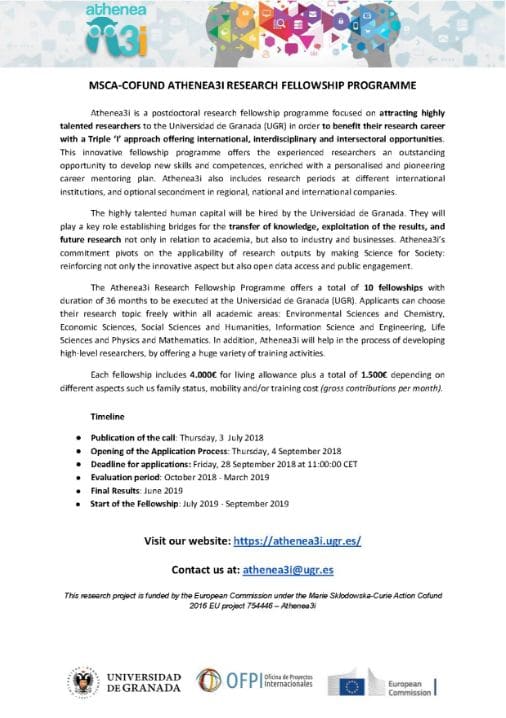
MSCA-COFUND Athenea3i Research Postdoctoral Fellowship for International Researchers 2018/2019

Application Timeline:
  • Opening of the Application Process: 3rd September 2018
  • Deadline of the Application Process: 28th September 2018
Eligible Countries: International

To Be Taken At (Country): Universidad de Granada (UGR), Spain

About the Award: Athenea3i is a MSCA-COFUND Fellowship Programme for international talented researchers granted by Universidad de Granada (UGR) and European Commission.

Field of Research: Applicants can choose their research topic freely within all academic areas. They will be organized in:
  • Environmental Sciences and Chemistry (ENV-CHE)
  • Economic Sciences, Social Sciences and Humanities (ECO-SOC)
  • Information Science and Engineering (ENG)
  • Life Sciences (LIFE)
  • Physics and Mathematics (PHY-MAT)
At least one fellowship per area will be funded.

Type: Fellowship (Academics), Research

Eligibility: Applicants for the fellowship, at the date of the call deadline, must meet the following requirements:
  • Nationality: the UGR welcomes researchers from any nationality.
  • Doctoral degree: it is mandatory to hold a Doctoral degree.
  • Doctoral degree elapsed period: no more than 7 years ago. We will consider an extension period to these 7 years in case of maternity leave (18 months per child), paternity leave or long-term illnesses (all these exceptions have to be properly certified).
  • Mobility rule: at the time of the relevant deadline for submission of proposals, the researcher must not have resided or carried out his/her main activity (work, studies, etc) in Spain for more than 12 months in the 3 years immediately prior to the date of the call deadline. Compulsory national service and/or short stays such as holidays are not taken into account.
Selection Criteria: 
  • Scientific Excellence
  • Impact
  • Implementation
Number of Awards: 10

Value of Award: Each Fellowship includes € 4,000 for living allowance plus  a total of €1,500 for other expenses.

Duration of Programme: The duration of each fellowship will be 36 months to be executed at the UGR. During the fellowship, the fellows may do an optional:
  • Outgoing Phase in an international entity to be planned between the month 10th and the month 18th.
  • Secondment in an international entity to be planned during the last 18 months of the project. The candidates are encouraged to second their time in a large company or SME.
How to apply

Visit Programme Webpage for Details

Award Providers: Universidad de Granada (UGR) and European Commission.

Camargo Core Fellowship Program in Arts and Humanities (Fully-funded to Cassis, France) 2019/2020

Application Deadline: 17th October 2018

Eligible Countries: All

To Be Taken At (Country): Cassis, France

Field of Study: Three main categories are available, and several subcategories for artists’ applications.
  • Scholars: applicants should be connected to the Arts and Humanities working on French and Francophone cultures, including but not limited to cross-cultural studies that engage the cultures and influences of the Mediterranean region. To be eligible for a fellowship in the “Scholars” category, applicants are expected either to hold a PhD and a record of post-doctoral scholarship, or to be PhD candidates completing the final stages of research for, or writing of, their dissertation.
  • Thinkers: this category includes accomplished professionals and practitioners in cultural and creative fields (such as curators, journalists, critics, urban planners, independent scholars, etc.) who are professionally engaged in critical thought. We are interested in work attuned to the theoretical “arena”, the arts, and society. Like the scholars, they should be working on French and Francophone cultures, including but not limited to cross-cultural studies that engage the cultures and influences of the Mediterranean region.
  • Artists (all disciplines): applicants should be the primary creators of a new work/project and have achieved a track record of publications/performances/exhibitions, credits, awards and/or grants. We are interested in artists who have a fully developed, mature artistic voice. Applicants may include those who have been commissioned for multiple projects. When applying, artists will have to choose among the following subcategories: Visual Artists / Choreographers and Performance Artists / Writers and Playwrights / Film, Video and Digital Artists / Composers and Sound Artists / Multidisciplinary Artists.
About the Award: The Camargo Core Program is the historical and flagship program of the Foundation. Each year an international call is launched through which 18 fellows (9 artists and 9 scholars/thinkers) are selected.
The Camargo Core Program offers time and space in a contemplative environment to think, create, and connect. By encouraging groundbreaking research and experimentation, it supports the visionary work of artists, scholars and thinkers in the Arts and Humanities. By encouraging multidisciplinary and interdisciplinary approaches, it intends to foster connections between research and creation. The Fellowship is for:
  • Research, experiment & create: applicants may apply either with a specific project or a specific area of inquiry on which they would like to work during the residency. An area of inquiry should be specific and represent exploration and investigation in the Fellow’s field. The Camargo Core Program welcomes both open-ended exploration, or more focused works and long-term research projects.
  • Exchange & network: during the residency, discussions are held regularly to foster cross-disciplinary exchange between Fellows. In addition, the Camargo Foundation’s Staff provides formal and informal links with local professionals to develop possible creative collaborations between the Fellow and the region.
Type: Fellowship

Eligibility: 
  • Work developed during the residency may be in any language. In the interests of Camargo’s interdisciplinary, multicultural community, candidates must be able to communicate well in English. A basic knowledge of French is useful, but not required.
  • The time in Cassis must be spent on the project or area of inquiry proposed to and accepted by the selection committees, and ratified by the Camargo Board of Trustees.
  • Fellows must physically be in residence at the Camargo Foundation. This stipulation does not preclude absences during weekends. Frequent or prolonged absences are not acceptable.
  • Research should be at a stage that does not require resources unavailable in the Marseille-Cassis-Aix region or online.
  • Applicants planning on conducting research in local archives may need to rent a car during their Fellowship at their own expense.
  • An evaluation is conducted at the end of the residency period. The Foundation may ask Fellows two to three years after their fellowship for an update on the progress on the project or area of inquiry pursued while at Camargo Foundation.
  • A copy of any publication (digital or paper) resulting from work done during the residency should be sent to the Camargo Foundation.
  • Any publication, exhibit, or performance resulting from the grant should give credit to the Camargo Foundation.
Selection Criteria: During the review process, eligible applications are reviewed and evaluated in relationship to four criteria:
  • the quality of the proposal
  • the quality and significance of the professional accomplishments of the applicant
  • the connection between the proposal and the Camargo Foundation / Aix-Marseille-Provence area
  • the relevance of a residency at the stage of the career of the applicant
Number of Awards: 18 Fellowships/year: 9 artists and 9 scholars/thinkers

Value of Award: 
  • A stipend of 250 USD per week is available, as is funding for basic transportation to and from Cassis for the Fellow for the residency. In the case of air travel, basic coach class booked far in advance is covered.
  • Fellows may not accept gainful employment that will prevent them from focusing on their project while staying at Camargo. Research leave or other forms of sabbatical are allowed, as fees for occasional lectures or participation in seminars. Additional grants with requirements that do not contradict the conditions of the Camargo Fellowship are encouraged.
  • Spouses/adult partners and dependent minor children may accompany fellows for short stays or for the duration of the residency. Accompanying children must be at least six years old upon arrival and enrolled in and attending school or organized activities outside the Camargo Foundation campus, during the week.
  • The Camargo Foundation’s campus includes twelve furnished apartments, a reference library, a music/conference room, an openair theater, an artist’s studio with darkroom, and a composer’s studio. The Camargo Foundation does not have a dance studio.
Duration of Program: The Camargo Core Program consists of fellowship residencies of six to eleven weeks. The dates for 2019/2020 are:
  • Fall 2019: 8 weeks from September 10 to November 5
  • Spring 2020: 6 weeks from February 25 to April 7; 8 weeks from February 25 to April 21; 11 weeks from February 25 to May 12
How to Apply: Applications should be submitted via Submittable and can be accessed here
The application form must be submitted in English, the supporting materials (CV, work samples, etc.) can be submitted either in English or French.
Applications must include the following:
  • A proposal narrative: describe your intended focus of the residency, whether on (a) particular work(s) or a more open-ended area of inquiry, examining the relevance of your project for today.
  • A rationale for wanting to work specifically at Camargo and/or in the Aix-Marseille-Provence area, including existing or potential connections with people, places, organizations, and environments.
  • A rationale about why a residency is appropriate at this specific stage of the proposal and/or career.
  • A current C.V.
  • For artists: work samples. If providing a work in progress, please also provide finished work. Work samples can be: up to 16 images for visual artists; up to 20 pages for writers; up to 20 minutes of clips for filmmakers, etc. Vimeo is preferred but not required for videos. Applicants must provide information about each work sample, including cue point, passwords, the applicant’s role in the work represented, etc.
  • Two references. Submitters whose applications manage to get to the final stages of review might be asked to provide recommendation letters from their referees at a later stage.
Visit the Program Webpage for Details

Award Providers: Camargo Foundation

United Nations – Nippon Foundation of Japan Fellowship Program for Developing Countries 2018/2019

Application Deadline: 14th September 2018

Offered annually? Yes

Eligible Countries: International

To be Taken at (Organisation): Participating host institutions and the United Nations Headquarters in New York.

About the Fellowship: On 22 April 2004, the United Nations and The Nippon Foundation of Japan concluded a trust fund project agreement to provide capacity-building and human resource development to developing States Parties and non-Parties to UNCLOS through a Fellowship Program.
The Program is jointly executed by the Division for Ocean Affairs and the Law of the Sea (DOALOS) of the Office of Legal Affairs and the Department of Economic and Social Affairs (DESA). DOALOS serves as the focal point in charge of all substantive elements of the Project. DESA, in its capacity as implementing agency for the Project, is responsible for providing certain administrative services to the Project on behalf of DOALOS.
The objective of the fellowship is to provide opportunities for advanced education and research in the field of ocean affairs and the law of the sea, and related disciplines including marine science in support of management frameworks, to Government officials and other mid-level professionals from developing States, so that they may obtain the necessary knowledge to assist their countries to formulate comprehensive ocean policy and to implement the legal regime set out in UNCLOS and related instruments.

Type: Fellowship

Offered Since: 2004

Who is qualified to apply? Candidate wishing to be considered for a Fellowship award must:
  • must be between the ages of 25 and 40;
  • must have successfully completed a first university degree, and demonstrate a capacity to undertake independent advanced academic research and study;
  • must be a mid-level administrator from a national government organ of a developing coastal State, or another government related agency in such a State, which deals directly with ocean affairs issues, and your professional position must allow you to directly assist your nation in the formulation and/or implementation of policy in this area. This includes marine sciences and the science-policy linkage. Your “Nomination and Recommendation Form” should be completed by a Government official who can attest to the nature of your work with respect to the Government’s ocean affairs and law of the sea related activities, and indicate how an Award would directly contribute to these activities; and
  • Candidate’s proposed research and study program must contribute directly to your nation’s formulation and/or implementation of ocean affairs and law of the sea policies and programmes.
  • Candidates must be free of all non-Fellowship obligations during this entire period unless otherwise authorized by the Division for Ocean Affairs and the Law of the Sea, Office of Legal Affairs, United Nations. Phase 1 is approximately 3 months at United Nations Head Quarters in New York (normally April through June) and phase 2 is approximately six months at the host institution (normally July through December).
Selection Criteria: Satisfaction of the above criteria must be clearly demonstrated by the candidate through the application forms and confirmed by a nominating authority.

Number of Awards: 10

Value of Award: Fully-funded. Fellows will receive a stipend in accordance with the cost of living in the country in which he/she will be studying; travel costs and other support.

Programme Structure: The 9-month Fellowship Program is composed of two consecutive phases which provide Fellows with advanced and customized research and training opportunities in their chosen fields:
  • Phase One: 3-month Research and Training – normally undertaken at DOALOS at the United Nations Headquarters in New York.
  • Phase Two: 6-month Advanced Academic Research and Study – undertaken at one of the prestigious participating Host Institutions and under the guidance of subject matter expert(s) who have recognized in-depth expertise in the Fellows’ chosen field of study.
How to Apply: It is important for interested candidates to go through the Application Requirements before applying.


Visit the Scholarship Webpage for Details

Sponsors: The United Nations, The Nippon Foundation.