24 Sept 2018

A Few Admiring Words On ‘Crypto-Socialist’ Singapore

Andre Vltchek

Imagine a country with 5.6 million inhabitants (of which around 4 million are citizens), surrounded by a collapsing giant – Indonesia – in the south and south-west, by the historically hostile Malaysia in the north, and that proverbial deep blue sea (Strait of Malacca, full of nasty pirates) over the horizon.
Officially Indonesia has 250 million mainly desperately poor inhabitants, but my friends, top UN statisticians working in Montreal, Canada (at the UNESCO Institute for the Statistics), believe that it has, already since one decade ago, well over 300 million ‘souls’ (remember the “Dead Souls” of Gogol, a pre-revolutionary Russian writer and his iconic novel about corruption?), some of them actually ‘so dead’ to the Indonesian government that it doesn’t even want to acknowledge their miserable existence, let alone to feed them.
Malaysia has 32 million people, and an incredibly complex and turbulent past.It is not a friendly country towards Singapore, which actually used to be a part of Malaya Federation for 2 years but got unceremoniously kicked out in 1965. While it is hardly ever pronounced now, the main reasons for the expulsion were that Singapore was ‘too Chinese’, and it had too many Communists at that time, including those inside the ruling People’s Action Party (PAP).
From the very beginning of its modern-day existence as an independent state, Malaysia readily and shamelessly collaborated with the West, particularly with the United Kingdom, brutally suppressing all Communist movements. Singapore was seen as a ‘Communist haven’ by the West and by many Malaysian leaders. The ruling party of Malaya, United Malays National Organisation (UMNO), was and always has been,a staunchly anti-communist force. It was interfering in Singapore’s politics, and was strongly supporting non-Communist wing of the PAP.
Needless to say, a sizeable pro-communist wing of the PAP was never too enthusiastic about the merger of their country with Malaysia. Predictably, the Brits were promoting the union, and for extremely pragmatic reasons – they believed that an ‘incorporated’ Singapore would be eventually forced into submission and its leanings towards Communism could then be easily side-tracked.
Malaysia gained independence from the UK in 1957, then Singapore was maneuvered into joining the Federation of Malaya in 1963.However, it was expelled two years later.
*
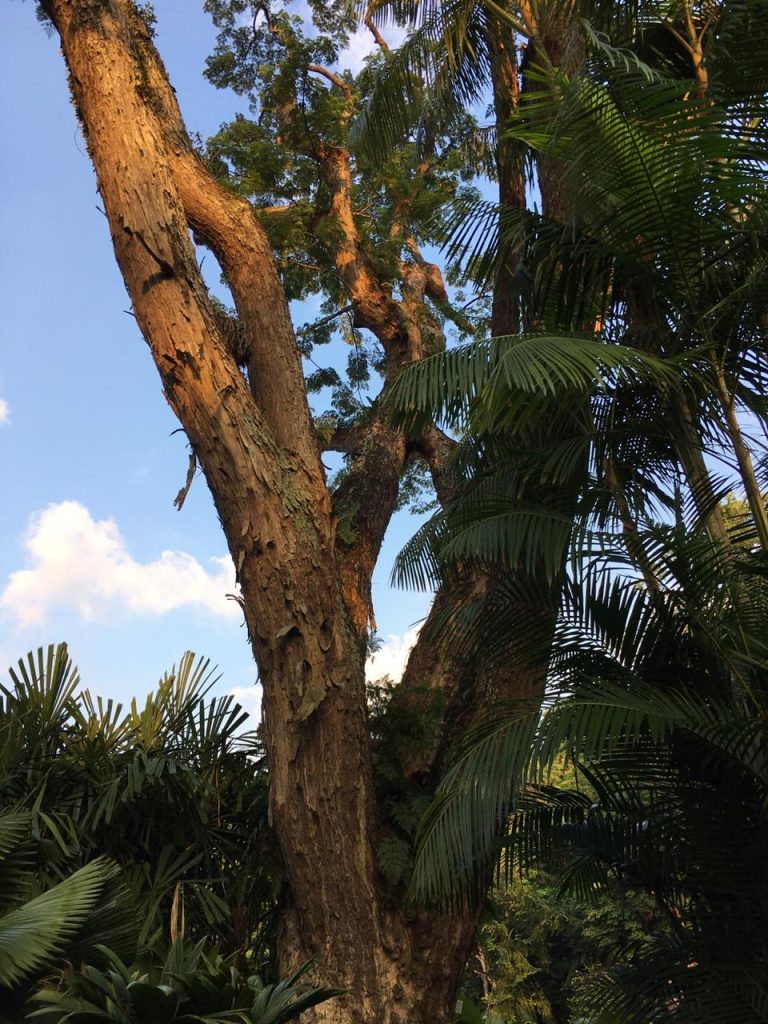
ancient trees in Singapore Gardens
“Singapore shall forever be a sovereign democratic and independent nation, founded upon the principles of liberty and justice and ever seeking the welfare and happiness of her people in a more just and equal society.” These were the words of the “Proclamation of Singapore” by Lee Kuan Yew on 9 August 1965.
Now, more than 5 decades later, Singapore is acknowledged as the country with the highest quality of life in Asia, and one of the highest in the world. It has strong and effective government, extremely low corruption rates, and some of the best social policies on Earth.
It is also, wrongly, perceived by many in the West as an ‘extremely capitalist’, business-oriented nation.
About time to‘re-visit’ Singapore!
What has been achieved here since independence? What was the dream, the vision of Lee Kuan Yew (LKY), the country’s first Prime Minister, who governed with an iron fist but also with great foresight, determination and compassion?
Is Singapore really a ‘Mecca’ of capitalism, or is it, perhaps, a crypto-Communist or at least a socialist country; a ‘ban Communism but do it their way’ kind of nation?
Yes, the country is ‘transparent’, ‘open for business’, a great ‘magnet for foreign companies’. But investment does not disappear in deep pockets of local elites, instead everyone benefits here. And the government decides who is welcomed and who is not, and in which direction the country should be developing. Singapore is a curious hybrid of a controlled and planned economy, and of what is known as ‘free market’.
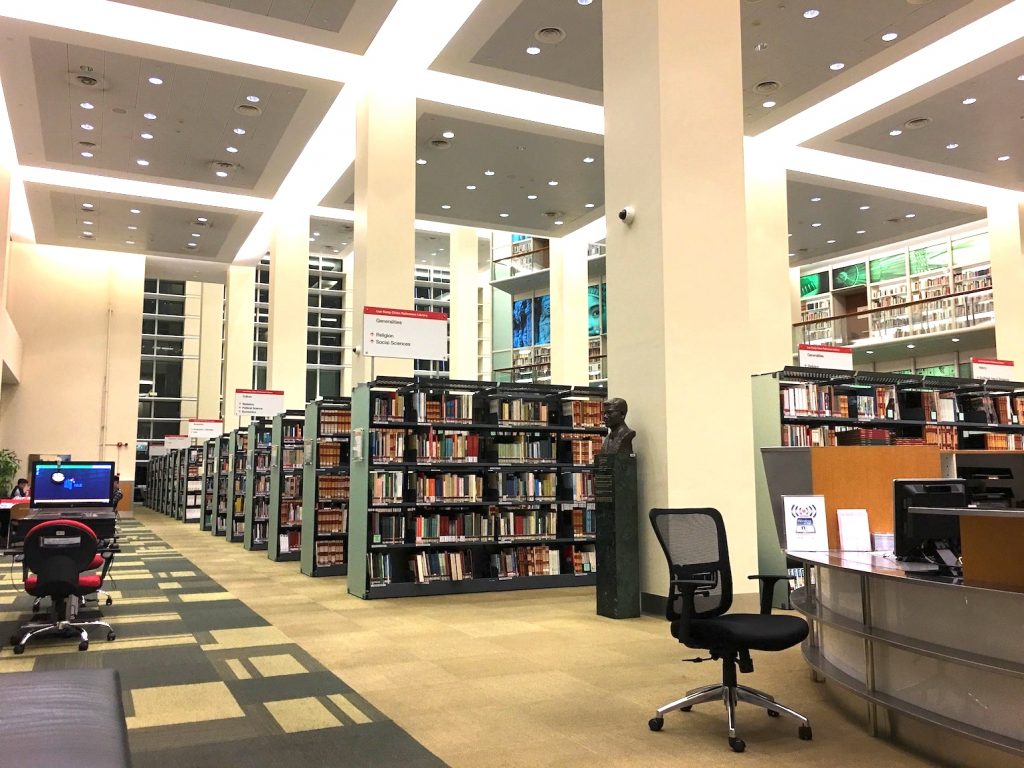
One room at an enormous National Library
I have some 25 years of history with Singapore. I do research in its libraries and archives; I admire its world class art institutions, brilliantly diverse food. And I simply enjoy healthy brisk walks through its vast public spaces.
Sometimes I am not hundred percent sure what precisely Singapore is, but I always know what it isn’t – it never succumbed to that brutal, heartless, primitive and uneducated turbo capitalism of other Southeast Asian countries like Indonesia, Malaysia, the Philippines and Thailand.
It educates, heals, and houses its citizens, and it gives them time, space, health, culture and perhaps the best public transportation on Earth, so in summary, they can enjoy some of the highest quality of life on Earth.
It does not rob its own people.
Is it ‘enough’? I am not sure. But it is a lot, more than almost anywhere else on our planet Earth.
*
What makes one country truly “revolutionary”, “socialist” or even “Communist”?
Is it its ideology, its banners and fiery anti-imperialist speeches; is it that country’s political and internationalist stand?
Or is it the quality of life enjoyed by its people; the way their country treats them: their health, education, housing, quality of air, public spaces, public transportation and cultural life?
I am convinced that it is both.Social and economic success without ideology and fighting spirit, leads to emptiness and in the end, to destructive consumerism.
Ideology without high quality of life helps Western propagandists to trigger subversion.
But where does Singapore stand, if measured by these scales?
It has some of the highest Human Development Indexes on Earth (HDI of UNDP), the highest in Asia, 5th in the world in 2017, and perhaps it would get the prime and become the number one on Earth, if non-Western criteria were to be applied.
The students of Singapore are scoring the best in the world in several fields and appear to be more creative than the Westerners. Most of the education facilities are free, and so is health, covered by efficient national insurance schemes. Public transportation is some of the best (if not the best) in the world, and heavily subsidized by the state. The arts in Singapore are flourishing – the country is impressively cosmopolitan, ecological, promoting ‘Asian values’, and attracting some of the greatest thinkers, artists and performers from China, India, Malaysia and the West.
Its libraries and archives are also some of the best in the world, and totally free, even for foreigners.
Since the independence, the Singaporean government forced people to leave their backward kampungs (villages) – many of them consisted of malaria-infested dwellings in the middle of swamps. In exchange, families were given flats in concrete buildings: with clean running water, electricity, top notch sanitation system, but also with playgrounds, parks, sports facilities, and public transportation.
All this was not unlike the urban design created in the Soviet Union, East Germany, Czechoslovakia, Korea (both North and South) or Cuba.
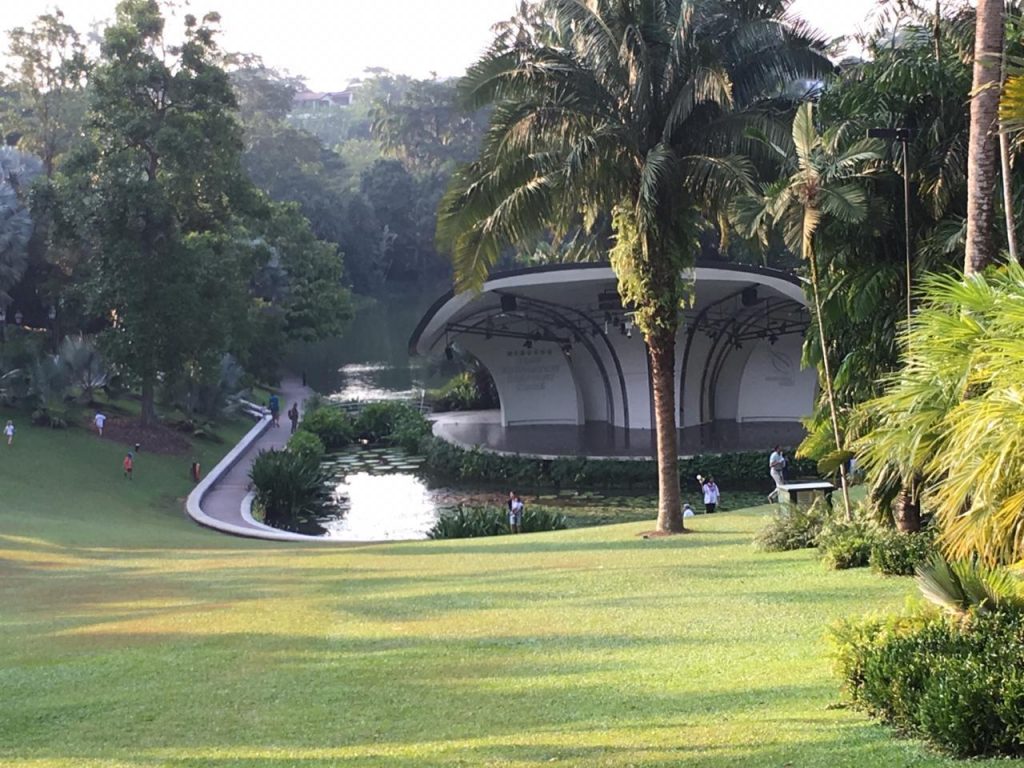
Concert stage at Singapore Botanical Gardens
From the very beginning, Singapore relied on the so-called ‘mixed economy’ – on a strong, powerful, incorruptible socially driven state/government, and paralleled by a thriving private sector, which, however, was forced to put the interests of the country well above its profits.
Singapore also counts on one of the fairest legal systems on Earth, but also one of the toughest, with the death penalty often used for drug trafficking, and for extreme and violent crimes.
It is clearly based on the‘Asian model’: the minority is expected to yield to the interests of the majority.
Contrary to that, in the West, the rights of the ‘minorities’ are pedantically protected, but often against the interests of the majority. The Western system clearly evolved from the ideas of protecting small and extreme rich groups of people (‘minorities’) against the masses of the poor (majority). On these foundations was also constructed the global imperialist system, through which the West has been brutalizing, plundering and ‘ruling’ the world for several centuries.
*
Based on various surveys, the Singaporeans are the “happiest people on the Asian continent”. No wonder: the country has some of the lowest crime rates in the world, perhaps the best and the most generous ‘social net’ of any officially capitalist country on the planet, tremendous opportunities for its citizens, and an exciting, cosmopolitan lifestyle.
There are no homeless people on its 68 islands and islets; one can walk safely basically anywhere, even in the middle of the night. Enormous public parks are everywhere, hugging the coast, and the river. The Botanic Gardens of Singapore are so stunning, that UNESCO inscribed them as a world heritage site.
For Singaporeans and the residents of the country, almost all cultural events, as well as educational facilities and spots, come free of charge.
Housing is heavily subsidized, especially for families that are buying their first (and mostly only) home. The great majority of Singaporeans live in huge but very well constructed apartment blocks, not unlike those that were erected in such Communist countries like the Soviet Union or former Czechoslovakia.
Rich foreigners (so-called ‘expats’) enjoy no such privileges: they pay through their ears and noses, sometimes twice, sometimes four or even five times more than the locals. Singapore is often voted as the most expensive city in Asia, up there with Tokyo and Hong Kong. But that is for the corporate types – for foreigners who would do just about anything in their power to be based in Singapore, instead of being based in totally collapsed, polluted and unlivable regional capitals like Jakarta or Manila. That ‘anything’ includes almost daily ‘commutes’ on one of the best airlines in the world (of course, the legendary Singapore Airlines) between Singapore and Jakarta.
For the Singaporeans, their country is perhaps one of the cheapest in the so-called ‘first world’.
If this is not a kind of socialism, one has to wonder, what really is.
*
Unlike the West, Singapore does not plunder. It is tremendously rich, because its people are very hardworking (most of them are Chinese and share with China both work ethic and honesty). Singaporeans are also extremely well educated, by some standards the best educated in the world.
Several years ago, Singapore evolved from a manufacturing center, into a research and science hub, as well as the regional transportation hub with Changi –repeatedly voted as the best airport in the world(never leaving the top 5). Its hi-tech port is used by the entire region.
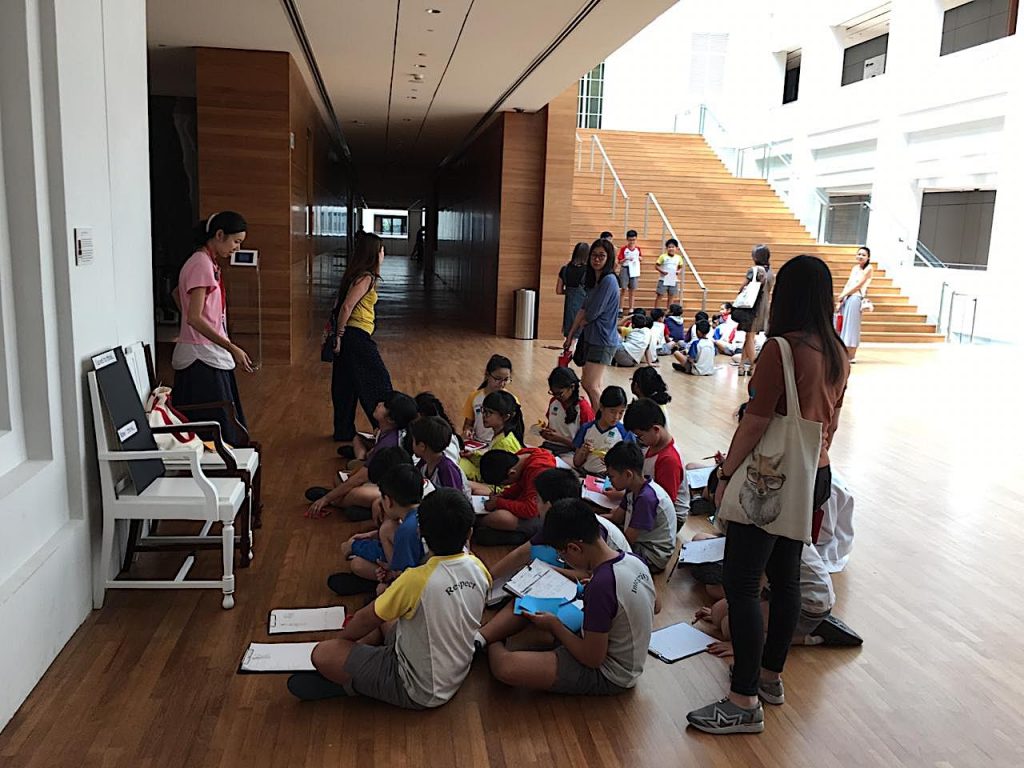
children studying art at Singapore National Art Gallery
Singapore is also renowned for its schools, which are mainly free for the locals, but not cheap at all for the foreigners, although they give generous scholarships for talented students from the region. The same can be said about its hospitals and the medical centers, which attract patients from the regional countries with collapsed, capitalist and monstrously overpriced medical systems (U.S.-style, but with some ten times lower incomes), like Indonesia and the Philippines.
Then the government decided to turn Singapore into a world-class city for the arts.
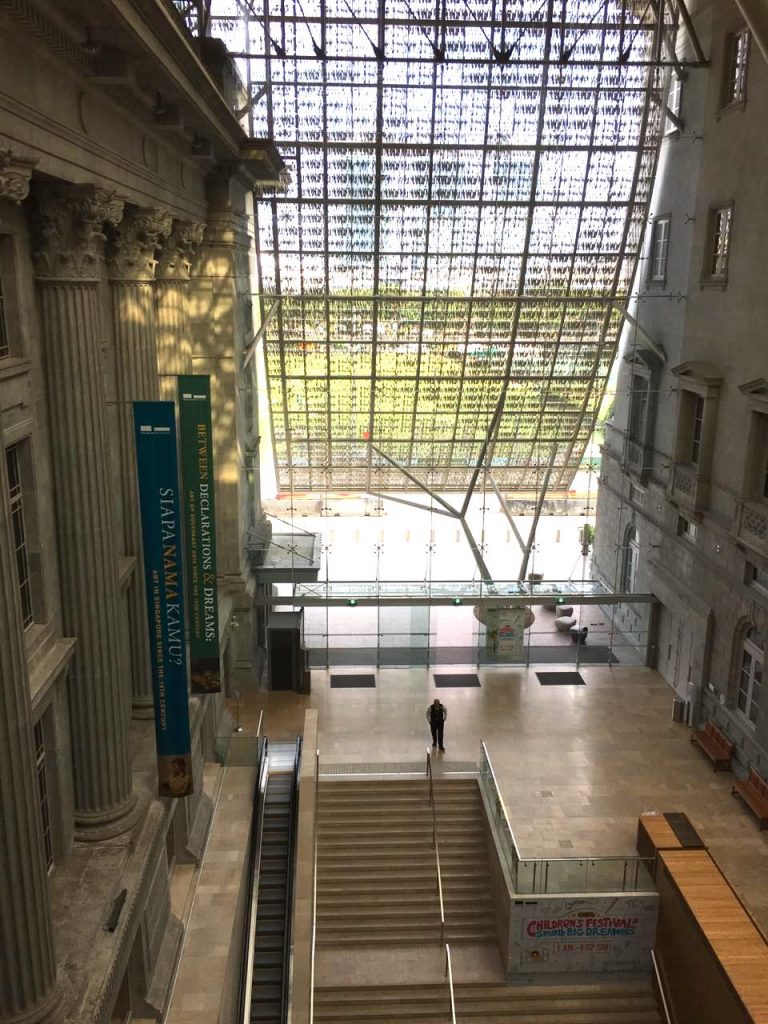
National Museum entrance
It was a great success. Its museums are second to none in the Southeast Asia, and some of the best on the continent. Art schools, cosmopolitan and subsidized concert halls, the creative fusion of arts and education – all this is on par with Beijing, while putting even such cities like Hong Kong to shame.
Just take a walk at night, and admire traditional Chinese statues exhibited freely along the river, as well as masterpieces by Salvador Dali or Botero, a Columbian sculptor and painter, originally known for his corpulent women, but also the one who, several years ago, created the powerful exhibition depicting the U.S. torture chambers at the notorious Abu Ghraib. It is all here, in Singapore, for everyone to admire. It is free for the Singaporeans. While Thailand, Malaysia, Indonesia or the Philippines cannot come up even with one decent National Museum, or a world-class public concert hall (Kuala Lumpur has one, but it belongs to the Malaysian oil company “Petronas”).
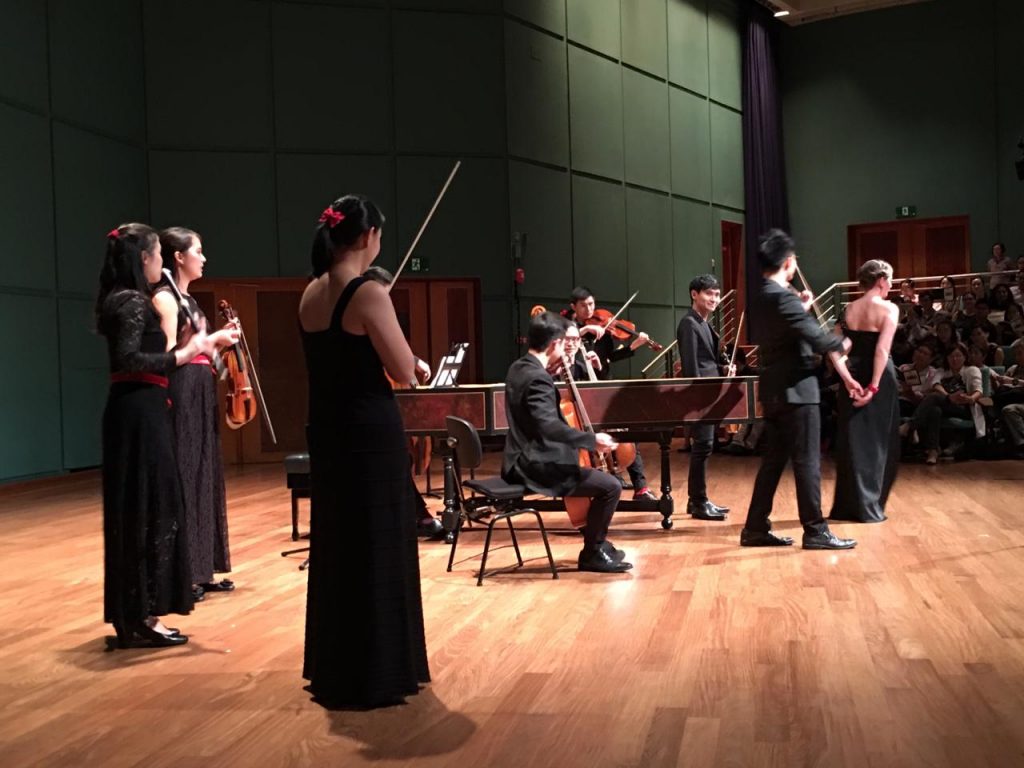
Red Dot performs at Esplanade Theatres
The arts in Singapore are not just influenced by the West, although such great performers like the Argentinean concert pianist Martha Argerich, are now household names here. Singapore is obsessed with Chinese Opera, Russian Ballet, as well as the classical music coming from all corners of India.

*
Many Westerners strongly dislike Singapore. Some of them never set their foot here (although they have no problems living in such centers of Western imperialism, like New York, Paris or London).
Mainly, it is a complex of inferiority that is haunting them. They feel poor here, and they are simply not permitted to behave like the masters of the universe. Coming here from almost anywhere in Europe or North America, the gap is really big. Singapore is too rich, too clean and elegant, but also too ‘socialist’ – designed to serve the people who call it home.
It is evidently a Chinese city, with an international flair, and the West ‘does not like China’.
Most of the Westerners ‘like poor Asian countries’, where uneducated women in their teens are ready to fall, out of desperation, around the neck of even the most brutal and uneducated Western males. They like to feel superior, in control, and rich. As long as their 100 dollars bills go far, very far, they are willing to overlook the terrible desperation of the Western neo-colonies, to breath polluted air, to eat terrible food and live in the mega-cities with almost no greenery, no beauty and no culture (culture all over Southeast Asia, but particularly in Indonesia, was ruined, massacred, by Western pop-culture and implanted radical forms of religion).
In Singapore, religions play very little role. Singaporean women are in control – educated and confident. They don’t need balding sugar daddies and their potbellies. Westerners are no gods here – they are treated very politely (as everyone here is) – but not extraordinarily.
Singapore is proud. It believes in ‘Asian values’. It does not need to be lectured by the Europeans with their collapsing infrastructure, social systems, and unwavering desire to plunder and control the world.
*
But Singapore can also be tough. It has to be.
In the past, it had already been attacked by Indonesia, antagonized by Malaysia and of course, colonized by the West.
Not everything here is so orderly as it appears, and the law often closes eyes, at least half-way. Not when it comes to crime committed by the locals, or when the common disputes are concerned, but when the foreigners bring in their ‘dirty money’. Singapore, as well as Hong Kong and the West, allows hundreds and some say even thousands of Indonesian and other Southeast Asian unsavory ‘businessmen’ and corrupt government officials, to wash their money here, to buy top end real estate or to send their offspring to the local schools and universities. The deal is clear: you can come and buy your condominiums, but you lay low, behave properly, and leave your wild feudalist gangster habits back in Jakarta or Manila.
The other issue, for which Singapore is often criticized by the Left, is its defense contracts with, and some even say military reliance on, Israel.
This question is, however, much more complex than how it appears on the surface. Singapore does not share any ideology or political positions with Israel, and it absolutely does not endorse apartheid. Of course, it is not a ‘perfect country’, but with time it has become, by all measures, one of the best functioning multi-cultural societies on Earth, definitely much more egalitarian than the Western countries. Minorities here are not just being ‘tolerated’ – they are directly influencing and shaping the nation.
Singapore sees Israel as a geographically small and extremely rich country, surrounded by the ‘enemies’. It does not analyze ‘why’ – it just wants to pragmatically learn and improve its own survival skills. Singaporean tough military conscription system is shaped on the Israeli model; both young men and women are called to armed force service, and then again, on several occasions in their life, for military exercises and training.
The ‘thread’ is usually never defined, at least openly. But it is clear that it is both Indonesia and Malaysia; two countries with much greater and much poorer populations, with Wahhabi Sunni Muslim majorities which are increasingly militant and fanatically pro-capitalist and anti-socialist.
Both Indonesia and Malaysia have already managed to thoroughly ruin their environments, as well as their economies, (especially in Indonesia); they are ‘growing’ only thanks to a thorough plunder of the natural resources. Confusion, undefined anger and frustration are never channeled into the revolutionary strives by the left-wing politics, as they are, for instance in Latin America, but also in the Philippines and often in India. Both thee neighboring countries of Singapore have been thoroughly brainwashed by the Western anti-left-wing propaganda.
Singapore, with no doubt the cleanest and ecologically-oriented society, is regularly covered by a deadly haze coming from the burning tropical forests of the Indonesian islands of Sumatra and Kalimantan (Borneo).
While Malaysia and Singapore are already locked in a dangerous dispute over fresh water supply.
Desperate, exasperated the Indonesian poor are crossing into Singapore in search of manual jobs. Singapore, unlike the EU and North America or Japan, has an ‘open door policy’. Almost everyone can come and visit, mostly visa-free. Many people are even allowed to settle and work here, enjoying almost the same rights and privileges as the Singaporean citizens (roughly 30% of people living in Singapore are foreigners, a much greater percentage than in the U.S. or the U.K.). But everything has to be done ‘legally’ here, and things are monitored closely.
Nowhere else on Earth does exist such a tremendous contrast between the affluence and social egalitarianism, and the misery accompanied by unequal distribution of wealth, as between Singapore and Indonesia. It is enough to take a high-speed ferry between Singapore and the Indonesian island of Batam, to understand. The two places are separated by only 20 kilometers of water, but they might have been on two different planets, or in heaven and hell.
Therefore, Singapore is scared.
In Indonesia, social frustration and anger always leads to racist outbreaks. Three genocides (1965, East Timor and the ongoing one in Papua) have always had a racist, as well as fascist and extreme religious undertone. When Suharto (an anti-communist and pro-Western fascist and bigoted dictator) was stepping down from power, it was Indonesian Chinese women who were dragged from their cars and gang-raped, right in front of grinning police officers. In Indonesian history, there have been countless anti-Chinese pogroms, some organized by the Dutch, some by the Indonesians themselves.
And Singapore is predominantly a Chinese country.
And it is not just‘genetic’. The culture of Singapore is Chinese, the work ethic, the way of life, are too. Its secularism is Chinese (while in both Indonesia and Malaysia religiousness is compulsory, and atheism de facto illegal), and so is its obsession with knowledge and education. Building the nation, constructive patriotism – all that is Chinese.
China (PRC) is the closest trade partner of Singapore, but also, the two countries are now extremely close allies.
But again, all this is hardly ever discussed. These issues are clearly taboo, but why?
Singapore knows where it stands, and where it is located. Southeast Asia has been a killing field for the West. Whenever any country decided to go Communist or socialist, it was smashed, bombed back to the stone ages. Vietnam, Laos and Cambodia lost millions of inhabitants, just because they decided to kick out Western colonialists and embark on the Communist path. Indonesia lost between 1 and 3 million people because the West wanted its natural resources, but also because in 1966 (one year after the 1965 coup), the Communist Party of Indonesia (PKI) was poised to win elections, democratically and clearly. East Timor lost 30% of its citizens because its leading political force – FRETILIN – was built on Marxist ideology. And Thailand’s massacres of its own left, as well as collaboration with the West against anything even remotely progressive in the region, has got the country permanently stuck between the third and the first world, with hardly any progress.
Singapore is a very small country. It is not a heroic nation, like Russia, Cuba or Syria. It only wants to work and play hard, and for its people to live well and in peace.
It knows perfectly well, that if it makes one ‘wrong’ statement or one ‘wrong’ move, it could be smashed to pieces, no matter how well trained and equipped its NAVY and air force are, no matter how healthy and prepared its people are.
It is willing to compromise, to pay, and even to bend its beliefs, if necessary. It is resigned to be silent about the collapse of Indonesia, and about the insanity of the Malaysian politics. All that, but only to a certain extent.
*
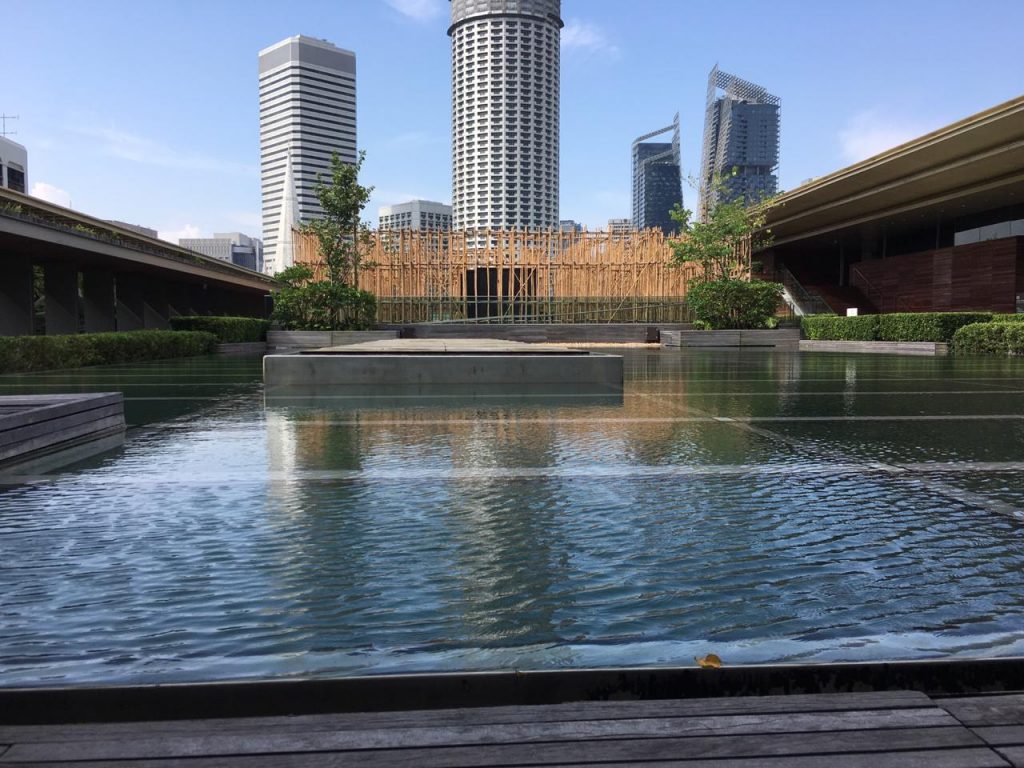
Rooftop of the National Museum
It is an extremely interesting, even fascinating place; a country where the government destroyed Communists, only to build a crypto-Communist state, using the ‘market economy’. It is pure madness, but it works, and it works extremely well.
It is loved by some, while despised by others (although many who hate it do so out of ignorance, envy or misunderstanding).
Most of Singaporeans love their country – it is, after all, their home, for which they fought, which they built shedding sweat, tightening belts, sacrificing lives.
Whatever Westerners say, almost all Southeast Asians either love or at least envy Singapore. Vietnamese government people as well as their city planners go there to study, trying to understand how to build great cities “for the people”, not “against them” like in Indonesia or the Philippines.
And the main criticism or ‘outrage’ of the Western backed NGO’s? Well, just ask people in Manila, Jakarta or in Hanoi, if they’d mind if the individuals who are ruining what is left of nature in their cities would get few cane hits over their buttocks, or if the corrupt business people and government officials would have to, once in a while, face a firing squad for robbing poor people.
I am not passing my judgment here, I am only saying: “Ask the people.” That’s how democracy should function, no? By consulting the local citizens, not the Western ‘advisers’ and Western-paid ‘civil society’.
Naturally, some Singaporeans do not like their country. But if they don’t, they are free to go. The Singaporean passport is one of the most powerful on Earth. When they leave, they are extremely well educated, healthy, self-sufficient, and speak at least two languages. They are respected. Both men and women are.
I call Singapore a “crypto-Communist country”. But I don’t say it loudly;neither do I do it too often, in order not to provoke the beast in the West, and its lackeys in Southeast Asia.
Yes, ideologically and rhetorically, Singapore “betrayed the left”. Practically, however, it built a socialist, or call it a ‘utopian Communist paradise’ for its people. During the process, it got greatly influenced by China, while influencing China in return.
To look obedient, it participated in a couple of Western military adventures. It never openly snapped at a rotting, corrupt and collapsing giant next door – Indonesia. It knows better. Whenever disasters strike and Indonesia is in agony, Singapore sends, discreetly, its doctors, rescue teams, even military, to help. But it never openly criticizes. And it never hears any ‘thanks’.
It is clear that the Singaporean leaders have been reading and studyingthe great Chinese classic – “Art of War”.
And it is obvious that the Singaporean people, ‘citizens of the happiest country in Asia’, will never allow their model to be abandoned. The dreadful scenarios which the West injected into Southeast Asia, and which it has been shamelessly glorifying as ‘tolerant’ and ‘democratic’, are just too close and too visible to be overlooked. They keep haunting, only few miles away, playing like a brutal horror film, over and over again.
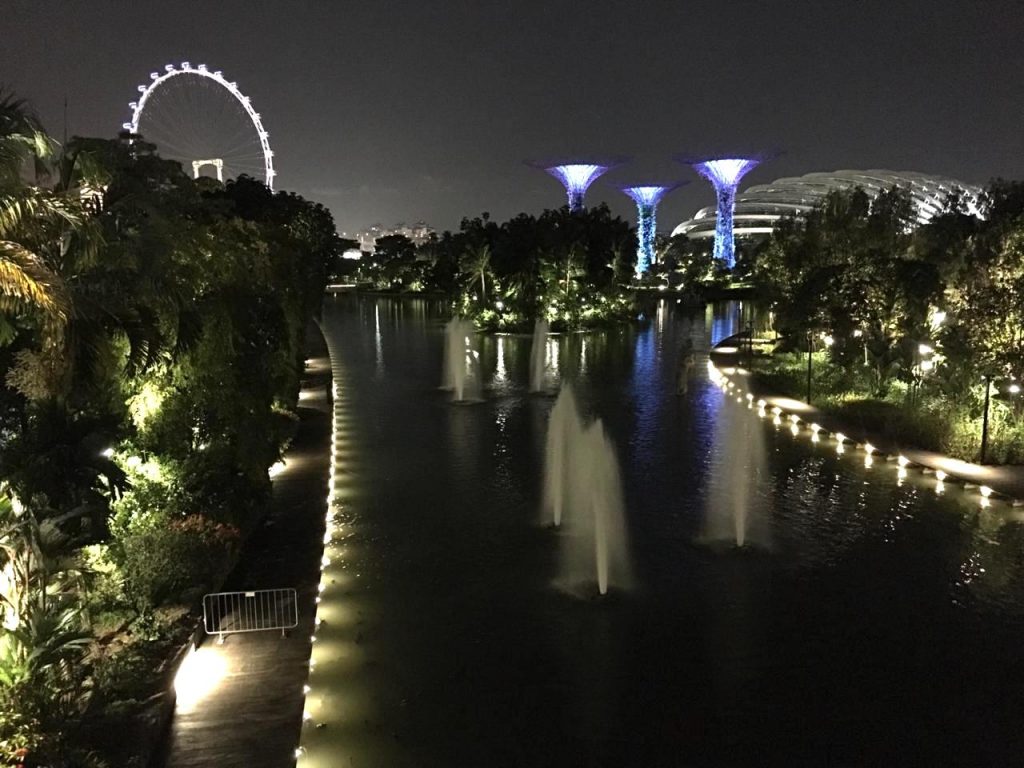
New public park
Singapore is a plush oasis in a dry and hostile desert of region’s social collapse. It is surrounded from all sides. It looks soft, sometimes too soft, but in reality, it is tough. Therefore, it will not surrender; it will be defending its people and its “Asian values”, and it will, most likely, in the end, “bring Southeast Asia back to Asia”, instead of succumbing to bizarre Western colonialist models that are robbing and raping the local people and entire nations.

Attack in Iran raises spectre of a potentially far larger conflagration

James M. Dorsey

An attack on a military parade in the southern Iranian city of Ahwaz is likely to prompt Iranian retaliation against opposition groups at home and abroad. It also deepens Iranian fears that the United States. Saudi Arabia and others may seek to destabilize the country by instigating unrest among its ethnic minorities.
With competing claims of responsibility by the Islamic State and the Ahvaz National Resistance for the attack that killed 29 people and wounded 70 others in the oil-rich province of Khuzestan, which borders on Iraq and is home to Iran’s ethnic Arab community, it is hard to determine with certainty the affiliation of the four perpetrators, all of whom were killed in the incident.
Statements by Iranian officials, however, accusing the United States and its allies, Saudi Arabia, the United Arab Emirates and Israel, suggest that they see the Ahvaz group rather than the Islamic State as responsible for the incident, the worst since the Islamic State attacked the Iranian parliament and the mausoleum of Ayatollah Ruhollah Khomeini in Tehran in 2017.
Iran’s summoning, in the wake of the attack, of the ambassadors of Britain, the Netherlands and Denmark, countries from which Iranian opposition groups operate, comes at an awkward moment for Tehran.
It complicates Iranian efforts to ensure that European measures effectively neutralize potentially crippling US sanctions that are being imposed as a result of the US withdrawal in May from the 2015 international agreement that curbed the Islamic republic’s nuclear program.
Ahvaz-related violence last year spilled on to the street of The Hague when unidentified gunmen killed Ahwazi activist Ahmad Mola Nissi. Mr. Nissi was shot dead days before he was scheduled to launch a Saudi-funded television station staffed with Saudi-trained personnel that would target Khuzestan, according to Ahvazi activists.
This week, a group of exile Iranian academics and political activists, led by The Hague-based social scientist Damon Golriz, announced the creation of a group that intends to campaign for a liberal democracy in Iran under the auspices of Reza Pahlavi, the son of the ousted Shah of Iran who lives in the United States.
While Iran appears to be targeting exile groups in the wake of the Ahvaz attack, Iran itself has witnessed in recent years stepped up activity by various insurgent groups amid indications of Saudi support, leading to repeated clashes and interception of Kurdish, Baloch and other ethnic insurgents.
Last monthAzeri and Iranian Arab protests erupted in soccer stadiums while the country’s Revolutionary Guards Corps reported clashes with Iraq-based Iranian Kurdish insurgents.
State-run television warned at the time in a primetime broadcast that foreign agents could turn legitimate protests stemming from domestic anger at the government’s mismanagement of the economy and corruption into “incendiary calls for regime change” by inciting violence that would provoke a crackdown by security forces and give the United States fodder to tackle Iran.
The People’s Mujahedin Organization of Iran or Mujahedin-e-Khalq (MeK), a controversial exiled opposition group that enjoys the support of serving and former Western officials, including some in the Trump administration, as well as prominent Saudis such as Prince Turki al-Faisal, a former Saudi intelligence chief, who is believed to be close to Saudi Crown Prince Mohammed bin Salman, has taken credit for a number of the protests in Khuzestan.
The incidents fit an emerging pattern, prompting suggestions that if a Gulf-backed group was responsible for this weekend’s attack, it may have been designed to provoke a more direct confrontation between Iran and the United States.
“If the terrorist attack in Ahvaz was part of a larger Saudi and UAE escalation in Iran, their goal is likely to goad Iran to retaliate and then use Tehran’s reaction to spark a larger war and force the US to enter since Riyadh and Abu Dhabi likely cannot take on Iran militarily alone… If so, the terrorist attack is as much about trapping Iran into war as it is to trap the US into a war of choice,” said Trita Parsi of the National Iranian American Council.
Iran appears with its response to the Ahvaz attack to be saying that its fears of US and Saudi destabilization efforts are becoming reality. The Iranian view is not wholly unfounded.
Speaking in a private capacity on the same day as the attack in Ahvaz, US President Donald J. Trump’s personal lawyer, Rudolph Giuliani, declared that US. sanctions were causing economic pain that could lead to a “successful revolution” in Iran.
“I don’t know when we’re going to overthrow them. It could be in a few days, months, a couple of years. But it’s going to happen,” Mr. Giuliani told an audience gathered in New York for an Iran Uprising Summit organized by the Organization of Iranian-American Communities, a Washington-based group associated with the Mujahedeen-e-Khalq.
Mr. Giuliani is together with John Bolton, Mr. Trump’s national security advisor, a long-standing supporter of the Mujahedeen-e-Khalq that calls for the violent overthrow of the Iranian regime.
Mr. Bolton, last year before assuming office, drafted at the request of Mr. Trump’s then strategic advisor, Steve Bannon, a plan that envisioned US support “for the democratic Iranian opposition,” “Kurdish national aspirations in Iran, Iraq and Syria,” and assistance for Iranian Arabs in Khuzestan and Baloch in the Pakistani province of Balochistan and Iran’s neighbouring Sistan and Balochistan province.
The Trump administration has officially shied away from formally endorsing the goal of toppling the regime in Tehran. Mr. Bolton, since becoming national security advisor, has insisted that US policy was to put “unprecedented pressure” on Iran to change its behaviour”, not its regime.
Messrs. Bolton and Giuliani’s inclination towards regime change is, however, shared by several US allies in the Middle East, and circumstantial evidence suggests that their views may be seeping into US policy moves without it being officially acknowledged.
Moreover, Saudi support for confrontation with Iran precedes Mr. Trump’s coming to office but has intensified since, in part as a result of King Salman’s ascendance to the Saudi throne in 2015 and the rise of his son, Prince Mohammed.
Already a decade ago, Saudi Arabia’s then King Abdullah urged the United States to “cut off the head of the snake” by launching military strikes to destroy Iran’s nuclear program.
Writing in 2012 in Asharq Al Awsat, a Saudi newspaper, Amal Al-Hazzani, an academic, asserted in an op-ed entitled “The oppressed Arab district of al-Ahwaz“ that Khuzestan “is an Arab territory… Its Arab residents have been facing continual repression ever since the Persian state assumed control of the region in 1925… It is imperative that the Arabs take up the al-Ahwaz cause, at least from the humanitarian perspective.”
More recently, Prince Mohammed vowed that “we won’t wait for the battle to be in Saudi Arabia. Instead, we will work so that the battle is for them in Iran.”
Abdulkhaleq Abdulla, a prominent UAE scholar, who is believed to be close to Emirati Crown Prince Mohammed bin Zayed, played into Iranian assertions of Gulf involvement in this weekend’s attack by tweeting that it wasn’t a terrorist incident.
Mr. Abdulla suggested that “moving the battle to the Iranian side is a declared option” and that the number of such attacks “will increase during the next phase”.
A Saudi think tank, believed to be backed by Prince Mohammed last year called in a study for Saudi support for a low-level Baloch insurgency in Iran. Prince Mohammed vowed around the same time that “we will work so that the battle is for them in Iran, not in Saudi Arabia.”
Pakistani militants have claimed that Saudi Arabia has stepped up funding of militant madrassas or religious seminaries in Balochistan that allegedly serve as havens for anti-Iranian fighters.
The KDPI has recently stepped up its attacks in Iranian Kurdistan, killing nine people weeks before Mr. Hijri’s meeting with Mr. Fagin. Other Kurdish groups have reported similar attacks. Several Iranian Kurdish groups are discussing ways to coordinate efforts to confront the Iranian regime.
Similarly, the Central Intelligence Agency (CIA) last year appointed a seasoned covert operations officer as head of its Iran operations.
Said Saudi Ambassador to the United States Prince Khalid bin Salman, Prince Mohammed’s brother: President “Trump makes clear that we will not approach Iran with the sort of appeasement policies that failed so miserably to halt Nazi Germany’s rise to power, or avert the costliest war ever waged.”

Australian university students face unprecedented financial pressures

Martin Scott

The 2017 Student Finances Survey, released last month by Universities Australia, revealed that 15 percent of Australian students regularly go without food or other basic necessities.
The report, based on data from 18,584 students enrolled at 38 universities, paints a picture of the unprecedented financial hardship faced by students in higher education resulting from decades of cutbacks by successive governments, Labor and Liberal-National alike.
More than half of the students surveyed said that their financial situation was often a source of worry. A quarter of undergraduates had been forced to reduce their course load or defer their studies because they could not afford to continue.
The situation is most dire for indigenous students and working class students classified as being from low socio-economic status (SES) backgrounds.
Some 71 percent of indigenous, and 63 percent of low SES, students were concerned about their finances. Around 27 percent of indigenous students regularly go without food or other basic necessities because they cannot afford them. Indigenous and low SES students are also less likely to have savings or financial support from family.
The report found that four in five domestic students are engaged in paid employment. Approximately 30 percent of full-time domestic undergraduates reported working more than 20 hours a week in addition to their studies, up from just 16 percent in 2006.
The pressure to work increased hours has a detrimental effect on studies, with 27 percent of full-time domestic students regularly missing class to attend work, and 40 percent stating that their work commitments adversely affect their performance at university. About 36 percent of part-time students are regularly forced to skip classes for work, and more than half report that employment has a negative impact on their studies.
The median annual income from paid employment in 2017 was $15,600 for full-time domestic undergraduates, and $33,900 for part-time domestic undergraduates. Taking into account other sources, including poverty-level government allowances, the median total income for full-time domestic undergraduates was $18,300, and for part-time domestic undergraduates, $33,900.
More than half of full-time domestic undergraduates, and at least 20 percent of part-time domestic undergraduates reported total annual income below the poverty line of $26,494, defined as 50 percent of median income.
In fact, the present situation is likely worse than the survey suggests, as the data, collected in 2017, does not reflect the full impact of federal cuts to Sunday and late-night penalty rates introduced in July last year, and extended in July 2018.
The second most common source of student income after paid employment was government support. One third of domestic undergraduates, and 18 percent of domestic postgraduate students received Youth Allowance, AUSTUDY, or ABSTUDY payments averaging about $10,000 annually.
Legislation proposed as part of the 2017 Federal Budget would increase the maximum liquid assets test waiting period for these payments from 13 to 26 weeks. The waiting period before receiving these payments would be increased for anyone with more than $11,500 in savings, and the maximum 26-week wait would apply to the estimated 25 percent of students with liquid assets of $18,000 or more.
Domestic undergraduates estimated they would complete their studies having incurred an average HELP student loan debt to the government of $32,000. Average estimated HELP debt for domestic postgraduate students was $40,000, and for higher-degree research students, $30,000. New legislation passed in August lowers the minimum repayment threshold for these loans from an annual income of $55,874 to $45,000.
For many domestic students earning $40,000 and over, this will mean beginning to pay back student loans while still at university.
Median annual expenditure for domestic students was $16,300 for undergraduates, $32,500 for postgraduate coursework students, and $31,500 for higher degree research students. The primary expense reported by students was housing.
Economic modelling in a recent Urbis report found that a student earning average income could afford to pay $114 per week for accommodation. The average weekly cost of one bedroom in a shared three bedroom house was $112. For the more than half of full-time students who earn less than the average income, the cost of housing is prohibitive.
The majority of students at Australian universities live in private rental housing rather than purpose-built student accommodation, and are therefore subject to the same housing crisis facing workers across the country. Most Australian universities are located in the major cities, Sydney, Melbourne, Brisbane, Perth, and Adelaide, which were all considered “severely unaffordable” housing markets by a 2017 Demographia survey. Sydney was the second least affordable city in the world, and Melbourne the fifth least affordable.
In recent years there has been a significant increase in the amount of purpose-built student accommodation, primarily to cater to full-fee-paying international students, who are a crucial source of revenue for universities looking to compensate for cuts in government funding.
Most of these new developments are commercially owned and managed, and according to real-estate analyst Savills, “record numbers of investors are looking to access the Australian student accommodation market.” This growth can hardly be seen as a move to provide affordable housing for all students. According to Urbis, the average weekly cost of such accommodation was $222, or 24 percent more than a student earning average income could afford to pay.
The effect of rising tuition and housing costs, reduced access to government support, and growing inability to earn sufficient income while studying will be to exclude from higher education all but the wealthiest of students.
This is the outcome of decades of funding cuts to higher education, imposed by successive Labor and Liberal-National governments. Recent funding reductions imposed by Liberal-National governments are a continuation of sweeping cuts imposed by the Greens-backed Labor government of Julia Gillard, which in 2013 introduced a $2.3 billion cut to university funding, the largest in history.
The increasingly dire plight of students makes clear that the fundamental social right to education is incompatible with a society subordinated to the profit dictates of a tiny corporate and financial elite.

Financial Times expresses concerns over Sri Lanka taking Chinese loans

Naveen Dewage

The London-based Financial Times (FT) recently published an article entitled “Sri Lanka sinks deeper into China’s grasp as debt woes spiral.” It is yet another expression of the concerns of US, European and major Asian powers about cash-strapped Sri Lanka relying more on China for economic support.
The US, with the backing of India and Japan, is increasingly putting pressure on Sri Lanka not to deviate from its efforts to undermine and encircle China.
The FT article is directed against Sri Lanka’s plan to issue $US250 million worth of renminbi-denominated Panda bonds. Country has already agreed to a $1 billion syndicated loan from China Development Bank in August. Its first instalment of $500 million was to be released in the first week of this month.
The article also noted that Sri Lanka had accumulated foreign debt of $55 billion of which Chinese lenders hold 10 percent, while Japan, the Asian Development Bank and World Bank have 13, 14 and 11 percent respectively.
However, the article claimed: “Sri Lanka’s mounting burden has earned some notoriety, with some observers saying the country is falling into a debt trap of Chinese design.” It added: “This view gained currency last year, after $1.1bn in debt was written off in exchange for the deep water port of Hambantota, near the southern tip of Sri Lanka.”
The major powers and the international media are increasingly using the catch phrase “China’s debt trap.” They claim that Beijing provides “unsustainable loans” and investments to bring countries under its fold to achieve China’s strategic ambitions for global domination.
This claim has nothing to do with their concerns for the plight of Sri Lanka or, for that matter, any of the backward countries facing mounting debts for which most of the major powers are directly responsible.
For decades, US imperialism has sought to undermine Beijing’s influence in Asia and Africa. Sri Lanka is among Washington’s major concerns because it is strategically located in the Indian Ocean astride important sea-lanes between North East Asia and Africa, the Middle East and Europe.
Washington was hostile to the close economic relations of the former President Mahinda Rajapakse government with Beijing, including the procuring of arms from China for the communal war against the separatist Liberation Tigers of Tamil Eelam (LTTE), which ended in mid-2009. Washington exploited human rights abuses by the Sri Lankan military to pressurise Rajapakse to distance himself from Beijing. Washington hypocritically used these war crimes though it fully backed Colombo’s war.
In the end, the Obama administration orchestrated a regime change operation in Colombo in the January 2015 presidential election to bring Maithripala Sirisena to power. To this end, Washington secured the help of right-wing United National Party (UNP) leader Ranil Wickremasinghe and former President Chandrika Kumaratunga.
After coming to power, Sirisena and Wickremesinghe immediately changed the foreign policy in favour of the US and India and even held up China-funded projects.
However, facing a financial crisis, the government has turned to China for funding. Colombo obtained a bailout loan from the International Monetary Fund (IMF) in June 2016 which was attached to far-reaching austerity measures for restructuring the economy and slashing government expenditure on basic services. This was the second IMF bailout loan in seven years—the first being obtained in 2009 under the Rajapakse regime.
As well as allowing Chinese companies to resume work on stalled projects, the government ceded a majority share of the Chinese-funded Hambantota Port to China Merchant Port Holdings in December 2017 in an attempt to offset the debt incurred for the port project.
Eyeing more financial assistance, Wickremesinghe declared at the handing-over ceremony that Hambantota was “part of the modern silk route,” a reference to Beijing’s ambitious “Belt and Road Initiative” (BRI) project.
The US, India and Japan immediately expressed concerns over the handing of the Hambantota port to China, claiming that it would be used as a military base by China to control the Indian Ocean.
With its own regional ambitions, India considers Sri Lanka as part of its sphere of influence in South Asia. To counter China’s rise, New Delhi has developed a close strategic partnership with Washington, and lined up with Japan which is also hostile to China.
Last month Japanese Defence Minister Itsunori Onodera visited Sri Lanka to boost military ties after having discussions with his Indian counterpart, Nirmala Sitharaman. Onodera visited Hambantota and told Japan’s NHK that the “port should not be used for military purposes,” indirectly referring to China.
Begun under the Obama administration, Washington’s aggressive economic and military moves against Beijing have intensified under Trump. Trade war measures are being ramped up by the US against China while military alliances with India, Japan and Australia are being strengthened. The US is insisting that countries in the region line up with its actions against China.
An FT editorial on September 10 declared that “China’s reputation as development financier [was] on the line.” It added: “US officials now see a disturbing pattern in which Beijing has encouraged indebtedness in order to gain control of strategic assets when debtors default on repayments.” Declaring that eight out of 68 countries “already have unsustainable levels of sovereign debts,” the editorial called for the US to “raise its own game plan” to counter China.
Defending his government, Sri Lankan Prime Minister Wickremesinghe declared at ASEAN’s World Economic Forum in Hanoi on September 10: “We are dealing with China. There is a fair amount of Chinese investments. There are China loans… I can’t see it as a threat.” He denied ceding the Hambantota port to China’s control.
There is no doubt that Sri Lanka will come under increasing pressure from the US and its allies to distance itself from China. The Sri Lankan military already has close relations with the US military and its warships frequently visit the island’s ports. Last week Colombo announced it will fully support US sanctions against Iran and halt oil imports from that country.

India cancels talks with Pakistan, threatens military action

Keith Jones

Indian Army Chief Bipin Rawat threatened military action against Pakistan Saturday, while applauding the Indian government’s sudden about-face on accepting a Pakistani offer for their respective foreign ministers to meet on the sidelines of this week’s UN General Assembly.
“I think our government’s policy has been quite clear and concise,” General Rawat told reporters. “We’ve made no bones about the fact that talks and terrorism can’t go hand in hand. Pakistan needs to curb (the) menace of terrorism.”
On Thursday, India’s government, which is led by Narendra Modi and his Hindu supremacist Bharatiya Janata Party (BJP), had accepted an offer of talks from Pakistan’s newly-minted prime minister, Imran Khan. But less than 24 hours later, New Delhi scuttled the planned meeting between India’s External Affairs Minister Sushma Swaraj and her Pakistani counterpart, Shah Mahmood Qureshi.
As justification, India cited the killing of three policemen, who had been abducted by anti-Indian Kashmiri insurgents from their homes in Jammu and Kashmir Thursday evening, and the alleged mutilation of the corpse of an Indian soldier killed earlier in the week in firing across the Line of Control (Loc) that separates Indian- and Pakistani-held Kashmir. A third reason cited by India was the Pakistani post office’s publication of a series of stamps commemorating Burhan Wani, the 21-year-old commander of an Islamist Kashmiri insurgent group whose July 2016 killing sparked mass protests in Indian-held Kashmir.
In his remarks Saturday, General Rawat, who was reportedly promoted over more senior officers because of his readiness to pursue an aggressive policy against India’s nuclear-armed rival, went beyond supporting the government’s hardline and declared India should inflict “pain” on Pakistan. “We need to take stern action to avenge the barbarism that terrorists and the Pakistan Army have been carrying out. Yes, it’s time to give it back to them in the same coin, not resorting to [a] similar kind of barbarism. But I think the other side must also feel the same pain.”
Peace talks between India and Pakistan, the arch-rivals born from the 1947 communal partition of South Asia, have been in limbo for more than a decade.
Beginning in late September 2016, India and Pakistan exchanged bloodcurdling threats of all-out war and heavy artillery and gun fire across the (LoC) on virtually a daily basis, causing scores of military and civilian casualties on both sides.
Nevertheless, both New Delhi and Islamabad claimed the coming to power of a new government in Pakistan last month provided an opportunity to ratchet down tensions.
Pakistan has responded to Friday’s announcement from New Delhi and Rawat’s threats by both repeating its offer of talks and declaring its readiness for war. Warning that India should not misconstrue Pakistan’s offer of “friendship” as “weakness,” Prime Minster Imran Khan said, “Our people are ready, our tanks are also ready.”
Islamabad has charged that India’s about-face was a sham, that it never wanted the foreign ministers’ meeting to go ahead. It chose to make a show of accepting the offer only to pull-out a day later, so as to highlight its hardline stance against Pakistan in the run-up to the flurry of diplomatic activity that will surround this week’s UN General Assembly.
What is clear is that India’s ruling elite, emboldened by its emergence as Washington’s principal ally in South Asia, is determined to bully Pakistan into demonstratively accepting New Delhi’s preeminence. Specifically, it is demanding that Islamabad ensure no logistical support is provided to the anti-Indian insurgency in Kashmir. This goes hand in hand with a narrative that reduces the alienation of the population of India’s lone Muslim-majority province to Pakistan’s machinations.
In reality, the Indian government has repeatedly and systematically violated Jammu and Kashmir’s constitutionally guaranteed autonomy and rigged its elections. For the past three decades, Indian security forces have waged a “dirty” counter-insurgency war in Jammu and Kashmir, subjecting the state’s population to armed-occupation, torture, disappearances and summary executions.
The Pakistan bourgeoisie is no less hostile to the democratic and social aspirations of Kashmir’s workers and toilers. It has manipulated the insurgency, promoting reactionary Islamist forces, so as to use them to pursue its own reactionary geo-strategic interests.
The cancellation of the foreign ministers’ talks fits well with the political calculations of the BJP government in the run-up next year’s general election. It has proclaimed September 29 “Surgical Strikes” day to mark the second anniversary of the provocative raid that Indian forces carried out inside Pakistan on September 28–29, 2016. It has also “suggested” the country’s universities organize parades to be addressed by Indian military personnel and cajoled students to write letters and emails pledging support to the armed forces.
But there is strong support across the Indian political establishment for a belligerent stance against Pakistan. The country’s main opposition party, the Congress Party, denounced the BJP government for its short-lived acceptance of the Pakistani offer of talks, and when it cancelled them complained that the BJP should never have agreed to talks.
In the brief interim between New Delhi’s acceptance and cancellation of the foreign ministers’ meeting, the US State Department declared the planned talks to be “terrific news.”
For the past decade, Washington has showered India with strategic favours, with the aim of transforming it into a frontline state in its military-strategic offensive against China, while dramatically downgrading ties with Pakistan. This has included explicit threats from Trump and his top aides that the US could repudiate Islamabad’s designation as a major non-NATO ally, and block an IMF emergency loan to Islamabad. However, the US still hopes to bully Pakistan, which has turned much of the country into a killing zone in support of the Afghan war, to eliminate all Taliban “safe-havens” in Pakistan, and calculates a lessening of tensions between New Delhi and Islamabad would help.
Under the four-year-old BJP government, India has dramatically increased its integration into the US drive against China, including throwing open its airbases and ports to routine use by Pentagon warplanes and warships and developing trilateral and quadrilateral ties with Washington’s closest allies in the Asia-Pacific, Japan and Australia.
New Delhi is also preparing, albeit reluctantly, to abide by the US sanctions against Iran, although India is heavily dependent on imported oil and Iran is one of its largest suppliers.
However, when it comes to Pakistan, India is ready to ignore Washington, as it seeks the greatest room and leverage to ruthlessly pursue what it deems its core strategic interests.
India’s corporate media has responded to the scuttling of the Indo-Pakistani foreign ministers’ meeting by saying that it indicates there will be no meaningful steps to revive the so-called “comprehensive peace progress” until after India’s general elections next May.
Such statements are based on an enormous underestimation of the combustibility of the Indo-Pakistani conflict and the extent to which it has become intertwined with the maelstrom of world geo-politics, above all the US-China divide. Pakistan has repeatedly warned that Washington’s drive to harness India to its predatory strategic ambitions has overturned the balance of power in the region. It is forcing Islamabad to both deepen its longtime strategic alliance with Beijing, leading to the crystallization of South Asia into rival blocs—the US and India versus China and Pakistan—and to deploy tactical, i.e., battlefield, nuclear weapons.

Brazil election campaign preparing rise of right-wing government

Miguel Andrade

With Brazil’s national elections just two weeks away, it is becoming increasingly clear that, whatever the results at the polls, the next government will be the country’s most right-wing since the fall of the 1964–1985 US-backed military dictatorship.
Currently, first-round polls give the the fascistic army reserve captain and seven-term Rio de Janeiro federal representative Jair Bolsonaro the lead with 28 percent, followed by Workers Party (PT) candidate Fernando Haddad with 16 percent and Ciro Gomes of the Democratic Labor Party (PDT) with 13 percent. The candidate for Brazil’s former leading right-wing party, the Brazilian Social Democracy (PSDB), has been unable to break out of single digits, despite his electoral alliance holding a third of the seats Congress.
Polls for the second round of the election show Bolsonaro being narrowly defeated by every other candidate.
Whatever the results, however, two trends, vastly accelerated in the recent weeks, must be taken by the working class as a sharp warning of the violent swing by the Brazilian ruling class that lies ahead.
The first is the increasing frequency of comments on the part of military and far-right figures implying that the legitimacy of the next administration may be in question, either because of claims of election fraud or “foreign meddling.” The latter is a reference to the strategy of the Workers Party to take the case of former president Luiz Inácio Lula da Silva, who has been jailed on corruption charges and denied the right to run as the PT’s candidate, to the UN.
The second trend is the rush to the right by the so-called “anti-fascist” opposition to Bolsonaro, which is doubling down on its claims, in the fashion of the bankrupt Democratic Party opposition to Trump, that Bolsonaro is a threat to Brazilian capitalist interests.
The far-right campaign to justify a military coup in Brazil, casting the military as the only “legitimate” power, was already evidenced by the April 3 threats made by Brazilian Army commander, Gen. Eduardo Villas Bôas in relation to a Supreme Court ruling on a habeas corpus motion filed on behalf of Lula, which was ultimately struck down. At the time, Villas Bôas declared that “the army shares the feelings of well-meaning citizens’ against impunity [for Lula].”
On September 8, Bolsonaro’s vice-presidential running mate, Gen. Hamilton Mourão, escalated the campaign, declaring to Globonews that the military’s “mission” was to “guarantee the proper functioning of the institutions” of the state. He added that, “according to the Army’s manuals” it was up to the “interpretation of the commander” whether or not a military intervention was necessary. Making clear the deeply unstable conditions anticipated within military circles, even in the event of a Bolsonaro electoral victory, Mourão said that the president, as commander-in-chief, could “legitimately” mobilize the military for a “self-coup” if he felt “institutions were not working,” that is, if the president didn’t get his way in the face of political opposition, adding, “as we’ve seen many times in other countries.”
A day later, Gen. Villas Bôas declared to Brazil’s right-wing daily O Estado de S. Paulo that, in face of both the attempt on Bolsonaro’s life by a deeply disturbed individual during a campaign rally, and the brief divisions within ruling circles regarding the blocking of Lula’s candidacy after the UN Human Rights Committee’s recommendation that he be allowed to run, the legitimacy of the elections could be questioned.
Villas Bôas declared the UN recommendation a “violation of Brazilian sovereignty” after several pundits and an O Estado de S. Paulo editorial had already adopted this line, and that on these grounds a ruling in Lula’s favor could delegitimize the elections. Likewise, the attack on Bolsonaro could be grounds for Bolsonaro to claim that he was unable to campaign, and also delegitimize the elections. After the knife attack on September 6, Bolsonaro remained in semi-intensive care for two weeks and is still a patient in one of the favorite private hospitals of Brazil’s wealthy elite.
Such declarations emboldened Bolsonaro himself to declare, in a video from his hospital room, that the Brazilian electronic ballots were going to be manipulated for a Workers Party victory that would free Lula through a presidential pardon. In the video, he asks his supporters, “think of what you would do in prison; would you accept it? Lula has not attempted to run because he has a plan.”
Under the weight of the international economic crisis and the collapse of the commodity boom that allowed the so-called Pink Tide of IMF-friendly “nationalist” regimes to sweep to power in Latin America, the Brazilian ruling class is demanding not only the destruction of workers’ living standards, but an unhindered alignment with US imperialism and an abandonment of whatever negotiating strategies were employed by the Workers Party to extract benefits from imperialism through ties with China and other “south-south” strategies.
Conscious of the growing restiveness in the working class and the inevitable resistance these policies will produce, ruling circles are increasingly turning to the military. After decades of exclusion from political life due to demoralization after being forced from power and held responsible for the crimes of the murderous 1964–1985 dictatorship, high-ranking generals are taking over civilian posts, including the Defense Ministry, and, most importantly, Rio de Janeiro’s law enforcement. Military officers are also running for office in record numbers.
Most recently, on September 13, for the first time in Brazilian history, a military officer was nominated to serve as counsel to the incoming Supreme Court’s president, José Antônio Dias Toffoli, who claims that four-star Gen. Fernando de Azevedo e Silva is qualified to advise him “with his knowledge of our county.”
Against this backdrop, the “anti-fascist” opposition to Bolsonaro is pitching its appeal to the Brazilian ruling class and “democratic” imperialist governments and officials, allowing the country’s far right to posture as nationalist and an opponent of the establishment.
Leading pundits, both right-wing and ostensibly “left”, including those tied to the Workers Party, have for almost a year attempted to discredit Bolsonaro, not by exposing his lies about being able to create jobs by slashing wages, but by criticizing the “half-heartedness” of his support for neoliberal “reforms,” citing his record of voting against privatizations and the slashing of pensions.
In the last two weeks, however, they have almost unanimously shifted their critique further to the right. They have seized upon several recent reports in the imperialist press, including the Financial TimesBloomberg and, most prominently, the Economist’s September 20 editorial, claiming Bolsonaro would be a “disastrous president” to try to dissuade Brazil’s ruling class from supporting him.
Celebratory comments from PT-supporting pundits came in the form of an article titled “‘Bye, bye, darling’, says ‘The Economist’ to Bolsonaro” by Flávio Ribeiro on the GGN news website on September 21. Similarly, the sycophantic Paulo Moreira Leite posted a column on the PT-aligned website Brasil247 on September 20, titled “Markets are already starting to distrust Bolsonaro’s unbelievable proposals,” referring to a plan to cut taxes for the rich. In other words, the wisdom of the financial markets’ support for IMF-approved PT policies, and not the votes—much less the mobilization—of the working class, will propel the Workers Party back to power.
The most recent “warnings” against Bolsonaro from the leading imperialist circles have coincided with the rise of the Workers Party’s substitute for Lula, Fernando Haddad, in the latest polls. The only São Paulo mayor to ever lose a re-election bid in the first round with 16 percent of the votes—less than the share of spoiled ballots—Haddad was able to earn São Paulo a Fitch investment grade rating amid the worst economic crisis in a century, an “accomplishment” achieved at the expense of the city’s working class and through a virtual zero investment policy.
Contrary to the “Free Lula” campaign’s lies about the ex-president’s “defiant” policies in favor of the poor, the party has continued a sharp turn to the right to compete with Bolsonaro for the support of the ruling elite. Lula’s nomination of the right-wing Haddad to head his economic team in January was already an indication of this trajectory.
GGN’s editor Luís Nassif celebrated on September 14 an FGV think-tank report explaining that market fluctuations in Brazil were more connected to international factors than any concern by finance capital about a PT victory—also in contradiction to the claims of the “Free Lula” campaign about his “defiant” defense of the oppressed.
This was followed by pundit Patrícia Campos Mello in her September 21 Folha de S. Paulo column citing favorable commentary about Haddad, repeatedly pointing out that it came, not from “progressive” and “anti-Trump” newspapers like the New York Times or the Guardian, but from Bloomberg and the Financial Times (“Financial markets Bibles are abandoning Bolsonaro”). It is symptomatic of the rightward turn by Bolsonaro’s “anti-fascist” critics that they shy away even from the positive references to the PT in CIA mouthpieces such as the New York Times .
One of the reports quoted by these columnists is Bloomberg’s Matthew Winkler’s analysis of the Brazilian situation from September 20, which ends by saying that investors believe that the winner of the election “doesn’t matter.”
As the Brazilian military increasingly indicate that it is preparing to guarantee that the election “doesn’t matter,” and the PT makes clear it has no intention of standing in their way, the responsibility for the dangers facing the Brazilian working class lie squarely with those pseudo-left forces promoting the PT as a political alternative.