1 Oct 2018

Brazil’s Workers Party leader covers up far-right threats to next government

Miguel Andrade

With Brazil’s October 7 general elections less than a week away, the political life of the country has been dominated by increasing threats to democratic institutions by the military and officials associated with the presidential campaign of the fascistic army reserve captain and seven-term Rio de Janeiro federal representative Jair Bolsonaro.
With Bolsonaro leading the polls, the official “democratic” bourgeois factions are themselves moving sharply to the right.
The latest far-right move in the crisis-ridden campaign has been an interview given by Bolsonaro to the right-wing pundit José Luiz Datena, from the Bandeirantes TV channel, declaring that “based on what he sees on the streets,” he could not accept an electoral defeat at the hands of the Workers Party (PT) candidate Fernando Haddad.
Bolsonaro gave the interview from a semi-intensive care unit in one of the favorite hospitals of São Paulo’s wealthy elite, where he has spent 20 days recovering from a life-threatening knife wound inflicted by a deeply disturbed individual during a campaign rally.
With 28 percent, Bolsonaro leads the latest polls, but is ever more closely followed by Haddad, who is rapidly closing the gap and now polls at 22 percent, largely due to the so-called “vote transfer” from former PT President Luiz Inácio Lula da Silva. Lula had previously led the polls for almost a year. Jailed for corruption, on September 11, after an eight-month legal battle, Lula finally dropped his candidacy in favor of Haddad.
Tied in third place with around 10 percent are Ciro Gomes, the candidate of the oldest functioning bourgeois party in Brazil, the Democratic Labor Party (PDT), and former São Paulo state governor Geraldo Alckmin, from the Brazilian Social Democracy Party (PSDB), the country’s former leading right-wing party. The latest Datafolha poll from September 28 saw every contender increase his lead over Bolsonaro in a likely second-round run-off election.
The latest ominous threat by the far right follows repeated declarations by high-ranking military officers, especially the commander of the Brazilian Army, Gen. Eduardo Villas Bôas, and echoed by right-wing pundits, questioning the legitimacy of the elections. They have pointed to “foreign interference” by a UN panel that voiced concerns over the treatment of Lula, a potential ruling by the Supreme Court freeing the ex-PT president on appeal and the impact of the attempt on the life of Bolsonaro, who could claim he was denied the right to campaign by the attack.
Villas Bôas’ declarations have emboldened Bolsonaro’s vice presidential running mate, Gen. Hamilton Mourão, to declare the legitimacy of a presidential self-coup—calling out the military—in face of the widespread opposition Bolsonaro would inevitably face if elected.
They have also emboldened Bolsonaro himself to declare that the Electoral Court may rig Brazil’s electronic voting system in the PT’s favor, and that this would be the “only” possible explanation for his defeat at the polls.
What is becoming increasingly clear is that the far right will apply maximum pressure in order to guarantee that the next government, whether led by Bolsonaro or by Haddad, is going to be the most right-wing since the fall of the 21-year US-backed military dictatorship in 1985.
Against such a menacing backdrop, the PT is making it ever clearer that it will play the leading role in covering up this threat from the far right, whether it wins the election or not.
The far-right campaign has prompted the PT to dispatch its former chancellor and defense minister, Celso Amorim, to a round of interviews with what passes for the “left” press in Brazil—the local edition of the Spanish Daily El País and PT mouthpieces such as Carta Capital and Brasil247 —in which he has guaranteed that the pack of generals behind Bolsonaro and the army commander Gen. Villas Bôas do not represent “the vision of the Armed Forces.”
Amorim made this media tour in the wake of the PT-organized “Threats to democracy and the multipolar world” conference in São Paulo, which had as one of its main speakers Dominique de Villepin, the right-wing former French prime minister who oversaw major anti-working class “reforms” responsible for the unprecedented growth of the far right in France.
Support from imperialist officials and mouthpieces, such as the New York TimesLe Monde, the Financial Times and the Economist, has been a central prop of the PT’s appeals to the Brazilian ruling elite, with Lula receiving supporting letters and jail visits from warmongers such as François Hollande and Martin Schultz.
In his first interview in his PT-sponsored media tour, Celso Amorim told Carta Capital that Bolsonaro and General Mourão are “a minority” within the military. He singled out desperate workers willing to cast a vote for the nationalist and populist-posturing Bolsonaro as the greatest threat to democracy.
To El País, on the next day, Amorim praised Gen. Joaquim Silva e Luna, Brazil’s first uniformed defense minister since the Army, Navy and Air Force ministries were unified to increase civilian control over the military, for “being constructive” during the proceedings of the Congressional Truth Commission on the 1964-1985 dictatorship. During this process, the military insisted that no prosecution would be allowed for its assassins and torturers and openly threatened mutiny if any attempt were made to hold them accountable.
In the same interview, he dismissed Villas Bôas’s declarations threatening the Supreme Court on the eve of its April 3 ruling on Lula’s Habeas Corpus plea. He said that the army was “attentive to its missions” and “shared the feelings of well-meaning citizens’ against impunity [for Lula].” He added that he didn’t want to “speculate on what he meant” and that “he cannot judge his intentions,” and that “he could not cast any suspicion” on Villas Bôas from what he knew of him as defense minister.
Later, on September 28, he declared to Brasil 247 that “the military will accept Haddad’s victory,” once again relying on the “constructive” Gen. Silva e Luna, whom he said “has highlighted that the election result would be respected, whatever it is.”
Amorim’s press tour and his promotion of General Silva e Luna constitute a carefully thought-out maneuver by the PT to court the military and present the party as the force best suited to its interests. The clearest indication of this has been Amorim’s reference, in Carta Capital, to the need for “a preemptive Marshall Lott.”
Marshall Henrique Lott was responsible for guaranteeing that President Juscelino Kubitscheck could take office in 1956 after the threat of a military coup, and for later reining in another coup threat against President João Goulart in 1961, in the so-called “Legality Campaign.”
Amid an escalating military threat and an increase in working class militancy, it was the Communist Party’s insistence that workers subordinate themselves for more than 10 years to “constitutionalist” bourgeois forces like Lott and the Brazilian Labor Party, to which Goulart belonged, that proved the main factor in the final success of the military in the coup of 1964, which initiated a 21-year, blood-soaked regime that murderously silenced any opposition.
The references to Lott and “constitutionalist” military go hand-in-hand with the declarations by PT officials that they are pursuing a “Perón strategy,” of “Haddad as President, Lula in Power.” The Argentine President Juan Domingo Perón, harbored by the fascist Franco regime in Spain after a 1955 Argentine military coup, came back to Argentina after his hand-picked candidate, Héctor Cámpora, won the 1973 elections. He allowed Perón’s return and quickly resigned in order to convene new elections that Perón would win. Taking office amid increasing working class unrest, Perón died in 1974, and his party turned viciously against the working class, founding the murderous Argentine Anticommunist Alliance and purging the unions before being ousted by the military, leaving the working class defenseless, in the face of the 1976 coup.
The PT’s rightward movement is preparing a no-less bloody end. The first task of the working class in preparing itself for the inevitable future confrontations is to consciously break with the PT and all of its “anti-fascist” bourgeois alliance.

López Obrador promises Truth Commission in disappearance of Ayotzinapa students

Don Knowland 

Last week marked the fourth anniversary of the forced disappearance of 43 teaching students (normalistas) from the Raúl Isidro Burgo Rural Normal School in the town of Ayotzinapa in the southern Mexican state of Guerrero. Following a demonstration against cuts in education funding in the city of Iguala, local police herded the students into buses and likely turned them over to a local gang, the Guerreros Unidos. They have never been heard from since, and the remains have been recovered of only one of the students.
The incident itself, as well as its investigation by the Attorney General of Mexico (PGR) under what is now the outgoing government of President Enrique Peña Nieto and his Party of the Institutional Revolution (PRI), were emblematic of the lawlessness of the Mexican state, its corruption and its ties to organized crime. At a more fundamental level, the case evinced the disdain of Mexico’s ruling oligarchy and government for the most basic rights of the Mexican population, who were outraged by this monstrous crime.
The PGR’s investigation concluded that the Guerreros Unidos gang killed the students and then incinerated their remains in a dump by a river in the neighboring town of Cocula. This is known in Mexico as the “historical explanation.”
Its deficiencies and inconsistencies were exposed by the Interdisciplinary Group of Independent Experts of the Inter-American Commission on Human Rights (CIDH) and the Argentine Forensic Anthropology Team, among others. They proved that the students’ remains could not have been incinerated at the Cocula dump site as the PGR had concluded.
The PGR arrested 170 people, including members of Guerreros Unidos and local police from Iguala and Cocula. One hundred and nineteen of them are still detained, of whom 69 are directly accused of complicity in the events. Not a single person has been sentenced for the crime.
Confessions by many of those detained were extracted under torture. Courts later ordered a number of them freed for that reason.
The PGR also ignored credible evidence developed by the CIDH of the complicity in the crime of various government authorities—the Guerrero state police, the federal police, and the 27th Battalion of the Army stationed in Iguala—who either directly participated in the detentions and murder of the students, or stood by as they transpired.
The PGR under President Peña Nieto stuck to the historical explanation precisely in order to cover up the involvement of these forces, above all in order not to subject the Army to scrutiny.
The Mexican government rejected widespread calls for a “truth commission” that would continue and expand the investigation, including those by the Office in Mexico of the United Nations High Commissioner for Human Rights (UN-DH), who decried the government’s conclusions as “unsustainable.”
The families of the disappeared students and their supporters went to court in order to reopen the investigation and seek the implementation of such a commission. The PGR opposed this relief, filing literally dozens of court appeals to head this off.
In June, a constitutional court issued a landmark ruling that ordered the creation of an independent “Commission of Investigation for Truth and Justice” to once again take up the case. The PGR challenged that ruling, asserting that impaneling such a commission was a “legal and material impossibility.”
On September 20, the First Collegiate Court of the Nineteenth Circuit based in Reynosa rejected the position of the PGR. The State could not investigate the federal police and Army, because it would in effect be investigating itself.
Now the Supreme Court of Justice of the Nation will review this ruling.
Last Wednesday, over ten thousand marched in Mexico City, including the students’ family members, university students, teachers and social organizations, to commemorate the disappearance of the normalistas, and press for a new, thorough and honest investigation.
The families then met with President-elect Andrés Manuel López Obrador (popularly known as AMLO) of the victorious Morena (Movement for National Regeneration) party.
AMLO offered the next of kin the investiture of a truth commission, with or without a court ruling. The new government’s goal he said was to work for “truth and justice,” without impunity. But, he cautioned, there would be no “witch hunt.”
A decree to that effect would be issued on December 1, requiring the government to cooperate fully with, rather than impede, such an investigation, and to allow the participation of the UN and the IGIE, which would include utilization of the latter’s technical assistance.
After the families met with AMLO, Alejandro Encinas—once a militant of the former Communist Party of Mexico, former head of the Mexico City government and the current senator representing Mexico City in Congress—who AMLO says he will appoint deputy minister of the Interior to oversee human rights generally and the Truth Commission specifically, addressed the press. Encinas stressed that a commission would “allow us to have an instrument with sufficient judicial force to review the case and continue the investigation.”
However, when Encinas was asked about whether the participation of the military in these crimes would be investigated, he equivocated: We “will see. It is not the objective to investigate the Army… [We] do not want to ‘strap on knives’ with the Army.”
Encinas continued: “It is different to talk about the Armed Forces in the abstract, than say, elements of the Armed Forces. You have to make that differentiation.”
When specific reference was made to the participation of the Army’s 27th Battalion, Encinas demurred, saying any comment would have to wait the new investigation, and that it was not up to him to speculate.
Pressed further, Encinas said that “if there are elements of the Armed Forces [involved], they will have to be subject to the corresponding sanction.” In other words, if the Army high command ordered or covered up local army involvement that would be out of bounds in any truth commission.
This deference to the Armed Forces is of a piece with AMLO recently backtracking from his campaign promise that he would pull soldiers from the streets, where they were placed over ten years ago by President Felipe Calderón, ostensibly to battle the drug cartels, “back to their barracks.” Now, he explains, although the military operation has led to tens of thousands of deaths, that is not practicable.
AMLO also must tread carefully, lest leaders in his own party or other supporters turn out to have been involved in the Ayotzinapa events, or in their coverup. In 2014 he and Morena had been grooming Iguala’s former mayor, José Luis Abarca, to run for governor of Guerrero state. It turned out that Abarca was directly involved in ordering the seizure of the normalistas the night they disappeared. He and his wife, the latter a sibling of the leader of Guerreros Unidos, were later convicted of involvement with the gang and money laundering.
AMLO ran for president as a “progressive social democrat.” His platform stressed most of all fighting corruption. Corrupt governors, those in bed with the narcotics cartels, officials who stole or committed fraud against public property, who rigged bids for public contracts, who turned a blind eye in Mexico City to enforcement of building standards, despite a history of major earthquakes, who illegally spied on citizens—and their co-conspirators in business—would all face a day of reckoning, without “impunity.” Presumably, even the outgoing president might have to face the music.
Mexico’s working class will learn soon enough that once in office AMLO will disappoint them on many fronts. He inevitably will pursue more and more right-wing measures in the interests of the Mexican and international bourgeoisie.

World Bank warns Gaza faces economic collapse

Jean Shaoul 

Gaza’s economy is in “free fall,” the World Bank has warned. It has contracted by 6 percent in the first quarter of 2018, with every indication that it would continue to deteriorate. The Bank warned of Gaza’s “immediate collapse” without urgent intervention.
A report published September 25 stated, “The result is an alarming situation with every second person living in poverty and the unemployment rate for its overwhelmingly young population at over 70 percent.”
The Bank blamed Israel’s economic blockade of Gaza, imposed in 2007 and later joined by Egypt, along with cuts in funding from the United Nations Relief and Works Agency for Palestine Refugees (UNRWA) and the Palestinian Authority, for the disastrous situation facing its near-destitute population.
Since 2006, Palestinians in Gaza have been unable to export their manufactured goods, fruit and vegetables, work in Israel’s construction and agricultural sectors or import crucial materials required for production and construction, leading to the de-industrialisation of the economy.
So tight is the blockade by air, sea and land that it is almost impossible to leave Gaza, even to seek life-saving medical treatment in Egypt, Jordan, Israel or the West Bank, rendering it an open-air prison.
In 2015, a United Nations Conference on Trade and Development (UNCTAD) report said Gaza would become “unliveable” in less than five years if the current economic and population trends continued.
What the World Bank report did not say was that Israel’s draconian blockade was its response to Hamas’ victory in internationally-monitored elections for the Palestinian Authority parliament in January 2006, and is an act of collective punishment prohibited under international law. In 2006, a senior adviser to then Prime Minister Ehud Olmert, Dov Weisglass, explained the goal of the Gaza siege was to put the people of Gaza “on a diet, but not to make them die of hunger.” The goal, according to Israel’s Defence ministry, was to wage “economic warfare” that would generate a political crisis, leading to a popular uprising against Hamas.
The blockade, along with the destruction of infrastructure and tens of thousands of homes by the Israeli military in three major military assaults in 2008-9, 2012 and 2014, has devastated the territory and its 1.9 million inhabitants.
Successive US administrations, Democratic and Republican, have given unconditional support to the Israeli state as it has carried out its attacks on Gaza, including the recent massacre of unarmed protesters in Gaza where at least 170 have been gunned down by Israeli snipers and thousands more have been wounded.
Gaza’s economy has become entirely dependent upon aid and remittances, almost the only sources of money flowing into the Strip. Earlier this month, the Trump administration announced that it was ending all further payments to UNRWA, including the $290 million planned for this year—itself a reduction on the $364 million last year—as part of its plans to close down the agency altogether. The US contribution accounts for nearly 30 percent of UNRWA’s total budget that provides health care, education and social services to Palestinians in the West Bank, Gaza Strip, Jordan, Syria and Lebanon. UNRWA warned that unless $217 million was forthcoming from other donors, it would have to make cuts.
Starting in 2017, President Mahmoud Abbas’ Palestinian Authority in the West Bank, which is responsible for the payment of Gaza’s public sector workers, cut its funding and in 2018 stopped it altogether. The PA withheld payments to Israel for Gaza’s power supply—already limited—leading to further power cuts, water shortages and untreated sewage.
According to the World Bank, the PA and UNRWA were the main source of non-trade related funding, totalling more than $2.3 billion in 2014, with some $500 million of informal sources flowing to Hamas, providing nearly 100 percent of Gaza’s GDP in 2014.
A few weeks ago, UNRWA announced it was laying off nearly 1,000 of its 13,000 staff in Gaza, transferring 580 to part-time contracts and cutting salaries of hundreds more. This sparked angry protests and caused UNRWA to “lose control” of its compound in Gaza for more than two weeks. In July, an UNRWA worker tried to set himself on fire after receiving his dismissal notice. On Monday, 13,000 UNRWA workers went on strike in Gaza.
The World Bank said that the net result was that Gaza’s average growth over the last two decades has been lower than all other comparators, including the West Bank. It anticipates a further deterioration in Gaza’s economic situation, noting that Egypt’s attempts to broker a long-term ceasefire between Hamas, the bourgeois Islamist group that controls Gaza, and Israel, and some easing of the blockade, had failed, as had repeated attempts to negotiate a reconciliation between the rival Palestinian factions.
Israel, with Washington’s backing, has absolutely no intention of lifting the siege and will wage further assaults on the defenceless Palestinians. With half of Gaza’s population dependent upon food aid from UNRWA, which also runs more than 250 of Gaza’s schools and 22 medical centres, and up to 80 percent of the population dependent upon international aid, the implications are devastating.
As it is, some 70 percent of UNRWA schools and over 63 percent of Ministry of Education schools operate on a double or triple shift system that has cut teaching time to about four hours a day, and limited the time available to reinforce learning, support slow learners, and offer remedial education and extracurricular activities.
The traumatic conditions of everyday life, constant wars, air strikes and assassinations carried out by Israel’s military forces have taken a terrible psychological toll on Gaza’s children. At least 300,000 children need treatment for psychosomatic disorders such as nightmares, eating disorders, intense fear and bed wetting.
The world’s media have been largely silent about the World Bank’s report, which evoked no editorial statements by major media outlets. There has been a deafening silence from world leaders, denoting their complicity in Israel’s crimes against the Palestinian people and exposing their humanitarian pretensions as nothing but a cover for neo-colonial wars for regime change and plunder.
Almost the entire Palestinian community in Gaza has been brought to such a calamitous state as part of a calculated plan, aimed at terrorising the entire population and breaking the 70-year history of Palestinian resistance to occupation.
The situation imposed by Israel on Gaza today is reminiscent of that imposed by the Nazis on the Warsaw Ghetto. That Israel has resorted to such barbarism testifies to the bankruptcy of the Zionist project, which justified the establishment of Israel as a safe-haven for the Jewish people who had suffered under Nazi oppression. It must constitute a warning of what is being prepared against the working class in every country. Sieges against entire populations, whether through closing the borders, as in Gaza’s case, blockading Hodeida, Yemen, or imposing economic sanctions—along with secondary sanctions—to strangle Iran, are the shape of things to come.
Reaction, militarism and the drive to dictatorship are sweeping across all the major powers in response to the deepening of the world capitalist crisis and the growing signs of working-class resistance. No appeals to the “international community” to provide financial support for Gaza or put pressure on Israel to lift the blockade will have any effect. The international working class must come to the defence of the Palestinian masses and fight for the unity of all workers, across all religious and national lines, in the Middle East and internationally.

Dozens injured as Catalan separatists and regional police clash in Barcelona

Alejandro López

On Saturday, ahead of today’s one-year anniversary of the Catalan independence referendum, dozens of demonstrators were injured and six were arrested in clashes with regional police in Barcelona.
A year ago, Madrid deployed 16,000 police in a failed attempt to suppress the referendum by violently assaulting peaceful voters, including the elderly. With tacit European Union support, the central government threatened direct military intervention. It proceeded to jail Catalan nationalist politicians and impose an unelected government on the region.
Since then, despite mass protests in Barcelona, successive governments, led first by the right-wing Popular Party (PP) and then by the Spanish Socialist Party (PSOE), have continued Madrid’s reactionary course in Catalonia. The current social democratic government is doing so with the support of Podemos.
Saturday’s clashes erupted after Catalan regional police intervened to separate a separatist protest organised by the Committees for the Defence of the Republic (CDR), a group close to the Catalan nationalist Candidatures of Popular Unity (CUP), from a rally backing the national police.
The pro-police demonstration was organized by Jusapol, an association of national police and civil guards that demands equal pay between Spain’s two nationwide police forces and Catalonia’s regional police. The aim of the demonstration was to pay tribute to the crackdown on the October 2017 referendum.
Jusapol President Natan Espinosa provocatively declared that his organization wanted to “honour those who worked to preserve the unity of Spain.” A leader of the far-right Vox party, Javier Ortega, also participated in the Jusapol rally.
The Jusapol demonstration marshalled some 3,000 protesters. They chanted “Long Live Spain” and “Go Get Them!”—a reference to slogans shouted by far-right demonstrators in support of national police units that were deployed to Catalonia on the eve of the referendum.
The CDR counterdemonstration mobilized over 6,000 people. The separatist protesters shouted at the Spanish police supporters, “October 1, We Neither Forgive Nor Forget,” “Get Out of Here, Fascists!” and “Independence!” The right-wing demonstrators responded by shouting, “We Will Be Victorious!” “Long Live Spain” and “Our Cause Is Just!”
Clashes reportedly erupted when CDR protesters tried to confront the pro-police rally. When the regional police cordon blocked them, the demonstrators sprayed coloured powder and threw eggs at the regional police.
The Catalan police responded by charging with batons in at least at three different locations, leaving at least 24 injured, of whom six were hospitalized. Videos and images on YouTube show police hitting protesters above the waist and in some cases on the head—violating police regulations.
The regional Catalan Home Affairs minister, Miquel Buch, defended the actions of the Catalan police, the Mossos d'Esquadra, saying on Sunday “We managed to avoid bigger problems. Such a clash could have become very violent.” However, he admitted that some policemen did not behave “according to protocol.” The CUP, which has historically supported the current Catalan ruling parties, has urged the minister to resign.
Barcelona Mayor Ada Colau of Podemos-backed Barcelona en Comú spoke on Catalunya Radio to say: “I make a call for calm… This city has always defended the right of everyone to exercise the right to free speech.” Keeping silent on the pro-police rally’s far-right character, Colau appealed for law and order, saying Barcelona had requested more police officers to fight against “insecurity.”
Saturday’s violent clash reflects the explosive political and class tensions created by the PP government’s crackdown in Catalonia. A year after the 2017 Catalan independence referendum, none of the issues that led the Catalan nationalists to call the independence referendum, and Madrid to order its repression, have been resolved.
A strike wave is developing across Spain and Europe amid growing anger over austerity and the militarist policies of the EU and Madrid. With the installation of a new PSOE minority government backed by Podemos and the main Catalan nationalist parties, the class gulf separating the entire political establishment and masses of working people has come to the fore.
PSOE Prime Minister Pedro Sánchez has in all essentials continued the PP’s policies of militarism and police state repression, while broaching a few symbolic concessions. He has declared his sympathy for Catalan autonomy and floated proposals for investing €500 million in Catalan infrastructure. At the same time, however, the PSOE government, which is maintained in power by the support of Podemos, has kept Catalan nationalist prisoners in jail and retained “rebellion” charges against nine incarcerated Catalan leaders. The charges carry sentences of up to 25 years in jail.
The reactionary policies of the PSOE and Podemos have exposed the bankruptcy of the main Catalan nationalist parties, Together for Catalonia (JxCat) and Catalan Republican Left (ERC), both of which backed the June no-confidence vote that installed the PSOE government.
The pseudo-left CUP and its appendages, such as the Morenoite Workers’ Revolutionary Current (WRC), are responding with calls to implement the so-called “mandate of the October 1 referendum.” With a 92 percent vote for independence on a turnout of only 43 percent, less than 40 percent of voters supported independence. Nonetheless, the CUP and the WRC are agitating for the Catalan nationalists to secede from Spain, criticizing JxCat and the ERC for seeking only “a return to regional normality and protecting investments of the large Catalan companies.”
The CUP and the WRC know that the Catalan nationalists have no base in the working class, any more than the Spanish ruling parties, and they fear the growing radicalization among workers.
The WRC’s Izquierda Diario website calls on the Catalan nationalists to “expand their base” by going to the “factories, offices and working-class neighbourhoods.” This, they claim, will “add the bulk of the Catalan working class to this democratic struggle, [which will] return to the streets much renewed and with a political programme that solves the serious democratic and social problems.” They add, “It is necessary to link the struggle for the Catalan Republic with the struggle to end precarious employment and the low salaries of young people, women and immigrants.”
In fact, the past year has shown that a Catalan secessionist perspective, which divides Catalan and Spanish-speaking workers, is a trap for workers opposed to the police state policies of the EU and Spain. Those who dress it up in “left” colours, like the CUP, have long records of voting for austerity budgets proposed by the main Catalan nationalist parties. These parties are violently opposed to mobilizing the working class and oriented to the sordid political manoeuvres in Madrid.
JxCat and ERC have threatened to withdraw support from the PSOE government and let it collapse if Sánchez refuses to discuss self-determination and fails to free the jailed Catalan nationalists. However, they have not acted on this threat, fearing that new elections might bring to power the PP and the Citizens Party, which are calling on Sánchez to again impose an unelected government in Catalonia.
The political bankruptcy of all these forces vindicates the statement the International Committee of the Fourth International (ICFI) released last year on the eve of the referendum. It warned that opposition to repression “cannot be mounted under the grip of the ruling parties in Madrid or the Catalan nationalists, who are unflaggingly hostile to the working class.”
The ICFI insisted that the “division of the Spanish working class by the building of a new capitalist state in Catalonia, governed by parties with a long record of supporting war and imposing austerity, offers workers nothing. It would separate Catalan workers from their greatest ally against Madrid’s onslaught: the entire Spanish and European working class.”
The only viable policy against the danger of war and dictatorship, the ICFI wrote, “is to fight to unify the working class in Spain and Europe in a struggle against capitalism and for the socialist reorganization of society. This can be carried out only in revolutionary struggle against all of Spain’s bourgeois factions.”

More than eight hundred dead after earthquakes and tsunami strike Indonesia

John Braddock

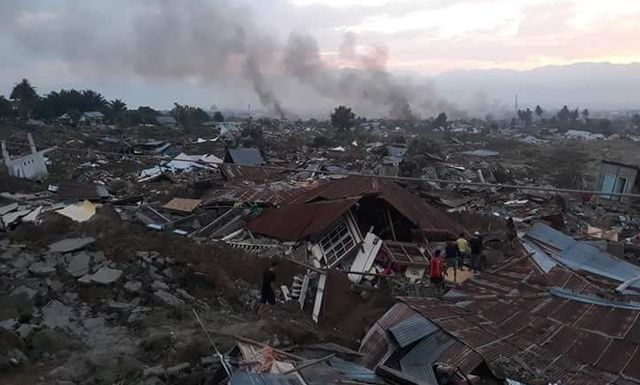
The Indonesian government warned on Saturday that thousands of people may have perished after earthquakes and a tsunami struck the island of Sulawesi last Friday. The official death toll rose sharply to 832 on Sunday and is expected to increase again once rescuers reach more remote areas.
While reports remain scanty, it is clear that what is unfolding is a tragedy on a massive scale, devastating the lives of hundreds of thousands, or even millions, of impoverished workers, farmers and their families. Some 2.4 million people live on the Palu-Koro fault and the worst hit cities are Donggala and Palu. About 17,000 people have been evacuated.
The main 7.5-magnitude quake struck at 6.02pm local time, followed by tsunami waves which were estimated at 6 metres high in some places. An earlier magnitude 6.1 quake in central Sulawesi killed several people, injured 10 and damaged dozens of houses.
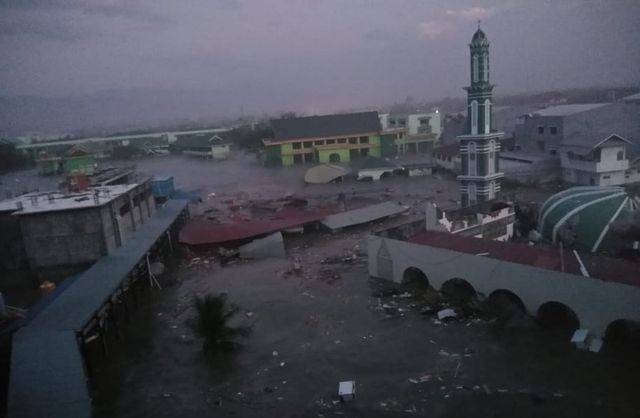
A section of Palu partially submerged by the tsunami, Credit: IHH Humanitarian Relief Foundation
The powerful tremor was felt in the far south of the island in its largest city Makassar and on neighbouring Kalimantan, Indonesia’s portion of Borneo. More than 150 aftershocks have hit the region, situated 1,300km northwest of Jakarta.
It is the most devastating earthquake to hit Indonesia in over a decade, and comes just seven weeks after the islands of Lombok and Bali were devastated by a series of quakes that killed at least 623 people and destroyed hundreds of thousands of buildings.
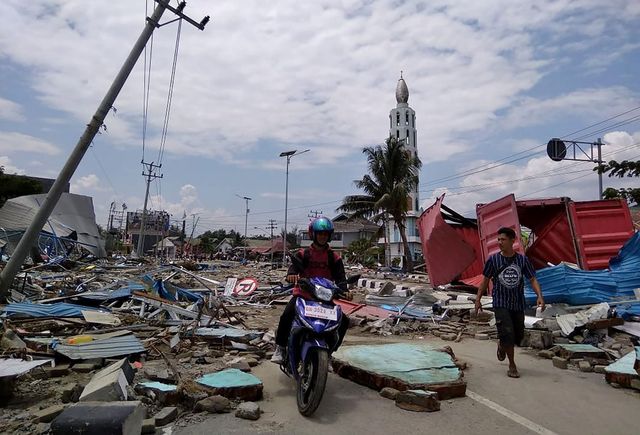
Palu has been left shattered. There is no electricity, and drinking water is in short supply. Video footage showed waves bringing down several buildings and inundating a large mosque which was half submerged in the rising waters. The town is strewn with debris from collapsed buildings and a large shopping mall is all but destroyed.
Some 821 of the recorded deaths occurred in Palu. Partially covered bodies have been shown lying near the shore, with survivors left to search through a tangle of corrugated steel roofing, timber and rubble. One man was seen carrying the muddy corpse of a small child. With the threat of disease increasing, mass graves are being prepared to bury the many dead.
Among the deceased was a 21 year-old air traffic controller, Anthonius Gunawan Agung, who heroically stayed in the swaying control tower at Palu airport to ensure that a plane carrying hundreds of passengers took off safely. He jumped from the tower and died before a medical helicopter could reach him.
The government has stated there is “no word” about casualties in Donggala, a city of some 300,000 people which remains completely cut-off after its main bridge collapsed. Jan Gelfand, a Jakarta-based Red Cross official said; “We have heard nothing from Donggala and this is extremely worrying…This is already a tragedy, but it could get much worse.”
A spokesman for the National Disaster Mitigation Agency, Sutopo Purwo Nugroho, said at least 540 people had been badly injured, and many are still missing. There are ongoing concerns over the fate of hundreds of people who were preparing for a beach festival that had been due to start when the tsunami hit.
Palu is built around a narrow bay that apparently magnified the force of the tsunami. Sutopo shared video showing the liquefaction of the land when the tsunami struck and said as it approached it had reached 800 kms/ hr. Most people were killed by the tsunami. The Guardian cited one local resident, Nining, who said; “Many corpses are scattered on the beach and floating on the surface of the sea.”
Destroyed homes and buildings in Palu, Credit: IHH Humanitarian Relief Foundation
Hospitals have struggled to cope with the influx of casualties, setting up open-air clinics to treat the injured. Rescuers working to retrieve up to 50 people from the rubble of a hotel in Palu said they could hear the voices of people inside but did not have the heavy equipment needed to get to them.
Indonesian officials and aid agencies have struggled with battered communications, destroyed roads and landslides. Aid deliveries by sea have been disrupted since Palu's port was badly damaged. Only a limited number of government planes carrying relief supplies have managed to land at the airport in Palu.
The shambolic character of the official response makes clear that fourteen years after the 2004 tsunami—which killed as many as 230,000 people throughout the Indian Ocean region, the majority of them in Indonesia—nothing has been done to prevent further calamities.
Governments throughout the region have instead intensified cutbacks to social spending, in line with the demands of international finance and the local ruling elites that they represent.
The Associated Press reported today that an early warning system, designed in the wake of the 2004 tsunami, has “been stalled in the testing phase” for over a decade. After severe funding reductions by successive governments, Indonesia’s disaster agencies have been unable to cobble together a paltry 1 billion rupiah ($A95,500) required to complete the project.
Louise Comfort, a University of Pittsburgh academic who was involved in the project commented today: “To me this is a tragedy for science, even more so a tragedy for the Indonesian people as the residents of Sulawesi are discovering right now. It’s a heartbreak to watch when there is a well-designed sensor network that could provide critical information.”
Some 22 buoys, which are a key component of the existing warning mechanism are no longer functioning. It is reportedly difficult, using the antiquated system, to provide any advanced warning of an impending tsunami, that would aid those in affected areas to escape.
Criticisms have been levelled against the country's geophysics agency for lifting the tsunami warning just 34 minutes after it was first issued, which may have caused confusion and exacerbated the death toll.
Spokesman Rahmat Triyono claimed the agency followed standard operating procedure and made the call to “end” the warning based on data available from the closest tidal sensor, 200km from Palu. He said the tide gauge, which measures changes in the sea level, had only recorded an “insignificant” 6cm wave. “If we had a tide gauge or proper data in Palu it would have been better. This is something we must evaluate for the future,” Triyono said.
A street in Palu, Credit: IHH Humanitarian Relief Foundation
Indonesia, a 5,000-kilometre long archipelago comprising 17,000 islands, is one of the most quake-prone regions in the world, in a zone known as the Ring of Fire. Little has been done, however, to ensure that new dwellings are built to resist the frequent natural disasters.
Sutopo declared in August that Indonesians “do not have houses that are earthquake resistant especially for people in rural villages with weak economic conditions.” No government regulations required residential dwellings to be built to earthquake-resistant standards, and many construction workers are reportedly not aware of building practices required to mitigate damage.
There has been negligible aid or material assistance from any of the major powers or regional governments. Condolences, but no concrete promises, have been issued by the Australian and Singapore governments. Turkey’s Humanitarian Relief Foundation (IHH) has sent a tiny five-person emergency aid team. Experience from previous disasters indicates that any international aid will be tardy, woefully inadequate, and dictated by geo-strategic considerations rather than concern for the thousands of victims.
Troops are being rushed to the area. Indonesian president, Joko Widodo, said the military was being called in to the region to help search-and-rescue teams get to victims and find bodies. However, their priority will be to prevent the outbreak of any anti-government sentiment as conditions inevitably deteriorate.
Troop deployments are a regular occurrence following such disasters. The government fears that they could become a focal point of broader anger over social inequality and poverty, amid ongoing political instability. Last year, Oxfam ranked Indonesia as the sixth most unequal country in the world. The four richest individuals have a combined wealth greater than the poorest 100 million people. Workers and the rural poor inevitably suffer the hardest in any such natural calamities.
The repeated occurrence of such catastrophes is not merely a natural phenomenon. Above all, it is an expression of the irrational character of the profit system, which subordinates social need to the profit requirements of a tiny corporate and financial elite, at the expense of the vast majority of the population.

29 Sept 2018

Guinness Nigeria Undergraduate Scholarship Scheme 2018/2019 for Nigerian Students

Application Deadline: 12th October 2018

Eligible Countries: Nigeria

To be taken at (country): Nigeria

About the Award: This scholarship supports Guinness Nigeria’s commitment to implementing transformative schemes that foster youth development.

Eligible Fields of Study: Applications are open to students studying the following courses: Engineering & Sciences – Mechanical, Electrical, Chemical, Lab Science, Microbiology, Bio-Chemistry, Marketing & Sales, Human Resources/Industrial & Labour Relations and Accounting.

Type: Undergraduate

Eligibility:
  • Candidates must be 1st or 2nd year students in Nigeria Universities or Polytechnics.
  • Student from Guinness host communities are encourage to apply.
Selection Criteria: 
  • Candidates may be required to write an aptitude test
  • Shortlisted candidates may be required to provide a letter of introduction from the Chairman of their Community Development Associations where applicable. .
Number of Awards: Not specified

Value of Award: The scholarship will provide full tuition for students who are currently studying in Nigerian Universities and Polytechnics. Student from our host communities are encourage to apply.

How to Apply: Interested and qualified candidates should send the following details below to: info.gn@diageo.com
  • Full Name
  • University/Polytechnic
  • Matriculation Number/Year of study
  • Home Town/Local Government Area/State of Origin
  • Phone Number/e-mail address
  • Scanned copy of Student ID card or
  • Admission letter.

PEO International Peace Scholarships for Women to Study in USA and Canada 2018/2019

Application Timeline: 
  • Application closes: 15th December, 2018
  • March 1, 2019: Last day to submit completed application materials from applicants already enrolled in the graduate program and school for which their scholarship is intended.
  • April 1, 2019: Last day to submit completed application materials from applicants not yet enrolled in the graduate program or school for which the scholarship is intended. Last day to submit completed application materials for applicants who will be attending Cottey College
Offered Annually: Yes

About the Award: Members of P.E.O. believe that education is fundamental to world peace and understanding. The scholarship is based upon demonstrated need; however, the award is not intended to cover all academic or personal expenses.

Eligibility and Criteria:
  • An applicant must be qualified for admission to full-time graduate study and working toward a graduate degree in an accredited college or university in the united States or canada.
  • A student who is a citizen or permanent resident of the United States or Canada is not eligible.
  • Scholarships are not given for research, internships, or practical training, unless it is combined with coursework. Awards are not to be used to pay past debts.
  • In order to qualify for her first scholarship, an applicant must have a full year of coursework remaining, be enrolled and in residence for the entire school year.
  • Doctoral students who have completed coursework and are working only on dissertations are not eligible as first-time applicants.
  • international students attending cottey college are eligible to apply for a scholarship.
Scholarship Worth
  • The maximum amount awarded to a student is $12,500. Lesser amounts may be awarded according to individual needs.
  • The scholarship is based upon demonstrated financial need; however, the award is not intended to cover all academic or personal expenses. At the time of application, the applicant is required to confirm additional financial resources adequate to meet her estimated expenses. Additional resources may include personal and family funds, tuition waivers, work scholarships, teaching assistantships, study grants and other scholarships.
  • Awards are announced in May. The amount of the PEO International scholarship will be divided into two payments to be distributed in August and December
Application Guideline and Procedures
  • Information concerning the international peace Scholarship program is available from the P.E.O. Executive Office or from the website at peointernational.org.
  • Eligibility must be established before application material is made available. Eligibility information and application deadlines can be found at any time on the P.E.O. website.
  • Information concerning admission to Cottey college may be obtained by writing to the coordinator of Admissions, Cottey College, Nevada, Missouri 64772, or visit them at cottey.edu.
Awards are announced in May. The amount of the scholarship will be divided into two payments to be distributed in August and December.

Visit P.E.O. International Peace Scholarship Fund Information

Russian Duma rams through pension reform amid mass opposition

Clara Weiss

The lower house of the Russian parliament (Duma) has passed the pension reform, which will raise the retirement age for men and women by five years, in a final reading on Thursday, September 27, in a slightly amended version. The passing of the reform, the most unpopular measure of the Russian government in decades, sets the stage for a sharp escalation of social and political conflicts in Russia.
A second reading of the bill, introduced for the first time in mid-June during the opening of the FIFA World Cup 2018 in Russia, took place on Wednesday, September 26. Over 300 amendments had been submitted to the Duma before the second reading, including nine by President Vladimir Putin, who had endorsed the pension reform in late August. The amendments by Putin were endorsed by all deputies unanimously.
The amended bill provides for a raising of the retirement age for men from 60 to 65 years and for women from 55 to 60 years. Starting in 2019, the retirement age will be raised gradually, to reach 65 years for men by 2028 and 60 years for women by 2034.
Following a phony debate, which gave opposition deputies from the Stalinist KPRF, the nationalist Just Russia and the fascistic LDPR, the chance to pose as opponents of the reform, the bill was passed in an amended version with 72.4 percent of the Duma (326 deputies) voting for it. All opposition deputies present (59) voted against the bill, without endangering its passage.
On Thursday, a third and final reading of the bill resulted in its adoption with 332 deputies voting for, and 83 against it. Before the bill takes effect, it will have to be reviewed by the upper house of the Russian Duma on October 2-3, which is widely expected to approve it.
The pension reform is being rammed through in the face of mass opposition with polls indicating that between 85 and 92 percent of the population oppose it. The raising of the retirement age is rightly perceived by the vast majority of the working population as a blatant act of systematized state theft of funds that working Russians have been paying into all their lives.
The state will effectively steal 1 million rubles (US$16,000) from every working woman and 1.5 million rubles (US$24,000) from every working man as a result of the reform. In a country where the average salary is 35,900 rubles ($567) per month, and even less for millions of workers, these are very significant sums.
Following the catastrophic socioeconomic collapse of the 1990s during capitalist restoration, life expectancy in Russia is still significantly lower than in most advanced countries. Over a third of Russian men will not live long enough to receive their pensions at 65.
Low pensions are already a source of social and political outrage and disgust. The average pension of 13,300 rubles ($210) a month barely puts pensioners above the official poverty line. Over a third of Russian pensioners are forced to work to make ends meet.
In a case that is symptomatic of the conditions facing pensioners and workers throughout the country, local news recently reported that thousands of pensioners in Krasnoyarsk, a major industrial city in Siberia, depend on buying groceries beyond their expiration date on a street market because they were not able to buy food in grocery stores on their miserable pensions. According to a local news station, hundreds of pensioners go to the small market every day to buy spoiled milk for 10 rubles (15 cents), or sausages for 70 rubles ($1,06).
One elderly woman who is forced to buy her food on the market said that this was the only way for her to feed herself on a pension of 12,000 rubles ($183) a month. “I would ask all major supermarkets [in the area] to somehow organize [the selling] of this kind of groceries that are beyond their expiration date but still entirely eatable for poor devils like myself. And there are many of us. We cannot cope with this life.” Since the news broke about this, a charity organization has started an online collection of expired food items to send to pensioners.
In Russia, more so than in Western Europe or North America, many pensioners live with their children and grandchildren. Millions of families depend on pension payments to add to their meager salaries. Retired family members are often key to enabling both parents or single parents to work one or more jobs to maintain the family, by taking care of the small children. The raising of the retirement age for women in particular will thus place significant financial and logistical burdens on what is already a deeply impoverished working class.
The argument advanced by the defenders of the reform, including Vladimir Putin, that it is necessary to maintain the pension system and raise pensions, is recognized as a transparent lie. Putin speaks for a super-rich oligarchy whose wealth is based on the ruthless plunder of the working class and raw material resources. It is in their hands that the resources necessary to meet the needs of society, including pensions and salaries on which workers can actually live, are concentrated. They include billionaires like Alisher Usmanov with $12.3 billion, Viktor Vekselberg, who is worth over $13 billion, Vladimir Potanin ($14.8 billion), Alexei Mordashov ($18.4 billion) and Leonid Mikhelson (over $20 billion).
The recklessness with which the Russian oligarchy has pushed through this reform within just a few months mirrors the ever-more aggressive moves by the bourgeoisie internationally against the working class, such as the massive tax breaks for the super-rich of the Trump administration and the escalation of social austerity in France under Macron.
It is thus no coincidence that the pension reform is widely supported by governments internationally and has indeed been pushed for over more than a decade by the World Bank and imperialist think tanks. In its present form, the reform has been developed above all by Alexei Kudrin, the former finance minister of Russia and a close ally of Putin, who is regarded as one of the figures in Russian politics with the best connections to Western imperialist governments and business circles.
The mass outrage over this frontal assault on workers’ living standards finds no expression in the existing political system. The protests against the pension reform that were organized by an alliance of right-wing parties, ranging from the Stalinist KPRF and other pseudo-left formations, to Alexei Navalny, a nationalist stooge of US imperialism, and the fascistic LDPR, have drawn only very limited numbers of a few thousand people or less and have eventually all but petered out. As the WSWS warned early on, the aim of these protests was, from the very beginning, to strangle mass opposition by steering it into right-wing, nationalist channels, and thus enable the Kremlin to push through the pension reform.
In contrast to the promotion of nationalism by all bourgeois and petty-bourgeois parties in Russia, the opposition to the pension reform has to be oriented toward linking up the emerging struggles of Russian workers with the struggles of workers throughout Europe and the United States. It has to become part of a socialist counteroffensive by the international working class and a struggle to overthrow capitalism.

US announces new barrier to citizenship for low-income immigrants

Meenakshi Jagadeesan

On Friday, US Department of Homeland Security (DHS) Secretary Kirstjen Nielson signed a proposed new rule that will require all immigrants applying for permanent legal status or citizenship to provide evidence of their financial status, including applications for public benefits, proof of private health insurance and credit histories and scores.
The rule is another major step in the Trump administration’s drive to create a class-based immigration system. The DHS defends the new rule as a means of preventing immigrants who may become a “public charge” from acquiring permanent legal status.
This is supposedly being done to prevent foreigners from becoming a “burden” on the American taxpayer—an appeal to national chauvinism and xenophobia. Neither the Trump administration nor its nominal opposition in the Democratic Party evinces a similar concern for the burden on the average taxpayer of multitrillion-dollar tax cuts for corporations and the rich.
According to the proposal, a credit check is needed to reveal an individual’s bill payment history, current debt, work history, bankruptcies and, most importantly, whether a person can be “self-sufficient” in the United States.
This proposal follows a regulation change announced last week that will effectively bar immigrants from acquiring permanent legal status if their families have used social programs. That new policy labels as public charges all undocumented immigrants who have ever used cash or non-cash benefits—such as food stamps, housing vouchers or Medicaid—making it all but impossible for them to obtain permanent legal status (a green card). This directly affects just under 10 million undocumented workers who have already used the benefits outlined in the rule.
Millions more immigrant workers will be affected because they will forgo use of public benefits for themselves and the children for fear of being branded “public charges” and targeted for deportation. The rule, as numerous studies have pointed out and even the DHS itself has acknowledged, disproportionately targets the most vulnerable sections of the population, including pregnant women, infants and children and will increase poverty rates.
There are 10.4 million children who are US citizens with at least one non-citizen parent. Of this group, nearly 6 million children receive public health benefits. These families could be separated if a parent is considered a public charge and not granted legal permanent residency.
These rule changes will take effect after a 60-day pro forma public comment period. They are being announced alongside ongoing Gestapo-style raids and mass arrests by immigration police at work sites around the country, the construction of a network of detention camps for immigrants, and the continuing detention of hundreds of immigrant children who have been separated from their parents.
The Trump administration is escalating its war on immigrants behind a wall of media silence and the connivance of the Democratic Party, which says nothing. The Democrats have all but dropped any pretext of defending immigrant workers and youth. They are focusing all their efforts in the run-up to the November midterm elections on promoting their warmongering anti-Russia campaign and their right-wing #MeToo witch hunt, designed to solidarize their alliance with the CIA and the military and mobilize their base among privileged upper-middle-class layers of the population.
Meanwhile, tens of thousands of immigrant workers are being subjected to the most brutal conditions in detention centers across the country, their only “crime” being the search for refuge from the hellish conditions of poverty and violence caused by a century of US imperialist intervention in Central and Latin America.
This past week a court case in Tacoma, Washington revealed a month-long hunger strike by detainees at the Northwest Detention Center, a facility run by the for-profit company GEO Group. The detainees, who are paid $1 a day instead of the state’s minimum wage, were protesting against the overall “zero tolerance” policy of the Trump administration as well as more specific issues within their facility, including a chickenpox outbreak and exposure to toxins from a nearby chemical fire.
It is also reported that nearly 70 fathers, separated from their children, have started a hunger strike at the Karnes detention facility in Texas.
Workplace raids by Immigration and Customs Enforcement (ICE) are continuing unabated. This past week, ICE carried out a series of raids in Southern California, arresting 150 immigrants who were categorized as “public safety threats.”
A 10-day ICE operation in North Texas and Oklahoma led to the arrest of almost 100 people.
The persecution and scapegoating of immigrants is not simply a US issue. It is a global phenomenon. Across Europe—in Germany, Italy, the UK, Eastern Europe and Scandinavia—the capitalist ruling classes and all of the major parties are seeking to divert mass discontent along reactionary nationalist channels by witch-hunting immigrants and blaming them for unemployment and poverty. They are encouraging the growth of far right and neofascist parties as part of the preparation for war abroad and dictatorship at home.
Workers in the US must join hands with workers all over the world to defend the rights of immigrants and fight for a socialist policy of open borders. Workers of every country must have the right to live and work in the country of their choice.

28 Sept 2018

IBM Fellowship Awards Program for Ph.D Students 2019

Application Deadline: 25th October, 2018

Offered annually? Yes

Eligible Countries: International

To be taken at (country): Fellowships vary by country/geographic area

About the Award: The IBM Ph.D. Fellowship Awards Program is an intensely competitive worldwide program, which honors exceptional Ph.D. students who have an interest in solving problems that are important to IBM and fundamental to innovation in many academic disciplines and areas of study. This includes pioneering work in: cognitive computing and augmented intelligence; quantum computing; blockchain; data-centric systems; advanced analytics; security; radical cloud innovation; next-generation silicon (and beyond); and brain-inspired devices and infrastructure.
IBM brings together hundreds of researchers who possess deep industry expertise across domains. Collaborating with clients in the field and in its global THINKLab network, IBM addresses some of the most challenging problems and creates disruptive technologies that hold the potential to transform companies, industries and the world at large. For more than seven decades, IBM has collaborated with clients and universities to work on multi-disciplinary projects that quickly lead to prototypes, as well as long-term projects that last for years. IBM has an environment that nurtures some of the most innovative and creative thinking in the world.

Eligible Fields of Study: The academic disciplines and areas of study include: computer science and engineering, electrical and mechanical engineering, physical sciences (including chemistry, material sciences, and physics), mathematical sciences (including big data analytics, operations research, and optimization), public sector and business sciences (including urban policy and analytics, social technologies, learning systems and cognitive computing), and Service Science, Management, and Engineering (SSME), and industry solutions (healthcare, life sciences, education, energy & environment, retail and financial services).
Focus areas include the following topics of particular interest:
  • AI / Cognitive Computing
  • Blockchain
  • Cloud Computing
  • Data Science / Big Data / Analytics
  • Internet of things
  • Quantum Computing
  • Security
Type: Fellowship

Eligibility: 
  • Students must be nominated by a doctoral faculty member and enrolled full-time in a college or university Ph.D. program. The faculty member is encouraged to contact an IBM colleague prior to submitting the nomination to assure mutual interest.
  • Students from Europe and Russia may be nominated in their first year of study in their doctoral program.
  • Outside of Europe and Russia, students must have completed at least one year of study in their doctoral program at the time of their nomination.
  • Students from U.S. embargoed countries are not eligible for the program.
  • Award Recipients will be selected based on their overall potential for research excellence, the degree to which their technical interests align with those of IBM, and their academic progress to-date, as evidenced by publications and endorsements from their faculty advisor and department head.
  • While students may accept other supplemental fellowships, to be eligible for the IBM Ph.D. Fellowship Award they may not accept a major award in addition to the IBM Ph.D. Fellowship.
Selection Criteria: 
  • Preference will be given to students who have had an IBM internship or have closely collaborated with technical or services people from IBM.
  • The IBM Ph.D. Fellowship Awards program also supports our long-standing commitment to workforce diversity. IBM values diversity in the workplace and encourages nominations of women, minorities and all who contribute to that diversity.
Value and Duration of Fellowship: 
  • The 2019 two-year IBM PhD Fellowships are awarded worldwide. A fellowship includes a stipend for two academic years (2019-2020 and 2020-2021) and, in the US, an education allowance for year one (2019-2020).
  • In the US, fellowship recipients while in school will receive a stipend for living expenses, travel, and to attend conferences ($35,000 for 2019-2020 and $35,000 for 2020-2021). US fellowship recipients will also receive $25,000 toward their education in 2019-2020.
  • Outside the US, fellowship recipients while in school will receive a competitive stipend for living expenses, travel, and to attend conferences for the two academic years 2019-2020 and 2020-2021. Fellowship stipends vary by country.
  • All IBM PhD Fellowship awardees will be mentored by an IBMer in order to collaborate on a research or technology project for the duration of the award period and are strongly encouraged to do an internship during the first or second year of their award.
How to Apply: Visit Fellowship Webpage (See Link below) to access the Nomination form.
Interested candidates are advised to read the eligibility requirements and FAQ before applying

Visit Fellowship Webpage for details

Trust for Sustainable Living (TSL) Primary/Secondary Schools Essay Competition (Fully-funded to British Columbia, Canada) 2019

Application Deadline: 20th December 2018.

Offered annually? Yes

Eligible Countries: All

To be taken at (country): British Columbia, Canada.

About the Award: Young people are key to supporting Life on Land (SDG #15)
The Trust for Sustainable Living is pleased to invite schoolchildren around the world to share their ideas on the role young people can play in helping to conserve and sustainably manage Life on Land (United Nations SDG #15).
The essay competition is aimed at primary students and secondary students, supported by Teacher Champions, parents and schools.
All students and Teacher Champions who participate in the essay competition are warmly invited to attend the 2019 International Schools Debates in British Columbia, Canada (8-12 July, 2019).

Type: Contest

Eligibility: Each student is invited to submit one essay in English, entitled:
Primary students (ages 7-11): Young people are key to sustaining life on land (max. 400 words)
Secondary students (ages 11-17): Young people are key to sustaining life on land (max. 600 words)

Selection Criteria: 
  • The essays are judged for originality and creativity in all formats, and the potential to contribute to a constructive international debate.
  • Unique and well-argued perspectives score highly. Please refrain from copying and pasting non-original material.
Number of Awardees: 5 finalists, 1 winner and lots of consolation prizes.

Value of Competition:
  • Every year, one overall Grand Prize winner (plus Teacher Champion and parent) wins a free trip to the TSL International Schools Debates & Awards. The 2019 debates will take place in British Columbia, Canada.
  • The writers of the top ten essays in each category (Primary or Secondary) receive medals and all Finalists, Honourable Mentions and Debate Attendees receive personalised certificates.
How to Apply: Apply here

Visit Competition Webpage for details