2 Oct 2018

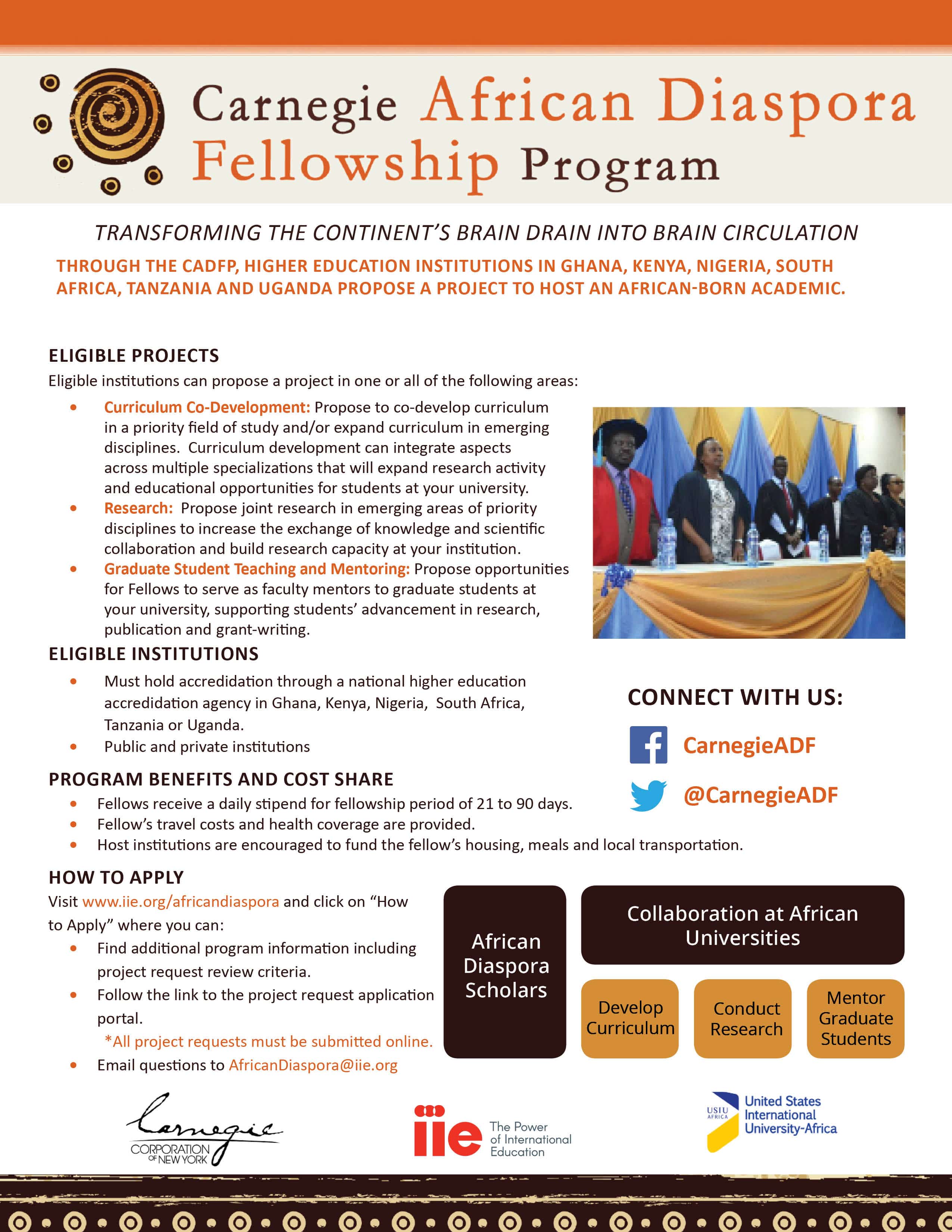
Carnegie African Diaspora Fellowship Programme (CADFP) for African-Born Researchers in US and Canada 2019/2020

Application Deadline: 9th December, 2018

Offered annually? Twice in the year

Eligible Countries: African-born academics currently living in the United States and Canada and working in higher education.

To be taken at (country): Fellows will engage in educational projects proposed and hosted by faculty of public or private higher education institutions in the following CCNY partner countries: Ghana, Kenya, Nigeria, South Africa, Tanzania and Uganda

About the Award: The Carnegie African Diaspora Fellowship Programme (CADFP) is a scholar fellowship programme for educational projects at African higher education institutions for African researchers in diaspora. Offered by IIE in partnership with the United States International University-Africa (USIU-Africa), the programme is funded by a grant from Carnegie Corporation of New York (CCNY). In the first two years of the programme, the CADFP supported 110 short-term faculty fellowships for African-born academics. In October 2015, additional funding was secured from CCNY to support up to 140 fellowships. The programme exemplifies CCNY’s enduring commitment to higher education in Africa. IIE manages and administers the programme, including applications, project requests and fellowships.

Eligible Project Activities: 
  • curriculum co-development
  • research collaboration
  • graduate student mentoring and training
Type: Research, Fellowship

Eligibility: To be eligible for the Carnegie African Diaspora Fellowship Programme:
  • One CADFP-funded project visit by a Diaspora Fellow of 14 to 90 days is proposed during program period. Project visit date parameters follow
  • Diaspora Scholar was born in Africa, lives in and works at accredited higher education institution in United States or Canada and holds terminal degree. Diaspora Scholar application includes letter of reference from administrator at level of dean or higher from home institution, scholar curriculum vitae and biodata page from scholar passport.
  • Project request is from an accredited public or private higher education institution in Ghana, Kenya, Nigeria, South Africa, Uganda or Tanzania.
  • Project request includes a letter of support from dean or higher from prospective host institution.
  • Project request indicates either a specific Diaspora scholar or the areas of expertise sought in a Diaspora scholar collaborator. Scholar application and host institution project request are submitted and complete by applicable deadline.
Selection Criteria of Project: 
  • Specific activities are proposed to collaborate on research, curriculum co-development and/or graduate student teaching, training and mentoring.
  • Strong project concept and rationale are provided; project demonstrates innovation.
  • Project Request clearly indicates what has been done by the institution on the proposed topic(s), the resources of the host institution, the problem to address, the goals of what to change or improve, the gaps and the anticipated specific role of the Diaspora Fellow in the proposed activities.
  • Clear mission of what the host institution wants to accomplish through project visit is articulated, and justification is provided on reasons to partner in the effort with a Diaspora scholar.
  • The proposed scholar’s discipline, subfields, areas of expertise, experience and motivation for applying are well-suited to the success and impact of the project.
  • Evidence of relevant experience by the proposed scholar in each requested project activity is demonstrated.
  • The proposed project must have the potential for impact
  • If potential impact of longer term project will take more time to be realized or evaluated, explanation is provided on how initial impact of project visit will be measured or how it is expected to contribute to larger goals.
Value of Fellowship: For the fellowship, the African Diaspora Fellow will receive
  • a $200/day stipend
  • visa costs
  • limited health insurance coverage
  • round-trip international air travel and ground transportation costs to and from home and the U.S. or Canadian airport.
Duration of Fellowship: Fourteen to Ninety days

How to Apply: Go here to apply

See the Review Criteria and the How to Apply for African Institutions links for further information.

Visit Fellowship Webpage for details

Award Provider: The Carnegie African Diaspora Fellowship Programme (CADFP)

Global Giving Accelerator 2018 for Young Entrepreneurs

Application Deadline: 15th October 2018

Eligible Countries: All

About the Award: The GlobalGiving Accelerator is a virtual training program and crowdfunding campaign that will help you take your fundraising to the next level. Following an optional two-week training curriculum, you’ll be entered into an Accelerator campaign where you’ll raise at least $5,000 total from a minimum of 40 different donors in order to graduate and secure a permanent fundraising spot on the GlobalGiving platform.
The GlobalGiving Accelerator is an opportunity for you and your organization to build skills, access tools, and grow your base of supporters to achieve crowdfunding success. When you graduate, your organization becomes a permanent member of GlobalGiving, and you’ll have access to all the tools, training, and one-on-one support available in the GlobalGiving community.

Type: Entrepreneurship

Eligibility: Any registered nonprofit (anywhere in the world!) is eligible to apply.

Number of Awards: Not specified

Value of Award:
  • GlobalGiving will provide $20,000 in matching funding and bonus prizes for participating organizations.
  • You will be supported as you reach out to your own networks, and tell your story in new and compelling ways. Donors can give in USD or GBP, helping you reach your supporters in the US, the UK, and beyond. You will also be provided with matching incentives for your donors, and bonus prizes for the most successful participants.
  • Many other benefits
How to Apply: The first step is to complete the online application. Our next deadline to submit applications is October 15, 2018 but we accept applications at any time!

Visit Program Webpage for Details

Award Providers: Global Giving

World Veterinary Association (WVA) Veterinary Student Scholarship Program for Students from Developing Countries 2019

Application Deadline: 1st January 2019, 12:00 pm (Brussels time)

Eligible Countries: Countries in Latin America, Africa, North Africa/Middle East and Asia/Oceania.

To Be Taken At (Country): Belgium

About the Award: Following the successful delivery of the MSD Animal Health/WVA Veterinary Student Scholarship Program 2016, and 2017, MSD Animal Health and WVA agreed to continue the successful collaboration and to launch the 2018 Veterinary Student Scholarship Program to include 41 scholarships of US$ 5,000 (of a total of $205,000) to be granted to selected students from countries in the regions of Latin America (16 grants), Africa (10 grants), North Africa/Middle East (10 grants) and Asia/Oceania (5 grants).

Field of Study: Veterinary Medicine

Type: Masters

Eligibility: 
  • Citizen of one of the countries under the grant coverage.
  • Second or Third year veterinary students (accomplishment of first year exams).
  • Currently enrolled and in good standing at a recognized school of veterinary medicine in their country.
The applications will be reviewed by the WVA Review Committee. The announcement of the selected students will occur during the World Veterinary Association Congress in San Jose, Costa Rica over 27-30 April 2019.

Number of Awards: 41
  • Latin America (16 grants),
  • Africa (10 grants),
  • North Africa/Middle East (10 grants) and
  • Asia/Oceania (5 grants).
Value of Award:  US$ 5000 each

How to Apply:Completed application must be submitted by 1st January 2019, 12:00 pm (Brussels time)towva_assistant@worldvet.org
The application form can be downloaded by clicking on the following links: EnglishFrench and Spanish.

Visit Programme Webpage for Details

Award Providers: World Veterinary Association (WVA)

Is China-led Belt and Road Initiative Afraid of Competition?

Gerry Brown

Hardly a day goes by without some lies about Belt and Road Initiative (BRI) being concocted and disseminated by the empire’s propaganda arm, also known as corporate media. In the first 2 or 3 years after BRI was launched, western press and politicians fabricated the narrative that Beijing sought to export its excess production capacity and establish/widen its spheres of influence with the BRI. Since last year, accusations of China springing debt traps and neo-colonizing unsuspecting Third World nations have become the mantra of western corporate media. Lately, they are spinning tales of BRI unravelling and coming unglued.
As the lies and propaganda are exposed for what they are and gaining little traction, the empire and its vassals from Japan and India to EU are ganging up to counter BRI with their own versions of New Silk Road.
The Asia-Africa Growth Corridor or AAGC proposed by Japan and India was unveiled with great fanfare by BRI-sceptic Modi last year. To date, there has not been any tangible sign of AAGC getting off the ground. It looks like AAGC is merely a publicity stunt to stroke the ego of India’s Modi and Japan’s Abe.
Last week, the US announced talks on a tie up between its Overseas Private Investment Corporation or OPIC and India’s counterpart. This came after the US Congress passed a bill to revamp and expand the funding cap of OPIC to $60 billion. The US had earlier entered into agreements with Japan and Australia on a partnership to take on China-led BRI. Japan International Cooperation Agency or JICA has a war chest of $110 billion and an annual budget of $12 billion. Australia has no equivalent development finance agency; AusAid administers some of the overseas assistance under $1 billion a year. India operates bilateral aid focused on South Asia through the Development Partnership Cooperation with a yearly budget below $2 billion. In fact, India receives much more foreign aid and international project financing than it gives to its South Asian neighbours. All told, the four countries or QUAD have way shallower pockets (under $200 billion, with JICA’s interest in infrastructures being peripheral) than China’s commitment of at least $1 trillion to BRI.
After years of griping about BRI not being a level playing field for EU businesses, Brussels recently rolled out “Connectivity Strategy” linking Europe and Asia. The document is long on motherhood statements such as sustainability, environmental friendliness and labour rights – straight out of the empire’s lexicon – but woefully short on funding details. EU’s complaint about Chinese-funded projects not being open to public bidding is disingenuous and fatuous . Which country would lend tens of billions of dollars at concessionary rates and bear the risk of default, and then put the projects funded by it up for public tender? (The terms of such contracts are actually quite unfavorable compared with privatized build-operate-transfer concessions.) No one has stopped or prevented EU from doing the same!
All the concerns about sustainability and environmental friendliness are unfounded. First of all, Beijing is sincere and serious about building a Green Silk Road. For the record, China is the global leader in Green Finance. To date, the Chinese market has issued more than $30 billion in Green Bonds, the most in the world. Second, the use of gas in lieu of coal for power generation can’t be done in all cases, especially when there’s no gas supply at reasonable prices and there is an acute shortage of power. That’s the case in Mindanao Island in the Philippines and in Pakistan. To insist on gas-powered plants in such circumstances is like asking a person trapped in a famine to have a balanced diet and not to eat high-carbs food that’s available, but go hungry (and die!) until meat and vegetables arrive. Third, to put its money where its mouth is, China is building and funding the world’s largest solar farm in a desert in Pakistan that can generate 1,000 Megawatts of power enough for 320,000 households. The project forms part of the China-Pakistan Economic Corridor or CPEC for short.
The zero-sum mentality of the empire and its vassals is in full display. Instead of joining the Asian Infrastructure Investment Bank or AIIB and participating in BRI to help develop trade and the economy in Eurasia – the US, Japan and India have opted to stay out, and now start their own schemes to counteract BRI.
China isn’t concerned or afraid of the competition. On the contrary, China welcomes it if that doesn’t morph into or turn out to be disruption or outright sabotage. The fact of the matter is Asia’s need for infrastructures and their financing are HUGE! The Japan-controlled Asian Development Bank or ADB published a report in February last year on the subject.
According to the ADB report, Developing Asia (developing countries in Asia ) excluding China has infrastructure needs of $13 trillion in the 15 years to 2030, or $870 BILLION PER YEAR. The infrastructure financing shortfall excluding China is more than half a trillion dollars EACH YEAR! In other words, AIIB’s $100 billion dollars in capital is no more than a drop in a big bucket. Even with China’s multi-year commitment of $1 trillion, the gaping hole is far from filled. Multilateral Development Assistance accounts for a paltry 2.5% of total infrastructure needs! The ADB counts on fiscal reforms in Developing Asia and private investors to bridge the yawning gulf . That’s akin to a new government or administration banking on the elusive or self-deceiving “savings through increased efficiency and waste elimination” to balance the budget!
In summary, the infrastructure needs in Asia are so massive that even the Chinese commitment of $1 trillion to BRI can scarcely meet. The zero-sum mentality of the Imperium to counter the BRI is therefore plain stupid and diabolical.

Chemical Deceit

Evaggelos Vallianatos

A friend recently put me in touch with Janet Brown (not her real name). This is a woman from Chicago who had the misfortune of renting an apartment that had been sprayed with the neurotoxic pesticide chlorpyrifos. Dow/DuPont produces this deleterious substance.
In late August 2018, Janet Brown visited me and we spent several hours talking. Her real education started in the poisoned apartment in Chicago.
She had read my book, Poison Spring. She wanted to talk.
A poisoned apartment
Our discussion was mostly about pesticides and the Environmental Protection Agency, which “regulates” toxic pesticides like chlorpyrifos. I told Janet Brown a few of my EPA stories. And she told me her astonishing story.
Janet Brown grew up in Illinois. She got married to a doctor. She had hopes of becoming a doctor herself. However, the poisoned apartment blew up in her face, causing a tsunami of psychological and health adversities and pain.
The tragedy took place in the 1990s. Janet Brown gave birth to two children. The apartment landlord informed her he was spraying the apartment. He did that for a decade.
The effects of chlorpyrifos poisoning were devastating to her and her children. She had trouble staying awake. She was confused, ill, and endured chronic and savage headaches. The children screamed for days and months. They could barely crawl, walk and talk. Experts said autism explained their hyperactivity, inability to pay attention,  low self-esteem, and aggressive behavior.
This tyranny of disease, the perpetual anguish of the mother, and the ceaseless pain of the children: their constant humiliations in school, the incomprehensible anger and hidden violence boiling over at home and everywhere else, teenagers unable to sign their name or find their shoes – all but annihilated their future.
In 2000, Janet Brown started suspecting the chemical sprayings of her apartment was probably responsible for the maladies of her children.
She saw a headline in a newspaper linking indoor use of chlorpyrifos and children’s health. The article said that a crevice treatment with chlorpyrifos put so much poison in the air that exposed children inhaled hundreds of times more chlorpyrifos than the amount EPA considered “safe.”
She called the Poison Control Center, only to be told there was nothing to worry about. Chlorpyrifos was “safe.”
At that moment, Janet Brown panicked. She rushed her children to the emergency room of a hospital. She was lucky. The doctor on duty had just taken training in chemical warfare. He told her to stop immediately the spaying of chlorpyrifos in her home. Chlorpyrifos, he told her, was a chemical warfare agent.
The light of truth
This sudden confrontation with the truth, rather than the façade of pesticide safety, started Janet Brown to healing herself. She decided she was going to get a formal education in public health and devote her life to teaching and informing people of the dangers of pesticides.
She stopped the chlorpyrifos spraying of her home. But chlorpyrifos remained, its deadly molecules locked into the teeth of her children.
I listened carefully to this extraordinary story. Unfortunately, there are probably millions of people with similar tales of deceit and personal pain. They trust advertisements and the government, only to discover an abyss of a difference between the promise and the real thing.
We concluded America’s “environmental protection” had poisonspringdegenerated to immoral policies satisfying the rich and powerful. I explained to her that the heavy layers of scientists, administrators, Congressional and White House officials form an almost impenetrable cover for the lobbyists and owners of toxins like chlorpyrifos. The more dangerous the chemical, the more formidable the phalanx of lobbyists.
Why were countless Americans, including this mother, being deceived and poisoned? Why did the EPA register this nerve gas, especially, for indoor use?
In 2011, scientists at Columbia University published a study of hundreds of infants that had been exposed to chlorpyrifos before birth. The study concluded that the higher the exposure of the pregnant mothers to chlorpyrifos, the larger the decrease in “cognitive functioning” of the baby. In other words, this chemical, like all organophosphates, affects the brain and intelligence of human beings.
No doubt, EPA and DowDuPont knew of this Columbia study and more important than that: they were certain chlorpyrifos was an organophosphate chemical, which, by definition, is a dangerous nerve poison. They are equally responsible for harming victims like Janet Brown and her two children. So, why did American scientists fail to raise their voice against this chemical weapon?
The companies spraying such deleterious stuff should be put out of business.
Self-reliance and the common good
However, with president Trump, don’t expect any relief from the top. On the contrary, things will get worse. That’s the nature of oligarchies. The business oligarchs (of America and the world) are under the delusion that money will even buy them health, even in an unhealthy environment and polluted world.
Any relief we experience will, ultimately, be relief from us.
Stop buying conventional food contaminated by pesticides. Support organic farmers. They don’t use toxic synthetic petrochemicals and nerve poisons. Be alert and decode the secret danger hiding in the  advertisements for chemicals.
We need to educate ourselves about farming and what farmers spray the crops we eat. In fact, ask: do we need sprays in the raising of our food? Industrialized farming depends on chlorpyrifos-like substances and massive machinery. It’s no longer family farming. Is that good for America?
In the 1860s, President Lincoln founded the US Department of Agriculture as the people’s department. Now USDA is the department of agribusiness. Is that good for America?
Chlorpyrifos is on its way to extinction because a panel of federal judges agreed with scientific evidence the chemical is causing “neurodevelopmental damage” to children. In August 9, 2018, they ordered EPA to ban Chlorpyrifos. Yet the Trump Justice Department wants to reinstate the nerve poison. It demanded the US 9th Circuit Court of Appeals of 22 judges reconsider the banning of chlorpyrifos.
Chlorpyrifos, the tragedy of Janet Brown, and the insistence of the Trump administration to keep the neurotoxin in its deadly path of poisoning children ought to become lessons of why we must be better informed about almost everything, especially things affecting our health. Americans, especially young women, should be outraged by this act of callousness by the Trump administration.
Read the label carefully. Ask questions. Be active in the politics of your hometown and state, including the politics of the country. That’s good for your health — and democracy.
Under no circumstances should we negotiate the integrity of our health and the health of the natural world.

Drought In Thar, Pakistan And The Lives of Hindu Minorities

Chander Kolhi

Tharparkar is a district of Sindh province in Pakistan where Hindus live in majority. Most of them are Bheels, Meghwar, Kolhi, Jogis and other marginalized communities within Hindus. The life status of these communities is extremely bad   because of lack of good governance in this desert. Tharparkar is a deserted area which is why the life of most of the residents of Tharparkar merely depends on the rainfall during a year which is often expected to fall from June to mid-August. Sindh; a province of Pakistan is mainly divided into Northern and Southern Sindh in which Tharparkar is situated in Southern Sindh with some issues based on human rights violation i.e., land grabbing, abduction  suicide of young generation due to lack of employment etc. Tharparkar is divided into seven Talukas i.e., Nagarparkar, Diplo, Chhachhro, Mithi, Dahli, Islamkot and Kaloi consisting a total population of about two million.Pakistan’s first largest minority in terms of population dwell there with a total of more than 60% of the total population of Tharparkar. The accurate figures of Tharparkar as per its census are not shared by the Bureau of Statistics therefore quoting here the figures of 1998 census;the total population of this district as per 1998 census is 914,291 with 45% ratio of females. Out of this total population as per Bureau of Statistics 95.64% dwell in rural areas with the overall literacy ratio of 18.3% only.
The life for human beings in rural Tharparkar is a misery in which any facility is not completely available in this region whether it is health, education, water, mobile phone signals, proper public transportation or the roads to transport. An area  of about 2600 villages in Tharparkar from a total areas of 22,000 square kilometers among which more than 70% villages has no facilities which are basic for life.
Majority of the people of Tharparkar from rural areas and marginalized groups have to migrate each year due to low rains and less agriculture production to barrage areas where agriculture is available to earn a meal for them and food for their livestock. It is very difficult for people to live without rains in Tharparkar as the economic conditions of the people of Tharparkar from rural areas are not admirable and most of them are unemployed due to less employment opportunities and zero concentration by the government. This year the drought has been declared by Sindh government in Tharparkar which is a huge problem for them. People have started migration to barrage areas with their livestock for a shorter period of two to three months to cover their needs of food for themselves and their livestock.
While interviewing some residents of Tharparkar it was informed by them that majority of the migrants to barrage areas from Thar desert are accompanied by their children and families; lock their houses and move to Badin, Hyderabad and Nawabshah, Mirpurkhas and Sanghar districts of Sindh province where water and agriculture is available. A few of the migrants from this desert move to barrage areas to earn bread and after a very short period of a month they leave their families back and then move back to the same areas or other with their livestock to make life easier for their family; they do so for the security of their families.
As per statistics of residents by NGOs a total of 1.3 million people live in Tharparkar district in the areas which are close to Indian border where the life is too difficult with rains as well; there has always been an issue of less transportation, zero medical health facilities and of course limited educational opportunities for children.
Those who migrate to barrage areas leaving Tharparkar to fulfill their needs of  starvation and save money for the year also have to suffer in barrage areas as the education of their children is neglected and these children start to contribute their parents in the cultivation of crops and collecting grass for their livestock so they leave their interest of education forever and turns back. Schools in these areas have the policy to educate a child on behalf of a certificate which they often don’t have and are deprived of their classes.Cases of rape with young Hindu girls and their abduction are also reported several times by their land lords or their companions; many of these cases go unreported as they feel fear of loosing their honor; second girl or police does not file a complaint and some of the cases which are reported are later on closed by parents due to life threats. The government of Pakistan and other law enforcing agencies must think on it for a permanent solution to secure the rights of minorities. The World is working on Sustainable Development Goals which should also be our priority to make Pakistan a safe place for religious minorities living there since Pakistan was founded.

Covert Wars in the UN Halls

Elias Akleh

Last week the UN halls have been the battlefields of aggressive covert wars in the form of speeches by world leaders. Each speech has maneuvers of attacks, defense, threats and bullying, lies and justifications, and rallying support of the international community. My interest is in the speeches concerning the Middle East; a very dangerous and volatile area, whose unfolding battles are affecting the whole world. The warriors of these battles were American Donald Trump, Zionist Israeli Benjamin Netanyahu, Palestinian Mahmoud Abbas, Iranian Hassan Rouhani, and Syrian Walid Al-Moualem.
In a monotonous voice, that drags one to sleep, Trump started his speech bragging about himself and the accomplishment of his administration “that has accomplished more than almost any administrations in the history of our country”; adding $10 trillion to American wealth, high stock-market, low jobless claims in 50 years, added half a million jobs, tax cuts, record military funding of $700 billion this year and $716 billion next year, and starting the construction of border wall with Mexico that made US “stronger, safer and richer.”
One cannot but explode in laughing about these narcissistic false claims as the whole audience had done. The American people have not seen those $10 trillion, that were paid to military corporations, stock-market prices have been artificially raised, unemployment is record high with the majority of people living from one pay check to the next, homelessness has become epidemic, tax cuts went only to the wealthy, educational budgets were severely cut, medical coverage are not affordable by the millions, crime rates and police violence are on the rise, record military funding for perpetual wars and border walls are shame to brag about.
Trump stated that “We”; his administration, stand up for the American people and for the world and “… that is why America will always choose independence and cooperation over global governance, control and domination.” Politicians excel in camouflaging their dubious behaviors into the exact opposite, and Trump is the master in this. History has proven that the choice of these Zionist Judaic controlled American administrations has always been perpetual wars, terrorism, intimidation, bullying, blackmail, control and dominance without any respect for the rights and well-being of other nations and not even for their own citizens.
Recent administrations have felt emboldened even to confess that they create, finance and arm terrorist groups to wage American as well as Israeli proxy wars around the globe. Strong historical evidence prove that the US had toppled many democratically elected governments; e.g. 1953 Iranian democratically elected Mosaddeq’s regime, created al-Qaeda in Afghanistan,  ISIS and al-Nusra in Syria, and waged proxy war against Yemen among many other documented examples around the globe. The American administrations have used, and are still using, financial resources and armies of other states such as Saudi Arabia, UAE, Qatar, Jordan, Egypt to wage its proxy wars against other states in the region.
As NATO members are beginning to free themselves from the American warmongering whims Trump has assigned CIA director; Mike Pompeo to work “with the Gulf Cooperation Council, Jordan, and Egypt to establish a regional strategic alliance so that Middle Eastern nations can advance prosperity, stability, and security across their home region.” This is actually an Arab NATO-like alliance similar to the 1990 anti-Iraq Gulf War Coalition, whose main function is to wage American/Israeli proxy wars in the region specifically against Iran.
Iran has become a painful thorn in the Israeli and American rears after spoiling their plan to destroy and fragment Syria as they had done to Iraq and Libya. Thus, Iran has to be demonized in order to weaken and contain it if not toppling its regime and destroying it. So, Trump called for “Every solution to the humanitarian crisis in Syria must also include a strategy to address the brutal regime that has fueled and financed it: the corrupt dictatorship in Iran.”
Trump demonized Iran’s leaders stating “Iran’s leaders sow chaos, death, and destruction, they do not respect their neighbors or borders or the sovereign rights of nation” Actually, Iran’s leaders sow respect, cooperation, security and humanity that gained them popularity and respect in the region. They fought American/Israel/Saudi terrorists, sheltered and secured refugees, and donated aid to disaster areas.
Trump continued “Iran’s leaders plunder the nation’s resources to enrich themselves and to spread mayhem across the Middle East and far beyond” and “have embezzled billions of dollars from Iran’s treasury, seized valuable portions of the economy, and looted the people’s religious endowments, all to line their own pockets and send their proxies to wage war.” He is, here, actually describing his own administration, Wall Street, Federal Reserve and banking system, and American mega corporations, who are perpetrating these crimes.
Trump warned that “We cannot allow the world’s leading sponsor of terrorism to possess the planet’s most dangerous weapons. We cannot allow a regime that chants “Death to America,” and that threatens Israel with annihilation, to possess the means to deliver a nuclear warhead to any city on Earth.” It is the USA that possess the most dangerous weapons, bully other nations, call for regime change and destruction of countries and is advancing its nuclear warheads to make them “so strong & so powerful.”
As soon as Israeli Netanyahu started his speech he immediately accused Iran of having secret nuclear program, again using his silly drawings, “Disclosing for the first time that Iran has another nuclear facility, a secret warehouse for material for secret Iran’s nuclear program” where Iran is storing at least 15 gigantic ship containers full of 300 tons of nuclear equipment and materials hidden in nuclear compounds in “Turqusabad”. Iranians could not but explode in laughter when Netanyahu mentioned Turqusabad, because in their folklore stories Turqusabad is a non-existent fictional place. Yet this did not stop Netanyahu from urging IAEA to inspect this imaginary location.
Netanyahu accused Iran “Last year Iran attacked Kurds in Iraq, slaughtered Sunnis in Syria, armed Hezbollah in Lebanon, financed Hamas in Gaza, fired missiles into Saudi Arabia, and threatened freedom of navigation in the straights of Hurmuz and straights of Bab el-Mandab.”    Using scare tactics, he warned UN members that “Iranian aggression will not be confined to the Middle East”citing alleged arrested Iranian agents plotting terror attacks in the US and in the heart of Europe.
Justifying Israel’s 210 air raids against Syria Netanyahu accused Iran of building military bases in Syria, launching missiles and drones in Israeli territory, arming Gaza Palestinians to rain rockets onto Israeli cities, directing Lebanese Hezbollah to build secret sites to manufacture precision guided missiles to target Israel, and use Lebanese as human shields when placing these missile sites along Beirut’s international airport. His proof is a kiddy drawing he claimed to be “worth a thousand missiles”
Netanyahu implicitly insulted UN members’ intelligence when he stated “while US is confronting Iran with new sanctions Europe and others are appeasing Iran by trying to help it bypass these sanctions… While Iran was caught red handed plotting against Europe, European leaders are rolling the red carpet for Iranian leader; president Rouhani, promising to give Iran even more money … have these European leaders learned nothing from history, will they wake up?”
Netanyahu urged UN countries to stop cuddling Iran’s dictators and to join Trump’s sanctions against Iran because companies would abandon Iran and do business with US, whose GDP is 50 times the size of Iran’s GDP, Iran’s economy is destined to collapse, it’s currency is plummeting, inflation and unemployment are souring and most important when next patch of economic sanctions are imposed in November Iranian people will rally against the regime rather than around it, and will chant “death to the dictator rather than death to America”, and instead of chanting to export the Islamic revolution they will demand to leave Syria and Lebanon and Gaza and to take care of us.
One cannot help but be amazed by Netanyahu’s wide unrealistic imaginations and lying creativity. Maybe he thinks people are so stupid that he can outsmart them. Really, will the world learn lessons from Netanyahu’s perpetual lying episodes?
Due to the myths of America’s manifest destiny, and god’s chosen people, both Trump’s administration and Israel seem to feel privileged and entitled to dictate their will, to violate international laws and conventions and to undermine international organization using bullying, intimidation and economic and financial sanctions. Trump’s administration has withdrawn from climate accord, from NAFTA, from Transpacific Partnership, from JCPOA in violation of UNSC resolution 2231, undermined World Trade Organization to impose unreasonable tariffs and sanctions on other countries, undermined and withdrew from UN Human Rights Council after Nikki Haley threatened to take names of its members, undermined International Criminal Court (ICC), pulled out of UNESCO, cut down US contribution to UN peacekeeping budget, and stopped funds to UNRWA.
Israel has never implemented any related UN resolution since its illegal establishment. Since 1947 there have been 705 UN resolutions and 86 Security Council resolutions related to the Arab/Israeli conflict. Emboldened and supported by American policies and VETO power Israel has never implemented any of these resolutions. Israel has also violated all agreements and accords it signed with the Palestinians.
While praising warmongering butchers king Salman and crown prince; Muhammad bin Salman (MBS), for their alleged bold new reforms, discarding their on-going genocide in Yemen, and celebrating Israel’s 70th anniversary and genocide of Palestinians as a thriving democracy in the Holy Land, Trump did not mention Palestine, but claimed that he took significant steps forward in the Middle East by acknowledging obvious facts and moving US embassy to Jerusalem. Palestinians for Trump are nobody to be concerned about.
Netanyahu expressed Israel’s appreciation to Trump and Haley “for their unwavering support they provided Israel at the UN “, and for pulling out of “history-denied UNESCO in the morally bankrupt UN Human Rights Council, who have more resolutions about Israel than the whole world combined and tenfold compared to Iran or Syria.” In itself, this is a confession that this international human rights organization has recognized that Israeli terror is the utmost danger.
Emboldened by the unwavering but unethical American support Netanyahu diverted blame from Israel by accusing “… unreformed UNRWA; an organization instead of solving the Palestinian problem perpetuate it.” UNRWA is a humanitarian organization, whose job is to aid Palestinian refugees and not solving Palestinian political problem.
Answering accusation of Israel as a racist apartheid state by Palestinian Mahmoud Abbas because Israel adopted the racist law of “Israel as the nation state of the Jewish people”, Netanyahu reminded Abbas that he wrote a dissertation denying the holocaust, and accused him of paying Palestinians to attack Israelis and to impose death sentence on Palestinians, who sell land to Israelis. He shamelessly and flagrantly defended adopting the racist Jewish nation law by criticizing what he called the “specialty of the UN; slandering Israel” and accused the UN of the old exhausted cliché of anti-semitism, whose “foul stench still clinches to these halls.” He also described UN accusing Israel of racism, apartheid and of ethnic cleansing as “this is the same old anti-semitism with a brand-new face.”
Ignoring the fact that Israel is brutally usurping Palestinian land, destroying their towns and homes, murdering their women and children, locking their teen agers in prisons for years, desecrating their Muslim and Christian holy places, and having armed Jewish religious fanatics routinely attack Palestinian neighborhoods (midnight Sunday 9/30 was the latest), and not  mentioning racist Jewish Israelis attacking black African Ethiopian Jews for their color, Netanyahu still insists that Israel is “both Jewish and democratic with guaranteed equal rights to all.”
Resorting to his distorted religious beliefs (the opium of the people), and ignoring the existence of the indigenous owners of Palestine, he told the mythical story of Abraham, Sara and other Judaic figures, who immigrated to Palestine and signed an eternal covenant with god; a contract with a racist real estate broker, who choses one small group of people over the billions of other people and promises them a piece of land. He concluded his speech with the historical distortion and his disillusioned poetic assertion that Palestine is the land “from which we were exiled and to which we return, rebuilding our ancient and eternal capital Jerusalem. The nation state of Israel is the only place where Jewish people proudly can exercise our collective right of self-determination” – on the expense of indigenous Palestinians.
Mahmoud Abbas’ speech came as a whimpering sick dog begging for help rather than demanding justice. In between sick coughing and throat clearing he complained about Israeli violation of all agreements and accords, and of not implementing even one of the many UN resolutions. He criticized Israel’s nation law describing it an apartheid law. He complained about Israeli oppressive measures against Palestinians and desecration of Palestinian holy places. He complained about Israel’s intention of demolishing the village of Khan El-Ahmar to divide the Palestinian territories into two halves.
He rejected Trump’s unjust actions of recognizing Jerusalem as Israel’s capital and moving the American embassy there. He also complained that Trump had cut funds to the PA, to Palestinian hospitals in Jerusalem, of cutting funds to the UNRWA, and of closing the Palestinian office in Washington. He expressed his disappointment of Trump’s administration and asked Trump to retract all these measures.
Abbas considered the US to have become a biased to Israel rather than an honest broker to peace process, and asked other nations including the Quartet to become brokers for peace instead. He objected to the fact that although the PLO is considered and is recognized by the UN as the only representative of the Palestinian people the American Congress still considers it a terrorist organization.
He reiterated PA’s commitment to peace, readiness as always to sit at the negotiating table with Israel, renouncing violence and armed resistance but following what he called peaceful popular resistance vis a vie the armed settlers’ aggression. Then he asked what else do you want us to do after we had already given up almost everything.
He confessed that the PA is not able to protect itself nor its Palestinian people and blamed the UN for not protecting Palestinians after they promised to do so. He also requested UN members, who did not recognize Palestinian state to join those who did and recognize the Palestinian state.
Although the UN is not the correct place to do this, Abbas claimed that he is exerting every effort for reconciliation with Hamas in Gaza to re-unite Palestinians, yet he threatened Hamas that he will not take any responsibility if they refused his conditions. Hamas was the democratically elected government in 2007 as certified by international observers.
Abbas, whose term has expired since 2007, has been a huge disappointment to Palestinians. Instead of protecting his people, he, and his so-called security forces, has functioned as Israeli proxy police force protecting Israelis and oppressing his people. He instructed his security forces to arrest hundreds of Palestinian activists the night before his speech.
Syrian Deputy Walid Al-Moualem and Iranian President Hassan Rouhani defended Palestine better than pathetic Abbas. Rouhani considered the Palestinian question as “the most pressing crisis in the Middle East”, and that the passage of time must not and cannot justify Israeli occupation. He accused the US to be a complete partner to Israeli crimes when he stated that “the innumerable crimes of Israel against the Palestinians would not have been possible without the material and military assistance and political propaganda support of the US.”
He considered the US decision to transfer its embassy in Israel to Jerusalem and the Israeli enactment of the racist Jewish state law as flagrant violations of international law and clear manifestation of apartheid. “Israel equipped with nuclear arsenal and blatantly threaten others with nuclear annihilation presents the most daunting threat to regional and global peace and stability”he emphasized.
Al-Moualem summed up his defense as such: “The international community must also help the Palestinian people to establish their own independent state with Jerusalem as its capital, and facilitate the return of Palestinian refugees to their land pursuing to international resolutions according to international legitimacy. Any action that undermine these rights are null and void and threaten regional peace and security especially the Israeli racist law known as the nation state law, and the decision of the US administration to move the US embassy to Jerusalem and stop funding UNRWA.”
Both Rouhani and Al-Moualem criticized US administration for its withdrawal from the JPCOA in violation of UNSC 2231and imposing sanctions although IAEA had issued 12 reports indicating that Iran is compliant with the agreement. They considered these sanctions as economic war and warned that US bullying other nations to violate and undermining international laws and conventions will endanger world peace and security.
“The US understanding of international relations is authoritarian. In its estimation might is right. Its understanding of power not of legal legitimate authority is reflected in bullying and in imposition. No nation can be brought to negotiating table by force” accused Rouhani.
Rouhani accused Trump of withdrawing from the JPCOA because it is the legacy of his previous domestic rivals; Obama’s administration, and warned that Trump is threatening international security as a way of escaping from domestic policy problems and scandals in his administration. He asked Trump just to fulfill America’s international obligations explaining that Iran’s proposal is clear: “commitment for commitment, violation for violation, threat for threat, and step for step”
Rouhani explained that Iran is against nuclear weapons yet for nuclear knowledge. Similar to the US and other countries Iran has the right to develop defensive weapons, such as ballistic missiles that have been used only twice against terrorist groups; ISIS, who attacked the Iranian Parliament and a number of cities in the Iranian Kurdish region.
Rouhani accused US of supporting terrorist groups despite its claims of fighting them. Referring to the terrorist attack on Iranian military parade in Ahwaz Saturday 9/22 he questioned “why can the leaders of these terrorist operations, including the organization that had publicly claimed responsibility for the Saturday crime, live and operate freely in western countries and even openly solicit funds?”
In the Syrian crisis Rouhani explained that Iran had warned against any foreign intervention in the internal affairs of Syria, and that the crisis can only be resolved thorough intra-Syrian dialogue. He explained that the presence of Iranian military advisers in Syria has been at the request of the Syrian government, and consistent with the international law, and aimed at assisting the Syrian government in combating terrorists. Through the Astana Process Iran had helped preventing escalation in blood shed in Idlib region.
Syrian Deputy; Al-Moualem explained that the battle in Syria could be a lesson to other countries because it is the battle of ideologies, a struggle between two global camps; one promotes peace while the other promotes terrorism and hegemony. He accused the US of leading an illegitimate international coalition to destroy Syria under the pretext of combating terrorism, while they are providing military support to the terrorists.
He accused the US of releasing terrorists from Guantanamo prison and sending them to Syria where they became leaders of al-Nusra and other terrorist groups. He explained that US forces present in the Tanaf area in south Syria had created a safe haven for ISIS terrorists, who perpetrated suicide attacks against the governate of Suwayda.
Al-Moualem warned that “Any foreign presence on Syrian territories without the consent of Syrian government is illegal and constitutes a flagrant violation of international law and the UN charter. It is an assault on our sovereign nationality” considering US, French and Turkish forces operating on Syrian territories without explicit request from Syrian government as occupying forces and threatening to deal with them as such. He advised that these forces must immediately withdraw without any conditions.
He also explained that Israel, too, has been supporting and protecting terrorist groups attacking Syria. He further stated that Israel continues to occupy Syrian Golan and aggressively oppress Syrian citizens there. He demanded the international community to compel Israel to implement UN resolution 497 on the occupied Golan and expressing his government determination to liberate the Golan to the lines of June 4th 1967 the same way they liberated southern Syria from terrorists.
He defended Syria against accusation of chemical weapons use by reiterating that Syria rejects the use of chemical weapons and reminding that Syria had completely eliminated all its chemical weapons as confirmed by international organizations, and had always cooperated with Organization for the Prohibition of Chemical Weapons (OPCW) to investigate all alleged accusations. He condemned the tripartite aggression perpetrated by US, France and UK against Syria last April claiming that chemical weapons were used without any investigation or evidence, and in flagrant violation of Syrian sovereignty, the international law and the UN charter. He accused the White Helmet group, created by British intelligence, as a terrorist organization, who orchestrated and fabricated accusations of chemical weapons attacks.
Al-Moualem concluded his speech expressing solidarity with Palestinians against Israeli occupation and American late illegal measures, solidarity with Venezuela in the face of American interference in its internal affairs, and a call for lifting all unilateral economic sanctions imposed on all countries including Syria, Iran, DPRK, Cuba and Belarus.

New Zealand education riven by class inequality

John Braddock

An investigation published last month by the New Zealand Herald highlighted the extent to which working-class students are excluded from university. It laid bare the vast social gulf that has opened up following three decades of pro-market assaults in every aspect of life, including for young people.
Written by journalist Kirsty Johnston and headlined, “Want to be a doctor, lawyer or engineer? Don’t grow up poor,” the report found that only one in 100 entrants to top university courses come from the most deprived homes.
Johnston analysed university entrance data according to the economic status of the schools from which students had enrolled. Each school has a “decile” ranking, from the poorest at 1, through to the wealthiest at 10. Ratings are based on census data for households with school-aged children in a school’s catchment area, using measures such as income, parents on a benefit, occupation, education, and household crowding.
There has always been a correlation between school deciles and examination results. So-called “league tables,” published annually in the media, draw attention to the disparity between wealthier schools—both public and private—with their higher results, and poorer schools which invariably occupy the bottom rankings. Many schools in working-class areas become stigmatised as “failing.”
Decile rankings can influence local property values, particularly in the major city, Auckland. Houses in well-known decile 10 school zones, such as Auckland Grammar, are advertised as “in the grammar zone,” inflating their price. These elite public schools benefit from donations and other support from their relatively well-heeled parental base and business sponsorships.
In an attempt to obscure the deepening social class divide, the last National Party government, supported by the Ministry of Education (MoE), proposed abolishing the decile ranking system, claiming it was too “blunt” an instrument to be useful.
While limited, decile profiles have been useful for investigations highlighted by the Herald. Johnston’s research found that Canterbury University took just a single decile 1 student into engineering in five years, but over 500 decile 10 students, out of a total 2,000 course entrants.
Achievement gaps between rich and poor students exist throughout the school system, and widen at tertiary level. At Level 2 of the National Certificate of Educational Achievement, the penultimate year of secondary school, there is a seven percentage point disparity between the pass rates of low- and high-decile students.
By the time students take University Entrance in their final year, the gap grows to 44 points. Only 17 percent of low-decile students go to university, whereas 50 percent of high-decile students do.
Another gap occurs with second-year university courses that have limited numbers and high entry thresholds, such as law, medicine and dentistry which lead to professions with the highest salaries. Data from six universities showed that while 60 percent of almost 16,000 students accepted into law, medicine and engineering in the past five years came from the richest third of homes, just 6 percent came from the poorest third.
Focusing solely on decile 1 schools, the latter figure drops to just 1 percent. Victoria University of Wellington’s law school took just eight decile 1 students over the period while Otago University law took three. Auckland University medical school took 12 decile one students out of 1,160 total admissions to its second-year course.
Universities told the Herald they didn’t accept more students from poor backgrounds because these students failed to get the grades. Last year, just 20 percent of final year students at low-decile schools passed University Entrance, compared to 64 percent at high decile.
Schools countered that universities needed better outreach programmes and more scholarships to improve “equity.” Universities NZ chief executive Chris Whelan said the lack of equity funding was a major barrier. Universities were not encouraged to take more “marginal” students, and there was no recognition that poverty had more impact on achievement than ethnicity.
In fact, social class inequality is deeply systemic and cannot be addressed by quotas and competition for a handful of scholarships.
Auckland University professor Alan France told the Herald: “People think education is a level playing-field but this is showing that’s not the case. We talk about increasing Māori and Pacific participation at university, but actually the underlying issue is socio-economics. It’s money. It’s class. It’s privilege.” According to economist Brian Easton, NZ is now the fifth most economically stratified of the OECD’s 34 member countries.
Inequality in education is a product of the oppression of the working class under capitalism. Working-class children face a barrage of intractable issues over money, parental time, poor housing and health, and access to books and other learning or cultural experiences. By kindergarten age, children from the poorest backgrounds are already far behind on measures of early reading and math skills.
Many students entering decile 1 high schools show up as reading at 2–3 years below their chronological age. The Program for International Student Assessment (PISA) tests in reading, maths and science indicate that New Zealand has one of the biggest variations in student achievement, with the gap in average scores for students from poor and rich backgrounds the equivalent of more than three years of schooling.
Inequality has been exacerbated since the education “reforms” enacted by the Labour Party government of 1984–90, supported by the trade unions and enforced by successive administrations. A “market” model was imposed on schools and universities, with self-governing boards tasked with imposing “business” disciplines and competition for students. In the early 1990s, many schools in working-class areas were struggling to survive.
In 1989, student fees were introduced and have increased almost every year. Tertiary study, including at polytechnics, has now become too costly for many working-class students. In 2017, it was estimated that the combined student loan debt of 731,800 people, with an average debt of $NZ21,000, was $15.3 billion.
Significantly, the material produced by the Herald shatters the assiduously cultivated myth that “disparities” in education are not a matter of social class, but are due to other factors, such as ethnicity and gender.
All governments have promoted identity politics to divide the working class, while elevating a small upper middle class layer, particularly among indigenous Maori. A virtual academic industry, abetted and funded by the MoE, is devoted to sustaining the notion that Maori and Pacific students are worse off because of “institutional racism,” not class.
The insistence that ethnicity is the central cause of inequality has fuelled reactionary political agendas, including demands for racially segregated school systems and charter schools controlled by Maori tribal-based businesses. As in the US and Britain, these publicly-funded, privately-run schools were introduced by the National government to undermine public education and establish a bridge-head for widespread privatisation.
Social class divisions, however, are asserting themselves more powerfully than ever, as capitalism lurches more deeply into global crisis. Internationally, including in New Zealand, teachers and other sections of the working class are beginning to fight back. Primary school teachers held a 24-hour nationwide strike in mid-August, following an effective pay freeze for much of the past decade, and severely understaffed schools. Their primary demands were for a pay increase of 16 percent, smaller class sizes and more support for needy students.

Pakistani premier Imran Khan imposes austerity mini-budget

Athiyan Silva & Kumaran Ira

After coming into power by exploiting social anger and anti-war sentiment, the ruling Tehrik-e-Insaaf (PTI) of Pakistan’s Prime Minister Imran Khan is positioning itself to drop his limited electoral promises and attack the working class with deep budget cuts. Khan’s pro-austerity and pro-imperialist line have been exposed barely two months after his election. At the same time, he is aligning Pakistan with US imperialism while seeking to renegotiate financial deals with China.
On September 18, the PTI presented the 2018 Finance Supplementary (Amendment) Bill, dubbed the “mini-budget,” in the National Assembly. The mini-budget was closely coordinated with the International Monetary Fund (IMF) and was presented after Pakistani officials held a video conference with the IMF officials at the Finance Ministry.
Presenting the budget, Finance Minister Asad Umar claimed that Pakistan faces “difficult times” and called for “difficult” measures to slash budget deficits. Noting that the budget deficit had grown to 6.6 percent from 4.1 percent, Umar said: “The most dangerous situation is that if we continue as we have, the budget deficit will expand 7.2 percent by the end of the ongoing year. This is the assessment of the finance ministry as well as economic experts.”
Umar claimed these measures were the only way to halt the fall in the rupee’s value against the dollar and save Pakistan’s plunging economy, warning that the country’s foreign exchange reserves had fallen to the equivalent of two months’ worth of imports. While Pakistan’s foreign currency reserves have plunged to $9.3 billion, external debt stands at $92 billion.
Umar said that difficult decisions had to be made or inflationary pressures would build up to the point that they would become painful for the average consumer.
Prime Minister Imran Khan exploited social anger at the previous PML-N government to win the July election, making demagogic promises, including to create more jobs and provide relief for the poor, while criticizing the murderous US drone attacks in the Federally Administered Tribal Area.
Khan formed his government by picking ministers who have already worked under former military ruler General Pervez Musharraf, Pakistan Muslim League (Nawaz), and Pakistan People’s Party (PPP) governments, which imposed IMF austerity measures and collaborated with the US-led NATO war in Afghanistan. With his mini-budget, Khan is ditching his electoral promises and pursuing policies similar to those of its predecessors.
The mini budget consists of price and tax hikes on the most essential items such as food and gas. To cut the budget deficit, Khan is proposing a cut in the federal Public Sector Development Programme from Rs 1,030 billion to Rs 700 billion, along with new taxation measures.
The government will also increase customs and regulatory duties, including on mobile phone imports. Through severe cuts, it hopes to bring in some $1.5 billion. It has also formed a special cabinet committee to oversee privatizations of public sector firms.
Last week, Pakistani officials held talks with the IMF, as the PTI government prepares to seek a bailout. In exchange, the IMF will demand severe austerity measures.
The Diplomat wrote, “It is likely that the IMF, before offering any new loan program to Pakistan, will ask for a number of reforms that may not be in the interest of Pakistan’s middle and poor classes. It is expected that the tax base targeting the salaried class is expected to grow and more direct and indirect taxes are likely to be called into action. Meanwhile, subsidies in the field of agriculture and other areas are likely to see a significant reduction in the coming weeks and months.”
With its austerity measures and collaboration with the IMF, the Khan government is moving rapidly toward a confrontation with masses of working and oppressed people, in a country of 210 million people where the majority live on under US$2 a day.
More than 60 percent of Pakistanis struggle to find food, and women and children are the most affected by the poverty. Half the youth are unemployed, while 3.8 million children are exploited in slave labor conditions. About 25 million children have no access to education, with thousands of schools lacking basic facilities, including water, electricity and sanitation. The conditions of public hospitals are worsening with a lack of beds, medical equipment, medicines and doctors.
At the same time, just 22 Pakistani billionaires monopolize enormous wealth. These include former Pakistan Muslim League (PML-N) prime minister Nawaz Sharif (US$1.4 billion), and the former president of Pakistan and Pakistan People’s Party (PPP) co-chairman Asif Ali Zardari (US$1.8 billion).
The Khan regime’s defense of the interests of the banks, of US imperialism and of the super-rich points to the historic bankruptcy of Pakistani capitalism. Corrupt, sclerotic, and totally dependent on its ties to imperialism, it has nothing to offer to the masses.
The growing conflict between Washington and Beijing has undermined the deals the Pakistani capitalist class tried to use to overcome the essential unviability of the Pakistani state—the product of the partition of the Indian subcontinent in 1947—imposed upon independence from British imperialism. The Islamabad regime maintained an alliance with both the US and China that it sought to mobilize against its arch rival, India.
Now, however, Islamabad is confronted with the reality that its two key “allies” are pursuing a bitter war for influence and geo-strategic advantage across the Middle East and Central Asia.
Khan is, for now at least, tacking closer to Washington. Dropping his campaign rhetoric against US drone murder, Khan met with US Secretary of State Mike Pompeo last month and urged him to build strong relations with Pakistan. He declared he was “optimistic” about relations with Washington. “You know I’m a born optimist,” he said. “A sportsman always is an optimist.”
However, Islamabad is still also committed to developing its economy and industry via the multi-billion-dollar China-Pakistan Economic Corridor (CPEC) project, the “flagship project” of China’s Eurasian BRI (Belt and Road Initiative). Launched in 2015, the CPEC is a planned network of roads, railways and energy projects linking western China to Pakistan’s strategic Gwadar Port on the Indian Ocean, near the oil-rich Persian Gulf.
The Diplomat reported, “China has so far invested $19 billion in various sectors of Pakistan’s economy while nine of the 22 under-construction and planned projects have been completed. Around 30,000 Chinese are working on different projects across Pakistan.”
Pompeo has already stated that it would be “unacceptable” for Pakistan to use US financial aid to pay off infrastructure and industrial debts to China, however, and Pakistan’s economic foundations are at the mercy of any major international shock.