5 Oct 2018

Australian banks downgraded as concerns mount over falling property prices

Mike Head

Australia’s four major banks, depicted by the government and the media as among the most secure in the world, are no longer “unquestionably strong,” according to a credit rating agency. The reason is their exposure to record levels of household debt and declining real estate values.
In a survey of 100 world banks compiled by S&P Global Ratings, Australian banks last year experienced among the “steepest declines” in their risk adjusted capital, or RAC, pushing them into the bottom half of global rankings. They would need to raise billions of dollars to return to the “unquestionably strong” top quarter of lenders.
This result, reported on the front page of the Australian Financial Review on Wednesday, but virtually nowhere else, is another indicator of a potential property and financial crash that would have devastating economic consequences, particularly for millions of ordinary working people who could lose their homes.
Since 2012, soaring house prices, combined with falling real wages, have accelerated the rise in Australia’s total household debt to around $2.5 trillion, and around 200 percent of disposable household income—one of the highest ratios in the world. Back in 1991, the ratio was less than 75 percent.
The unsustainable property bubble, while enriching layers of investors, also kept the economy afloat after the collapse of the mining boom six years ago. That collapse itself flowed from the 2008-09 global crash, the impact of which was temporarily delayed by raw material exports to China, boosted by Beijing’s massive debt-driven stimulus measures.
Over the past year, however, house prices have begun to fall, threatening to leave many households with mortgage debt greater than the value of their homes. Any rise in interest rates, which the Reserve Bank of Australia has kept at the record low official level of 1.5 percent since August 2016, will have a severe impact on heavily-indebted working class families.
By one estimate, a 5-point rise, taking rates back to the “normal” level before the 2008-09 breakdown, would throw more than two million households into “stress,” leaving them without enough income to cover living expenses.
The S&P downgrading could have dire implications during the next global financial meltdown, which is being predicted in ruling class circles. During the last crash, the banks were suddenly endangered because of their dependence on international financial markets, which froze. The Labor government of Kevin Rudd propped up the banks by guaranteeing their loans and deposits.
In late 2014, a financial system inquiry headed by ex-Commonwealth Bank of Australia chief David Murray recommended Australia’s banks maintain “unquestionably strong” status. This week, Murray told the Australian Financial Review that this was necessary for two reasons: firstly, to ensure that if the government did have to support the banks in a crisis, it would eventually get its money back; and, secondly, to allow the banks to retain the faith of foreign investors in a systemic downturn, given their reliance on international debt capital markets.
The S&P decision reflects its view on the vulnerability of Australian capitalism as a whole, not just the big banks. The agency’s RAC ratio is calculated by dividing a bank’s total capital by its risk-weighted assets. The risk-weighted assets figure is adjusted based on the prevailing economic risk score of the country in which the bank operates.
Corporate media commentators are warning of a steeper fall in the property market if the current royal commission into the abuses and predatory crimes committed by the banks and other financial companies recommends regulatory changes to curb profiteering lending practices.
Capital Economics chief economist Paul Dales told the media that while house price falls to date have been “small”—2.7 percent nationally over the past year—Australia could be in for a record decline. “At the moment the trajectory is a bit worrying, because the house prices seem to be declining at a faster rate and, in our view at Capital Economics, this will eventually prove to be the largest downturn in Australia’s modern history,” he warned.
Dales forecast a greater slowdown in the housing market over the next 6 to 12 months.
Some figures in the finance industry have predicted an even more serious implosion. Last month, on the Nine Network’s “60 Minutes” program, Martin North from Digital Finance Analytics said that Australia was uniquely vulnerable when it came to an economic crash tied to a property downturn.
North drew attention to the possibility of a crunch, produced by a combination of unmanageable household debt, rising interest rates and renewed global financial turmoil.
“At the worst end of the spectrum, if everything turns against us we could see property prices 40-45 percent down from their peaks, which is a huge deal. There’s $1.7 trillion held by the banks in mortgages for owner-occupiers and investors. And that’s about 65 percent of their total lending. That’s higher than any other country in the Western world by a long way… We’ve got a debt bomb, we’ve got a debt crisis and at some point it’s going to explode in our face.”
That prognosis triggered a flurry of denials throughout the corporate media, insisting it was scare-mongering. But indicators in recent weeks have added to the plausibility of North’s warning.
  • House prices across the country fell for the 12th straight month in September and this trend is now spreading from the biggest markets, Sydney and Melbourne, which are 6.2 percent and 4.4 percent down from their respective peaks in July and November 2017.
  • Sales volumes are declining even faster. Settled sales activity is down 10 percent year-on-year, with Sydney down 18.5 percent and Melbourne down 15.8 percent.
  • Financial comparison site Canstar reported that an average homeowner is spending more than one-third of their income on home loan repayments, leaving them in mortgage stress.
  • A forward indicator—new dwelling approvals—fell to its lowest level in almost two years in August, led by a 38 percent drop in high-rise apartments from July. This also throws into doubt thousands of construction workers’ jobs.
  • One unnamed major bank sent to property brokers a blacklist of 6,700 apartment projects, where it would refuse loans to buyers or offer reduced loan to value ratios.
There were also reports in the Australian Financial Review of “off the plan” purchasers of apartments having difficulty financing the final settlements on their units, because banks had dropped their valuations of the properties by as much as 25 percent since the sales contracts were signed.
Adding further nervousness is the fact that banks, in their insatiable quest for profits, made approximately $500 billion in interest-only property loans during 2013-16. These loans are due to convert to principal and interest mortgages, with far higher repayments, over the next three years.
Both the Liberal-National government, led by recently-installed Prime Minister Scott Morrison, and the opposition Labor Party, assisted by the media, are trying to bury nearly all mention of this worsening financial and social crisis. They are concerned that it will produce even deeper political disaffection, in addition to multiple evictions and the consequent human misery.

50 million user accounts hacked in Facebook data breach

Kevin Reed

Facebook reported on September 28 that hackers had exploited a technical flaw in the social media platform and obtained the user information of about 50 million accounts. In this largest ever breach since the company was founded 14 years ago, the hackers found a security hole in the “View As” feature—that allows users to see what their profile looks like from other Facebook accounts—to gain access to login details.
Among the hacked accounts were those of Facebook founder and CEO Mark Zuckerberg and Facebook COO Sheryl Sandberg. In a Security Update blog post on Facebook’s Newsroom page, VP of Product Development Guy Rosen wrote that the hackers had used the “View As” feature to “steal Facebook access tokens which they could then use to take over people’s accounts. Access tokens are the equivalent of digital keys that keep people logged in to Facebook so they don’t need to re-enter their password every time they use the app.”
Rosen further explained that the vulnerability had been fixed, that law enforcement had been notified of the breach and that a thorough security review was being conducted to determine if the compromised accounts had been accessed or misused. The access tokens of both the affected 50 million accounts as well as another 40 million accounts that have been subject to the “View As” look-up in the last year have been reset, Rosen said.
One of the more troubling aspects of the hack is that access to Facebook account details can also enable access to many other user accounts. For example, there are hundreds of apps—among the most popular are Spotify and Instagram—that allow people to use Facebook credentials as a third-party login to their other accounts.
As in the report last spring of the harvesting of personal Facebook data by Cambridge Analytica, the Facebook “View As” hack is being seized upon as further evidence of Russian meddling and to demand government intervention and control of social media. Some news outlets immediately began raising the likelihood of “rogue state” involvement in the breach without presenting any evidence backing it up.
Virginia Democratic Senator Mark Warner released a statement on the same day that Facebook made the announcement that said, “This is another sobering indicator that Congress needs to step up and take action to protect the privacy and security of social media users.” Additionally, the Irish Data Protection Commission opened a formal investigation into the data breach under the terms of the European Union’s General Data Protection Regulation (GDPR) that could result in a fine of up to $1.63 billion.
During a conference call, Facebook executives reported that company engineers noticed a problem on September 16 when an unusual “spike in traffic” appeared on their systems. It was not known initially if this spike was evidence of malicious activity. According to the executives, it took another nine days before the engineers uncovered the massive security breach.
Security experts familiar with the complex technical issues involved in the Facebook hack have said that it may be impossible to trace the source of the attack or “connect the dots” in order to identify the hackers.
Over the past year and a half, Facebook has increasingly cooperated with the US government and state intelligence agencies in promoting the unsubstantiated claims of anti-Russian meddling during the 2016 elections and the need to promote “trusted sources” in opposition to “fake news.” More recently, Facebook worked with the Digital Forensic Lab of the Atlantic Council to shut down pages, posts and accounts connected with a purported, but still unproven, Iranian influence campaign.
These efforts are part of a broader drive to censor left-wing speech across all social media platforms, gather intelligence on political activists and create a framework for disabling accounts and publishing activity deemed “divisive” or “inauthentic.” The technology monopolies and the state fear that the social media platforms will be used increasingly as tools for coordinating and organizing the growing social and political struggle of the working class and young people. The recent data breach—regardless of who is responsible for it—plays directly into these strategic aims of the ruling elite and strengthens the instruments of censorship and state repression.

Risk of no-deal Brexit staggers European companies and economy

Alex Lantier

The growing likelihood of a no-deal Brexit next March is sending economic and political shock-waves across Europe. After the European Union (EU) rejected UK Prime Minister Theresa May’s “Chequers plan” for Brexit at its Salzburg summit last month, it is ever clearer that Britain may well exit the EU without any agreement on future political and trading relations—an event with vast and still uncharted ramifications.
On Wednesday in Paris, European Affairs Minister Nathalie Loiseau reported she had presented to the French council of ministers a law allowing President Emmanuel Macron to impose emergency decrees to deal with problems related to Brexit arising in France.
“A good agreement on the United Kingdom’s exit is still possible,” Loiseau said. “But we must be prepared for all scenarios, including one with no agreement. We owe it to our citizens, to our firms, and to British citizens living in France to be ready for all eventualities.” She added, “We are making these preparations, other EU member states are as well. The British are making them as much as we are. We are not trying to show mistrust as to the state of the negotiations or with regards to our British partners.”
Loiseau said, however, that major problems could include “the situation of Frenchmen now residing in Britain but returning to France,” as well as ensuring that “on March 30, 2019, British people living in France do not suddenly discover they are undocumented immigrants.” Some 1.2 million British citizens currently live outside Britain in the EU.
What is clear is that nearly two years of talks between the EU and London have made no discernible progress in creating a stable relationship between countries at the heart of Europe’s economy. Last month, French and British scallop-fishing vessels violently clashed in the English Channel. Now, ports, industrial enterprises and governments are scrambling to prepare for the sudden termination of the old cross-Channel relations, under conditions where no one knows what new relations might emerge from the Brexit talks.
All the major EU governments bordering Britain are making plans to re-establish border controls with Britain, which would wreak havoc on European supply chains. On Tuesday, the French government agreed to deploy 700 new border guards to inspect trucks transiting to Britain via ferry or Eurotunnel in anticipation of a no-deal Brexit. The Netherlands made plans to deploy 1,000 new border guards over Brexit in July, and Belgium 141 border guards in June.
With mass layoffs in preparation at auto firms, plans in ruling circles are well advanced to place the full costs of any Brexit crisis firmly on the backs of the working class internationally. Last month, Jaguar Land Rover moved 1,000 workers at its Castle Bromwich plant in Birmingham onto a three-day week for the rest of the year.
The chairman of Japan’s Keidanren business lobby, Hiroaki Nakanishi, told Bloomberg that in case of a no-deal Brexit, “It’s natural to assume that Japanese companies may start leaving the UK.” These companies include Toyota, whose president for Europe, Johan van Zyl, confirmed that it is planning to halt production in Britain, given that 87 percent of the 144,000 vehicles produced at its Burnaston plant are then shipped to EU markets. The Mitsubishi financial group is also planning to shift its European headquarters from London to Amsterdam, threatening up to 2,000 jobs.
However, not all the jobs threatened by Brexit at Japanese-owned firms are located in Britain. Japanese brewer Asahi exports Peroni beer to Britain from Italy, where it has a small presence in the local beer market, and could face significant losses in Italy. Hitachi Construction Machinery has said that it may stop exporting machinery to Britain from manufacturing facilities in the Netherlands, and ship from Japan instead.
More broadly, expectations of Brexit are setting into motion plans for a vast shift in trade relations that could send a wrenching shock to the European and world economy. The Journal of Commerce reported that 40 percent of businesses interviewed in Britain are looking to replace European suppliers, while 63 percent of EU businesses working with UK suppliers expect to move part or all of their supply chains out of Britain.
Ports and shipping companies are struggling to determine the consequences of any Brexit, even one that ends with a friendly deal between EU officials and London. “You at least will have to announce to the customs what you are transporting in much higher detail than today. Even if a shipment isn’t singled out for inspection, you will still need to provide all the necessary data to do a risk assessment,” ECS European Containers CEO Pieter Balcaen told The Globe and Mail.
Some 14,000 trucks cross the EU-Britain border daily, and 53 percent of UK imports originate in the EU, making detailed border controls of all UK-EU traffic—which could be mandated if Britain leaves the Common Market amid a no-deal Brexit—all but impossible. Joachim Coens, the CEO of Belgium’s Zeebrugge port, told the Independent that some 4,000 trucks drive through Zeebrugge to Britain. “If they are blocked even for a few hours, then you have 60 kilometers (40 miles) of blockage. Nobody wants that,” he said.
Even larger bottlenecks could develop at the British port of Dover, which handles 10,000 trucks in Britain-EU transit daily, as well as at the Eurotunnel between Britain and France.
Anticipating the worst, industrial enterprises are already building up inventory in case the UK-EU border becomes blocked for a protracted period.
Detlef Trefzger, CEO of the major German logistics firm Kuehne-Nagel, told the Journal of Commerce: “Our customers have started to build up inventory in the UK and are asking us for six to 12 months of additional capacity to build up a buffer until they have a better idea of what the impact will be. … CFOs [Chief Financial Officers] don’t like to build up inventory because of the costs, but they need to be prepared. We are seeing that in the hi-tech, automotive, and aerospace industries.”
A statement from the European Shippers’ Council noted, “Shippers and logistics operators all over Europe and globally are spending time and money analysing the possible consequences of Brexit: congestion at ports, impact on transshipment operations, and new barriers to trade. Contingency plans can be made, but each one is very time-consuming to develop, and in the current climate of uncertainty there could be many scenarios that need to be considered.”
The chaos emerging in the run-up to Brexit underscores the political bankruptcy of European capitalism. The Brexit vote—reflecting not only corrupt manoeuvres of more nationalistic sections of the British bourgeoisie, but above all the disillusionment of masses of voters with the EU’s austerity and attacks on democratic rights—has brought the contradiction between world economy and the nation-state system to a new level of intensity. The danger of an economic crash is clearly growing.
More broadly, however, the critical question that is posed is the unification of the working class in Britain and across Europe in struggle against the ruling class on both sides of the Channel, and their attempts to place the costs of Brexit on the backs of the workers.

US, UK and NATO allies ramp up anti-Russia offensive over “cyber spying” and Skripals

Robert Stevens

The US Department of Justice is seeking the arrest of seven Russian nationals it claims worked for the GRU, the main Russian military intelligence agency. They are accused of hacking, with the Organisation for the Prohibition of Chemical Weapons (OPCW) as the most important target, as well as wire fraud, identity theft and money laundering.
The announcement followed a coordinated blitz by the UK, the Netherlands and other NATO powers. To frame the demand for the seven arrests, the US used all the material gathered against Russia over the Skripal/novichok affair as a pedestal.
Seven months to the day since the still unexplained events in Salisbury that saw the poisoning of the Russian double agent Sergei Skripal and his daughter Yulia, and the later death of resident Dawn Sturgess, the US made use of an operation carried out by Dutch intelligence in April, first announced last month, when four Russians were expelled for allegedly trying to hack the OPCW.
The narrative of the imperialist powers is that the alleged Russian attack on the OPCW was mounted because it was conducting investigations into the poisoning of the Skripals and the alleged chemical weapons gas attack by the Moscow-backed Syrian regime in Douma earlier this year. Four of the seven listed in the US indictment, Aleksei Morenets and Evegenii Serebriakov, Oleg Sotnikov and Alexey Minin, are the Russians expelled from the Netherlands.
According to the Financial Times, British intelligence tipped off their Dutch counterparts that they suspected the Russians, who they said had been organising reconnaissance around the OPCW headquarters at The Hague, after arriving in the Netherlands on April 10. They were supposedly planning, according to the FT, a “so-called ‘close access hack’ of the OPCW computer networks. This involves getting physically close enough to pick up the Wi-Fi signal of the building being targeted.”
The Dutch alleged that on April 13, the Russians parked a car in a hotel car park with its boot facing the headquarters of the nearby OPCW HQ. Counterintelligence officials reportedly arrested the four men and confiscated electronic equipment found on them, including mobile phones and laptops, and then took them to Schiphol airport to board a flight back to Russia.
Three of the defendants in the US indictment had already been charged in July by Robert Mueller, the special counsel heading a probe into Russian “meddling” in the US election and possible complicity of the Trump campaign. They were among a dozen Russians, alleged officers in the GRU, charged with hacking and leaking emails from senior Democratic Party officials and the 2016 Hillary Clinton presidential campaign.
The US indictment was preceded yesterday morning by UK Foreign Secretary Jeremy Hunt declaring that Russia was behind “reckless and indiscriminate cyber-attacks,” including the 2016 hacking of the DNC headquarters. Hunt based his allegations on an assessment by the UK’s National Cyber Security Centre who said it was “highly likely” that 12 hacking groups operating around the world were really fronts for Russian intelligence. Hunt said the attacks were “in flagrant violation of international law, had affected citizens in a large number of countries, including Russia, and had cost national economies millions of pounds.”
Attacks supposedly carried out included the hacking of confidential medical files of international athletes under the control of the World Anti-Doping Agency.
In the afternoon, Peter Wilson, the British ambassador to the Netherlands, took part in a press conference alongside the head of the Dutch military intelligence and security service, Onno Eichelsheim, and Defence Minister Ank Bijleveld. Wilson stated that Russia had attempted to hack the computer network at Porton Down, the UK’s highly secretive chemical weapons laboratory—while it was investigating the attack on the Skripals just a few miles away—as well as UK Foreign Ministry computer networks.
According to the UK government statement, among the attacks organised by the hackers were ones hitting Russia’s central bank and two Russian media outlets, Fontanka.ru and news agency Interfax.
The UK and Dutch prime ministers, Theresa May and Mark Rutte, issued a joint statement condemning Russia.
Speaking at a NATO summit in Brussels, UK Defence Secretary Gavin Williamson also ratcheted up the tensions, stating that “here at NATO we stand shoulder to shoulder with our allies in unity against such actions. What we have made clear is that we are not going to be backward leaning.”
Labour Party deputy leader Tom Watson joined the fray, writing to Hunt to demand details of any possible Russian “interference” in the 2016 Brexit referendum. He asked, “Can you… confirm whether any investigation is being undertaken by our intelligence services and other authorities into Russian interference in the UK? If it is not will you instruct the security services and other relevant bodies to begin one?”
The coordinated moves by the US and its NATO partners followed last week’s threat delivered by Hunt via Sky News while at the United Nations General Assembly to his Russian counterpart, Sergei Lavrov, that if Russia used chemical weapons, then “the price will be too high.” He repeated this threat in a speech to the Conservative conference in Birmingham Sunday, adding that he intended to “close the net on the GRU.” Hunt used his August visit to the US to demand that the European Union (EU) follow Washington’s lead in placing “comprehensive” sanctions on Russia.
As the Tory party conference opened, UK Defence Secretary Gavin Williamson told the Sunday Telegraph of plans to establish a new British military base in the Arctic circle, in northern Norway, to counteract Russian “influence.” The base will be manned by 800 marine commandos.
Tory MP Julian Lewis, head of parliament’s Defence Select Committee, published an article on Politics Home, insisting, “The best response to the Salisbury outrage is to put an end to the relentless hollowing out—under successive governments—of our army, our navy and our air force. Salisbury shows that the downgrading of defence must now be reversed.”
The “deterrent power of Western nuclear weapons and the collective security provided by Article 5 of the North Atlantic treaty,” and confronting the Soviet Union “did not come cheaply” and neither does confronting Russia today. Lewis stressed, “Since 2016, the Defence Committee has been making the case for a defence spending target of 3 percent of GDP.” However, he made clear this was not enough. “In the early 1960s, UK defence spending accounted for 6 percent of our GDP—the same percentage as welfare. The current welfare budget is six times the size of the defence budget.”
The campaign to attribute the poisoning of the Skripals to the Russian government took a dramatic turn on September 26 with the “identification” on the Bellingcat website of Ruslan Boshirov, one of the named “novichok suspects,” as Colonel Anatoliy Chepiga. The site claims Chepiga is a decorated soldier who served with a Special Forces unit under the military intelligence department, the GRU, before being transferred to Moscow as an undercover operative. Bellingcat is run by Elliot Higgins, a senior fellow of the fanatically anti-Russian US geostrategic think tank, the Atlantic Council.

The US military’s vision for state censorship

Andre Damon

In March, the United States Special Operations Command, the section of the Defense Department supervising the US Special Forces, held a conference on the theme of “Sovereignty in the information age.” The conference brought together Special Forces officers with domestic police forces, including officials from the New York police department, and representatives from technology companies such as Microsoft.
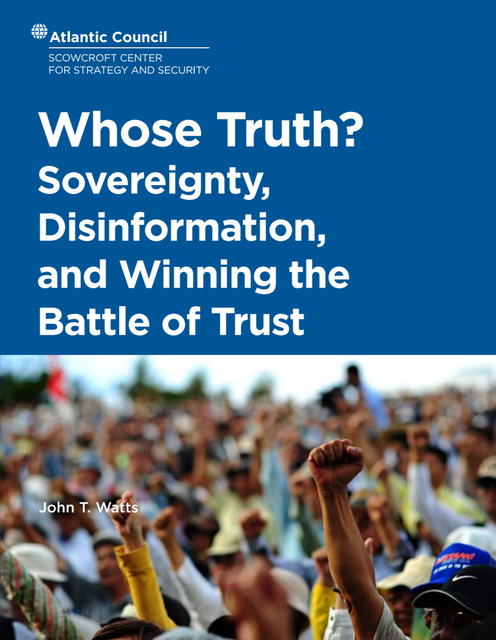
This meeting of top military and corporate representatives went unreported and unpublicized at the time. However, the Atlantic Council recently published a 21-page document summarizing the orientation of the proceedings. It is authored by John T. Watts, a former Australian Army officer and consultant to the US Department of Defense and Department of Homeland Security.
The Atlantic Council report
The Atlantic Council, a think-tank with close ties to the highest levels of the state, has been a key partner in the social media companies’ censorship of left-wing views. Most notably, Facebook acted on a tip from the Atlantic Council when it shut down the official event page for an anti-fascist demonstration in Washington on the anniversary of last year’s neo-Nazi riot in Charlottesville.
Confident that none of the hundreds of journalists in Washington will question, or even report, what he writes, Watts lays out, from the standpoint of the repressive apparatus of the state and the financial oligarchy it defends, why censorship is necessary.
The central theme of the report is “sovereignty,” or the state’s ability to impose its will upon the population. This “sovereignty,” Watts writes, faces “greater challenges now than it ever has in the past,” due to the confluence of growing political opposition to the state with the Internet’s ability to quickly spread political dissent.
Watts cites the precedent of the invention of the printing press, which helped overthrow the feudal world order. In the Atlantic Council’s estimation, however, this was an overwhelmingly negative development, ushering in “decades, and arguably centuries, of conflict and disruption” and undermining the “sovereignty” of absolutist states. The “invention of the internet is similarly creating conflict and disruption,” Watts writes.
“Trust in Western society,” he warns, “is experiencing a crisis. The 2018 Edelman Trust Barometer has tracked this erosion, showing a 30 percent drop in trust in government over the last year in the United States.”
Watts notes that this collapse in support for the government cannot be explained merely by the rise of social media. This process began in the early 2000s, “at the dawn of the social media age but before it had become mainstream.” Left out are the major reasons for the collapse of popular support for government institutions: the stolen election of 2000, the Bush Administration’s lies about weapons of mass destruction, unending war and the impact of the 2008 financial crisis.
However, while it is “hard to argue that the current loss of trust results solely from the emergence of social media,” Watts writes, there “can be little doubt that it acted as a critical amplifier of broader trends.
“Technology has democratized the ability for sub-state groups and individuals to broadcast a narrative with limited resources and virtually unlimited scope.” By contrast, “In the past, the general public had limited sources of information, which were managed by professional gatekeepers.”
In other words, the rise of uncensored social media allowed small groups with ideas that correspond to those of the broader population to challenge the political narrative of vested interests on an equal footing, without the “professional gatekeepers” of the mainstream print and broadcast media, which only publicizes a pro-government narrative.
When “radical and extremist views” and “incorrect ideas” are “broadcast over social media, they can even influence the views of people who would not otherwise be sympathetic to that perspective,” Watts warns. “When forwarded by a close friend or relation, false information carries additional legitimacy; once accepted by an individual, this false information can be difficult to correct.”
People must be isolated, in other words, from the “incorrect” ideas of their friends and family, because such ideas are “difficult to correct” by the state once disseminated.
But how is this to be done? The growth of oppositional sentiment cannot be combatted with “facts” or the “truth,” because “facts themselves are not sufficient to combat disinformation.” The “truth” is “too complex, less interesting, and less meaningful to individuals.”
Nor can the growth of political opposition, for the time being, simply be solved by “eliminating” (i.e., killing or jailing) political dissidents, because this only lends legitimacy to the ideas of the victims. “Eliminating those individuals and organizations will not be sufficient to combat the narrative and may in fact help amplify it.” He adds, “This is also the case for censorship as those behind the narrative can use the attempt to repress the message as proof of its truth, importance, or authenticity.”
Enter the social media companies. The best mechanism for suppressing oppositional viewpoints and promoting pro-government narratives is the private sector, in particular “technology giants, including Facebook, Google, YouTube, and Twitter,” which can “determine what people see and do not see.”
Watts adds, “Fortunately, shifts in the policies of social media platforms such as Facebook have had significant impact on the type and quality of the content that is broadcast.”
The private sector, therefore, must do the dirty work of the government, because government propaganda is viewed with suspicion by the population. “Business and the private sector may not naturally understand the role they play in combating disinformation, but theirs is one of the most important…. In the West at least, they have been thrust into a central role due to the general public’s increased trust in them as institutions.”
But this is only the beginning. Online newspapers should “consider disabling commentary systems—the function of allowing the general public to leave comments beneath a particular media item,” while social media companies should “use a grading system akin to that used to rate the cleanliness of restaurants” to rate their users’ political statements.
Strong-arm tactics still have a role, of course. Citing the example of Wikileaks editor Julian Assange, Watts declares that “governments need to create consequences” for spreading “disinformation” similar to those meted out for “state espionage” – which can carry the death penalty.
What Watts outlines in his document is a vision of a totalitarian social order, where the government, the media, and technology companies are united in suppressing oppositional viewpoints.
The most striking element of the document, however, is that it is not describing the future, but contemporary reality. Everything is in the present tense. The machinery of mass censorship has already been built.
The Atlantic Council report, based on high-level discussions within the military and state, is a confirmation of everything the World Socialist Web Site has said about the purpose of changes in the algorithms of internet and social media companies over the past year-and-a-half.
On August 25, 2017, the WSWS published an open letter to Google alleging that the company is “manipulating its Internet searches to restrict public awareness of and access to socialist, anti-war and left-wing websites.” It added, “Censorship on this scale is political blacklisting.”
Over the subsequent year, key details of the open letter have been indisputably confirmed. At congressional hearings and in other public statements, leading US technology companies explained that they reduced the propagation of political views and statements targeted by US intelligence agencies, and did so in secret because they feared public outcry. At the same time, they explained the technical means by which they promoted pro-government, pro-war news outlets, such as the New York Times and Washington Post.
But the Atlantic Council document presents the most clear, direct and unvarnished explanation of the regime of state censorship.
The struggle against censorship is the spearhead of the defense of all democratic rights. The most urgent task is to unify the working class, which is engaged in a wave of social struggle all over the world, behind the struggle against censorship as a component of the fight for socialism.

4 Oct 2018

Irish Aid Fellowships for Developing Countries for Study in Ireland (Fully-funded) 2019

Application Deadline: 30th November, 2018.

Offered annually? Yes 

Eligible Countries: Cambodia, Eritrea, Ethiopia, Kenya, Laos, Lesotho, Liberia, Malawi, Mozambique, Myanmar, Palestine, Rwanda, Sierra Leone, Somalia, Sudan, Tanzania, Uganda, Vietnam, Zambia or Zimbabwe.

Fields of Study: Relevant Masters programmes in Ireland and regionally.  A directory listing suitable courses for study in Ireland is available to applicants, covering programmes in up to 12 subject areas.
Before finalising your course choices and submitting your application, please confirm with the relevant Irish Embassy that they remain fully satisfied that the courses you have chosen from the Irish Aid Directory of Eligible Postgraduate Courses accord with the Embassy’s country priorities. Embassy contact details are available below.

About the Award: Irish Aid Fellowships are awarded by the Department of Foreign Affairs and are targeted mainly at the countries in which Ireland has established development cooperation programmes. The Fellowship Training Programme was Irish Aid’s first scholarship programme, begun in 1974. Since that time, it has brought suitably qualified candidates from developing countries to undertake Masters degrees at universities and colleges in Ireland, with further students supported for similar courses in their own region.
Awards are made in fields such as development studies, rural development, health care, education and law with the aim of supporting and enhancing the contribution recipients can make to Irish Aid’s partner organisations. Fellowship eligibility requirements aim to ensure close alignment with Irish Aid’s programmatic approach.

Selection: Irish Aid Partners initiate the selection process.  They are required to put forward a gender-balanced panel of candidates and a good representation of the Civil Society.  Candidates working in disadvantaged regions of the country are given priority. These candidates are then entered into the final competition of the Fellowship Training Programme together with candidates from other Irish Aid Partner Countries.

EligibilityTo be eligible, applicants must
  • be a citizen of one of the following countries: Cambodia, Eritrea, Ethiopia, Kenya, Laos, Lesotho, Liberia, Malawi, Mozambique, Myanmar, Palestine, Rwanda, Sierra Leone, Somalia, Sudan, Tanzania, Uganda, Vietnam, Zambia or Zimbabwe.
  • be resident in that country.
  • have achieved the necessary academic standard to be accepted onto a Master’s degree course in a higher education institution in Ireland (an undergraduate degree at equivalent to pass level is not sufficient).
  • be able to demonstrate a strong commitment to the development of their home country.
  • have identified and selected two relevant courses from the Irish Aid Directory of Eligible Postgraduate Courses.
  • be applying to commence a new qualification and not be seeking funding for a course they have already commenced or which will begin before fellowship awards have been notified.
  • be able to take up the fellowship in the academic year 2019/2020.
  • Applicants must be able to demonstrate their skills in academic English with an appropriate score on a recognised test (IELTS 6.5 or higher).
An applicant will not be considered further in either of the following circumstances:
  • They already hold a master’s qualification.
  • They have applied for the Fellowship Training Programme on two or more previous occasions without being awarded a fellowship. (Cases where an applicant withdrew from the process previously may be considered if there were exceptional or unforeseen circumstances for withdrawal in that instance).
  • They are currently working, or it is anticipated that they will work in the future, at our embassies or at headquarters. Those personnel who have worked with any of our embassies/missions in the past must allow a full year before becoming eligible to apply for a fellowship.
In addition to the above, some additional eligibility requirements apply in some countries as follows:

Applications by invitation onlyCambodia, Kenya, Laos, Lesotho, Liberia, Malawi, Myanmar, Namibia, Palestine, Sierra Leone, Uganda, Vietnam, Zambia, Zimbabwe.

Minimum of 2 years’ work experience following undergraduate studies: Cambodia, Ethiopia, Mozambique, Myanmar, Namibia, Uganda, Vietnam, Zambia.

IELTS certificate must be submitted at time of application (before November 30, 2018): Ethiopia.

All successful applicants will be required to sign a commitment to return to their home country within 14 days of completing their studies in Ireland.

Number of Awards: Not Specified

Value of Award: The scholarship award covers course fees, required flights, accommodation (for out of country study), monthly allowances, insurance and other incidental expenses. Eligible Masters programmes in Ireland commence in the period August to September each year and, depending on the course, scholarships will run for between 10 and 16 months.

How to Apply: The Application Form and Directory of Postgraduate Courses are both available for download in the Scholarship Webpage Link below.
Click on your country in the Scholarship Webpage (See Link below) to contact the relevant Embassy of Ireland / Mission.

Visit Scholarship Webpage for Details

Award Provider: Irish Government

Japan Africa Dream Scholarship (JADS) 2018/2019 Fully-funded Programme for African Students to Study in Japanese Universities

Application Deadline: 31st October 2018

Eligible Countries: African countries

To Be Taken At (Country): Japan

About the Award: The Japan Africa Dream Scholarship (JADS) Program – capacity building in energy sector through skills development for sustainable development– is a joint initiative by the AfDB and Japan that aims at providing two-year scholarship awards to highly achieving African graduate students to enable them to undergo post-graduate studies (i.e. a two-year Master’s degree program) in priority development areas on the continent and abroad (including in Japan). This Japan Africa Dream Scholarship programme is funded by the Government of Japan.
The overarching goal that the AfDB and the Government of Japan seeks to attain is to enhance skills and human resources development in Africa in a number of priority areas pertaining to science and technology with a special focus on the energy sector. JADS’s objectives are aligned with the Bank’s High 5 agenda (i.e. Light up and power Africa, Feed Africa, Industrialize Africa, Integrate Africa and Improve the quality of life for the people of Africa) and key Japanese development assistance initiatives to Africa and the 6th Tokyo International Conference for African Development (TICAD VI) outcomes.
Upon completion of their studies, the beneficiary scholars are expected to return to their home countries to apply and disseminate their newly acquired knowledge and skills, and contribute to the promotion of sustainable development of their countries.

Type: Masters

Eligibility: The Japan Africa Dream Scholarship is open to those who have gained admission to an approved Masters degree course at a Japanese partner university. Candidates should be 35 years old or younger; in good health; with a Bachelor’s degree or its equivalent in the energy area or related area; and have a superior academic record. Upon completion of their study programs, scholars are expected to return to their home country to contribute to its economic and social development.
Details on Eligibility Criteria are provided in that call’s Application Guidelines, and these detailed eligibility criteria are strictly adhered to. No exceptions are made.
Broadly speaking, nationals of African countries must:
  • Be a national of a AfDB member country;
  • Be in good health;
  • Hold a Bachelor (or equivalent) degree in the energy area (or related field) earned at least 1 years prior to the application deadline date;
  • Have 1 years or more of recent development-related experience after earning a Bachelor (or equivalent) degree;
  • Be accepted unconditionally to enroll in the upcoming academic year in at least one of the JADS partner universities for a Master’s degree;
  • Applicants living or working in a country other than his or her home country are not eligible for scholarships.
  • JADS does not support applicants who are already enrolled in graduate degree programs.
  • Not be an Executive Director, his/her alternate, and/or staff of all types of appointments of the African Development Bank Group or a close relative of the aforementioned by blood or adoption with the term “close relative” defined as: Mother, Father, Sister, Half-sister, Brother, Half-brother, Son, Daughter, Aunt, Uncle, Niece, or Nephew.
Selection Criteria: The Japan Africa Dream Scholarship programme uses the following four main factors and the degree of cohesion, to review eligible scholarship applications, with the aim of identifying the candidates with the highest potential, after completion of their graduate studies, to impact the development of their countries.
  1. Quality of Education Background
  2. Quality of Professional Recommendations
  3. Quality of Professional Experience
  4. Quality of Commitment to your Home Country
  5. Quality of Statement of Purpose
Japan Africa Dream Scholarship (JADS) awards scholarships to applicants who have had at least 1 year of paid employment in the applicant’s home country or in other African countries acquired after receiving the first Bachelors (or equivalent university) degree within the past 3 years.
The JADS Secretariat uses the following criteria to select the finalists:
  • Maintaining a reasonably wide geographical distribution of awards, that takes into account the geographic distribution of eligible applications;
  • Maintaining a reasonable distribution of awards across gender that takes into account the distribution of eligible applications across gender;
  • Giving scholarships to those applicants who, other things being equal, appear to have limited financial resources
  • Unusual circumstances / hardships, when assessing the employment experience and other aspects of an application.
Number of Awards: Not specified

Value of Award: The scholarship program provides tuition, a monthly living stipend, round-trip airfare, health insurance, and travel allowance.

How to Apply:
  1. Applicant completes JADS application form
  2. Applicant sends documents (application form, university transcripts and certificate, CV, professional references and research proposal), to the JADS Secretariat for first screening
  3.  JADS Secretariat sends shortlist of candidates to selected Japanese universities
  4.  Universities does second screening and share selected students with JADS Secretariat
  5. JADS Secretariat recommends awardees based on its selection criteria to the Japanese Executive Director for approval.
  6. AfDB contacts selected awardees, and informs partner universities.
Visit the Program Webpage for Details

Award Providers: This JADS program is funded by the Government of Japan.

Why Don’t We Talk About Mental Health?

Moin Qazi

World Mental Health Day-10 October 2018
Among the many challenges India faces, the most underappreciated is the ongoing mental health crisis.  Mental illness is actually India’s ticking bomb .The National Mental Health Survey of India (2016), the largest exercise to count the numbers of those affected by mental disorders, reported that one of every ten adults experiences a clinically significant condition. Nearly 90% of these people have received no care at all in the past years. The survey further estimates that 13.7 percent of the Indian population above the age of 18 suffers from mental morbidity, requiring active intervention.It also suggests that one in every 20 Indians suffers from depression and nearly one percent of Indians suffer from high suicidal risks.
The importance of emotional and mental health in the overall well-being of an individual and its impact on the national economy and growth is being increasingly acknowledged. At present, the mentally-ill account for nearly 6.5 percent of the country’s population and it is estimated that by 2020 this number will increase to a staggering 20 percent. Further, the World Health Organisation (WHO) estimates that nearly 56 million Indians, that is, 4.5 percent of India’s population, suffer from depression. Another thirty-eight million Indians, or three percent of India’s population, suffer from anxiety disorders including panic attacks, phobias, post-traumatic stress disorder (PTSD) and obsessive-compulsive disorder (OCD).

Particularly worrying is the intensity of mental disorders in the adolescents. Half of all mental illness starts by the age of 14, but most cases go undetected and untreated. Suicide is the second leading cause of death among 15-29-year-old. Depression is the third leading item in  the burden of   disease among adolescents Fortunately, there is a growing from the earliest ages, in order to cope with the challenges of today’s world
The pathetic state of mental health care in the country coupled with government’s apathy is a cause of great concern. A plausible reason is the sheer scale of the problem. Hence, nobody wants to discuss the elephant in the room. However, the nation cannot afford to ignore the stark reality. There are only about 43 mental hospitals in the country, and most of them are in disarray. Six states, mainly in the northern and eastern regions with a combined population of 56 million people, do not have a single mental hospital. Most government –run mental hospitals lack essential infrastructure, treatment facilities and have a sickening ambience. Visiting private clinics and sustaining the treatment, which is usually a long, drawn-out affair, is an expensive proposition for most families.
The Key facts
  • One in six people are aged 10–19 years.
  • Mental health conditions account for 16% of the global burden of disease and injury in people aged 10–19 years.
  • Half of all mental health conditions start by 14 years of age but most cases are undetected and untreated.
  • Globally, depression is one of the leading causes of illness and disability among adolescents.
  • Suicide is the third leading cause of death in 15–19 year old.
  • The consequences of not addressing adolescent mental health conditions extend to adulthood, impairing both physical and mental health and limiting opportunities to lead fulfilling lives as adults.
  • Mental health promotion and prevention are key to helping adolescents thrive.
According to a Ministry of Health and Family Welfare report, India faces a treatment gap of 50-70 percent for mental health care. The government data highlights the dismal number of mental healthcare professionals in India; 3,800 psychiatrists and just 898 clinical psychologists. A large number of them are situated in urban areas. The WHO reports that there are only three psychiatrists per million people in India, while in other Commonwealth countries, the ratio is 5.6 psychiatrists for the same. By this estimate, India is short of 66,200 psychiatrists.
Mental health care accounts for 0.16 percent of the total Union Health Budget, which is less than that of Bangladesh, which spends 0.44 percent. A developed nation’s expenditure on the same amounts to an average of 4 percent. India must find better ways to parlay its impressive economic growth into faster progress in this critical area as maintaining an ignorant stance on the issue will not help in its resolve.
A survey conducted by the All India Institute of Medical Sciences (AIIMS) in collaboration with WHO across 11 centres in the country, involving 3,000 people from each city found that 95 percent of those with mental-health problems remain deprived of treatment due to stigma, shame and getting shunned from societies. Three age groups are particularly vulnerable to depression: pregnant or post-partum women, the youth and the elderly.
With resources tight an effective method for successfully tackling mental illness is a major expansion of online psychiatric resources such as virtual clinics and web-based psychotherapies. The economic consequences of poor mental health are quite significant. The cognitive symptoms of depression like difficulties in concentrating, making decisions and remembering cause significant impairment in work function and productivity. A World Economic Forum-Harvard School of Public Health study estimated that the cumulative global impact of mental disorders in terms of lost economic output will amount to $16.3 trillion between 2011 and 2030. In India, mental illness is estimated to cost $1.03 trillion (22 percent of the economic output) during 2012-2030. Estimates suggest that by 2025, 38.1m  years of healthy life will be lost to mental illness  in India (23% increase).
The fact is that poor mental health is just as bad as or maybe even worse than any kind of physical injury. Left untreated, it can lead to debili­tating, life-altering conditions. Medical science has progressed enough to be able to cure, or at least control, nearly all of the mental-health problems with a combination of drugs, therapy and community support. Individuals can lead fulfilling and productive lives while performing day-to-day activities such as going to school, raising a family and pursuing a career.
Although mental illness is experienced by a significant portion of the population, it is still seen as a taboo. Depression is so deeply stigmatised that people adopt enforced silence and social isolation. In villages, there are dreadful, recorded cases of patients being locked up in homes during the day, being tied to trees or even being flogged to exorcise evil spirits. Stories of extreme barbarity abound in tribal cultures. In some societies, family honour is so paramount that the notion of seeking psychiatric help more regularly is considered to be anathema to them. Recognition and acknowledgement, rather than denial and ignorance are the need of the hour.
Many a time, mental-health problems are either looked down upon or trivialised. These man-made barriers deprive people of their dignity. We need to shift the paradigm of how we view and address mental illness at a systemic level. Tragically, support networks for the mentally ill are woefully inadequate. There is an urgent need for an ambience of empathy, awareness and acceptance of these people so that prejudices dissipate and patients are able to overcome the stigma and shame.
India’s Mental Health Care Act is a very progressive legislation, and   is the equivalent of a bill of rights for people with mental disorders. Fundamentally, the Act treats mental disorders on the same plane =as    physical health problems thus stripping it of all stigmatizations. Mental health issues get the same priority as physical disorders Conceptually, it transforms the focus of mental health legislations from supposedly protecting society and families by relegating people with mental disorders to second-class citizens, to emphasizing the provision of affordable and quality  care,  , financed by the government, through the primary care system
There have been some encouraging innovations in India, led by voluntary organisations that are both impactful and replicable. Dr Vikram Patel, who is a professor at the London School of Hygiene and Tropical Medicine and co-founder of the Goa-based mental health research non-profit ‘Sangath’, has been at the forefront of community mental health programmes in central India.
It deploys health workers, some with no background in mental health.  The mission tasks community-based workers to provide low intensity psychosocial interventions and raise mental health awareness and provide “psychological first-aid.” Since they are drawn from the same community, they are able to empathise with the patients. The next stage consists of mental health professionals. The programme uses Primary Health Centres for screening people with mental illnesses.
According to Patel, mental-health support workers can be trained at a modest cost. Given the limited availability of mental-health professionals, such first-aid approaches can be suitably and successfully adapted to community needs with limited resources. The senior therapists can be given basic training in general medicine, psychology, psychiatry, psychopharmacology, social work and patient management.
His model envisages the involvement of primary care based counsellors and community based workers to reduce the burden of depression in the population. There is no longer any doubt about whether community health workers can be trained and supervised to deliver clinically effective psychosocial interventions. The challenge before us now is how to go beyond pilots and research studies and scale these innovations up in routine health care. Involvement of the social, health and education sectors in comprehensive, integrated, evidence-based programmes for the mental health of young people is vital for strengthening the overall healthcare framework at the grassroots level.
Mental healthcare initiatives are presently focused on a narrow biomedical approach that tends to ignore socio-cultural contexts.Community mental-health services can offer a mix of clinical, psychological and social services to people with severe, moderate and mild mental illnesses. Also, counselling can make a profound difference and build resilience to cope with despair. Providing psychoeducation to the patients’ families can also help. Unfortunately, in recent decades, academic psychologists have largely forsaken psychoanalysis and made themselves over as biologists. There is need for strengthening the cadre of behavioral health therapists.
Prevention must begin with people being made aware of    the early warning signs and symptoms of mental illness. Parents and teachers can help build life skills of children and adolescents to help them cope with everyday challenges at home and at school. Psychosocial support can be provided in schools and other community settings
Training for health workers to enable them to detect and manage mental health disorders can be put in place, improved or expanded. Such programmes should also cover   peers, parents and teachers so that they know how to support their friends, children and students overcome mental stress and neurotic problems.
There is a need for more open discussion and dialogue on this subject with the general public, and not just expert’s .this can help create a more inclusive environment for people with mental illness.
With simple yet effective steps, we can turn the situation around and  build a more accommodating environment for those struggling with mental distress.

End of Hegemony: UN Must Reflect Changing World Order

Ramzy Baroud

There is a rational explanation of why India and Brazil, two countries with vast populations and large and growing economies, are not permanent members of the United Nations Security Council (UNSC).
The Council – made up of 5 permanent and ten rotating members – was designed to reflect a world order that was birthed from the horrific violence of World War II. It was as simple as this: Those who emerged on the side of the victors were granted permanent membership and a ‘veto’ power that would allow a single country to defy the will of the entire international community.
This unfair system, which has perpetually weakened the moral foundation of the UN, remains in effect to this day. 
The 73rd session of the UN General Assembly just held in New York reflected both the impotence of the UN’s ability as a global platform to address pressing problems, and also the chaotic political scene resulting from the organization’s lack of unity.
The misuse of the veto, the lack of accountability and the unfair representation at the UNSC – for example, not a single African or Latin American country is a permanent member – have all emasculated an organization that is meant, at least on paper, to uphold international law and achieve peace and global security.
While Richard Falk, the former UN Special Rapporteur, advocates the “need for a stronger UN,” he argues that “from the perspective of current geopolitical trends (the UN) seems to have declined almost to the vanishing point with respect to overarching challenges that states acting on their own cannot hope to overcome.”
Some of these problems are interconnected and cannot be redeemed through short-term or provisional solutions. For instance, climate change often leads to food shortages and hunger, which, in turn, contribute to the rising levels of migration and, consequently, to racism and violence.
Late last year, the UN’s World Food Program reported that global hunger is, in fact, increasing, despite all attempts to curb it and to, ultimately, achieve the declared goal of ‘zero hunger.’ According to the WFP, 815 million people suffered from hunger in 2016, an increase of nearly 40 million from the previous year. The UN body called the latest figure an ‘indictment to humanity.’
The failing fight against climate change is another ‘indictment to humanity’. The UN-sponsored Paris Agreement of 2016 was a rare shining moment for the UN, as leaders from 195 countries consented to reduce their carbon dioxide emission through the lowering of their reliance on fossil fuel. The excitement, however, soon died out. In June 2017, the United States government pulled out of the global accord, putting the world, once more, in peril of global warming with its devastating impact on humanity.
This decision by the US Donald Trump Administration exemplifies the foundational problem within the UN – where one country can dominate or derail the whole international agenda, rendering the UN practically irrelevant.
Interestingly, the UN was established in 1945 to replace a body that, too, was rendered irrelevant and ineffective: The League of Nations.
But if the League of Nations lost its credibility because of its inability to prevent war, why has the UN survived all these years?  
Perhaps, then, the UN was never established to tackle the problems of war or global security in the first place, but rather to reflect the new power paradigm that caters to those most invested in the existence of the UN in its current form.
As soon as the UN was established, the US and its allies rose to dominate the global agenda.
As experience has shown, the US is committed to the UN when the international organization serves the US agenda but is uncommitted whenever the organization fails to meet Washington’s expectations.
For example, the former US President, George W. Bush, repeatedly censured the UN for failing to support his unlawful war efforts against Iraq. In a speech before the General Assembly, in 2002, Bush asked: “Will the United Nations serve the purpose of its founding or will it be irrelevant?”
“The purpose of its founding” here, of course, refers to the US agenda that has remained a
top UN priority for decades.
US ambassadors to the UN have worked ceaselessly to undermine various UN institutions that refuse to toe the American line. The current US ambassador, Nikki Haley, is far more aggressive than her predecessors, as her antagonistic language and undiplomatic tactics – especially in the context of the illegal Israeli Occupation and Apartheid in Palestine – further highlight the deteriorating relationship between Washington and the UN.
Indeed, the UN is not a monolithic institution. It is a supranational body that simply reflects the nature of global power. In post-WWII, the UN became divided around political and ideological lines resulting from the Cold War. At the end of the Cold War era, in the early 1990s, the UN became an American tool reflecting the US quest for global domination.
Starting from 2003, the UN has entered a new era in which the US is no longer the only hegemonic power; the rise of China and Russia as economic hubs and military actors, in addition to the rise of regional and economic blocs elsewhere, are causing a greater and growing challenge to the US at the UNSC and various other UN institutions.
Although the General Assembly remains largely impotent, it is still able to, occasionally, challenge the dominance of great powers through its support of other UN bodies, such as UNESCO, the International Court of Justice, the World Health Organization and so on.
The world is vastly changing, yet the UN continues its operations based on an archaic and faulty formula that crowned the winners of WWII as the world’s leaders. There can be no hope for the UN if it continues to operate on the basis of such erroneous assumptions, and it should not take another global war for the UN to be reformed to reflect this new and irreversible reality.