11 Oct 2018

Calls grow in Madrid to ban Catalan nationalist parties

Alejandro López

Demands are growing inside the Spanish political establishment to ban the main Catalan nationalist parties—the Catalan European Democratic Party (PDeCAT), the Republican Left of Catalonia (ERC) and the pseudo-left Candidatures of Popular Unity (CUP). These calls to attack or outlaw parties that collectively receive millions of votes mark a major escalation in the drive of the Spanish and European bourgeoisie toward a police state.
A year has passed since the Catalan independence referendum last October and its violent repression by police, which left over 1,000 peaceful voters injured. Yet the underlying conflicts are as bitter as ever. The right-wing Popular Party (PP) and Citizens are demanding the outlawing of the CUP; a new electoral law making it harder for Catalan, Basque and Galician nationalist forces to get seats in parliament; and that Madrid impose an unelected regional government in Catalonia by again invoking Article 155 of Spain’s 1978 constitution.
The International Committee of the Fourth International (ICFI) opposed the Catalan referendum, a vote called by pro-austerity, pro-European Union (EU) parties aiming to split the working class along national lines. But its principled opposition to Catalan bourgeois and petty-bourgeois nationalism does not lessen its opposition to the moves by the Spanish bourgeoisie, backed by the EU, to build a police-state regime whose central target would be rising militancy and strikes in the working class.
The PP and Citizens are seizing upon various events as pretexts for a crackdown and relying on the reactionary policies of the minority Spanish Socialist Party (PSOE) government of Pedro Sánchez, backed by the pseudo-left Podemos party.
The first were clashes between Catalan police and CUP-aligned forces protesting a provocative pro-Spanish police rally held by the right-wing Jusapol Foundation. The pro-police rally hailed the violent police crackdown on the Catalan referendum or, in Jusapol President Natan Espinosa’s words, it was to “honour those who worked to preserve the unity of Spain.”
The other pretext is Catalan regional premier Quim Torra’s threat to withdraw his support for the minority PSOE government and push for unilateral independence if Sánchez does not recognise Catalan self-determination. Torra called for pro-CUP protesters to keep marching—saying, “Press hard, you do well in pressing”—again exposing the CUP’s close ties to Torra’s austerity regime.
The day after the clashes, PP leader Pablo Casado said all Catalan nationalist parties should be outlawed. He pledged to “request the modification of the Law of Parties so that we can already act against those parties and organisations in Catalonia that are encouraging violence and inciting civil confrontation. … After the altercations yesterday, we cannot tolerate that there are political parties like the CUP, ERC or PDeCat that do not condemn these intolerable aggressions.”
Casado proposed achieving this end by invoking the law used in 2003 to ban Batasuna, the political wing of the Basque nationalist group ETA. He also called for financially strangling parties that he said “encourage or justify violence” by eliminating all public subsidies to them.
Casado then attacked Sánchez, saying there is “no longer an excuse” not to implement Article 155 and impose a new unelected regional government in Catalonia. On Twitter, he compared Torra’s comments to “support for Kale borroka,” the Basque word for street fighting—like burning cars, attacking houses or banking facilities, and attacking public transport as carried out by pro-ETA Basque nationalist youth in the 1980s and 1990s.
All but calling for the permanent suspension of the Catalan regional government, he demanded that Article 155 be implemented “with the necessary duration, the necessary extensions, and sufficient state involvement.”
Citizens leader Albert Rivera said he would discuss outlawing the CUP, which gives a pro-independence majority in the Catalan parliament for Torra’s secessionist, pro-austerity government. He also called for reforming Spain’s electoral law to set a 3 percent threshold for parties to enter Spain’s parliament. Since the Catalan nationalists have virtually no support outside Catalonia, this would de facto eliminate the ERC, PDeCAT and the Basque Nationalist Party from the national parliament.
As the PP and Citizens fall short of the parliamentary majority to reform the electoral law, Rivera called on Sánchez to support such a move. The PSOE is currently rejecting this, with the secretary of the party calling it “throwing petrol” over the political fire in Catalonia.
There is broad opposition to the PP in Spain, as well as to the secessionist programme of the Catalan nationalists in Catalonia, and a growing wave of strikes in Spain as well as across Europe. If the PP and Citizens can proceed with attacks on democratic rights and moves to build a police state, this is above all due to the reactionary role of Podemos in supporting the PSOE government and suppressing left-wing opposition to the PSOE and the PP. The absence of any opposition from these two parties emboldens the right wing to step up its attacks on democratic rights.
Sánchez has continued the previous PP government’s crackdown on the Catalan nationalists, while making a few symbolic concessions to try to smooth over relations. While Sánchez declared his sympathy for Catalan autonomy, he kept Catalan political prisoners in jail and retained “rebellion” charges against nine incarcerated Catalan officials and politicians. The charges carry sentences of up to 25 years in jail.
The PSOE, which like the PP before it runs a minority government, can hold power only through the support in parliament from Podemos, together with the various regional-nationalist parties. Podemos General Secretary Pablos Iglesias has visited Catalan political prisoners in jail to give them messages from Sánchez, and has called upon Sánchez to design a “concrete state policy” on Catalonia. Iglesias makes no secret of the close political collaboration between Podemos and the government.
Iglesias said that “never has Podemos had as much influence as now,” adding that the party is “proud of our push” as Sánchez’s main supporters. These boasts are a devastating exposure of the reactionary role of Podemos.
The Podemos leadership is declaring its unstinting support to all the anti-worker policies the PSOE has implemented since taking power last June. The PSOE has not only continued jailing Catalan nationalists on fraudulent charges, but threatened to re-impose Article 155 on the region and passed the previous PP government’s austerity budget, including billions of euros in defence spending increases. It also sold precision bombs to Saudi Arabia in its bloody war in Yemen, carried out mass expulsions of migrants and sent police to break up strikes.
This again confirms the ICFI’s assessment of the role of Podemos as an anti-working class and anti-Marxist party, and its insistence that the key question in Spain and across Europe is building sections of the ICFI to give political leadership to the emerging struggles of the working class.
As the ICFI warned in its statement, “Oppose the state crackdown on the Catalan independence referendum!” on the eve of the vote, “The Catalan crisis has yet again exposed the Podemos party’s reactionary role. … Podemos is still calling for an alliance with the PSOE, even as the PSOE supports the PP’s onslaught in Catalonia.” The ICFI warned that Podemos was “signaling the ruling class that it is also available to form an alternate government. … Such a government were it to be formed, would offer no alternative to the drive to dictatorship and austerity currently being prosecuted by the PP.”
This assessment of the role a Podemos-backed government would play in Spain has been thoroughly vindicated.

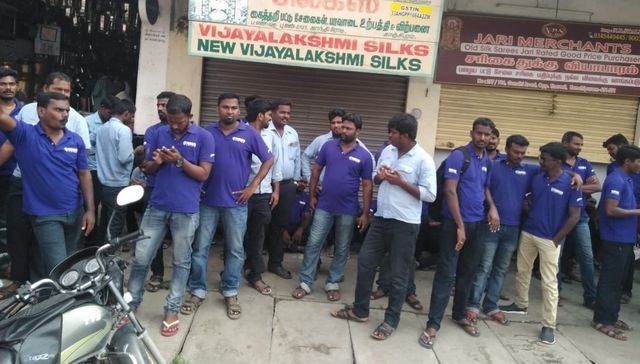
Tamil Nadu police arrest hundreds of striking Indian autoworkers

Arun Kumar & Moses Rajkumar

In recent weeks, thousands of autoworkers from Yamaha Motor India, Royal Enfield and Myoung Shin Automotive (MSA) plants in the Oragadam-Chengalpattu industrial zone have been involved in strikes, occupations and protests to demand union rights, better working conditions and wage rises.
Located southwest of Chennai, the Tamil Nadu state capital, the zone employs hundreds of thousands of workers. Colloquially known as the “Detroit of Asia,” the area has the majority of India’s 7.6 million autoworkers. Companies located there include Ford, Daimler AG, Renault–Nissan, Komatsu, Mitsubishi and Toyota.
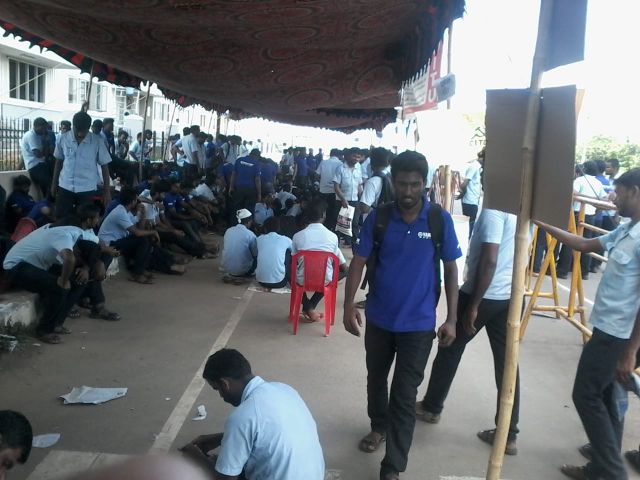
Last Sunday, hundreds of Yamaha and MSA workers held a “human chain” demonstration to support their respective demands and protest against company and police repression. The Yamaha and Enfield plants produce motorcycles while MSA makes auto parts. The demonstration followed a series of struggles.
Yamaha workers assembling for a human chain protest
* On September 21, over 750 Yamaha permanent workers had walked out on strike indefinitely and established an occupation to demand the reinstatement of two workers. The workers were sacked because of their involvement in organising a new union—the Yamaha Motor Thozhilalar Sangham (Yamaha Motor Workers Association)—at the facility. The union is affiliated to the Centre of Indian Trade Unions (CITU), which is controlled by the Stalinist Communist Party of India (Marxist) or CPM.
Of the nearly 2,500 employed at Yamaha India, 750 are permanent, 1,500 are on contract and around 250 are apprentices. Permanent workers’ monthly salaries range from 13,000 rupees ($US180) to 18,000 rupees. Contract workers wanted to join the strike, but the union instructed them not to become involved, declaring that their jobs were at risk.
Yamaha India immediately declared the strike “illegal” and took the dispute to the Madras High Court. After the court ruled that any protest by the workers must be 200 metres from the factory premises, Tamil Nadu police entered the facility on September 26, attacked the striking workers and ejected them from the plant.
On October 3, police conducted early morning raids on the homes of four Yamaha workers, arresting them for allegedly climbing onto mobile towers a week earlier to highlight their demands.
* On September 24, about 1,300 Royal Enfield workers walked out to demand a wage rise and other claims. The company responded by threatening trainees with the sack if they did not return to work. Armed with a court order, the police, on the same day as they attacked the Yamaha strikers, raided the Enfield factory and forcibly removed strikers.
In line with the demands of union officials, Royal Enfield workers ended their strike on September 30. The union claimed to have reached an agreement with the company that there would be no reprisals against the strikers. A new CITU-linked union—the Royal Enfield Employees Union (REEU)—was recently established in the plant, but is not recognised by the company.
Despite the supposed agreement, management cut workers’ salaries for the days they were on strike, disciplined eight employees, and sacked another, over alleged involvement in union activities. The company also refused to allow workers to take their mobile phones into the plant. Nearly 700 permanent workers immediately walked out in protest.
Following union talks with the company, the Enfield strikers returned to work again on October 5, only to face another management provocation. They were told to “apologise” for striking and agree to a “good conduct” undertaking.
Angered by these demands, the workers occupied the plant, only to be attacked by police who arrested about 600 protestors, holding them in a nearby hall until that evening.
While management and the police were launching their attacks on the Yamaha and Enfield workers, the CITU, acting as an industrial police force, “advised” the workers to “honour” the court orders.
* On September 5, over 500 workers, including 150 permanent employees from MSA, a supplier to Hyundai in Tamil Nadu, began a strike and occupation to demand payment of a long-outstanding wage rise.
On September 27, a number of striking MSA workers were arrested by the police when they planned to picket the South Korean embassy in Chennai. Police detained them in a nearby hall before releasing them in the evening.
Striking Yamaha workers
Tamil Nadu business chiefs have denounced the wave of industrial action and demanded that the state government crush strikes.
Ar Rm Arun, chairman of the Tamil Nadu branch of the Federation of Indian Chambers of Commerce and Industry, India’s peak business body, told the Hindu newspaper: “MNCs [multinational corporations] are not mandated to be bogged down in any way by such issues. If the environment is not conducive to their business, there are so many choices for them.”
Arun called on the state government to “follow the example of the Singapore prime minister in how he firmly dealt with the striking Singapore Airlines pilots.” This was a reference to former Singapore dictator Lee Kwan Yew’s threats to crush the pilots’ strike in 1980.
Indian big business, global investors, the federal and state governments and the judiciary, working closely with the unions, are determined to suppress any independent eruption of class struggles. The repression of the Maruti Suzuki workers is a case in point.
In 2012, after Maruti Suzuki workers rejected a management-controlled union and formed an independent union, the company worked with police and Indian government authorities to launch a series of provocations. This resulted in the arrest and frame-up of Maruti Suzuki workers and the sentencing of 13 to life imprisonment on bogus murder charges. The CPM and CITU rejected demands for unified national action and then isolated the jailed Maruti Suzuki workers.
While Yamaha, Enfield and MSA workers have demonstrated their determination to fight, the CPM and CITU have repeatedly intervened to prevent unified industrial action.
CITU officials used last Sunday’s protest as another occasion to promote illusions in the Tamil Nadu state government. CITU district leader Muthu Kumar called on the ruling All India Anna Dravida Munnetra Kazhagam (AIADMK), a right-wing communalist party, to “find an amicable solution.”
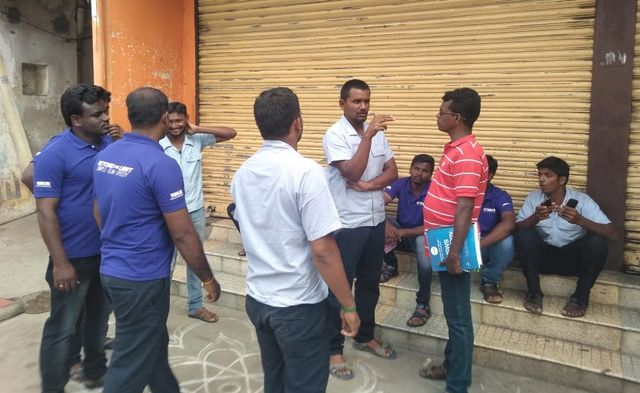
Yamaha workers speak to WSWS reporters
WSWS reporters recently distributed leaflets among the striking workers explaining the necessity for unified national industrial action to take forward their struggle and exposing the CITU’s role.
Numerous Yamaha workers voiced their discontent and blamed the unions for not mobilising contract workers, apprentices and other workers in support of these struggles. Several union bureaucrats intervened and repeatedly demanded that the WSWS reporters leave the area.
Last week, union officials banned workers from speaking to WSWS reporters and, on Sunday, CITU leaders Muthu Kumar and S. Kannan threatened physical violence. Kannan claimed that WSWS reporters were working for the auto companies. Next time, he declared: “CPM comrades will kill you.”
These threats are another indication that the CPM and CITU are acutely nervous about the rising militancy of autoworkers and fear any exposure of their political record and pro-big business line. Notwithstanding their occasional “left” demagogy, the Indian Stalinists, as demonstrated in the states where they have held power, such as West Bengal, Tripura and Kerala, will do whatever is demanded of them by international investors and the Indian capitalist elites.

IMF revises down global growth projection

Nick Beams

Ten years after the global financial crisis, the World Economic Outlook (WEO) report issued by the International Monetary Fund this week makes clear the global economy is far removed from the growth path that existed in the years leading up to 2008.
In its two previous semi-annual reports, the IMF had pointed to synchronised global growth in 2017. While overall growth projections for 2018–19 remain above the levels for 2012–2016, synchronisation has largely petered out, with the outlook for the future on a downward trend.
Global growth is projected at 3.7 percent for 2018–19, some 0.2 percentage points lower than the forecast last April.
“The downward revision reflects surprises,” the WEO stated. It referred to “suppressed activity in early 2018 in some major advanced economies, the negative effects of the trade measures implemented or approved between April and mid-September, as well as a weaker outlook for some key emerging markets and developing economies arising from country-specific factors, tightening financial conditions, geopolitical tensions and higher oil import bills.”
The overall situation, the IMF assessed, was not going to improve as “growth in most advanced economies is expected to decline to potential rates well below the averages reached before the global financial crisis of a decade ago.”
While the WEO predicted that global expansion would continue over the next two years, it would be much less synchronised than in 2017, which saw the biggest increase in growth since the rebound of 2010.
“A smaller share of countries, particularly among advanced economies” was expected to experience an acceleration of economic activity in 2018. The report noted that among the advanced economies, growth “disappointed” in the euro area and in the UK, with the latter experiencing lower growth than had been anticipated.
The only exception to this overall trend was the United States where growth was expected to remain elevated until 2020 as a result of what the IMF called a “sizable fiscal stimulus”—the massive corporate and personal income tax cuts enacted by the Trump administration, which have increased the US budget deficit.
But like a shot of adrenalin, the effects would not last. The pace of economic expansion was expected to slow “as the stimulus reverses and reinforces the effect of ongoing monetary tightening” flowing from the US Federal Reserve’s moves to increase interest rates. Growth in the US was expected to fall to the somewhat anaemic level of 1.8 percent in 2020, with growth expected to further drop to 1.4 percent in later years.
The WEO noted that a “core element” in the upsurge in global growth and trade in 2017 was the pickup of investment in the advanced economies and an “end to investment contractions in some large, stressed commodity exporters.” But this pace of expansion was expected to decline in 2018–19 compared to last year, “with a more notable decline in trade growth.”
The report pointed to “rising trade tensions and policy uncertainty” which could lead firms to postpone or forgo capital spending and “hence slow down growth in investment and demand.” High frequency data, such as the purchasing managers’ indices, pointed to a “slowdown in international trade and industrial production.” The IMF revised down its forecast for fixed investment growth in advanced economies by around 0.4 percentage points from its prediction of six months ago.
According to the WEO, the “balance of risks” to the global forecast has shifted to the downside in the context of “elevated policy uncertainty.” Risks the IMF identified earlier, including rising trade barriers and a reversal of capital flows due to a tightening of monetary settings, “have become more pronounced or have partially materialized.”
The report warned that “escalating trade tensions and the potential shift away from a multilateral rules-based trading system are key threats to the global outlook.” In rather understated language, it said “a cooperative approach to reduce trade costs and resolve disagreements has so far proved elusive,” with the US imposing tariffs on a variety of imports and its trading partners undertaking retaliatory action.
Having marked down its predictions for growth in emerging markets and developing economics by 0.2 and 0.4 percentage points respectively, the WEO said the main source for the revision was the “negative expected impact of the trade measures” on activity in China and other economies in emerging Asia.
With the protectionist rhetoric in the US now having turned to action, the report stressed that the escalation of trade tensions could reach a point where “systemic risk” to the global economy was a “distinct possibility without policy cooperation.”
But there is no prospect for such cooperation because the eruption of trade conflicts is itself an expression of sharpening economic and geo-strategic rivalries.
The WEO instead concluded that tightening monetary conditions in the US, a stronger US dollar and a larger US current account deficit risk “aggravating trade tensions.” This could lead to a faster tightening of global financing, with “negative implications for emerging market economies, especially those with weak external positions.”
Financial risks had increased because an “extremely supportive financial environment” in the years since the financial crisis had rendered the global economy vulnerable to “sudden tightening of financial conditions.” This was a reference to the ultra-low interest rate regime and the pumping of trillions of dollars into the financial system by the world’s major central banks.
The report noted that measures of “equity valuations,” such as the US stock market, appeared “stretched,” leading investors to move into riskier assets in search of yield. “Across many economies, government and corporate debt is substantially higher than before the global financial crisis” and in “some emerging markets, there are concerns about rising contingent liabilities.”
Under conditions of tightening interest rates and rising uncertainty, the IMF said the risk of contagion had increased and not only in emerging markets. The report cited the rise in yields (increased interest rates and lower bond prices) on Italian sovereign debt as “a case in point.”
“A significant further decline in sovereign bond prices, with possible contagion effects, would impose valuation losses on investors, worsen public debt dynamics, and weaken bank balance sheets, reigniting concerns about sovereign-debt feed-back loops in the euro area,” the WEO stated.
A chapter in the report outlined the economic impact of the global financial crisis. It drew out that the effects have been long lasting and extend well beyond the countries that experienced a banking crisis.
Some 91 countries, representing two-thirds of global economic output, experienced a contraction in 2009, making the crisis the biggest economic shock in the post-war period.
Comparing the fall in output with the pre-2008 trend, the IMF said 24 countries that experienced a banking crisis, 18 of which were high-income countries, were still showing a shortfall relative to the preceding trend. Relative to the pre-crisis trend, the average shortfall was around 10 percent, but in some cases it was between 20 and 40 percent.
The main reason for the fall in production was the collapse in investment, which was down by an average of 25 percent compared to the pre-crisis trend. And the fall in output would have been greater if not for the massive economic stimulus provided by China, equivalent to around 10 percent of its gross domestic product.
Writing on this aspect of the IMF report, Financial Times columnist Martin Wolf concluded: “‘Never again’ must be the watchword.”
As the IMF survey makes clear, however, this remains nothing more than a pious hope. That is due to the increase in global indebtedness, the continued vulnerability of the world economy to financial shocks, and the ongoing breakdown of the international trading system, to name just some of the major trends.
The disease that struck the world capitalist economy a decade ago has not been cured, it has simply assumed more malignant forms.

Major fall on Wall Street as interest rates rise

Nick Beams

Wall Street experienced its biggest fall in eight months yesterday, as major indexes dropped by more than 3 percent in the wake of the upward movement of interest rates in the recent period.
The biggest falls were in tech stocks, with the Nasdaq Composite index down by more than 4 percent in its biggest drop since June 2016, following the Brexit referendum in the UK. The Standard & Poor’s 500 index was down by 3.3 percent, its biggest decline since February. It has now fallen for five days in a row—its longest losing streak since Donald Trump became president.
The Dow fell 832 points, a drop of 3.2 percent, and the Chloe Volatility Index rose to over 20, its highest level since April, an indication that further volatility is expected.
The main factor behind the fall appears to be the spike in yields (interest rates) on US Treasury bonds, which have risen sharply in recent days to above 3 percent. The sell-off in the bond market and the rise in interest rates (bond prices and interest rates have an inverse relationship) imply a fall in the value of shares, as the Treasury yield is used to discount expected future income flows.
The yield on the 10-year US Treasury bond hit a seven-year high of 3.26 percent earlier this week, reflecting the belief that the US Federal Reserve will continue to lift its base rate on expectations of higher US economic growth. While it is not explicitly stated, a key factor in the move by the Fed for higher interest rates is the growing push by workers in the United States for wage rises, with stagnant and falling wages a key factor in promoting the stock market boom over the past nine years.
In its report on the plunge, the Wall Street Journal pointed to the fact that major corporations that have fueled the rise of the market with share buybacks are at present on the sidelines, reluctant to engage in further purchases in advance of the release of third quarter earnings results.
The newspaper reported that S&P 500 companies “have spent a staggering $380 billion on stock repurchases through the first half of this year, with Apple, Cisco and Facebook among the most active buyers of stock.”
The fall on Wall Street prompted a comment from Trump on the Fed’s tightening of interest rates. Trump has continually pointed to the rise of the stock market as indicating the strength of his economic policies.
“I think the Fed is making a mistake,” he said. “They are so tight. I think the Fed has gone crazy.”
A statement from the White House issued by press secretary Sarah Huckabee Sanders also indicated the concern of the administration over the market sell-off. “The fundamentals and future of the US economy remain incredibly strong,” she said. “President Trump’s economic policies are the reasons for these historic successes and they have created a solid base for continued economic growth.”
But as numbers of commentators have pointed out, if that is the case, and the US economy is sound and growing, then the Fed should be increasing interest rates more rapidly in order to lift them from the historic lows of the period following the 2008 crisis to more normal levels.
In announcing the latest increase in September, Fed chairman Jerome Powell said interest rates were still “accommodative” and the central bank was moving to a position where they would be neutral, but they were probably “a long way from neutral” at present—an indication that the Fed expects further tightening.
The comments by Trump and the statement from the White House on the market fall point to concerns within the administration that, far from a reflecting the strength of the US economy, the surging stock market may be a house of cards extremely vulnerable to a tightening of financial conditions.
While the immediate outcome of the latest sell-off is unclear, numerous reports on the state of the global financial system ten years after the 2008 crash have pointed to the creation of conditions for another disaster produced by the very measures—ultra-low interest rates and the injection of trillions of dollars—that were used to prop up the global financial system.
In its latest Global Financial Stability Report, produced for its semi-annual meeting being held this week in Bali, Indonesia, the International Monetary Fund said that while regulatory frameworks had been enhanced and the banking system had been made stronger, “new vulnerabilities had emerged, and the reliance of the global financial system has yet to be tested.”
It said medium-term risks to global financial stability remain elevated:
“A number of vulnerabilities that have built up over the years could be exposed by a sudden sharp tightening of financial conditions. In advanced economies, key financial vulnerabilities include high and rising leverage levels in the nonfinancial sector, continued deterioration in underwriting standards, and stretched asset valuations in some major markets.”
One of the key expressions of “stretched asset valuations” is the record rise of the US stock market, prompted by low interest rates and the increasing use of share buybacks.
The IMF said that while banks had increased their capital and liquidity buffers since the crisis, they remained exposed to highly indebted companies, households and governments and to what it called their “holdings of opaque and illiquid assets.”
The IMF report warned that, as central banks withdraw monetary accommodation, financial conditions would tighten and this could “expose fragilities in the financial system” that have emerged since the global finance crisis.
One of those “fragilities” is the build-up of dollar-denominated debt in emerging market economies.
In a speech delivered earlier this month, IMF Managing Director Christine Lagarde noted that global debt, both public and private, has now reached an all-time high of $182 trillion—some 60 percent greater than in 2007. This left governments and companies “more vulnerable to a tightening of financial conditions.”
If such tightening were to rapidly accelerate, it could lead to “market corrections,” sharp exchange rate movements and a weakening of capital flows. The IMF has estimated that under such conditions, emerging markets, excluding China, could face a “debt portfolio outflow” of up to $100 billion, an amount equivalent to that in the financial crisis ten years ago.
That alone, she said, should serve as a “wake-up call.” Yesterday’s fall on Wall Street and the somewhat frantic response of the White House may be another indication of the underlying instability of the financial system.

Tech firms have shifted away from “free speech and towards censorship”

Kevin Reed

On Tuesday, the far-right news outlet Breitbart News published a leaked internal briefing by employees at technology giant Google that openly discusses political censorship.
The document observes that “tech firms have gradually shifted away from unmediated free speech and towards censorship and moderation.” In the process, the document states, Google, Facebook and Twitter have sought to emphasize creating “well-ordered spaces for safety and civility” over “unmediated ‘marketplaces of ideas.’”
Breitbart said Google did not deny the veracity of the document, but it wrote that “an official Google source said the document should be considered internal research, and not an official company position.”
The leaked Google document quoted MIT Tech Review editor-in-chief Jason Pontin as saying, “On the global scale, the internet and the social platforms have been a wonderful boon for free speech. The internet has given platforms to billion (sic) of people to express themselves and has made it almost impossible for governments—even in highly controlled nations like China—to control people’s speech effectively.”
But the next page of the briefing declares that “recent global events have undermined this utopian narrative.”
The document explains the “shift towards censorship” by pointing to “commercial” and “government” demands. One aim of censorship is to “Protect advertisers from controversial content, [and] increase revenues,” it declares.
The briefing adds that “Google might continue to shift with the times—changing its stance on how much or how little it censors (due to public, governmental or commercial pressures).”
The document admits that there is a shift from the “American tradition that prioritizes free speech for democracy, not civility,” on the part of social media companies.
In August 2017, the World Socialist Web Site published an open letter to Google alleging that changes to its search algorithms had led to a massive drop in traffic to left-wing, anti-war, and socialist web sites.
“Censorship on this scale is political blacklisting,” the letter declared. “The obvious intent of Google’s censorship algorithm is to block news that your company does not want reported and to suppress opinions with which you do not agree. Political blacklisting is not a legitimate exercise of whatever may be Google’s prerogatives as a commercial enterprise. It is a gross abuse of monopolistic power. What you are doing is an attack on freedom of speech.”
The publication of the leaked document followed an October 5 report by the Washington Post that that Google CEO Sundar Pichai met secretly with civilian and military officials at the Pentagon during a recent trip to Washington DC.
Based on interviews with two anonymous sources familiar with the meeting, the Post said Pichai was “seeking to smooth over tensions roughly four months after employee outrage prompted the tech giant to sever a defense contract to analyze drone video”—known as Project Maven.
The Post reported that Pichai met with officials from the Office of the Undersecretary of Defense for Intelligence, a department that reports on matters relating to military intelligence to the US Secretary of Defense, former United States Marine Corps General James Mattis. The office is responsible for the Project Maven program, which is developing artificial intelligence capabilities to identify cars, buildings and other objects recorded in videos by drones flying over combat zones and other landscapes.
Neither Defense Department officials nor Google representatives would comment publicly on the secret meeting. The termination of the Project Maven contract—after more than 3,000 employees signed a letter protesting the company’s participation in “the business of war,” was a blow to the efforts of Google to deepen its collaboration with the military-intelligence establishment.
In June, in response to the protest, Google management announced that the Project Maven contract would not be renewed in 2019. However, Pichai was quick to publish a blog post in which he outlined Google’s artificial intelligence objectives and explained that the company would continue work with the Pentagon on “cybersecurity, training, military recruitment, veterans’ health care, and search and rescue.”

Pentagon report points to US preparations for total war

Andre Damon 

Over the past two weeks, with next to no media coverage, the United States has moved substantially closer toward open military confrontation with both Russia and China, the second- and third-ranked nuclear powers in the world.
On October 3, the United States threatened, for the first time since the Cold War, to directly attack the Russian homeland. UN Ambassador to NATO Kay Bailey Hutchison accused the country of violating the Intermediate Range Nuclear Forces (INF) treaty by developing a nuclear cruise missile and said that Washington was preparing to “take out” the weapon with a US strike.
This statement came just three days after a Chinese warship set a collision course with a US destroyer carrying out a so-called “freedom of navigation” operation in the South China Sea, forcing the American ship to maneuver to avoid a collision and the potentially deadliest military clash in the Pacific in decades.
Behind such hair-raising incidents, the United States is undertaking serious, long-term preparations to restructure the American economy to fight a major war with a “peer” adversary, entailing radical changes to American economic, social and political life.
This is the essential content of a 146-page document released by the Pentagon last Friday, titled “Assessing and Strengthening the Manufacturing and Defense Industrial Base and Supply Chain Resiliency of the United States.” It makes it clear that Washington is preparing not just for isolated regional clashes, but rather for a massive, long-term war effort against Russia and China under conditions of potential national autarchy.
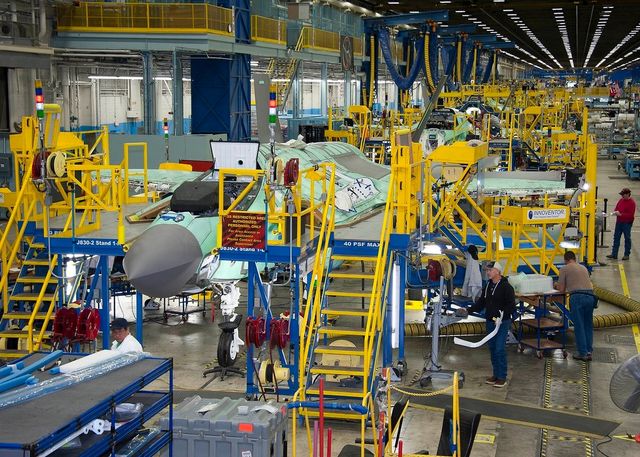
Martin employees work on the F-35 Lightning II Joint Strike Fighter production line in Fort Worth, Texas [Credit - Defense Contract Management Agency].jpg
The document made clear that a major restructuring of the American economy will be necessary to reach the United States military’s stated goal of being prepared to “fight tonight” against a “peer adversary.” The United States must “retool” for “great-power competition,” the document declared.
“America’s manufacturing and defense industrial base,” observes the report, creates the “platform and systems” upon which “our Warfighter depends.” This complex encompasses not just the government, but the private sector, as well as “R&D organizations” and “academic institutions.” In other words, the entire economy and society.
It warns that “The erosion of American manufacturing over the last two decades… threatens to undermine the ability of U.S. manufacturers to meet national security requirements. Today, we rely on single domestic sources for some products and foreign supply chains for others, and we face the possibility of not being able to produce specialized components for the military at home.”
Correcting this strategic deficiency, the report concludes, means that “support for a vibrant domestic manufacturing sector, a solid defense industrial base, and resilient supply chains is a national priority.”
The report squarely targets China, declaring, “China’s economic strategies, combined with the adverse impacts of other nations’ industrial policies, pose significant threats to the U.S. industrial base and thereby pose a growing risk to U.S. national security.”
The promotion of US manufacturing dominance, in other words, is vital for promoting military dominance.
The protection of heavy industry goes together with the administration’s efforts to defend America’s high-tech sector, the source of a vast portion of US profitability.
As the report notes, “One of the Chinese Communist Party’s primary industrial initiatives, Made in China 2025, targets artificial intelligence, quantum computing, robotics, autonomous and new energy vehicles, high performance medical devices, high-tech ship components, and other emerging industries critical to national defense.”
It warns that “Chinese R&D spending is rapidly converging to that of the U.S. and will likely achieve parity sometime in the near future,” and worriedly points to the fact that the Chinese manufacturer DJI dominates the commercial aerial drone market.
The Pentagon’s plans for protecting and expanding the US high-tech sector include its backing for the administration’s efforts to limit the admission of Chinese students to US universities through visa restrictions. The report complains that, with as many as 25 percent of “STEM [Science, Technology, Engineering and Mathematics] graduates in the U.S. being Chinese nationals… American universities are major enablers of China’s economic and military rise.”
The vision in the document, in other words, is the concrete expression of the conception outlined in the latest US national security strategy, calling for “the seamless integration of multiple elements of national power—diplomacy, information, economics, finance, intelligence, law enforcement and military.”
A leading element of this equation is the American corporate technology sector, which has scrambled for fat Pentagon contracts to develop the latest generation of weapons systems. In exchange for these payouts, and aggressive protection from their international rivals, they have worked closely to implement what one leaked internal Google document called a “shift towards censorship” in cooperation with the demands of the US military and intelligence agencies.
The logic of this growing fusion between the repressive apparatus of the state and increasingly powerful monopolies is the necessary correlation between “total war” and a “totalitarian” society, in which key constitutional provisions are rendered effectively meaningless.
The central target of such measures will be the forcible suppression of the class struggle in the name of promoting “national security.” The escalation of global US militarism has coincided with a major upsurge in the class struggle, including the rejection of a concessions contract by workers at UPS, the logistics giant whose powerful workforce is capable of crippling not just America’s industrial base, but substantial sections of the wartime economy.

Murder in Istanbul

Bill Van Auken

As more and more details emerge about the disappearance on October 2 of the well-known Saudi journalist Jamal Khashoggi, after he entered the Saudi consulate in Istanbul, Turkey, it is becoming clear that a monstrous crime has been committed with serious worldwide implications.
The Turkish media has published photographs and video footage documenting the arrival at Ataturk airport on the same day as Khashoggi’s disappearance of a 15-member Saudi death squad. It included two air force officers, intelligence operatives and members of the elite personal guard of the Saudi monarchy. Also among them, according to Turkish authorities, was a forensics expert, who reportedly came equipped with a bone saw.
Turkish media reports indicate that Khashoggi had visited the consulate a week earlier seeking documents he needed for his planned marriage to a Turkish woman. He was told to return on October 2 at 1 p.m. Local staff were instructed to take the afternoon off as the 15 state assassins arrived. Khashoggi was, according to accounts of Turkish security officials speaking on condition of anonymity, dragged from the consul’s office and killed, and his body then dismembered with the saw.
This crime has attracted worldwide attention for its brazenness and brutality, as well as because of the identity of the apparent victim. Khashoggi’s journalistic career has been that of an insider within Saudi ruling circles, with close connections to some of the Kingdom’s most powerful officials and billionaires. He served as an aide to the long-time Saudi intelligence chief and former ambassador to the US, Prince Turki bin Faisal, and was known as an interlocutor between the monarchy and Western media and officials.
In September 2017 the kingdom’s de facto ruler, Crown Prince Mohammed bin Salman (MBS)—praised by the Western media as a great “reformer” and feted by the Trump administration as well as America’s financial elite—launched a brutal crackdown, including against members of the royal family, prominent business figures and some journalists. The dictatorial actions were largely ignored or supported by the Western media. The ineffable foreign affairs columnist for the New York Times, Thomas Friedman, who was wined and dined at a royal palace in Riyadh, wrote at the time that “not a single Saudi I spoke to here over three days expressed anything other than effusive support for this anticorruption drive.”
Khashoggi chose to avoid imprisonment through self-imposed exile in the US, where he was given a column in the Washington Post and initiated the process of becoming a US citizen. He used the column to criticize Mohammed bin Salman from a standpoint reflecting the divisions within the royal family itself. Most recently, he wrote a condemnation of the war waged by the Saudi regime against Yemen, an intervention initiated by MBS.
Despite his prominence, the Trump administration has been extremely reticent to call any attention to Khashoggi’s disappearance, waiting a week to make any statement. Trump told reporters at the White House on Tuesday that he knew “what everybody else knows—nothing” about the journalist’s fate. Meanwhile, Secretary of State Mike Pompeo issued a statement calling on the Saudi monarchy to support a “thorough investigation” of its own crime.
It appears, however, that the US government was well informed of Saudi plans to eliminate Khashoggi, with the Washington Post reporting that before his disappearance, US intelligence had intercepted communications between Saudi officials revealing a plan to abduct the journalist.
Whatever the case, Saudi Arabia’s vicious monarchical regime has long been the linchpin of imperialist domination and political reaction throughout the Middle East. These ties—under both Democratic and Republican administrations—have remained firm as the regime has routinely beheaded political opponents and non-violent offenders, putting 150 to the sword in 2017 alone.
Before Khashoggi’s disappearance, an estimated 30 Saudi journalists had already been imprisoned or disappeared, without any protest from the Western powers, the US chief among them, who sell billions of dollars in arms to the kingdom and profit off its oil wealth.
The US-Saudi connection has grown only closer under the Trump administration, which has sought to forge an anti-Iranian axis based upon Saudi Arabia and Israel, while continuing and expanding US aid to the near-genocidal war against the people of Yemen.
This relationship—underscored once again by Washington’s official reaction to the disappearance of Khashoggi—exposes the unmitigated cynicism and hypocrisy of US imperialism’s “human rights” pretensions and feigned outrage over alleged crimes carried out by governments that it views as strategic rivals or that it is seeking to overthrow, from Russia and China to Iran, Syria and Venezuela.
The Khashoggi affair has far broader international significance. It is emblematic of a sinister shift in world politics, in which such heinous crimes are becoming more and more common and accepted. It recalls the conditions that existed in the darkest days of the 1930s, when fascist and Stalinist death squads hunted down and murdered socialists and other opponents of Hitler and Stalin throughout Europe.
Journalists have suffered the consequence of this change in global politics, with the Committee to Protect Journalists reporting 48 killed this year—a 50 percent increase over all of 2017—as well as another 60 “disappeared” around the planet.
Targeted assassinations, developed by the Israelis as a central instrument of state policy, were adapted by Washington in its so-called “global war on terror” on an industrial scale. The killings, torture and “extraordinary renditions” begun under the Bush administration—for which no one was ever punished, not to mention a “black site” torturer being elevated to director of the CIA—were institutionalized under Obama with the White House organizing its so-called “terror Tuesdays” in which targets for assassination were selected from files and photographs presented to the president and his aides.
US wars of aggression that have claimed the lives of millions, the routine assassination of supposed “terrorists,” and the wholesale repudiation of international law as an unacceptable fetter on American interests, have created a fetid global political environment in which crimes like that committed against Khashoggi are not only possible, but inevitable.
In the face of growing social tensions and sharpening class struggle rooted in the crisis of the global capitalist system, there has been a sharp turn to the right and toward authoritarianism in bourgeois politics, from the rise of Trump in the US, to the increasing strength of far-right forces in Europe, to the near election of a fascistic former army captain in Brazil. Under these conditions, the methods of assassination and disappearances as a means of dealing with opponents of the existing governments and social order will become ever more prevalent.
The fate of Jamal Khashoggi, whose high-level connections apparently failed to protect him, must be taken as a serious warning. Those who place themselves in the hands of the state in virtually any country have no reliable expectation that they will emerge intact.
The only answer to this threat—and that of a global relapse into fascism and world war—lies in the building of a mass revolutionary socialist movement to unite the international working class in the struggle against social inequality, dictatorship and war.

10 Oct 2018

French Agency for Development (AFD) Digital Challenge Innovation for Women in Africa 2019

Application Deadline: 12th November 2018 – 13:00 TU

Eligible Countries: Francophone and Anglophone African countries

To be Taken at: France

About the Award: To promote entrepreneurial initiatives managed by women and/or men, tackling the challenges of women’s inclusion and gender inequalities – whether social, economic, cultural or political – and leveraging digital innovation for  their development.

Type: Contest

Eligibility: Eligible projects for the AFD Digital Challenge Innovation are those that take into account the specific constraints and issues of women, and facilitate the access to:
  • education, vocational training, mentoring and tutoring services.
  • health services (including sexual health and reproduction),
  • employment and professional opportunities, including women’s participation in sectors that traditionally employ men,
  • financial services and other markets
  • information about rights and access to judicial services
  • mobility and transport
Will also be considered projects that contribute to:

  • the deconstruction of gender stereotypes (eg media)
  • the fight against gender-based violence
  • the development of practices that do not discriminate against women (eg in the professional world, at school, etc.).
The challenge will be open to all entrepreneurs who have developed innovative solutions for Africa on this topic.
Number of Awards: 5 startups

Value of Award: Award-winning startups will receive financial and technical support.
The Challenge will reward three categories of projects:
  1. AFD Digital Challenge Initiative, which rewards two start-up startups in the seed phase, remarkable by their capacity for innovation. Definition of seed stage in the context of the competition: the start-up is currently developing its prototype or its first product and is entering the commercialization phase.
  2. AFD Digital Success Challenge, which rewards two start-ups in the development phase that are remarkable for their ability to grow and expand. Definition of the development phase in the context of the competition: The start-up is positioned within its sector and its market, covers part of its costs through the income generated by its activities and to a well-established clientele.
  3. AFD Digital Challenge – Jury Award, which rewards a company that stands out for its original approach to women’s inclusion and gender equality, regardless of its stage of development.
All of the winners of this third edition of the AFD Digital Challenge Innovation will benefit from unprecedented visibility and privileged access to a global network of partners, customers and investors. They integrate a community that brings together the best talents of digital innovation, in Africa and for Africa, sharing experiences and practices.

How to Apply: Apply here

Visit Programme Webpage for Details

Award Provider: French Agency for Development

MIT-Africa Empowering the Teachers Fellowship 2019/2020 for African Academics (Fully-funded to Massachusetts Institute of Technology – MIT, Boston, USA)

Application Deadline: 18th November, 2018 8pmEST

Eligible Countries: African countries

To be taken at (country): Massachusetts Institute of Technology (MIT), Boston, USA

About the Award: MIT-Empowering the Teachers (MIT-ETT) is a teaching-focused fellowship, offered by MIT-AFRICA together with its corporate partner NNPC/Total E& P Nigeria Ltd.
The MIT-Empowering the Teachers (MIT-ETT) program at MIT strives to foster innovation in science and engineering education in tertiary academic institutions in Africa through an intense engagement with faculty members from African universities.

The aim is to facilitate in African institutions improved teaching content development that is geared towards (1) students-centered content delivery (2) problem solving and (3) creativity. This amongst other things will result in the development new courses and the modification of existing curricula to ones that are geared towards critical thinking, open ended problem solving and hands-on design but also promote innovation and creativity. While at MIT, these African academics developed new course content for their home universities which are consistent with the objectives of developing these skills in their students.
During their semester at MIT, Fellows do the following:
  • observe instruction in their own disciplines & subjects
  • interact with MIT faculty teaching in their own disciplines & subjects
  • develop courses based on problem-solving approach inspired by equivalent course at MIT
  • discuss & explore curricular enrichment & reform through both formal and informal interaction with the MIT community
The ultimate goal is to reform their current curricular using new materials, approaches and methods that exemplify the best of MIT’s practices: problem-solving, student-centered, innovation and bringing knowledge to bear on the world’s greatest challenges.

Type: Fellowship, Training

Eligibility: MIT-ETT welcomes applications from all qualified faculty who are:
  •  Interested in developing new curriculum and teaching methods and consider themselves to be change-agents;
  • A faculty member holding a PhD and teach in a department corresponding to Electrical Engineering and Computer Science, Mechanical Engineering or Petroleum Engineering at a university in Nigeria;
  • Lecturer One rank. Applications will be thoroughly vetted.
Value of Fellowship: MIT-Empowering the Teachers will cover the travel, living and instructional materials expenses of the participants. The home universities of the successful applicants will commit to provide paid leaves of absence during the period of the MIT program.
The faculty selected to participate in the MIT-ETT program will spend a full semester at MIT observing classes similar to ones they themselves currently teach. They will work on new curricular materials and teaching approaches for adoption in their own classes. During their stay at MIT, they will participate regularly in at least two MIT subjects (including lectures, recitations and tutorials) that correspond to courses the faculty members teach at their home universities. They will attend twice-weekly MIT-Empowering the Teachers Seminar meetings, one which will focus on curriculum review and development led by Professor Akinwande.

Duration of Fellowship: 6 months

How to Apply: To apply, please visit the Links below
MIT-ETT 2019-2020 Application

Visit Fellowship Webpage for details

Award Provider:  MIT-AFRICA together with its corporate partner NNPC/Total E& P Nigeria Ltd.

The Future Awards Africa (TFAA) Nigeria’s New Tribe Awards Program 2018

Application Deadline: Ongoing

Eligible Countries: Nigeria

To Be Taken At (Country): Nigeria

About the Award: Themed ‘Nigeria’s New Tribe’, this year’s edition seeks to acknowledge inspiring young people making a difference through social enterprise, social good, and innovation. Beyond tribal lines, tunic differences and religious affiliations, they are united by the possibilities of their talent, commitment to hardwork and driven by achievement in impacting the economy, society and rewriting the African narrative.
In the last twelve years, the Awards have been a catalyst towards building a new tribe of citizens who are bound by their potentials, relentless hard work and united by their soaring achievements.
With the first franchise set to be unveiled in Ghana, the awards will find young
Africans who understand that the future can only be shaped by ideas and secured by action that seeks to elevate and unify, placing The Future Awards Africa as the ultimate soapbox for their unconventional points of view.


Understanding the true value of these innovators, the public can nominate unorthodox persons, community advocates, creators and pioneers from their communities between the ages of 18 – 31 in 21 categories ranging from social activism and business, to media and entertainment.

Type: Award

Eligibility: Persons eligible for nomination must have made considerable impact within Nigeria and/or globally within the last year and must have easily accessible documentation of their achievements.

Categories: The categories for the 2018 TFAA are:
  • The Future Awards Africa Prize for Acting
  • The Future Awards Africa Prize for Fashion and Design
  • The Future Awards Africa Prize for Beauty
  • The Future Awards Africa Prize for Music
  • The Future Awards Africa Prize for Professional Service
  • The Future Awards Africa Prize for Business
  • The Future Awards Africa Prize for Sports
  • University of Sussex & The Future Awards Africa Prize for Education
  • The Future Awards Africa Prize for Technology
  • The Futures Awards and EbonyLife Prize for New Media
  • The Future Awards Africa Prize for Media Enterprise
  • The Future Awards Africa Prize in Public Service
  • The Future Awards Africa Prize for Arts & Culture
  • The Future Awards Africa Prize for Comedy
  • The Future Awards Africa Prize for Advocacy
  • The Future Awards Africa Prize for Agriculture
  • The Edwin George Prize for Photography
  • The Futures Awards and EbonyLife Prize for Journalism
  • The Future Awards and EbonyLife Prize for On Air Personality (visual)
  • The Future Awards and EbonyLife Prize for On Air Personality (audio)
  • The Future Awards Africa Prize for Young Person of the Year
How to Apply: Nominate here

Visit the Program Webpage for Details

Japan Student Services Organization (JSSO) Follow-up Research Fellowship for Students from Developing Countries 2019

Application Deadline: 30th November 2018

Eligible Candidates: Returnees from Japan with nationalities of developing countries and regions

To Be Taken At (Country): Japan

About the Award: The Japan Student Services Organization provides the Follow-up Research Fellowship for former international students in Japan to researchers who have previously come to study in Japan from a developing country, region, etc. These fellowships are available to conduct short-term research of 60-90 consecutive days.
The aim of the fellowships is to give an opportunity to researchers to conduct short-term research with academic advisors at universities (except junior colleges) in Japan.

Japan Student Services Organization (JASSO) is an independent administrative institution established under the Ministry of Education, Culture, Sports, Science and  Technology.

Type: Fellowship, Research

Eligibility: 
  • Under 45 years old.
  • At least one year after returning from Japan.
Number of Awards: Not specified

Value of Award: 
  • Round-trip Air fare and
  • Daily allowance (¥11,000/day) for the recipient and
  • Remuneration for cooperation (up to ¥50,000) for the research advisor
Duration of Program: 60-90 consecutive days

How to Apply: 
  • Applications must be received by November 30th, 2018. The deadline is just for JASSO. The deadline at your host university might be different. Please confirm the deadline for your host university.
  • Submit both 5 printed copies of application forms(1 copy of Form1 original) and the digital file data. Please let you confirm “For University Use:Cautions When Submitting Files” by all means when you make it.
Visit Program Webpage for Details