12 Oct 2018

A global people’s bailout for the coming crash

Adam Parsons

A full decade since the great crash of 2008, many progressive thinkers have recently reflected on the consequences of that fateful day when the investment bank Lehman Brothers collapsed, foreshadowing the worst international financial crisis of the post-war period. What seems obvious to everyone is that lessons have not been learnt, the financial sector is now larger and more dominant than ever, and an even greater crisis is set to happen anytime soon. But the real question is when it strikes, what are the chances of achieving a bailout for ordinary people and the planet this time?
In the aftermath of the last global financial meltdown, there was a constant stream of analysis about its proximate causes. This centred on the bursting of the US housing bubble, fuelled in large part by reckless sub-prime lending and an under-regulated shadow banking system. Media commentaries fixated on the implosion of collateralised debt obligations, credit default swaps and other financial innovations—all evidence of the speculative greed and lax government oversight which led to the housing and credit booms.
The term ‘financialisation’ has become a buzzword to explain the factors which precipitated these events, referring to the vastly expanded role of financial markets in the operation of domestic and global economies. It is not only about the growth of big banks and hedge funds, but the radical transformation of our entire society that has taken place as a result of the increasing dominance of the financial sector with its short-termist, profitmaking logic.
The origins of the crisis are rooted in the early 1970s, when the US government decided to end the fixed convertibility of dollars into gold, formally ending the Bretton Woods monetary system. It marked the beginning of a new regime of floating exchange rates, free trade in goods and the free movement of capital across borders. The sweeping reforms brought in under the Thatcher and Reagan governments accelerated a wave of deregulation and privatisation, with minimum protective barriers against the ‘self-regulating market’.
The agenda was pushed aggressively by most national governments in the Global North, while being imposed on many Southern countries through the International Monetary Fund and World Bank’s infamous ‘structural adjustment programmes’. A legion of books have examined the disastrous consequences of this market-led approach to monetary and fiscal policy, derisorily labelled the neoliberal Washington Consensus. As governments increasingly focused on maintaining low inflation and removing regulations on capital and corporations, the world of finance boomed—and the foundations were laid for a dramatic dénouement in 2008.
Missed opportunities
What’s extraordinary to recall about the immediate aftermath of the great crash is the temporary reversal of those policies that had dominated the previous two decades. At the G20 summit in April 2009 hosted by British Prime Minister Gordon Brown, heads of state envisaged a return to Keynesian macroeconomic prescriptions, including a large-scale fiscal stimulus in both developed and developing countries. It appeared that the Washington Consensus had suddenly lost all legitimacy. The liberalised global financial system had clearly failed to provide for a net transfer of resources to the developing world, or prevent instability and recurrent crisis without effective state regulation and democratic public oversight.
Many civil society organisations saw the moment to call for fundamental reform of the Bretton Woods institutions, as well as a complete rethink of the role of the state in the economy. There was even talk of negotiating a new Bretton Woods agreement that re-regulates international capital flows, and supports policy diversity and multilateralism as a core principle (in direct contrast to the IMF’s discredited  approach).
The United Nations played a staunch role in upholding such demands, particularly through a commission set up by the then-President of the UN General Assembly, Miguel d’Escoto Brockmann. Led by Nobel laureate Joseph Stiglitz, the ‘UN Conference on the World Financial and Economic Crisis and its Impact on Development’ proposed a number of sensible measures to protect the least privileged citizens from the effects of the crisis, while giving developing countries greater influence in reforming the global economy.
Around the same time, the UN Secretary-General endorsed a Global Green New Deal that could stimulate an economic recovery, combat poverty and avert dangerous climate change simultaneously. It envisioned a massive programme of direct public investments and other internationally-coordinated interventions, arguing that the time had come to transform the global economy for the greater benefit of people everywhere, including the millions living in poverty in developing and emerging industrial economies.
This wasn’t the first time that nations were called upon to enact a full-scale reordering of global priorities in response to financial turmoil. At the onset of the ‘third world’ debt crisis in 1980, an Independent Commission on International Development Issues convened by the former West German Chancellor, Willy Brandt, also proposed far-reaching emergency measures to reform the global economic system and effectively bail out the world’s poor.
Yet the Brandt Commission proposals were widely ignored by Western governments at the time, which marked the rise of the neoliberal counterrevolution in macroeconomic policy—and all the conditions that led to financial breakdown three decades later. Then once again, governments responded in precisely the opposite direction for bringing about a sustainable economic recovery based on principles of equity, justice, sharing and human rights.
A world falling apart
We are all familiar with the course of action taken from 2008-9: colossal bank bailouts enacted (without public consultation) that favoured creditors, not debtors, despite using taxpayer money. Quantitative easing (QE) programmes that have pumped trillions of dollars into the global financial system, unleashing a fresh wave of speculative investment and further widening income and wealth gaps. And the perceived blame for the crisis deflected towards excessive public spending, leading to fiscal austerity measures being rolled out across most countries—a ‘decade of adjustment’ that is projected to affect nearly 80 percent of the global population by 2020.
To be sure, the ensuing policy responses across Europe were often compared to structural adjustment programmes imposed on developing countries in the 1980s and 1990s, when repayments to creditors of commercial banks similarly took precedence over measures to ensure social and economic recovery. The same pattern has repeated in every crisis-hit region, where the poorest in society pay the price through extreme austerity and the privatisation of public assets and services, despite being the least to blame for causing the crisis in the first place.
After ten years of these policies a new billionaire is created every second day, banks are still paying out billions of dollars in bonuses each year, and the top 1% of the world population are far wealthier than before the crisis happened. At the same time, global income inequality has returned to 1820 levels, and indicators suggest progress is now reversing on the prevention of extreme poverty and multiple forms of malnutrition.
Indeed the United Nations continues to face the worst humanitarian situation since the second world war, in large part due to conflict-driven crises that are rooted in the economic fallout of the 2008 crash—most dramatically in Syria, Libya, and Yemen. Countries of both the Global North and South remain in the grip of a record upsurge of forced human displacement, to which governments are predictably failing to respond to in the direction of cooperative burden sharing through agreements and institutions at the international level.
Not to mention the rise of fascism and divisive populism that is escalating in almost every society, often as a misguided response to pervasive inequality and a widespread sense of unfairness among ordinary workers. It is surely reasonable to suggest that all these trends would not be deteriorating if the community of nations had seized the opportunity a decade ago, and acted in accordance with calls for a just transition to a more equitable world order.
The worst is yet to come
We now live in a strange era of political limbo. Neoclassical economics may have failed to predict the great crash or provide answers for a sustained recovery, yet it still retains its hold on conventional academic thought. Neoliberalism may also be discredited as the dominant political and economic paradigm, yet mainstream institutions like the IMF and OECD still embrace the fundamentals of free market orthodoxy and countenance no meaningful alternative. Consequently, the new regulatory initiatives agreed at the global level are largely voluntary and inadequate, and governments have done little to counter the power of oligopolistic banks or prevent reckless speculative behaviour.
Banks may be relatively safer and possess a bigger crisis toolkit, but the risk has moved to the largely unregulated shadow banking system which has massively increased in size, growing from $28 trillion in 2010 to $45 trillion in 2018. Even major banks like JP Morgan are forewarning an imminent crisis, which may be caused by a digital ‘flash crash’ in which high frequency investments (measuring trades in millionths of a second) lead to a sudden downfall of global stock markets.
Another probable cause is the precipitous rise in global debt, which has soared from $142 to $250 trillion since 2008, three times the combined income of every nation. Global markets are running on easy money and credit, leading to a debt build-up which economists from across the political spectrum agree cannot last indefinitely without catastrophic results. The problem is most acute in emerging and developing economies, where short-term capital flowed in response to low interest rates and QE policies in the West. As the US and other rich countries begin to steadily raise interest rates again, there is a risk of a mass exodus of capital from emerging markets that could trigger a renewed debt crisis in the world’s poorest countries.
Of most concern is China, however, whose credit-fuelled expansion in the post-crash years has led to massive over-investment and national debt. With an overheating real-estate sector, volatile stock market and uncontrolled shadow banking system, it is a prime candidate to be the site for the next financial implosion.
However it originates, all the evidence suggests that an economic collapse could be far worse this time around. The ‘too-big-to-fail’ problem remains critical, with the biggest US banks owning more deposits, assets and cash than ever before. And with interest rates at historic lows for many G-10 central banks while the QE taps are still turned on, both developed and developing countries have less policy and fiscal space to respond to another shock.
Above all, China and the US are not in a position to take the same decisive central bank action that helped avert a world depression in 2008. And then there all the contemporary political factors that mitigate against a coordinated international response—the retreat from multilateralism, the disintegration of established geopolitical structures and relationships, the fragmentation and polarisation of political systems throughout the world.
After two years of a US presidency that recklessly scraps global agreements and instigates trade wars, it is hard to imagine a repeat of the G20 gathering in 2009 when assembled leaders pledged never to go down the road of protectionist tariff policies again, fearing a return to the dire economic conditions that led to a world war in the 1930s. The domestic policies of the Trump administration are also especially perturbing, considering its current push for greater deregulation of the financial sector—rolling back the Dodd-Frank and consumer protection acts, increasing the speed of the revolving door between Wall Street and Washington, D.C., and more.
Mobilising from below
None of this should be a reason to despair or lose hope. The great crash has opened up a new awareness and energy for a better society that brings finance under popular control, as a servant to the public and no longer its master. Many different movements and campaigns have sprung up in the post-crash years that focus on addressing the problems wrought by financialisation, which more and more people realise is the underlying source of most of the world’s interlinking crises. All of these developments are hugely important, although the true test of this rising political consciousness will come when the next crash happens.
After the worldwide bank bailouts of 2008-9—estimated in excess of $29 trillion by the US Federal Reserve alone—it is no longer possible to argue that governments cannot afford to provide for the basic necessities of everyone. Just a fraction of that sum would be enough to end income poverty for the 10% of the global population who live on less than $1.90 a day. Not to mention the trillions of dollars, euros, pounds and yen that have been directly pumped into financial markets by central banks of the major developed economies, constituting a regressive form of distribution in favour of the already wealthy that could have been converted into some form of ‘quantitative easing for the people’.
A reversal of government priorities on this scale is clearly not going to be led by the political class. They have already missed the opportunity, and are largely beholden to vested interests that are unduly concerned with short-term profit maximisation, not the rebuilding of the public realm or the universal provision of essential goods and services. The great crash and its aftermath was a global phenomenon that called for a cooperative global response, yet the necessary vision from within the ranks of our governments was woefully lacking. If the financial crisis resurfaces in a different and severer manifestation, we the people will have to fill the vacuum in political leadership. It will call for a monumental mobilisation of citizens from below, focused on a single and unifying demand for a people’s bailout across the world.
Much inspiration can be drawn from the popular uprisings throughout 2011 and 2012, although the Arab Spring and Occupy movements were unable to sustain the momentum for change without a clear agenda that is truly international in scope, and attentive to the needs of the world’s majority poor. That is why we should coalesce our voices around Article 25 of the Universal Declaration of Human Rights, which proclaims the right of everyone to the minimal requirements for a dignified life—adequate food, housing, medical care, access to social services and financial security.
Through ceaseless demonstrations in all countries that continue day and night, a united call for implementing Article 25 worldwide may finally impel governments to cooperate at the highest level, and rewrite the rules of the international economic system on the basis of shared mutual interests. In the wake of a breakdown of the entire international financial and economic order, such a grassroots mobilisation of numberless people may be the last chance we have of resurrecting long-forgotten proposals in the UN archives, as notably embodied in the aforementioned Brandt Report or Stiglitz Commission.
The case of Iceland is widely remembered as an example of how a people’s bailout can be achieved, following the ‘Pots and Pans Revolution’ that swept the country in 2009—the largest protests in the country’s history to date. As a result of the public’s demands, a new coalition government was able to buck all trends by avoiding austerity measures, actively intervening in capital markets and strengthening social programs for the less privileged. The results were remarkable for Iceland’s economic recovery, which was achieved without forcing society as a whole to pay for the blunders of corrupt banks. Yet it still wasn’t enough to prevent the old establishment political parties from eventually returning to power, and resuming their support for the same neoliberal policies that generated the crisis.
So what must happen if another systemic banking collapse occurs of even greater magnitude, not only in Iceland but in every country of the world? That is the moment when we’ll need a global Pots and Pans Revolution that is replicated by citizens of all nationalities and political persuasions, on and on until the entire planet is engulfed in a wave of peaceful demonstrations with a common cause. It will require a huge resurgence of the goodwill and staying power that once animated Occupy encampments, although this time focused on a more inclusive and universal demand for implementing Article 25 and sharing the world’s resources.
It may seem far-fetched to presume such an unprecedented awakening of a disillusioned populace, as if we can expect a visionary leader of Christ-like stature to point out the path towards resurrecting the UN’s founding ideals of “better standards of life for everyone in the world”. However nothing less may suffice in this age of economic chaos and confusion, so let us all be prepared for the climactic events about to take place.

The Girls Do YELL! – A Season of Sexual Allegations in India

Syed Ali Mujtaba

Indian media has few pet topics that come with its own season. The universal themes for such season are Indian Muslims, Kashmir and Pakistan. Rape is another topic that has its own season though it comes in daily doses.
Breaking the monotony of seasonal news feed a ‘new season’ has now in Indian media. This is allegation of sexual abuse in work place against celebs that are from the world of cinema, journalism and politics.
In recent past, two high profile cases of sexual abuse were reported in the media; one against Tarun Tejpal, Tehalka magazine Editor and other against Mehmood Farooqi, the co-director of the movie ‘Pepli live’.
The case against Tejpal is at a hearing stage in the Supreme Court with allegation that he had put his hands inside the pantie of his female colleague while coming down from the lift at a five star hotel in Goa. He was arrested for such charges and now on bail.
The second case is against Mehmood Farooqi with the allegation that in a drunken state, he had asked the victim to suck his private parts. The lower court has booked him on such charges and sent him to jail. Later, the Supreme Court exonerated him from all such charges as it found that the act was consensual in nature.
Now there is a long list of Indian celebs that are facing similar allegations from women who have come out in open to say that they have been victim of sexual abuse at work by their men bosses. Thanks to online women movement ‘Me Too,’ that allegation against some high profile personalities has come into limelight with many women narrating their horrifying account through this social media platform.
First let’s start with the journalist turned politician, M J Akbar, a Union Minister who is in the eye of the storm these days.  As many as seven women journalists have come up so far with allegation of sexual harassment done by the former editor of ‘The Asian Age’ with at least one on record, alleging that he had molested her.
Another high profile journalist, Prashant Jha, Chief of Bureau and Political Editor of Hindustan Times had to resign his job after the allegations of sexual misconduct done by him on some of his female colleagues.
Two women have accused Journalist, Sidharth Bhatia, the founder Editor of ‘The Wire,’ for having made sexual advances and showing inappropriate behavior towards them.
Allegation of sexual harassment has also surfaced against journalist like; Gautam Adhikari ex DNA Editor-in-Chief, K.R. Sreenivas, Resident Editor, Times of India, Hyderabad and Mayank Jain of Business Standard too.
Apart from journalist, men from the film and entertainment industry have also come under the scanner for sexual misconduct by some ‘Me Too’ brigade.
Advertisement icon and Celebrity consultant, Suhel Seth, 55, is accused of sexual assault by at least four women, including one who said she was a minor at the time of the alleged crime.
Actress Tanushree Dutta says that actor Nana Patekar has made inappropriate behavior with her on the set of Horn Ok Pleasss, some 10 years ago. She also alleged that filmmaker Vivek Agnihotri had made sexual advances towards her while shooting at a movie in 2005.
Vinta Nanda, a veteran writer-producer of the avant-garde 1990s’ show “Tara”, has accused actor Alok Nath, known for his “sanskaari” on-screen image of sexually abusing her, almost two decades ago.
Bollywood actress Flora Saini, who played the role of the ghost in the recently released film ‘Stree,’ has alleged that producer Gaurang Doshi had sexually harassed her.
Actress Kangana Ranaut, has said that that director Vikas Bahl would “bury his face on her neck and hold her tight” during the making of the film “Queen.”
While, two women have accused actor Rajat Kapoor for alleged inappropriate behavior and sexual harassment against them, a former student of BHU has accused award-winning lyricist and writer Varun Grover had misbehaved with her on the pretext of working on a play in 2001.
A Mumbai comedian, Utsav Chakraborty, is accused of sending lewd messages to women and young girls requesting them for topless photos.
A female journalist has accused singer Kailash Kher of harassment, saying “he kept his hand on her thigh.”
Similarly, a woman shared screenshots of WhatsApp conversations with top-selling author Chetan Bhagat, alleged to have been making lewd conversation with her.
The sexual stories centering on such personalities are emerging thick and fast all the flavors of citrus juices that media would love to publish. Even some rebuttals on such allegation like ‘ I didn’t enjoyed even Clinton’s moments’ hogged  headline as it was really hot.
In this season of sexual allegations the pertinent question is, ‘if there is a smoke, there must be fire?’ So what is going to happen after all the allegations are over? Are we going to live with the smoke and fire stories or clean up such pollution that’s recurring with regular intervals?
Well, since time immemorial men with power and position name and fame have always forced their masculinity on the women and they continue to do so even now. Women being vulnerable species have continued to suffer such miseries because the ‘Girls Don’t Yell’!
This is the title of the Iranian movie that deals with the subject of sexual crime that was committed long ago.  In the movie, the victim has come out into open much later after being raped in her childhood. The Iranian court opened a trial against the culprit and found him guilty and ordered his execution.
The harsh punishment was a message that such activities cannot be tolerated and men should refrain from committing such crimes as death penalty awaits them as punishment.
Many may not subscribe to such harsh solutions but the fact remains that to brush such allegations under the carpet would be like providing oil to a burning lamp.
The proper thing would be to frame charges against all such accused and the onus of proving the allegations may rest on the victims.  If the culprits against whom the allegations are made are found to be guilty should be given exemplary punishment so that others may take lessons from such cases.
In the same breath if the victims are found to be making false allegation, then they should be taken to task, so that none  can dare Yell again such nonsense.

Hindutva Poses the Greatest Threat to Women

Akhileshwari Ramagoud 

India is today standing on a precipice, staring at the grave danger of plunging into an ideology that threatens every single citizen. It threatens not just the minorities and the Hindu-oppressed lower castes but the majority of its citizens, the women.
Both the ideology and the many pronouncements of  leaders of RSS and its many affiliates, confirm that women in their scheme of things, occupy pretty much the same place as women in the Taliban ideology. In their rule of five years in Afghanistan, Taliban suppressed women with unusual brutality, attributing it to their narrow interpretation of the Islamic Sharia law. Not just in Afghanistan, Taliban subjugated women in their areas of influence in Pakistan bordering Afghanistan. According to the international organisation, Physicians for Human Rights, “no other regime in the world has methodically and violently, forced half of its population (ie women) into virtual house arrest, prohibiting them on pain of physical punishment.” The most known of the victims of Taliban is the young MalalaYousfuzai, who was shot by Taliban gunmen in 2012 for her activism for education for girl children. She and two other girls were shot and injured, Malala very seriously, while they were on their way to their school. Two other girls who were with Malala were also shot in the Swat district of Khyber Pakhtunkhwa province of north west Pakistan.
The brutality of Taliban towards women is well-known. The women were banned from being educated; they could not go out of their homes unless accompanied by a male relative; they had to wear burqa compulsorily; they were prohibited from employment of all kinds except  in the medical field and this exception was granted since male doctors were prohibited from treating female patients. There were several other restrictions such as wearing high heels, not talking or laughing loudly in public, they could not be photographed, appear on TV or in any kind of public gatherings, appearing on balconies of their homes, riding cycles even if wearing burqa, from playing any kind of sport, and so on. Punishment for transgressing these diktats was severe and brutal. The punishment was were often carried out publicly, like lashing, whipping, cutting off of finger tips, chopping off of ears, nose,  and even execution. Another punishment was to punish the men of the household of the women who violated the rules of the Taliban, holding them accountable for the ‘crime’ committed by the women.
Misogyny and Patriarchy marks Hindutva
The all-pervasive misogyny and patriarchy that was practiced by the Taliban, also afflicts the RSS and its political wing of BJP and their many affiliates. Like any religious fundamentalist organisation, RSS believes in the superiority of man over woman, believes that women are superfluous to society, are of no use except to serve the man and reproduce his children. The only purpose of the existence of women is to promote, protect and propagate the ideology of patriarchy. And importantly, produce male children and inculcate patriarchy in them so that they will continue the tradition of domination. Similarly, the women should produce replicas of themselves in their daughters, to serve men so that the men can ‘protect’ their religion, a responsibility that they have given themselves. This is an extremely insidious side of patriarchy that has been perfected by Hindutva: use women to enslave women, so that they will replicate and reproduce the Manu-ordained prototype of the female slave. Hence, the ideology will promote traditions, rituals and mythology that subordinate women; it will wilfully distort history; adopt strong women of history as their own and attribute religious overtones to their martyrdom/rebellion/acts of bravery. In short, women should be, at all times, at the mercy of the all-powerful males of the family and society and rulers, for their survival; in fact, for their very existence. What happens should women should ‘stray’ from the patriarchal path?
Arsenal of Hindutva
The arsenal of Hindutva has many weapons. One of them is rape. One does not need to go very far in the past to look for examples. Not very long ago, Kathua happened, in which Hindutva male ‘soldiers’ had no compunction in raping a child for days in a temple till she died. The child was used to instill fear in the Muslim nomadic group to which she belonged so that they will leave the Hindu-dominated Kathua district. Then Unnao happened. A minor girl was said to have been raped last year by the local MLA of BJP, KuldeepSengar. She was again abducted a week later and gang-raped by the MLA’s followers including his brother. When the family complained to the police, ironically the victim’s father was arrested. He later died from torture in police custody. The victim attempted self-immolation. Only when outrage against the atrocities enveloped the country and against the brazen indifference by the BJP-ruled government that a SIT inquiry was ordered. According to a study by the Association of Democratic Reforms, the ruling BJP has the most number of MPs/MLAs with cases of crimes against women. Several of these cases are of rape.
BJP elected representatives celebrate and support rapists. They encourage kidnapping of women as in the case of a BJP MLA offering to kidnap a girl that a young male relative of his fancies. Should the women not do the bidding of men, or should they do something that men disapprove of , then the Hindutva followers, the men, will not hesitate to use physical and verbal violence to punish women, as happened in  Mangalore a few years ago when the ‘warriors’ of SriramaSene chased, kicked, punched young women who were enjoying a drink in a  pub.
The other weapons in the Hindutva arsenal against the women are religious edicts that they interpret to suit their patriarchal needs; the religious mythology that promotes Savitri, Seeta, et al as ideal women who were obedient to their husbands and were prepared to give up their life for that of the husband; distorting history to uphold chastity and virginity of women at the cost of their life; citing ‘culture’ and ‘tradition’ of dependency and acquiescence to the male; creating imaginary ‘enemies’ that ‘threaten’ the Hindu women like love jihad and religious conversion. Hindutva leaders, both men and women have justified husband using violence against wife, dowry. The Hindutva ideology does not believe in the independence of women nor in gender equality. These, it believes, are ‘western’ notions that are against Hindu ‘culture’. Any assertion by women, any talk of ‘women’s rights’, any seeking of equality with the male are dismissed as un-Hindu, un-Indian and hence, they are to be eschewed. In the event of controversy over these rights, it will be settled on the basis of ‘shastras.’ Unless there is a dire necessity, women should not ‘neglect’ home and the family and go out to earn. Divorce is a no-no and, polygamy is acceptable.
In short, the male power is over-arching, in all fields, in every sphere. Female power, if any, is to be devoted for ensuring the well-being of the husband and bringing up children. In short, the female power is totally domestic, if not domesticated. While the male will determine the physical, mental and emotional needs of the woman through control, domination and suppression, the woman will have to be happy to be dependent on the males in her family, the father, husband and son. In short, the male is the master and the female, a slave. Welcome to the Hindu Republic of Slavery.

The Great Red Sea Tsunami and the Disappearence of an Ancient African City

Thomas C. Mountain

One day in the 7th Century AD a great earthquake in the Red Sea rocked the sea bed and created a tsunami so powerful that it travelled over six kilometers inland and completely wiped off from the face of the earth the ancient African city of Adulis, capital of Punt, “Land of the Gods” or “God’s Land”.
Adulis, built in the dry stone method, was an extensive city that existed for thousands of years before the giant wall of water sent it stones and inhabitants alike tumbling inland and then back out to sea, that which would float.
Today all that remains of Adulis is windblown sand filled foundations and stones, stones everywhere, scattered suddenly by a cataclysmic event so powerful it even erased history.
The story of Adulis is just now being uncovered with the discovery of another great Red Sea earthquake and a biblically related tidal wave that destroyed an ancient civilization.
What Italian archeologists digging in the soil of ancient Adulis, Zula Bay, Eritrea, found was evidence of this greatest of marine disasters, profound because it struck so suddenly, without warning scrapping all and asunder before it and leaving no trace of what it had destroyed.
We know from the ancient Egyptian mummified baboons that baboons living near the remains of Adulis are the closest match found in East Africa settling the question once and for all with undeniable scientific evidence that today’s Zula Bay in Eritrea was the ancient “Punt, Land of the Gods”. Or so say the ancient Egyptian sarcophagi that held the mummified remains of the ancestors of today’s Eritrean baboons.
Adulis, capital of “Punt; Land of the Gods” as it was almost always written (maybe “Gods Land”?) was a maritime civilization first recorded in history during the 5th dynasty of ancient Kemet, what is todays Egypt. It was a critical re-watering point on any maritime journey down the Red Sea coast on the way to and from the fabulous riches of the East, India and China. To this day sailors stick to the African coast of the Red Sea when traversing this most salty of waters and half way down the coast or so a legendary underground river fed Adulis, so plentiful that it supported thousands of inhabitants, or at least the preliminary surveys seem to show.
“Punt, Land of the Gods” was famous world wide for being the home of sweet myrrh, Comophora Erytraea, the sacred oil used to anoint the bodies of the Pharaohs so they could pass into the afterlife. The word Kristos in Yesus Kristos means “the anointed one” as in anointed in sweet myrrh oil, the source of which is still growing in today’s Eritrea.
“Ethiopian Gold” from the highlands, ivory and ebony from the lowlands, Onycha (snail nail/operculum shell), the sacred binding agent once used in holy incense found only along todays Eritrean coast and of course, Red Sea salt, white gold, used for currency even, from the salt fields in what is todays port city of Massawa.
Maybe someday, when more digging brings more history to light the world will find out more about Adulis and how a great civilization disappeared from history without a trace, erased by a massive wall of water obliterating everything before it and leaving nothing behind but the writings of a few ancient texts.

Argentine teachers facing massive pay cuts strike for 48 hours

Andrea Lobo

On Monday and Tuesday, teachers in Argentina’s Buenos Aires province carried out a 48-hour strike to demand wage increases and greater spending for school infrastructure, materials and training. This comes after the provincial governor María Eugenia Vidal, one of the leading figures of president Mauricio Macri’s right-wing Cambiemos coalition, decreed an insulting 19 percent wage increase, in the face of an official forecast of a 42 percent inflation rate for 2018.
While the Vidal administration responded to the strike by continuing the negotiations or paritarias on Thursday after a month of stalled talks, currently teachers would lose almost a quarter of their real buying power this year, on top of significant cuts in real salaries for the last three consecutive years.
Simultaneously with the teachers’ strike, some 10,000 health care workers in Buenos Aires walked out after receiving an offer from the government of a 15 percent pay hike..
The 282,000 teachers in Buenos Aires have seen one of the longest paritarias in history, while mounting social opposition to the government’s intended cuts has been reflected in a record number of individual walkouts this year in the province, adding up to 24 days of strike. The trade unions, however, have used these limited actions to let off steam and isolate teachers from workers in other sectors and regions of the country, let alone internationally.
This comes only two weeks after the fourth general strike against Macri. The most recent one protested the $57 billion loan and austerity package signed by the president with the International Monetary Fund (IMF). One week earlier, the government presented its proposed 2019 budget, which is chiefly aimed at implementing the no-deficit clause dictated by the IMF to pay back creditors. The Congress is set to vote on this bill on October 24, and it will generate a new round of demonstrations and strikes.
Argentina is facing at least two years of economic recession after a massive capital outflow earlier this year, largely in response to higher interest rates in the US and fears over the local impact of the US trade war against China. Initially ineffective measures like increasing interest rates to 60 percent and signing on to the largest rescue package in IMF history have resulted in two weeks of relative stability for the Argentine peso and financial markets.
Nonetheless, world finance capital is demanding far greater attacks on the Argentine working class. As indicated last Friday by the Financial Times: “In the longer term the credibility of the [IMF] programme relies on President Mauricio Macri and his ability to manage the public mood… Austerity drives are always unpopular, especially in election years—and Macri has said he wants to make a re-election bid next year.”
As his approval ratings plummet and militancy grows among workers and youth, including student occupations and strikes in schools and universities, Argentina is approaching major social upheavals that could threaten the ability of Macri to even finish his term.
The deficit-zero bill incorporates massive tax exemptions for the rich and corporations and lowers employer contributions for social security. The cost is placed fully on the backs of workers and the poor.
The Scalabrini Ortiz research center (CESO) cites some of the sharpest cuts in real terms, assuming an optimistic inflation of 17 percent next year: 22 percent in Social Assistance to Individuals, 91 percent in the National Food and Infant Formula Plan, 50 percent in federal money for provinces—eliminating entire food, health, and education plans and cutting 92 percent of the fund for teachers’ salaries, 41 percent in transport subsidies, 17 percent in hospital care and 19 percent in public health insurance; and it goes on and on. Other economists estimate up to a 40 percent cut in real terms to public education.
Macri plans to eliminate at least five ministries and fire thousands of public-sector workers’ jobs, while forcing entire new layers of the population into conditions of unemployment, hunger, cold, and deprivation, willing to work for little to nothing and thereby creating ripe conditions to further intensify the exploitation of the entire working class.
Workers have demonstrated their willingness to defeat this ruthless offensive, with the United Teachers Front of Buenos Aires (FUDB), which incorporates all trade unions in the sector, announcing that 90 percent of teachers participated in the strike this week.
This is occurring against the backdrop of strikes and overwhelming strike-authorization votes by hundreds of thousands of teachers, UPS workers, steelworkers, and other sectors across the United States, a one-month strike in the public sector in Costa Rica, international strikes by Ryanair workers in Europe, and growing class struggles in every continent.
Whether compelled to call for strikes, or postponing them indefinitely, the trade unions are without exception working to subordinate workers behind one or another sector of the local capitalist class and its bankrupt national-reformist promises, which in turn conceal further attacks against social and democratic rights to make workers pay for the capitalist crisis.
The de facto leader of the FUDB, Roberto Baradel, along with other figures in the Confederation of Argentine Workers (CTA) have joined the new Trade-Union Front for a National Model being organized by the Trucker’s Union leader, Hugo Moyano. The front’s main objective is to channel opposition behind efforts to consolidate and bring to power a new Peronist political coalition led by ex-president and current Senator Cristina Fernández de Kirchner, whose administration (2007–2015) began the current austerity drive.
Earlier this month, the General Confederation of Workers (CGT) was left tottering after Juan Carlos Schmid and his Confederation of Transportation Workers left the CGT triumvirate (now duumvirate), in support of Moyano. Ultimately, Moyano is pressuring the CGT into convoking elections to gain full control of the main trade-union confederation.
After participating in the demobilizing alliance between the CGT and Macri since 2015, Moyano suddenly began criticizing the government and CGT around August 2017, while calling for more frequent, symbolic one- or two-day strikes. Beyond corruption charges and government sanctions against the Truckers Union and his side businesses; Moyano’s record at the service of the Argentine ruling class demonstrates that his maneuvers and those of his coterie are aimed against growing militancy and social opposition.
In 1971, the 27-year-old Moyano joined the leading body of the CGT and became the head of the Peronist Trade-Unionist Youth (JSP), which played a key role, in collaboration with the Triple-A death squads and the military itself, in the “disappearance,” torture and murder of left-wing workers and youth under the Peron administration (1973–1976). A US-backed coup in 1976 imposed a fascist-military dictatorship that sharply escalated this repression, including against the CGT. However, Moyano was brought onto the CGT directorate again in 1980 as soon as the dictatorship permitted its collaborationist activities.
Since the return to civilian rule, Moyano has responded to growing opposition against austerity and privatizations by distancing himself from the CGT leadership and the government in place only to channel social anger behind a new bourgeois government and allied trade-union front. In 1993, he founded the Argentine Workers Movement (MTA) in opposition to the CGT and Menem administration only to channel it behind illusions in de la Rúa and the right-wing CGT leader Rodolfo Daer; then in 2001 against the de la Rúa administration and behind the Duhalde administration and finally behind Kirchnerism during the convulsive political crisis of 2001–2003. In 2004, he became general secretary of the CGT in close partnership with Kirchnerism, only to break in 2012 with Cristina Fernández de Kirchner as opposition grew against her government, creating a Dissident CGT that year and eventually forming an alliance with the conservative Macri government in 2015.
Now, Moyano seeks to politically resurrect the discredited Kirchner, while making broader appeals to pseudo-left parties and trade-union currents under his demagogic Trade-Union Front. The only purpose these schemes can have is to prepare a new betrayal against the working class, in correspondence with the turn by the ruling elites in Argentina and internationally to dictatorship and police-state repression.

Polls in German state elections forecast massive rejection of Grand Coalition

Marianne Arens & Markus Salzmann

Elections are taking place in two German states, Bavaria on Sunday and in Hesse two weeks later. These are the first significant elections since the re-launching of the grand coalition in Berlin. If current opinion polls are correct the results will not only send shock waves through the states affected, but also through the federal government.
Both in Bavaria and Hesse, polls indicate a massive rejection of the policies of the grand coalition (CDU, CSU, SDP) at a federal level, an opposition, which only finds a distorted expression in the existing party system.
In Bavaria, the Christian Social Union (CSU), which has governed the state since 1957, and the Social Democratic Party SPD, which has sat in opposition for just as long, face losses of 25 percent. The CSU, which had received 47.7 of the vote five years ago and over 60 percent in its best ever results, is currently polling at 33 percent. The party only polled worse in 1950, when two strong right-wing opponents sat in the state legislature. In the last state election the SPD received 20.6 percent. It is now polling at 10 percent.
A number of parties are profiting from this situation. The Greens, until now resigned to a vote in single digits, are now reckoned to be the second strongest party with 18 percent. The far-right Alternative for Germany, which is running in the state for the first time, is in third place with 14 percent, followed by the Free Voters, who have improved their share of the vote from 9 to 11 percent. The Free Democratic Party could enter the new state parliament with 5.5 percent (up 2.2 percent), while the Left Party is unlikely to be able to clear the five percent hurdle necessary for representation, despite doubling in the polls from 2.1 to 4.5 percent.
In Hesse the picture is similar. The Christian Democratic Union, CDU, which governs the state in an alliance with the Greens, has dropped to just under 29 percent (from 38.3 percent in 2012), the SPD to 23 percent (from 30.7). The Greens have improved from 11.1 to 17, the AfD from 4.1 to 13, the Left Party from 5.2 to 8 and the FDP from 5.0 to just under 7 percent. The polls do not include non-voters and invalid votes.
If the voting results follow the polls, they will be a blow to the grand coalition in Berlin as well as a clear rejection of the right-wing politics pursued in Bavaria and Hesse.
The CSU has played a key role in helping the AfD impose its own refugee policy. CSU chairman Horst Seehofer is the federal minister of the interior responsible for the “Migration Master Plan,” which envisages a comprehensive system of camps for refugees, the hermetic sealing of borders and mass deportations. When thousands of right-wing extremists marched into Chemnitz at the end of August, Seehofer expressed his solidarity with them, declared migration the “mother of all problems” and lined up behind the domestic intelligence agency chief, Hans-Georg Maassen, who also defended the neo-Nazis.
Markus Söder, who replaced Seehofer in March as Bavarian premier, also placed the persecution of refugees at the center of his policy. He railed against “asylum tourism” and said that Bavaria would “organise deportations much more effectively and in a targeted manner.” At the same time, the state government passed a new Police Act (PAG), which grants the police far-reaching powers, overrides fundamental civil rights and serves as a model for other federal states.
These right-wing policies have met with massive resistance. On the day devoted to German Unification, 40,000 people demonstrated against racism and the Police Task Law in the Bavarian capital. It is already the fourth major demonstration this year in Munich.
At the same time, social contradictions in Bavaria have intensified enormously, although the state is home to seven major German companies, including Siemens, BMW and Allianz. With a gross domestic product of 600 billion euros, Bavaria is surpassed by just five European countries.
Poverty is increasing, especially in the big cities. Last year, the Munich Poverty Report counted 269,000 poor adult persons, 65,000 more than five years ago; a percentage increase from 14.7 percent to 17.4 percent. Horrendous levels of rents and the high cost of living have forced many families to spend half of their income on housing while low earners are unable to find any accommodation at all. Child care places and nursing staff for the elderly are also in scarce supply. The debacle of the Bavarian State Bank, caused by the state government, cost the state budget billions, which were then subsequently recovered by cuts to social spending.
In Hesse the situation looks the same. Here too, recent protests against social cuts have come together with demonstrations against the far right. On September 1, Germany’s traditional day devoted to opposing war, more than 10,000 participated in a Rock against the Right concert in Frankfurt. On September 17, 7,000 people called for the resignation of the Interior Minister at the demonstration “Sea Rescues instead of Seehofer!” Wherever the AfD holds electoral meetings, it is met by ten times as many demonstrators shouting “Nazis out” and “Stop the AfD.”
In factories, anger is growing over the attacks on jobs and social gains. Recently, bus drivers, airport workers, daycare workers, teachers, hospital staff and employees of Siemens, Amazon and Ryanair have all taken strike action and hundreds of thousands of workers are ready to go on strike.
Hesse is one of Germany’s richest states, but social polarisation is rapidly increasing. Around 900,000 inhabitants, or 15 percent, are considered to be at risk of poverty. Every sixth pensioner and two-fifths of all families with single parents are affected by poverty. Workers and clerical employees struggle to find a long-term job with reasonable pay. They can no longer afford to live in the cities and there is a lack of teachers and educational assistants. There is a desperate lack of housing in the conurbation of Frankfurt. Following Brexit, more and more banks and bankers are moving to the city, in turn driving up rents. The number of millionaires is increasing at a double-digit rate.
In both in Bavaria and Hesse it is not only the ruling conservative parties (CDU and CSU) that are losing votes. Support for the Social Democrats is also plummeting, although they have been in opposition for years. With its anti-social Hartz laws, support for repressive measures against refugees, police state rearmament and militarism during its tenure as part of the federal coalition, the SPD has destroyed any illusion that it is some sort of left-wing alternative to the other bourgeois parties.
While the AfD has been able to benefit from the fact that its policies have been adopted by the federal government, the urban-based middle classes which formerly voted for the SPD are increasingly turning to the Greens. This is particularly pronounced in Bavaria, where its cities have grown recently due to influx from other federal states. Even former voters of the CSU and CDU, who support a humanitarian refugee policy in line with their Christian faith, are now supporting the Greens.
But the Greens have long since become a loyal representative of the interests of big business, banking and the state. In Wiesbaden (Hesse), they have been governing in a coalition with the CDU for five years. Referring to the Greens, state premier Volker Bouffier (CDU) boasted, “We work together successfully and respectfully. … We don’t argue.”
Under the Green Economy and Transport Minister Tarik al-Wazir, state owned companies such as Fraport, the clinics Giessen-Marburg, Offenbach and Frankfurt-Höchst as well as public transport are being systematically deregulated and privatised. In the election campaign, the Greens prioritised nationalist slogans and placards with the slogan: “Homeland? Naturally!”
In Bavaria, the Greens have long been regarded as bitter opponents of the CSU, now they are already preparing to form a possible coalition government. In a “television duel” between Premier Markus Söder (CSU) and the Greens leading candidate Ludwig Hartmann, Söder repeatedly emphasised their “similarities.” Other leading Greens, including the premier of the state of Baden-Württemberg, Winfried Kretschmann, who has ruled in an alliance with the CDU for two years, have commented positively on a possible coalition.
The Left Party hopes to form a government with those parties expected to be punished by the electorate. While it is trying to enter the state parliament in Bavaria for the first time, in Hesse it is abiding by its old plan of forming a governing coalition with the SPD and the Greens, which, according to the polls, has little chance of gaining a majority.
The leading candidate of the Hessian Left Party, Janine Wissler (Marx21), has appeared in the election campaign alongside Sahra Wagenknecht, who recently formed a movement called “Stand Up.” which defends xenophobic and nationalist policies. Wissler has also appeared alongside the SPD’s leading candidate Thorsten Schäfer-Gümbel. The Left Party would play its role in a so-called red-red-green alliance, Wissler asserted in an election rally in Frankfurt. Such a coalition is currently in power in the state of Berlin, and its policies are just as right-wing and anti-working-class as those of other state governments.
The Hessian SPD politician Heidi Wieczorek-Zeul called in the Frankfurter Rundschau for “a new alliance of left-wing parties.” In the article she defended the right-wing policies of the former SPD-Green federal government headed by Gerhard Schröder and Joschka Fischer government, in which she acted as a development aid minister.
She went to defend German participation in the war against Serbia and promotes new wars. It is not acceptable “that one praises the UN on the one hand, but on the other Germany refuses to participate in a UN-mandated mission because it rejects any such missions in principle and defames them as ‘war interventions’,” she writes.
The extent to which the Left Party resembles the other bourgeois parties is also demonstrated by its constant calls for an increase in police. All of the parties are responding to growing popular and working-class opposition by moving closer together and further to the right. This will shape political developments after the elections in Bavaria and Hesse.
There are already voices promoting a future coalition with the AfD. For example, the Erlangen CSU city councilor Stefan Rohmer has demanded that the CSU “consider a coalition with the AfD” and justified his call with the “broad agreement on political positions.” These voices are quiet for the moment for tactical electoral reasons, but will undoubtedly become louder after the two elections, when political infighting breaks out.
The danger from the right, the agitation against refugees, police state rearmament and militarism can only be fought by a movement that mobilises the working class and links the fight against the right wing with the struggle against capitalism and a socialist program. This is the policy of the Socialist Equality Party.

US places alleged “Chinese spy” on public trial

Mike Head

In a dramatic escalation of its declaration of economic and strategic war against China, the US government yesterday revealed that a Chinese citizen accused of being an intelligence official had been arrested and extradited from Belgium to be charged with conspiring to commit “economic espionage” and steal trade secrets.
While many of the circumstances surrounding the case remain extremely murky, the extradition of Yanjun Xu as a supposed Chinese “spy” is unprecedented. Xu was reportedly snatched by Belgian authorities on April 1 as the result of a US entrapment operation, in which he was lured to Belgium from China by an offer of information about a fan blade design developed by GE Aviation, an American aerospace giant.
Despite a growing tide of vague and unsubstantiated US government and media allegations of Chinese “theft” of commercial and military technology, this is the first time an alleged Chinese agent has been seized and transported to the US to stand trial.
Moreover, the operation’s timing points to a new stage in Washington’s increasingly open drive to prevent China from becoming an economic or military threat to US global hegemony. This drive is combining punitive tariffs, trade war and sanctions with sweeping allegations of Chinese “espionage” and “interference” in the United States.
Xu’s extradition was announced days after US President Donald Trump, Vice President Mike Pence and FBI Director Christopher Wray all declared China to be the greatest threat to America’s economic and military security.
It also came less than a week after the Pentagon released a 146-page document, titled “Assessing and Strengthening the Manufacturing and Defense Industrial Base and Supply Chain Resiliency of the United States,” which made clear Washington is preparing for a massive, long-term total war effort against both China and Russia.
China’s foreign ministry spokesman Lu Kang immediately rejected the US charges, telling a press conference yesterday they were “purely fabricated.” He said: “We hope the US can deal with the issue fairly and legally and ensure the legitimate interests of a Chinese citizen.”
Nevertheless, the unveiling of the entrapment operation conducted against Xu was accompanied by provocative accusations against China, both intensifying the confrontation with Beijing and prejudicing any chance of Xu receiving a fair trial on charges that could see him jailed for 15 years.
As Xu made an initial appearance in federal court in Ohio yesterday, Assistant Attorney General for National Security John Demers declared: “This case is not an isolated incident. It is part of an overall economic policy of developing China at American expense… we cannot tolerate a nation stealing our firepower and the fruits of our brainpower.”
Likewise, FBI assistant director Bill Priestap told the media: “This unprecedented extradition of a Chinese intelligence officer exposes the Chinese government’s direct oversight of economic espionage against the United States.”
This language echoed that of FBI director Christopher Wray, who branded China “the broadest, most complicated, most long-term” threat to US interests during October 10 testimony to a Senate Homeland Security Committee hearing.
The accusations also matched last week’s bellicose speech by Pence, in which he accused Beijing of directing “its bureaucrats and businesses to obtain American intellectual property—the foundation of our economic leadership—by any means necessary.” And Trump himself earlier accused China of interfering in the US mid-term elections in a bid to remove him from office.
The indictment against Xu alleges that he is a deputy division director in a department of China’s Ministry of State Security, the country’s intelligence agency. But the allegations against him relate to what appear to be routine activities involving exchanges of information between researchers and academics, in which Xu was employed by the Jiangsu Science & Technology Promotion Association.
Prosecutors alleged that Xu worked from 2013 through this year with others associated with the ministry and several Chinese universities to obtain “sensitive and proprietary information” from aviation and aerospace companies. They said he invited experts to travel to China, often for the initial purpose of delivering a university presentation, and paid their costs.
Such invitations and arrangements are commonplace among academics, scientists and technology experts, so the charges against Xu are also a wider threat to the civil liberties and basic democratic rights, including those of thousands of Chinese or Chinese-descended researchers and students in the US.
In last week’s speech, Pence targeted the more than 300,000 Chinese students studying in the US, as well as Chinese student organisations, as potential “fronts” to be countered as Washington puts the US on a war footing against China.
Xu was entrapped into travelling to Belgium after months of undercover operations by FBI agents, working in collaboration with GE Aviation. Yesterday, the Justice Department praised GE Aviation for its cooperation in the investigation.
This joint operation underscores the growing merging of the American corporate technology sector giants, which benefit from huge Pentagon contracts, with the repressive intelligence and police apparatus that aggressively protects the global and domestic interests of US imperialism.
The corporate media produced sensationalised headlines about a “Chinese spy” charged with stealing secrets. But any Chinese diplomatic and intelligence activities focussed on the US undoubtedly pale into insignificance compared to the massive operations conducted by Washington’s surveillance and military agencies against China, and every other country. These have been documented thoroughly by National Security Agency whistleblower Edward Snowden and WikiLeaks founder Julian Assange.
Significantly, Stratfor, which has close links to the US security apparatus, described as “unusual” the decision to haul Xu to the US for a public trial, instead of possibly swapping him for a US spy or informant arrested by China. The state-owned Global Times said the unprecedented operation may be related to the reported 2010–2012 “dismantling” by the Chinese authorities of a CIA network of agents across the country.
On August 15, Foreign Policy reported that the CIA had “botched the communications system it used to interact with its sources in China, according to five current and former intelligence officials.” Dozens of suspected US spies were reportedly executed. China has neither confirmed nor denied the Foreign Policy report, and the US agencies have refused to comment on it.
What is clear is that by seizing Xu, and eight months later placing him on what amounts to a public show trial, the US government has taken another step toward military confrontation with China.

Facebook carries out massive purge of oppositional pages

Andre Damon

On Thursday, Facebook removed some of the most popular oppositional pages and accounts on the world’s largest social media network in a massive and unconstitutional assault on the freedom of expression.
With no public notice or accounting, over 800 pages and accounts have been summarily removed from the Internet. The removed pages include Police the Police, with a following of over 1.9 million, Cop Block, with a following of 1.7 million, and Filming Cops, with a following of 1.5 million. Other pages targeted included the Anti-Media, with 2.1 million followers, Reverb Press, with 800,000 followers, Counter Current News, 500,000 followers, and the Resistance, 240,000 followers.
Right-wing publications, including Right Wing News, were also removed.
The move has no precedent in the modern history of the Internet. Workers throughout the United States and the world must be put on notice: the ruling elite is meeting a growing strike wave by workers with the expansion of censorship and police-state measures.
In a blog post, Facebook announced that it was “banning… Pages, Groups and accounts created to stir up political debate,” referring to this as “coordinated inauthentic activity.”
These pages use “sensational political content” to “build an audience and drive traffic to their websites.” Tellingly, the pages “are often indistinguishable from legitimate political debate,” the social media monopoly said.
Facebook said the pages were targeted for their “behavior” including operating “multiple accounts” and posting “clickbait.” These half-hearted efforts to deny that it is targeting oppositional Facebook pages with unsubstantiated allegations about their “behavior” are a transparent lie.
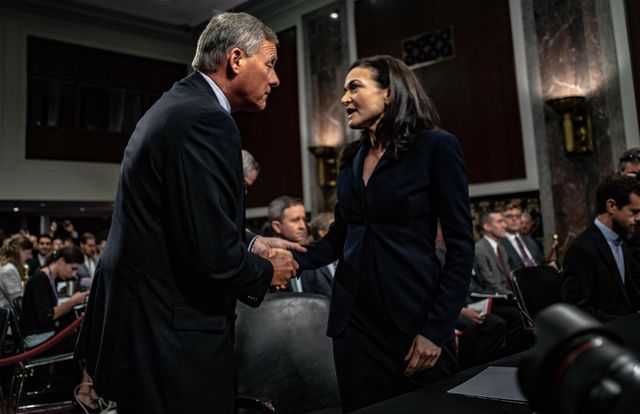
Facebook COO Sheryl Sandberg shakes hands with Senate Intelligence Committee Chairman Richard Burr
In an instant, the world’s largest social media monopoly has removed avenues through which the American population learns about police criminality, state murder, and other government crimes.
An article in the New York Times on Facebook’s moves makes clear that the moves to censor the Internet, which began under the pretext of combatting “Russian meddling” in the 2016 elections, are now openly targeting domestic political organizations.
In “Made and Distributed in the USA: Online Disinformation,” the Times refers approvingly to the suppression of “influence campaigns” that “are increasingly a domestic phenomenon fomented by Americans on the left and the right.” It sites an “information warfare researcher” from the New Media Frontier organization as stating, “There are now well-developed networks of Americans targeting other Americans with purposefully designed manipulations.”
The Times further sites Ryan Fox, co-founder of New Knowledge, as claiming that censored pages and organizations “are trying to manipulate people by manufacturing consensus—that’s crossing the line over free speech.” Fox has previously worked for the NSA and the US Joint Special Operation Command. The CEO of New Knowledge, Jonathon Morgan, is connected to the Brookings Institution and was previously a Special Advisor to the US State Department.
In alliance with the state, Facebook and other social media companies are deciding what organizations constitute “well-developed network” seeking to “manipulate” public opinion. Of course, this applies not to the mass media, which is engaged in constant government propaganda, but opposition groups.
The main targets are left-wing organizations. In August 2017, the World Socialist Web Site published an open letter to Google alleging that it was censoring left -wing, anti-war, and socialist web sites, together with other social media monopolies. As a result of changes to Google’s search ranking algorithm, traffic to leading left-wing pages dropped by as much as 75 percent.
“Censorship on this scale is political blacklisting,” the letter declared. “The obvious intent of Google’s censorship algorithm is to block news that your company does not want reported and to suppress opinions with which you do not agree. Political blacklisting is not a legitimate exercise of whatever may be Google’s prerogatives as a commercial enterprise. It is a gross abuse of monopolistic power. What you are doing is an attack on freedom of speech.”
The same indictment applies to Facebook’s latest action.
Censorship by social media monopolies have been instigated by leading figures within the US government, including Democratic Senators Mark Warner and Dianne Feinstein and Democratic Congressman Adam Schiff, who have demanded that the companies suppress “divisive content” in repeated hearings by the House and Senate intelligence and judiciary committees.
In acting as the agents of the American government in carrying out mass censorship, Facebook is directly violating the First Amendment of the Constitution, which prohibits the government from “abridging the freedom of speech.”
While attempting to hide their efforts behind the false pretenses of stopping “inauthentic behavior,” the social media companies have directly acknowledged that they are engaging in political censorship in internal discussions. An internal Google document leaked on Tuesday admitted that “tech firms have gradually shifted away from unmediated free speech and towards censorship.”
The document acknowledged that such actions constitute a break with the “American tradition that prioritizes free speech for democracy.” Amid growing demands by the government and corporate advertisers to police what users say, the document states, censorship is a means to “increase revenues.”
These efforts are entirely in line with plans by the US military to move towards a police-state regime. Last month, the Atlantic Council summarized the proceedings of a US Special Forces conference that called for a sweeping crackdown on the freedom of expression.
The report observed that “technology has democratized the ability for sub-state groups and individuals to broadcast a narrative with limited resources and virtually unlimited scope,” bypassing the “professional gatekeepers” of the establishment media.
Social media companies have been “thrust into a central role” in seeking to stifle “incorrect” political viewpoints because the vast majority of the population opposes direct government censorship, the report noted.