15 Oct 2018

New Zealand to fine travellers who refuse to unlock electronic devices at border

Tom Peters

A law passed by New Zealand’s Labour Party-led coalition government, which came into effect this month, significantly strengthens the anti-democratic powers of Customs officials to search people entering the country.
The amended Customs and Excise Act allows border agents to fine travellers $NZ5,000 ($US3,300) if they refuse to hand over electronic devices and provide passwords and “other information or assistance,” such as encryption keys, to access private data.
Customs officials do not need to get a warrant or provide any justification to search smartphones, computers and other devices. The law change also allows them to copy and retain data found on such devices.
People entering the United States, Australia, Britain, and many other countries can be subjected to similar invasive searches. US border officials reportedly searched 23,877 electronic devices in 2016.
New Zealand’s amendments, however, go further than other countries in strengthening the power of the state to spy on travellers. A spokesperson for the Customs Service told the New York Times: “We’re not aware of any other country that has legislated for the potential of a penalty to be applied if people do not divulge their passwords.”
The new law further demonstrates the right-wing character of the Labour Party-New Zealand First-Green Party coalition government, which is falsely portrayed in the media as progressive. As it prepares to confront working-class opposition to austerity and war, Prime Minister Jacinda Ardern’s government is boosting the police state apparatus put in place over the past two decades by Labour and National Party governments.
Most significantly, the previous National government vastly expanded the powers of the Government Communications Security Bureau (GCSB), the country’s external intelligence agency, to spy on New Zealand citizens. This followed revelations that the agency had illegally spied on several people. The exposures provoked mass protests throughout the country in 2013.
Before the 2014 election, Labour, NZ First and the Greens claimed to oppose the National government’s law change. In office, however, they have maintained all of GCSB’s expanded powers.
Edward Snowden, the US National Security Agency (NSA) whistleblower, revealed in 2014 that, as part of the US-led Five Eyes intelligence alliance, the GCSB carries out mass surveillance of New Zealanders’ electronic communications. Further leaks in 2015 revealed that the GCSB spies on China and other countries in Asia such as Bangladesh, and several Pacific Island countries, which New Zealand’s ruling class considers its neo-colonial sphere.
Search and surveillance powers for the police and the Security Intelligence Service, NZ’s domestic-focused spy agency, were also expanded under the Nationals, with Labour’s support.
Customs Minister Kris Faafoi said his agency’s new powers were necessary because “organised crime groups are becoming a lot more sophisticated in the ways they’re trying to get things across the border.”
In fact, the legislative change will target many travellers, including independent journalists and political activists, who are unlikely to be able to afford a $5,000 fine to protect their privacy.
There is widespread opposition to the amendment, which was made with complete disregard for the sentiments of the population. An online poll of 11,800 people by the news website Stuff showed that only 33 percent agreed with Customs’ new powers and 64 percent viewed them as “a gross invasion of privacy.”
New Zealand Council for Civil Liberties spokesman Thomas Beagle said in a statement that the law was “a grave invasion of personal privacy,” giving Customs access to “highly sensitive private information including emails, letters, medical records, personal photos.”
The government is expanding state surveillance as part of its preparations to deal with growing working class opposition. This year, for the first time in decades, nurses and teachers have held nationwide strikes against gross underfunding and low wages. Many other workers are looking for ways to fight back against austerity measures imposed since the financial crash of 2008.
The ruling elite is also deeply concerned about rising anti-war sentiment, as New Zealand and Australia become more closely integrated into the US build-up to war against North Korea, China and Russia. Last month, New Zealand extended troop deployments to Iraq and Afghanistan and sent troops to Japan to join the encirclement of North Korea.
In addition to spying on the population, the Labour-led government is recruiting 1,800 more police officers and expanding the military. Since 2012, soldiers have undergone training, in the biennial Southern Katipo exercise, to “restore order” in the event of a popular uprising or civil war in a Pacific island country. Such skills could also be used to suppress unrest in New Zealand.
Internationally, the US and other governments are preparing to defend their economic position through war abroad and class war at home. This cannot be carried out democratically. Free speech is under attack, most notably through the censorship of anti-war, left-wing and socialist websites, including the World Socialist Web Site, by Google and Facebook.
The NZ Customs legislation was undoubtedly drawn up in consultation with Washington. In August, New Zealand ministers attended a Five Eyes meeting in Australia which discussed how the spy agencies could get around encryption software to access private communications. Australia’s government is seeking to pass legislation to force technology companies to provide “back doors” for the state to bypass encryption.
The other Five Eyes members—the US, the UK and Canada—see Australia and New Zealand as a testing ground for measures they intend to deploy against their own populations.
In the New Zealand parliament every party is complicit in the attacks on democratic rights. This includes Labour’s ally, the Green Party, which sometimes presents itself as anti-surveillance.
Green MP Golriz Ghahraman told parliament in March it was “a pleasure to support” the Customs and Excise Act amendments. She stated that concerns about Customs being allowed to “go through your phone and look at your pictures” had been “addressed through the select committee process and through changes to drafting in this bill.” These assurances were a whitewash. Clearly such powers are part of the legislation.
Privacy, free speech and freedom of information are under attack because basic democratic rights are no longer compatible with capitalism, which is plunging the world towards war and economic disaster. The defence of these rights must therefore be taken up by the international working class, mobilised in opposition to the entire political establishment on the basis of a socialist program.

Washington presses Central America to militarize and turn away from China

Andrea Lobo

Last Thursday and Friday, the US Department of Homeland Security hosted the second security conference of the Alliance for Prosperity of the Central American Northern Triangle, which includes El Salvador, Guatemala, and Honduras.
US Secretary of State Mike Pompeo, Secretary of Homeland Security Kirstjen Nielsen and Vice-President Mike Pence were joined by the presidents of Honduras, Guatemala, the Vice-President of El Salvador, the Foreign Secretary of Mexico and representatives of the incoming Mexican administration of president-elect Andrés Manuel López Obrador.
While focusing on reviewing the ongoing build-up of the armed forces in the region, as well as efforts to counter immigration and drug trafficking, the US government used the occasion to warn against falling out of line with Washington’s campaign to counter the growth of China’s influence in the region.
“On behalf of our administration,” Pence declared, “as you build commercial partnerships with other countries, including China, we urge you to focus on, and demand, transparency and look after your—and our—long-term interests.”
After referring to economic challenges in Central America, he added: “Even as countries like China tries [sic] to expand their influence in the region, the best way to solve these problems, we believe, is to strengthen the bonds between the United States and the Northern Triangle and all the nations of our hemisphere to strengthen the economic ties between our nations.”
This warning comes two weeks after Donald Trump’s rant at the UN General Assembly, where he stressed US intentions to enforce the Monroe Doctrine of neo-colonial domination over the hemisphere and warned against “expansionist foreign powers.”
Earlier last month, Washington also temporarily recalled its top diplomatic personnel from El Salvador, the Dominican Republic and Panama in protest over the recent decisions by the governments of these countries to break with Taiwan and establish relations with the Chinese government in Beijing. This dispute also led the Trump administration to cancel a summit with foreign ministers and security chiefs of the Alliance for Prosperity.
Last Friday, moreover, the Pentagon published a report on the status of industrial preparations for war in the United States, in which it interjects specifically that “Chinese investment in developing countries in exchange for an encumbrance on their natural resources and access to their markets, particularly in Africa and Latin America, adds an additional level of consideration for the scope of this threat to American economic and national security.”
While the emphasis on preparing for major geopolitical conflicts and social upheavals is becoming increasingly apparent, the same efforts have been ongoing since the Obama administration created the Plan Alliance for Prosperity in November 2014. While established in immediate response to a surge in the arrival of unaccompanied minors escaping rampant violence and poverty in the Northern Triangle at the time, it was advanced as the first step in a drive to strengthen the US stranglehold over the hemisphere within the framework of “national security” and Obama’s “pivot to Asia” aimed against Chinese influence.
Since then, billions of dollars from the treasuries of these impoverished Central American countries, which have been forced to pick up most of the bill, along with hundreds of millions of dollars from the US government and the Inter-American Development Bank, have been poured into building up the region’s armed forces, as well as significant infrastructure, transport and logistics developments primarily for trade northward, including the US-sponsored creation in 2016 of a Mexico-Central America Interconnection Commission.
So far, the economic effects of the Plan Alliance for Prosperity have not been different from the similar packages of US aid and infrastructure expansion in the early 2000s, which were sold as a means to create jobs for tens of thousands of youth being deported from the US by the Clinton and Bush administrations—many of them because of criminal records and activity in gangs in American inner cities. Most of the benefits from the improved logistics and presence of US corporations went to the local ruling elite and the professional middle class, while unemployment and poverty remained prevalent for the masses and laid the basis for the expansion of the same US gangs re-formed in Central America as the MS-13 and 18th Street maras .
At the same time, these projects have significantly reduced the costs of and streamlined regional trade, and effectively achieved a new level of integration of the supply chains across the continent, and therefore strengthened the objective international links of the working class.
On the other hand, this integration has also been expressed in new inter-army operations and command centers under the supervision of the Pentagon.
This is happening as countries rapidly expand their armed forces. The Mexican president elect announced this week that he intends to add 50,000 new soldiers to the army, a 27 percent increase. Also, since the beginning of the year, the US Embassy has been leading efforts in Guatemala to train and re-deploy the Guatemalan army toward the borders and seas as a “defense force” instead of focusing on police work, while adding 12,000 new police officers and special units.
In May 2017, the US think-tank Atlantic Council published a report laying out the framework for Alliance for Prosperity under the Trump administration. It was co-chaired by the US war criminal and first Director of National Intelligence, John Negroponte, and presented by then US Homeland Security and now White House Chief of Staff, John Kelly.
One of its emphases was a “public-private supply chain security initiative that focuses on the physical safety of transported goods.” As the WSWS warned at the time, this was “directed not only against gangs, but at securing US access to cheap labor across a more ‘integrated’ region in preparation for war.”
While the recent Pentagon report on production centered on the “manufacturing and defense industrial base” within the United States, the military is ultimately calling to reformulate “resilient supply chains” that will undoubtedly be extended across North, Central and South America.
Undoubtedly, this was one of the considerations behind the unprecedented clause in the new US-Mexico-Canada Agreement (USMCA), preventing its signatories from signing free trade agreements with “non-market economies,” referring to China.
The Alliance for Prosperity conference this week was chiefly aimed at communicating this order to the Northern Triangle governments. Although in a much broader vein, the US-Central America and the DR (Dominican Republic) Free Trade Agreement (CAFTA-DR) does include the provision in Article 21.2, that states: “no Party will be prevented from applying the measures it considers necessary to fulfill its obligations regarding the preservation or restoration of peace and international security, or to protect its essential interests in security matters.”
As in the US itself, the deployment of military and police forces against immigrants and refugees subject the most vulnerable layers to the initial brunt of repression, but the militarization at the US-Mexico border and the entire region southward is ultimately aimed at suppressing any social challenge by the entire working class to the drive to turn Latin America into a US battlefield and industrial platform to wage war against other “great powers.”

Brexit crisis leaves fate of May government in balance

Robert Stevens

The future of Prime Minister Theresa May’s government is on a knife edge on the eve of this week’s crucial talks on the terms of the UK’s withdrawal from the European Union (EU).
The dilemma in ruling circles is over whether the government can reach a deal with the EU, preserving access to the Single European Market, that does not precipitate a rebellion by the Conservatives’ pro-Brexit wing and the Democratic Unionist Party (DUP), which might force a general election bringing a Jeremy Corbyn Labour-led government to power.
EU officials led by Michel Barnier were in last-minute discussions with UK negotiators in Brussels yesterday, called for by Brexit Secretary Dominic Raab. On Tuesday, a meeting of EU ministers will take place, as well as a meeting of May’s cabinet, ahead of a full EU summit Wednesday and Thursday.
Contending pro- and anti-EU factions are insisting that May accede to their demands, or they will reject any deal she reaches. Such is the factional acrimony that it is difficult to estimate the numbers involved or how far they are willing to go to achieve their ends.
The DUP have 10 MPs elected by constituents in Northern Ireland and prop up May’s minority government. It is opposed to every aspect of May’s Chequers Plan for a “soft Brexit” maintaining tariff-free single market access, agreed in cabinet in June. The plan proposed, at the EU’s insistence, that there be a “backstop” in place—after the UK leaves the EU—aligning Northern Ireland in a customs arrangement with the Republic of Ireland, an EU member. This was to ensure there will be no “hard border” between the south and north.
An end date for the backstop had been provisionally set for December 2021, but this time limit is opposed by the EU. BBC’s “Newsnight” reported Friday that May intends to get around this by inserting a “review clause” for the backstop rather than an end-date. This has only inflamed the opposition of the DUP and the Tory Brexiteers.
On Saturday, DUP leader Arlene Foster reiterated that her party would be prepared to vote against the Tories’ upcoming October 29 budget if May’s proposals on the Irish border issue remained in place. Writing in the Belfast Telegraph, she said, “I fully appreciate the risks of a ‘no deal’ (Brexit) but the dangers of a bad deal are worse.
“This backstop arrangement [proposed by May] would not be temporary. It would be the permanent annexation of Northern Ireland away from the rest of the United Kingdom and forever leave us subject to rules made in a place where we have no say.”
The pro-EU Observer reported emails between Foster and Barnier, “leaked from the highest levels of government,” that the DUP was positioning itself for a “no deal Brexit.” One email claimed, “AF [Arlene Foster] said the DUP were ready for a no deal scenario, which she now believed was the likeliest one.”
The weekend witnessed a flurry of articles and comments against May by her former Brexit Secretary David Davis—who called for a Cabinet rebellion against May—former Foreign Secretary Boris Johnson and Jacob Rees Mogg, the leader of the anti-EU European Research Group. The Sunday Telegraph led its front page with a report that 63 hard Brexit Tory MPs have written a letter to May attacking her Brexit forecasts.
The pro-Tory Spectator commented, “If the DUP voted against May’s deal, getting it through the Commons would become very difficult. In these circumstances, even if the whips succeeded in reducing the Tory rebellion to 15 or so, which would be an impressive feat of party management, they would still need 25 Labour MPs to back the deal. That would be a stretch.”
Under the UK’s fixed term Parliament legislation, governments now cannot formally make votes an issue of no confidence—and are unable to utilise the calculation that rebel MPs would not vote against a sitting prime minister as this would result in the fall of the government. The Spectator commented that “Mogg and co believe they can vote down her deal but still vote to keep the government in place.” But it suggested a way in which May could call their bluff by raising the stakes to the highest possible level:
“These Tory rebels, though, would face an acute dilemma if May, having lost a first vote, responded by announcing she was holding another one. If the Commons again rejected her plan, she would then go to the palace and advise the Queen to call Jeremy Corbyn and ask him to form a government. While this plan would be a high-risk move, it would put the Tory rebels on the spot.”
The intervention made by former Labour leader Tony Blair into the crisis was extraordinary, in that it was framed openly as a means of avoiding the election of a Labour government. Speaking to Reuters, he described the prospect of a Corbyn government as a “truly damaging and challenging situation.” He urged Labour MPs not to back any deal May came back with as a supposedly better option than a no-deal Brexit, even though voting down a deal would be “really difficult” and create more uncertainty. This would lay the basis for a second referendum on Brexit, with the possibility of reversing the 2016 vote. The Tories, he said, would be “suicidal” to hold a general election on the issue of Brexit, but the majority of Tory MPs could back a second referendum on Brexit.
Blair intervened amid claims being made by May’s aides that 25 to 30 Labour MPs were ready to rebel against a whip imposed by Corbyn and vote with her to pass a “soft-Brexit” deal. Such claims were denied by several leading Blairites who echoed his call for a second referendum. The Labour-supporting New Statesman commented that “a golden rule of any story about rebellions is that the word ‘up to’ is always a synonym for ‘less than’.”
With any Brexit deal on offer and a no deal all threatening major economic dislocation, big business is stepping up its preparations. Later this month, Jaguar Land Rover (JLR), Britain’s biggest carmaker, will temporarily shut down one of its largest UK plants at Solihull, affecting 9,000 workers’ jobs. This follows JLR’s announcement last month that it would impose a three-day working week at its Castle Bromwich factory until Christmas. The company laid off 1,000 agency staff earlier this year.
JLR said its two-week shutdown was in response to a nearly 50 percent slump in Chinese demand for its luxury Range Rover vehicles, an overall year on year 12 percent decline in sales, and the ongoing move against diesel motors in Europe. However, a piece in the Financial Times Sunday revealed the extent to which a hard Brexit scenario is driving their response. It noted, “The company has already spent several million pounds on contingency planning, talking to every port in the UK and installing AI [artificial intelligence] systems that will help it automatically fill out some paperwork.”
The majority of JLR’s production is based in the UK but Hanno Kirner, the company’s strategy director, said a “hard Brexit” leading to tariffs being imposed “would drive us to reconsider our industrial footprint and it would, probably, necessitate building more cars where we sell them. … That would be in Europe, most likely.”

US, European powers threaten Saudi crown prince after Khashoggi murder

Alex Lantier 

Mounting evidence that Saudi crown prince Mohammed bin Salman ordered the gruesome October 2 murder of Saudi journalist and Washington Post contributor Jamal Khashoggi has unleashed a political crisis of global proportions.
Over the weekend, Turkish officials again charged that Saudi Arabia sent a 15-man death squad to the Saudi consulate, armed with a bone saw, to murder and dismember Khashoggi and transport his remains out of Turkey. The daily Sabah wrote that Khashoggi’s Apple watch, synced to the iPhone he left with his Turkish fiancée Hatice Cengiz outside the consulate, recorded his murder: “The moments when Khashoggi was interrogated, tortured and murdered were recorded in the Apple Watch’s memory.”
US intelligence officials endorsed the authenticity of these recordings, possibly taken from bugs planted by Turkish intelligence in the consulate. They told the Washington Post: “The voice recording from inside the embassy lays out what happened to Jamal after he entered. You can hear his voice and the voices of men speaking Arabic. You can hear how he was interrogated, tortured and then murdered.”
These charges against America’s closest Middle East ally, also the world’s largest oil exporter at the heart of the global financial system, expose the brazen criminality of the entire financial aristocracy. A profound contradiction underlies the official response to Khashoggi’s murder. US and European businessmen and politicians are deeply tied to the brutal Saudi regime, which underwrites both US war strategy in the Middle East and the capitalist financial system as a whole.
They are flocking to the “Davos in the Desert” conference planned for this month in the Saudi capital, Riyadh. The initial conference last year was attended by former British Prime Minister Tony Blair and French President Nicolas Sarkozy. Among those still slated to attend this year’s conference are US Treasury Secretary Steven Mnuchin, JP Morgan Chase CEO Jamie Dimon, and BlackRock investment firm CEO Lawrence Fink, whom Barron’s magazine recently crowned the “New Conscience of Wall Street.”
While conference attendees “cringe at lending their names or prestige to Crown Prince Mohammed’s gathering,” the New York Times reported, the murder charges against Riyadh leave “many financiers and technology executives in a deeply awkward position. Some have made multibillion-dollar investments in Saudi Arabia; others are managing billions of dollars of Saudi money. They want to keep the money flowing ...”
At the same time, however, a debate is emerging in the imperialist capitals over whether to use the Khashoggi murder to push for a change in personnel at the top of the Saudi regime. After US senators threatened to invoke the Global Magnitsky Act yesterday, allowing Washington to impose sanctions on top Saudi officials, the Saudi stock exchange plunged 7 percent.
Speaking on CBS television yesterday, Donald Trump pledged “severe punishment” for the “terrible and disgusting” killing, while pledging to continue arming Saudi Arabia to the teeth. The Saudis “are ordering military equipment. Everybody in the world wanted that order,” Trump said, adding: “I tell you what I don’t want to do. Boeing, Lockheed, Raytheon, all these companies. I don’t want to hurt jobs. I don’t want to lose an order like that. And you know there are other ways of punishing, to use a word that’s a pretty harsh word, but it’s true.”
“There are other things we can do that are very, very powerful, very strong and we’ll do them,” he said, without specifying what this meant.
The UK, German and French foreign ministries issued a joint statement calling for “a credible investigation to establish the truth about what happened, and—if relevant—to identify those bearing responsibility for the disappearance of Jamal Khashoggi, and ensure that they are held to account. We ... expect the Saudi Government to provide a complete and detailed response.”
The Saudi monarchy responded with an aggressive statement stressing its “total rejection of any threats and attempts to undermine it. … The kingdom also affirms that if it is [targeted by] any action, it will respond with greater action.” With Saudi Arabia providing key oil exports to the world market to make up for supplies lost as Washington re-imposes sanctions on Iran, it warned that Saudi Arabia “plays an effective and vital role in the world economy.”
Turki Aldhakhil, the manager of Saudi Arabia’s Al Arabiya news, penned a piece threatening that Saudi Arabia could form a military alliance with Russia and slash its oil exports, sending oil prices to over $100 a barrel and devastating the already crisis-ridden world economy. He wrote, “The truth is that if Washington imposes sanctions on Riyadh, it will stab its own economy to death, even though it thinks that it is stabbing only Riyadh.”
US and European threats are utterly hypocritical and mark a new stage in their decades-long campaign of bloody imperialist wars, occupations and intrigue in the Middle East, from Iraq and Syria to Afghanistan, that have cost millions of lives and turned tens of millions into refugees.
They did not object as the Saudi regime executed hundreds of people per year and viciously attacked political opposition among working people. This year, Riyadh ruled it would decapitate the 29-year-old female political activist Israa al-Ghomgham, her husband, Moussa al-Hashem, and three others for the crime of organizing peaceful demonstrations against the monarchy. This provoked no observable change in US or European policy toward Saudi Arabia.
Seven years after working-class uprisings toppled US-backed dictatorships in Tunisia and Egypt, the NATO powers are united with the Saudi royal family in their fear of the working class in Saudi Arabia and beyond. One former diplomat bleakly told the Washington Post that Prince “Mohammed knew that if meaningful jobs were not found for Saudi Arabia’s young and highly educated population, and if the oil-dominated economy were not diversified, ‘they were doomed.’”
Current US calls for a change in personnel at the top of the Saudi monarchy aim to strengthen it against opposition at home, whip its foreign policy more closely into alignment with US interests, and in particular to block any move by Riyadh toward closer alignment with Russia or China.
The hypocrisy of attempts to wrapping this bloodstained agenda in the fraudulent banner of human rights was exemplified by former CIA director John Brennan’s column on the Khashoggi murder in the Washington Post, titled “The US should never turn a blind eye to this sort of inhumanity.”
Reports of Khashoggi’s disappearance, Brennan intoned, “have the hallmarks of a professional capture operation or, more ominously, an assassination.” Citing his long professional experience with Saudi officials, Brennan added: “I am certain that if such an operation occurred inside a Saudi diplomatic mission against a high-profile journalist working for a US newspaper, it would have needed the direct authorization of Saudi Arabia’s top leadership—the crown prince.”
Who does Brennan think he is kidding, pretending to be repulsed by the “ominous” signs of an assassination? If he can recognize the hallmarks of state murder, it is because the CIA is the world’s leading expert in torture and killing. Its thousands of drone murders, its network of “black site” prisons and torture centers, and its bloody history of coups and provocations are infamous internationally, as proof that the single most dangerous force in the world is American imperialism.
Based on his selective outrage, Brennan outlined a plan for reacting to Khashoggi’s murder with a campaign against the Saudi regime similar to US threats against Russia.
Ideally, the Saudi regime would punish “those responsible,” Brennan wrote, but if it “doesn’t have the will or the ability, the United States would have to act. That would include immediate sanctions on all Saudis involved; a freeze on US military sales to Saudi Arabia; suspension of all routine intelligence cooperation with Saudi security services; and a US-sponsored UN Security Council resolution condemning the murder. The message would be clear: the United States will never turn a blind eye to such inhuman behavior, even when carried out by friends, because this is a nation that remains faithful to its values.”
The CIA’s grotesque invocation of American “values” as a justification for stepping up US intrigue in the Middle East is absurd on its face.
The task of dealing with the bloodstained Saudi monarchy belongs to the working class and oppressed masses of Saudi Arabia. Intrigues by the CIA and allied intelligence services trying to engineer a change in the Saudi regime’s ruling personnel, it can be safely predicted, will only produce more economic turmoil and bloodshed.

A quarter-million protest in Berlin against the grand coalition and the return of fascism

Ulrich Rippert

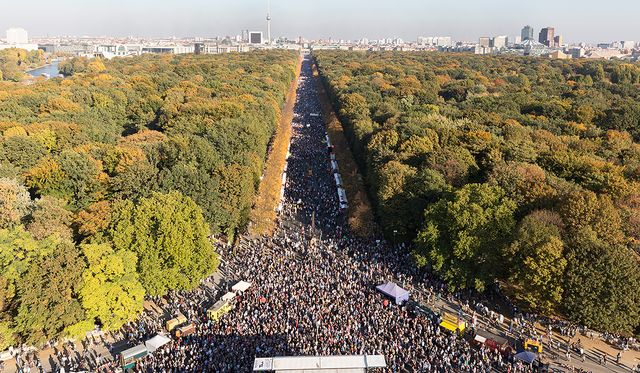
Nearly 250,000 people demonstrated Saturday in Berlin against racism, the far-right Alternative for Germany’s witch-hunting of immigrants, and the reactionary policies of the grand coalition government.
Demonstration at Potsdamer Platz
Organized around the central slogan “#indivisible—solidarity instead of exclusion,” the protest was one of the largest in recent German history.
The organizers had expected 40,000 participants and were stunned when more than six times that number showed up to demonstrate. The opening rally at Berlin’s Alexanderplatz was jam packed, and when the front of the demonstration arrived at the Victory Column, just under three kilometres away, many still had not set off from the starting point.
The protest was the culmination of a growing mobilization against the grand coalition government of the Christian Democrats and Social Democrats, which is implementing the xenophobic and right-wing extremist positions of the Alternative for Germany (AfD) in all major policy areas.
In recent weeks, demonstrations against the AfD and the right-wing policies of the grand coalition have taken place in a number of cities. They have for the most part been given little coverage by the media. Most recently more than 40,000 people demonstrated in Munich and Hamburg against racism and a new, right-wing police law.
Especially since the events in Chemnitz and Dortmund, where far-right thugs and neo-fascists chased down foreigners, evoking sympathetic and supportive comments from the police, the secret service and the federal interior minister, resistance to the government has been increasing. On Saturday, protesters carried banners and posters saying, “No to Hate Against Muslims,” “No Place for Nazis” and “Racism is Not an Alternative.”
One banner read, “Solidarity with the Victims of Right-Wing, Racist and Anti-Semitic Violence.”
In addition to the fight against racism and xenophobia, demonstrators opposed the government’s anti-social policies and the growth of economic inequality. Ulrich Schneider, chief executive of the Joint Welfare Association, warned of the effects of rising poverty in Germany and called for urgent action by the government against uncontrolled increases in rents in many cities. He also denounced the efforts to pit the growing ranks of the poor and needy against immigrants and asylum seekers.
An employee of the low-wage airline Ryanair spoke about the brutal conditions confronting the workers and the strikes by Ryanair pilots and flight attendants in recent months.
A section of the 250,000 person demonstration
The demonstration was called by the “Indivisible” alliance, a coalition of some 4,500 associations, organizations and individuals. The alliance was joined by church organizations, charities and trade unions. Many celebrities, including the well known actor Benno Fürmann, the television presenter Jan Böhmermann and the band Die Ärzte, supported the protest. In the evening, a performance was given by songwriters Konstantin Wecker and Herbert Grönemeyer.
When it became clear in the run-up to the demonstration that the turnout could be bigger than originally anticipated, a number of political parties attempted to become involved. Foreign Minister Heiko Maas of the Social Democratic Party (SPD) spoke of a great “affirmation of tolerance and cosmopolitanism.” Instead of sealing off [borders] and promoting nationalism, he declared, what was needed was more diversity and solidarity.
This was said by an SPD minister whose party supports the so-called “master plan” against foreigners drawn up by Interior Minister Horst Seehofer of the Christian Social Union (CSU). The plan is a scheme for locking up immigrants in camps, where they can be bureaucratically abused and deported as quickly as possible. Last year, in the previous grand coalition government, then-Justice Minister Heiko Maas had attacked anti-G20 demonstrators in Hamburg as “left-wing extremists” and called for the holding of a “rock against the left” concert.
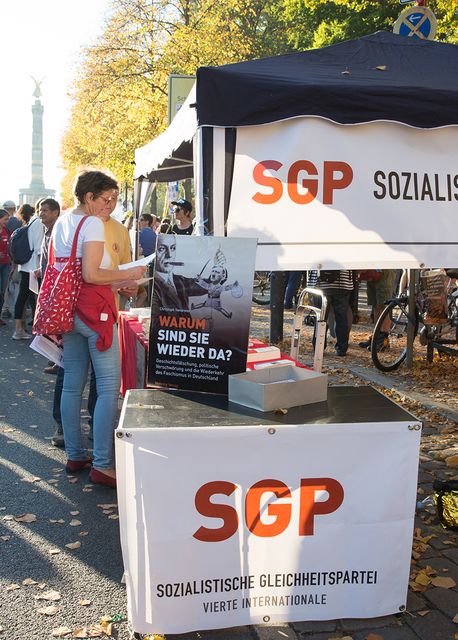
At the demonstration, the Sozialistische Gleichheitspartei (Socialist Equality Party—SGP) distributed many thousands of leaflets with the headline “The fight against right-wing terror requires a socialist perspective.” At two information stands, the SGP announced the publication of a new book titled Why are they back? Historical falsification, political conspiracy and the return of fascism in Germany. The book attracted great interest and sparked many discussions.
SGP information stand
A young woman who had come to the demonstration with her mother from Luckenwalde in Brandenburg expressed great concern over the strengthening of the AfD and the increase in right-wing violence. “I think it is high time to fight right-wing tendencies and violence,” she said. “It is already the case that too much is accepted that is inhuman. We saw in World War II where that leads. In my opinion, we can see the beginnings here. We have to oppose that.”
Another demonstrator said she was participating in the protest to deliver on a promise she had made to her grandmother that she would never again experience such terrible events as she had experienced in her lifetime.
In many discussions, the right-wing policies of the grand coalition came up. It is widely understood that the establishment of a system of camps and the brutal deportation of refugees means that the government has adopted the slogan of the AfD, “Foreigners Out!”
A young man from Frankfurt am Main, who did not want to give his name for fear of reprisals, expressed indignation at the government’s policy. The treatment of refugees was “completely unacceptable,” he said. It was also “unacceptable that those who wanted to help refugees were treated like criminals,” he added. One had to assume, he continued, that in the next few years, because of the effects of climate change and the exploitation of the countries of Africa and the Middle East, more migrants would be forced to leave their homelands.
People are outraged by the fact that more than 1,500 refugees have drowned in the Mediterranean this year alone, and the German government and European Union are under such conditions constantly tightening their refugee policies. This was made clear by banners such as “Sea Rescue is Not a Crime.”
Michael said he was “appalled and angry” about the situation. The sealing off of Europe’s borders meant the government was allowing “hundreds of refugees to drown in the Mediterranean, which is terrible.”
Michael
He stressed that the government’s inhumane policy was directed not only against refugees, but also against its own people. While “billions of euros” were being spent on arming the military, “there is just as little money left for refugees as for healthcare, kindergartens and many other social needs,” Michael said.
At the closing rally, when it was announced from the platform that there were also SPD officials and leaders of the Left Party and the Greens present, there were loud whistles and boos. Maya, a sales assistant from East Berlin, said angrily that it was “unheard of for the SPD to be demonstrating here while it carries out in government exactly the policy that is being protested against.”
Overall, the protest was characterized by a marked contradiction. While many demonstrators were outraged by the AfD, the growth of neo-fascist forces and the right-wing policies of the government, and were looking for a way to counter this, most of those addressing the rally sought to calm things down and de-escalate the situation. Their key words were harmony, reconciliation and neighbourly love.
In his speech, the secretary-general of the German section of Amnesty International, Markus Beeko, referred to the Universal Declaration of Human Rights, which was passed almost 70 years ago. This guaranteed, he said, “universal and indivisible rights to every human being on this earth.” The right to think and say what you want, to believe who you want, to be protected from torture or persecution, to marry whomever you love—it was “a great idea” for which it was worthwhile getting involved.
The Protestant theologian and Berlin General Superintendent Ulrike Trautwein emphasized that hate damages social coexistence. She pointed to the peaceful demonstrations in East Germany in the autumn of 1989. At that time, a common slogan was “no violence.” The pastor exclaimed, “That should connect us today! No violence!” She said she feared that racism and anti-Semitism could make social violence socially acceptable again.
Jutta Weduwen, executive director of the Action Reconciliation Service for Peace (ASF), also expressed concern over the increase in social conflict and warned against “eroding solidarity and cold feelings.”
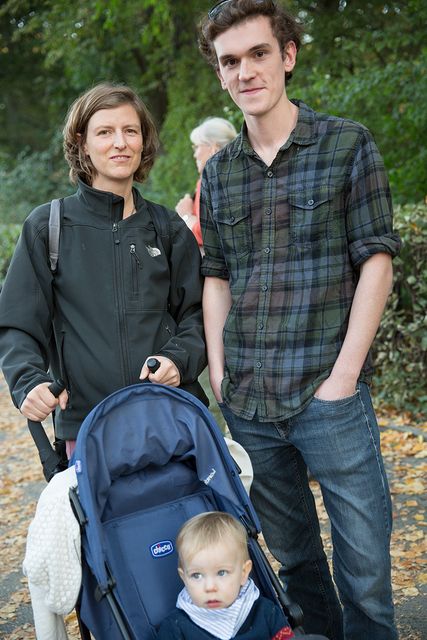
Hannah and Mathew
Many protesters responded to such calls for harmony with unease or hostility. This sentiment clearly emerged in a conversation with a couple from Berlin, Hannah and Mathew, who marched while wheeling their child in a pram. “I’m not as full of love as keeps being stressed here,” said Mathew, who comes from Scotland and is studying in Berlin. “When I see the right-wing extremists on the rise again, I’m angry. What I miss in all the speeches is a fight—not violence, but a political struggle.”
“It’s not all about love,” added Hannah, who has already completed her biology studies. “The cause of the problems is capitalism and the constant intensification of exploitation. We need a left-wing movement that fights against the existing system and does more than say love one another, be nice to each other. What is missing is a vision, a political idea.”
The demonstration Saturday was marked by the fact that very different positions on the fight against right-wing extremists and neo-fascists existed side by side. But it can already be seen that the aggravation of social conflicts will very quickly lead to a political differentiation.
The intervention of the Sozialistische Gleichheitspartei was directed toward preparing the next stage of the struggle and making clear that the fight against the right requires a struggle against capitalism and therefore a socialist perspective.
The SGP has shown in recent years how the rise of the AfD and the neo-fascists was ideologically prepared. It has fought against efforts to downplay the crimes of German imperialism and the Nazi regime by professors such as Jörg Baberowski and Herfried Münkler at Humboldt University. It has warned of and exposed the return of German militarism. It has fought to mobilize the working class against these developments and their source in the capitalist system and all of its political parties and apologists, including the supposedly “left” organizations such as the SPD, the Left Party and the Greens.
The SGP leaflet to the demonstrators states: “The only social force that can counter this development and stop the right wing is the international working class. For this reason, we call for the expansion of working class struggles across the continent. The conspiracy of the grand coalition, the intelligence services and right-wing extremists must be ended.
“It is time to revive the revolutionary socialist traditions of Marx, Engels, Luxemburg, Liebknecht, Lenin and Trotsky, defended only by the International Committee of the Fourth International and its sections. The SGP calls on workers and young people to join and to take up the fight against capitalism, fascism and war.”

13 Oct 2018

Australian “edu-business” set to profit under Gonski 2.0

Erika Zimmer

Last month, the South Australian Liberal Party government announced that it will partner with a major international education software provider, Civica, to “transform school and preschool operations.” The decision underscores the pro-business agenda behind the Gonski 2.0 plan for Australian school education.
The Gonski 2.0 report, announced in May, was overseen by David Gonski, a prominent member of Australia’s corporate and financial elite. It advocates an even more regressive testing regime than the NAPLAN (National Assessment Program—Literacy and Numeracy) model, implemented by the Rudd Labor government in 2008 as part of its “Education Revolution.”
NAPLAN itself was based on testing regimes introduced decades ago in the US, following business demands that schools adopt “standards” and “standardised testing.” According to academics, the test industry in the US alone is now worth $48 billion annually, part of a $4.3 trillion global education industry.
Civica states on the company’s website that its Civica Education Suite has been designed “to enable schools to fully embrace the Gonski 2.0 report recommendations.” It is to be rolled out to 30,000 teachers and 185,000 students in the state of South Australia.
For its part, the New South Wales (NSW) government, in Australia’s most populous state, has made clear its determination to proceed with the Gonski 2.0 agenda, following the publication of the Gonski 2.0 report by announcing that it would be conducting a major review of the NSW school curriculum. However, while the “review” would take 18 months to complete, NSW Education Minister Rob Stokes decided to declare its outcome in advance. It will implement the findings of the Gonski 2.0 report.
The speed with which governments have taken up the Gonski 2.0 recommendations is only matched by their failure to investigate why the current education model has, according to the Gonski 2.0 report, “failed a generation of students.” It also confirms the warnings made by the WSWS from the outset, that the fundamental aim of both NAPLAN and Gonski 2.0 is to align school education ever more closely with the rapidly evolving interests of so-called “edu-business.” (Link to Gonski 2.0 article May 2018)
Ex-federal education minister Julia Gillard promoted the NAPLAN testing regime on the basis that it would improve education outcomes, especially for low achievers. In reality, and predictably, it has had the opposite effect. The already stark inequities in Australia’s school system have widened and the concentration of disadvantaged students in disadvantaged schools increased to one of the highest in the OECD.
The Gonski 2.0 blueprint titled, Through Growth to Achievement: Report of the Review to Achieve Educational Excellence in Australian Schools is being sold as an education model that promotes individualised learning. A key component of its recommendations is for schools to measure individual students’ “learning progressions,” rather than assessing progress according to a student’s age or year level. In other words, in addition to the NAPLAN periodic assessment every two years, teachers will be required to continuously analyse a student’s proficiency in relation to hundreds of new criteria.
The fact that a pilot mass data collection system, ALAN (Assessment for Literacy and Numeracy), has been set up in hundreds of NSW schools this year, and rejected by teachers as unworkable, has done nothing to halt the rush by governments and business to forge ahead with Gonski 2.0.
The NSW Education Department was forced to pause the rollout of ALAN after teachers found it time consuming and overwhelming. Teacher Dan Hogan told the Sydney Morning Herald that the workload involved addressing more than 1000 indicators, across seven so-called “sub-elements” of literacy and numeracy, for each child.
These “learning progressions” have to be “micro-audited” to document a child’s progress from beginner to master of a subject, with teachers updating each indicator every five weeks.
“The micro level to which teachers are expected to be assessing and plotting children is beyond ridiculous,” one teacher told the NSW Teachers Federation.
Dismissing teacher objections, NSW Education Department secretary, Mark Scott, endorsed ALAN, declaring it was in line with Gonski 2.0’s recommendation for more focus on individual growth.
Academic Anna Hogan has warned that profit making, not evidence, underpins the agenda of edu-business. Writing on NAPLAN she stated, “According to ACARA (the Australian Curriculum Assessment and Reporting Authority responsible for developing the test), NAPLAN is delivered by ‘experts’ across the field. It seems problematic that experts in this case are not teachers, curriculum developers or even university researchers. Instead experts are constituted by their ability to offer “‘value-for-money’ on competitive tender applications.”
Hogan also raised concerns over potential conflicts of interest, whereby edu-businesses are “contracted to develop aspects of NAPLAN, but also create revenue through marking the NAPLAN test and the selling of resources to improve NAPLAN results.” The NAPLAN market includes practice tests, student workbooks, online programs, tutoring, teacher professional development and data analysis for schools. One such test, the PAT (Progressive Achievement Test) records data that is utilised to prepare for NAPLAN. PAT has been purchased by over 7,000 of Australia’s 9,400 schools.
Gonski 2.0 will open up opportunities for edu-business to reap far bigger profits. In June, Deputy President of the NSW Teachers Federation (NSWTF), Joan Lemaire, claimed, following what she described as “productive discussions” with the NSW Education Department, that the mass data collection by teachers would be “slowed down.”
In reality, the opposite is the case. In July, Correna Haythorpe, President of the Australian Education Union (AEU), affiliated to the NSWTF, told delegates at the NSW Teachers Federation Annual Conference that the federal government intends to tie school funding to the introduction of Gonski 2.0’s “learning progressions and an online assessment tool.” Moreover, while the NSW ALAN trial only covered two curriculum areas, maths and literacy, the National School Reform Agreement between the Commonwealth and state and territory governments would cover 15 areas: the seven Key Learning Areas, in addition to 8 “general capabilities,” an initiative outlined in the Gonski report designed to boost student workforce skills. At the same time NAPLAN would be retained.
“So NAPLAN, learning progressions, online assessment tools—when will teachers actually have the time to teach? It’s a resource-intensive, one-size-fits-all school reform, without any additional resources,” Haythorpe told the Conference.
The teachers’ unions are well versed in posturing as opponents of the government’s pro-business education reforms. In 2010, following mass opposition to NAPLAN, they pledged to organise a national boycott of the regressive testing regime, only to call off the ban at the last minute, after the government agreed to include the union in its “working party” to examine the use of student performance data. The union then insisted that their members administer the tests. Haythorpe’s main concern over the introduction of Gonski 2.0 reforms is not their impact on teachers, but the fact that the unions have not been consulted.
The teachers’ unions will enforce, not fight, the pro-business agenda of the entire political establishment. The Socialist Equality Party has established the Committee for Public Education in order to mobilise the rapidly growing opposition of teachers, parents and students, outraged at the ongoing dismantling of public education. Such a struggle can only be based on a socialist perspective, fighting for the transformation of society as a whole in the interests of the working class, not the privileged few.
We urge all those who agree with the CFPE’s perspective to become actively involved in this vital political initiative.

Australian government flags forcing new immigrants to live in designated zones

Mike Head 

The government of recently-installed Prime Minister Scott Morrison this week launched a concerted bid to blame immigrants, including refugees, for the soaring living costs and deteriorating basic infrastructure that confront millions of working class people.
The Liberal-National Coalition government is seeking to whip up a xenophobic and anti-immigrant social base. It is accusing migrants of causing “congestion” in Australia’s biggest metropolitan areas—Sydney, Melbourne and Brisbane-Gold Coast.
The turn to scapegoating immigrants is another indication of the wholesale lurch to the right within the political establishment signalled by the late August backroom removal of Morrison’s predecessor Malcolm Turnbull.
Within weeks of taking office, Morrison told Fairfax Media last month that he wanted a “fair dinkum” conversation about population and tougher rules to slow the entry of migrants into “congested” cities. His comments echoed the calls issued by far-right and anti-immigrant outfits, such as Senator Pauline Hanson’s One Nation.
Home Affairs Minister Peter Dutton, who triggered Turnbull’s ouster, is already boasting of having slashed the annual immigration intake from about 190,000 to 160,000.
On Tuesday, Population Minister Alan Tudge foreshadowed plans to force newly-arrived immigrants to live in designated parts of the country. “We are working on measures to have more new arrivals go the smaller states and regions and require them to be there for at least a few years,” he declared in a speech at the Menzies Research Centre, a Coalition thinktank.
Fearing widespread opposition in Australia’s increasingly internationalised working class, which is comprised of workers from all over the world, Tudge provided no information on how such a regime would be monitored, policed and enforced. The mooted scheme would resemble an apartheid-style system in which immigrants would be compelled to carry identification, and be under constant surveillance by the Australian Border Force.
Nor did Tudge refer to the penalties—most likely detention or deportation—for families who breached the zoning system. Scenes like those in the United States, where Immigration and Customs Enforcement (ICE) officers swoop on homes and workplaces of alleged “undocumented” migrants, would be certain to follow.
The type of measures being drawn up behind closed doors was indicated by Australian opinion columnist Niki Savva. She asked if immigrants would be treated like prisoners released on parole. “Would it be like home detention with ankle bracelets or subcutaneous devices to alert authorities to their whereabouts?” she suggested. “What happens if people are found residing outside the borders of their designated living areas? … Would they be rounded up, detained, returned to the country towns they are meant to be in—along with their partners or children—or sent back to their place of origin for breaching their visa conditions?”
There is a dark history of such measures in Australia. Many indigenous people were confined to missions and reservations until the 1970s and thousands of “enemy aliens” from Italy, Germany and Japan were rounded up and interned during World Wars I and II.
Tudge’s speech specifically targeted people of Chinese descent. He warned that the “multicultural composition of our population is also changing rapidly,” noting: “Today, over a million Australians have Chinese heritage.”
These divisive remarks were made in a definite context. The Trump administration has embarked an escalating tariff and economic war to prevent China from challenging the US as the global military and corporate hegemon, accompanied by provocations that could trigger armed conflicts in the South China Sea and elsewhere, leading to another world war.
Tudge alleged that immigration was producing unprecedented “integration challenges.” There were people who “struggle to speak the national language,” a “higher than ever concentration of the overseas born in particular areas” and “a small minority” that was “challenging our values and sometimes using violence to do so.” Tudge has previously proposed stronger English language tests to block unwanted migrants.
One aim of compelling immigrants to live in specified zones is to make them available to employers as a cheap labour force, driving down wages for all workers. This already occurs in regional areas where refugees, international backpackers and Pacific Island temporary visa holders are ruthlessly exploited, often as fruit pickers or meatworkers.
Above all, the parliamentary establishment is seeking to channel the growing popular discontent over inequality and falling living standards in reactionary nationalist directions. Tudge essentially accused incoming migrants of clogging the roads and trains in the urban centres, saying average peak time commuting now took almost twice as long as it did a decade ago.
In reality, working class people face worsening traffic and public transport logjams and delays because of the profit-driven character of urban development under capitalism. Billionaire property magnates dominate residential construction, build with little or no regard for the transport, education, health and social needs of residents. Banks, investors and speculators have driven up housing prices, forcing workers to live on far-flung city outskirts. Basic services, including water, power, public transport, roads and airports, have been privatised or franchised, adding to the chaos and costs inflicted on working people.
Tudge claimed the government was undertaking a “massive boost in infrastructure expenditure” to build road and rail networks. In fact, the level of spending has fallen per head of population. Moreover, the projects he listed are mostly expensive toll roads and other developments that will proceed only if they generate huge profits for their corporate operators.
Even if the Morrison government’s supposed “record $75 billion in forward 10-year plans” materialises, it stands in stark contrast to the $200 billion allocated for military weaponry—that is war preparations—over the same period.
Morrison and his ministers know they have backing throughout the parliamentary elite for their immigrant-bashing. On the eve of Tudge’s speech, Labor Party leader Bill Shorten wrote to Morrison proposing a bipartisan “population task force,” indicating support for “a new settlement policy” to redistribute people away from Sydney and Melbourne.
From their “White Australia” origins onward, Labor and the trade unions have long records of trying to isolate and divide workers in Australia from their fellow workers in Asia and globally. Spearheaded by Prime Minister Julia Gillard, the last Labor government began to cut immigration numbers and advanced a similar plan for regional settlement zones.
The underlying Labor-Coalition unity was displayed again this week when New South Wales Premier Gladys Berejiklian followed Tudge’s speech by saying immigration had been allowed to “balloon out of control” in Sydney and her state. State Labor leader Luke Foley objected that Berejiklian had “panned” him in March for issuing a similar call. In March, Foley sought to fuel racist sentiment, claiming that immigrants were causing a “white flight” from Sydney suburbs.
As in the US and Britain, the Murdoch media is fanning the anti-immigrant scare-mongering. Recent editorials in the Australian have urged politicians not to be “afraid of a frank and sensible debate about the pros and cons of immigration,” claiming it was the “barbecue-stopping” concern of voters.
Exactly the opposite is true. The ruling class, exemplified by Murdoch, and its political servants are seeking to cultivate a right-wing constituency and use it against the growing opposition in the working class to social inequality and deteriorating conditions.
Workers should reject the poisonous drive to pit them against each other along national, ethnic and communal lines. Immigrant workers and their families have the basic democratic right to live and work where they choose. The only way to reverse the corporate offensive on living standards and halt the lurch toward war is to unify the struggles of the working class on a global basis to overturn capitalism and reorganise economic and social life to satisfy human need, including by pouring trillions of dollars into the advanced infrastructure necessary for modern life.

Russia: Putin ally Kudrin pushes for rapprochement with the imperialist powers

Clara Weiss

Alexei Kudrin, one of Vladimir Putin’s closest allies, has stepped up his campaign for a rapprochement with the imperialist powers.
In recent days, Kudrin made several statements indicating that a powerful wing in the Kremlin seeks to mend ties with the West. On Wednesday, Kudrin argued that the sanctions by the West “create great risks for the speed of [economic] growth.” They would make it virtually impossible for Putin’s outlined goals for social improvement to be realized, Kudrin said.
This comes after years in which the Kremlin has officially tried to argue that the Western sanctions have had no significant impact on the Russian economy. Then, Kudrin warned that the sanctions which are now being discussed in the EU and above all the US “could lead to a recession already in the next year.”
Therefore, he continued, Russia’s foreign policy had to be oriented toward “minimizing the tensions with other countries and at least maintaining and lowering of the sanction regime, and not its escalation.” He added that he “would measure the effectiveness of [Russian] foreign policy” on the basis of whether or not sanctions would continue.
A few days earlier, Kudrin was in Riga, the capital of NATO-member state Latvia, and made a case for the improvement of Latvian-Russian relations. This is under conditions where Latvia, like the other two Baltic states, has been at the forefront and a major staging ground for the NATO military build-up against Russia.
In none of these remarks did Kudrin even so much as mention the systematic encirclement of Russia by NATO, denounce the endless imperialist provocations over the alleged “Russian hacking“ of the US 2016 elections and the alleged Skripal poisoning, or describe the sanctions as the economic warfare on the part of imperialism they objectively constitute. Judging by Kudrin’s line, the question of mending ties with imperialism was solely a matter of Russia changing its foreign policy.
Kudrin also recently expressed concerns about prevailing mass poverty in Russia, stating that “given the GDP per capita that we have, it is dishonourable to have such levels of poverty in our country.”
Kudrin’s remarks reflect broader discussions and shifts within the Russian oligarchy. Now the head of the Audit Chamber, which functions as a watchdog for the budget, Kudrin has been a key figure in Russian politics for decades. He rose to power and wealth alongside Putin under the shadow of Leningrad mayor Anatoly Sobchak in the 1990s. In the first two presidencies of Putin, he was finance minister and responsible for a major wave of social cuts in the early 2000s. If there is mass poverty in Russia, Kudrin is amongst those primarily responsible for it.
A few years ago, he founded the Center for Strategic Research, a think tank which has provided the blueprint for the deeply unpopular pension reform bill that Putin signed just last week. While meeting suspicion and opposition from sections of the elites, especially in the military and the military-industrial complex, Kudrin is viewed as a possible link to the pro-US liberal opposition and is popular in international finance circles.
In this year’s state of the nation address in March, Putin had already signalled that his fourth presidency would involve much more far-reaching concessions to the liberal opposition. Numerous pro-Kremlin outlets greeted his reelection as an opportunity to enact the very reforms of the liberal opposition that voters had expressed their opposition to in voting for Putin.
The widely hated pension reform is itself part of this attempt by the Russian oligarchy to make concessions to both the imperialist powers and the liberal opposition, which for decades have been demanding such an assault on workers’ living standards.
The fact that US imperialism has made absolutely no sign of lowering its pressure on Russia in recent years, no matter what concessions the Kremlin was willing to make in domestic and foreign policy, but, on the contrary, has only continued to escalate it, underscores the desperation of the Russian oligarchy. Without any prospect of being rewarded for its concessions to imperialism, it is frantically trying to manoeuvre itself out of its historical dead end.
Underlying the recent push toward improving relations with the imperialist powers are above all the class tensions in Russia itself. In light of an ongoing economic crisis, which has been significantly exacerbated by the Western sanctions, there is enormous anger about the oligarchy’s decade-long monopolization of wealth and political power. The ramming through of the pension bill, which will raise the retirement age for Russians by five years in the face of opposition by some 90 percent of the population, has significantly exacerbated social and political tensions.
The social discontent has found an initial reflection in the recent regional elections, which saw opposition candidates from the far-right Liberal Democratic Party (LDPR) and the Stalinist KPRF win in several regions, while the votes for United Russia plummeted in numerous regions by 10 to 20 percent.
The election results have caused enormous nervousness in the Kremlin. While both the KPRF and the LDPR have proven over decades to be a reliable “loyal’ and right-wing nationalist opposition to the ruling United Russia party, the oligarchy is well aware that the votes for these parties express much broader political and social opposition to the status quo. The growing struggles of workers internationally add to the concerns of the oligarchy that the working class in Russia too will sooner rather than later be driven into struggle.
These fears were spelled out quite concretely in a lengthy piece published October 10 in the Kremlin controlled Rossiiskaya Gazeta. The author is Valerii Zorkin, the 75-year-old head of Russia’s Constitutional Court, who for decades worked for the Stalinist regime before becoming a major figure in Russian legislation during capitalist restoration. In his piece, he raised alarm about the potential political fall-out from the prevailing extreme poverty and social inequality in Russia.
According to Zorkin, the Constitutional Court is receiving a large number of complaints about the lack of social welfare assistance in Russia. There was enormous discontent, Zorkin argued, over economic and social injustice and the impact of “three decades of reforms,” meaning— even if Zorkin did not dare put it this way—almost three decades of capitalism.
He wrote: “Society perceives most acutely and sharply the extremely unequal distribution of the burden of the economic reforms that have been conducted in the country, the main testimony of which is first and foremost the extraordinary social inequality. ... Over 20 million Russians live beneath the poverty line. In this context, one cannot fail to note that a year ago we celebrated the centenary of the events of 1917, which, as is clear today, were provoked above all by the deep socio-economic divide within Russian society.”
Among the proposals Zorkin presented was greater “political pluralism,” including the opportunity for the opposition to actually get into positions of power, and constitutional reforms. None of his proposals would benefit the working class. Rather, like Kudrin’s proposals, they amount to a plea for greater collaboration of all sections of the oligarchy with US imperialism and sections of the upper middle class that back the liberal opposition, with the aim of uniting against what they perceive to be their common enemy: the working class.