The Syrian civil war has always been devilishly complex, with multiple actors following different scripts, but in the past few months it appeared to be winding down. The Damascus government now controls 60 percent of the country and the major population centers, the Islamic State has been routed, and the rebels opposed to Syrian President Bashar al-Assad are largely cornered in Idilb Province in the country’s northwest. But suddenly the Americans moved the goal posts—maybe—the Russians have fallen out with the Israelis, the Iranians are digging in their heels, and the Turks are trying to multi-task with a home front in disarray.
So the devil is still very much at work in a war that has lasted more than seven years, claimed up to 500,000 lives, displaced millions of people, destabilized an already fragile Middle East, and is far from over.
There are at least three theaters in the Syrian war, each with its own complexities: Idilb in the north, the territory east of the Euphrates River, and the region that abuts the southern section of the Golan Heights. Just sorting out the antagonists is daunting. Turks, Iranians, Americans and Kurds are the key actors in the east. Russians, Turks, Kurds and Assad are in a temporary standoff in the north. And Iran, Assad and Israel are in a faceoff near Golan, a conflict that has suddenly drawn in Moscow.
Assad’s goals are straightforward: reunite the country under the rule of Damascus and begin re-building Syria’s shattered cities. The major roadblock to this is Idilb, the last large concentration of anti-Assad groups, Jihadists linked with al-Qaeda, and a modest Turkish occupation force representing Operation Olive Branch. The province, which borders Turkey in the north, is mountainous and re-taking it promises to be difficult.
For the time being there is a stand down. The Russians cut a deal with Turkey to demilitarize the area around Idilb city, neutralize the jihadist groups, and re-open major roads. The agreement holds off a joint Assad-Russian assault on Idilb, which would have driven hundreds of thousands of refugees into Turkey and likely have resulted in large numbers of civilian casualties.
But the agreement is temporary—about a month—because Russia is impatient to end the fighting and begin the reconstruction. However, it is hard to see how the Turks are going to get a handle on the bewildering number of groups packed into the province, some of which they have actively aided for years. Ankara could bring in more soldiers, but Turkey already has troops east of the Euphrates and is teetering on the edge of a major economic crisis. Pouring more wealth into what has become a quagmire may not sit well with the Turkish public, which has seen inflation eat up their paychecks and pensions, and the Turkish Lira fall nearly 40 percent in value in the past year. Local elections will be held in 2019, and Turkish President Recep Tayyip Erdogan and his Justice and Development Party ‘s power is built on improving the economy.
In Syria’s east, Turkish troops—part of Operation Euphrates Shield—are pushing up against the Americans and the Kurdish-dominated Syrian Democratic Forces fighting the Islamic State (IS). Erdogan is far more worried about the Syrian Kurds and the effect they might have on Turkey’s Kurdish population, than he is about the IS.
Ankara’s ally in this case is Iran, which is not overly concerned about the Kurds, but quite concerned about the 2,200 Americans. “We need to resolve the difficulty east of the Euphrates and force America out,” Iranian President Hassan Rouhani said in early September.
That latter goal just got more complex. The U.S. Special Forces were originally charged with aiding the Kurdish and Arab allies drive out the IS. President Donald Trump told a meeting in March, “we’ll be coming out of Syria like very soon.” But that policy appears to have changed. National Security Advisor John Bolton now says U.S. troops will remain in Syria until Iran leaves. Since there is little chance of that happening, the U.S. commitment suddenly sounds open-ended. Bolton’s comment has stirred up some opposition in the U.S. Congress to “mission creep,” although Trump has yet to directly address the situation.
The Kurds are caught in the middle. The U.S. has made no commitment to defend them from Turkey, and the Assad regime is pressing to bring the region under Damascus’ control. However, the Syrian government has made overtures to the Kurds for talks about more regional autonomy, and one suspects the Kurds will try to cut a deal to protect them from Ankara. The Russians have been pushing for Assad-Kurd détente.
Turkey may want to stay in eastern Syria, but it is hard to see how Ankara will be able to do that, especially if the Turks are stretched between Idlib and Euphrates Shield in the east. The simple fact is that Erdogan misjudged the resiliency of the Assad regime and over reached when he thought shooting down a Russian fighter-bomber in 2015 would bring NATO to his rescue and intimidate Moscow. Instead, the Russians now control the skies over Idlib, and Turkey is estranged from NATO.
The Russians have been careful in Syria. Their main concerns are keeping their naval base at Latakia, beating up on al-Qaeda and the IS, and supporting their long-time ally Syria.Instead of responding directly to Erdogan’s 2015 provocation, Moscow brought in their dangerous S-400 anti-aircraft system, a wing of advanced fighter aircraft, and beefed up their naval presence with its advanced radar systems. The message was clear: don’t try that again.
But the Russians held off the attack on Idlib, and have been trying to keep the Israelis and Iranians from tangling with one another in the region around the Golan Heights. Moscow proposed keeping Iran and its allies at least 60 miles from the Israeli border, but Israel—and now the U.S.—is demanding Iran fully withdraw from Syria.
The Assad regime wants Teheran to stay, but also to avoid any major shootout between Iran and Israel that would catch Damascus in the middle. In spite of hundreds of Israeli air attacks into Syria, there has been no counter attacks by the Syrians or the Iranians, suggesting that Assad has ruled out any violent reaction.
That all came to end Sept 17, when Israeli aircraft apparently used a Russian Ilyushin-M20 electronic reconnaissance plane to mask an attack on Damascus. Syrian anti-aircraft responded and ending up shooting down the Russian plane and killing all aboard.Russia blamed the Israelis and a few days later, Russian President Vladimir Putin announced that Moscow was sending its S-300 anti-aircraft system to Syria, along with a series of upgrades in Damascus’ radar network. Syria currently uses the S-200 system that goes back to the ‘60s.
The upgrade will not really threaten Israeli aircraft—the S-300 is dated and the Israelis likely have the electronics to overcome it—but suddenly the skies over Syria are no longer uncontested, and, if Tel Aviv decides to go after the Syrian radar grid, the Russians have their S-400 in the wings. Not checkmate, but check.
How all of this shakes down is hardly clear, but there are glimmers of solution out there. Turkey will have to eventually withdraw from Syria, but will probably get some concessions over how much autonomy Syria’s Kurds will end up with. The Kurds can cut a deal with Assad because the regime needs peace. The Iranians want to keep their influence in Syria and a link to Hezbollah in Lebanon, but don’t want a serious dustup with Israel.
An upcoming Istanbul summit on Syria of Russia, France, Turkey and Germany will talk about a political solution to the civil war and post-war reconstruction.
Israel will eventually have to come to terms with Iran as a major player in the Middle East and recognize that the great “united front” against Teheran of Washington, Tel Aviv and the Gulf monarchies is mostly illusion. The Saudis are in serious economic trouble, the Gulf Cooperation Council is divided, and it is Israel and the U.S. are increasingly isolated over in hostility to Teheran.
India produces enough food to meet the needs of its entire population, and has at its disposal arable land that has the potential to produce food surplus for export. Yet, it is unable to feed millions of its people, especially women and children. India ranks 100th among 119 countries in the Global Hunger Index (GHI) 2017, where it has consistently ranked poorly. Indeed, the world’s zero-hunger goal appears to be slipping further into the future rather than getting ever closer.
Imagine a land mass greater than China. Now imagine that land is only used to produce food. Then suppose all the crops and produce from those 2.5bn acres are not eaten and left to rot. Imagine all of that – and you get an idea of the amount of food the world wastes every year. It is almost a third of the world’s . In terms of weight, it adds up to around 1.3bn tonnes. The case for action becomes even stronger when we consider that 1 in 9 people are malnourished worldwide.
Despite the fact that every twelfth Indian has to sleep on an empty stomach, the country wastes food worth a whopping Rs 58,000 crores in a year, about seven percent of its total food production. It is lost during harvest, or on the journey from farm to markets- in essence in production, processing, retailing and consumption Lack of cooling facilities is the major reason for crops perishing after harvest.
As you trudge through the mire of any government-run food auction yard, or mandi, you will find piles of supposedly fresh produce lying everywhere, rotting in the sun and competing with mangy dogs and scampering mice for your attention. A lack of education on post-harvest practices often results in poor quality control and food being damaged during handling. Better processing and recycling can feed 11 per cent of the world’s population.
One of the major ways of enhancing food security in India is by simply controlling wastage. . India is the second-largest producer of vegetables and fruits, but about 25-30 percent of it is wasted due to inadequate logistical support, lack of refrigerated storage, supply chain bottlenecks, poor transport and underdeveloped marketing channels. The Food and Agriculture Organisation (FAO) puts this figure at around 40 percent, worth around $8.3 billion.
Twenty-one million metric tonnes of wheat, which is almost equal to Australia’s annual production, rots each year due to improper storage. According to the Associated Chambers of Commerce, the country experiences a post-harvest loss of Rs 2 lakh crores annually. Less than 4 percent of India’s fresh produce is transported by cold-chains, compared to more than 90 percent in the UK. Better cold storage, improved infrastructure and education about food handling could help transform this situation.
The World Bank recently stated that nearly 60 percent of the country’s food subsidies do not reach the poor; they are syphoned off by the middlemen. Reforming the faltering public distribution system which mainly supplies subsidised grain to the poor and modernizing other areas, such as computerization of outlets and satellite control over the movement of transport vehicles can go a long way in plugging the leakages.
The Food Corporation of India (FCI) was set up in 1964 to offer impetus to price support systems, encourage nationwide distribution and maintain sufficient buffer of staples like wheat and rice but its performance has been woefully inadequate, in comparison to the needs of the country. Around one percent of the Gross Domestic Product (GDP) gets shaved off annually in the form of food waste. The FCI has neither a warehouse capacity nor the manpower to manage this humongous stockpile of foodgrains.
Every year, the government purchases millions of tonnes of grain from the farmers to ensure that they get a good price for their produce, for numerous food subsidy programmes and to maintain an emergency buffer. The cruel truth, however, is that most of the produce is left out in the open, vulnerable to rain and attacks by rodents or stored in makeshift spaces, covered by tarpaulin sheets, thus increasing the chances of spoilage. Several countries are now using metal grain silos to guard against fungus attacks on the grain stock.
It is estimated that one million tonnes of onions vanish on their way from farms to markets, as do 2.2 million tonnes of tomatoes. Tomatoes get squished if they are packed into jute sacks. Overall, five million eggs crack or go bad due to lack of cold storage. Just three states of India—Punjab, Madhya Pradesh and Haryana—grow most of India’s grains and the food has to be transported to far-flung areas.
A study undertaken by the Indian Council of Agricultural Research (2013) highlights that the underlying cause of post-harvest loss in the country is due to the lack of infrastructure for short-term storage, particularly at the farm level, as well as the lack of intermediate processing in the production catchments. If there are no proper roads linking fields to markets, farmers cannot easily sell their surplus produce, which may then spoil before it can be eaten. Improving road and rail capacity enables farmers to reach buyers and likewise, fertilisers and other agricultural inputs to reach farmers.
The Indian Institute of Management, Kolkata, has uncovered that only 10 percent of the perishable produce has access to cold storage facilities in India. These are mostly used for potatoes to meet India’s robust demand for chips. This, along with inappropriate supply chain management, has resulted in India becoming a significant contributor to food wastage both at pre and post-harvest levels. The study estimates that India needs storage facilities for another 370 million metric tonnes of perishable produce.
Added to the wastage of food, there is a depletion of precious resources involved in its production. According to the United Nations, India is estimated to use more than 230 cubic kilometres of fresh water annually, for producing food items that will be ultimately wasted. To put this into context, this amount of water is enough to provide drinking water to 100 million people every year. Besides this, nearly 300 million barrels of oil used in the process are also ultimately wasted.
Despite being the world’s largest banana producer, India holds just 0.3 percent share of the global banana market. Production is fragmented compared to the large-scale commercial farms of its competitors, with small-hold farmers having little business or technical support.
The cost of delivering energy to remote, rural regions for running storage facilities is also quite steep and this means that even when storage facilities are built, they may not be able to function.
In recent years, numerous initiatives and interventions have been undertaken by the Indian government, and local and international actors to target food loss and wastage across the agricultural value chain. For instance, the Indian government is seeking to streamline and modernise agricultural value chains, through reformation of the PDS to reduce the waste and loss associated with the distribution and storage of foodgrains. The government is also extending support for the setting up of cold chain projects whereby 138 cold chain projects have been installed.
Studies have also indicated that on-farm interventions can also contribute towards reducing food losses and waste. For instance, a pilot study sponsored by the Bill & Melinda Gates Foundation has revealed food loss reductions of around 60 percent during field trials, testing low-cost storage techniques and handling practices. Another study, undertaken in Punjab, which focused on the harvesting of ‘Kinnow’ (a citrus fruit), demonstrated how on-farm food losses decreased from ten percent to only two percent when a combination of harvesting techniques was used.
India has developed some modern supply chains linked to food processing companies, such as Nestlé, Pepsi, Unilever and Del Monte but these handle only a fraction of the country’s perishable food produce.
India needs to mobilise large-scale investments in cold storage methods, refrigerated transport and other modern logistics to modernise its food supply chain. Apart from this a strong will by the political class and an imaginative thinking on the part of the policy-makers is needed.
Food and environment campaigner Dr Rosemary Mason has just produced the report ‘Shockingly high levels of weedkiller found in popular breakfast cereals marketed for British children’. In this 68-page document, she draws from new research in the UK that mirrors findings from the US about the dangerous levels of glyphosate found in food, especially products aimed at children (glyphosate is the active ingredient in Monsanto’s weedicide Roundup). Readers can access this report here (which contains all relevant references).
Mason begins by reporting on research that significant levels of weedkiller were found in 43 out of 45 popular breakfast cereals marketed to US children. Glyphosate was detected in an array of popular breakfast cereals, oats and snack bars.
Tests revealed glyphosate was present in all but two of the 45 oat-derived products that were sampled by the Environmental Working Group, a public health organisation. Nearly three in four of the products exceeded what the EWG classes safe for children to consume. Products with some of the highest levels of glyphosate include granola, oats and snack bars made by leading industry names Quaker, Kellogg’s and General Mills, which makes Cheerios.
Back in April, internal emails obtained from the Food and Drug Administration (FDA) showed that scientists had found glyphosate on a wide range of commonly consumed food, to the point that they were finding it difficult to identify a food without the chemical on it. In response to these findings, however, The Guardian newspaper in the UK reported that there was no indication that the claims related to products sold outside the US.
In view of this statement by the Guardian, Mason was involved in sending samples of four oat-based breakfast cereals marketed for children in the UK to the Health Research Institute, Fairfield, Iowa, an accredited laboratory for glyphosate testing.
After testing the samples which were sent, Dr Fagan, the institute’s director, said:
“The levels consumed in a single daily helping of any one of these cereals, even the one with the lowest level of contamination, is sufficient to put the person’s glyphosate levels above the levels that cause fatty liver disease in rats (and likely in people).” (Access the Certificate of Analysis here.)
Just as concerning were results for two ‘organic’ products from the US that were also tested at the time: granola had some glyphosate in and ‘organic’ rolled oats had even higher levels of the chemical.
Mason argues that the fact such high levels of glyphosate have been found in cereals in Britain should ring alarm bells across Europe, especially as the distribution of glyphosate and aminomethylphosphonic acid in agricultural top soils of the European Union is widespread.
A question of power
As in her previous documents, Mason describes how regulators in the EU and the UK relicensed Roundup for the benefit of the industry-backed Glyphosate Task Force. Even more alarming is that, on the back of Brexit, she notes that a US-UK trade deal could result in the introduction of Roundup ready GM crops in the UK. Indeed, high-level plans for cementing this deal are afoot.
Mason offers worrying data about the increasing use of biocides, especially glyphosate, as well as the subsequent destruction of the global environment due to their use. As usual, she produces a very data-rich report which draws on many sources, including official reports and peer-reviewed papers.
Of course, there is a strong focus on Monsanto. Aside from the use of glyphosate, she also documents the impact of the company’s presence in Wales, where she lives, with regard to the dumping of toxic chemicals (PCBs) from its manufacturing site there between 1949 and 1979, the effects of which persist and still plague the population and the environment.
Mason asks:
“Monsanto has been bought up by Bayer, so the Monsanto name has disappeared but where are the Monsanto executives hiding?”
She is aware of course that such figures don’t have to hide anywhere. The company ‘got away with it’ in Wales. And its recent crop of executives received huge ‘golden handshakes’ after the Bayer deal despite them having perpetuated a degenerative model of industrial agriculture. A model that has only secured legitimacy by virtue of the power of the global agritech lobby to lock in a bogus narrative of success, as outlined in the report ‘From Uniformity to Diversity’ by The International Panel of Experts on Sustainable Food Systems.
As that report notes, locking farmers into corporate-dependent treadmills, state support of (export) commodity cropping via subsidies and the discounting of the massive health, environment and social costs of industrial agriculture ensures that model prevails and makes it appear successful. If you base your food regime on short-term thinking and a reductionist yield-output paradigm and define success within narrow confines, then the model is a sure-fire winner – for corporate growth (profit) if little else.
Without being able to externalise the health, social and environmental costs of its actions and products, this model would not be viable for the corporations involved. Widening the parameters to properly evaluate ‘success’ entails asking the industry questions that it finds very difficult to gloss over, not least what has been the cost of input-(biocide)dependent yields of commodities in terms of pollution, health, local food security and caloric production, nutrition per acre, water tables, soil quality and structure and new pests and disease pressures?
Why have African countries been turned from food exporters to food importers? Why is land in South America being used for Roundup Ready crops to feed the appetite for meat in rich countries, while peasant farmers who grew food for themselves and local communities have been displaced?
And what are the effects on once thriving rural communities; on birds, insects and biodiversity in general; on the climate as a result of chemical inputs and soil degradation; and what have been the effects of shifting towards globalised production chains, especially in terms of transportation and fossil fuel consumption?
The global food regime degrades public health and the environment, and it has narrowed the range of crops grown, resulting in increasingly monolithic, nutrient-deficient diets. Yet the powerful industry lobby calls for more deregulation and more techno-fixes like GMOs to ‘feed the world’. This is in spite of the fact that hunger and malnutrition are political: these phenomena are in large part the outcome of a global capitalist food regime that, with help from IMF/World Bank geopolitical lending strategies and WTO rules, has undermined food security for vast sections of the global population by creating a system that by its very nature drives inequality, injustice and creates food deficit areas.
Moving to a more sustainable model of agriculture based on localisation, food sovereignty and agroecology calls for a different world view. Proponents of industrial agriculture are resistant to this because it would harm what has become a highly profitable system based on the capture of political, research and media institutions.
And this is where we return to Rosemary Mason. If there is an overriding theme within her work over the years, it is corruption at high levels which facilitate much of the above. For instance, she notes the determination of the UK government, working hand in glove with global agribusiness, to ensure certain biocide products remain on the market and to help major corporations avoid any culpability for their health- and environment-damaging practices and chemicals.
Mason and various whistleblowers and writers have over the years described how these corporations have become institutionally embedded within high-profile public bodies and scientific research policy initiatives. Regulatory delinquency, institutionalised corruption and complete disregard for the health and well-being of the public is the order of the day.
GMOs and a post-Brexit deal with the US
If the UK is about to introduce GM crops into its fields on the back of a post-Brexit deal with the Trump administration, then it should take heed of what the ex-director of J.R. Simplot and team leader at Monsanto Dr Caius Rommens says in his new book:
“The main problem about the current process for deregulation of GMO crops is that it is based on an evaluation of data provided by the developers of GMO crops. There is a conflict of interest. I propose that the safety of GMO crops is assessed by an independent group of scientists trained at identifying unintended effects.”
This former high-level Monsanto researcher of potatoes now acknowledges that genetic engineers had limited insight into the effects of their experiments. Genetic engineering passes off the inherent uncertainty, unintended consequences and imprecision of its endeavours as unquestionable certainty. And the USDA accepts industry information and reassurances.
After finding that most GMO varieties of potatoes that he was involved in developing were stunted, chlorotic, mutated or sterile, and many of them died quickly, Rommens renounced his genetic engineering career and wrote a book about his experiences, ‘Pandora’s Potatoes: The Worst GMOs’.
In an interview with GMWatch, Rommens is asked why regulators in the US, Canada and Japan, which have approved these potatoes, are ignoring these aspects.
Rommens responds:
“The standard tests needed to ensure regulatory approval are not set up to identify unintended effects. They are meant to confirm the safety of a GM crop, not to question their safety. None of the issues I address in my book were considered by the regulatory agencies.”
A damning indictment of regulatory delinquency based on ‘don’t look, don’t find’. GMOs have nonetheless become the mainstay of US agriculture. Now the industry is rubbing its hands in anticipation of Brexit, which would pry the UK from the EU and its precautionary principle-based regulation of GMOs.
The push to open up Britain to globalisation in the 1980s ushered in a free-for-all for global capital to determine the future direction of a deregulated UK. Three decades down the line, the consequences are clear for food, agriculture, democracy and public health. The worrying thing is that thanks to Brexit, it could be the case that even worse is yet to come!
As key representatives of the three chief villains of international finance and trade, the IMF, World Bank (WB) and the World Trade Organization (WTO) met on the lush resort island of Bali, Indonesia, they warned the world of dire consequences in terms of reduced international investments and decline of economic growth as a result of the ever-widening trade wars initiated and instigated by the Trump Administration. They criticized protectionism that might draw countries into decline of prosperity. The IMF cuts its global economic growth forecast for the current year and for 2019.
This is pure scaremongering based on nothing. In fact, economic growth of the past that claimed of having emanated from increased trade and investments has served a small minority and driven a widening wedge between rich and poor of both developing and industrialized countries. It’s interesting, how nobody ever talks about the internal distribution of GDP growth that these handlers and instruments of empire and liars for the elite are boasting about; nobody ever seems to question the way these growth rates are calculated – or perhaps just drawn out of hot air? Take the case of Peru, a resource-rich country that boasted in the past often an economic growth of 5% to 7%. On average, the distribution of this growth was such that 80% went to 5% of the population and 20% was to be distributed among 95% of the people. This doesn’t even address the fragmentation of the lower and higher tiers of the percentage breakdowns, but it surely creates more poverty, more inequality, more unemployment and more delinquency.
Or just look at the insane and totally unfounded IMF prediction of 1 million percent inflation of the Venezuelan new currency in 2018 and 2019? – What are they talking about? No substantiation whatsoever. The same with the prediction of dire consequences from reduced trade, when trade as we know it, has and is serving almost exclusively the corporate world of rich industrialized countries, leaving poorer developing countries behind with a burden of unfair deals and often a resulting debt trap.
Such manipulations of truth coming out of international financial and trade organizations, especially the IMF and the WB, are so flagrantly and scrupulously wrong that they cannot be backed with a shred of professionalism, yet they get away with it, because of their apparent unfailable reputation, scaremongering government into doing what is against their and their peoples’ best interest, namely caring for their own local, sovereign economy, without any foreign interference.
Time and again it has been proven that countries that need and want to recover from economic fallouts do best by concentrating on and promoting their own internal socioeconomic capacities, with as little as possible outside interference. One of the most prominent cases in point is China. After China emerged on 1 October 1949 from centuries of western colonization and oppression by Chairman Mao’s creation of the People’s Republic of China (PRC), Mao and the Chinese Communist party first had to put a devastated ‘house in order’, a country ruined by disease, lack of education, suffering from hopeless famine as a result of shameless exploitation by western colons. In order to do that China remained practically closed to the outside world until about the mid- 1980’s. Only then, when China had overcome the rampant diseases and famine, built a countrywide education system and became a net exporter of grains and other agricultural products, China, by now totally self-sufficient, gradually opened its borders for international investments and trade. – And look where China is today. Only 30 years later, China has not only become the world’s number one economy, but also a world super power that can no longer be overrun by western imperialism.
But you don’t need to look that far. North Dakota saved herself from the 2008 “crisis”, by using public banking addressing the ND State’s economic needs – not the shareholder’s greed – and planning production and service activities that guaranteed basically full employment, while the rest of the country’s unemployment skyrocketed. The State’s economy grew by close to 3% in 2008 and 2009 – and is still today the State with the fastest growth rate in the country and with the lowest unemployment rate. This is mostly due to a state economic development policy that concentrates on local capacities and that banks on public banking. Today, North Dakota has still the only public bank in the country; but other States, like New Jersey, New Mexico, Arizona and others, as well as the city of Los Angeles are at the brink of creating pubic banking. The mainstream media, however, doesn’t propagate such examples, as they are not in the interest of the banking and corporate oligarchs.
Local economy with local investments for the benefit of the local population, is, of course, not what the ultra-capitalist system wants. It doesn’t fit the neoliberal economic doctrine – driving globalization forward, pushing its bitter medicine of austerity down poor governments throats, so to further exploit their people, creating more poverty, milking their social systems and steeling their natural resources.
Enough! Wake up! – Whatever you may think of President Trump – and he is certainly no panacea for world peace and his abject policy of interference in foreign lands and fueling conflicts and wars in the Middle East and around the globe must be condemned – but his protectionist policies, the “tariff wars” are a welcome sword into the belly of globalization – of the very neoliberal doctrine that has for the last thirty years brought more misery to 99.99% of the planet’s population than any other economic doctrine since Adam Smith. Trump may or may not know what he is doing, but certainly his handlers and advisers, hidden or overt, know the purpose of their newly professed turn of international policy.
Its intention is to cut the political cohesion created by globalization, to divide again for the empire to conquer. Yes. The intention is not to promote local economies, per se, but rather to get countries ready for unguarded bilateral negotiations and agreements between Washington and the developing world, under which the latter have no protection, and with their mostly corrupt leaders, they buckle under facing the harsh conditions of the empire. So, the purpose is not to help, say, the Latin American US backyard to become sovereign again, to the contrary, with imposed bilateral deals – see Brazil, Argentina, Chile, Ecuador, Peru, Colombia – they are slated to become increasingly vulnerable to and dependent on the US and US-dollar hegemony.
The point is – for self-conscious and alert governments with the desire to return to their sovereign national politics – this is a crucial moment of truth to take advantage of. The ship is turning. It is the moment to jump off the globalized bandwagon, the globalized trade – the open borders for indiscriminate foreign investments; it is time to sit down and reflect – and return to autonomous local policies: local economies, for local markets, with local money and local public banking for the benefit of the local economy. Trade, of course is part of a local economy; but trade should best be kept within the realm of friendly neighbors and nations that have similar interests and similar political convictions. Trade under de-globalized circumstances should and will return equal benefits for partners, a win-win situation for all trading partners – as it should be according to the original interpretation of trade. By contrast, modern trade as we know it, has almost consistently benefitted the rich countries to the detriment of the poorer ones.
A good example for fair and equal trade may be ALBA (Alianza Bolivariana para los Pueblos de Nuestra América) – an association of 11 Latin American and Caribbean countries (Antigua and Barbuda Bolivia, Cuba, Dominica, Grenada, Nicaragua, Saint Kitts and Nevis, Saint Lucia, Saint Vincent, Surinam, the Grenadines and Venezuela), initiated and created by Venezuela and Cuba. ALBA may be an excellent illustration on how trade should work between countries or groups of countries. Most people have never heard of ALBA, for the simple reason, the international media are typically silent about it, because the neoliberal elite doesn’t want a case of equality to become an example for others to follow. There exist currently other similar, even lesser known cases of fair and equal trade, throughout the world, that are equally silenced by the media.
Promoting fair and equal trade is not an agenda item of WTO, nor of the IMF or the World Bank. Their role is just the contrary, being facilitators for the west to further exploit the people of the South and to further deplete the workers’ accumulated funds of their social safety-net that are still available in many western industrialized countries, especially in the western EU. It’s the bedrock of social safety that can be privatized and sucked empty by the international corporate banking system, along with privatization of social infrastructure, such as water supply and sanitation, electricity, hospitals, airports, railways – and much more. All what has the air of profitability can and must be privatized under neoliberal economic doctrines.
Countries, nations and societies, beware from listening and adhering to and working with these nefarious globalizing organizations – IMF, WTO and WB. They are mere servants of western corporatism and debt enslaving financial systems driven by the US Federal Reserves (FED), as well as Wall Street and their European banking partners.
This is an appeal to all countries that are proud of regaining their political sovereignty and economic autonomy, to ignore scaremongering and fear imposing threats by the IMF, the World Bank and WTO. They are not representing the truth, but their nasty role is to belie reality in favor of manipulative invented statistics that are expected to being believed because they stem from these so-called well-reputed institutions. Again, the best example of the IMF’s nonsensical statements is their repeated denigration of Venezuela, accusing the country of fostering an economy that creates a one million percent inflation in 2018 and even higher, they say, in 2019. – Can you imagine? – That says it all. Be aware – their words, whether spoken in Bali, Washington or Geneva, are nothing more than fear- and threat mongering hot air.
Women are forging ahead in many new sectors which were hitherto considered male bastions. Adding to their achievements, the visually impaired and blind women are being trained in detection of breast cancer. In a unique initiative, the women in Delhi are being trained to detect breast cancer by medical tactile examination. According to a report in Hindustan Times ( Kabir Singh Bhandari, updated October 14, 2018, ), The National Association for the Blind (NAB) Centre for Blind Women and Disability Studies in collaboration with Discovering Hands, Germany, has started training for the women so that they will be able to detect early signs of breast cancer.
The article commemorating world sight day quotes Shalini Khanna, Director of NAB, ” We were contacted by Discovering Hands, Germany in 2015 and they told us about the programme where blind women through a manual check up can detect early signs of breast cancer. Along with Dr. Kanchan Kaur who is associate Director at the Breast Services in Mendata Medicity Gurgaon, I went to Germany to thoroughly check this system since we had our doubts about it. However we realized that the blind women were conducting the examination in the same manner as medical professionals, but with more concentration and focus”.
Explaining the procedure, Khanna says, ” There is a five day assessment period during we check certain skills that are imperative for them to be chosen for the course, and a lot of them do not succeed during this test. Also the women have to be over 18, and their age and maturity is an important criterion. After all, they are looking for a tumour! We coach them so that they’re comfortable about their own bodies and examining others. Breasts are something we don’t really talk about much in India. ”
Procedure
Medical Tactile Examiners ( MTEs) assist doctors in detecting tumours leading to breast cancer. They use tactile strips with Braille markings on breast region that is divided into four parts – breasts, underarm area till rib region, back and neck region. If examination reveals a lump, braille markings can indicate exact points. MTEs jot down the findings on tactile graph for doctor. Manual checks can detect lumps as small as 0.5 cms. Neha Suri is among the first seven member batch of blind women to be trained for the job.(Ambika Pundit, updated Sep 30, 2018, timesofindia,indiatimes.com). She is part of a pilot that seeks to make differently- abled inclusion real. Neha will be working with a team of doctors at Fortis hospital, Vasant Kunj ( Delhi) to encourage women undergo non- invasive preventive check-ups.
Trained MTEs use ‘ optimal sensory touch’ which involves putting just enough pressure and releasing it with fingers that move from one centimeter to the other covering the entire breast region.
Dr . Frank Hoffman, German Gynecologist who was behind ‘ Discovering Hands ‘ project argues that because of their disability, blind possess more accurately developed sense of touch which has proved to be valuable asset in breast examination.( Nick Wade and Joana Krause- Palfner, Blind women help detect breast cancer, updated Jul 30, 2009, cnn.com). A study at the Essen University’s womens ‘s clinic Germany concluded that MTUs found more smaller tumours than doctors in 450 cases.
A new hope for visually disabled women
Breast cancer is the most common cancer among women in India. Its incidence is about 24 in 100, 000 population. Early detection is key to cure of the dreaded disease.
Shalini Khanna feels that MTEs can fill up the vacuum that currently exists in preventive check – up category.
The initiative to execute this innovative program in hospitals has been taken up by Dr Mandeep Singh Malhotra, Head,Surgical Oncology and his team of doctors at FLT , LT Rajan DhallFortis Hospital, Vasant Kunj. A lot of women come from background where being blind is unbearable to family. The family ignores them. Sweta Verna, one of the MTEs recounts her emotional journey and feels happy as she got work and her family talks to her. ( newsapexs.com). Her message to blind individuals and parents is that they should be given support. There are many centers where the disabled can be enrolled for training and make their parents proud of their work.
“Only God can save our children”, say Yemeni fathers and mothers as they can do nothing but watch their children die, try to comfort them in their final agonizing hours, and pray for God to spare them from death. The fathers and mothers watch and pray, as one by another their children die from cholera, dehydration and starvation.
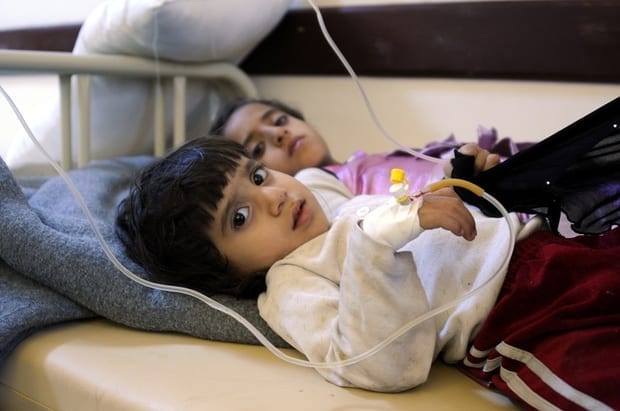
Biqdad, nine, and Mariah, two, are receiving treatment for cholera in the state-run Al-Sabeen hospital in Sanaa, Yemen. (MEE/Mohammed Hamoud)
Where is God? He cannot get through the total US blockade of Yemen to save the children. A cholera epidemic is a man-made disaster. Since 2015 the cholera epidemic has been spread by biological warfare against Yemen. US bombs dropped by Saudi pilots destroyed Yemen’s public water and sewage systems. The parts, chemicals and fuel to operate Yemen’s water purification and sewage plants are blockaded. Potable water, cholera vaccine, and even individual water purification tablets cannot get in.
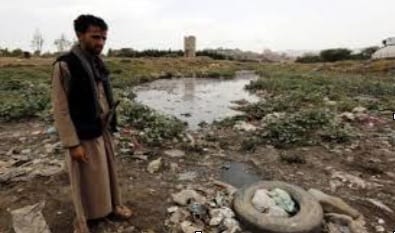
The sewage from non-working treatment plants overflows into streams that run onto agricultural land, thus contaminating vegetables before they go to market. Sewage flows into the cities, residential areas and the refugee camps. Flies swarm over the sewage and spread cholera everywhere. The International Committee of the Red Cross, the Red Crescent, and Doctors Without Borders; hospitals, clinics and disaster relief organizations, and human rights workers have been deliberately bombed.
[Sanitation problems, as well as a shortage of medicine and supplies have pushed the number of cholera cases in Yemen. Photo by Yahya Arhab/EPA]
The US dominated United Nations adds a fig leaf of legality to the blockade, and a one-sided weapons embargo against Yemen. To ask why there is no UN arms embargo against Saudi Arabia is, of course, a rhetorical question.
The former US ambassador to the United Nations Nikki Haley threw a temper tantrum when the UN dared to even voice mild criticism against the US, when it moved its embassy to Jerusalem. She spoke of the UN “disrespecting” the US, and she threatened financial retaliation against the UN and countries that voted contrary to US wishes.
President Donald Trump cut funding to humanitarian UN agencies, did not try to stop Israel from gunning down thousands of unarmed Palestinians, withdrew the US from the UN Human Rights Council, and thumbed his nose at the UN International Court of Justice. Trump’s national security adviser John Bolton said that the US plans on withdrawing from more treaties that are the foundation of international law.
The US dominated United Nations adds a fig leaf of legality to the blockade, and a one-sided weapons embargo against Yemen. To ask why there is no UN arms embargo against Saudi Arabia is, of course, a rhetorical question.
In other words, Bolton is confirming that the US is a rouge state; it makes a mockery of the United Nations. From the beginning of the Bush-era War on Terror, the US showed contempt for the Geneva Conventions. Obama too violated customary international law with impunity. Obama assassinated US citizens, droned Afghan wedding parties and funerals, and destroyed Libya. He invaded Syria in an illegal war of aggression. Obama was really good at killing. He allegedly said so himself.
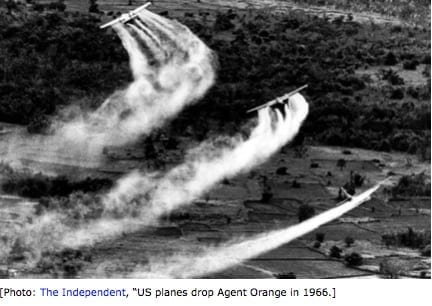
Purposely causing a cholera epidemic is biological warfare. Yemen is not an unprecedented case of US use of biological-chemical warfare. During the 1950’s Korean War the US was accused convincingly of biological warfare. In the Vietnam-American War the US sprayed millions of gallons of Agent Orange, which poisoned the soil, rivers and people. Agent Orange, 40 years later is still “causing miscarriages, skin diseases, cancers, birth defects, and congenital malformations”.
The US contaminated Bosnia, Afghanistan, and the Middle East with so-called depleted uranium. Depleted uranium can cause cancer, birth defects, and as yet other unknown health effects. The US knows it. It has put out a health warning to US Iraq war veterans.
In 1995, Madeleine Albright was interview by Lesley Stahl on the TV show “60 Minutes”. That interview should live in infamy in a hall of shame for eternity. Stahl asked Albright if the death of over 500,000 Iraqi children caused by US sanctions was “worth it”. Albright’s answer was, “I think this is a very hard choice, but the price–we think the price is worth it.” (Whoever the “we” is, Albright did not elaborate.) It is now known that “we” purposely used biological warfare to kill those 500,000 Iraqi children.
How many more children did Albright, the Bill Clinton administration and “we” continue to kill because “we” thought it was “worth it”? Hundreds of thousands, according to a study of the partially declassified Defense Intelligence Agency document “Iraq Water Treatment Vulnerabilities”. The partially declassified document was discovered in 1998 on an official website of the Military Health System. In 2001 the Association of Genocide Scholars released the study referred to above: The Role of “Iraq Water Treatment Vulnerabilities” in Halting One Genocide and Preventing Others.
During the 1991 First Gulf War the US purposely targeted all of the water purification plants and sanitation works in Iraq, which is itself a war crime. The “Iraq Water Treatment Vulnerabilities” document produced by the US Department of Defense and implemented in1991, was continued under President Bill Clinton. Even after Albright’s admission on “60 Minutes” that the US sanctions regime had killed 500,000 Iraqi children, “we” continued the draconian embargo of water purification equipment.
The Department of Defense and Madeleine Albright’s “we” knew that without potable water that the rate of waterborne diseases, such as cholera, would sicken and kill hundreds of thousands of Iraqis. Depriving an entire population of the essentials of life is genocide, and it is a violation of the Geneva Conventions. Degrading of the water supply to knowinglu cause epidemics, such as cholera, is biological warfare. Economic sanctions and trade embargos are barbaric siege warfare against civilian populations. There is no way to pretty them up as surgically targeting a regime or being humanitarian. Now think about Cuba, Iran, Venezuela, Syria, Burma and, Côte d’Ivoire that are suffering under a US embargo today.
The “Iraq Water Treatment Vulnerabilities” document reveals the diabolical intention of a sanctions regime, even when authorized by the UN. It is for these and other reasons that The International Committee of the Red Cross has often raised concerns, including concerns about UN authorized sanctions regimes. Not even the UN has the authority to violate the Geneva Conventions, and the UN oversteps its authority when it does so.
The US has also overstepped the UN’s authority against Yemen, by imposing a total blockade. Hundreds of children are dying every day in Yemen. Tens of thousands of civilians have died from starvation, disease and the lack of medicine. Twenty million human beings are starving to death in a famine caused by the US, and its proxy, the so-called Saudi coalition.
For three years, starting with the Obama administration the US has been passing Saudi Arabia the bombs, ammunition, fuel, and most importantly it is the US military at the command and control center of the war. Other war-profiteering countries, such as the UK, EU countries, and Canada have their hands dripping with the blood and cholera infected feces of Yemeni children, too.
[Photo: Nora Al-Alwaki, an American citizen killed by Navy SEALs when they raided her Yemeni village on January 29, 2017.]
US Special Forces, Seal Team 6, and the CIA carry out night raids and assignations, such as the one that killed 8 year old Nora, pictured above. She was an American citizen who lived with her grandparents in a Yemeni village.
Nora was the daughter of Anwar al-Awlaki, who was the first known American citizen to be executed by the US without due process. A week later his 16 year old son, Abdulrahman al-Awlaki was assassinated by a US drone. Barack Obama carried out those killings in 2011. It was also Obama that planned the raid in which Nora was killed by Trump on February 1, 2017.
I don’t believe it was a coincidence. When Obama’s press secretary Robert Gibb was asked why 16 year old Abdurahman was killed, his answer was that his crime was that he “should have had a more responsible father”. Was that Nora’s “crime” too?
The war against Yemen is another dirty war like Iraq was. It is an ‘all but in name only’ a US genocide-scale slaughter of civilians and the destruction of a country. The Kingdom of Saudi Arabia and its so-called coalition are the US proxy that pays for the bombs and drops them. It is the US that picks out the targets, from back at the command and control center.
The complicit mainstream media tries hard to sell the people the idea that the US imperial military is actually engaged in worthwhile missions. Here’s what the moral imbeciles at CBS came up with, the glorification of SEAL teams.
Most of the ground fighting inside Yemen is caused by an invasion of US, Saudi and UAE sponsored Salafists terrorists, mujahideen, al-Qaeda, Muslim Brotherhood, and Blackwater (rebranded Academi) US, Somalia and South American mercenaries. Saudi-backed terrorists are attacking in the north, while UAE-backed terrorist attack in the south. Saudi-backed terrorists are fighting UAE terrorists. Saudi Arabia has put a blockade on Qatar, in a squabble over Yemen.
Thede facto government of Yemen is the leadership of the Houthi Movement, named after its charismatic founder Hussein Badreddin al-Houthi. The Houthi Movement is backed by Yemen’s military units, security forces and a broad base of the Yemeni people, including many Sunnis. That is not to say that Yemenis do not have many differences. They do, but when their common self-interests are at stake, they do come together, despite their differences.
There are some internal groups opposed to the Houthi Movement and they are collaborating with the Saudi and UAE terrorist groups, but this is not a Sunni vs. Shia war. Nor is the war a proxy war between Saudi Arabia and Iran, as the corporate mainstream media monopoly would have the US public believe.
The Zaydi Shia that makes up about 42% of Yemen’s population is closer to Sunni Islam than they are to the Shia branch of Islam in Iran. The Zaidi-led Houthi Movement “have not called for restoring the imamate in Yemen, and religious grievances have not been a major factor in the war”, according to Al Jazeera. Rather, the Houthi Movement has been primarily economic, political and regional in nature.
There is a separatist movement in what was once South Yemen, which until 1990 was a separate communist country: The Democratic Republic of Yemen. Before unification North Yemen was the Yemen Arab Republic. In the power struggle that followed unification the south lost power and patronage. The UAE is backing a southern separatist group, the Southern Transitional Council, which also opposes Hadi and Saudi Arabia. As mentioned, Saudi backed terrorists are fighting UAE-backed terrorists.
The US, KSA and the UN try to pass off the “internationally recognized legitimate government of Yemen” as if it were Abdrabbuh Mansour Hadi. Hadi was the president of an interim government of Yemen from 2012 to 2014. Hadi fraudulently overstayed his term when it expired in 2014.
Hadi was forcefully removed from office by the Houthi Movement, and a broad base uprising of the Yemeni people. Hadi resigned his office and fled to Saudi Arabia. The US, KSA and the UN use Hadi as a figurehead to add a fig leaf of legality to the illegal US-led war of aggression against Yemen.
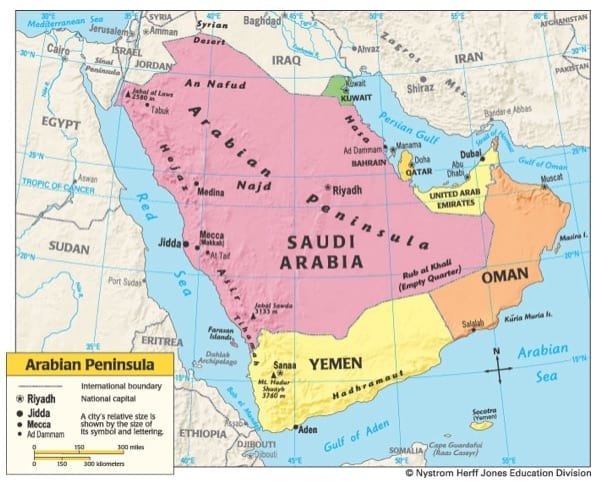
There is little if any evidence that Iran is providing the Houthi Movement with weapons, materials or fighters. Look at the map. How would Iran be able to get past the total US blockade, even if it wanted to. Iran has its hands full with its (legal) support of its ally Syria. Iran is struggling with its own economic crisis caused by the illegal US economic sanctions regime, re-imposed by the Trump administration.
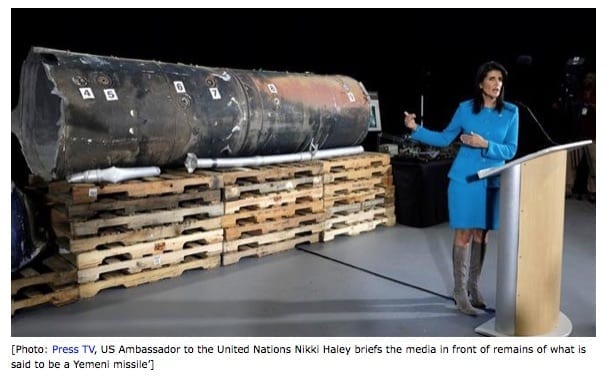
When the US was pressed for hard evidence to back up its allegations that Iran was involved in Yemen, the best that the former UN ambassador Nikki Haley could do was come up with a few missile parts. The UN dismissed Haley’s show as having “no evidence as to the identity of the broker or supplier.” Iran has denied involvement in Yemen, and rejected the US’s claims as unfounded, and Iran further added: “These accusations seek also to cover up for the Saudi war crimes in Yemen, with the US complicity, and divert attention from the stalemate war of aggression against the Yemenis.”
Yemenis, regardless of religion, region or tribe are fiercely nationalistic, and they are nobody’s puppet. They resent attempts by foreign invaders to dominate them. Yemen, like Afghanistan,is a graveyard where empires come to die. The Saudis and the UAE are leaning it the hard way.
The US is like a zombie empire that never dies in an empire graveyard. Instead when faced with humiliation and defeat, the US totally destroys its antagonist from the air, as it did Iraq, Libya and Syria. The US shows no mercy for the civilian population. The US destroys civilian infrastructure, blockades food, water and medicine. It targets the people with cluster bombs and white phosphorus; and the US poisons their water, soil and air with biological, chemical and radioactive weapons.
[Photo: Minn Post, “Secretary of State Hillary Clinton with Libyan soldiers upon her departure from Tripoli in Libya on October 18, 2011.]
As with Iraq, Libya, and Syria and with so many other small countries that the US declared to be its enemy, Yemen poses no threat to the US national security. So why does the US destroy small countries, and why is the US destroying Yemen?
Whatever name US world domination goes by, it is all the same. The US considers itself above international law, customary moral behavior and believes it alone has the right to pursue whatever it thinks is in its self-interest politically, militarily and financially. If the US were a person, it would be diagnosed as a psychopath, with no conscience, no empathy, and no remorse; aggressive, narcissistic and a serial mass murderer.
Yemen is often scripted by the corporate-government mainstream media as “the poorest country in the Middle East”, as if it has no wealth that anybody could possibly want. The people of Yemen are poor, but Yemen is rich in oil, pipeline routes, gold, minerals, agriculture, fishing, state owned enterprises, desirable real estate, finance, and its geography gives Yemen great potential for tourism.
Yemen’s 30 million people are both a potential source of cheap labor and a potential market for the products of US global corporations. Yemen is strategically located at the Bab-el-Mandeb strait, through which 1.4 billion barrels of oil pass every day. For millennium Yemen was a center for trade.
The US covets Yemen’s wealth and its strategic location as part of the neoliberal New World Order. The US vision of the New World Order is a world dominated by US global corporations, US financial institutions and wealthy US family dynasties.
US foreign policy is shaped by special interests, monopolies and their political action committees (PACS), such as those of weapons manufacturers, financial institutions, pharmaceutical companies, and agri-business. Foreign countries such as Israel and Saudi Arabia also have powerful lobbies that can manipulate US foreign policy to their advantage. US foreign policy has little to do with the interests of the average US citizen.
Yemen is the southern neighbor to the KSA, and the Saudis want a corrupt, compliant and passive government in Yemen. The KSA has expanded its border to encroach on Yemen’s northern borderlands, which is the birthplace of the Houthi Movement. The Saudi dynasty also fears an independent Yemeni people that might influence the oppressed people of the Saudi Dynasty. The KSA is a powder keg for an uprising of the people, they are ready to explode.
The KSA uses extremist Wahhabi Islam as a political subterfuge to recruit jihadist, terrorists, and to spread Saudi influence throughout West Asia, Africa and beyond. International terrorism has been a joint venture of the US, Saudi Arabia and other Gulf Cooperation Council (GCC) member states. All the GCC states: KSA, UAE, Bahrain, Oman, and Kuwait are theocratic monarchies. That says volumes about US values for democracy and human rights.
The US has a long history of coveting the wealth of Yemen. In the mid-1980s the Bush family and their Texas oil buddies at Hunt Oil invested in Yemen’s oil-rich Marib Shabwa basin. Bush obtained for Hunt Oil the rights for future exploration. Deviously, the former director of the CIA and then Vice President Bush arranged for Iraq’s Saddam Hussein to finance the Bush-Hunt investments in Yemen. A few years later Bush “repaid” Saddam’s loan with Shock and Awe.
Since 2015 the US has been protecting the Bush family’s investments in Yemen, global corporations, neoliberalism and the vision of a New World Order. The people of Yemen have been starch opponents of neoliberalism and like their old world order. They rebelled against the 33 year rule of Ali Abdullah Saleh for selling out Yemen to neoliberalism, and then the people rebelled against the interim government of Hadi for his fire-sale privatization scheming with the neoliberal empire.
The US beneficiaries of neoliberalism were not happy when their benefactor Hadi was deposed by the Houthi Movement. Nor was Saudi Arabia, which had been trying to exploit Yemen for decades. The vultures of the other GCC countries started circling Yemen in the hope of picking at its corpse too. The US is providing the GCC with the Shock and Awe to kill the prey, and the US does not care if it kills 22 million people in the process of looting Yemen. It is the US that is providing the bombs. The Saudi-led coalition of the GCC is just the delivery boys.
To summarize, there is no civil war in Yemen. Iran is made the scapegoat for a US-led illegal war of aggression. Saudi Arabia and its coalition of Gulf Cooperation Council (GCC) are headquartered in Riyadh, Saudi Arabia. The GCC is made up of the Kingdom of Saudi Arabia, Bahrain, Oman, and the United Arab Emirates. They are all monarchies. The US hopes to walk off with Yemen’s main prizes, and the KSA, UAE and Qatar are already fighting each other over the crumbs. The lives of 22 million Yemeni people are hanging by a thread, because of a US blockade of food, water and medicine. The US is the cause of the worst cholera epidemic in history. It is biological warfare and genocide.