30 Oct 2018

Saudi Arabia: A Dark Stain on Islam

Ghali Hassan

Many people around the world wrongly believe that Saudi Arabia “represents” Islam. Nothing could be further from the truth. Islam is not represented by any nation, at least not Saudi Arabia. Like all enemies of Islam, Saudi Arabia has blackened the name of Islam.
Since its creation by the Anglo-American imperialism in the early 1930s, Saudi Arabia has served AngloZionism interests with distinction at the expense of Islam, the region, and the people of the region, including the people of Saudi Arabia. As AngloZionism most obedient regime, the Saudi regime – the House of Al-Saud, a Mafia-like tyranny – has plotted (with U.S.-Israel and Britain complicity) against Muslim-majority nations from Palestine to Egypt and from Afghanistan to Iraq and Iran, and from Libya to Syria and Yemen, creating one humanitarian catastrophe after another. The Saudi-sponsored terror in Syria, Iraq and in Yemen, and its ongoing animosity and threats (colluding with the fascist regime of Benjamin Netanyahu) towards Iran are for everyone to see. In fact, overwhelming evidence shows that the Saudi regime has a record of active complicity in every U.S. war against Muslim-majority nations. The Saudi regime collusion with the Israeli fascist regime poses the biggest threat to the entire region. The two religio-extremist regimes have much in common and their alliance is not different from that of Hitler-Mussolini alliance. Together, they have been and remain the greatest destabiliser of peace and prosperity in the region.
The Saudi regime services to AngloZionism go way beyond merely propelling U.S. economy and supplying oil to the U.S., which has significantly declined in importance. It involves vital interests of: (1) maintaining the dollar as the global exchange currency for oil trade, (2) massive annual purchases (in hundreds of billions of dollars) of U.S., British, French, and Canadian weapons, (3) funding of many C.I.A. clandestine terror operations – including recruiting, financing and arming al-Qaeda and ISIS terrorists – around the world, and (4) the projection of Anglo-Zionist power across the Middle East and West Asia, including helping Israel in the dispossession of the Palestinians. As U.S. President Donald Trump acknowledged recently: Among many things, the Saudis have “been helping us a lot with respect to Israel. They’ve been funding a lot of things”, including mass atrocities and terror
The second most important service to AngloZionism is Saudi Arabia apparent version of “religious extremism” or Wahhabism. The Saudi regime uses Wahhabism as a political subterfuge to recruit terrorists, and to spread not only Saudi, but also U.S. influence throughout West Asia, Africa and beyond. International terrorism – masquerading as “Islamic terrorism” – has been a joint venture of the U.S., Britain, Israel, Saudi Arabia and other Gulf Cooperation Council (GCC) theocratic tyrannies. International terrorism is not only used by the U.S. and its allies to demonise Islam and Muslims but also as a proxy army to attack majority-Muslim nations.
The tyrannical Saudi regime has turned Saudi Arabia into an example of intolerance, extremism and the world’s most regressive regime. The Saudi regime regularly ranked as one of the “worst of the worst” by Freedom House annual survey of political and civil rights. The barbaric preaches and practices of the Saudi regime are antithetical to Islam and the teaching of the Prophet Muhammad (Peace and Blessings be Upon Him). Apart from Mecca – Islam’s holiest city and Prophet Muhammad birthplace – and al-Madinah – Prophet Muhammad burial place –, Saudi Arabia has nothing to contribute to Islam. The Saudi regime lives by the sword and rules according to pre-Islamic (dark age) tribal vengeance law. This barbaric Saudi regime does not deserve to be the custodian of Islam’s most holy and sacred sites.
Saudi Arabia and its “Islamic” extremism are cleverly used by the U.S., Europe and Israel to justify demonising and attacking Muslims, particularly Arabs Islam. Islam is portrayed as violent, backward and misogynist religion. The same goes for Arabs and Muslims.  If Westerners want to criticise Arabs and Islam, Saudi Arabia provides (a distorted) image of Islam. In fact, Saudi Arabia distorts the true teaching and image of Islam as a way of life and has for decades been destroying Islamic heritage, including Islam’s holiest stone of the Ka’ba.
The Saudi regime relies on U.S.-British protection and promotion, including the elevation of Clown Prince Mohammed bin Salman (MBS as he is known in the West) to the rank of “reformist”, a.k.a. Western-oriented.  The ill-informed garbage bag Clown Prince is directly responsible for the murder of Mr Khashoggi. The Saudi regime is always depicted by Western politicians and Western media as the region “leader”. However, very often U.S. leaders remind the Saudi stooges who is boss. Because without the U.S. and Britain, the Saudi regime wouldn’t have survived seven decades, not because of external threat, but because the oppressed Saudi people will revolt and take the regime down. As President Trump reminded the current Saudi ruler: “I love the king [of Saudi Arabia], King Salman, but I said: ‘King, we’re protecting you. You might not be there for two weeks without us. You have to pay for your military, you have to pay”. In his last speech in Minnesota, Trump said: “Excuse me, King Salman, he is my friend, ‘do you mind paying for the military? Do you mind? Pay!’… I said, ‘do you mind paying?’ ‘But nobody has asked me’, I said ‘but I’m asking you, King.” It was humiliating. Of course, the Saudi regime pays, not only to stay in power but also to destroy nations that challenge its extremist ideology as it did pay for the U.S.-Britain illegal aggression and wanton destruction of Iraq, Libya, Syria and Yemen.
For its services to Anglo-Zionism, the Saudi regime is allowed to get away with heinous war crimes and abhorrent human right abuses at home and abroad. The unprovoked violent aggression against the people of Yemen and the premediated murder and decapitation of the U.S.-based Washington Post journalist and former Saudi-C.I.A. asset Mr Jamal Khashoggi are current examples.
The murder of Mr Khashoggi in the Saudi Consulate in Istanbul by a 15-member Saudi death-squad was a criminal act perpetuated by a Mafia-like regime that have been beheading and even crucifying its critics and opponents for decades with Western blessing. President Trump called it, “the worst coverup in history” of criminal coverups, helped of course by no other than the U.S. It was “a total fiasco from day one”, Trump added. The Saudi regime was self-defeating, it has not thought about the consequences of its gruesome crime.
First, we were told Mr Khashoggi supposedly left the Consulate from a “backdoor” and there was blanket denial of any Saudi regime involvement. Then, a “fistfight” broke out and Khashoggi was killed inside the Consulate. And now it was an “aberration” or “huge and grave mistake” that he died in the Saudi Consulate. It was a preposterous explanation to coverup Khashoggi’s murder. It was obvious that Khashoggi was tortured to death and decapitated Saudi-style. It was a premediated murder, according to Saudi Attorney-General Saud al-Mojeb confirming Turkish President Recep Tayyip Erdogan who – while holding back vital and damning evidence – revealed that, it was a “pre-planned” gangsters’ operation rather than a spontaneous incident. “No sooner had the Saudis issued their latest lie to coverup previous lies, U.S. President Trump was lending White House prestige to travesty”, writes columnist Finian Cunningham. Like all his predecessors, Trump is cosying up to the Saudi tyrants. British media that Khashoggi was about to disclose details of the Saudi regime’s use of chemical weapons in its war on Yemen when he was killed.
Lets’ also bear in mind that, the Saudi rulers wouldn’t have acted so recklessly unless they were certain of U.S. green light and complicity. The U.S. is complicit in their long list of crimes, and for decades the U.S. has been providing political-diplomatic cover for Saudi criminal policies that have caused disastrous consequences for the region. According to a Bloomberg report, the U.S. knew the Saudis planned to seize Mr Khashoggi because the C.I.A. had intercepted communications between Saudi officials discussing the plan. Furthermore, the Saudi regime did inform British intelligence (MI6) of its intention to abduct and kill Khashoggi three weeks before he was murdered.
Of course, it was not the first time. The Saudi regime have for years been abducting dissidents abroad and returning them to the Kingdom to be secretly murdered. “There is a long and shameful history of Saudi Arabia abducting dissidents and bringing them back to the kingdom and they never appear again,” says Bruce Riedel, a former C.I.A. agent and now a senior fellow at the Brookings Institution. There are thousands of male and female scholars, clerics, intellectuals, economists, university professors, and political activists languishing in Saudi jails, ignored by Amnesty International and Human Rights Watch. (For more see: Telesurtv.net).
Now, imagine an Iranian journalist residing in the U.S. or Europe had walked into the Iranian Consulate in Istanbul and never came out alive. It transpired that he was murdered inside the Iranian Consulate by an Iranian death-squad sent to Turkey from Tehran. You can be sure that the U.S. and its allies will demand the UN Security Council urgently convene to condemn the Iranian regime. The U.S. and it allies will impose harsh sanctions on Iran and would call for airstrikes on targets in Iran. Western-based “human rights” organisations will demand severe actions against Iran.  When it comes to double standards and hypocrisy, the U.S. and its allies are the world’s champions of double standards and hypocrisy. The deafening silence of the British government and the British media is outrageous, considering their ongoing attacks on Russia regarding the Skripal scandal.
Since March 2015, a Saudi-led “Coalition” of tyrants – including Kuwait, the United Arab Emirates, Bahrain, Egypt, Morocco, Jordan, Sudan and Senegal – bribed a coerced by the Saudi regime have waged a criminal war on Yemen and terrorised the Yemeni people. Actively armed and supported by Western regimes and Israel, the tyrants have killed tens of thousands of defenceless Yemeni civilians – according to UNHRC 50,00 children were killed by daily Saudi air raids using British-made bombs and U.S.-supplied war planes –, destroying Yemen’s civilian infrastructures and causing a deadly cholera epidemic  and famine for more than 10 million people. Saudi-led air strikes – guided by U.S. and British Special Forces – have systematically bombed Yemen’s civilian infrastructure destroying Yemen’s public water and sewage systems.
The Saudi regime war crimes in Yemen is modelled on its Anglo-Zionist masters, the U.S., Britain and Israel war crimes in Syria, Iraq and Libya. The Saudi-led Coalition’s blockade of food and medicine into Yemen has also brought the country to the brink of famine. Some 18 million Yemenis now at risk of starving to death — including over 5 million children, while thousands more are dying from preventable diseases in a country which is under indiscriminate daily bombardment by the Saudi regime. According to the UN Office for the Coordination of Humanitarian Affairs: “An alarming 22.2 million people in Yemen need some kind of humanitarian or protection assistance, an estimated 17.8 million are food insecure — 8.4 million people are severely food insecure and at risk of starvation — 16 million lack access to safe water and sanitation, and 16.4 million lack access to adequate healthcare. Needs across the country have increased steadily, with 11.3 million who are in acute need — an increase of more than one million people in acute need of humanitarian assistance to survive”. Furthermore, at least 14 million Yemenis are facing “pre-famine conditions,” relying on food aid for their very survival. The U.S. and European regimes are complicit and shared responsibility for the deaths and atrocities caused by Saudi barbarism, because without their weapons, many Yemini women and children would be alive today.
A study for the World Peace Foundation by Professor Martha Mundy of London School of Economics writes: “While the US and UK back their Coalition allies unfailingly in their wider political and strategic objectives, the two major Arab actors in the Coalition, Saudi Arabia and the [UA] Emirates, have different economic priorities in the war. That of Saudi Arabia is oil wealth, including preventing a united Yemen’s use of its own oil revenues, and developing a new pipeline through Yemen to the Indian Ocean; that of the Emirates is [colonisation and] control over seaports, for trade, tourism and fish wealth. The attack on al-Hudayda [a major port] explicitly aims to complete the economic war militarily. That the immense suffering of Yemen’s people has still not brought surrender by those in Sanʾa [the Yemeni capital] does not give credibility to the tactic of further hunger and disease. Yet for the Coalition, as a senior Saudi diplomat responded (off the record) to a question about threatened starvation: ‘Once we control them, we will feed them,’” according to Saudi barbaric agenda. What the Saudi regime is doing in Yemen is not different from what the U.S., British and Israeli regimes have been doing in the region for decades. The media play an important role in diverting public attention away by turning blind eye to Western atrocities. One hardly hears about Saudi atrocities in Yemen and Israel’s terror in Palestine. While the outrage over Khashoggi’s murder is justified, one wonders why is the death of one privilege “journalist” receives global coverage by Western media while the deaths of hundreds of thousands of Yemenis by ongoing Saudi aggression are ignored?
Finally, it is worth noting that, while Saudi Arabia is among the wealthiest regimes in the world, the country remains backward, completely dependent on the sale of oil and foreign imports. Youth unemployment is very high. Most of Saudi Arabia’s wealth is wasted by the regime on purchasing weapons and indulging in decadence “entertainments”. The U.S. primary goal has been to keep Saudi Arabia (and all the fiefdoms of the Gulf) backward, feudal and unindustrialised to benefit U.S.-Western industries. In fact, the U.S. has an agenda to keep countries under its tump, dependent, backward and in constant conflict. It is not Saudi Arabia that is known for its advanced public health care and education system. Iraq and Syria were the region’s envy, with very advanced free public health care and free public education. Libya had the region’s highest Human Development Index (HDI) under the leadership of Muammar al-Qadhafi. Iraq and Libya have been terrorised and destroyed violently. Their massive reserves of gold and oil reserves (assets) were stolen by the U.S. and its vassal states allies, including Saudi Arabia and other Gulf fiefdom regimes.
The Saudi regime and its barbaric practices and politics have no place in Islam. The murder of the Jamal Khashoggi, one of countless murders by the Saudi regime, is an opportunity for civilised nations to distance themselves from and pressure the Saudi regime to change its barbaric behaviour, stop arming and financing international terrorists and end its aggression against the people of Yemen. It is the duty of the people of Saudi Arabia to remove the dark stain that has blackened the images of Islam for decades.

Mercury, the other geologically persistent planetary poison

David Archer


The thing that really gets me in the gut about global warming from fossil fuel combustion is how long it will last. Carbon mined from the deep Earth and injected into the “fast carbon cycle” of the atmosphere, ocean, and land surface will continue to affect atmospheric CO2 concentrations, and climate, for hundreds of thousands of years into the future, unless we clean up the atmosphere ourselves.
It turns out that human emissions of the element mercury (Hg) will elevate mercury concentrations in the environment, and in upper trophic-level seafood, for thousands of years into the future. There are a lot of parallels to the carbon cycle. But, unlike the carbon cycle, the mercury cycle would be impossible to clean up.
The astonishing thing about the heavy metal, mercury, is how unheavy it seems to be as it runs around in the environment (Blum, 2013). Almost as massive as uranium, which they make artillery slugs and armor out of, mercury is a liquid at room temperature, and it can even evaporate into the air, plus dissolve in water. These tricks give it global mobility.
Mercury vapor, in the uncharged metal form written as Hg0, is chemically unstable in air, and it tends to oxidize (“rust”) to Hg2+, a charged ion that sticks to particles and dissolves in droplets, and rains out. But Hg2+ does an amazing trick called photo-reduction, absorbing a photon of ultraviolet sunlight and popping back up the energy hill to the Hg0 vapor phase1. Photo-reduction of Hg2+ allows mercury to float around in the atmosphere for about a year, enough time to deposit all around the world (Horowitz et al., 2017).
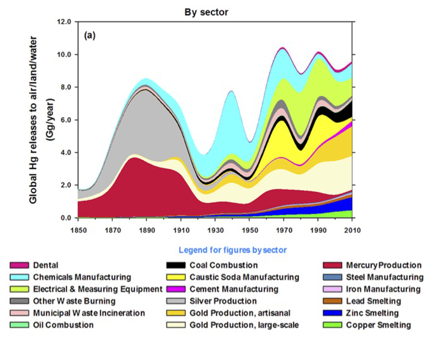
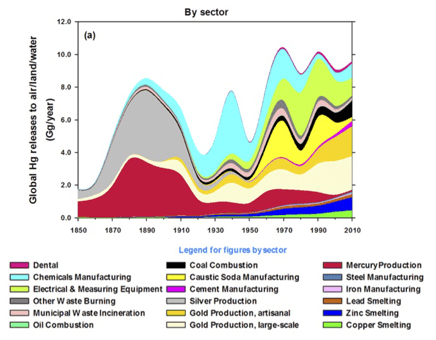
The global footprint of mercury deposition makes it harder to motivate ourselves to reduce emissions, in a tragedy of the commons that is totally analogous to the carbon cycle. Why (one may ask, and I will attempt to answer) should we clean up the mercury emissions from our coal plants when there are coal plants emitting mercury in China? And what’s up with “artisanal gold mining”?? (Image from Streets et al., 2017).
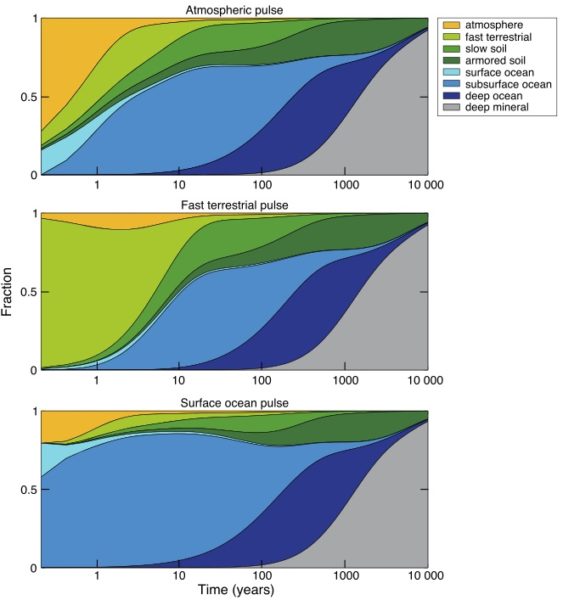
But once mercury does go to ground, it’s only the beginning of the story (Blum, 2013). Both the ocean and the land surface act like storage reservoirs in the mercury cycle, taking up mercury now when there’s a lot of it flying around, to release it back to the environment on various time scales in the future, some of them very long.
The ultimate removal pathway for mercury is deposition in ocean sediments, which is a pretty small flux relative to other fluxes in the mercury cycle. So, just like carbon, the “fast” surface cycle gets charged up with the extra load (mercury or carbon), until the slow leak flux to the solid Earth, by way of ocean sediments, finally cleans up the load. For mercury, the clean-up time scale is probably about 10,000 years (Amos et al., 2013).
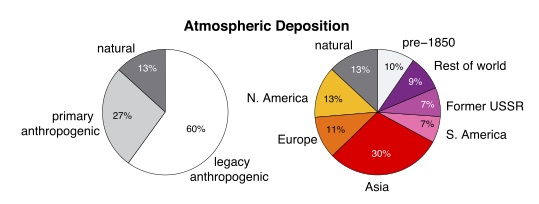
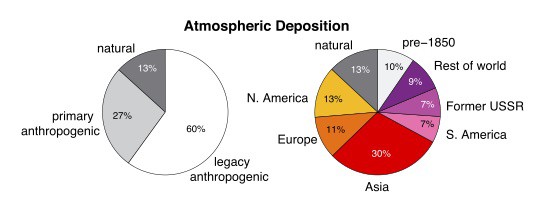
Because of mercury’s tendency to recycle after it deposits, today there is more mercury deposition called “legacy anthropogenic”, meaning recycled from emission decades ago, than there is deposition of mercury we are emitting now. So just like for carbon, we are creating an accumulating load in the mercury cycle.
From (Amos et al., 2013), showing the origins of global mercury deposition, “when from” on the left, and “where from” on the right.
Mercury deposition on land is primarily through mercury vapor uptake by plant leaves (called “dry deposition”, (Demers et al., 2007)). The mercury is carried to the ground in leaf litter, and it collects in the soil organic carbon pool. Soil organic carbon cycling is important in the carbon cycle as well, so it has been well studied, but it is a complicated world. The fate and lifetime of organic carbon in a soil is very different in, for example, a depositional swamp versus a rain-scoured and eroding hillside.
On a global scale, what happened to bomb radiocarbon (14C) from nuclear weapons testing in the 1960’s can tell us a lot about the behavior of the soil organic carbon system. It can be described in broad brush by a simple reservoir or “box” model, consisting of several reservoirs with differing carbon production rates, and turnover times ranging from years to thousands of years, with names like “slow”, “fast”, and “armoured” (Smith-Downey et al., 2010). The mercury attached to the carbon is re-released to the environment, primarily as dissolved Hg2+, when the organic carbon degrades. The Hg2+ will probably be carried to the ocean and eventually recycled from there. Mercury that goes to ground in the longest-lived organic carbon pools will continue to dribble back out to the environment for thousands of years.
In the ocean, most of the mercury that falls to the ocean surface gets quickly returned to the atmosphere, by photo-reduction of Hg2+ in the surface ocean, producing Hg0 that “evades” (think evaporates) (Soerensen et al., 2010). The elevated mercury deposition rates today have driven up the concentration of Hg2+ in the surface ocean, and the load has been carried subsurface by ocean flow. The mercury load near the sea surface also sticks to sinking particles, re-dissolving at the depths where the organic carbon in the particles degrades. When high-mercury subsurface water eventually comes back to the surface, it releases its mercury back to the atmosphere (Cossa et al., 2004). The ocean therefore acts as another mercury reservoir, which will recycle human-mined mercury back to the atmosphere for thousands of years.
Surprisingly, given that we live on land, most human exposure to mercury comes from the ocean mercury cycle, by way of seafood. Mercury bio-accumulates in fish in the form of mono-methyl mercury (MMHg, chemical form CH3Hg+). This is a quantitatively relatively minor species with an outsized impact, a little bit like methane, maybe? OK, that’s weak. MMHg is produced by bacteria, and degrades quickly enough that MMHg and Hg2+ coexist in a quasi-equilibrium in the ocean, with about 5-10% of mercury in the methylated form in most places and depths (Semeniuk and Dastoor, 2017; Archer and Blum, 2018). MMHg is the form taken up by phytoplankton and amplified up the food chain, to the point that higher trophic-level fish like most tuna, orange roughy, sea bass, swordfish, and shark are toxic to eat too often.
When we realize that we have degraded the climate system by releasing fossil carbon, we can theoretically clean it up. Although there may not be enough agricultural land to do it entirely with the currently fashionable option, bio-energy carbon capture and sequestration (BECCS), there is always chemical removal of CO2 from the atmosphere (Keith et al., 2018). Cleaning up the anthropogenic carbon is theoretically feasible because a relatively large fraction of the anthropogenic carbon, a little more than half, is still in the atmosphere. If we pulled enough CO2out of the atmosphere, the oceans would degas CO2, slowing down the atmospheric recovery. But it would be theoretically feasible, carbon-cycle wise, to pull atmospheric pCO2 down to the 350 ppm “safe” level in a few decades.
The one-year atmospheric lifetime of mercury is much shorter than the drawdown lifetime for carbon (decades to centuries: (Archer et al., 2009)). For this reason, a much smaller fraction of all of the anthropogenic mercury is still in the atmosphere, only about 1.5% (from Amos et al., 2013). Hg0 vapor is out of equilibrium and photo-sensitive, so it would presumably be feasible to scrub mercury from air alongside CO2 in the chemical atmosphere-scrubber plants. But most of the anthropogenic mercury has already gone to ground, on land and in the oceans, and until it dribs and drabs back into the environmental mercury cycle over thousands of years, it will be out of our reach, making a quick cleanup impossible.
And since the atmospheric Hg0 concentration is controlled by the mercury cycle with a time constant of just one year, we could never move the needle of the atmospheric Hg0 concentration, or therefore mercury deposition rates or seafood mercury loads. Once the Hg is released into the biosphere, it can only be endured, for thousands of years. My personal feeling is that if there were any grown-ups on the planet, we wouldn’t be allowed to do this.

Reforming the Faith: Indonesia’s battle for the soul of Islam

James M. Dorsey

Nahdlatul Ulama, with 94 million members the world’s largest Sunni Muslim movement, is bent on reforming Islam.
The powerful Indonesian conservative and nationalist group that operates madrassahs or religious seminaries across the archipelago has taken on the ambitious task of reintroducing ijtihad or legal interpretation to Islam as it stands to enhance its political clout with its spiritual leader, Ma’ruf Amin, slated to become vice president as the running mate of incumbent President Joko Widodo in elections scheduled for next April.
In a 40-page document, argued in terms of Islamic law and jurisprudence and scheduled for publication in the coming days, Nahdlatul Ulama’s powerful young adults wing, Gerakan Pemuda Ansor, spells out a framework for what it sees as a humanitarian interpretation of Islam that is tolerant and pluralistic in nature.
The initiative is designed to counter what many in Nahdlatul Ulama, founded in 1926 in opposition to Wahhabism, see as Islam’s foremost challenge; the rise of radical Islam. The group that boasts a two million-strong private militia defines as radical not only militants and jihadists but any expression of political Islam and asserts that it is struggling against the weaponization of the faith.
While it stands a good chance of impacting Islamic discourse in Indonesia, the world’s largest Muslim nation, it is likely to face an uphill battle in making substantial headway beyond Indonesia despite its links to major Muslim organizations in India, the United States and elsewhere. It also could encounter opposition from the group’s more conservative factions.
Mr. Amin, the vice-presidential candidate, is widely viewed as a conservative who as issued fatwas against minorities, including one in 2005 denouncing Ahmadis, a sect widely viewed by Muslims as heretics. Violent attacks on Ahmadis by extremists have since escalated with mob killings and the razing to the ground of their homes.
Mr. Amin is also believed to have played a key role in last year’s mass protests that brought down Jakarta governor Basuki Tjahaja Purnama, aka Ahok, an ethnic Chinese Christian, and led to his sentencing to two years in prison on charges of blasphemy against Islam.
The vice-presidential candidate appears to have since mellowed. In a recent speech in Singapore hosted by the S. Rajaratnam School of International Studies (RSIS), Mr. Amin projected himself as an advocate of an Islam that represents a middle way and stands for balance, tolerance, egalitarianism, non-discrimination, consultation, consensus and reform.
Mr. Amin’s speech appeared to be not out of sync with the reformist thinking of Ansor.
To achieve its goal, Ansor hopes to win Middle Eastern hearts and minds in a roundabout way by targeting European governments as well as the Trump administration in a bid to generate pressure on Arab regimes to promote a tolerant, pluralistic form of Islam rather than use the faith to garner legitimacy and enhance regional influence.
To further that goal, Yahya Staquf, a diminutive, soft-spoken general secretary of the group’s Supreme Council and a member of Mr. Widodo’s presidential advisory council, met in June with US Vice President Mike Pence and Reverend Johnnie Moore.
Mr Moore is an evangelist who in May was appointed by President Donald J. Trump as a member of the board of the US Commission on International Religious Freedom.
Mr. Staquf also paid in June a controversial visit to Israel where he met with Prime Minister Benyamin Netanyahu against the backdrop of Mr. Trump’s recognition of Jerusalem as the capital of Israel.
Mr. Netanyahu’s office trumpeted the meeting as an indication that “Arab countries and many Muslim countries (are) getting closer to Israel” despite Israel’s policy towards the Palestinians becoming with US backing more hard line. The meeting served to strengthen Nahdlatul Ulama’s relations with Mr. Trump’s evangelist, pro-Israel supporters.
While making significant inroads in the West, Nahdlatul Ulama risks being identified with autocrats like United Arab Emirates crown prince Mohammed bin Zayed who strives to depoliticize Islam as a means of ensuring the survival of his regime. It also risks being tainted by its tactical association with Islamophobes and Christian fundamentalists who would project their alliance as Muslim justification of their perception of the evils of Islam.
Nahdlatul Ulama’s association could further bolster the position of evangelists locked into battle with expanding Islam along the 10th parallel, the front line between the two belief systems, with Nigeria and Boko Haram, the West African jihadist group, at its core.
If successful, Nahdlatul Ulama’s strategy could have far-reaching consequences. For many Middle Eastern autocrats, adopting a more tolerant, pluralistic interpretation of Islam would mean allowing far greater social and political freedoms. That would likely lead to a weakening of their grip on power.
Nahdlatul Ulama’s credibility in pushing a tolerant, pluralistic interpretation of Islam rides in part on its willingness to subdue its own demons, first and foremost among which sectarianism manifested in deep-seated prejudice against Muslim sects, including Shiites and Ahmadis. That may be too tall an order in a country in which ultra-conservative Islam remains a social and political force.
As a result, Nahdlatul Ulama’s battlefields are as much at home as they are in the larger Muslim world. Proponents of the reform strategy chose to launch it under the auspices of the group’s young adults wing in an admission that not all of Nahdlatul Ulama’s members may embrace it.
The most recent clash occurred last week on the eve of a meeting in Yogyakarta of the Ansor-sponsored Global Unity Forum convened to stop the politicization of Islam. Attendees included Mr. Moore as well as Imam Umer Ahmed Ilyasi of the All India Imam Organization and imams from the United States.
Beyond militants in Indonesia, Nahdlatul Ulama’s foremost rival is Turkey.
It is a battle that is shaped by the need to counter the fallout of a $100 billion, four decades-long Saudi public diplomacy campaign that enjoyed tacit Western support to anchor ultra-conservative Sunni Muslim Islam in communities across the globe in a bid to dampen the appeal of post-1979 Iranian revolutionary zeal. The campaign created a breeding ground for more militant and violent strands of the faith.
The battle for the soul of Islam finds it most geopolitical expression in the rivalry between Saudi Arabia and Turkey as well as Iran. The battle with Turkey has come to a head with the killing earlier this month of journalist Jamal Khashoggi while visiting the kingdom’s consulate in Istanbul to certify his divorce papers.
Turkish President Recep Tayyip Erdogan drove the point home by exploiting the Khashoggi crisis to advise religious leaders that “Turkey with its cultural wealth, accretion of history and geographical location, has hosted diverse faiths in peace for centuries, and is the only country that can lead the Muslim world.”
If Nahdlatul Ulama couches its position in terms of Islamic law and jurisprudence, Mr. Erdogan’s framework is history and geopolitics. “The Turkish president’s foreign policy strategy aims to make Muslims proud again. Under this vision, a reimagined and modernized version of the Ottoman past, the Turks are to lead Muslims to greatness,” said Turkey scholar Soner Cagaptay.
Nahdlatul Ulama’s focus may not be Middle Eastern geopolitics. Nevertheless, its strategy, if successful, would significantly impact the region’s political map. In attempting to do so, the group may find that the odds are humongous, if not insurmountable.

The Unexplained Wealth Order legislation and London’s financial aristocracy

Thomas Scripps

Zamira Hajiyeva, the wife of former Azerbaijani state banker Jahangir Hajiyev, is the first person to be investigated by Britain’s National Crime Agency (NCA) under an Unexplained Wealth Order (UWO).
Jahangir Hajiyev is currently serving a 15-year prison sentence in Azerbaijan for a massive fraud operation involving the embezzlement of tens of millions of pounds from the country’s International Bank. Zamira is being investigated by the UK financial authorities on the suspicion that she enjoyed an extravagant life in London on the proceeds of his crimes.
In 2009, a company based in the British Virgin Islands—traced back to the ownership of Hajiyev and his wife—bought an £11.5 million home in Knightsbridge. The five-bedroom property is currently worth around £15 million. It is conveniently located within minutes of the luxury Harrods department store, where Hajiyeva spent £16 million across 35 credit cards in 10 years—nearly £4,500 a day. Her other known purchases include more than £10 million buying the Mill Ride Golf Club estate in Berkshire and £31 million (£42 million in today’s money) on a private jet. These stand to be seized if Hajiyeva cannot provide an account of how she lawfully acquired the money to purchase them.
As with all such moves against corruption by the ruling elite, an individual—and a very easy target in this case—is being used to distract from the untold billions of pounds worth of criminal wealth that has been allowed, and encouraged by successive governments, to find a comfortable home in the capital. The timing of the introduction of UWOs into legislation this January was not accidental. They were introduced as part of the British ruling elite’s ever more hysterical anti-Russia campaign. Although a UWO has not yet been levelled against a Russian, the legislation is also designed to give the government leverage over influential Russian oligarchs possessing UK investments.
UK government manoeuvres against one or two, or even one group of foreign-born oligarchs are utterly hypocritical. They will not in any way alter London’s status as a playground for the super-rich and haven for illegal wealth. In fact, the city has provided a safe retreat especially for those who made their fortunes plundering the state assets of the former Soviet Union and Eastern Europe.
Following the dissolution of the Soviet Union in the early 1990s, the UK opened its arms wide to the newly minted elite, fabulously enriched by their asset stripping of the former Soviet republics. In 1992 only one Russian was granted British citizenship, but by 2002 the number had grown to 806. This was such a phenomenon that London became known as “Moscow on Thames” or “Little Moscow” to this group, who enjoyed the effusive support of the British establishment. In 2015, the BBC aired a documentary, “Rich, Russian and Living in London,” detailing the staggering levels of wealth and spending of this tiny layer.
The same process took place as China was opened up as a capitalist market, and Chinese millionaires and billionaires overtook their Russian counterparts as the main group applying for UK residency and citizenship.
Hajiyeva is a prime example of this process. She was given permission to live in the UK under a Tier 1 investor visa—better known as a “golden visa.” Individuals are granted residency in return for investing £2 million in UK bonds or shares and are then eligible for indefinite leave to remain or full citizenship after five years. The five years are cut to three for an investment of £5 million and two for £10 million.
More than 3,000 visas were granted under this scheme since it was set up in 2008, 60 percent of them to Chinese and Russian nationals. Between March 2017 and March 2018, the number of applications increased 46 percent over the previous year.
Multiple watchdogs have pointed to the visas and the residency they lead to as simply tools for laundering shady or illegal wealth.
Hayijeva’s case echoes that of Madiyar Ablyazov a few years ago. He was granted a Tier 1 visa in 2009 and given indefinite leave to remain in 2013 on the basis of UK investments made by his father, Mukhtar Ablyazov. The pair owned Carlton House located on the prestigious The Bishops Avenue. Some of the properties on the street go for up to £65 million. The house is equipped with seven bedrooms, an indoor swimming pool complex and a 10-person Turkish bath. Mukhtar was, from 2009, investigated for and charged with carrying out a massive, multibillion-pound fraud against the BTA bank in Kazakhstan and has been on the run ever since.
The vast majority of such crimes never see the light of day, let alone ever reach trial. The National Crime Agency estimated that as much as £90 billion is laundered through the UK economy each year, with the vast bulk of it through London. In 2015, the capital was named the money-laundering centre of the world’s drug trade by an international crime expert.
The case of Jahangir Hajiyev and Zamira Hajiyeva must be put in proper perspective. The media focus on their case is aimed at obscuring the main issues. The fact is, the likes of Hajiyeva and Ablyazov participated as members of a super-rich milieu, characterised by grotesque decadence, and are distinguished only by the fact that they were born in another country.
Honoré de Balzac observed in 1835 that the “secret of great fortunes without apparent cause is a crime forgotten, for it was properly done.” Never was this truer than today. In the luxury shops and restaurants of central London, Hajiyeva could rub shoulders with the likes of Sir Philip Green—whose billionaire fortune was buoyed by raiding his retail workers’ pension fund —and Mike Ashley— another billionaire, who was made rich from the super-exploitation of thousands of Sports Direct workers.
Hajiyeva’s lawyer, James Lewis QC, perhaps revealed more than he intended when he defended his client’s enormous wealth by describing her husband as not merely a modestly paid banker but a stereotypical “fat cat international banker” who could easily afford such extravagances. In other words, the lifestyle of a major fraudster is comparable to that afforded to any number of international oligarchs and financial swindlers. In fact, as proved by the Hajiyev case, they are relatively small fry in comparison with their British and international counterparts.
If unexplained wealth legislation was to be seriously focussed where it should be, it would need to be aimed against the capitalist elite of Britain and every nationality. What about the “unexplained wealth” that is hidden by the British financial aristocracy in tax havens such as Panama, as exposed in the Panama Papers revelations, or in Jersey where an estimated £1.2 trillion of wealth was being hoarded, in large part due to its zero corporate tax rate? What about the unexplained wealth hidden in the British Virgin Islands—that in 2012 was the fifth largest recipient of foreign direct investment globally with inflows at $72 billion?
There are around 4,900 “ultra-high-net-worth” individuals, with assets of over £21 million, based in London. Their number has climbed by 28 percent in the last decade. The capital is home to 86 billionaires, whose extravagances make Hajiyeva’s Harrods shopping bill appear as loose change. Her £15 million house is a tenth of the value of One Hyde Park, which was purchased earlier this month by property tycoon Nick Candy—becoming the most expensive property ever to be sold in London. Other penthouses in One Hyde Park have previously gone for £140 million and prior to that £137 million for a triple-storey penthouse sold to Ukrainian billionaire Rinat Akhmetov.
Not content with the best residences money can buy, London’s financial oligarchy now frequently reside in and are commissioning so-called “iceberg homes,” where living space is expanded through massively expensive underground extensions. More than 4,650 basement builds were granted planning permission in the richer London boroughs between 2008 and 2017. These plans include, according to the Guardian, “at least 376 swimming pools, 456 cinemas, 996 gyms, 381 wine stores and cellars, 340 games and recreation rooms, 241 saunas or steam rooms, 115 staff quarters, including bedrooms for nannies and au pairs, 65 garages, 40 libraries, two gun stores, a car museum, a banquet hall and an artificial beach.”
In every sense, such vast squandering of wealth for the pleasures of a sated few—made possible by all manner of criminality, stock market speculation and immense exploitation of the working class—in the context of a population suffering rocketing levels of poverty, homelessness and hunger—is just as obscene as anything done by Hajiyeva and her spouse.

State elections in Hesse mark further defeat for Germany’s grand coalition

Ulrich Rippert

In the second state election since the formation of the Grand Coalition government in Berlin, the ruling parties in Germany once again received a severe defeat at the ballot box. As with the election two weeks ago in Bavaria, the Christian Democrats (CDU) and the Social Democrats (SPD) lost more than 22 percentage points between them in Hesse.
The CDU, which has ruled the state of Hesse in coalition with the Greens for the last five years, lost 11.3 percent, dropping to 27 percent. This is the worst result for the Hesse CDU in over fifty years. The SPD lost 10.9 percent and slipped below the 20 percent mark.
The election result is an expression of the growing hostility towards the Grand Coalition and its right-wing policies of militarism, state repression and social austerity. After the loss of votes in Bavaria and the large-scale demonstration against their xenophobic refugee policy in Berlin, the CDU and SPD party leaders pledged they would reverse the trend in Hesse and sent top personnel into the election campaign. But the more representatives of the grand coalition there were, the more hostile the voters' reaction was.
The rejection of the grand coalition was particularly massive among young people, first-time voters and in working class areas.
This hostility towards the Berlin government finds no progressive expression in the existing party system. As a result, the votes have simply shifted around the different parliamentary parties, all of which agree on all the main political issues and work together in various federal or state government coalitions. About one hundred thousand SPD voters and 95,000 CDU voters migrated to the Greens, who have worked smoothly with the CDU over the past five years.
The Greens received 19.8 percent of the vote, an increase of 8.7 percent, and were celebrated as the election winners. Their policies hardly differ from those of the CDU and the SPD, however. During the election campaign, they criticized the grand coalition’s aggressive refugee policy and the establishment of anchor centres for accelerated deportation. That was only window dressing, however.
Wherever the Greens participate in government, the security forces are rearmed, and refugees are brutally deported. The Green mayor of Tübingen, Boris Palmer, advocated for some of the most aggressive anti-refugee policies in Greece.
The same applies to Hesse. According to media reports, almost 600 men and women were deported in the first four months of this year alone. This is 50 percent more than in the same period in 2017. Frankfurt airport is a hub for refugee deportations. The former speaker for asylum and migration policy, Mürvet Öztürk, resigned from the Green parliamentary group three years ago because the party had recognised Albania, Montenegro and Kosovo as safe countries of origin for refugees, contrary to its election promises.
In addition, the CDU and Greens in Hesse passed one of the toughest police laws in Germany. Among other things, it allows the police to penetrate smartphones and computers by means of the so-called “Hesse-Trojans”, although the police are actually forbidden by law from using secret service methods.
Critical social problems received little or no attention during the election campaign, although protest rallies and demonstrations took place in many cities. In Frankfurt alone, thousands have participated in the past two months in a series of demonstrations against the grand coalition’s promotion of the extreme right.
The Left Party plays a key role in blocking growing opposition to social cuts, high rents and right-wing extremism. They focus on providing the SPD and the Greens with a left-wing cover for their right-wing policies. In Hesse, their entire election campaign was aimed at coming to power themselves in alliance with the SPD and the Greens.
While top Left Party candidate Janine Wissler emerged as a darling of the media—the right-wing Frankfurter Allgemeine Zeitung (FAZ) dedicated an article “The Charming Communist” to her—and appeared in numerous talk shows, the Left Party was punished at the ballot box. Despite the massive losses incurred by the SPD, the Left Party’s vote total of 6.3 percent was only slightly higher than five years ago. Compared to last year's Bundestag elections, it lost 1.8 percent.
Under these conditions, the far-right Alternative for Germany (AfD) was able to enter the state parliament of Hesse with 13.1 percent. For the first time, it is now represented in all state parliaments. In spite of the CDU’s dramatic losses, the former Prime Minister Volker Bouffier will continue to govern. The CDU and the Greens have a narrow majority of one vote; no three-party coalition excluding the CDU has a majority.
The federal government is reacting to growing popular opposition by tightening its right-wing policy. The head of the Chancellor's Office, Helge Braun (CDU), stated that the Grand Coalition would now “focus on the subject” and “move closer together”. SPD leader Andrea Nahles announced a “binding timetable”, and SPD Secretary General Lars Klingbeil explained: “Something must change here in Berlin. I don't think there will be any new elections.”
On Monday, Chancellor Angela Merkel announced that she would surrender the CDU chairmanship at the upcoming party congress in December but continue to serve as chancellor. Previously, she had insisted that the same person should occupy both offices. This is largely seen as the beginning of the end of her political career. Merkel has chaired the CDU for 18 years and led the government for 13 years.
Already on election night, media commentators were calling for Merkel's withdrawal. “Chancellor Angela Merkel will have to bear the consequences,” wrote Spiegel Online.
“The Merkel brand has worn itself out, that's one of the messages from Hesse,” commented the FAZ: “It would be a mistake for Angela Merkel to run again for CDU party chair. But does the Chancellor hear the signals?”
Behind the scenes, there is obviously also a discussion about integrating the AfD into future governments. One day before the election, Der Spiegel had portrayed Björn Höcke, who is on the far right of the AfD, as a kind, sensitive politician in a six-page report in its print edition that quoted extensively from his new book.
The election results in Hesse once again make clear the significance of the fight to build the Socialist Equality Party (SGP). It is the only party fighting for a socialist program directed against capitalism and based on an independent movement of the working class. Without expropriating the large banks, corporations and assets, and without orienting economic life towards the needs of society rather than the profit interests of capital, not a single social problem can be solved.

Infighting deepens between rival factions of Sri Lankan elite

Deepal Jayasekera

Mahinda Rajapakse, who was installed as prime minister by Sri Lankan President Maithripala Sirisena in a political coup last Friday, assumed his duties yesterday morning. In the evening, Ranil Wickremesinghe, who was ousted in an unconstitutional manoeuvre, delivered a statement to the press declaring he was still prime minister of the country.
The Colombo political establishment has been in turmoil since Friday’s coup. Sirisena’s faction of the Sri Lanka Freedom Party (SLFP)—which participated in the previous unity government with Wickremesinghe’s United National Party (UNP)—has now united with its erstwhile opponents of the SLFP faction led by Rajapakse, the island’s president prior to 2015.
The bitter infighting that has erupted within Sri Lanka’s ruling elite has nothing to do with the democratic and social rights of working people, as is being claimed by the competing factions. Rather it is over how best to respond, in the interests of the corporate elite, to the explosive economic problems of the country, intensified by the deepening global crisis, and mounting opposition from the working class and the poor to the attacks on their living and social conditions.
As part of an attempt to consolidate the new regime, Sirisena yesterday appointed 10 cabinet and state ministers. Rajapakse was assigned the key post of minister for finance and economic affairs. There was no indication of other ministerial appointments.
Sirisena informed all ministry secretaries on Saturday that the terms of all cabinet ministers from the previous government had ended. It increasingly appears that Sirisena, Rajapakse and a tiny cabal will run the new regime.
At the same time, the government has drastically reduced Wickremesinghe’s security detail from around 1,000 personnel to just 10. His supporters have brought generators to Temple Trees, the official prime ministerial residence where Wickemesinghe is staying, after Sirisena cut off its electricity. A large number of UNP parliamentarians and supporters have camped inside building.
Under conditions of a government ultimatum for Wickremesinghe to vacate Temple Trees, and warnings that it will take “action” if he fails to do so, violent clashes could develop. The UNP has called on its members and supporters to take to the streets today in opposition to Wickremesinghe’s sacking and Sirisena’s proroguing of parliament. Wickremesinghe is demanding that the parliament sit so he can demonstrate he has a majority.
Wickremesinghe told the media on Monday that a speech to the nation by Sirisena the previous day, attempting to justify the coup, was full of lies. For his part, Wickremesinghe sought to paint a rosy picture of the ousted government, with his own falsehoods.
Wickremesinghe claimed the government had “created democratic freedom never enjoyed before in the country,” and had protected human rights, media freedom and improved living standards and social conditions.
All these claims were aimed at covering up the real record of the government.
Sirisena came to power in the 2015 presidential elections by exploiting widespread hostility to the former Rajapakse government and its ruthless attacks on democratic rights, including atrocities during the war against the separatist Liberation Tigers of Tamil Eelam.
However, facing a mounting economic crisis, Sirisena and Wickemesinghe implemented the austerity measures dictated by the International Monetary Fund. The government increased the prices of essentials, unleashed police violence against protesting workers, students and farmers and continued the military occupation in the north and east of the country.
At the end of his statement, Wickremesinghe declared: “We are standing firm to re-establish democracy,” and “will never allow anti-constitutional dictatorship to rule this country.”
These declarations are worthless. Wickremesinghe’s UNP and the SLFP have ruled Sri Lanka for the past 70 years by suppressing democratic rights, including through racist discrimination against the country’s Tamil and Muslim communities aimed at defending capitalist rule by dividing and weakening the working class.
Wickremesinghe hinted that he has the backing of the US, other Western powers and India, which are displeased with the change of government, stating: “Not only the people of this small island, but also the rest of the world are with us at this moment.” The previous evening, he met at Temple Trees with diplomats from the US, the major European countries, Japan and India.
Thoroughly discredited among ordinary people, Wickremesinghe is seeking to return to government with the support of the major powers, including the US and India.
Significantly, yesterday morning US State Department spokeswoman Heather Nauert urged “all sides to refrain from intimidation and violence.” Then she stated: “We call on the President, in consultation with the Speaker, to immediately reconvene parliament and allow the democratically elected representatives of the Sri Lankan people to fulfill their responsibility to affirm who will lead their government.”
This statement is a clear sign that Washington backs Wickremesinghe and his call for parliament to be reconvened.
Washington’s concerns have nothing to do with democratic rights. Successive American governments supported Rajapakse’s previous government, between 2005 and 2015, as it carried out its brutal anti-Tamil war and turned to increasingly autocratic rule. However, after the LTTE’s defeat in 2009, the US grew increasingly hostile to the Rajapakse government’s close economic and military relations with Beijing.
In order to scuttle these ties and bring the strategically-located island back into its fold, Washington, with the support of New Delhi, orchestrated a regime-change operation to bring Sirisena to power in Sri Lanka’s 2015 presidential election. Its principal allies in this operation were Wickremesinghe and former president Chandrika Kumaratunga.
After coming to power, the Sirisena-Wickremesinghe government shifted Colombo’s foreign policy orientation towards the US and India, and away from China.
The Trump administration’s statements since Friday show it is not ready to allow a regime to emerge that leans towards China. Yesterday, Washington issued a travel warning to its citizens in Sri Lanka, saying protests there may turn violent. Similar travel warnings have also been issued by the UK and the EU.
India, taking a more cautious line, has also indicated its preference for a return to the Sirisena-Wickremesinghe government, while keeping open the option of working with Rajapakse if he manages to consolidate his rule.
In an attempt to assure the US, the Western powers and India that the change of government would not undermine their strategic interests, Sirisena convened a meeting of foreign diplomats at the Presidential Secretariat yesterday evening.
The Janatha Vimukthi Peramuna (JVP), an opposition party, has made a bogus attempt to distance itself from the rival factions, calling a protest tomorrow against Sirisena, Wickremesinghe and Rajapakse. The JVP says it will rally all progressive elements in the competing factions to build “people’s power.”
The JVP played a central role in bringing Rajapakse to power in the 2005 presidential election and was an enthusiastic supporter of his renewal of the racialist war against the LTTE and brutal attacks on the basic rights of the working class and oppressed masses. In 2010, the JVP allied with the UNP, backing the presidential campaign of former army chief Sarath Fonseka.
The JVP again lined-up with the UNP to bring Sirisena to power in January 2015. Their protest tomorrow is aimed at covering-up the real issues underlying the present crisis of the ruling elites and their preparations to suppress the emerging social and political struggles of the working class.
The working class must reject these traps and build a socialist movement, independent of all factions of the ruling class, to lead the rural poor and oppressed masses in the fight for a genuine alternative: a workers’ and peasants’ government based on a socialist program.

Sri Lankan president’s cynical justifications for his political coup

Wasantha Rupasinghe

In a televised speech yesterday, Sri Lankan President Maithripala Sirisena attempted to justify his political coup last Friday, in which he unconstitutionally sacked Ranil Wickremesinghe as prime minister and installed former president Mahinda Rajapakse to replace him. The removal of Wickremesinghe signals a deepening of the country’s political crisis, which is being fuelled by a deteriorating economy and growing resistance to the IMF’s austerity demands.
The upheaval ends the unstable national unity government formed in 2015 when Sirisena defected from the Rajapakse government and, with the backing of Wickremesinghe’s United National Party (UNP), won the presidential election. The Sri Lanka Freedom Party (SLFP), which has effectively been split into pro-Sirisena and pro-Rajapakse factions, has now reunified to back Sirisena’s actions.
The battle lines have now been drawn. Wickremesinghe has refused to accept his dismissal and has remained in Temple Trees, the prime ministerial residence. In response to his call for a sitting of parliament to prove his government still commands a majority, Sirisena has prorogued parliament until November 16.
Rajapakse ally Wimal Weerawansa, who is notorious for his demagogy, yesterday issued an ultimatum to Wickremesinghe to leave Temple Trees and threatened to take action to oust him. Already one man is dead and two other were injured in a violent clash between pro-Rajapakse thugs and a former minister and his body guards.
Sirisena’s self-serving and cynical speech was to justify his anti-democratic actions, cover up the underlying reasons, and appeal to layers of the population who increasingly opposed the Wickremesinghe’s government’s attacks on living standards.
Sirisena accused Wickremesinghe of “conduct that was unbecoming of civilised politics,” saying he “destroyed the concept and the noble expectations of good governance by his actions during the last few years”. This, however, is the same pretext that he and Wickremesinghe used in 2015 to justify turning against Rajapakse whose government was responsible for the systematic abuse of democratic rights and war crimes in its war against the separatist Liberation Tigers of Tamil Eelam (LTTE).
Sirisena accused Wickremesinghe of corruption over a bond scam in which a finance company, Perpetual Treasuries, owned by the son-in-law of the newly-appointed Central Bank Governor, Arjuna Mahendran, a close confidante of Wickremesinghe, amassed a profit of at least 10 billion rupees ($US65 million) after receiving inside information. No charges have been laid against Wickremesinghe over the allegations.
The president also again raised unsubstantiated claims of a “strong plot to assassinate” him, which involved an unnamed cabinet minister. Sirisena said that this supposed coup was the “most proximate and powerful reason” that made him appoint Rajapakse as prime minister, but provided no evidence. He denounced the Inspector General of Police, a close associate of Wickremesinghe, over the investigation into the supposed assassination plan.
Sirisena cynically tried to pose as a “man of the people,” contrasting himself with Wickremesinghe who “belonged to a privileged class and did not understand the pulse of the people and conducted themselves as if shaping the future of the country was a fun game they played.”
In reality, Sirisena, Wickremesinghe and Rajapakse are the political representatives of Sri Lanka’s venal ruling class that have trampled on the democratic and social rights of working people since formal independence in 1948. Successive UNP and SLFP-led governments have imposed the IMF’s austerity agenda by slashing social spending and jobs, used police state measures to suppress opposition and whipped up Sinhala chauvinism to divide the working class. Both parties are directly responsible for the brutal communal war that devastated the island from 1983 to 2009.
Sirisena claimed that his actions were “totally in accordance with the constitution and on the advice of legal experts,” but made no attempt to argue why that should be so. In coming to power in 2015, he promised to abolish the country’s executive presidency which has far reaching autocratic powers. In reality, the Sirisena-Wickremesinghe government only amended these powers, but it did end the president’s ability to unilaterally sack a prime minister. Sirisena has now breached the constitution to remove Wickremesinghe.
Sirisena’s actions in arbitrarily suspending parliament are aimed at preventing Wickremesinghe demonstrating that he still has a majority, and buying time to bribe or bully MPs to switch sides. Colombo politicians are well-known for their opportunistic “cross-overs”. Rajapakse yesterday promised to hold fresh elections as soon as possible, but there is no guarantee that the regime will hold elections anytime soon, or at all.
The president ended his speech by posturing as a patriot—demagogy that is aimed at appealing to extreme right-wing, Sinhala chauvinist groups that have been condemning the Wickremesinghe government for selling off the country. “In the last few years,” he declared, “the economic policy relied on foreign investments, and that weakened our local industries.”
Sirisena declared: “Many valuable assets were given to foreigners without tenders. Construction awards were also given without tenders,” and continued: “If the last week’s Land Ordinance Special Act was passed by the Cabinet and then by the parliament, all the lands of our Motherland could be bought outright by foreigners without any difficulty.”
These condemnations carry distinct chauvinist overtones. Much of the criticisms of Rajapakse and his allies against the government has been directed at India and thus indirectly at the island’s Tamil minority, who are often branded by extreme nationalists as agents of Indian expansionism. Colombo politicians have long used anti-Tamil chauvinism to divide working people and it is no accident that such a campaign is being whipped up now amid a sharp increase in strikes and protests over deteriorating living standards.
The anti-Indian rhetoric also plays into intensifying geo-political rivalries in South Asia between China on the one hand, and the US and India on the other. The US orchestrated the 2015 regime change operation that enabled Sirisena to oust Rajapakse, who was regarded as too close to China. The Trump administration as it ratchets up its trade war measures and confrontation with China is unlikely to passively accept the establishment of what it regards as a pro-Beijing government in strategically placed Sri Lanka. The behind-the-scenes manoeuvring will only intensify, further compounding the political crisis in Colombo.
Sirisena is due to swear in Rajapakse’s new cabinet today. On Saturday, the presidential secretariat notified all department heads, chairmen of the state corporations, statutory boards and state banks that the tenure of the ministers of the previous government had ended. Senior UNP leaders have called for people to “take to the streets” to oppose the ousting of the government in protests that could lead to further clashes with pro-Rajapakse forces.
None of the establishment parties defends the interests of the working class and the poor. The new regime, like the previous government, will seek to impose the burden of the economic crisis on working people and ruthlessly suppress any opposition. The working class must chart its own independent path in this political crisis by rejecting both wings of the ruling class and their divisive chauvinist politics, and mobilising the urban and rural poor in the fight for a workers’ and peasants’ government to carry out socialist policies.

Chinese president tells military to prepare for war

Peter Symonds

In another sign of rapidly rising US-China tensions and the danger of conflict, President Xi Jinping has told his country’s military to prepare for war. His speech last Thursday to the People’s Liberation Army’s (PLA) Southern Theatre Command was a response to the Trump administration’s aggressive actions not just in intensifying trade war, but overtly readying for military conflict with both China and Russia.
Xi, who is also the Chinese military commander-in-chief, stressed the need for military forces that can “fight and win wars” and told the command to “concentrate [on] preparations for fighting a war.” He declared: “We have to step up combat readiness exercises, joint exercises and confrontational exercises to enhance servicemen’s capabilities and preparation for war.”
“You’re constantly working at the front line, and playing key roles in protecting national territorial sovereignty and maritime interests,” Xi declared. The command had a “heavy military responsibility” to “take all complex situations into consideration and make emergency plans accordingly,” he said.
The PLA’s Southern Theatre Command is responsible for the South China Sea and the Taiwan Strait—two dangerous flashpoints for war. Under the Trump administration, the Pentagon already has conducted more provocative Freedom of Navigation operations in the South China Sea—eight in all—than under President Barack Obama.
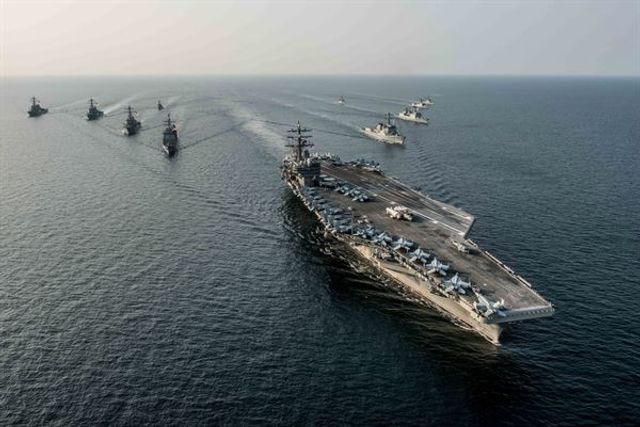
A US Carrier strike group, Photo Credit: US Navy
The latest US provocation, earlier this month, resulted in a close encounter between a Chinese warship and the USS Decatur, which deliberately challenged Chinese maritime claims by sailing within the 12-nautical mile limit of Chinese-controlled islets in the Spratly Islands. Needless to say, if Chinese warships conducted such operations off the US coastline in the vicinity of sensitive military bases, that would provoke an outcry in Washington and a clamour for retaliation.
The US is also sending an increasing number of warships through the narrow Taiwan Strait that separates China from Taiwan, which Beijing has long claimed at its territory. The Trump administration is deliberately inflaming tensions over Taiwan by strengthening military ties with Taipei.
Chinese Defence Minister Wei Fenghe declared last week that Taiwan “touches upon China’s core interests.” He bluntly warned: “On this issue, it is extremely dangerous to repeatedly challenge China’s bottom line. If someone tries to separate out Taiwan, China’s military will take the necessary actions at any cost.”
Yet that is exactly what the Trump administration is doing. Earlier this month, CNN reported that the US Navy was preparing for “a major show of force” in November as a warning to China. The draft proposal recommended a concentrated series of operations over a week involving the dispatch of US warships and warplanes near Chinese territorial waters in the South China Sea and Taiwan Strait.
Such plans are part of far broader US preparations for war with China, which along with Russia, the Pentagon branded at the beginning of the year as “a revisionist power” and strategic competitor. In a bellicose speech earlier this month, US Vice President Mike Pence signalled a dramatic escalation in the Trump administration’s confrontation with China, which has already led to a worsening trade war.
The Trump administration has also taken two major military steps this month that certainly would have sounded alarm bells in Beijing.
A day after Pence’s speech, the Pentagon released a report that can be interpreted only as the economic preparation for total war. It urged an end to US dependence on imports of strategic materials and items, particularly from rivals such as China, and the establishment of “a solid defence industrial base and resilient supply chains” in order to sustain a protracted military conflict.
The second move—Trump’s decision to pull out of the Intermediate-Range Nuclear Forces (INF) Treaty—is even more inflammatory. The treaty signed between the US and the former Soviet Union in 1987 formally prohibited the development of short- and medium-range nuclear missiles. By pulling out of the agreement, Donald Trump signalled his intention to massively expand the US nuclear arsenal directed not only against Russia, but above all, at ringing China with nuclear weapons based in Asia.
The growing danger of a nuclear conflict between the US and China was the subject of an article in the latest edition of Foreign Affairs entitled “Beijing’s nuclear option: Why a US-Chinese war could spiral out of control.” Analyst Caitlin Talmadge concluded that any US conventional conflict would necessarily threaten China’s relatively small nuclear arsenal.
If that were the case, the Chinese military would be confronted with the choice of using its nuclear weapons or losing its ability to retaliate against a US nuclear attack. Talmadge dismissed the Pentagon’s routine assurances that there was no likelihood of a nuclear war between the US and China. “If deployed against China, the Pentagon’s preferred style of conventional war [to knock out an enemy’s military assets] would be a recipe for nuclear escalation,” he warned.
There is nothing progressive about the response of Xi Jinping and the Chinese Communist Party (CCP) to the threat of US aggression. The CCP regime represents the interests of the tiny layer of super-rich oligarchs who have amassed enormous wealth though the processes of capitalist restoration that began in 1978. As such, Beijing is organically incapable of making any appeal to the working class in China and internationally to mount a unified class offensive against capitalism and its outmoded nation-state system. Instead, Xi has sought to appease US imperialism, offering concessions, while at the same time accelerating China’s own military build-up—a recipe for war.
The US drive to war against China, initiated under Obama and accelerated under Trump, is a product of the deepening crisis of global capitalism, centred in the United States. In a desperate attempt to counteract its own historic decline, US imperialism regards China as the chief current threat to its world hegemony and will stop at nothing to subordinate China to its economic and strategic interests.
The rising danger of nuclear war must be answered through the building of a unified anti-war movement of the working class in China, the United States and internationally based on a socialist perspective to put an end to the capitalist system that threatens to plunge humanity into barbarism.

29 Oct 2018

Erasmus Mundus Scholarships for Masters in Environmental Sciences, Policy and Management (MESPOM) 2019/2021

Application Deadline: 3rd January 2019 23:59 CET

Eligible Countries: International

About the Award: MESPOM is an Erasmus+: Erasmus Mundus Joint Master Degree in Environmental Sciences, Policy and Management operated by four leading European Universities with support from two Universities in the USA and Canada and 18 partners around the world. MESPOM prepares students for identifying and implementing solutions to complex environmental challenges, especially in an international context.
The MESPOM study programme is in English and lasts two years. The students study in at least three consortium universities: Central European University (CEU, Hungary), the University of the Aegean (UAegean, Greece), Lund University (ILU, Sweden), the University of Manchester (UoM, UK),  Middlebury Institute of International Studies at Monterey (MIIS, USA), and the University of Saskatchewan (UoS, Canada).
MESPOM is an Erasmus Mundus Joint Masters Degree receiving support from Erasmus+: Erasmus Mundus programme.

Type: Masters

Eligibility:
  • Applicants to MESPOM must have earned a first degree (Bachelor’s or equivalent; not less than 3 years of full-time studies) from a recognized university or institution of higher education, or provide documentation indicating that they will earn their first degree from such an institution by the time of enrolling in MESPOM.
  • Their first degree should be in environmental studies or closely related fields.
  • Candidates with first degrees in agricultural studies, social sciences, legal and administratie studies, economics, engineering or natural sciences will also be considered if they show commitment to environmental challenges, usually through voluntary or professional work and on-the-job training.
  • Applicants must demonstrate proficiency in English. Those applicants whose first language is not English must submit standardized English language test scores, e.g., the Test of English as a Foreign Language (TOEFL). Students taking TOEFL should request a copy of their results to be sent to the CEU Admissions Office. The CEU test code is 0069. Other substitute tests of English language are noted below.
Selection Criteria: Admission is based on the academic and intellectual excellence of applicants as well as their motivation and prior experience. All candidates should demonstrate proficiency in English. In order to create a multicultural learning environment, the Consortium strives to achieve a balance between various geographic and disciplinary backgrounds of MESPOM students.

Number of Awards: Not specified

Value of Award: Outstanding candidates are offered E+:Erasmus Mundus Joint Masters Degree (EMJMD) Scholarships of maximum €47,000 per two years of study to outstanding students from outside Europe (Partner Country Scholarships), and scholarships of €33,000 to European-based candidates (Programme Country Scholarships).

Duration of Programme: 2 years

How to Apply

Visit Programme Webpage for Details